NEET Exam  >  NEET Test  >  Biology Class 11  >  Test: Biology Class 11 Mini Mock - 4 - NEET MCQ

Biology Class 11 Mini Mock - 4 - Free MCQ Practice Test with solutions,


Full Mock Test & Solutions: Test: Biology Class 11 Mini Mock - 4 (45 Questions)

You can boost your NEET 2026 exam preparation with this Test: Biology Class 11 Mini Mock - 4 (available with detailed solutions).. This mock test has been designed with the analysis of important topics, recent trends of the exam, and previous year questions of the last 3-years. All the questions have been designed to mirror the official pattern of NEET 2026 exam, helping you build speed, accuracy as per the actual exam.

Mock Test Highlights:

  • - Format: Multiple Choice Questions (MCQ)
  • - Duration: 45 minutes
  • - Total Questions: 45
  • - Analysis: Detailed Solutions & Performance Insights

Sign up on EduRev for free and get access to these mock tests, get your All India Rank, and identify your weak areas to improve your marks & rank in the actual exam.

Test: Biology Class 11 Mini Mock - 4 - Question 1

Cyanobacteria are used in agricultural fields for improvement because they cause

Detailed Solution: Question 1

Cyanobacteria can fix atmospheric nitrogen in specialised cells called heterocysts, e.g., Nostoc and Anabaena. Chemosynthetic autotrophic bacteria oxidise various inorganic substances such as nitrates, nitrites and ammonia and use the released energy for their ATP production. They play a great role in recycling nutrients like nitrogen, phosphorous, iron and sulphur.

Topic in NCERT: Eubacteria

Line in NCERT: "Some of these organisms can fix atmospheric nitrogen in specialised cells called heterocysts, e.g., Nostoc and Anabaena."

Test: Biology Class 11 Mini Mock - 4 - Question 2

The part of a nephron which adds HCO-3 to the filtrate is :

Detailed Solution: Question 2

The distal convoluted tubule (DCT) plays an important role in maintaining the acid-base balance of the body. It can secrete hydrogen ions (H+) and add bicarbonate ions (HCO₃-) to the filtrate or reabsorb them into the blood as needed. Thus, it helps regulate the pH of blood and urine.

Test: Biology Class 11 Mini Mock - 4 - Question 3

In the overall process of photosynthesis, the total number of CO2, water, sugar and O2 molecules utilised and produced is​:

Detailed Solution: Question 3

Here,

  • Total molecules utilized = 6 CO2 + 12 H2O = 18
  • Total molecules produced = 1 glucose + 6 H2O + 6 O2 = 13
  • Therefore, total number of molecules involved = 18 + 13 = 31

Test: Biology Class 11 Mini Mock - 4 - Question 4

In which of the following part of mitochondria dehydrogenase enzyme is located?

Detailed Solution: Question 4

Succinate dehydrogenase, anenzyme complex involume in TCA cycle, is located in inner mitochondrial membrare.

Topic in NCERT: Mitochondrial Structure and Function

Line in NCERT: "The two membranes have their own specific enzymes associated with the mitochondrial function."

Test: Biology Class 11 Mini Mock - 4 - Question 5

Which one of the following has its own DNA?

Detailed Solution: Question 5

In mitochondria, the inner membrane space is filled with a matrix which contains dense granules  along  with  ribosomes  and mitochondrial DNA. The mitochondrial DNA is circular in nature. There number varies from 2-6. Besides DNA, a mitochondrion has RNA and its ribosomes also. Thus, a complete protein synthesizing machinery is present in mitochondria, which suggests  the semi-autonomous nature of mitochondria. Dictyosome, lysosome and peroxisome do not have their own DNA.

Topic in NCERT: Mitochondria

Line in NCERT: "the matrix also possesses single circular DNA molecule, a few RNA molecules, ribosomes (70S) and the components required for the synthesis of proteins."

Test: Biology Class 11 Mini Mock - 4 - Question 6

Identify the step in tricarboxylic acid cycle, which does not involve oxidation of substrate?

Detailed Solution: Question 6

The correct option is 2 i.e., conversion of Succinyl coA to Succinic acid.
During the conversion of succinyl-CoA to succinic acid a molecule of GTP is synthesised. This is a substrate level phosphorylation.
The other 3 steps involve oxidation-reduction reaction where NAD+ is reduced to NADH + H+ and one point where FAD+ is reduced to FADH2.

Topic in NCERT: Citric acid cycle

Line in NCERT: "during the conversion of succinyl-coa to succinic acid a molecule of gtp is synthesised. this is a substrate level phosphorylation."

Test: Biology Class 11 Mini Mock - 4 - Question 7

Feedback inhibition of enzyme is influenced by

Detailed Solution: Question 7
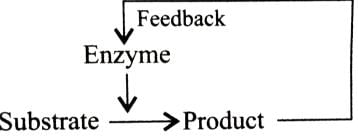
In feedback inhibition, product of a reaction inhibits the enzyme catalysing that reaction. It is a type of control mechanism at the enzyme level. If the product is produced in sufficient amount, in inhibits the enzyme to stop the further production.


Test: Biology Class 11 Mini Mock - 4 - Question 8

Undersecretion of adrenal cortex causes :-

Detailed Solution: Question 8

Addison's disease is caused due to hyposecretion of steroid hormones from adrenal glands. The steroid hormones are cortisol and aldosterone which are secreted from adrenal cortex.
Cretinism is the retarded mental and physical development due to hyposecretion of thyroid hormones.
Dwarfism is the retarded physical development due to hyposecretion of growth hormone during period of skeletal growth.
Sterility is the inability of an individual to produce offspring.
So, the correct answer is 'Addison's disease'.

Topic in NCERT: Adrenal gland

Line in NCERT: "underproduction of hormones by the adrenal cortex alters carbohydrate metabolism causing acute weakness and fatigue leading to a disease called addison's disease."

Test: Biology Class 11 Mini Mock - 4 - Question 9

Which of the following is not an accessory pigment?

Detailed Solution: Question 9

Chlorophyll a is the primary (chief) pigment in higher plants and is not an accessory pigment.

Accessory pigments in higher plants include chlorophyll b and carotenoids (for example, xanthophylls); these pigments broaden the range of light that can be absorbed and transfer energy to chlorophyll a.

  • Phycobilins occur in cyanobacteria and red algae, not in the leaves of higher plants.
  • Bacteriochlorophyll occurs in certain photosynthetic bacteria and is not found in higher plant leaves.

Therefore, Chlorophyll a is not an accessory pigment. Correct answer: D.

Test: Biology Class 11 Mini Mock - 4 - Question 10

Pituitary dwarfs will not show :

Detailed Solution: Question 10

Pituitary dwarf hormone will show normal intelligence, stunned growth and inhibited growth of long bones. Pituitary dwarfs will no show mental retardation.

Test: Biology Class 11 Mini Mock - 4 - Question 11

In cells, ATP is synthesized in:

Detailed Solution: Question 11

ATP is synthesized in mitochondria during respiration and in chloroplasts during photosynthesis. This process is called phosphorylation. It can be oxidative phosphorylation (in mitochondria) or photophosphorylation (in chloroplasts).

Topic in NCERT: PHOTOSYNTHESIS IN HIGHER PLANTS

Line in NCERT: "ATP is synthesised by cells (in mitochondria and chloroplasts) is named phosphorylation."

Test: Biology Class 11 Mini Mock - 4 - Question 12

The natural plant hormones were first isolated from

Detailed Solution: Question 12

Auxins were first isolated from human urine. The term auxin is applied to the indole-3-acetic acid (IAA), and to other natural and synthetic compounds having certain growth-regulating properties.

Cytokinins have specific effects on cytokinesis and were discovered as kinetin from the autoclaved herring sperm DNA.
Kinetin does not occur naturally in plants. Search for natural substances with cytokinin-like activities led to the isolation of zeatin from corn kernels (corn germ oil) and coconut milk.

Hence option C is correct.

Topic in NCERT: Auxins

Line in NCERT: "auxins (from greek ‘auxein': to grow) was first isolated from human urine."

Test: Biology Class 11 Mini Mock - 4 - Question 13

For wheat, which of the following combinations is correct?

Detailed Solution: Question 13

  • Genus Triticum
  • Family Poaceae
  • Order Poales 
  • Class Monocotyledonae.

Hence the correct option is A.

Test: Biology Class 11 Mini Mock - 4 - Question 14

Consider the following statements about the epidermal tissue system as described in the given text:

1. The epidermal tissue system forms the outermost covering of the entire plant body.

2. The epidermis is usually single-layered and made up of elongated, compactly arranged cells.

3. The cuticle is present on the epidermis of roots to prevent water loss.

4. Trichomes on the stem are always unicellular and help in water absorption.

Which of the above statements are correct?

Detailed Solution: Question 14

The epidermal tissue system forms the outermost covering of the plant body (statement 1). The epidermis is usually single-layered with elongated, compactly arranged cells (statement 2). The cuticle is absent in roots, not present to prevent water loss (statement 3 is incorrect). Trichomes on the stem are multicellular and help prevent water loss due to transpiration, not water absorption (statement 4 is incorrect).

Test: Biology Class 11 Mini Mock - 4 - Question 15

Maximum growth in root occurs -

Detailed Solution: Question 15

Maximum growth of root takes place in the back side portion of the root apex. Apex portion is made up of root cap and then follows the region of cell division where meristematic tissues are present.

Test: Biology Class 11 Mini Mock - 4 - Question 16

Choose the correct classification of the following metabolites as either primary or secondary.
Metabolites: (i) Amino acids (ii) Sugars (iii) Flavonoids (iv) Alkaloids

Detailed Solution: Question 16

Primary metabolites are essential for basic cellular functions such as growth, development, and reproduction. Amino acids and sugars fall into this category because they are fundamental components of proteins and energy production, respectively. Secondary metabolites, such as flavonoids and alkaloids, do not have a direct role in these primary physiological processes but are often involved in plant defense mechanisms and other ecological interactions. Therefore, the correct classification is (i) Primary, (ii) Primary, (iii) Secondary, (iv) Secondary, making Option A the correct choice.

Test: Biology Class 11 Mini Mock - 4 - Question 17

During seed germination its stored food is mobilized [NEET 2013]

Detailed Solution: Question 17

Gibberellins stimulate the synthesis of α-amylase and proteases enzyme in germinating grains of cereals. They are involved in the conversion of starch into sugar. The proteases convert an inactive β-amylase to the active form. The active β-amylase and α-amylase together digest starch to glucose which is mobilized to meet the metabolic demands of embryo. 

Topic in NCERT: Gibberellins

Line in NCERT: "gibberellins also promotes bolting (internode elongation just prior to flowering) in beet, cabbages and many plants with rosette habit."

Test: Biology Class 11 Mini Mock - 4 - Question 18

A simple mechanical tissue devoid of lignin is -

Detailed Solution: Question 18

The is "mechanical tissue". Both sclerenchyma and collenchyma are mechanical tissues, but sclerenchyma contains lignin. Hence the simple mechanical tissue without lignin is chollenchyma. 

Test: Biology Class 11 Mini Mock - 4 - Question 19

The functional connection between two neurons is called :-

Detailed Solution: Question 19

Synapse, also called neuronal junction, the site of transmission of electric nerve impulses between two nerve cells (neurons) or between a neuron and a gland or muscle cell (effector). A synaptic connection between a neuron and a muscle cell is called a neuromuscular junction

Topic in NCERT: Transmission of Impulses

Line in NCERT: "A nerve impulse is transmitted from one neuron to another through junctions called synapses."

Test: Biology Class 11 Mini Mock - 4 - Question 20

Identify distinctive features for kingdom Monera.

(a) It includes prokaryotic cells with nucleus and membrane bound cell organelles.
(b) Some of the Monerans are autotrophic and some of them are heterotrophic forms.
(c) Monera have been divided into two domains, archaeabacteria and eubacteria.
(d) Bacteria and diatoms  are the sole members of the Kingdom Monera.

Detailed Solution: Question 20

Let's examine the features:

(a) Incorrect. Kingdom Monera includes prokaryotic cells, which do not have a nucleus or membrane-bound organelles.

(b) Correct. Monerans (bacteria) can be autotrophic (e.g., cyanobacteria) or heterotrophic (e.g., most bacteria).

(c) Correct. Monera has been divided into two domains: Archaeabacteria and Eubacteria.

(d) Incorrect. only Bacteria are the sole members of the Kingdom Monera

Test: Biology Class 11 Mini Mock - 4 - Question 21

The pharynx opens into the larynx by a slit-like aperture called ______.

Detailed Solution: Question 21
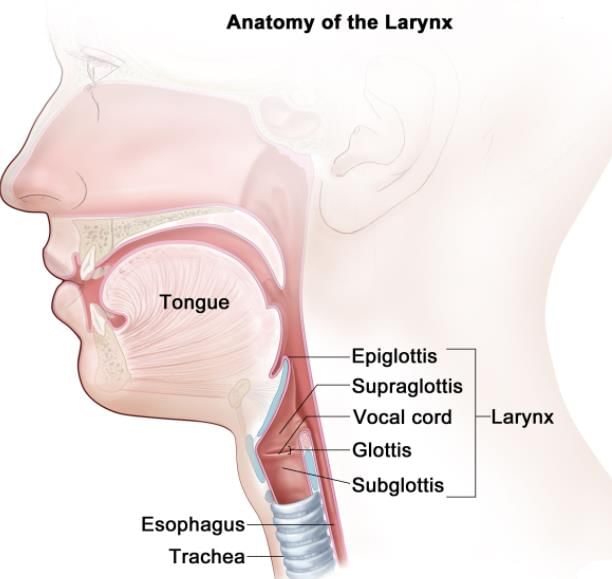
  • The pharynx opens into the larynx by a slit-like aperture called the glottis, which is covered by a cartilaginous flap called the epiglottis.
  • The epiglottis closes the glottis to prevent the entry of food particles during swallowing.

Hence, the correct option is C.

NCERT Reference: Topic- Human Respiratory System” of chapter "Breathing and Exchange of Gases" of NCERT

Test: Biology Class 11 Mini Mock - 4 - Question 22

The separation of two chromatids of each chromosome at early anaphase is initiated by

Detailed Solution: Question 22

Kinetochore is a plate-like structure by which microtubules of the spindle attach to the centromere of a chromosome during nuclear division. The centromere of each chromosome divides into two, so that each chormatied comes to have its own centromere. The two chromatids now start repelling each otherand separate completely to become daughter chromosmes. the daughter or new chromosmes. The daughter or new chromosomes move towards the poles of spindle along the path of their chromosome fibres.

Topic in NCERT: Anaphase

Line in NCERT: "Centromeres split and chromatids separate."
Test: Biology Class 11 Mini Mock - 4 - Question 23

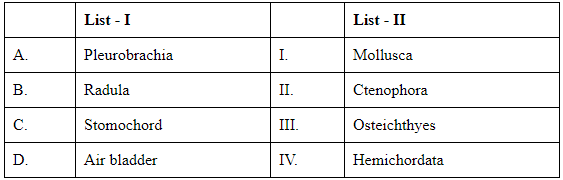
Match List I with List II:     (NEET 2024)

Choose the correct answer from the options given below :

Detailed Solution: Question 23

To solve this matching question, we must evaluate each term in List I and determine its corresponding class or phylum in List II. Let's analyze each match:

Pleurobrachia: Pleurobrachia is a genus that belongs to the phylum Ctenophora, which is commonly known as comb jellies. Thus, A should be matched with II (Ctenophora).
Radula: A radula is a toothed, chitinous organ found within mollusks that is used for scraping or cutting food before the food enters the esophagus. Hence, B should be matched with I (Mollusca).
Stomochord: The stomochord is a small, tubular structure found in the collar of hemichordates, a fundamental character previously thought to link hemichordates and chordates. Therefore, C should be matched with IV (Hemichordata).
Air bladder: The air bladder, or swim bladder, is a gas-filled sac present in many bony fish that helps to maintain buoyancy. Hence, D should be matched with III (Osteichthyes, a class of bony fish).

Now, let's review the options given:

  • Option A: A-IV, B-II, C-III, D-I
  • Option B: A-II, B-I, C-IV, D-III
  • Option C: A-II, B-IV, C-I, D-III
  • Option D: A-IV, B-III, C-II, D-I

The correct matches, based on the classification should be: A-II, B-I, C-IV, D-III. Therefore, the correct answer is: Option B

Test: Biology Class 11 Mini Mock - 4 - Question 24

The common characteristics between tomato and potato will be maximum at the level of their: [NEET 2013]

Detailed Solution: Question 24

  • Tomato: Solanum lycopersicum

  • Potato: Solanum tuberosum
    Both belong to the family Solanaceae.

Although they share the same genus (Solanum), NEET considers the family level as the correct answer because the question compares two different species, and maximum common characteristics among different species are generally found up to the family level in the classification hierarchy.

Why other options are wrong:

  • (a) Genus: Too specific. Similarities at the genus level apply mainly to organisms that are very closely related species. NEET interprets “maximum similarities between tomato and potato” in a broader sense, as both are economically important but distinct plants; hence the family level is considered.

  • (c) Order: Higher level than family, so fewer common characteristics.

  • (d) Division: Much broader category (includes many unrelated plants); very few common features at this level.

Final Answer: Family (Solanaceae) – because this level includes both tomato and potato and shows the greatest number of shared characteristics among them compared to order or division.

Test: Biology Class 11 Mini Mock - 4 - Question 25

Which of these disorders is caused due to low concentrations of calcium ions?

Detailed Solution: Question 25

Muscular dystrophy, gout, tetany and osteoporosis are disorders of the muscular system and the skeletal system. Out of these, tetany is caused due to low concentrations of calcium ions.

Test: Biology Class 11 Mini Mock - 4 - Question 26

One of the following is genetic :-

Detailed Solution: Question 26

Hereditary factors may cause goiters. Risk factors for the development of a goiter include female sex, age over 40 years, inadequate dietary intake of iodine, residence in an endemic area, and a family history of goiter. Symptoms: Thyroid enlargement varying from a single small nodule to massive enlargement (neck lump). But there is no proof of goitres being hereditary. Hence, Option D.

Test: Biology Class 11 Mini Mock - 4 - Question 27

The scientific name of lion is _________

Detailed Solution: Question 27

Biological names are Latinized and written in Italics. The generic epithet starts with capital letter while the second component specific epithet starts with small letter. Here the binomial nomenclature of Lion is Panthera leo but not Panthera Leo. Also, in Panthera Tigress the second component is written in capital letter which means that Panthera Tigress is not the answer. And in Panthera Lion the word Lion is not derived from Latin which reflects that Panthera Lion is also not the answer.

Topic in NCERT: Genus

Line in NCERT: "Lion (Panthera leo), leopard (P. pardus) and tiger (P. tigris) with several common features, are all species of the genus Panthera."

Test: Biology Class 11 Mini Mock - 4 - Question 28

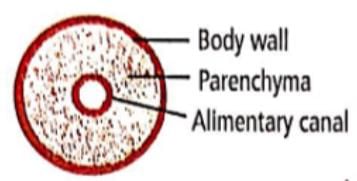
The given figure shows a cross section of the body of an invertebrate. Identify the animal which has such body plan.

Detailed Solution: Question 28

The animals in which the coelom is absent are called acoelomates, for example, flatworms (Planaria). In them, the space between ectoderm and endodorm is filled with parenchyma derived from mesoderm.

Topic in NCERT: flatworms

Line in NCERT: "Flatworms are bilaterally symmetrical, triploblastic and acoelomate animals with an organ level of organisation."

Test: Biology Class 11 Mini Mock - 4 - Question 29

Choose the schematic diagram which properly respresents pulmonary circulation in humans.

Detailed Solution: Question 29

Pulmonary circulation is the movement of blood between heart and lungs. During this pathway deoxygenated blood entering the right atrium, moves into the right ventricle From here it moves through the pulmonary arch into the lungs for oxygenation. Then from lungs oxygenated blood moves into the left atrium through pulmonary veins.

Test: Biology Class 11 Mini Mock - 4 - Question 30

Which plant hormone is named anti-ageing hormone?

Detailed Solution: Question 30

Cytokinin is known as the 'anti-ageing' hormone because it:

  • Delays leaf senescence
  • Promotes cell division
  • Maintains plant growth and vitality

View more questions
142 videos|410 docs|135 tests
Information about Test: Biology Class 11 Mini Mock - 4 Page
In this test you can find the Exam questions for Test: Biology Class 11 Mini Mock - 4 solved & explained in the simplest way possible. Besides giving Questions and answers for Test: Biology Class 11 Mini Mock - 4, EduRev gives you an ample number of Online tests for practice
142 videos|410 docs|135 tests
Download as PDF