GMAT Exam  >  GMAT Test  >  Quantitative Reasoning  >  Test: Factors And Multiples- 2 - GMAT MCQ

Test: Factors And Multiples- 2 - GMAT MCQ


Test Description

15 Questions MCQ Test Quantitative Reasoning for GMAT - Test: Factors And Multiples- 2

Test: Factors And Multiples- 2 for GMAT 2026 is part of Quantitative Reasoning for GMAT preparation. The Test: Factors And Multiples- 2 questions and answers have been prepared according to the GMAT exam syllabus.The Test: Factors And Multiples- 2 MCQs are made for GMAT 2026 Exam. Find important definitions, questions, notes, meanings, examples, exercises, MCQs and online tests for Test: Factors And Multiples- 2 below.
Solutions of Test: Factors And Multiples- 2 questions in English are available as part of our Quantitative Reasoning for GMAT for GMAT & Test: Factors And Multiples- 2 solutions in Hindi for Quantitative Reasoning for GMAT course. Download more important topics, notes, lectures and mock test series for GMAT Exam by signing up for free. Attempt Test: Factors And Multiples- 2 | 15 questions in 30 minutes | Mock test for GMAT preparation | Free important questions MCQ to study Quantitative Reasoning for GMAT for GMAT Exam | Download free PDF with solutions
Test: Factors And Multiples- 2 - Question 1

Which of the following CANNOT be the greatest common divisor of two positive integers a and b

Detailed Solution for Test: Factors And Multiples- 2 - Question 1

The greatest common divisor (GCD) of two positive integers a and b is the largest positive integer that divides both a and b without leaving a remainder.

Out of the given options, the only number that cannot be the GCD of two positive integers a and b is option 4, a - 2b.

To see why, consider the following example: let a = 10 and b = 4. The factors of 10 are 1, 2, 5, and 10, and the factors of 4 are 1, 2, and 4. The common factors of 10 and 4 are 1 and 2, and the greatest common factor is 2.

Now, if we substitute a = 10 and b = 4 into the expression a - 2b, we get:

a - 2b = 10 - 2(4) = 2

Since 2 is the GCD of 10 and 4, it is possible for a - 2b to be the GCD of two positive integers. However, there are other cases where a - 2b is not the GCD of two positive integers, so it cannot be concluded that a - 2b is always a valid option for the GCD of two positive integers.

Therefore, the correct answer is option 4, a - 2b.

Test: Factors And Multiples- 2 - Question 2

Which of the following CANNOT be the greatest common divisor of two different prime numbers a and b

Detailed Solution for Test: Factors And Multiples- 2 - Question 2

To determine which of the options cannot be the greatest common divisor (GCD) of two different prime numbers a and b, we need to understand the properties of prime numbers.

Prime numbers have only two distinct positive divisors: 1 and themselves. Thus, the GCD of any two different prime numbers is always 1, since they do not share any factors other than 1.

a - b: This represents the difference between the two primes and can be greater than 1, but it cannot be a divisor common to both.
b - a: Similar to the previous point, this is just the negative of the first option and does not affect the GCD.
2a - b: This also does not have to equal 1 and can be any number depending on the values of a and b.
a b: This represents the product of a and b, which is much larger than 1, and cannot be a GCD as it is not a common divisor.

Since the GCD of two different prime numbers is always 1, the only option that cannot be the GCD is a b, as it is greater than 1.

Test: Factors And Multiples- 2 - Question 3

Which of the following can be the greatest common divisor of two prime numbers a and b

Detailed Solution for Test: Factors And Multiples- 2 - Question 3

t means any two prime numbers will have only one common factor and that would be '1', as per the definitions of prime number and highest common factor. Hence, any two different prime numbers will have the highest common factor as '1'. It means the H.C.F. of given two prime numbers a and b is 1.

Test: Factors And Multiples- 2 - Question 4

Which of the following CANNOT be the least common multiple of two integers a and b, where a and b are both greater than 1

Test: Factors And Multiples- 2 - Question 5

Which of the following can be the least common multiple of two distinct integers a and b? 

Detailed Solution for Test: Factors And Multiples- 2 - Question 5

The least common multiple (LCM) of two distinct positive integers a and b cannot be a + b.
Instead, it is the smallest number that is a multiple of both a and b, which is either a or b if one divides the other.

Hence , Option D is correct.

Test: Factors And Multiples- 2 - Question 6

What is the value of integer x?

1)  The lowest common multiple of x and 16 is 48. ?

2)  The greatest common factor of x and 16 is 4. 

Detailed Solution for Test: Factors And Multiples- 2 - Question 6

To find a unique integer x, we need both pieces of information together:

Statement 1 alone (lcm(x,16)=48) ⇒ x could be 3, 6, 12, 24, or 48 (all give LCM = 48).
Statement 2 alone (gcd(x,16)=4) ⇒ x could be 4, 12, 20, 28, … infinitely many.

Only by using both do we pin down x:

From lcm=48 we get x=3·2ᵏ with k≤4 ⇒ {3,6,12,24,48}.

From gcd=4 we need x divisible by 4 but not by 8 ⇒ leaves x=12.

Hence both statements are required.

Answer: (b) Both statements are required to answer the question.

Test: Factors And Multiples- 2 - Question 7

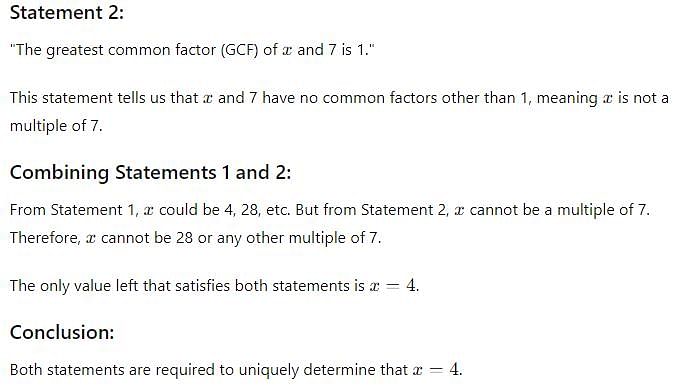
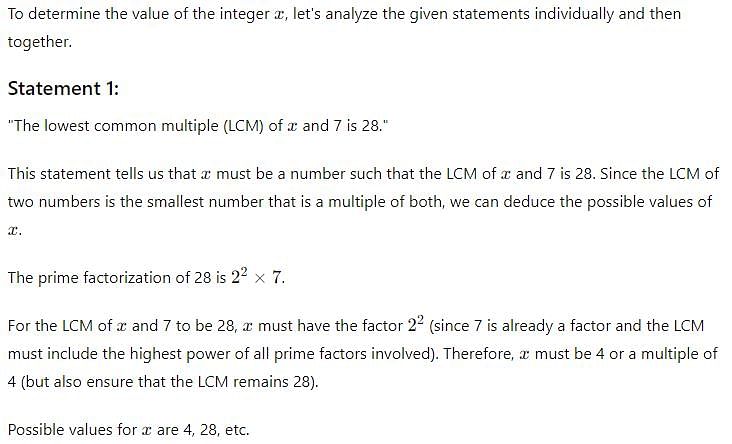
What is the value of integer x?

1)  The lowest common multiple of x and 7 is 28. ?

2)  The greatest common factor of x and 7 is 1. 
Detailed Solution for Test: Factors And Multiples- 2 - Question 7


Test: Factors And Multiples- 2 - Question 8

If 375y = x2 and x and y are positive integers, then which of the following must be an integer? 

I. y/15
II. y/30
III. y2/25 

Detailed Solution for Test: Factors And Multiples- 2 - Question 8

375 = (3)(5)(5)(5) = (3)(5)(5²)
In order for 375y to be a perfect square, the prime factorization of y must contain at least one 3 and one 5.
In other words, y must be a multiple of 15.

If y is a multiple of 15, then y/15 must be an integer and y²/25 must be an integer.

Test: Factors And Multiples- 2 - Question 9

If x, y, and z are distinct prime numbers, how many positive factors does (xy)z have?

1)  z = 5 ?

2)  x + y = 10 

Test: Factors And Multiples- 2 - Question 10

If x, y, and z are distinct integers, how many positive factors does (xy)z have? (D)

1)  z = 5 ?

2)  x + y = 10 

Test: Factors And Multiples- 2 - Question 11

If a, b, and c are positive integers and (a/6) + (b/5) = (c/30), is c divisible by 5?

1) b is divisible by 5

2) a is even

Test: Factors And Multiples- 2 - Question 12

If x and y are nonzero integers, is x/y an integer?

1)  x is the product of 2 and another integer. ?

2)  There is only one pair of positive integers whose product equals y. ?

Test: Factors And Multiples- 2 - Question 13

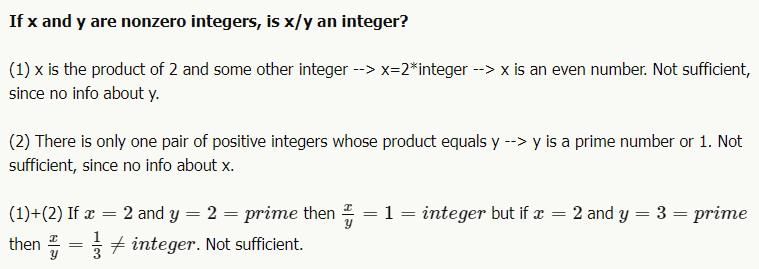
If x and y are nonzero integers, is x/y an integer?

(1) x is the product of 2 and some other integer.
(2) There is only one pair of positive integers whose product equals y.
Detailed Solution for Test: Factors And Multiples- 2 - Question 13

Test: Factors And Multiples- 2 - Question 14

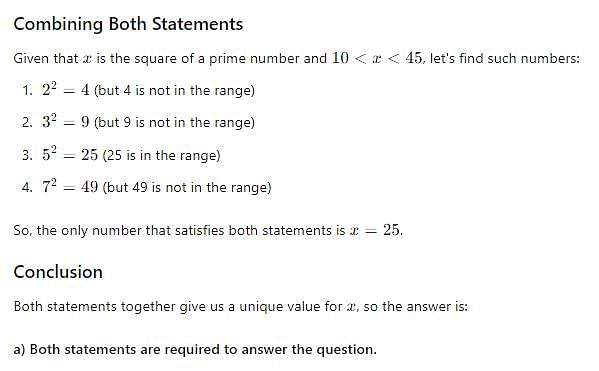
What is the value of x?

1)  x has exactly 3 factors. 

2)  10 < x < 45 
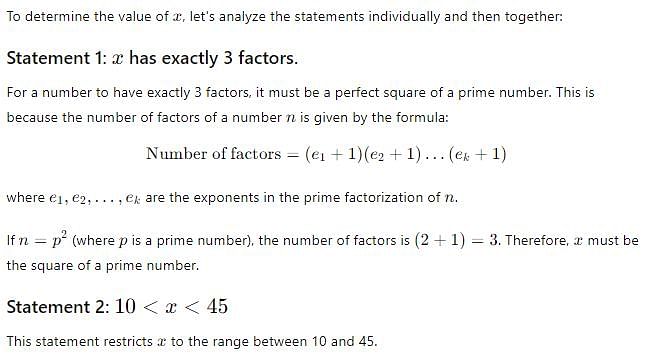
Detailed Solution for Test: Factors And Multiples- 2 - Question 14


Test: Factors And Multiples- 2 - Question 15

Can a batch of identical cookies be split evenly between Laurel and Jean without leftovers and without breaking a cookie?
1) If the batch of cookies were split among Laurel, Jean and Marc, there would be one cookie left over.
2) If Peter eats three of the cookies before they are split, there will be no leftovers when the cookies are split evenly between Laurel and Jean.

123 videos|186 docs|107 tests
Information about Test: Factors And Multiples- 2 Page
In this test you can find the Exam questions for Test: Factors And Multiples- 2 solved & explained in the simplest way possible. Besides giving Questions and answers for Test: Factors And Multiples- 2, EduRev gives you an ample number of Online tests for practice
123 videos|186 docs|107 tests
Download as PDF