KVS PGT/TGT/PRT Exam  >  KVS PGT/TGT/PRT Test  >  KVS Librarian Exam Mock Test Series 2026  >  KVS Librarian Tier 2 Mock Test- 1 - KVS PGT/TGT/PRT MCQ

KVS Librarian Exam Tier 2 Mock Test- 1 Free Online Test 2026


Full Mock Test & Solutions: KVS Librarian Tier 2 Mock Test- 1 (60 Questions)

You can boost your KVS PGT/TGT/PRT 2026 exam preparation with this KVS Librarian Tier 2 Mock Test- 1 (available with detailed solutions).. This mock test has been designed with the analysis of important topics, recent trends of the exam, and previous year questions of the last 3-years. All the questions have been designed to mirror the official pattern of KVS PGT/TGT/PRT 2026 exam, helping you build speed, accuracy as per the actual exam.

Mock Test Highlights:

  • - Format: Multiple Choice Questions (MCQ)
  • - Duration: 150 minutes
  • - Total Questions: 60
  • - Analysis: Detailed Solutions & Performance Insights

Sign up on EduRev for free and get access to these mock tests, get your All India Rank, and identify your weak areas to improve your marks & rank in the actual exam.

KVS Librarian Tier 2 Mock Test- 1 - Question 1

Which of the following are the tertiary sources?
I. Journals
II. Books
III. Bibliography of Bibliographies
IV. Union Catalogue
Choose the correct answer from the options given below.

Detailed Solution: Question 1

The Correct answer is III and IV
Explanation

  • Tertiary Source:
    • A source that is primarily dependent on secondary sources or primary and secondary sources for its existence is tertiary.
    • These sources act as key to primary sources as well as secondary sources.
    • Examples are Library Catalogue, Bibliography of bibliographies, Guides to literature, Directory of directories, Union Catalogue etc.

Other Related Points

  • Primary Source:
    • The primary source of information carries newly generated information, original work of research, or a new interpretation of already known facts.
    • The information contained in the primary source is generally scattered and unorganized.
    • Examples are - Primary Periodicals, Monographs, Patents, Trade Literature, Memoranda, etc.
  • Secondary Source:
    • A source that is more or less completely dependent on primary sources for its existence is a secondary source.
    • Information in the secondary source is organized and arranged according to a definite plan.
    • Examples are Secondary Periodicals, Treatises,

KVS Librarian Tier 2 Mock Test- 1 - Question 2

What additional information does a DOI often include?

Detailed Solution: Question 2

The Correct answer is Metadata such as title, author, and publication date.
Explanation
Refer to these Lines:

  • "Additionally, DOIs often include metadata such as the title, author, publication date, and publisher, further enhancing the discoverability and authenticity of digital content."

A DOI often includes metadata such as the title, author, and publication date of the digital resource. This additional information enhances the discoverability and credibility of the content by providing key details about the resource in a structured format.

KVS Librarian Tier 2 Mock Test- 1 - Question 3

What is the name of the conceptual framework in which the research is carried out?

Detailed Solution: Question 3

The correct answer is Research design.
Explanation

  • Research design is the framework or blueprint for conducting the research project.
  • It details the procedures necessary for obtaining the information needed to structure or solve research problems.
  • It ensures that the study will be relevant to the problem and will use economical procedures.
  • A good research design should provide a clear and precise plan for the research process and ensure the research questions are effectively addressed.
  • There are various types of research designs such as exploratory, descriptive, and causal research designs.
  • The choice of research design greatly influences the validity and reliability of the research findings.

Other Related Points

  • Research hypothesis
    • A research hypothesis is a specific, clear, and testable proposition or predictive statement about the possible outcome of a scientific research study.
    • It is an essential part of the scientific method and is used to test the relationships between variables.
  • Synopsis of Research
    • A synopsis of research is a brief summary of the research project, including its objectives, methodology, and potential implications.
    • It is often used to provide a quick overview of the research proposal to stakeholders or funding bodies.
  • Research paradigm
    • A research paradigm is a set of beliefs, values, and assumptions that a community of researchers has in common regarding the nature and conduct of research.
    • Examples include positivism, interpretivism, and critical theory

KVS Librarian Tier 2 Mock Test- 1 - Question 4

Deductive reasoning involves
(a) Observation
(b) Confirmation
(c) Theory
(d) Hypothesis
Select the correct answer from the following options given below-

Detailed Solution: Question 4

The correct answer is c → a → d → b.
Explanation

  • Deductive reasoning starts with a theory (general principle).
  • It then moves to an observation to see if the theory applies to specific instances.
  • Next, it forms a hypothesis based on the observations.
  • Finally, it seeks confirmation to validate or refute the hypothesis.

Other Related Points

  • Observation
    • An observation involves gathering data or noticing specific instances or phenomena.
    • It is crucial for forming hypotheses and theories.
  • Confirmation
    • Confirmation is the process of verifying or validating a hypothesis or theory.
    • It often involves experiments, tests, or further observation.
  • Theory
    • A theory is a well-substantiated explanation of some aspect of the natural world.
    • It is based on a body of evidence and can predict future occurrences or observations.
  • Hypothesis
    • A hypothesis is a tentative explanation or prediction that can be tested through study and experimentation.
    • It is often derived from observations and existing theories.

KVS Librarian Tier 2 Mock Test- 1 - Question 5

The three leadership styles identified by Koontz and others are
i. Autocratic
ii. Democratic
iii. Trait approach
iv. Free-reign

Detailed Solution: Question 5

The Correct answer is i, ii, and iv are correct.
Explanation

  • The three leadership styles identified by Koontz and others are Autocratic, Democratic, and Free-reign.
  • Autocratic Leadership:
    • Autocratic Leadership, also known as authoritarian leadership, involves a single individual having complete authority and control over decision-making.
    • This leadership style is typically applied in smaller organizations with a limited number of employees.
    • Authoritarian leaders make decisions independently, often without seeking input from the group.
  • Participative Leadership:
    • Participative Leadership, also known as democratic, consultative, or ideographic leadership, involves decentralizing the decision-making process.
    • Decisions are made through consultation and participation with followers, valuing their ideas and giving them importance.
    • There are three categories of participative leaders:
      • Consultative Participative: Supervisors seek opinions from the group before making a decision, with the understanding that they may or may not incorporate those opinions.
      • Consensual Participative: Group discussions are held on problems, and decisions are made after achieving consensus among group members.
      • Democratic Participative: Full authority is given to subordinates.
  • Free-Rein Leadership:
    • ​Free-rein leadership, also known as laissez-faire leadership, gives subordinates the freedom to make decisions. It encourages open discussion and creativity.
    • Advantages of Free-Rein Leadership:
      • Requires minimal guidance and direction from supervisors.
      • Provides full freedom to subordinates for decision-making.
      • Encourages more creative decisions.
      • Promotes self-control within the group.
      • Allows for problem-solving by subordinates.

Other Related Points

  • Trait Theory:
    • Trait Theory focuses on identifying specific characteristics or traits essential for someone to become a leader.
    • Often referred to as the "great man" theory, it assumes that leaders are inherently born with certain necessary traits for effective leadership.
    • Notable trait theorists include Ordway Tead and Chester I. Barnard.
    • Tead outlined ten qualities that leaders should possess, including physical and nervous energy, a sense of purpose, enthusiasm, friendliness, integrity, technical mastery, decisiveness, intelligence, teaching skill, and faith.

KVS Librarian Tier 2 Mock Test- 1 - Question 6

Which of the following are the key stages involved in the data mining process:
(A). Data gathering
(B). Data Warehousing
(C). Data preparation
(D). Mining the data

Detailed Solution: Question 6
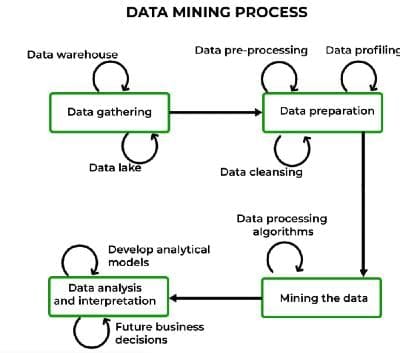
The Correct answer is A, C, and D.
Explanation

  • Data Mining is the practice of extracting meaningful patterns from large datasets to inform business decisions.
  • Data mining is performed by data scientists and analysts using tools from machine learning, AI, and statistics to sort, clean, and model data drawn from sources like data lakes, warehouses, or IoT feeds.

Core Process:

  • Data Gathering: Identify and collect relevant raw data from structured databases or unstructured sources.
  • Data Preparation: Clean, profile, and preprocess to correct errors and ensure consistency.
  • Mining & Modeling: Choose algorithms (e.g., clustering, classification) and train models on sample data before applying them at scale.
  • Analysis & Communication: Interpret model outputs, build predictive or descriptive analytics, and present findings—often via visualizations—to guide strategic decisions.

KVS Librarian Tier 2 Mock Test- 1 - Question 7

PubMed database is maintained by

Detailed Solution: Question 7

The Correct answer is National Centre for Biotechnology Information.
Explanation
PubMED:

  • PubMed is a freely accessible search engine primarily indexing the MEDLINE database, which contains references and abstracts on topics related to life sciences and biomedicine.
  • Available to the public online since 1996, PubMed was developed and is maintained by the National Center for Biotechnology Information (NCBI), at the U.S. National Library of Medicine (NLM), located at the National Institutes of Health (NIH).
  • Before PubMed's launch in January 1996, access to the MEDLINE database was primarily through institutional facilities like medical libraries. PubMed revolutionized this access, offering private, free, and home-computerized searching of MEDLINE.
  • It became publicly available in June 1997, marking the beginning of web-based MEDLINE searches.

Other Related Points
PubMED Central:

  • PubMed Central (PMC) is a free digital archive of biomedical and life sciences journal literature, maintained by the U.S. National Library of Medicine (NLM) at the National Institutes of Health (NIH/NLM).
  • Developed by NLM's National Center for Biotechnology Information (NCBI), PMC was launched in February 2000 to fulfill NLM's legislative mandate of collecting and preserving biomedical literature.
  • Serving as a digital counterpart to NLM's print journal collection, PMC ensures permanent access to its content, regardless of technological advancements.
  • NLM emphasizes the importance of consistent and active utilization of the archive to ensure the accessibility and longevity of digital material. As such, free access to all journal literature is a fundamental principle of PMC.

KVS Librarian Tier 2 Mock Test- 1 - Question 8

E - Granthalaya software is developed under which of the following Ministry?

Detailed Solution: Question 8

The Correct answer is the Ministry of Electronics and Information Technology.
Explanation

  • e-Granthalaya:
    • e-Granthalaya is a digital platform created by the National Informatics Centre (NIC), Ministry of Electronics and Information Technology, Government of India, specifically designed for government libraries.
    • This comprehensive platform offers an Information and Communication Technology (ICT) solution featuring integrated Library Management Software, a Digital Library Module, a Cloud hosting environment, and a Library Portal (OPAC) with support from NICSI-empaneled Roll-out Services.
    • The latest version, e-Granthalaya 4.0, released in 2015 is designed as a 'Cloud Ready Application,' offering a web-based solution in enterprise mode with a centralized database for a cluster of libraries.
    • This ICT solution adheres to international standards prevalent in libraries, incorporating the latest ICT technology and cloud hosting.
    • e-Granthalaya 4.0 utilizes PostgreSQL, an open-source Database Management System (DBMS), as the backend database solution.
    • It is hosted on the NIC National Cloud (Meghraj) for Government Libraries upon request, providing online access to applications and databases.
    • The history of e-Granthalaya traces back to its initiation as an in-house project at the 'Karnataka State Centre of NIC, Bangalore.'
    • The initial version of the software was designed for public libraries in the state. Subsequently, NIC HQ's 'Library and Information Services Division' took charge of the software's design, involving library professionals in the process.

Other Related Points

  • e-Granthalaya versions:
    • Version 1.0 (2003): Public Library Edition
    • Version 2.0 (2005): Government Libraries Edition
    • Version 3.0 (2007): Network Edition
    • Version 4.0 (2015): Enterprise Edition
  • e-Granthalaya 4.0 contains the following components:
    • Database (Separate database for each library cluster)
    • e-Granthalaya 4.0 Application
    • Crystal Reports Executables
    • Z39.50 Libraries

KVS Librarian Tier 2 Mock Test- 1 - Question 9

Yuge Yugeen Bharat National Museum is part of which initiative?

Detailed Solution: Question 9

The Correct answer is Central Vista Redevelopment Project.
Explanation

  • The upcoming Yuge Yugeen Bharat National Museum, to be housed in New Delhi's North and South Blocks, is a key component of the Central Vista Redevelopment Project.
  • Designed to showcase India’s rich civilizational and cultural heritage, the museum aims to bridge the past with the present and inspire future generations.
  • On 19th December 2024, an agreement was signed between the National Museum and France Museums Development for technical collaboration.
  • Project details, including budget and timeline, will be finalized after a feasibility study.
  • The initiative was announced by Union Culture & Tourism Minister Gajendra Singh Shekhawat in the Lok Sabha.

KVS Librarian Tier 2 Mock Test- 1 - Question 10

Which of the following is associated with NICMAS
(A). INDOCEAN
(B). NIOPUB
(C). ASFA
(D). INDMS

Detailed Solution: Question 10

The correct answer is All of these.
Explanation

  • The National Information Centre for Marine Sciences (NICMAS) is one of the sectoral information centers under the National Information System for Science & Technology (NISSAT), an initiative by the Department of Science & Technology, Government of India.
  • NICMAS and other recognized centers in India aim to provide specialized information to professionals and industries.
  • Recognition is based on the availability of essential resources and their services to the community.
  • NICMAS focuses on sourcing and delivering information to users.

Databases Compiled by NICMAS:

  • INDOCEAN:
    • This database compiles oceanographic research conducted in the Indian Ocean since the 18th century.
    • It includes a vast collection of research papers and aquaculture literature.
    • The database is continually updated and adheres to international standards and tools from the Aquatic Sciences & Fisheries Information System (ASFIS).
    • Only reliable information, verified through original documents, is included.
  • NIOPUB:
    • Managed by the National Institute of Oceanography (NIO), this database lists the publications of NIO scientists.
    • It includes journal articles, conference proceedings, and reports, updated daily.
  • OCEANLINE:
    • This catalog allows users to search for books, reports, conference proceedings, and serials available in the NIO library.
    • It provides real-time information on the availability of these documents.
  • INDMS:
    • This is an updated version of the Indian National Directory of Marine Scientists, initially published in 1992.
    • The updated directory will be available in digital format and accessible on the Indian National Oceanographic Internet Server (INOIS).
    • It will also be shared with the International Directory of Marine Scientists on the Intergovernmental Oceanographic Commission's server at UNESCO, Paris.

The National Information Centre for Marine Sciences (NICMAS) has International databases.

  • Aquatic Sciences & Fisheries Abstract (ASFA)
  • Current Content on Diskettes (CCOD)
  • PATSCAN

KVS Librarian Tier 2 Mock Test- 1 - Question 11

Newbie is a person -

Detailed Solution: Question 11

The Correct answer is A person who recently joined the mailing list.
Explanation

  • A newbie, also known as a noob or newb, refers to a person who is new to a particular activity, community, or field.
  • In the context of online communities, a newbie is typically someone who has recently joined a mailing list, forum, or other online group.
  • Newbies often need time to adjust and become familiar with the norms and etiquette of the group.
  • Experienced members of the community usually offer guidance and support to help newbies integrate smoothly.
  • The term is generally used in a non-derogatory manner, though it can sometimes carry a connotation of inexperience.

Other Related Points

  • A person who is expert in developing computer virus
    • Such individuals are often referred to as hackers or cybercriminals.
    • They possess specialized knowledge in malware creation and cybersecurity.
    • Activities related to developing computer viruses are illegal and subject to severe penalties.
  • Who is expert in programming
    • These individuals are typically known as software developers or programmers.
    • They have proficiency in various programming languages such as Python, Java, C++, etc.
    • They are involved in software development, application creation, and system maintenance.
  • Who has hardware expertise
    • Experts in this field are often referred to as hardware engineers or technicians.
    • They specialize in the design, development, and maintenance of computer hardware components.
    • Their work includes dealing with circuit boards, processors, memory devices, and other physical components

KVS Librarian Tier 2 Mock Test- 1 - Question 12

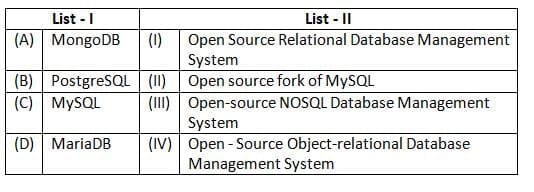
Match the following:

Detailed Solution: Question 12

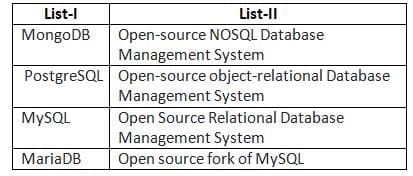
The Correct answer is A - (III), B - (IV), C - (I), D - (II).
Explanation
To match the database systems with their descriptions correctly:

  • MongoDB:
    • MongoDB, a cross-platform document-oriented database program, is categorized as a NoSQL database system.
    • Utilizing JSON-like documents with optional schemas, it is developed by MongoDB Inc. and the current versions are licensed under the Server Side Public License (SSPL). MongoDB is a part of the MACH Alliance.
    • The company adopted an open-source development model in 2009, with commercial support and related services being provided.
    • In 2013, 10gen rebranded itself as MongoDB Inc.
  • PostgreSQL:
    • PostgreSQL stands as a freely available and open-source relational database management system (RDBMS).
    • Originally conceived as a successor to the Ingres database, which originated at the University of California, Berkeley.
    • Developer: PostgreSQL Global Development Group.
    • Latest PostgreSQL Release: PostgreSQL 15.2.
    • PostgreSQL License: PostgreSQL license.
    • Initial Release: 1989.
  • MySQL:
    • MySQL, an open-source relational database management system (RDBMS), is freely available for use.
    • Initially owned by MySQL AB, it later came under the ownership of Sun Microsystems and subsequently became part of Oracle Corporation since 2010.
    • The original development credits go to Ulf Michael Widenius, along with Swedes David Axmark and Allan Larsson, who founded MySQL AB.
    • Prominent database-driven web applications like WordPress, Joomla, and phpBB, along with major websites such as MediaWiki, Twitter, and Facebook, rely on MySQL for efficient data management
    • Developer: Oracle Corporation.
    • Latest MySQL Release: MySQL 8.0.32.
    • Initial Release: 1995
    • MySQL License: GNU General Public License version 2 and proprietary.
  • MariaDB:
    • MariaDB stands as a community-driven, open-source relational database management system (RDBMS) available at no cost.
    • Originating as a fork of MySQL, MariaDB was initially developed by Ulf Michael Widenius, David Axmark, and Allan Larsson—key figures from MySQL AB and the MariaDB Foundation.
    • Currently, Ulf Michael Widenius serves as the lead developer and Chief Technical Officer (CTO) of MariaDB.
    • Widely adopted, MariaDB is integrated into various Linux distributions, including CentOS, Debian, and RHEL.
    • Notable organizations such as Wikipedia, Google, and Tumblr leverage MariaDB for their database needs.
    • Developers: MariaDB Corporation Ab and MariaDB Foundation.
    • Latest MariaDB Release: MariaDB 11.1.0.
    • Initial Release: 2009
    • MariaDB License: GPL version 2.

KVS Librarian Tier 2 Mock Test- 1 - Question 13

____________ is one of the editors of the book entitled ‘‘Public Library System: India, Sri Lanka, UK, USA’’.

Detailed Solution: Question 13

The correct answer is "Neelamegha".
Explanation

  • A. Neelameghan:
    • Arshanipalai Neelameghan was head of the Documentation Research and Training Centre, Indian Statistical Institute, Bengaluru.
    • He initiated the regional information network ASTINFO for Asia.
    • He successfully laid the Technical Assistance Missions to developing countries in Asia, the USA, Arab, etc
    • He edited the book entitled ‘‘Public Library System: India, Sri Lanka, UK, USA’’.with Ranganathan.
  • M.A, Gopinath:
    • He is an Indian author and Librarian.
    • He is the author of "construction of the depth version of colon classification".
  • Krishan Kumar:
    • He is the professor and Head of the Department of Library Science, at the University of Delhi.
    • He is also an author and wrote several books on Library Science.
  • V. Venkatappaiah:
    • He is a well-known research scholar in Library and Information Science.
    • He brought the "Model Public Library and Information Services Act (1995)" which is the revised act of ​"The Model Public Libraries Act" drafted in 1989 by him.

KVS Librarian Tier 2 Mock Test- 1 - Question 14

Who has published the guidance document on 'Good Academic Research Practices' ?

Detailed Solution: Question 14

The Correct answer is University Grants Commission (UGC).
Explanation

  • In 2020, the University Grants Commission (UGC), in collaboration with Clarivate, released the Good Academic Research Practices (GARP) document to promote ethical, high-quality research across Indian academia.
  • Key Highlights:
    • Research Integrity Focus: Provides a structured framework to uphold research integrity by identifying risks and promoting ethical practices throughout the research lifecycle.
    • Practical Tools: Includes easy-to-use checklists for key research stages—design, execution, data handling, authorship, and more.
    • Misconduct Prevention: Addresses issues like plagiarism, fabrication, falsification, and conflicts of interest.
    • Global Alignment: Integrates national and international standards to bring Indian research practices in line with global expectations.
    • Expert-Led Development: Drafted by a panel led by Prof. Rakesh Bhatnagar, supported by UGC Vice Chairman Bhushan Patwardhan and Clarivate.

KVS Librarian Tier 2 Mock Test- 1 - Question 15

British Council Libraries and USIS Libraries are gropued under

Detailed Solution: Question 15

The Correct answer is Contact Libraries.
Explanation

  • Contact Libraries:
    • The term "contact libraries" is not commonly used in the USA, but it is widely employed in India.
    • It is used to describe the type of libraries that many countries establish in foreign nations to offer information about their own country to the people of that foreign country.
    • These libraries serve as a means of connection between two countries. Examples of well-known contact libraries include the British Council Libraries and USIS, recognized worldwide (MoCabe, 1964).

Other Related Points

  • USIS Libraries:
    • USIS libraries, an extension of the United States Information Agency (USIA), serve as specialized libraries with the mission of fostering a deeper understanding of the United States as a nation.
    • The USIS library comes under the authority of the cultural affairs officer and is responsible for providing back-up information for any USIS project.
    • The USIA and the IIA together have had twelve different heads since 1949.
  • ​British Council Libraries:
    • The British Council is the UK's global organization for educational opportunities and cultural relations.
    • They facilitate international opportunities for people in the UK and worldwide, promoting trust and understanding between nations.
    • Established in India in 1948, the British Council's headquarters is in New Delhi, with additional offices in Chennai, Kolkata, and Mumbai.

Important Points

  • Archives of News Paper Libraries:
    • News paper Libraries maintains collections of news articles and news-related items.
    • Archives of newspapers, magazines and other periodicals in print for consultation in public libraries.
    • The term also refers to an archive or a collection of newspapers, magazines and other journalistic publications of a specific type such as document archives of publishers.
  • Transportation Libraries:
    • Transportation libraries are established to support the study, research, and dissemination of information related to transportations.
    • They provide resources related to policy, regulations, operations, and other aspects of transportation.
  • Military Libraries:
    • Military libraries are designed to support the needs of members of a nation's armed forces and other personnel attached to the unit or base that the library is a part of .
    • The primary responsibilities of military libraries are assisting military personnel with access to resources for professional development, personal education, and leisure.
    • For example: DESIDOC, NAL Information resource centre, ISRO Information centre etc.

KVS Librarian Tier 2 Mock Test- 1 - Question 16

Maharani Laxmibai Arts and Commerce College Gwalior has subscribes which of the following Journals for Department of Library & Information Science?
(A). CLIS Observer (Half Yearly)
(B). Granthalaya Vigyan (Half Yearly)
(C). Annals of Library and Information Studies
(D). Madhya Pradesh Paryavaran

Detailed Solution: Question 16

The Correct answer is A, B and C.
Explanation

  • M.L.B. College Central Library:
    • The M.L.B. College Central Library caters to UG, PG, and Research Scholars, offering a comprehensive collection of 1,60,438 books.
    • It provides additional facilities such as a reading room and a departmental library for PG students.
  • Subscribed Journals:
    • ILA Bulletin (Quarterly)
    • IASLIC Bulletin (Quarterly)
    • Granthalaya Vigyan (Half-Yearly)
    • Annals of Library and Information Studies
    • Desidoc Journal of Library and Information Technology
    • Kelpro Bulletin
    • CLIS Observer (Half-Yearly)
    • PC Quest (Monthly)

Other Related Points

  • Maharani Laxmi Bai Government College of Excellence, Gwalior (M.L.B. College) is a government institution in Gwalior, Madhya Pradesh, affiliated with Jiwaji University.
  • History:
    • Established in 1846 as Lashkar Madarsa.
    • Renamed Victoria College in 1887.
    • In 1957, it was renamed in honor of Maharani Laxmi Bai.
    • The college was affiliated with various universities:
      • University of Calcutta (until 1887)
      • University of Allahabad (1887-1927)
      • Agra University (1927-1957)
      • Vikram University (1957-1964)
    • Since 1964, it has been affiliated with Jiwaji University.

KVS Librarian Tier 2 Mock Test- 1 - Question 17

Where can a DOI be resolved to access the linked content?

Detailed Solution: Question 17

The correct answer is doi.org
Explanation
Refer to these Lines:

  • "DOIs are resolved through the website 'doi.org,' which redirects users to the current location of the content."

A DOI can be resolved to access the linked content through doi.org, which serves as the central platform for redirecting users to the current location of the digital resource. The DOI system ensures that users can reliably access the resource regardless of changes in its hosting location.

KVS Librarian Tier 2 Mock Test- 1 - Question 18

What does the Open-Air Art Wall Museum at Mausam Bhawan celebrate?

Detailed Solution: Question 18

The Correct answer is ​150 years of the India Meteorological Department (IMD).
Explanation

  • Dr. Jitendra Singh, Union Minister of State (Independent Charge) for Science and Technology and Earth Sciences, inaugurated India’s first Open Air Art Wall Museum at Mausam Bhawan, marking 150 years of the India Meteorological Department (IMD).
  • This unique outdoor museum, created in partnership with Delhi Street Art, transforms the walls of IMD’s Lodhi Road headquarters into a vivid visual story of India’s meteorological journey.
  • The museum features 38 murals illustrating IMD’s history, advancements in weather forecasting technology—including satellites and radars—and its vital role in agriculture, disaster management, and saving lives through early warnings of cyclones and extreme weather.

Other Related Points

  • India Meteorological Department (IMD):
    • The IMD, under the Ministry of Earth Sciences, is India’s chief agency for meteorological observations, weather forecasting, and seismology.
    • Headquartered in Delhi, it operates numerous observation stations across India and Antarctica, with regional offices in Chennai, Mumbai, Kolkata, Nagpur, Guwahati, and New Delhi.
    • As one of the six Regional Specialized Meteorological Centres of the World Meteorological Organization, IMD is responsible for forecasting, naming, and issuing warnings for tropical cyclones in the Northern Indian Ocean region, covering areas like the Bay of Bengal, Arabian Sea, Malacca Straits, and Persian Gulf.

KVS Librarian Tier 2 Mock Test- 1 - Question 19

'Nupedia' is a

Detailed Solution: Question 19

The Correct answer is English-language online encyclopedia
Explanation

  • Nupedia, an English-language online encyclopedia, operated from October 1999 until September 2003.
  • Articles were authored by volunteer contributors with subject matter expertise, reviewed by expert editors, and licensed as free content.
  • Founded by Jimmy Wales and backed by Bomis, with Larry Sanger as editor-in-chief, it is widely recognized as the precursor to Wikipedia.
  • In January 2000, Larry Sanger was hired to oversee its development, and the project officially launched on 9 March 2000.
  • Despite its initial aspirations, Nupedia struggled to gain momentum, with only two full-length articles published by November 2000.
  • Initially, the project utilized the Nupedia Open Content License but transitioned to the GNU Free Documentation License in January 2001, following encouragement from Richard Stallman and the Free Software Foundation.
  • Additionally, in January 2001, Nupedia initiated Wikipedia as a complementary project, allowing collaborative article development before undergoing peer review.

KVS Librarian Tier 2 Mock Test- 1 - Question 20

________ is a type of Threat to Information Security in which coordinated stream of requests is launched against target from many locations simultaneously.

Detailed Solution: Question 20

The correct answer is Distributed Denial-of-Service (DDoS) Attacks
Explanation

  • Distributed Denial-of-Service (DDoS)
    • It is a cybercrime in which the attacke flooods with coordinated stream of requests against target from many locations simultaneously.
    • Some common types of DDoS attacks:
      • Volumetric Attacks
      • TCP Flood Attacks
      • Application Layer Attacks
      • Protocol Attacks
      • Reflection and Amplification Attacks

Other Related Points

  • Denial-of-Service (DoS):
    • Attacker sends large number of connection or information requests to a target.
    • In this target system cannot handle successfully along with other, legitimate service requests.
  • A Brute force;
    • This attack is a hacking method that uses trial and error to crack passwords, login credentials, and encryption keys.
  • Malicious code:
    • it includes execution of viruses, worms, Trojan horses, and active Web scripts with intent to destroy or steal information.
  • Back door: gaining access to system or network using known or previously unknown/newly discovered access mechanism.
  • Password crack: attempting to reverse calculate a password.
  • Dictionary: selects specific accounts to attack and uses commonly used passwords (i.e., the dictionary) to guide guesses.

Confusion Points
Distributed Denial-of-Service (DDoS) attacks and Denial-of-Service (DoS) attacks are both malicious activities aimed at disrupting the availability of a targeted system or network. However, they differ in terms of scale, execution, and impact. Here's a breakdown of the differences:

  • Denial-of-Service (DoS) Attacks:
    • Single Source
    • Limited Scale
    • Detection and Mitigation
    • Impact: DoS attacks can still disrupt the targeted system's services and cause temporary unavailability, but their impact might be limited compared to DDoS attacks.
  • Distributed Denial-of-Service (DDoS) Attacks:
    • Multiple Sources
    • Massive Scale
    • Complexity
    • Impact: DDoS attacks can cause more severe disruptions and service unavailability. They can overwhelm the target's network bandwidth, processing capacity, or other resources, making it difficult for legitimate users to access the services.

KVS Librarian Tier 2 Mock Test- 1 - Question 21

Which of the following statements is not correct regarding the IBM SPSS'?
(A). Offers advanced statistical analysis
(B). Offers open source extensibility
(C). Offers integration with big data
(D). Suitable for small projects only

Detailed Solution: Question 21

The correct answer is D only.
Explanation

  • SPSS Statistics, now known as IBM SPSS Statistics, is a comprehensive software suite developed by IBM for various data-related tasks such as data management, advanced analytics, multivariate analysis, business intelligence, and criminal investigation.
  • It was initially produced by SPSS Inc., which was acquired by IBM in 2009, and has since been rebranded as IBM SPSS Statistics.
  • SPSS Statistics enables users to perform statistical analysis, data management, and data documentation through an interface that supports both pull-down menus and a proprietary 4GL command syntax language.
  • The data structures in SPSS Statistics are primarily two-dimensional tables, with rows representing cases and columns representing measurements, while data processing occurs sequentially case-by-case through the dataset.
  • It Offers Advanced Statistical Analysis.
  • It Offers Open Source Extensibility.
  • It Offers Integration with Big Data.
  • IBM SPSS is not limited to small projects. It is equally adept at handling large and complex datasets.

Advantages of Using SPSS:

  • Data Import/Export
  • Efficient Data Handling
  • Flexible Syntax Use
  • Reliability and Speed
  • Dynamic Visualization
  • Wide Accessibility
  • Effective Data Management
  • User-Friendly

KVS Librarian Tier 2 Mock Test- 1 - Question 22

Which quadrant is known as the "deductive phase" in Ranganathan's Spiral?

Detailed Solution: Question 22

The Correct answer is North-East (III)
Explanation

  • S.R. Ranganathan (1892-1972) incorporated the "Spiral of Scientific Method" in the second edition of his renowned work, "Five Laws of Library Science" (1957).
  • This addition aimed to substantiate the scientific essence of librarianship and address skepticism regarding the scientific nature of this discipline.
  • The spiral concept illustrates the dynamic and progressive nature of science, suggesting a continuous movement in a clockwise direction, akin to a spiral.
  • This representation signifies the perpetual advancement and exploration of new realms, portraying the ongoing evolution of scientific knowledge.
  • Structure of the Spiral
    • The spiral moves forward in a clockwise direction.
    • The lowest end of the vertical line is called the nadir – literally means the lowest point.
    • The upper end of the vertical line is called Zenith –the highest point.
    • The left horizontal line is called Ascendency i.e., going upwards.
    • The right end of the horizontal line is called descendent – which means going downwards.
  • In this first quadrant (called the empirical phase) data is collected empirically and the problem may be refined further.
  • In the second quadrant (called the hypothesis phase) the data is collected, tabulated, classified, and analyzed.
  • In the third quadrant (called the deductive phase) laws are deduced with the help of deductive logic.
  • The fourth quadrant is also known as the verification phase. Here the laws formulated in the third quadrant are tested and verified, and further, some higher generalizations may be drawn.

KVS Librarian Tier 2 Mock Test- 1 - Question 23

Which type of coupling is utilised in the working principle of high-frequency and lowfrequency RFID tags?

Detailed Solution: Question 23

The Correct answer is ​Inductive coupling.
Explanation

  • RFID (Radio-Frequency Identification) is a technology that enables contactless data exchange between an RFID transponder and an RFID writer/reader device.
  • The RFID writer/reader device generates a magnetic or electromagnetic field to facilitate data transmission, providing energy to the RFID transponder.
  • As long as the RFID transponder remains within the electromagnetic field of the RFID writer/reader device, data exchange can occur.
  • This allows information to be read from the chip in the RFID transponder, as well as enabling new data to be stored on the chip.
  • The RFID transponder responds using the principle of inductive coupling, which applies to both low-frequency (LF) and high-frequency (HF) transponders.
  • In this principle, the sender emits an electromagnetic field through an antenna coil, which is received by the transponder.
  • The transponder receives power through induction from this electromagnetic field, which powers the transponder.
  • By controlling the power through chip circuits, the transponder can emit its own signal, which is detected by the sender for digital communication purposes

KVS Librarian Tier 2 Mock Test- 1 - Question 24

Match the Types of Information with their Correct Description

Detailed Solution: Question 24

The Correct answer is A-2, B-1, C-3, D-4.
Explanation
Information has been defined in various ways by scholars:

  • Weisman (1972): Information is knowledge, intelligence, facts, or data that can be used, communicated, or transferred, derived from experience, observation, interaction, or reading.
  • Bhattacharyya (1978): Information is the message conveyed by a systematic body of ideas or its acceptable alternatives.
  • Feynman (1996): Information is not just a physical property of a message but also depends on the receiver’s knowledge about it.
  • McCreadie and Rice (1999): After reviewing five decades of information studies, they categorized information as:
    • Representation of Knowledge: Stored knowledge, traditionally in books, increasingly in electronic media.
    • Data in Environment: Information from environmental stimuli, informative when interpreted.
    • Part of Communication: Meaning lies in people, with social and timing factors influencing interpretation.
    • Resource or Commodity: Information as a message exchanged between sender and receiver, gaining value during dissemination.
  • Madden (2000): Information is a stimulus from one system affecting another system’s interpretation of their relationship or their environment.

Types of Information (Shera, 1972)

  • Conceptual Information: Related to ideas, theories, or hypotheses about variable relationships.
  • Empirical Information: Based on experience or research data, either personal or communicated.
  • Directive Information: Used to coordinate and support effective group activities.
  • Policy Information: Focused on decision-making processes.
  • Stimulatory Information: Motivated internally or influenced by the environment.
  • Procedural Information: Data related to investigation methods, reflecting scientific approaches and testing.

KVS Librarian Tier 2 Mock Test- 1 - Question 25

Freshworks Inc. is a cloud-based software-as-a-service company, founded in

Detailed Solution: Question 25

The Correct answer is 2010.
Explanation

  • Freshdesk' is a Knowledge Management Software.
  • Freshworks Inc. is a Chennai, India-based cloud software company established in 2010, offering cloud-based solutions for customer relationship management (CRM), IT service management (ITSM), and e-commerce marketing.
  • With a client base exceeding 60,000 as of October 2023, the majority, over 51,000, are small and medium-sized businesses (SMBs), defined as those with up to 250 employees.
  • In a historic milestone on September 22, 2021, Freshworks became the first Indian Software-as-a-Service (SaaS) company to be listed on Nasdaq, raising $1.03 billion in its initial public offering.
  • This achievement followed earlier funding rounds from prominent venture capital firms such as Accel and Google's CapitalG.
  • Founded in 2010 by former Zoho employees Girish Mathrubootham and Shan Krishnasamy as Freshdesk, the company transitioned its headquarters to San Mateo, California, in 2018.
  • Freshworks primarily focuses on developing cloud-based customer service software and has received funding from investors like Accel, Tiger Global Management, and Sequoia Capital.

KVS Librarian Tier 2 Mock Test- 1 - Question 26

___________define information needs as “that which arises whenever individuals find themselves in a situation requiring knowledge to deal with a situation”.

Detailed Solution: Question 26

The Correct answer is Chen and Hernon.
Explanation

  • Paisley (1968) says information need is not a psychological state of mind rather it is an objective need oriented towards particular tasks, problems, etc.
  • Rawley and Turner (1978) state that information needs are “any piece of information recorded as well as unrecorded, that a scholar may need (as distinct from want, demand, and use) in connection with his study, teaching, and research activities.
  • Belkin, et al. (1982) think that information need is an anomalous state of knowledge.
  • Chen and Hernon (1982) define information needs as “that which arises whenever individuals find themselves in a situation requiring knowledge to deal with a situation”. It may arise in all aspects of life, the home, the office, in a relationship, or at work.
  • To Ogunrombi and Marama (1998), information needs are necessary for the management of information centres/libraries. Information becomes useful only when it is packaged in the right format; delivered to the right user at the right time.
  • Forsetlund and Bjorndal (2001) have defined information need as “any stimulus that reduces uncertainty in a decision-making process”.
  • Girja Kumar (1990) has defined information need in detail as “input–process–output model, where the basic components of the system are – problem, problem-solving process and solution”.

KVS Librarian Tier 2 Mock Test- 1 - Question 27

Which one of the following is the Indian Patent Advanced Search System'?

Detailed Solution: Question 27

The Correct answer is InPASS
Explanation

  • Indian Patent Advance Search System:
    • The Indian Patent Advanced Search System (InPASS) represents an upgraded version of IPAIRS, offering a comprehensive search of all Indian patents and Patent Applications through full-text search capabilities.
    • InPASS allows users to perform patent searches using Wild Cards and Boolean Operators.
    • Serving as the patent office database of IP India, InPASS plays a crucial role in facilitating advanced patent searches within the country.
    • InPASS layout encompasses four main menu tabs:
      • Patent Search
      • Patent E-register
      • Application Status
      • Help
    • Within the 'Patent Search' tab, you'll find two checkboxes enabling you to conduct searches specifically for Granted patents, Published applications, or a combination of both.
    • It's important to note that InPASS has limitations on displaying search records, allowing up to 1000 records with 25 records per page.
    • The 'Help' tab also offers guidance on utilizing Boolean operators and Wild cards for more effective searches.

KVS Librarian Tier 2 Mock Test- 1 - Question 28

Which is not the principle of helpful sequence?

Detailed Solution: Question 28

The correct answer is the Principle of Osmosis.
Explanation

  • Principles of Helpful Sequence: To achieve a helpful sequence of entities in an array, Ranganathan formulated eight Principles of Helpful Sequence. These are
  • Principle of Later-in-Time
  • Principle of Later-in-Evolution
  • Principle of Spatial Contiguity
    • Principles for Entities along a Vertical Line:
      • Principle of Bottom Upwards
      • Principle of Top Downwards
    • Principles for Entities along a Horizontal Line:
      • Principle of Left to Right
      • Principle of Right to Left
    • Principles of Entities along a Circular Line:
      • Principle of Clockwise Direction
      • Principle of Counter-Clockwise Direction
    • Principles for Entities along long a Radial Line:
      • Principle of Centre to Periphery
      • Principle of Periphery to Centre
    • Principle of Away-from-Position
  • Principles for Quantitative Measure
    • Principle of Increasing Quantity
    • Principle of Decreasing Quantity
  • Principle of Increasing Complexity
  • Principle of Canonical Sequence
  • Principle of Literary Warrant
  • Principle of Alphabetical Sequence

Other Related Points

  • Principles of Facet Sequence: Ranganathan formulated four principles of Facet Sequence, viz,
    • Wall-Picture Principle
    • Whole-Organ Principle
    • Cow-Calf Principle
    • Actand Action-Actor-Tool Principle

KVS Librarian Tier 2 Mock Test- 1 - Question 29

Which of the following are the non-parametric tests?
(I) Sign test
(II) Z-test
(III) U-test
(IV) McNemar's test
(V) F-test

Detailed Solution: Question 29

The Correct answer is (I), (III) and (IV)
Explanation

  • Parametric tests:
    • Parametric tests are employed when there is prior knowledge of the population distribution, or in cases where the distribution can be approximated to a normal distribution, facilitated by the Central Limit Theorem.
    • These tests are built upon statistical distributions within the data and involve assumptions about the population parameters.
    • Examples:
      • T-tests
      • Z-Tests
      • F-Tests
      • ANOVA (Analysis of Variance).
  • Non-parametric tests:
    • Non-parametric tests are employed when there is insufficient knowledge about the population, and there's a requirement to test hypotheses regarding the population.
    • Unlike parametric tests, these tests do not rely on any specific distribution and refrain from making assumptions about the population parameters.
    • Examples:
      • The Kruskal-Wallis Test
      • The runs Test
      • Chi-square test,
      • Signed Rank test,
      • Rank Sum test,
      • Mann-Whitney U test
      • Wilcoxon signed-rank test
  • The Sign test is used to determine if there is a median difference between paired observations.
  • The U-test, also known as the Mann-Whitney U test, is used to compare differences between two independent groups.
  • McNemar's test is used on paired nominal data to determine if there are differences on a dichotomous trait.

Other Related Points

  • Z-test
    • A Z-test is a parametric test used to determine if there is a significant difference between sample and population means, assuming the data follows a normal distribution.
    • It's often used when the sample size is large (n > 30).
  • F-test
    • An F-test is a parametric test used to compare two variances and determine if they are significantly different.
    • It is used in the context of analysis of variance (ANOVA).

KVS Librarian Tier 2 Mock Test- 1 - Question 30

McGraw Hill Encyclopaedia of Science and Technology was first published in

Detailed Solution: Question 30

The correct answer is 1960.
Explanation

  • McGraw-Hill Encyclopaedia of Science and Technology:
    • The McGraw-Hill Encyclopedia of Science & Technology is an English-language multivolume encyclopedia, specifically focused on scientific and technical subjects and published by McGraw-Hill Education.​
    • It was first published in 1960 and has been updated regularly since then, with the latest edition (11th edition) being published in 2012.
    • The encyclopedia covers the life sciences and physical sciences, as well as engineering and technology topics
    • The online version of it is called Access Science.

View more questions
10 tests
Information about KVS Librarian Tier 2 Mock Test- 1 Page
In this test you can find the Exam questions for KVS Librarian Tier 2 Mock Test- 1 solved & explained in the simplest way possible. Besides giving Questions and answers for KVS Librarian Tier 2 Mock Test- 1, EduRev gives you an ample number of Online tests for practice
Download as PDF