KVS PGT/TGT/PRT Exam  >  KVS PGT/TGT/PRT Test  >  KVS Librarian Exam Mock Test Series 2026  >  KVS Librarian Tier 2 Mock Test- 2 - KVS PGT/TGT/PRT MCQ

KVS Librarian Exam Tier 2 Mock Test- 2 Free Online Test 2026


Full Mock Test & Solutions: KVS Librarian Tier 2 Mock Test- 2 (60 Questions)

You can boost your KVS PGT/TGT/PRT 2026 exam preparation with this KVS Librarian Tier 2 Mock Test- 2 (available with detailed solutions).. This mock test has been designed with the analysis of important topics, recent trends of the exam, and previous year questions of the last 3-years. All the questions have been designed to mirror the official pattern of KVS PGT/TGT/PRT 2026 exam, helping you build speed, accuracy as per the actual exam.

Mock Test Highlights:

  • - Format: Multiple Choice Questions (MCQ)
  • - Duration: 150 minutes
  • - Total Questions: 60
  • - Analysis: Detailed Solutions & Performance Insights

Sign up on EduRev for free and get access to these mock tests, get your All India Rank, and identify your weak areas to improve your marks & rank in the actual exam.

KVS Librarian Tier 2 Mock Test- 2 - Question 1

Who developed the '7-S Model' for change management?

Detailed Solution: Question 1
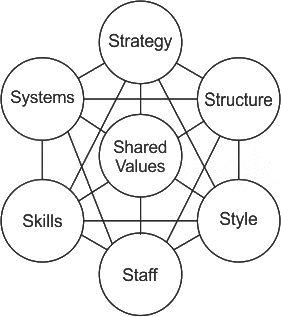
The Correct answer is McKinsey's Peters and Waterman.
Explanation

  • 7-S model:
    • McKinsey's 7s model was developed in the 1980s by McKinsey consultants Tom Peters, Robert Waterman, and Julien Philips with help from Richard Pascale and Anthony G. Athos.
    • The elements are defined as follows:
      • Strategy: This is the organization’s alignment of resources and capabilities to “win” in its market.
      • Structure: This describes how the organization is organized. This includes roles, responsibilities, and accountability relationships.
      • Systems: This is the business and technical infrastructure that employees use on a day-to-day basis to accomplish their aims and goals.
      • Shared Values: This is a set of traits, behaviors, and characteristics that the organization believes in. This would include the organization’s mission and vision.
      • Style:This is the behavioral elements the organizational leadership uses and culture of interaction.
      • Staff:This is the employee base, staffing plans, and talent management.
      • Skills:This is the ability to do the organization’s work. It reflects in the performance of the organization.

Other Related Points

  • Kurt Lewin's 3-Step Change Model:
    • Unfreezing
    • Changing
    • Refreezing
  • John Kotter's 8-Step Process for Leading Change:
    • Create a Sense of Urgency
    • Build a Guiding Coalition
    • Form a Strategic Vision and Initiatives
    • Enlist a Volunteer Army
    • Enable Action by Removing Barriers
    • Generate Short-Term Wins
    • Sustain Acceleration
    • Institute Change
  • The Prosci ADKAR Model:
    • Created by Jeff Hiatt ADKAR is an acronym
    • Awareness of the need for change
    • Desire to participate and support the change
    • Knowledge of what to do during and after the change
    • Ability to realize or implement the change as required
    • Reinforcement to ensure the results of a change continue.
  • The Plan-Do-Check-Act Cycle:
    • The Plan-Do-Check-Act Cycle, created by W. Edwards Deming, is a management method to improve the business method for control and continuous improvement of choosing which changes to implement.

KVS Librarian Tier 2 Mock Test- 2 - Question 2

Which of the following is not a property of ontology?

Detailed Solution: Question 2

The correct answer is Encryption.
Explanation

  • Ontology is a formal representation of a set of concepts within a domain and the relationships between those concepts.
  • Ontologies are typically used to model domain knowledge and support tasks such as reasoning, integration, and interoperability.
  • Extendable: Ontologies are designed to be extendable, allowing new concepts and relationships to be added as the domain knowledge evolves.
  • Reusable: Ontologies are reusable across different applications and domains, making them a valuable tool for knowledge management and sharing.
  • Encryption: Ontology itself does not inherently involve encryption. Encryption is a security measure used to protect data confidentiality, which is not a typical feature or property of ontologies.

Other Related Points

  • Extendable
    • In the context of ontologies, extendability refers to the ability to add new concepts and relationships without disrupting the existing structure.
    • This property is crucial for adapting to new information and evolving domain knowledge.
  • Reusable
    • Reusability ensures that the same ontology can be applied to various applications, promoting consistency and efficiency.
    • This is particularly beneficial in fields like biomedical research, where standardized ontologies facilitate data sharing and integration.

KVS Librarian Tier 2 Mock Test- 2 - Question 3

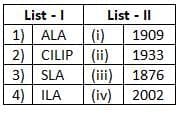
Match the following:

Detailed Solution: Question 3

The correct answer is 1 - iii, 2 - iv, 3 - i, 4 - ii
Explanation

  • ALA (American Library Association) was founded in 1876.
  • CLLIP (Chartered Institute of Library and Information Professionals) was established in 2002.
  • SLA (Special Libraries Association) was formed in 1909.
  • ILA (Indian Library Association) was founded in 1933.

Other Related Points

  • ALA (American Library Association)
    • The ALA is the oldest and largest library association in the world.
    • It was established on October 6, 1876, during the Centennial Exposition in Philadelphia.
    • The ALA works to promote libraries and librarianship and has more than 57,000 members.
  • CLLIP (Chartered Institute of Library and Information Professionals)
    • The CLLIP was formed in 2002 by the merger of the Library Association and the Institute of Information Scientists.
    • It is the leading professional body for librarians, information specialists, and knowledge managers in the United Kingdom.
  • SLA (Special Libraries Association)
    • The SLA was founded in 1909.
    • It is an international organization for innovative information professionals and their strategic partners.
  • ILA (Indian Library Association)
    • The ILA was established in 1933.
    • It is the national association for librarians in India and works to promote the library movement in the country.

KVS Librarian Tier 2 Mock Test- 2 - Question 4

Ziman, a physicist, emphasizes three aspects of organizing public knowledge
(A). Organization by Creation
(B). Self-organization
(C). Explicit organization
(D). Bibliographic Organisation

Detailed Solution: Question 4

The Correct answer is A, B, and D.
Explanation

  • Knowledge can be broadly categorized into personal knowledge and social knowledge.
    • Personal Knowledge: This is individual knowledge, accessible to others only when communicated.
    • Social Knowledge: This is collective knowledge possessed by a society and is ideally available to all members, often provided by libraries and information centers.
  • Ziman, a physicist, emphasizes three aspects of organizing public knowledge:
    • Organization by Creation: Knowledge is generated through research and experiments, recorded, and shared for communication.
    • Self-organization: This refers to how documents reference each other, establishing connections and forming an intellectual network.
    • Bibliographic Organisation: This involves organizing documents through bibliographies, indexes, abstracts, etc., which libraries and information centers manage.
  • Michael Polanyi distinguishes between explicit and tacit knowledge:
    • Explicit Knowledge: Knowledge that is shared and communicated to others, either orally or in written form.
    • Tacit Knowledge: Personal knowledge that may not be expressed fully by the individual. For instance, skills in arts or music, which can be demonstrated but not easily explained, represent tacit knowledge. Polanyi highlights that people often know more than they can articulate.
  • Philosopher Karl Popper identifies three worlds of knowledge:
    • World 1: The physical world, which includes everything in the universe, like matter and energy.
    • World 2: The subjective, individual knowledge formed through personal experiences and observations.
    • World 3: Objective knowledge recorded in language, art, science, and technology, representing human accomplishments and stored in libraries and information centers.

KVS Librarian Tier 2 Mock Test- 2 - Question 5

The Library Company of Philadelphia was founded in

Detailed Solution: Question 5

The Correct answer is 1731.
Explanation

  • The Library Company of Philadelphia (LCP), situated on Locust Street in Center City Philadelphia, is a non-profit organization with deep historical roots established in 1731.
  • It was established by Benjamin Franklin, it has since become a custodian of an extensive and invaluable collection of manuscripts and printed materials in the United States.
  • The library's holdings encompass around 500,000 books and 70,000 other items.
  • The library houses first editions of literary classics like "Moby-Dick" and "Leaves of Grass."
  • The first librarian appointed at the Library Company of Philadelphia, making him America's first librarian, was Louis Timothee.
  • Benjamin Franklin assumed the responsibilities of the next librarian.
  • Franklin's service as the librarian concluded in 1734 when he was succeeded by William Parsons, who held the position for the next twelve years.
  • Following Parsons, Robert Greenway became the fourth librarian, and he served in this capacity until 1763.

Confusion Points

  • The Free Library of Philadelphia:
    • The Free Library of Philadelphia is the public library system serving Philadelphia.
    • The Free Library of Philadelphia was chartered in 1891 with the mission to establish "a general library which shall be free to all."
    • Dr. William Pepper played a pivotal role in its founding, securing initial funding through a $225,000 bequest from his uncle, George S. Pepper.

KVS Librarian Tier 2 Mock Test- 2 - Question 6

What is the primary goal of the Academy of Scientific & Innovative Research (AcSIR)?

Detailed Solution: Question 6

The Correct answer is To create future leaders in Science & Technology through innovative curricula and research opportunities.
Explanation

  • The Academy of Scientific & Innovative Research (AcSIR) is a research institution established by an Act of the Indian Parliament as an Institute of National Importance.
  • AcSIR aims to train future leaders in Science & Technology through innovative curricula, pedagogy, and evaluation, focusing on areas not typically covered in regular academic universities in India.
  • With the merger of CSIR-NISTADS and CSIR-NISCAIR into the new entity, CSIR-NIScPR, AcSIR has gained new opportunities and challenges.
  • This merger reinforces the commitment to support AcSIR’s initiatives.
  • AcSIR has also introduced its first Academic Handbook for the Ph.D. program, which includes student and faculty details, along with other academic activities.

Other Related Points

  • CSIR-NISCPR:
    • It stands for National Institute of Science Communication and Policy Research (CSIR-NIScPR).
    • It came into existence on 14th January 2021 with the merger of two internationally acclaimed CSIR Institutions namely CSIR-NISCAIR and CSIR-NISTADS.
    • It works in the domain of science policy research and science communication.
  • NISTADS:
    • It stands for National Institute of Science, Technology, and Development Studies.
    • It started as a Center for the Study of Science Technology and Development (CSSTD) in 1974 at CSIR New Delhi.
    • NISTADS came into existence as an institute in 1980.
  • NISCAIR:
    • NISCAIR stands for National Institute of Science Communication and Infomation Resources.
    • In India, NISCAIR (formerly INSDOC) provides Translation Services to the Scientific community.
    • NISCAIR provides translation of S&T Documents from 20 foreign languages into English.
    • It was founded in 2002 by merging NISCOM and INSDOC and is headquartered in Delhi.
    • It is the national center of ISSN for assigning ISSN to serials published in India.

KVS Librarian Tier 2 Mock Test- 2 - Question 7

The root of term encyclopaedia enkyklios paideia is from which language?

Detailed Solution: Question 7

The Correct answer is Greek.
Explanation

  • An encyclopedia is a comprehensive reference work that provides summaries of knowledge across various fields or disciplines.
  • It consists of articles or entries arranged alphabetically or thematically, with hyperlinks for easy navigation and searchability.
  • Encyclopedia entries are more detailed than dictionary entries, focusing on factual information about the subject rather than linguistic aspects.
  • The term "encyclopedia" originates from the Koine Greek words "enkyklios paideia," meaning 'general education' or 'complete instruction.'
  • This phrase was later misconstrued as a single word, "encyclopedia," due to a scribal error in a Latin manuscript edition of Quintillian in 1470.
  • As a result, the term entered Neo-Latin and eventually English usage.
  • Despite this, it's been erroneously attributed to ancient Roman authors Quintillian and Pliny as describing an ancient genre.

Popular Encyclopedias:

  • Encyclopadia Britannica
  • Encyclopedia Americana
  • McGraw-Hill Encyclopedia of Science & Technology
  • Encyclopedia of Library & Information Science

KVS Librarian Tier 2 Mock Test- 2 - Question 8

Who proposed the Cultivation Theory, which suggests that media exposure shapes a person's world view?

Detailed Solution: Question 8

The correct answer is George Gerbner.
Explanation

  • George Gerbner was a Hungarian-American professor of communication and the founder of cultivation theory.
  • The Cultivation Theory suggests that long-term exposure to media content shapes a viewer's perception of reality.
  • Gerbner introduced this theory in the 1960s to study the effects of television on viewers.
  • The theory posits that heavy television viewers are more likely to perceive the world in ways that reflect the most recurrent and consistent messages of the TV world, often leading to a distorted view of reality.
  • Gerbner's work highlighted the role of media in shaping cultural norms and public opinion.

Other Related Points

  • Lev Vygotsky
    • Lev Vygotsky was a Soviet psychologist known for his work on cognitive development.
    • He introduced the concept of the Zone of Proximal Development (ZPD), which describes the difference between what a learner can do without help and what they can achieve with guidance.
    • Vygotsky emphasized the role of social interaction in cognitive development.
  • Paulo Freire
    • Paulo Freire was a Brazilian educator and philosopher who was a leading advocate for critical pedagogy.
    • He is best known for his influential work, "Pedagogy of the Oppressed," which emphasizes the importance of education in achieving social justice.
    • Freire's approach focuses on dialogue and the empowerment of the oppressed to achieve liberation.
  • Harold Lasswell
    • Harold Lasswell was an American political scientist and communication theorist.
    • He is famous for his model of communication, which asks: "Who says what in which channel to whom with what effect?"
    • Lasswell's work laid the foundation for modern communication studies and media analysis.

KVS Librarian Tier 2 Mock Test- 2 - Question 9

Which of the following is NOT one of the six criteria identified by Cleverdon for evaluating an information retrieval system?

Detailed Solution: Question 9

The correct answer is User satisfaction
Explanation

  • In 1966, Cleverdon identified six criteria for the evaluation of an information retrieval system.
  • These are:
    • Recall, i.e., the ability of the system to present all the relevant items
    • Precision, i.e., the ability of the system to present only those item that are relevant
    • Time lag, i.e. the average interval between the time the search request is made and the time an answer is provided
    • Effort, intellectual as well as physical, required from the user in obtaining answers to the search requests
    • Form of presentation of the search output, which affects the user’s ability to make use of the retrieved items, and
    • Coverage of the collection, i.e. the extent to which the system includes relevant matter

KVS Librarian Tier 2 Mock Test- 2 - Question 10

Which of the following scenarios does not require a new ISSN for a publication?

Detailed Solution: Question 10

The Correct answer is A journal changes its publisher.
Explanation

  • ISSN:
    • It stands for International Standard Serial Number.
    • It is an 8-digit serial number.
    • It was first published by ISO in 1976.
    • It is a unique serial number given to periodicals such as newspapers, and magazines to identify them.
    • NISCAIR is the national center of ISSN for assigning ISSN to serials published in India.
    • An ISSN is an eight-digit code separated by a hyphen into two sets of four digits.
    • The last digit, ranging from zero to nine or represented by an X, serves as a check digit, uniquely identifying the ISSN by its first seven digits.

Changing ISSN:

  • A new ISSN must be applied for in the following 2 cases:
    • The publication’s medium changes (e.g.; a print magazine becomes an online magazine), or the publication’s title changes.
  • Other changes such as:
    • Change of publisher
    • Change of publication location
    • Change of frequency
    • Change of editorial policy, etc. do not result in a change of ISSN.

​Applying for multiple ISSNs:

  • When the same publication is published:
    • On different media (e.g.; print version and online version), or
    • In different languages (e.g.; French edition and English edition), applications must be submitted for distinct ISSNs for each medium or each linguistic edition.

KVS Librarian Tier 2 Mock Test- 2 - Question 11

Who developed information literacy logo?

Detailed Solution: Question 11

The correct answer is IFLA/UNESCO.
Explanation

  • IFLA stands for the International Federation of Library Associations and Institutions.
  • UNESCO stands for the United Nations Educational, Scientific and Cultural Organization.
  • The information literacy logo was developed as part of a collaborative effort between IFLA and UNESCO.
  • This logo is used to promote and recognize information literacy initiatives globally.
  • Information literacy is the ability to identify, locate, evaluate, and effectively use information, which is crucial in the digital age.

Other Related Points

  • LC/OCLC
    • LC stands for the Library of Congress, the research library that officially serves the United States Congress.
    • OCLC stands for the Online Computer Library Center, a global library cooperative providing shared technology services, original research, and community programs.
  • ALA/ACRL
    • ALA stands for the American Library Association, a nonprofit organization based in the United States that promotes libraries and library education.
    • ACRL stands for the Association of College and Research Libraries, a division of the ALA dedicated to college and university libraries.
  • IFLA/ALA
    • The International Federation of Library Associations and Institutions (IFLA) and the American Library Association (ALA) are both prominent library organizations, but they did not collaborate on the information literacy logo.

KVS Librarian Tier 2 Mock Test- 2 - Question 12

Self-links denote:

Detailed Solution: Question 12

The Correct answer is ​Links between the source and the target of the page within the same site or domain.
Explanation
Refer to these Lines:

  • Links for which the source and the target of the page are within the same site or domain are called self-links.
    • In the given passage, self-links refer to links where the source and the target of the page are within the same site or domain. It is mentioned that links for which the source and the target of the page are within the same site or domain are called self-links.
    • Therefore, the correct answer is "Links between source and the target of the page within the same site or domain."

KVS Librarian Tier 2 Mock Test- 2 - Question 13

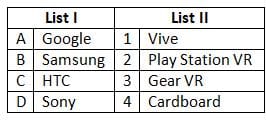
Match the following:

Detailed Solution: Question 13

The Correct answer is (a) - (iv), (b) - (iii), (c) - (i), (d) - (ii)
Explanation

  • Google →Cardboard
    • Google Cardboard is a virtual reality platform developed by Google.
    • It’s made of foldable cardboard, into which you place your smartphone to experience VR.
    • Purpose: To democratize VR by making it affordable and widely accessible.
    • It's the simplest and cheapest VR solution, often used for educational or entry-level VR experiences.
  • Samsung → Gear VR
    • Samsung Gear VR is a virtual reality headset developed by Samsung in collaboration with Oculus (a division of Meta/Facebook).
    • It works with select Samsung Galaxy smartphones that act as the screen and processor.
    • The device allows immersive mobile VR experiences and was among the first consumer-focused mobile VR devices.
  • HTC → Vive
    • This should correctly be HTC Vive, not Hive (likely a typo).
    • The HTC Vive is a high-end VR headset developed by HTC and Valve Corporation.
    • It’s widely used in gaming, simulations, and enterprise environments.
    • It supports room-scale VR and uses motion tracking sensors.
  • Sony → PlayStation VR
    • Sony’s PlayStation VR is a VR headset designed to work with the PlayStation 4 and PlayStation 5 gaming consoles.
    • It features immersive visuals and audio tailored for console-based gaming.
    • Sony was the first major gaming console brand to enter the VR space with a dedicated headset.

KVS Librarian Tier 2 Mock Test- 2 - Question 14

In 1988, UGC constituted a committee on National Network System under the Chairmanship of:

Detailed Solution: Question 14
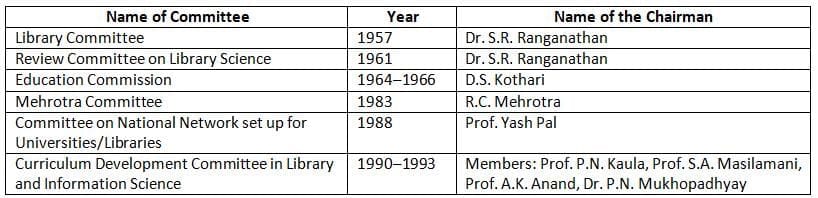
The Correct answer is Prof. Yash Pal.
Explanation
Committee on National Network System for Universities ILibraries (1988):

  • ​In 1988, the UGC constituted a Committee on National Network System under the Chairmanship of Prof. Yash Pal,the then UGC Chairman to suggest measures for
    networking of libraries and information centers in universities, deemed universities, institutions of national importance, UGC Information Centres, R&D institutions and
    colleges.
  • The main objective of the Committee was to share the existing resources to optimize utilisation and avoid duplications of holdings so as to have an access to wide range of literature.
  • In the first meeting on April 24, 1988, the Committee decided to constitute a Working Group to prepare a project report on 'Information and Library Network' (INFLIBNET) within three months.

Other Related Points
Library Committees and Commissions Appointed by UGC

KVS Librarian Tier 2 Mock Test- 2 - Question 15

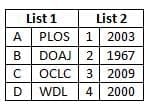
Match the LIST-I with LIST-II

Detailed Solution: Question 15

The Correct answer is A-4, B-1, C-2, D-3.
Explanation

  • PLOS:
    • PLOS, which stands for Public Library of Science (formerly PLoS until 2012), is a nonprofit publisher that specializes in open-access journals covering various fields such as science, technology, medicine, and other scientific literature.
    • Operating under an open-content license, PLOS was established in 2000 and introduced its inaugural journal, PLOS Biology, in October 2003.
    • PLOS journals are featured in the Directory of Open Access Journals (DOAJ).
    • The organization is actively involved in initiatives supporting open access, including being a member of the Open Access Scholarly Publishers Association (OASPA), participating in the Initiative for Open Citations, and holding membership in the Committee on Publication Ethics (COPE).
  • Directory of Open Access Journals:
    • Established in 2003 with an initial 300 open-access journals, the Directory of Open Access Journals (DOAJ) is a website that houses a community-curated list of open-access journals. It is maintained by Infrastructure Services for Open Access (IS4OA).
    • DOAJ is dedicated to enhancing the visibility, accessibility, reputation, usage, and impact of high-quality, peer-reviewed, open-access scholarly research journals on a global scale, without any restrictions based on discipline, geography, or language.
    • DOAJ is a founding member of Think. Check. Submit. and actively contribute to this initiative as a longstanding committee member.
    • Launched in 2015, Think. Check. Submit. emerged in response to concerns about predatory publishing and the increasing array of unfamiliar publishing avenues confronting researchers in scholarly communications.
    • In 2023, DOAJ marked its 20th anniversary with a year-long campaign, featuring three distinct events themed around 'Open,' 'Global,' and 'Trusted.'
  • OCLC:
    • It stands for "Online Computer Library Center".
    • It is an American non-profit cooperative organization founded in 1967 as the "Ohio College Library Center".
    • It provides shared technology services, original research, and community programs for its membership and the library community at large.
    • The OCLC cataloging and resource-sharing system is the largest and most heavily used computer library system in the world.
    • The OCLC and its member libraries cooperatively produce and maintain WorldCat, the Online Union Catalogue of Books available in the libraries of member institutions.
    • Products and services of OCLC:
      • Relais ILL
      • Capira
      • BibControl library statistics solution
      • BIBLIOTHECA library management system
      • CatExpress cataloging service
      • Choreo Insights
      • Contentdm Etc.
  • WDL:
    • The World Digital Library (WDL) is an international digital library operated by UNESCO and the United States Library of Congress.
    • The World Digital Library was launched on April 21, 2009, at UNESCO headquarters in Paris, France.
    • The WDL has stated that its mission is to promote international and intercultural understanding.

KVS Librarian Tier 2 Mock Test- 2 - Question 16

Why is budgeting important in library management?

Detailed Solution: Question 16

The Correct answer is To plan for acquiring new resources, maintaining collections, and upgrading technology.
Explanation

  • Libraries must plan and allocate funds for acquiring new materials, maintaining current collections, upgrading technology, and paying staff.
    • Budgeting plans for acquiring new materials and upgrading technology.
    • It ensures the library can maintain resources and services.
    • Financial planning helps libraries stay within their means.
    • Reducing resources is not the main aim of budgeting.

KVS Librarian Tier 2 Mock Test- 2 - Question 17

Photo charging system was introduced by:

Detailed Solution: Question 17

The Correct answer is Ralph R. Shaw
Explanation

  • Photo charging system:
    • In this system, Microphotos are taken off the borrower's card, the book card, and a sequentially numbered date of issue or date due slip.
    • The photo Charging system was introduced by Ralph R Shaw.

Other Related Points

  • The Browne Charging System: The Browne Charging System was devised by Nina E. Browne in 1895.
  • Newark Charging System: It was introduced by John Cotton Danna.

​Ralph R Shaw:

  • Ralph R Shaw (Ralph Robert Shaw) invented the photo-charging machine widely used in libraries.
  • Ralph R. Shaw, was an internationally known librarian who distinguished himself as an inventor, educator, publisher, and bibliographer.
  • A former president of the American Library Association was noted for his adaptation of machines to the library (service and related inventions.
  • He was senior assistant chief bibliographer of the Engineering Societies Library from 1929 to 1936 and chief librarian of the Gary Public Library from 1936 to 1940.
  • He served as a professor at Rutgers University's Graduate School of Library Service from 1954 to 1964.
  • He founded a publishing company called the Scarecrow Press in 1950.

J.H. Shera:

  • Jesse Hauk Shera was an American librarian and library scientist.
  • He is known for his contributions to the field of library and information science, particularly in the area of social epistemology.

Samuel Swett Green:

  • ​He was a founding figure in America’s public library movement.
  • He is considered the "father of reference work".
  • He introduced the idea of a modern "library reference service" in 1876.

KVS Librarian Tier 2 Mock Test- 2 - Question 18

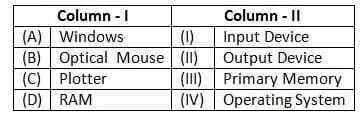
Match the following:

Select correct answer from the options given below.

Detailed Solution: Question 18

The Correct answer is a - IV, b - I, c - II, d - III.
Explanation

  • Windows is an Operating System (A - IV).
  • An Optical Mouse is an Input Device (B - I).
  • A Plotter is an Output Device (C - II).
  • RAM (Random Access Memory) is a type of Primary Memory (D - III).

Other Related Points

  • Operating System
    • An Operating System (OS) is software that manages computer hardware and software resources and provides common services for computer programs.
    • Examples include Windows, macOS, and Linux.
  • Input Device
    • Input devices are used to interact with or provide data to the computer.
    • Common examples include keyboard, mouse, and scanner.
  • Output Device
    • Output devices receive data from the computer and translate it into a form understandable by humans.
    • Examples include monitors, printers, and plotters.
  • Primary Memory
    • Primary memory is the computer's main memory, used to store data that is actively being used or processed.
    • RAM and ROM are types of primary memory.

KVS Librarian Tier 2 Mock Test- 2 - Question 19

Which Librarian used the word ‘Reference Interview’ for the first time?

Detailed Solution: Question 19

The correct answer is Margaret Hutchins.
Explanation
Margaret Hutchins

  • Margaret Hutchins (September 21, 1884 – January 4, 1961) was an American librarian and educator.
  • According to Bunge (1984), Hutchins is believed to be the first to coin the term “reference interview” in her classic text, introduction to Reference Work (1944).
  • She postulated four categories of reference questions:
    • Bibliographical
    • Biographical
    • Historical and geographical

Reference Interview

  • The Online Dictionary of Library and Information Science defines a reference interview as “The interpersonal communication that occurs between a reference librarian and a library user to determine the person’s specific information need(s), which may turn out to be different than the reference question initially posed.
  • A reference interview is a conversation between a librarian and a library user, usually at a reference desk, in which the librarian responds to the user's initial explanation of his or her information need by first attempting to clarify that need and then by directing the user to appropriate information resources.

Other Related Points
S.R Ranganathan:

  • Shiyali Ramamrita Ranganathan (9 August 1892 – 27 September 1972) was a librarian and mathematician.
  • He is known as the Father of Library Science in India.
  • Ranganathan is best known for his pioneering work in library classification and cataloging, particularly the development of the
    Colon Classification System and the Five Laws of Library Science.
  • His birthday is observed every year as National Librarian Day in India.
  • The FullTime post of Reference Librarian at Madras University was set up in 1937.

D.J Foskett:

  • Douglas John Foskett born on 27 June 1918 was a British librarian and library and information scientist.
  • He was the author of several special faceted classification systems.

KVS Librarian Tier 2 Mock Test- 2 - Question 20

The list of all population units from which sample is selected, is known as

Detailed Solution: Question 20

The Correct answer is Sampling frame.
Explanation

  • The sampling frame (synonyms: "sample frame", "survey frame") is the actual set of units from which a sample has been drawn
  • In the case of a simple random sample, all units from the sampling frame have an equal chance to be drawn and to occur in the sample.
  • The sampling frame is the list from which units are drawn for the sample.
  • The 'list' may be an actual listing of units, as in a phone book from which phone numbers will be sampled, or some other description of the population, such as a map from which areas will be sampled.

Other Related Points

  • Population frame:
    • This refers to the complete list of all individuals, items, or units that make up the entire population of interest.
    • For example, if you were conducting a survey on the opinions of students in a university, the population frame would be a list of all enrolled students.
  • Sampling design:
    • This refers to the plan or method used to select a sample from the sampling frame.
    • It includes details such as the sampling technique (e.g., random sampling, stratified sampling), sample size, and any other considerations for ensuring the sample is representative of the population.
  • Sampling unit:
    • This is the individual element or unit from which the sample is actually selected.
    • It could be a person, household, organization, or any other distinct entity depending on the context of the study.
    • In the university survey, each enrolled student would be a sampling unit.

KVS Librarian Tier 2 Mock Test- 2 - Question 21

The Chairman of the Curriculum Development Committee (CDC) on Library and Information Science 1990 set up by UGC was

Detailed Solution: Question 21

The correct answer is Prof. P. N. Kaula.
Explanation

  • Curriculum Development Committee (CDC), 1993:
    • ​The UGC formed the first Curriculum Development Committee (CDC) in Library and Information Science (LIS) in 1990, chaired by Prof. P. N. Kaula.
    • After extensive discussions, the committee submitted its report, including model syllabi, to the UGC.
    • The published report, titled "Report of the Curriculum Development Committee on Library and Information Science," in 1993, highlighted recommendations, with a primary focus on revising the LIS course curriculum.
    • The committee also made suggestions related to admission policies, medium of instruction, teaching staff, methods and aids, departmental library, workshop cum information processing laboratory, internship program, educational tour, and accreditation agency.
  • Curriculum Development Committee (CDC), 2001:
    • The second Curriculum Development Committee (CDC) in Library and Information Science (LIS) was established by the UGC, chaired by Dr. C. R. Karisiddappa in 2000, and the committee presented its report in 2001.
    • The focal point of the report was the Model Curriculum for Library and Information Science.
    • The primary goal of this curriculum model was to integrate Information Technology into the syllabi while preserving traditional areas.
    • The committee aimed to strike a balance between traditional and technological elements in the Model Curriculum.
    • Additionally, recommendations included the breakdown of study hours, mark patterns, optimal teaching program hours, and infrastructure facilities in LIS departments.
    • The committee strongly advocated for a two-year integrated master's degree course.

KVS Librarian Tier 2 Mock Test- 2 - Question 22

How do web-scale discovery services enhance user experience in the library?

Detailed Solution: Question 22

The correct answer is by providing a single entry point for assessing electronic resources
Explanation

  • Web-scale discovery services enhance user experience in the library by providing a single entry point for accessing electronic resources.
  • Instead of navigating multiple databases or catalogs separately, users can search across a wide range of library resources simultaneously.
  • This simplifies the search process, saving users time and effort.
  • Additionally, these services often offer advanced search features and filters, allowing users to refine their searches effectively and find relevant information more efficiently.
  • Therefore, they contribute to reducing search time and improving the overall user experience in the library.

Other Related Points

  • Traits of Web-Scale Discovery Services:
    • Content
      • These Services harvest content from local and remotely hosted repositories and create a vastly comprehensive centralized index - to the article level.
      • Content is enabled through the harvesting of local library resources, combined with brokered agreements with publishers and aggregators allowing access to their metadata and full-text content for indexing purposes.
    • Discovery
      • These services have a single
        search box providing a Google-like search
        experience (as well as advanced searching
        capabilities).
    • Delivery
      • These services provide quick
        results ranked by relevancy in a modern interface offering functionality and design cues intuitive to and expected by today’s users.
    • Flexibility
      • These services are agnostic to underlying systems, whether hosted by the library or hosted remotely by content providers.
      • These services are open compared to traditional library systems and allow libraries greater latitude to customize the services and make the service it's own.

KVS Librarian Tier 2 Mock Test- 2 - Question 23

Which of the following Creative Commons licenses allows for commercial use but does not permit derivative works or adaptations?

Detailed Solution: Question 23

The Correct answer is CC BY-ND
Explanation
There are six Creative Commons licenses, ranked from most to least permissive:

  • CC BY: This license allows others to distribute, remix, adapt, and build upon the material in any medium or format, including commercially, as long as credit is given to the creator.
  • Elements included:
    • BY: Attribution to the creator.
  • CC BY-SA :This license permits others to distribute, remix, adapt, and build upon the material in any medium or format, including commercially, provided attribution is given to the creator and any derivatives are licensed under the same terms.
  • Elements included:
    • BY: Attribution to the creator.
    • SA: Share adaptations under the same terms.
  • CC BY-NC: This license allows others to distribute, remix, adapt, and build upon the material in any medium or format for non-commercial purposes only, with attribution to the creator. Elements included:
    • BY: Attribution to the creator.
    • NC: Non-commercial use only.
  • ​CC BY-NC-SA This license enables others to distribute, remix, adapt, and build upon the material in any medium or format for non-commercial purposes only, provided attribution is given and derivative works are licensed under the same terms. Elements included:
    • BY: Attribution to the creator.
    • NC: Non-commercial use only.
    • SA: Share adaptations under the same terms.
  • CC BY-ND :This license allows others to copy and distribute the material in any medium or format in its original, unadapted form, including commercially, with credit to the creator. Elements included:
    • BY: Attribution to the creator.
    • ND: No derivatives or adaptations allowed.
  • CC BY-NC-ND This license permits others to copy and distribute the material in any medium or format in its original, unadapted form only for non-commercial purposes, with attribution to the creator. Elements included:
    • BY: Attribution to the creator.
    • NC: Non-commercial use only.
    • ND: No derivatives or adaptations allowed.

Other Related Points
reative Commons:

  • Creative Commons is a nonprofit organization offering copyright licenses that empower creators to share their work with others while maintaining control over its use.
  • Aligned with copyright law, these licenses provide creators with a means to grant permission for the use of their work. With six distinct licenses,
  • Creative Commons allows content creators to retain copyright while enabling others to reuse the content under specified conditions.
  • It enables authors to specify how others can use their published work.

KVS Librarian Tier 2 Mock Test- 2 - Question 24

Which of the following is correct statement regarding the Compariasion between folksonomy and traditional taxonomies
(A). In a traditional taxonomy, information is organized hierarchically by experts or authorities while as Folksonomies
are user-generated and lack a predefined structure imposed by experts.
(B). Traditional Taconomy is Centralized authority with experts determining categories and relationships while as
Folksonomies are Decentralized authority where users collectively contribute and define content organization.
(C). Typically traditional Taconomyit is less flexible while as Folksonomies are highly flexible.
(D). Traditional Taconomy aims for high semantic precision and consistency while as Folksonomies have lower semantic precision

Detailed Solution: Question 24
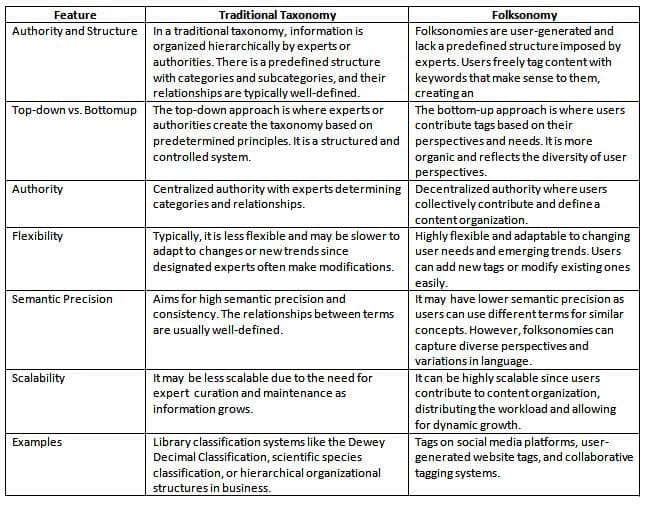
The Correct answer is ​A, B, C and D.
Explanation

KVS Librarian Tier 2 Mock Test- 2 - Question 25

What does the prefix "978" or "979" in an ISBN signify?

Detailed Solution: Question 25

The correct answer is The country of publication.
Explanation

  • The prefix "978" or "979" in an ISBN is an international code used to identify the country of publication.
  • ISBN stands for International Standard Book Number, a unique identifier for books.
  • The ISBN is divided into five parts: Prefix, Registration group, Registrant, Publication, and Check digit.
  • The prefix "978" was introduced in 2007 when the ISBN system transitioned from a 10-digit to a 13-digit format.
  • The country identifier helps in tracking the book's origin and facilitates the global distribution and cataloging of books.

Other Related Points

The International Standard Book Number (ISBN) is a unique International Publisher’s Identifier number for monographic publications such as books, pamphlets, educational kits, microform, CD-ROMs, and other digital and electronic publications.

  • An ISBN is a 13-digit number.
  • Before 2007 the ISBN is of 10 digits but after 1 January 2007, it consists of 13 digits.
  • ISBN consists of Five elements
  • E.g: 978-81-8038-835-4
    • Ist element- Denotes a specified prefix element (978).
    • IInd element- Identifies the particular country or geographical area (81)
    • IIIrd element- Identifies the particular publisher (8038)
    • IVth element- Identifies the particular edition, and format of a specific title (835)
    • Vth element- Check digit (4).
  • Raja Ram Mohan Roy National Agency for ISBN is responsible for ISBN registration in the country.
  • It is under the administrative control of the Ministry of Education, Division, Deptt. of Higher Education.
  • It was founded in January 1985 and is situated in New Delhi.

KVS Librarian Tier 2 Mock Test- 2 - Question 26

Job Rotation' is also used as a technique for:

Detailed Solution: Question 26

The Correct answer is Training.
Explanation

  • Job Rotation is primarily a training technique used in organizations. It involves moving employees through a series of job assignments in different departments, positions, or geographical locations.
  • This method helps employees gain a broader understanding of the business, develop new skills, and stay motivated and engaged by reducing the monotony of work.
  • Job rotation involves moving employees through different positions within the organization.
  • It provides individuals with exposure to various roles and responsibilities, allowing them to acquire a broader understanding of the organization's functions.
  • Job rotation is an effective on-the-job method for developing a well-rounded skill set and preparing individuals for leadership roles.

Other Related Points

  • Performance Appraisals:
    • Performance appraisal" denotes the routine assessment of an employee's job performance and their overall contributions to a company.
    • Referred to by various terms such as annual review, employee appraisal, or performance evaluation, it involves evaluating the employee's skills, accomplishments, and development, or any areas lacking in progress.
  • Job Analysis:
    • Job analysis, also referred to as work analysis, encompasses a set of procedures aimed at delineating the components of a job.
    • These components include the tasks and activities associated with the job, as well as the skills, qualifications, and prerequisites essential for performing those tasks.
    • According to Edwin B. Flippo, “Job analysis is the process of studying and collecting information relating to the operations and responsibilities for a specific job. The immediate products of this analysis are job description and job specifications”
  • Job specification:
    • Also called ‘Employee Specification’, A job specification is an official document that describes the duties, required knowledge, skills, abilities, and minimum qualifications of State jobs.
    • According to Edwin B. Flippo, “Job specification is a statement of the minimum acceptable human qualities necessary to perform a job properly…
    • Job specification lists qualities that the employee should or sometimes, must have in order to qualify for the job.

KVS Librarian Tier 2 Mock Test- 2 - Question 27

Which of the following is a potential barrier to Resource Sharing
(A). Preference for Ownership
(B). Fear of Losing Identity
(C). Limited Resource Sharing in Core Areas
(D). Geographical, Legal, and Administrative Barriers

Detailed Solution: Question 27

The Correct answer is All of these.
Explanation
Barriers to Resource Sharing

  • Preference for Ownership:
    • Many libraries still prefer owning materials rather than accessing them through other libraries or networks, limiting the expansion of their information base.
  • Fear of Losing Identity:
    • Libraries participating in networks may feel they are losing autonomy and must follow group guidelines, which deters them from joining resource-sharing initiatives.
  • Centralization Resistance:
    • Libraries often resist the centralization of activities and services under a network, making it difficult to implement resource-sharing programs.
  • Difficulty in Demonstrating Benefits:
    • Explaining the benefits of consortia participation is challenging, especially in the initial stages, as the value of collaboration may not be immediately evident to decision-makers.
  • Limited Resource Sharing in Core Areas:
    • Resource sharing tends to be focused on marginal areas rather than core collections, leading to limited savings and benefits.
  • Lack of Institutional Support:
    • The absence of adequate institutional support, including infrastructure, authority, and user engagement, can hinder the success of resource-sharing programs.
  • Inefficient Information Transfer:
    • An unreliable system for document or information transfer reduces user confidence, especially if delivery is not timely or efficient.
  • Geographical, Legal, and Administrative Barriers:
    • Geographical, legal, and administrative challenges further complicate resource sharing, creating obstacles in its implementation.

KVS Librarian Tier 2 Mock Test- 2 - Question 28

'Detroit self-charging system' was developed by

Detailed Solution: Question 28
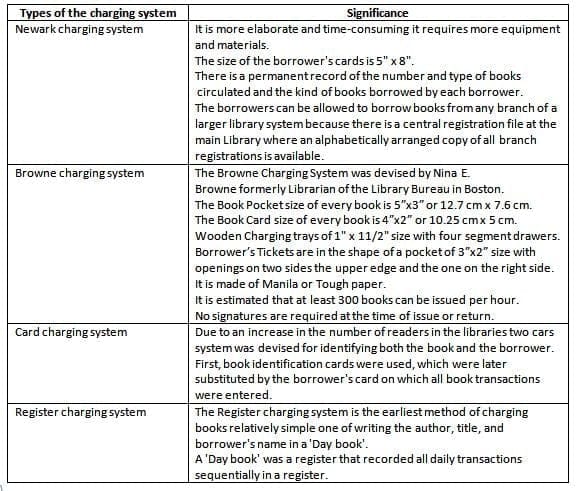
The Correct answer is Ralph Ulveling.
Explanation

  • The Detroit Self-Charging System, created by Ralph Ulveling in 1929, simplified the Newark System.
  • In the Newark System, essential components included book pockets, book cards, date slips, and borrower's cards.
  • However, the Detroit Self Charging System streamlined this process by utilizing pre-dated cards and identification cards in place of borrower's cards.
  • Mechanization of book charging began later, with machines like the Dickman in 1927 and the Gaylord in 1931, which imprinted borrower numbers and due dates.
  • A significant change in college and university libraries occurred when the University of Texas adopted punched card call slips in 1936.

Other Related Points

KVS Librarian Tier 2 Mock Test- 2 - Question 29

There are four main ways in which periodicals may be arranged. They can be arranged alphabetically by:
1. Title
2. Language
3. Region
4. Country
5. Publication House
6. Subject

Detailed Solution: Question 29

The correct answer is 1, 2, 4 and 6
Explanation

  • Periodicals can be arranged in various ways, typically alphabetically by:
    • Title
    • Language
    • Country
    • Subject
  • ​Key Approaches:
    • Alphabetical Arrangement: The most straightforward method, ideal for easy access, especially in smaller collections.
    • Subject-wise Arrangement: Common in larger libraries, where periodicals are first grouped by broad subject headings and then arranged alphabetically within those groups.
    • Display Racks: Periodicals can be displayed alphabetically or randomly, especially in smaller libraries with fewer periodicals.
    • Back Issues: Often arranged alphabetically on shelves for easy retrieval, though they may also be organized by subject.
    • Bound Volumes: These may be classified and placed with books or kept alongside loose back issues, depending on the library's preference.

KVS Librarian Tier 2 Mock Test- 2 - Question 30

The 7 P's of Web marketing mix are Product, Price, Place, Promotion, Process, Physical evidence and  ___________.

Detailed Solution: Question 30
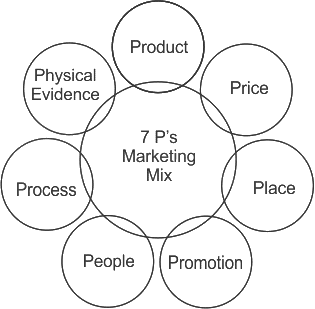
The Correct answer is People.
Explanation

  • The 7 P's of the marketing mix extend the traditional 4 P's (Product, Price, Place, Promotion) to include three additional elements that are crucial for services and online marketing.
  • These elements are:
    • Product: What you are selling, including the quality and features.
    • Price: How much the product or service costs.
    • Place: Where the product is sold and how it is delivered.
    • Promotion: The methods used to promote and advertise the product.
    • Process: The processes involved in delivering your product or service.
    • Physical Evidence: The tangible proof that a service was provided, such as receipts or packaging.
    • People: The human element, including customer service and personnel who interact with customers.

View more questions
10 tests
Information about KVS Librarian Tier 2 Mock Test- 2 Page
In this test you can find the Exam questions for KVS Librarian Tier 2 Mock Test- 2 solved & explained in the simplest way possible. Besides giving Questions and answers for KVS Librarian Tier 2 Mock Test- 2, EduRev gives you an ample number of Online tests for practice
Download as PDF