
KVS Librarian Exam Tier 2 Mock Test- 4 Free Online Test 2026
Full Mock Test & Solutions: KVS Librarian Tier 2 Mock Test- 4 (60 Questions)
You can boost your KVS PGT/TGT/PRT 2026 exam preparation with this KVS Librarian Tier 2 Mock Test- 4 (available with detailed solutions).. This mock test has been designed with the analysis of important topics, recent trends of the exam, and previous year questions of the last 3-years. All the questions have been designed to mirror the official pattern of KVS PGT/TGT/PRT 2026 exam, helping you build speed, accuracy as per the actual exam.
Mock Test Highlights:
- - Format: Multiple Choice Questions (MCQ)
- - Duration: 150 minutes
- - Total Questions: 60
- - Analysis: Detailed Solutions & Performance Insights
Sign up on EduRev for free and get access to these mock tests, get your All India Rank, and identify your weak areas to improve your marks & rank in the actual exam.

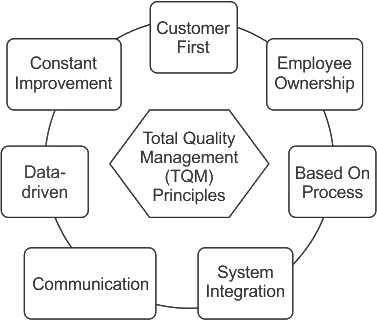
In the context of TQM, what is the significance of employee engagement?
Detailed Solution: Question 1
The Correct answer is Ensuring comprehensive quality control.
Explanation
- Total Quality Management (TQM):
- Total Quality Management (TQM) represents a management strategy aimed at achieving enduring success by consistently delivering superior customer satisfaction through high-quality IT services.
- Effectively implementing TQM necessitates the cohesive functioning of the entire organization as a unified entity in the relentless pursuit of excellence.
- This is accomplished by maintaining a sharp focus on the principles of TQM.
- Customer priority:
- TQM places utmost emphasis on ensuring an exceptional customer experience during all interactions with the organization.
- From the initial engagement to purchase and ongoing support, prioritizing the customer remains paramount.
- Employee engagement:
- TQM necessitates the active involvement of every team member to ensure comprehensive quality control at all levels.
- By involving all departments, TQM aims to guarantee customers receive a superior experience from every facet of the organization.
- Process orientation:
- TQM concentrates on establishing and implementing processes that enable organizations to achieve and replicate success.
- Measuring achievements and outlining the steps taken to attain them are crucial for effective TQM implementation.
- Integrated systems:
- TQM strategies revolve around optimizing all available resources within the company.
- This is best achieved through the integration of systems, uniting disparate parts of the organization into a well-coordinated entity operating in seamless synergy.
- Effective communication:
- TQM demands that every team member performs at their best and contributes value to the team.
- Consequently, communication and transparency serve as fundamental pillars of successful TQM practices.
- Data-centric approach:
- TQM relies on data rather than guesswork. Data is leveraged for the organization's improvement, and decisions are based on quantifiable facts.
- Continuous enhancement:
- TQM is an ongoing process rather than a one-time effort. Acknowledging the unattainability of perfection, TQM continually strives to bring the organization as close as possible to this ideal state.
- Customer priority:
Who categorized users as General, special, Subject, Non-Reading
Detailed Solution: Question 2
The correct answer is Whittaker.
Explanation
- Whittaker also proposed a classification system for library users based on their predominant use of library services:
- General Readers: These users primarily focus on accessing light reading materials available in the library.
- Subject Readers: Subject readers direct their attention to library materials related to a specific field of interest.
- Special Readers: This category includes users with unique information needs that require specialized library services. Examples may include readers with physical or visual disabilities in academic libraries.
- Non-Reading Users: This group comprises sub-categories of users who utilize library resources but not for reading materials. An instance could be a user visiting the library solely to borrow a video.
Other Related Points
Dr. S.R. Ranganathan categorizes users into the following groups:
- The Fresher: This category comprises newcomers to the library, often referred to as freshmen. They require guidance and orientation to the library, including how to discover books tailored to their interests.
- Ordinary Reader: These are individuals seeking ordinary books and basic services from the library. Their reading needs are typically general and straightforward.
- Specialist Reader: Expert readers are users who have specialized knowledge in a specific niche or field of study. They have precise, research-oriented demands for books and resources that cater to their specialization.
- General Reader: The diverse reader group encompasses individuals who do not fit neatly into any of the aforementioned categories. They have a wide range of interests and reading preferences, making them a diverse and varied user group.
Werner Kunz et al. also introduced a classification system for library users based on their interaction with library information:
- Potential User: These individuals require information but may have difficulty articulating their needs. Specific library services tailored to their requirements can assist them.
- Expected User: Expected users are those who have expressed their intention to utilize specific information services.
- Actual User: Actual users are individuals who have utilized an information service, regardless of whether they benefited from it or not.
- Beneficiary User: Beneficiary users are those who have gained measurable advantages from the information services provided by the library.

Detailed Solution: Question 3
The Correct answer is 1836.
Explanation
- The Calcutta Public Library began its journey on 21st March 1836.
- The Library was established for reference and lending, open to all, irrespective of class, colour& nationalities, on the self-financing principle.
- The Calcutta Public Library was subsequently merged with the Imperial Library and combining the collection of a number of secretariat libraries, the Imperial Library was opened to the public in January in 1903.
- After Independence of India, the National Library came into being in place of Imperial Library by the “Imperial Library (Change of Name) Act” in 1948.
- It was accorded a special status of an institution of national importance in the Article 62 in the 7th Schedule of the Union list of the Constitution of India and Maulana Abul Kalam Azad, the then Union Minister of Education opened the Library to Public on 1st February 1953.
When attached to a subject they give it an anterior position over other subjects of the same class
Detailed Solution: Question 4
The Correct answer is Anteriorising Common Isolates.
Explanation
- Common Isolates in Colon Classification: Common isolates are defined in CC as those that denote the same isolate term and are represented by the same isolate number.
- There are several types of common isolates:
- Anteriorising Common Isolates in CC:
- Anteriorising common isolates means that they have precedence in arrangement over the class numbers to which they have been attached. In short, the anteriorising common isolates have the anterior value.
- Anteriorising common isolates Applicable before space facet:
- a - bibliography
- c - concordance
- d - table
- f - atlas
- k – cyclopaedia
- m - periodical
- p - conference proceedings
- v - history
- w - biography
- Anteriorising common isolatesApplicable after space facet
- r - periodical administration report
- s - statistics (serial).
- Anteriorising common isolates Applicable after time facet
- T - commission report
- t4 - survey
- v - source material
- v46 - genealogy
- v6 chronology
- Posteriorising Common Isolates in CC:
- Posteriorizing common isolates are of three types, personality, matter, and energy common isolates. They are to be attached to the host(core) class with their respective connecting symbols, viz., comma, semi-colon and colon.
- some of which- are as follows:
- f - investigating- institution
- f2 - observational institution
- f3 - laboratory
- g - learned body
- h6 - museum
- y - cultural organizations
- Anteriorising Common Isolates in CC:
What classification method categorizes users based on their approach to information services?
Detailed Solution: Question 5
The Correct answer is Potential user classification.
Explanation
Users can be grouped based on their approach to information services into four categories:
- The potential user: Individuals who require information that can be supplied by particular services.
- The expected user: Individuals who intend to utilize specific information services.
- The actual user: Individuals who have utilized an information service, regardless of whether they benefited from it or not.
- The beneficiary user: Individuals who gain a measurable advantage from information services.
Other Related Points
- Werner Kunz et al. introduced a classification system for library users based on their interaction with library information:
- Potential User: These individuals require information but may have difficulty articulating their needs. Specific library services tailored to their requirements can assist them.
- Expected User: Expected users are those who have expressed their intention to utilize specific information services.
- Actual User: Actual users are individuals who have utilized an information service, regardless of whether they benefited from it or not.
- Beneficiary User: Beneficiary users are those who have gained measurable advantages from the information services provided by the library.
- Ranganathan proposed grouping them based on different types of services.
- The Fresher: This category comprises newcomers to the library, often referred to as freshmen. They require guidance and orientation to the library, including how to discover books tailored to their interests.
- Ordinary Reader: These are individuals seeking ordinary books and basic services from the library. Their reading needs are typically general and straightforward.
- Specialist Reader: Expert readers are users who have specialized knowledge in a specific niche or field of study. They have precise, research-oriented demands for books and resources that cater to their specialization.
- General Reader: The diverse reader group encompasses individuals who do not fit neatly into any of the aforementioned categories. They have a wide range of interests and reading preferences, making them a diverse and varied user group.
- Whittaker also proposed a classification system for library users based on their predominant use of library services:
- General Readers: These users primarily focus on accessing light reading materials available in the library.
- Subject Readers: Subject readers direct their attention to library materials related to a specific field of interest.
- Special Readers: This category includes users with unique information needs that require specialized library services. Examples may include readers with physical or visual disabilities in academic libraries.
- Non-Reading Users: This group comprises sub-categories of users who utilize library resources but not for reading materials. An instance could be a user visiting the library solely to borrow a video.
Which National level Committee/ Commission recommended that 6.25% of the total budget of the university or Rs. 40 per student should be spent on the library?
Detailed Solution: Question 6
The Correct answer is University Education Commission, 1948, Chairman: Dr. S. Radhakrishnan.
Explanation
- The University Education Commission was set up in 1948 under the chairmanship of Dr. S. Radhakrishnan and recommended that 6.25 % of the total budget of the university or Rs. 40 per student should be spent on libraries.
- However, the Education Commission (1964-1966) popularly known as the 'Kothari Commission' recommended "6.5% of the educational budget as reasonable expenditure on libraries. But this could vary, say from 6.5% to 10%, depending on the stage of development of each university library.”
Other Related Points
- Radhakrishnan Commission
- It was the first commission on education after Independence
- The University Education Commission was appointed in 1948 under the chairmanship of Dr. Sarvepalli Radha Krishnan.
- Dr. Sarvepalli Radha Krishnan was the first Vice President of India (1952-1962), and the second President of India (1962-1967).
- Radhakrishnan Commission opined that The library is the heart of university work.
- Library Committee (1957)
- It was chaired by Dr. S R Ranganathan to look into the functioning of academic libraries.
Mehrotra Committee:
- UGC appointed this committee on December 24, 1983, under the chairmanship of Professor R.C. Mehrotra.
- The objective of the committee was to consider the revision of pay scales, professional development, and service condition of library science teachers in universities and colleges.
- The committee submitted its report on the revision of pay scales of librarians on September 3, 1986.
Which law directly addresses the principle of inclusivity in library services?
Detailed Solution: Question 7
The correct answer is the Second law: "Every reader his/her book".
Explanation
- The Second law of library science is "Every reader his/her book".
- This law emphasizes the principle of inclusivity in library services.
- It ensures that libraries cater to the diverse needs and interests of all readers.
- By adhering to this principle, libraries can serve a wide range of users without discrimination.
- This law promotes the idea that everyone should have access to the information and resources they need.
Other Related Points
- Third law: "Every book its reader"
- This law emphasizes that every book has its readers.
- It highlights the importance of cataloging and classification to ensure that books are accessible to those who need them.
- Fourth law
- The Fourth law states "Save the time of the reader".
- It focuses on the efficiency and effectiveness of library services.
- Fifth law
- The Fifth law states "A library is a growing organism".
- It emphasizes that libraries should continuously evolve and adapt to meet the changing needs of users.
Detailed Solution: Question 8
The Correct answer is As an alphanumeric string with a prefix and suffix
Explanation
Refer to these Lines:
- A DOI includes a prefix, typically representing the publisher or organization, and a suffix, which uniquely identifies the specific resource."
A DOI (Digital Object Identifier) is typically structured as an alphanumeric string with a prefix and suffix. The prefix usually identifies the publisher or organization, while the suffix uniquely identifies the specific digital resource. This structure ensures that each DOI is distinct and can reliably point to a specific piece of content.
Detailed Solution: Question 9
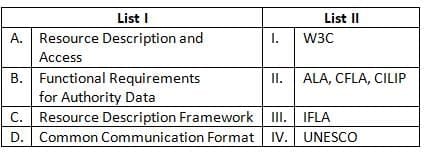
The Correct answer is (A) - (II), (B) - (III), (C) - (I), (D) - (IV)
Explanation
RDA:
- Resource Description and Access (RDA) is a standard for descriptive cataloging that was initially released in June 2010.
- It offers instructions and guidelines for creating bibliographic data and is intended for use by libraries, museums, archives, and other cultural organizations.
- RDA serves as the successor to the Anglo-American Cataloguing Rules, Second Edition (AACR2).
- The origins of RDA trace back to the International Conference on the Principles & Future Development of AACR held in Toronto in 1997.
- It is jointly published by the American Library Association, the Canadian Federation of Library Associations, and the Chartered Institute of Library and Information Professionals (CILIP) in the United Kingdom.
- The RDA Steering Committee (RSC) is responsible for maintaining RDA.
Functional Requirements for Authority Data:
- The Functional Requirements for Authority Data (FRAD) is a conceptual model developed by the International Federation of Library Associations (IFLA).
- It serves as a companion document to the Functional Requirements for Bibliographic Records (FRBR) conceptual model.
- FRAD introduces additional attributes for each of the Group 1, 2, and 3 entities, and it incorporates a new Group 2 entity (Family).
- This conceptual model also encompasses attributes designed to support the authority control process, including Name, Identifier, Controlled Access Point, Rules, and Agency.
Resource Description Framework:
- RDF stands for Resource Description Framework.
- RDF is a framework for describing resources on the web.
- The first version of RDF was published in 1998, final W3C recommendation was released on 10. February 2004.
- RDF documents are written in XML. The XML language used by RDF is called RDF/XML.
- RDF is a part of the W3C's Semantic Web Activity.
- RDF uses Web identifiers (URIs) to identify resources and describes resources with properties and property values.
- The combination of a Resource, a Property, and a Property value forms a Statement (known as the subject, predicate, and object of a Statement).
Common Communication Format (CCF):
- An international symposium in Taormina, Sicily conducted by UNESCO was held in April 1978.
- On the recommendations of the symposium, UNESCO/PGI formed the ad-hoc group on the establishment of a Common Communication Format (CCF).
- The first edition of CCF was published in 1984 under the editorship of Peter Simmons and Alan Hopkins and its second edition was published in 1988 in two volumes called CCF/B and CCF/F.
- Several countries have adopted this standard for the exchange and creation of bibliographic records at the national level.
Detailed Solution: Question 10
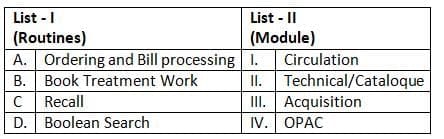
The Correct answer is A - III, B - II, C - I, D - IV
Explanation
- Ordering and Bill processing is related to the Acquisition module in library management systems. This module handles the acquisition of new materials and the processing of orders and bills.
- Book Treatment Work pertains to the Technical/Catalogue module. This module deals with cataloging and processing books to make them ready for circulation.
- Recall is a function of the Circulation module. This module manages the lending and returning of library materials, including recalls.
- Boolean Search is a feature of the OPAC (Online Public Access Catalog) module. This module allows users to search the library catalog using Boolean operators.
Other Related Points
- Circulation Module
- The Circulation module is essential for managing the borrowing and returning of library items.
- It includes features like issuing, returning, renewing, and recalling books.
- It also handles overdue fines and reservations.
- Technical/Catalogue Module
- The Technical/Catalogue module involves the technical processing of library materials.
- This includes cataloging, classification, and physical processing of materials.
- It ensures that materials are accurately described and easily retrievable.
- Acquisition Module
- The Acquisition module is responsible for the procurement of new materials.
- It handles the selection, ordering, and receiving of new books and resources.
- This module also deals with budget management and vendor communication.
- OPAC (Online Public Access Catalog) Module
- The OPAC module allows library users to search the catalog online.
- It provides search functionalities, including Boolean search, keyword search, and advanced search options.
- Users can check the availability of materials and place holds through the OPAC
Which of the following is true regarding Source Normalized Impact per Paper (SNIP)
(A). The Source Normalized Impact per Paper (SNIP) measures citation impact
(B). SNIP was developed by Professor Henk F. Moed
(C). SNIP was revised in 2015.
(D). % Self-Citations is the proportion of self-citations in a journal’s total citations in the last three years.
(A). The Source Normalized Impact per Paper (SNIP) measures citation impact
(B). SNIP was developed by Professor Henk F. Moed
(C). SNIP was revised in 2015.
(D). % Self-Citations is the proportion of self-citations in a journal’s total citations in the last three years.
Detailed Solution: Question 11
The Correct answer is A, B and D.
Explanation
- The Source Normalized Impact per Paper (SNIP) measures citation impact by adjusting for differences in citation practices across various fields.
- It assigns greater value to citations in areas where they are less common, ensuring more accurate cross-field comparisons of citation impact.
- Unlike the journal impact factor, SNIP accounts for subject-specific citation trends, making it a more reliable indicator.
- The CWTS Journal Indicators also include stability intervals to assess the reliability of a journal's SNIP value.
- SNIP was developed by Professor Henk F. Moed in 2009 at the Centre for Science and Technology Studies (CWTS) at the University of Leiden.
- 2012 Revision: Added new indicators:
- P: The number of publications in the past three years.
- RIP: Raw Impact per Publication, similar to the journal impact factor but without correcting for citation practice differences.
- SNIP: Corrects for these differences by normalizing citations, giving less weight to citations from publications with longer reference lists.
- % Self-Citations: The proportion of self-citations in a journal’s total citations in the last three years.
A questionnaire which provides a list of possible responses and allows the respondent to select any number of choices from the list-
Detailed Solution: Question 12
The correct answer is the Multiple Structured Questionnaire.
Explanation
- A Multiple Structured Questionnaire is a type of questionnaire that provides a list of possible responses.
- It allows the respondent to select any number of choices from the list.
- This type of questionnaire is commonly used in surveys and research to gather comprehensive data.
- It helps in collecting quantitative data as respondents can choose multiple options that apply to them.
- Structured questionnaires are designed to ensure that all respondents are asked the same set of questions in the same order.
- They help in improving the reliability and validity of the data collected.
- Examples include customer satisfaction surveys, market research surveys, and employee feedback forms.
Other Related Points
- Dichotomous Questionnaire
- A Dichotomous Questionnaire provides only two possible responses to each question, such as Yes/No or True/False.
- It is useful for simple, binary choices and is often used in preliminary surveys or screening questionnaires.
- Multiple Scaling Questionnaire
- A Multiple Scaling Questionnaire involves asking respondents to rate items on a scale, such as Likert scales or semantic differential scales.
- This type of questionnaire is used to measure attitudes, opinions, and perceptions.
- Multiple Dichotomous Questionnaire
- A Multiple Dichotomous Questionnaire combines elements of dichotomous questions with multiple-choice formats.
- Respondents are given multiple questions, each with a binary choice.
_______ supports libraries to promote culture and to safeguard and provide access to heritage, for the benefit of their communities today and tomorrow.
Detailed Solution: Question 13
The Correct answer is IFLA.
Explanation
- IFLA supports libraries to promote culture and to safeguard and provide access to heritage, for the benefit of their communities, today and tomorrow.
- Culture, encompassing both contemporary creativity and the heritage of the past, holds immense value in shaping the identity and development of societies.
- Libraries serve as essential platforms for supporting and preserving cultural heritage and fostering inclusive sustainable development.
Other Related Points
American Library Association (ALA):
- It is the oldest and largest library association in the world.
- The motto of ALA is The best reading, for the largest number at the least cost.
- ALA provides leadership for the development and improvement of the Library.
- ALA was established on October 6, 1876.
- When the ALA was forming Melvil Dewey and C. A Cutter was present there.
- Chicago is the headquarter of ALA.
- The ALA Constitution states the purpose of ALA as, “The object of the American Library Association shall be to promote library service and librarianship.”
- The stated mission is, “To provide leadership for the development, promotion, and improvement of library and information services and the profession of librarianship in order to enhance learning and ensure access to information for all.”
IFLA:
- The International Federation of Library Associations and Institutions (IFLA) is the leading international body representing the interests of people who rely on libraries and information professionals.
- IFLA was founded in Scotland in 1927 and maintains headquarters at the National Library of the Netherlands in The Hague.
- IFLA sponsors the annual IFLA World Library and Information Congress.
SLA:
- The Special Library Association (SLA) is a nonprofit global organization for information professionals and special librarians.
- It was founded in 1909 to provide a forum for exchanging information and ideas among those working in specialized libraries and information centers.
- John Cotton Dana is the founder and first president of SLA.
- In 1979, SLA created the John Cotton Dana Award to recognize selected information professionals for a lifetime of achievement as well as exceptional service to special librarianship. The Dana Award is SLA’s highest honor.
CILIP:
- It stands for The Chartered Institute of Library and Information Professionals.
- It came into existence in 2002 with the merger of the erstwhile Library Association (LA or LAUK) and the Institute of Information Science (IIS).
- It is headquartered in London, England.
- It is the only independent voice representing the UK's information profession.
Detailed Solution: Question 14
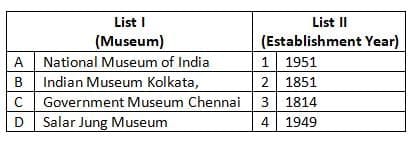
The Correct answer is A-4, B-3, C-2, D-1.
Explanation
- National Museum of India:
- The National Museum, also known as the National Museum of India, located in New Delhi, stands as one of India's largest and most significant museums.
- Established in 1949, it boasts a diverse collection of artifacts that span from the pre-historic era to contemporary works of art.
- Operating under the aegis of the Ministry of Culture, Government of India, the museum is situated on Janpath.
- The collection at the National Museum in New Delhi features several notable artifacts, including:
- Mother Goddess (2700–2100 BC)
- Toy Cart (2700–2100 BC)
- Bull (2700–2100 BC)
- Dancing Girl (2700–2100 BC)
- Indian Museum Kolkata:
- The Indian Museum, located in Central Kolkata, West Bengal, India, is a significant institution with a rich history.
- It is renowned for being the ninth oldest museum globally and holds the distinction of being the oldest and largest museum in India and Asia.
- Established in 1814 by the Asiatic Society of Bengal in Kolkata (formerly Calcutta), this institution was founded under the curatorship of Nathaniel Wallich, a Danish botanist.
- The museum is organized into six sections, each encompassing thirty-five galleries that house a diverse array of cultural and scientific artifacts.
- Government Museum Chennai:
- The Government Museum, Chennai, also known as the Madras Museum, is a significant repository of human history and culture situated within the Government Museum Complex in the Egmore neighborhood of Chennai, India.
- Established in 1851, it holds the distinction of being the second oldest museum in India, following the Indian Museum in Kolkata.
- The museum is especially renowned for its extensive archaeological and numismatic collections and boasts the largest assemblage of Roman antiquities outside of Europe.
- One of its remarkable features is the colossal Museum Theatre.
- The Salar Jung Museum
- The Salar Jung Museum, situated in Hyderabad, Telangana, India, is an esteemed art museum located at Dar-ul-Shifa, along the southern bank of the Musi River.
- This museum holds the distinction of being one of the prominent National Museums of India.
- Originally, it began as a private art collection owned by the Salar Jung family but was generously bequeathed to the nation after the passing of Salar Jung III.
- The museum was officially inaugurated on 16 December 1951.
In POPSI, a subject index entry is divided into three key sections:
(A). Approach-term Section
(B). Alphabetisation Section
(C). Organising Classification Section
(D). Location/Address Section
(A). Approach-term Section
(B). Alphabetisation Section
(C). Organising Classification Section
(D). Location/Address Section
Detailed Solution: Question 15
The Correct answer is A, C and D.
Explanation
- POPSI:
- It stands for "Postulate-based Permuted Subject Indexing (POPSI)".
- G. Bhattacharyya developed the POPSI through logical interpretation of the deep structure of subject indexing language (SIL) in 1980.
- It prescribes the use of apparatus words – such as prepositions, conjunctions, participles, etc. when necessary.
- It is built around fundamental theoretical ideas on classification, not on a specific classification system like class numbers.
- It is based on Ranganathan’s General Theory of Library Classification.
- Entry Format:
- In POPSI, a subject index entry is divided into three key sections:
- Approach-term Section: Contains the approach-term, with or without upper links, helping in locating subject entries.
- Organising Classification Section: Provides entries for organising classification, aiding in the understanding and relevance prediction of subjects.
- Location/Address Section: Lists the serial numbers of records, assisting in finding the bibliographic information related to the subject.
- In POPSI, a subject index entry is divided into three key sections:
Detailed Solution: Question 16
The Correct answer is Check digit
Explanation
- ISSN:
- It stands for International Standard Serial Number.
- It is an 8-digit serial number.
- It was first published by ISO in 1976.
- It is a unique serial number given to periodicals such as newspapers, and magazines to identify them.
- NISCAIR is the national center of ISSN for assigning ISSN to serials published in India.
- An ISSN is an eight-digit code separated by a hyphen into two sets of four digits.
- The last digit, ranging from zero to nine or represented by an X, serves as a check digit, uniquely identifying the ISSN by its first seven digits.
- The e-ISSN, or Electronic ISSN, is the standard label for the electronic media (online) version of a serial.
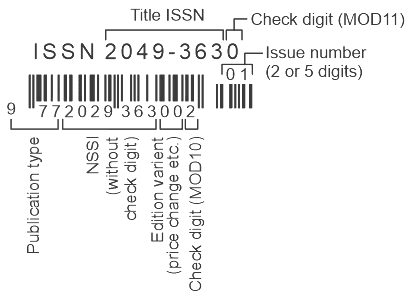
- ISNI:
- It stands for International Standard Name Identifier.
- It is the ISO-certified global standard number for uniquely identifying the contributors to creative works such as researchers, writers, artists, Etc.
- It was published by ISO on March 15, 2012.
- It is made up of 16 digits.
- ISBN:
- It stands for International Standard Book Number.
- It is a unique numeric commercial book identifier.
- The 10-digit ISBN format was developed by the International Organization for Standardization (ISO) in 1970.
- Since January 1, 2007, ISBN has contained 13 digits.
- Publishers purchase the ISBNs from an affiliate of the International ISBN Agency
- The Ministry of Human Resource Development, Government of India put the administration for ISBN India to Raja Rammohun Roy National Agency (RRRLF).
What is a common method used by libraries to verify the identity of a new member during the registration process?
Detailed Solution: Question 17
The correct answer is Submission of a valid ID proof.
Explanation
- Libraries often require the submission of a valid ID proof to verify the identity of new members during the registration process.
- This method ensures that the library can confirm the legitimacy and identity of the applicant.
- Common forms of valid ID proof include government-issued IDs such as a driver's license, passport, or national ID card.
- Submitting a valid ID proof helps to prevent fraudulent activities and ensures that the library maintains accurate and reliable records.
- It is a standard practice in many institutions to enhance security and accountability.
Other Related Points
- Telephone verification
- Telephone verification involves calling the applicant to confirm their identity. However, it is less commonly used due to the potential for miscommunication and privacy issues.
- Personal interview
- A personal interview may be conducted to verify identity, but it is more time-consuming and less efficient compared to submitting a valid ID proof.
- Social media profile check
- Checking social media profiles is not a reliable method for verifying identity due to privacy concerns and the potential for fake profiles.
Which organization is a successor to the General Agreement on Tariffs and Trade (GATT), 1994
Detailed Solution: Question 18
The Correct answer is World Trade Organization (WTO).
Explanation
- The General Agreement on Tariffs and Trade (GATT), signed in 1947 by 23 nations, is a treaty aimed at reducing barriers to international trade by eliminating or reducing quotas, tariffs, and subsidies.
- It was designed to stimulate economic recovery following World War II.
- GATT underwent expansion and refinement over the years, culminating in the establishment of the World Trade Organization (WTO) in 1995, which absorbed the organization responsible for implementing GATT.
- The Council for Trade in Goods (Goods Council), comprising representatives from all WTO member countries, now oversees GATT.
- The primary objective of GATT was to facilitate international trade.
- GATT conducted eight rounds from April 1947 to December 1993, each yielding significant achievements.
Other Related Points
- World Trade Organization (WTO):
- The World Trade Organization (WTO) is an intergovernmental body that regulates and facilitates global trade.
- Headquartered in Geneva, Switzerland, it operates in collaboration with the United Nations System to establish, revise, and enforce international trade rules.
- Formally operational since 1 January 1995, replacing the General Agreement on Tariffs and Trade (GATT) 1948.
- The WTO remains the largest international economic organization, ensuring fair and efficient global trade practices.
- WIPO:
- It stands for "World Intellectual Property Organization" established on July 14, 1967, and entered into force on April 26, 1970.
- It is one of the 15 specialized agencies of the United Nations (UN).
- It aims to promote and protect intellectual property (IP) across the world through international cooperation in the creation, dissemination, use, and protection of works of the human mind for the economic, cultural, and social progress of all mankind.
- IMF:
- The International Monetary Fund (IMF) is a prominent financial agency of the United Nations and an international financial institution supported by 190 member countries.
- Headquartered in Washington, D.C., the IMF is often regarded as the global lender of last resort and a key proponent of exchange-rate stability.
- It was founded on July 1944, at the Bretton Woods Conference.
- UNO:
- The UN (United Nations Organisation) was founded in 1945.
- It is committed to maintaining international peace and security and developing friendly relations among nations.
- It promotes social progress, better living standards, and human rights.
- The UN is headquartered in New York City.
In which year was the term of copyright extended to 60 years from 50 years after the death of the author in India ?
Detailed Solution: Question 19
The Correct answer is 1992.
Explanation
- In 1992, the Copyright (Amendment) Act extended India’s copyright term from the author’s life plus 50 years to life plus 60 years. Before this change, copyright lasted for 50 years after the author's death.
Other Related Points
- After independence, India introduced the Copyright Act, 1957, which remains the main law governing copyright today.
- This act aligns with major international copyright treaties that India has joined, including the Berne Convention (1886/1971), Universal Copyright Convention (1952), Geneva Phonogram Convention (1971), TRIPS Agreement (1995), WIPO Copyright Treaty (1996), WIPO Performances and Phonograms Treaty (1996), and the Marrakesh Treaty (2013) to improve access for visually impaired individuals.
Key Amendments: 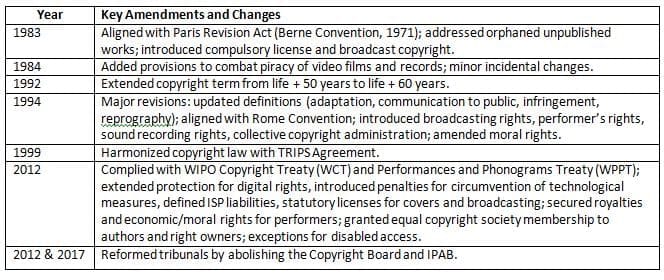
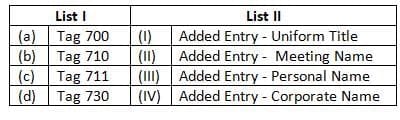
Match the following tags of MARC-21 format for Bibliographic data with the respective fields:
Detailed Solution: Question 20
The Correct answer is (A) - (III), (B) - (IV), (C) - (II), (D) - (I).
Explanation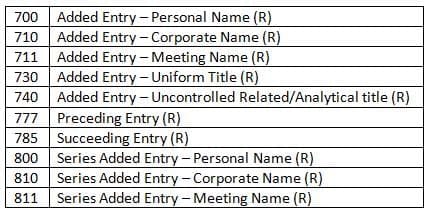
'Instruction designed to teach library users about the library collection, services and information seeking skill' is called:
Detailed Solution: Question 21
The Correct answer is User Education.
Explanation
- User Education refers to instructional programs designed to help library users understand the library's collection, services, and information-seeking skills.
- It includes orientation sessions, bibliographic instruction, information literacy training, and workshops to help users efficiently access and utilize library resources.
- Definitions of User Education:
- Fleming (1990) defines user education “as various programs of instruction, education, and exploration provided by libraries to users to enable them to make more effective, efficient and independent use of information sources and services to which these libraries provide access”.
- Mews (1972) defines this as instruction given to help the users to make the best use of the library.
- Nancy (1984) defines “User Education is concerned with the library whole information and communication process and one part of this involves the total user interaction.
- Jacques Tocatline (1978) defined `user education’ to include any effort or program that will guide and instruct existing and potential users, individually or collectively.
Components or levels of User education:
- Library orientation
- Library instruction
- Bibliographic instruction
Who created and has been managing the „Library Map of the World‟?
Detailed Solution: Question 22
The Correct answer is IFLA.
Explanation
- In 2017, IFLA developed “Library Map of the World” as an initiative to collect data from different types of libraries established in the world.
- The IFLA Library Map of the World serves as a comprehensive source of fundamental library statistics and a powerful tool for presenting country-level data and global comparisons of various library performance metrics by region.
- The Library Map of the World encompasses various library types such as national, academic, public, community, school, and special libraries.
- Functioning as both an informative resource and an advocacy tool, the Library Map of the World offers access to stories highlighting how libraries worldwide contribute to the United Nations Sustainable Development Goals.
- The development of the IFLA Library Map of the World involves partnerships with contributors, including national library associations, national libraries, library support organizations, and institutions globally.
- IFLA library map of the world describes the UN 2030 agenda for sustainable development (SDG).
Other Related Points
- UNESCO:
- UNESCO, short for the United Nations Educational, Scientific and Cultural Organization, is a specialized agency within the United Nations.
- Established in 1945, its primary objective is to promote global peace and security through international cooperation.
- UNESCO boasts 193 member countries and is headquartered in Paris, France.
- Key UNESCO Publications include:
- Copyright Bulletin (Quarterly)
- Impact of Science on Society (Quarterly)
- UNESCO Courier (Monthly)
- UNESCO Journal of Information Science Librarianship and Archives Administration (Quarterly) [Formerly UNESCO Bulletin for Libraries]
- UNO:
- Established in 1945, the United Nations (UN) is dedicated to upholding global peace and security while fostering amicable relations among nations.
- Its objectives include advancing social progress, improving living standards, and championing human rights.
- The UN has its headquarters in New York City.
- ALA:
- Founded on October 6, 1876, the American Library Association (ALA) stands as the oldest and largest library association globally.
- Headquartered in Chicago, ALA is dedicated to providing leadership for the enhancement and progress of libraries.
- Noteworthy figures like Melvil Dewey and C. A. Cutter played key roles during its formation.
- The association's motto is "The best reading, for the largest number at the least cost."
- IFLA:
- Established in 1927, the International Federation of Library Associations and Institutions (IFLA) is a non-governmental organization headquartered in The Hague.
- With over 1,400 member institutions from more than 140 countries, IFLA is dedicated to fostering global connections among library associations and professionals.
- The organization is actively involved in various programs and initiatives, including Sister Libraries for Children's and Young Adults Reading, demonstrating its commitment to promoting literacy among the youth.
- IFLA engages in core activities such as ALP Action for Development through Libraries Programme, PAC for Preservation and Conservation, ICADS for IFLA-CDNL Alliance for Digital Strategies, IFLA UNIMARC, FAIFE for Free Access to Information and Freedom of Expression, CLM for Committee on Copyright and Other Legal Matters, and COS for Committee on Standards.
Detailed Solution: Question 23
The Correct answer is Bowker Saur, East Grinstead.
Explanation
- Bowker Saur is a well-known publishing company that specializes in reference books, directories, and databases.
- In 1992, Bowker Saur published LISA Plus, which stands for Library and Information Science Abstracts Plus.
- LISA Plus is an essential resource for professionals in the field of library and information science.
- The publication provides abstracts and indexing for a wide range of library and information science literature.
- Bowker Saur is headquartered in East Grinstead, which is located in the county of West Sussex, England.
Other Related Points
- H.W. Wilson Company
- The H.W. Wilson Company is another notable publishing company that provides reference materials and databases, mainly for libraries.
- However, they were not the publishers of LISA Plus in 1992.
- Mc Graw Hill
- Mc Graw Hill is a global leader in educational content, software, and services.
- They focus on educational books and resources rather than specialized library science abstracts like LISA Plus.
Important Points
- Library and Information Science Abstracts (LISA) serves as a comprehensive international abstracting and indexing tool catering to the needs of library professionals and information specialists.
- Since its inception in 1969, LISA has covered a wide range of literature in Library and Information Science (LIS), encapsulating 440+ periodicals from over 68 countries, with content available in more than 20 languages.
- Initially published by the Library Association, LISA's publishing was later taken up by Bowker-Saur in 1991.
- Subsequently, Cambridge Information Group acquired Bowker in 2001, leading to the production of LISA by its subsidiary, Cambridge Scientific Abstracts.
- The merger of CSA with ProQuest in 2007 further solidified LISA's position in the field of LIS resources.
- LISA Plus-Library and Information Science Abstracts have been published by Bowker Saur, based in East Grinstead, Great Britain, in CD-ROM format since 1992, with quarterly releases throughout the year.
Under which Act, National Library of India receives book?
Detailed Solution: Question 24
the correct answer is the Delivery of Books Act, of 1954;
Explanation
- Delivery of Books Act,
- In 1954 Indian parliament passed the Delivery of Books (Public Libraries) Act.
- According to this Act, the publisher of every book, newspaper, or serial must deliver at his own expense a copy of the book within thirty days from the date of its publication to the National Library at Calcutta (Kolkata) and one copy each to three other public libraries specified by the Central Government.
- The Delivery of Books (Public Libraries) Act, 1954: No. 27 of 1954, amended by the Delivery of Books (Public Libraries) Amendment Act, 1956: No. 99 of 1956, and thus it became “The Delivery of Books 'and Newspapers' (Public Libraries) Act, 1954”.
Other Related Points
- The Registration of Books Act, 1887:
- The Registration of Books Act, of 1887 is an act of the Indian Parliament that provides for the registration of books published in India. The Act was passed on 16th September 1887 and came into effect on 1st January 1888.
- The nomenclature of the Act has been given by the Indian Short Titles Act, 1897 (14 of 1897).
- The purpose of the Registration of Books Act is to ensure that books published in India are registered with the government and that a record is maintained of all published works.
- In 2011, Govt introduced The Press and Registration of Books And the Publication Bill on 16 Dec.
- The Copyright Act, 1957:
- The Copyright Act in India is known as the Copyright Act, of 1957, which came into force on January 21, 1958.
- The copyright Act, of 1957, as amended in 1999 came into effect on January 15, 2000. In the following text, we will refer to it as the Act.
- The Copyright Act, of 1957 provides for the protection of original works of authorship, including literary, dramatic, musical, and artistic works, as well as cinematographic films and sound recordings.
- The copyright Act, 1976:
- Copyright Act, of 1976, is a federal law in the United States that provides copyright protection for original works of authorship.
Detailed Solution: Question 25
The Correct answer is Joint Photographic Experts Group.
Explanation
JPEG (Joint Photographic Experts Group):
- JPEG is a common file format for digital images.
- It is a lossy compression method designed to reduce the file size of photographic images while maintaining reasonable image quality.
- JPEG is widely used for storing and sharing photographs on the web, social media, and digital cameras due to its smaller file sizes compared to other formats like TIFF.
- However, JPEG compression may result in a loss of image detail, especially in areas with high contrast or sharp edges.
Other Related Points
TIFF (Tagged Image File Format):
- TIFF is a widely used raster graphics file format for storing high-quality images.
- It supports various color depths and compression methods, making it suitable for both photographic and line art images.
- TIFF files can preserve layers, transparency, and other image attributes, making them popular in professional environments where image quality is paramount, such as the printing and publishing industries.
PNG (Portable Network Graphics):
- PNG is a raster graphics file format that supports lossless data compression.
- It was developed as an improved alternative to the GIF format, offering support for more colors, transparency, and better compression.
- PNG files are widely used for web graphics, digital art, and other applications where lossless compression and transparency are desired.
- They are particularly suitable for images with text, line art, and images containing transparency layers
MPEG (Moving Picture Experts Group):
- MPEG is not an image file format but rather a standard for compressing audio and video data.
- It stands for Moving Picture Experts Group and is used for encoding digital video files.
- MPEG files are commonly used for streaming videos, DVDs, digital television, and other multimedia applications.
- Unlike image formats like TIFF and JPEG, MPEG files contain compressed audio and video streams.
In a literature review on professional values within Library and Information Science (LIS), Finks (1989) classifies these values into four categories:
(A). Intellectual Values
(B). Professional Values
(C). General Values
(D). Personal Values
(E). Rival Values
(A). Intellectual Values
(B). Professional Values
(C). General Values
(D). Personal Values
(E). Rival Values
Detailed Solution: Question 26
The Correct answer is B, C, D and E.
Explanation
- Lester (2010) defines a professional as an individual claiming expertise in a particular subject area and adhering to a specific code of values, both integral aspects of professional roles.
- Wikibooks (2013) emphasizes the significance of values in librarianship, asserting that values highlight what is "important and worthy in the long run," playing a defining role in the librarian profession.
- In a literature review on professional values within Library and Information Science (LIS), Finks (1989) classifies these values into four categories:
- Professional Values:
- Inherent to librarianship, these values encompass recognizing the significance of service and stewardship, upholding philosophical values reflecting wisdom, truth, and neutrality, preserving democratic values, and fostering a deep passion for reading and books.
- General Values:
- Shared by individuals across various fields, librarians' general values express a dedication to lifelong learning, the importance of tolerance and cooperation, and the need for acceptance in their work, social, and satisfaction contexts.
- Personal Values:
- Uniquely belonging to librarians, personal values include humanistic, idealistic, conservative, and aesthetic values.
- Librarians are encouraged to exhibit a genuine passion for people and reading.
- Rival Values:
- Posed as a threat to the mission of libraries, rival values encompass bureaucratic, antiintellectual, and nihilistic (useless and senseless) ideas.
- Librarians are urged to maintain faith in the profession's capacity to excel (Finks, 1989; Wikibooks, 2013).
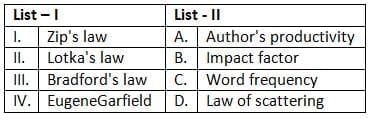
Match the following and select the correct answer from the codes given below:
Codes:
Detailed Solution: Question 27
The Correct answer is (I) - (C) , (II) - (A) , (III) - (D) , (IV) - (B).
Explanation
Zipf's Law
- Zipf's law refers to the fact that for many types of data studied in the physical and social sciences, the rank-frequency distribution is an inverse relation.
- According to this law, Rank x frequency = constant.
- Zipf's law was originally formulated in terms of quantitative linguistics
- The frequency of any word is inversely proportional to its rank in the frequency table.
- The law is named after the American linguist George Kingsley Zipf.
- The law is similar in concept, though not identical in distribution, to Benford's law.
Lotka's Law
- Lotka's law was named after Alfred J. Lotka.
- It is related to Scientific Productivity.
- It is one of a variety of special applications of Zipf's law.
- It describes the frequency of publication by authors in any given field.
- As the number of articles published increases, authors producing that many publications become less frequent.
The general formula is XnY = C
- X is the number of publications,
- Y is the relative frequency of authors with X publications.
Bradford's Law:
- Bradford's Law, formulated by Samuel C. Bradford in 1934, describes the diminishing returns when searching for references in science journals.
- According to one version of the law, if you group journals in a field into three segments, each containing roughly one-third of all articles, the number of journals in each segment follows a proportional pattern of 1:n:n2.
- It is also called as Law of scattering as it describes how the articles on a particular subject are scattered throughout the mass of periodicals.
Eugene Eli Garfield:
- Eugene Eli Garfield, an American linguist and entrepreneur, played a pivotal role in shaping the fields of bibliometrics and scientometrics.
- Notably, he was instrumental in the creation of renowned bibliographic tools such as Current Contents, the Science Citation Index (SCI), Journal Citation Reports, and Index Chemicus.
- The impact factor was devised by Eugene Garfield.
- In 1956, Garfield established the Institute for Scientific Information (ISI), through which he introduced several innovative citation databases.
- His notable contributions include the development of the magazine The Scientist and the publication of the compilation "Essays of an Information Scientist" in 1993.
Which of the following is not a characteristic of technical writing?
Detailed Solution: Question 28
The Correct answer is It is based on intuition, feeling and imagination.
Explanation
- Technical writing is a specialized, factual, and objective form of communication used primarily in scientific, engineering, and professional fields.
- It focuses on conveying accurate and clear information to help users understand complex concepts or complete specific tasks.
- It reports subject-specific data and ideas:
- This is a characteristic of technical writing.
- It often covers specialized topics in science, engineering, IT, medicine, and other fields.
- The goal is to present accurate, relevant, and topic-specific information that can be verified and applied.
- It presents information in tabular and graphical mode:
- Also a key feature of technical writing.
- Visual aids like tables, charts, diagrams, and graphs are used to:
- Simplify complex data
- Improve understanding
- Support written explanations
- These visuals make content more accessible and easier to interpret.
- It presents information as per the needs of potential readers:
- This aligns perfectly with the audience-focused nature of technical writing.
- Writers tailor content to the knowledge level, language ability, and needs of the target audience.
- A well-written technical document ensures that the user can understand and act on the information without confusion.
- Technical writing is not emotional, imaginative, or subjective:
- It avoids personal feelings, intuition, or creativity in the artistic sense.
- Instead, it emphasizes facts, logic, structure, and clarity.
- Writers base content on research, data, and observation, not personal opinion or creative expression.
"Living with Books : The Art of Book Selection is written by
Detailed Solution: Question 29
The Correct answer is H.E. Haines
Explanation
Book Selection Principles:
- L. R. McColvin: Theory of Book Selection (1925): McColvin introduced the Demand and Supply Theory of Book Selection in his book ‘Theory of Book Selection for Public Libraries’ first published in 1925.
- By the term ‘Supply’ he means the availability of reading material in all its varieties, whereas ‘Demand’, refers to the users’ expressed and unexpressed informational needs.
- Francis Drury: Book Selection (1930): Drury's book selection principles states ‘to provide the right book to the right user at the right time.
- According to his theory, READER is the central theme.
- Melvil Dewey's principle states, ‘the best reading for the largest number at the least cost’.
- According to this principle, a library should select, within the financial resources available, the best documents which may satisfy the information needs of the maximum number of readers.
- Helen E. Haines: Living with books (1935): The first edition of ‘Living with Books: The Art of Book Selection’ was published in 1935.
- It was one of the first true textbooks aimed at training librarians in the art of book selection.
- The 2nd edition came out in 1950.
- S. R. Ranganathan: Library book selection (1952, reprint 1990): The first edition of ‘Library Book Selection’ by Dr. S. R. Ranganathan appeared in 1952. The book describes how the first three laws of library science are helpful in formulating the principles of document selection for libraries
Detailed Solution: Question 30
The Correct answer is Technical.
Explanation
Refer to these Lines:
- The reason for counting self-sitations instead of self-links is technical.
- The reason for counting self-sitations, as mentioned in the passage, is Technical.
- The passage states: "
- The difference between self-links and self-sitations is that for self-sitations a page with several self-links is counted with multiplicity one.
- The reason for counting self-sitations instead of self links is technical."
Top Courses for KVS PGT/TGT/PRT

About this KVS PGT/TGT/PRT Mock Test
Explore more KVS PGT/TGT/PRT Resources
- Video Lectures: covering all the topics of KVS Librarian Exam Mock Test Series 2026
- Notes for Revision: offering revision notes, important questions, summaries, flashcards, cheatsheets & more for KVS PGT/TGT/PRT preparation
- MCQ Test: variety of questions as per the pattern of KVS PGT/TGT/PRT exam
within 7 days!