
KVS Librarian Exam Tier 2 Mock Test- 5 Free Online Test 2026
Full Mock Test & Solutions: KVS Librarian Tier 2 Mock Test- 5 (60 Questions)
You can boost your KVS PGT/TGT/PRT 2026 exam preparation with this KVS Librarian Tier 2 Mock Test- 5 (available with detailed solutions).. This mock test has been designed with the analysis of important topics, recent trends of the exam, and previous year questions of the last 3-years. All the questions have been designed to mirror the official pattern of KVS PGT/TGT/PRT 2026 exam, helping you build speed, accuracy as per the actual exam.
Mock Test Highlights:
- - Format: Multiple Choice Questions (MCQ)
- - Duration: 150 minutes
- - Total Questions: 60
- - Analysis: Detailed Solutions & Performance Insights
Sign up on EduRev for free and get access to these mock tests, get your All India Rank, and identify your weak areas to improve your marks & rank in the actual exam.

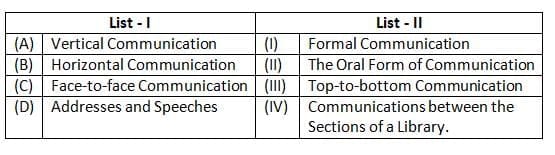
Detailed Solution: Question 1
The correct answer is a - III, b - IV, c - II, d - I
Explanation
- Vertical Communication (a) is related to Top to bottom Communication (III).
- Horizontal Communication (b) refers to Communications between the Sections of a Library (IV).
- Face to face Communication (c) is an Oral form of Communication (II).
- Addresses and Speeches (d) are a type of Formal Communication (I).
Other Related Points
- Vertical Communication
- Vertical communication occurs between different levels of the organizational hierarchy, such as between managers and their subordinates.
- It can be downward (from top to bottom) or upward (from bottom to top).
- This type of communication helps in the implementation of policies and procedures.
- Horizontal Communication
- Horizontal communication occurs between peers or colleagues at the same hierarchical level.
- It is crucial for coordination and collaboration within an organization.
- This type of communication ensures that different sections or departments work together efficiently.
- Face-to-face Communication
- Face to face communication is a direct, personal form of communication.
- It allows for immediate feedback and is effective for complex or sensitive discussions.
- This type of communication can include meetings, interviews, and casual conversations.
- Addresses and Speeches
- Addresses and speeches are formal methods of communication typically used in official settings.
- They are often used to convey important information to a large audience.
- Examples include presidential addresses, keynote speeches at conferences, and formal announcements.
Arrange the steps of Selective Dissemination of Information in the correct order :
(I) Matching
(II) Document Profile
(III) Notification
(IV) User Profile
(I) Matching
(II) Document Profile
(III) Notification
(IV) User Profile
Detailed Solution: Question 2
The Correct answer is (IV) (II) (I) (III).
Explanation
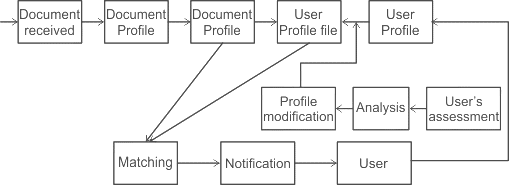
- Selective Dissemination of Information (SDI) refers to a service provided by libraries and information centers, aiming to deliver information on particular topics to individuals or groups based on their specific information requirements.
- The concept of selective dissemination of information (SDI) was originally proposed by Hans Peter Luhn in 1958.
- The initial implementation of the mechanized SDI system, following Luhn's design, took place in 1959 at the Advanced Systems Development Division of IBM Corporation.
- Components of SDI:
- User Profile – A user profile includes the name, address, and keyword/s that represent the interest of the user.
- The user profile may be corrected and needs to be updated from time to time.
- Document Profile: In the document profile complete bibliographical details of the documents are provided along with the keywords that represent the subject/s of the document.
- In the document profile, you may use any number of keywords as the document demands.
- Matching: In this process, the user profile file is matched with the document profile file. Usually, the matching is done by using a computer.
- Notification: The user will be notified by e-mail, or any other communication means about the document that has matched her/his profile.
- Feedback: Along with the document, a feedback card will also be sent. The user is supposed to fill in the card and send it back to the agency providing the service.
- User Profile – A user profile includes the name, address, and keyword/s that represent the interest of the user.
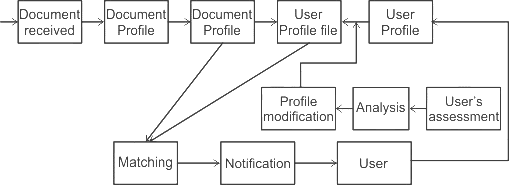
- SDI Flowchart:

“In stock room, each row of book-racks should be furnished at each end with a “signal” guide on which the classes accommodated in the row are indicated in a manner calculated to catch the eye of the reader”:
The S.R. Ranganathan’s guidelines mentioned above have to do with
The S.R. Ranganathan’s guidelines mentioned above have to do with
Detailed Solution: Question 3
The Correct answer is Fouth law:
Explanation
- S.R. Ranganathan's Fourth Law of Library Science, "Save the time of the reader," underscores the significance of making library services and resources as time-efficient as possible for the benefit of the library users.
- This law recognizes that readers' time is valuable, and libraries should strive to minimize any unnecessary delays or obstacles in accessing information.
- The guideline mentioned, "In stock room, each row of book-racks should be furnished at each end with a 'signal' guide on which the classes accommodated in the row are indicated in a manner calculated to catch the eye of the reader," directly aligns with the principle of saving the time of the reader.
- Clear Identification:
- The guideline emphasizes the importance of providing clear signals or guides at the ends of book-racks.
- This clear identification serves to catch the eye of the reader, making it easier for them to quickly locate the specific classes or categories of books they are interested in.
- Efficient Navigation:
- By having visible signals, readers can navigate through the stock room more efficiently.
- They can quickly identify the relevant section without having to spend unnecessary time searching or deciphering the arrangement of books.
- Minimizing Search Time:
- The ultimate goal is to minimize the time readers spend searching for books, ensuring that they can access the materials they need promptly.
- This aligns with the broader principle of saving the time of the reader, as advocated by the Fourth Law.
In a thesaurus, which is the type of relationship between a Discipline (e.g. Seismology) and Phenomena studied (e.g. Earthquakes)
Detailed Solution: Question 4
The Correct answer is Associative Relationship
Explanation
- The word `thesaurus' comes from the Greek term `thesauros' meaning a storehouse or treasury of words.
- The Oxford English Dictionary defines "thesaurus" as an archaeological term "a treasury of temple, etc." and quotes its use in 1736 as a treasury or storehouse of knowledge.
- The dictionary defines it as "a book of words or information about a particular field or a set of concepts, especially a dictionary of synonyms".
Relationships Between Terms
- Hierarchical Relationships: These relationships indicate a superordinate (broader) and subordinate (narrower) connection, and include:
- Genus-Species (Generic) Relationship: Links a broader concept (genus) to a narrower one (species).
- Whole-Part Relationship: The part is inherently related to its whole.
- Instance Relationship: Links a specific instance or proper name to a general concept.
- Non-Hierarchical Relationships; These describe relationships where terms are related in other ways:
- Equivalence (Preferential) Relationship: Used for terms that are nearly synonymous or interchangeable. Terms may be preferred or non-preferred
- Associative (Affinitive) Relationship: Connects terms that are conceptually related but don't follow hierarchical or equivalence patterns.
- Example:
- Birds → Ornithology (RT)
- Indexing → Efficiency (RT)
- Weaving → Cloth (RT)
- Seismology → Earthquakes
What is the effect of AI’s personalization on library users?
Detailed Solution: Question 5
The Correct answer is AI suggests resources tailored to user preferences and behavior.
Explanation
- Furthermore, AI is increasingly used in personalizing the library experience. Machine learning algorithms analyze user behavior to suggest books, journals, and research articles that match the user's interests and previous searches.
- AI analyzes user behavior for personalized recommendations.
- It helps to suggest books, journals, and research articles based on past interactions.
- It enhances engagement by matching resources to user interests.
- Personalized suggestions improve the learning experience.
Detailed Solution: Question 6
The Correct answer is 2012.
Explanation
- Founded in 2012, DigitalOcean was designed to provide simple and affordable cloud computing solutions for developers.
- Its first product, the Droplet, is an easy-to-use virtual machine that can be deployed in minutes.
- Over time, DigitalOcean has expanded its offerings to cater to both developers and small-to-medium-sized businesses (SMBs) at the forefront of innovation.
- Headquartered in New York City, DigitalOcean Holdings, Inc. is an American multinational cloud service provider with 15 data centers worldwide.
- The company offers cloud infrastructure-as-a-service platforms, primarily serving developers, startups, and SMBs.
- In addition to cloud services, DigitalOcean hosts Hacktoberfest, an annual event celebrating open-source software, in partnership with organizations like GitHub, Twilio, and Intel.
In Flowchart ___________ symbol serves to indicate either the beginning or the conclusion of the system.
Detailed Solution: Question 7
The Correct answer is Terminal.
Explanation
- Basic Symbols of a Flowchart:
- Terminal:
- The terminator symbol serves to indicate either the beginning or the conclusion of the system. Typically, it includes the label "Start" or "End."
- Terminal:

- Action or Process Symbol:
- A box can denote a singular action ("incorporate two cups of flour") or a complete sub-process ("create bread") within a broader process.

- Decision Symbol:
- A decision point or branching point is indicated. Lines emanating from various points of the diamond represent different choices.

- Connector:
- A Line is a connector that represents the relationship between representative shapes.

Other Related Points
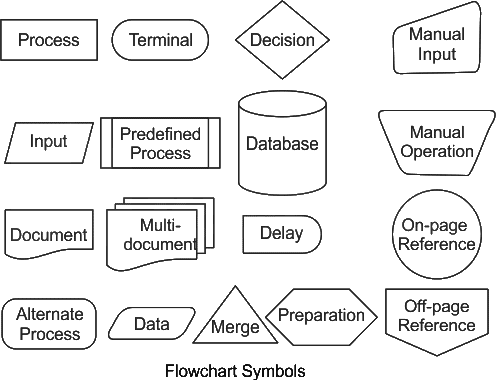
- Flow Chart:
- The flowchart is a diagram that visually presents the flow of data through processing systems.
- This means by seeing a flow chart one can know the operations performed and the sequence of these operations in a system. Algorithms are nothing but sequences of steps for solving problems. So a flow chart can be used for representing an algorithm.
- A flowchart will describe the operations (and in what sequence) required to solve a given problem
Match List I with List II
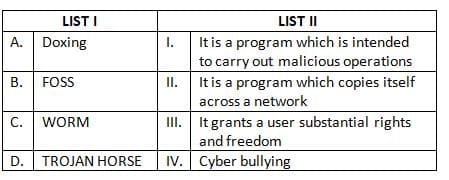
Choose the correct answer from the options given below:
Detailed Solution: Question 8
The correct answer is Option 1.
Explanation
- Doxing is associated with cyber bullying (IV).
- Doxing involves the act of publicly revealing or publishing private information about an individual, typically with malicious intent.
- FOSS (Free and Open Source Software) grants a user substantial rights and freedom (III).
- FOSS allows users to freely use, modify, and distribute software, fostering collaboration and transparency.
- A WORM (Write Once Read Many) is a program which copies itself across a network (II).
- A worm is a type of malware that replicates itself to spread to other computers, often exploiting network vulnerabilities.
- A Trojan Horse is a program which is intended to carry out malicious operations (I).
- Trojan Horse appears to be a legitimate program but performs malicious activities once executed.
Other Related Points
- Doxing can lead to severe consequences for victims, including harassment and identity theft.
- FOSS projects often have strong community support and can lead to rapid software improvement and innovation.
- Worms can cause significant damage by consuming bandwidth and overloading web servers.
- Trojan Horses can be used to steal sensitive data, install additional malware, or create backdoors into systems.
Detailed Solution: Question 9
The Correct answer is Misleading, Ugly, Superseded, Trivial, Irrelevant, Elsewhere available.
Explanation
- MUSTIE is the acronym for six negative factors that make books and other materials prime candidates for weeding.
- A few of these factors are noted as not relevant for ebooks but most can be applied to them.
- Misleading (and/or factually inaccurate).
- Weed outdated editions and books that are no longer accurate. Pay special attention to areas where information has changed recently or where it changes rapidly, like in medicine and travel.
- Ugly: Not relevant to e-books.
- Superseded (by a truly new edition or by a much better book on the subject).
- Especially for reference materials, test guides, and travel manuals, weed older editions. Most public libraries don’t need to keep older editions for research value
- Trivial (of no discernible literary or scientific merit; usually of ephemeral interest at some time in the past).
- Weed older titles that were of fleeting interest or are about outdated popular culture.
- Irrelevant to the needs and interests of your community.
- Even e-books should be expected to circulate or be used online at least once every few years.
- Also weed self-published e-books that are not circulating.
- Elsewhere – the material is easily obtainable from another library
- Misleading (and/or factually inaccurate).
Other Related Points
- General guidelines for collection management are adapted from the CREW method.
- CREW stands for Continuous Review, Evaluation, and Weeding
- CREW in Ten Steps
- Make weeding a part of policy
- Gather usage statistics of your library's collection.
- Build weeding into the year's work calendar
- Gather the following materials on a book truck at the shelves to be analyzed:
- A computer printout of the section being reviewed
- A blank note pad and sticky notes (like Post-It Notes™)
- A pen and/or colored pencils
- A shelf marker
- CREW manual (or a copy of the Overview Chart of CREW Formulas found in Appendix)
- An empty book cart
- Supply of disposal slips.
- Study the area you will be weeding as a whole
- Inventory the library's holding
- Check the pulled books against any standard indexes and bibliographic resources in the library's reference collection or in databases available to patrons.
- Treat the books according to their slips.
- Replacement checking and ordering
- Set up displays for low circulating, high quality books that would benefit from exposure.
- CREW manual was created by the Texas State Library and Archives Commission.
Which of the following is a Classical IR Model
(A). Boolean
(B). Information logic
(C). Vector
(D). Cluster model
(A). Boolean
(B). Information logic
(C). Vector
(D). Cluster model
Detailed Solution: Question 10
The Correct answer is A and C.
Explanation
- Information Retrieval (IR) is the process of finding relevant information from a collection of resources based on a user's query or need.
- Searches may use full-text or content-based indexing and can target documents, metadata, or databases containing text, images, or audio.
Types of IR Models:
- Classical IR Models
- Based on well-known mathematical principles
- Simple and easy to implement
- Includes: Boolean, Vector, and Probabilistic models
- Non-Classical IR Models
- Use different principles beyond similarity, probability, or Boolean logic
- Examples: Information Logic, Situation Theory, and Interaction models
- Alternative IR Models
- Enhance classical models using techniques from other fields
- Examples: Cluster, Fuzzy, and Latent Semantic Indexing (LSI) models
Identify the correct order in which the Library Committees were set up:
(i) A. L. Mudaliar Committee
(ii) J. Bhore Committee
(iii) Ekbote Committee
(iv) A. A. Fyzee Committee
Detailed Solution: Question 11
The Correct answer is (iv) (ii) (i) (iii).
Explanation
- A. A. Fyzee Committee:
- The Library Development Committee, Bombay 1939-40, led by Mr. A.A.A. Fyzee, was one of the earliest recognized committees dedicated to regional public libraries.
- While initially tasked with establishing central and regional libraries, the committee extended its focus to encompass a broader scope.
- It proposed a comprehensive plan for the development of libraries in the former Bombay province, spanning six stages, including villages with populations of less than 1,000.
- Due to the financial constraints of the committee's suggestions, the Government of Bombay was unable to implement all six stages.
- As a result of the Fyzee Committee's recommendations, one central library, three regional libraries, and 15 district libraries were established, marking the initiation of stages 1 and 2.
- J. Bhore Committee:
- Established by the Government of India in 1943, the Bhore Committee—officially the Health Survey and Development Committee—was chaired by Joseph William Bhore.
- Comprised of leading healthcare experts, the committee conducted a comprehensive review of India’s health system and submitted its report in 1946.
- The objective is to evaluate the country’s existing health conditions and infrastructure and recommend long-term strategies to improve public health services.
- Mudliar Commission of Secondary Education:
- In 1951, the Central Advisory Board of Education recommended the establishment of a Secondary Education Commission to the central government.
- Subsequently, on September 23, 1952, the government appointed the Secondary Education Commission, with Dr. Lakshamanswami Mudaliar, the then Vice Chancellor of Madras University, serving as its chairman.
- This commission came to be known as the Mudaliar Commission in honor of its chairman.
- Ekbote Committee:
- In February 1976, the Government of Andhra Pradesh constituted a committee chaired by Justice Gopal Rao Ekbote to review the functioning of the Andhra Pradesh Public Libraries Act 1960 and propose necessary amendments.
- The committee, which submitted its report in 1977, offered valuable recommendations on various aspects of the public library system.
In which order the library negotiates the price in advance with the vendor(s) and takes its delivery on multiple dates over some time?
Detailed Solution: Question 12
The Correct answer is Blanket order.
Explanation
- Blanket Orders in Library Acquisitions:
- Blanket orders in library acquisitions signify a thorough commitment to obtaining all materials related to a specific topic or category from a designated publisher or vendor.
- This approach enables libraries to simplify their acquisition procedures, especially when managing specialized collections or focused subjects.
- Through a blanket order, the library secures all pertinent materials published by the specified source, eliminating the necessity for individual selection or assessment for each item.
- A Blanket Order is a purchasing arrangement in which a library negotiates the price in advance with one or more vendors for multiple items or services.
- Instead of placing individual orders for each item as the need arises, the library issues a single, overall purchase order that covers a specified period.
- The vendor is then obligated to supply the requested items or services as needed during that time frame.
Other Related Points
- Standing Orders:
- Standing orders in library acquisitions refer to ongoing open orders for all titles that fall within a specific category or subject.
- This method is particularly beneficial for the continuous acquisition of series or serials.
- Libraries utilize standing orders to ensure the automatic acquisition of new titles within a predefined subject area or category, eliminating the need for individual and manual ordering for each new item.
- By setting up standing orders, libraries can streamline the process of obtaining new materials and ensure the timely inclusion of relevant resources in their collections.
- Firm Orders:
- These are specific orders for particular titles, often books or journals, that the library desires to include in its collection.
- Subscriptions:
- Commonly used for journals, newspapers, and other serials, subscriptions involve making a contract with a publisher or vendor for automatic delivery of the specified materials for a set period.
Which is the first library to use Artificial Intelligence and robots to help people to find books?
Detailed Solution: Question 13
The correct answer is Mohammed bin Rashid Library.
Explanation
- The Mohammed bin Rashid Library is the first library to use Artificial Intelligence (AI) and robots to help people find books.
- Located in Dubai, UAE, this library is a part of the Dubai Future Foundation initiative.
- The library features automated systems and robotic assistants that guide visitors to their desired books and sections.
- It aims to provide a futuristic and seamless experience for its users by integrating technology into traditional library services.
- The library is designed to support the UAE's vision of becoming a global leader in innovation and technology.
Other Related Points
- Baker Library/Bloomberg Center of Harvard Business School
- The Baker Library/Bloomberg Center is a part of Harvard Business School and is renowned for its extensive collection of business and management resources.
- It does not, however, utilize AI and robots to assist in finding books.
- California Library
- While California is home to many advanced libraries, there is no specific library named "California Library" known for the use of AI and robots for assisting users.
- The Royal Library, Denmark
- The Royal Library, also known as the Black Diamond, is the national library of Denmark and one of the largest in the world.
- It is known for its vast collection and architectural beauty but does not use AI and robots for book assistance.
Detailed Solution: Question 14
The Correct answer is Full-text Database.
Explanation
- PubMed Central (PMC) is a digital repository that stores open-access full-text scholarly articles from biomedical and life sciences journals.
- PubMed Central, originally conceived as E-Biomed, was first proposed in May 1999 by Harold Varmus, the then-NIH director.
- Established in February 2000, the repository has experienced significant growth due to the NIH Public Access Policy.
- This policy aims to ensure that all research funded by the National Institutes of Health (NIH) is readily available to the public.
- The PMCID (PubMed Central identifier), also referred to as the PMC reference number, serves as a bibliographic identifier specific to the PubMed Central open-access database.
- Similar to the PMID for the PubMed database, the PMCID is a distinct identifier and follows the format "PMC" followed by a string of numbers.
Other Related Points
PubMED:
- PubMed is a freely accessible search engine primarily indexing the MEDLINE database, which contains references and abstracts on topics related to life sciences and biomedicine.
- Maintained by the United States National Library of Medicine (NLM) at the National Institutes of Health (NIH), PubMed forms part of the Entrez system for information retrieval.
- Before PubMed's launch in January 1996, access to the MEDLINE database was primarily through institutional facilities like medical libraries. PubMed revolutionized this access, offering private, free, and home-computerized searching of MEDLINE.
- It became publicly available in June 1997, marking the beginning of web-based MEDLINE searches
Who coined the term "Information Science" in the 1950s?
Detailed Solution: Question 15
The Correct answer is Jason Farradane
Explanation
- The term “information scientist” was introduced in the 1950s by Jason Farradane, who envisioned a professional dedicated to managing and sharing knowledge within industrial and research settings.
- According to sources like ResearchGate and ProQuest, he positioned this role as analogous to a research scientist, emphasizing its scientific foundation.
- Jason Farradane: Coined “information scientist” to define a role centered on organizational knowledge management.
- Claude Shannon: His 1940s work on information theory laid the groundwork for viewing information as a quantifiable concept.
Other Related Points
- Alan Turing: Known for foundational work in computing and artificial intelligence, but not linked to coining "Information Science".
- Claude Shannon: Known as the father of Information Theory, but his work focused on the mathematical theory of communication, not the broader field of Information Science.
- John von Neumann: A key figure in computing and mathematics, but not associated with the specific term “Information Science”.
What is the essential aspect of information service?
Detailed Solution: Question 16
The correct answer is Communication of information.
Explanation
- Communication of information is the most essential aspect of information services as it involves the dissemination and sharing of information with the intended audience.
- This ensures that the right information reaches the right people at the right time.
- Effective communication is crucial for decision-making, problem-solving, and knowledge sharing within an organization or community.
- Information services utilize various channels and technologies to facilitate the communication process. These include the internet, email, social media, and traditional media.
- The primary goal of information communication is to ensure that the information provided is accurate, timely, and accessible to those who need it.
- Communication also incorporates feedback mechanisms to verify that the information meets the users' needs.
Other Related Points
- Retrieval of information
- This refers to the process of accessing and obtaining information from various sources.
- While essential, it is a preliminary step and not the most essential aspect of an information service.
- Storage of information
- This involves the organization and preservation of information for future use.
- It ensures that information is kept safe and can be retrieved when needed, but it does not encompass the broader aspect of communication.
- Collection of information
- This is the process of gathering data and information from various sources.
- It is crucial for building a comprehensive information base but does not address the need for effective information dissemination.
What is the role of PREMIS in digital preservation?
Detailed Solution: Question 17
The Correct answer is To provide metadata standards for long-term digital object preservation.
Explanation
- PREMIS (Preservation Metadata Implementation Strategies) standard offers a framework for recording essential information needed to ensure the long-term usability of digital objects.
- PREMIS provides metadata standards for digital preservation.
- It ensures the long-term usability of digital objects.
- The standard includes a data dictionary and model for metadata.
- It does not provide hardware solutions or financial support.
Other Related Points
- PREMIS, which stands for "PREservation Metadata: Implementation Strategies," was an international working group sponsored by OCLC and RLG from 2003 to 2005.
- The group developed the PREMIS Data Dictionary for Preservation Metadata, providing both a data dictionary and narrative guidance on preservation metadata.
- The second version of this report was issued in March 2008, with the Library of Congress maintaining a schema for representing PREMIS in XML.
- The PREMIS data model defines five key entities:
- Intellectual Entities
- Objects
- Events
- Rights
- Agents
Which of the following is a disadvantage of Multi-Factor Authentication (MFA)?
Detailed Solution: Question 18
The Correct answer is Time-consuming.
Explanation
- Multi-Factor Authentication (MFA):
- In this system, multiple authentication factors are required, providing enhanced security. MFA prevents attacks like keylogging and phishing.
- Advantages:
- No risk of security breaches
- Protects against keyloggers and phishing
- Information is well-secured
- Disadvantages:
- Can be time-consuming
- May rely on third-party services
Other Related Points
Single-Factor Authentication (SFA)
- This is the simplest form of authentication, where a user provides a username and password to gain access. If either of these is incorrect, access is denied.
- Advantages:
- Easy to use
- Cost-effective
- Requires minimal user knowledge
- Disadvantages:
- Not very secure, relying solely on password strength
- Low protection level
Two-Factor Authentication (2FA)
- This method requires the user to enter a username, password, and an additional factor like OTP, virtual tokens, or wireless tokens.
- Advantages:
- Stronger security than SFA
- Reduces risks of fraud and unauthorized access
- Increases user trust in the system
- Disadvantages:
- Can be time-consuming
In which edition of CC A New indicator digit "&" (ampersand) is used in place of old indicator digit "0" (zero) for Phase Relation.
Detailed Solution: Question 19
The Correct answer is 7th.
Explanation
- In Edition 7 of CC (1987), several changes were introduced.
Some of the key updates include:
- The number of Main Subjects/Basics Subjects was increased.
- Some subjects were divided into canonical divisions (e.g., Book Science, Research Technique).
- Certain isolates, like [1PI], were treated as canonical divisions in subjects such as Engineering, Technology, Geography, and Economics.
- New formations, such as agglomeration (Subject Bundles), were added as canonical divisions.
- Systems and specials were reclassified as Basic Subjects.
- The double inverted comma (") is now used to indicate an "Anteriorising Isolate" instead of Roman small letters, which were used in Edition 6.
- [E], [MIT], and [P] are now recognized as Common Fundamental Category Isolates.
- The ampersand (&) replaces the zero (0) for Phase Relation.
- Facet formula changes were made, particularly the insertion of a comma (",") before Level 1 of the [P] facet in any Round or subject.
According to ISI standard, the height of the book rack should be:
Detailed Solution: Question 20
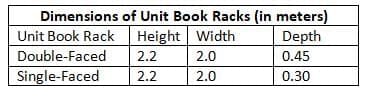
The correct answer is "2.200 meters ".
|Explanation
- Dimension of the Unit Book Racks:
- Generally, a 350 mm center-to-center distance should be adopted for shelves.
- The overall tolerance (dimensions specified in Table 1) shall not vary by more than ± 5 mm.
- The wooden book racks shall be rectangular at all the measurable surfaces within a tolerance of ± 8 mm between the two diagonals of the rectangle.
Other Related Points
- Indian Standard Specification for Library Furniture and Fitting:
- This Indian Standard (First Revision) was adopted by the Indian Standards Institution on 22 February 1978, after the draft finalized by the Library Buildings, Fittings, and the Civil Engineering Division Council had approved Furniture Sectional Committee.
- Keeping this in view IS: 1553-1976* was prepared to serve as a guide relating to essential design elements pertaining to library buildings.
- This standard was first published in 1961.
- The dimensions for different items of furniture have been modified and the size and shape of the control region altered, for optimum utilization of space
- In the formulation of this standard due weightage has been given to international co-ordination among the standards and practices prevailing in different countries in addition to relating to the practices in the field in this country
- This standard is one of a series of Indian Standards covering the requirements of libraries.
Detailed Solution: Question 21
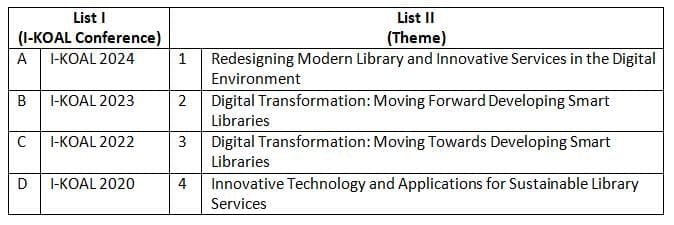
The Correct answer is Innovative Technology and Applications for Sustainable Library Services.
Explanation
- The International Conference on Knowledge Organisation in Academic Libraries (I-KOAL), formerly known as the National Conference on Knowledge Organisation in Academic Libraries (KOAL), is organized by the Library Professionals Association (LPA) in India.
- I-KOAL 2024: February 15-16, 2024, MIT World Peace University, Pune, India
- Conference Theme: Innovative Technology and Applications for Sustainable Library Services
- Co-organizer: Knowledge Resource Centre, Dr. Vishwanath Karad MIT World Peace University
- I-KOAL 2023: January 20-21, 2023, C-DAC, Navi Mumbai, India
- Conference Theme: Redesigning Modern Library and Innovative Services in the Digital Environment
- Co-organizer: Mumbai Library; Centre for Development of Advanced Computing
- I-KOAL 2022: April 22-23, 2022, Tumkur University, Tumkuru, India
- Conference Theme: Digital Transformation: Moving Forward Developing Smart Libraries
- Co-organizer: Department of Studies and Research in Library and Information Science, Tumkur University
- I-KOAL 2020: October 16-17, 2020, Tumkur University, Tumkuru, India
- Conference Theme: Digital Transformation: Moving Towards Developing Smart Libraries
- I--KOAL 2019: September 12-13, 2019, Sardar Patel University, Vallabh Vidyanagar, India
- Theme: Building Smart Libraries: Challenges and Discovery Tools
- Co-organizer: Bhaikaka Library (University Library) & Department of Library and Information Science, Sardar Patel University
Detailed Solution: Question 22
The correct answer is the National Centre on Bibliometrics.
Explanation
- The CSIR Research Output is an annual publication produced by the National Centre on Bibliometrics.
- However, its circulation is limited.
- Another significant publication by the Centre is In Search of Knowledge, which features the best research papers produced by CSIR since its inception in 1942.
- Each laboratory initially selected the best papers, and only those meeting the citation criteria for each subject were included in the volumes.
Other Related Points
National Centre on Bibliometrics
- The establishment of the National Centre on Bibliometrics (NCB) in 1988 with the support of NISSAT is possibly the greatest contribution of INSDOC to bibliometrics.
The objectives of the Centre were:
- To create an S & T citation database of Indian contributions appearing in Indian S & T journals;
- To develop tools, techniques, and modalities for the analysis of research output based on SCI data and the Indian S &T citation database
- to analyze the research outputs of selected research institutions, agencies, universities, and other similar bodies.
- The efforts enumerated above would develop science indicators that could be useful in planning, funding, policy-making for R & D management, assessment of R & D output, etc. in any specialized system or conglomeration of systems.
Which of the following is the first step in starting the research process?
Detailed Solution: Question 23
The correct answer is Identification of the problem.
Explanation
Steps in Research:
- Identify a Research Question:
- The first step is to identify a research question that is clear, focused, and researchable. This question should be relevant to your field of study and have the potential to make a meaningful contribution to the existing knowledge base.
- Conduct a Literature Review:
- A comprehensive literature review is crucial to understanding the current state of knowledge on your research topic. It involves reviewing academic publications, books, reports, and other relevant sources to gather information about the existing research, identify gaps in knowledge, and position your study within the broader context of the field.
- Develop a Research Design:
- The research design outlines the plan for conducting your research and answering your research question. It specifies the type of research approach (quantitative, qualitative, or mixed methods), the data collection methods, the sampling procedures, and the data analysis techniques.
- Collect Data:
- Data collection is the process of gathering the information needed to address your research question. The specific data collection methods will depend on your research design and may include surveys, interviews, observations, experiments, or document analysis.
- Analyze Data:
- Data analysis involves organizing, interpreting, and evaluating the data you have collected. The specific data analysis techniques will depend on the type of data you have collected and your research question.
- Interpret Results:
- Interpreting the results involves drawing conclusions from your data analysis and linking them back to your research question. This process involves understanding the patterns, trends, and relationships in the data and explaining their significance in the context of your research topic.
- Communicate Findings:
- The final step is to communicate your research findings effectively to the intended audience. This may involve writing a research report, presenting at conferences, or publishing your findings in academic journals.
Who said, “Public Library is the responsibility of Local and National Authorities. It must be supported by specific legislation and financed by National and Local Governments”?
Detailed Solution: Question 24
In UNESCO Manifesto 1994, the statement was made that:
“Public Library is the responsibility of Local and National Authorities. It must be supported by specific legislation and financed by National and Local Government. It has to be an essential component of any long-term strategy for culture, information provision, literacy and educations”
Comments:
- Public libraries are a community agency providing access at local level to a range of knowledge and information for the benefit of the individual and society as a whole.
- In order to maintain the level of service required to fulfil their functions public libraries should be supported by legislation and sustained funding.
Which of the following are maintained to provide Selective Dissemination of Information (SDI) service?
1) Author Profile
2) Library Profile
3) Document Profile
4) User Profile
1) Author Profile
2) Library Profile
3) Document Profile
4) User Profile
Detailed Solution: Question 25
The correct answer is 3 and 4 are correct.
Explanation
- Selective Dissemination of Information (SDI) is a service that provides users with information tailored to their specific needs and interests.
- Selective Dissemination of Information (SDI):
- Selective Dissemination of Information (SDI) refers to a specialized service provided by libraries and information centers, aiming to cater to the specific information requirements of individuals or groups by delivering pertinent information on particular topics.
- The concept of SDI was initially proposed by Hans Peter Luhn in 1958.
- The first implementation of the mechanized SDI system, following Luhn's blueprint, took place in 1959 at the Advanced Systems Development Division of IBM Corporation.
- Elements of SDI:
- User Profile:
- The user profile contains essential details such as the user's name, address, and specific keywords representing their areas of interest.
- Regular updates and corrections are necessary to ensure the profile remains relevant.
- Document Profile:
- The document profile encompasses comprehensive bibliographic information about the documents, accompanied by keywords reflecting the document's subjects.
- There is no restriction on the number of keywords that can be used, depending on the document's content.
- Matching:
- This stage involves the comparison of the user profile file with the document profile file, typically executed using a computer or automated system.
- Notification:
- Users receive notifications through email or other communication channels informing them about the documents that align with their profiles.
- Feedback:
- In addition to the document, a feedback card is provided, prompting users to share their input by completing the card and returning it to the service provider.
- User Profile:
- SDI Flow Chart
Library and Information Science (LIS) education in India completed its ______ years in the year 2011.
Detailed Solution: Question 26
The Correct answer is 100 years.
Explanation
- Library and Information Science education has played a pivotal role in advancing the information society in India through well-planned initiatives.
- In 2011, Library and Information Science education in India celebrated its centenary, highlighting its significant contributions.
- S.R. Ranganathan (1892–1972), recognized as the father of the library movement in India, introduced formal LIS education in the country.
- The earliest evidence of library training in modern India dates back to 1903 when a staff member from the Central Hindu College in Benaras received in-house training at the Imperial Library (National Library) in Calcutta.
- Maharaja Sayaji Rao Gaekwad II, the ruler of Baroda State, made a notable contribution to library development.
- In 1906, he invited William Alanson Borden from the USA, a student of the first batch of the Albany School founded by Melvil Dewey in 1887.
- Borden, an experienced librarian, worked with Melvil Dewey as a lecturer at the Library School of Columbia University, the world's first Library School
- Impressed by the public libraries in the United States, Maharaja Sayaji Rao Gaekwad II established a free public library network in Baroda State by 1910.
- Recognizing the need for qualified personnel, he, under Borden's guidance, inaugurated a Library Science School in Baroda in 1911, marking the commencement of library education in India.
- In 1915, the University of Punjab in Lahore (undivided India) saw the establishment of the second library school. This initiative was led by Mr. Asa Don Dickinson, an American librarian who had studied under Melvil Dewey.
Detailed Solution: Question 27
The Correct answer is Experimental research.?
Explanation
- A control group in experimental research refers to a group that is not exposed to the experimental treatment or variable, used for comparison with the experimental group.
- This helps determine whether observed changes in the experimental group are truly due to the treatment, rather than other factors.
- Purpose: The control group acts as a baseline to isolate the effects of the treatment.
- How it works: Researchers keep all conditions the same for both groups, except for the treatment being tested, ensuring that any differences observed are due to the treatment itself.
Other Related Points
- Case study: This refers to a detailed investigation of a particular individual or group, often used to explore certain phenomena in depth. It doesn't typically involve control groups.
- Historical research: This involves studying past events and is not typically associated with controlled groups, which are more commonly used in experimental designs.
- Experimental research: This is the correct answer. In experimental research, a "controlled group" is used to compare with the experimental group to test the effect of an independent variable.
- Descriptive research: This type of research aims to describe characteristics of a phenomenon but does not generally use controlled groups for comparison.
Videotext is a generic term that refers to both videotext and __________.
Detailed Solution: Question 28
The Correct answer is Teletext.
Explanation
- Videotex (or Videotext) was an early system that allowed interactive text and graphics to be displayed on a TV or terminal through a telephone line.
- Teletext is a broadcast information service where pages of text are sent along with the TV signal.
- Videotext and Teletext are innovative information services that brought computer-like functions to the television.
- Though similar, they differ in technology: Videotext is an interactive system that lets users request information from a central computer via telephone or cable lines, while Teletext delivers pre-transmitted information over the air, retrievable directly on TV screens.
- Together, they represent a new wave of communication technologies, turning television from a mere entertainment medium into a powerful information tool.
_________ method of budgeting was first proposed by USDOD (United States Department of Defence).
Detailed Solution: Question 29
The Correct answer is PPBS (Planning, Programming, Budgeting System).
Explanation
- The Planning, Programming, Budgeting System (PPBS) was first proposed by the United States Department of Defense (USDOD).
- PPBS is a management tool used to ensure that the organization’s resources are allocated in an efficient manner.
- It involves a systematic process of setting objectives, identifying resources, and budgeting for the achievement of these objectives.
- The main goal of PPBS is to improve the efficiency and effectiveness of government programs and operations.
- PPBS is characterized by its focus on long-term planning and the integration of budgeting with planning and programming.
- It was introduced in the early 1960s to address the need for a more organized and structured approach to government budgeting.
Other Related Points
- ZBB (Zero-Based Budgeting)
- Zero-Based Budgeting (ZBB) is a budgeting method where all expenses must be justified for each new period.
- ZBB starts from a "zero base" and every function within an organization is analyzed for its needs and costs.
- It was developed in the 1970s by Peter Pyhrr and became popular in both the public and private sectors.
- Performance Budgeting
- Performance Budgeting focuses on the outcomes and results of the budgeted programs.
- It aims to improve the efficiency and effectiveness of public spending by linking the allocation of resources to the achievement of specific performance targets.
- This method is widely used in various governments and organizations to enhance accountability.
- Line-Item Budgeting
- Line-Item Budgeting is the traditional form of budgeting where expenditures are listed by specific categories or items.
- This method is easy to understand and provides a clear picture of where funds are being allocated.
- However, it does not focus on the results or outcomes of the expenditures.
Identify the Library:
(a) This library in India is known for its large collection of rare manuscripts.
(b) Founder of this library opened it for the people in 1891.
(c) The founder of this library was buried in the premises of this library.
(a) This library in India is known for its large collection of rare manuscripts.
(b) Founder of this library opened it for the people in 1891.
(c) The founder of this library was buried in the premises of this library.
Detailed Solution: Question 30
The correct answer is Khuda Baksh Oriental Public Library.
Explanation
- Khuda Bakhsh Oriental Public Library:
- The origin of the establishment is back in 1842 as Muhammadiyah Private Library.
- It is situated in Patna (Bihar).
- 29th of October in 1891 it was established as Khuda Bakhsh Oriental Public Library by HMJ Sir Khan Bahadur Khuda Baksh and opened to the public.
- Maulvi Muhammad Baksh Khan, on his death, left a collection of 1500 manuscripts.
- The Govt. of India declared the Library an Institution of National Importance by an act of Parliament in 1969.
- The Library is now fully funded by the Ministry of Culture (Govt. of India).
- It is one of the National Libraries of India.
- It is an autonomous organization under the Ministry of Culture and is governed by a board with the Government of Bihar as its ex officio chairman.
- The library is also a designated Manuscript Conservation Centre (MCC) under the National Mission for Manuscript.
- Khuda Bakhsh Khan, the founder, is buried in the premises of the library.
Other Related Points
- Connemara Public Library:
- The Connemara Public Library is located in Chennai, the capital city of the Indian state of Tamil Nadu.
- The library is situated on Pantheon Road in the Egmore neighborhood of Chennai.
- It is one of the four National Depository Libraries in India and is known for its extensive collection of books, manuscripts, and other materials related to the history and culture of Tamil Nadu and India.
- The Connemara Public Library was established in 1896 and was named after Lord Connemara (by then the former Governor), an Anglo-Irish nobleman.
- It became the state central library in 1950.
- In 1981 the central government ordered that the library became one of the four national depository libraries.
- Edgar Thurston was its first librarian.
- K. Selvakumar is its present librarian (02 February 2021 onwards)
- Adyar Library:
- The Adyar Library and Research Centre is located in Chennai and was founded in 1886 by Colonel Olcott.
- This library specializes in Indological research and holds a significant collection of manuscripts in various languages.
- Kavi Narmad Central Library:
- The Kavi Narmad Central Library is located in Surat, Gujarat.
- It is named after the famous Gujarati poet Narmadashankar Lalshankar Dave, also known as Kavi Narmad.
Top Courses for KVS PGT/TGT/PRT

About this KVS PGT/TGT/PRT Mock Test
Explore more KVS PGT/TGT/PRT Resources
- Video Lectures: covering all the topics of KVS Librarian Exam Mock Test Series 2026
- Notes for Revision: offering revision notes, important questions, summaries, flashcards, cheatsheets & more for KVS PGT/TGT/PRT preparation
- MCQ Test: variety of questions as per the pattern of KVS PGT/TGT/PRT exam