Bank Exams Exam  >  Bank Exams Test  >  IBPS PO Prelims & Mains Preparation  >  Practice Test 3: Reasoning Ability - Bank Exams MCQ

Practice Test 3: Reasoning Ability Bank Exams MCQs & solutions - Free


MCQ Practice Test & Solutions: Practice Test 3: Reasoning Ability (20 Questions)

You can prepare effectively for Bank Exams IBPS PO Prelims & Mains Preparation with this dedicated MCQ Practice Test (available with solutions) on the important topic of "Practice Test 3: Reasoning Ability". These 20 questions have been designed by the experts with the latest curriculum of Bank Exams 2026, to help you master the concept.

Test Highlights:

  • - Format: Multiple Choice Questions (MCQ)
  • - Duration: 20 minutes
  • - Number of Questions: 20

Sign up on EduRev for free to attempt this test and track your preparation progress.

Practice Test 3: Reasoning Ability - Question 1

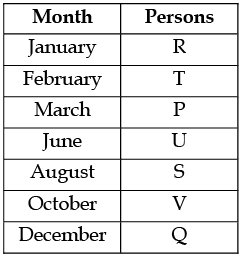
Who among the following person has seminar just before of U?

Detailed Solution: Question 1
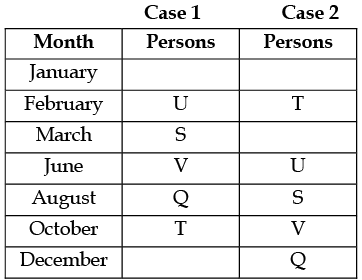
From the given statements, U’s seminar is just before of S but not in the month which has 31 days. Here, we get two possibilities now i.e. Case 1 and Case 2. There are two persons who have a seminar between S and T. V has seminar just before of Q. 

From the given statements, there is one person’s seminar between R and P, whose seminar is after R. Now, Case 1 is ruled out now. 
So, the final arrangement will be like this-

Practice Test 3: Reasoning Ability - Question 2

Which of the following information is true with regarding to Q?

Detailed Solution: Question 2

From the given statements, U’s seminar is just before of S but not in the month which has 31 days. Here, we get two possibilities now i.e. Case 1 and Case 2. There are two persons who have a seminar between S and T. V has seminar just before of Q. 

From the given statements, there is one person’s seminar between R and P, whose seminar is after R. Now, Case 1 is ruled out now. 
So, the final arrangement will be like this-

Practice Test 3: Reasoning Ability - Question 3

Four of the following five are alike in a certain way and hence they form a group. Which one of the following does not belong to that group?

Detailed Solution: Question 3

From the given statements, U’s seminar is just before of S but not in the month which has 31 days. Here, we get two possibilities now i.e. Case 1 and Case 2. There are two persons who have a seminar between S and T. V has seminar just before of Q. 

From the given statements, there is one person’s seminar between R and P, whose seminar is after R. Now, Case 1 is ruled out now. 
So, the final arrangement will be like this-

Practice Test 3: Reasoning Ability - Question 4

Which of the following person has seminar in August?

Detailed Solution: Question 4

From the given statements, U’s seminar is just before of S but not in the month which has 31 days. Here, we get two possibilities now i.e. Case 1 and Case 2. There are two persons who have a seminar between S and T. V has seminar just before of Q. 

From the given statements, there is one person’s seminar between R and P, whose seminar is after R. Now, Case 1 is ruled out now. 
So, the final arrangement will be like this-

Practice Test 3: Reasoning Ability - Question 5

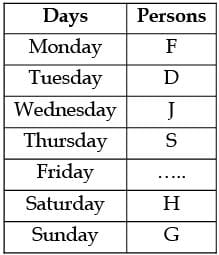
On which of the following day No one takes the class?

Detailed Solution: Question 5
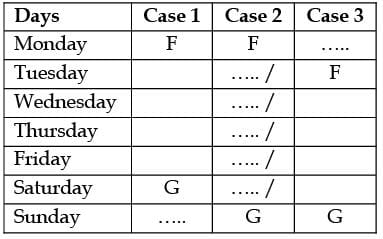
From the given statements, four persons are taking class between F and G. G neither takes class on Monday nor on Tuesday. Here, we get three possibilities i.e. Case 1, Case 2 and Case 3. 

From the given statements, as many persons take class between F and D as between H and G. S takes class before H and after J. S takes class just before the day when no one takes class. Here, Case 1 and Case 3 are eliminated.
So, the final arrangement will be: -

Practice Test 3: Reasoning Ability - Question 6

If X sits fourth from one of the ends of the row, then how many persons are sitting in the row?

Detailed Solution: Question 6

From the given statements, B sits third to the right of A. Only five persons sit between A and S.
Here, we get two possibilities i.e. Case 1 and Case 2. V sits fourth to the left of S. M is an immediate neighbour of V. D sits third to the right of M.

From the given statements, K is an immediate neighbour of D. X sits second to the left of K. So, from this case-1 gets eliminated.
So, the final arrangement is-

Practice Test 3: Reasoning Ability - Question 7

How many persons sit between K and A?

Detailed Solution: Question 7

From the given statements, B sits third to the right of A. Only five persons sit between A and S.
Here, we get two possibilities i.e. Case 1 and Case 2. V sits fourth to the left of S. M is an immediate neighbour of V. D sits third to the right of M.

From the given statements, K is an immediate neighbour of D. X sits second to the left of K. So, from this case-1 gets eliminated.
So, the final arrangement is-

Practice Test 3: Reasoning Ability - Question 8

What is the position of V with respect to K?

Detailed Solution: Question 8

From the given statements, B sits third to the right of A. Only five persons sit between A and S.
Here, we get two possibilities i.e. Case 1 and Case 2. V sits fourth to the left of S. M is an immediate neighbour of V. D sits third to the right of M.

From the given statements, K is an immediate neighbour of D. X sits second to the left of K. So, from this case-1 gets eliminated.
So, the final arrangement is-

Practice Test 3: Reasoning Ability - Question 9

If only one person sits between B and C then how many persons sit between C and S?

Detailed Solution: Question 9

From the given statements, B sits third to the right of A. Only five persons sit between A and S.
Here, we get two possibilities i.e. Case 1 and Case 2. V sits fourth to the left of S. M is an immediate neighbour of V. D sits third to the right of M.

From the given statements, K is an immediate neighbour of D. X sits second to the left of K. So, from this case-1 gets eliminated.
So, the final arrangement is-

Practice Test 3: Reasoning Ability - Question 10

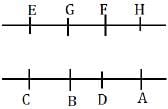
Who among the following sits to the immediate left of F?

Detailed Solution: Question 10
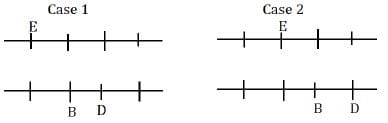
From the given statements, D faces the person who sits 2nd to the left of E. Here, we get two possibilities i.e. Case 1 and Case 2. B sits to the immediate right of the person who faces E.

From the given statements, G doesn’t face A who is an immediate neighbour of D. Here, Case 2 is ruled out.
There is one person sits between G and H.
So, final arrangement will be: -

Practice Test 3: Reasoning Ability - Question 11

Directions: Study the following questions carefully and answer the questions given below.

S is mother of T, T is husband of J, N is son of J, Z is father-In-law of J, K is brother of N. How K is related to Z?

Detailed Solution: Question 11

N is son of T and J. So, K is son of T and J.
Z is father of T
Therefore, Z is grandfather of K. K is grandson of Z.
Hence, the option E is correct.

Practice Test 3: Reasoning Ability - Question 12

Directions: Study the following questions carefully and answer the questions given below.

Pointing towards another boy Veena said “He is the son of only son of my paternal grandfather”. How is that boy related to Veena?

Detailed Solution: Question 12

He is the  son of only son of my grandfather – Veen’s Father’s son 
Therefore, that boy is a Veena’s brother.
Hence, the option B is correct. 

Practice Test 3: Reasoning Ability - Question 13

Directions: In each of the questions below are given some statements followed by two conclusions. You have to take the given statements to be true even if they seem to be at variance with commonly known facts. Read all the conclusions and then decide which of the given conclusions logically follows from the given statements disregarding commonly known facts.
Statement:
All seats are hot
All belts are hot
Conclusions:

I. Some seats are belts
II. All hot are either seats or belts.

Detailed Solution: Question 13
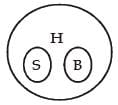
Neither I nor II follow

Practice Test 3: Reasoning Ability - Question 14

Directions: In each of the questions below are given some statements followed by two conclusions. You have to take the given statements to be true even if they seem to be at variance with commonly known facts. Read all the conclusions and then decide which of the given conclusions logically follows from the given statements disregarding commonly known facts.
Statement:
All book are pen
No book is a copy
Conclusions:
I. No pen is a copy
II. At least some book is copy.

Detailed Solution: Question 14
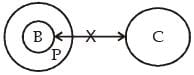
Neither follow

Practice Test 3: Reasoning Ability - Question 15

If Salman walks 4 m to the North of point F, how far and in which direction will he be from point G?

Detailed Solution: Question 15
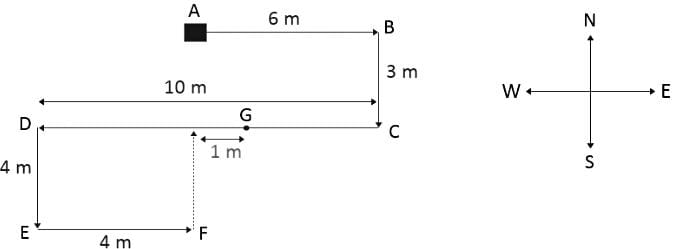
 
It's clear from the diagram that Salman's end point will be 1 m far from and in the west direction with respect to point G.
Hence, option C is correct.
 

Practice Test 3: Reasoning Ability - Question 16

How far and in which direction is point F from point A?

Detailed Solution: Question 16
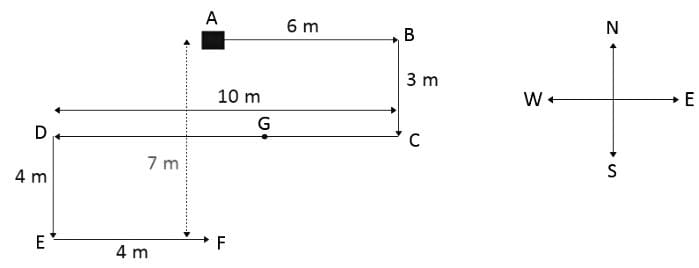
It's clear from the diagram that the point F is 7 m far from and in the south direction with respect to point A.
Hence, option A is correct.

Practice Test 3: Reasoning Ability - Question 17

Directions: The following questions are based on the five three-digit numbers given below:
574 658 821 945 247

If one is added to the last digit of each of the numbers, in how many numbers thus formed will the last digit be a perfect square (1 is also be a perfect square)?

Detailed Solution: Question 17

after adding 1 last digit = 5,9,2,6,8 only 9 is a perfect square.

Practice Test 3: Reasoning Ability - Question 18

Directions: The following questions are based on the five three-digit numbers given below:
574 658 821 945 247

If 1 is subtracted from the 1st digit of each number then how many numbers thus formed will be divisible by three?

Detailed Solution: Question 18

after subtracted 1 to from each 1st digit of each number, the number become 474, 558, 721, 845, 147. Only 474, 558 and 147 are divisible by three

Practice Test 3: Reasoning Ability - Question 19

Directions: In each of the following questions assuming the given statements to be true, find which of the two conclusions I and II given below is/are definitely true and give your answer accordingly. 
Statements: H ≤ R, R< M, M = J
Conclusions: I. H < J II. H ≤ J

Detailed Solution: Question 19

H ≤ R < M = J, only I is true

Practice Test 3: Reasoning Ability - Question 20

Directions: In each of the following questions assuming the given statements to be true, find which of the two conclusions I and II given below is/are definitely true and give your answer accordingly. 
Statements: B ≤ K, K> M, C ≤ M
Conclusions: I. B < C II. K > C

Detailed Solution: Question 20

B ≤ K > M ≤ C, only II is true.

665 videos|1092 docs|379 tests
Information about Practice Test 3: Reasoning Ability Page
In this test you can find the Exam questions for Practice Test 3: Reasoning Ability solved & explained in the simplest way possible. Besides giving Questions and answers for Practice Test 3: Reasoning Ability, EduRev gives you an ample number of Online tests for practice
Download as PDF