
Practice Test 7: Reasoning Ability Bank Exams MCQs & solutions - Free
MCQ Practice Test & Solutions: Practice Test 7: Reasoning Ability (20 Questions)
You can prepare effectively for Bank Exams IBPS PO Prelims & Mains Preparation with this dedicated MCQ Practice Test (available with solutions) on the important topic of "Practice Test 7: Reasoning Ability". These 20 questions have been designed by the experts with the latest curriculum of Bank Exams 2026, to help you master the concept.
Test Highlights:
- - Format: Multiple Choice Questions (MCQ)
- - Duration: 20 minutes
- - Number of Questions: 20
Sign up on EduRev for free to attempt this test and track your preparation progress.

If we interchanged S and O’s floor, then who among the following person lives just below the O’s floor?
Detailed Solution: Question 1
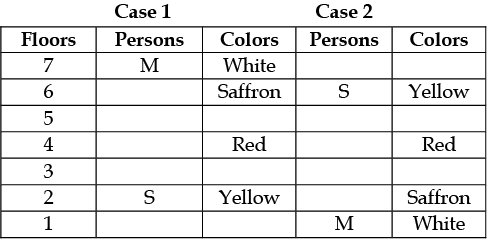
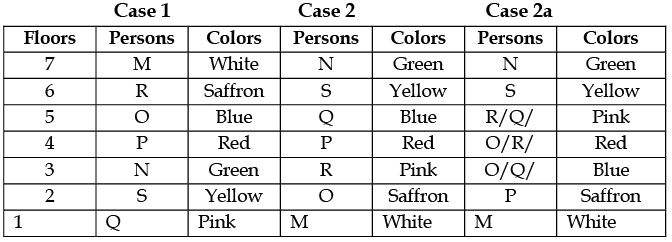 From the given statements, the number of persons live between O and N is the same as between N and Q. Now, Case 2 and Case 2a are eliminated.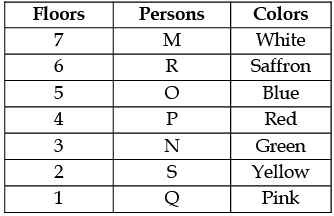
Detailed Solution: Question 2

Four of the following five are alike in a certain way and hence they form a group. Which one of the following does not belong to that group?
Detailed Solution: Question 3
Which of the following is not true, as per the given information?
Detailed Solution: Question 4
Who among the following person lives on flat-2 of floor-1?
Detailed Solution: Question 5
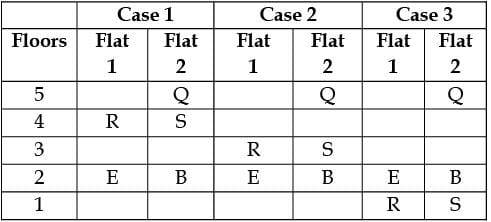
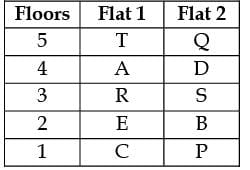
Who among the following persons are the immediate neighbours of T?
Detailed Solution: Question 6
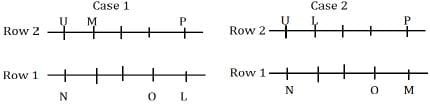
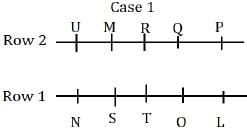
Four of the following five are alike in certain way based from a group, find the one which does not belong to that group?
Detailed Solution: Question 7
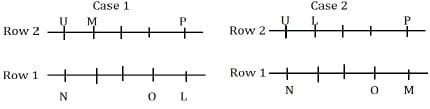
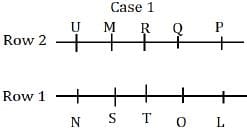
Who among the following persons sits to the immediate left of W?
Detailed Solution: Question 8
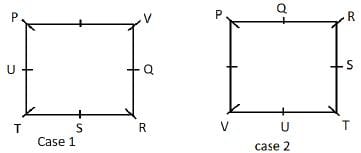
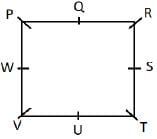
Who among the following persons sits at the corner of the table?
Detailed Solution: Question 9
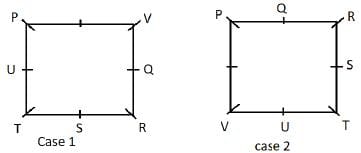
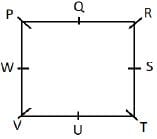
Which among the following is true regarding W?
Detailed Solution: Question 10
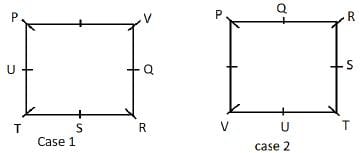
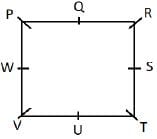
Detailed Solution: Question 11
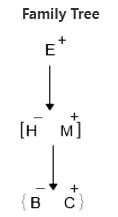
Detailed Solution: Question 12
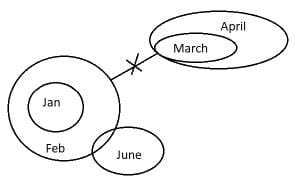
Directions: In each of the questions below are given some statements followed by two conclusions. You have to take the given statements to be true even if they seem to be at variance with commonly known facts. Read all the conclusions and then decide which of the given conclusions logically follows from the given statements disregarding commonly known facts.
Statements:
All Jan are Feb.
No Feb is March.
All March are April.
Some Feb are June.
Conclusion:
I. All June can be Jan.
II. Some April are June.
Statements:
All Jan are Feb.
No Feb is March.
All March are April.
Some Feb are June.
Conclusion:
I. All June can be Jan.
II. Some April are June.
Detailed Solution: Question 13
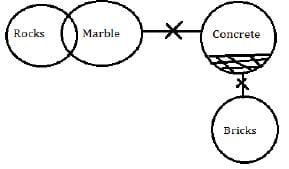
Directions: In each of the questions below are given some statements followed by two conclusions. You have to take the given statements to be true even if they seem to be at variance with commonly known facts. Read all the conclusions and then decide which of the given conclusions logically follows from the given statements disregarding commonly known facts.
Statements:
Some Rocks are Marble.
No Marble is Concrete.
Some Concrete are not Bricks.
Conclusions:
I. Some Marble are Bricks.
II. No Bricks is Marble.
Statements:
Some Rocks are Marble.
No Marble is Concrete.
Some Concrete are not Bricks.
Conclusions:
I. Some Marble are Bricks.
II. No Bricks is Marble.
Detailed Solution: Question 14
Detailed Solution: Question 15
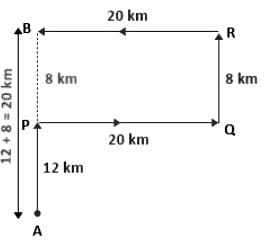
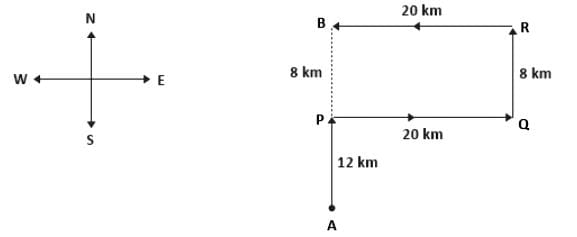
Towards which direction does Shahrukh move before stopping at point B?
Detailed Solution: Question 16
Directions: These questions are based on the following set of numbers.
538 687 239 764 848
If ‘1’ is added to the first digit of each number and ‘1’ is subtracted from the second digit, which number will be the largest?
538 687 239 764 848
Detailed Solution: Question 17
Directions: These questions are based on the following set of numbers.
538 687 239 764 848
If in each number the positions of the first and second digits are interchanged which number will be the smallest?
538 687 239 764 848
Detailed Solution: Question 18
Directions: In each of the following questions assuming the given statements to be true, find which of the following, conclusion I and II given below is/are definitely true and give your answer accordingly:
Statements: Z = N, N ≥ K, K > M, M < D
Conclusions: I. M > N II. M = N
Statements: Z = N, N ≥ K, K > M, M < D
Conclusions: I. M > N II. M = N
Detailed Solution: Question 19
Directions: In each of the following questions assuming the given statements to be true, find which of the following, conclusion I and II given below is/are definitely true and give your answer accordingly:
Statements: F < W, W > V, V = B, B ≥ D
Conclusions: I. V = F II. W = D
Statements: F < W, W > V, V = B, B ≥ D
Conclusions: I. V = F II. W = D
Detailed Solution: Question 20
665 videos|1092 docs|379 tests |
