Bank Exams Exam  >  Bank Exams Test  >  IBPS PO Prelims & Mains Preparation  >  Practice Test 11: Reasoning Ability - Bank Exams MCQ

Practice Test 11: Reasoning Ability Bank Exams MCQs & solutions - Free


MCQ Practice Test & Solutions: Practice Test 11: Reasoning Ability (20 Questions)

You can prepare effectively for Bank Exams IBPS PO Prelims & Mains Preparation with this dedicated MCQ Practice Test (available with solutions) on the important topic of "Practice Test 11: Reasoning Ability". These 20 questions have been designed by the experts with the latest curriculum of Bank Exams 2026, to help you master the concept.

Test Highlights:

  • - Format: Multiple Choice Questions (MCQ)
  • - Duration: 20 minutes
  • - Number of Questions: 20

Sign up on EduRev for free to attempt this test and track your preparation progress.

Practice Test 11: Reasoning Ability - Question 1

How many Boxes are there between Box R and Box U?

Detailed Solution: Question 1
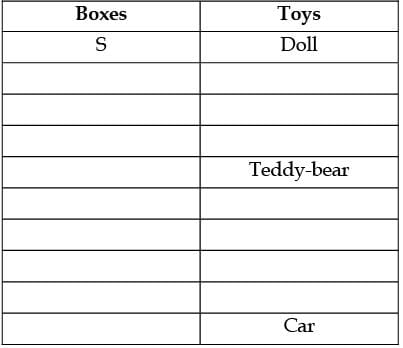
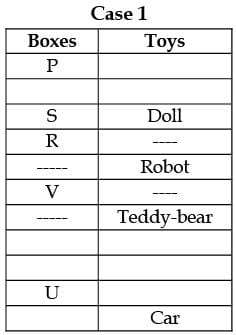
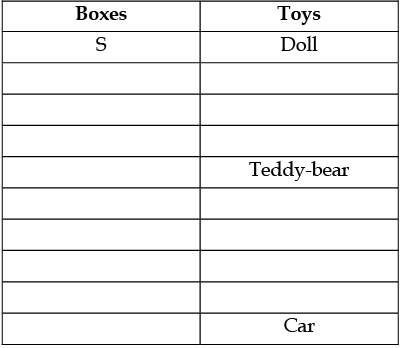
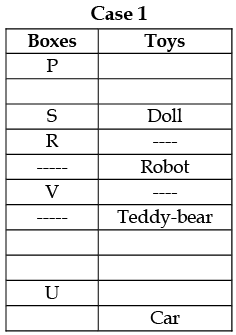
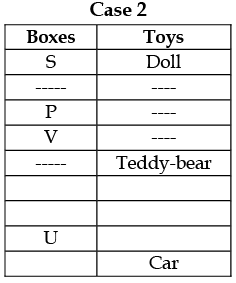
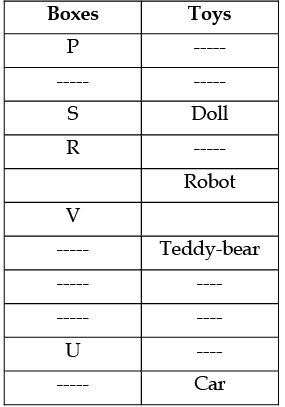
Step 1: From the given conditions, only three Boxes are placed in between the Box which has Teddy-bear toy and the one which has the Doll toy and the Box having Doll toy is above Box having Teddy-bear toy. Box S has Doll toy in it. There are as many Boxes placed between Box S and the Box having Teddy-bear toy as between the Box having car toy and the Box having Teddy-bear toy in it.

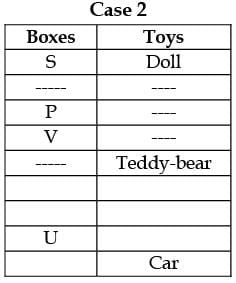
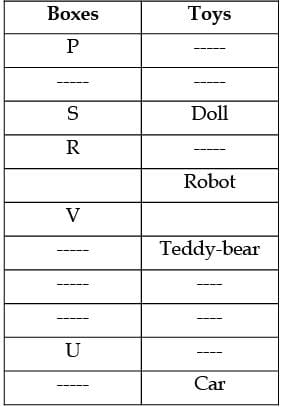
Step 2: From the remaining given conditions, Box U is immediately above the Box having car toy. There are three Boxes which are placed in between the Box U and Box V so V placed above to Box U because the Box having car toy in it is placed at the bottom. There is one Box in between the Box P and the Box having doll. So, from these conditions there will be two possibility of the Box P in case 1 Box is placed above Box S and in case 2 Box P placed below Box S. 


Step 3. Now it is given that, Box R is just above the Box having Robot toy in it. Box R is placed somewhere in between Box P and the Box having Teddy bear toy. Box R is not placed immediately above to Box V. So, case 2 will be eliminated as there is no place for Box R and we get our final answer.

Practice Test 11: Reasoning Ability - Question 2

Which Box is immediately above Box R?

Detailed Solution: Question 2

Step 1: From the given conditions, only three Boxes are placed in between the Box which has Teddy-bear toy and the one which has the Doll toy and the Box having Doll toy is above Box having Teddy-bear toy. Box S has Doll toy in it. There are as many Boxes placed between Box S and the Box having Teddy-bear toy as between the Box having car toy and the Box having Teddy-bear toy in it.

Step 2: From the remaining given conditions, Box U is immediately above the Box having car toy. There are three Boxes which are placed in between the Box U and Box V so V placed above to Box U because the Box having car toy in it is placed at the bottom. There is one Box in between the Box P and the Box having doll. So, from these conditions there will be two possibility of the Box P in case 1 Box is placed above Box S and in case 2 Box P placed below Box S. 

Step 3. Now it is given that, Box R is just above the Box having Robot toy in it. Box R is placed somewhere in between Box P and the Box having Teddy bear toy. Box R is not placed immediately above to Box V. So, case 2 will be eliminated as there is no place for Box R and we get our final answer.

Practice Test 11: Reasoning Ability - Question 3

How many Boxes are there in the arrangement?

Detailed Solution: Question 3

Step 1: From the given conditions, only three Boxes are placed in between the Box which has Teddy-bear toy and the one which has the Doll toy and the Box having Doll toy is above Box having Teddy-bear toy. Box S has Doll toy in it. There are as many Boxes placed between Box S and the Box having Teddy-bear toy as between the Box having car toy and the Box having Teddy-bear toy in it.

Step 2: From the remaining given conditions, Box U is immediately above the Box having car toy. There are three Boxes which are placed in between the Box U and Box V so V placed above to Box U because the Box having car toy in it is placed at the bottom. There is one Box in between the Box P and the Box having doll. So, from these conditions there will be two possibility of the Box P in case 1 Box is placed above Box S and in case 2 Box P placed below Box S. 

Step 3. Now it is given that, Box R is just above the Box having Robot toy in it. Box R is placed somewhere in between Box P and the Box having Teddy bear toy. Box R is not placed immediately above to Box V. So, case 2 will be eliminated as there is no place for Box R and we get our final answer.

Practice Test 11: Reasoning Ability - Question 4

How many Boxes are kept above the Box V?

Detailed Solution: Question 4

Step 1: From the given conditions, only three Boxes are placed in between the Box which has Teddy-bear toy and the one which has the Doll toy and the Box having Doll toy is above Box having Teddy-bear toy. Box S has Doll toy in it. There are as many Boxes placed between Box S and the Box having Teddy-bear toy as between the Box having car toy and the Box having Teddy-bear toy in it.

Step 2: From the remaining given conditions, Box U is immediately above the Box having car toy. There are three Boxes which are placed in between the Box U and Box V so V placed above to Box U because the Box having car toy in it is placed at the bottom. There is one Box in between the Box P and the Box having doll. So, from these conditions there will be two possibility of the Box P in case 1 Box is placed above Box S and in case 2 Box P placed below Box S. 

Step 3. Now it is given that, Box R is just above the Box having Robot toy in it. Box R is placed somewhere in between Box P and the Box having Teddy bear toy. Box R is not placed immediately above to Box V. So, case 2 will be eliminated as there is no place for Box R and we get our final answer.

Practice Test 11: Reasoning Ability - Question 5

How many Boxes are kept between Box P and Box V?

Detailed Solution: Question 5

Step 1: From the given conditions, only three Boxes are placed in between the Box which has Teddy-bear toy and the one which has the Doll toy and the Box having Doll toy is above Box having Teddy-bear toy. Box S has Doll toy in it. There are as many Boxes placed between Box S and the Box having Teddy-bear toy as between the Box having car toy and the Box having Teddy-bear toy in it.

Step 2: From the remaining given conditions, Box U is immediately above the Box having car toy. There are three Boxes which are placed in between the Box U and Box V so V placed above to Box U because the Box having car toy in it is placed at the bottom. There is one Box in between the Box P and the Box having doll. So, from these conditions there will be two possibility of the Box P in case 1 Box is placed above Box S and in case 2 Box P placed below Box S. 

Step 3. Now it is given that, Box R is just above the Box having Robot toy in it. Box R is placed somewhere in between Box P and the Box having Teddy bear toy. Box R is not placed immediately above to Box V. So, case 2 will be eliminated as there is no place for Box R and we get our final answer.

Practice Test 11: Reasoning Ability - Question 6

Who among the following born on 15th of November?

Detailed Solution: Question 6
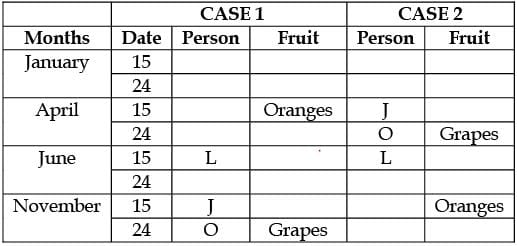
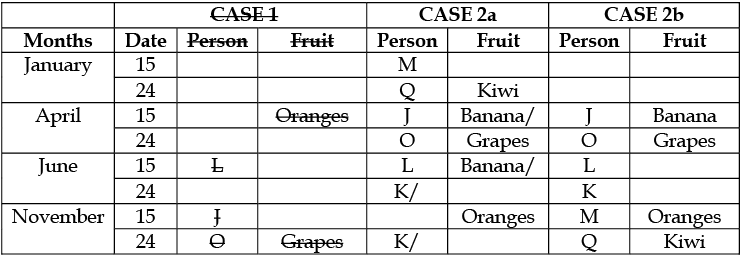
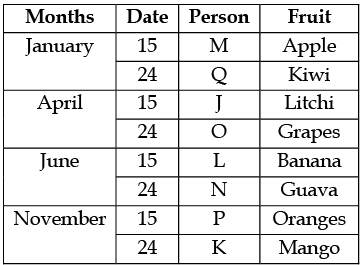
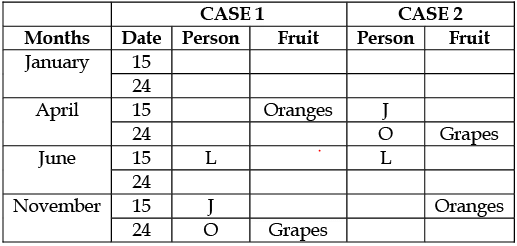
L was born in the month of June. Only one person born between L and the one who likes Oranges, who does not born on an even number date. Only Three persons born Between J and the one who like Oranges. J and O, who likes Grapes born in the same month. Here, we have two possible cases case1 and case2.

Two persons born between M and the one who likes Grapes. So, case 1 gets eliminated. Q likes Kiwi and born immediately after M. K does not like Orange and born in the month having 30 days. Two persons born between K and the one who likes Banana. 


J does not like Banana. So, case 2b gets eliminated. N, who likes Guava born immediately before P, but not in the same month. The one who likes Litchi born before the one who likes Mango, who does not born in the June month. M does not like Litchi. 

Practice Test 11: Reasoning Ability - Question 7

Who among the following likes Mango?

Detailed Solution: Question 7

L was born in the month of June. Only one person born between L and the one who likes Oranges, who does not born on an even number date. Only Three persons born Between J and the one who like Oranges. J and O, who likes Grapes born in the same month. Here, we have two possible cases case1 and case2.

Two persons born between M and the one who likes Grapes. So, case 1 gets eliminated. Q likes Kiwi and born immediately after M. K does not like Orange and born in the month having 30 days. Two persons born between K and the one who likes Banana. 

J does not like Banana. So, case 2b gets eliminated. N, who likes Guava born immediately before P, but not in the same month. The one who likes Litchi born before the one who likes Mango, who does not born in the June month. M does not like Litchi. 

Practice Test 11: Reasoning Ability - Question 8

How many persons born between P and J?

Detailed Solution: Question 8

L was born in the month of June. Only one person born between L and the one who likes Oranges, who does not born on an even number date. Only Three persons born Between J and the one who like Oranges. J and O, who likes Grapes born in the same month. Here, we have two possible cases case1 and case2.

Two persons born between M and the one who likes Grapes. So, case 1 gets eliminated. Q likes Kiwi and born immediately after M. K does not like Orange and born in the month having 30 days. Two persons born between K and the one who likes Banana. 

J does not like Banana. So, case 2b gets eliminated. N, who likes Guava born immediately before P, but not in the same month. The one who likes Litchi born before the one who likes Mango, who does not born in the June month. M does not like Litchi. 

Practice Test 11: Reasoning Ability - Question 9

M likes which of the following Fruit?

Detailed Solution: Question 9

L was born in the month of June. Only one person born between L and the one who likes Oranges, who does not born on an even number date. Only Three persons born Between J and the one who like Oranges. J and O, who likes Grapes born in the same month. Here, we have two possible cases case1 and case2.

Two persons born between M and the one who likes Grapes. So, case 1 gets eliminated. Q likes Kiwi and born immediately after M. K does not like Orange and born in the month having 30 days. Two persons born between K and the one who likes Banana. 

J does not like Banana. So, case 2b gets eliminated. N, who likes Guava born immediately before P, but not in the same month. The one who likes Litchi born before the one who likes Mango, who does not born in the June month. M does not like Litchi. 

Practice Test 11: Reasoning Ability - Question 10

Which of the following pair born in the same month?

Detailed Solution: Question 10

L was born in the month of June. Only one person born between L and the one who likes Oranges, who does not born on an even number date. Only Three persons born Between J and the one who like Oranges. J and O, who likes Grapes born in the same month. Here, we have two possible cases case1 and case2.

Two persons born between M and the one who likes Grapes. So, case 1 gets eliminated. Q likes Kiwi and born immediately after M. K does not like Orange and born in the month having 30 days. Two persons born between K and the one who likes Banana. 

J does not like Banana. So, case 2b gets eliminated. N, who likes Guava born immediately before P, but not in the same month. The one who likes Litchi born before the one who likes Mango, who does not born in the June month. M does not like Litchi. 

Practice Test 11: Reasoning Ability - Question 11

Which of the following statements is true?

Detailed Solution: Question 11

From the common explanation we get that C is the granddaughter of F.
Option E is hence the correct answer.
Common Explanation: 
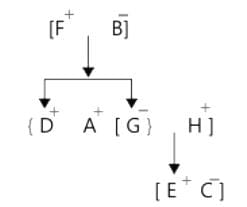
  • G and D are the children of B while F is the father of D. Hence, F must be the husband of B. 
  • Now as one of G and D is male and the other is female and since H is the husband of G, G must be a female and D is one of her two brothers. 
  • Further, it's given that C is the daughter-in-law of G. Hence, she has to be married to the son of G. 
  • Since B has only one grandchild i.e. E, E has to be the son of G and H. 
  • Thus, F-B, H-G and E-C form three couples.  
  • Now, since D is one brother of G, the only person remaining i.e. A, therefore, has to be the other brother. 

The entire family relation is as shown below:
 

Practice Test 11: Reasoning Ability - Question 12

How is E related to F?

Detailed Solution: Question 12

Clearly, E is the grandson of F.
Option C is hence the correct answer.
Common Explanation:
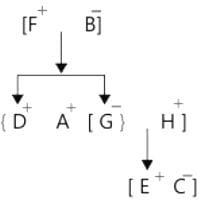
  • G and D are the children of B while F is the father of D. Hence, F must be the husband of B. 
  • Now as one of G and D is male and the other is female and since H is the husband of G, G must be a female and D is one of her two brothers. 
  • Further, it's given that C is the daughter-in-law of G. Hence, she has to be married to the son of G. 
  • Since B has only one grandchild i.e. E, E has to be the son of G and H. 
  • Thus, F-B, H-G and E-C form three couples.  
  • Now, since D is one brother of G, the only person remaining i.e. A, therefore, has to be the other brother. 

The entire family relation is as shown below: 
 

Practice Test 11: Reasoning Ability - Question 13

Directions: In each of the following questions assuming the given statements to be true, find which of the following conclusion I and II given below is/are definitely true and give your answer accordingly.
Statements: W = B, B ≤ F, F < R, R > F
Conclusions: I. W = F II. W < F

Detailed Solution: Question 13

W = B ≤ F < R > F, Either I or II is true

Practice Test 11: Reasoning Ability - Question 14

Directions: In each of the following questions assuming the given statements to be true, find which of the following conclusion I and II given below is/are definitely true and give your answer accordingly.
Statements: E ≤ K, K > T, T < N, B ≥ N
Conclusions: I. T ≥ E II. K < N

Detailed Solution: Question 14

E ≤ K > T < N ≤ B, None is true.

Practice Test 11: Reasoning Ability - Question 15

In a class of 45 student Aditya’s rank is twelve from top what is his rank from bottom.

Detailed Solution: Question 15

Rank from bottom [(total no. of students + 1) – rank from top)] = [(45 + 1) – 12] = 34th

Practice Test 11: Reasoning Ability - Question 16

In a class of 42 students Nutan’s Rank is 22 from bottom what is her rank from top.

Detailed Solution: Question 16

(42 + 1) – 22 = 21

Practice Test 11: Reasoning Ability - Question 17

In a class, Sonal rank is 10th from top what is his rank from bottom.

Detailed Solution: Question 17

cannot be determine

Practice Test 11: Reasoning Ability - Question 18

If in a certain code, LUTE is written as MUTE and FATE is written as GATE, then how will BLUE be written in that code?

Detailed Solution: Question 18

The first letter of the word is moved one step forward to obtain the first letter of the code, while the other letters remain unaltered.

Practice Test 11: Reasoning Ability - Question 19

Direction: Each of the following questions below consists of a question and two statements numbered I and II given below it. You have to decide whether the data provided in the statements are sufficient to answer the question. Read both the statements and give answer.

Who amongst A, Q, R, S and T is the tallest?
I. S is not the tallest. R is taller than A.
II. T is not the tallest. A is taller than Q.

Detailed Solution: Question 19

From I: R > A, but S is not the tallest.
From II: A > Q, but T is not the tallest.
From I and II: R > A > Q. Neither S nor T can be the tallest.
Hence R is the tallest.

Practice Test 11: Reasoning Ability - Question 20

Direction: Each of the following questions below consists of a question and two statements numbered I and II given below it. You have to decide whether the data provided in the statements are sufficient to answer the question. Read both the statements and give answer.

In which month of the year did Raman go for a football match?
I. Aman correctly remembers that Raman went for a football match in the first half of the year.
II. Aman’s brother correctly remembers that Raman went for a football match after 31st March but before 1st May.

Detailed Solution: Question 20

From I: Possible months: January, February, March, April, May or June.
From II: Aman’s brother correctly remembers that he went for a football match after 31st March but before 1st May.
So, he went for a football match in the month of April.
Hence only II is sufficient.

665 videos|1092 docs|379 tests
Information about Practice Test 11: Reasoning Ability Page
In this test you can find the Exam questions for Practice Test 11: Reasoning Ability solved & explained in the simplest way possible. Besides giving Questions and answers for Practice Test 11: Reasoning Ability, EduRev gives you an ample number of Online tests for practice
Download as PDF