UPSC Exam  >  UPSC Test  >   Indian Forest Service (IFoS) Mock Test Series  >  UPSC Indian Forest Service Prelims (GS1) Mock Test- 3 - UPSC MCQ

UPSC Indian Forest Service (IFoS) Prelims (GS1) Mock Test- 3 Free Online


Full Mock Test & Solutions: UPSC Indian Forest Service Prelims (GS1) Mock Test- 3 (100 Questions)

You can boost your UPSC 2026 exam preparation with this UPSC Indian Forest Service Prelims (GS1) Mock Test- 3 (available with detailed solutions).. This mock test has been designed with the analysis of important topics, recent trends of the exam, and previous year questions of the last 3-years. All the questions have been designed to mirror the official pattern of UPSC 2026 exam, helping you build speed, accuracy as per the actual exam.

Mock Test Highlights:

  • - Format: Multiple Choice Questions (MCQ)
  • - Duration: 120 minutes
  • - Total Questions: 100
  • - Analysis: Detailed Solutions & Performance Insights

Sign up on EduRev for free and get access to these mock tests, get your All India Rank, and identify your weak areas to improve your marks & rank in the actual exam.

UPSC Indian Forest Service Prelims (GS1) Mock Test- 3 - Question 1

With reference to the archaeological sites found in the Indian sub-continent, consider the following statements:

1. Mehrgarh is the earliest known Mesolithic site, where evidence of farming and herding has been found.

2. Koldihwa, situated along the Belan River, is one of the few Neolithic sites in Uttar Pradesh.

3. The cave paintings at Bhimbetka are dated to the Indian Mesolithic period.

How many of the above statements is/are correct?

Detailed Solution: Question 1

Correct answer is B. 1 only


Stone Age – Palaeolithic, Mesolithic and Neolithic:
The Palaeolithic Age is also known as the Old Stone Age. It dates from 500,00-10,000 BCE. During this period, the Indians belonged to the ‘Negrito’ race. The Old Stone Age can be divided into three parts : The Lower Palaeolithic Age; the Middle Palaeolithic Age; and the Upper Palaeolithic Age. The Mesolithic Age, also known as the Middle Stone Age, was the second part of the Stone Age. In India, it spanned from 9,000 BCE to 4,000 BCE. This Age is characterized by the appearance of Microliths (small-bladed stone tools). The Mesolithic Age was a transitional phase between the Palaeolithic Age and the Neolithic Age. The people of this age lived on hunting, fishing and food gathering. Later on, they also domesticated animals. The Neolithic Age, which means the New Stone Age, was the last and the third part of the Stone Age. In India, it spanned from around 7,000 BCE to 1,000 BCE. The Neolithic Age is mainly characterized by the development of settled agriculture, and the use of tools and weapons made of polished stones. The major crops grown during this period were ragi, horse gram, cotton, rice, wheat and barley. Pottery first appeared at this Age. Some important sites:

1. Mehrgarh: Mehrgarh was probably one of the places where the people learned to grow barley and wheat, and rear sheep and goats for the first time in this area. It is one of the earliest villages.. It is a Neolithic archaeological site (dated c. 7,000 BCE – c. 2,500/2,000 BCE), situated on the Kacchi Plain of Baluchistan in Pakistan. It is located near the Bolan Pass, to the west of the Indus River. Mehrgarh, the earliest known site in the Indian sub-continent, provides evidence of farming and herding practices. This statement is incorrect.

2. Koldihwa: It is an archaeological site in Uttar Pradesh (India). It is situated in the valleys of the Belan River. Along with Mahagara, it is one of the few Neolithic sites in Uttar Pradesh. Dating back to 6,500 BCE, it stands as the earliest known site providing evidence of rice domestication. The agricultural practices in the Belan Valley commenced around the same time, encompassing not only rice cultivation, but also the growing of barley, as evidenced at Mahgara. This statement is incorrect.

3. Bhimbetka, in the present-day Madhya Pradesh: This is an old site with caves and rock shelters. The people chose these natural caves because they provided shelter from rain, heat and wind. These rock shelters are close to the Narmada Valley. Some of the Bhimbetka rock shelters feature pre-historic cave paintings and the earliest are dated to 10,000 BCE, corresponding to the Indian Mesolithic period. This statement is correct.

UPSC Indian Forest Service Prelims (GS1) Mock Test- 3 - Question 2

Which of the following is not used to calculate national income?

Detailed Solution: Question 2

  • GDP is the market value of all final goods and services produced within a domestic territory of a country measured in a year. There are three ways to calculate the national income; namely product method, expenditure method, and income method.
    • The Product or Value-Added Method: In the product method, the aggregate annual value of goods and services produced (if a year is the unit of time) is calculated. If we sum the gross value added of all the firms of the economy in a year, we get a measure of the value of the aggregate amount of goods and services produced by the economy in a year (just as we had done in the wheat-bread example). Such an estimate is called Gross Domestic Product (GDP).
    • Expenditure Method: An alternative way to calculate the GDP is by looking at the demand side of the products. This method is referred to as the expenditure method.
    • The expenditure approach is the most commonly used GDP formula, which is based on the money spent by various groups that participate in the economy. GDP = C + G + I + NX;
      • C = consumption or all private consumer spending within a country’s economy, including, durable goods (items with a lifespan greater than three years), nondurable goods (food & clothing), and services.
      • G = total government expenditures, including salaries of government employees, road construction/repair, public schools, and military expenditures.
      • I = sum of a country’s investments spent on capital equipment, inventories, and housing.
      • NX = net exports or a country’s total exports less total imports.
    • Income Method: As we mentioned in the beginning, the sum of final expenditures in the economy must be equal to the incomes received by all the factors of production taken together (final expenditure is the spending on final goods, it does not include spending on intermediate goods).  Total National Income – the sum of all wages, rent, interest, and profits.
  • Balance of Payment: In international economics, the balance of payments of a country is the difference between all money flowing into the country in a particular period of time and the outflow of money to the rest of the world. Balance of Payment is primarily an indicator of an economy's link with the outside world and is not used as a method to calculate the national income. Hence option (c) is the correct answer.

UPSC Indian Forest Service Prelims (GS1) Mock Test- 3 - Question 3

Consider the following statements regarding the Organization for Economic Co-operation and Development (OECD):

1. Most OECD members are high-income economies with a very high Human Development Index (HDI).

2. Costa Rica became the latest member of the OECD in 2021.

3. OECD is headquartered in Paris, France.

How many of the above statements are correct?

Detailed Solution: Question 3

  • Organization for Economic Co-operation and Development (OECD): The OECD is an intergovernmental economic organization, founded to stimulate economic progress and world trade. Most OECD members are high-income economies with a very high Human Development Index (HDI) and are regarded as developed countries. Hence, statement 1 is correct.
  • It was founded in 1961 with its Headquarters in Paris, France, and its total membership is 38 countries. Hence, statement 3 is correct.
  • The most recent countries to join the OECD were Colombia, in April 2020, and Costa Rica, in May 2021. Hence, statement 2 is correct.
  • India is not a member, but a key economic partner. Reports and Indices by OECD: Government at a Glance. OECD Better Life Index. 

UPSC Indian Forest Service Prelims (GS1) Mock Test- 3 - Question 4

Consider the following statements:

Statement I: Soils in the taiga climate are acidic.

Statement II: Low temperatures and anaerobiosis in taiga climate inhibit decompositions.

Which one of the following is correct in respect of the above statements?

Detailed Solution: Question 4

  • Boreal forests, or taiga is the term applied to the huge area of dense coniferous forests of North America, northern Europe and Asia occurring at high latitudes where the climate is characterised by very cold winters, usually about 40cm of rainfall and a short summer growing season. The dominant species are evergreens, such as pine, spruce, fir, whose water loss through transpiration is low in winter at the time when the soils may be permanently frozen.
  • Unlike tropical forests which have a huge range of species, the boreal forest usually have rather few species of trees, shrubs and plants. In fact the undergrowth of boreal forests is almost non-existent. The species present are able to get their nutrient requirements from the very shallow layer of soil above the permafrost. The trees present have a notable climatic tolerance and survive on rather infertile soils.
  • Most of the soils are strongly leached as a result of centuries of leaching and somewhat impoverished parent materials. The soils are generally strongly acid and the main soil process under this dominantly leaching climate is 'podzolisation' leading to podsolic soils. The extreme climate coupled with the strong soil acidity means that relatively few organisms exist in the soil and the turnover of organic matter is slow.
  • Therefore, low temperature and anaerobiosis (lack of oxygen) inhibit decomposition resulting in a buildup of organic matter, and soils become acidic in taiga climate. Hence option (a) is the correct answer.

UPSC Indian Forest Service Prelims (GS1) Mock Test- 3 - Question 5

With reference to 9th schedule of Indian constitution, consider the following statements:
1. It was added to protect the laws included in it from judicial review.
2. It was part of the original constitution.
Which of the statements given above is/are correct?

Detailed Solution: Question 5

Option (a) is correct:
9th schedule (Article 31-B) Acts and Regulations (originally 13 but presently 282) of the state legislatures dealing with land reforms and abolition of the zamindari system and of the Parliament dealing with other matters. This schedule was added by the 1st Amendment (1951) to protect the laws included in it from judicial scrutiny on the ground of violation of fundamental rights. However, in 2007, the Supreme Court ruled that the laws included in this schedule after April 24, 1973, are now open to judicial review. The Ninth Schedule contains a list of central and state laws which cannot be challenged in courts. Currently, 284 such laws are shielded from judicial review.

UPSC Indian Forest Service Prelims (GS1) Mock Test- 3 - Question 6

With reference to Non-fungible tokens (NFTs), consider the following statements:

1. NFT is a digital asset that exists on a blockchain with a unique digital signature.

2. These can be bought with cryptocurrencies or cash.

3. All kinds of digital objects including texts and tweets on twitter can be turned into an NFT.

Which of the statements given above is/are correct?

Detailed Solution: Question 6

  • An NFT is a digital asset that exists on a blockchain. The blockchain serves as a public ledger, allowing anyone to verify the asset's authenticity and ownership. So unlike most digital items which can be endlessly reproduced, each NFT has a unique digital signature, meaning it is one of a kind. Hence statement 1 is correct.
  • NFTs are usually bought with the cryptocurrency Ether or in dollars and the blockchain keeps a record of transactions Hence statement 2 is incorrect.
  • While anyone can view the NFTs, the buyer has the status of being the official owner - a kind of digital bragging right. All kinds of digital objects - images, videos, music, text and even tweets - can be turned into an NFT. An auction for the first-ever tweet from Twitter boss Jack Dorsey - "just setting up my twttr" - ends on March 21. Hence statement 3 is correct.
  • For artists, NFTs could solve the problem of how they can monetise digital artworks. They can receive more income from NFTs, as they can get a royalty each time the NFT changes hands after the initial sale.

UPSC Indian Forest Service Prelims (GS1) Mock Test- 3 - Question 7

Consider the following statements about the Lieutenant governor of Union territories in India

  1. The Lieutenant Governor is the constitutional head of a Union Territory.
  2. Term of office of the Lieutenant Governor is fixed for  5 years and not at the President’s pleasure unlike Governor of state.

Choose the correct statements:

Detailed Solution: Question 7

Statement 1: Correct
The Lieutenant Governor (LG) is indeed the constitutional head of five of the eight Union Territories in India. They are appointed by the President of India and hold office at the President’s pleasure. However, the powers and responsibilities of a Lieutenant Governor can vary based on the Union Territory. In some Union Territories like Delhi and Puducherry, where there is an elected legislative assembly, the role is more ceremonial. In others, such as Andaman and Nicobar Islands and Ladakh, the LG holds more executive powers.

Statement 2: Incorrect
The Lieutenant Governor is appointed by the President of India, but they do not have a fixed term of five years. The term can vary and the LG holds office at the pleasure of the President. Therefore, the statement that the term is specifically five years is incorrect.

UPSC Indian Forest Service Prelims (GS1) Mock Test- 3 - Question 8

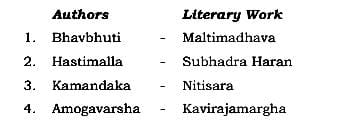
Consider the following pairs :

How many pairs given above is/are correctly matched ?

Detailed Solution: Question 8

Bhavabhuti was a dramatist who lived at Kanyakubja (modern-day Kannauj in U.P) in the early 8th century. He has three surviving plays, namely Malatimadhava, Mahaviracharita and Uttararamacharita. So, Pair (1) is correct.

Hastimalla was a 13th-century Kannada poet and playwright in the Hoysala empire. He wrote Purvapurana. He wrote 8 plays, including Vikrant Kaurava and Subhadra Harana. So, Pair (2) is correct.

Kamandaka’s Nitisara was a work written during the Gupta period (4th century CE). It is a work on polity addressed to the king. Kamandaka’s Nitisara advises the king to be like a florist or milkman in matters of taxation. Just as cows have to be tended to at certain times and milked at others, and just as a florist takes care of his plants and sprinkles water on them, besides cutting them, similarly, the king should help his subjects with money and provisions at certain times and tax them at others. Kamandaka also warns sternly that royal officials who become rich through ill-gotten gains should be bled like a surgeon bleeds a swelling abscess. So, Pair (3) is correct.

Amoghavarsha, or Nripatunga of Manyakheta, was a Rashtrakuta king who is famous for building a new capital city of Manyakheta (identified with modern Malkhed). He was a patron of literature and a scholar himself. He wrote the Kavirajamarga, which is considered to be the earliest Kannada work on poetics.

So, Pair (4) is correct.

UPSC Indian Forest Service Prelims (GS1) Mock Test- 3 - Question 9

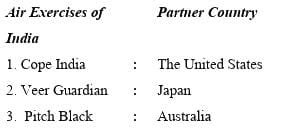
Consider the following pairs:

Which of the pairs given above is/are  correctly matched? 

Detailed Solution: Question 9

  • Air Exercises With Quad Countries: o Cope India began in 2004 as a fighter training exercise held at Air Station Gwalior, India. The exercise has evolved to incorporate subject matter expert exchanges, air mobility training, airdrop training and large-force exercises, in addition to fighter-training exercises.
    • The exercise showcases U.S. and India’s efforts and commitment to a free and open Indo-Pacific region. Exercise Cope India 23 was held at Air Force Stations Arjan Singh (Panagarh), Kalaikunda and Agra. Hence pair 1 is correctly matched.
    • The inaugural edition of the bilateral air exercise 'Veer Guardian 2023' between the Indian Air Force (IAF) and Japan Air Self-Defence Force (JASDF) concluded in Japan, on  26 January 2023. The JASDF participated in the exercise with its F-2 and F-15 aircraft, while the IAF contingent participated with the Su-30 MKI aircraft. The IAF fighter contingent was complemented by one IL-78 Flight Refueling Aircraft and two C-17 Globemaster strategic airlift transport aircraft.
      • During the joint training spanning 16 days, the two Air Forces engaged in complex and comprehensive aerial manoeuvres in multiple simulated operational scenarios. The exercise involved precise planning and skillful execution by both air forces. IAF and JASDF engaged in air combat maneuvering, interception, and air defence missions, both in Visual and Beyond Visual Range settings. Aircrew of the two participating Air Forces also flew in each other's fighter aircraft to gain a deeper understanding of each other's operating philosophies. Hence pair 2 is correctly matched.
    • Exercise Pitch Black 22 was hosted by the Royal Australian Air Force at its Darwin Air Base. Spanning over three weeks, the exercise saw the participation of 17 Air Forces and over 2500 military personnel. The IAF contingent included four Su-30 MKI & two C-17 aircraft. The participating forces took part in various multi-aircraft combat drills by day & night, simulating complex aerial scenarios, involving large formations.
      • The exercise provided an opportunity for the air forces to share best practices and experiences. The event witnessed a collaborative spirit that has led to a better understanding of each other's capabilities & a bonhomie that will lead to enduring ties between the participating nations. Hence pair 3 is correctly matched.

UPSC Indian Forest Service Prelims (GS1) Mock Test- 3 - Question 10

With reference to the religious history ofIndia, Mahavibhasa is a

Detailed Solution: Question 10

  • The rise of the Sarvāstivāda school of Buddhism as a distinct group dates back to the 2nd to 1st centuries BCE. They attained prominence in the region of Mathura and in Kashmir.
  • According to Buddhist historical literature, the Sarvāstivādins split from the Sthaviravāda school at the third Buddhist council held in Pāṭaliputra (present-day Patna).
    • The third council led the divergence of Sthaviravāda into two schools: Vibhajyavādins and Sarvāstivādins. Then, a new school of Sarvāstivādins, Sautrāntikas spring off.
  • The name “Sarvāstivāda” suggests that the disagreement with the Sthaviravādins was a matter of doctrinal viewpoint: “sarvāstivāda” is derived from the Sanskrit sarvam asti, meaning essentially “everything exists/all is.” The question from which the school derives its name is whether discrete entities (dharma) have an existence only in the present, or whether they also exist as such in the past and future. In other words, the question is whether the past becomes manifest in the present, and whether the future is already latent in the present. This focus on philosophical interpretation and debate explains why the Sarvāstivāda school predominantly is an abhidharma school.
  • The Fourth Buddhist Council was held in Kashmir by the patronage of Kanishka in Kashmir about 72-78 AD. It was presided over by Vasumitra and Asvaghosha and had to deal with a serious conflict between the Sarvasthivada teachers of Kashmir and Gandhara.
    • During this meeting the Sarvasthavadin doctrines were organized into a Mahavibhasa containing three large commentaries on the Pitakas. They were codified in a summary. Hence option (c) is the correct answer.
    • In the fourth council, the Sarvāstivādins were dominant. They debated on the orthodoxy and the authenticity of their teachings at this council.
    • One was the Sarvāstivāda and the Sautrāntika. The Sautrāntika was the school that began to be critical of the realism and pluralism of the Sarvāstivāda. The Sarvāstivāda regarded them as real while the Sautrāntika regarded them as mentally created. The meaning of the name Sautrāntika comes from the term ’Sūtra’, that is, those who adhere to Sūtra.
    • There is a principal difference noticed between the Sautrāntika and the Sarvāstivāda. The Sarvāstivāda was also called Vaibhāṣika, the followers of the Vibhāṣā or Commentaries. The Sarvāstivādins believed that the Abhidharma was the word of the Buddha whereas the Sautrāntikas did not accept that.
    • At this council, the Vaibhāṣikas, the Sarvāstivādins won the debate and the Sautrāntikas were disgraced.

UPSC Indian Forest Service Prelims (GS1) Mock Test- 3 - Question 11

Consider the following statements about the Board for Financial Supervision (BFS):

1. The BFS is an autonomous body under the Finance Ministry, with a mandate to supervise the financial sector.

2. The BFS has a mandate to supervise both the banks and the NBFCs (Non- Banking Financial Companies).

Which of the statements given above is/are correct?

Detailed Solution: Question 11

The Board for Financial Supervision (BFS) has been constituted as an autonomous body under the RBI to undertake consolidated supervision of the financial sector, comprising the Scheduled Commercial and Cooperative Banks, All India Financial Institutions, Local Area Banks, Small Finance Banks, Payments Banks, Credit Information Companies, Non-Banking Finance Companies and Primary Dealers.

UPSC Indian Forest Service Prelims (GS1) Mock Test- 3 - Question 12

With reference to the election process and guidelines in India consider the following statements :

1. Any person contesting elections to the Lok Sabha must deposit 25000 rupees.

2. EVMs and postal ballot papers used in elections contain photographs of the candidates along with their party symbols.

3. Any person who is not convicted but in jail can vote in an election.

Which of the statements given above is/are correct?

Detailed Solution: Question 12

Any person contesting elections to the Lok Sabha must deposit 25000 rupees.

  • This statement is correct as of the last known guidelines. The Election Commission of India requires a security deposit for candidates contesting in Lok Sabha (General) Elections. The amount is ₹25,000 for general candidates and ₹12,500 for candidates belonging to Scheduled Castes/Scheduled Tribes. This deposit is meant to ensure that only serious candidates contest the elections, and it is forfeited if the candidate fails to secure a certain percentage of votes.

EVMs and postal ballot papers used in elections contain photographs of the candidates along with their party symbols.

  • This statement is also correct. The Election Commission of India introduced photographs of candidates on Electronic Voting Machines (EVMs) and postal ballot papers to help voters make an informed choice and to prevent confusion with candidates of similar names. This measure has been implemented to enhance transparency and aid voter recognition.

Any person who is not convicted but in jail can vote in an election.

  • This statement is incorrect. In India, under Section 62(5) of the Representation of the People Act, 1951, no person shall vote at any election if they are confined in a prison, whether under a sentence of imprisonment or transportation or otherwise, or is in lawful custody of the police. However, this does not apply to those under preventive detention. Therefore, being in jail, regardless of conviction status, disqualifies a person from voting in elections.

Given these clarifications:

  • Statement 1 is correct.
  • Statement 2 is correct.
  • Statement 3 is incorrect.

Therefore, the correct answer is: 1 and 2 only

UPSC Indian Forest Service Prelims (GS1) Mock Test- 3 - Question 13

It is one of the great lakes of East Africa, the lake empties into the Rusizi River and one of the largest inland island on the planet, Idjwi Island, is located on this lake. Which of the following lake suits the above description?

Detailed Solution: Question 13

Lake Kivu:

  • Location: Lake Kivu is one of the Great Lakes of East Africa, situated between the Democratic Republic of Congo (DRC) to the west and Rwanda to the east.
  • Size and Ranking: It is Rwanda's largest lake and the sixth largest lake in Africa.
  • Geographical Features: Lake Kivu is located in the Albertine Rift, which is part of the East African Rift. It lies at an altitude of 1,460 meters above sea level, covering an area of 1,040 square miles (2,700 sq. km).
  • Distribution of Waters: Approximately 58% of its waters are in the DRC, while the remaining portion is in Rwanda.
  • Dimensions: Lake Kivu is about 90 km long and 50 km wide, with a maximum depth of 475 meters and an average depth of 220 meters.
  • Shoreline: The lake has an irregular shoreline, with numerous inlets and peninsulas, and it is known for having several waterfalls along its shores.
  • Outflow: The lake drains into the Rusizi River, which flows southward into Lake Tanganyika.
  • Idjwi Island: Lake Kivu is home to Idjwi Island, which is the tenth largest inland island in the world.

UPSC Indian Forest Service Prelims (GS1) Mock Test- 3 - Question 14

The founding and settling of hill stations in India were initially connected with the needs of the British army. In this context, consider the following statements:

1. Shimla was founded during the course of the Gurkha War of 1815-16.

2. The British developed Mount Abu during the Third Anglo-Maratha War.

3. Britishers seized Darjeeling from the rulers of Bengal in 1835.

Which of the statements given above is/are correct?

Detailed Solution: Question 14

  • As in the case of cantonments, hill stations were a distinctive feature of colonial urban development. The founding and settling of hill stations was initially connected with the needs of the British army.
    • Shimla (present-day Shimla) was founded during the course of the Gurkha War (1815-16). Hence statement 1 is correct. o The Anglo-Maratha War of 1818 (Third Anglo-Maratha war) led to British interest in Mount Abu. Hence statement 2 is correct.
    • Darjeeling was wrested from the rulers of Sikkim in 1835. Hence statement 3 is not correct.
    • Hill stations became strategic places for billeting troops, guarding frontiers and launching campaigns against enemy rulers. The temperate and cool climate of the Indian hills was seen as an advantage, particularly since the British associated hot weather with epidemics. Cholera and malaria were particularly feared and attempts were made to protect the army from these diseases. The overwhelming presence of the army made these stations a new kind of cantonment in the hills. o These hill stations were also developed as sanitariums, i.e., places where soldiers could be sent for rest and recovery from illnesses. Because the hill stations approximated the cold climates of Europe, they became an attractive destination for the new rulers. It became a practice for viceroys to move to hill stations during the summer months.
    • In 1864 the Viceroy John Lawrence officially moved his council to Shimla, setting the seal to the practice of shifting capitals during the hot season. Shimla also became the official residence of the commander-in-chief of the Indian army. 

UPSC Indian Forest Service Prelims (GS1) Mock Test- 3 - Question 15

Consider the following statements related to Mauryan Art and Architecture:

  1. Chandragupta’s palace was inspired by Greco-Bactrian architecture.
  2. Ashokan pillars feature animal capitals like lions and bulls.
  3. Stupas are found at Rajagriha, Vaishali, and Kapilavastu.

How many of the above statements is/are correct?

Detailed Solution: Question 15

  • Mauryan art and architecture showcase a combination of native styles and Achaemenid influences.
  • Chandragupta’s palace, praised by both Megasthenes and Fa Hien, was mainly constructed from wood and drew inspiration from Achaemenid palaces like Persepolis (not Greco-Bactrian architecture). Therefore, statement 1 is incorrect.
  • Ashokan pillars, crafted from polished sandstone from Chunar, are monolithic, rock-cut structures with animal capitals such as lions and bulls. These symbolize state power and serve to spread Buddhist teachings. Therefore, statement 2 is correct.
  • Stupas, featuring elements like the anda (dome) and chhatra (umbrella), were central to Buddhist architecture. Notable examples include Sanchi (Madhya Pradesh), Piprahwa (Uttar Pradesh), and the post-Buddha stupas at Rajagriha, Vaishali, and Kapilavastu. Therefore, statement 3 is correct.

UPSC Indian Forest Service Prelims (GS1) Mock Test- 3 - Question 16

Consider the following mechanisms of accessing credit :

1. Issue of dated Government securities to the public

2. Issue of Treasury Bills to the public

3. Ways and Means Advance facility from RBI

4. Issue of dated Government Securities to RBI

In the context of the Government of India, through which of the above mechanisms does the Government finance its deficit ?

Detailed Solution: Question 16

  • Deficit financing means generating funds to finance the deficit resulting from excess expenditure over revenue. The gap is being covered by borrowing from the public through the sale of bonds or by printing new money. The below mechanisms do the Government finance its deficit:
  • The Reserve Bank of India issues dated Government securities to the public on behalf of the Government, which are long-term debt instruments that mature in 5-40 years. These securities are typically used to finance the long-term requirements of the Government.
  • The Government issues Treasury Bills to the public, which are short-term debt instruments that mature in less than one year. These bills are used to finance the short-term requirements of the Government.
  • The Government can also avail of the Ways and Means Advance facility from the Reserve Bank of India (RBI) to meet its temporary mismatches in cash flow. This facility is essentially an overdraft facility extended by the RBI to the Government. So, Statements 1, 2 and 3 are correct.
  • Dated Government securities are long-term securities or government bonds that carry a fixed or floating coupon (interest rate). Securities are issued by the government (center or state) for mobilizing funds. Financing the fiscal deficit is the most important purpose for issuing dated securities. On behalf of the government, only the RBI issues the securities, pays interest and gives back money at the maturity period.The government does not issue them to the RBI.
  • RBI’s public debt office manages all these activities. The RBI sells securities through auction through the Negotiated Dealing System (NDS). They are bought by institutions known as primary dealers (Primarily dealers are mostly commercial banks, insurance companies etc.) So, Statement 4 is not correct. 

UPSC Indian Forest Service Prelims (GS1) Mock Test- 3 - Question 17

Consider the following statements regarding the Office of Chief Labour Commissioner (Central):

1. It is responsible for the prevention and settlement of industrial disputes through conciliation/mediation.

2. It verifies the membership of Trade Unions affiliated to the Central Organisations of workers.

3. It is responsible for the revision of the dearness allowance component of minimum wages in the scheduled employments under the Minimum Wages Act, 1948.

Which of the statements given above is/are correct?

Detailed Solution: Question 17

  • The organization of the Chief Labour Commissioner (Central) also known as Central Industrial Relations Machinery is an apex organization in the country responsible for maintaining harmonious industrial relations mainly in the sphere of central Government.
  • The Organisation of Chief Labour Commissioner (Central) (CLC(C) is entrusted with the following functions
    • Prevention and settlement of industrial disputes through conciliation/mediation. Hence statement 1 is correct.
    • enforcement of awards and settlements
    • implementation of labour laws in industries and establishments in respect of which Central Government is the appropriate government
    • verification of membership of Trade Unions affiliated to the Central Organisations of workers for giving them representation in national and international conferences and committees. Hence statement 2 is correct.
    • fixation and revision of dearness allowance component of minimum wages under the Minimum Wages Act, 1948 in the scheduled employments. Hence statement 3 is correct.
    • Assists Labour Ministry in preparation of different reports required to be submitted to ILO.
    • Attending to Parliamentary Committees and other important delegations as per advice of the Ministry.

UPSC Indian Forest Service Prelims (GS1) Mock Test- 3 - Question 18

In the context of Indian polity, which one of the following would you accept as the most appropriate definition of secularism?

Detailed Solution: Question 18

  • Secularism is first and foremost a doctrine that opposes all forms of inter-religious domination. This is however only one crucial aspect of the concept of secularism. An equally important dimension of secularism is its opposition to intra-religious domination.
  • The mainstream, western conception, of secularism, means the mutual exclusion of state and religion in order to protect values such as individual freedom and citizenship rights of individuals.
  • Conditions in India are different and to respond to the challenge they posed, the makers of the Constitution had to work out an alternative conception of secularism.
    • Indian philosophy of secularism is related to “Sarva Dharma Sambhava” (literally it means that the destination of the paths followed by all religions is the same, though the paths themselves may be different) which means equal respect to all religions.
    • There’s no clear demarcation between state and religion in India, positive intervention of the state in religious affairs is not prohibited. In India, both state and religion can, and often do, interact and intervene in each other's affairs within the legally prescribed and judicially settled parameters also the State does not discriminate on the basis of any religion. India does partially separate religion and state. Hence, option (d) is the correct answer.

UPSC Indian Forest Service Prelims (GS1) Mock Test- 3 - Question 19

Which of the following factors are responsible for creating chilling effect in northern India during the winter season?

1. Snowfall in the Himalayas.

2. Distant location of the states, like Punjab and Haryana, from the sea.

3. Cold waves from Turkmenistan hitting the north-west India.

Select the correct answer using the code given below:

Detailed Solution: Question 19

Usually, the cold weather season sets in by mid-November in northern India. December and January are the coldest months in the northern plains. The mean daily temperature remains below 21°C over most parts of northern India. The night temperature may be quite low, sometimes going below the freezing point in Punjab and Rajasthan. There are 3 main reasons for the excessive cold in north India during this season:
(i) States, like Punjab, Haryana and Rajasthan, being far away from the moderating influence of the sea, experience continental climate.
(ii) The snowfall in the nearby Himalayan ranges creates cold wave situation; and
(iii) Around February, the cold winds coming from the Caspian Sea and Turkmenistan bring cold wave along with frost and fog over the north- western parts of India. 

UPSC Indian Forest Service Prelims (GS1) Mock Test- 3 - Question 20

In the context of ancient Indian history, the terms Bhaga and Hiranya refer to

Detailed Solution: Question 20

  • Harshavardhana (590–647 CE) was a Pushyabhuti/Vardhana emperor who ruled northern India from 606 to 647 CE. He subdued the minor powers and became the king of Thanesar and Kanauj. His authority and control prevailed over Bengal, Kamarupa, Valabhi, Sind, Nepal and Kashmir.
  • Revenue administration under Harshavardhana's reign included Bhaga, Hiranya and Bali as the three kinds of taxes collected. x Bhaga was the land tax paid in kind, one-sixth of the produce was collected as land revenue. Hiranya, literally, means tax payable on gold coins, but in practice, was the tax paid by farmers and merchants in cash.
  • Hence option (b) is the correct answer. 

UPSC Indian Forest Service Prelims (GS1) Mock Test- 3 - Question 21

Consider the following:
1. Variable Rate Applicator
2. Geographic Information Systems (GIS)
3. Remote Sensing (RS) technique
4. Global Navigation Satellite Systems (GNSS)
Which of the above technologies are used in precision farming?
 

Detailed Solution: Question 21

  • Precision farming is an approach where inputs are utilised in precise amounts to get increased average yields, compared to traditional cultivation techniques.
  • An information and technology-based farm management system identifies, analyses, and manages variability in fields by conducting crop production practices at the right place and time and in the right way, for optimum profitability, sustainability, and protection of the land resource.
  • Technologies include a vast array of tools of hardware, software, and equipment:
    • Global Navigation Satellite Systems (GNSS) receivers
    • Differential Global Positioning System (DGPS)
    • Geographic Information Systems (GIS)
    • Remote Sensing (RS) technique
    • Variable Rate Applicator
    • Combine harvesters with yield monitors
  • Hence option (d) is the correct answer.
  • Sustainable precision farming and healthy food production increase profitability and output, improve economic efficiency, and lessen adverse environmental effects. Other advantages include efficient use of water resources, prevention of soil degradation and even improving farmers' socio-economic standing.
  • Precision farming also enables climate-smart agri-business which is necessary for achieving climate goals.
     

UPSC Indian Forest Service Prelims (GS1) Mock Test- 3 - Question 22

Arrange the following electoral reforms in India in chronological order.
1. Supply of electoral rolls free of cost 2. Provision made to facilitate the use of Electronic Voting Machines (EVMs) in
elections
3. Restrictions imposed on exit polls 
4. Provision made to facilitate voting through postal ballot
Select the correct answer using the code given below.

Detailed Solution: Question 22

  • Electronic Voting Machines: In 1989, a provision was made to facilitate the use of Electronic Voting Machines (EVMs) in elections. The EVMs were used for the first time in 1998 on an experimental basis in selected constituencies in the elections to the Assemblies of Rajasthan, Madhya Pradesh, and Delhi. The EVMs were used for the first time in the general elections (entire state) to the Assembly of Goa in 1999.
  • Voting through Postal Ballot: In 1999, a provision was made for voting by certain classes of persons through postal ballot.
  • Free Supply of Electoral Rolls: According to a 2003 provision, the Government should supply, free of cost, copies of the electoral rolls and other prescribed material to the candidates of recognized political parties for the Lok Sabha and Assembly elections.
  • Restrictions Imposed on Exit Polls: According to a 2009 provision, conducting exit polls and publishing results of existing polls would be prohibited during the election to Lok Sabha and State Legislative Assemblies.
  • Hence option (c) is the correct answer.

UPSC Indian Forest Service Prelims (GS1) Mock Test- 3 - Question 23

The Representation of the People Act, 1950, provides for which of the following?

1. Delimitation of constituencies for election.

2. Appointment of the Observers during the conduct of general elections.

3. Preparation of the electoral roles for the Assembly and the Council constituencies.

Select the correct answer using the code given below:

Detailed Solution: Question 23

The Observers are appointed under Section 20B of the Representation of the People Act, 1951. 

UPSC Indian Forest Service Prelims (GS1) Mock Test- 3 - Question 24

Which of the following statements is/are correct regarding droughts in India?

1. About 30% of the country’s total area is identified as drought prone.

2. High dependence upon monsoonal rainfalls is one of the most important reasons for drought severity in India.

Select the correct answer using the code given below:

Detailed Solution: Question 24

  • Indian agriculture has been heavily dependent on the monsoon rainfall. Droughts and floods are the two accompanying features of the Indian climate. According to some estimates, nearly 19% of the total geographical area of the country and 12% of its total population suffer due to drought every year.
  • About 30% of the country’s total area is identified as drought prone, affecting around 50 million people. It is a common experience that while some parts of the country reel under floods, there are regions that face severe drought during the same period. Moreover, it is also a common sight to witness that one region suffers due to floods in one season and experiences drought in the other. This is mainly because of the large-scale variations and unpredictability in the behaviour of the monsoon in India.
  • Thus, droughts are widespread and common phenomena in most parts of the country, but these are most recurrent and severe in some and not so in others. On the basis of the severity of the droughts, India can be divided into the following regions: Extreme Drought Affected Areas: It is evident that most parts of Rajasthan, particularly the areas to the west of the Aravalli Hills, i.e., Marusthali and Kachchh regions of Gujarat, fall in this category. Included here are also the districts like Jaisalmer and Barmer from the Indian desert that receive less than 90 mm average annual rainfall.
  • Severe Drought Prone Areas: Parts of eastern Rajasthan, most parts of Madhya Pradesh, eastern parts of Maharashtra, interior parts of Andhra Pradesh and Karnataka Plateau, northern parts of interior Tamil Nadu and southern parts of Jharkhand and interior Odisha are included in this category. Moderate Drought Affected Areas: Northern parts of Rajasthan, Haryana, southern districts of Uttar Pradesh, the remaining parts of Gujarat, Maharashtra, except Konkan, Jharkhand and Coimbatore Plateau of Tamil Nadu and interior Karnataka are included in this category. The remaining parts of India can be considered either free or less prone to droughts.

UPSC Indian Forest Service Prelims (GS1) Mock Test- 3 - Question 25

Poverty Reduction and Growth Facility (PRGF) which provides concessional financial support to its low-income members is an arm of

Detailed Solution: Question 25

  • The Poverty Reduction and Growth Facility (PRGF) is an arm of the International Monetary Fund which lends to the world's poorest countries. It was created on September 16, 1999, replacing the Enhanced Structural Adjustment Facility.
    • Concessional support through the Poverty Reduction and Growth Trust (PRGT) is currently interest free. x It has three lending facilities
    • Extended Credit Facility (ECF): Sustained medium- to long-term engagement in case of protracted balance of payments problems.
    • Standby Credit Facility (SCF) Financing for low-income countries with actual or potential short- term balance of payments and adjustment needs caused by domestic or external shocks, or policy slippages. It can also be used on a precautionary basis during times of increased risk and uncertainty.
    • Rapid Credit Facility (RCF): One-off disbursement for low-income countries facing urgent balance of payments needs. Repeated disbursements over a limited period are possible in case of recurring or ongoing balance of payments needs.
  • Hence option (a) is the correct answer. 

UPSC Indian Forest Service Prelims (GS1) Mock Test- 3 - Question 26

Consider the following statements:

1. The Amazon river basin covers parts of Guyana, Colombia, Ecuador, Bolivia, Suriname, French Guiana, and Venezuela.

2. The Amazon rainforest is bound by the Andes mountain to the east and Atlantic Ocean to the west.

Which of the statements given above is/are correct?

Detailed Solution: Question 26

  • Amazon Rainforest are large tropical rainforests occupying the drainage basin of the Amazon River and its tributaries in northern South America and covering an area of 6,000,000 square km. The Amazon Basin supports the world’s largest rainforest, which accounts for more than half the total volume of rainforests in the world. Comprising about 40% of Brazil’s total area, Peru, and also parts of Guyana, Colombia, Ecuador, Bolivia, Suriname, French Guiana, and Venezuela, the Amazon River Basin is the world’s largest drainage system. Hence, statement 1 is correct.
  • It is bounded by the Guiana Highlands to the north, the Andes Mountains to the west, the Brazilian Central Plateau to the south, and the Atlantic Ocean to the east. Hence, statement 2 is not correct 

UPSC Indian Forest Service Prelims (GS1) Mock Test- 3 - Question 27

“This Biosphere Reserve is situated in Uttarakhand. The major forest types of the Reserve are temperate. A few important species are silver weed and orchids, like latifolie and rhododendron. The Biosphere Reserve has a rich fauna, for example, the snow leopard, black bear, brown bear, musk deer, snowcock, golden eagle and black eagle.” The above sentences describe which of the following Biosphere Reserves?

Detailed Solution: Question 27

  • The Nilgiri Biosphere Reserve (NBR), the first of the 14 Biosphere Reserves of India, was established in September, 1986. It embraces the sanctuary complex of Wyanad, Nagarhole, Bandipur and Mudumalai, the entire forested hill slopes of Nilambur, the Upper Nilgiri Plateau, the Silent Valley and the Siruvani Hills.
  • The total area of the Reserve is around 5,520 sq. km. The Nilgiri Biosphere Reserve possesses different habitat types, unspoilt areas of natural vegetation types with several dry scrubs, dry and moist deciduous, semi- evergreen and wet evergreen forests, evergreen sholas, grasslands and swamps. It includes the largest known population of two endangered animal species, viz., the Nilgiri Tahr and the Lion-tailed Macaque. The Nanda Devi Biosphere Reserve is situated in Uttarakhand and includes parts of Chamoli, Almora, Pithoragarh and Bageshwar districts. The major forest types of the Reserve are temperate.
  • A few important species are silver weed and orchids, like latifolie and rhododendron. The Reserve has a rich fauna, for example, the snow leopard, black bear, brown bear, musk deer, snowcock, golden eagle and black eagle. The Sundarbans Biosphere Reserve is located in the swampy delta of the Ganga River in West Bengal. It extends over a vast area of 9,630 sq. km and consists of mangrove forests, swamps and forested islands. Sundarbans is the home of nearly 200 Royal Bengal tigers.
  • The tangled mass of roots of mangrove trees provides safe homes for a large number of species, from fish to shrimps. More than 170 bird’s species are known to inhabit these mangrove forests.

UPSC Indian Forest Service Prelims (GS1) Mock Test- 3 - Question 28

Under the Hindu Succession Act 1956, the Right to family properties is applicable to women belonging to which of the following categories ?

1. Hinduism

2. Buddhism

3. Jainism

4. Schedule tribes

5. Muslim

Select the correct answer using the codes given below :

Detailed Solution: Question 28

  • Section 14 of the Hindu Succession Act, 1956 states: “Any property possessed by a female Hindu, whether acquired before or after the commencement of this Act, shall be held by her as full owner thereof and not as a limited owner. However, it was not until the 2005 Amendment that daughters were allowed equal receipt of property as sons. 
  • The Hindu Succession Act 1956 deals with succession and inheritance of property, applicable to any person, who is a Hindu by religion in any of its forms or developments, including a Vira Shaiva, a Lingayat or a follower of the Brahmo, Prarthana or Arya Samaj,
  • The Hindu Succession Act 1956 applies to any person who is a Buddhist, Jaina or Sikh by religion and to any other person who is not a Muslim, Christian, Parsi or Jew by religion unless it is proved that any such person would not have been governed by the Hindu law or by any custom or usage as part of that law in respect of any of the matters dealt with herein if this Act had not been passed. As per Section 2(2) of the Hindu Succession Act, the statute, which guarantees equal shares for male and female heirs, does not apply to Scheduled Tribe members. So, Option (b) is correct.

UPSC Indian Forest Service Prelims (GS1) Mock Test- 3 - Question 29

This Act sought 'to make better provisions for the Constitution of the Council for the Governor-General' and 'for the Local Government of the several Presidencies and Provinces'. The act was said to be the 'Prime Charter of the Indian Legislatures' inaugurating the 'system of Legislative devolution of India'. Which of the following acts is being described in the passage given above?

Detailed Solution: Question 29

  • After the great revolt of 1857, the British Government felt the necessity of seeking the cooperation of the Indians in the administration of their country. In pursuance of this policy of association, three acts were enacted by the British Parliament in 1861, 1892 and 1909. The Indian Councils Act of 1861 is an important landmark in the constitutional and political history of India.
  • The Indian Council Act of 1861 sought 'to make better provisions for the Constitution of the Council for the Governor-General' and 'for the Local Government of the several Presidencies and Provinces'. The act was said to be the 'Prime Charter of the Indian Legislatures' inaugurating the 'system of Legislative devaluation of India'. It introduced important changes in the machinery for Legislation, both at the Central and Provisional levels.
  • It initiated the process of decentralization by restoring the legislative powers to the Bombay and Madras Presidencies. It, thus, reversed the centralizing tendency that started from the Regulating Act of 1773 and reached its climax under the Charter Act of 1833. This policy of legislative devolution resulted in the grant of almost complete internal autonomy to the provinces in 1937. Hence option (c) is the correct answer.
  • The other important features of this Act were as follows:
    • It made the beginning of the representative institutions by associating Indians with the law-making process. It, thus, provided that the Viceroy should nominate some Indians as non-official members of his expanded council. In 1862, Lord Canning, the then Viceroy, nominated three Indians to his legislative council–the Raja of Benaras, the Maharaja of Patiala and Sir Dinkar Rao.
    • It also provided for the establishment of new legislative councils for Bengal, North-Western Provinces and Punjab, which were established in 1862, 1886, and 1897, respectively.
    • It empowered the Viceroy to make rules and orders for the more convenient transaction of business in the council. It also gave recognition to the ‘portfolio’ system, introduced by Lord Canning in 1859. Under this, a member of the Viceroy’s council was made in charge of one or more departments of the Government and was authorized to issue final orders on behalf of the council on matters of his department(s).
    • It empowered the Viceroy to issue ordinances, without the concurrence of the legislative council, during an emergency.
    • The life of such an ordinance was six months.

UPSC Indian Forest Service Prelims (GS1) Mock Test- 3 - Question 30

With reference to the North-Eastern Council, consider the following statements:
1. It was created by North-Eastern Council Act of 1971.
2. Its functions are similar to those of the zonal councils.
Which of the statements given above is/are correct?

Detailed Solution: Question 30

Option (c) is correct:
North-Eastern Council was created by a separate Act of Parliament—the North- Eastern Council Act of 1971. Its members include Assam, Manipur, Mizoram, Arunachal Pradesh, Nagaland, Meghalaya, Tripura and Sikkim. Its functions are similar to those of the zonal councils, but with few additions. It has to formulate a unified and coordinated regional plan covering matters of common importance. It has to review from time to time the measures taken by the member states for the maintenance of security and public order in the region.

View more questions
20 tests
Information about UPSC Indian Forest Service Prelims (GS1) Mock Test- 3 Page
In this test you can find the Exam questions for UPSC Indian Forest Service Prelims (GS1) Mock Test- 3 solved & explained in the simplest way possible. Besides giving Questions and answers for UPSC Indian Forest Service Prelims (GS1) Mock Test- 3, EduRev gives you an ample number of Online tests for practice
Download as PDF