UPSC Exam  >  UPSC Test  >   Indian Forest Service (IFoS) Mock Test Series  >  UPSC Indian Forest Service Prelims (GS1) Mock Test- 6 - UPSC MCQ

UPSC Indian Forest Service (IFoS) Prelims (GS1) Mock Test- 6 Free Online


Full Mock Test & Solutions: UPSC Indian Forest Service Prelims (GS1) Mock Test- 6 (100 Questions)

You can boost your UPSC 2026 exam preparation with this UPSC Indian Forest Service Prelims (GS1) Mock Test- 6 (available with detailed solutions).. This mock test has been designed with the analysis of important topics, recent trends of the exam, and previous year questions of the last 3-years. All the questions have been designed to mirror the official pattern of UPSC 2026 exam, helping you build speed, accuracy as per the actual exam.

Mock Test Highlights:

  • - Format: Multiple Choice Questions (MCQ)
  • - Duration: 120 minutes
  • - Total Questions: 100
  • - Analysis: Detailed Solutions & Performance Insights

Sign up on EduRev for free and get access to these mock tests, get your All India Rank, and identify your weak areas to improve your marks & rank in the actual exam.

UPSC Indian Forest Service Prelims (GS1) Mock Test- 6 - Question 1

Consider the following statements regarding AUKUS:

1. It is a trilateral security partnership between the United Kingdom, the United States of America, and Australia.

2. It has a component which is designed to equip Australia with nuclear-powered attack submarines (SSNs).

Which of the statements given above is/are correct?

Detailed Solution: Question 1

The Chinese ambassador to New Zealand cautions that joining AUKUS could harm NZ-China relations. 

About AUKUS:

  • It is a trilateral security partnership between the United Kingdom, the United States of America, and Australia agreed in 2021 that focuses on technology sharing in the Indo-Pacific region.
  • The alliance is widely understood to be a strategic buildup in response to, and a deterrence against, Chinese aggression and ambitions in that strategically important area.
  • AUKUS is intended to strengthen the ability of each government to support security and defense interests, building on longstanding and ongoing bilateral ties.
  • It consists of two key pillars.
  • Pillar 1 focuses on supporting Australia to acquire its first conventionally armed, nuclear-powered submarine fleet. It does not involve the transfer of nuclear weapons to Australia.
  • Pillar 2 focuses on cooperation in eight advanced military capability areas: artificial intelligence (AI), quantum technologies, innovation, information sharing, and cyber, undersea, hypersonic, counter-hypersonic, and electronic warfare domains.
  • Submarine Component:
  • It is designed to equip Australia with nuclear-powered attack submarines (SSNs).
  • In total, Australia will end up with eight of the new nuclear submarines, called SSN-AUKUS.
  • These submarines will be based on a British design but have American technology or an American combat system.
  • AUKUS will make Australia the seventh country in the world to be armed with nuclear-powered submarines and the second, after the United Kingdom, with whom the United States has shared this technology.
  • It will significantly enhance Australia’s undersea capabilities in the Indo-Pacific as nuclear-powered submarines offer many advantages, such as extended range, endurance, and stealth—features.
  • These countries, however, made it clear that their aim is not to arm the new submarines with nuclear weapons. This is because Australia is a signatory to the Nuclear Non-proliferation Treaty (NPT), which bans it from acquiring or deploying nuclear weapons.

Hence both statements are correct.

UPSC Indian Forest Service Prelims (GS1) Mock Test- 6 - Question 2

In the context of interstate financial relations, under Article 282, the Union can make financial grants for

Detailed Solution: Question 2

  • Article 282 empowers both the Centre and the states to make any grants for any public purpose, even if it is not within their respective legislative competence. Under this provision, the Centre makes grants to the states. Hence option (b) is the correct answer.
  • These grants are also known as discretionary grants, the reason being that the Centre is under no obligation to give these grants and the matter lies within its discretion. These grants have a two-fold purpose: to help the state financially to fulfil plan targets; and to give some leverage to the Centre to influence and coordinate state action to effectuate the national plan.

UPSC Indian Forest Service Prelims (GS1) Mock Test- 6 - Question 3

With reference to Zebrafish, consider the following statements:

1. It is a small freshwater fish, native to Africa.

2. It has adequate regeneration capacity of almost all its organs.

3. The majority of zebrafish genes are also present in a similar form in humans.

How many of the statements given above are correct?

Detailed Solution: Question 3

A new study maps out a detailed atlas of all the cells involved in regenerating the zebrafish spinal cord.

About Zebrafish

  • It is a small (2-3 cm long) freshwater fish found in tropical and subtropical regions.
  • The vertebrate takes its name from the horizontal blue stripes running the length of its body. 
  • It is native to South Asia's Indo-Gangetic plains, where they are mostly found in the paddy fields and even in stagnant water and streams.
  • Why do researchers investigate zebrafish?
  • It attracts developmental biologists due to its adequate regeneration capacity of almost all its organs, including the brain, heart, eye, and spinal cord.
  • It possesses several advantages over rodent models in the study of vertebrate development and disease.
  • They are easily bred in large numbers with a relatively low maintenance cost. 
  • Approximately 70 percent of zebrafish genes are also present in a similar form in humans.
  • Over 80 percent of genes that are known to trigger disease in humans are also present in this fish. 

Hence option b is the correct answer.

UPSC Indian Forest Service Prelims (GS1) Mock Test- 6 - Question 4

 Which of the following has served as the president of Indian National Congress (INC) sessions more than once?

1. Madan Mohan Malaviya

2. Motilal Nehru

3. Vallabhbhai Patel

Select the correct answer using the code given below.

Detailed Solution: Question 4

  • Pandit Malviya played a big role in the Civil Disobedience and Non-cooperation movement which was led by Mahatma Gandhi. On account of his services to the Congress he was elected its President in 1909, 1918, 1932, and 1933, but owing to his arrest by the Government of India, he could not preside over the 1932 and 1933 sessions which had been banned. Thus he presided over the INC sessions twice. Hence option 1 is correct.
  • Motilal Nehru presided over the INC sessions of 1919 and 1928. In 1907, Motilal Nehru presided over a provincial conference of Moderate politicians at Allahabad. In 1909 he was elected a member of the United Provinces Council. He attended the Delhi Durbar in 1911 in honor of the visit of King George V and Queen Mary and became a member of the Allahabad Municipal Board and of the All India Congress Committee. He was elected President of the United Province Congress. He preside over the Amritsar Congress in December 1919 and the Calcutta Congress in December 1928. Hence option 2 is correct.
  • In March 1931, Sardar Patel presided over the 46th session of the Indian National Congress which was called upon to ratify the Gandhi - Irwin Pact, which had just then been concluded. Hence option 3 is not correct. 

UPSC Indian Forest Service Prelims (GS1) Mock Test- 6 - Question 5

Consider the following statements:

  1. Chimeric antigen receptor (CAR) T cell therapy is a type of cancer immunotherapy treatment.
  2. CAR T cells are cells that are genetically engineered in a laboratory.
  3. T cells are white blood cells that find and fight illness and infection throughout the body.

Which of the statements given above is/are correct?

Detailed Solution: Question 5

  • CAR T cell therapy is a type of cancer immunotherapy treatment that uses immune cells called T cells that are genetically altered in a lab to enable them in locating in destroying cancer cells more effectively.
  • CAR T treatment can be very effective against some types of cancer, even when other treatments are not working.
  • T cells are white blood cells that find and fight illness and infection throughout the body. Each T cell has a receptor that can recognize antigens (proteins or molecules that are recognizable by the immune system). When the immune system recognizes foreign or abnormal antigens, it can work to destroy them.
  • But cancer cells sometimes have antigens that body doesn't recognize as abnormal. As a result, the immune system may not send T cells to fight cancer cells. In other cases, the T cells may not be able to clear the cancer cells.
  • Chimeric antigen receptor T cells are cells that are genetically engineered (changed) in a laboratory. They have a new receptor so they can bind to cancer cells and kill them.

UPSC Indian Forest Service Prelims (GS1) Mock Test- 6 - Question 6

With respect to the “Adaptive Evolution”, consider the following statements:

1. It is an evolution of an animal into a wide variety of types adapted to specialized modes of life.

2. This feature is exhibited only in the Placental mammals.

Which of the statements given above is/are correct?

Detailed Solution: Question 6

The process of evolution of different species (plants, animals) area, starting in from radiating (habitats), to is other called a a given point areas adaptive geographical and of literally geography radiation. Example is the Australian marsupials. A number of marsupials, each different from the other, evolved from an ancestral stock, but all within the Australian island continent. When more than one adaptive radiation appeared to have occurred in an isolated geographical different habitats), area one (representing can call ‘convergent evolution’. Placental mammals in in Australia also exhibit adaptive radiation evolving into varieties of such placental mammals, each of which appears to be ‘similar’ to a corresponding marsupial (e.g., Placental wolf marsupial).

UPSC Indian Forest Service Prelims (GS1) Mock Test- 6 - Question 7

Which of the following were the provisions of the Government of India Act of 1858?

1. The Act abolished the East India Company and transferred the powers of the Government, territories and revenues to the British Crown.

2. It changed the designation of the Viceroy of India to that of the Governor- General of India, who became the direct representative of the British Crown in India.

3. It ended the system of double Government by abolishing the Board of Control and the Court of Directors, which was established under the Charter Act of 1793.

4. The Secretary of State for India was vested with complete authority and control over the Indian administration, assisted by a Council of 15 members, known as the Council of India.

Select the correct answer using the code given below:

Detailed Solution: Question 7

The salient features of the Government of India Act of 1858 are as follows:

  • It provided that India, henceforth, was to be governed by, and in the name of, Her Majesty.
  • It changed the designation of the Governor-General of India to that of the Viceroy of India. He (Viceroy) was the direct representative of the British Crown in India. Lord Canning, thus, became the first Viceroy of India.
  • It ended the system of double Government by abolishing the Board of Control and the Court of Directors, which was established by the Pitt’s India Act of 1784.
  • It created a new office, the Secretary of State for India, vested with complete authority and control over the Indian administration.
  • The Secretary of State was a member of the British Cabinet and was responsible ultimately to the British Parliament.
  • It established a 15-member Council of India to assist the Secretary of State for India. The Council was an advisory body. The Secretary of State was made the Chairman of the Council.
  • It constituted the Secretary of State-in- Council as a body corporate, capable of suing and being sued in India and in England.

UPSC Indian Forest Service Prelims (GS1) Mock Test- 6 - Question 8

Which of the following statements best describes the ‘head count ratio’?

Detailed Solution: Question 8

  • A common method used to estimate poverty in India is based on the income or consumption levels and if the income or consumption falls below a given minimum level, then the household is said to be Below the Poverty Line (BPL).
  • Poverty: According to the World Bank, Poverty is pronounced deprivation in well-being and comprises many dimensions. It includes low incomes and the inability to acquire the basic goods and services necessary for survival with dignity.
  • Poverty Line: The conventional approach to measuring poverty is to specify a minimum expenditure (or income) required to purchase a basket of goods and services necessary to satisfy basic human needs and this minimum expenditure is called the poverty line.
  • Poverty Line Basket: The basket of goods and services necessary to satisfy basic human needs is the Poverty Line Basket (PLB).
  • Poverty Ratio: The proportion of the population below the poverty line is called the poverty ratio or headcount ratio (HCR). Hence option (b) is the correct answer.

UPSC Indian Forest Service Prelims (GS1) Mock Test- 6 - Question 9

Recently, India launched Operation Kaveri to:

Detailed Solution: Question 9

  • Recent context: India started ‘Operation Kaveri’ to evacuate its nationals owing to the Current Crisis in Sudan. Around 3,000 Indians were stuck in various parts of Sudan, including capital Khartoum and in distant provinces like Darfur. Hence option (d) is the correct answer.
  • Operation Kaveri is a codename for India's evacuation effort to bring back its citizens stranded in Sudan amid intense fighting between the army and a rival paramilitary force there.
  • The operation involves the deployment of the Indian Navy’s INS Sumedha, a stealth offshore patrol vessel, and two Indian Air Force C-130J special operations aircraft on standby in Jeddah.
  • There are about 2,800 Indian nationals in Sudan, and there is also a settled Indian community of about 1,200 in the country.
  • What is the current crisis in Sudan.
    • The conflict in Sudan has its roots in the overthrowing of long-serving President Omar al-Bashir by military generals in April 2019, following widespread protests.
    • This led to an agreement between the military and protesters, under which a power-sharing body called the Sovereignty Council was established to lead Sudan to elections at the end of 2023.
    • However, the military overthrew the transitional government led by Abdalla Hamdok in October 2021, with Burhan becoming the de-facto leader of the country and Dagalo his second-in-command.
    • Soon after the 2021 coup, a power struggle between two military (SAF) and paramilitary (RSF) generals arose, interrupting a plan to transition to elections.
    • A preliminary deal was reached in December 2021 for a political transition, but negotiations hit a roadblock over the integration of the paramilitary Rapid Support Forces (RSF) with the Sudanese Armed Forces (SAF), due to disagreements over the timetable and security sector reforms.
    • Tensions escalated over the control of resources and RSF integration, leading to clashes.
    • There was disagreement over how the 10,000-strong RSF should be integrated into the army, and which authority should oversee that process.
    • Also, Dagalo (RSF general) wanted to delay the integration for 10 years but the army said it would take place in the next two years.
  • The RSF is a group, evolved from Janjaweed militias, which fought in a conflict in the 2000s in the Darfur region in West Sudan nearing the Border of Chad. Over time, the militia grew and made into the RSF in 2013, and its forces were used as border guards in particular.

UPSC Indian Forest Service Prelims (GS1) Mock Test- 6 - Question 10

Consider the following statements:

Statement-I: The people of the Harappan Civilization were aware of drought-resistant crops, such as wheat and barley, as the region did not receive heavy rainfall.

Statement-II: The Harappan Civilization relied solely on rain-fed agriculture, as they lacked the knowledge and practice of irrigation.

Which one of the following is correct in respect of the above statements?

Detailed Solution: Question 10

  • Agriculture served as the sole means of sustenance for the people of the Harappan Civilization, with farming and agriculture becoming the primary occupation for those who were unable to engage in trade. From the remains, we get the evidence of the plants that the Harappans grew. In winters, crops, such as wheat, barley, peas, lentils, linseed and mustard seeds were sown, while millet, sesame and rice were planted during the summer season.
  • A new tool, the plough, was used to dig the earth for turning the soil and planting seeds. While real ploughs, which were probably made of wood, have not survived, toy models have been found. As this region does not receive heavy rainfall, some form of irrigation may have been used. This means that water was stored and supplied to the fields when the plants were growing. The Indus people employed an irrigation system to cultivate their crops, enabling them to meet the needs of their population by departing from the ancient nomadic practices and embracing contemporary technologies.
  • The Harappans reared cattle, sheep, goat and buffalo. Water and pastures were available around the settlements. However, in the dry summer months, large herds of animals were probably taken to greater distances in search of grass and water.
  • Mohenjo-Daro, Harappa and Lothal also had huge storehouses used for storing grains and hence, were called granaries.

UPSC Indian Forest Service Prelims (GS1) Mock Test- 6 - Question 11

Which of the following are the business areas of New Space India Limited (NSIL), the commercial arm of the Indian Space Research Organisation (ISRO) ?

1. Production of Polar Satellite Launch Vehicle (PSLV) and Small Satellite Launch Vehicle (SSLV)

2. Transponder leasing

3. Building Communication and Earth Observation Satellites

4. Transfer of technology developed by ISRO

5. Marketing of products emanating out of ISRO activities

Select the correct answer using the code given below :

Detailed Solution: Question 11

  • New Space India Limited (NSIL), incorporated on 6 March 2019 (under the Companies Act, 2013), is a wholly owned Government of India company under the administrative control of the Department of Space (DOS). NSIL is the commercial arm of the Indian Space Research Organization (ISRO) with the primary responsibility of enabling Indian industries to take up high-technology space-related activities.
  • It is also responsible for promoting and commercializing the products and services emanating from the Indian space program. To satisfy the needs of its customers, NSIL draws upon the proven heritage of the Indian Space Program and ISRO’s vast experience in diverse branches of Space Technology. The major business areas of NSIL include:
    • Production of Polar Satellite Launch Vehicle (PSLV) and Small Satellite Launch Vehicle (SSLV) through industry; Production and marketing of space-based services, including launch services and space-based applications like transponder leasing, remote sensing and mission support services;
    • Building of Satellites (both Communication and Earth Observation) as per user requirements. Transfer of technology developed by ISRO centers/ units and constituent institutions of Dept. of Space; Marketing spin-off technologies and products/ services emanating out of ISRO activities. Consultancy services So, Option (d) is correct. 

UPSC Indian Forest Service Prelims (GS1) Mock Test- 6 - Question 12

In the context of the space sciences, consider the following statements about the Lagrange point:

1. They are positions where the gravitational pull of two large masses precisely equals the centripetal force required for a small object to move with them.

2. The fuel consumption of a spacecraft to remain in position at these points increases.

Which of the statements given above is/are correct?

Detailed Solution: Question 12

  • Lagrange Points are positions in space where the gravitational forces of a two-body system like the Sun and the Earth produce enhanced regions of attraction and repulsion.
  • These can be used by spacecraft to reduce fuel consumption needed to remain in position. Hence, statement 2 is not correct.
  • Lagrange points are named in honour of Italian-French mathematician Joseph-Louis Lagrange. There are five special points where a small mass can orbit in a constant pattern with two larger masses. The Lagrange Points are positions where the gravitational pull of two large masses precisely equals the centripetal force required for a small object to move with them. Hence, statement 1 is correct.
  • Of the five Lagrange points, three are unstable and two are stable. The unstable Lagrange points - labelled L1, L2 and L3 - lie along the line connecting the two large masses. The stable Lagrange points - labelled L4 and L5 - form the apex of two equilateral triangles that have large masses at their vertices. L4 leads the orbit of the earth and L5 follows.

UPSC Indian Forest Service Prelims (GS1) Mock Test- 6 - Question 13

How many of the following activities can use the Indian National Satellite (INSAT) system?

  1. Weather forecasting
  2. Search and Rescue operations
  3. Navigation
  4. Television broadcasting

Select the correct answer using the code given below.

Detailed Solution: Question 13

  • The Indian National Satellite (INSAT) system is one of the largest domestic communication satellite systems in Asia-Pacific region with nine operational communication satellites placed in Geo-stationary orbit. Established in 1983 with commissioning of INSAT-1B, it initiated a major revolution in India’s communications sector and sustained the same later.
  • The INSAT system with more than 200 transponders in the C, Extended C and Ku-bands provides services to telecommunications, television broadcasting, satellite newsgathering, societal applications, weather forecasting, disaster warning, and Search and Rescue operations.
  • While not a primary navigation system, INSAT can provide augmentation to satellite-based navigation systems. It offers location and timing information to enhance navigation accuracy in applications such as civil aviation and maritime navigation. GSAT-8 / INSAT-4G is an Indian Ku-band satellite carrying 18 transponders similar to that of INSAT-4A and INSAT-4B. It carries 2 BSS transponders and a GAGAN (Navstar Aided Geo Augmented Navigation) payload (satellite navigation for aviation). The satellite was originally planned to be launched during 2008-09, but was postponed until 2011.
  • GSAT-7 or INSAT-4F is a multi-band military communications satellite developed by the Indian Space Research Organisation. Hence option (d) is the correct answer.

UPSC Indian Forest Service Prelims (GS1) Mock Test- 6 - Question 14

Consider the following statements with respect to the eutrophication of lakes:

1. It is a manmade process and does not occur naturally.

2. The prime contaminants for eutrophication are nitrates and phosphates.

Which of the statements given above is/are correct?

Detailed Solution: Question 14

  • Eutrophication is the natural aging of a lake by nutrient enrichment of its water. Hence statement 1 is not correct.
    • In a young lake, the water is cold and clear, supporting little life. With time, streams draining into the lake introduce nutrients such as nitrogen and phosphorus, which encourage the growth of aquatic organisms.
    • As the lake’s fertility increases, plant and animal life burgeons, and organic remains begin to be deposited on the lake bottom.
    • Over the centuries, as silt and organic debris pile up, the lake grows shallower and warmer, with warm-water organisms supplanting those that thrive in a cold environment.
    • Marsh plants take root in the shallows and begin to fill in the original lake basin.
    • Eventually, the lake gives way to large masses of floating plants (bog), finally converting into land.
    • Depending on the climate, size of the lake, and other factors, the natural aging of a lake may span thousands of years.
  • However, pollutants from man’s activities like effluents from industries and homes can radically accelerate the aging process. This phenomenon has been called Cultural or Accelerated Eutrophication.
    • During the past century, lakes in many parts of the earth have been severely eutrophied by sewage and agricultural and industrial wastes.
    • The prime contaminants are nitrates and phosphates, which act as plant nutrients. They overstimulate the growth of algae, causing unsightly scum and unpleasant odors, and robbing the water of dissolved oxygen vital to other aquatic life. Hence statement 2 is correct.
    • At the same time, other pollutants flowing into a lake may poison whole populations of fish, whose decomposing remains further deplete the water’s dissolved oxygen content. In such a fashion, a lake can literally choke to death.

UPSC Indian Forest Service Prelims (GS1) Mock Test- 6 - Question 15

Consider the following statements :

1. The nomenclature 'Rajya Sabha' for Council of States was adopted in 1949.

2. In independent India, Rajya Sabha met for the first time in 1952.

3. S.V.Krishnamoorthy Rao was the first Deputy Chairman of Rajya Sabha.

Which of the statements given above is/are correct?

Detailed Solution: Question 15

  • The Rajya Sabha or the Council of States is the upper house of the Parliament of India. It represents the states and union territories of the Indian Union. On 23 August 1954, the Chairman, Rajya Sabha made an announcement in the House that the Council of States would now be called  ̳Rajya Sabha‘ in Hindi. Hence, statement 1 is not correct.
  • Article 80 of the Constitution lays down the maximum strength of Rajya Sabha as 250, out of which 12 members are nominated by the President and 238 are representatives of the States and of the two Union Territories.
    • The present strength of Rajya Sabha, however, is 245, out of which 233 are representatives of the States and Union territories of Delhi and Puducherry and 12 are nominated by the President.
    • The members nominated by the President are persons having special knowledge or practical experience in respect of such matters as literature, science, art, and social service. The Fourth Schedule to the Constitution provides for the allocation of seats to the States and Union Territories in Rajya Sabha. The allocation of seats is made on the basis of the population of each State. In independent India, Rajya Sabha met for the first time on 13 May 1952 under the Chairmanship Dr. S. Radhakrishnan. Hence, statement 2 is correct. S.V.Krishnamoorthy Rao was the first Deputy Chairman of Rajya Sabha.
    • S. V. Krishnamoorthy Rao was born on 15 November 1902 in Shimoga, Karnataka.
    • Rao started the National Educational Society at Shimoga which ran multiple high schools and middle schools.
    • Rao was imprisoned for 18 months in connection with the 1942 Quit India movement and took part in the Mysore Struggle - a movement that demanded the responsible government for Mysore. He was an active member of the Congress Party's political pursuits while simultaneously practicing as an advocate
    • Rao was the first Deputy Chairman of the Rajya Sabha (31 May 1952- 1 March 1962). He also served as a Deputy Speaker in the Lok Sabha from 1962. Hence, statement 3 is correct.

UPSC Indian Forest Service Prelims (GS1) Mock Test- 6 - Question 16

Consider the following statements regarding the Electoral Trusts Scheme:

1. An Electoral Trust is a Trust set up by companies with the sole objective to distribute the contributions received by it from other Companies and individuals to the political parties.

2. The scheme was notified by the Election Commission of India (ECI).

3. Only the companies registered under Section 25 of the Companies Act, 1956 are eligible to make an application for approval as an Electoral Trust.

How many of the above statements are not correct?

Detailed Solution: Question 16

Electoral Trusts Scheme, 2013

  • Electoral Trusts Scheme, 2013 was notified by the Central Board of Direct Taxes (CBDT). Hence, statement 2 is not correct.
  • An Electoral Trust is a Trust set up by companies with the sole objective to distribute the contributions received by it from other Companies and individuals to the political parties. Hence, statement 1 is correct.
  • Only the companies registered under Section 25 of the Companies Act, 1956 are eligible to make an application for approval as an Electoral Trust. The electoral trusts have to apply for renewal every three financial years. Hence, statement 3 is correct.
  • The scheme lays down a procedure for grant of approval to an electoral trust which will receive voluntary contributions and distribute the same to the political parties. The provisions related to the electoral trust are under Income-tax Act, 1961 and Income tax rules-1962.

UPSC Indian Forest Service Prelims (GS1) Mock Test- 6 - Question 17

Which of the following statements are incorrect?

1. Akbar abolished the pilgrim tax on bathing at holy places.

2. Majority of great Hindu nobles, except Birbal, joined the order initiated by Akbar, i.e., Tauhid-i-Ilahi.

3. Ibadat Khana was built by Akbar to appease the orthodox Islamic scholars.

4. Akbar raised the age of marriage for both girls and boys.

Select the incorrect answer using the code given below:

Detailed Solution: Question 17

  • One of the first actions which Akbar took, after he had taken power in his own hands, was to abolish the poll tax or Jizyah, which the non-Muslims were required to pay in a Muslim state. Although it was not a heavy tax, it was disliked because it made a distinction between the subjects. At the same time, Akbar abolished the pilgrim tax on bathing at holy places, such as Prayag, Banaras, etc. He also abolished the practice of forcibly converting prisoners of war to Islam. This laid the essential foundation of an empire based on equal rights to all citizens, irrespective of their religious beliefs. In 1575, Akbar built a hall called Ibadat Khana or the Hall of Prayer at his new capital, Fatehpur Sikri.
  • To this he called selected theologians, mystics and those of his courtiers and nobles, who were known for their scholarship and intellectual attainments. Akbar discussed religious and spiritual topics with them. The proceedings, at first, were confined to the Muslims. They were hardly orderly. The Mullahs wrangled, shouted and abused each other, even in the presence of the emperor. The behaviour of the Mullahs, their pride and conceit in their learning disgusted Akbar, and further alienated him from the Mullahs. At this stage, Akbar opened the Ibadat Khana to the people of all religions — Christians, Zoroastrians, Hindus, Jains, even atheists.
  • This broadened the discussions and debates began even on issues on which all Muslims were agreed, such as whether the Quran was the last revealed book and Muhammad its Prophet, resurrection, nature of God, etc. This horrified the theologians and all kinds of rumours began to circulate about Akbar’s desire to forsake Islam. Badayuni asserts that as a result of discussions at the Ibadat Khana, Akbar gradually turned away from Islam and set up a new religion, which was compounded of many existing religions - Hinduism, Christianity, Zoroastrianism, etc.
  • However, modern historians are not inclined to accept this view and think that Badayuni has exaggerated. There is little evidence to prove that Akbar intended or actually promulgated a new religion. The word used by Abul Fazl and Badayuni for the so-called new path was Tauhid-i-Ilahi, which literally means ‘Divine Monotheism’. Tauhid-i-Ilahi should not be confused with Akbar selecting a small group of trusted nobles who were totally devoted to him.
  • According to Badayuni, those selected were to promise sacrifice of property, life, honour and religion. Giving up religion, apparently meant giving up attachment to the narrow concepts and observances which, again, was in keeping with the Sufi ideas. However, many leading nobles, including all the great Hindu nobles, except Birbal, declined to join. The number of this group, as far as we know, amounted to about 18 only, while those who were enrolled as disciples of Akbar amounted to thousands. Akbar did not use force, nor was money used for enrolling the disciples or Murids. Akbar also introduced a number of social and educational reforms. He stopped Sati, the burning of a widow, unless she herself, of her own free will, persistently desired it. Widows of tender age, who had not shared the bed with their husbands, were not to be burnt at all. Widow Remarriage was also legalised.
  • Akbar was against anyone having more than one wife, unless the first wife was barren. The age of marriage was raised to 14 for girls and 16 for boys. The sale of wines and spirits was restricted. Not all these steps were, however, successful. As we know, the success of social legislation depends largely on the willing co- operation of the people. Akbar was living in an age of superstition and it seems that his social reforms had only limited success.

UPSC Indian Forest Service Prelims (GS1) Mock Test- 6 - Question 18

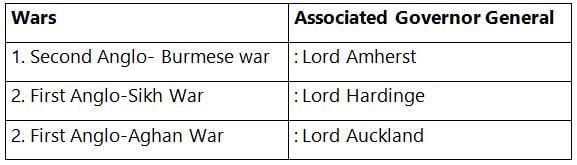
Consider the following pairs:

How many of the above pairs are correctly matched? 

Detailed Solution: Question 18

Second Anglo-Burmese War (1852-53):

  • In 1852, commercial disputes in Rangoon prompted new hostilities between the British and the Burmese. The war was caused by the British commercial greed as they began to exploit the vast forests of upper Burma for timber. They wanted to expand their market for the sale of cotton products as well.
  • Lord Dalhousie was the governor-general of India (1848-56) who provoked this war. He dispatched Commodore Lambert to Burma over several minor issues related to the previous treaty. The Burmese had started blocking commercial exploitation through the coasts. Hence pair 1 is not correctly matched.
  • After the end of the Second Burmese War (1852), Dalhousie annexed Lower Burma with its capital at Pegu. The annexation of Lower Burma proved beneficial to Britain. Rangoon, Britain’s most valuable acquisition from the war, became one of the biggest ports in Asia Lord Amherst was Governor general of Bengal during the first Anglo-Burmerse war.
  • First Anglo-Sikh War (1845–46):
    • The outbreak of the first of the Anglo-Sikh wars has been attributed to the action of the Sikh army crossing the River Sutlej on December 11, 1845. This was seen as an aggressive manoeuvre that provided the Lord Hardinge(1844-48) with the justification to declare war. Hence pair 2 is correctly matched.
    • The war began in December 1845, with 20,000 to 30,000 troops in the British side, while the Sikhs had about 50,000 men under the overall command of Lal Singh. But the treachery of Lal Singh and Teja Singh caused five successive defeats to the Sikhs. Lahore fell to the British forces on February 20, 1846 without a fight.
    • The end of the first Anglo-Sikh War forced the Sikhs to sign a humiliating Treaty of Lahore, 1846 in 1846.
  • First Anglo-Afghan War (1839-42):
    • Following a protracted civil war that began in 1816, the Barakzay clan became the ruling dynasty of Afghanistan, with its most powerful member, Dost Moḥammad Khan, ascending the throne in 1826.
      • With Great Britain and Russia maneuvering for influence in Afghanistan, Dost Moḥammad was forced to balance his country between the two great powers.
    • The British, feeling that Dost Moḥammad was either hostile to them or unable to resist Russian penetration, moved to take a direct role in Afghan affairs. First they negotiated unsatisfactorily with Dost Moḥammad, and then an invasion of Afghanistan was ordered by the governor-general of India, Lord Auckland, with the object of restoring exiled Afghan ruler Shah Shojāʿ to the throne.
  • Lord Auckland served as Governor-General of India from 1836 to 1842. The first Anglo-Afghan war, which occurred during his reign, dealt a major blow to British prestige in India. He is noted for his mistakes in the Afghan wars and has been dubbed India's most disastrous Governor-General. Hence pair 3 is correctly matched.

UPSC Indian Forest Service Prelims (GS1) Mock Test- 6 - Question 19

Which of the following are the applications of High-altitude balloons?

  1. Weather forecasting
  2. Military and espionage
  3. Near-space exploration
  4. Internet and telecommunications

Select the correct answer using the code given below:

Detailed Solution: Question 19

High-altitude balloons are manned or unmanned balloons, usually filled with helium or hydrogen, that are released into the stratosphere. Usually, they rise to 20-40 km in the air and carry payloads as heavy as a few thousand kilograms.
Use cases of high-altitude balloons:

  • Earth observation forecasting and weather
  • Near-space exploration
  • Military and espionage
  • Internet and telecommunications
  • Advertising and entertainment

Benefits: Cheap, easy to launch and control, provides better quality images to observe specific parts of the Earth and can mostly remain undetected.

UPSC Indian Forest Service Prelims (GS1) Mock Test- 6 - Question 20

Which of the following statements is correct regarding photochemical smog?

Detailed Solution: Question 20

  • A Smog is a combination of smoke and fog (smoky fog) caused by the burning of large amounts of coal, vehicular emission and industrial fumes. It usually contains particulates like smoke, sulphur dioxide, nitrogen dioxide and other components.
  • At least two distinct types of smog are recognized:
    • Sulfurous smog
      • It is also called the “London smog,” (first formed in London).
      • It results from a high concentration of sulphur oxides in the air caused by the use of sulfur-bearing fossil fuels, particularly coal (Coal was the mains source of power in London during the 19th century, the effects of which started becoming evident in the early twentieth century).
      • This type of smog is aggravated by dampness and a high concentration of suspended particulate matter in the air.
    • Photochemical smog
      • It is a brownish-grey haze caused by the action of solar ultraviolet radiation on the atmosphere polluted with hydrocarbons and oxides of nitrogen. It is also known as the “Los Angeles smog”. Los Angeles smog consists mainly of carbon oxides, nitrogen oxides, and hydrocarbons.
      • It occurs most prominently in urban areas wherein anthropogenic air pollutants, mainly ozone, nitric acid, and organic compounds, get trapped near the ground by temperature inversion. The major source of such pollutants is the large numbers of automobiles (and the resultant emissions). The resulting smog directly affects the health of humans, animals, and plants and results in other effects including- reduced visibility, etc.
      • Photochemical smog is sometimes called as Oxidizing smog as it contains high concentrations of oxidizing agents like Ozone, HNO3 whereas Classical Smog is called Reducing as it contains high concentrations of sulphur dioxide, which is a reducing agent.
      • Hence option (d) is the correct answer.

UPSC Indian Forest Service Prelims (GS1) Mock Test- 6 - Question 21

Consider the following statements about Parivesh 2.0 portal.

  1. The website is designed , updated and maintained by the Ministry of  Environment, Forests and Climate change.
  2. It provides a single window platform for environmental clearance, forest  clearance, coastal regulation zone clearance etc

Select the correct statement(s)

Detailed Solution: Question 21

  • Statement 1: Correct

    • PARIVESH stands for Pro-Active Responsive Facilitation by Interactive and Virtuous Environmental Single-window Hub.
  • Statement 2: Correct

    • The Ministry of Environment, Forest and Climate Change (MoEFCC) is the nodal ministry for Parivesh 2.0, a web-based application for environmental clearances.

    • Parivesh was originally launched in 2018 to provide a single window for environmental, forest, wildlife, and coastal regulation zone clearances, among others.

    • Parivesh 2.0 introduces a mobile app that allows project proponents to track their clearance applications and compliance submissions.

UPSC Indian Forest Service Prelims (GS1) Mock Test- 6 - Question 22

Consider the following statements with reference to the representations of the Kakatiya architecture:

1. Thousand Pillar temple built during this period is a triple shrine dedicated to Vishnu, Shiva, and Surya.

2. Golconda Fort which served as an early capital of the Qutub Shahi dynasty was built during Kakatiya rule.

3. Sandbox Technique was used to build the foundation of the Ramappa Temple.

Which of the statements given above is/are correct?

Detailed Solution: Question 22

The Kakatiyas were earlier feudatories of Western Chalukyas. All three contemporary dynasties of Deccan i.e., Hoysalas, Yadavas and Kakatiyas were feudatories of Western Chalukyas.

  • The independent dynasty was established when Rudradeva (Prataparudra I) became first independent ruler of Kakatiya dynasty in 1158AD.
  • Warangal was the capital of Kakatiyas. They faced Islamic invasion from 1310 (by Alauddin Khilji) and ultimately came under control of Delhi Sultanate in 1323 (invasion by Sultan Ghiyasuddin Tughlaq). Architecture:
  • Rudreswara Temple: also known as VeyyisthambalaGudi (Thousand pillar temple) in Telugu is one of the earliest structures of Kakatiya architecture. It was built by Rudra Deva in 1163 AD. The temple is dedicated to Vishnu, Shiva and Surya. Hence statement 1 is correct. The temple is known for its richly carved pillars, perforated screens, special icons like rock-cut elephants and monolithic Nandi. 
  • The temple was desecrated by the rulers of Tughlaq dynasty during their invasion of the Deccan region.
  • Golconda Fort in Hyderabad (Telangana) was also constructed by the Kakatiya rulers. Later, it became the capital of the Qutb Shahi kings, who ruled from CE 1518-1687. Hence statement 2 is correct.
  • Ramappa Temple: It is situated in Palampet Village, around 67 km from the city of Warangal. It is dedicated to Lord Shiva. : It is the only temple in India known by the name of the sculptor who built it, rather than after the presiding deity
  • It was built on behalf of the king, Kakati Ganapathi Deva by his chief commander Rudra Samani. o The temple, known for its exquisite craftsmanship and delicate relief work, is savvy blend of technical know-how and materials of its time. The foundation is built with the ―sandbox technique‖, the flooring is granite and the pillars basalt. Hence statement 3 is correct
  • The sculptural work of dance postures in the temple were great inspiration for the famous work ̳Nritya Ratnavali‘, by Jayapa Senani.
  • The temple is recently given the tag of World Heritage site by UNESCO .

UPSC Indian Forest Service Prelims (GS1) Mock Test- 6 - Question 23

In the context of the food processing industry, consider the following statements about the Individual Quick Freezing Technique (IQF):
1. Due to quick freezing, the original texture and flavour of the food are maintained.
2. It does not allow large ice crystals to form in vegetable cells.
Which of the statements given above is/are correct?

Detailed Solution: Question 23

  • Frozen foods have outstanding quality and nutritive value. Indeed, some frozen vegetables, such as green peas and sweet corn, may be superior in flavour to fresh produce. The high quality of frozen foods is mainly due to the development of a technology known as the individually quick-frozen (IQF) method.
  • IQF is a method that does not allow large ice crystals to form in vegetable cells. Hence, statement 2 is correct.
  • Also, since each piece is individually frozen, particles do not cohere, and the final product is not frozen into a solid block.
  • Various freezing techniques are commonly used in the preservation of vegetables. These include blast freezing, plate freezing, belt-tunnel freezing, fluidized-bed freezing, cryogenic freezing, and dehydrofreezing. The choice of method depends on the quality of the end product desired, the kind of vegetable to be frozen, capital limitations, and whether or not the products are to be stored as bulk or as individual retail packages.
  • This individual quick frozen process allows the ice crystals that form inside the cells of the food tissues to be very small, which does not allow the cell walls of the food to break. Therefore, when defrosting the product there is no leakage of cellular fluids, which is where the nutrients of the food are found, and at the same time, it guarantees that the original texture and flavor are maintained. Hence, statement 1 is correct.

UPSC Indian Forest Service Prelims (GS1) Mock Test- 6 - Question 24

Consider the following statements regarding Immunotherapy:

  1. Immunotherapy teaches the body’s immune system to recognise and attack cancer cells.
  2. It helps in detecting, treating and understanding cancer.
  3. It provides patients with more effective and less invasive treatments.

How many of the above statements are correct?

Detailed Solution: Question 24

  • Immunotherapy is a type of biological therapy. Biological therapy is a type of treatment that uses substances made from living organisms to treat cancer.
  • Statement 1 is correct: Immunotherapy teaches the body’s immune system to recognise and attack cancer cells.
  • Statements 2 is correct: It helps in detecting, treating and understanding cancer.
  • Statements 3 is correct: It provides patients with more effective and less invasive treatments.

UPSC Indian Forest Service Prelims (GS1) Mock Test- 6 - Question 25

President's Standard and Colours is the highest honour that can be awarded to which among the following in India?

1. a military unit

2. mlitary training establishments

3. State/UT Police forces

Select the correct answer using the code given below:

Detailed Solution: Question 25

About President’s Standard and Colours:

  • It is the highest honour that can be awarded to any military unit, military training establishments, or State/UT Police Forces of India.
  • It is bestowed upon a military unit in recognition of exceptional service rendered to the nation, both in peace and in war.
  • It is also known as “Rashtrapati ka Nishaan” in Hindi.
  • History:
  • The award has its history way back to ancient Indian traditions.
  • In ancient times, whenever any military unit marches, they carried ‘dhwajas’ or ‘patakas’ or simply a flag of their respective kings to demonstrate their king’s supremacy. The flag had emblems or messages of their kings to other rulers.
  • During British rule in India, the tradition continues. The military unit of the British Armed Forces of that time carried the king’s/queen’s version of the flag whenever they go for a military march.
  • On November 23, 1950, the ‘king’s colour’ of the erstwhile British Indian regiments was laid to rest in Chetwode Hall, Dehradun, to make way for the ‘colours’ of the President of the Republic of India.
  • The Indian Navy was the first Indian Armed Forces to be awarded the President Colour by Dr. Rajendra Prasad on May 27, 1951. 
  • Award:
  • It is a type of special flag, also known as ‘Nishaan’, which is awarded to a military unit in an organised ceremony. 
  • Colours are generally presented personally by the President, who is the Supreme Commander of the Armed Forces, and in case of the President’s non-availability, by the Service Chief.
  • The flag consists of a golden border in the middle and the insignia of a respective military unit, training establishments, and police forces in the centre.
  • Sometimes, it may also contain the motto, important achievements, and battle participation of those military units to which the award is bestowed.
  • During any ceremonial parade, the President’s Colour, i.e., the special flag of a military unit, is kept in a special position, and soldiers often march with the President’s Colour on important dates, like their establishment anniversary.

Hence option c is the correct answer.

UPSC Indian Forest Service Prelims (GS1) Mock Test- 6 - Question 26

Consider the following:

  1. He was influenced by Gandhi's views on caste and untouchability and led a simple life.
  2. He gave up his legal career to join the independence movement in 1920 and was imprisoned during the Salt Satyagraha in 1931.
  3. Presided over the Bombay session of the Indian National Congress in 1934 and became Congress President after Subhash Chandra Bose's resignation in 1939.
  4. He was appointed President of the Constituent Assembly in 1946.

Which of the following Personalities best matches the above description?

Detailed Solution: Question 26

Dr. Rajendra Prasad:

  • Born on 3rd December 1884, in Zeradei, Siwan, Bihar.
  • Influenced by Gandhi's stance on caste and untouchability, he lived a simple life.
  • He abandoned his legal profession to join the independence movement in 1920 and was jailed during the Salt Satyagraha in 1931 and the Quit India movement in 1942.
  • He presided over the Bombay session of the Indian National Congress in 1934 and became Congress President after Subhash Chandra Bose's resignation in 1939.
  • Appointed President of the Constituent Assembly in 1946.

Hence, option A is correct.

UPSC Indian Forest Service Prelims (GS1) Mock Test- 6 - Question 27

With reference to the general characteristics of the isotherms, which of the following statements is not correct?

Detailed Solution: Question 27

  • Isotherms, lines connecting points of equal air temperature are used to map the geographic pattern of temperature across the earth's surface. The spacing of isotherms depicts the temperature gradient across a portion of the Earth's surface. Widely spaced isotherms indicate a small change in temperature over distance and closely spaced isotherms indicate large changes in temperature.
  • The shape of isotherms as they appear on a map are influenced by the distribution of large land masses and water bodies and the time of the year. The temperature gradient is generally more widely spaced over tropics and closely spaced over middle and higher latitudes.
  • Temperature gradients are usually low (isotherms are widely spaced) over the eastern margins of continents because of warm ocean currents.
  • While passing through an area with warm ocean currents, the isotherms show a poleward shift. E.g. North Atlantic Drift and Gulf Stream in Northern Atlantic; Kurishino Current and North Pacific Current combined in Northern Pacific.
  • Temperature gradients are usually high (isotherms are closely spaced) over the western margins of continents because of cold ocean currents.
  • Isotherms bend much more between seasons in the Northern Hemisphere than in the Southern Hemisphere. The Southern Hemisphere is more uniformly water than the Northern Hemisphere. Large landmasses in the Northern Hemisphere cause isotherms to bend toward the equator in winter and poles in summer as they change their temperature much more than the water. Air temperatures over land fluctuate more because land changes its temperature much more rapidly than ocean water does. Thus they shift north and south much more over land through the year than they do over water.
  • Comparing the difference in the values of the isotherms between seasons, the smallest temperature ranges are found near the equator while the largest are found over high latitude continental interiors, Siberia for example.
  • During January, it is winter in the northern hemisphere and summer in the southern hemisphere. An equatorward bend of the isotherms over the northern continents shows that the landmasses are overcooled and that polar cold winds are able to penetrate southwards, even in the interiors. The isotherms over the northern oceans show a poleward shift indicating that the oceans are warmer and are able to carry high temperatures poleward.
  • During July, the isothermal behaviour is the opposite of what it is in January. Over the northern continents, a poleward bend of the isotherms indicates that the landmasses are overheated and the hot tropical winds are able to go far into the northern interiors. The isotherms over the northern oceans show an equator-ward shift indicating that the oceans are cooler and are able to carry the moderating effect into tropical interiors. Hence option (c) is the correct answer.

UPSC Indian Forest Service Prelims (GS1) Mock Test- 6 - Question 28

With reference to Anti defection law, consider the following statements:

  1. An elected member of the parliament can be disqualified if he/she votes contrary to any direction of the party.
  2. A nominated member of a House stands disqualified for being a member of the House if he joins any political party after the expiry of three months from the date of taking seat in the house.
  3. Disqualification on ground of defection not to apply in case of merger.

Which of the statements given above are correct?

Detailed Solution: Question 28

Important Highlights of the Tenth Schedule:

  • Both Elected and Nominated members of Parliament would be disqualified on the ground of defection if She/he voluntarily relinquishes his membership of such political party or votes or abstains from voting in such House contrary to any direction of such party or is expelled from such party.
  • A nominated member of a House shall be disqualified for being a member of the House if he joins any political party after the expiry of six months from the date on which he takes his seat after complying with the requirements of article 99 or, as the case may be, article 188 of the constitution.
  • Disqualification on ground of defection not to apply in case of merger The merger of the original - political party of a member of a House shall be allowed only if, not less than two-thirds of the members of the legislature party concerned have agreed to such merger.

UPSC Indian Forest Service Prelims (GS1) Mock Test- 6 - Question 29

In the context of astronomy, which of thefollowing statements best describes the term“Oort Cloud”?

Detailed Solution: Question 29

  • The Oort Cloud is the most distant region of our solar system. It lies beyond the Kuiper Belt.
  • Unlike the orbits of the planets and the Kuiper Belt, which lie mostly in the same flat disk around the Sun, the Oort Cloud is believed to be a giant spherical shell surrounding the rest of the solar system.
  • It is like a big, thick-walled bubble made of icy pieces of space debris the sizes of mountains and sometimes larger.
  • The Oort Cloud might contain billions, or even trillions, of objects. It is divided into two regions: a disc- shaped inner Oort cloud (or Hills cloud) and a spherical outer Oort cloud. Both regions lie beyond the heliosphere.
  • Scientists suspect that the Oort Cloud is the source of most of the long-period comets including comet C/2013 A1 Siding Spring which made a very close pass by Mars in 2014 and will not return for about 740,000 years.
  • The inner edge of the Oort Cloud is thought to be between 2,000 and 5,000 AU from the Sun. The outer edge might be 10,000 or even 100,000 AU from the Sun — that's one-quarter to halfway between the Sun and the nearest neighboring star. x Hence option (c) is the correct answer.

UPSC Indian Forest Service Prelims (GS1) Mock Test- 6 - Question 30

Which of the following will not be a consequence of the splitting up of plates of the African Rift Valley?

Detailed Solution: Question 30

  • The three plates — the Nubian African Plate, Somalian African Plate and Arabian Plate — are separating at different speeds. The Arabian Plate is moving away from Africa at a rate of about an inch per year, while the two African plates are separating even slower, between half an inch to 0.2 inches per year.
  • Scientists, in 2020, predicted a new ocean would be created as Africa gradually splits into two separate parts. While the prospect of a new coastline is undoubtedly exciting, the process will not be without significant repercussions.
    • The division of the continent is connected to the East African Rift, a crack that stretches 56 kilometres and appeared in the desert of Ethiopia in 2005, triggering the formation of a new sea.
    • This geological process will inevitably divide the continent, resulting in currently landlocked countries, such as Uganda and Zambia, obtaining their own coastlines in due time, which would take five to 10 million years.
    • As the Somali and Nubian tectonic plates continue to pull apart from each other, a smaller continent will be created from the rift, which will include present-day Somalia and parts of Kenya, Ethiopia, and Tanzania.
    • The Gulf of Aden and the Red Sea will eventually flood into the Afar region in Ethiopia and the East African Rift Valley, leading to the formation of a new ocean. This new ocean will result in East Africa (not with gulf countries) becoming a separate small continent with its own unique geographic and ecological characteristics. Hence option (c) is the correct answer.

View more questions
20 tests
Information about UPSC Indian Forest Service Prelims (GS1) Mock Test- 6 Page
In this test you can find the Exam questions for UPSC Indian Forest Service Prelims (GS1) Mock Test- 6 solved & explained in the simplest way possible. Besides giving Questions and answers for UPSC Indian Forest Service Prelims (GS1) Mock Test- 6, EduRev gives you an ample number of Online tests for practice
Download as PDF