AIBE Exam  >  AIBE Test  >   (All India Bar Exam) Mock Test Series  >  AIBE (All India Bar Exam) Mock Test- 3 - AIBE MCQ

AIBE (All India Bar Exam) Mock Test- 3 Free Online Test 2026


Full Mock Test & Solutions: AIBE (All India Bar Exam) Mock Test- 3 (100 Questions)

You can boost your AIBE 2026 exam preparation with this AIBE (All India Bar Exam) Mock Test- 3 (available with detailed solutions).. This mock test has been designed with the analysis of important topics, recent trends of the exam, and previous year questions of the last 3-years. All the questions have been designed to mirror the official pattern of AIBE 2026 exam, helping you build speed, accuracy as per the actual exam.

Mock Test Highlights:

  • - Format: Multiple Choice Questions (MCQ)
  • - Duration: 210 minutes
  • - Total Questions: 100
  • - Analysis: Detailed Solutions & Performance Insights

Sign up on EduRev for free and get access to these mock tests, get your All India Rank, and identify your weak areas to improve your marks & rank in the actual exam.

AIBE (All India Bar Exam) Mock Test- 3 - Question 1

What was the primary focus of the Forest Policy established during early colonial rule in India?

Detailed Solution: Question 1

The Forest Policy of 1894 was primarily focused on maximizing revenue from commercial forests. The colonial administration viewed forests as state-owned assets to be exploited for timber and other products to meet the demands of expanding infrastructure, particularly railways and telegraphs.

AIBE (All India Bar Exam) Mock Test- 3 - Question 2

How long is the name approval valid once granted by the Registrar of Companies (ROC)?

Detailed Solution: Question 2

Once the name is approved by the Registrar of Companies, it is valid for a period of 6 months. During this time, the company must submit the necessary incorporation documents, including the Memorandum and Articles of Association. If the company fails to incorporate within this timeframe, it will need to renew the name approval, which may incur additional fees. This regulation helps ensure timely registration and compliance with company law.

AIBE (All India Bar Exam) Mock Test- 3 - Question 3

What is a Digital Signature as defined by the Information Technology Act, 2000?

Detailed Solution: Question 3

A Digital Signature, as defined by the Information Technology Act of 2000, is an encrypted electronic record that serves to authenticate an electronic document. This technology is crucial for ensuring the integrity and authenticity of digital communications, facilitating secure transactions in the digital age.

AIBE (All India Bar Exam) Mock Test- 3 - Question 4

Which case involved Ms. Sheela Barse taking up the plight of women prisoners?

Detailed Solution: Question 4

In Sheela Barse v. State of Maharashtra (1983), journalist Sheela Barse filed a PIL based on a newspaper report about custodial violence against women prisoners. The Court issued directions for protection and separate treatment of female detainees.

AIBE (All India Bar Exam) Mock Test- 3 - Question 5

In Parmanand Katara v. Union of India, the Supreme Court dealt with:

Detailed Solution: Question 5

Parmanand Katara (1989) addressed the refusal of hospitals to treat accident victims without police clearance. The Court declared that preserving life under Article 21 overrides procedural formalities, mandating immediate medical aid.

AIBE (All India Bar Exam) Mock Test- 3 - Question 6

For what purpose can the Bar Council of India borrow money from a bank or financial institution?

Detailed Solution: Question 6

Section 10A of the Advocates Act permits the Bar Council of India to borrow money only for the purpose of acquiring land, constructing or renovating buildings, or other capital purposes related to infrastructure.

AIBE (All India Bar Exam) Mock Test- 3 - Question 7

What is the term of office for members of the Disciplinary Committee of the Bar Council of India?

Detailed Solution: Question 7

As per Section 9(3) of the Advocates Act, 1961, members of the Disciplinary Committee hold office for a term of three years from the date of their election or nomination.

AIBE (All India Bar Exam) Mock Test- 3 - Question 8

What is the quorum for meetings of the Executive Committee and the Legal Education Committee of the Bar Council of India?

Detailed Solution: Question 8

The quorum for meetings of the Executive Committee and the Legal Education Committee is fixed at four members under the relevant rules, reflecting their smaller composition compared to the full Council.

AIBE (All India Bar Exam) Mock Test- 3 - Question 9

What is the primary goal of the Child and Adolescent Labour (Prohibition and Regulation) Act?

Detailed Solution: Question 9

The primary goal of the Child and Adolescent Labour (Prohibition and Regulation) Act is to prohibit the employment of children in all occupations and to regulate the conditions of work for adolescents in non-hazardous jobs. This comprehensive legislation aims to protect children from exploitation and ensure that their rights to education and development are upheld. The act signifies a critical step toward eliminating child labor in all its forms.

AIBE (All India Bar Exam) Mock Test- 3 - Question 10

In the context of GST, what is the significance of Para 6 (a) of Schedule II to the CGST Act, 2017?

Detailed Solution: Question 10

Para 6 (a) of Schedule II to the CGST Act, 2017 is significant because it classifies works contracts specifically as a supply of services. This classification helps in understanding the tax implications and compliance requirements for such contracts.

AIBE (All India Bar Exam) Mock Test- 3 - Question 11

What is the weightage of votes for the Centre in the GST Council's decision-making process?

Detailed Solution: Question 11

In the GST Council's decision-making process, the Centre's vote carries a weightage of one-third. This weighted voting system is designed to ensure that both the Centre and the States have a significant say in the decision-making process, reflecting the federal structure of governance in India. This approach encourages cooperation and consensus-building among different levels of government.

AIBE (All India Bar Exam) Mock Test- 3 - Question 12

What is the primary requirement for establishing tortious liability in a legal context?

Detailed Solution: Question 12

To establish tortious liability, it is essential to prove that a wrongful act or omission occurred. This means that the defendant engaged in an action or failed to act in a way that violated legal rights, leading to harm. Without this fundamental element, the claim for tortious liability cannot proceed. This principle underscores the necessity of a legal basis for claims, distinguishing tort law from moral or ethical considerations.

AIBE (All India Bar Exam) Mock Test- 3 - Question 13

In the context of vicarious liability, what does the term "course of employment" refer to?

Detailed Solution: Question 13

"Course of employment" refers to actions taken by a servant that are authorized or implicitly permitted by the master. This concept is crucial in determining liability, as it establishes whether the wrongful act occurred within the context of the servant's duties and responsibilities.

AIBE (All India Bar Exam) Mock Test- 3 - Question 14

In Rylands v. Fletcher (1868), what type of liability was introduced for harm caused by dangerous activities?

Detailed Solution: Question 14

Rylands v. Fletcher introduced the concept of strict liability, which holds a party responsible for damages caused by their actions regardless of negligence. Specifically, if a person brings a dangerous substance onto their land and it escapes, they can be held liable for any resulting harm. This principle is crucial in tort law, particularly concerning hazardous activities and environmental issues.

AIBE (All India Bar Exam) Mock Test- 3 - Question 15

Which of the following best reflects the majority’s view on the scope of negligence?

Detailed Solution: Question 15

Lord Macmillan famously said, “the categories of negligence are never closed.” This reflects the idea that negligence law evolves with new situations.

AIBE (All India Bar Exam) Mock Test- 3 - Question 16

What does Section 124 of the legal provisions primarily address?

Detailed Solution: Question 16

Section 124 focuses on the protection of official communications where public officers cannot be compelled to disclose confidential communications if it risks public interest. This legal provision underscores the importance of maintaining confidentiality in certain situations to safeguard public interest and sensitive information.

AIBE (All India Bar Exam) Mock Test- 3 - Question 17

What circumstances surrounded Hetal Parekh at the time of the tragic event in her residence?

Detailed Solution: Question 17

Hetal was alone in the flat at the time of the tragic event, as her family members were away for work and studies. Understanding the circumstances surrounding the victim is critical in investigating such cases and determining the sequence of events leading to the incident.

AIBE (All India Bar Exam) Mock Test- 3 - Question 18

What is the role of the Marriage Registrar according to the Act?

Detailed Solution: Question 18

The Marriage Registrar plays a crucial role in maintaining records of marriages and ensuring that all regulations and requirements are met under the Act. This includes filing notices of intended marriages and issuing certificates.

AIBE (All India Bar Exam) Mock Test- 3 - Question 19

What is the role of the mutawalli in relation to Wakf property?

Detailed Solution: Question 19

The mutawalli is responsible for managing and administering the Wakf property, but does not own it. The property is considered to be vested in God, and the mutawalli acts as a manager rather than a trustee, ensuring that the benefits are utilized according to the intentions of the wakif. This distinction is crucial in understanding the operational framework of Wakf management.

AIBE (All India Bar Exam) Mock Test- 3 - Question 20

Which of the following is a responsibility of the pawnee regarding the pledged goods?

Detailed Solution: Question 20

The pawnee has a duty to take reasonable care of the pledged goods, which means they must manage and protect the goods as a prudent person would do with their property. This responsibility is essential because it helps maintain the value of the goods until the pawnor can fulfill their obligation, thereby ensuring fairness in the transaction.

AIBE (All India Bar Exam) Mock Test- 3 - Question 21

In the context of anticipatory bail, which court is typically approached for an application?

Detailed Solution: Question 21

An application for anticipatory bail is generally made to the High Court or the Court of Session. This type of bail is sought by individuals who apprehend arrest for a non-bailable offense, allowing them to secure their release before any arrest occurs. The courts take into consideration the nature of the offense and the applicant's circumstances before granting anticipatory bail. An interesting fact is that anticipatory bail serves as a preventive measure, aiming to protect individuals from the potential misuse of the arrest power by law enforcement.

AIBE (All India Bar Exam) Mock Test- 3 - Question 22

In an interpleader suit, what is the primary objective?

Detailed Solution: Question 22

The primary goal of an interpleader suit is to resolve conflicting claims between rival defendants, often arising from disputed debts, assets, or other properties solely between the defendants. This legal action is initiated to settle matters involving a third party, where the plaintiff is not directly involved in the subject under dispute.

AIBE (All India Bar Exam) Mock Test- 3 - Question 23

What is an example of secondary evidence under BSA?

Detailed Solution: Question 23

Secondary evidence under BSA includes copies of original documents, like a photocopy when the original is lost, not original contracts, oral statements, or video recordings in custody. Hence, Option B is the correct choice.

AIBE (All India Bar Exam) Mock Test- 3 - Question 24

What is the primary difference between a tort and a crime?

Detailed Solution: Question 24

Torts are civil wrongs tried in civil courts and are compoundable, while crimes are tried in criminal courts and are generally not compoundable, except in specific cases. Hence, Option C is the correct choice.

AIBE (All India Bar Exam) Mock Test- 3 - Question 25

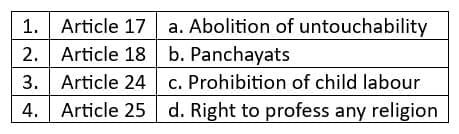
Which of the following is/are correctly matched?
Detailed Solution: Question 25

The correct answer is Only 1, 3, and 4.

  • Article 17 is a fundamental right that prohibits untouchability.
  • Article 18 is a fundamental right that prohibits the use of titles like Sir, Lord, Viceroy, Rai Bahadur, Deewan, Sahab, etc.
  • Note: Doctor, Major, Padamshree, Vibushn, Bharat Ratna, etc these are honors, not titles.
  • Article 24 prohibits child labour except for the child who is working in the newspaper, advertisement, film industry besides their studies should not be discontinued.
  • Article 25 gives the freedom to profess, propagate, conscience any religion.

AIBE (All India Bar Exam) Mock Test- 3 - Question 26

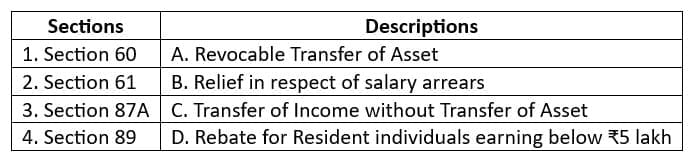
Match the sections of the Income Tax Act with their respective descriptions:
Detailed Solution: Question 26

The correct answer is 1-C, 2-A, 3-D, 4-B
Explanation

  • Section 60 (1) matches with Transfer of Income without Transfer of Asset (C).
    • This section deals with scenarios where income is transferred without transferring the ownership of the asset itself.
    • It prevents tax evasion by ensuring that income remains taxable in the hands of the transferor.
    • Typical applications can involve trusts and other financial arrangements.
    • The idea is to ensure that merely transferring income does not allow lower taxation.
  • Section 61 (2) matches with Revocable Transfer of Asset (A).
    • This section addresses situations where an asset is transferred with conditions that allow the transferor to reclaim it.
    • Income from such an asset remains taxable in the hands of the transferor.
    • Ensures that individuals cannot escape tax liability through temporary transfers.
    • Revocable transfers include clauses that can reverse the transaction.
  • Section 87A (3) matches with Rebate for Resident individuals earning below ₹5 lakh (D).
    • This section provides a tax rebate for resident individuals earning a total income below ₹5 lakh.
    • The rebate aims to reduce the tax burden on low-income taxpayers.
    • The amount of rebate is specified under this section and is deducted from the total tax payable.
    • This helps ensure that taxpayers with lower incomes receive appropriate relief.
  • Section 89 (4) matches with Relief in respect of salary arrears (B).
    • This section provides relief for taxpayers who receive salary arrears or other income in a lump sum.
    • It helps distribute the tax liability more equitably over the relevant years.
    • The goal is to prevent undue tax burden due to the receipt of back payments.
    • It uses a method to calculate the relief, ensuring fair taxation.

AIBE (All India Bar Exam) Mock Test- 3 - Question 27

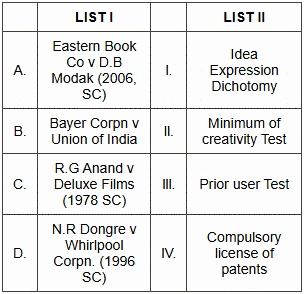
Match List I with List II

Choose the correct answer from the options given below:

Detailed Solution: Question 27

Hint

To match the cases from List I with the appropriate legal principles from List II and explain each, we proceed as follows:

1.Eastern Book Co v D.B Modak (2006, SC)

Correct Match: II. Minimum of Creativity Test

This landmark case dealt with the copyright law in India, specifically focusing on the requirement of a certain level of creativity for copyright protection. The Supreme Court held that the "sweat of the brow" doctrine, which grants copyright based on the effort put into the work, was not applicable in India. Instead, a "modicum of creativity" or an "originality" test is required for copyright protection. The judgment clarified that for a work to be copyrighted, it must possess some degree of creativity beyond mere labor and effort.

2.Bayer Corporation v Union of India

Correct Match: IV. Compulsory License of Patents

In this case, the issue revolved around the granting of the firstever compulsory license in India under the Patents Act, 1970. Bayer Corporation was the patent holder of Nexavar, a cancer treatment drug. The Compulsory License was granted to Natco Pharma for manufacturing and selling the drug at a lower price in India, due to the exorbitant price at which Bayer was selling it, making it unaffordable for most. The case was significant for the implementation of compulsory licensing provisions under the Indian patent law, aiming to make essential drugs more accessible and affordable.

3.R.G Anand v Deluxe Films (1978 SC)

Correct Match: I. Idea Expression Dichotomy

This Supreme Court case is a cornerstone in the development of copyright law in India, particularly regarding the distinction between the idea and the expression of an idea. The court held that copyright does not protect ideas, procedures, methods of operation, or mathematical concepts as such. It is the expression of the idea that is protected under copyright law. This principle, known as the "idea expression dichotomy," is crucial in determining the scope of copyright protection.

4.N.R Dongre v Whirlpool Corporation (1996 SC)

Correct Match: III. Prior User Test

This case pertains to trademark law, where the Supreme Court of India dealt with the issue of "prior use" in trademark disputes. Whirlpool Corporation, despite not using its trademark in India, had its trademark registered and was well known globally. The court recognized the importance of the "prior user" principle in trademark law, giving precedence to the party who first used the trademark in the market, even if the other party had registered the trademark. This principle is vital in resolving disputes where trademark registration and actual use in the market do not coincide.

Conclusion:

The correct matching, as identified, is option 2, which aligns the landmark cases with the corresponding legal principles they are best known for elucidating or establishing within Indian jurisprudence.

AIBE (All India Bar Exam) Mock Test- 3 - Question 28

According to article 80 of the Constitution of India, the representatives of each state in the Council of States are elected by:

Detailed Solution: Question 28

Hint

Correct Answer Explanation:
The representatives of each state in the Council of States (Rajya Sabha) are elected by the elected members of the Legislative Assembly of the State in accordance with the system of proportional representation by means of the single transferable vote. This method ensures that the representation of different political parties in the Rajya Sabha is proportional to their representation in the State Legislative Assembly, allowing for a more equitable and representative election outcome.

AIBE (All India Bar Exam) Mock Test- 3 - Question 29

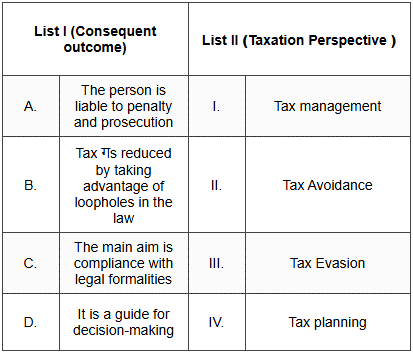
Match List I with List II.


Choose the correct answer from the options given below:

Detailed Solution: Question 29
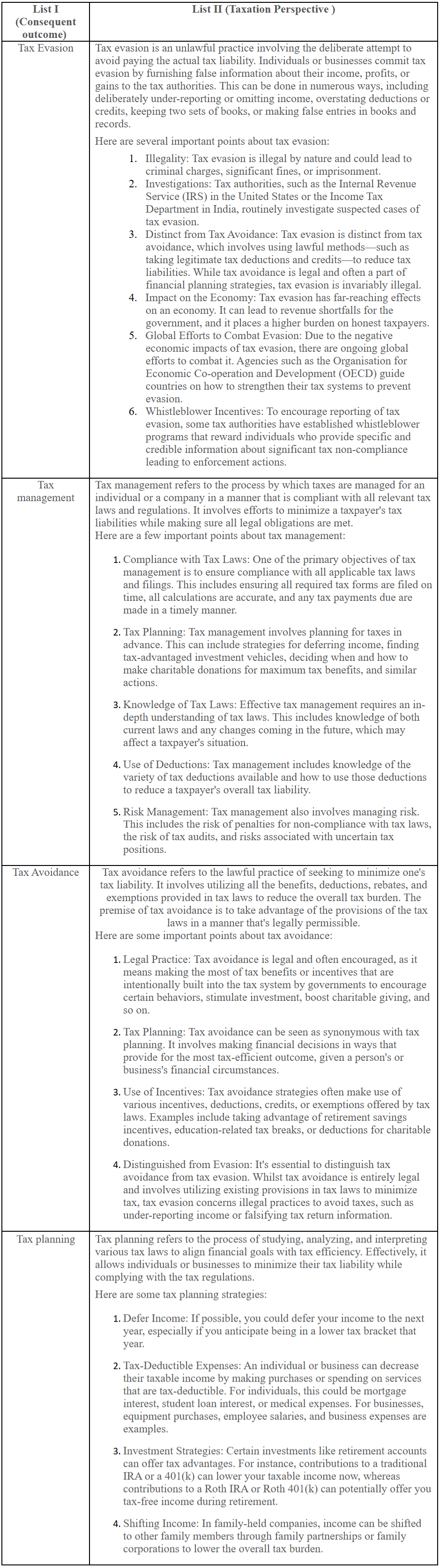
The correct answer is A - III, B - II, C - I, D - IV

Explanation

AIBE (All India Bar Exam) Mock Test- 3 - Question 30

TRIPs agreement:

(i) aims at protecting intellectual property rights to reward creativity and inventiveness

(ii) is added to the Agreement Establishing the World Trade Organisation (WTO)

(iii) it is multilateral Trade Agreement

(iv) it is an integral part of Geneva Convention

Detailed Solution: Question 30

The correct answer is 'Only (i), (ii), (iii) are correct'

Explanation

  • TRIPs Agreement:
    • The TRIPs (Trade-Related Aspects of Intellectual Property Rights) Agreement aims at protecting intellectual property rights to reward creativity and inventiveness.
    • It is added to the Agreement Establishing the World Trade Organisation (WTO) and is a crucial component of the global trading system.
    • The TRIPs Agreement is a multilateral trade agreement, meaning it involves multiple countries agreeing to its terms and conditions.

Other Related Points

  • Integral part of Geneva Convention:
    • The statement that TRIPs is an integral part of the Geneva Convention is incorrect. The Geneva Conventions primarily deal with the humanitarian treatment of war victims, while TRIPs is focused on intellectual property rights within the framework of the WTO.
  • Other incorrect options:
    • Option 1: This option is incorrect because it includes (iv), which is not true as TRIPs is not part of the Geneva Convention.
    • Option 2: This option is incorrect as it only considers (i) correct, while (ii) and (iii) are also correct.
    • Option 3: This option is incorrect because (iv) is not correct.

View more questions
5 tests
Information about AIBE (All India Bar Exam) Mock Test- 3 Page
In this test you can find the Exam questions for AIBE (All India Bar Exam) Mock Test- 3 solved & explained in the simplest way possible. Besides giving Questions and answers for AIBE (All India Bar Exam) Mock Test- 3, EduRev gives you an ample number of Online tests for practice
Download as PDF