
IDBI Bank JAM Mock Test- 4 Free Online Test 2026
Full Mock Test & Solutions: IDBI Bank JAM Mock Test- 4 (200 Questions)
You can boost your Bank Exams 2026 exam preparation with this IDBI Bank JAM Mock Test- 4 (available with detailed solutions).. This mock test has been designed with the analysis of important topics, recent trends of the exam, and previous year questions of the last 3-years. All the questions have been designed to mirror the official pattern of Bank Exams 2026 exam, helping you build speed, accuracy as per the actual exam.
Mock Test Highlights:
- - Format: Multiple Choice Questions (MCQ)
- - Duration: 120 minutes
- - Total Questions: 200
- - Analysis: Detailed Solutions & Performance Insights
- - Sections covered: LR, Data Analysis & Interpretation, English Language, Quantitative Aptitude, General,Eco,Banking Awareness, Comp,IT
Sign up on EduRev for free and get access to these mock tests, get your All India Rank, and identify your weak areas to improve your marks & rank in the actual exam.

Direction: Read the following information carefully and answer the question given below-
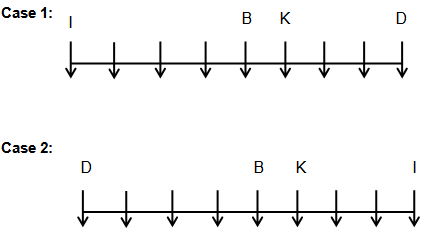
There are certain number of persons sitting in a row and all were facing South and have their birthdays on 8th and 25th of four different months i.e. March, April, May and June but not necessarily in the same order. B is in the middle of the row. D is fifth to the right of E. B has birthday on 8th of the month which is having 31 days. Two persons sit between G and I who is five places away from K. Only three persons have birthday between D and I. M is third from one of the extreme ends but is not sitting between D and E. E is at one of the extreme end. Only one person has birthday before D. Number of persons between B and D is one less than the number of persons between D and N. N sits to the immediate left of M. E and G are having birthday in the same month having 30 days but not in April. Three people sit between I and B who is immediate right of K. K has birthday after M who is elder than N. Number of persons between I and B are same as number of persons between B and D. E’s birthday was held before G.
Q. Who among the following is the eldest if all the persons were born in the same year?
Detailed Solution: Question 1




Direction: Read the following information carefully and answer the question given below-
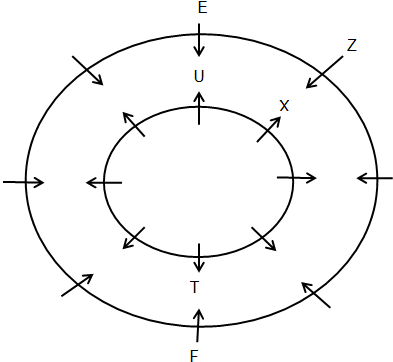
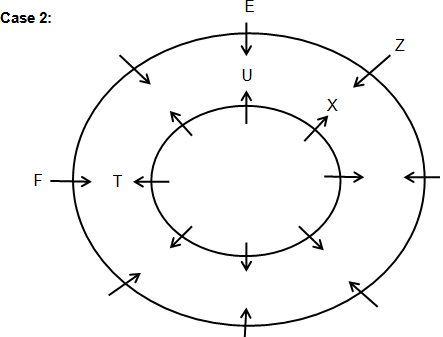
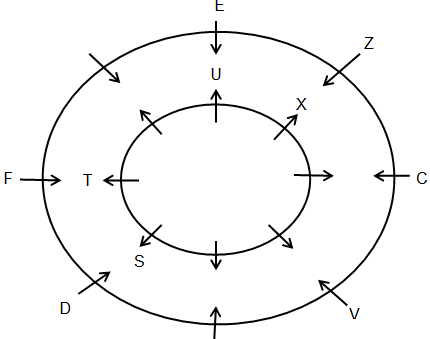
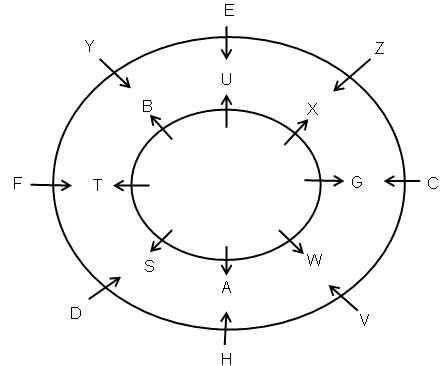
Sixteen persons Z, Y, X, W, V, U, T, S, H, G, F, E, D, C, B and A are sitting around two circular tables. There is small circular table inside the bigger circular table. The persons sitting around the inner circular table faces outside and the persons sitting around the outer circular table faces inside in such a way persons sitting on both tables facing each other.
Two persons sit between Y and H. Three persons are sitting between F and C who sits exactly between Z and V. X sits to the immediate right of U. Four persons are sitting between W and U. Only two persons are sitting between X and T who faces F. S sits to the immediate left of T and faces D. T and F sit on different tables. The one who faces V sits exactly between G and A who faces H. U who faces E, faces outside. Z faces X.
Q. Who among the following faces A?
Detailed Solution: Question 2

Direction: Read the following information carefully and answer the question given below-
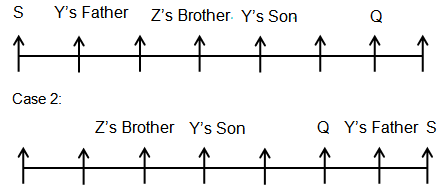
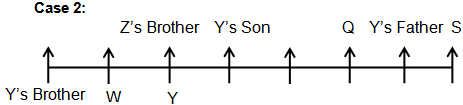
There are eight members Y, Z, U, W, Q, S, C and E. Each of them is related to Y in some way or the other and all of them have different chocolates among 20, 27, 33, 38, 40, 43, 45 and 50 but not necessarily in the same order and all are sitting in a straight line facing North.
Q is sitting second to right of Y’s son. Two people are sitting between Q and Z’s brother. Two people are sitting between Y’s son and Y’s father. S is an immediate neighbour of Y’s father. S is sitting at one of extreme ends. The sum of chocolates of C and Q is equal to sum of chocolates kept by W and E. One among the four have the highest number of chocolates and one among the four have the lowest number of chocolates. W and Y’s brother are sitting together. The difference between the chocolates of W and Z is equal to the difference between the chocolates of Q and U. Y’s brother is sitting second to left of Y. Two people are sitting between W and Y’s sister. Y is not an immediate neighbour of Q. C has more number of chocolates than Y but less than S. E’s father is sitting to the immediate right of Y’s daughter. Y’s wife is immediate neighbour of E. C is younger than U. Q does not have highest no of choclates and E have third highest number of choclates.
Q. Who among the following is father of Y ?
Detailed Solution: Question 3

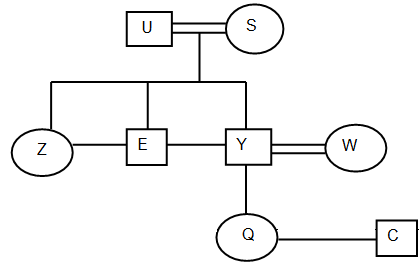

Direction: Read the following information carefully and answer the question given below-
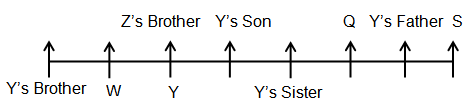
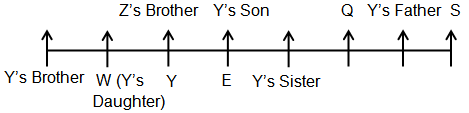
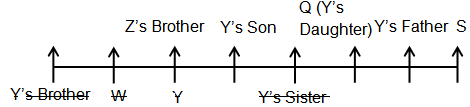
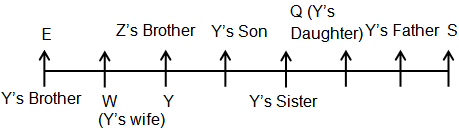
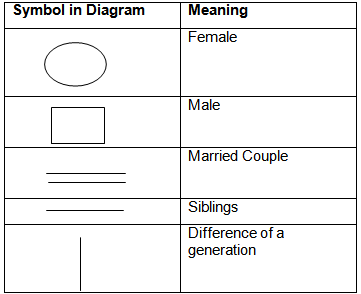
There are eight members Y, Z, U, W, Q, S, C and E. Each of them is related to Y in some way or the other and all of them have different chocolates among 20, 27, 33, 38, 40, 43, 45 and 50 but not necessarily in the same order and all are sitting in a straight line facing North.
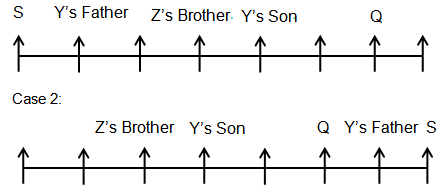
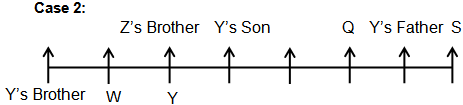
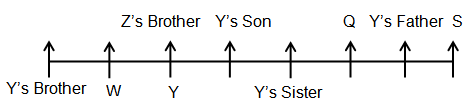
Q is sitting second to right of Y’s son. Two people are sitting between Q and Z’s brother. Two people are sitting between Y’s son and Y’s father. S is an immediate neighbour of Y’s father. S is sitting at one of extreme ends. The sum of chocolates of C and Q is equal to sum of chocolates kept by W and E. One among the four have the highest number of chocolates and one among the four have the lowest number of chocolates. W and Y’s brother are sitting together. The difference between the chocolates of W and Z is equal to the difference between the chocolates of Q and U. Y’s brother is sitting second to left of Y. Two people are sitting between W and Y’s sister. Y is not an immediate neighbour of Q. C has more number of chocolates than Y but less than S. E’s father is sitting to the immediate right of Y’s daughter. Y’s wife is immediate neighbour of E. C is younger than U. Q does not have highest no of choclates and E have third highest number of choclates.
Q. How is S related to C?
Detailed Solution: Question 4

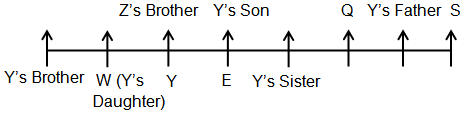
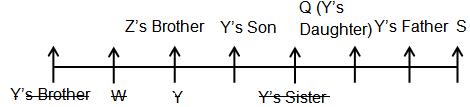
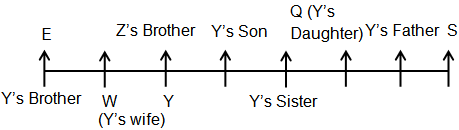
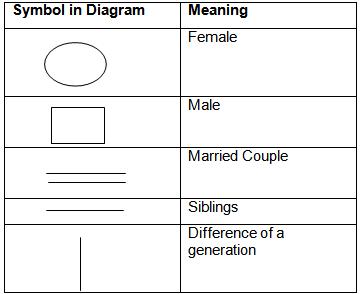
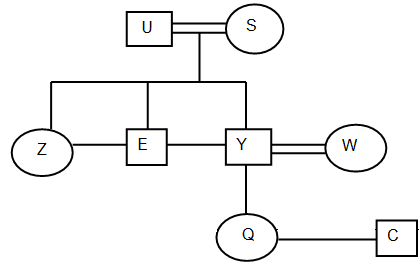

Direction: Read the following information carefully and answer the question given below-
In a certain code,
today positive decent found is written as @6A @6V &7B @5Q
people attend daily party’ is written as @6V *6V #5B @5A
regular fitness sound health is written as @6A @8P #8O @5E
picture perfect quality movie is written as #6B #8B #8V @8Q
Q. What is the code for the word ‘product’?
Detailed Solution: Question 5
Direction: Read the following information carefully and answer the question given below-
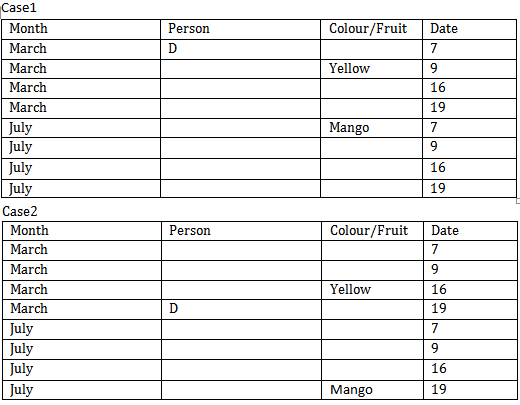
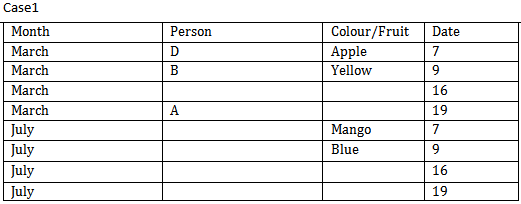
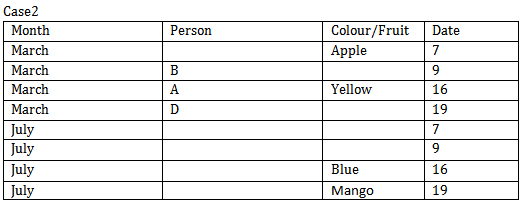
Eight friends A, B, C, D, E, F, G, and H were born on 7th, 9th,16th, and 19th in March and July. Each one of them likes either a colour or a fruit. The persons who likes colours were born on that day which is a perfect square and they like Yellow, Green, Red and Blue. The persons who were born on the day which denotes a prime numbers like fruits – Apple, Cherry, Mango, and Banana. (Note: None of the given information is necessary in the same order). The one who likes yellow color was born on a day which is a perfect square in the month of March. No person was born between D and the one who likes yellow. D doesn’t like colour. Only three persons were born between D and the one who likes Mango. No person is born between the one who likes Mango and Blue colour. The number of people born after the one who likes blue colour is one less than a number of persons born before A. The one who likes Apple was born immediately before B. B does not like Mango. The number of people born before B is same as the number of persons born after G. Only three persons were born between the one who likes Green and H . H and the one who likes Cherry was born in the same month but not in March. C was born after the one who likes blue colour. E doesn’t like any colour. F doesn’t like Apple.
Q. Who was born on 19th of March and 16th of July?
Detailed Solution: Question 6
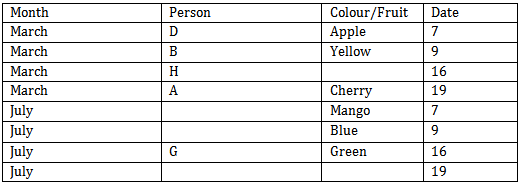
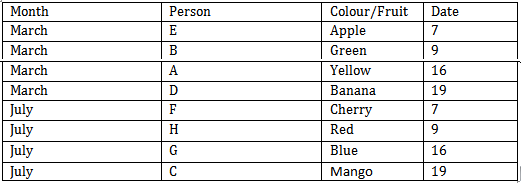
Direction: Read the following graph carefully and answer the question given below.
The following bar graph represents the amount invested by four persons A, B, C and D in each year (share of profit divided among them in each year) and the line graph represents the percentage of amount increased by them in the investment after 6 months.
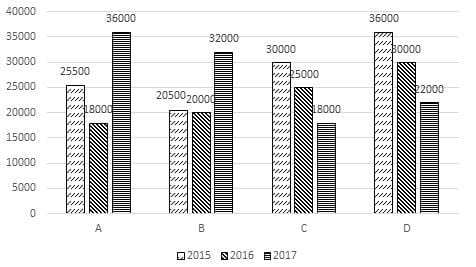
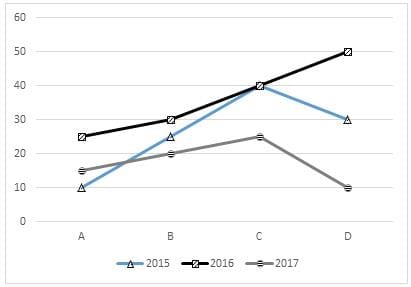
Q. If A, and B invested their amount together in the year 2015 and B and C invested their amount together in the year 2016 and the profit earned by A and B together in the year 2015 and profit earned by B and C together in the year 2016 is same, then what is the ratio of profit earned by A in the year 2015 and profit earned by C in the year 2016?
Detailed Solution: Question 7

Direction: Read the following graph carefully and answer the question given below.
The following bar graph represents the amount invested by four persons A, B, C and D in each year (share of profit divided among them in each year) and the line graph represents the percentage of amount increased by them in the investment after 6 months.
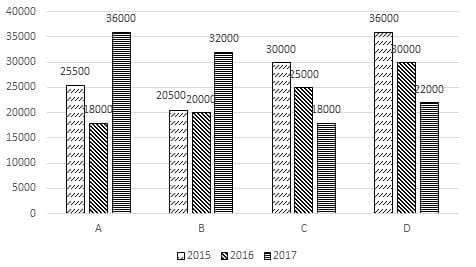
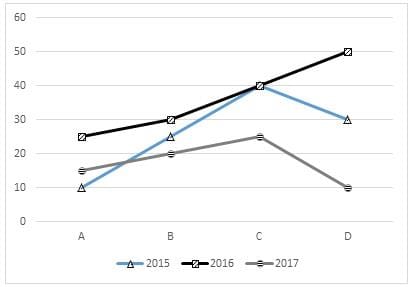
Q. C and D invested their amount together in the year 2016 and they also invested their amount together in the year 2017. If profit earned by C and D in the year 2016 and 2017 are respectively Rs 8910 and Rs 11560, then find the difference between profit earned by C in the year 2016 and profit earned by D in the year 2017.
Detailed Solution: Question 8


Direction: Refer to the data below and answer the questions that follow.
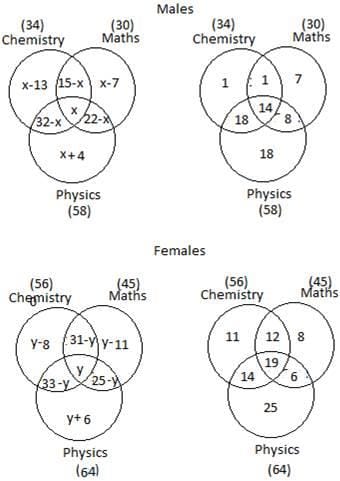
In a survey among students in the college, it was found that out of the male population 34% preferred Chemistry, 30% liked Maths and 58% Physics. Of the total Male students, 15% liked Chemistry and Maths, 22% liked Physics and Maths and 32% liked Physics and Chemistry. Only 33% of the male students did not like any of these subjects.
It was also found that out of the female population 56% preferred Chemistry, 45% liked Maths and 94% likes Physics. Out of the total female students, 31% liked Chemistry and Maths, 25% liked Physics and Maths and 33% liked Physics and Chemistry. Only 5% of the female students did not like any of these subjects.
Total number of male students in the college is 3000 and total number of students in the college is 5000.
Q. What is the difference between number of female students of those who like Maths and Physics but not Chemistry and number of male students who like Chemistry only?
Detailed Solution: Question 9
Direction: Read the following passage carefully and answer the questions given below it. Certain words have been printed in the underline to help you locate them while answering some of the questions.
One of our largest infrastructure finance companies, Infrastructure Leasing and Financial Services (IL&FS), a “systemically important core investment company” registered with the Reserve Bank of India (RBI), began to implode. Starting with a default on its Rs 1,000 crore bond repayment to SIDBI, IL&FS and its non-banking finance subsidiaries have begun to renege on one repayment after another. Fears that mounting troubles in the IL&FS group might be symptomatic of larger problems in the non-banking finance company (NBFC) space and, in turn, pose a serious threat to financial stability saw markets plunge more than 1,100 points intra-day. The unstated fear was that thanks to its inter-linkages with the financial system IL&FS may drag the entire financial system and the larger macro-economy down with it.
For now the storm seems to have abated. Latest reports speak of Orix Corporation, the diversified Japanese financial services company and one of the largest shareholders in IL&FS, being willing to up its stake; of government and RBI pitching in to help with speedy sale of IL&FS assets. But these are only band-aid solutions that cannot, and will not, last. We need to look deeper and address the cause, rather than the symptom, of the disease. The crisis at IL&FS has exposed a number of fault lines. To begin with, the ills of the financial sector go much beyond the much-maligned public sector banks. It is the familiar story of failure on multiple fronts: the regulator Reserve Bank of India (RBI), credit rating agencies who downgraded IL&FS much too late, auditors, and most importantly, the board of IL&FS.
Given that one of the biggest learnings of the 2008 crisis is of the dangers posed by shadow banks like IL&FS, one would have expected RBI to keep a close eye on IL&FS, particularly in view of its excessive leverage. But, sadly, it failed to do so! If RBI bears the main responsibility for the unfolding events at IL&FS, it is not the only one. Rating agencies have, again, been caught sleeping on the watch. Ratings have been rapidly downgraded; in many cases after the event. Rating agencies are technically under the Securities and Exchange Board of India (Sebi); but are not subject to close regulatory oversight. Worse, under the current rating model, fees are paid by the rated entities. There is, thus, a huge incentive to give generous ratings for fear of losing business. Until we address this basic flaw in the rating model, ratings must be taken for what they are worth: very little! Company auditors are no less culpable. The annual accounts of IL&FS and its close to 200 subsidiaries were audited by some of the biggest names in the profession. Yet none thought it fit to red flag the growing dependence on short term debt and the excessively high leverage. The biggest opprobrium must, however, be reserved for the board of IL&FS. IL&FS had a star-studded board. Yet Ravi Parthasarathy, CEO from 1989 till July 2018, seems to have run the company like his fiefdom. Since he was asked no questions, it seemed that he was handsomely rewarded for presiding the virtual destruction of IL&FS.
Each of these entities must share the blame and take corrective measures. But there is a larger factor at play that must be factored in while considering any kind of rescue package: the inherent flaw in the extant model of infrastructure financing. Infra projects have long gestation periods. They require long term funding that neither banks nor NBFCs can provide. Moreover, issues related to land acquisition, environmental clearance, policy flip-flop, political interference and rapidly changing external dynamics make infrastructure financing particularly risky. Cost and time overruns are inevitable. Unless we address these we will not be able to ring-fence either banks or NBFCs from the risk associated with financing infrastructure. It is imperative that before we consider any solution, especially bailout with taxpayer money, RBI must make an informed assessment of IL&FS’s inter-connectedness (and, hence, risk of systemic failure). Remember, any solution will prove short lived unless we address fault lines all around, including underlying risks in infra financing.
Q. Choose the correct option for 107.
Detailed Solution: Question 10
Direction: Read the following passage carefully and answer the questions given below it. Certain words have been printed in the underline to help you locate them while answering some of the questions.
One of our largest infrastructure finance companies, Infrastructure Leasing and Financial Services (IL&FS), a “systemically important core investment company” registered with the Reserve Bank of India (RBI), began to implode. Starting with a default on its Rs 1,000 crore bond repayment to SIDBI, IL&FS and its non-banking finance subsidiaries have begun to renege on one repayment after another. Fears that mounting troubles in the IL&FS group might be symptomatic of larger problems in the non-banking finance company (NBFC) space and, in turn, pose a serious threat to financial stability saw markets plunge more than 1,100 points intra-day. The unstated fear was that thanks to its inter-linkages with the financial system IL&FS may drag the entire financial system and the larger macro-economy down with it.
For now the storm seems to have abated. Latest reports speak of Orix Corporation, the diversified Japanese financial services company and one of the largest shareholders in IL&FS, being willing to up its stake; of government and RBI pitching in to help with speedy sale of IL&FS assets. But these are only band-aid solutions that cannot, and will not, last. We need to look deeper and address the cause, rather than the symptom, of the disease. The crisis at IL&FS has exposed a number of fault lines. To begin with, the ills of the financial sector go much beyond the much-maligned public sector banks. It is the familiar story of failure on multiple fronts: the regulator Reserve Bank of India (RBI), credit rating agencies who downgraded IL&FS much too late, auditors, and most importantly, the board of IL&FS.
Given that one of the biggest learnings of the 2008 crisis is of the dangers posed by shadow banks like IL&FS, one would have expected RBI to keep a close eye on IL&FS, particularly in view of its excessive leverage. But, sadly, it failed to do so! If RBI bears the main responsibility for the unfolding events at IL&FS, it is not the only one. Rating agencies have, again, been caught sleeping on the watch. Ratings have been rapidly downgraded; in many cases after the event. Rating agencies are technically under the Securities and Exchange Board of India (Sebi); but are not subject to close regulatory oversight. Worse, under the current rating model, fees are paid by the rated entities. There is, thus, a huge incentive to give generous ratings for fear of losing business. Until we address this basic flaw in the rating model, ratings must be taken for what they are worth: very little! Company auditors are no less culpable. The annual accounts of IL&FS and its close to 200 subsidiaries were audited by some of the biggest names in the profession. Yet none thought it fit to red flag the growing dependence on short term debt and the excessively high leverage. The biggest opprobrium must, however, be reserved for the board of IL&FS. IL&FS had a star-studded board. Yet Ravi Parthasarathy, CEO from 1989 till July 2018, seems to have run the company like his fiefdom. Since he was asked no questions, it seemed that he was handsomely rewarded for presiding the virtual destruction of IL&FS.
Each of these entities must share the blame and take corrective measures. But there is a larger factor at play that must be factored in while considering any kind of rescue package: the inherent flaw in the extant model of infrastructure financing. Infra projects have long gestation periods. They require long term funding that neither banks nor NBFCs can provide. Moreover, issues related to land acquisition, environmental clearance, policy flip-flop, political interference and rapidly changing external dynamics make infrastructure financing particularly risky. Cost and time overruns are inevitable. Unless we address these we will not be able to ring-fence either banks or NBFCs from the risk associated with financing infrastructure. It is imperative that before we consider any solution, especially bailout with taxpayer money, RBI must make an informed assessment of IL&FS’s inter-connectedness (and, hence, risk of systemic failure). Remember, any solution will prove short lived unless we address fault lines all around, including underlying risks in infra financing.
Q. Which of the following statements can start the passage?
I. Infrastructure Leasing & Financial Services (IL&FS) is in cold water.
II. Almost to the day 10 years ago, when trouble surfaced at iconic US investment bank Lehman Bros, leading to its bankruptcy on September 15, 2008, India had its own near-Lehman moment.
III. There’s trouble brewing in the infrastructure sector.
Detailed Solution: Question 11
Direction: Fill in the blank with an appropriate word.
Q. Stimuli conducive to economical and effective response, such as our system of roads and means of transportation, do not, by themselves or in their aggregate, __________ a civilization.
Detailed Solution: Question 12
Direction: Fill in the blank with an appropriate word.
Q. In directing the activities of the young, society determines its own future in ____________ that of the young.
Detailed Solution: Question 13
Rearrange the following sentences in the right order so that they make a grammatically correct and meaningful paragraph and answer the following questions.
A. The Insolvency and Bankruptcy Code (IBC), enacted in 2016, provided a structured mechanism for resolving stressed assets and recovering dues.
B. For years, India's public sector banks struggled under the weight of mounting non-performing assets (NPAs), threatening financial stability.
C. The government also initiated a massive recapitalisation programme, infusing capital into state-owned banks to restore lending capacity.
D. In tandem with these measures, the RBI tightened supervisory norms and mandated banks to disclose bad loans more transparently.
E. As a result of these concerted efforts, India's banking sector has shown a marked improvement in asset quality in recent years.
F. Recognising the gravity of the crisis, the government and the Reserve Bank of India (RBI) undertook a series of structural reforms.
Which sentence can be inserted between the FOURTH and FIFTH sentence?
A. The Insolvency and Bankruptcy Code (IBC), enacted in 2016, provided a structured mechanism for resolving stressed assets and recovering dues.
B. For years, India's public sector banks struggled under the weight of mounting non-performing assets (NPAs), threatening financial stability.
C. The government also initiated a massive recapitalisation programme, infusing capital into state-owned banks to restore lending capacity.
D. In tandem with these measures, the RBI tightened supervisory norms and mandated banks to disclose bad loans more transparently.
E. As a result of these concerted efforts, India's banking sector has shown a marked improvement in asset quality in recent years.
F. Recognising the gravity of the crisis, the government and the Reserve Bank of India (RBI) undertook a series of structural reforms.
Which sentence can be inserted between the FOURTH and FIFTH sentence?
Detailed Solution: Question 14
According to the passage, where is the cassowary found besides Indonesia?
Detailed Solution: Question 15
Read the following information carefully and answer the questions.
The given table chart shows the number of blue jeans sold in four different shops namely A, B, C and D and also given the number of black jeans sold in these shops and also given the ratio of the number of blue to white jeans sold in these shops.
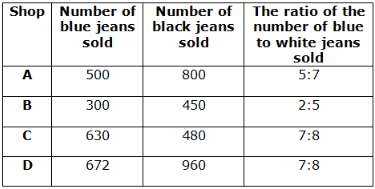
Q. Find the difference between the number of white jeans sold in Shop B and the number of blue jeans sold in Shop C?
Detailed Solution: Question 16
The following question contains two equations I and II. You have to solve both equations and determine the relationship between them and give the answer as,
I) x2 – 24x + 143 = 0
II) y2 – 15y+ 54 = 0
Detailed Solution: Question 17
Each question below is followed by two statements I and II. You have to determine whether the data given in the statements are sufficient for answering the question. You should use the data and your knowledge of Mathematics to choose the best possible answer.
Find the number of marbles with B.
Statement I: A has 24 marbles, which is 3/8 of the total marbles with A and B together.
Statement II: The ratio of marbles with A to B is 3:5.
Find the number of marbles with B.
Statement I: A has 24 marbles, which is 3/8 of the total marbles with A and B together.
Statement II: The ratio of marbles with A to B is 3:5.
Detailed Solution: Question 18
Name the three-year roadmap finalised by Reserve Bank of India board to improve regulation and supervision of the central bank?
Detailed Solution: Question 19
Which bank has collaborated with Google to enable customers to use their cards on Google Pay platform?
Detailed Solution: Question 20
Which of the following persons inaugurated India’s first-ever global tourism mart in New Delhi?
Detailed Solution: Question 21
The Airports Authority of India (AAI) will prepare a detailed project report (DPR) for the development of which airport in Sri Lanka?
Detailed Solution: Question 22
India’s first ‘smart fence’ pilot project was launched by Union Home Minister Rajnath Singh along with which border?
Detailed Solution: Question 23
BCCI has formally appointed which cricketer as the National Cricket Academy’s Head of Cricket to oversee all cricket related activities at NCA?
Detailed Solution: Question 24
In June 2025, The United Nations General Assembly (UNGA) recently elected new non-permanent members to the UN Security Council (UNSC) for the 2026–2027 term. Which of the following statements is/are correct regarding this development?
1. Bahrain, Colombia, Democratic Republic of the Congo, Latvia, and Liberia were elected as non-permanent members for the term starting 1 January 2026.
2. These five countries will join Algeria, Guyana, Sierra Leone, South Korea, and Slovenia on the Council for the 2026–2027 term.
3. The elected countries will replace outgoing members and join current non-permanent members such as Denmark and Pakistan.
1. Bahrain, Colombia, Democratic Republic of the Congo, Latvia, and Liberia were elected as non-permanent members for the term starting 1 January 2026.
2. These five countries will join Algeria, Guyana, Sierra Leone, South Korea, and Slovenia on the Council for the 2026–2027 term.
3. The elected countries will replace outgoing members and join current non-permanent members such as Denmark and Pakistan.
Detailed Solution: Question 25
In September 2025, India and Japan have agreed to commence signalling work for the Ahmedabad-Mumbai bullet train project. Which of the following statements about this collaboration and project timelines is/are correct?
1. The signalling work includes installing Japanese Shinkansen technology to facilitate train inspection and operation on the Gujarat section.
2. The Mumbai-Ahmedabad High-Speed Rail (MAHSR) project began in 2017 with the foundation stone laid by PM Modi and Japan’s PM Shinzo Abe and plans to open the Gujarat section by December 2027.
3. Japan intends to debut the E10 train exclusively in India by 2035, well after testing older trains in 2028.
1. The signalling work includes installing Japanese Shinkansen technology to facilitate train inspection and operation on the Gujarat section.
2. The Mumbai-Ahmedabad High-Speed Rail (MAHSR) project began in 2017 with the foundation stone laid by PM Modi and Japan’s PM Shinzo Abe and plans to open the Gujarat section by December 2027.
3. Japan intends to debut the E10 train exclusively in India by 2035, well after testing older trains in 2028.
Detailed Solution: Question 26
According to an official government release in August 2025, a significant milestone has been reached in the Pradhan Mantri Jan Dhan Yojana (PMJDY), a flagship financial inclusion program launched in 2014. This initiative aims to ensure access to financial services for all, particularly the underprivileged sections of society. How many bank accounts have been successfully opened under the PMJDY?
Detailed Solution: Question 27
In August 2025, Initiatives led by the National Bank for Agriculture and Rural Development (Nabard) and the Reserve Bank of India have made significant strides in promoting digital and financial literacy in India’s rural landscape. According to the Ministry of State, how many Centre for Financial Literacy (CFL) centres have been established across India by March 31, 2025 to support rural financial literacy, and what is the average coverage per centre?
Detailed Solution: Question 28
In July 2025, according to the government data presented in Parliament, unclaimed deposits with banks reached a substantial figure, highlighting a growing concern regarding inactive accounts in the banking system. Among the various banks, the State Bank of India (SBI) and ICICI Bank led in their respective categories. As of June 30, 2025, which public sector bank had the largest volume of unclaimed deposits in India?
Detailed Solution: Question 29
As of October 2025, which of the following statements about Balod in Chhattisgarh being declared India’s first Child Marriage-Free district is/are correct?
1. Balod achieved zero reported child marriage cases across all 436 gram panchayats and 9 urban local bodies for two years under the "Child Marriage-Free India" campaign.
2. The district’s certification process involved rigorous verification procedures confirming no child marriage cases for the last three years, setting a national standard.
3. Following Balod’s declaration, Surajpur district certified 75 gram panchayats as child marriage-free, with Chhattisgarh targeting state-wide elimination of child marriage by 2028–29.
1. Balod achieved zero reported child marriage cases across all 436 gram panchayats and 9 urban local bodies for two years under the "Child Marriage-Free India" campaign.
2. The district’s certification process involved rigorous verification procedures confirming no child marriage cases for the last three years, setting a national standard.
3. Following Balod’s declaration, Surajpur district certified 75 gram panchayats as child marriage-free, with Chhattisgarh targeting state-wide elimination of child marriage by 2028–29.
Detailed Solution: Question 30
