NEET Exam  >  NEET Test  >   Mock Test Series - Updated 2026 Pattern  >  Test: Botany Mock Test - 1 - NEET MCQ

NEET Test: Botany Mock Test - 1 Free Online Test 2026


Full Mock Test & Solutions: Test: Botany Mock Test - 1 (45 Questions)

You can boost your NEET 2026 exam preparation with this Test: Botany Mock Test - 1 (available with detailed solutions).. This mock test has been designed with the analysis of important topics, recent trends of the exam, and previous year questions of the last 3-years. All the questions have been designed to mirror the official pattern of NEET 2026 exam, helping you build speed, accuracy as per the actual exam.

Mock Test Highlights:

  • - Format: Multiple Choice Questions (MCQ)
  • - Duration: 45 minutes
  • - Total Questions: 45
  • - Analysis: Detailed Solutions & Performance Insights

Sign up on EduRev for free and get access to these mock tests, get your All India Rank, and identify your weak areas to improve your marks & rank in the actual exam.

Test: Botany Mock Test - 1 - Question 1

The small disc shaped like structures occur in the centromere are called as

Detailed Solution: Question 1

Small disc-shaped structures at the surface of the centromeres are called kinetochores. These structures serve as the sites of attachment of spindle fibres (formed by the spindle fibres) to the chromosomes.

Topic in NCERT: Metaphase

Line in NCERT: "small disc-shaped structures at the surface of the centromeres are called kinetochores."

Test: Botany Mock Test - 1 - Question 2

Meristems are not found in -

Detailed Solution: Question 2

Pollen of Pinus do not have meristems. A meristem is the tissue in most plants containing undifferentiated cells, found in zones of the plant where growth can take place. Meristematic cells give rise to various organs of the plant and keep the plant growing. Meristematic cells are incompletely or not at all differentiated, and are capable of continued cellular division.

Thus, the correct answer is option D.

Test: Botany Mock Test - 1 - Question 3

To prove that DNA is the genetic material, which radioactive isotopes were used by Hershey and Chase(1952) in their experiments?

Detailed Solution: Question 3

Hershey and Chase experiment is based on the fact that DNA contains phosphorus and similarly, sulphur is present in proteins but not in DNA. They incorporated radioactive isotope of phosphorus (32P) into phage DNA and that of sulphur (35S) into proteins of a separate phage culture. Viruses grown in the presence of radioactive phosphorus contained radioactive DNA but not radioactive protein because DNA contains phosphorus but proteins do not, Similarly, viruses grown on radioactive sulphur contain radioactive- protein but not-radioactive DNA because DNA does not contain sulphur.

Test: Botany Mock Test - 1 - Question 4

In a plant, red fruit (R) is dominant over yellow fruit (r) and tallness (T) is dominant over shortness (t). If a plant with RRTt genotype is crossed with a plant that is rrtt:

Detailed Solution: Question 4

If a plant with RRTt genotype is crossed with a plant that is rrtt 50% of the offspring will be tall with red fruit.

Test: Botany Mock Test - 1 - Question 5

Enormous diversity of protein molecules is due to

Detailed Solution: Question 5

Proteins are building blocks of the body. The proteins are made up of amino acids. The amino acids are linked together by peptide bonds to form a protein. The amino acids consist of amine group made up of nitrogen and hydrogen and the carboxyl group at the end and a side chain of R group which is specific to a particular amino acid. This specific group brings a variability to the proteins. If R group is H it is glycine while if it is CH2 it is alanine. The sequence of amino acids determines the protein. 

Topic in NCERT: Structure of proteins

Line in NCERT: "the sequence of amino acids i.e., the positional information in a protein - which is the first amino acid, which is second, and so on – is called the primary structure."

Test: Botany Mock Test - 1 - Question 6

Which one of the following is an example of ex-situ conservation?     [NEET 2025]

Detailed Solution: Question 6

Zoos and botanical gardens: These are examples of ex-situ conservation. They involve the preservation of species outside their natural habitats. Here, animals and plants are provided with a controlled environment that mimics their natural surroundings as much as possible. These facilities play a crucial role in breeding programs, research, public education, and reintroducing species into the wild when conditions permit.

  • Zoos: Focus on preserving and breeding animal species.
  • Botanical gardens: Aim to conserve diverse plant species, including rare and endangered ones.

Test: Botany Mock Test - 1 - Question 7

Mycorrhizal roots of ____ are associated with some fungal symbionts.

Detailed Solution: Question 7

A mycorrhiza is a symbiotic association of a fungus with a root system. The mycorrhizal roots of Pinus occur near the soil surface. They are devoid of root hair and root cap. The fungus commonly associated with mycorhizic roots of Pinus is Boletus elegans.

Test: Botany Mock Test - 1 - Question 8

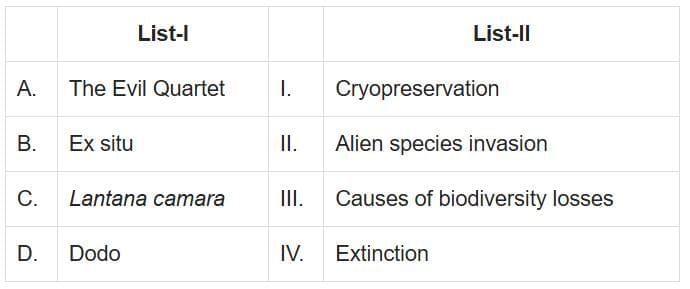
Match List-I with List-II:     [NEET 2025]
2025
Choose the options with all correct matches.

Detailed Solution: Question 8

A. The Evil Quartet - III. Causes of biodiversity losses:

  • The "Evil Quartet" refers to four major causes of biodiversity loss: habitat destruction, overexploitation, invasive species, and co-extinctions.
  • These factors collectively threaten the survival of various species and ecosystems globally.

B. Ex situ conservation - I. Cryopreservation:

  • Ex situ conservation involves conserving biodiversity outside their natural habitats, such as in seed banks, botanical gardens, or through cryopreservation.
  • Cryopreservation is a technique used for freezing and storing genetic material (like seeds or embryos) at very low temperatures for future use.

C. Lantana camara - II. Alien species invasion:

  • Lantana camara is an invasive alien species that disrupts native ecosystems by competing with native flora and causing ecological imbalances.
  • Alien species invasions are a major contributor to biodiversity loss and ecosystem degradation.
  • The environmental damage caused and threat posed to our native species by invasive weed species like carrot grass (Parthenium), Lantana and water hyacinth (Eicchornia).

D. Dodo - IV. Extinction:

  • The Dodo is an example of a species that has gone extinct due to human activities such as hunting and habitat destruction.
  • Extinction is the complete loss of a species, often driven by factors like overexploitation, invasive species, and habitat destruction.

Test: Botany Mock Test - 1 - Question 9

Which chromosome in the human genome has the highest number of genes?     [NEET 2025]

Detailed Solution: Question 9

  • Humans have 23 pairs of chromosomes (46 total), with 22 pairs being autosomes and 1 pair of sex chromosomes (X and Y).
  • Chromosomes carry genes, which are the functional units of heredity made up of DNA. Each chromosome contains a unique set of genes that determine various biological functions.
  • Chromosome 1 is the largest human chromosome and contains the highest number of genes compared to other chromosomes in the human genome.
  • Chromosome 1 is the largest of all human chromosomes and contains approximately 2,968 genes, making it the chromosome with the highest number of genes.
  • Chromosome Y has the fewest ~231 genes.

Test: Botany Mock Test - 1 - Question 10

In which group of plants does the sporophyte not have a free-living stage?

Detailed Solution: Question 10

In Bryophytes, the sporophyte does not have a free-living stage. It is dependent on the gametophyte for nutrition and support. This contrasts with other plant groups like Pteridophytes and Gymnosperms, where the sporophyte is the dominant, free-living stage of the life cycle.

Topic in NCERT: gametophyte

Line in NCERT: "The main plant body of the bryophyte is haploid. It produces gametes, hence is called a gametophyte."

Test: Botany Mock Test - 1 - Question 11

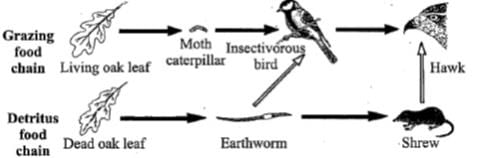
Given figure represents food chains of a deciduous woodland linked together to form a food web.
Which of the following constitute first trophic level of the grazing food chain and the detritus food chain respectively? 

Detailed Solution: Question 11

  • In a grazing food chain, the first trophic level consists of primary producers, which are green plants (like the living oak leaf in this case).
  • In a detritus food chain, the first trophic level consists of detritus or dead organic matter (like the dead oak leaf in this case).

Thus, the first trophic levels for the grazing food chain and detritus food chain are living oak leaf and dead oak leaf, respectively.

Topic in NCERT: Trophic Levels in an Ecosystem

Line in NCERT: "Producers belong to the first trophic level, herbivores (primary consumer) to the second and carnivores (secondary consumer) to the third."

Test: Botany Mock Test - 1 - Question 12

Anaerobic respiration of yeast produces

Detailed Solution: Question 12

Glucose is achieved under anaerobic conditions by sets of reactions where pyruvic acid is converted to carbon dioxide and ethanol.

Test: Botany Mock Test - 1 - Question 13

Ecosystem follows:

Detailed Solution: Question 13

The chemical energy of food is the main source of energy required by all living organisms. This energy is transmitted to different trophic levels along the food chain. This energy flow is based on two different laws of thermodynamics:

  • First law of thermodynamics, that states that energy can neither be created nor destroyed, it can only change from one form to another.
  • Second law of thermodynamics, that states that as energy is transferred more and more of it is wasted.

Test: Botany Mock Test - 1 - Question 14

Identify the incorrectly matched pair:

Detailed Solution: Question 14

Let's analyze each pair to identify the incorrectly matched one:

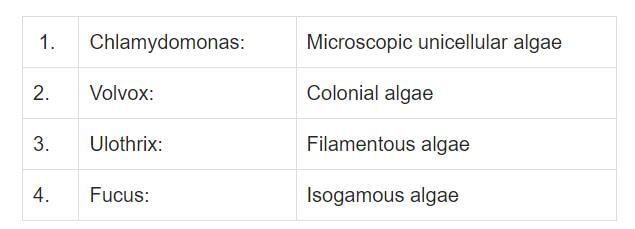
  1. Chlamydomonas: Microscopic unicellular algae

    • This is correct. Chlamydomonas is indeed a microscopic unicellular alga.
  2. Volvox: Colonial algae

    • This is correct. Volvox forms colonial structures, making it a colonial alga.
  3. Ulothrix: Filamentous algae

    • This is correct. Ulothrix is a filamentous green alga.
  4. Fucus: Isogamous algae

    • This is incorrect. Fucus is a type of brown alga that reproduces via oogamous reproduction, not isogamous. Isogamous algae have gametes of similar shape and size, whereas Fucus has distinct male and female gametes.

So the incorrectly matched pair is:

4 Fucus: Isogamous algae

Test: Botany Mock Test - 1 - Question 15

Assertion(A): Deuteromycetes are called imperfect fungi.
Reason(R):  These fungi have  autotrophic mode  of nutrition .

Detailed Solution: Question 15

- Deuteromycetes are indeed called "imperfect fungi" because only the asexual or vegetative phases of these fungi are known. When the sexual forms of these fungi were discovered they were moved into classes they rightly belong to. It is also possible that the asexual and vegetative stage have been given one name (and placed under deuteromycetes) and the sexual stage another (and placed under another class)
- However, the reason given in the statement that these fungi have an autotrophic mode of nutrition is incorrect. Deuteromycetes are actually heterotrophic, not autotrophic.
- Therefore, the correct answer is: C: (A) is true, but (R) is false.

Topic in NCERT: Deuteromycetes

Line in NCERT: "Commonly known as imperfect fungi because only the asexual or vegetative phases of these fungi are known."

Test: Botany Mock Test - 1 - Question 16

When fats are the respiratory substrate, the value of RQ would be​

Detailed Solution: Question 16

The respiratory quotient (RQ) is used in calculations of basal metabolic rate (BMR). It is the ratio of the volume of carbon dioxide produced by the body to the volume of oxygen consumed by the body in respiration over a period of time. It depends on the type of respiratory substrate used during respiration. RQ of fat is about 0.7. RQ of carbohydrate is 1. RQ of organic acids is above 1. RQ of protein is 0.9. RQ value gives information about the source of energy an animal is using.
Thus, the correct answer is option A.

Topic in NCERT: Respiratory quotient

Line in NCERT: "when fats are used in respiration, the rq is less than 1."
Test: Botany Mock Test - 1 - Question 17

In which type of leaves does the abaxial epidermis contain more stomata than the adaxial epidermis?

Detailed Solution: Question 17

The correct answer is b) Dicotyledonous leaves.

In most dicotyledonous leaves, the abaxial epidermis (the underside of the leaf) typically contains more stomata than the adaxial epidermis (the upper side). This arrangement helps in reducing water loss while allowing for gas exchange, as the lower surface is less exposed to direct sunlight and wind.

Topic in NCERT: Dorsiventral (dicotyledonous) leaf

Line in NCERT: The vertical section of a dorsiventral leaf through the lamina shows three main parts, namely, epidermis, mesophyll and vascular system. The epidermis which covers both the upper surface (adaxial epidermis) and lower surface (abaxial epidermis) of the leaf has a conspicuous cuticle. The abaxial epidermis generally bears more stomata than the adaxial epidermis.

Test: Botany Mock Test - 1 - Question 18

In a plant, red fruit (R) is dominant over yellow fruit (r) and tallness (T) is dominant over shortness (t). If a plant with RRTT genotype is crossed with a plant that is rrtt, then:

Detailed Solution: Question 18

The RRTT plant will produce only gametes with RT, and the rrtt plant will produce gametes with rt. The resulting F1 generation will all have the genotype RrTt and will exhibit the dominant traits for both characteristics: tallness and red fruit. Therefore, all offspring will be tall with red fruit.

Test: Botany Mock Test - 1 - Question 19

Select the correct pattern of arrangement of reproductive structures for gymnosperms.

Detailed Solution: Question 19

The correct pattern of arrangement of reproductive structures for gymnosperms is:

Spores → Sporangia → Sporophylls → Strobili.
Spores are produced in the Sporangia, which are located on the Sporophylls, and these are arranged in Strobili (cones), which is the main reproductive structure of gymnosperms.

More Explanation on this:
Spores
In gymnosperms, spores are the first stage in the reproductive cycle. These are single-celled reproductive units that can develop into a new organism without the need for fertilization. Gymnosperms produce two types of spores: microspores and megaspores.

Sporangia
The spores are contained within structures called sporangia. Sporangia are specialized for spore production and are typically found on the undersides of leaves or within cones in gymnosperms. Each sporangium can produce numerous spores.

Sporophylls
Sporophylls are specialized leaves that bear sporangia. In gymnosperms, sporophylls are usually arranged in a cone-like structure. Depending on the type of spore they produce, sporophylls can be either microsporophylls (bearing microsporangia and producing microspores) or megasporophylls (bearing megasporangia and producing megaspores).

Strobili (Cones)
Strobili, or cones, are the reproductive structures of gymnosperms where sporophylls are found. There are male cones that contain microsporophylls and female cones that contain megasporophylls. The male cones release pollen (containing the male gametophyte), which is carried by the wind to the female cones, leading to fertilization and the production of seeds.

Test: Botany Mock Test - 1 - Question 20

Who described the first action spectrum for photosynthesis?

Detailed Solution: Question 20

T. W. Engelmann was the first to describe the action spectrum of photosynthesis. He conducted an experiment using a prism to split light into its different wavelengths and then illuminated a green alga, Cladophora, placed in a suspension of aerobic bacteria. The bacteria accumulated in regions where oxygen was released in greater amounts — primarily in the blue and red regions of the spectrum. This demonstrated that these wavelengths are the most effective for photosynthesis.

Topic in NCERT: Engelmann's Experiments on Photosynthesis

Line in NCERT: "Using a prism he split light into its spectral components and then illuminated a green alga, Cladophora, placed in a suspension of aerobic bacteria. A first action spectrum of photosynthesis was thus described."

Test: Botany Mock Test - 1 - Question 21

Select the correct option:Centrioles undergo duplication during _______(i) of ________(ii), and begin to move towards opposite poles of the cell during ________(iii) stage of _________(iv).

Detailed Solution: Question 21

In animal cells, during the S phase of interphase, DNA replication begins in the nucleus and the centriole duplicates in the cytoplasm. These duplicated centrioles move towards opposite poles of the cell in prophase of mitosis.

Test: Botany Mock Test - 1 - Question 22

By which bonds the purine & pyrimidine pairs of Complementary Strands of DNA held together?

Detailed Solution: Question 22

In complementary strands of DNA, purines and pyrimidine are held together by Hydrogen bond (H-bond). Adenine and Thymine have double hydrogen bond and cytosine and guanine are held by triple hydrogen bond.

Topic in NCERT: Base pairing in dna

Line in NCERT: "adenine forms two hydrogen bonds with thymine from opposite strand and vice-versa. similarly, guanine is bonded with cytosine with three h-bonds."

Test: Botany Mock Test - 1 - Question 23

Monstera has

Detailed Solution: Question 23

In some plants, like grass,Monsteraand the banyan tree, roots arisefrom parts of the plant other than theradicle and are called adventitious roots

Topic in NCERT: THE ROOT

Line in NCERT: "In some plants, like grass, Monstera and the banyan tree, roots arise from parts of the plant other than the radicle and are called adventitious roots."

Test: Botany Mock Test - 1 - Question 24

 The ultimate gain of light reaction is :-

Detailed Solution: Question 24

The energy of light captured by pigment molecules called chlorophylls, in chloroplasts is used to generate high- energy electrons with great reducing potential. These electrons are used to produce NADPH2 as well as ATP in a series of reactions called the light reactions because they require light.

Test: Botany Mock Test - 1 - Question 25

Mesosomes are the infoldings of cell membrane, which 
(i) are present in both prokaryotic and eukaryotic cells.
(ii) help in cell wall formation, DNA replication and respiration.
(iii) increase the surface area of plasma membrane.

Detailed Solution: Question 25

The correct option is B (ii) and (iii)
No organelles, like the ones in eukaryotes, are found in prokaryotic cells except for ribosomes. Prokaryotes have something unique in the form of inclusions. A specialised differentiated form of cell membrane called mesosome is the characteristic of prokaryotes. They are essentially infoldings of cell membrane. Mesosomes are formed by the extensions of plasma membrane into the cell. These extensions are in the form of vesicles, tubules and lamellae. They help in cell wall formation, DNA replication and distribution to daughter cells. They also help in respiration, secretion processes, to increase the surface area of the plasma membrane and enzymatic content. In some prokaryotes like cyanobacteria, there are other membranous extensions into the cytoplasm called chromatophores which contain pigments.

Test: Botany Mock Test - 1 - Question 26

In cells, ATP is synthesized in:

Detailed Solution: Question 26

ATP is synthesized in mitochondria during respiration and in chloroplasts during photosynthesis. This process is called phosphorylation. It can be oxidative phosphorylation (in mitochondria) or photophosphorylation (in chloroplasts).

Topic in NCERT: PHOTOSYNTHESIS IN HIGHER PLANTS

Line in NCERT: "ATP is synthesised by cells (in mitochondria and chloroplasts) is named phosphorylation."

Test: Botany Mock Test - 1 - Question 27

Which among the following is incorrect about different parts of the leaf?

Detailed Solution: Question 27

  • Lamina contains veins and veinlets that transmit water to different regions of the leaf.
  • Petiole is flexible thin structure that helps in fluttering of leaves in the air.
  • Based on the presence or absence of petiole, plants are classified into petiolate and sessile respectively.
  • Since petiole is absent in grass, it is considered to be sessile.
  • Legumes have a swollen leaf base called Pulvinus.

Test: Botany Mock Test - 1 - Question 28

Given below are two statements: One is labelled as Assertion (A) and the other is labelled as Reason (R).     [NEET 2025]
Assertion (A): A typical unfertilised, angiosperm embryo sac at maturity is 8-nucleate and 7-celled.
Reason (R): The egg apparatus has 2 polar nuclei.
Choose the correct answer from the options given below:

Detailed Solution: Question 28

Assertion (A): True
A mature embryo sac in angiosperms is typically 8-nucleate and 7-celled: 1 egg cell, 2 synergids, 3 antipodal cells, 1 central cell with 2 polar nuclei → Total: 7 cells, 8 nuclei
Reason (R): False
The egg apparatus consists of: 1 egg cell, 2 synergids. It does NOT contain the polar nuclei.
The 2 polar nuclei are found in the central cell, not in the egg apparatus.
Therefore, the correct answer is: 1. (A) is True but (R) is False.

Test: Botany Mock Test - 1 - Question 29

Genetic information is carried out by long chain molecule made up of

Detailed Solution: Question 29

Genetic information is carried out by DNA and RNA. Both DNA and RNA are called genetic material, made up of long chain of nucleotide having-nitrogenous base, sugar and phosphate ions.

Topic in NCERT: Molecular basis of inheritance

Line in NCERT: "nucleic acids are long polymers of nucleotides."

Test: Botany Mock Test - 1 - Question 30

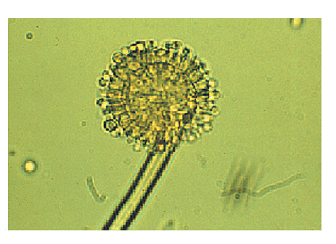
Identify the incorrect statement about the diagram of the fungi given below -

NCERT Ebook for Biological Classification - Biological Classification -  Chapter 2 - NCERT Biology - XI

Detailed Solution: Question 30

Figure mentioned in the question is aspergillus which belong to class ascomycetes.

The asexual spores are conidia produced exogenously on the special mycelium called conidiophores. Conidia on germination produce mycelium. Sexual spores are called ascospores which are produced endogenously in sac like asci (singular ascus). These asci are arranged in different types of fruiting bodies called ascocarps. Some examples are Aspergillus, Claviceps and Neurospora.

Topic in NCERT: Ascomycetes

Line in NCERT: The asexual spores are conidia produced exogenously on the special mycelium called conidiophores. Conidia on germination produce mycelium. Sexual spores are called ascospores which are produced endogenously in sac like asci (singular ascus). These asci are arranged in different types of fruiting bodies called ascocarps.

View more questions
1 videos|19 docs|61 tests
Information about Test: Botany Mock Test - 1 Page
In this test you can find the Exam questions for Test: Botany Mock Test - 1 solved & explained in the simplest way possible. Besides giving Questions and answers for Test: Botany Mock Test - 1, EduRev gives you an ample number of Online tests for practice
Download as PDF