JEE Exam  >  JEE Test  >  WB Sample Papers, Section Wise & Full Mock Tests 2026  >  WBJEE Maths Test - 14 - JEE MCQ

WBJEE Sample Papers, Section Wise & Full Maths Test - 14 Free Online Test


MCQ Practice Test & Solutions: WBJEE Maths Test - 14 (75 Questions)

You can prepare effectively for JEE WBJEE Sample Papers, Section Wise & Full Mock Tests 2026 with this dedicated MCQ Practice Test (available with solutions) on the important topic of "WBJEE Maths Test - 14". These 75 questions have been designed by the experts with the latest curriculum of JEE 2026, to help you master the concept.

Test Highlights:

  • - Format: Multiple Choice Questions (MCQ)
  • - Duration: 120 minutes
  • - Number of Questions: 75

Sign up on EduRev for free to attempt this test and track your preparation progress.

WBJEE Maths Test - 14 - Question 1

The coefficients xp and xq in the expansion of (1+x)(p+q) (where p and q are positive integers) are

WBJEE Maths Test - 14 - Question 2

The first three terms in the expansion of (1 + ax)n (n ≠ 0) are 1, 6x and 16x 2. Then the values of a and n are respectively

WBJEE Maths Test - 14 - Question 3

In the expansion of (1+x)(2n+2) the maximum coefficient is :

WBJEE Maths Test - 14 - Question 4

The polar of a point P w.r.t a circle of radius a touching both x and y axis and lying in the first quadrant is x + 2y = 4a. The coordinates of P are

WBJEE Maths Test - 14 - Question 5

The limiting point of the system of co-axial circles x2+y2-6x-6y+4=0, x2+y2-2x-4y+3=0 is
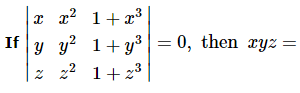
WBJEE Maths Test - 14 - Question 6

Detailed Solution: Question 6

WBJEE Maths Test - 14 - Question 7

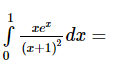
Find the value of

WBJEE Maths Test - 14 - Question 8

WBJEE Maths Test - 14 - Question 9

WBJEE Maths Test - 14 - Question 10

WBJEE Maths Test - 14 - Question 11

Let f(x) be a function satisfying f ′ x = f x with f(0) = 1 and g(x) be a function that satisfies f(x) + g(x) = x2, then value of integral
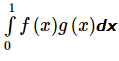
is equal to

WBJEE Maths Test - 14 - Question 12

WBJEE Maths Test - 14 - Question 13

WBJEE Maths Test - 14 - Question 14

If x dy = y(dx + y dy), y > 0 and y (1) = 1, then y (-3) is equal to

WBJEE Maths Test - 14 - Question 15

Solution of cos x dy/dx+y sin x =1 is

WBJEE Maths Test - 14 - Question 16

If y = 2ax and dydx = log 256 at x = 1, then a =

WBJEE Maths Test - 14 - Question 17

The number of points at which the function f(x)=|x-0.5|+|x-1|+tanx is not differentiable in (0,2) is

WBJEE Maths Test - 14 - Question 18

The eccentricity of the conic 9x2 + 25y2 = 225 is

WBJEE Maths Test - 14 - Question 19

S and T are the foci of an ellipse and B is an end of the minor axis. If STB is an equilateral triangle then the eccentricity of the ellipse is

WBJEE Maths Test - 14 - Question 20

The st. line lx + my + n = 0 touches the hyperbola x2/a2 - y22/b2 = 1 if

WBJEE Maths Test - 14 - Question 21

The line y = 4x + c touches the hyperbola x2 - y2 = 1 if

Detailed Solution: Question 21
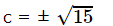
We know that the line y = mx + c touches the hyperbola x 2 a 2 - y 2 b 2 = 1, then
c2 = a2m2 - b2
Here the hyperbola is x2 - y2 = 1
ie here a2 = b2 = 1
and comparing y = 4x + c with y = mx + c,
we get
m = 4
∴ c2 = 16 - 1 = 15

WBJEE Maths Test - 14 - Question 22

The equation x + ex = 0 has

Detailed Solution: Question 22

Let f x = x + e x = 0.


Since f − ∞ = − ∞ and f + ∞ = ∞ ,
∴ f x = 0 has a real root.
Let the real root be α . Then f( α ) = 0.
Now , f ′ x = 1 + e x > 0, ∀ x ∈ R
∴ f x is an increasing function ∀ x ∈ R .
∴ for any other real number β ,
f β > f α or f β < f α .
But f a = 0 ; so , f β ≠ 0.
∴ f x = 0 has no other real root.
Hence, the equation has only one real root.

WBJEE Maths Test - 14 - Question 23

tan⁻1(1/7)+2tan⁻1(1/3)=

WBJEE Maths Test - 14 - Question 24

WBJEE Maths Test - 14 - Question 25

If A is a singular matrix, then Adj A is

WBJEE Maths Test - 14 - Question 26

The maximum value of x3 - 3x in [0,2] is

WBJEE Maths Test - 14 - Question 27

If |z₁|=|z₂| and amp. z₁+amp.z₂=0, then

WBJEE Maths Test - 14 - Question 28

The normals to the parabola y2=4ax from the point (5a,2a) are

WBJEE Maths Test - 14 - Question 29

The line y=mx+c touches the parabola x2=4ay if

WBJEE Maths Test - 14 - Question 30

Five digit number divisible by 3 is formed using the digits 0, 1 , 2, 3, 4 and 5 without repetition. Total number of such numbers is

Detailed Solution: Question 30

A number is divisible by 3 if and only if the sum of its digits are divisible by 3
Notice that 1 + 2 + 3 + 4 + 5 = 15, which is divisible by 3
The only other way we can have a sum of 5 digits divisible by 3 is to replace the 3 by the 0 making the sum 3 less:
1 + 2 + 0 + 4 + 5 = 12, which is divisible by 3
No other choice of 5 digits can have a sum divisible by 3, because there is no other way to make the sum 12 or 15, and we certainly can't have a sum of 9 or 18
So the number of 5-digit numbers that can be formed from the digits {1,2,3,4,5} is

Number of ways = 1 x 2 x 3 x 4 x 5 = 120
And the number of 5-digit numbers that can be formed from the digits {1, 2, 0, 4, 5} is figured this way

Number of ways = 1 x 2 x 3 x 4 x 4 = 96
Total Number of ways = 120 + 96 = 216

View more questions
3 videos|21 docs|54 tests
Information about WBJEE Maths Test - 14 Page
In this test you can find the Exam questions for WBJEE Maths Test - 14 solved & explained in the simplest way possible. Besides giving Questions and answers for WBJEE Maths Test - 14, EduRev gives you an ample number of Online tests for practice
Download as PDF