
J&K Bank Clerk Mock Test - 4 Free Online Test 2026
Full Mock Test & Solutions: J&K Bank Clerk Mock Test - 4 (100 Questions)
You can boost your Bank Exams 2026 exam preparation with this J&K Bank Clerk Mock Test - 4 (available with detailed solutions).. This mock test has been designed with the analysis of important topics, recent trends of the exam, and previous year questions of the last 3-years. All the questions have been designed to mirror the official pattern of Bank Exams 2026 exam, helping you build speed, accuracy as per the actual exam.
Mock Test Highlights:
- - Format: Multiple Choice Questions (MCQ)
- - Duration: 60 minutes
- - Total Questions: 100
- - Analysis: Detailed Solutions & Performance Insights
- - Sections covered: English Language, Numerical Ability, Reasoning Ability
Sign up on EduRev for free and get access to these mock tests, get your All India Rank, and identify your weak areas to improve your marks & rank in the actual exam.

In the following passage, some of the words have been left out. Each of the blank is indicated by a letter. Find the suitable choice for each blank.
In countries as far afield as Iceland, Denmark and the UK, and in cities such as Los Angeles, Sydney, Berlin and Beijing, public swimming pools have historically been democratic palaces of ____(A)_____. In the UK, many public pools and outdoor lidos have long lain neglected; yet they are now experiencing a _____(B)_____, as people increasingly rediscover the _____(C)_____ pleasures of swimming, especially outdoors. With a growing number of community groups and councils ____(D)_____ the value of lidos and pools to local communities, many are being ____(E)_____ and modernised to meet 21st-Century requirements.
Q. Which of the following Words can appropriately fit in the position D?
a) acknowledging
b) brimming
c) recognizing
Detailed Solution: Question 1
Direction: Read the passage carefully and answer the questions that follow:
In July, 1947 a UFO crashed in Roswell, New Mexico, and the government tried to cover it up by saying that it was not a flying saucer but an experimental high-altitude surveillance balloon belonging to a classified program named, "Mogul." However, many proponents of the UFO theory claim that a crashed alien aircraft and bodies were recovered and that the military staged an elaborate cover-up because it was a threat to national security. Now, 64 years later, the debate is still going on and the government is no more cooperative about revealing the details than it was then.
Throughout the years, it has been shown time and again that information that was originally classified as confidential because it was a threat to national security, remained classified many decades later even though the crisis had long since passed and no threat remained. It has also been seen that anytime the government needed an excuse for anything, they only had to say that the information was classified.
In the United States we have run into this kind of obfuscation time and again so when President Obama announced to the world that we were going to have transparency in government, I was overjoyed. It meant that we were finally going to see what went on behind the scenes with Congress. It meant that we could turn on C-SPAN and be privy to the wheeling and dealing of our legislators as they bargained for earmarks.
This has had a so-so effect. Not much has changed. Enter WikiLeaks. At first I was thrilled at the prospect that what I've wanted for years was finally happening. Hundreds of thousands of confidential papers were being aired publicly. The bad guys were being excoriated in the press and the good guys were going to win the war of public opinion and maybe even bring about some good governments. But it isn't turning out that way. There are no clear-cut winners and losers and the head of WikiLeaks has had problems within his own ranks as well as being in trouble with the law of several countries, ours included.
Understandably, the guys who have committed the worst offenses want him out of the way and everyone is taking guesses as to how long he will remain alive before someone kills him. The people in OpenLeaks is doing this a little differently; they are leaking the information to the media in bits and pieces and letting them take the blame for the leaks, hence, presumably, no one's life is on the line while this classified information reaches the public in a safer form of whistle-blowing.
I'm one of the people who has been in favour of what WikiLeaks and OpenLeaks are trying to do. I'm tired of all this secrecy and I do want it to stop. And if that was all there was to it, I'd hitch my wagon to it and ride out the storm of controversy.
But now it has taken a much more sinister turn. It is no longer about public officials misusing and abusing power and corrupt and ruthless governments toppling; now it has come to the doorstep of the people; it has come into the lives of all of us.
Hackers, in their rallying cry for transparency and no more secrets, have taken to hacking into the files of banks and financial institutions. Millions of depositors have had their personal information, their identities, and their lives stolen out from under them. People who stood behind the precepts of WikiLeaks and OpenLeaks are now their victims. It's still not clearly understood whether these hackers are part of WikiLeaks and OpenLeaks or are just hanging onto their coattails and operating on their own. It doesn't matter at this point whether they are independent agents or working in unison with WikiLeaks or OpenLeaks. All that matters is that these people who have had their personal information hijacked, had nothing to do with the secrecy in government nor the corruption that ensued as a result.
These hackers have taken it a step too far and it's time for them to reassess their objectives and find a better way to attain them without causing the rest of the world to come toppling down around them, Unless, of course, that is their intent.
Connie H. Deutsch
Q. What does the author mean by the last sentence of the passage “Unless, of course, that is their intent”?
Detailed Solution: Question 2

Direction: Read the passage carefully and answer the questions that follow:
In July, 1947 a UFO crashed in Roswell, New Mexico, and the government tried to cover it up by saying that it was not a flying saucer but an experimental high-altitude surveillance balloon belonging to a classified program named, "Mogul." However, many proponents of the UFO theory claim that a crashed alien aircraft and bodies were recovered and that the military staged an elaborate cover-up because it was a threat to national security. Now, 64 years later, the debate is still going on and the government is no more cooperative about revealing the details than it was then.
Throughout the years, it has been shown time and again that information that was originally classified as confidential because it was a threat to national security, remained classified many decades later even though the crisis had long since passed and no threat remained. It has also been seen that anytime the government needed an excuse for anything, they only had to say that the information was classified.
In the United States we have run into this kind of obfuscation time and again so when President Obama announced to the world that we were going to have transparency in government, I was overjoyed. It meant that we were finally going to see what went on behind the scenes with Congress. It meant that we could turn on C-SPAN and be privy to the wheeling and dealing of our legislators as they bargained for earmarks.
This has had a so-so effect. Not much has changed. Enter WikiLeaks. At first I was thrilled at the prospect that what I've wanted for years was finally happening. Hundreds of thousands of confidential papers were being aired publicly. The bad guys were being excoriated in the press and the good guys were going to win the war of public opinion and maybe even bring about some good governments. But it isn't turning out that way. There are no clear-cut winners and losers and the head of WikiLeaks has had problems within his own ranks as well as being in trouble with the law of several countries, ours included.
Understandably, the guys who have committed the worst offenses want him out of the way and everyone is taking guesses as to how long he will remain alive before someone kills him. The people in OpenLeaks is doing this a little differently; they are leaking the information to the media in bits and pieces and letting them take the blame for the leaks, hence, presumably, no one's life is on the line while this classified information reaches the public in a safer form of whistle-blowing.
I'm one of the people who has been in favour of what WikiLeaks and OpenLeaks are trying to do. I'm tired of all this secrecy and I do want it to stop. And if that was all there was to it, I'd hitch my wagon to it and ride out the storm of controversy.
But now it has taken a much more sinister turn. It is no longer about public officials misusing and abusing power and corrupt and ruthless governments toppling; now it has come to the doorstep of the people; it has come into the lives of all of us.
Hackers, in their rallying cry for transparency and no more secrets, have taken to hacking into the files of banks and financial institutions. Millions of depositors have had their personal information, their identities, and their lives stolen out from under them. People who stood behind the precepts of WikiLeaks and OpenLeaks are now their victims. It's still not clearly understood whether these hackers are part of WikiLeaks and OpenLeaks or are just hanging onto their coattails and operating on their own. It doesn't matter at this point whether they are independent agents or working in unison with WikiLeaks or OpenLeaks. All that matters is that these people who have had their personal information hijacked, had nothing to do with the secrecy in government nor the corruption that ensued as a result.
These hackers have taken it a step too far and it's time for them to reassess their objectives and find a better way to attain them without causing the rest of the world to come toppling down around them, Unless, of course, that is their intent.
Connie H. Deutsch
Q. Which of the following words is opposite in meaning to the word “sinister”?
Detailed Solution: Question 3
A passage has been given below. Few words and sentences have been highlighted to help you answer some of the questions. Read the same carefully and answer the questions that follow:
Concern over ‘freebies’ in Indian politics has recently been expressed by those in the highest offices in the country. Speaking at the inaugural ceremony of the Bundelkhand Expressway (Uttar Pradesh) on July 16, Prime Minister Narendra Modi warned youth not to get carried away by the ‘revari culture’, where votes are sought by promising freebies. He hit out at the Opposition parties for offering freebies and said that this was dangerous and harmful to the development of the country.
these distort the electoral process (P)/ Days later, a Bench headed by the Chief Justice of India (Q)/ irrational freebies’ by claiming that (R)/ N.V. Ramana, heard a public interest litigation in (S)/ which the petitioner argued against the promise of (T).
It has been reported that during the hearing, the Chief Justice of India remarked that ‘freebies were a serious issue and asked the Central government to take a stand on the need to control the announcement of ‘freebies’ by political parties during election campaigns. The Court also suggested that the Finance Commission could be involved to look into the matter and propose solutions.
The discussion on the demerits of freebies distributed to the public as a result of election promises is not new in India. However, there is often confusion on what constitutes ‘freebies’, with several services that the Government provides to meet its constitutional obligations towards citizens also being clubbed in this category.
The basic argument is that these are a waste of resources and place a burden on already stressed fiscal resources. In such discussions, ‘freebies’ not only include the free distribution of what may be considered ‘club goods’ such as televisions and gold chains but also welfare schemes such as free or subsidized rations under the Public Distribution System (PDS), cooked meals under the midday meal scheme, supplementary nutrition through anganwadis, and work provided through the Mahatma Gandhi National Rural Employment Guarantee Act (MGNREGA).
But can these expenditures by the Government be considered ‘freebies’, as many commentators seem to do? For instance, is the distribution of free food-grain during a pandemic that devastated lives and livelihoods at a time when godowns of the Food Corporation of India (FCI) had over 100million tonnes of rice and wheat a ‘freebie’? The Prime Minister and members of the Bharatiya Janata Party have repeatedly campaigned about the Government implementing the ‘world’s largest food security programme’ by distributing free food-grain, through the Pradhan Mantri Garib KalyanAnna Yojana (PMGKAY) to around80 crore ration card holders. The PMGKAY is probably what kept many away from the brink of starvation during the novel coronavirus pandemic. If anything, it can be argued that coverage under the PMGKAY must be expanded to include non-ration card holders as well, as there are many who are excluded from ration lists but are in need of subsidized or free food-grains. Even before the COVID19 pandemic, there have been studies which showed the poverty reducing effect of the PDS. Subsidized food-grains distributed under the PDS not only contribute to ensuring basic food security but also act as an implicit income transfer allowing the poor to afford commodities that they otherwise could not. Further, the PDS also plays an important role in our country where public procurement at minimum support prices (MSPs) is one of the main instruments of support to farmers. The PDS allows food-grains to be available for cheap for consumers while assuring remunerative prices to farmers.
Q. How would you describe the "revari culture", discussed in the first paragraph?
a) this culture creates new facilities for the present.
b) offering freebies for winning elections
c) in which votes were sought by promising freebies.
Detailed Solution: Question 4
A passage has been given below. Few words and sentences have been highlighted to help you answer some of the questions. Read the same carefully and answer the questions that follow:
Concern over ‘freebies’ in Indian politics has recently been expressed by those in the highest offices in the country. Speaking at the inaugural ceremony of the Bundelkhand Expressway (Uttar Pradesh) on July 16, Prime Minister Narendra Modi warned youth not to get carried away by the ‘revari culture’, where votes are sought by promising freebies. He hit out at the Opposition parties for offering freebies and said that this was dangerous and harmful to the development of the country.
these distort the electoral process (P)/ Days later, a Bench headed by the Chief Justice of India (Q)/ irrational freebies’ by claiming that (R)/ N.V. Ramana, heard a public interest litigation in (S)/ which the petitioner argued against the promise of (T).
It has been reported that during the hearing, the Chief Justice of India remarked that ‘freebies were a serious issue and asked the Central government to take a stand on the need to control the announcement of ‘freebies’ by political parties during election campaigns. The Court also suggested that the Finance Commission could be involved to look into the matter and propose solutions.
The discussion on the demerits of freebies distributed to the public as a result of election promises is not new in India. However, there is often confusion on what constitutes ‘freebies’, with several services that the Government provides to meet its constitutional obligations towards citizens also being clubbed in this category.
The basic argument is that these are a waste of resources and place a burden on already stressed fiscal resources. In such discussions, ‘freebies’ not only include the free distribution of what may be considered ‘club goods’ such as televisions and gold chains but also welfare schemes such as free or subsidized rations under the Public Distribution System (PDS), cooked meals under the midday meal scheme, supplementary nutrition through anganwadis, and work provided through the Mahatma Gandhi National Rural Employment Guarantee Act (MGNREGA).
But can these expenditures by the Government be considered ‘freebies’, as many commentators seem to do? For instance, is the distribution of free food-grain during a pandemic that devastated lives and livelihoods at a time when godowns of the Food Corporation of India (FCI) had over 100million tonnes of rice and wheat a ‘freebie’? The Prime Minister and members of the Bharatiya Janata Party have repeatedly campaigned about the Government implementing the ‘world’s largest food security programme’ by distributing free food-grain, through the Pradhan Mantri Garib KalyanAnna Yojana (PMGKAY) to around80 crore ration card holders. The PMGKAY is probably what kept many away from the brink of starvation during the novel coronavirus pandemic. If anything, it can be argued that coverage under the PMGKAY must be expanded to include non-ration card holders as well, as there are many who are excluded from ration lists but are in need of subsidized or free food-grains. Even before the COVID19 pandemic, there have been studies which showed the poverty reducing effect of the PDS. Subsidized food-grains distributed under the PDS not only contribute to ensuring basic food security but also act as an implicit income transfer allowing the poor to afford commodities that they otherwise could not. Further, the PDS also plays an important role in our country where public procurement at minimum support prices (MSPs) is one of the main instruments of support to farmers. The PDS allows food-grains to be available for cheap for consumers while assuring remunerative prices to farmers.
Q. Which of the following is/are necessary for India's freebies schemes to succeed?
a) including supplementary nutrition through anganwadis
b) providing cooked meals under the midday meal scheme
c) curbing the distribution of club goods
Detailed Solution: Question 5
A passage has been given below. Few words and sentences have been highlighted to help you answer some of the questions. Read the same carefully and answer the questions that follow:
Concern over ‘freebies’ in Indian politics has recently been expressed by those in the highest offices in the country. Speaking at the inaugural ceremony of the Bundelkhand Expressway (Uttar Pradesh) on July 16, Prime Minister Narendra Modi warned youth not to get carried away by the ‘revari culture’, where votes are sought by promising freebies. He hit out at the Opposition parties for offering freebies and said that this was dangerous and harmful to the development of the country.
these distort the electoral process (P)/ Days later, a Bench headed by the Chief Justice of India (Q)/ irrational freebies’ by claiming that (R)/ N.V. Ramana, heard a public interest litigation in (S)/ which the petitioner argued against the promise of (T).
It has been reported that during the hearing, the Chief Justice of India remarked that ‘freebies were a serious issue and asked the Central government to take a stand on the need to control the announcement of ‘freebies’ by political parties during election campaigns. The Court also suggested that the Finance Commission could be involved to look into the matter and propose solutions.
The discussion on the demerits of freebies distributed to the public as a result of election promises is not new in India. However, there is often confusion on what constitutes ‘freebies’, with several services that the Government provides to meet its constitutional obligations towards citizens also being clubbed in this category.
The basic argument is that these are a waste of resources and place a burden on already stressed fiscal resources. In such discussions, ‘freebies’ not only include the free distribution of what may be considered ‘club goods’ such as televisions and gold chains but also welfare schemes such as free or subsidized rations under the Public Distribution System (PDS), cooked meals under the midday meal scheme, supplementary nutrition through anganwadis, and work provided through the Mahatma Gandhi National Rural Employment Guarantee Act (MGNREGA).
But can these expenditures by the Government be considered ‘freebies’, as many commentators seem to do? For instance, is the distribution of free food-grain during a pandemic that devastated lives and livelihoods at a time when godowns of the Food Corporation of India (FCI) had over 100million tonnes of rice and wheat a ‘freebie’? The Prime Minister and members of the Bharatiya Janata Party have repeatedly campaigned about the Government implementing the ‘world’s largest food security programme’ by distributing free food-grain, through the Pradhan Mantri Garib KalyanAnna Yojana (PMGKAY) to around80 crore ration card holders. The PMGKAY is probably what kept many away from the brink of starvation during the novel coronavirus pandemic. If anything, it can be argued that coverage under the PMGKAY must be expanded to include non-ration card holders as well, as there are many who are excluded from ration lists but are in need of subsidized or free food-grains. Even before the COVID19 pandemic, there have been studies which showed the poverty reducing effect of the PDS. Subsidized food-grains distributed under the PDS not only contribute to ensuring basic food security but also act as an implicit income transfer allowing the poor to afford commodities that they otherwise could not. Further, the PDS also plays an important role in our country where public procurement at minimum support prices (MSPs) is one of the main instruments of support to farmers. The PDS allows food-grains to be available for cheap for consumers while assuring remunerative prices to farmers.
Q. Which of the following options conveys the same meaning as the highlighted PHRASE “hit out”?
a) criticize someone
b) to make an angry attack against (someone)
c) be naturally friendly or well suited.
Detailed Solution: Question 6
A passage has been given below. Few words and sentences have been highlighted to help you answer some of the questions. Read the same carefully and answer the questions that follow:
Concern over ‘freebies’ in Indian politics has recently been expressed by those in the highest offices in the country. Speaking at the inaugural ceremony of the Bundelkhand Expressway (Uttar Pradesh) on July 16, Prime Minister Narendra Modi warned youth not to get carried away by the ‘revari culture’, where votes are sought by promising freebies. He hit out at the Opposition parties for offering freebies and said that this was dangerous and harmful to the development of the country.
these distort the electoral process (P)/ Days later, a Bench headed by the Chief Justice of India (Q)/ irrational freebies’ by claiming that (R)/ N.V. Ramana, heard a public interest litigation in (S)/ which the petitioner argued against the promise of (T).
It has been reported that during the hearing, the Chief Justice of India remarked that ‘freebies were a serious issue and asked the Central government to take a stand on the need to control the announcement of ‘freebies’ by political parties during election campaigns. The Court also suggested that the Finance Commission could be involved to look into the matter and propose solutions.
The discussion on the demerits of freebies distributed to the public as a result of election promises is not new in India. However, there is often confusion on what constitutes ‘freebies’, with several services that the Government provides to meet its constitutional obligations towards citizens also being clubbed in this category.
The basic argument is that these are a waste of resources and place a burden on already stressed fiscal resources. In such discussions, ‘freebies’ not only include the free distribution of what may be considered ‘club goods’ such as televisions and gold chains but also welfare schemes such as free or subsidized rations under the Public Distribution System (PDS), cooked meals under the midday meal scheme, supplementary nutrition through anganwadis, and work provided through the Mahatma Gandhi National Rural Employment Guarantee Act (MGNREGA).
But can these expenditures by the Government be considered ‘freebies’, as many commentators seem to do? For instance, is the distribution of free food-grain during a pandemic that devastated lives and livelihoods at a time when godowns of the Food Corporation of India (FCI) had over 100million tonnes of rice and wheat a ‘freebie’? The Prime Minister and members of the Bharatiya Janata Party have repeatedly campaigned about the Government implementing the ‘world’s largest food security programme’ by distributing free food-grain, through the Pradhan Mantri Garib KalyanAnna Yojana (PMGKAY) to around80 crore ration card holders. The PMGKAY is probably what kept many away from the brink of starvation during the novel coronavirus pandemic. If anything, it can be argued that coverage under the PMGKAY must be expanded to include non-ration card holders as well, as there are many who are excluded from ration lists but are in need of subsidized or free food-grains. Even before the COVID19 pandemic, there have been studies which showed the poverty reducing effect of the PDS. Subsidized food-grains distributed under the PDS not only contribute to ensuring basic food security but also act as an implicit income transfer allowing the poor to afford commodities that they otherwise could not. Further, the PDS also plays an important role in our country where public procurement at minimum support prices (MSPs) is one of the main instruments of support to farmers. The PDS allows food-grains to be available for cheap for consumers while assuring remunerative prices to farmers.
A sentence, highlighted in Underline, is divided into five parts. This question is followed by four options which give the sequence of rearranged parts. You must choose the option which gives the correct sequence of the parts.
these distort the electoral process (P)/ days later, a Bench headed by the Chief Justice of India (Q)/ irrational freebies’ by claiming that (R)/ N.V. Ramana, heard a public interest litigation in (S)/ which the petitioner argued against the promise of (T)
Detailed Solution: Question 7
Direction: Fill in the blank with an appropriate word.
Q. The importance of language in gaining knowledge is doubtless the chief cause of the common ________ that knowledge may be passed directly from one to another.
Detailed Solution: Question 8
Direction: Fill in the blank with an appropriate word.
Q. In directing the activities of the young, society determines its own future in ____________ that of the young.
Detailed Solution: Question 9
Direction: Fill in the blank with an appropriate word.
Q. It is clear that the current government will not instill a sense of _____ and patriotism in the people.
Detailed Solution: Question 10
What value should come in the place of (?) in the following questions.
(36.8 * 4 * 5) ÷ 92 = ?
Detailed Solution: Question 11
What value should come in the place of (?) in the following questions.
% of 850 + 541 = 1255
Detailed Solution: Question 12
Direction: What will come in the place of the question mark (?) in the following number series?
7, 12, 37, 162, ?
Detailed Solution: Question 13
Direction: What will come in the place of the question mark (?) in the following number series?
3, 7, 23, 59, ?
Detailed Solution: Question 14
Study the following information carefully and answer the questions.
The given line graph shows the average number of boys and girls who are selected for internship from five different colleges i.e. A, B, C, D and E and also given the percentage of the number of boys who are selected for internship from five different colleges.
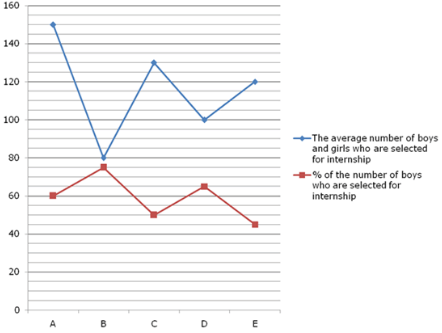
Q. Find the difference between the number of boys who are selected for internship from college A and the number of girls who are selected for internship from college E?
Detailed Solution: Question 15
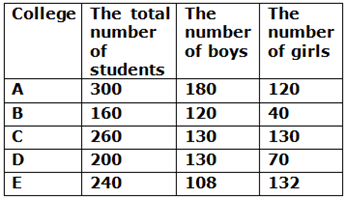
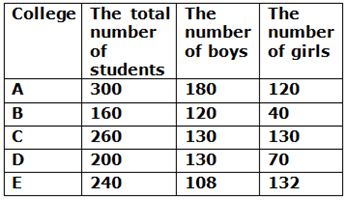
Study the following information carefully and answer the questions.
The given line graph shows the average number of boys and girls who are selected for internship from five different colleges i.e. A, B, C, D and E and also given the percentage of the number of boys who are selected for internship from five different colleges.
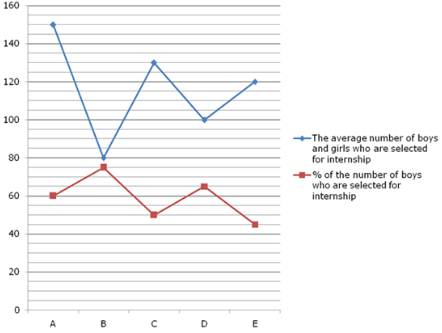
Q. If the total number of students who selected for internship from college F is 50% more than that of college C and the ratio of the number of girls who selected for internship from college C to college F is 13 : 15, then find the number of boys who selected for internship from college F?
Detailed Solution: Question 16
There are 2000 saplings to be planted. Abu plants half of all the saplings. Bibu plants one fifth of the remaining sampling. Out of the remaining one fourth are planted by Chinu. All of the remaining are planted by Dinu. How many saplings did Dinu plant?
Detailed Solution: Question 17
In each of the following questions, two equations are given. You have to solve both the equations to find the relation between x and y.
I) x2+29x + 210 = 0
II) y2+ 25y +156 = 0
Detailed Solution: Question 18
In each of the following questions, two equations are given. You have to solve both the equations to find the relation between x and y.
I) x2– 2x - 195 = 0
II) y2+ 27y + 182 = 0
Detailed Solution: Question 19
Direction: What approximate value should come in the place of the question mark in the following questions? You are not expected to calculate the exact value.
(23.89)3 = ?
Detailed Solution: Question 20
Direction: In the following question assuming the given statement to be true. Find which of the following conclusion(s) among the given conclusions is/are definitely true and then give your answer accordingly.
Statement:
F < D ≤ G, K > M > L ≥ G
Conclusion:
I. M > D
II. M = D
Detailed Solution: Question 21
Study the following information carefully and answer the questions below:
Six persons are getting different salaries. F gets more than E and not less than D. A gets Rs.5,000 more than E. C gets more than D, whose salary is not more than anyone. The highest salaried person gets Rs.50,000. A gets less than F, who is not the highest salaried person. E gets more than B and gets the salary of Rs.15,000.
Q. If the sum of the salaries of A and B is Rs.30,000, then what is the salary of D?
Detailed Solution: Question 22
If in a certain code language, ELEPHANT is written as FKFOIZOS, which word would be written as FUBKVZUHPM?
Detailed Solution: Question 23
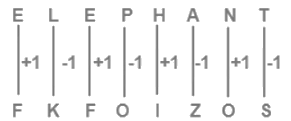
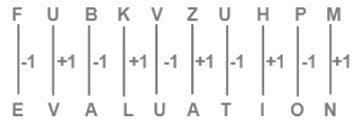
Direction: Study the information given below carefully and answer the questions that follow.
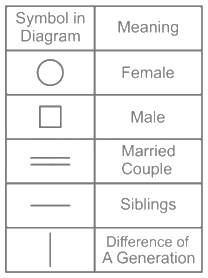
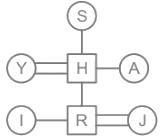
There are 7 members in the family. There are 2 married couples. R is son of H. S is mother of A. H is son of S. Y and H are married couples. A is aunt of I who is the daughter of Y. I is sister-in-law of J.
Q. How is Y related to J?
Detailed Solution: Question 24
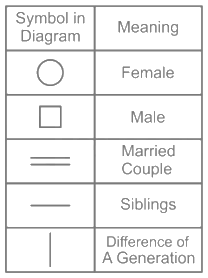
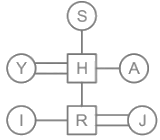
Direction: Study the information given below carefully and answer the questions that follow.
There are 7 members in the family. There are 2 married couples. R is son of H. S is mother of A. H is son of S. Y and H are married couples. A is aunt of I who is the daughter of Y. I is sister-in-law of J.
Q. Who is daughter of H?
Detailed Solution: Question 25
Study the following information carefully and answer the questions below:
536 749 357 984 196
If the third digit of the second highest number is divided by the first digit of the second lowest number, then what will be the resultant?
Detailed Solution: Question 26
Study the following information carefully and answer the questions below:
536 749 357 984 196
If the sum of the last two digits of the given numbers is multiplied by 3 and subtracted from the first digit, then how many numbers thus formed are odd numbers?
Detailed Solution: Question 27
Study the following information carefully and answer the questions given below.
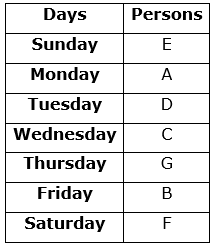
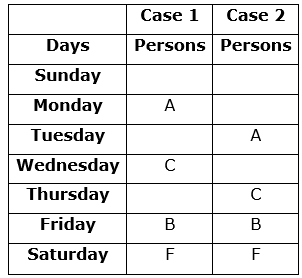
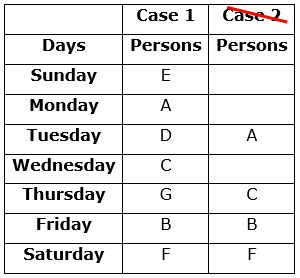
Seven persons - A, B, C, D, E, F and G attend the music class on seven different days from Sunday to Saturday of the same week, but not necessarily in the same order.
A attends the class before Wednesday. Only one person attends the class between A and C, where neither of them attends the class on Sunday. B attends the class immediately before F, who neither attends on Monday nor on Friday. As many persons attend the class before D is same as after G. The number of persons attending the class between D and E is one less than the number of persons attending the class between D and B
Q. The number of persons attending the class before C is one more than the number of persons attending the class after______.
Detailed Solution: Question 28
Direction: Study the following arrangement carefully and answer the questions given below:
L K 1 C D 9 Z Y ^ P 2 N © K S 3 ↑ 5 M T ®
Q. Which of the following elements is exactly in the middle of 9 and 3?
Detailed Solution: Question 29
Direction: Study the following arrangement carefully and answer the questions given below:
L K 1 C D 9 Z Y ^ P 2 N © K S 3 ↑ 5 M T ®
Q. Which of the following elements is tenth to the left of the fifth element from the right end?
Detailed Solution: Question 30
