
J&K Bank Clerk Mock Test - 7 Free Online Test 2026
Full Mock Test & Solutions: J&K Bank Clerk Mock Test - 7 (100 Questions)
You can boost your Bank Exams 2026 exam preparation with this J&K Bank Clerk Mock Test - 7 (available with detailed solutions).. This mock test has been designed with the analysis of important topics, recent trends of the exam, and previous year questions of the last 3-years. All the questions have been designed to mirror the official pattern of Bank Exams 2026 exam, helping you build speed, accuracy as per the actual exam.
Mock Test Highlights:
- - Format: Multiple Choice Questions (MCQ)
- - Duration: 60 minutes
- - Total Questions: 100
- - Analysis: Detailed Solutions & Performance Insights
- - Sections covered: English Language, Quantitative Aptitude, Reasoning Ability
Sign up on EduRev for free and get access to these mock tests, get your All India Rank, and identify your weak areas to improve your marks & rank in the actual exam.

Directions : Read the following passage carefully and answer the questions given below. Certain words/phrases have been printed in bold to help you locate them.
The former Telecom Regulatory Authority of India (TRAI) Chairman Pradip Baijal’s interesting account of his years in the Indian Administrative Service (IAS) raises, among other things, several crucial issues in public administration. Of course his book, The Complete Story of Indian Reforms: 2G, Power & Private Enterprise — A Practitioner’s Diary, is better known in the media for some of its “startling revelations” about the 2G scam. In the book, he gives eloquent expression to his pent-up anguish over his maltreatment, especially the alleged unleashing of enforcement agencies against him by those who were annoyed with him for his stubborn stand on a variety of issues. I must say that he sounds credible if one goes by what has been widely reported across the media and on the debate on the state of governance in the last decade. This takes me on a brief journey into the country’s administrative history.
Notwithstanding tribulations and moments of despair and disappointment, an average Indian civil servant, in the first few years after Independence, enjoyed working in a professional ambience that would become the envy of those who followed him. For about three decades — till 1975 to be precise — things were quite hunky dory. Barring a few aberrations, an honest government official could hold his head high and stick to his principles while discharging his duties, even if it meant being argumentative and difficult in the eyes of his political superiors. The Emergency (1975-77) changed all that. From about this point of time, civil servants were perforce required to kow tow to people who belonged to a strikingly different genre and who enjoyed wielding their enormous authority in day-to-day administration. The earlier equilibrium in the polity gradually yielded place to strife and confrontation, and a fear psychosis started developing even among top civil servants. The healthy relationship that had existed earlier between minister and civil servant became a thing of the past. In many States honest dissent even at the highest levels such as the Chief Secretary and the Director General of Police was resented, and unquestioned obeisance alone rewarded. There has been no visible change since then in respect of ministerial authoritarianism and hubris. I do not buy the argument that this power shift is inevitable in a dynamic democracy like ours. The sharp and honest public servant should be allowed to have his say although he can be overruled by the political executive in as decorous manner as possible, instead of being targeted for imaginary charges with the aid and abetment of enforcement agencies like the Central Bureau of Investigation (CBI) or State Vigilance Bureaus. The perception now is that the back of the bureaucracy has been broken and its political neutrality totally wiped out. It is heartening that a small process of recovery has begun at the Centre, but it may take a long time before its impact becomes measurable. It is against this backdrop that the memoirs of a few senior civil servants, published in the recent past, including the recent one by Mr. Baijal will have to be viewed. Not all the writing may seem distinguished or profound. In fact, Mr. Baijal’s book is disjointed and gives the impression of having been “assembled from different sources” — all his own — in a hurry. Some allowance may also have to be given for bias and factual inaccuracy that inevitably creeps into such accounts.
One principal charge levelled against all such writers, post-retirement, is that they speak too late. This is unfair and uninformed criticism. If ever you have worked in government, you would understand how scary it is to take on a Minister, especially a person who is a political heavyweight and one on whom the very survival of a government depends. The fear of reprisal lasts much longer even after one has hung up one’s boots, given the mystic power of rehabilitation that many politicians seem to possess. To criticise a senior official for taking his own time to recapitulate all that he experienced while in service is preposterous. In public discourse, it is the larger picture painted by them that should count. Mr. Baijal has had more than his share of highs and lows in a long innings, first as a Secretary to the Government of India, and later at TRAI. He no doubt had a few good bosses from the political firmament who valued propriety and decorum. A bright spark like Mr. Arun Shourie believed in his ability and motivated him to be innovative and daring. As against this, there was an equal number who did not swear by principles and who did not fancy the likes of Mr. Baijal.
Q. Which of the following is true related to the post-independence ?
Directions : Read the following passage carefully and answer the questions given below. Certain words/phrases have been printed in bold to help you locate them.
The former Telecom Regulatory Authority of India (TRAI) Chairman Pradip Baijal’s interesting account of his years in the Indian Administrative Service (IAS) raises, among other things, several crucial issues in public administration. Of course his book, The Complete Story of Indian Reforms: 2G, Power & Private Enterprise — A Practitioner’s Diary, is better known in the media for some of its “startling revelations” about the 2G scam. In the book, he gives eloquent expression to his pent-up anguish over his maltreatment, especially the alleged unleashing of enforcement agencies against him by those who were annoyed with him for his stubborn stand on a variety of issues. I must say that he sounds credible if one goes by what has been widely reported across the media and on the debate on the state of governance in the last decade. This takes me on a brief journey into the country’s administrative history.
Notwithstanding tribulations and moments of despair and disappointment, an average Indian civil servant, in the first few years after Independence, enjoyed working in a professional ambience that would become the envy of those who followed him. For about three decades — till 1975 to be precise — things were quite hunky dory. Barring a few aberrations, an honest government official could hold his head high and stick to his principles while discharging his duties, even if it meant being argumentative and difficult in the eyes of his political superiors. The Emergency (1975-77) changed all that. From about this point of time, civil servants were perforce required to kow tow to people who belonged to a strikingly different genre and who enjoyed wielding their enormous authority in day-to-day administration. The earlier equilibrium in the polity gradually yielded place to strife and confrontation, and a fear psychosis started developing even among top civil servants. The healthy relationship that had existed earlier between minister and civil servant became a thing of the past. In many States honest dissent even at the highest levels such as the Chief Secretary and the Director General of Police was resented, and unquestioned obeisance alone rewarded. There has been no visible change since then in respect of ministerial authoritarianism and hubris. I do not buy the argument that this power shift is inevitable in a dynamic democracy like ours. The sharp and honest public servant should be allowed to have his say although he can be overruled by the political executive in as decorous manner as possible, instead of being targeted for imaginary charges with the aid and abetment of enforcement agencies like the Central Bureau of Investigation (CBI) or State Vigilance Bureaus. The perception now is that the back of the bureaucracy has been broken and its political neutrality totally wiped out. It is heartening that a small process of recovery has begun at the Centre, but it may take a long time before its impact becomes measurable. It is against this backdrop that the memoirs of a few senior civil servants, published in the recent past, including the recent one by Mr. Baijal will have to be viewed. Not all the writing may seem distinguished or profound. In fact, Mr. Baijal’s book is disjointed and gives the impression of having been “assembled from different sources” — all his own — in a hurry. Some allowance may also have to be given for bias and factual inaccuracy that inevitably creeps into such accounts.
One principal charge levelled against all such writers, post-retirement, is that they speak too late. This is unfair and uninformed criticism. If ever you have worked in government, you would understand how scary it is to take on a Minister, especially a person who is a political heavyweight and one on whom the very survival of a government depends. The fear of reprisal lasts much longer even after one has hung up one’s boots, given the mystic power of rehabilitation that many politicians seem to possess. To criticise a senior official for taking his own time to recapitulate all that he experienced while in service is preposterous. In public discourse, it is the larger picture painted by them that should count. Mr. Baijal has had more than his share of highs and lows in a long innings, first as a Secretary to the Government of India, and later at TRAI. He no doubt had a few good bosses from the political firmament who valued propriety and decorum. A bright spark like Mr. Arun Shourie believed in his ability and motivated him to be innovative and daring. As against this, there was an equal number who did not swear by principles and who did not fancy the likes of Mr. Baijal.
Q. What does the author mean by the phrase “his pent-up anguish over his maltreatment”?

Directions : Read the following passage carefully and answer the questions given below. Certain words/phrases have been printed in bold to help you locate them.
The former Telecom Regulatory Authority of India (TRAI) Chairman Pradip Baijal’s interesting account of his years in the Indian Administrative Service (IAS) raises, among other things, several crucial issues in public administration. Of course his book, The Complete Story of Indian Reforms: 2G, Power & Private Enterprise — A Practitioner’s Diary, is better known in the media for some of its “startling revelations” about the 2G scam. In the book, he gives eloquent expression to his pent-up anguish over his maltreatment, especially the alleged unleashing of enforcement agencies against him by those who were annoyed with him for his stubborn stand on a variety of issues. I must say that he sounds credible if one goes by what has been widely reported across the media and on the debate on the state of governance in the last decade. This takes me on a brief journey into the country’s administrative history.
Notwithstanding tribulations and moments of despair and disappointment, an average Indian civil servant, in the first few years after Independence, enjoyed working in a professional ambience that would become the envy of those who followed him. For about three decades — till 1975 to be precise — things were quite hunky dory. Barring a few aberrations, an honest government official could hold his head high and stick to his principles while discharging his duties, even if it meant being argumentative and difficult in the eyes of his political superiors. The Emergency (1975-77) changed all that. From about this point of time, civil servants were perforce required to kow tow to people who belonged to a strikingly different genre and who enjoyed wielding their enormous authority in day-to-day administration. The earlier equilibrium in the polity gradually yielded place to strife and confrontation, and a fear psychosis started developing even among top civil servants. The healthy relationship that had existed earlier between minister and civil servant became a thing of the past. In many States honest dissent even at the highest levels such as the Chief Secretary and the Director General of Police was resented, and unquestioned obeisance alone rewarded. There has been no visible change since then in respect of ministerial authoritarianism and hubris. I do not buy the argument that this power shift is inevitable in a dynamic democracy like ours. The sharp and honest public servant should be allowed to have his say although he can be overruled by the political executive in as decorous manner as possible, instead of being targeted for imaginary charges with the aid and abetment of enforcement agencies like the Central Bureau of Investigation (CBI) or State Vigilance Bureaus. The perception now is that the back of the bureaucracy has been broken and its political neutrality totally wiped out. It is heartening that a small process of recovery has begun at the Centre, but it may take a long time before its impact becomes measurable. It is against this backdrop that the memoirs of a few senior civil servants, published in the recent past, including the recent one by Mr. Baijal will have to be viewed. Not all the writing may seem distinguished or profound. In fact, Mr. Baijal’s book is disjointed and gives the impression of having been “assembled from different sources” — all his own — in a hurry. Some allowance may also have to be given for bias and factual inaccuracy that inevitably creeps into such accounts.
One principal charge levelled against all such writers, post-retirement, is that they speak too late. This is unfair and uninformed criticism. If ever you have worked in government, you would understand how scary it is to take on a Minister, especially a person who is a political heavyweight and one on whom the very survival of a government depends. The fear of reprisal lasts much longer even after one has hung up one’s boots, given the mystic power of rehabilitation that many politicians seem to possess. To criticise a senior official for taking his own time to recapitulate all that he experienced while in service is preposterous. In public discourse, it is the larger picture painted by them that should count. Mr. Baijal has had more than his share of highs and lows in a long innings, first as a Secretary to the Government of India, and later at TRAI. He no doubt had a few good bosses from the political firmament who valued propriety and decorum. A bright spark like Mr. Arun Shourie believed in his ability and motivated him to be innovative and daring. As against this, there was an equal number who did not swear by principles and who did not fancy the likes of Mr. Baijal.
Q. Which of the following is not the synonym of the word “abetment”?
Directions : Read the following passage carefully and answer the questions given below. Certain words/phrases have been printed in bold to help you locate them.
The former Telecom Regulatory Authority of India (TRAI) Chairman Pradip Baijal’s interesting account of his years in the Indian Administrative Service (IAS) raises, among other things, several crucial issues in public administration. Of course his book, The Complete Story of Indian Reforms: 2G, Power & Private Enterprise — A Practitioner’s Diary, is better known in the media for some of its “startling revelations” about the 2G scam. In the book, he gives eloquent expression to his pent-up anguish over his maltreatment, especially the alleged unleashing of enforcement agencies against him by those who were annoyed with him for his stubborn stand on a variety of issues. I must say that he sounds credible if one goes by what has been widely reported across the media and on the debate on the state of governance in the last decade. This takes me on a brief journey into the country’s administrative history.
Notwithstanding tribulations and moments of despair and disappointment, an average Indian civil servant, in the first few years after Independence, enjoyed working in a professional ambience that would become the envy of those who followed him. For about three decades — till 1975 to be precise — things were quite hunky dory. Barring a few aberrations, an honest government official could hold his head high and stick to his principles while discharging his duties, even if it meant being argumentative and difficult in the eyes of his political superiors. The Emergency (1975-77) changed all that. From about this point of time, civil servants were perforce required to kow tow to people who belonged to a strikingly different genre and who enjoyed wielding their enormous authority in day-to-day administration. The earlier equilibrium in the polity gradually yielded place to strife and confrontation, and a fear psychosis started developing even among top civil servants. The healthy relationship that had existed earlier between minister and civil servant became a thing of the past. In many States honest dissent even at the highest levels such as the Chief Secretary and the Director General of Police was resented, and unquestioned obeisance alone rewarded. There has been no visible change since then in respect of ministerial authoritarianism and hubris. I do not buy the argument that this power shift is inevitable in a dynamic democracy like ours. The sharp and honest public servant should be allowed to have his say although he can be overruled by the political executive in as decorous manner as possible, instead of being targeted for imaginary charges with the aid and abetment of enforcement agencies like the Central Bureau of Investigation (CBI) or State Vigilance Bureaus. The perception now is that the back of the bureaucracy has been broken and its political neutrality totally wiped out. It is heartening that a small process of recovery has begun at the Centre, but it may take a long time before its impact becomes measurable. It is against this backdrop that the memoirs of a few senior civil servants, published in the recent past, including the recent one by Mr. Baijal will have to be viewed. Not all the writing may seem distinguished or profound. In fact, Mr. Baijal’s book is disjointed and gives the impression of having been “assembled from different sources” — all his own — in a hurry. Some allowance may also have to be given for bias and factual inaccuracy that inevitably creeps into such accounts.
One principal charge levelled against all such writers, post-retirement, is that they speak too late. This is unfair and uninformed criticism. If ever you have worked in government, you would understand how scary it is to take on a Minister, especially a person who is a political heavyweight and one on whom the very survival of a government depends. The fear of reprisal lasts much longer even after one has hung up one’s boots, given the mystic power of rehabilitation that many politicians seem to possess. To criticise a senior official for taking his own time to recapitulate all that he experienced while in service is preposterous. In public discourse, it is the larger picture painted by them that should count. Mr. Baijal has had more than his share of highs and lows in a long innings, first as a Secretary to the Government of India, and later at TRAI. He no doubt had a few good bosses from the political firmament who valued propriety and decorum. A bright spark like Mr. Arun Shourie believed in his ability and motivated him to be innovative and daring. As against this, there was an equal number who did not swear by principles and who did not fancy the likes of Mr. Baijal.
Q. Which of the following is the synonym of the word “despair”?
Directions : Read the following passage carefully and answer the questions given below. Certain words/phrases have been printed in bold to help you locate them.
The former Telecom Regulatory Authority of India (TRAI) Chairman Pradip Baijal’s interesting account of his years in the Indian Administrative Service (IAS) raises, among other things, several crucial issues in public administration. Of course his book, The Complete Story of Indian Reforms: 2G, Power & Private Enterprise — A Practitioner’s Diary, is better known in the media for some of its “startling revelations” about the 2G scam. In the book, he gives eloquent expression to his pent-up anguish over his maltreatment, especially the alleged unleashing of enforcement agencies against him by those who were annoyed with him for his stubborn stand on a variety of issues. I must say that he sounds credible if one goes by what has been widely reported across the media and on the debate on the state of governance in the last decade. This takes me on a brief journey into the country’s administrative history.
Notwithstanding tribulations and moments of despair and disappointment, an average Indian civil servant, in the first few years after Independence, enjoyed working in a professional ambience that would become the envy of those who followed him. For about three decades — till 1975 to be precise — things were quite hunky dory. Barring a few aberrations, an honest government official could hold his head high and stick to his principles while discharging his duties, even if it meant being argumentative and difficult in the eyes of his political superiors. The Emergency (1975-77) changed all that. From about this point of time, civil servants were perforce required to kow tow to people who belonged to a strikingly different genre and who enjoyed wielding their enormous authority in day-to-day administration. The earlier equilibrium in the polity gradually yielded place to strife and confrontation, and a fear psychosis started developing even among top civil servants. The healthy relationship that had existed earlier between minister and civil servant became a thing of the past. In many States honest dissent even at the highest levels such as the Chief Secretary and the Director General of Police was resented, and unquestioned obeisance alone rewarded. There has been no visible change since then in respect of ministerial authoritarianism and hubris. I do not buy the argument that this power shift is inevitable in a dynamic democracy like ours. The sharp and honest public servant should be allowed to have his say although he can be overruled by the political executive in as decorous manner as possible, instead of being targeted for imaginary charges with the aid and abetment of enforcement agencies like the Central Bureau of Investigation (CBI) or State Vigilance Bureaus. The perception now is that the back of the bureaucracy has been broken and its political neutrality totally wiped out. It is heartening that a small process of recovery has begun at the Centre, but it may take a long time before its impact becomes measurable. It is against this backdrop that the memoirs of a few senior civil servants, published in the recent past, including the recent one by Mr. Baijal will have to be viewed. Not all the writing may seem distinguished or profound. In fact, Mr. Baijal’s book is disjointed and gives the impression of having been “assembled from different sources” — all his own — in a hurry. Some allowance may also have to be given for bias and factual inaccuracy that inevitably creeps into such accounts.
One principal charge levelled against all such writers, post-retirement, is that they speak too late. This is unfair and uninformed criticism. If ever you have worked in government, you would understand how scary it is to take on a Minister, especially a person who is a political heavyweight and one on whom the very survival of a government depends. The fear of reprisal lasts much longer even after one has hung up one’s boots, given the mystic power of rehabilitation that many politicians seem to possess. To criticise a senior official for taking his own time to recapitulate all that he experienced while in service is preposterous. In public discourse, it is the larger picture painted by them that should count. Mr. Baijal has had more than his share of highs and lows in a long innings, first as a Secretary to the Government of India, and later at TRAI. He no doubt had a few good bosses from the political firmament who valued propriety and decorum. A bright spark like Mr. Arun Shourie believed in his ability and motivated him to be innovative and daring. As against this, there was an equal number who did not swear by principles and who did not fancy the likes of Mr. Baijal.
Q. Which of the following is the synonym of the word “wielding”?
Directions: Rearrange the following six sentences (A), (B), (C), (E) and (F) in the proper sequence to form a meaningful paragraph; then answer the questions given below them.
(A) There are a number of items in the atomic energy programme which are being made indigenously.
(B) Given the overall energy situation in India, the use of nuclear power in some measure is inescapable even while thermal and hydro power continue to be the dominant elements.
(C) However, commercial aspects of exploiting nuclear capabilities, especially for power-generation programmes, have been recently given high priority.
(D) Atomic energy programmes have been subject to severe restrictions for very obvious reasons as the Department of Atomic Energy is becoming self-reliant in areas in which only a few countries have such capability.
(E) Even to meet these nuclear power requirements, India critically requires a commercial-level power-generation capability, with its commensurate safety and nuclear waste management arrangements.
(F) Thus, in the Indian context energy security is also crucial, perhaps much more than it is for the USA, because India imports a good part of its crude oil requirements, paying for it with precious foreign exchange.
Q. Which of the following will be the FIFTH sentence after rearrangement?
Detailed Solution: Question 6
Directions: Rearrange the following six sentences (A), (B), (C), (E) and (F) in the proper sequence to form a meaningful paragraph; then answer the questions given below them.
(A) There are a number of items in the atomic energy programme which are being made indigenously.
(B) Given the overall energy situation in India, the use of nuclear power in some measure is inescapable even while thermal and hydro power continue to be the dominant elements.
(C) However, commercial aspects of exploiting nuclear capabilities, especially for power-generation programmes, have been recently given high priority.
(D) Atomic energy programmes have been subject to severe restrictions for very obvious reasons as the Department of Atomic Energy is becoming self-reliant in areas in which only a few countries have such capability.
(E) Even to meet these nuclear power requirements, India critically requires a commercial-level power-generation capability, with its commensurate safety and nuclear waste management arrangements.
(F) Thus, in the Indian context energy security is also crucial, perhaps much more than it is for the USA, because India imports a good part of its crude oil requirements, paying for it with precious foreign exchange.
Q. Which of the following will be the THIRD sentence after rearrangement?
Detailed Solution: Question 7
Directions: Rearrange the following six sentences (A), (B), (C), (E) and (F) in the proper sequence to form a meaningful paragraph; then answer the questions given below them.
(A) There are a number of items in the atomic energy programme which are being made indigenously.
(B) Given the overall energy situation in India, the use of nuclear power in some measure is inescapable even while thermal and hydro power continue to be the dominant elements.
(C) However, commercial aspects of exploiting nuclear capabilities, especially for power-generation programmes, have been recently given high priority.
(D) Atomic energy programmes have been subject to severe restrictions for very obvious reasons as the Department of Atomic Energy is becoming self-reliant in areas in which only a few countries have such capability.
(E) Even to meet these nuclear power requirements, India critically requires a commercial-level power-generation capability, with its commensurate safety and nuclear waste management arrangements.
(F) Thus, in the Indian context energy security is also crucial, perhaps much more than it is for the USA, because India imports a good part of its crude oil requirements, paying for it with precious foreign exchange.
Q. Which of the following will be the FOURTH sentence after rearrangement?
Detailed Solution: Question 8
Directions : Which of the phrase (1), (2), (3), (4) given below each sentences should replace the phrase printed in bold to make the sentence grammatically correct? If the sentence is correct as it is, mark (5) is ‘No correction required’ as the answer.
In spite of trying his best, Karthik delivered whatever he had promised.
Directions : Which of the phrase (1), (2), (3), (4) given below each sentences should replace the phrase printed in bold to make the sentence grammatically correct? If the sentence is correct as it is, mark (5) is ‘No correction required’ as the answer.
The salaries we pay our employees are equal the ones that commercial banks pay theirs.
Directions : Which of the phrase (1), (2), (3), (4) given below each sentences should replace the phrase printed in bold to make the sentence grammatically correct? If the sentence is correct as it is, mark (5) is ‘No correction required’ as the answer.
Overcoming obstacles in the course of her job giving her a lot of self-confidence.
Directions :In each of the following sentences there are two blank spaces. Below each sentence there are five pairs of words denoted by numbers (1), (2), (3) ,(4) and (5). Find out which pair of words can be filled up in the blanks in the sentence in the same sequence to make the sentence grammatically correct and meaningfully complete.
The Dalits have never had a ___________ of freedom in the suffocating society. They are a wounded people ___________ and broken.
Directions :In each of the following sentences there are two blank spaces. Below each sentence there are five pairs of words denoted by numbers (1), (2), (3) ,(4) and (5). Find out which pair of words can be filled up in the blanks in the sentence in the same sequence to make the sentence grammatically correct and meaningfully complete.
A person’s formal educational background may ___________ rich but complex information. To some degree education ___________ a person’s knowledge and skill base.
Directions : Read each sentence to find out whether there is any grammatical or idiomatic error in it. The error, if any, will be in one part of the sentence. The number of that part is the answer. If there is 'No error' the answer is 5). (Ignore errors of punctuation, if any)
Yet for historical reasons, 1)/ many organisation today 2)/ don't have 3)/ much leadership. 4)/ No error 5
Detailed Solution: Question 14
Directions : Read each sentence to find out whether there is any grammatical or idiomatic error in it. The error, if any, will be in one part of the sentence. The number of that part is the answer. If there is 'No error' the answer is 5). (Ignore errors of punctuation, if any)
There is a sense of 1)/ joy in doing 2)/ one's work 3)/ honestly and efficiently. 4) /No error 5)
Directions : Read each sentence to find out whether there is any grammatical or idiomatic error in it. The error, if any, will be in one part of the sentence. The number of that part is the answer. If there is 'No error' the answer is 5). (Ignore errors of punctuation, if any)
Any attempt to abolish 1)/ child labour 2)/ through legal recourse would, 3)/ in the circumstances, not be practical. 4)/ No error 5)
Detailed Solution: Question 16
Directions: Study the following graph and answer the questions below.
Table shows the population and percentage increase/decrease of three cities in year 2001 and 2002.
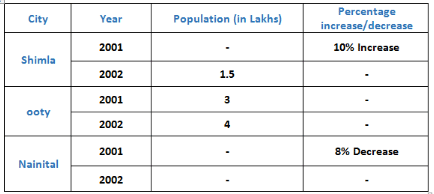
Q. What is the percentage increase in the population of Ooty from 2001 to 2002?
Table shows the population and percentage increase/decrease of three cities in year 2001 and 2002.
Detailed Solution: Question 17

Directions: The following table shows the percentage of marks obtained by five students in six different subjects. Answer the following questions based on this table.
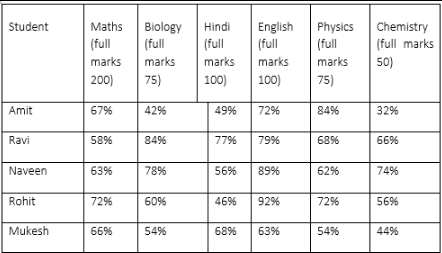
Q. What is the average marks scored by all students in Biology?
Detailed Solution: Question 18
Directions: The following table shows the percentage of marks obtained by five students in six different subjects. Answer the following questions based on this table.
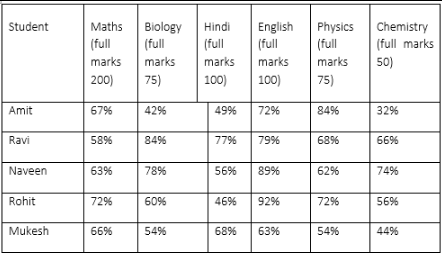
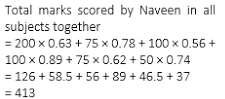
Q. What is the total marks scored by Naveen in all subjects together?
Detailed Solution: Question 19
Detailed Solution: Question 20
Detailed Solution: Question 21
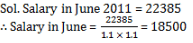
Mr Shamin’s salary increases every year by 10% in June. If there is no other increase or reduction in the salary and his salary in June 2011 was Rs. 22,385, what was his salary in June 2009?
Detailed Solution: Question 22
Directions : In these questions, a relationship between different elements is shown in the statements. The statements are followed by two conclusions. Give answer
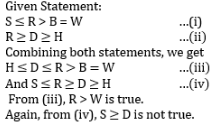
Statements: S ≤ R > B = W, R ≥ D ≥ H
Conclusions: I. R > W II. S ≥ D
Conclusions: I. R > W II. S ≥ D
Detailed Solution: Question 23
Directions : In these questions, a relationship between different elements is shown in the statements. The statements are followed by two conclusions. Give answer
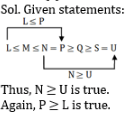
Statements: L ≤ M ≤ N = P ≥ Q ≥ S = U
Conclusions: I. N ≥ U II. P ≥ L
Conclusions: I. N ≥ U II. P ≥ L
Detailed Solution: Question 24
Directions : Study the following information carefully and answer the questions given below:
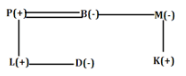
P is father of L, M is mother of K and sister of B. B is mother of L. There are three females in the family. D is sister of L.
Q. How is P related to M?
P is father of L, M is mother of K and sister of B. B is mother of L. There are three females in the family. D is sister of L.
Detailed Solution: Question 25
Directions : In each question below are given two/three statements followed by two conclusions numbered I and II. You have to take the given statements to be true even if they seem to be at variance with commonly known facts. Read all the conclusions and then decide which of the given conclusions logically follows from the given statements, disregarding commonly known facts. Given answer
Statements:
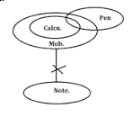
All calculators are mobiles.
No mobile is a notebook.
Some pens are calculators.
Conclusions:
I. All notebooks being mobiles is a possibility.
II. Some notebooks are not calculators.
II. Some notebooks are not calculators.
Detailed Solution: Question 26
Directions: Study the following information carefully and answer the questions which follow:
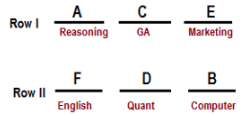
Six faculties A, B, C, D, E and F of six different subjects- English, Computer, Reasoning, Quantitative Aptitude, General Awareness(GA) and Marketing are sitting in two parallel rows containing three people each such that they are equidistant from each other. Three of them in row I are facing south and another three in row-II are facing north. Therefore, in the given seating arrangement, each member seated in a row faces another member of the other row.
C is the faculty of General Awareness and sits in the same row in which A sits. F is seated immediate left of the faculty who faces to the faculty of General Awareness. The faculty of Quantitative Aptitude sits immediate near to B. D is not near to the faculty of General Awareness and Reasoning. The faculty of English does not sit near to the faculty of Reasoning or Computer but he/she is not A or B. A sits second to the right of the faculty of Marketing. D does not sit at any of the extreme ends.
Q. Which of the following statement is true?
Detailed Solution: Question 27
Directions: Study the following information carefully and answer the questions given below.
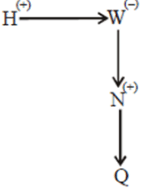
(i) P × Q means P is brother of Q
(ii) P + Q means P is sister of Q
(iii) P – Q means P is father of Q
(iv) P ÷ Q means P is mother of Q
Q. Which of the following does shows that W is grandmother of Q?
(i) P × Q means P is brother of Q
Detailed Solution: Question 28
Directions: Study the following arrangement carefully and answer the questions given below:
R D A K 5 B I 2 M J E N 9 7 U Z V 1 W 3 H 4 F Y 8 P 6 T G
Q. How many such numbers are there in the above arrangement, each of which is immediately preceded by a consonant and immediately followed by a vowel?
R D A K 5 B I 2 M J E N 9 7 U Z V 1 W 3 H 4 F Y 8 P 6 T G
Directions: Study the following arrangement carefully and answer the questions given below:
R D A K 5 B I 2 M J E N 9 7 U Z V 1 W 3 H 4 F Y 8 P 6 T G
Q. How many such vowels are there in the above arrangement, each of which is immediately preceded by a number and immediately followed by another consonant?
R D A K 5 B I 2 M J E N 9 7 U Z V 1 W 3 H 4 F Y 8 P 6 T G
Detailed Solution: Question 30
