
J&K Bank Clerk Mock Test - 9 Free Online Test 2026
Full Mock Test & Solutions: J&K Bank Clerk Mock Test - 9 (100 Questions)
You can boost your Bank Exams 2026 exam preparation with this J&K Bank Clerk Mock Test - 9 (available with detailed solutions).. This mock test has been designed with the analysis of important topics, recent trends of the exam, and previous year questions of the last 3-years. All the questions have been designed to mirror the official pattern of Bank Exams 2026 exam, helping you build speed, accuracy as per the actual exam.
Mock Test Highlights:
- - Format: Multiple Choice Questions (MCQ)
- - Duration: 60 minutes
- - Total Questions: 100
- - Analysis: Detailed Solutions & Performance Insights
- - Sections covered: English Language, Quantitative Aptitude, Reasoning Ability
Sign up on EduRev for free and get access to these mock tests, get your All India Rank, and identify your weak areas to improve your marks & rank in the actual exam.

Directions: Read the following passage carefully and answer the questions given below. Certain words/phrases have been printed in bold to help you locate them.
The Karnataka government’s decision to file an appeal against the acquittal of the Tamil Nadu Chief Minister, Jayalalithaa, is bound to be welcomed by all those who value probity in public life and believe that the courts are the right forums to take forward issues relating to corruption in high places. The Congress dispensation in Karnataka understandably took its time to arrive at a decision on whether to file an appeal in the Supreme Court. It has gone by sound legal principles by examining the recommendations of the Special Public Prosecutor, the State’s Advocate-General and the Law Department. The primary question it had to contend with was raised by the legal wing of the Karnataka Pradesh Congress Committee itself: what is Karnataka’s interest in the outcome of the case? The argument was that the State had already discharged its duty by hosting the trial in Bengaluru, appointing a Special Judge and Special Public Prosecutor, obtaining a conviction in the trial stage and seeing it overturned by the High Court. Should the State go beyond this specified administrative function by filing an appeal in the Supreme Court, taking on the role of an aggrieved party? The question may appear valid, but to abandon a legal process midway is also untenable. The Supreme Court has made it clear that Karnataka is now playing the role of the prosecuting State and has stepped into the shoes of Tamil Nadu. Its duty now includes taking up the mantle of the aggrieved party and pursuing the legal process to its logical end.
Moreover, the Karnataka High Court judgment acquitting the Tamil Nadu Chief Minister is widely seen as flawed in many respects, especially in the computation of the quantum of ‘disproportionate assets’ that ultimately formed the basis of her acquittal. Special Public Prosecutor B.V. Acharya has said the arithmetical errors are glaringly obvious. Some aspects of the High Court’s reasoning are controversial: it has included cash gifts of high value as legitimate income and given credence to a newspaper subscription scheme that had been termed fake by the trial court. It has gone zealously by a 1976 Supreme Court ruling that unexplained assets up to the value of 10 per cent of known income is acceptable, even though the anti-corruption law has since been amended to make disclosure as per statutory requirements the standard to assess legitimate income. The prosecution believes revisiting the computation itself will propel the quantum of ‘disproportionate assets’ beyond this 10 per cent limit. Overall, it will be in the public interest to have an authoritative pronouncement by the highest court on whether the trial court or the High Court was right in appreciating all the evidence. It will also be in Ms. Jayalalithaa’s own interest that her exoneration — if she succeeds in sustaining it — is a vindication that clears her political path rather than one that depends on a conclusion seen to be perennially under dispute and in the realms of legal debate.
Q. Choose an appropriate title for the passage.
Directions: Read the following passage carefully and answer the questions given below. Certain words/phrases have been printed in bold to help you locate them.
The Karnataka government’s decision to file an appeal against the acquittal of the Tamil Nadu Chief Minister, Jayalalithaa, is bound to be welcomed by all those who value probity in public life and believe that the courts are the right forums to take forward issues relating to corruption in high places. The Congress dispensation in Karnataka understandably took its time to arrive at a decision on whether to file an appeal in the Supreme Court. It has gone by sound legal principles by examining the recommendations of the Special Public Prosecutor, the State’s Advocate-General and the Law Department. The primary question it had to contend with was raised by the legal wing of the Karnataka Pradesh Congress Committee itself: what is Karnataka’s interest in the outcome of the case? The argument was that the State had already discharged its duty by hosting the trial in Bengaluru, appointing a Special Judge and Special Public Prosecutor, obtaining a conviction in the trial stage and seeing it overturned by the High Court. Should the State go beyond this specified administrative function by filing an appeal in the Supreme Court, taking on the role of an aggrieved party? The question may appear valid, but to abandon a legal process midway is also untenable. The Supreme Court has made it clear that Karnataka is now playing the role of the prosecuting State and has stepped into the shoes of Tamil Nadu. Its duty now includes taking up the mantle of the aggrieved party and pursuing the legal process to its logical end.
Moreover, the Karnataka High Court judgment acquitting the Tamil Nadu Chief Minister is widely seen as flawed in many respects, especially in the computation of the quantum of ‘disproportionate assets’ that ultimately formed the basis of her acquittal. Special Public Prosecutor B.V. Acharya has said the arithmetical errors are glaringly obvious. Some aspects of the High Court’s reasoning are controversial: it has included cash gifts of high value as legitimate income and given credence to a newspaper subscription scheme that had been termed fake by the trial court. It has gone zealously by a 1976 Supreme Court ruling that unexplained assets up to the value of 10 per cent of known income is acceptable, even though the anti-corruption law has since been amended to make disclosure as per statutory requirements the standard to assess legitimate income. The prosecution believes revisiting the computation itself will propel the quantum of ‘disproportionate assets’ beyond this 10 per cent limit. Overall, it will be in the public interest to have an authoritative pronouncement by the highest court on whether the trial court or the High Court was right in appreciating all the evidence. It will also be in Ms. Jayalalithaa’s own interest that her exoneration — if she succeeds in sustaining it — is a vindication that clears her political path rather than one that depends on a conclusion seen to be perennially under dispute and in the realms of legal debate.
Q. What is the reason that acquittal of Jaylalitha is considered to be flawed?

Directions: Read the following passage carefully and answer the questions given below. Certain words/phrases have been printed in bold to help you locate them.
The Karnataka government’s decision to file an appeal against the acquittal of the Tamil Nadu Chief Minister, Jayalalithaa, is bound to be welcomed by all those who value probity in public life and believe that the courts are the right forums to take forward issues relating to corruption in high places. The Congress dispensation in Karnataka understandably took its time to arrive at a decision on whether to file an appeal in the Supreme Court. It has gone by sound legal principles by examining the recommendations of the Special Public Prosecutor, the State’s Advocate-General and the Law Department. The primary question it had to contend with was raised by the legal wing of the Karnataka Pradesh Congress Committee itself: what is Karnataka’s interest in the outcome of the case? The argument was that the State had already discharged its duty by hosting the trial in Bengaluru, appointing a Special Judge and Special Public Prosecutor, obtaining a conviction in the trial stage and seeing it overturned by the High Court. Should the State go beyond this specified administrative function by filing an appeal in the Supreme Court, taking on the role of an aggrieved party? The question may appear valid, but to abandon a legal process midway is also untenable. The Supreme Court has made it clear that Karnataka is now playing the role of the prosecuting State and has stepped into the shoes of Tamil Nadu. Its duty now includes taking up the mantle of the aggrieved party and pursuing the legal process to its logical end.
Moreover, the Karnataka High Court judgment acquitting the Tamil Nadu Chief Minister is widely seen as flawed in many respects, especially in the computation of the quantum of ‘disproportionate assets’ that ultimately formed the basis of her acquittal. Special Public Prosecutor B.V. Acharya has said the arithmetical errors are glaringly obvious. Some aspects of the High Court’s reasoning are controversial: it has included cash gifts of high value as legitimate income and given credence to a newspaper subscription scheme that had been termed fake by the trial court. It has gone zealously by a 1976 Supreme Court ruling that unexplained assets up to the value of 10 per cent of known income is acceptable, even though the anti-corruption law has since been amended to make disclosure as per statutory requirements the standard to assess legitimate income. The prosecution believes revisiting the computation itself will propel the quantum of ‘disproportionate assets’ beyond this 10 per cent limit. Overall, it will be in the public interest to have an authoritative pronouncement by the highest court on whether the trial court or the High Court was right in appreciating all the evidence. It will also be in Ms. Jayalalithaa’s own interest that her exoneration — if she succeeds in sustaining it — is a vindication that clears her political path rather than one that depends on a conclusion seen to be perennially under dispute and in the realms of legal debate.
Q. What does the author mean by the phrase “abandon a legal process midway is also untenable”?
Directions: Read the following passage carefully and answer the questions given below. Certain words/phrases have been printed in bold to help you locate them.
The Karnataka government’s decision to file an appeal against the acquittal of the Tamil Nadu Chief Minister, Jayalalithaa, is bound to be welcomed by all those who value probity in public life and believe that the courts are the right forums to take forward issues relating to corruption in high places. The Congress dispensation in Karnataka understandably took its time to arrive at a decision on whether to file an appeal in the Supreme Court. It has gone by sound legal principles by examining the recommendations of the Special Public Prosecutor, the State’s Advocate-General and the Law Department. The primary question it had to contend with was raised by the legal wing of the Karnataka Pradesh Congress Committee itself: what is Karnataka’s interest in the outcome of the case? The argument was that the State had already discharged its duty by hosting the trial in Bengaluru, appointing a Special Judge and Special Public Prosecutor, obtaining a conviction in the trial stage and seeing it overturned by the High Court. Should the State go beyond this specified administrative function by filing an appeal in the Supreme Court, taking on the role of an aggrieved party? The question may appear valid, but to abandon a legal process midway is also untenable. The Supreme Court has made it clear that Karnataka is now playing the role of the prosecuting State and has stepped into the shoes of Tamil Nadu. Its duty now includes taking up the mantle of the aggrieved party and pursuing the legal process to its logical end.
Moreover, the Karnataka High Court judgment acquitting the Tamil Nadu Chief Minister is widely seen as flawed in many respects, especially in the computation of the quantum of ‘disproportionate assets’ that ultimately formed the basis of her acquittal. Special Public Prosecutor B.V. Acharya has said the arithmetical errors are glaringly obvious. Some aspects of the High Court’s reasoning are controversial: it has included cash gifts of high value as legitimate income and given credence to a newspaper subscription scheme that had been termed fake by the trial court. It has gone zealously by a 1976 Supreme Court ruling that unexplained assets up to the value of 10 per cent of known income is acceptable, even though the anti-corruption law has since been amended to make disclosure as per statutory requirements the standard to assess legitimate income. The prosecution believes revisiting the computation itself will propel the quantum of ‘disproportionate assets’ beyond this 10 per cent limit. Overall, it will be in the public interest to have an authoritative pronouncement by the highest court on whether the trial court or the High Court was right in appreciating all the evidence. It will also be in Ms. Jayalalithaa’s own interest that her exoneration — if she succeeds in sustaining it — is a vindication that clears her political path rather than one that depends on a conclusion seen to be perennially under dispute and in the realms of legal debate.
Q. Which of the following is not the synonym of the word “probity”?
Directions: Read the following passage carefully and answer the questions given below. Certain words/phrases have been printed in bold to help you locate them.
The Karnataka government’s decision to file an appeal against the acquittal of the Tamil Nadu Chief Minister, Jayalalithaa, is bound to be welcomed by all those who value probity in public life and believe that the courts are the right forums to take forward issues relating to corruption in high places. The Congress dispensation in Karnataka understandably took its time to arrive at a decision on whether to file an appeal in the Supreme Court. It has gone by sound legal principles by examining the recommendations of the Special Public Prosecutor, the State’s Advocate-General and the Law Department. The primary question it had to contend with was raised by the legal wing of the Karnataka Pradesh Congress Committee itself: what is Karnataka’s interest in the outcome of the case? The argument was that the State had already discharged its duty by hosting the trial in Bengaluru, appointing a Special Judge and Special Public Prosecutor, obtaining a conviction in the trial stage and seeing it overturned by the High Court. Should the State go beyond this specified administrative function by filing an appeal in the Supreme Court, taking on the role of an aggrieved party? The question may appear valid, but to abandon a legal process midway is also untenable. The Supreme Court has made it clear that Karnataka is now playing the role of the prosecuting State and has stepped into the shoes of Tamil Nadu. Its duty now includes taking up the mantle of the aggrieved party and pursuing the legal process to its logical end.
Moreover, the Karnataka High Court judgment acquitting the Tamil Nadu Chief Minister is widely seen as flawed in many respects, especially in the computation of the quantum of ‘disproportionate assets’ that ultimately formed the basis of her acquittal. Special Public Prosecutor B.V. Acharya has said the arithmetical errors are glaringly obvious. Some aspects of the High Court’s reasoning are controversial: it has included cash gifts of high value as legitimate income and given credence to a newspaper subscription scheme that had been termed fake by the trial court. It has gone zealously by a 1976 Supreme Court ruling that unexplained assets up to the value of 10 per cent of known income is acceptable, even though the anti-corruption law has since been amended to make disclosure as per statutory requirements the standard to assess legitimate income. The prosecution believes revisiting the computation itself will propel the quantum of ‘disproportionate assets’ beyond this 10 per cent limit. Overall, it will be in the public interest to have an authoritative pronouncement by the highest court on whether the trial court or the High Court was right in appreciating all the evidence. It will also be in Ms. Jayalalithaa’s own interest that her exoneration — if she succeeds in sustaining it — is a vindication that clears her political path rather than one that depends on a conclusion seen to be perennially under dispute and in the realms of legal debate.
Q. Which of the following is the synonym of the word “aggrieved”?
Directions: Read the following passage carefully and answer the questions given below. Certain words/phrases have been printed in bold to help you locate them.
The Karnataka government’s decision to file an appeal against the acquittal of the Tamil Nadu Chief Minister, Jayalalithaa, is bound to be welcomed by all those who value probity in public life and believe that the courts are the right forums to take forward issues relating to corruption in high places. The Congress dispensation in Karnataka understandably took its time to arrive at a decision on whether to file an appeal in the Supreme Court. It has gone by sound legal principles by examining the recommendations of the Special Public Prosecutor, the State’s Advocate-General and the Law Department. The primary question it had to contend with was raised by the legal wing of the Karnataka Pradesh Congress Committee itself: what is Karnataka’s interest in the outcome of the case? The argument was that the State had already discharged its duty by hosting the trial in Bengaluru, appointing a Special Judge and Special Public Prosecutor, obtaining a conviction in the trial stage and seeing it overturned by the High Court. Should the State go beyond this specified administrative function by filing an appeal in the Supreme Court, taking on the role of an aggrieved party? The question may appear valid, but to abandon a legal process midway is also untenable. The Supreme Court has made it clear that Karnataka is now playing the role of the prosecuting State and has stepped into the shoes of Tamil Nadu. Its duty now includes taking up the mantle of the aggrieved party and pursuing the legal process to its logical end.
Moreover, the Karnataka High Court judgment acquitting the Tamil Nadu Chief Minister is widely seen as flawed in many respects, especially in the computation of the quantum of ‘disproportionate assets’ that ultimately formed the basis of her acquittal. Special Public Prosecutor B.V. Acharya has said the arithmetical errors are glaringly obvious. Some aspects of the High Court’s reasoning are controversial: it has included cash gifts of high value as legitimate income and given credence to a newspaper subscription scheme that had been termed fake by the trial court. It has gone zealously by a 1976 Supreme Court ruling that unexplained assets up to the value of 10 per cent of known income is acceptable, even though the anti-corruption law has since been amended to make disclosure as per statutory requirements the standard to assess legitimate income. The prosecution believes revisiting the computation itself will propel the quantum of ‘disproportionate assets’ beyond this 10 per cent limit. Overall, it will be in the public interest to have an authoritative pronouncement by the highest court on whether the trial court or the High Court was right in appreciating all the evidence. It will also be in Ms. Jayalalithaa’s own interest that her exoneration — if she succeeds in sustaining it — is a vindication that clears her political path rather than one that depends on a conclusion seen to be perennially under dispute and in the realms of legal debate.
Q. Which of the following is the synonym of the word “credence”?
Directions: Rearrange the following seven sentences (A), (B), (C), (D), (E), (F) and (G) in the proper sequence to form a meaningful paragraph and then answer the questions given below.
(A) A person enrolled as an advocate under the Advocates Act, 1961, is entitled to practice law throughout the country.
(B) In India, the law relating to legal profession is governed by the Advocates Act, 1961 and the rules framed there under by the Bar Council of India.
(C) An advocate on the roll of a State Bar Council may apply for transfer to the roll of any other State Bar Council in the prescribed manner.
(D) It is a self-contained code of law relating to legal practitioners and provides for the constitution of State Bar Councils and Bar Council of India.
(E) An advocate with his consent, may be designated as a senior advocate, if the Supreme Court or a High Court is of the opinion that by virtue of his ability, he deserves such distinction.
(F) There are two classes of advocates, namely, senior advocates and other advocates.
(G) No person can be enrolled as an advocate on the rolls of more than one State Bar Council.
Q. Which of the following should be the FIRST sentence after rearrangement?
Detailed Solution: Question 7
Directions: Rearrange the following seven sentences (A), (B), (C), (D), (E), (F) and (G) in the proper sequence to form a meaningful paragraph and then answer the questions given below.
(A) A person enrolled as an advocate under the Advocates Act, 1961, is entitled to practice law throughout the country.
(B) In India, the law relating to legal profession is governed by the Advocates Act, 1961 and the rules framed there under by the Bar Council of India.
(C) An advocate on the roll of a State Bar Council may apply for transfer to the roll of any other State Bar Council in the prescribed manner.
(D) It is a self-contained code of law relating to legal practitioners and provides for the constitution of State Bar Councils and Bar Council of India.
(E) An advocate with his consent, may be designated as a senior advocate, if the Supreme Court or a High Court is of the opinion that by virtue of his ability, he deserves such distinction.
(F) There are two classes of advocates, namely, senior advocates and other advocates.
(G) No person can be enrolled as an advocate on the rolls of more than one State Bar Council.
Q. Which of the following should be the SECOND sentence after rearrangement?
Detailed Solution: Question 8
Directions: Rearrange the following seven sentences (A), (B), (C), (D), (E), (F) and (G) in the proper sequence to form a meaningful paragraph and then answer the questions given below.
(A) A person enrolled as an advocate under the Advocates Act, 1961, is entitled to practice law throughout the country.
(B) In India, the law relating to legal profession is governed by the Advocates Act, 1961 and the rules framed there under by the Bar Council of India.
(C) An advocate on the roll of a State Bar Council may apply for transfer to the roll of any other State Bar Council in the prescribed manner.
(D) It is a self-contained code of law relating to legal practitioners and provides for the constitution of State Bar Councils and Bar Council of India.
(E) An advocate with his consent, may be designated as a senior advocate, if the Supreme Court or a High Court is of the opinion that by virtue of his ability, he deserves such distinction.
(F) There are two classes of advocates, namely, senior advocates and other advocates.
(G) No person can be enrolled as an advocate on the rolls of more than one State Bar Council.
Q. Which of the following should be the THIRD sentence after rearrangement?
Detailed Solution: Question 9
Directions: Rearrange the following seven sentences (A), (B), (C), (D), (E), (F) and (G) in the proper sequence to form a meaningful paragraph and then answer the questions given below.
(A) A person enrolled as an advocate under the Advocates Act, 1961, is entitled to practice law throughout the country.
(B) In India, the law relating to legal profession is governed by the Advocates Act, 1961 and the rules framed there under by the Bar Council of India.
(C) An advocate on the roll of a State Bar Council may apply for transfer to the roll of any other State Bar Council in the prescribed manner.
(D) It is a self-contained code of law relating to legal practitioners and provides for the constitution of State Bar Councils and Bar Council of India.
(E) An advocate with his consent, may be designated as a senior advocate, if the Supreme Court or a High Court is of the opinion that by virtue of his ability, he deserves such distinction.
(F) There are two classes of advocates, namely, senior advocates and other advocates.
(G) No person can be enrolled as an advocate on the rolls of more than one State Bar Council.
Q. Which of the following should be the FOURTH sentence after rearrangement?
Directions : Read each sentence to find out whether there is any grammatical or idiomatic error in it. The error, if any, will be in one part of the sentence. The number of that part is the answer. If there is 'No error', the answer is 5). (Ignore errors of punctuation, If any).
1) The film has faces which is not just popular in Maharashtra / 2) but outside of it too, / 3) a reason why he would add subtitles in English for a wider audience / 4) and may have an all–India release with help from PVR cinemas./ 5) No error
Detailed Solution: Question 11
Directions: In each of the following questions there are two blank spaces. Below each five pairs of words have been denoted by numbers (1), (2), (3), (4) and (5). Find out which pair of words can be filled up in the blanks in the sentence in the same sequence to make the sentence meaningful complete.
The producer is known to__________ with new stars and fresh talent and though there have been a few hits and misses, this filmmaker totally ________for the new breed.
Directions: In each of the following questions there are two blank spaces. Below each five pairs of words have been denoted by numbers (1), (2), (3), (4) and (5). Find out which pair of words can be filled up in the blanks in the sentence in the same sequence to make the sentence meaningful complete.
There were screams, chills and thrills __________at the discotheque the other night as the director along with the producers hosted a party to__________ the success of their latest horror flick.
Directions : Read each sentence to find out whether there is any grammatical or idiomatic error in it. The error, if any, will be in one part of the sentence. The number of that part is the answer. If there is 'No error', the answer is 5). (Ignore errors of punctuation, If any).
Both India (1) /as well Russia (2)/are participating (3)/ in the games (4)/No error (5)
Detailed Solution: Question 14
Directions for questions: A team of 5 players A, B, C, D and E participated in a tournament and played four matches (1 to 4). The following table gives partial information about their individual scores and the total runs scored by the team in each match.
Each column has two values missing. These are the runs scored by the two lowest scorers in that match. None of the two missing values is more than 10% of the total runs scored in that match.
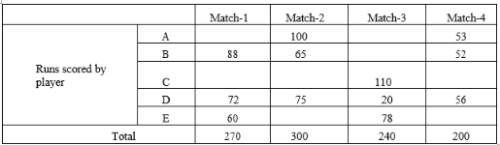
Q. What is the maximum possible percentage contribution of A in the total runs scored in the four matches?
Detailed Solution: Question 15
Directions for questions: A team of 5 players A, B, C, D and E participated in a tournament and played four matches (1 to 4). The following table gives partial information about their individual scores and the total runs scored by the team in each match.
Each column has two values missing. These are the runs scored by the two lowest scorers in that match. None of the two missing values is more than 10% of the total runs scored in that match.
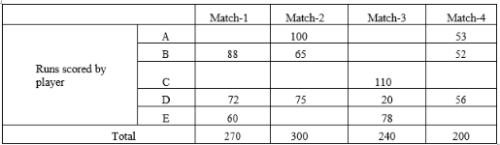
Q. What is the maximum possible percentage contribution of E in the total runs scored in the four matches?
Detailed Solution: Question 16
Directions: Study the following graph carefully and answer the questions that follow.
Per cent rise in profit of two companies A and B from the year 1994 to 1999
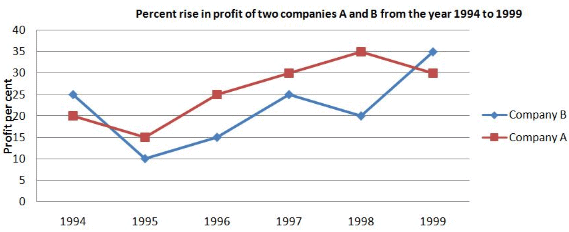
Q. What was the percentage increase in per cent rise in profit of company B in the year 1999 from the previous year?
Detailed Solution: Question 17

Directions: Study the following graph carefully and answer the questions that follow.
Per cent rise in profit of two companies A and B from the year 1994 to 1999
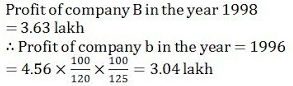
Q. If the profit earned by company B in the year 1998 was Rs. 4.56 lakh, what was the amount of profit earned by it in the year 1996?
Detailed Solution: Question 18
The compound interest accrued on an amount at the end of two years at the rate of 12 p.c.p.a is Rs. 2,862/-. What is the amount?
Detailed Solution: Question 19
A 280 m long train, travelling at a uniform speed, crosses a platform in 60 seconds and a man standing on the platform in 20 seconds. What is the length of the platform?
Detailed Solution: Question 20
Detailed Solution: Question 21
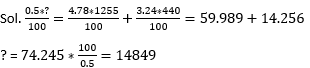
irections : In the following questions two equations numbered I and II are given. You have to solve both the equations and Give answer:
I. 225x2- 4 = 0
II. √225 y + 2= 0
Detailed Solution: Question 22
Directions : In the following questions two equations numbered I and II are given. You have to solve both the equations and Give answer:
I. x2 - 10x + 24 = 0
II. y2 - 9y + 20 = 0
Detailed Solution: Question 23
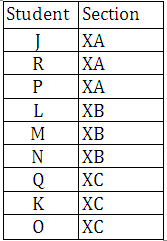
Directions : Study the following information carefully and answer the questions given below:
Nine friends, J, K, L, M, N, O, P, Q and R study in a school in class X. They are divided into three sections XA, XB and XC. Only three students will be studying in each section.
J studies in section XA. Q studies in XC. L and M study in the same section but not with R. J and K are not in the same section. N is not in the same section as R but is in XB. O is the section in Which either Q or K or both of them study. R and Q are not in the same section. O studies neither with N nor with R.
Q. Which of the following groups studies in section XC?
Detailed Solution: Question 24
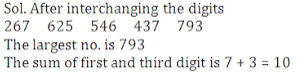
Directions : These questions are based on the following set of numbers:
276 652 564 473 739
Q. If in each number the second and the third digits are interchanged, what will be the sum of the first and the third digit of the largest number?
Detailed Solution: Question 25
Directions : Study the following information to answer the given questions:
In certain code ‘always to be right’ is written as ‘4 9 3 2,’ ‘right is also just’ is written as ‘9 7 6 5’, ‘come to terms’ is written as ‘1 3 8’, ‘terms are just’ is written as ‘0 1 6’ and ‘always is’ is written as ‘7 4’.
Q. Which of the following can be coded as ‘8 6 3 1 5’?
Detailed Solution: Question 26
Directions : Study the following information to answer the given questions:
In certain code ‘always to be right’ is written as ‘4 9 3 2,’ ‘right is also just’ is written as ‘9 7 6 5’, ‘come to terms’ is written as ‘1 3 8’, ‘terms are just’ is written as ‘0 1 6’ and ‘always is’ is written as ‘7 4’.
Q. What does ‘6’ represent in this code?
Detailed Solution: Question 27
What should come in place of question mark (?) in the given expression to make T > P and S ≤ T definitely true?
R > T ? S ? P > Q
Detailed Solution: Question 28
Which of the following symbols should be placed in the blank spaces respectively in order to complete the given expression in such a manner that makes the expression N ≥ R, S < R and Q > S definitely true?N _ R _ S < P _ Q
Detailed Solution: Question 29
Which of the following symbols should be placed in the blank spaces respectively in order to complete the given expression in such a manner that makes the expression R ≥ S and T > N definitely true?
T > P _ N < R _ S
Detailed Solution: Question 30
