CBSE Class 10  >  Class 10 Test  >  Online MCQ Tests  >  RS Aggarwal Test: Real Numbers - 3 - Class 10 MCQ

RS Aggarwal Test: Real Numbers - 3 - Free MCQs with solutions Class 10


MCQ Practice Test & Solutions: RS Aggarwal Test: Real Numbers - 3 (24 Questions)

You can prepare effectively for Class 10 Online MCQ Tests for Class 10 with this dedicated MCQ Practice Test (available with solutions) on the important topic of "RS Aggarwal Test: Real Numbers - 3". These 24 questions have been designed by the experts with the latest curriculum of Class 10 2026, to help you master the concept.

Test Highlights:

  • - Format: Multiple Choice Questions (MCQ)
  • - Duration: 25 minutes
  • - Number of Questions: 24

Sign up on EduRev for free to attempt this test and track your preparation progress.

RS Aggarwal Test: Real Numbers - 3 - Question 1

Pairs of natural numbers whose least common multiple is 78 and the greatest common divisor is 13 are:

Detailed Solution: Question 1

Let the no.s be a & b,

GCD [ a , b ] = 13;
=> Let a = 13m and b = 13n

Now, LCM [ a , b ] = 78
=> 13m | 78
=> m | 6 and similarly, n | 6; --> Also, m does not divide n

.'. Possible values of (m,n) are :-> 
 [ 1 , 6 ] , [ 2 , 3 ]
.'. Possible values for ( a , b ) are : [ 13 , 78 ] , [ 26 , 39 ]

RS Aggarwal Test: Real Numbers - 3 - Question 2

1/√3 is -

Detailed Solution: Question 2

Let as assume to the contrary that 1/✓3 is rational number. Then, we can find coprime integers a and b (≠ 0) such that :
1/✓3= P/Q { where P and Q are co-prime and Q not equal to 0}
✓3 P =Q .1 
✓3 = Q/P 
 Since Q/P is a Rational number

Since L.H.S = R.H.S

So ✓3 is also rational number.

But this contradicts the fact that ✓3 is an irrational number. This contradiction has arisen because of our incorrect assumption that 1/√3 is a rational number.

So this proves that 1/√3 is an irrational number. 

RS Aggarwal Test: Real Numbers - 3 - Question 3

7√3 is -

Detailed Solution: Question 3

√3 cannot be expressed in the form p/q where q ≠ 0 which is the form of a rational number. So any number multiplied by it will give an irrational number. So 7√3 is irrational.

RS Aggarwal Test: Real Numbers - 3 - Question 4

5√3 is -

Detailed Solution: Question 4

To prove : 5-√3 is irrational

Proof: 
Let us assume that 5 -√3 is rational.

Let ,
 5 - √3 = r , where "r" is rational

5 - r = √3
Here,
LHS is purely rational.But,on the other hand ,RHS is irrational.
This leads to a contradiction.
Hence,5-√3 is irrational.

RS Aggarwal Test: Real Numbers - 3 - Question 5

Detailed Solution: Question 5

In the 1760s, Johann Heinrich Lambert proved that the number π (pi) is irrational: that is, it cannot be expressed as a fraction a/b, where a is an integer and b is a non-zero integer.

RS Aggarwal Test: Real Numbers - 3 - Question 6

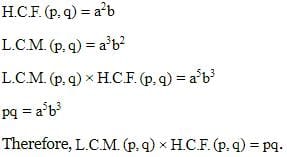
If two positive integers p and q are written as p=a2b2 and q=a3b, a,b are prime numbers then the vaue of L.C.M.(p,q)×H.C.F.(p,q) will be equal to

Detailed Solution: Question 6

RS Aggarwal Test: Real Numbers - 3 - Question 7

Two natural numbers whose sum is 85 and the least common multiple is 102 are:      
Detailed Solution: Question 7

Prime factorisation of 102 = 2 x 3 x 17.
Prime factorisation of 85 = 5 x 17 = (2+3) x 17.
The two numbers are:
1. 2 x 17 = 34.
2. 3 x 17 =51

RS Aggarwal Test: Real Numbers - 3 - Question 8

0.737373...=

Detailed Solution: Question 8


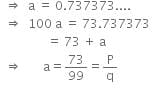
⇒ a = 0.737373...
⇒  100a = 73.737373
= 73 + a
⇒ a = 73/99 = p/q
⇒  p=73 and q = 99 are co-prime.
Here, q=3X 11.

RS Aggarwal Test: Real Numbers - 3 - Question 9

If p is a positive prime integer, then √p is –

Detailed Solution: Question 9

Let us assume, to the contrary, that √p is
rational.
So, we can find coprime integers a and b(b ≠ 0)
such that √p = a/b
⇒ √p b = a
⇒ pb2 = a2 ….(i) [Squaring both the sides]
⇒ a2 is divisible by p
⇒  a is divisible by p
So, we can write a = pc for some integer c.
Therefore, a2 = p2c2 ….[Squaring both the sides]
⇒ pb2 = p2c2 ….[From (i)]
⇒ b2 = pc2
⇒ b2 is divisible by p
⇒ b is divisible by p
⇒ p divides both a and b.
⇒ a and b have at least p as a common factor.
But this contradicts the fact that a and b are coprime.
This contradiction arises because we have
assumed that √p is rational.
Therefore, √p is irrational.

RS Aggarwal Test: Real Numbers - 3 - Question 10

LCM of three numbers 28, 44, 132 is –

Detailed Solution: Question 10

LCM = 22. 71. 111. 31 = 924

RS Aggarwal Test: Real Numbers - 3 - Question 11

If a is a positive integer and p be a prime number and p divides a2, then

Detailed Solution: Question 11

If a is a positive integer and p be a prime number and p divides a2
So it implies that p divides a . 

RS Aggarwal Test: Real Numbers - 3 - Question 12

If the HCF of 65 and 117 is expressible in the form 65m – 117, then the value of m is
Detailed Solution: Question 12

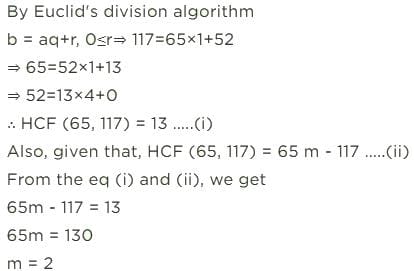
By Euclid’s Division Algorithm:

We use the form:
b = aq + r, where 0 ≤ r < a

Step 1:
117 = 65 × 1 + 52

Step 2:
65 = 52 × 1 + 13

Step 3:
52 = 13 × 4 + 0

Since the remainder becomes 0, the last non-zero remainder is the HCF.
So, HCF of 65 and 117 is 13 ......(i)

We are also given:
HCF (65, 117) = 65m - 117 ......(ii)

Now, from equation (i) and (ii), we get:
65m - 117 = 13

Solving this:
65m = 130
m = 2

RS Aggarwal Test: Real Numbers - 3 - Question 13

If x =   and y =  , then the value of (x2 + y2) is

Detailed Solution: Question 13

The correct option is Option A.

x = √3 + 1 / √3 - 1

y = √3 - 1 / √3 + 1

Now, 

  x² + y²

= (√3 + 1 / √3 - 1)² + (√3 - 1 / √3 + 1)²

= (3 + 2√3 + 1 / 3 - 2√3 + 1) + (3  - 2√3 + 1 / 3 + 2√3 + 1)

= (4 + 2√3 / 4 - 2√3) + (4 - 2√3 / 4 + 2√3)

= (4 + 2√3)² + (4 - 2√3)² / (4 - 2√3) × (4 + 2√3)

By solving this, 

= 28 + 16√3 + 28 - 16√3 / 16 - 12

= 56 / 4

= 14

RS Aggarwal Test: Real Numbers - 3 - Question 14

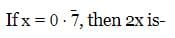
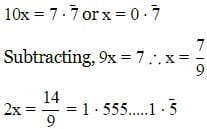
Detailed Solution: Question 14

RS Aggarwal Test: Real Numbers - 3 - Question 15

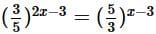
Find the value of x then 

Detailed Solution: Question 15

(3/5)2x-3= (5/3)x-3
(3/5)2x-3=(3/5)3-x
2x-3=3-x
2x+x=6
3x=6
x=2

RS Aggarwal Test: Real Numbers - 3 - Question 16

 is equal to –

RS Aggarwal Test: Real Numbers - 3 - Question 17

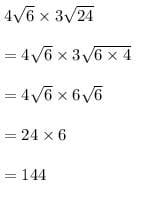
The product of 4√6 and  is -

Detailed Solution: Question 17

We will factorize 24 to 6x4, take out the 4 from root to make both common

RS Aggarwal Test: Real Numbers - 3 - Question 18

If two positive integers a and b are written as a = x3y2 and b = xy3; x, y are prime numbers, then HCF (a, b) is

Detailed Solution: Question 18

Given that, a =x3y2 = x × x × x × y × y
and b = xy3 = x × y × y × y
∴ HCF of a and b = HCF (x3y2,xy3) = x × y × y = xy
[Since, HCF is the product of the smallest power of each common prime factor involved in the numbers]

RS Aggarwal Test: Real Numbers - 3 - Question 19

The least number that is divisible by all the numbers from 1 to 10 (both inclusive) is

Detailed Solution: Question 19

The least number divisible by all the numbers from 1 to 10 will be the LCM of these numbers.

We have,

1 = 1

2 = 2 × 1

3 = 3 × 1

4 = 2 × 2

5 = 5 × 1

6 = 2 × 3

7 = 7 × 1

8 = 2 × 2 × 2

9 = 3 × 3

10 = 2 × 5

So, LCM of these numbers = 1 × 2 × 2 × 2 × 3 × 3 × 5 × 7 = 2520

Hence, least number divisible by all the numbers from 1 to 10 is 2520.

RS Aggarwal Test: Real Numbers - 3 - Question 20

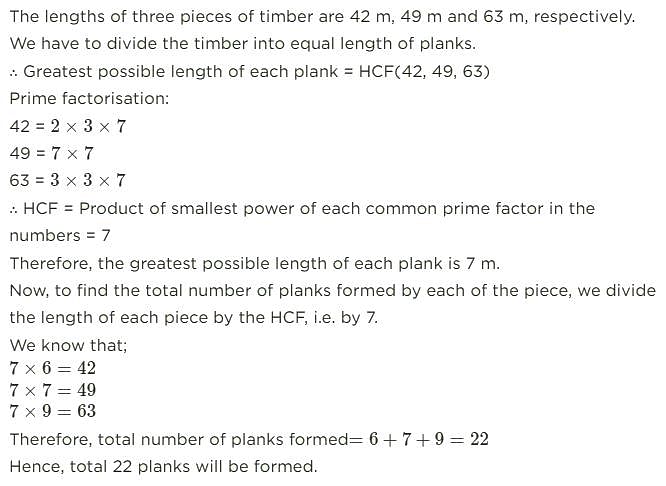
Three pieces of timber 42 m, 49 m and 63 m long have to be divided into planks of the same length. What is the greatest possible length of each plank? How many planks are formed?
Detailed Solution: Question 20

RS Aggarwal Test: Real Numbers - 3 - Question 21

By what smallest number should 450 be multiplied to make it a perfect cube?

  • 6
  • 15
  • 30
  • 60

Detailed Solution: Question 21

450 = 2 × 32 × 52. For a perfect cube, each prime exponent must be a multiple of 3. • Exponent of 2 is 1, needs 2 more → multiply by 22 • Exponent of 3 is 2, needs 1 more → multiply by 3 • Exponent of 5 is 2, needs 1 more → multiply by 5 Required factor = 22 × 3 × 5 = 4 × 3 × 5 = 60. Thus, 450 × 60 is a perfect cube.

RS Aggarwal Test: Real Numbers - 3 - Question 22

The standard form of (1 + i) (1 + 2i) is –

Detailed Solution: Question 22

( 1 + i ) (1 + 2i )

=1 + 2i + i + 2i^2

=1 + 3i -2  ( Because i^2 = -1)

= -1 + 3i 

= a + ib = -1 + 3i

Here a = -1 and b = 3 

So the standard form of  (1 + i) (1 + 2i) is : 

-1 + 3i

So option D is correct answer. 

RS Aggarwal Test: Real Numbers - 3 - Question 23

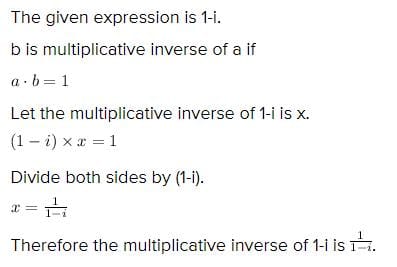
The multiplicative inverse of 1 – i is 

Detailed Solution: Question 23

RS Aggarwal Test: Real Numbers - 3 - Question 24

The least number which when divided by 12, 16, and 20 leaves a remainder 2 in each case, is:

Detailed Solution: Question 24

Find LCM of 12, 16, and 20
12 = 2× 3
16 = 24
20 = 2× 5
LCM = 2× 3 × 5 = 16 × 15 = 240

Required Number = LCM + 2 = 240 + 2 = 242

459 tests
Information about RS Aggarwal Test: Real Numbers - 3 Page
In this test you can find the Exam questions for RS Aggarwal Test: Real Numbers - 3 solved & explained in the simplest way possible. Besides giving Questions and answers for RS Aggarwal Test: Real Numbers - 3, EduRev gives you an ample number of Online tests for practice
Download as PDF