Electronics and Communication Engineering (ECE) Exam  >  Electronics and Communication Engineering (ECE) Test  >  Digital Signal Processing  >  Test: Discrete Time Systems Difference Equations - Electronics and Communication Engineering (ECE) MCQ

Discrete Time Systems Difference Equations - Free MCQ Practice Test


MCQ Practice Test & Solutions: Test: Discrete Time Systems Difference Equations (10 Questions)

You can prepare effectively for Electronics and Communication Engineering (ECE) Digital Signal Processing with this dedicated MCQ Practice Test (available with solutions) on the important topic of "Test: Discrete Time Systems Difference Equations". These 10 questions have been designed by the experts with the latest curriculum of Electronics and Communication Engineering (ECE) 2026, to help you master the concept.

Test Highlights:

  • - Format: Multiple Choice Questions (MCQ)
  • - Duration: 10 minutes
  • - Number of Questions: 10

Sign up on EduRev for free to attempt this test and track your preparation progress.

Test: Discrete Time Systems Difference Equations - Question 1

If the system is initially relaxed at time n=0 and memory equals to zero, then the response of such state is called as:

Detailed Solution: Question 1

Explanation: The memory of the system, describes, in some case, the ‘state’ of the system, the output of the system is called as ‘zero-state response’.

Test: Discrete Time Systems Difference Equations - Question 2

Zero-state response is also known as:

Detailed Solution: Question 2

Explanation: The zero-state response depends on the nature of the system and the input signal. Since this output is a response forced upon it by the input signal, it is also known as ‘Forced response’.

Test: Discrete Time Systems Difference Equations - Question 3

Zero-input response is also known as Natural or Free response. 

Detailed Solution: Question 3

Explanation: For a zero-input response, the input is zero and the output of the system is independent of the input of the system. So, the response if such system is also known as Natural or Free response.

Test: Discrete Time Systems Difference Equations - Question 4

The solution obtained by assuming the input x(n) of the system is zero is:

Detailed Solution: Question 4

Explanation: By making the input x(n)=0 we will get a homogenous difference equation and the solution of that difference equation is known as Homogenous or Complementary solution.

Test: Discrete Time Systems Difference Equations - Question 5

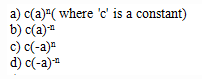
What is the homogenous solution of the system described by the first order difference equation y(n)+ay(n-1)=x(n)?
Detailed Solution: Question 5
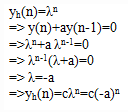
Explanation: The assumed solution obtained by assigning x(n)=0 is

Test: Discrete Time Systems Difference Equations - Question 6

What is the zero-input response of the system described by the homogenous second order equation y(n)-3y(n-1)-4y(n-2)=0 if the initial conditions are y(-1)=5 and y(-2)=0? 

Detailed Solution: Question 6
Explanation: Given difference equation is y(n)-3y(n-1)-4y(n-2)=0—-(1)
Let y(n)=λn
Substituting y(n) in the given equation
=> λn – 3λn-1 – 4λn-2 = 0
=> λn-22 – 3λ – 4) = 0
the roots of the above equation are λ=-1,4
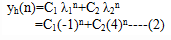
Therefore, general form of the solution of the homogenous equation is

The zero-input response of the system can be calculated from the homogenous solution by evaluating the constants in the above equation, given the initial conditions y(-1) and y(-2).
From the given equation (1)
y(0)=3y(-1)+4y(-2)
y(1)=3y(0)+4y(-1)
=3[3y(-1)+4y(-2)]+4y(-1)
=13y(-1)+12y(-2)
From the equation (2)
y(0)=C1+C2 and
y(1)=C1(-1)+C2(4)=-C1+4C2
By equating these two set of relations, we have
C1+C2=3y(-1)+4y(-2)=15
-C1+4C2=13y(-1)+12y(-2)=65
On solving the above two equations we get C1=-1 and C2=16
Therefore the zero-input response is Yzi(n) = (-1)n+1 + (4)n+2.

Test: Discrete Time Systems Difference Equations - Question 7

What is the particular solution of the first order difference equation y(n)+ay(n-1)=x(n) where |a|<1, when the input of the system x(n)=u(n)?

Detailed Solution: Question 7

Explanation: The assumed solution of the difference equation to the forcing equation x(n), called the particular solution of the difference equation is
yp(n)=Kx(n)=Ku(n) (where K is a scale factor)
Substitute the above equation in the given equation
=>Ku(n)+aKu(n-1)=u(n)
To determine K we must evaluate the above equation for any n>=1, so that no term vanishes.
=> K+aK=1
=>K=1/(1+a)
Therefore the particular solution is yp(n)= 1/(1+a) u(n).

Test: Discrete Time Systems Difference Equations - Question 8

 What is the particular solution of the difference equation y(n)= 5/6y(n-1)- 1/6y(n-2)+x(n) when the forcing function x(n)=2n, n≥0 and zero elsewhere? 

Detailed Solution: Question 8

Explanation: The assumed solution of the difference equation to the forcing equation x(n), called the particular solution of the difference equation is
yp(n)=Kx(n)=K2nu(n) (where K is a scale factor)
Upon substituting yp(n) into the difference equation, we obtain
K2nu(n)=5/6K2n-1u(n-1)-1/6 K2n-2u(n-2)+2nu(n)
To determine K we must evaluate the above equation for any n>=2, so that no term vanishes.
=> 4K= 5/6(2K)-1/6 (K)+4
=> K= 8/5
=> yp(n)= (8/5) 2n.

Test: Discrete Time Systems Difference Equations - Question 9

The total solution of the difference equation is given as: 

Detailed Solution: Question 9

Explanation: The linearity property of the linear constant coefficient difference equation allows us to add the homogenous and particular solution in order to obtain the total solution.

Test: Discrete Time Systems Difference Equations - Question 10

What is the impulse response of the system described by the second order difference equation y(n)-3y(n-1)-4y(n-2)=x(n)+2x(n-1)? 

Detailed Solution: Question 10

Explanation: The homogenous solution of the given equation is yh(n)=C1(-1)n+C2(4)n—-(1)
To find the impulse response, x(n)=δ(n)
now, for n=0 and n=1 we get
y(0)=1 and
y(1)=3+2=5
From equation (1) we get
y(0)=C1+C2 and
y(1)=-C1+4C2
On solving the above two set of equations we get
C1=- 1/5 and C2= 6/5
=>h(n)= [-1/5 (-1)n + 6/5 (4)n]u(n).

3 videos|75 docs|54 tests
Information about Test: Discrete Time Systems Difference Equations Page
In this test you can find the Exam questions for Test: Discrete Time Systems Difference Equations solved & explained in the simplest way possible. Besides giving Questions and answers for Test: Discrete Time Systems Difference Equations, EduRev gives you an ample number of Online tests for practice
3 videos|75 docs|54 tests
Download as PDF