Electrical Engineering (EE) Exam  >  Electrical Engineering (EE) Test  >  Network Theory (Electric Circuits)  >  Test: Thevenin’s Theorem - Electrical Engineering (EE) MCQ

Thevenin’s Theorem - GATE EE Network Theory Free MCQ Test with solutions


MCQ Practice Test & Solutions: Test: Thevenin’s Theorem (10 Questions)

You can prepare effectively for Electrical Engineering (EE) Network Theory (Electric Circuits) with this dedicated MCQ Practice Test (available with solutions) on the important topic of "Test: Thevenin’s Theorem ". These 10 questions have been designed by the experts with the latest curriculum of Electrical Engineering (EE) 2026, to help you master the concept.

Test Highlights:

  • - Format: Multiple Choice Questions (MCQ)
  • - Duration: 10 minutes
  • - Number of Questions: 10

Sign up on EduRev for free to attempt this test and track your preparation progress.

Test: Thevenin’s Theorem - Question 1

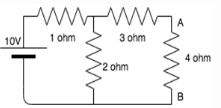
Calculate the Thevenin resistance across the terminal AB for the following circuit.​

Detailed Solution: Question 1

Thevenin resistance is found by opening the circuit between the specified terminal and shorting all voltage sources.
When the 10V source is shorted, we get:
Rth=(1||2)+3=3.67 ohm.

Test: Thevenin’s Theorem - Question 2

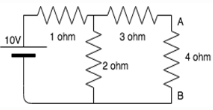
Calculate Vth for the given circuit.​

Detailed Solution: Question 2

Thevenin resistance is found by opening the circuit between the specified terminal and shorting all voltage sources.
When the 10V source is shorted, we get:
Rth=(1||2)+3=3.67 ohm.
Vth is calculated by opening the specified terminal.
Using voltage divider, Vth= 2*10/(2+1)=6.67V.

Test: Thevenin’s Theorem - Question 3

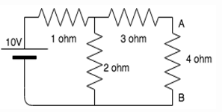
Calculate the current across the 4 ohm resistor.​

Detailed Solution: Question 3

Thevenin resistance is found by opening the circuit between the specified terminal and shorting all voltage sources.
When the 10V source is shorted, we get:
Rth=(1||2)+3=3.67 ohm.
Vth is calculated by opening the specified terminal.
Using voltage divider, Vth= 2*10/(2+1)=6.67V.
On drawing the Thevenin equivalent circuit, we get Rth, 4 ohm and Vth in series.
Applying ohm’s law, I=Vth/(4+Rth)= 0.86A.

Test: Thevenin’s Theorem - Question 4

The Thevenin voltage is the__________

Detailed Solution: Question 4

Thevenin voltage is the open circuit voltage. It is the voltage across the specified terminals. It is not the short circuit voltage because short circuit voltage is equal to zero.

Test: Thevenin’s Theorem - Question 5

 Thevenin resistance is found by ________

Detailed Solution: Question 5

 Current sources have infinite internal resistance hence behave like an open circuit whereas ideal voltage sources have 0 internal resistance hence behave as a short circuit.

Test: Thevenin’s Theorem - Question 6

Thevenin’s theorem is true for __________

Detailed Solution: Question 6

 Thevenin’s theorem works for only linear circuit elements and not non-linear ones such as BJT, semiconductors etc.

Test: Thevenin’s Theorem - Question 7

In Thevenin’s theorem Vth is__________

Detailed Solution: Question 7

Thevenin’s theorem states that a combination of voltage sources, current sources and resistors is equivalent to a single voltage source V and a single series resistor R.

Test: Thevenin’s Theorem - Question 8

Vth is found across the ____________ terminals of the network.

Detailed Solution: Question 8

 According to Thevenin’s theorem, Vth is found across the output terminals of a network and not the input terminals.

Test: Thevenin’s Theorem - Question 9

Can we use Thevinin’s theorem on a circuit containing a BJT?

Detailed Solution: Question 9

We can use Thevenin’s theorem only for linear networks. BJT is a non-linear network hence we cannot apply Thevenin’s theorem for it.

Test: Thevenin’s Theorem - Question 10

A Thevenin equivalent source comprises of which of the following elements?

Detailed Solution: Question 10
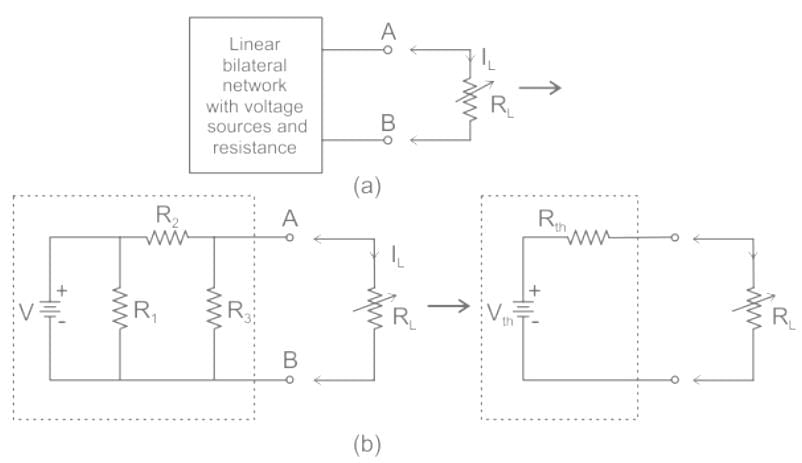
Thevenin Equivalent Source:

Thevenin's theorem states that any linear electrical network with voltage and current sources and resistances can be replaced at a pair of terminals by an equivalent voltage source (Vth) in series with an equivalent resistance (Rth).


This means the Thevenin equivalent source is characterized by:

  • A single voltage source (Vth)
  • A single series resistance (Rth)

Therefore, the correct description of a Thevenin equivalent source is: A single voltage source in series with a resistance

74 videos|151 docs|62 tests
Information about Test: Thevenin’s Theorem Page
In this test you can find the Exam questions for Test: Thevenin’s Theorem solved & explained in the simplest way possible. Besides giving Questions and answers for Test: Thevenin’s Theorem , EduRev gives you an ample number of Online tests for practice
Download as PDF