
Fluid Pressure At a Point & Pascal’s Law - Free MCQ Practice Test
MCQ Practice Test & Solutions: Test: Fluid Pressure At a Point & Pascal’s Law (10 Questions)
You can prepare effectively for Mechanical Engineering Fluid Mechanics for Mechanical Engineering with this dedicated MCQ Practice Test (available with solutions) on the important topic of "Test: Fluid Pressure At a Point & Pascal’s Law". These 10 questions have been designed by the experts with the latest curriculum of Mechanical Engineering 2026, to help you master the concept.
Test Highlights:
- - Format: Multiple Choice Questions (MCQ)
- - Duration: 20 minutes
- - Number of Questions: 10
Sign up on EduRev for free to attempt this test and track your preparation progress.

A Hydraulic press has a ram of 30 cm diameter and a plunger of of 2 cm diameter. It is used for lifting a weight of 35 kN. Find the force required at the plunger.
Detailed Solution: Question 1
The pressure at a point in the fluid is 4.9 N/cm2. Find height when the fluid under consideration is in oil of specific gravity of 0.85.
Detailed Solution: Question 2

An open tank contains water upto a depth of 350 cm and above it an oil of specific gravity 0.65 for a depth of 2.5 m. Find the pressure intensity at the extreme bottom of the tank.
Detailed Solution: Question 3
The diameters of a small piston and a large piston of a hydraulic jack are 45 mm and 100 mm respectively.Force of 0.09 kN applied on smaller in size piston. Find load lifted by piston if smaller in size piston is 40 cm above the large piston. The density of fluid is 850 kg/m3
Detailed Solution: Question 4
In a hydraulic-brake system, a force of 25 N can be applied to a surface area of 5 cm2. What force can thus be exerted on each brake cylinder having an area of 100 cm2
Detailed Solution: Question 5
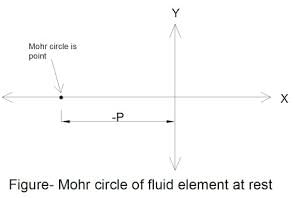
We can draw Mohr’s circle for a fluid at rest.
Detailed Solution: Question 6
If fluid is at rest in a container of a narrow mouth at a certain column height and same fluid is at rest at same column height in a container having broad mouth, will the pressure be different at certain depth from fluid surface?
Detailed Solution: Question 7
Calculate the hydrostatic pressure for water moving with constant velocity at a depth of 5 m from the surface.
Detailed Solution: Question 8
Pressure distribution for fluid at rest takes into consideration pressure due to viscous force.
Detailed Solution: Question 9
Barometer uses the principle of fluid at rest or pressure gradient for its pressure calculation.
Detailed Solution: Question 10
56 videos|148 docs|75 tests |
