Semiconductor Physics - Free MCQ Practice Test with solutions, GATE EE
MCQ Practice Test & Solutions: Test: Semiconductor Physics (10 Questions)
You can prepare effectively for Electrical Engineering (EE) with this dedicated MCQ Practice Test (available with solutions) on the important topic of "Test: Semiconductor Physics". These 10 questions have been designed by the experts with the latest curriculum of Electrical Engineering (EE) 2026, to help you master the concept.
Test Highlights:
- - Format: Multiple Choice Questions (MCQ)
- - Duration: 10 minutes
- - Number of Questions: 10
Sign up on EduRev for free to attempt this test and track your preparation progress.

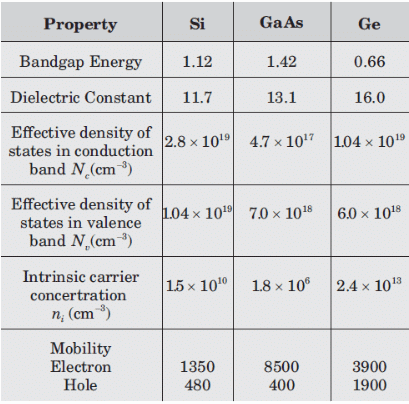
In the problems assume the parameter given in following table. Use the temperature T= 300 K unless otherwise stated.
In germanium semiconductor material at T 400 K the intrinsic concentration is (x 10^14 per cc)
In germanium semiconductor material at T 400 K the intrinsic concentration is (x 10^14 per cc)
Detailed Solution: Question 1
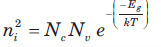
The intrinsic carrier concentration in silicon is to be no greater than ni = 1 x 10^12 cc. The maximum temperature allowed for the silicon is ( Eg = 1.12 eV)

Two semiconductor material have exactly the same properties except that material A has a bandgap of 1.0eV and material B has a bandgap energy of 1.2 eV. The ratio of intrinsic concentration of material A to that ofmaterial B is
Detailed Solution: Question 3

In silicon at T = 300 K the thermal-equilibrium concentration of electron is n0 = 5 x 10^4 cc. The hole concentration is
Detailed Solution: Question 4
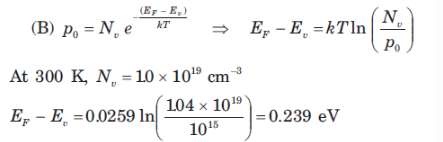
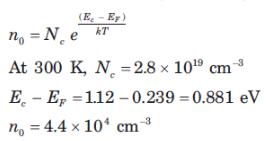
In silicon at T = 300 K if the Fermi energy is 0.22 eV above the valence band energy, the value of p0 is
Detailed Solution: Question 5

The thermal-equilibrium concentration of hole p0 in silicon at T = 300 K is 1015 cm3. The value of n0 is
Detailed Solution: Question 6
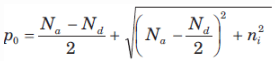
In germanium semiconductor at T 300 K, the acceptor concentrations is Na 1013 cm3 and donor concentration is Nd 0. The thermal equilibrium concentration p0 is
Detailed Solution: Question 7
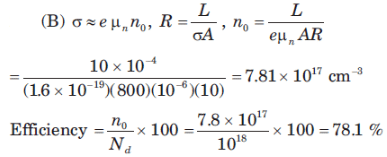
A silicon sample doped n type at 10^18 cm3 have a resistance of 10 ohm. The sample has an area of 10^(-6) cm2 and a length of 10 µm . The doping efficiency of the sample is (µn = 800 cm2/V-s )
Detailed Solution: Question 8
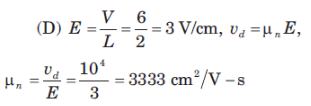
Six volts is applied across a 2 cm long semiconductor bar. The average drift velocity is 104 cms. The electron mobility is
Detailed Solution: Question 9
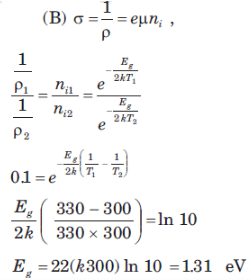
A particular intrinsic semiconductor has a resistivity of 50 (ohm-cm) at T = 300 K and 5 (ohm-cm) at T = 330 K. If change in mobility with temperature is neglected, the bandgap energy of the semiconductor is
Detailed Solution: Question 10