


All Exams > NEET > Weekly Tests for NEET Preparation > All Questions
All questions of June Week 2 for NEET Exam
Molar conductivity for a compound AB is 145.0 Scm2mol-1 and for CB is 110.1 Scm2mol-1. Limiting molar conductivity for A+ is 73.5 Scm2mol-1. What is limiting molar conductivity for C+?- a)326.6 S cm2 mol-1
- b)38.6 S cm2 mol-1
- c)181.6 S cm2 mol-1
- d)90.8 S cm2 mol-1
Correct answer is option 'B'. Can you explain this answer?
Molar conductivity for a compound AB is 145.0 Scm2mol-1 and for CB is 110.1 Scm2mol-1. Limiting molar conductivity for A+ is 73.5 Scm2mol-1. What is limiting molar conductivity for C+?
a)
326.6 S cm2 mol-1
b)
38.6 S cm2 mol-1
c)
181.6 S cm2 mol-1
d)
90.8 S cm2 mol-1
 | Subhankar Choudhary answered |
Given:
Molar conductivity of AB = 145.0 Scm²mol⁻¹
Molar conductivity of CB = 110.1 Scm²mol⁻¹
Limiting molar conductivity of A = 73.5 Scm²mol⁻¹
To find: Limiting molar conductivity of C
Formula used:
Kohlrausch law of independent migration of ions states that the limiting molar conductivity of an electrolyte can be represented as the sum of the molar conductivity of its cation and anion, each multiplied by its own migration constant. That is,
Λ°(AB) = λ⁺(A) + λ⁻(B)
Λ°(CB) = λ⁺(C) + λ⁻(B)
where, λ⁺ and λ⁻ are the molar conductivities of the cation and anion, respectively, and the migration constants are represented by Greek letters.
Calculation:
Using Kohlrausch law,
λ⁺(A) + λ⁻(B) = 73.5 Scm²mol⁻¹
λ⁺(C) + λ⁻(B) = 110.1 Scm²mol⁻¹
Subtracting the first equation from the second equation,
(λ⁺(C) + λ⁻(B)) - (λ⁺(A) + λ⁻(B)) = 110.1 Scm²mol⁻¹ - 73.5 Scm²mol⁻¹
λ⁺(C) - λ⁺(A) = 36.6 Scm²mol⁻¹
Therefore, the limiting molar conductivity of C can be calculated as:
λ⁺(C) = λ⁺(A) + 36.6 Scm²mol⁻¹
λ⁺(C) = 73.5 Scm²mol⁻¹ + 36.6 Scm²mol⁻¹
λ⁺(C) = 110.1 Scm²mol⁻¹
Hence, the limiting molar conductivity of C is 110.1 Scm²mol⁻¹.
Therefore, the correct option is (B) 38.6 S cm²mol⁻¹.
Molar conductivity of AB = 145.0 Scm²mol⁻¹
Molar conductivity of CB = 110.1 Scm²mol⁻¹
Limiting molar conductivity of A = 73.5 Scm²mol⁻¹
To find: Limiting molar conductivity of C
Formula used:
Kohlrausch law of independent migration of ions states that the limiting molar conductivity of an electrolyte can be represented as the sum of the molar conductivity of its cation and anion, each multiplied by its own migration constant. That is,
Λ°(AB) = λ⁺(A) + λ⁻(B)
Λ°(CB) = λ⁺(C) + λ⁻(B)
where, λ⁺ and λ⁻ are the molar conductivities of the cation and anion, respectively, and the migration constants are represented by Greek letters.
Calculation:
Using Kohlrausch law,
λ⁺(A) + λ⁻(B) = 73.5 Scm²mol⁻¹
λ⁺(C) + λ⁻(B) = 110.1 Scm²mol⁻¹
Subtracting the first equation from the second equation,
(λ⁺(C) + λ⁻(B)) - (λ⁺(A) + λ⁻(B)) = 110.1 Scm²mol⁻¹ - 73.5 Scm²mol⁻¹
λ⁺(C) - λ⁺(A) = 36.6 Scm²mol⁻¹
Therefore, the limiting molar conductivity of C can be calculated as:
λ⁺(C) = λ⁺(A) + 36.6 Scm²mol⁻¹
λ⁺(C) = 73.5 Scm²mol⁻¹ + 36.6 Scm²mol⁻¹
λ⁺(C) = 110.1 Scm²mol⁻¹
Hence, the limiting molar conductivity of C is 110.1 Scm²mol⁻¹.
Therefore, the correct option is (B) 38.6 S cm²mol⁻¹.

Three different capacitors are connected in series, then:- a)they will have equal charges
- b)they will have same potential
- c)both 1 & 2
- d)none of these
Correct answer is option 'A'. Can you explain this answer?
Three different capacitors are connected in series, then:
a)
they will have equal charges
b)
they will have same potential
c)
both 1 & 2
d)
none of these
 | Ciel Knowledge answered |
C = Q/V
series connection splits the battery potential, hence....
V = V1 + V2
V1 = Q/C1 & V2 = Q/C2
Therefore, both have equal charge
series connection splits the battery potential, hence....
V = V1 + V2
V1 = Q/C1 & V2 = Q/C2
Therefore, both have equal charge

Two capacitors of 20 μƒ and 30 μƒ are connected in series to a battery of 40V. Calculate charge on each capacitor.- a)480 C
- b)478 C
- c)450 C
- d)500 C
Correct answer is option 'A'. Can you explain this answer?
Two capacitors of 20 μƒ and 30 μƒ are connected in series to a battery of 40V. Calculate charge on each capacitor.
a)
480 C
b)
478 C
c)
450 C
d)
500 C
 | Nikita Singh answered |
C1= 20×10µf
and C2= 30×10µf
in series Ceq = C1C2/(C1+C2)
Ceq = 20×10^(-6)×30×10^(-6)/20×10^(-6)+30^×10(-6)
Ceq= 12×10^(-6)f
As we know that Q = CV
Putting the values of C and V= 40V, we get
Q = (12 * 10^-6) * 40
= 480µC
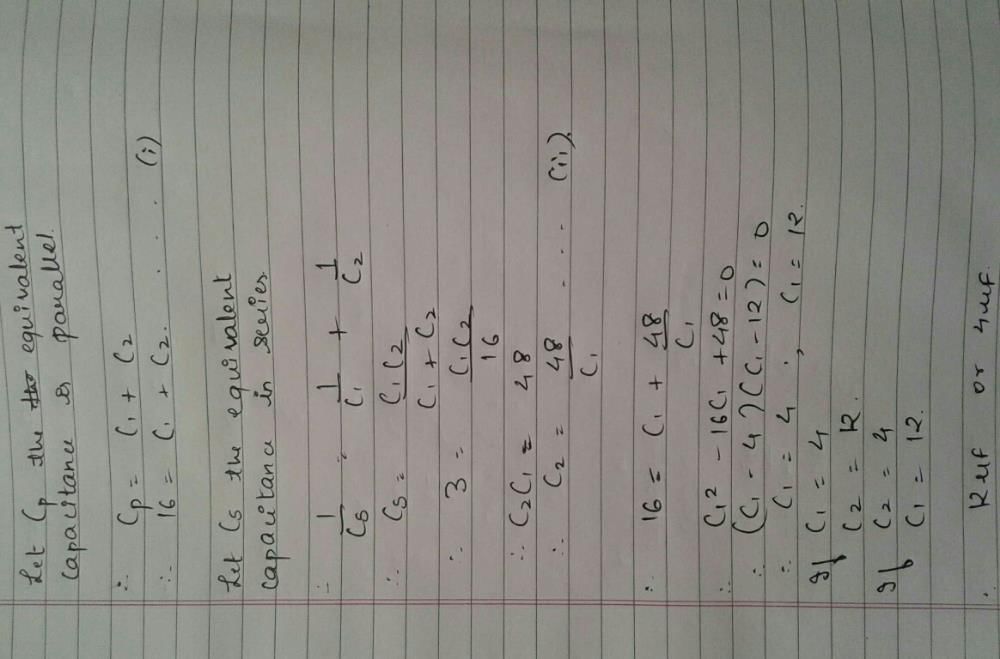
When two capacitors C1 and C2 are connected in series and parallel, their equivalent capacitances comes out to be 3 μƒ and 16 μƒ respectively. Calculate values of C1 and C2.- a)4μƒ and 12μƒ
- b)6μƒ and 10μƒ
- c)4μƒ and 10μƒ
- d)6μƒ and 12μƒ
Correct answer is option 'A'. Can you explain this answer?
When two capacitors C1 and C2 are connected in series and parallel, their equivalent capacitances comes out to be 3 μƒ and 16 μƒ respectively. Calculate values of C1 and C2.
a)
4μƒ and 12μƒ
b)
6μƒ and 10μƒ
c)
4μƒ and 10μƒ
d)
6μƒ and 12μƒ
 | Anonymous answered |
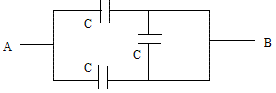
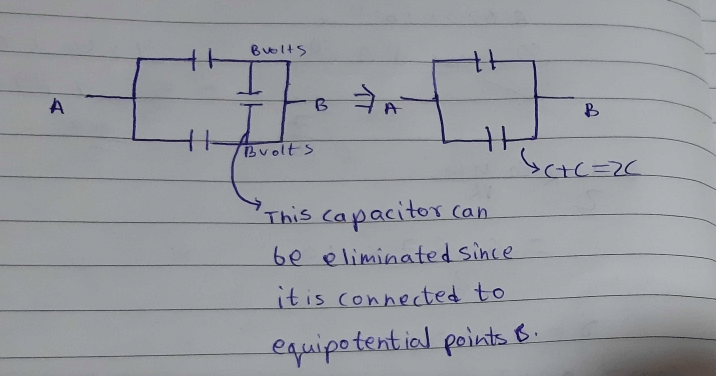
Here is a combination of three identical capacitors. If resultant capacitance is 1 μƒ, calculate capacitance of each capacitor.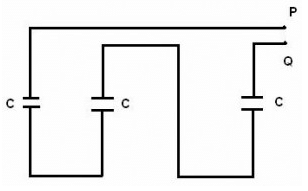
- a)6 μƒ
- b)3 μƒ
- c)4 μƒ
- d)2 μƒ
Correct answer is option 'B'. Can you explain this answer?
Here is a combination of three identical capacitors. If resultant capacitance is 1 μƒ, calculate capacitance of each capacitor.
a)
6 μƒ
b)
3 μƒ
c)
4 μƒ
d)
2 μƒ
 | Lavanya Menon answered |
Combination of Capacitors in Series
C(effective) = C/3 = 1
C(effective) = C/3 = 1
At 300K molar conductivity of solution A is 350 units, and at infinite dilution the molar conductivity of the same sample is 480 unit. Predict the percentage dissociation of the electrolyte.- a)73.0%
- b)37.0%
- c)63.0%
- d)137.0%
Correct answer is option 'A'. Can you explain this answer?
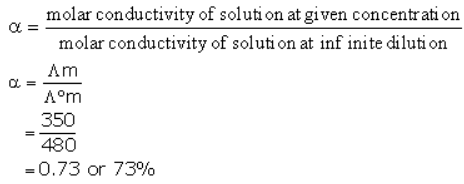
At 300K molar conductivity of solution A is 350 units, and at infinite dilution the molar conductivity of the same sample is 480 unit. Predict the percentage dissociation of the electrolyte.
a)
73.0%
b)
37.0%
c)
63.0%
d)
137.0%
 | Gunjan Lakhani answered |
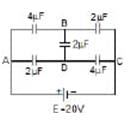
Find the equivalent capacitance of the combination.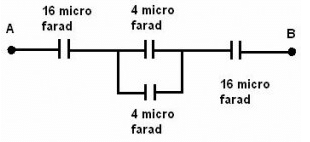
- a)16/3 μƒ
- b)16 μƒ
- c)19.0 μƒ
- d)8 μƒ
Correct answer is option 'C'. Can you explain this answer?
Find the equivalent capacitance of the combination.
a)
16/3 μƒ
b)
16 μƒ
c)
19.0 μƒ
d)
8 μƒ
 | Kumari Sakshi answered |
none of the optaion match answer should be 4
Kohlrausch’s Law shows that:- a)at infinite dilution the ionic conductivity of ions is additive.
- b)at infinite dilution the ionic conductivity of all the ions of the electrolyte become equal.
- c)at infinite dilution the concentration of the electrolyte becomes unity.
- d)at infinite dilution the concentration of ions increases.
Correct answer is option 'A'. Can you explain this answer?
Kohlrausch’s Law shows that:
a)
at infinite dilution the ionic conductivity of ions is additive.
b)
at infinite dilution the ionic conductivity of all the ions of the electrolyte become equal.
c)
at infinite dilution the concentration of the electrolyte becomes unity.
d)
at infinite dilution the concentration of ions increases.
 | Preeti Khanna answered |
The correct answer is option A
Kohlrausch's law states that the equivalent conductivity of an electrolyte at infinite dilution is equal to the sum of the conductances of the anions and cations. If a salt is dissolved in water, the conductivity of the solution is the sum of the conductances of the anions and cations.
Hence, at infinite dilution the ionic conductivity of ions is additive.
Hence, at infinite dilution the ionic conductivity of ions is additive.
Which of the following is wrongly matched?- a)IUI - semen collected crom husband or donor is artificially introduced either into the vagina or into the uterus
- b)GIFT - transfer of embroys with more than 8 blastomers intothe Fallopian tube
- c)ICSI- sperm directily injected into the ovum
- d)ZIFT- transfer of embrys with upto 8 blastomeres into the Fallopian tube
Correct answer is option 'B'. Can you explain this answer?
Which of the following is wrongly matched?
a)
IUI - semen collected crom husband or donor is artificially introduced either into the vagina or into the uterus
b)
GIFT - transfer of embroys with more than 8 blastomers intothe Fallopian tube
c)
ICSI- sperm directily injected into the ovum
d)
ZIFT- transfer of embrys with upto 8 blastomeres into the Fallopian tube
| | Priya Menon answered |
GIFT (Gamete Intra Fallopian Transfer) is transfer of an ovum collected from a donor into the Fallopian tube of another female who cannot produce ovum but can provide proper environment for fertilization and further development.
If two spheres of different radii have equal charge, then the potential will be- a)dependent on nature of material of the spheres.
- b)more on smaller sphere
- c)more on bigger sphere
- d)equal on both spheres
Correct answer is option 'B'. Can you explain this answer?
If two spheres of different radii have equal charge, then the potential will be
a)
dependent on nature of material of the spheres.
b)
more on smaller sphere
c)
more on bigger sphere
d)
equal on both spheres
 | Sushil Kumar answered |
When equal charges are given to two spheres of different radii, the potential will be more or the smaller sphere as per the equation, Potential = Charge / Radius.
Since potential is inversely proportional to radius, the smaller radius will have higher potential and vice versa.
Since potential is inversely proportional to radius, the smaller radius will have higher potential and vice versa.
The capacitor preferred for high-frequency circuit is - a)Air capacitor
- b)Mica capacitor
- c)Electrolytic capacitor
- d)None of the above
Correct answer is option 'B'. Can you explain this answer?
The capacitor preferred for high-frequency circuit is
a)
Air capacitor
b)
Mica capacitor
c)
Electrolytic capacitor
d)
None of the above
| | Sushil Kumar answered |
Mica capacitor. Mica capacitors have low resistive and inductive components associated with it. Hence, they have high Q factor and because of high Q factor their characteristics are mostly frequency independent, which allows this capacitor to work at high frequency.
Which of the following statements is correct?- a)Molar conductivity of a strong electrolyte decreases with dilution
- b)Molar conductivity of a strong and weak electrolyte decreases with dilution
- c)Molar conductivity of a weak electrolyte decreases with dilution
- d)Molar conductivity of a strong and weak electrolyte increases with dilution
Correct answer is option 'D'. Can you explain this answer?
Which of the following statements is correct?
a)
Molar conductivity of a strong electrolyte decreases with dilution
b)
Molar conductivity of a strong and weak electrolyte decreases with dilution
c)
Molar conductivity of a weak electrolyte decreases with dilution
d)
Molar conductivity of a strong and weak electrolyte increases with dilution
| | Pooja Mehta answered |
Molar conductivity increases with decrease in concentration as the total volume, , of solution containing one mole of electrolyte also increases. Upon dilution the concentration decreases. Variation of molar conductivity with concentration is different for strong and weak electrolytes.
Consider the following statements and select the option stating which ones are true (T) and which ones are false (F).
(i) Abortions could happen spontaneously too.
(ii) Infertility is the inability to produce viable offspring due to defects in the female partner only.
(iii) Complete lactation could help in contraception.
(iv) Creating awareness can help create a reproductively healthy society.- a)(i) F, (ii) F, (iii) T, (iv) - T
- b)(i) F, (ii) T, (iii) F, (iv) - T
- c)(i) T, (ii) F, (iii) T, (iv) - T
- d)(i) T, (ii) T, (iii) F, (iv) - F
Correct answer is option 'C'. Can you explain this answer?
Consider the following statements and select the option stating which ones are true (T) and which ones are false (F).
(i) Abortions could happen spontaneously too.
(ii) Infertility is the inability to produce viable offspring due to defects in the female partner only.
(iii) Complete lactation could help in contraception.
(iv) Creating awareness can help create a reproductively healthy society.
(i) Abortions could happen spontaneously too.
(ii) Infertility is the inability to produce viable offspring due to defects in the female partner only.
(iii) Complete lactation could help in contraception.
(iv) Creating awareness can help create a reproductively healthy society.
a)
(i) F, (ii) F, (iii) T, (iv) - T
b)
(i) F, (ii) T, (iii) F, (iv) - T
c)
(i) T, (ii) F, (iii) T, (iv) - T
d)
(i) T, (ii) T, (iii) F, (iv) - F
 | Meera Singh answered |
Abortions could occur spontaneously too. The reason for this could be any physiological problem in the mother or foetus or both. During complete lactation, there is no ovulation and thus chances of conceiving are nil or less during this period. Creating awareness about reproduction by audio-visual and print media, governmental and non-governmental agencies help in creating a reproductively healthy society. Infertility is the inability to produce viable offspring due to defects in either male or female or both the partners.
Which two of the following statements are incorrect regarding in vitro fertilization?
(i) In this method, ova from the wife/donor female and sperms from the husband/donor male are induced to form zygote in the uterus.
(ii) If the embryo is having 2 blastomeres, it is transferred into the uterus.
(iii) If the embryo is with more than 8 blastomeres, it is transferred into the uterus.
(iv) The baby thus produced is called test tube baby.- a)(iii) and (iv)
- b)(i) and (ii)
- c)(ii) and (iii)
- d)(i) and (iv)
Correct answer is option 'B'. Can you explain this answer?
Which two of the following statements are incorrect regarding in vitro fertilization?
(i) In this method, ova from the wife/donor female and sperms from the husband/donor male are induced to form zygote in the uterus.
(ii) If the embryo is having 2 blastomeres, it is transferred into the uterus.
(iii) If the embryo is with more than 8 blastomeres, it is transferred into the uterus.
(iv) The baby thus produced is called test tube baby.
(i) In this method, ova from the wife/donor female and sperms from the husband/donor male are induced to form zygote in the uterus.
(ii) If the embryo is having 2 blastomeres, it is transferred into the uterus.
(iii) If the embryo is with more than 8 blastomeres, it is transferred into the uterus.
(iv) The baby thus produced is called test tube baby.
a)
(iii) and (iv)
b)
(i) and (ii)
c)
(ii) and (iii)
d)
(i) and (iv)
| | Priya Menon answered |
In-vitro fertilization technique essentially involves the fusion of ovum and sperm outside the body of the female. The zygote is allowed to develop in-vitro and embryo with 6-8 blastomere is transferred into the uterus. the baby thus developed is called test tube baby.
(i) In IVF, ova from the wife/donor female and sperm from the husband/donor male are induced to form zygote in the test-tube or in-vitro.
(ii) Embryo with 2 blastomeres is not transferred into the uterus. It is allowed to develop.
(iii) If the embryo has achieved 6-8 blastomeres, it is tranferred into the uterus for implantation.
(iv) The baby thus developed is called the test tube baby.
(i) In IVF, ova from the wife/donor female and sperm from the husband/donor male are induced to form zygote in the test-tube or in-vitro.
(ii) Embryo with 2 blastomeres is not transferred into the uterus. It is allowed to develop.
(iii) If the embryo has achieved 6-8 blastomeres, it is tranferred into the uterus for implantation.
(iv) The baby thus developed is called the test tube baby.
Match the ARTs with their descriptionI. Collected gametes are made to form the zygote in the laboratory.
II. Zygote or early embryo with up to 8 blastomeres is transferred into the oviduct.
III. Zygote with more than 8 blastomeres is transferred into the uterus.
IV. Fusion of gametes within the female.
V. Transfer of ovum from a donor to the oviduct of the recipient.
VI. Sperm is injected into the ovum in-vitro.A. GIFT
B. ZIFT
C. AI
D. ICSI
E. IUT
F. IVF
G. IUI
H. In-vivo fertilization- a) I - G, II - B, III - F, IV - H, V - A, VI - D
- b) I - F, II - B, III - A, IV - H, V - A, VI - G
- c)I - F, II - B, III - E, IV - H, V - A, VI - D
- d)I - G, II - B, III - F, IV - H, V - C, VI - E
Correct answer is option 'C'. Can you explain this answer?
Match the ARTs with their description
I. Collected gametes are made to form the zygote in the laboratory.
II. Zygote or early embryo with up to 8 blastomeres is transferred into the oviduct.
III. Zygote with more than 8 blastomeres is transferred into the uterus.
IV. Fusion of gametes within the female.
V. Transfer of ovum from a donor to the oviduct of the recipient.
VI. Sperm is injected into the ovum in-vitro.
II. Zygote or early embryo with up to 8 blastomeres is transferred into the oviduct.
III. Zygote with more than 8 blastomeres is transferred into the uterus.
IV. Fusion of gametes within the female.
V. Transfer of ovum from a donor to the oviduct of the recipient.
VI. Sperm is injected into the ovum in-vitro.
A. GIFT
B. ZIFT
C. AI
D. ICSI
E. IUT
F. IVF
G. IUI
H. In-vivo fertilization
B. ZIFT
C. AI
D. ICSI
E. IUT
F. IVF
G. IUI
H. In-vivo fertilization
a)
I - G, II - B, III - F, IV - H, V - A, VI - D
b)
I - F, II - B, III - A, IV - H, V - A, VI - G
c)
I - F, II - B, III - E, IV - H, V - A, VI - D
d)
I - G, II - B, III - F, IV - H, V - C, VI - E
 | Ambition Institute answered |
- I - F (IVF): In vitro fertilization (IVF) involves the collection of gametes and their fertilization in the laboratory to form a zygote.
- II - B (ZIFT): Zygote intra-fallopian tube transfer (ZIFT) involves transferring a zygote or early embryo (up to 8 blastomeres) into the oviduct.
- III - E (IUT): Intrauterine transfer (IUT) involves transferring a zygote with more than 8 blastomeres into the uterus.
- IV - H (In-vivo fertilization): Fusion of gametes within the female, which is the natural process of fertilization.
- V - A (GIFT): Gamete intra-fallopian tube transfer (GIFT) involves transferring ovum from a donor to the oviduct of the recipient.
- VI - D (ICSI): Intracytoplasmic sperm injection (ICSI) involves injecting sperm directly into the ovum in vitro.
Thus, the correct match is: I - F, II - B, III - E, IV - H, V - A, VI - D.
Which of the following statements are correct?
(i) MTP was legalized in 1971.
(ii) Inability to conceive or produce children even after 2 years of unprotected sexual cohabitation is called infertility.
(iii) Surgical method of contraception prevents gamete formation.
(iv) MTPs are relatively safe up to 12 weeks of pregnancy.- a)(i), (ii) and (iv)
- b)(ii), (iii) and (iv)
- c)(iii) and (iv)
- d)(i) and (iii)
Correct answer is option 'A'. Can you explain this answer?
Which of the following statements are correct?
(i) MTP was legalized in 1971.
(ii) Inability to conceive or produce children even after 2 years of unprotected sexual cohabitation is called infertility.
(iii) Surgical method of contraception prevents gamete formation.
(iv) MTPs are relatively safe up to 12 weeks of pregnancy.
(i) MTP was legalized in 1971.
(ii) Inability to conceive or produce children even after 2 years of unprotected sexual cohabitation is called infertility.
(iii) Surgical method of contraception prevents gamete formation.
(iv) MTPs are relatively safe up to 12 weeks of pregnancy.
a)
(i), (ii) and (iv)
b)
(ii), (iii) and (iv)
c)
(iii) and (iv)
d)
(i) and (iii)
 | Rishabh Chawla answered |
Answer:
To determine the correct statements, let us analyze each option:
(i) MTP was legalized in 1971:
This statement is incorrect. MTP, which stands for Medical Termination of Pregnancy, was legalized in India in 1971. Therefore, statement (i) is incorrect.
(ii) Inability to conceive or produce children even after 2 years of unprotected sexual cohabitation is called infertility:
This statement is correct. Inability to conceive or produce children even after 2 years of unprotected sexual cohabitation is defined as infertility. Therefore, statement (ii) is correct.
(iii) Surgical method of contraception prevents gamete formation:
This statement is incorrect. The surgical method of contraception, such as tubectomy in females or vasectomy in males, does not prevent gamete formation. It involves the blocking or cutting of the fallopian tubes or vas deferens respectively, which prevents the gametes (sperm or egg) from reaching each other for fertilization. However, gametes continue to be formed. Therefore, statement (iii) is incorrect.
(iv) MTPs are relatively safe up to 12 weeks of pregnancy:
This statement is correct. MTPs are considered relatively safe when performed within the first trimester, which is up to 12 weeks of pregnancy. Beyond this period, the risks associated with the procedure increase. Therefore, statement (iv) is correct.
Based on the analysis, the correct statements are (ii) and (iv). Hence, option A is the correct answer.
To determine the correct statements, let us analyze each option:
(i) MTP was legalized in 1971:
This statement is incorrect. MTP, which stands for Medical Termination of Pregnancy, was legalized in India in 1971. Therefore, statement (i) is incorrect.
(ii) Inability to conceive or produce children even after 2 years of unprotected sexual cohabitation is called infertility:
This statement is correct. Inability to conceive or produce children even after 2 years of unprotected sexual cohabitation is defined as infertility. Therefore, statement (ii) is correct.
(iii) Surgical method of contraception prevents gamete formation:
This statement is incorrect. The surgical method of contraception, such as tubectomy in females or vasectomy in males, does not prevent gamete formation. It involves the blocking or cutting of the fallopian tubes or vas deferens respectively, which prevents the gametes (sperm or egg) from reaching each other for fertilization. However, gametes continue to be formed. Therefore, statement (iii) is incorrect.
(iv) MTPs are relatively safe up to 12 weeks of pregnancy:
This statement is correct. MTPs are considered relatively safe when performed within the first trimester, which is up to 12 weeks of pregnancy. Beyond this period, the risks associated with the procedure increase. Therefore, statement (iv) is correct.
Based on the analysis, the correct statements are (ii) and (iv). Hence, option A is the correct answer.
Which of these can be used to cure infertility in couples where male partner has very low sperm count?- a)IUD
- b)GIFT
- c)IUI
- d)None of these
Correct answer is option 'C'. Can you explain this answer?
Which of these can be used to cure infertility in couples where male partner has very low sperm count?
a)
IUD
b)
GIFT
c)
IUI
d)
None of these
| | Lavanya Menon answered |
IUI (Intra-Uterine Insemination) is the technique where sperms either from husband or healthy donor are artificially introduced either into vagina or into uterus to carry out fertilisation.
A Van de graph generator is used- a)to accelerate both charged and uncharged particles.
- b)to produce charged particle
- c)to accelerate uncharged particles.
- d)to accelerate charged particles.
Correct answer is option 'D'. Can you explain this answer?
A Van de graph generator is used
a)
to accelerate both charged and uncharged particles.
b)
to produce charged particle
c)
to accelerate uncharged particles.
d)
to accelerate charged particles.
| | Jyoti Kapoor answered |
The Van De Graaff Generator is basically an electrostatic machine that can generate high voltages. A typical Van De Graaff Generator consists of an insulating belt that transports electrical charge to a terminal. ... Generally used for scientific experiments, the generated charges are used to speed particles such as ions. It also used to accelerate charged particles.
Read the following statements:
(i) Birth control pills are likely to cause cardiovascular problems
(ii) A women who substitutes or takes the place of the real mother to nurse the embryo is called surrogate mother
(iii) Numerous children have been produced by in vitro fertilisation but with some abnormalities
(iv) Women plays a key role in the continuity of the family and human species
(v) Foetal sex determinatio test should not be banned
Which of the following pair consists of incorrect statements?- a)(i) and (ii)
- b)(ii) and (iv)
- c)(iii) and (v)
- d)None of these
Correct answer is option 'C'. Can you explain this answer?
Read the following statements:
(i) Birth control pills are likely to cause cardiovascular problems
(ii) A women who substitutes or takes the place of the real mother to nurse the embryo is called surrogate mother
(iii) Numerous children have been produced by in vitro fertilisation but with some abnormalities
(iv) Women plays a key role in the continuity of the family and human species
(v) Foetal sex determinatio test should not be banned
Which of the following pair consists of incorrect statements?
(i) Birth control pills are likely to cause cardiovascular problems
(ii) A women who substitutes or takes the place of the real mother to nurse the embryo is called surrogate mother
(iii) Numerous children have been produced by in vitro fertilisation but with some abnormalities
(iv) Women plays a key role in the continuity of the family and human species
(v) Foetal sex determinatio test should not be banned
Which of the following pair consists of incorrect statements?
a)
(i) and (ii)
b)
(ii) and (iv)
c)
(iii) and (v)
d)
None of these
 | EduRev NEET answered |
Numerous children have been produced by in vitro fertilisation without any abnormality. Foetal sex determination test should be banned as it is being misused for female foeticide.
The test-tube baby programme employes which one of the following techniqes?- a)intra cytoplasmic -sperm injection (ICSI)
- b)Intra uterine insemination (IUI)
- c)Gamete intra transfer (GIFT)
- d)Zygote intra fallopian transfer (ZIFT)
Correct answer is option 'D'. Can you explain this answer?
The test-tube baby programme employes which one of the following techniqes?
a)
intra cytoplasmic -sperm injection (ICSI)
b)
Intra uterine insemination (IUI)
c)
Gamete intra transfer (GIFT)
d)
Zygote intra fallopian transfer (ZIFT)
| | Akash Menon answered |
Understanding the Test-Tube Baby Programme
The term "test-tube baby" typically refers to assisted reproductive technologies that help individuals conceive. Among the various techniques, Zygote Intra Fallopian Transfer (ZIFT) is a key method used in this program.
What is Zygote Intra Fallopian Transfer (ZIFT)?
- ZIFT involves the fertilization of an egg by sperm in a laboratory setting.
- Once the zygote (fertilized egg) is formed, it is transferred into the fallopian tube instead of the uterus.
- This technique allows for natural transport to the uterus, promoting early development within the body.
Comparison with Other Techniques
- Intra Cytoplasmic Sperm Injection (ICSI): A single sperm is injected directly into an egg. This is more commonly used when there are male fertility issues.
- Intra Uterine Insemination (IUI): Sperm is placed directly into the uterus, bypassing the cervix to increase the chances of fertilization. It is simpler and less invasive than ZIFT.
- Gamete Intra Fallopian Transfer (GIFT): Both eggs and sperm are placed in the fallopian tube, allowing natural fertilization to occur inside the body. This method is less common compared to ZIFT.
Conclusion
ZIFT is particularly beneficial for women with patent fallopian tubes who prefer a more natural approach to conception after in vitro fertilization. The choice of technique depends on the specific fertility issues faced by the couple, making it essential to consult with a fertility specialist to determine the most appropriate option.
The term "test-tube baby" typically refers to assisted reproductive technologies that help individuals conceive. Among the various techniques, Zygote Intra Fallopian Transfer (ZIFT) is a key method used in this program.
What is Zygote Intra Fallopian Transfer (ZIFT)?
- ZIFT involves the fertilization of an egg by sperm in a laboratory setting.
- Once the zygote (fertilized egg) is formed, it is transferred into the fallopian tube instead of the uterus.
- This technique allows for natural transport to the uterus, promoting early development within the body.
Comparison with Other Techniques
- Intra Cytoplasmic Sperm Injection (ICSI): A single sperm is injected directly into an egg. This is more commonly used when there are male fertility issues.
- Intra Uterine Insemination (IUI): Sperm is placed directly into the uterus, bypassing the cervix to increase the chances of fertilization. It is simpler and less invasive than ZIFT.
- Gamete Intra Fallopian Transfer (GIFT): Both eggs and sperm are placed in the fallopian tube, allowing natural fertilization to occur inside the body. This method is less common compared to ZIFT.
Conclusion
ZIFT is particularly beneficial for women with patent fallopian tubes who prefer a more natural approach to conception after in vitro fertilization. The choice of technique depends on the specific fertility issues faced by the couple, making it essential to consult with a fertility specialist to determine the most appropriate option.
The limiting ionic conductances at 298 K for H⁺, CH₃COO⁻ and Cl⁻ ions are 349.6, 40.9 and 76.3 S cm² mol⁻¹ respectively. If the molar conductivity of a 0.01 M acetic acid solution is 16.3 S cm² mol⁻¹, the degree of dissociation (α) of acetic acid at this concentration is approximately:- a)0.042
- b)0.125
- c)0.217
- d)0.315
Correct answer is option 'A'. Can you explain this answer?
a)
0.042
b)
0.125
c)
0.217
d)
0.315
 | Aryan Dasgupta answered |
Understanding Molar Conductivity and Degree of Dissociation
To determine the degree of dissociation (α) of acetic acid in a 0.01 M solution, we can use the relationship between molar conductivity, limiting ionic conductances, and degree of dissociation.
Step 1: Calculate the Molar Conductivity of the Dissociated Ions
The dissociation of acetic acid can be represented as:
CH₃COOH ⇌ H⁺ + CH₃COO⁻
The total molar conductivity (Λ) of the dissociated ions at infinite dilution is given by:
Λ° = λ(H⁺) + λ(CH₃COO⁻)
Using the provided limiting ionic conductances:
- λ(H⁺) = 349.6 S cm² mol⁻¹
- λ(CH₃COO⁻) = 40.9 S cm² mol⁻¹
Calculate:
Λ° = 349.6 + 40.9 = 390.5 S cm² mol⁻¹
Step 2: Relate Molar Conductivity to Degree of Dissociation
The molar conductivity (Λ) of the acetic acid solution can be expressed as:
Λ = α * Λ° + (1 - α) * λ(CH₃COOH)
Since acetic acid is a weak acid and mostly remains undissociated, we can approximate λ(CH₃COOH) as negligible, focusing on the dissociated ions:
Λ ≈ α * Λ°
Thus:
16.3 = α * 390.5
Step 3: Calculate the Degree of Dissociation (α)
Rearranging the equation gives:
α = Λ / Λ° = 16.3 / 390.5
Calculating this yields:
α ≈ 0.0417, which is approximately 0.042.
Conclusion
Thus, the degree of dissociation (α) of acetic acid at the given concentration is approximately 0.042, corresponding to option 'A'. This indicates that about 4.2% of the acetic acid molecules are dissociated into ions in the solution.
To determine the degree of dissociation (α) of acetic acid in a 0.01 M solution, we can use the relationship between molar conductivity, limiting ionic conductances, and degree of dissociation.
Step 1: Calculate the Molar Conductivity of the Dissociated Ions
The dissociation of acetic acid can be represented as:
CH₃COOH ⇌ H⁺ + CH₃COO⁻
The total molar conductivity (Λ) of the dissociated ions at infinite dilution is given by:
Λ° = λ(H⁺) + λ(CH₃COO⁻)
Using the provided limiting ionic conductances:
- λ(H⁺) = 349.6 S cm² mol⁻¹
- λ(CH₃COO⁻) = 40.9 S cm² mol⁻¹
Calculate:
Λ° = 349.6 + 40.9 = 390.5 S cm² mol⁻¹
Step 2: Relate Molar Conductivity to Degree of Dissociation
The molar conductivity (Λ) of the acetic acid solution can be expressed as:
Λ = α * Λ° + (1 - α) * λ(CH₃COOH)
Since acetic acid is a weak acid and mostly remains undissociated, we can approximate λ(CH₃COOH) as negligible, focusing on the dissociated ions:
Λ ≈ α * Λ°
Thus:
16.3 = α * 390.5
Step 3: Calculate the Degree of Dissociation (α)
Rearranging the equation gives:
α = Λ / Λ° = 16.3 / 390.5
Calculating this yields:
α ≈ 0.0417, which is approximately 0.042.
Conclusion
Thus, the degree of dissociation (α) of acetic acid at the given concentration is approximately 0.042, corresponding to option 'A'. This indicates that about 4.2% of the acetic acid molecules are dissociated into ions in the solution.
Which of the following statements is correct with reference to a test tube baby?- a)Fertilisation of the egg is completed outside the body; the fertilised egg is then placed in the womb of the mother where the gestation is completed.
- b)Fertilisation of the egg is completed in the female genital tract. It is then taken out and grown in a large test tube.
- c)A prematurely born baby is reared in an incubator.
- d)Fertilisation of the egg and growth of the embryo is completed in a large test tube.
Correct answer is option 'A'. Can you explain this answer?
Which of the following statements is correct with reference to a test tube baby?
a)
Fertilisation of the egg is completed outside the body; the fertilised egg is then placed in the womb of the mother where the gestation is completed.
b)
Fertilisation of the egg is completed in the female genital tract. It is then taken out and grown in a large test tube.
c)
A prematurely born baby is reared in an incubator.
d)
Fertilisation of the egg and growth of the embryo is completed in a large test tube.
| | Mira Joshi answered |
In test tube baby or in vitro fertilisation technique, the ovum is fertilised with the sperm outside the body of a woman providing the ovum with the same environmental conditions as it would have got inside the uterus. The zygote formed is grown inside a culture and when embryo (having 8 or more blastomeres) is formed, it is then implanted into uterus where it develops into foetus.
The equivalent capacitance between points A and B in the below shown figure will be ______ μF.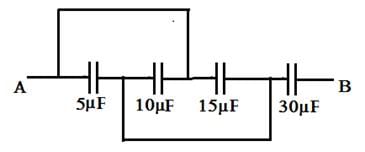
- a)15 μF
- b)6 μF
- c)9 μF
- d)12 μF
Correct answer is option 'A'. Can you explain this answer?
The equivalent capacitance between points A and B in the below shown figure will be ______ μF.
a)
15 μF
b)
6 μF
c)
9 μF
d)
12 μF
 | Mohit Rajpoot answered |
So, the equivalent circuit for the given circuit in the problem is as follows,
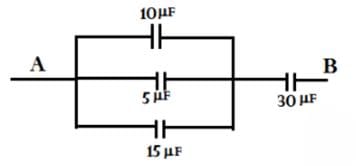
We know that the equivalent capacitance of a parallel combination of capacitors is the total sum of the individual capacitances.
So, CP = 10 + 5 + 15 = 30 μF
So, CP = 10 + 5 + 15 = 30 μF
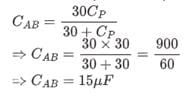
Now this equivalent capacitance will be in a series combination with the remaining one capacitor of magnitude 30μF.
So, the circuit will look like this,
So, the circuit will look like this,
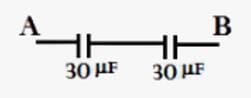
So now the equivalent capacitance of the resultant circuit between points A and B is,
Assisted reproductive technologies (ART)- a)include social awareness programmes to educate people about reproductive health and diseases
- b)include research organisation working to produce new and more effective contraceptives for birth control
- c)include a number of special techniques which assist infertile couples to have children
- d)both (b) and (c)
Correct answer is option 'C'. Can you explain this answer?
Assisted reproductive technologies (ART)
a)
include social awareness programmes to educate people about reproductive health and diseases
b)
include research organisation working to produce new and more effective contraceptives for birth control
c)
include a number of special techniques which assist infertile couples to have children
d)
both (b) and (c)
 | Raghav Bansal answered |
Inability to conceive or produce children even after unprotected sexual intercourse is called infertility. Specialised infertility clinics can help in diagnosis and proper treatment of infertile couples. But, when such treatment is not possible, the couples can be assisted to have children through certain special techniques called assisted reproductive technologies (ART).
Chapter doubts & questions for June Week 2 - Weekly Tests for NEET Preparation 2026 is part of NEET exam preparation. The chapters have been prepared according to the NEET exam syllabus. The Chapter doubts & questions, notes, tests & MCQs are made for NEET 2026 Exam. Find important definitions, questions, notes, meanings, examples, exercises, MCQs and online tests here.
Chapter doubts & questions of June Week 2 - Weekly Tests for NEET Preparation in English & Hindi are available as part of NEET exam. Download more important topics, notes, lectures and mock test series for NEET Exam by signing up for free.
