


All Exams > UPSC > Weekly Tests for UPSC Preparation > All Questions
All questions of July Week 4 for UPSC CSE Exam
Two boys starts from the same place walking at the rate of 5 kmph and 5.5 kmph respectively in the same direction. What time will they take to be 8.5 km apart?
- a)17 hr
- b)14 hr
- c)12 hr
- d)19 hr
Correct answer is option 'A'. Can you explain this answer?
a)
17 hr
b)
14 hr
c)
12 hr
d)
19 hr
 | Raghavendra Sharma answered |
In this type of questions we need to get the relative speed between them,
The relative speed of the boys = 5.5kmph – 5kmph
= 0.5 kmph
Distance between them is 8.5 km
Time = Distance/Speed
Time= 8.5km / 0.5 kmph = 17 hrs

Practice Quiz or MCQ (Multiple Choice Questions) with solution are available for Practice, which would help you prepare for Time & Distance under Quantitative Aptitude. You can practice these practice quizzes as per your speed and improvise the topic. The same topic is covered under various competitive examinations like - CAT, GMAT, Bank PO, SSC and other competitive examinations. Q. A man takes 5 hours 45 min in walking to a certain place and riding back. He would have gained 2 hours by riding both ways. The time he would take to walk both ways is- a)11 hrs
- b)8 hrs 45 min
- c)7 hrs 45 min
- d)9 hrs 20 min
Correct answer is option 'C'. Can you explain this answer?
Practice Quiz or MCQ (Multiple Choice Questions) with solution are available for Practice, which would help you prepare for Time & Distance under Quantitative Aptitude. You can practice these practice quizzes as per your speed and improvise the topic. The same topic is covered under various competitive examinations like - CAT, GMAT, Bank PO, SSC and other competitive examinations.
Q. A man takes 5 hours 45 min in walking to a certain place and riding back. He would have gained 2 hours by riding both ways. The time he would take to walk both ways is
a)
11 hrs
b)
8 hrs 45 min
c)
7 hrs 45 min
d)
9 hrs 20 min
 | Manoj Ghosh answered |
Given that time taken for riding both ways will be 2 hours lesser than
the time needed for waking one way and riding back
From this, we can understand that
time needed for riding one way = time needed for waking one way - 2 hours
Given that time taken in walking one way and riding back = 5 hours 45 min
Hence The time he would take to walk both ways = 5 hours 45 min + 2 hours = 7 hours 45 min
In fact, you can do all these calculations mentally and save a lot of time
which will be a real benefit for you.
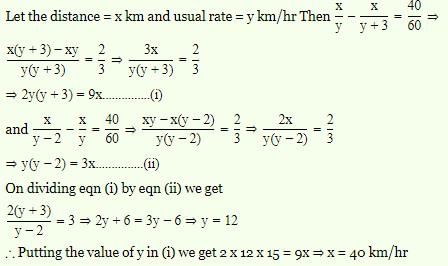
A man covered a certain distance at some speed. If he had moved 3 kmph faster, he would have taken 40 minutes less. If he had moved 2 kmph slower, he would have taken 40 minutes more. What is the the distance in km?- a)36
- b)38
- c)40
- d)42
Correct answer is option 'C'. Can you explain this answer?
A man covered a certain distance at some speed. If he had moved 3 kmph faster, he would have taken 40 minutes less. If he had moved 2 kmph slower, he would have taken 40 minutes more. What is the the distance in km?
a)
36
b)
38
c)
40
d)
42
 | Sameer Rane answered |
A man complete a journey in 10 hours. He travels first half of the journey at the rate of 21 km/hr and second half at the rate of 24 km/hr. Find the total journey in km.
- a)121 km
- b)242 km
- c)224 km
- d)112 km
Correct answer is option 'C'. Can you explain this answer?
a)
121 km
b)
242 km
c)
224 km
d)
112 km
 | Dhruv Mehra answered |
Let time taken to travel the first half = x hr
Then time taken to travel the second half = (10 - x) hr
Distance covered in the the first half = 21x [because, distance = time*speed]
Distance covered in the the second half = 24(10 - x)
Distance covered in the the first half = Distance covered in the the second half
So,
21x = 24(10 - x)
=> 45x = 240
=> x = 16/3
Total Distance = 2*21(16/3) = 224 Km [multiplied by 2 as 21x was distance of half way]
A and B walk around a circular track. A and B walk at a speed of 2 rounds per hour and 3 rounds per hour respectively. If they start at 8 a.m. from the same point in opposite directions, how many times shall they cross each other before 9.30 a.m.?
- a)5
- b)6
- c)7
- d)8
Correct answer is option 'C'. Can you explain this answer?
a)
5
b)
6
c)
7
d)
8
 | Pallabi Deshpande answered |
Relative speed = Speed of A + Speed of B (∴ they walk in opposite directions)
=2+3 = 5 rounds per hour
Therefore, they cross each other 5 times in 1 hour and 2 times in 1/2 hour
Time duration from 8 a.m. to 9.30 a.m. = 1.5 hour
Hence they cross each other 7 times before 9.30 a.m.
A person crosses a 600 m long street in 5 minutes. What is his speed in km per hour?- a)8.2
- b)4.2
- c)6.1
- d)7.2
Correct answer is option 'D'. Can you explain this answer?
A person crosses a 600 m long street in 5 minutes. What is his speed in km per hour?
a)
8.2
b)
4.2
c)
6.1
d)
7.2
| | Manoj Ghosh answered |
Speed = (600/5*60)m/sec.
= 2 m/sec.
Converting m/sec to km/hr
= (2*18/5)km/hr
= 7.2 km/hr.
Excluding stoppages, the speed of a bus is 54 kmph and including stoppages, it is 45 kmph. For how many minutes does the bus stop per hour?
- a)12
- b)11
- c)10
- d)9
Correct answer is option 'C'. Can you explain this answer?
a)
12
b)
11
c)
10
d)
9
 | Ishani Rane answered |
Due to stoppages, it covers 9 km less.
Time taken to cover 9 km =(9/54 *60)min = 10 min.
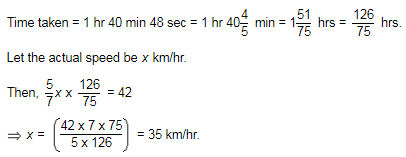

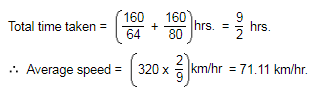
In covering a distance of 30 km, Arun takes 2 hours more than Anil. If Arun doubles his speed, then he would take 1 hour less than Anil. What is Arun's speed?
- a)8 kmph
- b)5 kmph
- c)4 kmph
- d)7 kmph
Correct answer is option 'B'. Can you explain this answer?
a)
8 kmph
b)
5 kmph
c)
4 kmph
d)
7 kmph
| | Raghavendra Sharma answered |
If Arun doubles his speed, he needs 3 hour less. Double speed means half time. Hence, half of the time required by Arun to cover 30 km = 3 hours
i.e., Time required by Arun to cover 30 km = 6 hours
Arun's speed = 30/6 = 5 km/h

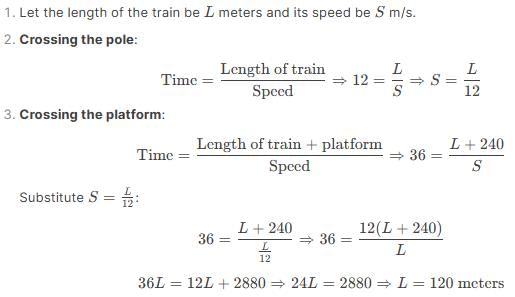
A train traveling at 100 kmph overtakes a motorbike traveling at 64 kmph in 40 seconds. What is the length of the train in meters?- a)1777 m
- b)1822 m
- c)400 m
- d)1400 m
Correct answer is option 'C'. Can you explain this answer?
A train traveling at 100 kmph overtakes a motorbike traveling at 64 kmph in 40 seconds. What is the length of the train in meters?
a)
1777 m
b)
1822 m
c)
400 m
d)
1400 m
 | Lakshya Ias answered |
When a train overtakes another object such as a motorbike, whose length is negligible compared to the length of the train, then the distance traveled by the train while overtaking the motorbike is the same as the length of the train.
The length of the train = distance traveled by the train while overtaking the motorbike
= relative speed between the train and the motorbike * time taken
In this case, as both the objects i.e., the train and the motorbike are moving in the same direction, the relative speed between them = difference between their respective speeds = 100 - 64 = 36 kmph.
Distance traveled by the train while overtaking the motorbike = 36 kmph * 40 seconds.
The final answer is given in meters and the speed is given in kmph and the time in seconds.
So let us convert the given speed from kmph to m/sec.
1 kmph = 5/18 m/sec
Therefore, 36 kmph = 36 * 5 /18 = 10 m/sec.
Relative speed = 10 m/sec. Time taken = 40 seconds.
Therefore, distance traveled = 10 * 40 = 400 meters.
The length of the train = distance traveled by the train while overtaking the motorbike
= relative speed between the train and the motorbike * time taken
In this case, as both the objects i.e., the train and the motorbike are moving in the same direction, the relative speed between them = difference between their respective speeds = 100 - 64 = 36 kmph.
Distance traveled by the train while overtaking the motorbike = 36 kmph * 40 seconds.
The final answer is given in meters and the speed is given in kmph and the time in seconds.
So let us convert the given speed from kmph to m/sec.
1 kmph = 5/18 m/sec
Therefore, 36 kmph = 36 * 5 /18 = 10 m/sec.
Relative speed = 10 m/sec. Time taken = 40 seconds.
Therefore, distance traveled = 10 * 40 = 400 meters.
A distance is covered at a certain speed in a certain time. If the double of this distance is covered in four times the time, then what is the ratio of the two speeds?- a)1.5 : 0.7
- b)1 : 1.9
- c)4 : 2
- d)6 : 1
Correct answer is option 'C'. Can you explain this answer?
A distance is covered at a certain speed in a certain time. If the double of this distance is covered in four times the time, then what is the ratio of the two speeds?
a)
1.5 : 0.7
b)
1 : 1.9
c)
4 : 2
d)
6 : 1
 | Upsc Toppers answered |
Case I : Distance D Speed S1 Time D/S1
Case II : Distance 2D Speed S2 Time 4(D/S1)
=> Speed for case II = S2 = Distance/Time = 2D/(4D/S1) = S1/22/(4/1) = 1/2
Hence, speed for case I : speed for case II = S1:S2 = 1:1/2 = 2:1 => Option C is correct.
The legislative matters on which uniformity of legislation throughout the country is desirable but not essential are enumerated in the (Constitution)- a)Residuary List
- b)Concurrent List
- c)Fifth and Sixth Schedule
- d)Directive Principles of State Policy
Correct answer is option 'B'. Can you explain this answer?
The legislative matters on which uniformity of legislation throughout the country is desirable but not essential are enumerated in the (Constitution)
a)
Residuary List
b)
Concurrent List
c)
Fifth and Sixth Schedule
d)
Directive Principles of State Policy
 | Debanshi Chakraborty answered |
Legislative matters on which uniformity of legislation throughout the country is desirable but not essential are enumerated in the Concurrent List of the Indian Constitution. This list consists of subjects on which both the Central and State Governments can legislate simultaneously. Some of the important matters covered under the Concurrent List include:
1. Education: This includes primary, secondary and higher education, as well as vocational training and technical education.
2. Criminal law: This includes the Indian Penal Code, Criminal Procedure Code, and other laws relating to crimes and punishments.
3. Marriage and divorce: This includes laws regulating marriage, divorce, and maintenance.
4. Adoption: This includes laws relating to the adoption of children.
5. Drugs and poisons: This includes laws relating to the manufacture, sale, and distribution of drugs and poisons.
6. Trade unions: This includes laws relating to the formation, registration, and regulation of trade unions.
7. Economic and social planning: This includes laws relating to economic and social planning, as well as the implementation of plans.
8. Family planning: This includes laws relating to family planning and population control.
9. Labour welfare: This includes laws relating to the welfare of labour, such as the Employees' State Insurance Act, the Minimum Wages Act, and the Factories Act.
In conclusion, the Concurrent List of the Indian Constitution contains important legislative matters on which both the Central and State Governments can legislate simultaneously, and the uniformity of legislation throughout the country is desirable but not essential.
1. Education: This includes primary, secondary and higher education, as well as vocational training and technical education.
2. Criminal law: This includes the Indian Penal Code, Criminal Procedure Code, and other laws relating to crimes and punishments.
3. Marriage and divorce: This includes laws regulating marriage, divorce, and maintenance.
4. Adoption: This includes laws relating to the adoption of children.
5. Drugs and poisons: This includes laws relating to the manufacture, sale, and distribution of drugs and poisons.
6. Trade unions: This includes laws relating to the formation, registration, and regulation of trade unions.
7. Economic and social planning: This includes laws relating to economic and social planning, as well as the implementation of plans.
8. Family planning: This includes laws relating to family planning and population control.
9. Labour welfare: This includes laws relating to the welfare of labour, such as the Employees' State Insurance Act, the Minimum Wages Act, and the Factories Act.
In conclusion, the Concurrent List of the Indian Constitution contains important legislative matters on which both the Central and State Governments can legislate simultaneously, and the uniformity of legislation throughout the country is desirable but not essential.
Consider the following pairs regarding financial relations between the Centre and the States in India:1. Article 268 - Taxes levied by the Centre but collected and appropriated by the States2. Article 269 -Taxes levied and collected the Union but assigned to the States.3. Article 270 - Surcharge on taxes and duties allocated exclusively to the Centre4. Article 271 - Grants-in-aid provided to the StatesHow many pairs given above are correctly matched?- a)Only one pair
- b)Only two pairs
- c)Only three pairs
- d)All four pairs.
Correct answer is option 'B'. Can you explain this answer?
Consider the following pairs regarding financial relations between the Centre and the States in India:
1. Article 268 - Taxes levied by the Centre but collected and appropriated by the States
2. Article 269 -Taxes levied and collected the Union but assigned to the States.
3. Article 270 - Surcharge on taxes and duties allocated exclusively to the Centre
4. Article 271 - Grants-in-aid provided to the States
How many pairs given above are correctly matched?
a)
Only one pair
b)
Only two pairs
c)
Only three pairs
d)
All four pairs.
 | Samridhi Chakraborty answered |
Understanding Financial Relations in India
In India, the financial relations between the Centre and the States are governed by various articles in the Constitution. Let’s evaluate the pairs mentioned:
1. Article 268
- This article refers to taxes levied by the Centre but collected and appropriated by the States.
- Correct Match: This is accurate as certain taxes like stamp duty and property tax are levied by the Centre but collected by the States.
2. Article 269
- This article deals with taxes levied and collected by the Union but assigned to the States.
- Incorrect Match: Article 269 pertains to taxes that are levied by the Centre but collected by the States, not the other way around.
3. Article 270
- This article mentions the distribution of income tax and other taxes between the Centre and States.
- Incorrect Match: It does not talk about surcharges allocated exclusively to the Centre; instead, it discusses the sharing of taxes.
4. Article 271
- This article allows for the imposition of a surcharge on certain taxes for the purpose of augmenting the financial resources of the Centre.
- Incorrect Match: Grants-in-aid are covered under different provisions, not Article 271.
Conclusion
Based on the analysis above, only the first pair is correctly matched. The remaining pairs have inaccuracies regarding their definitions.
Therefore, the correct answer is option 'B' - Only two pairs:
- Article 268 (correct)
- Article 269 (incorrect)
- Article 270 (incorrect)
- Article 271 (incorrect)
Only one pair is correctly matched, making the total correct pairs as one.
In India, the financial relations between the Centre and the States are governed by various articles in the Constitution. Let’s evaluate the pairs mentioned:
1. Article 268
- This article refers to taxes levied by the Centre but collected and appropriated by the States.
- Correct Match: This is accurate as certain taxes like stamp duty and property tax are levied by the Centre but collected by the States.
2. Article 269
- This article deals with taxes levied and collected by the Union but assigned to the States.
- Incorrect Match: Article 269 pertains to taxes that are levied by the Centre but collected by the States, not the other way around.
3. Article 270
- This article mentions the distribution of income tax and other taxes between the Centre and States.
- Incorrect Match: It does not talk about surcharges allocated exclusively to the Centre; instead, it discusses the sharing of taxes.
4. Article 271
- This article allows for the imposition of a surcharge on certain taxes for the purpose of augmenting the financial resources of the Centre.
- Incorrect Match: Grants-in-aid are covered under different provisions, not Article 271.
Conclusion
Based on the analysis above, only the first pair is correctly matched. The remaining pairs have inaccuracies regarding their definitions.
Therefore, the correct answer is option 'B' - Only two pairs:
- Article 268 (correct)
- Article 269 (incorrect)
- Article 270 (incorrect)
- Article 271 (incorrect)
Only one pair is correctly matched, making the total correct pairs as one.
Who can make laws on, matters not included in the state List or Concurrent List?- a)Parliament alone.
- b)State Legislature alone.
- c)Both Parliament and State Legislature.
- d)Council of Ministers.
Correct answer is option 'A'. Can you explain this answer?
Who can make laws on, matters not included in the state List or Concurrent List?
a)
Parliament alone.
b)
State Legislature alone.
c)
Both Parliament and State Legislature.
d)
Council of Ministers.
 | Neha Joshi answered |
- The Parliament of India is competent to legislate on all matters that are enumerated in the Union List and the Concurrent List of the Constitution.
- In the Concurrent List, the Parliament and the State Legislatures have joint jurisdiction.
- However, in case of conflict over any law made under the Concurrent List, the Union Law will prevail upon the State Law provided the State Law has not received the earlier assent of the President.
- Parliament alone has the power to make laws on matters not included in the state list or concurrent list.
A person going from Pondicherry to Ootacamond travels 120 km by steamer, 450 km by rail and 60 km by horse transit. The journey occupies 13 hours 30 minutes, and the speed of the train is three times that of the horse-transit and 1(1/2) times that of the steamer. Find the speed of the train.- a)20 kmph
- b)60 kmph
- c)10 kmph
- d)50 kmph
Correct answer is option 'B'. Can you explain this answer?
A person going from Pondicherry to Ootacamond travels 120 km by steamer, 450 km by rail and 60 km by horse transit. The journey occupies 13 hours 30 minutes, and the speed of the train is three times that of the horse-transit and 1(1/2) times that of the steamer. Find the speed of the train.
a)
20 kmph
b)
60 kmph
c)
10 kmph
d)
50 kmph
 | Rajeev Kumar answered |
If speed of horse is X, then speed of steamer = 2X and
Speed of train = 3X => (120/2x)+ (450/3x)+(60/x) = 13.5
=> X = 20 km/hr => 3X = 60 km/hr.
A jeep travels a distance of 100 km at a uniform speed. If the speed of the jeep is 5 kmph more, then it takes 1 hour less to cover the same distance. The original speed of the jeep is:- a)20 kmph
- b)25 kmph
- c)30 kmph
- d)50 kmph
Correct answer is option 'A'. Can you explain this answer?
A jeep travels a distance of 100 km at a uniform speed. If the speed of the jeep is 5 kmph more, then it takes 1 hour less to cover the same distance. The original speed of the jeep is:
a)
20 kmph
b)
25 kmph
c)
30 kmph
d)
50 kmph
| | Rajeev Kumar answered |
Let the original speed of the jeep be x kmph.
⇒100/x−100/(x+5)=1
Solving this, we get x = 20 kmph.
Two athletes cover the same distance at the rate of 10 and 15 kmph respectively. Find the distance travelled when one takes 15 minutes longer than the other.- a)8.5 km
- b)750 km
- c)7.5 km
- d)15 km
Correct answer is option 'C'. Can you explain this answer?
Two athletes cover the same distance at the rate of 10 and 15 kmph respectively. Find the distance travelled when one takes 15 minutes longer than the other.
a)
8.5 km
b)
750 km
c)
7.5 km
d)
15 km
| | Rajeev Kumar answered |
The distance travelled is 7.5 km.
Let the time taken by the athlete travelling at 10 kmph be t hours.
The time taken by the athlete travelling at 15 kmph is t -15/60 hours.
The distance travelled by both athletes is the same.
Therefore, 10t = 15(t -15/60)
Solving for t, we get t = 3/4 hours.
The distance travelled by both athletes is 10t = 10 * 3/4 = 7.5 km.
If Sita walks at 5 kmph, she misses her train by 10 minutes. If she walks at 7 kmph, she reaches the station 10 minutes early. How much distance does she walk to the station?- a)5.8 km
- b)35.6 km
- c)10.6 km
- d)92 km
Correct answer is option 'A'. Can you explain this answer?
If Sita walks at 5 kmph, she misses her train by 10 minutes. If she walks at 7 kmph, she reaches the station 10 minutes early. How much distance does she walk to the station?
a)
5.8 km
b)
35.6 km
c)
10.6 km
d)
92 km
| | Rajeev Kumar answered |
The distance to the station can be calculated as follows:
Let's denote the distance to the station as "d" (in km), and the time difference between the two cases as "t" (in minutes).
In the first case, Sita walks at 5 km/h and misses the train by 10 minutes. So the time it would take her to get to the train on time is: d/5 (in hours) + 10/60 (in hours) = d/5 + 1/6 (in hours).
In the second case, Sita walks at 7 km/h and arrives 10 minutes early. So the time it takes her to get to the train is: d/7 - 10/60 = d/7 - 1/6 (in hours).
Since these two times should be the same, we can equate them:
d/5 + 1/6 = d/7 - 1/6
Solving this equation for "d" gives:
d = 35/6 km = 5.8 km
So the correct answer is 5.8 km.
Let's denote the distance to the station as "d" (in km), and the time difference between the two cases as "t" (in minutes).
In the first case, Sita walks at 5 km/h and misses the train by 10 minutes. So the time it would take her to get to the train on time is: d/5 (in hours) + 10/60 (in hours) = d/5 + 1/6 (in hours).
In the second case, Sita walks at 7 km/h and arrives 10 minutes early. So the time it takes her to get to the train is: d/7 - 10/60 = d/7 - 1/6 (in hours).
Since these two times should be the same, we can equate them:
d/5 + 1/6 = d/7 - 1/6
Solving this equation for "d" gives:
d = 35/6 km = 5.8 km
So the correct answer is 5.8 km.
Consider the following statements:Statement-I:
The Finance Commission is a quasi-judicial entity constituted every fifth year by the President, primarily responsible for providing recommendations on the distribution of net proceeds of taxes between the Centre and states, grants-in-aid to states, and enhancing the Consolidated Fund of a state.
Statement-II:
The Goods and Services Tax (GST) Council, established through the 101st Amendment Act of 2016, is mandated to make recommendations on integrating various taxes, determining goods and services for GST, setting threshold turnover limits, and guiding principles for determining the place of supply.
Which one of the following is correct in respect of the above statements?- a)Both Statement-I and Statement-II are correct and Statement-II explains Statement-I
- b)Both Statement-I and Statement-II are correct, but Statement-II does not explain Statement-I
- c)Statement-I is correct, but Statement-II is incorrect
- d)Statement-I is incorrect, but Statement-II is correct
Correct answer is option 'C'. Can you explain this answer?
Consider the following statements:
Statement-I:
The Finance Commission is a quasi-judicial entity constituted every fifth year by the President, primarily responsible for providing recommendations on the distribution of net proceeds of taxes between the Centre and states, grants-in-aid to states, and enhancing the Consolidated Fund of a state.
Statement-II:
The Goods and Services Tax (GST) Council, established through the 101st Amendment Act of 2016, is mandated to make recommendations on integrating various taxes, determining goods and services for GST, setting threshold turnover limits, and guiding principles for determining the place of supply.
Which one of the following is correct in respect of the above statements?
The Finance Commission is a quasi-judicial entity constituted every fifth year by the President, primarily responsible for providing recommendations on the distribution of net proceeds of taxes between the Centre and states, grants-in-aid to states, and enhancing the Consolidated Fund of a state.
Statement-II:
The Goods and Services Tax (GST) Council, established through the 101st Amendment Act of 2016, is mandated to make recommendations on integrating various taxes, determining goods and services for GST, setting threshold turnover limits, and guiding principles for determining the place of supply.
Which one of the following is correct in respect of the above statements?
a)
Both Statement-I and Statement-II are correct and Statement-II explains Statement-I
b)
Both Statement-I and Statement-II are correct, but Statement-II does not explain Statement-I
c)
Statement-I is correct, but Statement-II is incorrect
d)
Statement-I is incorrect, but Statement-II is correct
 | Future Foundation Institute answered |
Statement 1 : Correct: The Finance Commission, established under Article 280 of the Indian Constitution, is a quasi-judicial body constituted by the President every five years. It provides recommendations on:
- Distribution of net tax proceeds between the Centre and States.
- Principles governing grants-in-aid to States.
- Measures to enhance the Consolidated Fund of a State to supplement the resources of Panchayats and Municipalitie
Statement 2 : The GST Council's mandate does not include "integrating various taxes" or determining the place of supply. These aspects are governed by the GST Act and related rules, not by the Council directly. The GST Council is primarily responsible for:
- Recommending taxes, cesses, and surcharges to be subsumed under GST.
- Recommending GST rates, exemptions, and threshold limits.
- Resolving disputes related to GST implementation among states and the Centre.
Therefore,Correct Answer - Option C
Consider the following statements:1. The Indian Constitution allows Parliament to legislate on any matter enumerated in the State List during a national emergency.2. The President can establish regulations for Union Territories which can override parliamentary acts concerning those territories.3. The Governor of a state can direct that a parliamentary act does not apply to a scheduled area or apply with modifications and exceptions.Which of the statements given above is/are correct?- a)1 Only
- b)1 and 2 Only
- c)1 and 3 Only
- d)1, 2 and 3
Correct answer is option 'D'. Can you explain this answer?
Consider the following statements:
1. The Indian Constitution allows Parliament to legislate on any matter enumerated in the State List during a national emergency.
2. The President can establish regulations for Union Territories which can override parliamentary acts concerning those territories.
3. The Governor of a state can direct that a parliamentary act does not apply to a scheduled area or apply with modifications and exceptions.
Which of the statements given above is/are correct?
a)
1 Only
b)
1 and 2 Only
c)
1 and 3 Only
d)
1, 2 and 3
 | Sreemoyee Kaur answered |
Analysis of the Statements
Let's evaluate the three statements one by one to understand why the correct answer is option 'D'.
1. National Emergency and State List
- During a national emergency, the Indian Constitution permits Parliament to legislate on matters in the State List.
- This power is granted under Article 250, allowing Parliament to make laws for states if the President declares a national emergency.
2. President's Regulations for Union Territories
- The President can indeed establish regulations for Union Territories under Article 239.
- These regulations have the power to override existing parliamentary acts concerning those territories, thus giving the President significant legislative authority.
3. Governor's Powers in Scheduled Areas
- The Governor of a state has the authority to direct that a parliamentary act does not apply to a scheduled area.
- Under Article 244, the Governor can apply such laws with modifications or exceptions, allowing for local governance that respects tribal rights and customs.
Conclusion
- All three statements are correct, reflecting the various provisions in the Indian Constitution that empower different authorities during specific circumstances.
- Therefore, the correct answer is option 'D': 1, 2, and 3.
Understanding these provisions is crucial for grasping the constitutional framework of India, especially in relation to the distribution of powers among various levels of government.
Let's evaluate the three statements one by one to understand why the correct answer is option 'D'.
1. National Emergency and State List
- During a national emergency, the Indian Constitution permits Parliament to legislate on matters in the State List.
- This power is granted under Article 250, allowing Parliament to make laws for states if the President declares a national emergency.
2. President's Regulations for Union Territories
- The President can indeed establish regulations for Union Territories under Article 239.
- These regulations have the power to override existing parliamentary acts concerning those territories, thus giving the President significant legislative authority.
3. Governor's Powers in Scheduled Areas
- The Governor of a state has the authority to direct that a parliamentary act does not apply to a scheduled area.
- Under Article 244, the Governor can apply such laws with modifications or exceptions, allowing for local governance that respects tribal rights and customs.
Conclusion
- All three statements are correct, reflecting the various provisions in the Indian Constitution that empower different authorities during specific circumstances.
- Therefore, the correct answer is option 'D': 1, 2, and 3.
Understanding these provisions is crucial for grasping the constitutional framework of India, especially in relation to the distribution of powers among various levels of government.
Consider the following statements:Statement-I: The Governor can reserve a bill passed by the state legislature for the consideration of the President.Statement-II: The President holds absolute veto power over a bill reserved by the Governor.Which one of the following is correct in respect of the above statements?- a)Both Statement-I and Statement-II are correct and Statement-II explains Statement-I
- b)Both Statement-I and Statement-II are correct, but Statement-II does not explain Statement-I
- c)Statement-I is correct, but Statement-II is incorrect
- d)Statement-I is incorrect, but Statement-II is correct
Correct answer is option 'B'. Can you explain this answer?
Consider the following statements:
Statement-I: The Governor can reserve a bill passed by the state legislature for the consideration of the President.
Statement-II: The President holds absolute veto power over a bill reserved by the Governor.
Which one of the following is correct in respect of the above statements?
a)
Both Statement-I and Statement-II are correct and Statement-II explains Statement-I
b)
Both Statement-I and Statement-II are correct, but Statement-II does not explain Statement-I
c)
Statement-I is correct, but Statement-II is incorrect
d)
Statement-I is incorrect, but Statement-II is correct
 | Gargi Sengupta answered |
Understanding the Statements
To analyze the correctness of the statements regarding the Governor and the President's powers concerning state legislation, let's break down each statement.
Statement-I: The Governor can reserve a bill passed by the state legislature for the consideration of the President.
- This statement is correct.
- Under Article 200 of the Constitution, the Governor has the authority to reserve certain bills, especially those affecting the interests of the Union or those that are contentious, for the President's consideration.
Statement-II: The President holds absolute veto power over a bill reserved by the Governor.
- This statement is also correct.
- When a bill is reserved for the President's consideration, the President can either give assent, withhold assent (veto), or return the bill (if it is not a money bill) for reconsideration by the legislature.
- However, it is important to note that while the President does have veto power, it is not absolute in the sense that the legislature can potentially override a veto with a sufficient majority in some cases.
Conclusion
- The correct answer is option B: Both Statement-I and Statement-II are correct, but Statement-II does not explain Statement-I.
- The relationship between the two statements is that while both are true, one does not inherently clarify or justify the other.
This understanding clarifies the roles of the Governor and the President in the legislative process within the framework of the Constitution.
To analyze the correctness of the statements regarding the Governor and the President's powers concerning state legislation, let's break down each statement.
Statement-I: The Governor can reserve a bill passed by the state legislature for the consideration of the President.
- This statement is correct.
- Under Article 200 of the Constitution, the Governor has the authority to reserve certain bills, especially those affecting the interests of the Union or those that are contentious, for the President's consideration.
Statement-II: The President holds absolute veto power over a bill reserved by the Governor.
- This statement is also correct.
- When a bill is reserved for the President's consideration, the President can either give assent, withhold assent (veto), or return the bill (if it is not a money bill) for reconsideration by the legislature.
- However, it is important to note that while the President does have veto power, it is not absolute in the sense that the legislature can potentially override a veto with a sufficient majority in some cases.
Conclusion
- The correct answer is option B: Both Statement-I and Statement-II are correct, but Statement-II does not explain Statement-I.
- The relationship between the two statements is that while both are true, one does not inherently clarify or justify the other.
This understanding clarifies the roles of the Governor and the President in the legislative process within the framework of the Constitution.
Which latitude range approximately defines the Tundra region's location?- a)0ºN to 23.5°N.
- b)23.5°S to 23.5°N.
- c)55°N to 70°N.
- d)65°N to 90°N.
Correct answer is option 'D'. Can you explain this answer?
Which latitude range approximately defines the Tundra region's location?
a)
0ºN to 23.5°N.
b)
23.5°S to 23.5°N.
c)
55°N to 70°N.
d)
65°N to 90°N.
 | Valor Academy answered |
The Tundra region is located approximately between 65?N and 90?N latitudes. It is a cold and barren environment found in the high northern latitudes.
Two men A and B walk from P to Q, a distance of 21 km, at 3 and 4 km an hour respectively. B reaches Q, returns immediately and meets A at R. The distance from P to R is- a)12 km
- b)18 km
- c)10 km
- d)24 km
Correct answer is option 'B'. Can you explain this answer?
Two men A and B walk from P to Q, a distance of 21 km, at 3 and 4 km an hour respectively. B reaches Q, returns immediately and meets A at R. The distance from P to R is
a)
12 km
b)
18 km
c)
10 km
d)
24 km
 | K.L Institute answered |
When B meets A at R, B has walked the distance PQ + QR and A the distance PR.
That is, both of them have together walked twice the distance from P to Q, i.e. 42 km.
Now, the speed of A and B are in the ratio 3 : 4, and they have walked 42 km.
Hence, the distance PR travelled by A = 3/7 of 42 km = 18 km.
Which of the following non-constitutional mechanisms promote coordination between the centre and states?1. National Integration council2. Finance Commission3. Regional Development Council4. National Advisory Council5. University Grants CommissionChoose the correct answer using the codes below: - a)All of the above
- b)1, 3, 4 and 5
- c)1, 3 and 4
- d)1 and 5
Correct answer is option 'D'. Can you explain this answer?
Which of the following non-constitutional mechanisms promote coordination between the centre and states?
1. National Integration council
2. Finance Commission
3. Regional Development Council
4. National Advisory Council
5. University Grants Commission
Choose the correct answer using the codes below:
a)
All of the above
b)
1, 3, 4 and 5
c)
1, 3 and 4
d)
1 and 5
 | Hitbullseye Cat answered |
- Finance commission is a constitutional body.
- There is no council named Regional Development Council. However, several councils are regional in nature like North Eastern Council etc.
- National Advisory panel makes policies at the national level. States do not have a say in it.
- University Grant Commission (UDC) coordinates the centre and the states in matters of university education.
The Parliament can make any law for the whole or any part of India for implementing international treaties- a)With the consent of all the States
- b)With the consent of the majority of States
- c)With the consent of the States concerned
- d)Without the consent of any State
Correct answer is option 'D'. Can you explain this answer?
The Parliament can make any law for the whole or any part of India for implementing international treaties
a)
With the consent of all the States
b)
With the consent of the majority of States
c)
With the consent of the States concerned
d)
Without the consent of any State
 | Meera Kapoor answered |
This power of the Parliament is derived from the sovereign nature of India. The states need not ratify sovereign deals.
Consider the following statements regarding the Centre-State financial relations in India:1. The Finance Commission of India is appointed by the President every five years to recommend the distribution of tax revenues between the Centre and the States.2. During a national emergency, the President can modify the financial distribution between the Centre and the States as per Article 352.3. The Goods and Services Tax Council, formed under Article 279-A, primarily focuses on the distribution of GST revenues between the Centre and the States.Which of the statements given above is/are correct?- a)1 and 2 Only
- b) 1 Only
- c)1 and 3 Only
- d)1, 2 and 3
Correct answer is option 'B'. Can you explain this answer?
Consider the following statements regarding the Centre-State financial relations in India:
1. The Finance Commission of India is appointed by the President every five years to recommend the distribution of tax revenues between the Centre and the States.
2. During a national emergency, the President can modify the financial distribution between the Centre and the States as per Article 352.
3. The Goods and Services Tax Council, formed under Article 279-A, primarily focuses on the distribution of GST revenues between the Centre and the States.
Which of the statements given above is/are correct?
a)
1 and 2 Only
b)
1 Only
c)
1 and 3 Only
d)
1, 2 and 3
 | Abhishek Das answered |
Understanding Centre-State Financial Relations in India
When analyzing the statements regarding Centre-State financial relations in India, we can assess their accuracy as follows:
Statement 1: Finance Commission
- The Finance Commission of India is indeed appointed by the President every five years.
- Its primary role is to recommend the distribution of tax revenues between the Centre and the States.
- This statement is correct.
Statement 2: National Emergency and Financial Distribution
- Article 352 pertains to the proclamation of a national emergency due to war, external aggression, or armed rebellion.
- However, the power to modify financial distribution during an emergency is not directly under this article.
- The relevant provision is Article 356, which relates to the President's Rule and does allow for financial alterations, but Article 352 does not explicitly grant this authority.
- Thus, this statement is incorrect.
Statement 3: Goods and Services Tax (GST) Council
- The GST Council is indeed formed under Article 279-A.
- However, its primary function is to make recommendations on issues related to the Goods and Services Tax, including tax rates and exemptions.
- While it does discuss revenue distribution, claiming it primarily focuses on this aspect is misleading.
- Therefore, this statement is also incorrect.
Conclusion
Based on the analysis, only Statement 1 is correct. Thus, the answer is option 'B': 1 Only.
When analyzing the statements regarding Centre-State financial relations in India, we can assess their accuracy as follows:
Statement 1: Finance Commission
- The Finance Commission of India is indeed appointed by the President every five years.
- Its primary role is to recommend the distribution of tax revenues between the Centre and the States.
- This statement is correct.
Statement 2: National Emergency and Financial Distribution
- Article 352 pertains to the proclamation of a national emergency due to war, external aggression, or armed rebellion.
- However, the power to modify financial distribution during an emergency is not directly under this article.
- The relevant provision is Article 356, which relates to the President's Rule and does allow for financial alterations, but Article 352 does not explicitly grant this authority.
- Thus, this statement is incorrect.
Statement 3: Goods and Services Tax (GST) Council
- The GST Council is indeed formed under Article 279-A.
- However, its primary function is to make recommendations on issues related to the Goods and Services Tax, including tax rates and exemptions.
- While it does discuss revenue distribution, claiming it primarily focuses on this aspect is misleading.
- Therefore, this statement is also incorrect.
Conclusion
Based on the analysis, only Statement 1 is correct. Thus, the answer is option 'B': 1 Only.
Consider the following pairs:1. Goods and Services Tax Council - Established under Article 279-A2. Finance Commission - Recommends measures to supplement the resources of Panchayats3. Sarkaria Commission - Recommended abolition of All-India Services4. Punchhi Commission - Suggested fixed tenure for GovernorsHow many pairs given above are correctly matched?- a)Only one pair
- b)Only two pairs
- c)Only three pairs
- d)All four pairs
Correct answer is option 'C'. Can you explain this answer?
Consider the following pairs:
1. Goods and Services Tax Council - Established under Article 279-A
2. Finance Commission - Recommends measures to supplement the resources of Panchayats
3. Sarkaria Commission - Recommended abolition of All-India Services
4. Punchhi Commission - Suggested fixed tenure for Governors
How many pairs given above are correctly matched?
a)
Only one pair
b)
Only two pairs
c)
Only three pairs
d)
All four pairs
| | Sanskriti Singh answered |
Analysis of the Pairs
To determine how many pairs are correctly matched, let's analyze each one:
1. Goods and Services Tax Council
- Correctly Matched: Established under Article 279-A of the Indian Constitution, the GST Council is responsible for making recommendations on issues related to GST.
2. Finance Commission
- Incorrectly Matched: The Finance Commission primarily recommends the distribution of taxes between the Centre and the States and does not directly recommend measures specifically for Panchayats.
3. Sarkaria Commission
- Incorrectly Matched: The Sarkaria Commission was set up to review the balance of power between the Centre and the States but did not recommend the abolition of All-India Services.
4. Punchhi Commission
- Correctly Matched: The Punchhi Commission suggested several reforms, including the fixed tenure for Governors to ensure stability in the functioning of state governments.
Correct Pairs Count
- Out of the four pairs, only pairs 1 and 4 are correctly matched, while pairs 2 and 3 are incorrect.
Conclusion
- Therefore, the correct answer is only two pairs. The answer provided as option 'C' stating "only three pairs" is incorrect. The correct interpretation should be that only two pairs (1 and 4) are accurately matched.
To determine how many pairs are correctly matched, let's analyze each one:
1. Goods and Services Tax Council
- Correctly Matched: Established under Article 279-A of the Indian Constitution, the GST Council is responsible for making recommendations on issues related to GST.
2. Finance Commission
- Incorrectly Matched: The Finance Commission primarily recommends the distribution of taxes between the Centre and the States and does not directly recommend measures specifically for Panchayats.
3. Sarkaria Commission
- Incorrectly Matched: The Sarkaria Commission was set up to review the balance of power between the Centre and the States but did not recommend the abolition of All-India Services.
4. Punchhi Commission
- Correctly Matched: The Punchhi Commission suggested several reforms, including the fixed tenure for Governors to ensure stability in the functioning of state governments.
Correct Pairs Count
- Out of the four pairs, only pairs 1 and 4 are correctly matched, while pairs 2 and 3 are incorrect.
Conclusion
- Therefore, the correct answer is only two pairs. The answer provided as option 'C' stating "only three pairs" is incorrect. The correct interpretation should be that only two pairs (1 and 4) are accurately matched.
What is the term for the percentage of deaths among the population affected by a disease?- a)Morbidity
- b)Autopsy
- c)Prognosis
- d)Pathology
Correct answer is option 'A'. Can you explain this answer?
a)
Morbidity
b)
Autopsy
c)
Prognosis
d)
Pathology
| | Deepa Iyer answered |
Morbidity is the percentage of deaths within a population that is affected by a particular disease. It provides insight into the impact of the disease on a population.
A ship is 156 km away from the bank of river. A leak, which admits  metric tons of water in
  min, but the pumps throughout 15 metric tons in 1 hour. 68 metric tons would sufficient to sink the ship. Find the average rate of sailing so that she may just reach the bank as she begins to sink
- a)15
- b)60
- c)18
- d)10
Correct answer is option 'A'. Can you explain this answer?
A ship is 156 km away from the bank of river. A leak, which admits metric tons of water in min, but the pumps throughout 15 metric tons in 1 hour. 68 metric tons would sufficient to sink the ship. Find the average rate of sailing so that she may just reach the bank as she begins to sink
metric tons of water in min, but the pumps throughout 15 metric tons in 1 hour. 68 metric tons would sufficient to sink the ship. Find the average rate of sailing so that she may just reach the bank as she begins to sinka)
15
b)
60
c)
18
d)
10
 | Mira Choudhury answered |
Given Data:
- Distance from shore: 156 km
- Rate of water ingress: 2.5 metric tons in 6.5 minutes
- Sinking threshold: 68 metric tons
- Pump rate: 15 metric tons in an hour
Calculations:
1. The ship will start sinking when it accumulates 68 metric tons of water.
2. The pumps can remove 15 metric tons of water in an hour, which is equivalent to 0.25 metric tons per minute.
Time to sink:
- Time to sink = (68 metric tons) / (2.5 metric tons per 6.5 minutes)
- Time to sink = 17.2 * 6.5 = 111.8 minutes
Time to reach shore:
- Time to reach shore = 156 km / (x km/h)
- Time to reach shore = 156 / x hours
Condition:
The ship should reach the shore just as it starts sinking.
So, time to reach shore = time to sink
Equating the times:
- 156 / x = 111.8
- x = 156 / 111.8
- x ≈ 18 km/h
Therefore, the average rate of sailing so that the ship just reaches the shore as it begins to sink should be 18 km/h (option A).
- Distance from shore: 156 km
- Rate of water ingress: 2.5 metric tons in 6.5 minutes
- Sinking threshold: 68 metric tons
- Pump rate: 15 metric tons in an hour
Calculations:
1. The ship will start sinking when it accumulates 68 metric tons of water.
2. The pumps can remove 15 metric tons of water in an hour, which is equivalent to 0.25 metric tons per minute.
Time to sink:
- Time to sink = (68 metric tons) / (2.5 metric tons per 6.5 minutes)
- Time to sink = 17.2 * 6.5 = 111.8 minutes
Time to reach shore:
- Time to reach shore = 156 km / (x km/h)
- Time to reach shore = 156 / x hours
Condition:
The ship should reach the shore just as it starts sinking.
So, time to reach shore = time to sink
Equating the times:
- 156 / x = 111.8
- x = 156 / 111.8
- x ≈ 18 km/h
Therefore, the average rate of sailing so that the ship just reaches the shore as it begins to sink should be 18 km/h (option A).
Find the time taken by two trains, one 180 m long and the other 270 m long, to cross each other, if they are running at speeds of 46 kmph and 54 kmph respectively. Consider both possible cases of motion.- a)202.5, 16.2 sec
- b)160, 100 sec
- c)108.45, 15.6 sec
- d)204.5, 14.8 sec
Correct answer is option 'A'. Can you explain this answer?
Find the time taken by two trains, one 180 m long and the other 270 m long, to cross each other, if they are running at speeds of 46 kmph and 54 kmph respectively. Consider both possible cases of motion.
a)
202.5, 16.2 sec
b)
160, 100 sec
c)
108.45, 15.6 sec
d)
204.5, 14.8 sec
 | Lohit Matani answered |
Case I: Motion in same direction
=>Relative speed = 54 — 46 = 8 km/hr.
Distance to be covered = 180 + 270 = 450 m.
=>Time = 0.450/8 = 0.056 hrs = 202.5 sec.
Case II: Motion in opposite direction.
=> Relative Speed = 54 + 46=100 km/hr.
Distance to be covered = 180 + 270= 450 m.
=>Time = 0.450/100 = 0.00045 hrs = 16.2 sec.
What is the term for the time that elapses between the action of a cause and the manifestation of disease?- a)Etiology
- b)Incubation period
- c)Pathogenesis
- d)Symptoms
Correct answer is option 'B'. Can you explain this answer?
a)
Etiology
b)
Incubation period
c)
Pathogenesis
d)
Symptoms
 | Kavita Shah answered |
The incubation period is the duration between the exposure to a causative agent and the appearance of symptoms or signs of a disease.
Which of the following is an example of a congenital hypertrophy?- a)Increase in the number of digits
- b)Ventricular hypertrophy
- c)Closure of a hollow organ
- d)Webbed digits
Correct answer is option 'B'. Can you explain this answer?
a)
Increase in the number of digits
b)
Ventricular hypertrophy
c)
Closure of a hollow organ
d)
Webbed digits
 | Sanjay Rana answered |
Congenital hypertrophy refers to an increase in the size of an organ or structure. Ventricular hypertrophy specifically pertains to the enlargement of the myocardium of the heart's ventricles.
Which term refers to the examination of tissues received from the living body?- a)Autopsy
- b)Etiology
- c)Biopsy
- d)Pathogenesis
Correct answer is option 'C'. Can you explain this answer?
a)
Autopsy
b)
Etiology
c)
Biopsy
d)
Pathogenesis
| | Kavita Shah answered |
A biopsy is the medical procedure involving the extraction and examination of tissues from a living body to diagnose or evaluate a condition.
Which term refers to the alteration in the structure that is detectable by the naked eye or microscope?- a)Symptoms
- b)Lesion
- c)Pathology
- d)Autopsy
Correct answer is option 'B'. Can you explain this answer?
a)
Symptoms
b)
Lesion
c)
Pathology
d)
Autopsy
| | Kavita Shah answered |
A lesion is an alteration in the structure of tissue or organs that can be observed either macroscopically (with the naked eye) or microscopically.
What is the term for the mechanism by which the body is kept in equilibrium?- a)Etiology
- b)Pathogenesis
- c)Homeostasis
- d)Prognosis
Correct answer is option 'C'. Can you explain this answer?
a)
Etiology
b)
Pathogenesis
c)
Homeostasis
d)
Prognosis
| | Deepa Iyer answered |
Homeostasis is the mechanism by which the body maintains a stable internal environment to ensure its proper functioning.
What is the term for the study of the causation of disease?- a)Etiology
- b)Pathogenesis
- c)Homeostasis
- d)Morbidity
Correct answer is option 'A'. Can you explain this answer?
a)
Etiology
b)
Pathogenesis
c)
Homeostasis
d)
Morbidity
| | Deepa Iyer answered |
Etiology is the study of the causation of disease. It involves investigating both intrinsic and extrinsic factors that contribute to the development of diseases.
What is the term for causes that make a person susceptible to a disease and are also known as remote or distant causes?- a)Genetic or Inherited Causes
- b)Non-genetic or Non-inherited Defects
- c)Predisposing Causes
- d)Pathogenic Causes
Correct answer is option 'C'. Can you explain this answer?
a)
Genetic or Inherited Causes
b)
Non-genetic or Non-inherited Defects
c)
Predisposing Causes
d)
Pathogenic Causes
| | Kavita Shah answered |
Predisposing causes are factors that increase an individual's susceptibility to a disease. They are also referred to as remote or distant causes.
What is the term for the mechanism by which the causes produce disease?- a)Etiology
- b)Pathogenesis
- c)Homeostasis
- d)Prognosis
Correct answer is option 'B'. Can you explain this answer?
a)
Etiology
b)
Pathogenesis
c)
Homeostasis
d)
Prognosis
| | Rahul Choudhury answered |
Pathogenesis is the study of how the causes of a disease lead to its development and progression within the body. It explores the process by which diseases are produced.
Chapter doubts & questions for July Week 4 - Weekly Tests for UPSC Preparation 2026 is part of UPSC CSE exam preparation. The chapters have been prepared according to the UPSC CSE exam syllabus. The Chapter doubts & questions, notes, tests & MCQs are made for UPSC CSE 2026 Exam. Find important definitions, questions, notes, meanings, examples, exercises, MCQs and online tests here.
Chapter doubts & questions of July Week 4 - Weekly Tests for UPSC Preparation in English & Hindi are available as part of UPSC CSE exam. Download more important topics, notes, lectures and mock test series for UPSC CSE Exam by signing up for free.
