


All Exams > UPSC > Weekly Tests for UPSC Preparation > All Questions
All questions of November Week 4 for UPSC CSE Exam
In an area with an annual rainfall of more than 200 cm and sloping hills which crop will be ideal?- a)Jute
- b)Cotton
- c)Maize
- d)Tea
Correct answer is option 'D'. Can you explain this answer?
In an area with an annual rainfall of more than 200 cm and sloping hills which crop will be ideal?
a)
Jute
b)
Cotton
c)
Maize
d)
Tea
 | Karishma Karishma answered |
Yes, tea is rainfall of more than 200 cm and sloping hills tea crop will be ideal

Parts of Himachal Pradesh had evolved a local system of canal irrigation over four hundred years ago. It is called—- a)Kulhs
- b)Baori
- c)Jhalara
- d)Khadin
Correct answer is option 'A'. Can you explain this answer?
Parts of Himachal Pradesh had evolved a local system of canal irrigation over four hundred years ago. It is called—
a)
Kulhs
b)
Baori
c)
Jhalara
d)
Khadin
 | Deepa Iyer answered |
Kuhls are a traditional irrigation system in Himachal Pradesh. They are surface channels diverting water from natural flowing streams (khuds). A typical community Kuhl services 6 to 30 farmers, irrigating an area of about 20 ha.
Which qualification is given in the constitution to be elected a commissioner of Election Commission? - a)Being in Indian Administrative Service
- b)Shall have Experience of at least 5 years as a lawyer in a High Court
- c)Completion of 35 years of age
- d)None of the above
Correct answer is option 'D'. Can you explain this answer?
Which qualification is given in the constitution to be elected a commissioner of Election Commission?
a)
Being in Indian Administrative Service
b)
Shall have Experience of at least 5 years as a lawyer in a High Court
c)
Completion of 35 years of age
d)
None of the above
 | Aditi Tiwari answered |
D
With regard to organic manure, consider the following statements:1. It enhances the water holding capacity of the soil.2. It makes the soil loose and porous.3. It enhances the number of friendly microbes.Which of the statements given above is/are correct?- a)1 Only
- b)1 and 2 Only
- c)2 and 3 Only
- d)1, 2 and 3
Correct answer is option 'D'. Can you explain this answer?
With regard to organic manure, consider the following statements:
1. It enhances the water holding capacity of the soil.
2. It makes the soil loose and porous.
3. It enhances the number of friendly microbes.
Which of the statements given above is/are correct?
a)
1 Only
b)
1 and 2 Only
c)
2 and 3 Only
d)
1, 2 and 3
 | Saptarshi Chakraborty answered |
The correct answer is option 'D' - 1, 2 and 3. Let's understand why each statement is correct:
1. It enhances the water holding capacity of the soil:
Organic manure, such as compost or animal manure, contains organic matter that improves the water holding capacity of the soil. When organic matter decomposes, it forms humus, which acts as a sponge, holding water in the soil. This helps to prevent water runoff and allows the soil to retain moisture for a longer period. As a result, the soil becomes more capable of sustaining plant growth, especially during dry periods.
2. It makes the soil loose and porous:
Organic manure contains organic matter that enriches the soil and improves its structure. The organic matter helps to break up compacted soil, making it loose and porous. This improves the soil's ability to hold air and water, facilitating better root growth and nutrient uptake by plants. The increased porosity also enhances soil drainage, preventing waterlogging and reducing the risk of root rot.
3. It enhances the number of friendly microbes:
Organic manure provides a food source for beneficial microorganisms in the soil. These microbes break down organic matter and release essential nutrients in a form that plants can absorb. The presence of organic manure in the soil promotes the growth and multiplication of these beneficial microbes, such as bacteria, fungi, and earthworms. These microbes help in nutrient cycling, soil aeration, and the suppression of harmful pathogens, thus creating a healthier soil ecosystem.
In conclusion, organic manure has several positive effects on soil health. It enhances the water holding capacity of the soil, making it more resilient to drought conditions. It also improves soil structure, making it loose and porous, which aids in root growth and nutrient availability. Additionally, organic manure promotes the growth of friendly microbes that contribute to nutrient cycling and soil health. Therefore, all three statements are correct.
1. It enhances the water holding capacity of the soil:
Organic manure, such as compost or animal manure, contains organic matter that improves the water holding capacity of the soil. When organic matter decomposes, it forms humus, which acts as a sponge, holding water in the soil. This helps to prevent water runoff and allows the soil to retain moisture for a longer period. As a result, the soil becomes more capable of sustaining plant growth, especially during dry periods.
2. It makes the soil loose and porous:
Organic manure contains organic matter that enriches the soil and improves its structure. The organic matter helps to break up compacted soil, making it loose and porous. This improves the soil's ability to hold air and water, facilitating better root growth and nutrient uptake by plants. The increased porosity also enhances soil drainage, preventing waterlogging and reducing the risk of root rot.
3. It enhances the number of friendly microbes:
Organic manure provides a food source for beneficial microorganisms in the soil. These microbes break down organic matter and release essential nutrients in a form that plants can absorb. The presence of organic manure in the soil promotes the growth and multiplication of these beneficial microbes, such as bacteria, fungi, and earthworms. These microbes help in nutrient cycling, soil aeration, and the suppression of harmful pathogens, thus creating a healthier soil ecosystem.
In conclusion, organic manure has several positive effects on soil health. It enhances the water holding capacity of the soil, making it more resilient to drought conditions. It also improves soil structure, making it loose and porous, which aids in root growth and nutrient availability. Additionally, organic manure promotes the growth of friendly microbes that contribute to nutrient cycling and soil health. Therefore, all three statements are correct.
Which of the following statements are correct about pabna agrarian leagues? 1. Having had enough of the oppressive regime, the peasants of Yusufshahi Pargana in Patna district formed an agrarian league or combination to resist the demands of the zamindars 2. The league organized a rent strike—the ryots refused to pay the enhanced rents, challenging the zamindars in the courts- a)1 Only
- b)2 Only
- c)Both of them
- d)Neither of them
Correct answer is option 'C'. Can you explain this answer?
Which of the following statements are correct about pabna agrarian leagues?
1. Having had enough of the oppressive regime, the peasants of Yusufshahi Pargana in Patna district formed an agrarian league or combination to resist the demands of the zamindars
2. The league organized a rent strike—the ryots refused to pay the enhanced rents, challenging the zamindars in the courts
a)
1 Only
b)
2 Only
c)
Both of them
d)
Neither of them
 | Tarun Datta answered |
The correct answer is option 'C' - Both of them.
Explanation:
1. Formation of the Agrarian League:
The statement correctly states that the peasants of Yusufshahi Pargana in Patna district formed an agrarian league or combination. This league was formed by the peasants in response to the oppressive regime they were facing. The zamindars, who were the landowners, were imposing heavy demands on the peasants, leading to their dissatisfaction and desire for resistance.
2. Rent Strike by the Agrarian League:
The statement also correctly mentions that the league organized a rent strike. The ryots, which refers to the peasants or tenants, refused to pay the enhanced rents demanded by the zamindars. The ryots challenged the zamindars in the courts, seeking justice and relief from the oppressive demands.
The agrarian league's rent strike was a form of protest and resistance against the exploitative practices of the zamindars. By refusing to pay the enhanced rents, the ryots aimed to assert their rights and demand fair treatment. The strike also aimed to draw attention to the unjust conditions faced by the peasants and put pressure on the authorities to address their grievances.
Overall, both statements accurately describe the formation and actions of the Pabna Agrarian League. The league was formed by the peasants to resist the oppressive demands of the zamindars, and they organized a rent strike as a means of protest and seeking justice.
Explanation:
1. Formation of the Agrarian League:
The statement correctly states that the peasants of Yusufshahi Pargana in Patna district formed an agrarian league or combination. This league was formed by the peasants in response to the oppressive regime they were facing. The zamindars, who were the landowners, were imposing heavy demands on the peasants, leading to their dissatisfaction and desire for resistance.
2. Rent Strike by the Agrarian League:
The statement also correctly mentions that the league organized a rent strike. The ryots, which refers to the peasants or tenants, refused to pay the enhanced rents demanded by the zamindars. The ryots challenged the zamindars in the courts, seeking justice and relief from the oppressive demands.
The agrarian league's rent strike was a form of protest and resistance against the exploitative practices of the zamindars. By refusing to pay the enhanced rents, the ryots aimed to assert their rights and demand fair treatment. The strike also aimed to draw attention to the unjust conditions faced by the peasants and put pressure on the authorities to address their grievances.
Overall, both statements accurately describe the formation and actions of the Pabna Agrarian League. The league was formed by the peasants to resist the oppressive demands of the zamindars, and they organized a rent strike as a means of protest and seeking justice.
Which of the following statements is correct?- a)The powers of the Chief Election Commissioner and two other Election Commissioners vary in many ways.
- b)The salary and allowances of the Election Commissioner are similar to that of the High Court Judge.
- c)The Governor appoints State Election Commissions on the advice of the Election Commission
- d)The term of the Election Commissioners is up to 6 years or 65 years of age.
Correct answer is option 'D'. Can you explain this answer?
Which of the following statements is correct?
a)
The powers of the Chief Election Commissioner and two other Election Commissioners vary in many ways.
b)
The salary and allowances of the Election Commissioner are similar to that of the High Court Judge.
c)
The Governor appoints State Election Commissions on the advice of the Election Commission
d)
The term of the Election Commissioners is up to 6 years or 65 years of age.
 | Vikram Kapoor answered |
The term of the Election Commissioners is up to 6 years or 65 years of age.
Which one of the following crops does not require nitrogenous fertiliser?- a)Wheat
- b)Millet
- c)Beans
- d)Paddy
Correct answer is option 'C'. Can you explain this answer?
Which one of the following crops does not require nitrogenous fertiliser?
a)
Wheat
b)
Millet
c)
Beans
d)
Paddy
 | Tanishq Roy answered |
Introduction:
Nitrogen is an essential nutrient required by plants for their growth and development. It is a major component of proteins, nucleic acids, and chlorophyll. Most plants obtain nitrogen from the soil in the form of nitrates or ammonium ions. However, some crops have the ability to fix atmospheric nitrogen with the help of symbiotic bacteria.
Explanation:
Among the given options, beans (option C) do not require nitrogenous fertilizer. Let's understand why.
Nitrogen Fixation:
Some plants have a symbiotic relationship with nitrogen-fixing bacteria, which are capable of converting atmospheric nitrogen into a usable form for plants. This process is called nitrogen fixation. These bacteria reside in root nodules of leguminous plants, such as beans, peas, and lentils. The bacteria take atmospheric nitrogen and convert it into ammonia, which is then used by the plants for their growth. Therefore, leguminous crops like beans do not require nitrogenous fertilizers as they can obtain nitrogen through biological fixation.
Other Crops:
1. Wheat (option A): Wheat is not capable of nitrogen fixation and relies on the availability of nitrogen in the soil. Therefore, wheat crops require nitrogenous fertilizers to meet their nitrogen requirements.
2. Millet (option B): Similar to wheat, millet crops do not have the ability to fix atmospheric nitrogen. Hence, they need nitrogenous fertilizers to fulfill their nitrogen needs.
3. Paddy (option D): Paddy, also known as rice, does not have the ability to fix nitrogen either. It requires nitrogenous fertilizers to meet its nitrogen demands.
Conclusion:
In conclusion, among the given options, beans do not require nitrogenous fertilizers as they have the ability to fix atmospheric nitrogen with the help of symbiotic bacteria present in their root nodules. On the other hand, crops like wheat, millet, and paddy rely on nitrogenous fertilizers to meet their nitrogen requirements.
Nitrogen is an essential nutrient required by plants for their growth and development. It is a major component of proteins, nucleic acids, and chlorophyll. Most plants obtain nitrogen from the soil in the form of nitrates or ammonium ions. However, some crops have the ability to fix atmospheric nitrogen with the help of symbiotic bacteria.
Explanation:
Among the given options, beans (option C) do not require nitrogenous fertilizer. Let's understand why.
Nitrogen Fixation:
Some plants have a symbiotic relationship with nitrogen-fixing bacteria, which are capable of converting atmospheric nitrogen into a usable form for plants. This process is called nitrogen fixation. These bacteria reside in root nodules of leguminous plants, such as beans, peas, and lentils. The bacteria take atmospheric nitrogen and convert it into ammonia, which is then used by the plants for their growth. Therefore, leguminous crops like beans do not require nitrogenous fertilizers as they can obtain nitrogen through biological fixation.
Other Crops:
1. Wheat (option A): Wheat is not capable of nitrogen fixation and relies on the availability of nitrogen in the soil. Therefore, wheat crops require nitrogenous fertilizers to meet their nitrogen requirements.
2. Millet (option B): Similar to wheat, millet crops do not have the ability to fix atmospheric nitrogen. Hence, they need nitrogenous fertilizers to fulfill their nitrogen needs.
3. Paddy (option D): Paddy, also known as rice, does not have the ability to fix nitrogen either. It requires nitrogenous fertilizers to meet its nitrogen demands.
Conclusion:
In conclusion, among the given options, beans do not require nitrogenous fertilizers as they have the ability to fix atmospheric nitrogen with the help of symbiotic bacteria present in their root nodules. On the other hand, crops like wheat, millet, and paddy rely on nitrogenous fertilizers to meet their nitrogen requirements.
The process of loosening and turning the soil is called:- a)Ploughing
- b)Levelling
- c)Manuring
- d)All the above
Correct answer is option 'A'. Can you explain this answer?
The process of loosening and turning the soil is called:
a)
Ploughing
b)
Levelling
c)
Manuring
d)
All the above
 | Tejas Datta answered |
Introduction:
The process of loosening and turning the soil is called ploughing. It is an important agricultural practice that helps prepare the soil for planting crops. Ploughing involves breaking up the soil, turning it over, and creating furrows for planting seeds.
Explanation:
Ploughing is an essential step in the cultivation of crops as it helps improve soil structure and fertility. It provides several benefits to the soil and the crops grown on it. Let's discuss these benefits in detail:
1. Loosening the soil:
Ploughing helps in loosening the compacted soil, which is necessary for the growth of plant roots. This process allows air, water, and nutrients to penetrate the soil more easily, promoting healthy root development.
2. Weed control:
Ploughing helps control weeds by uprooting and burying them deep into the soil. This prevents weed growth and competition with the cultivated crops. Turning the soil also exposes weed seeds to sunlight, which can inhibit their germination.
3. Enhancing soil aeration:
By breaking up the soil, ploughing improves soil aeration. This allows oxygen to reach the root zone, facilitating the respiration process of the plants. Adequate oxygen availability promotes healthy root growth and overall plant development.
4. Mixing organic matter:
During ploughing, organic matter such as crop residues or manure can be incorporated into the soil. This improves the soil's nutrient content, organic matter content, and overall fertility. Organic matter acts as a source of nutrients for the plants and also enhances the soil's water-holding capacity.
5. Pest and disease management:
Ploughing can help manage pests and diseases by burying crop residues and pathogens deep into the soil. This reduces the survival and spread of pests and diseases, minimizing their impact on subsequent crops.
Conclusion:
In conclusion, ploughing is the process of loosening and turning the soil, which is crucial for successful crop cultivation. It improves soil structure, enhances nutrient availability, controls weeds, and manages pests and diseases. Ploughing is an integral part of sustainable agricultural practices and plays a vital role in ensuring high crop yields.
The process of loosening and turning the soil is called ploughing. It is an important agricultural practice that helps prepare the soil for planting crops. Ploughing involves breaking up the soil, turning it over, and creating furrows for planting seeds.
Explanation:
Ploughing is an essential step in the cultivation of crops as it helps improve soil structure and fertility. It provides several benefits to the soil and the crops grown on it. Let's discuss these benefits in detail:
1. Loosening the soil:
Ploughing helps in loosening the compacted soil, which is necessary for the growth of plant roots. This process allows air, water, and nutrients to penetrate the soil more easily, promoting healthy root development.
2. Weed control:
Ploughing helps control weeds by uprooting and burying them deep into the soil. This prevents weed growth and competition with the cultivated crops. Turning the soil also exposes weed seeds to sunlight, which can inhibit their germination.
3. Enhancing soil aeration:
By breaking up the soil, ploughing improves soil aeration. This allows oxygen to reach the root zone, facilitating the respiration process of the plants. Adequate oxygen availability promotes healthy root growth and overall plant development.
4. Mixing organic matter:
During ploughing, organic matter such as crop residues or manure can be incorporated into the soil. This improves the soil's nutrient content, organic matter content, and overall fertility. Organic matter acts as a source of nutrients for the plants and also enhances the soil's water-holding capacity.
5. Pest and disease management:
Ploughing can help manage pests and diseases by burying crop residues and pathogens deep into the soil. This reduces the survival and spread of pests and diseases, minimizing their impact on subsequent crops.
Conclusion:
In conclusion, ploughing is the process of loosening and turning the soil, which is crucial for successful crop cultivation. It improves soil structure, enhances nutrient availability, controls weeds, and manages pests and diseases. Ploughing is an integral part of sustainable agricultural practices and plays a vital role in ensuring high crop yields.
Which leaves are used to protect stored grains from insects and microorganisms?- a)Mango leaves
- b)Peepal leaves
- c)Banana leaves
- d)Neem leaves
Correct answer is option 'D'. Can you explain this answer?
Which leaves are used to protect stored grains from insects and microorganisms?
a)
Mango leaves
b)
Peepal leaves
c)
Banana leaves
d)
Neem leaves
 | Pooja Choudhury answered |
Neem tree is native of India. Its leaves contain chemicals such as Nimbin which have antifungal, antibacterial properties. Hence, dried neem leaves are used for storing food grains at home. Neem leaves are kept in stored grain, protecting from pests and microorganisms.
Consider the following:1. Algae: Spirogyra2. Protozoa: Chlamydomonas3. Fungi: Rhizopus (bread mould)Which of the pairs given above is/are correctly matched?- a)1 Only
- b)1 and 3 Only
- c)3 Only
- d)1, 2 and 3
Correct answer is option 'B'. Can you explain this answer?
Consider the following:
1. Algae: Spirogyra
2. Protozoa: Chlamydomonas
3. Fungi: Rhizopus (bread mould)
Which of the pairs given above is/are correctly matched?
a)
1 Only
b)
1 and 3 Only
c)
3 Only
d)
1, 2 and 3
 | Eesha Bhat answered |
- Of the given microorganisms, Spirogyra and Chlamydomonas are examples of algae. Common examples of protozoa are amoeba and paramecium.
- Rhizopus (bread mould), Penicillium and Aspergillus are examples of fungi. Microorganisms can be unicellular, like bacteria; some are multicellular, like algae and fungi.
- Some microorganisms are dependent on other microorganisms (parasitic), while some are not (free living). Microorganisms like amoeba live alone (solitary) while fungi live in groups (colonial).
Which of the following crops are grown mostly under subsistence farming?- a)Millets and Rice
- b)Cotton and Tobacco
- c)Tea and Coffee
- d)Vegetables and Fruits
Correct answer is option 'A'. Can you explain this answer?
Which of the following crops are grown mostly under subsistence farming?
a)
Millets and Rice
b)
Cotton and Tobacco
c)
Tea and Coffee
d)
Vegetables and Fruits
| | Anjali Rao answered |
Millets and Rice are grown mostly under subsistence farming. Subsistence agriculture is self-sufficiency farming in which the farmers focus on growing enough food to feed themselves and their families. The typical subsistence farm has a range of crops and animals needed by the family to feed and clothe themselves during the year.
Consider the following statements.1. Article 244 in Part X of the Constitution envisages a special system of administration for certain areas designated as 'scheduled areas' and tribal areas'.2. The Fifth Schedule of the Constitution deals with the administration and control of Tribal areas in any state except the four states of Assam, Meghalaya, Tripura and Mizoram'.Which of these statements is/are correct?- a)1 Only
- b)2 Only
- c)Both of them
- d)None of them
Correct answer is option 'C'. Can you explain this answer?
Consider the following statements.
1. Article 244 in Part X of the Constitution envisages a special system of administration for certain areas designated as 'scheduled areas' and tribal areas'.
2. The Fifth Schedule of the Constitution deals with the administration and control of Tribal areas in any state except the four states of Assam, Meghalaya, Tripura and Mizoram'.
Which of these statements is/are correct?
a)
1 Only
b)
2 Only
c)
Both of them
d)
None of them
| | Vijay Kumar answered |
The Fifth Schedule of the Constitution deals with the administration and control of scheduled areas and scheduled tribes in any state except the four states of Assam, Meghalaya, Tripura and Mizoram'. The Sixth Schedule of the Constitution, on the other hand, deals with the administration of the tribal areas in the four northeastern states of Assam, Meghalaya, Tripura and Mizoram.
Which of the following methods is/are suitable for soil conservation in the hilly region?1. Terracing and contour bunding2. Shifting cultivation3. Contour ploughingSelect the correct answer using the codes given below :- a)1 and 3
- b)Only 2
- c)Only 3
- d)All of these
Correct answer is option 'A'. Can you explain this answer?
Which of the following methods is/are suitable for soil conservation in the hilly region?
1. Terracing and contour bunding
2. Shifting cultivation
3. Contour ploughing
Select the correct answer using the codes given below :
a)
1 and 3
b)
Only 2
c)
Only 3
d)
All of these
| | Muskaan Nambiar answered |
Methods for Soil Conservation in Hilly Regions
In hilly regions, soil erosion is a major concern due to the steep slopes and heavy rainfall. To prevent soil erosion and conserve soil in these areas, certain methods are employed. Let's discuss the suitability of the given methods for soil conservation in hilly regions:
1. Terracing and Contour Bunding:
Terracing involves creating flat areas on the slopes by constructing horizontal steps or terraces. This method helps to slow down the flow of water and prevents soil erosion. Contour bunding, on the other hand, involves constructing barriers along the contour lines of the slopes to retain water and prevent erosion.
Both terracing and contour bunding are highly suitable for soil conservation in hilly regions. These methods effectively reduce the speed of water runoff, allowing it to infiltrate into the soil and reducing erosion. Moreover, the terraces and bunds help to retain moisture in the soil, promoting better plant growth.
2. Shifting Cultivation:
Shifting cultivation, also known as slash and burn agriculture, involves clearing a patch of land, burning the vegetation, and cultivating crops for a few years before moving to a new area. While this method may have been traditionally practiced in hilly regions, it is not suitable for soil conservation.
Shifting cultivation leads to deforestation, which exposes the soil to erosion. The burnt vegetation does not provide sufficient cover to protect the soil from heavy rainfall. Additionally, the short cultivation periods do not allow for the development of stable soil structure and fertility. Therefore, shifting cultivation is not a suitable method for soil conservation in hilly regions.
3. Contour Ploughing:
Contour ploughing involves ploughing along the contour lines of the slopes instead of ploughing up and down the slope. This method helps to reduce the speed of water runoff and prevent soil erosion.
Contour ploughing is suitable for soil conservation in hilly regions as it helps to slow down the flow of water and encourages water infiltration into the soil. By ploughing along the contour lines, the risk of soil erosion on steep slopes is minimized, and the soil structure remains intact.
Conclusion:
From the given methods, terracing and contour bunding (1) and contour ploughing (3) are suitable for soil conservation in hilly regions. These methods effectively control soil erosion, retain moisture, and promote better plant growth. Shifting cultivation (2) is not suitable as it leads to deforestation and soil degradation.
In hilly regions, soil erosion is a major concern due to the steep slopes and heavy rainfall. To prevent soil erosion and conserve soil in these areas, certain methods are employed. Let's discuss the suitability of the given methods for soil conservation in hilly regions:
1. Terracing and Contour Bunding:
Terracing involves creating flat areas on the slopes by constructing horizontal steps or terraces. This method helps to slow down the flow of water and prevents soil erosion. Contour bunding, on the other hand, involves constructing barriers along the contour lines of the slopes to retain water and prevent erosion.
Both terracing and contour bunding are highly suitable for soil conservation in hilly regions. These methods effectively reduce the speed of water runoff, allowing it to infiltrate into the soil and reducing erosion. Moreover, the terraces and bunds help to retain moisture in the soil, promoting better plant growth.
2. Shifting Cultivation:
Shifting cultivation, also known as slash and burn agriculture, involves clearing a patch of land, burning the vegetation, and cultivating crops for a few years before moving to a new area. While this method may have been traditionally practiced in hilly regions, it is not suitable for soil conservation.
Shifting cultivation leads to deforestation, which exposes the soil to erosion. The burnt vegetation does not provide sufficient cover to protect the soil from heavy rainfall. Additionally, the short cultivation periods do not allow for the development of stable soil structure and fertility. Therefore, shifting cultivation is not a suitable method for soil conservation in hilly regions.
3. Contour Ploughing:
Contour ploughing involves ploughing along the contour lines of the slopes instead of ploughing up and down the slope. This method helps to reduce the speed of water runoff and prevent soil erosion.
Contour ploughing is suitable for soil conservation in hilly regions as it helps to slow down the flow of water and encourages water infiltration into the soil. By ploughing along the contour lines, the risk of soil erosion on steep slopes is minimized, and the soil structure remains intact.
Conclusion:
From the given methods, terracing and contour bunding (1) and contour ploughing (3) are suitable for soil conservation in hilly regions. These methods effectively control soil erosion, retain moisture, and promote better plant growth. Shifting cultivation (2) is not suitable as it leads to deforestation and soil degradation.
Double cropping is a common practice in areas having1. a lot of rainfall.2. good irrigation facilities.3. a long growing period.4. alluvial soils.Codes: - a)2, 3 and 4
- b)1, 2 and 4
- c)1, 2 and 3
- d)1, 3 and 4
Correct answer is option 'C'. Can you explain this answer?
Double cropping is a common practice in areas having
1. a lot of rainfall.
2. good irrigation facilities.
3. a long growing period.
4. alluvial soils.
Codes:
a)
2, 3 and 4
b)
1, 2 and 4
c)
1, 2 and 3
d)
1, 3 and 4
| | Ritika Choudhury answered |
- In agriculture, multiple cropping is the practice of growing two or more crops in the same piece of land during a single growing season. It is a form of polyculture. It can take the form of double-cropping, in which a second crop is planted after the first has been harvested, or relay cropping, in which the second crop is started amidst the first crop before it has been harvested.
- A related practice, companion planting, is sometimes used in gardening and intensive cultivation of vegetables and fruits. One example of multi-cropping is tomatoes + onions + marigold; the marigolds repel some tomato pests.
Consider the following statements.1. The tribal areas in the four states of Assam, Meghalaya, Tripura and Mizoram have been constituted as autonomous districts2. The executive power of a state extends to the tribal areas therein Which of these statements is/are correct?- a)1 Only
- b)2 Only
- c)Both 1 and 2
- d)None of them
Correct answer is option 'C'. Can you explain this answer?
Consider the following statements.
1. The tribal areas in the four states of Assam, Meghalaya, Tripura and Mizoram have been constituted as autonomous districts
2. The executive power of a state extends to the tribal areas therein
Which of these statements is/are correct?
a)
1 Only
b)
2 Only
c)
Both 1 and 2
d)
None of them
| | Kavita Mehta answered |
They do not fall outside the executive authority of the state concerned.
How many Election Commissioners are in the Election Commission?- a)3
- b)4
- c)5
- d)6
Correct answer is option 'A'. Can you explain this answer?
How many Election Commissioners are in the Election Commission?
a)
3
b)
4
c)
5
d)
6
 | Divya Mukherjee answered |
The Election Commission of India
The Election Commission of India is an autonomous constitutional authority responsible for administering the electoral processes in India. It was established in 1950 and operates under the provisions of the Constitution of India. The main objective of the Election Commission is to ensure free and fair elections and to safeguard the democratic rights of the citizens.
Composition of the Election Commission
The Election Commission consists of a Chief Election Commissioner (CEC) and Election Commissioners (ECs). The CEC is appointed by the President of India and is usually a retired judge of the Supreme Court or a retired civil servant. The ECs are also appointed by the President, based on the recommendations of the CEC. The total number of Election Commissioners in the Election Commission is three.
Answer: Option A (3)
The correct answer to the question is option A, which states that there are three Election Commissioners in the Election Commission.
Explanation
The Election Commission of India comprises one Chief Election Commissioner (CEC) and two Election Commissioners (ECs), making a total of three Election Commissioners. The Chief Election Commissioner is the head of the Election Commission and is responsible for the overall administration of the electoral processes. The Election Commissioners assist the Chief Election Commissioner in the conduct of elections and other related duties.
Role of Election Commissioners
The Election Commissioners play a crucial role in ensuring the smooth and transparent conduct of elections in India. Some of their key responsibilities include:
1. Conducting elections: The Election Commissioners are responsible for conducting elections at various levels, including the Lok Sabha (lower house of parliament), State Legislative Assemblies, and local bodies.
2. Election management: They oversee the entire process of election management, including the preparation of electoral rolls, voter registration, and the appointment of polling officers.
3. Monitoring election expenditure: The Election Commissioners closely monitor the election expenditure of candidates and political parties to ensure compliance with the set guidelines.
4. Addressing electoral malpractices: They take necessary measures to prevent electoral malpractices such as booth capturing, bribery, and voter intimidation.
5. Electoral reforms: The Election Commissioners also play a significant role in suggesting and implementing electoral reforms to enhance the credibility and transparency of the electoral process.
In conclusion
The Election Commission of India consists of one Chief Election Commissioner and two Election Commissioners, totaling three Election Commissioners. They work together to ensure the smooth and fair conduct of elections in the country.
The Election Commission of India is an autonomous constitutional authority responsible for administering the electoral processes in India. It was established in 1950 and operates under the provisions of the Constitution of India. The main objective of the Election Commission is to ensure free and fair elections and to safeguard the democratic rights of the citizens.
Composition of the Election Commission
The Election Commission consists of a Chief Election Commissioner (CEC) and Election Commissioners (ECs). The CEC is appointed by the President of India and is usually a retired judge of the Supreme Court or a retired civil servant. The ECs are also appointed by the President, based on the recommendations of the CEC. The total number of Election Commissioners in the Election Commission is three.
Answer: Option A (3)
The correct answer to the question is option A, which states that there are three Election Commissioners in the Election Commission.
Explanation
The Election Commission of India comprises one Chief Election Commissioner (CEC) and two Election Commissioners (ECs), making a total of three Election Commissioners. The Chief Election Commissioner is the head of the Election Commission and is responsible for the overall administration of the electoral processes. The Election Commissioners assist the Chief Election Commissioner in the conduct of elections and other related duties.
Role of Election Commissioners
The Election Commissioners play a crucial role in ensuring the smooth and transparent conduct of elections in India. Some of their key responsibilities include:
1. Conducting elections: The Election Commissioners are responsible for conducting elections at various levels, including the Lok Sabha (lower house of parliament), State Legislative Assemblies, and local bodies.
2. Election management: They oversee the entire process of election management, including the preparation of electoral rolls, voter registration, and the appointment of polling officers.
3. Monitoring election expenditure: The Election Commissioners closely monitor the election expenditure of candidates and political parties to ensure compliance with the set guidelines.
4. Addressing electoral malpractices: They take necessary measures to prevent electoral malpractices such as booth capturing, bribery, and voter intimidation.
5. Electoral reforms: The Election Commissioners also play a significant role in suggesting and implementing electoral reforms to enhance the credibility and transparency of the electoral process.
In conclusion
The Election Commission of India consists of one Chief Election Commissioner and two Election Commissioners, totaling three Election Commissioners. They work together to ensure the smooth and fair conduct of elections in the country.
Beans and peas are preferably grown in nitrogen deficient soil because:1. They absorb most of the nitrogen from the soil.2. They are leguminous plants.3. They have rhizobium in root nodules which can fix atmospheric nitrogen.4. They are green plants.- a)1 and 2 only
- b)2 and 3 Only
- c)3 and 4 Only
- d)1 and 4 only
Correct answer is option 'B'. Can you explain this answer?
Beans and peas are preferably grown in nitrogen deficient soil because:
1. They absorb most of the nitrogen from the soil.
2. They are leguminous plants.
3. They have rhizobium in root nodules which can fix atmospheric nitrogen.
4. They are green plants.
a)
1 and 2 only
b)
2 and 3 Only
c)
3 and 4 Only
d)
1 and 4 only
| | Anita Desai answered |
- Bean and Peas are leguminous plants.
- They fix nitrogen in the soil with the help of Rhizobium bacteria present in the root nodules of the plants.
- Thus, they fix nitrogen and replenish the deficiency of nitrogen in the soil. Therefore, farmers prefer to grow beans and peas in nitrogen deficient soil.
Which one of the following is a preservative used in preservation of fruits as jams and jellies?- a)Mustard oil
- b)Vinegar
- c)Sugar
- d)All of the above
Correct answer is option 'C'. Can you explain this answer?
Which one of the following is a preservative used in preservation of fruits as jams and jellies?
a)
Mustard oil
b)
Vinegar
c)
Sugar
d)
All of the above
| | Deepak Kapoor answered |
- SUGAR and Citric Acid (Lemon Juice) are the main preservatives The product is preserved by lowering the water activity by cooking the fruit (evaporating water) in a very high sugar concentration.
- Acid helps by lowering the pH After the jam is ready it is hot-filled to a clean jar, which is sterilized by the heat from the jam. The inversion of the jars helps by sterilizing the lid. Vinegar contains acetic acid, it is perfectly suited to preserve foods. It works because most of the microorganisms responsible for destroying food cannot live in an acetic acid environment.
- Preservation is probably the most common reason vinegar is used in food preparation.
- The use of mustard oil or vinegar prevents the spoilage of fruits and vegetables because food-spoiling bacteria cannot live in such an environment.
- They are used as preservatives for preserving fruits such as raw mango,amla and lemon in the form of their pickles.
Which of the following are the factors for the impoverishment of the Indian peasantry? 1. Colonial economic policies 2. The new land revenue system 3. Overcrowding of land Choose from the following options.- a)1 and 3 Only
- b)2 and 3 Only
- c)1 and 2 Only
- d)All of them
Correct answer is option 'D'. Can you explain this answer?
Which of the following are the factors for the impoverishment of the Indian peasantry?
1. Colonial economic policies
2. The new land revenue system
3. Overcrowding of land
Choose from the following options.
a)
1 and 3 Only
b)
2 and 3 Only
c)
1 and 2 Only
d)
All of them
| | Kunal Menon answered |
Factors for the Impoverishment of the Indian Peasantry
Factors for the impoverishment of the Indian peasantry include colonial economic policies, the new land revenue system, and overcrowding of land. These factors have played a significant role in the economic and social degradation of the Indian peasantry.
1. Colonial economic policies:
Under British colonial rule, India's economy was subjugated to benefit the British Empire. The British implemented policies that exploited and drained the resources of India, resulting in the impoverishment of the Indian peasantry. These policies included:
- Drain of wealth: The British extracted enormous wealth from India through heavy taxation, trade policies, and the export of raw materials. This led to economic exploitation and hindered the development of industries and agricultural practices in India, further impoverishing the peasantry.
- Deindustrialization: The British dismantled India's indigenous industries to protect their own industries in England. This led to the collapse of many traditional Indian crafts and industries, leaving the peasantry with limited economic opportunities and forcing them to rely solely on agriculture, which further intensified their poverty.
2. The new land revenue system:
The British introduced the Permanent Settlement System, also known as the Zamindari system, in many parts of India. This system involved the fixation of land revenue, which had to be paid by the peasants to the Zamindars (landlords). This system had several negative consequences:
- Increased burden on peasants: The fixed revenue demand was often high, and the peasants were forced to pay it irrespective of their economic conditions. This led to an increased burden on the peasantry, pushing them further into poverty.
- Exploitation by Zamindars: The Zamindars, who were appointed by the British as intermediaries, exploited the peasants by extracting exorbitant rents and imposing arbitrary taxes. This further impoverished the peasantry as they were left with little to no surplus from their agricultural produce.
3. Overcrowding of land:
Due to the growing population and limited availability of land, there was overcrowding of land in rural areas. This resulted in smaller landholdings for individual farmers, leading to decreased productivity and income. Overcrowding also intensified competition for resources, further exacerbating poverty among the peasantry.
In conclusion, the impoverishment of the Indian peasantry can be attributed to factors such as colonial economic policies, the new land revenue system, and overcrowding of land. These factors, driven by British colonial rule, created a cycle of economic exploitation and social degradation, leaving the peasantry trapped in a cycle of poverty.
Factors for the impoverishment of the Indian peasantry include colonial economic policies, the new land revenue system, and overcrowding of land. These factors have played a significant role in the economic and social degradation of the Indian peasantry.
1. Colonial economic policies:
Under British colonial rule, India's economy was subjugated to benefit the British Empire. The British implemented policies that exploited and drained the resources of India, resulting in the impoverishment of the Indian peasantry. These policies included:
- Drain of wealth: The British extracted enormous wealth from India through heavy taxation, trade policies, and the export of raw materials. This led to economic exploitation and hindered the development of industries and agricultural practices in India, further impoverishing the peasantry.
- Deindustrialization: The British dismantled India's indigenous industries to protect their own industries in England. This led to the collapse of many traditional Indian crafts and industries, leaving the peasantry with limited economic opportunities and forcing them to rely solely on agriculture, which further intensified their poverty.
2. The new land revenue system:
The British introduced the Permanent Settlement System, also known as the Zamindari system, in many parts of India. This system involved the fixation of land revenue, which had to be paid by the peasants to the Zamindars (landlords). This system had several negative consequences:
- Increased burden on peasants: The fixed revenue demand was often high, and the peasants were forced to pay it irrespective of their economic conditions. This led to an increased burden on the peasantry, pushing them further into poverty.
- Exploitation by Zamindars: The Zamindars, who were appointed by the British as intermediaries, exploited the peasants by extracting exorbitant rents and imposing arbitrary taxes. This further impoverished the peasantry as they were left with little to no surplus from their agricultural produce.
3. Overcrowding of land:
Due to the growing population and limited availability of land, there was overcrowding of land in rural areas. This resulted in smaller landholdings for individual farmers, leading to decreased productivity and income. Overcrowding also intensified competition for resources, further exacerbating poverty among the peasantry.
In conclusion, the impoverishment of the Indian peasantry can be attributed to factors such as colonial economic policies, the new land revenue system, and overcrowding of land. These factors, driven by British colonial rule, created a cycle of economic exploitation and social degradation, leaving the peasantry trapped in a cycle of poverty.
Consider the following statements in the context of microorganisms and diseases caused by them:1. Chicken pox and Hepatitis A are caused by viruses.2. Typhoid and Measles are caused by bacteria.3. Diarrhoea and Malaria are caused by protozoa.Which of the statements given above is/are correct?- a)1 Only
- b)2 Only
- c)1 and 3 Only
- d)1, 2 and 3
Correct answer is option 'C'. Can you explain this answer?
Consider the following statements in the context of microorganisms and diseases caused by them:
1. Chicken pox and Hepatitis A are caused by viruses.
2. Typhoid and Measles are caused by bacteria.
3. Diarrhoea and Malaria are caused by protozoa.
Which of the statements given above is/are correct?
a)
1 Only
b)
2 Only
c)
1 and 3 Only
d)
1, 2 and 3
 | Gitanjali Khanna answered |
Explanation:
1. Chicken pox and Hepatitis A are caused by viruses:
- Chicken pox is caused by the varicella-zoster virus, while Hepatitis A is caused by the Hepatitis A virus.
- Both of these diseases are viral infections that can be transmitted from person to person.
2. Typhoid and Measles are caused by bacteria:
- Typhoid fever is caused by the bacterium Salmonella typhi, while Measles is caused by the measles virus.
- Typhoid is a bacterial infection that spreads through contaminated food and water, while Measles is a highly contagious viral infection.
3. Diarrhoea and Malaria are caused by protozoa:
- Diarrhoea can be caused by various protozoa such as Giardia lamblia and Cryptosporidium, leading to gastrointestinal infections.
- Malaria is caused by the Plasmodium parasite, which is transmitted through the bite of infected mosquitoes.
Therefore, statement 1 (Chicken pox and Hepatitis A are caused by viruses) and statement 3 (Diarrhoea and Malaria are caused by protozoa) are correct. Statement 2 (Typhoid and Measles are caused by bacteria) is incorrect as Measles is caused by a virus, not bacteria. Hence, the correct answer is option 'C' - 1 and 3 Only.
1. Chicken pox and Hepatitis A are caused by viruses:
- Chicken pox is caused by the varicella-zoster virus, while Hepatitis A is caused by the Hepatitis A virus.
- Both of these diseases are viral infections that can be transmitted from person to person.
2. Typhoid and Measles are caused by bacteria:
- Typhoid fever is caused by the bacterium Salmonella typhi, while Measles is caused by the measles virus.
- Typhoid is a bacterial infection that spreads through contaminated food and water, while Measles is a highly contagious viral infection.
3. Diarrhoea and Malaria are caused by protozoa:
- Diarrhoea can be caused by various protozoa such as Giardia lamblia and Cryptosporidium, leading to gastrointestinal infections.
- Malaria is caused by the Plasmodium parasite, which is transmitted through the bite of infected mosquitoes.
Therefore, statement 1 (Chicken pox and Hepatitis A are caused by viruses) and statement 3 (Diarrhoea and Malaria are caused by protozoa) are correct. Statement 2 (Typhoid and Measles are caused by bacteria) is incorrect as Measles is caused by a virus, not bacteria. Hence, the correct answer is option 'C' - 1 and 3 Only.
Consider the following statements about Bardoli Satyagraha.1. An intelligence wing was set up to make sure all the tenants, followed the movement's resolutions2. Those who opposed the movement faced a social boycott3. There was less emphasis placed on the mobilization of womenChoose from the following options.- a)1 and 2 Only
- b)2 and 3 Only
- c)1 and 3 Only
- d)All of them
Correct answer is option 'A'. Can you explain this answer?
Consider the following statements about Bardoli Satyagraha.
1. An intelligence wing was set up to make sure all the tenants, followed the movement's resolutions
2. Those who opposed the movement faced a social boycott
3. There was less emphasis placed on the mobilization of women
Choose from the following options.
a)
1 and 2 Only
b)
2 and 3 Only
c)
1 and 3 Only
d)
All of them
 | Sameer Nambiar answered |
Bardoli Satyagraha was a prominent nonviolent protest movement led by Sardar Vallabhbhai Patel in the Bardoli taluka (administrative division) of Gujarat, India, between 1928 and 1929. It aimed to resist the excessive taxation imposed by the British colonial government on the farmers in Bardoli.
1. Intelligence Wing and Tenant Compliance:
- The first statement states that an intelligence wing was set up to ensure that all the tenants followed the resolutions of the Bardoli Satyagraha. This statement is true.
- During the movement, a system was established to monitor the activities of tenants and ensure their compliance with the movement's resolutions.
- The intelligence wing was responsible for gathering information, maintaining records, and ensuring that the tenants did not cooperate with the British government's demands for increased taxes.
2. Social Boycott of Opponents:
- The second statement mentions that those who opposed the Bardoli Satyagraha faced a social boycott. This statement is also true.
- The movement adopted a strategy of social boycott against individuals who opposed or undermined the cause of the satyagraha.
- This boycott involved isolating and ostracizing those who did not support the movement, which put pressure on them to reconsider their stance.
3. Emphasis on Mobilization of Women:
- The third statement suggests that there was less emphasis placed on the mobilization of women during the Bardoli Satyagraha. This statement is false.
- The Bardoli Satyagraha was unique in its mobilization of women. Women actively participated in various aspects of the protest, including organizing meetings, providing financial support, and participating in nonviolent demonstrations.
- The women of Bardoli played a significant role in the movement, contributing to its success and highlighting their determination for social and economic justice.
In conclusion, the correct answer is option 'A' - statements 1 and 2 are true, while statement 3 is false. The Bardoli Satyagraha had an intelligence wing to monitor tenant compliance, opponents faced a social boycott, and there was significant emphasis on the mobilization of women during the movement.
1. Intelligence Wing and Tenant Compliance:
- The first statement states that an intelligence wing was set up to ensure that all the tenants followed the resolutions of the Bardoli Satyagraha. This statement is true.
- During the movement, a system was established to monitor the activities of tenants and ensure their compliance with the movement's resolutions.
- The intelligence wing was responsible for gathering information, maintaining records, and ensuring that the tenants did not cooperate with the British government's demands for increased taxes.
2. Social Boycott of Opponents:
- The second statement mentions that those who opposed the Bardoli Satyagraha faced a social boycott. This statement is also true.
- The movement adopted a strategy of social boycott against individuals who opposed or undermined the cause of the satyagraha.
- This boycott involved isolating and ostracizing those who did not support the movement, which put pressure on them to reconsider their stance.
3. Emphasis on Mobilization of Women:
- The third statement suggests that there was less emphasis placed on the mobilization of women during the Bardoli Satyagraha. This statement is false.
- The Bardoli Satyagraha was unique in its mobilization of women. Women actively participated in various aspects of the protest, including organizing meetings, providing financial support, and participating in nonviolent demonstrations.
- The women of Bardoli played a significant role in the movement, contributing to its success and highlighting their determination for social and economic justice.
In conclusion, the correct answer is option 'A' - statements 1 and 2 are true, while statement 3 is false. The Bardoli Satyagraha had an intelligence wing to monitor tenant compliance, opponents faced a social boycott, and there was significant emphasis on the mobilization of women during the movement.
What were the issues of Peasants in Eka Movement?1. High rents2. Oppression of thikadars in charge of revenue collection3. Practice of share rentsChoose from the following options- a)1 and 2 Only
- b)2 and 3 Only
- c)1 and 3 Only
- d)All of them
Correct answer is option 'D'. Can you explain this answer?
What were the issues of Peasants in Eka Movement?
1. High rents
2. Oppression of thikadars in charge of revenue collection
3. Practice of share rents
Choose from the following options
a)
1 and 2 Only
b)
2 and 3 Only
c)
1 and 3 Only
d)
All of them
| | Vikram Verma answered |
The issues involved were: (i) high rents-50 per cent higher than the recorded rates; (ii) oppression of Thikadars in charge of revenue collection; and (iii) practice of share-rents.
What kind of procedure should be followed to remove the Chief Election Commissioner?- a)As it is followed to remove the Chief Justice of High Court
- b)As it is followed to remove the Judge of the Supreme Court
- c)By passing a resolution in the Lok Sabha only
- d)None of the above
Correct answer is option 'B'. Can you explain this answer?
What kind of procedure should be followed to remove the Chief Election Commissioner?
a)
As it is followed to remove the Chief Justice of High Court
b)
As it is followed to remove the Judge of the Supreme Court
c)
By passing a resolution in the Lok Sabha only
d)
None of the above
| | Suresh Reddy answered |
As it is followed to remove the Judge of the Supreme Court.
Which crop is afflicted by the disease called red rot?- a)Rice
- b)Wheat
- c)Bajra
- d)Sugarcane
Correct answer is option 'D'. Can you explain this answer?
Which crop is afflicted by the disease called red rot?
a)
Rice
b)
Wheat
c)
Bajra
d)
Sugarcane
| | Deepak Dasgupta answered |
Understanding Red Rot Disease
Red rot is a significant disease that primarily affects sugarcane, leading to severe economic losses in sugar production. This disease is caused by the fungus *Colletotrichum falcatum*, which infects the plant and causes various detrimental effects.
Symptoms of Red Rot
- The most notable symptom of red rot is the presence of red streaks or patches on the stem of the sugarcane.
- The affected areas can become soft and mushy, eventually leading to the rotting of the cane.
- In severe cases, the entire plant can collapse, resulting in a complete loss of yield.
Impact on Sugarcane Production
- Red rot can significantly reduce the sucrose content in sugarcane, affecting the quality of sugar produced.
- Infested crops often require more inputs for management, increasing the overall cost for farmers.
- The disease can spread rapidly, especially in humid conditions, making it crucial for farmers to implement effective management practices.
Management Strategies
- Crop rotation and the use of resistant sugarcane varieties are effective methods to combat red rot.
- Proper sanitation practices, like removing infected plant debris, can help limit the spread of the disease.
- Regular monitoring and timely fungicide application may also be necessary to control outbreaks.
In conclusion, red rot is a serious threat to sugarcane, and understanding its symptoms, impact, and management strategies is essential for farmers to mitigate losses and ensure sustainable production.
Red rot is a significant disease that primarily affects sugarcane, leading to severe economic losses in sugar production. This disease is caused by the fungus *Colletotrichum falcatum*, which infects the plant and causes various detrimental effects.
Symptoms of Red Rot
- The most notable symptom of red rot is the presence of red streaks or patches on the stem of the sugarcane.
- The affected areas can become soft and mushy, eventually leading to the rotting of the cane.
- In severe cases, the entire plant can collapse, resulting in a complete loss of yield.
Impact on Sugarcane Production
- Red rot can significantly reduce the sucrose content in sugarcane, affecting the quality of sugar produced.
- Infested crops often require more inputs for management, increasing the overall cost for farmers.
- The disease can spread rapidly, especially in humid conditions, making it crucial for farmers to implement effective management practices.
Management Strategies
- Crop rotation and the use of resistant sugarcane varieties are effective methods to combat red rot.
- Proper sanitation practices, like removing infected plant debris, can help limit the spread of the disease.
- Regular monitoring and timely fungicide application may also be necessary to control outbreaks.
In conclusion, red rot is a serious threat to sugarcane, and understanding its symptoms, impact, and management strategies is essential for farmers to mitigate losses and ensure sustainable production.
What is the chief cause of low yields of crops in India?1. Small size of holdings2. Traditional methods of farming3. less farmers4. Low level of farm mechanizationCodes:- a)1, 2 and 3
- b)1, 2 and 4
- c)2, 3 and 4
- d)1, 3 and 4
Correct answer is option 'B'. Can you explain this answer?
What is the chief cause of low yields of crops in India?
1. Small size of holdings
2. Traditional methods of farming
3. less farmers
4. Low level of farm mechanization
Codes:
a)
1, 2 and 3
b)
1, 2 and 4
c)
2, 3 and 4
d)
1, 3 and 4
| | Ojasvi Mehta answered |
The low productivity in India is a result of the following factors:
- The average size of land holdings is very small (less than 2 hectares) and is subject to fragmentation due to land ceiling acts, and in some cases, family disputes
- Adoption of modern agricultural practices and use of technology is inadequate
- India has inadequate infrastructure and services.
- Illiteracy, general socio-economic backwardness, slow progress in implementing land reforms and inadequate or inefficient finance and marketing services.
- Inconsistent government policy.
- Irrigation facilities are inadequate,
Cod liver oil contains a high amount of vitamin D. From which of the following animals, is cod liver oil obtained?- a)Frog
- b)Fish
- c)Snake
- d)None of these
Correct answer is option 'B'. Can you explain this answer?
Cod liver oil contains a high amount of vitamin D. From which of the following animals, is cod liver oil obtained?
a)
Frog
b)
Fish
c)
Snake
d)
None of these
 | Puja Iyer answered |
Explanation:
Source of Cod Liver Oil:
- Cod liver oil is obtained from fish, specifically from the liver of cod fish.
Vitamin D Content:
- Cod liver oil is known for its high vitamin D content, making it a popular supplement for individuals who may have vitamin D deficiency.
Benefits of Vitamin D:
- Vitamin D is essential for various bodily functions, including bone health, immune function, and mood regulation.
Other Nutrients:
- In addition to vitamin D, cod liver oil also contains omega-3 fatty acids, which are beneficial for heart health and reducing inflammation.
Usage of Cod Liver Oil:
- Cod liver oil can be consumed in liquid form or in capsule form as a dietary supplement.
Conclusion:
- Cod liver oil is a valuable source of vitamin D and other nutrients, making it a popular supplement for individuals looking to boost their intake of essential nutrients.
Source of Cod Liver Oil:
- Cod liver oil is obtained from fish, specifically from the liver of cod fish.
Vitamin D Content:
- Cod liver oil is known for its high vitamin D content, making it a popular supplement for individuals who may have vitamin D deficiency.
Benefits of Vitamin D:
- Vitamin D is essential for various bodily functions, including bone health, immune function, and mood regulation.
Other Nutrients:
- In addition to vitamin D, cod liver oil also contains omega-3 fatty acids, which are beneficial for heart health and reducing inflammation.
Usage of Cod Liver Oil:
- Cod liver oil can be consumed in liquid form or in capsule form as a dietary supplement.
Conclusion:
- Cod liver oil is a valuable source of vitamin D and other nutrients, making it a popular supplement for individuals looking to boost their intake of essential nutrients.
In India, crops are classified into two groups, on the basis of the season they grow-Rabi crops and Kharif crops. In the context of these crops, consider the following statements:1. Kharif crops are sown in summer.2. Rabi crops are grown in winter.Which of the statements given above is/are correct?- a)1 Only
- b)2 Only
- c)Both 1 and 2
- d)Neither 1 nor 2
Correct answer is option 'B'. Can you explain this answer?
In India, crops are classified into two groups, on the basis of the season they grow-Rabi crops and Kharif crops. In the context of these crops, consider the following statements:
1. Kharif crops are sown in summer.
2. Rabi crops are grown in winter.
Which of the statements given above is/are correct?
a)
1 Only
b)
2 Only
c)
Both 1 and 2
d)
Neither 1 nor 2
 | Meera Singh answered |
- Kharif crops are sown during the monsoon (June to September), and not in summer. Rice, corn, soybean, groundnut, cotton, etc. are Kharif crops.
- Rabi crops are grown in winter. Wheat, chickpea, pea, mustard, flax are examples of Rabi crops.
- Apart from this, several pulses and vegetables are grown in the summer season, in many places.
18 girls can do piece of work in 12 days. 12 boys can do the same piece of work in 9 days. Find in how many days will 8 boys and 8 girls complete that work?- a)8 days
- b)5 days
- c)12 days
- d)9 days
Correct answer is option 'D'. Can you explain this answer?
18 girls can do piece of work in 12 days. 12 boys can do the same piece of work in 9 days. Find in how many days will 8 boys and 8 girls complete that work?
a)
8 days
b)
5 days
c)
12 days
d)
9 days
| | Tarun Chauhan answered |
GIVEN:
18 g ⇒ 12 days
12 b ⇒ 9 days
18 g ⇒ 12 days
12 b ⇒ 9 days
FORMULA USED:
Total work = Total number of persons × Number of days
Total work = Total number of persons × Number of days
CALCULATION:
18 g × 12 = 12 b × 9
2g = 1b
Now, according to the question
Let the total work done by 8 boys and 8 girls be x days
then
(8b + 8g) × x = 18g × 12
(16g + 8g) × x = 18g × 12 or x = 18 × 12/24 = 9 days
18 g × 12 = 12 b × 9
2g = 1b
Now, according to the question
Let the total work done by 8 boys and 8 girls be x days
then
(8b + 8g) × x = 18g × 12
(16g + 8g) × x = 18g × 12 or x = 18 × 12/24 = 9 days
Large parts of East Bengal were engulfed by agrarian unrest during the 1870s and early 1880s. Which one of the following is NOT true with regards to the unrest?- a)In May 1873, an agrarian league or combination was formed in Yusufshahi Praganah in Pabna district to accept the demands of the zamindars.
- b)The unrest was caused by the efforts of the zamindars to inflate rent beyond legal limits.
- c)The unrest was caused by the efforts of the zamindars to prevent the tenants from acquiring occupancy rights under act X of 1859.
- d)The zamindars tried to achieve this through illegal coercive methods such as forced eviction and seizure of crops and cattle as well as by dragging the tenants into costly litigation in the courts.
Correct answer is option 'A'. Can you explain this answer?
Large parts of East Bengal were engulfed by agrarian unrest during the 1870s and early 1880s. Which one of the following is NOT true with regards to the unrest?
a)
In May 1873, an agrarian league or combination was formed in Yusufshahi Praganah in Pabna district to accept the demands of the zamindars.
b)
The unrest was caused by the efforts of the zamindars to inflate rent beyond legal limits.
c)
The unrest was caused by the efforts of the zamindars to prevent the tenants from acquiring occupancy rights under act X of 1859.
d)
The zamindars tried to achieve this through illegal coercive methods such as forced eviction and seizure of crops and cattle as well as by dragging the tenants into costly litigation in the courts.
| | Arun Khatri answered |
- The agrarian league was formed in Yusufshahi Parganah in the Pabna district of Bengal in May 1873.
- It was formed to resist the demands of the zamindars of enhanced rents. Hence, the 1st statement is completely FALSE.
- The league organized mass meetings of peasants and large crowds gathered and then they marched towards the villages frightening the zamindars.
- The league organized a rent-strike- the ryots refused to pay the enhanced rents and challenged the zamindars in the courts.
- The struggle gradually spread throughout Pabna and then to the other districts of East Bengal.
- Everywhere agrarian leagues were organized, rents were withheld and zamindars fought in the courts.
- The main form of struggle was that of legal resistance.
- There was very little violence - it only occurred when the zamindars tried to compel the ryots to submit to their terms by force.
- In the course of the movement, the ryots developed a strong awareness of the law and their legal rights and the ability to combine and form associations for peaceful agitation.
Which of these statements are correct about Mappila Revolt?1. The Mappila tenants were particularly encouraged the demand of the local Congress body for government legislation regulating tenant-landlord relations2. Soon, the Mappila movement merged with the ongoing Khilafat agitationChoose from the following options.- a)1 Only
- b)2 Only
- c)Both of them
- d)Neither of them
Correct answer is option 'C'. Can you explain this answer?
Which of these statements are correct about Mappila Revolt?
1. The Mappila tenants were particularly encouraged the demand of the local Congress body for government legislation regulating tenant-landlord relations
2. Soon, the Mappila movement merged with the ongoing Khilafat agitation
Choose from the following options.
a)
1 Only
b)
2 Only
c)
Both of them
d)
Neither of them
| | Arun Khatri answered |
- The Mappilas were the Muslim tenants inhabiting the Malabar region where most landlords were Hindus Mappilas had expressed their resentment against the landlords' oppression during the nineteenth century.
- Their grievances centred around lack of security of tenure, high rents, renewal fees and other oppressive exactions.
- The Mappila tenants were particularly encouraged by the local Congress body's demand for government legislation regulating tenant-landlord relations.
- Soon, the Mappila movement merged with the ongoing Khilafat agitation. The leaders of the Khilafat-Non-Cooperation Movement like Gandhi, Shaukat Ali and Maulana Azad, addressed Mappila meetings. After the arrest of national leaders, the leadership passed into the hands of local Mappila leaders.
Consider the following statements.1. The executive power of a state extends to the scheduled areas therein2. The governor has a special responsibility regarding such areas3. He has to submit a report to the president regarding the administration of such areas, annually or whenever so required by the presidentWhich of these statements is/are correct?- a)1 and 2 Only
- b)2 and 3 Only
- c)1 and 3 Only
- d)All of them
Correct answer is option 'D'. Can you explain this answer?
Consider the following statements.
1. The executive power of a state extends to the scheduled areas therein
2. The governor has a special responsibility regarding such areas
3. He has to submit a report to the president regarding the administration of such areas, annually or whenever so required by the president
Which of these statements is/are correct?
a)
1 and 2 Only
b)
2 and 3 Only
c)
1 and 3 Only
d)
All of them
| | Vijay Kumar answered |
The executive power of a state extends to the scheduled areas therein. But the governor has a special responsibility regarding such areas. He has to submit a report to the president regarding the administration of such areas, annually or whenever so required by the president. The executive power of the Centre extends to giving directions to the states regarding the administration of such areas.
What are the conditions favourable for tea cultivation?1. Warm temperature2. High rainfall3. High altitude4. Sloping land- a)1, 2 and 3
- b)2, 3 and 4
- c)1, 2 and 4
- d)All the four
Correct answer is option 'C'. Can you explain this answer?
What are the conditions favourable for tea cultivation?
1. Warm temperature
2. High rainfall
3. High altitude
4. Sloping land
a)
1, 2 and 3
b)
2, 3 and 4
c)
1, 2 and 4
d)
All the four
| | Meera Kapoor answered |
India is the largest producer and exporter of tea in the world. The ideal climatic conditions for the production and growing of tea are as follows:
- Temperature: 21°C to 29°C is ideal for the production of tea. High temperature is required in summer. The lowest temperature for the growth of tea is 16°C.
- Rainfall: 150-250 cm of rainfall is required for tea cultivation.
- Soil: Tea shrubs require fertile mountain soil mixed with lime and iron. The soil should be rich in humus.
- Land: Tea cultivation needs well-drained land. Stagnation of water is not good for tea plants. Heavy rainfall but no stagnancy of water, such mountain slopes are good for tea cultivation.
Which soil needs little irrigation as it retains soil moisture?- a)Alluvial soil
- b)Black soil
- c)Red soil
- d)Laterite soil
Correct answer is option 'B'. Can you explain this answer?
Which soil needs little irrigation as it retains soil moisture?
a)
Alluvial soil
b)
Black soil
c)
Red soil
d)
Laterite soil
| | Anagha Rane answered |
Black soil retains soil moisture and requires little irrigation
Black soil, also known as regur soil or black cotton soil, is a type of soil that is found in several parts of India. It is known for its high fertility and ability to retain soil moisture, making it suitable for agriculture. Here are the reasons why black soil needs little irrigation:
1. Composition and Structure:
- Black soil is composed of fine-grained clayey material, which has the ability to hold water.
- It has a good crumb structure, which allows water to penetrate and be retained in the soil.
2. High Water Holding Capacity:
- Black soil has a high water holding capacity due to its clay content.
- The clay particles in the soil have a large surface area, which allows them to hold onto water molecules.
- This means that black soil can retain moisture for a longer period, reducing the need for frequent irrigation.
3. Slow Drainage:
- Black soil has a slow drainage rate due to its compact nature and high clay content.
- The compactness of the soil restricts the movement of water, allowing it to be retained in the soil for a longer time.
- This slow drainage helps in conserving soil moisture and reducing the need for irrigation.
4. Drought Resistance:
- Black soil is known for its drought resistance properties.
- It can withstand dry periods without losing its fertility or moisture content.
- This resilience to drought conditions further reduces the need for irrigation.
Conclusion:
Black soil, with its composition, structure, high water holding capacity, slow drainage, and drought resistance properties, has the ability to retain soil moisture for a longer time. This reduces the need for frequent irrigation, making it a suitable soil for agriculture in areas with limited water availability.
Black soil, also known as regur soil or black cotton soil, is a type of soil that is found in several parts of India. It is known for its high fertility and ability to retain soil moisture, making it suitable for agriculture. Here are the reasons why black soil needs little irrigation:
1. Composition and Structure:
- Black soil is composed of fine-grained clayey material, which has the ability to hold water.
- It has a good crumb structure, which allows water to penetrate and be retained in the soil.
2. High Water Holding Capacity:
- Black soil has a high water holding capacity due to its clay content.
- The clay particles in the soil have a large surface area, which allows them to hold onto water molecules.
- This means that black soil can retain moisture for a longer period, reducing the need for frequent irrigation.
3. Slow Drainage:
- Black soil has a slow drainage rate due to its compact nature and high clay content.
- The compactness of the soil restricts the movement of water, allowing it to be retained in the soil for a longer time.
- This slow drainage helps in conserving soil moisture and reducing the need for irrigation.
4. Drought Resistance:
- Black soil is known for its drought resistance properties.
- It can withstand dry periods without losing its fertility or moisture content.
- This resilience to drought conditions further reduces the need for irrigation.
Conclusion:
Black soil, with its composition, structure, high water holding capacity, slow drainage, and drought resistance properties, has the ability to retain soil moisture for a longer time. This reduces the need for frequent irrigation, making it a suitable soil for agriculture in areas with limited water availability.
Dapog method of rice nursery was developed in- a)China
- b)Indonesia
- c)Japan
- d)Philippines
Correct answer is option 'D'. Can you explain this answer?
Dapog method of rice nursery was developed in
a)
China
b)
Indonesia
c)
Japan
d)
Philippines
 | Anmol Kumar answered |
The correct answer is option 'D' - Philippines.
The Dapog method of rice nursery is a technique that was developed in the Philippines. It is a traditional method of raising rice seedlings in a nursery before transplanting them to the main field. This method has been widely used by Filipino farmers for many years and has proven to be effective in increasing rice productivity.
Here is an explanation of the Dapog method of rice nursery in detail:
1. Definition and Purpose:
- The Dapog method involves the use of small seedbeds or nurseries to grow rice seedlings before they are transplanted to the main field.
- The purpose of this method is to ensure the healthy growth of seedlings, improve their survival rate, and achieve higher yields in the main field.
2. Preparation of the Nursery:
- A suitable area of land is selected for the nursery, usually near a water source for irrigation.
- The land is plowed and leveled to create a smooth seedbed.
- The size of the nursery can vary depending on the number of seedlings needed.
- The nursery is divided into small plots or dapogs, usually measuring around 1.5 meters by 1.5 meters.
3. Seed Preparation and Sowing:
- High-quality rice seeds are selected and soaked in water for about 24 hours.
- The soaked seeds are then spread evenly on a clean cloth or mat to allow them to dry for a few hours.
- The dried seeds are sown in the prepared dapogs, with a recommended spacing of 2-3 seeds per hole.
- The depth of sowing is around 1-2 centimeters.
4. Water Management:
- After sowing, the nursery is irrigated with water to keep the soil moist.
- Excessive water should be avoided to prevent seed rot or fungal diseases.
- The water level is maintained at around 2-3 centimeters throughout the nursery.
5. Care and Maintenance:
- Weeding is an important aspect of the Dapog method. Weeds compete with rice seedlings for nutrients and sunlight, so regular weeding is necessary.
- Pests and diseases should be monitored and appropriate measures taken to control them.
- Fertilizers can be applied to the nursery if necessary, following recommended guidelines.
6. Transplanting:
- After about 25-30 days, when the seedlings have grown to a suitable size (around 10-15 centimeters), they are ready for transplanting.
- The seedlings are carefully uprooted from the nursery and transplanted to the main field.
Overall, the Dapog method of rice nursery is an effective technique for raising healthy rice seedlings before transplanting them to the main field. It helps to ensure better crop establishment and higher yields, contributing to improved rice production in the Philippines.
The Dapog method of rice nursery is a technique that was developed in the Philippines. It is a traditional method of raising rice seedlings in a nursery before transplanting them to the main field. This method has been widely used by Filipino farmers for many years and has proven to be effective in increasing rice productivity.
Here is an explanation of the Dapog method of rice nursery in detail:
1. Definition and Purpose:
- The Dapog method involves the use of small seedbeds or nurseries to grow rice seedlings before they are transplanted to the main field.
- The purpose of this method is to ensure the healthy growth of seedlings, improve their survival rate, and achieve higher yields in the main field.
2. Preparation of the Nursery:
- A suitable area of land is selected for the nursery, usually near a water source for irrigation.
- The land is plowed and leveled to create a smooth seedbed.
- The size of the nursery can vary depending on the number of seedlings needed.
- The nursery is divided into small plots or dapogs, usually measuring around 1.5 meters by 1.5 meters.
3. Seed Preparation and Sowing:
- High-quality rice seeds are selected and soaked in water for about 24 hours.
- The soaked seeds are then spread evenly on a clean cloth or mat to allow them to dry for a few hours.
- The dried seeds are sown in the prepared dapogs, with a recommended spacing of 2-3 seeds per hole.
- The depth of sowing is around 1-2 centimeters.
4. Water Management:
- After sowing, the nursery is irrigated with water to keep the soil moist.
- Excessive water should be avoided to prevent seed rot or fungal diseases.
- The water level is maintained at around 2-3 centimeters throughout the nursery.
5. Care and Maintenance:
- Weeding is an important aspect of the Dapog method. Weeds compete with rice seedlings for nutrients and sunlight, so regular weeding is necessary.
- Pests and diseases should be monitored and appropriate measures taken to control them.
- Fertilizers can be applied to the nursery if necessary, following recommended guidelines.
6. Transplanting:
- After about 25-30 days, when the seedlings have grown to a suitable size (around 10-15 centimeters), they are ready for transplanting.
- The seedlings are carefully uprooted from the nursery and transplanted to the main field.
Overall, the Dapog method of rice nursery is an effective technique for raising healthy rice seedlings before transplanting them to the main field. It helps to ensure better crop establishment and higher yields, contributing to improved rice production in the Philippines.
Which of the following statements are correct about Indigo revolt?1. Peasants tried to use violent methods and initiated an armed revolution supported by fund collection.2. Gradually they learnt to go on a rent strike by refusing to pay the enhanced rentsChoose from the following options.- a)1 Only
- b)2 Only
- c)Both of them
- d)Neither of them
Correct answer is option 'B'. Can you explain this answer?
Which of the following statements are correct about Indigo revolt?
1. Peasants tried to use violent methods and initiated an armed revolution supported by fund collection.
2. Gradually they learnt to go on a rent strike by refusing to pay the enhanced rents
Choose from the following options.
a)
1 Only
b)
2 Only
c)
Both of them
d)
Neither of them
| | Vikram Kapoor answered |
- The anger of the peasants exploded in 1859 when Digambar Biswas and Bishnu Biswas of Nadia district decided not to grow indigo under duress and resisted the physical pressure of the planters and their lathiyals (retainers)backed by police and the courts.
- They also organized a counterforce against the planters' attacks. The planters also tried methods like evictions and enhanced rents. The ryots replied by going on a rent strike by refusing to pay the enhanced rents and by physically resisting the attempts to evict them.
- Gradually, they learned to use the legal machinery and initiated legal action supported by fund collection.
Which of these statements are correct about Deccan Riots?1. Here moneylenders were mostly outsiders - Marwaris or Gujaratis2. Modern Nationalist Intelligentsia of Maharashtra opposed the peasants' cause due to the violence- a)1 Only
- b)2 Only
- c)Both of them
- d)Neither of them
Correct answer is option 'A'. Can you explain this answer?
Which of these statements are correct about Deccan Riots?
1. Here moneylenders were mostly outsiders - Marwaris or Gujaratis
2. Modern Nationalist Intelligentsia of Maharashtra opposed the peasants' cause due to the violence
a)
1 Only
b)
2 Only
c)
Both of them
d)
Neither of them
 | Lakshmi Chavan answered |
Explanation:
1. Moneylenders were mostly outsiders - Marwaris or Gujaratis
- The statement is correct. In the Deccan Riots, moneylenders were predominantly outsiders, often Marwaris or Gujaratis.
- These moneylenders were seen as exploiting the local peasants and farmers by charging exorbitant interest rates, leading to resentment and anger among the local population.
- This economic exploitation played a significant role in sparking the riots in the Deccan region.
2. Modern Nationalist Intelligentsia of Maharashtra opposed the peasants' cause due to the violence
- This statement is not correct. In fact, the modern nationalist intelligentsia of Maharashtra, including leaders like Mahatma Gandhi and Bal Gangadhar Tilak, supported the peasants' cause during the Deccan Riots.
- They recognized the economic grievances of the peasants and farmers and advocated for their rights and better treatment.
- The nationalist leaders condemned the violence that occurred during the riots but stood in solidarity with the peasants in their struggle against economic exploitation.
In conclusion, the correct statement about the Deccan Riots is that moneylenders were mostly outsiders, while the modern nationalist intelligentsia of Maharashtra supported the peasants' cause rather than opposing it due to violence.
1. Moneylenders were mostly outsiders - Marwaris or Gujaratis
- The statement is correct. In the Deccan Riots, moneylenders were predominantly outsiders, often Marwaris or Gujaratis.
- These moneylenders were seen as exploiting the local peasants and farmers by charging exorbitant interest rates, leading to resentment and anger among the local population.
- This economic exploitation played a significant role in sparking the riots in the Deccan region.
2. Modern Nationalist Intelligentsia of Maharashtra opposed the peasants' cause due to the violence
- This statement is not correct. In fact, the modern nationalist intelligentsia of Maharashtra, including leaders like Mahatma Gandhi and Bal Gangadhar Tilak, supported the peasants' cause during the Deccan Riots.
- They recognized the economic grievances of the peasants and farmers and advocated for their rights and better treatment.
- The nationalist leaders condemned the violence that occurred during the riots but stood in solidarity with the peasants in their struggle against economic exploitation.
In conclusion, the correct statement about the Deccan Riots is that moneylenders were mostly outsiders, while the modern nationalist intelligentsia of Maharashtra supported the peasants' cause rather than opposing it due to violence.
Which one among the following is a useful microorganism?1. Salmonella typhi2. Rhizobium3. Lactobacillus4. Rhinovirus- a)1 and 2 only
- b)2 and 3 Only
- c)3 and 4 Only
- d)1 and 4 only
Correct answer is option 'B'. Can you explain this answer?
Which one among the following is a useful microorganism?
1. Salmonella typhi
2. Rhizobium
3. Lactobacillus
4. Rhinovirus
a)
1 and 2 only
b)
2 and 3 Only
c)
3 and 4 Only
d)
1 and 4 only
| | Shruti Bajaj answered |
Useful Microorganism: Rhizobium and Lactobacillus
Rhizobium:
- Rhizobium is a type of bacteria that forms a symbiotic relationship with legumes, such as peas, beans, and lentils.
- The bacteria infect the root nodules of these plants, forming a specialized structure called a bacteroid.
- Rhizobium helps in nitrogen fixation, which is the process of converting atmospheric nitrogen into a form that plants can use.
- This process is beneficial for both the bacteria and the host plant. The bacteria receive nutrients from the plant, while the plant gains a source of fixed nitrogen, which is essential for growth and development.
- The presence of Rhizobium bacteria in the soil can significantly improve the fertility of agricultural land by increasing nitrogen availability.
Lactobacillus:
- Lactobacillus is a genus of bacteria that is commonly found in the gut, as well as in fermented foods like yogurt and sauerkraut.
- These bacteria are considered beneficial because they help in maintaining a healthy balance of microorganisms in the gut, known as the gut microbiota.
- Lactobacillus produces lactic acid, which creates an acidic environment in the gut and inhibits the growth of harmful bacteria.
- They also help in the digestion and absorption of nutrients, produce vitamins, and support the immune system.
- Lactobacillus bacteria are often used as probiotics, which are live microorganisms that confer health benefits when consumed in adequate amounts.
- Probiotics containing Lactobacillus strains have been shown to have various positive effects on human health, including improving digestion, boosting the immune system, and reducing the risk of certain diseases.
Conclusion:
Both Rhizobium and Lactobacillus are useful microorganisms that play important roles in different ecosystems. Rhizobium helps in nitrogen fixation, enhancing soil fertility and promoting plant growth, while Lactobacillus contributes to gut health and overall well-being.
Rhizobium:
- Rhizobium is a type of bacteria that forms a symbiotic relationship with legumes, such as peas, beans, and lentils.
- The bacteria infect the root nodules of these plants, forming a specialized structure called a bacteroid.
- Rhizobium helps in nitrogen fixation, which is the process of converting atmospheric nitrogen into a form that plants can use.
- This process is beneficial for both the bacteria and the host plant. The bacteria receive nutrients from the plant, while the plant gains a source of fixed nitrogen, which is essential for growth and development.
- The presence of Rhizobium bacteria in the soil can significantly improve the fertility of agricultural land by increasing nitrogen availability.
Lactobacillus:
- Lactobacillus is a genus of bacteria that is commonly found in the gut, as well as in fermented foods like yogurt and sauerkraut.
- These bacteria are considered beneficial because they help in maintaining a healthy balance of microorganisms in the gut, known as the gut microbiota.
- Lactobacillus produces lactic acid, which creates an acidic environment in the gut and inhibits the growth of harmful bacteria.
- They also help in the digestion and absorption of nutrients, produce vitamins, and support the immune system.
- Lactobacillus bacteria are often used as probiotics, which are live microorganisms that confer health benefits when consumed in adequate amounts.
- Probiotics containing Lactobacillus strains have been shown to have various positive effects on human health, including improving digestion, boosting the immune system, and reducing the risk of certain diseases.
Conclusion:
Both Rhizobium and Lactobacillus are useful microorganisms that play important roles in different ecosystems. Rhizobium helps in nitrogen fixation, enhancing soil fertility and promoting plant growth, while Lactobacillus contributes to gut health and overall well-being.
Which of the following microorganisms is required to turn milk into curd?- a)Bacteria
- b)Fungi
- c)Virus
- d)None of the above
Correct answer is option 'A'. Can you explain this answer?
Which of the following microorganisms is required to turn milk into curd?
a)
Bacteria
b)
Fungi
c)
Virus
d)
None of the above
| | Pooja Choudhury answered |
Bacteria is required to turn milk into curd. Many microorganisms are found in curd, of which a microorganism called Lactobacillus plays a primary role. It multiplies in milk and converts it into curd. Microorganisms are helpful in the production of many food Items like cheese, bread etc.
The chief characteristics of shifting cultivation are1. High dependence on manual labour2. Low level of technology3. Utilization of poor soils through fallowing4. Use of chemical fertilizersCodes: - a)1, 2 and 4
- b)2, 3 and 4
- c)1, 3 and 4
- d)1, 2 and 3
Correct answer is option 'D'. Can you explain this answer?
The chief characteristics of shifting cultivation are
1. High dependence on manual labour
2. Low level of technology
3. Utilization of poor soils through fallowing
4. Use of chemical fertilizers
Codes:
a)
1, 2 and 4
b)
2, 3 and 4
c)
1, 3 and 4
d)
1, 2 and 3
 | Puja Roy answered |
Shifting cultivation, also known as slash-and-burn agriculture, is a traditional agricultural practice that involves clearing a plot of land, burning the vegetation, and then planting crops. After a few years of cultivation, the land is left to fallow and regenerate before being used again. The chief characteristics of shifting cultivation are:
1. High dependence on manual labour
Shifting cultivation is highly labour-intensive, as it involves clearing the land by hand and planting crops without the aid of machines. The entire process, from clearing the land to harvesting the crops, is performed manually by the farmers and their families.
2. Low level of technology
Shifting cultivation is a low-tech agricultural practice, as it does not require modern machinery or advanced farming techniques. Farmers rely on their traditional knowledge and skills to cultivate the land and produce crops.
3. Utilization of poor soils through fallowing
Shifting cultivation is often practiced on poor soils that are unsuitable for continuous cropping. By using fallow periods, farmers allow the soil to recover and regenerate, which helps to maintain soil fertility and prevent soil erosion.
4. Use of chemical fertilizers
Shifting cultivation does not involve the use of chemical fertilizers, as farmers rely on natural soil fertility and the nutrients provided by the vegetation that is burned and incorporated into the soil. However, some farmers may use small amounts of chemical fertilizers to enhance crop yields.
In conclusion, shifting cultivation is a traditional agricultural practice that is characterized by high labour intensity, low levels of technology, the utilization of poor soils through fallowing, and minimal use of chemical fertilizers. Although it has been criticized for its environmental impact, shifting cultivation remains an important source of livelihood for many rural communities in developing countries.
1. High dependence on manual labour
Shifting cultivation is highly labour-intensive, as it involves clearing the land by hand and planting crops without the aid of machines. The entire process, from clearing the land to harvesting the crops, is performed manually by the farmers and their families.
2. Low level of technology
Shifting cultivation is a low-tech agricultural practice, as it does not require modern machinery or advanced farming techniques. Farmers rely on their traditional knowledge and skills to cultivate the land and produce crops.
3. Utilization of poor soils through fallowing
Shifting cultivation is often practiced on poor soils that are unsuitable for continuous cropping. By using fallow periods, farmers allow the soil to recover and regenerate, which helps to maintain soil fertility and prevent soil erosion.
4. Use of chemical fertilizers
Shifting cultivation does not involve the use of chemical fertilizers, as farmers rely on natural soil fertility and the nutrients provided by the vegetation that is burned and incorporated into the soil. However, some farmers may use small amounts of chemical fertilizers to enhance crop yields.
In conclusion, shifting cultivation is a traditional agricultural practice that is characterized by high labour intensity, low levels of technology, the utilization of poor soils through fallowing, and minimal use of chemical fertilizers. Although it has been criticized for its environmental impact, shifting cultivation remains an important source of livelihood for many rural communities in developing countries.
Consider the following statements.1. The governor is empowered to direct that any particular act of state legislature does not apply to a scheduled area or apply with specified modifications and exceptions2. This power does apply to acts of parliament3. He can also make regulations for the peace and good governance of a scheduled area after consulting the tribes advisory councilWhich of these statements is/are correct?- a)1 and 2 Only
- b)2 and 3 Only
- c)1 and 3 Only
- d)All of them
Correct answer is option 'C'. Can you explain this answer?
Consider the following statements.
1. The governor is empowered to direct that any particular act of state legislature does not apply to a scheduled area or apply with specified modifications and exceptions
2. This power does apply to acts of parliament
3. He can also make regulations for the peace and good governance of a scheduled area after consulting the tribes advisory council
Which of these statements is/are correct?
a)
1 and 2 Only
b)
2 and 3 Only
c)
1 and 3 Only
d)
All of them
 | Master Training Institute answered |
- The governor is empowered to direct that any particular act of the state legislature does not apply to a scheduled area or applies with specified modifications and exceptions.
- This power does not apply to acts of Parliament.
- He can also make regulations for the peace and good governance of a scheduled area after consulting the tribes advisory council
Correct Answer- Option C
Consider the following statements.- The president is empowered to declare an area to be a scheduled area.
- He can also increase or decrease its area, alter its boundary lines, rescind such designation or make fresh orders for such designation on an area in consultation with the governer of the state concerned.
Which of these statements is/are incorrect?- a)1 Only
- b)Neither of them
- c)2 Only
- d)Both of them
Correct answer is option 'B'. Can you explain this answer?
Consider the following statements.
- The president is empowered to declare an area to be a scheduled area.
- He can also increase or decrease its area, alter its boundary lines, rescind such designation or make fresh orders for such designation on an area in consultation with the governer of the state concerned.
Which of these statements is/are incorrect?
a)
1 Only
b)
Neither of them
c)
2 Only
d)
Both of them
| | Rahul Choudhury answered |
Neither of the statements is incorrect. Both statements describe the powers of the president to declare an area as a scheduled area and make changes to its boundaries or designation in consultation with the governor of the concerned state. These powers are usually granted to the president under the legal framework of a country, such as the Constitution or specific legislation, to protect and promote the welfare of marginalized or tribal populations living in these areas.
Match the Crops with the Soil required by them and accordingly select the correct alternative: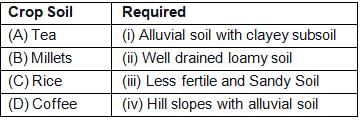
- a)A - iv, B - iii, C - i, D - ii
- b)A - ii, B - iii, C - iv, D - i
- c)A - ii, B - iv, C - i, D - iii
- d)A - iv, B - ii, C - i, D - iii
Correct answer is option 'A'. Can you explain this answer?
Match the Crops with the Soil required by them and accordingly select the correct alternative:
a)
A - iv, B - iii, C - i, D - ii
b)
A - ii, B - iii, C - iv, D - i
c)
A - ii, B - iv, C - i, D - iii
d)
A - iv, B - ii, C - i, D - iii
| | Ravi Sharma answered |
Tea – Hill slopes with alluvial soil
Millets – Less fertile and sandy soil
Rice – Alluvial soil with clayey subsoil
Coffee – well-drained loamy soil
Match the items in Column 1 with those in Column 2, and choose the correct option.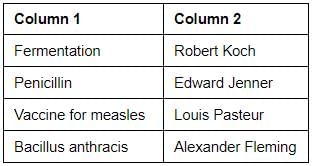

- a)(a)
- b)(b)
- c)(c)
- d)(d)
Correct answer is option 'A'. Can you explain this answer?
Match the items in Column 1 with those in Column 2, and choose the correct option.
a)
(a)
b)
(b)
c)
(c)
d)
(d)
| | Suresh Reddy answered |
- The process of conversion of sugar into alcohol is called fermentation. Louis Pasteur discovered fermentation in 1857.
- Penicillin was discovered by Alexander Fleming in 1929. It is an antibiotic which destroys the disease causing organisms.
- Streptomycin, terramycin and erythromycin are some of the commonly used antibiotics; which are produced from fungi and bacteria.
- Vaccine for measles was invented by Edward Jenner in 1798. If dead or inactive microorganisms are injected into the body, then the cells of the body release antibodies according to the microorganisms. This concept is the basis for the production of vaccines. Robert Koch discovered Bacillus anthracis in the year 1876, which is the causative organism of anthrax. Anthrax is a dangerous disease affecting humans and animals.
In the following question, select the related word from the given alternatives.
Steel : Alloy ∷ Zinc : ?- a)Metal
- b)Metalloids
- c)Salt
- d)Noble gas
Correct answer is option 'A'. Can you explain this answer?
In the following question, select the related word from the given alternatives.
Steel : Alloy ∷ Zinc : ?
Steel : Alloy ∷ Zinc : ?
a)
Metal
b)
Metalloids
c)
Salt
d)
Noble gas
| | Shubham Kumar answered |
Steel is an Alloy.
Similarly, Zinc is a Metal.
Hence, Metal is the answer.
Consider the following statements about the nature of Peasant movements after 1857 and choose the correct one?1. Colonialism was the target of these movements2. Territorial reach was limited3. There was no continuity of struggle or long term organization- a)1 and 2 Only
- b)2 and 3 Only
- c)1 and 3 Only
- d)All of them
Correct answer is option 'B'. Can you explain this answer?
Consider the following statements about the nature of Peasant movements after 1857 and choose the correct one?
1. Colonialism was the target of these movements
2. Territorial reach was limited
3. There was no continuity of struggle or long term organization
a)
1 and 2 Only
b)
2 and 3 Only
c)
1 and 3 Only
d)
All of them
| | Vikram Verma answered |
Changed Nature of Peasant Movements after 1857
• Peasants emerged as the main force in agrarian movements, fighting directly for their own demands.
• The demands were centred almost wholly on economic issues.
• The movements were directed against the immediate enemies of the peasant-foreign planters and indigenous zamindars and moneylenders.
• The struggles were directed towards specific and limited objectives and redressal of particular grievances.
• Colonialism was not the target of these movements.
• It was not the objective of these movements to end the subordination or exploitation of the peasants.
• Territorial reach was limited.
• There was no continuity of struggle or long-term organization
• The peasants developed a strong awareness of their legal rights and asserted them in and outside the courts
Consider the following statements.1. The All India Kisan Sabha was founded by Gauri Shankar Mishra and Indra Narayan Dwivedi2. The Congress Manifesto for the 1937 provincial elections was strongly influenced by the Awadh Kisan SabhaWhich of these statements are correct?- a)1 Only
- b)2 Only
- c)Both of them
- d)Neither of them
Correct answer is option 'D'. Can you explain this answer?
Consider the following statements.
1. The All India Kisan Sabha was founded by Gauri Shankar Mishra and Indra Narayan Dwivedi
2. The Congress Manifesto for the 1937 provincial elections was strongly influenced by the Awadh Kisan Sabha
Which of these statements are correct?
a)
1 Only
b)
2 Only
c)
Both of them
d)
Neither of them
| | Asha Banerjee answered |
The correct answer is option 'D', neither of them.
- The All India Kisan Sabha was actually founded by Swami Sahajanand Saraswati and N.G. Ranga in 1936. Gauri Shankar Mishra and Indra Narayan Dwivedi were not involved in its founding. The All India Kisan Sabha was a prominent peasant organization that aimed to address the issues and concerns of farmers and peasants across the country. It played a significant role in the peasant movements and struggles during the pre-independence period.
- The Congress Manifesto for the 1937 provincial elections was not strongly influenced by the Awadh Kisan Sabha. The Awadh Kisan Sabha was a peasant organization in Awadh region of Uttar Pradesh, led by Baba Ramchandra. While it did have some influence in the region, it did not have a significant impact on the Congress Manifesto for the 1937 elections. The Congress Manifesto was primarily guided by the policies and ideologies of the Indian National Congress, which aimed for a democratic and inclusive governance system.
Therefore, both statements are incorrect. The All India Kisan Sabha was founded by Swami Sahajanand Saraswati and N.G. Ranga, not Gauri Shankar Mishra and Indra Narayan Dwivedi. The Congress Manifesto for the 1937 elections was not strongly influenced by the Awadh Kisan Sabha, but rather by the ideologies and policies of the Indian National Congress.
In conclusion, it is important to verify the accuracy of statements before accepting them as true. In this case, both statements are incorrect, highlighting the need for factual accuracy and research in understanding historical events and organizations.
- The All India Kisan Sabha was actually founded by Swami Sahajanand Saraswati and N.G. Ranga in 1936. Gauri Shankar Mishra and Indra Narayan Dwivedi were not involved in its founding. The All India Kisan Sabha was a prominent peasant organization that aimed to address the issues and concerns of farmers and peasants across the country. It played a significant role in the peasant movements and struggles during the pre-independence period.
- The Congress Manifesto for the 1937 provincial elections was not strongly influenced by the Awadh Kisan Sabha. The Awadh Kisan Sabha was a peasant organization in Awadh region of Uttar Pradesh, led by Baba Ramchandra. While it did have some influence in the region, it did not have a significant impact on the Congress Manifesto for the 1937 elections. The Congress Manifesto was primarily guided by the policies and ideologies of the Indian National Congress, which aimed for a democratic and inclusive governance system.
Therefore, both statements are incorrect. The All India Kisan Sabha was founded by Swami Sahajanand Saraswati and N.G. Ranga, not Gauri Shankar Mishra and Indra Narayan Dwivedi. The Congress Manifesto for the 1937 elections was not strongly influenced by the Awadh Kisan Sabha, but rather by the ideologies and policies of the Indian National Congress.
In conclusion, it is important to verify the accuracy of statements before accepting them as true. In this case, both statements are incorrect, highlighting the need for factual accuracy and research in understanding historical events and organizations.
Which of the following is produced by yeast through respiration, when it is mixed with food items?- a)Oxygen
- b)Carbon dioxide
- c)Nitrogen
- d)None of these
Correct answer is option 'B'. Can you explain this answer?
Which of the following is produced by yeast through respiration, when it is mixed with food items?
a)
Oxygen
b)
Carbon dioxide
c)
Nitrogen
d)
None of these
| | Sanjay Rana answered |
Once mixed with food items, yeast multiplies quickly to give out carbon dioxide through respiration. Carbon dioxide bubbles enhance the volume of the food item. Yeast is used in the baking industry, to make bread, pastry, cake, etc.
Which one of the following pairs is incorrect?Aspergillosis - Fungi.- a)Rust of wheat - fungi
- b)Citrus canker - bacteria
- c)Yellow vein mosaic - Virus
- d)Aspergillosis –Bacteria
Correct answer is option 'D'. Can you explain this answer?
Which one of the following pairs is incorrect?
Aspergillosis - Fungi.
a)
Rust of wheat - fungi
b)
Citrus canker - bacteria
c)
Yellow vein mosaic - Virus
d)
Aspergillosis –Bacteria
| | Pranjal Chatterjee answered |
Incorrect Pair: Aspergillosis - Bacteria
Aspergillosis is a fungal infection caused by the Aspergillus fungi. It can affect the respiratory system, skin, and other organs of the body. This infection is commonly found in people with weakened immune systems, such as those with HIV/AIDS, cancer, or those who have undergone organ transplants.
Explanation:
Fungal infections are caused by fungi and not bacteria, and Aspergillosis is a fungal infection. Therefore, the pair of Aspergillosis and bacteria is incorrect.
Correct Pairs:
- Rust of wheat - Fungi: Rust of wheat is a fungal disease caused by Puccinia species of fungi. It affects the leaves, stems, and grains of wheat plants, causing a reduction in crop yield.
- Citrus canker - Bacteria: Citrus canker is a bacterial disease caused by the bacterium Xanthomonas axonopodis. It affects the leaves, fruits, and twigs of citrus trees, causing blemishes and fruit drop.
- Yellow vein mosaic - Virus: Yellow vein mosaic is a viral disease that affects a variety of crops, including okra, tomato, and beans. It is caused by various species of begomoviruses and can result in stunted growth, yellowing of leaves, and reduced crop yield.
Conclusion:
It is essential to understand the causative agent of any disease to diagnose and treat it correctly. A misdiagnosed disease can lead to ineffective treatment and further complications. Therefore, it is crucial to have proper knowledge of the causative agents of different diseases.
Aspergillosis is a fungal infection caused by the Aspergillus fungi. It can affect the respiratory system, skin, and other organs of the body. This infection is commonly found in people with weakened immune systems, such as those with HIV/AIDS, cancer, or those who have undergone organ transplants.
Explanation:
Fungal infections are caused by fungi and not bacteria, and Aspergillosis is a fungal infection. Therefore, the pair of Aspergillosis and bacteria is incorrect.
Correct Pairs:
- Rust of wheat - Fungi: Rust of wheat is a fungal disease caused by Puccinia species of fungi. It affects the leaves, stems, and grains of wheat plants, causing a reduction in crop yield.
- Citrus canker - Bacteria: Citrus canker is a bacterial disease caused by the bacterium Xanthomonas axonopodis. It affects the leaves, fruits, and twigs of citrus trees, causing blemishes and fruit drop.
- Yellow vein mosaic - Virus: Yellow vein mosaic is a viral disease that affects a variety of crops, including okra, tomato, and beans. It is caused by various species of begomoviruses and can result in stunted growth, yellowing of leaves, and reduced crop yield.
Conclusion:
It is essential to understand the causative agent of any disease to diagnose and treat it correctly. A misdiagnosed disease can lead to ineffective treatment and further complications. Therefore, it is crucial to have proper knowledge of the causative agents of different diseases.
Monoculture is a distinct characteristic of- a)Commercial grain farming
- b)Shifting cultivation
- c)Subsistence farming
- d)Organic farming
Correct answer is option 'A'. Can you explain this answer?
Monoculture is a distinct characteristic of
a)
Commercial grain farming
b)
Shifting cultivation
c)
Subsistence farming
d)
Organic farming
| | Ananya Deshmukh answered |
Monoculture is a distinct characteristic of commercial grain farming. Monoculture is the agricultural practise of producing or growing a single crop or plant species over a wide area and for a large number of consecutive years.
Match column I with column II and select the correct answer using the code given below the columns: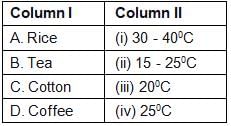
- a)A (i), B (ii), C (iii), D (iv)
- b)A (iii), B (iv), C (i), D (ii)
- c)A (ii), B (i), C (iv), D (iii)
- d)A (i), B (iii), C (iv), D (ii)
Correct answer is option 'C'. Can you explain this answer?
Match column I with column II and select the correct answer using the code given below the columns:
a)
A (i), B (ii), C (iii), D (iv)
b)
A (iii), B (iv), C (i), D (ii)
c)
A (ii), B (i), C (iv), D (iii)
d)
A (i), B (iii), C (iv), D (ii)
| | Ravi Sharma answered |
Rice is produced under 15 - 25̊ C, Tea is produced under 30 – 40 ̊ C, Cotton is produced under 25 ̊ C while coffee is produced under 20 ̊ C.
Chapter doubts & questions for November Week 4 - Weekly Tests for UPSC Preparation 2026 is part of UPSC CSE exam preparation. The chapters have been prepared according to the UPSC CSE exam syllabus. The Chapter doubts & questions, notes, tests & MCQs are made for UPSC CSE 2026 Exam. Find important definitions, questions, notes, meanings, examples, exercises, MCQs and online tests here.
Chapter doubts & questions of November Week 4 - Weekly Tests for UPSC Preparation in English & Hindi are available as part of UPSC CSE exam. Download more important topics, notes, lectures and mock test series for UPSC CSE Exam by signing up for free.
