


All Exams > UPSC > Weekly Tests for UPSC Preparation > All Questions
All questions of April Week 2 for UPSC CSE Exam
From which of the following part of a plant opium is obtained?- a)Dried leaves
- b)Dried latex
- c)Roots
- d)Stem bark
Correct answer is option 'B'. Can you explain this answer?
From which of the following part of a plant opium is obtained?
a)
Dried leaves
b)
Dried latex
c)
Roots
d)
Stem bark
 | Nishanth Jain answered |
Opium is the dried latex obtained from the opium poppy

Scattered settlements are found in- a)Bangladesh.
- b)Japan.
- c)Australia.
- d)India.
Correct answer is option 'C'. Can you explain this answer?
Scattered settlements are found in
a)
Bangladesh.
b)
Japan.
c)
Australia.
d)
India.
 | Hrishikesh Jain answered |
As the pressure of population is low; thus, man land ratio is very high, people live in large houses.
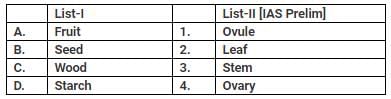
- a)A-2; B-1; C-3; D- 4
- b) A-4; B-1; C-3; D-2
- c) A-2; B-3; C-1; D-4
- d) A-4; B-3; C-1; D-2
Correct answer is option 'B'. Can you explain this answer?
a)
A-2; B-1; C-3; D- 4
b)
A-4; B-1; C-3; D-2
c)
A-2; B-3; C-1; D-4
d)
A-4; B-3; C-1; D-2
| | Sharad Chavan answered |
1. fruits is made up of ovary
2. seed is made up of ovule
3. wood is made up of stem
4. starch is present in leaf
so the correct answer is B.
2. seed is made up of ovule
3. wood is made up of stem
4. starch is present in leaf
so the correct answer is B.
Main function of lenticel is- a) transpiration
- b) guttation
- c) gaseous exchange
- d) both [a] & [c]
Correct answer is option 'C'. Can you explain this answer?
Main function of lenticel is
a)
transpiration
b)
guttation
c)
gaseous exchange
d)
both [a] & [c]
 | Shreya Desai answered |
The lenticels functions as a pore, providing a pathway for the direct exchange of gasesbetween the internal tissues and atmosphere through the bark, which is otherwise impermeable to gases.The lenticels help in the gaseous exchange between the atmosphere and the internal tissue of the stem. The lenticels also helps in transpiration called as the lenticular transpiration.Lenticels are a portions of periderm with numerous intercellular spaces and loosely organized cells
Cloves, used as a spice, are derived from which of the following plant parts? - a) Seeds
- b) Fruits
- c) Flower buds
- d) Young leaves
Correct answer is option 'C'. Can you explain this answer?
Cloves, used as a spice, are derived from which of the following plant parts?
a)
Seeds
b)
Fruits
c)
Flower buds
d)
Young leaves
| | Janhavi Bajaj answered |
Cloves are the rich, brown, dried, unopened flower buds of Syzygium aromaticum, an evergreen tree in the myrtle family. The name comes from the French "clou" meaning nail. Cloves come from Madagascar, Indonesia and Sri Lanka. Cloves are used in spice cookies and cakes.
Total number of ATP consume during Kreb's cycle is- a) 0
- b) 1
- c) 2
- d) 3
Correct answer is option 'C'. Can you explain this answer?
Total number of ATP consume during Kreb's cycle is
a)
0
b)
1
c)
2
d)
3
| | Saranya Basak answered |
The Krebs cycle produces two molecules of ATP for every molecule of glucose. The Krebs cycle also produces eight molecules of NADH and two molecules of FADH2 per molecule of glucose.
Which plant kingdom can survive both on land and in water?- a)Tracheophyta
- b)Pteridophyta
- c)Thallophyta
- d)Bryophyta
Correct answer is option 'D'. Can you explain this answer?
Which plant kingdom can survive both on land and in water?
a)
Tracheophyta
b)
Pteridophyta
c)
Thallophyta
d)
Bryophyta
| | Nidhi Pillai answered |
The sperm of bryophyte (antherozoids) are flagellate and need water to swim to the eggs. In other words, as these plants need water for reproduction unlike other plants, they are called as amphibians. Amphibians are those organisms which live on both land and in water.
Which one of the following types of activities dominate in a rural settlement?- a)Primary
- b)Tertiary
- c)Secondary
- d)Quaternary
Correct answer is option 'A'. Can you explain this answer?
Which one of the following types of activities dominate in a rural settlement?
a)
Primary
b)
Tertiary
c)
Secondary
d)
Quaternary
 | Swara Patel answered |
People are involved in primary activites.
Which one of the following plant nutrients is not supplemented in the soil for growing legumes?- a)Nitrogen
- b)Potassium
- c)Phosphorus
- d)None of these
Correct answer is option 'B'. Can you explain this answer?
Which one of the following plant nutrients is not supplemented in the soil for growing legumes?
a)
Nitrogen
b)
Potassium
c)
Phosphorus
d)
None of these
| | Avantika Mukherjee answered |
- Growing legume cover crops is one of the most important tools for increasing soil fertility in an organic garden.
- The bacteria take gaseous nitrogen from the air in the soil and feed this nitrogen to the legumes; in exchange the plant provides carbohydrates to the bacteria.
- The bacteria take gaseous nitrogen from the air in the soil and feed this nitrogen to the legumes; in exchange the plant provides carbohydrates to the bacteria.
Which one of the following statements is not an explanation of the general characteristics of a pressure group? - a)A major objective of a pressure group is to acquire, consolidate and extend political power.
- b)A pressure group aims at projecting and fulfilling specific interests.
- c)A pressure group seeks to influence decision-makers in a manner favourable to its specific interests.
- d)A pressure group is generally too limited in its organisation and goals to be mistaken for a bonafide political party.
Correct answer is option 'A'. Can you explain this answer?
Which one of the following statements is not an explanation of the general characteristics of a pressure group?
a)
A major objective of a pressure group is to acquire, consolidate and extend political power.
b)
A pressure group aims at projecting and fulfilling specific interests.
c)
A pressure group seeks to influence decision-makers in a manner favourable to its specific interests.
d)
A pressure group is generally too limited in its organisation and goals to be mistaken for a bonafide political party.
 | Simran Mehta answered |
Explanation of the correct answer:
Pressure groups are not primarily focused on acquiring, consolidating, and extending political power. Their main goal is to influence decision-makers in favor of their specific interests rather than seeking political power for themselves. Here's a breakdown of the characteristics of a pressure group:
A major objective of a pressure group is to acquire, consolidate and extend political power:
- Pressure groups do not aim to acquire political power themselves but rather seek to influence those in power to align with their interests.
- They often use various tactics such as lobbying, public campaigns, and advocacy to achieve their goals.
A pressure group aims at projecting and fulfilling specific interests:
- Pressure groups represent specific interests such as environmental protection, labor rights, or business interests.
- They work to advance these interests through influencing policy decisions and shaping public opinion.
A pressure group seeks to influence decision-makers in a manner favorable to its specific interests:
- The main purpose of a pressure group is to influence policymakers, lawmakers, and other decision-makers to support their causes.
- They use various strategies to make their voices heard and push for policies that benefit their members or constituents.
A pressure group is generally too limited in its organization and goals to be mistaken for a bonafide political party:
- Pressure groups are usually focused on specific issues or interests and do not have the broad platform or goals of a political party.
- They do not seek to govern or hold political office but rather work to influence the political process from the outside.
Pressure groups are not primarily focused on acquiring, consolidating, and extending political power. Their main goal is to influence decision-makers in favor of their specific interests rather than seeking political power for themselves. Here's a breakdown of the characteristics of a pressure group:
A major objective of a pressure group is to acquire, consolidate and extend political power:
- Pressure groups do not aim to acquire political power themselves but rather seek to influence those in power to align with their interests.
- They often use various tactics such as lobbying, public campaigns, and advocacy to achieve their goals.
A pressure group aims at projecting and fulfilling specific interests:
- Pressure groups represent specific interests such as environmental protection, labor rights, or business interests.
- They work to advance these interests through influencing policy decisions and shaping public opinion.
A pressure group seeks to influence decision-makers in a manner favorable to its specific interests:
- The main purpose of a pressure group is to influence policymakers, lawmakers, and other decision-makers to support their causes.
- They use various strategies to make their voices heard and push for policies that benefit their members or constituents.
A pressure group is generally too limited in its organization and goals to be mistaken for a bonafide political party:
- Pressure groups are usually focused on specific issues or interests and do not have the broad platform or goals of a political party.
- They do not seek to govern or hold political office but rather work to influence the political process from the outside.
Which one of the following is the primary purpose of a pressure group? - a)To criticise the government
- b)To contest the elections
- c)To formulate policy
- d)To bring pressure on government to influence policy decision
Correct answer is option 'D'. Can you explain this answer?
Which one of the following is the primary purpose of a pressure group?
a)
To criticise the government
b)
To contest the elections
c)
To formulate policy
d)
To bring pressure on government to influence policy decision
 | Ojasvi Mehta answered |
The pressure groups influence the policymaking and policy implementation in the government through legal and legitimate methods like lobbying, correspondence, publicity, propagandising, petitioning, public debating, maintaining contacts with their legislators and so forth.
Fungi are plants that lack:- a)Oxygen
- b)Carbon dioxide
- c)Chlorophyll
- d)None of these
Correct answer is option 'C'. Can you explain this answer?
Fungi are plants that lack:
a)
Oxygen
b)
Carbon dioxide
c)
Chlorophyll
d)
None of these
 | Preethi Chauhan answered |
Fungi are not plants because they lack chlorophyll, which is a key characteristic of plants. Chlorophyll is a pigment found in the chloroplasts of plant cells that is responsible for capturing sunlight and converting it into energy through the process of photosynthesis. Fungi, on the other hand, obtain their nutrients by absorbing organic matter from their environment, such as decaying plant and animal material.
Here is a detailed explanation of why fungi are not plants:
1. Absence of Chlorophyll:
Chlorophyll is essential for plants to carry out photosynthesis, the process by which they convert sunlight into energy. Fungi do not possess chlorophyll and are incapable of performing photosynthesis. Instead, they obtain their energy by breaking down organic matter through the secretion of enzymes and absorbing the resulting nutrients.
2. Mode of Nutrition:
Fungi are heterotrophic organisms, meaning they cannot produce their own food and rely on external sources for nutrients. They are decomposers, playing a crucial role in the ecosystem by breaking down dead organic matter and recycling nutrients. In contrast, plants are autotrophic organisms that can synthesize their own food through photosynthesis.
3. Cell Wall Composition:
The cell walls of fungi are primarily composed of chitin, a tough and flexible polysaccharide. In contrast, the cell walls of plants are composed of cellulose. This difference in cell wall composition is another distinguishing feature between fungi and plants.
4. Reproduction:
Fungi have a unique mode of reproduction that sets them apart from plants. While plants reproduce through seeds or spores produced within flowers or cones, fungi reproduce through the production of spores, which are released into the environment to establish new fungal colonies.
5. Taxonomic Classification:
Fungi belong to the kingdom Fungi, which is distinct from the kingdom Plantae. The kingdom Fungi includes diverse organisms such as mushrooms, yeasts, molds, and lichens. This taxonomic classification further emphasizes the biological differences between fungi and plants.
In conclusion, fungi are not plants because they lack chlorophyll, have a different mode of nutrition, possess cell walls made of chitin, reproduce differently, and are classified in a separate kingdom. These characteristics differentiate fungi from plants and highlight their unique biological features.
Here is a detailed explanation of why fungi are not plants:
1. Absence of Chlorophyll:
Chlorophyll is essential for plants to carry out photosynthesis, the process by which they convert sunlight into energy. Fungi do not possess chlorophyll and are incapable of performing photosynthesis. Instead, they obtain their energy by breaking down organic matter through the secretion of enzymes and absorbing the resulting nutrients.
2. Mode of Nutrition:
Fungi are heterotrophic organisms, meaning they cannot produce their own food and rely on external sources for nutrients. They are decomposers, playing a crucial role in the ecosystem by breaking down dead organic matter and recycling nutrients. In contrast, plants are autotrophic organisms that can synthesize their own food through photosynthesis.
3. Cell Wall Composition:
The cell walls of fungi are primarily composed of chitin, a tough and flexible polysaccharide. In contrast, the cell walls of plants are composed of cellulose. This difference in cell wall composition is another distinguishing feature between fungi and plants.
4. Reproduction:
Fungi have a unique mode of reproduction that sets them apart from plants. While plants reproduce through seeds or spores produced within flowers or cones, fungi reproduce through the production of spores, which are released into the environment to establish new fungal colonies.
5. Taxonomic Classification:
Fungi belong to the kingdom Fungi, which is distinct from the kingdom Plantae. The kingdom Fungi includes diverse organisms such as mushrooms, yeasts, molds, and lichens. This taxonomic classification further emphasizes the biological differences between fungi and plants.
In conclusion, fungi are not plants because they lack chlorophyll, have a different mode of nutrition, possess cell walls made of chitin, reproduce differently, and are classified in a separate kingdom. These characteristics differentiate fungi from plants and highlight their unique biological features.
Consider the following statements.1. A language family includes individual languages related through a common ancestor that existed before the recorded history.2. Dialect is a form of language spoken in a local area3. Only one dialect can be derived from a particular languageWhich of these statements are correct?- a)1 and 2 only
- b)2 and 3 only
- c)1 and 3 only
- d)All of them
Correct answer is option 'A'. Can you explain this answer?
Consider the following statements.
1. A language family includes individual languages related through a common ancestor that existed before the recorded history.
2. Dialect is a form of language spoken in a local area
3. Only one dialect can be derived from a particular language
Which of these statements are correct?
a)
1 and 2 only
b)
2 and 3 only
c)
1 and 3 only
d)
All of them
 | Deepika Ahuja answered |
Explanation:
The correct answer is option 'A' which means statements 1 and 2 are correct, but statement 3 is incorrect. Let's analyze each statement in detail.
Statement 1: A language family includes individual languages related through a common ancestor that existed before the recorded history.
This statement is correct. A language family is a group of languages that are related through a common ancestor. These languages have evolved over time, and their similarities can be traced back to a single ancestral language. However, the common ancestor of these languages typically existed before the recorded history, which means there is no written evidence of its existence.
Statement 2: Dialect is a form of language spoken in a local area.
This statement is also correct. A dialect is a form of a language that is spoken in a particular region or local area. It can differ from the standard or official language in terms of pronunciation, vocabulary, and grammar. Dialects often develop due to geographical isolation or cultural factors. For example, English has various dialects such as British English, American English, Australian English, etc.
Statement 3: Only one dialect can be derived from a particular language.
This statement is incorrect. A language can have multiple dialects. Dialects can vary based on geographical regions, social classes, ethnic groups, and other factors. For example, the English language has numerous dialects, including British English, American English, Canadian English, etc. Each of these dialects has its own distinct features and variations.
Summary:
To summarize, statement 1 and 2 are correct, while statement 3 is incorrect. A language family consists of languages related through a common ancestor, and a dialect is a form of language spoken in a local area. However, a particular language can have multiple dialects, and not just one.
The correct answer is option 'A' which means statements 1 and 2 are correct, but statement 3 is incorrect. Let's analyze each statement in detail.
Statement 1: A language family includes individual languages related through a common ancestor that existed before the recorded history.
This statement is correct. A language family is a group of languages that are related through a common ancestor. These languages have evolved over time, and their similarities can be traced back to a single ancestral language. However, the common ancestor of these languages typically existed before the recorded history, which means there is no written evidence of its existence.
Statement 2: Dialect is a form of language spoken in a local area.
This statement is also correct. A dialect is a form of a language that is spoken in a particular region or local area. It can differ from the standard or official language in terms of pronunciation, vocabulary, and grammar. Dialects often develop due to geographical isolation or cultural factors. For example, English has various dialects such as British English, American English, Australian English, etc.
Statement 3: Only one dialect can be derived from a particular language.
This statement is incorrect. A language can have multiple dialects. Dialects can vary based on geographical regions, social classes, ethnic groups, and other factors. For example, the English language has numerous dialects, including British English, American English, Canadian English, etc. Each of these dialects has its own distinct features and variations.
Summary:
To summarize, statement 1 and 2 are correct, while statement 3 is incorrect. A language family consists of languages related through a common ancestor, and a dialect is a form of language spoken in a local area. However, a particular language can have multiple dialects, and not just one.
Consider the following statements about Apabhramsa.1. Apabhramsa is also an umbrella term which means dialects other than Sanskrit or even Prakrit2. It represents a transition from Middle to Modern Indo-Aryan Group of languagesWhich of these statements is/are correct?- a)1 only
- b)2 only
- c)Both of them
- d)Neither of them
Correct answer is option 'C'. Can you explain this answer?
Consider the following statements about Apabhramsa.
1. Apabhramsa is also an umbrella term which means dialects other than Sanskrit or even Prakrit
2. It represents a transition from Middle to Modern Indo-Aryan Group of languages
Which of these statements is/are correct?
a)
1 only
b)
2 only
c)
Both of them
d)
Neither of them
 | Raghavendra Iyer answered |
Apabhramsa
Introduction:
Apabhramsa is an umbrella term used to refer to a group of dialects that emerged during the transition from Middle to Modern Indo-Aryan languages. It is distinct from both Sanskrit and Prakrit, and it played a significant role in the development of modern Indian languages. Let us analyze the given statements about Apabhramsa:
Statement 1: Apabhramsa is also an umbrella term which means dialects other than Sanskrit or even Prakrit.
This statement is correct. Apabhramsa is a term used to describe the dialects that evolved during the medieval period in India. These dialects were distinct from Sanskrit, which was the classical language, and Prakrit, which was the spoken language during that time. Apabhramsa dialects had their own unique characteristics and were widely spoken in various regions of India.
Statement 2: It represents a transition from Middle to Modern Indo-Aryan Group of languages.
This statement is also correct. Apabhramsa played a crucial role in the transition from Middle Indo-Aryan to Modern Indo-Aryan languages. During this period, the language underwent significant changes in terms of grammar, vocabulary, and phonetics. The dialects that emerged during this transition period eventually evolved into modern Indian languages such as Hindi, Bengali, Gujarati, Punjabi, etc.
Conclusion:
Both statements are correct. Apabhramsa is an umbrella term used to describe dialects other than Sanskrit or Prakrit, and it represents the transition from Middle Indo-Aryan to Modern Indo-Aryan languages. Apabhramsa played a significant role in the development of modern Indian languages and is an important part of India's linguistic heritage.
Introduction:
Apabhramsa is an umbrella term used to refer to a group of dialects that emerged during the transition from Middle to Modern Indo-Aryan languages. It is distinct from both Sanskrit and Prakrit, and it played a significant role in the development of modern Indian languages. Let us analyze the given statements about Apabhramsa:
Statement 1: Apabhramsa is also an umbrella term which means dialects other than Sanskrit or even Prakrit.
This statement is correct. Apabhramsa is a term used to describe the dialects that evolved during the medieval period in India. These dialects were distinct from Sanskrit, which was the classical language, and Prakrit, which was the spoken language during that time. Apabhramsa dialects had their own unique characteristics and were widely spoken in various regions of India.
Statement 2: It represents a transition from Middle to Modern Indo-Aryan Group of languages.
This statement is also correct. Apabhramsa played a crucial role in the transition from Middle Indo-Aryan to Modern Indo-Aryan languages. During this period, the language underwent significant changes in terms of grammar, vocabulary, and phonetics. The dialects that emerged during this transition period eventually evolved into modern Indian languages such as Hindi, Bengali, Gujarati, Punjabi, etc.
Conclusion:
Both statements are correct. Apabhramsa is an umbrella term used to describe dialects other than Sanskrit or Prakrit, and it represents the transition from Middle Indo-Aryan to Modern Indo-Aryan languages. Apabhramsa played a significant role in the development of modern Indian languages and is an important part of India's linguistic heritage.
Consider the following statements about ancient Indian languages.1. Pali was widely spoken in Magadha.2. The Tripitaka of Buddhism were also written in Pali.3. Among the Dravidian group, Kannada is the oldest language.Which of the above statements is/are correct?- a)1, 3
- b)1, 2
- c)2, 3
- d)1, 2, 3
Correct answer is option 'B'. Can you explain this answer?
Consider the following statements about ancient Indian languages.
1. Pali was widely spoken in Magadha.
2. The Tripitaka of Buddhism were also written in Pali.
3. Among the Dravidian group, Kannada is the oldest language.
Which of the above statements is/are correct?
a)
1, 3
b)
1, 2
c)
2, 3
d)
1, 2, 3
 | Suyash Unni answered |
Explanation:
The correct answer is option 'B' (1, 2).
Statement 1: Pali was widely spoken in Magadha.
Pali was an ancient language closely related to Sanskrit. It was widely spoken in Magadha, which was an important region in ancient India. Magadha was the center of political and cultural activities during the time of the Buddha, and Pali was the language used by the Buddha and his disciples to communicate and propagate his teachings.
Statement 2: The Tripitaka of Buddhism were also written in Pali.
The Tripitaka is the sacred scripture of Buddhism, and it is written in Pali. The Tripitaka consists of three parts - the Vinaya Pitaka (rules for monastic discipline), the Sutta Pitaka (discourses of the Buddha), and the Abhidhamma Pitaka (philosophical and psychological analysis). These texts were initially passed down orally, but they were later written down in Pali.
Statement 3: Among the Dravidian group, Kannada is the oldest language.
This statement is incorrect. Among the Dravidian languages, Tamil is considered to be the oldest language. Tamil has a rich literary tradition dating back more than 2,000 years, and it is one of the classical languages of India. Kannada, on the other hand, is also a Dravidian language, but it is not the oldest language in the group.
To summarize:
- Pali was widely spoken in Magadha, an important region in ancient India.
- The Tripitaka, the sacred scripture of Buddhism, was written in Pali.
- Kannada is not the oldest language among the Dravidian group; Tamil holds that distinction.
Therefore, the correct statements are 1 and 2, making option 'B' the correct answer.
The correct answer is option 'B' (1, 2).
Statement 1: Pali was widely spoken in Magadha.
Pali was an ancient language closely related to Sanskrit. It was widely spoken in Magadha, which was an important region in ancient India. Magadha was the center of political and cultural activities during the time of the Buddha, and Pali was the language used by the Buddha and his disciples to communicate and propagate his teachings.
Statement 2: The Tripitaka of Buddhism were also written in Pali.
The Tripitaka is the sacred scripture of Buddhism, and it is written in Pali. The Tripitaka consists of three parts - the Vinaya Pitaka (rules for monastic discipline), the Sutta Pitaka (discourses of the Buddha), and the Abhidhamma Pitaka (philosophical and psychological analysis). These texts were initially passed down orally, but they were later written down in Pali.
Statement 3: Among the Dravidian group, Kannada is the oldest language.
This statement is incorrect. Among the Dravidian languages, Tamil is considered to be the oldest language. Tamil has a rich literary tradition dating back more than 2,000 years, and it is one of the classical languages of India. Kannada, on the other hand, is also a Dravidian language, but it is not the oldest language in the group.
To summarize:
- Pali was widely spoken in Magadha, an important region in ancient India.
- The Tripitaka, the sacred scripture of Buddhism, was written in Pali.
- Kannada is not the oldest language among the Dravidian group; Tamil holds that distinction.
Therefore, the correct statements are 1 and 2, making option 'B' the correct answer.
Consider the following statements about the Old Indo-Aryan Group.1. This group had its development around 1500 B.C2. Sanskrit was born out of this groupWhich of these statements are correct?- a)1 only
- b)2 only
- c)Both of them
- d)Neither of them
Correct answer is option 'C'. Can you explain this answer?
Consider the following statements about the Old Indo-Aryan Group.
1. This group had its development around 1500 B.C
2. Sanskrit was born out of this group
Which of these statements are correct?
a)
1 only
b)
2 only
c)
Both of them
d)
Neither of them
 | Deepak Kapoor answered |
Old Indo-Aryan Group:
- This group had its development around 1500 B.C., and Sanskrit was born out of this group. The ancient form of Sanskrit is what we find in the Vedas. Even Upanishads, Puranas and Dharmasutras, were all written in Sanskrit. It can be said that Sanskrit is the mother of many Indian languages.
- Understanding the diversity and richness of our culture has been possible all because of the development of Sanskrit language during those times. It is the most ancient language of our country and is one of the 22 scheduled languages listed in the Constitution.
Which of the following languages are not included originally in the 8th schedule?1. Kannada2. Nepali3. SanthaliChoose from the following options.- a)1 and 2 only
- b)2 and 3 only
- c)1 and 3 only
- d)All of them
Correct answer is option 'B'. Can you explain this answer?
Which of the following languages are not included originally in the 8th schedule?
1. Kannada
2. Nepali
3. Santhali
Choose from the following options.
a)
1 and 2 only
b)
2 and 3 only
c)
1 and 3 only
d)
All of them
 | Vikram Kapoor answered |
- Later Sindhi was added as the 15th language through the 21st Amendment Act of 1967. 71stnAmendment Act, 1992 added three more languages.
- They are Konkani, Manipuri, and Nepali. 92nd Amendment Act, 2003 added four more languages to the Eighth Schedule. They are Bodo, Maithili, Dogri and Santhali.
- At present, there are 22 languages in total listed under the eighth schedule of the Indian Constitution.
In India scattered settlements are found in :- a)Himachal Pradesh
- b)Uttar Pradesh
- c)Tamil Nadu
- d)Punjab
Correct answer is option 'A'. Can you explain this answer?
In India scattered settlements are found in :
a)
Himachal Pradesh
b)
Uttar Pradesh
c)
Tamil Nadu
d)
Punjab
| | Soumya Bose answered |
Hilly topography and uneven terrain is the major reason responsible for scattered settlement in Himachal Pradesh.
In the fertile lands, we found settlements of- a)nucleated.
- b)linear.
- c)compact.
- d)isolated.
Correct answer is option 'C'. Can you explain this answer?
In the fertile lands, we found settlements of
a)
nucleated.
b)
linear.
c)
compact.
d)
isolated.
 | Harsh Chawla answered |
Compact settlements are those where spacing between houses as well as settlements is very less.
The largest slum of Asia is- a)Kalkaji.
- b)Dharavi.
- c)Fujiyama.
- d)Atambo.
Correct answer is option 'B'. Can you explain this answer?
The largest slum of Asia is
a)
Kalkaji.
b)
Dharavi.
c)
Fujiyama.
d)
Atambo.
| | Sanskriti Deshpande answered |
Dharavi, in Mumbai (India) is the largest and highly populated slum area in Asia, with 1 million people.
Cork is formed from- a) phellogen
- b) vascular cambium
- c) phloem
- d) xylem
Correct answer is option 'A'. Can you explain this answer?
Cork is formed from
a)
phellogen
b)
vascular cambium
c)
phloem
d)
xylem
| | Akanksha Ahuja answered |
The meristematic cell layer which is responsible for the development of the periderm is called phelloge. It produces cells both in and outwards. Cells which grow inwards will be phelloderm, and cells which develop outwards will be phellem or cork
A yellow dust appears on the fingers, whenever we touch the middle of a flower. These tiny yellow grains are one of the most precious substances in nature because they contain the secret of plant life. What is this dust called?- a)Pollen
- b)Sperm
- c)Spore
- d)Sporocyst
Correct answer is option 'A'. Can you explain this answer?
A yellow dust appears on the fingers, whenever we touch the middle of a flower. These tiny yellow grains are one of the most precious substances in nature because they contain the secret of plant life. What is this dust called?
a)
Pollen
b)
Sperm
c)
Spore
d)
Sporocyst
| | Aashna Singh answered |
The yellow powder is called pollen and the stick that holds it is known as stamen.
A plant that has seeds but no flowers and fruits?- a)Bryophyte
- b)Gymnosperms
- c)Mosses
- d)Pteridophyte
Correct answer is option 'B'. Can you explain this answer?
A plant that has seeds but no flowers and fruits?
a)
Bryophyte
b)
Gymnosperms
c)
Mosses
d)
Pteridophyte
| | Saanvi Iyer answered |
Gymnosperms evolved to have seeds but do not have flowers. Examples of gymnosperms include the Redwood, Fir, and Cypress trees. Gymnos means "naked" in Greek; the seeds of gymnosperms are naked, not protected by flowers. Flowering plants, or angiosperms, evolved to have vascular tissue, seeds, and flowers.
The following form of settlement develop along either side of roads, rivers etc, namely,- a)circular.
- b)linear.
- c)cross shaped.
- d)square.
Correct answer is option 'B'. Can you explain this answer?
The following form of settlement develop along either side of roads, rivers etc, namely,
a)
circular.
b)
linear.
c)
cross shaped.
d)
square.
 | Aniket Khanna answered |
In such settlements, houses are located along a road, railway line, river, canal edge of a valley or along a levee.
What is the primary goal of the Convention on Biological Diversity (CBD)?- a)To regulate international trade in endangered species.
- b)To protect human health from hazardous chemicals.
- c)To promote sustainable management of wetlands.
- d)To conserve biological diversity and ensure the fair use of genetic resources.
Correct answer is option 'D'. Can you explain this answer?
a)
To regulate international trade in endangered species.
b)
To protect human health from hazardous chemicals.
c)
To promote sustainable management of wetlands.
d)
To conserve biological diversity and ensure the fair use of genetic resources.
 | Divey Sethi answered |
The primary goal of the Convention on Biological Diversity (CBD) is to conserve biological diversity and ensure the fair and equitable use of genetic resources. This convention recognizes the importance of preserving the variety of life on Earth and promoting the sustainable use of its components. It addresses issues related to ecosystems, species, and genetic resources to protect our planet's biodiversity.
Which of the following languages is/are the national language of India?- a)Hindi
- b)English
- c)Both Hindi and English
- d)There is no National language in India.
Correct answer is option 'D'. Can you explain this answer?
Which of the following languages is/are the national language of India?
a)
Hindi
b)
English
c)
Both Hindi and English
d)
There is no National language in India.
| | Kavita Mehta answered |
Hindi and English are the official languages of India
Compact settlements are found in- a)mountains areas.
- b)plateau and hilly regions.
- c)river valleys and plains.
- d)forested areas.
Correct answer is option 'C'. Can you explain this answer?
Compact settlements are found in
a)
mountains areas.
b)
plateau and hilly regions.
c)
river valleys and plains.
d)
forested areas.
| | Simran Rane answered |
Compact settlements are found in river valleys and plains because of the availability of water, plain surface and fertile soils.
What is/are the criteria to determine the eligibility of languages to be considered for classification as a "classical language"?1. High antiquity of its early texts/recorded history over a period of 150-200 years.2. The literary tradition is original and not borrowed from another speech community.3. A body of ancient literature/texts, which is considered a valuable heritage by generations of speakers.Which of the statements given above is/are correct?- a)1 only
- b)3 only
- c)2 and 3 only
- d)1, 2 and 3
Correct answer is option 'C'. Can you explain this answer?
What is/are the criteria to determine the eligibility of languages to be considered for classification as a "classical language"?
1. High antiquity of its early texts/recorded history over a period of 150-200 years.
2. The literary tradition is original and not borrowed from another speech community.
3. A body of ancient literature/texts, which is considered a valuable heritage by generations of speakers.
Which of the statements given above is/are correct?
a)
1 only
b)
3 only
c)
2 and 3 only
d)
1, 2 and 3
 | Sandeep Dasgupta answered |
The correct answer is option 'C' - 2 and 3 only.
Explanation:
To be classified as a "classical language," a language must meet certain criteria. These criteria are as follows:
1. High antiquity of its early texts/recorded history over a period of 150-200 years:
- The language must have a long history, with early texts or recorded history that spans a significant period of time, typically around 150-200 years. This requirement ensures that the language has a rich literary and cultural heritage that has been developed and preserved over an extended period.
2. The literary tradition is original and not borrowed from another speech community:
- The language's literary tradition should be indigenous and not borrowed or heavily influenced by another speech community. This criterion emphasizes the uniqueness and originality of the language's literary works, which are considered as an important aspect of its classical status.
3. A body of ancient literature/texts, which is considered a valuable heritage by generations of speakers:
- The language should possess a substantial body of ancient literature or texts that are highly regarded and valued by generations of speakers. This literature is considered a cultural and intellectual heritage that reflects the language's richness, depth, and contribution to human knowledge and understanding.
Based on these criteria, the correct answer is 'C' - 2 and 3 only. The first statement is incorrect because it only mentions the high antiquity of early texts but does not consider the required time period of 150-200 years.
Explanation:
To be classified as a "classical language," a language must meet certain criteria. These criteria are as follows:
1. High antiquity of its early texts/recorded history over a period of 150-200 years:
- The language must have a long history, with early texts or recorded history that spans a significant period of time, typically around 150-200 years. This requirement ensures that the language has a rich literary and cultural heritage that has been developed and preserved over an extended period.
2. The literary tradition is original and not borrowed from another speech community:
- The language's literary tradition should be indigenous and not borrowed or heavily influenced by another speech community. This criterion emphasizes the uniqueness and originality of the language's literary works, which are considered as an important aspect of its classical status.
3. A body of ancient literature/texts, which is considered a valuable heritage by generations of speakers:
- The language should possess a substantial body of ancient literature or texts that are highly regarded and valued by generations of speakers. This literature is considered a cultural and intellectual heritage that reflects the language's richness, depth, and contribution to human knowledge and understanding.
Based on these criteria, the correct answer is 'C' - 2 and 3 only. The first statement is incorrect because it only mentions the high antiquity of early texts but does not consider the required time period of 150-200 years.
Which of the following is the ancient form of modern Sinhala language of Sri Lanka?- a)Pali
- b)Magadhi Prakrit
- c)Shauraseni
- d)Elu
Correct answer is option 'D'. Can you explain this answer?
Which of the following is the ancient form of modern Sinhala language of Sri Lanka?
a)
Pali
b)
Magadhi Prakrit
c)
Shauraseni
d)
Elu
| | Maya Choudhary answered |
Ancient Form of Modern Sinhala Language of Sri Lanka: Elu
Elu is considered to be the ancient form of the modern Sinhala language of Sri Lanka. It is believed to have been spoken during the pre-Buddhist period in Sri Lanka, dating back to around the 2nd century BCE. Elu played a significant role in the development of the Sinhala language and its literature.
Here are some key points about Elu:
1. Linguistic Origins: Elu is classified as a Prakrit language, which is a group of Middle Indo-Aryan languages. It is believed to have evolved from the Magadhi Prakrit, which was widely spoken in ancient India.
2. Influence of Elu: Elu had a significant influence on the development of the Sinhala language. It contributed to the vocabulary, grammar, and phonetics of Sinhala. Many words and constructions from Elu are still present in modern Sinhala.
3. Literary Importance: Elu was the language used in the ancient Sri Lankan literary works. It was used in inscriptions, rock edicts, and religious texts. Elu inscriptions can be found in various parts of Sri Lanka, including Anuradhapura, Polonnaruwa, and Sigiriya.
4. Transition to Modern Sinhala: Over time, Elu gradually transformed into what is known as the Old Sinhala language during the 6th to 12th centuries CE. Old Sinhala, in turn, evolved into the modern Sinhala language spoken today in Sri Lanka.
5. Script: Elu was written using the Brahmi script, which was the writing system used in ancient India and Sri Lanka. The Brahmi script eventually evolved into the Sinhala script, which is used to write both Sinhala and Elu.
In conclusion, Elu is the ancient form of the modern Sinhala language of Sri Lanka. It played a crucial role in the development of Sinhala and was the language used in ancient Sri Lankan literary works. Elu's influence can still be seen in the vocabulary and grammar of modern Sinhala.
Elu is considered to be the ancient form of the modern Sinhala language of Sri Lanka. It is believed to have been spoken during the pre-Buddhist period in Sri Lanka, dating back to around the 2nd century BCE. Elu played a significant role in the development of the Sinhala language and its literature.
Here are some key points about Elu:
1. Linguistic Origins: Elu is classified as a Prakrit language, which is a group of Middle Indo-Aryan languages. It is believed to have evolved from the Magadhi Prakrit, which was widely spoken in ancient India.
2. Influence of Elu: Elu had a significant influence on the development of the Sinhala language. It contributed to the vocabulary, grammar, and phonetics of Sinhala. Many words and constructions from Elu are still present in modern Sinhala.
3. Literary Importance: Elu was the language used in the ancient Sri Lankan literary works. It was used in inscriptions, rock edicts, and religious texts. Elu inscriptions can be found in various parts of Sri Lanka, including Anuradhapura, Polonnaruwa, and Sigiriya.
4. Transition to Modern Sinhala: Over time, Elu gradually transformed into what is known as the Old Sinhala language during the 6th to 12th centuries CE. Old Sinhala, in turn, evolved into the modern Sinhala language spoken today in Sri Lanka.
5. Script: Elu was written using the Brahmi script, which was the writing system used in ancient India and Sri Lanka. The Brahmi script eventually evolved into the Sinhala script, which is used to write both Sinhala and Elu.
In conclusion, Elu is the ancient form of the modern Sinhala language of Sri Lanka. It played a crucial role in the development of Sinhala and was the language used in ancient Sri Lankan literary works. Elu's influence can still be seen in the vocabulary and grammar of modern Sinhala.
Consider the following statements.1. Grammatical structure of Indo Aryan group is agglutinative2. Grammatical structure of the Dravidian family is infectedWhich of these statements is/are correct?- a)1 only
- b)2 only
- c)Both of them
- d)Neither of them
Correct answer is option 'D'. Can you explain this answer?
Consider the following statements.
1. Grammatical structure of Indo Aryan group is agglutinative
2. Grammatical structure of the Dravidian family is infected
Which of these statements is/are correct?
a)
1 only
b)
2 only
c)
Both of them
d)
Neither of them
| | Deepak Kapoor answered |
Difference between Indo-Aryan Group and the Dravidian Group of Languages
1. The root words in the two language families are different.
2. There is a different grammatical structure in the two groups.
(a) Grammatical structure of the Dravidian family is agglutinative, i.e. the combinations in which roots words are united with little or no change of form or loss of words.
(b) The Indo-Aryan group's grammatical structure is inflected, i.e. the words ending or its spelling changes according to its grammatical function in a sentence.
A pressure group is distinct from a political party in as much as it does not directly: - a)Contest elections
- b)Finance a candidate
- c)Propagate a policy
- d)Resort to mobilisation of opinion
Correct answer is option 'A'. Can you explain this answer?
A pressure group is distinct from a political party in as much as it does not directly:
a)
Contest elections
b)
Finance a candidate
c)
Propagate a policy
d)
Resort to mobilisation of opinion
| | Nisha Desai answered |
Contest Elections:
Pressure groups are different from political parties in that they do not directly contest elections. While political parties aim to gain power through winning elections and forming governments, pressure groups focus on influencing government policy and decision-making from outside the political system.
Finance a Candidate:
Political parties often provide financial support to their candidates during election campaigns. In contrast, pressure groups do not typically provide financial backing to individual candidates. Instead, they focus on raising awareness, lobbying policymakers, and advocating for specific causes or interests.
Propagate a Policy:
Pressure groups work to promote specific policies or agendas that align with their goals and interests. They engage in activities such as research, advocacy, and public education to influence public opinion and government decision-making. While political parties also propagate policies, their primary focus is on winning elections and governing.
Resort to Mobilisation of Opinion:
Pressure groups rely on mobilizing public opinion to support their causes and put pressure on policymakers. They may organize protests, petitions, media campaigns, and other forms of advocacy to raise awareness and influence government action. Political parties, on the other hand, focus on mobilizing voters to support their candidates in elections.
In conclusion, pressure groups play a crucial role in shaping public policy and promoting specific interests, but they operate differently from political parties. While political parties prioritize electoral success and governance, pressure groups focus on advocacy, lobbying, and influencing government decisions without directly contesting elections.
Pressure groups are different from political parties in that they do not directly contest elections. While political parties aim to gain power through winning elections and forming governments, pressure groups focus on influencing government policy and decision-making from outside the political system.
Finance a Candidate:
Political parties often provide financial support to their candidates during election campaigns. In contrast, pressure groups do not typically provide financial backing to individual candidates. Instead, they focus on raising awareness, lobbying policymakers, and advocating for specific causes or interests.
Propagate a Policy:
Pressure groups work to promote specific policies or agendas that align with their goals and interests. They engage in activities such as research, advocacy, and public education to influence public opinion and government decision-making. While political parties also propagate policies, their primary focus is on winning elections and governing.
Resort to Mobilisation of Opinion:
Pressure groups rely on mobilizing public opinion to support their causes and put pressure on policymakers. They may organize protests, petitions, media campaigns, and other forms of advocacy to raise awareness and influence government action. Political parties, on the other hand, focus on mobilizing voters to support their candidates in elections.
In conclusion, pressure groups play a crucial role in shaping public policy and promoting specific interests, but they operate differently from political parties. While political parties prioritize electoral success and governance, pressure groups focus on advocacy, lobbying, and influencing government decisions without directly contesting elections.
Assertion (A): Pressure groups involve themselves in politics and policy-making process in India through direct and indirect means.
Reason (R): They aspire to come to power to achieve their goals.
Codes: - a)Both A and R are individually true and R is the correct explanation of A.
- b)Both A and R are individually true but R is not the correct explanation of A.
- c)A is true but R is false.
- d)A is false but R is true.
Correct answer is option 'C'. Can you explain this answer?
Assertion (A): Pressure groups involve themselves in politics and policy-making process in India through direct and indirect means.
Reason (R): They aspire to come to power to achieve their goals.
Codes:
Reason (R): They aspire to come to power to achieve their goals.
Codes:
a)
Both A and R are individually true and R is the correct explanation of A.
b)
Both A and R are individually true but R is not the correct explanation of A.
c)
A is true but R is false.
d)
A is false but R is true.
| | Ojasvi Mehta answered |
The pressure groups influence the policymaking and policy implementation in the government through legal and legitimate methods like lobbying, correspondence, publicity, propagandising, petitioning, public debating, maintaining contacts with their legislators and so forth. However, some times they resort to illegitimate and illegal methods like strikes, violent activities and corruption which damages public interest and administrative integrity.
Root hairs develop from- a) region of maturation
- b) region of elongation
- c) region of meristematic activity
- d) root cap
Correct answer is option 'A'. Can you explain this answer?
Root hairs develop from
a)
region of maturation
b)
region of elongation
c)
region of meristematic activity
d)
root cap
| | Gargi Saha answered |
Root hairs develop from the region of maturation or the region of differentiation.
Roots develop from parts of the plant other than radicle are called- a) tap roots
- b) fibrous roots
- c) adventitious roots
- d) nodular roots
Correct answer is option 'C'. Can you explain this answer?
Roots develop from parts of the plant other than radicle are called
a)
tap roots
b)
fibrous roots
c)
adventitious roots
d)
nodular roots
| | Nishanth Jain answered |
Adventitious roots are the type of roots that are grown from different parts of plants such as stem, leaf and tubers etc.
These are used in vegetative propagation.
These are mostly grown on root tubers and the apex of these tubers contains numerous adventitious roots which grow into new plants.
Read more on Brainly.in - https://brainly.in/question/147876#readmore
Which one of the following process releases a carbon dioxide molecule?- a) Glycolysis
- b) Lactic acid fermentation
- c) Alcohol fermentation
- d) Hydrolysis of glycogen
Correct answer is option 'C'. Can you explain this answer?
Which one of the following process releases a carbon dioxide molecule?
a)
Glycolysis
b)
Lactic acid fermentation
c)
Alcohol fermentation
d)
Hydrolysis of glycogen
| | Shreya Mishra answered |
Lactic acid fermentation is a metabolic process by which glucose and other six-carbon sugars (also, disaccharides of six-carbon sugars, e.g. sucrose or lactose) are converted into cellular energy and the metabolite lactate.
Who among the following is associated with the bachpan bachao andolan?- a)Medha Patkar
- b)Kailash Satyarthi
- c)Sidhu Kanswal
- d)Jabreen Shah
Correct answer is option 'B'. Can you explain this answer?
Who among the following is associated with the bachpan bachao andolan?
a)
Medha Patkar
b)
Kailash Satyarthi
c)
Sidhu Kanswal
d)
Jabreen Shah
| | Nilesh Patel answered |
- Started in 1980, Bachpan Bachao Andolan is India's largest movement for the protection of children and works with government agencies and policy makers to strengthen the system.
- Kailash Satyarthl is the founder of the movement.
- He is a Nobel Peace Laureate, who envisions a world where all children are free, safe, healthy, receive quality education, and have the opportunity to realise their potential.
To which one of the following major political parties is the Center of Indian Trade Unions (CITU) attached? - a)Indian National Congress
- b)Communist Party of India (Marxist)
- c)Communist Party of India
- d)Bharatiya Janata Party
Correct answer is option 'B'. Can you explain this answer?
To which one of the following major political parties is the Center of Indian Trade Unions (CITU) attached?
a)
Indian National Congress
b)
Communist Party of India (Marxist)
c)
Communist Party of India
d)
Bharatiya Janata Party
 | Utkarsh Joshi answered |
They include:
(i) All-India Trade Union Congress (AITUC)–affiliated to CPI
(ii) Indian National Trade Union Congress (INTUC)–affiliated to
the Congress
(iii) Hind Mazdoor Sabha (HMS)–affiliated to the Socialists
(iv) Centre of Indian Trade Unions (CITU)– affiliated to the CPM
(v) Bharatiya Mazdoor Sangh (BMS)– affiliated to the BJP
(i) All-India Trade Union Congress (AITUC)–affiliated to CPI
(ii) Indian National Trade Union Congress (INTUC)–affiliated to
the Congress
(iii) Hind Mazdoor Sabha (HMS)–affiliated to the Socialists
(iv) Centre of Indian Trade Unions (CITU)– affiliated to the CPM
(v) Bharatiya Mazdoor Sangh (BMS)– affiliated to the BJP
What is the main purpose of the Coalition Against Wildlife Trafficking (CAWT)?- a)To promote the legal trade of wildlife products
- b)To raise awareness about the benefits of wildlife trafficking
- c)To focus on ending the illegal trade in wildlife and wildlife products
- d)To advocate for increased wildlife consumption worldwide
Correct answer is option 'C'. Can you explain this answer?
a)
To promote the legal trade of wildlife products
b)
To raise awareness about the benefits of wildlife trafficking
c)
To focus on ending the illegal trade in wildlife and wildlife products
d)
To advocate for increased wildlife consumption worldwide
| | Akanksha Ahuja answered |
The Coalition Against Wildlife Trafficking (CAWT)
The Coalition Against Wildlife Trafficking (CAWT) is a global initiative aimed at combating the illegal trade in wildlife and wildlife products. This focus is essential for several reasons:
1. Protecting Biodiversity
- Wildlife trafficking poses a significant threat to global biodiversity.
- Species such as elephants, rhinos, and tigers are at risk of extinction due to illegal poaching and trade.
2. Promoting Conservation Efforts
- CAWT works to strengthen conservation efforts by promoting sustainable practices that protect wildlife.
- The coalition engages governments, NGOs, and the private sector to address the root causes of wildlife trafficking.
3. Enhancing Law Enforcement
- The coalition supports improved law enforcement and legal frameworks to deter wildlife crime.
- By fostering collaboration among countries, CAWT helps to strengthen international cooperation against trafficking networks.
4. Raising Awareness
- CAWT focuses on raising public awareness about the impacts of wildlife trafficking.
- Education campaigns help inform communities about the importance of wildlife conservation and the dangers of illegal trade.
5. Supporting Sustainable Alternatives
- The coalition encourages sustainable livelihoods for communities that rely on wildlife.
- By promoting alternatives to illegal wildlife trade, CAWT helps to reduce economic dependency on trafficking.
In conclusion, the primary purpose of the CAWT is to end the illegal trade in wildlife and wildlife products, making it a crucial player in global conservation efforts. Through collaboration, awareness, and law enforcement, CAWT seeks to protect endangered species and ensure a sustainable future for wildlife.
The Coalition Against Wildlife Trafficking (CAWT) is a global initiative aimed at combating the illegal trade in wildlife and wildlife products. This focus is essential for several reasons:
1. Protecting Biodiversity
- Wildlife trafficking poses a significant threat to global biodiversity.
- Species such as elephants, rhinos, and tigers are at risk of extinction due to illegal poaching and trade.
2. Promoting Conservation Efforts
- CAWT works to strengthen conservation efforts by promoting sustainable practices that protect wildlife.
- The coalition engages governments, NGOs, and the private sector to address the root causes of wildlife trafficking.
3. Enhancing Law Enforcement
- The coalition supports improved law enforcement and legal frameworks to deter wildlife crime.
- By fostering collaboration among countries, CAWT helps to strengthen international cooperation against trafficking networks.
4. Raising Awareness
- CAWT focuses on raising public awareness about the impacts of wildlife trafficking.
- Education campaigns help inform communities about the importance of wildlife conservation and the dangers of illegal trade.
5. Supporting Sustainable Alternatives
- The coalition encourages sustainable livelihoods for communities that rely on wildlife.
- By promoting alternatives to illegal wildlife trade, CAWT helps to reduce economic dependency on trafficking.
In conclusion, the primary purpose of the CAWT is to end the illegal trade in wildlife and wildlife products, making it a crucial player in global conservation efforts. Through collaboration, awareness, and law enforcement, CAWT seeks to protect endangered species and ensure a sustainable future for wildlife.
A Statutory town is that has- a)secondary activities.
- b)municipal corporation and cantonment board.
- c)population more than 10,000.
- d)only primary activities.
Correct answer is option 'B'. Can you explain this answer?
A Statutory town is that has
a)
secondary activities.
b)
municipal corporation and cantonment board.
c)
population more than 10,000.
d)
only primary activities.
| | Kritika Saha answered |
Statutory town have local bodies like municipal corporations, municipalities, etc., irrespective of their demographic characteristics as reckoned on 31st December 2009. Examples: Vadodara (M Corp.), Shimla (MCorp.) etc.
The tribal language Kurukh, mother tongue belonging to a Dravidian family, was recently in the news due to which of the following:- a)It was declared to be 'nearly extinct', as a handful of speakers now survive.
- b)It was given the status of official language by the West Bengal Government.
- c)It created a new script which is now under consideration to be approved by the government.
- d)All of the above.
Correct answer is option 'B'. Can you explain this answer?
The tribal language Kurukh, mother tongue belonging to a Dravidian family, was recently in the news due to which of the following:
a)
It was declared to be 'nearly extinct', as a handful of speakers now survive.
b)
It was given the status of official language by the West Bengal Government.
c)
It created a new script which is now under consideration to be approved by the government.
d)
All of the above.
 | Jaya Nair answered |
- In West Bengal, the Oraon tribal community is spoken in Dooars (alluvial floodplains in northeastern India that lie south of outer foothills of Himalayas and north of Brahmaputra River basin).
- Most of the tribal languages in West Bengal have their origins in the Austro-Asiatic and Tibeto-Barman families.
- But Kurukh is an exception with its origin from the Dravidian family Malto, which is not spoken in West Bengal, but the Rajmahal hills area of Jharkhand.
- Its script is called Tolong Siki. It is an old script. So, C is wrong. The language has been incorporated as a 'vulnerable' state in UNESCO's list of endangered languages.
- Jharkhand recognised Kurukh as a language and its script in 2003. The state allows students to write their school final examination in this script.
Consider the following statements about Brahmi script.1. Brahmi is the oldest writing systems used in the Indian subcontinent and Central Asia2. It is usually written from left to right3. It was deciphered in 1937 by James PrinsepWhich of these statements are correct?- a)1 and 2 only
- b)2 and 3 only
- c)1 and 3 only
- d)All of them
Correct answer is option 'A'. Can you explain this answer?
Consider the following statements about Brahmi script.
1. Brahmi is the oldest writing systems used in the Indian subcontinent and Central Asia
2. It is usually written from left to right
3. It was deciphered in 1937 by James Prinsep
Which of these statements are correct?
a)
1 and 2 only
b)
2 and 3 only
c)
1 and 3 only
d)
All of them
| | Deepika Ahuja answered |
Correct answer: Option A - 1 and 2 only
Explanation:
The Brahmi script is one of the oldest writing systems used in the Indian subcontinent and Central Asia. Let us examine each statement to determine which ones are correct:
1. Brahmi is the oldest writing system used in the Indian subcontinent and Central Asia:
This statement is correct. The Brahmi script is considered one of the oldest writing systems in the world. It was used in ancient India, particularly during the Maurya Empire around the 3rd century BCE. It spread to other parts of the Indian subcontinent and Central Asia, influencing the development of various scripts and alphabets.
2. It is usually written from left to right:
This statement is correct. The Brahmi script is typically written from left to right, similar to most modern scripts. However, there have been instances of Brahmi inscriptions found where the writing direction is right to left or even boustrophedon (alternating directions).
3. It was deciphered in 1937 by James Prinsep:
This statement is incorrect. The decipherment of the Brahmi script is attributed to several scholars, but James Prinsep is not one of them. The decipherment of Brahmi was a gradual process that involved the combined efforts of several scholars over many years. The first significant breakthrough in deciphering Brahmi was made by James Princep's contemporary, Christian Lassen, in the early 19th century. However, it was mainly due to the work of James Princep, Alexander Cunningham, and others that Brahmi inscriptions were systematically studied and deciphered.
Therefore, the correct statements are 1 and 2 only.
Explanation:
The Brahmi script is one of the oldest writing systems used in the Indian subcontinent and Central Asia. Let us examine each statement to determine which ones are correct:
1. Brahmi is the oldest writing system used in the Indian subcontinent and Central Asia:
This statement is correct. The Brahmi script is considered one of the oldest writing systems in the world. It was used in ancient India, particularly during the Maurya Empire around the 3rd century BCE. It spread to other parts of the Indian subcontinent and Central Asia, influencing the development of various scripts and alphabets.
2. It is usually written from left to right:
This statement is correct. The Brahmi script is typically written from left to right, similar to most modern scripts. However, there have been instances of Brahmi inscriptions found where the writing direction is right to left or even boustrophedon (alternating directions).
3. It was deciphered in 1937 by James Prinsep:
This statement is incorrect. The decipherment of the Brahmi script is attributed to several scholars, but James Prinsep is not one of them. The decipherment of Brahmi was a gradual process that involved the combined efforts of several scholars over many years. The first significant breakthrough in deciphering Brahmi was made by James Princep's contemporary, Christian Lassen, in the early 19th century. However, it was mainly due to the work of James Princep, Alexander Cunningham, and others that Brahmi inscriptions were systematically studied and deciphered.
Therefore, the correct statements are 1 and 2 only.
Which one of the following was the first country-wide pressure group of the organised Indian working class? - a)All India Trade Union Congress
- b)Indian National Trade Union Congress
- c)United Trade Union Congress
- d)Hind Mazdoor Sabha
Correct answer is option 'A'. Can you explain this answer?
Which one of the following was the first country-wide pressure group of the organised Indian working class?
a)
All India Trade Union Congress
b)
Indian National Trade Union Congress
c)
United Trade Union Congress
d)
Hind Mazdoor Sabha
| | Ojasvi Mehta answered |
The trade unions voice the demands of the industrial workers. They are also known as labour groups. A peculiar feature of trade unions in India is that they are associated either directly or indirectly with different political parties. They include: All-India Trade Union Congress (AITUC)–affiliated to CPI
Which of the following can be considered as a pressure group?- a)Members of Lok Sabha
- b)Members of Panchayat
- c)Cabinet Ministers
- d)Members of a Trade Union
Correct answer is option 'D'. Can you explain this answer?
Which of the following can be considered as a pressure group?
a)
Members of Lok Sabha
b)
Members of Panchayat
c)
Cabinet Ministers
d)
Members of a Trade Union
| | Ojasvi Mehta answered |
- A pressure group is an organised group of people which are active in pursuing common interests.
- Pressure groups try to bring a change in public policy by exerting pressure on the government.
- The pressure groups are also called interest groups or vested groups.
- They do not have direct political party power.
- They are concerned with specific programs and issues and their activities are confined to the protection and promotion of the interests of their members by pressuring the government.
- The pressure groups influence the policy-making in the government through legal and legitimate methods like lobbying, correspondence publicity, propagandising, petitioning, public debating, legislations, etc.
Which among the following is not among Micronutrients required for plants?- a)Molybdenum
- b)Magnesium
- c)Manganese
- d)Zinc
Correct answer is option 'B'. Can you explain this answer?
Which among the following is not among Micronutrients required for plants?
a)
Molybdenum
b)
Magnesium
c)
Manganese
d)
Zinc
| | Ipsita Dey answered |
In order for a plant to grow and thrive, it needs a number of different chemical elements. The most important are: Carbon, hydrogen and oxygen – Available from air and water and therefore in plentiful supply Nitrogen, phosphorus, potassium (a.k.a. potash) – The three macronutrients and the three elements you find in most packaged fertilizers.
Sulfur, calcium, and magnesium – Secondary nutrients
Boron, cobalt, copper, iron, manganese, molybdenum and zinc – Micronutrients
ESMA - a)Essential Service Milestone Act
- b)Essential Service Maintenance Act
- c)Essential Service Management Act
- d)Essential Service Migration Act
Correct answer is option 'B'. Can you explain this answer?
a)
Essential Service Milestone Act
b)
Essential Service Maintenance Act
c)
Essential Service Management Act
d)
Essential Service Migration Act
| | Ankita Sengupta answered |
Essential Service Maintenance Act
The correct answer is option 'B', Essential Service Maintenance Act. This act is designed to ensure the maintenance of essential services during times of crisis or emergencies. Here is a detailed explanation of this answer:
Definition:
The Essential Service Maintenance Act (ESMA) is a legislation that empowers the government to declare any service as "essential" for the maintenance of public order. This act allows the government to prohibit strikes and lockouts in essential services to ensure their uninterrupted operation.
Objective:
The main objective of ESMA is to prevent disruptions in essential services such as healthcare, transportation, communication, and public utilities during times of crisis. By prohibiting strikes and lockouts in these sectors, the act aims to safeguard the interests of the public and ensure the smooth functioning of vital services.
Implementation:
ESMA is typically invoked by the government when there is a threat of disruption in essential services due to strikes or other forms of industrial action. Once declared, the act empowers the authorities to take necessary measures to maintain the continuity of essential services and prevent any disruptions that may affect public order.
Controversies:
While ESMA serves an important purpose in safeguarding essential services, it has also faced criticism for restricting the rights of workers to strike and bargain collectively. Some argue that the act infringes on the fundamental rights of workers and limits their ability to negotiate for better working conditions.
In conclusion, the Essential Service Maintenance Act plays a crucial role in ensuring the uninterrupted operation of essential services during emergencies. While it is a powerful tool for maintaining public order, it is important to strike a balance between the interests of the public and the rights of workers.
The correct answer is option 'B', Essential Service Maintenance Act. This act is designed to ensure the maintenance of essential services during times of crisis or emergencies. Here is a detailed explanation of this answer:
Definition:
The Essential Service Maintenance Act (ESMA) is a legislation that empowers the government to declare any service as "essential" for the maintenance of public order. This act allows the government to prohibit strikes and lockouts in essential services to ensure their uninterrupted operation.
Objective:
The main objective of ESMA is to prevent disruptions in essential services such as healthcare, transportation, communication, and public utilities during times of crisis. By prohibiting strikes and lockouts in these sectors, the act aims to safeguard the interests of the public and ensure the smooth functioning of vital services.
Implementation:
ESMA is typically invoked by the government when there is a threat of disruption in essential services due to strikes or other forms of industrial action. Once declared, the act empowers the authorities to take necessary measures to maintain the continuity of essential services and prevent any disruptions that may affect public order.
Controversies:
While ESMA serves an important purpose in safeguarding essential services, it has also faced criticism for restricting the rights of workers to strike and bargain collectively. Some argue that the act infringes on the fundamental rights of workers and limits their ability to negotiate for better working conditions.
In conclusion, the Essential Service Maintenance Act plays a crucial role in ensuring the uninterrupted operation of essential services during emergencies. While it is a powerful tool for maintaining public order, it is important to strike a balance between the interests of the public and the rights of workers.
'Anemophily’ is pollination by: - a)Birds
- b)Wind
- c)Ants
- d) Bats
Correct answer is option 'B'. Can you explain this answer?
'Anemophily’ is pollination by:
a)
Birds
b)
Wind
c)
Ants
d)
Bats
| | Saanvi Iyer answered |
Abiotic pollination refers to situations where pollination is mediated without the involvement of other organisms. The most common form of abiotic pollination, anemophily, is pollination by wind. This form of pollination is predominant in grasses, most conifers, and many deciduous trees.Of the 20% of abiotically pollinated species, 98% are anemophilous and 2% hydrophilous, being pollinated by water.
Consider the following statements about Sanskrit.1. Ashvaghosh's Buddhacarita is the oldest book in Sanskrit grammar2. The first evidence of the use of Sanskrit can be found in the inscriptions of rudradaman at JunagarhWhich of these statements is/are correct?- a)1 only
- b)2 only
- c)Both of them
- d)Neither of them
Correct answer is option 'B'. Can you explain this answer?
Consider the following statements about Sanskrit.
1. Ashvaghosh's Buddhacarita is the oldest book in Sanskrit grammar
2. The first evidence of the use of Sanskrit can be found in the inscriptions of rudradaman at Junagarh
Which of these statements is/are correct?
a)
1 only
b)
2 only
c)
Both of them
d)
Neither of them
| | Deepak Kapoor answered |
- The development of Sanskrit grammar began with Panini in 400 B.C. with his book Asthadhyayi being the oldest book in Sanskrit grammar.
- Some of the Buddhist literature belonging to Mahayana and the Hinayana school are even written in the Sanskrit language.
- The book Mahavastu of the Hinayana school is a treasure of stories. Lalitavistara, the most sacred Mahayana text and Ashvagosha's Buddhacharita were also written in Sanskrit.
- Sanskrit is the only language that transcended the barriers of region and boundaries. From north to south and east to west, there is no part of India that has not contributed to or been not affected by the Sanskrit language.
- The various literature in the Sanskrit language has been discussed in the chapter on literature. The chaste form of Sanskrit developed in between 300 BC to 200 BC.
Which of the following languages are included in the southern group of the Dravidian group?1. Tamil2. Kannada3. MalayalamChoose from the following options.- a)1 and 2 only
- b)2 and 3 only
- c)1 and 3 only
- d)All of them
Correct answer is option 'D'. Can you explain this answer?
Which of the following languages are included in the southern group of the Dravidian group?
1. Tamil
2. Kannada
3. Malayalam
Choose from the following options.
a)
1 and 2 only
b)
2 and 3 only
c)
1 and 3 only
d)
All of them
 | Jeet Rathore answered |
All of the above
Directions: The following line graph shows the data of rate of interests provided by company X and Y in the following 5 years, 2020, 2021, 2022, 2023,and 2024. (all the interest rates are simple interest rate)
 A person invests an amount of Rs. 50000 in company Y in 2023 for 1 year. After one year, from the total amount received, he bought a Television worth of Rs. 20000 and invested the remaining amount in company X for one year. Find the interest received by him from the investment.
- a)Rs. 2520
- b)Rs. 2620
- c)Rs. 2800
- d)Rs. 2820
Correct answer is option 'C'. Can you explain this answer?
Directions: The following line graph shows the data of rate of interests provided by company X and Y in the following 5 years, 2020, 2021, 2022, 2023,and 2024. (all the interest rates are simple interest rate)
A person invests an amount of Rs. 50000 in company Y in 2023 for 1 year. After one year, from the total amount received, he bought a Television worth of Rs. 20000 and invested the remaining amount in company X for one year. Find the interest received by him from the investment.
a)
Rs. 2520
b)
Rs. 2620
c)
Rs. 2800
d)
Rs. 2820
 | Aim It Academy answered |
Given:
A person invests an amount of Rs. 50000 in company Y in 2023 for 1 year
He bought a Television worth of Rs. 20000 in the next year with the amount received
He invested the remaining amount in company X for one year
Concept Used:
Simple interest (SI) = (P × R × T)/100
Where, P = principal amount, R = rate of interest, and T = time of investment
Calculation:
Amount received after 1 year from Y = 50000 + (50000 × 8)/100 = Rs. 54000
Remaining amount after buying television = 54000 - 20000 = Rs. 34000
Interest received on Rs. 34000 in the next year from X = (34000 × 8)/100 = Rs. 2720
∴ The correct answer is option 3
Which convention specifically addresses the protection of the ozone layer?- a)Vienna Convention on Climate Change
- b)Montreal Protocol on Substances that Deplete the Ozone Layer
- c)Basel Convention on Hazardous Wastes
- d)Convention on Biological Diversity
Correct answer is option 'B'. Can you explain this answer?
a)
Vienna Convention on Climate Change
b)
Montreal Protocol on Substances that Deplete the Ozone Layer
c)
Basel Convention on Hazardous Wastes
d)
Convention on Biological Diversity
 | Master Training Institute answered |
The convention that specifically addresses the protection of the ozone layer is the Montreal Protocol on Substances that Deplete the Ozone Layer. This international agreement aims to reduce the production and consumption of ozone-depleting substances, thus safeguarding the Earth's ozone layer from depletion, which can have harmful effects on the environment and human health.
Chapter doubts & questions for April Week 2 - Weekly Tests for UPSC Preparation 2026 is part of UPSC CSE exam preparation. The chapters have been prepared according to the UPSC CSE exam syllabus. The Chapter doubts & questions, notes, tests & MCQs are made for UPSC CSE 2026 Exam. Find important definitions, questions, notes, meanings, examples, exercises, MCQs and online tests here.
Chapter doubts & questions of April Week 2 - Weekly Tests for UPSC Preparation in English & Hindi are available as part of UPSC CSE exam. Download more important topics, notes, lectures and mock test series for UPSC CSE Exam by signing up for free.
