


All Exams > JEE > 6 Months Preparation for JEE > All Questions
All questions of Simple Harmonic Motion (SHM) and Oscillations for JEE Exam
Find the amplitude of the S.H.M whose displacement y in cm is given by equation y= 3sin 157t +4cos157t where t is time in seconds.- a)20Hz
- b)25Hz
- c)50Hz
- d)40Hz
Correct answer is option 'B'. Can you explain this answer?
Find the amplitude of the S.H.M whose displacement y in cm is given by equation y= 3sin 157t +4cos157t where t is time in seconds.
a)
20Hz
b)
25Hz
c)
50Hz
d)
40Hz
 | Pioneer Academy answered |
When the displacement of a SHM is:
y=a sin wt+ b cos wt
y=a sin wt+ b cos wt
- Amplitude of the SHM will be:
A=√a2+b2
Here, a = 3, b = 4
Amplitude, A= √(32+42) = 5 cm
Amplitude, A= √(32+42) = 5 cm
Hence option B is correct.

A second pendulum is mounted in a space shuttle. Its period of oscillations will decrease when rocket is- a)moving in geostationary orbit
- b)ascending up with uniform acceleration
- c)descending down with uniform acceleration
- d)moving up with uniform velocity
Correct answer is option 'B'. Can you explain this answer?
A second pendulum is mounted in a space shuttle. Its period of oscillations will decrease when rocket is
a)
moving in geostationary orbit
b)
ascending up with uniform acceleration
c)
descending down with uniform acceleration
d)
moving up with uniform velocity
 | Top Rankers answered |
- Time Period, T = 2π √(l/g')where,
l = Length of seconds pendulum
g’ = Apparent Gravity - For the period of oscillations of Seconds Pendulum to decrease, the Apparent gravity (g’) has to increase because:
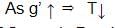
- Hence, Time Period of oscillations of Seconds Pendulum will decrease when the rocket is ascending up with uniform acceleration.
What is the maximum Kinetic energy and minimum potential energy of a harmonic oscillator with amplitude 0.03m, force constant 4×10⁵ N/m and total mechanical energy of 230 J.- a)200J, 40J
- b)180J,50J
- c)190J, 60J
- d)210J,60J
Correct answer is option 'B'. Can you explain this answer?
What is the maximum Kinetic energy and minimum potential energy of a harmonic oscillator with amplitude 0.03m, force constant 4×10⁵ N/m and total mechanical energy of 230 J.
a)
200J, 40J
b)
180J,50J
c)
190J, 60J
d)
210J,60J
 | Infinity Academy answered |
K. Σ=1/2 K(A2-x2)
Max of mean position,
K. Σ=1/2 KA2
=1/2 x4x105x(3x10-2)2
=180J
T.M. Σ=180+P.Σ
230=180+P.Σ
P.Σ=230-180
P.Σ=50J
Max of mean position,
K. Σ=1/2 KA2
=1/2 x4x105x(3x10-2)2
=180J
T.M. Σ=180+P.Σ
230=180+P.Σ
P.Σ=230-180
P.Σ=50J
If the length of a simple pendulum is increases by 1percent, then the new time-period
a) Decreases by 0.5 percent
b) Increases by 0.5 percent
c) Increases by 1 percent
d) Increases by 2.0 percent
Correct answer is option 'B'. Can you explain this answer?
 | Krishna Iyer answered |
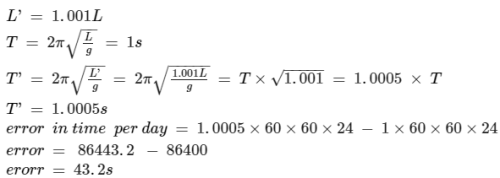
Time period, T=2π√l/g
=>T∝√l
=>ΔT/T=1/2 Δl/l
Δl/l=1%
Therefore, ΔT/T=1/2x1%=0.5%
=>T∝√l
=>ΔT/T=1/2 Δl/l
Δl/l=1%
Therefore, ΔT/T=1/2x1%=0.5%
If a simple pendulum oscillates with an amplitude 50 mm and time period 2s, then its maximum velocity isa)0.15 m/sb)0.1 m/sc)0.16 m/sd)0.8 m/sCorrect answer is option 'A'. Can you explain this answer?
 | Neha Joshi answered |
We know that in a simple harmonic motion the maximum velocity,
Vmax = A⍵
Here A = 50 mm
Vmax = A⍵
Here A = 50 mm
And ⍵ = 2π / T
= 2π / 2
= π
= 2π / 2
= π
Hence Vmax = 50 x 10-3.π
= 0.15 m/s
= 0.15 m/s
What will be the phase difference between bigger pendulum (with time period 5T/4 )and smaller pendulum (with time period T) after one oscillation of bigger pendulum?- a)π/4
- b)π/2
- c)π/3
- d)π
Correct answer is option 'B'. Can you explain this answer?
What will be the phase difference between bigger pendulum (with time period 5T/4 )and smaller pendulum (with time period T) after one oscillation of bigger pendulum?
a)
π/4
b)
π/2
c)
π/3
d)
π
 | Preeti Iyer answered |
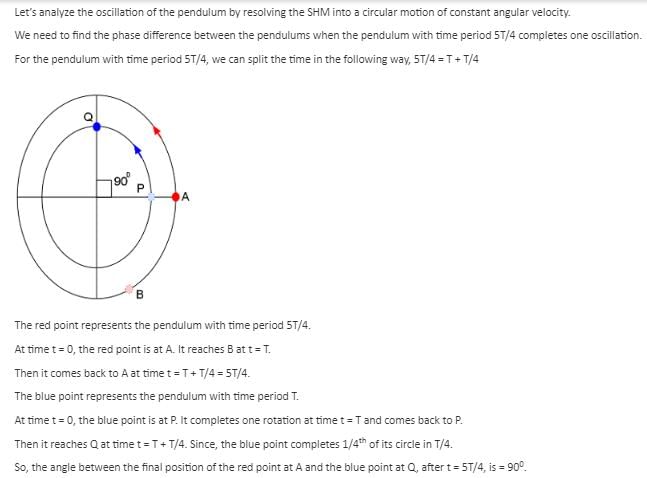
By the time bigger pendulum completes one vibration, the smaller pendulum would have completed 5/4 vibrations. That is smaller pendulum will be ahead by 1/4 vibration in phase. 1/4 vibration means λ/4 path or π/2 radians.
The dimensions and unit of phase constant Φ is- a)dinensionless,rad
- b)[T]-1 ,s-1
- c)dinensionless, no units
- d)[T] , s
Correct answer is option 'A'. Can you explain this answer?
The dimensions and unit of phase constant Φ is
a)
dinensionless,rad
b)
[T]-1 ,s-1
c)
dinensionless, no units
d)
[T] , s
 | Suresh Reddy answered |
Mathematical constants don't have any dimensions hence, it is dimensionless and phase constant is in angle therefore, the unit is radian.
What determines the natural frequency of a body?- a)Position of the body with respect to force applied
- b)Mass and speed of the body
- c)Oscillations in the body
- d)Elastic properties and dimensions of the body
Correct answer is option 'D'. Can you explain this answer?
What determines the natural frequency of a body?
a)
Position of the body with respect to force applied
b)
Mass and speed of the body
c)
Oscillations in the body
d)
Elastic properties and dimensions of the body
 | Lavanya Menon answered |
Natural frequency is the frequency at which a body tends to oscillate in the absence of any driving or damping force.
Free vibrations of any elastic body are called natural vibration and happen at a frequency called natural frequency. Natural vibrations are different from forced vibration which happen at frequency of applied force .
Free vibrations of any elastic body are called natural vibration and happen at a frequency called natural frequency. Natural vibrations are different from forced vibration which happen at frequency of applied force .
A frequency of 1Hz corresponds to:- a)2 vibrations per second
- b)1 vibration per second
- c)10 vibrations per second
- d)a time period of ½ second
Correct answer is option 'B'. Can you explain this answer?
A frequency of 1Hz corresponds to:
a)
2 vibrations per second
b)
1 vibration per second
c)
10 vibrations per second
d)
a time period of ½ second
 | Alok Mehta answered |
Frequency used to be measured in cycles per second, but now we use the unit of frequency - the Hertz (abbreviated Hz). One Hertz (1Hz) is equal to one vibration per second. So the weight above is bouncing with a frequency of about 1Hz. The sound wave corresponding to Middle C on a piano is around 256Hz.
If the period of oscillation of mass M suspended from a spring is one second, then the period of mass 4 M will be- a)1/ 4s
- b)4s
- c)1/ 2s
- d)2s
Correct answer is option 'D'. Can you explain this answer?
If the period of oscillation of mass M suspended from a spring is one second, then the period of mass 4 M will be
a)
1/ 4s
b)
4s
c)
1/ 2s
d)
2s
 | Geetika Shah answered |
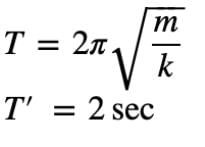
T=2*3.14*√m/√k=1 s (given)
T’=2*3.14*√4m/√k=2*3.14*2√m/√k=2*1s
Therefore T’=2s
If  is the natural frequency of the system and
  is the frequency of the external force that acts on an oscillating system then at resonance
- a)ωd ≥ ω
- b)ωd = ω
- c)ωd ≤ ω
- d)ωd ≠ ω
Correct answer is option 'B'. Can you explain this answer?
If is the natural frequency of the system and is the frequency of the external force that acts on an oscillating system then at resonance
is the natural frequency of the system and is the frequency of the external force that acts on an oscillating system then at resonancea)
ωd ≥ ω
b)
ωd = ω
c)
ωd ≤ ω
d)
ωd ≠ ω
 | Om Desai answered |
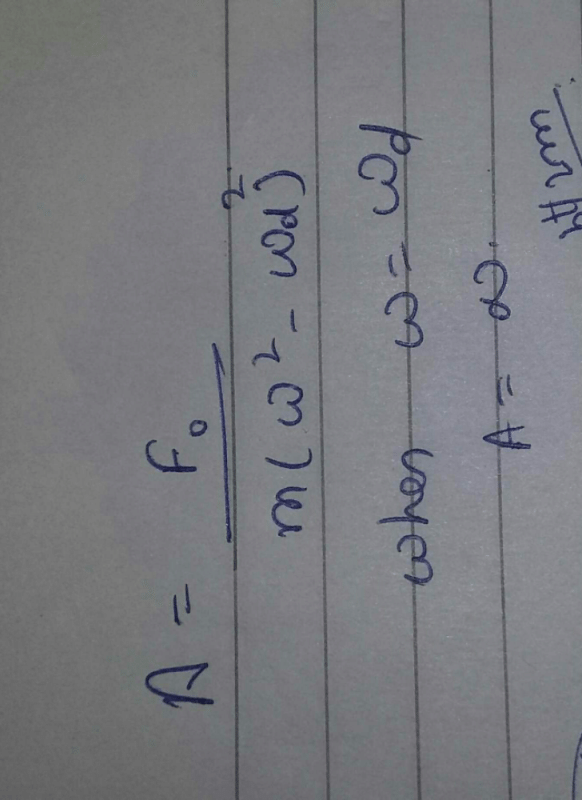
When the natural frequency and external frequency of an object are equal the phenomenon is called resonance.
A particle executes linear simple harmonic motion with an amplitude of 2 cm. When the particle is at 1 cm from the mean position, the magnitude of its velocity is equal to that of its acceleration. Then its time period in seconds is:- a)2π/√3
- b)2π√3
- c)√3/2π
- d)1/ 2π√3
Correct answer is option 'A'. Can you explain this answer?
A particle executes linear simple harmonic motion with an amplitude of 2 cm. When the particle is at 1 cm from the mean position, the magnitude of its velocity is equal to that of its acceleration. Then its time period in seconds is:
a)
2π/√3
b)
2π√3
c)
√3/2π
d)
1/ 2π√3
 | Jyoti Kapoor answered |
velocity at distance x in shm is given as
v= w sqrt(A2-x2)
so A = 2 x =1
v = w sqrt(4-1) = wsqrt3
now acc at distance x is a= w2 x = w2
as mag a = mag v
w2 = wsqrt3
w= sqrt3
2pi/T= sqrt3
T = 2pi/sqrt3
The restoring force in a simple harmonic motion is _________ in magnitude when the particle is instantaneously at rest.- a)zero
- b)maximum
- c)minimum
- d)none of these
Correct answer is option 'B'. Can you explain this answer?
The restoring force in a simple harmonic motion is _________ in magnitude when the particle is instantaneously at rest.
a)
zero
b)
maximum
c)
minimum
d)
none of these
 | Knowledge Hub answered |
The restoring force in a simple harmonic motion is maximum in magnitude when the particle is instantaneously at rest because in SHM object’s tendency is to return to mean position and here particle is instantaneously at rest after that instant restoring force will be max to bring particle to mean position.
If an external force with angular frequency ωd acts on an oscillating system with natural angular frequency ω, the system oscillates with angular frequency ωd. The amplitude of oscillations is the greatest when:- a)ωd > ω
- b)ωd < ω
- c)ωd ≥ ω
- d)ωd = ω
Correct answer is option 'D'. Can you explain this answer?
If an external force with angular frequency ωd acts on an oscillating system with natural angular frequency ω, the system oscillates with angular frequency ωd. The amplitude of oscillations is the greatest when:
a)
ωd > ω
b)
ωd < ω
c)
ωd ≥ ω
d)
ωd = ω
| | Jyoti Aiims Aspirant answered |
If the sign in equation F = -kx is changed what would happen to the motion of the oscillating body?- a)Motion would be linearly accelerated motion
- b)Body would come at rest
- c)Body would slow down
- d)Motion would be oscillating accelerated
Correct answer is option 'A'. Can you explain this answer?
If the sign in equation F = -kx is changed what would happen to the motion of the oscillating body?
a)
Motion would be linearly accelerated motion
b)
Body would come at rest
c)
Body would slow down
d)
Motion would be oscillating accelerated
 | Imk Pathsala answered |
If the sign is changed in F=-kx then the force and hence acceleration will not be opposite to the displacement. Due to this the particle will not oscillate and would accelerate in the direction of displacement. Hence the motion of the body will become linearly accelerated motion.
Under what condition angular frequency ω of the damped oscillator would be equivalent to angular velocity Ω of the undamped oscillator.- a)Velocity of oscillator is small
- b)Damping constant, b is small
- c)Damping constant ,b is large
- d)Force applied is small
Correct answer is option 'B'. Can you explain this answer?
Under what condition angular frequency ω of the damped oscillator would be equivalent to angular velocity Ω of the undamped oscillator.
a)
Velocity of oscillator is small
b)
Damping constant, b is small
c)
Damping constant ,b is large
d)
Force applied is small
 | Mohit Rajpoot answered |
A rubber ball with water, having a small hole in its bottom is used as the bob of a simple pendulum. The time-period of such a pendulum:- a)Increases with time
- b)First increases and then decreases finally having same value as at the beginning
- c)Decreases with time
- d)Is a constant
Correct answer is option 'B'. Can you explain this answer?
A rubber ball with water, having a small hole in its bottom is used as the bob of a simple pendulum. The time-period of such a pendulum:
a)
Increases with time
b)
First increases and then decreases finally having same value as at the beginning
c)
Decreases with time
d)
Is a constant
 | Rajesh Gupta answered |
When rubber ball completely filled with water its centre of gravity will be at its centre, as water will fall through hole its COG will shift towards lower side leading to increase in length of pendulum and thus T, when very small amount of water will be left in rubber ball its COG will again shifts upward causing decrease in length and thus T, and finally when rubber ball becomes empty its COG will be at its centre and T will remains same as earlier.
Whose motion is an ideal case of SHM?- a)An electric dipole placed stably in a uniform electric field and then given a very small regular displacement
- b)A simple pendulum with very small angle of swing
- c)Shadow of a point mass having uniform circular motion, on the vertical diameter
- d)none
Correct answer is option 'A'. Can you explain this answer?
Whose motion is an ideal case of SHM?
a)
An electric dipole placed stably in a uniform electric field and then given a very small regular displacement
b)
A simple pendulum with very small angle of swing
c)
Shadow of a point mass having uniform circular motion, on the vertical diameter
d)
none
| | Raghav Bansal answered |
Simple pendulum is not a case of ideal SHM as it is mention in NCERT.
Shadow of a point mass having uniform circular motion on the horizontal diameter is a case of SHM but not on the vertical diameter.
Shadow of a point mass having uniform circular motion on the horizontal diameter is a case of SHM but not on the vertical diameter.
The ratio of maximum acceleration to maximum velocity of a particle performing S.H.M is equal to- a)Square of amplitude
- b)Square of angular velocity
- c)Amplitude
- d)Angular velocity
Correct answer is option 'D'. Can you explain this answer?
The ratio of maximum acceleration to maximum velocity of a particle performing S.H.M is equal to
a)
Square of amplitude
b)
Square of angular velocity
c)
Amplitude
d)
Angular velocity
| | Om Desai answered |
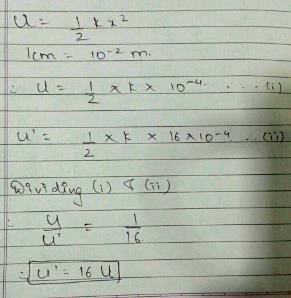
Maximum acceleration = w2A
Maximum velocity = wA
Ratio = w2A/wA = w
w = angular velocity
A = amplitude
Maximum velocity = wA
Ratio = w2A/wA = w
w = angular velocity
A = amplitude
Damping is due to- a)electrostatic forces
- b)resistive forces like air drag, friction etc.
- c)reaction forces
- d)conservative forces like gravity
Correct answer is option 'B'. Can you explain this answer?
Damping is due to
a)
electrostatic forces
b)
resistive forces like air drag, friction etc.
c)
reaction forces
d)
conservative forces like gravity
| | Om Desai answered |
Damping is due to resistive forces like air drag, friction etc.
A particle starts S.H.M. from the mean position. Its amplitude is A and time period is T. At the time when its speed is half of the maximum speed, its displacement y is- a)A√3/2
- b)2A/√3
- c)A/2
- d)A/√2
Correct answer is option 'A'. Can you explain this answer?
A particle starts S.H.M. from the mean position. Its amplitude is A and time period is T. At the time when its speed is half of the maximum speed, its displacement y is
a)
A√3/2
b)
2A/√3
c)
A/2
d)
A/√2
| | Rajesh Gupta answered |
The relation between angular frequency and displacement is given as
v=ω√A2−x2
Suppose
x=A sinω t
On differentiating the above equation w.r.t. time we get
dx/dt=Aωcosωt
The maximum value of velocity will be [{v{\max }} = A\omega \]
The displacement for the time when speed is half the maximum is given as
v=Aω/2
A2ω2=4ω(A2−x2)
By substituting the value in (1) we get the displacement as
x=A√3/2
v=ω√A2−x2
Suppose
x=A sinω t
On differentiating the above equation w.r.t. time we get
dx/dt=Aωcosωt
The maximum value of velocity will be [{v{\max }} = A\omega \]
The displacement for the time when speed is half the maximum is given as
v=Aω/2
A2ω2=4ω(A2−x2)
By substituting the value in (1) we get the displacement as
x=A√3/2
If the reference particle P moves in uniform circular motion, its projection along a diameter of the circle executes- a)motion along x axis
- b)motion along y axis
- c)circular motion
- d)Simple Harmonic motion
Correct answer is option 'D'. Can you explain this answer?
If the reference particle P moves in uniform circular motion, its projection along a diameter of the circle executes
a)
motion along x axis
b)
motion along y axis
c)
circular motion
d)
Simple Harmonic motion
| | Raghav Bansal answered |
SHM is a 1D projection of 2D UCM.

Damped natural frequency is- a)same as natural frequency
- b)lower than natural frequency
- c)higher than natural frequency
- d)none of the above
Correct answer is option 'B'. Can you explain this answer?
Damped natural frequency is
a)
same as natural frequency
b)
lower than natural frequency
c)
higher than natural frequency
d)
none of the above
| | Geetika Shah answered |
If a resonant mechanical structure is set in motion and left to its own devices, it will continue to oscillate at a particular frequency known as its natural frequency, or "damped natural frequency". This will be a little lower in frequency than the resonant frequency, which is the frequency it would assume if there were no damping. The resonant frequency is also called the "undamped natural frequency”
In a simple pendulum the restoring force is due to- a) The tangential component of the gravitational force
- b)The radial component of the gravitational force
- c)The tangential component of the tension in string
- d)The radial component of the tension in string
Correct answer is option 'A'. Can you explain this answer?
In a simple pendulum the restoring force is due to
a)
The tangential component of the gravitational force
b)
The radial component of the gravitational force
c)
The tangential component of the tension in string
d)
The radial component of the tension in string
| | Pooja Shah answered |
In a simple pendulum the restoring force is due to the tangential component of the gravitational force because on applying torque equation on the radial forces the effect is nullified due to it passing from centre & only tangential component remains.
The equation of motion of a particle is x= 3cos(0.45t+π/4)m. Its maximum acceleration is- a)0.60 ms-2
- b)0.50 ms-2
- c)0.55 ms-2
- d)0.45 ms-2
Correct answer is option 'A'. Can you explain this answer?
The equation of motion of a particle is x= 3cos(0.45t+π/4)m. Its maximum acceleration is
a)
0.60 ms-2
b)
0.50 ms-2
c)
0.55 ms-2
d)
0.45 ms-2
 | Nilotpal Singh answered |
+ 2) meters.
We can find the velocity and acceleration functions by taking the first and second derivatives of x with respect to time:
velocity v(t) = dx/dt = -3(0.45)sin(0.45t + 2)
acceleration a(t) = d^2x/dt^2 = -3(0.45)^2cos(0.45t + 2)
To find the maximum velocity, we set v(t) equal to zero and solve for t:
0 = -3(0.45)sin(0.45t + 2)
sin(0.45t + 2) = 0
0.45t + 2 = nπ, where n is an integer
t = (nπ - 2)/0.45
To find the maximum acceleration, we set a(t) equal to zero and solve for t:
0 = -3(0.45)^2cos(0.45t + 2)
cos(0.45t + 2) = 0
0.45t + 2 = (n + 0.5)π, where n is an integer
t = [(n + 0.5)π - 2]/0.45
Note that there are infinitely many solutions for both t_max_v and t_max_a, as there are infinitely many values of n.
To find the values of maximum velocity and maximum acceleration, we can substitute the values of t_max_v and t_max_a into the corresponding velocity and acceleration functions:
v_max = -3(0.45)sin(0.45t_max_v + 2)
a_max = -3(0.45)^2cos(0.45t_max_a + 2)
However, since there are infinitely many solutions for t_max_v and t_max_a, we cannot find a unique value for v_max and a_max without additional information.
We can find the velocity and acceleration functions by taking the first and second derivatives of x with respect to time:
velocity v(t) = dx/dt = -3(0.45)sin(0.45t + 2)
acceleration a(t) = d^2x/dt^2 = -3(0.45)^2cos(0.45t + 2)
To find the maximum velocity, we set v(t) equal to zero and solve for t:
0 = -3(0.45)sin(0.45t + 2)
sin(0.45t + 2) = 0
0.45t + 2 = nπ, where n is an integer
t = (nπ - 2)/0.45
To find the maximum acceleration, we set a(t) equal to zero and solve for t:
0 = -3(0.45)^2cos(0.45t + 2)
cos(0.45t + 2) = 0
0.45t + 2 = (n + 0.5)π, where n is an integer
t = [(n + 0.5)π - 2]/0.45
Note that there are infinitely many solutions for both t_max_v and t_max_a, as there are infinitely many values of n.
To find the values of maximum velocity and maximum acceleration, we can substitute the values of t_max_v and t_max_a into the corresponding velocity and acceleration functions:
v_max = -3(0.45)sin(0.45t_max_v + 2)
a_max = -3(0.45)^2cos(0.45t_max_a + 2)
However, since there are infinitely many solutions for t_max_v and t_max_a, we cannot find a unique value for v_max and a_max without additional information.
At what distance from the mean position would the K.E of a particle in simple harmonic motion be equal to its potential energy?- a)a/√2
- b)a/2
- c)2√a
- d)a
Correct answer is option 'A'. Can you explain this answer?
At what distance from the mean position would the K.E of a particle in simple harmonic motion be equal to its potential energy?
a)
a/√2
b)
a/2
c)
2√a
d)
a
| | Raghav Bansal answered |
Let say from some distance x, the KE = PE and as total energy must be conserved and TE = -½ kA2
Thus we get 2PE = ½ kA2
Thus we get 2kx2 = kA2
We get x = A / √2
Thus we get 2PE = ½ kA2
Thus we get 2kx2 = kA2
We get x = A / √2
The amplitude of S.H.M at resonance is _______ in the ideal case of zero damping.- a)Maximum
- b)Minimum
- c)Zero
- d)Infinite
Correct answer is option 'D'. Can you explain this answer?
The amplitude of S.H.M at resonance is _______ in the ideal case of zero damping.
a)
Maximum
b)
Minimum
c)
Zero
d)
Infinite
| | Neha Joshi answered |
In an ideal environment where there is no resistance to oscillation motion i.e. damping is zero, when we oscillate a system at its resonant frequency since there is no opposition to oscillation, the amplitude will go on increasing and reach infinity.
The kinetic energy of a body executing S.H.M. is 1/3 of the potential energy. Then, the displacement of the body is x percent of the amplitude, where x is- a)33
- b)50
- c)67
- d)87
Correct answer is option 'A'. Can you explain this answer?
The kinetic energy of a body executing S.H.M. is 1/3 of the potential energy. Then, the displacement of the body is x percent of the amplitude, where x is
a)
33
b)
50
c)
67
d)
87
| | Pooja Shah answered |
We know that PE + KE = TE = constant
Hence at the extremis TE = PE = ½ kz2
Where z is amplitude and k is shm constant.
Thus when KE = ⅓ PE
We get PE = ¾ TE = ½ kz2
Hence we get ½ kx2 = ¾ ½ kz2
We get x/z = √3/4
= 1.73 / 2
= .87
Thus we get x is 87 percent of the amplitude.
Hence at the extremis TE = PE = ½ kz2
Where z is amplitude and k is shm constant.
Thus when KE = ⅓ PE
We get PE = ¾ TE = ½ kz2
Hence we get ½ kx2 = ¾ ½ kz2
We get x/z = √3/4
= 1.73 / 2
= .87
Thus we get x is 87 percent of the amplitude.
Any periodic function can be expressed as a.- a)superposition of sine and cosine functions of different time periods with suitable coefficients
- b)superposition of exponential functions of real time periods with suitable coefficients
- c)superposition of polynomial functions of different time periods with suitable coefficients
- d)superposition of sine and cosine functions of same time period with suitable coefficients
Correct answer is option 'A'. Can you explain this answer?
Any periodic function can be expressed as a.
a)
superposition of sine and cosine functions of different time periods with suitable coefficients
b)
superposition of exponential functions of real time periods with suitable coefficients
c)
superposition of polynomial functions of different time periods with suitable coefficients
d)
superposition of sine and cosine functions of same time period with suitable coefficients
 | Sushil Kumar answered |
All periodic functions can, in principle, be represented as a sum of sine and cosine functions, since they form what's known as a complete set.
The velocity of a particle moving with simple harmonic motion is . . . . at the mean position.- a)Zero
- b)Minimum
- c)Maximum
- d)None of the above
Correct answer is option 'A'. Can you explain this answer?
The velocity of a particle moving with simple harmonic motion is . . . . at the mean position.
a)
Zero
b)
Minimum
c)
Maximum
d)
None of the above
| | Niharika Nair answered |
V = ω√(A2 – x2)
So the velocity is maximum at mean position
So the velocity is maximum at mean position
In the ideal case of zero damping, the amplitude of simple harmonic motion at resonance is:- a)zero
- b)infinite
- c)cannot be said
- d)varies from zero to infinite
Correct answer is option 'B'. Can you explain this answer?
In the ideal case of zero damping, the amplitude of simple harmonic motion at resonance is:
a)
zero
b)
infinite
c)
cannot be said
d)
varies from zero to infinite
| | Priya Patel answered |
In an ideal environment where there is no resistance to oscillatory motion, that is, damping is zero, when we oscillate a system at its resonant frequency, since there is no opposition to oscillation, a very large value of amplitude will be recorded. Forced oscillation is when you apply an external oscillating force.
A particle of mass 10 gm lies in a potential field v = (50x2+100) J/kg. The value of frequency of oscillations in cycle/sec is- a)5/π
- b)50/π
- c)10/π
- d)100/π
Correct answer is option 'A'. Can you explain this answer?
A particle of mass 10 gm lies in a potential field v = (50x2+100) J/kg. The value of frequency of oscillations in cycle/sec is
a)
5/π
b)
50/π
c)
10/π
d)
100/π
 | Ambition Institute answered |
Correct option: A
Mass is m = 10 g = 0.01 kg.
The actual potential energy is U = m × (potential per unit mass); the quadratic contribution is Uq = 50 m x2.
Compare with U = (1/2) k x2. Thus (1/2) k = 50 m, so k = 100 m.
Angular frequency satisfies ω² = k/m. Substituting gives ω² = 100, hence ω = 10 rad s-1.
Frequency is f = ω / (2π) = 10 / (2π) = 5/π Hz. Therefore option A is correct.
The pendulum of a wall clock executes- a)a translatory motion
- b)a rotary motion
- c)a random motion
- d)an oscillatory motion
Correct answer is option 'D'. Can you explain this answer?
The pendulum of a wall clock executes
a)
a translatory motion
b)
a rotary motion
c)
a random motion
d)
an oscillatory motion
| | Chirag Mehta answered |
The bob of a pendulum moves in such a way that it repeats its positions several time but alternately the time gap between these positions is always equal which proves that the motion of a pendulum is oscillatory.
A mass M is suspended from a spring of negligible mass. The spring is pulled a little and then released so that the mass executes simple harmonic oscillations with a time period T. If the mass is increased by m, the time period becomes 5T/3. then the ratio of m/M is- a)9/ 16
- b)25/ 16
- c)3/9
- d)25/22
Correct answer is option 'D'. Can you explain this answer?
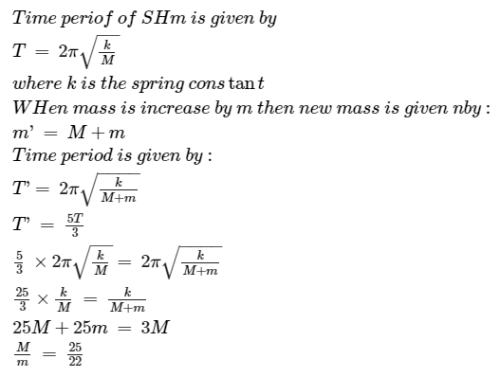
A mass M is suspended from a spring of negligible mass. The spring is pulled a little and then released so that the mass executes simple harmonic oscillations with a time period T. If the mass is increased by m, the time period becomes 5T/3. then the ratio of m/M is
a)
9/ 16
b)
25/ 16
c)
3/9
d)
25/22
| | Alok Mehta answered |
The length of the second’s pendulum on the surface of earth is 1m. The length of second’s pendulum on the surface of moon, where g is 1/6th the value on earth is- a)6m
- b)1/ 36m
- c)36m
- d)1/ 6m
Correct answer is option 'D'. Can you explain this answer?
The length of the second’s pendulum on the surface of earth is 1m. The length of second’s pendulum on the surface of moon, where g is 1/6th the value on earth is
a)
6m
b)
1/ 36m
c)
36m
d)
1/ 6m
| | Pooja Shah answered |
Time period remains same since
T = 2π √(L/g)
So, from proportionality we can solve
T = 2π √(L/g)
So, from proportionality we can solve
Choose the correct time period of the function sin ωt + cos ωt- a)π/8ω
- b)2π/ω
- c)π/4ω
- d)π/2ω
Correct answer is option 'B'. Can you explain this answer?
Choose the correct time period of the function sin ωt + cos ωt
a)
π/8ω
b)
2π/ω
c)
π/4ω
d)
π/2ω
| | Saanvi Choudhury answered |
Understanding the Function
The function given is sin(ωt) + cos(ωt). To determine the period of this function, we need to analyze its components.
Components of the Function
- The sine function, sin(ωt), has a standard period of 2π.
- The cosine function, cos(ωt), also has a period of 2π.
Since both functions share the same frequency, the overall period of their sum will also be 2π.
Calculating the Period
1. Period of Sine Function:
- The period is given by T = 2π/ω.
2. Period of Cosine Function:
- Similarly, the period is also T = 2π/ω.
Since both functions oscillate with the same frequency, the resultant function sin(ωt) + cos(ωt) will also have a period of 2π/ω.
Correct Option
Thus, the correct answer for the time period of the function sin(ωt) + cos(ωt) is:
- Option B: 2π/ω
This means that every 2π/ω seconds, the function will complete one full cycle.
Conclusion
In summary, the periodic behavior of both sine and cosine functions, when combined, maintains the same period of 2π/ω. Therefore, recognizing these fundamental properties allows us to confidently determine the period of the combined function.
The function given is sin(ωt) + cos(ωt). To determine the period of this function, we need to analyze its components.
Components of the Function
- The sine function, sin(ωt), has a standard period of 2π.
- The cosine function, cos(ωt), also has a period of 2π.
Since both functions share the same frequency, the overall period of their sum will also be 2π.
Calculating the Period
1. Period of Sine Function:
- The period is given by T = 2π/ω.
2. Period of Cosine Function:
- Similarly, the period is also T = 2π/ω.
Since both functions oscillate with the same frequency, the resultant function sin(ωt) + cos(ωt) will also have a period of 2π/ω.
Correct Option
Thus, the correct answer for the time period of the function sin(ωt) + cos(ωt) is:
- Option B: 2π/ω
This means that every 2π/ω seconds, the function will complete one full cycle.
Conclusion
In summary, the periodic behavior of both sine and cosine functions, when combined, maintains the same period of 2π/ω. Therefore, recognizing these fundamental properties allows us to confidently determine the period of the combined function.
If the maximum velocity and acceleration of a particle executing S.H.M are equal in magnitude, the time period will be- a)6.28 s
- b)1.57 s
- c)3.14 s
- d)12.56 s
Correct answer is option 'A'. Can you explain this answer?
If the maximum velocity and acceleration of a particle executing S.H.M are equal in magnitude, the time period will be
a)
6.28 s
b)
1.57 s
c)
3.14 s
d)
12.56 s
 | Jyoti Dey answered |
**Explanation:**
When a particle is executing Simple Harmonic Motion (SHM), its displacement from the mean position follows a sinusoidal function. The maximum displacement of the particle is called the amplitude (A) of the motion. The particle oscillates back and forth between two extreme positions, which are equal in magnitude but opposite in direction.
The time taken for one complete oscillation of the particle is called the time period (T) of the motion. It is the time taken for the particle to go from one extreme position to the other and back again.
The maximum velocity (vmax) of the particle occurs when the particle passes through the mean position (equilibrium position). At this point, the velocity is at a maximum and is in the same direction as the acceleration. The maximum acceleration (amax) of the particle occurs when the particle is at its extreme positions. At these points, the acceleration is at a maximum and is in the opposite direction to the displacement.
If the maximum velocity and acceleration of the particle are equal in magnitude, it means that the amplitude of the motion is equal to the acceleration. Mathematically, this can be represented as:
amax = vmax
Using the equations of SHM, we can relate the amplitude, time period, maximum velocity, and maximum acceleration as follows:
amax = ω^2 A
vmax = ω A
where ω is the angular frequency of the motion.
Since amax = vmax, we can equate the above two equations:
ω^2 A = ω A
Simplifying the equation:
ω^2 = ω
ω = 1
The angular frequency ω is related to the time period T by ω = 2π/T. Substituting this value into the equation:
(2π/T)^2 = 2π/T
Simplifying the equation:
4π^2/T^2 = 2π/T
2π/T = 4π^2/T^2
T = 2
Therefore, the time period of the motion is T = 2 seconds, which is equivalent to 6.28 seconds (approximately). Hence, the correct answer is option A: 6.28 s.
When a particle is executing Simple Harmonic Motion (SHM), its displacement from the mean position follows a sinusoidal function. The maximum displacement of the particle is called the amplitude (A) of the motion. The particle oscillates back and forth between two extreme positions, which are equal in magnitude but opposite in direction.
The time taken for one complete oscillation of the particle is called the time period (T) of the motion. It is the time taken for the particle to go from one extreme position to the other and back again.
The maximum velocity (vmax) of the particle occurs when the particle passes through the mean position (equilibrium position). At this point, the velocity is at a maximum and is in the same direction as the acceleration. The maximum acceleration (amax) of the particle occurs when the particle is at its extreme positions. At these points, the acceleration is at a maximum and is in the opposite direction to the displacement.
If the maximum velocity and acceleration of the particle are equal in magnitude, it means that the amplitude of the motion is equal to the acceleration. Mathematically, this can be represented as:
amax = vmax
Using the equations of SHM, we can relate the amplitude, time period, maximum velocity, and maximum acceleration as follows:
amax = ω^2 A
vmax = ω A
where ω is the angular frequency of the motion.
Since amax = vmax, we can equate the above two equations:
ω^2 A = ω A
Simplifying the equation:
ω^2 = ω
ω = 1
The angular frequency ω is related to the time period T by ω = 2π/T. Substituting this value into the equation:
(2π/T)^2 = 2π/T
Simplifying the equation:
4π^2/T^2 = 2π/T
2π/T = 4π^2/T^2
T = 2
Therefore, the time period of the motion is T = 2 seconds, which is equivalent to 6.28 seconds (approximately). Hence, the correct answer is option A: 6.28 s.
A particle executes SHM of time period T, the time period with which the total energy changes is- a)2T
- b)T
- c)T/2
- d)Infinite
Correct answer is option 'D'. Can you explain this answer?
A particle executes SHM of time period T, the time period with which the total energy changes is
a)
2T
b)
T
c)
T/2
d)
Infinite
| | Kavita Joshi answered |
Potential energy is a function of height. Now the motion of a simple pendulum can be expressed in terms of the angle at which the string makes with the normal (the angle it would hang at if it didn't swing.)Now Because the bob of the pendulum is always in motion except at the two turning points where the angle is at a maximum (and even at these points the bob is only motionless at one instant in time but for no inteval) the hight is always changing for every inteval of time and thus the potential energy is always changing.Also the potential energy is the same for all values of the angle that have the same magnatude (independent of the sign.)
The phenomenon of increase in amplitude when the driving force is close to the natural frequency of the oscillator is known as- a)Accelerated Amplitude
- b)Epoch
- c)Resonance
- d)Dampening
Correct answer is option 'C'. Can you explain this answer?
The phenomenon of increase in amplitude when the driving force is close to the natural frequency of the oscillator is known as
a)
Accelerated Amplitude
b)
Epoch
c)
Resonance
d)
Dampening
| | Lavanya Menon answered |
The phenomenon of increase in amplitude when the driving force is close to the natural frequency of the oscillator is known as resonance. By the definition of resonance.
A body is executing S.H.M When its displacement from the mean position is 4 cm and 5 cm, the corresponding velocities of the body are 10 cm per sec and 8 cm per sec. Then the time period of the body is- a)2 π/2 sec
- b)π sec
- c)3 π/2 sec
- d)2 π sec
Correct answer is option 'B'. Can you explain this answer?
A body is executing S.H.M When its displacement from the mean position is 4 cm and 5 cm, the corresponding velocities of the body are 10 cm per sec and 8 cm per sec. Then the time period of the body is
a)
2 π/2 sec
b)
π sec
c)
3 π/2 sec
d)
2 π sec
| | Pranavi Chopra answered |
v=ω√A2−x2
⇒8=ω √A2−25
&10=ω√A2−16
⇒(8/10)2= A2−25/ A2−16
⇒16/25= A2−25/ A2−16
⇒16A2−256=25A2−625
⇒9A2=369
A2=41
⇒8=ω41−25
⇒8=4ω
∴ω=2=T2π
T=π sec
⇒8=ω √A2−25
&10=ω√A2−16
⇒(8/10)2= A2−25/ A2−16
⇒16/25= A2−25/ A2−16
⇒16A2−256=25A2−625
⇒9A2=369
A2=41
⇒8=ω41−25
⇒8=4ω
∴ω=2=T2π
T=π sec
A particle is executing S.H.M with an amplitude of 4 cm and time period 12 sec. The time taken by the particle in going from its mean position to a position of displacement equal to 2 cm is T1..The time taken from this displaced position of 2 cm to reach the extreme position is T2. Therefore, T1/ T2 will be- a)1/ 3
- b)1/2
- c)41276.0
- d)1
Correct answer is option 'B'. Can you explain this answer?
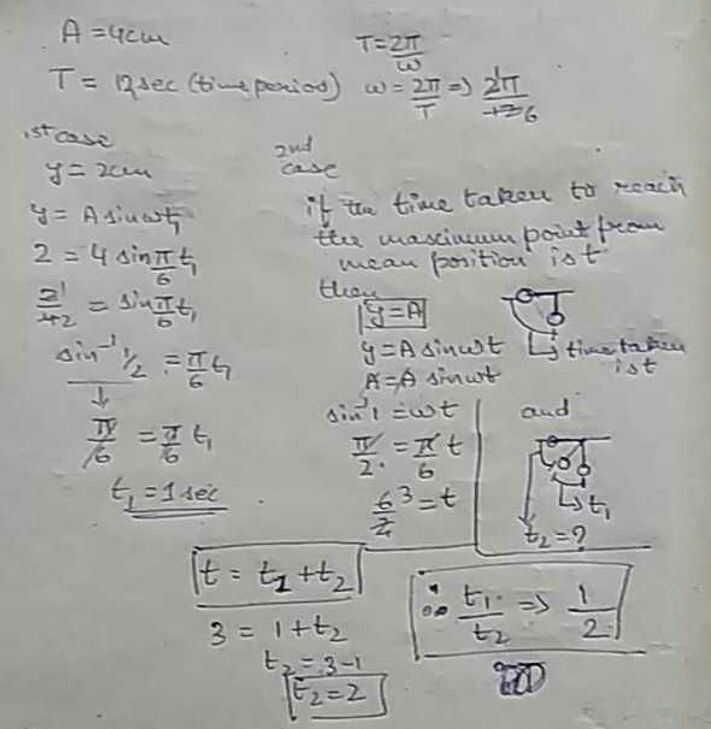
A particle is executing S.H.M with an amplitude of 4 cm and time period 12 sec. The time taken by the particle in going from its mean position to a position of displacement equal to 2 cm is T1..The time taken from this displaced position of 2 cm to reach the extreme position is T2. Therefore, T1/ T2 will be
a)
1/ 3
b)
1/2
c)
41276.0
d)
1
| | Raza Great answered |
Oscillatory motion is- a)combination of translation and rotation
- b)periodic to and fro motion
- c)rotation about a point
- d)none
Correct answer is option 'B'. Can you explain this answer?
Oscillatory motion is
a)
combination of translation and rotation
b)
periodic to and fro motion
c)
rotation about a point
d)
none
| | Ananya Datta answered |
Oscillatory motion is periodic to and fro motion. By definition
For all practical purposes, the motion of a simple pendulum is SHM,- a)None of these
- b)Only if the length of its string is at least one meter
- c)Only if the maximum angle which its string makes with the vertical is less than 342.
- d)Only if the maximum angle which the string makes with the vertical is less than I
Correct answer is option 'A'. Can you explain this answer?
For all practical purposes, the motion of a simple pendulum is SHM,
a)
None of these
b)
Only if the length of its string is at least one meter
c)
Only if the maximum angle which its string makes with the vertical is less than 342.
d)
Only if the maximum angle which the string makes with the vertical is less than I
 | Nitin Nair answered |
The motion of Simple Pendulum as Simple Harmonic Motion. When we pull a simple pendulum from its equilibrium position and then release it, it swings in a vertical plane under the influence of gravity. It begins to oscillate about its mean position. Therefore, the motion is periodic and oscillatory.
SO OPTION A IS CORRECT.
Under forced oscillation, the phase of the harmonic motion of the particle and phase of driving force- a)Are same
- b)Are different
- c)Both are zero
- d)Not present
Correct answer is option 'B'. Can you explain this answer?
Under forced oscillation, the phase of the harmonic motion of the particle and phase of driving force
a)
Are same
b)
Are different
c)
Both are zero
d)
Not present
| | Pratibha Sharma answered |
Harmonic motion is the natural motion of a body(we consider no air friction) under no force where as damped oscillation are under force hence the iscilation are different
The periodic time (tp) is given by- a)ω / 2 π
- b)2 π / ω
- c)2 π × ω
- d)π/ω
Correct answer is option 'B'. Can you explain this answer?
The periodic time (tp) is given by
a)
ω / 2 π
b)
2 π / ω
c)
2 π × ω
d)
π/ω
| | Divyansh Saha answered |
Periodic time is the time taken for one complete revolution of the particle.
∴ Periodic time, tp = 2 π/ω seconds.
∴ Periodic time, tp = 2 π/ω seconds.
Energy is supplied to the damped oscillatory system at the same rate at which it is dissipating energy, then the amplitude of such oscillations would become constant. Such oscillations are called- a)Damped oscillations
- b)Undamped oscillations
- c)Coupled oscillations
- d)Maintained oscillations
Correct answer is option 'D'. Can you explain this answer?
Energy is supplied to the damped oscillatory system at the same rate at which it is dissipating energy, then the amplitude of such oscillations would become constant. Such oscillations are called
a)
Damped oscillations
b)
Undamped oscillations
c)
Coupled oscillations
d)
Maintained oscillations
| | Anoushka Basu answered |
Energy is supplied to the damped oscillatory system at the same rate at which it is dissipating energy, and then the amplitude of such oscillations would become constant. Such oscillations are called maintained oscillations. By the definition of maintained oscillations.
Two pendulums of length 1 m and 16 m start vibrating one behind the other from the same stand. At some instant, the two are in the mean position in the same phase. The time period of shorter pendulum is T. The minimum time after which the two threads of the pendulum will be one behind the other is- a)2T/5
- b)T/3
- c)T/4
- d)4T/3
Correct answer is option 'D'. Can you explain this answer?
Two pendulums of length 1 m and 16 m start vibrating one behind the other from the same stand. At some instant, the two are in the mean position in the same phase. The time period of shorter pendulum is T. The minimum time after which the two threads of the pendulum will be one behind the other is
a)
2T/5
b)
T/3
c)
T/4
d)
4T/3
| | Anushka Banerjee answered |
T1=2π√1/g=T, T2=2π√16/g=4T
(ω1−ω2)t=2π
(2π/T−2π/4T)t=2π
t=4T/3
(ω1−ω2)t=2π
(2π/T−2π/4T)t=2π
t=4T/3
Chapter doubts & questions for Simple Harmonic Motion (SHM) and Oscillations - 6 Months Preparation for JEE 2026 is part of JEE exam preparation. The chapters have been prepared according to the JEE exam syllabus. The Chapter doubts & questions, notes, tests & MCQs are made for JEE 2026 Exam. Find important definitions, questions, notes, meanings, examples, exercises, MCQs and online tests here.
Chapter doubts & questions of Simple Harmonic Motion (SHM) and Oscillations - 6 Months Preparation for JEE in English & Hindi are available as part of JEE exam. Download more important topics, notes, lectures and mock test series for JEE Exam by signing up for free.
6 Months Preparation for JEE568 videos|1576 docs|600 tests |
