


All Exams > CTET & State TET > 2 Months Preparation for CTET Paper 1 > All Questions
All questions of Animals & Plants for CTET & State TET Exam
Which of the following is true about forests?- a)It is a system comprising various plants only
- b)In it, trees form the uppermost layer followed by herbs, and the lowest layer of vegetation is made of shrubs
- c)Forests keep on growing and changing but they can not regenerate on their own
- d)Forests are the lifeline for the forest-dwelling communities
Correct answer is option 'B'. Can you explain this answer?
a)
It is a system comprising various plants only
b)
In it, trees form the uppermost layer followed by herbs, and the lowest layer of vegetation is made of shrubs
c)
Forests keep on growing and changing but they can not regenerate on their own
d)
Forests are the lifeline for the forest-dwelling communities
 | Ritesh Kumar Shivhare answered |
In a forest, trees form the uppermost layer, followed by herbs, and the lowest layer of vegetation is made of shrubs.
This layered structure is essential for the overall functioning and health of the forest ecosystem, as each layer contributes to the biodiversity, nutrient cycling, and habitat for various species of plants and animals.
Additional Information
Canopy layer:
- This is the uppermost layer, which is composed of tall trees that form a dense cover above the forest.
- The canopy intercepts sunlight, rain, and wind, creating a unique microclimate for the lower layers.
- It is also home to a diverse range of species, such as birds, insects, and arboreal mammals, who find food, shelter, and nesting sites among the branches and leaves.
Understory layer:
- Below the canopy, the understory layer consists of smaller trees, shrubs, and young trees that have not yet reached the canopy.
- This layer has its own microclimate, receiving less sunlight, and often higher humidity levels than the canopy.
- The understory is important for providing habitat to shade-tolerant plant species and animals that prefer lower levels of the forest for their activities.
Forest floor layer:
- The lowest layer of vegetation in a forest is made up of herbaceous plants, grasses, and mosses, which are adapted to the low light conditions.
- These plants form a dense mat of vegetation that helps to prevent soil erosion and retain moisture in the soil.
- The forest floor is also a critical site for decomposition, with fungi, bacteria, and detritivores breaking down dead plant material and recycling nutrients back into the ecosystem.
Hence, the correct answer is option 2 i.e. In it, trees form the upper most layer followed by herbs and the lowest layer of vegetation is made of shrubs.

A bird that makes a nest hanging from the branch of a small tree or shrub is- a)sun bird
- b)crow
- c)barbet
- d)Indian robin
Correct answer is option 'A'. Can you explain this answer?
a)
sun bird
b)
crow
c)
barbet
d)
Indian robin
 | Code Nation answered |
Concept:
- Birds build nests tolay their eggs and incubate their younger ones.
- Different birds build nests at different places, some on ground level, some high up on the tree.
- Different birds use different techniques and different materials to build their nests.
Explanation:
Sunbird:
- They are tiny birds.
- These are usually seen during dawn.
- They make a tiny nesthanging from the branch of a small tree or shrub.
- Nest is usually made up of:
- Hair
- Grass
- Dry leaves
- Cloth pieces.
Additional Information
Barbet:
- It is a tropical bird constituting the familyCapitonidae.
- Barbets are named for the bristles at the bases of their stout, sharp bills.
- They are big-headed, short-tailed birds, 9–30 cm long, greenish or brownish, with splashes of bright colours or white.
- The distribution of the family spans Central America to northernSouth America; sub-Saharan Africa; and Southeast Asia, eastward only to Borneo and Bali.
- All are non-migratory.
- Barbets sit stolidly in treetops when not feeding oninsects, lizards, birds’ eggs, fruit, and berries.
- Some climb like woodpeckers; all fly weakly.
- Thenest is a hole, dug with the beak, high up in a rotting tree or in a termite nest.
Koyel:
- It is a crow size bird, with a similar appearance.
- It does not make its own nest.
- Crow makes a nest for it.
Indian robin:
- It makes its nest on the roadside between stones or grasslands.
- It is covered with twigs, cotton, and wool.
Tailorbird:
- It is a small bird with a long tail.
- It makes its nest by switching the two leaves together.
Choose the correct option from the given features of desert plants.(A) Leaves of some plants take the shape of spines.(B) Photosynthesis in cactus plant is usually carried out by leaves.(C) Roots of most desert plants go very deep into the soil for absorbing water.- a)Only (A)
- b)(A) and (B)
- c)(A) and (C)
- d)(B) and (C)
Correct answer is option 'C'. Can you explain this answer?
Choose the correct option from the given features of desert plants.
(A) Leaves of some plants take the shape of spines.
(B) Photosynthesis in cactus plant is usually carried out by leaves.
(C) Roots of most desert plants go very deep into the soil for absorbing water.
a)
Only (A)
b)
(A) and (B)
c)
(A) and (C)
d)
(B) and (C)
 | Gitanjali Desai answered |
Features of Desert Plants
Desert plants have adapted uniquely to survive in harsh environments characterized by extreme temperatures and limited water availability. Let's analyze the given statements:
Statement A: Leaves of some plants take the shape of spines.
- This statement is true.
- Many desert plants, like cacti, have modified their leaves into spines to minimize water loss through transpiration.
- Spines also provide protection from herbivores.
Statement B: Photosynthesis in cactus plant is usually carried out by leaves.
- This statement is false.
- In cacti, the leaves are reduced to spines, and photosynthesis is primarily conducted by the stems, which are green and capable of photosynthesis.
- This adaptation helps the plant conserve water while still performing vital functions.
Statement C: Roots of most desert plants go very deep into the soil for absorbing water.
- This statement is true.
- Many desert plants have extensive root systems that can reach deep into the ground to access moisture that is unavailable to surface-level plants.
- Some plants also have shallow roots that spread widely to capture rainwater quickly when it does occur.
Conclusion
Given the analysis, the correct answer is option 'C' because:
- Statements A and C are true, while statement B is false.
- Therefore, the option that includes both true statements (A and C) is the right choice.
Understanding these adaptations is crucial for appreciating how desert flora has evolved to thrive in extreme conditions.
Desert plants have adapted uniquely to survive in harsh environments characterized by extreme temperatures and limited water availability. Let's analyze the given statements:
Statement A: Leaves of some plants take the shape of spines.
- This statement is true.
- Many desert plants, like cacti, have modified their leaves into spines to minimize water loss through transpiration.
- Spines also provide protection from herbivores.
Statement B: Photosynthesis in cactus plant is usually carried out by leaves.
- This statement is false.
- In cacti, the leaves are reduced to spines, and photosynthesis is primarily conducted by the stems, which are green and capable of photosynthesis.
- This adaptation helps the plant conserve water while still performing vital functions.
Statement C: Roots of most desert plants go very deep into the soil for absorbing water.
- This statement is true.
- Many desert plants have extensive root systems that can reach deep into the ground to access moisture that is unavailable to surface-level plants.
- Some plants also have shallow roots that spread widely to capture rainwater quickly when it does occur.
Conclusion
Given the analysis, the correct answer is option 'C' because:
- Statements A and C are true, while statement B is false.
- Therefore, the option that includes both true statements (A and C) is the right choice.
Understanding these adaptations is crucial for appreciating how desert flora has evolved to thrive in extreme conditions.
Consider the following main functions of plants root:A. To produce and store foodB. To give strength and support to the plantC. To transport water and minerals from roots to other parts of plantThe main function(s) of the stem is/are:- a)Only B
- b)Only B and C
- c)Only A and B
- d)A, B and C
Correct answer is option 'B'. Can you explain this answer?
Consider the following main functions of plants root:
A. To produce and store food
B. To give strength and support to the plant
C. To transport water and minerals from roots to other parts of plant
The main function(s) of the stem is/are:
a)
Only B
b)
Only B and C
c)
Only A and B
d)
A, B and C
 | Tom Tattle answered |
The correct answer is Only B and C.
Key Points
The main function(s) of the stem include:
- To give strength and support to the plant.
- To transport water and minerals from roots to other parts of the plant.
- The stem of a plant serves as a structural support, holding up leaves, flowers, and fruits.
- It provides stability to the plant and keeps it upright.
- Additionally, the stem contains vascular tissues, such as the xylem and phloem, which are responsible for the transport of water, minerals, and nutrients from the roots to various parts of the plant, including leaves, flowers, and fruits.
Additional Information
- Plants serve various important roles in the ecosystem and interact with their surroundings in multiple ways.
- Plants play a crucial role in preventing soil erosion.
- The root systems of plants help hold the soil in place, reducing the risk of erosion caused by wind or water.
- By anchoring themselves in the ground, plants bind the soil particles together, making it less susceptible to being washed away.
- Furthermore, plants provide us with seeds, many of which are edible and serve as a valuable food source.
- They contain the necessary nutrients and genetic material for the growth of new plants.
Identify the incorrect statement- a)Bacteria, fungi, protozoa and some algae are major groups of microorganisms.
- b)All Fungi reproduce inside the cells of the host organism
- c)Microorganism may not be unicellular.
- d)Some microorganisms are useful while some are harmful for human beings.
Correct answer is option 'B'. Can you explain this answer?
a)
Bacteria, fungi, protozoa and some algae are major groups of microorganisms.
b)
All Fungi reproduce inside the cells of the host organism
c)
Microorganism may not be unicellular.
d)
Some microorganisms are useful while some are harmful for human beings.
 | Pk Academy answered |
Explanation:
- Microorganisms are living organisms that cannot be seen by the human eye.
- Bacteria, fungi, protozoa, and some algae are major groups of microorganisms.
- Viruses are also microscopic but they are behaving as living being only inside a host body.
- Some microorganisms are useful while some are harmful to human beings. Microorganisms are used for various purposes like fermentation, nitrogen fixation and preparation of certain antibiotics.
- Microorganisms can be both unicellular and multicellular.
- Bacteria and some algae are unicellular, while some of algae, fungi etc are multicellular.
- Fungi reproduce inside the cells of the host organism. This is wrong as the statement suits for the virus.
So the correct option is 'Fungi reproduce inside the cells of the host organism.'
Which of the following insects live in a group and have specific role allocation?- a)Honeybees, Ants, Spiders
- b)Wasps, Termites, Ants
- c)Ants, Mosquitoes, Spiders
- d)Honeybees, Housefly, Termites
Correct answer is option 'B'. Can you explain this answer?
Which of the following insects live in a group and have specific role allocation?
a)
Honeybees, Ants, Spiders
b)
Wasps, Termites, Ants
c)
Ants, Mosquitoes, Spiders
d)
Honeybees, Housefly, Termites
| | Rajdeep Datta answered |
Explanation:
Group Living Insects with Role Allocation:
- Wasps: Wasps live in colonies with specific roles allocated to different members such as queens, workers, and drones.
- Termites: Termites live in large colonies with a caste system that includes workers, soldiers, and the queen.
- Ants: Ants also live in colonies with clearly defined roles for worker ants, soldier ants, and the queen.
Explanation of Incorrect Options:
- Option A: Honeybees and ants are correct choices, but spiders do not typically live in groups with specific role allocation.
- Option C: Ants fit the criteria, but mosquitoes and spiders do not exhibit this behavior.
- Option D: Honeybees and termites have specific role allocation, but houseflies do not live in groups with specific roles.
Conclusion:
Among the choices given, option B (Wasps, Termites, Ants) is the correct answer as all three insects live in groups with specific role allocation within their colonies.
Group Living Insects with Role Allocation:
- Wasps: Wasps live in colonies with specific roles allocated to different members such as queens, workers, and drones.
- Termites: Termites live in large colonies with a caste system that includes workers, soldiers, and the queen.
- Ants: Ants also live in colonies with clearly defined roles for worker ants, soldier ants, and the queen.
Explanation of Incorrect Options:
- Option A: Honeybees and ants are correct choices, but spiders do not typically live in groups with specific role allocation.
- Option C: Ants fit the criteria, but mosquitoes and spiders do not exhibit this behavior.
- Option D: Honeybees and termites have specific role allocation, but houseflies do not live in groups with specific roles.
Conclusion:
Among the choices given, option B (Wasps, Termites, Ants) is the correct answer as all three insects live in groups with specific role allocation within their colonies.
Which of the following plant pairs have bisexual flowers?- a)Hibiscus and Mustard
- b)Mustard and Watermelon
- c)Hibiscus and Watermelon
- d)Mustard and Papaya
Correct answer is option 'A'. Can you explain this answer?
a)
Hibiscus and Mustard
b)
Mustard and Watermelon
c)
Hibiscus and Watermelon
d)
Mustard and Papaya
 | Qudrat Chauhan answered |
The correct answer is Hibiscus and Mustard.
Key Points
- Hibiscus has both male and female reproductive parts in the same flower.
- The male reproductive parts are the stamens, which produce pollen.
- The female reproductive parts are the pistil, which contains the ovary and stigma.
Additional Information
- Mustard also has both male and female reproductive parts in the same flower. The male reproductive parts are the stamens, which produce pollen. The female reproductive parts are the pistil, which contains the ovary and stigma.
- Watermelonhas male flowers and female flowersand Papaya, on the other hand, has unisexual flowers. This means that male and female reproductive parts are in separate flowers.
- Papaya has separate male and female flowers on the same plant, so the individual flowers are not bisexual.
Assertion (A): Decomposers break down dead organic material, enriching the soil.
Reason (R): Vultures are considered decomposers as they consume dead animals.- a)Both (A) and (R) are true, and (R) is the correct explanation of (A).
- b)Both (A) and (R) are true, but (R) is not the correct explanation of (A).
- c)(A) is true, but (R) is false.
- d)(A) is false, but (R) is true.
Correct answer is option 'B'. Can you explain this answer?
Reason (R): Vultures are considered decomposers as they consume dead animals.
a)
Both (A) and (R) are true, and (R) is the correct explanation of (A).
b)
Both (A) and (R) are true, but (R) is not the correct explanation of (A).
c)
(A) is true, but (R) is false.
d)
(A) is false, but (R) is true.
 | Aditya Nair answered |
Assertion (A): Decomposers and Their Role
Decomposers are essential organisms in ecosystems that play a critical role in nutrient cycling. They break down dead organic material, such as fallen leaves, dead animals, and other organic waste.
- Enrichment of Soil:
- Through decomposition, nutrients like nitrogen, phosphorus, and potassium are released back into the soil.
- This process enhances soil fertility, allowing plants to grow better.
Reason (R): Vultures as Decomposers
Vultures are scavengers that feed on dead animals, but they are not classified as traditional decomposers.
- Feeding Behavior:
- Vultures consume carrion (dead animals), helping to clean the environment.
- However, they do not break down organic material at a microscopic level.
- Role of True Decomposers:
- True decomposers, such as fungi and bacteria, perform the chemical breakdown of organic matter.
- They facilitate the recycling of nutrients in the ecosystem.
Conclusion: Understanding the Relationship
- Both (A) and (R) are true statements.
- However, (R) does not correctly explain (A) because vultures do not enrich the soil directly; they merely consume dead animals.
Thus, the correct answer is option 'B': Both (A) and (R) are true, but (R) is not the correct explanation of (A).
Decomposers are essential organisms in ecosystems that play a critical role in nutrient cycling. They break down dead organic material, such as fallen leaves, dead animals, and other organic waste.
- Enrichment of Soil:
- Through decomposition, nutrients like nitrogen, phosphorus, and potassium are released back into the soil.
- This process enhances soil fertility, allowing plants to grow better.
Reason (R): Vultures as Decomposers
Vultures are scavengers that feed on dead animals, but they are not classified as traditional decomposers.
- Feeding Behavior:
- Vultures consume carrion (dead animals), helping to clean the environment.
- However, they do not break down organic material at a microscopic level.
- Role of True Decomposers:
- True decomposers, such as fungi and bacteria, perform the chemical breakdown of organic matter.
- They facilitate the recycling of nutrients in the ecosystem.
Conclusion: Understanding the Relationship
- Both (A) and (R) are true statements.
- However, (R) does not correctly explain (A) because vultures do not enrich the soil directly; they merely consume dead animals.
Thus, the correct answer is option 'B': Both (A) and (R) are true, but (R) is not the correct explanation of (A).
The village got its name from the many khejri trees growing there. The people of this village take great care of the plants, trees, and animals. In India this village is- a)in Uttaranchal
- b)in Uttar Pradesh
- c)in Maharashtra
- d)in Rajasthan
Correct answer is option 'D'. Can you explain this answer?
The village got its name from the many khejri trees growing there. The people of this village take great care of the plants, trees, and animals. In India this village is
a)
in Uttaranchal
b)
in Uttar Pradesh
c)
in Maharashtra
d)
in Rajasthan
 | Tech Era answered |
Khejadli or Khejarli is a village in the
Jodhpur district of Rajasthan.
The name of the town is derived fromKhejadi
trees that were once abundant in the village.
Key Points
About Khejadi tree:
- Its scientific name is Prosopis cineraria.
- It is known by different names across India, e.g. Shami in Maharastra & Uttar Pradesh, Jammi in Telangana, Khijro in Gujarat, Khejri in Rajasthan, Janti in Haryana, and Jand in Punjab.
- It is a species of flowering tree in the pea family, Fabaceae.
- The Khejadi tree is found mainly in desert areas.
- It can grow without much water.
- Its bark is used for making medicines.
- People cook and eat its fruits.
- Its wood is such that it is not affected by insects.
- Animals in the area eat the leaves of the Khejadi.
Therefore, t
he correct answer is Rajasthan.
Additional Information
About the Khejadli village:
- In the Khejadli village,no tree is cut and no animal is harmed.
- The people of Khejadli villagetake the responsibility of protecting the Khejadi treesupon themselves as a part of their culture.
- The people of Khejadli village are well known for theirrevolt against the king,who has ordered the felling down of these Khejadi trees for wood.
- The peoplehugged the trees and did not let them go and died saving them.
- Even today, the people of this area, calledBishnois, continue to protect plants and animals.
- Even though in themiddle of the desert, this area is green and animals roam freely without fear.
Which of the following is NOT classified as macronutrient in plant nutrition?- a)Nitrogen
- b)Phosphorous
- c)Potassium
- d)Iron
Correct answer is option 'D'. Can you explain this answer?
a)
Nitrogen
b)
Phosphorous
c)
Potassium
d)
Iron
| | Ritesh Kumar Shivhare answered |
The correct answer is Iron.
- Iron is classified as a micronutrient and not as a macronutrient.
Key Points
- There are 17 elements which are required for the sustained growth of plants.
- Out of these 17 elements, 9 are classified as macronutrients and 8 are classified as micronutrients.
- Macronutrients:
- Carbon, hydrogen, oxygen, nitrogen, sulphur, phosphorous, potassium, magnesium and calcium.
- These elements are required in large amounts for plant growth.
- Micronutrients:
- Iron, zinc, copper, nickel, manganese, boron, molybdenum and chlorine.
- The elements are required in small quantities.
Important Points
- Critical elements:
- Nitrogen, phosphorous and potassium are called critical elements, as these are generally lacking in soil. Hence fertility of the soil is affected.
Additional Information
- Nitrogen:
- It helps in the formation of protein and nucleic acids in plants.
- Sulphur:
- It promotes the growth of roots and seeds in plants.
- A lack of sulphur turns the leaves yellow and fruits will not flourish.
- Phosphorus:
- They are found in nucleic acids and phospholipids of plant cells.
- They help in seed formation and maturity of fruits.
- Potassium:
- It helps in the general growth of plants.
- Lack of potassium causes blights on plant leaves and protein synthesis is disrupted.
- Iron:
- It plays a significant role in plant respiration.
- Found mainly in chromatids and protoplasm of plant cells.
- Lack of iron in plant causes chlorosis.


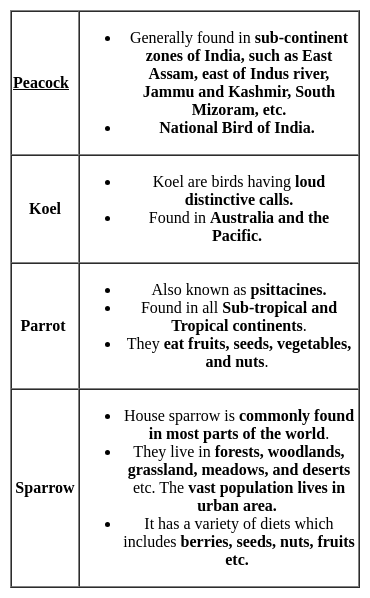
The bird that was common sight in Delhi but now a special day is observed to raise awareness about the bird as it has became rare due to the urbanization. The bird is?- a)Peacock
- b)Koel
- c)Parrot
- d)Sparrow
Correct answer is option 'D'. Can you explain this answer?
a)
Peacock
b)
Koel
c)
Parrot
d)
Sparrow
 | Diksha Sharma answered |
Concept:
- Delhi's former Chief Minister Sheila Dixit raised her concern about the decreasing number of Humble house sparrows in Delhi.
- Due to urbanization on a large scale, the birds lost their natural habitat and fails to build nests. Causing them to disappear.
- Mobile radiation and Telecom towers are enemies of Sparrows.
- They navigate by sensing the earth's magnetic field but the Tv towers and telephone towers disturb the earth's magnetic field and thus they are unable to locate their home.
- Thus, the Chief Minister of Delhi declared the Humble home sparrow as the state bird of Delhi to raise awareness about it.
Explanation:
The bird was a common sight in Delhi but now a special day is observed to raise awareness about the bird as it has become rare due to the urbanization. The bird is a sparrow.
Additional Information
Animals who depend on other dead animals are called- a)Parasite
- b)Decomposer
- c)Scavengers
- d)Omnivores
Correct answer is option 'C'. Can you explain this answer?
a)
Parasite
b)
Decomposer
c)
Scavengers
d)
Omnivores
 | Skyhigh Academy answered |
Scavengers feed on dead animals for survival. They help in cleaning the environment by removing decaying bodies. Therefore, option C is correct.
Choose the correct statement about weeds.(A) Weeds grow in the fields without being planted.(B) It is important to remove weeds from the field.(C) Weeds reduce the production of field by using the water and fertilizers given to the crops.(D) Weeds do not affect the production of crops.- a)(A) and (B)
- b)(A) and (C)
- c)(A), (B) and (C)
- d)(A), (B) and (D)
Correct answer is option 'C'. Can you explain this answer?
Choose the correct statement about weeds.
(A) Weeds grow in the fields without being planted.
(B) It is important to remove weeds from the field.
(C) Weeds reduce the production of field by using the water and fertilizers given to the crops.
(D) Weeds do not affect the production of crops.
a)
(A) and (B)
b)
(A) and (C)
c)
(A), (B) and (C)
d)
(A), (B) and (D)
 | TeamUnknown answered |
Key Points
Characteristics of Weeds:
- Weeds are unwanted, persistent, harmful plants.
- Undesirable weeds areplants that grow alongside the main plants.
- Theseimpede the growth of other crop plants and negatively impact human activities.
- They also affectagricultural production, natural phenomena, and the national economy.
- Xanthium and Partheniumare examples of weeds.
Thus,
(A), (B) and (C) are correct.
________ is / are found in the plant cell wall.- a)Cellulose
- b)Hemicellulose
- c)Both stated above
- d)Nepanthus
Correct answer is option 'C'. Can you explain this answer?
________ is / are found in the plant cell wall.
a)
Cellulose
b)
Hemicellulose
c)
Both stated above
d)
Nepanthus
 | Gargi Bose answered |
Plant Cell Wall Components:
Cell walls in plant cells are composed of various components that provide structural support and protection to the cell. Two of the main components found in the plant cell wall are cellulose and hemicellulose.
Cellulose:
- Cellulose is a long chain polymer of glucose molecules.
- It is a major component of the plant cell wall, providing strength and rigidity.
- Cellulose fibers form a network that gives the cell wall its structural integrity.
- Cellulose is synthesized by enzyme complexes called cellulose synthases, which are embedded in the cell membrane.
Hemicellulose:
- Hemicellulose is a complex carbohydrate that consists of various sugar molecules.
- It plays a role in cross-linking cellulose fibers in the cell wall, contributing to its overall strength.
- Hemicellulose also helps in water retention and provides flexibility to the cell wall.
- Different types of hemicelluloses are found in plant cell walls, such as xylans, mannans, and glucans.
Conclusion:
Both cellulose and hemicellulose are essential components of the plant cell wall, working together to provide structural support, protection, and flexibility to plant cells. These components are crucial for the overall function and integrity of plant cells.
Cell walls in plant cells are composed of various components that provide structural support and protection to the cell. Two of the main components found in the plant cell wall are cellulose and hemicellulose.
Cellulose:
- Cellulose is a long chain polymer of glucose molecules.
- It is a major component of the plant cell wall, providing strength and rigidity.
- Cellulose fibers form a network that gives the cell wall its structural integrity.
- Cellulose is synthesized by enzyme complexes called cellulose synthases, which are embedded in the cell membrane.
Hemicellulose:
- Hemicellulose is a complex carbohydrate that consists of various sugar molecules.
- It plays a role in cross-linking cellulose fibers in the cell wall, contributing to its overall strength.
- Hemicellulose also helps in water retention and provides flexibility to the cell wall.
- Different types of hemicelluloses are found in plant cell walls, such as xylans, mannans, and glucans.
Conclusion:
Both cellulose and hemicellulose are essential components of the plant cell wall, working together to provide structural support, protection, and flexibility to plant cells. These components are crucial for the overall function and integrity of plant cells.
The feathers of the birds are of different colours, shapes and sizes. Their feathers help them to fly andA. eat different types of foodB. keep them warmC. walk in different waysD. keep them waterproof- a)B and C
- b)B and D
- c)B, C and D
- d)A, B, C and D
Correct answer is option 'B'. Can you explain this answer?
The feathers of the birds are of different colours, shapes and sizes. Their feathers help them to fly and
A. eat different types of food
B. keep them warm
C. walk in different ways
D. keep them waterproof
a)
B and C
b)
B and D
c)
B, C and D
d)
A, B, C and D
 | Hridoy Yadav answered |
Feathers of Birds
Feathers of birds are not just for aesthetic purposes, they serve several important functions for the birds.
Help Them to Fly
One of the primary functions of bird feathers is to help them fly. The shape and structure of feathers are essential for providing lift and enabling birds to soar through the air.
Keep Them Warm
Bird feathers also serve as insulation, helping to regulate the bird's body temperature. The downy feathers close to the bird's body trap air and create a layer of warmth, keeping the bird comfortable in various weather conditions.
Keep Them Waterproof
Another important function of bird feathers is to keep the birds dry. Many birds have specialized oil glands that they use to preen their feathers, which helps to waterproof them and prevent water from seeping in.
Conclusion
In conclusion, bird feathers play a crucial role in the survival and well-being of birds. They not only enable birds to fly, but also keep them warm, dry, and comfortable in their environment.
Feathers of birds are not just for aesthetic purposes, they serve several important functions for the birds.
Help Them to Fly
One of the primary functions of bird feathers is to help them fly. The shape and structure of feathers are essential for providing lift and enabling birds to soar through the air.
Keep Them Warm
Bird feathers also serve as insulation, helping to regulate the bird's body temperature. The downy feathers close to the bird's body trap air and create a layer of warmth, keeping the bird comfortable in various weather conditions.
Keep Them Waterproof
Another important function of bird feathers is to keep the birds dry. Many birds have specialized oil glands that they use to preen their feathers, which helps to waterproof them and prevent water from seeping in.
Conclusion
In conclusion, bird feathers play a crucial role in the survival and well-being of birds. They not only enable birds to fly, but also keep them warm, dry, and comfortable in their environment.
What role do mycorrhizal fungi play in mutualism?- a)They decompose organic material.
- b)They provide nutrients to plant roots.
- c)They predate on harmful insects.
- d)They supply oxygen to aquatic animals.
Correct answer is option 'B'. Can you explain this answer?
a)
They decompose organic material.
b)
They provide nutrients to plant roots.
c)
They predate on harmful insects.
d)
They supply oxygen to aquatic animals.
 | Knowledge Centre answered |
Mycorrhizal fungi form a mutualistic association with plant roots, enhancing nutrient absorption, particularly phosphorus.
I am a/an _____. I can find my female worm from many kilometers away by her smell.- a)earthworm
- b)flatworm
- c)tapeworm
- d)silkworm
Correct answer is option 'D'. Can you explain this answer?
a)
earthworm
b)
flatworm
c)
tapeworm
d)
silkworm
 | Sanjana Chavan answered |
Understanding the Correct Answer: Silkworm
Silkworms, specifically the larvae of the silk moth (Bombyx mori), possess a remarkable ability to locate potential mates over considerable distances using their sense of smell. This capability is primarily due to the following factors:
1. Pheromone Detection
- Silkworm females release specific chemical signals known as pheromones into the air.
- Males can detect these pheromones from several kilometers away using their highly sensitive antennae.
- This adaptation is crucial for reproduction, as it allows males to find females even in dense environments.
2. Sensory Adaptations
- The antennae of silkworm males are equipped with specialized sensory receptors.
- These receptors respond to the chemical composition of the pheromones, enabling precise detection.
- This biological design enhances their ability to locate a mate, ensuring the continuation of their species.
3. Importance in Reproduction
- The ability to find females from long distances increases mating opportunities.
- Successful mating is essential for the lifecycle of silkworms, as they are cultivated for silk production.
- Farmers and breeders often rely on this natural behavior to optimize breeding programs.
Conclusion
In conclusion, silkworms are uniquely adapted to find their female counterparts using chemical cues. This distinguishes them from earthworms, flatworms, and tapeworms, which do not possess the same level of olfactory capabilities for mate detection. Understanding these biological traits is essential in the context of their ecological and economic significance.
Silkworms, specifically the larvae of the silk moth (Bombyx mori), possess a remarkable ability to locate potential mates over considerable distances using their sense of smell. This capability is primarily due to the following factors:
1. Pheromone Detection
- Silkworm females release specific chemical signals known as pheromones into the air.
- Males can detect these pheromones from several kilometers away using their highly sensitive antennae.
- This adaptation is crucial for reproduction, as it allows males to find females even in dense environments.
2. Sensory Adaptations
- The antennae of silkworm males are equipped with specialized sensory receptors.
- These receptors respond to the chemical composition of the pheromones, enabling precise detection.
- This biological design enhances their ability to locate a mate, ensuring the continuation of their species.
3. Importance in Reproduction
- The ability to find females from long distances increases mating opportunities.
- Successful mating is essential for the lifecycle of silkworms, as they are cultivated for silk production.
- Farmers and breeders often rely on this natural behavior to optimize breeding programs.
Conclusion
In conclusion, silkworms are uniquely adapted to find their female counterparts using chemical cues. This distinguishes them from earthworms, flatworms, and tapeworms, which do not possess the same level of olfactory capabilities for mate detection. Understanding these biological traits is essential in the context of their ecological and economic significance.
A boy wakes up a night and sees a bird flying very fast through the corners of buildings. When he studied that bird, he knows that these birds can see good at night and only in the colour black and white. These birds are known as _____- a)Binocular bird
- b)Flightless bird
- c)Nocturnal birds
- d)Diurnal bird
Correct answer is option 'C'. Can you explain this answer?
a)
Binocular bird
b)
Flightless bird
c)
Nocturnal birds
d)
Diurnal bird
 | Vaibhav Menon answered |
Explanation:
- Nocturnal birds: Nocturnal birds are birds that are active during the night. They have specially adapted eyes that allow them to see well in low light conditions. This enables them to hunt for food and navigate in the dark.
- Black and white vision: Nocturnal birds typically have monochromatic vision, which means they see in black and white. This type of vision helps them to detect movement and contrast in low light situations.
- Fast flying: Nocturnal birds, such as owls and nightjars, are known for their fast and agile flight. This allows them to quickly catch their prey in the darkness.
- Adapted for night: These birds have evolved to have keen hearing and silent flight to aid in their nocturnal activities. Their feathers are designed to dampen sound, making them stealthy hunters.
In conclusion, the boy likely observed a nocturnal bird with black and white vision flying swiftly through the night, showcasing its unique adaptations for hunting and survival in low light conditions.
Cuscuta is an example of:- a)autotroph
- b)parasite
- c)saprotroph
- d)host
Correct answer is option 'B'. Can you explain this answer?
a)
autotroph
b)
parasite
c)
saprotroph
d)
host
 | Ishita Kulkarni answered |
Understanding Cuscuta
Cuscuta, commonly known as dodder, is a genus of parasitic plants that exhibit unique characteristics distinguishing them from other plant types. It primarily relies on other plants for its nutrients, making it a classic example of a parasite.
Characteristics of Cuscuta
- Parasitic Nature:
- Cuscuta does not have chlorophyll, which means it cannot perform photosynthesis to create its own food. Instead, it attaches to host plants using specialized structures called haustoria.
- Nutrient Absorption:
- Through its haustoria, Cuscuta taps into the vascular system of the host plant to extract water and essential nutrients, thereby sustaining itself.
Differences from Other Categories
- Autotrophs:
- These organisms can synthesize their own food using sunlight or chemical energy. Cuscuta does not fit into this category as it lacks chlorophyll.
- Saprotrophs:
- Saprotrophic organisms decompose organic matter to obtain nutrients. Cuscuta, on the other hand, requires a living host for sustenance.
- Host:
- The term "host" refers to the organism that provides sustenance to a parasite. In this case, the host is the plant that Cuscuta attaches itself to.
Conclusion
In summary, Cuscuta is an example of a parasite due to its dependence on other plants for survival. Its unique adaptations enable it to thrive by extracting nutrients from its hosts, showcasing the complex relationships within ecosystems.
Cuscuta, commonly known as dodder, is a genus of parasitic plants that exhibit unique characteristics distinguishing them from other plant types. It primarily relies on other plants for its nutrients, making it a classic example of a parasite.
Characteristics of Cuscuta
- Parasitic Nature:
- Cuscuta does not have chlorophyll, which means it cannot perform photosynthesis to create its own food. Instead, it attaches to host plants using specialized structures called haustoria.
- Nutrient Absorption:
- Through its haustoria, Cuscuta taps into the vascular system of the host plant to extract water and essential nutrients, thereby sustaining itself.
Differences from Other Categories
- Autotrophs:
- These organisms can synthesize their own food using sunlight or chemical energy. Cuscuta does not fit into this category as it lacks chlorophyll.
- Saprotrophs:
- Saprotrophic organisms decompose organic matter to obtain nutrients. Cuscuta, on the other hand, requires a living host for sustenance.
- Host:
- The term "host" refers to the organism that provides sustenance to a parasite. In this case, the host is the plant that Cuscuta attaches itself to.
Conclusion
In summary, Cuscuta is an example of a parasite due to its dependence on other plants for survival. Its unique adaptations enable it to thrive by extracting nutrients from its hosts, showcasing the complex relationships within ecosystems.
Shoot system develops from of the baby plant or embryo- a)Cotyledons
- b)Roots
- c)Callus
- d)Plumule
Correct answer is option 'D'. Can you explain this answer?
a)
Cotyledons
b)
Roots
c)
Callus
d)
Plumule
| | Skyhigh Academy answered |
Plumule develops into stem and leaves. Thus, it forms the shoot system of the plant.
The different patterns on the skin of animals are- a)an indication of their physical strength
- b)due to the reflected light
- c)due to the hair on their skin
- d)due to the weather conditions they live in
Correct answer is option 'D'. Can you explain this answer?
a)
an indication of their physical strength
b)
due to the reflected light
c)
due to the hair on their skin
d)
due to the weather conditions they live in
| | Skyhigh Academy answered |
Skin patterns like stripes and patches are adaptations to the environment. They help in camouflage and survival in different weather conditions. Hence, option D is correct.
The root, stem leaves constitute the part of the plant body- a)Vegetative
- b)Reproductive
- c)Both (A) and (B)
- d)Neither (A) nor (B)
Correct answer is option 'A'. Can you explain this answer?
The root, stem leaves constitute the part of the plant body
a)
Vegetative
b)
Reproductive
c)
Both (A) and (B)
d)
Neither (A) nor (B)
 | Goel UPSC Coaching Center answered |
Root, stem and leaves help in plant growth and survival. Therefore, they are vegetative parts.
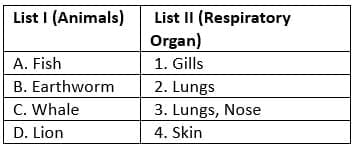
Match the following
Codes- a)4, 2, 3, 1
- b)1, 4, 3, 2
- c)1, 4, 2, 3
- d)4, 1, 2, 3
Correct answer is option 'B'. Can you explain this answer?
Match the following
Codes
Codes
a)
4, 2, 3, 1
b)
1, 4, 3, 2
c)
1, 4, 2, 3
d)
4, 1, 2, 3
 | Aspire Academy answered |
Fish breathe through gills and earthworm breathes through moist skin. Whale uses lungs and nose for breathing and lion breathes using lungs. Hence, the correct matching is option B.
Process through which plants reproduce?- a)Eating
- b)Evaporation
- c)Pollination
- d)Condensation
Correct answer is option 'C'. Can you explain this answer?
a)
Eating
b)
Evaporation
c)
Pollination
d)
Condensation
| | Skyhigh Academy answered |
Pollination is essential for formation of seeds. It helps in reproduction of flowering plants.
Which of the following is a stem?- a)Turnip
- b)Onion
- c)Radish
- d)Carrot
Correct answer is option 'B'. Can you explain this answer?
a)
Turnip
b)
Onion
c)
Radish
d)
Carrot
 | S.S Career Academy answered |
Onion is a modified underground stem (bulb). Turnip, radish and carrot are modified roots.
Stomata help in- a)Respiration
- b)Photosynthesis
- c)Transpiration
- d)All of these
Correct answer is option 'D'. Can you explain this answer?
a)
Respiration
b)
Photosynthesis
c)
Transpiration
d)
All of these
| | Goel UPSC Coaching Center answered |
Stomata allow exchange of gases for respiration and photosynthesis. They also help in transpiration.
Animals are classified on the basis of nutirition. Identify the true statements in this regard
I. Autotrophs can produce their own food.
II. Heterotrophs cannot produce their own food.
Which of the statement(s) given above is/are correct?- a)Only I
- b)Only II
- c)Both I and II
- d)Neither I nor II
Correct answer is option 'C'. Can you explain this answer?
I. Autotrophs can produce their own food.
II. Heterotrophs cannot produce their own food.
Which of the statement(s) given above is/are correct?
a)
Only I
b)
Only II
c)
Both I and II
d)
Neither I nor II
| | Skyhigh Academy answered |
Autotrophs make their own food using sunlight and chlorophyll. Heterotrophs depend on plants or other animals for food. Therefore, both statements are correct.
Find the one which is not oviparous?- a)Birds
- b)Reptiles
- c)Amphibian
- d)Mammal
Correct answer is option 'D'. Can you explain this answer?
a)
Birds
b)
Reptiles
c)
Amphibian
d)
Mammal
| | Aspire Academy answered |
Oviparous animals lay eggs like birds, reptiles, and amphibians. Mammals generally give birth to young ones directly. Therefore, mammals are not oviparous.
Photosynthate from the leaves is transported via- a)Xylem
- b)Phloem
- c)Stem
- d)Stomata
Correct answer is option 'B'. Can you explain this answer?
a)
Xylem
b)
Phloem
c)
Stem
d)
Stomata
| | Skyhigh Academy answered |
Phloem transports food prepared in the leaves. This food is carried to other parts of the plant.
During photosynthesis which gas is absorbed by plants?- a)Oxygen
- b)Nitrogen
- c)Carbon dioxide
- d)Phosphorus
Correct answer is option 'C'. Can you explain this answer?
a)
Oxygen
b)
Nitrogen
c)
Carbon dioxide
d)
Phosphorus
 | Prof. Sonal Sharma answered |
Plants absorb carbon dioxide during photosynthesis. Oxygen is released as a by-product.
Which one is the example of vegetatively geotropic roots?- a)Banyan tree
- b)Rhizophora
- c)Sugarcane
- d)Acacia
Correct answer is option 'B'. Can you explain this answer?
a)
Banyan tree
b)
Rhizophora
c)
Sugarcane
d)
Acacia
| | Aspire Academy answered |
Rhizophora grows in swampy areas and develops pneumatophores. These roots grow away from gravity for respiration.
Which of the following pairs is not correctly matched?- a)Frog : respiration through lungs
- b)Earthworm : respiration through skin
- c)Whale : respiration through gills
- d)Snakes : respiration through lungs
Correct answer is option 'C'. Can you explain this answer?
a)
Frog : respiration through lungs
b)
Earthworm : respiration through skin
c)
Whale : respiration through gills
d)
Snakes : respiration through lungs
| | Aspire Academy answered |
Whale is a mammal and breathes through lungs, not gills. Gills are mainly present in fishes. Therefore, “Whale : respiration through gills” is not correctly matched.
What are the main characteristics of adventitious roots?- a)One large, Central root
- b)Central dominating root
- c)Thin moderately branched roots
- d)All of the above
Correct answer is option 'C'. Can you explain this answer?
a)
One large, Central root
b)
Central dominating root
c)
Thin moderately branched roots
d)
All of the above
| | Goel UPSC Coaching Center answered |
Adventitious roots are thin and moderately branched. They do not have one dominant central root.
Read the following description of an animal and identify it
“It looks like a bear but it is not. It spends almost 17 hours a day sleeping while hanging upside down on a tree branch. It eats the leaves of the same tree on which it lives. It lives for about 40 years.”- a)Chimpanzee
- b)Panda
- c)Sloth
- d)Langur
Correct answer is option 'C'. Can you explain this answer?
“It looks like a bear but it is not. It spends almost 17 hours a day sleeping while hanging upside down on a tree branch. It eats the leaves of the same tree on which it lives. It lives for about 40 years.”
a)
Chimpanzee
b)
Panda
c)
Sloth
d)
Langur
| | Aspire Academy answered |
The described animal sleeps for long hours and hangs upside down on trees. It also eats leaves and lives for many years. These features match a sloth.
Which of the following animal is used a source of entertainment for human?- a)Dog
- b)Rabbit
- c)Hen
- d)Monkey
Correct answer is option 'C'. Can you explain this answer?
a)
Dog
b)
Rabbit
c)
Hen
d)
Monkey
 | Focus Academy answered |
Some animals are domesticated not only for products but also for entertainment. According to the provided key, hen is considered an entertainment source here. Hence option C is marked correct.
What is animal husbandry?- a)Keeping animal at house
- b)A science of breeding and caring of animals
- c)Making cow friendly to child
- d)All of the above
Correct answer is option 'B'. Can you explain this answer?
a)
Keeping animal at house
b)
A science of breeding and caring of animals
c)
Making cow friendly to child
d)
All of the above
| | Skyhigh Academy answered |
Animal husbandry refers to scientific care, management, and breeding of animals. It focuses on improving productivity like milk, meat, wool, etc. Therefore, option B is correct.
Which of the following is not biotic factor?- a)Plants
- b)Animals
- c)Microorganisms
- d)Stones
Correct answer is option 'D'. Can you explain this answer?
a)
Plants
b)
Animals
c)
Microorganisms
d)
Stones
| | Prof. Sonal Sharma answered |
Biotic factors include living organisms like plants, animals, and microbes. Stones are non-living and part of the abiotic environment. Hence, option D is correct.
Food formed photosynthesis store in the form of in the plant- a)Protein
- b)Fat
- c)Carbohydrate
- d)Vitamin
Correct answer is option 'C'. Can you explain this answer?
a)
Protein
b)
Fat
c)
Carbohydrate
d)
Vitamin
| | S.S Career Academy answered |
Plants store prepared food mainly as carbohydrates (starch). This stored food is used later for growth and energy.
Non-green plants like mushroom can’t make their own food because- a)They are too small
- b)They lack chlorophyll
- c)They lack photo-tropism
- d)They lack roots to suck water
Correct answer is option 'B'. Can you explain this answer?
a)
They are too small
b)
They lack chlorophyll
c)
They lack photo-tropism
d)
They lack roots to suck water
| | Aspire Academy answered |
Chlorophyll is required for photosynthesis. Mushrooms lack chlorophyll, so they cannot make food.
Which of the following statements are correct?
I. Oviparous lay eggs.
II. In external fertilisation of ovum and sperm takes place outside the body.
III. Viviparous animals lay eggs.
IV. In viviporous animals, fertilisation occur inside the female body.
Select the correct answer using the codes given below.- a)I, II and III
- b)III and IV
- c)I, II and IV
- d)II, III and IV
Correct answer is option 'C'. Can you explain this answer?
I. Oviparous lay eggs.
II. In external fertilisation of ovum and sperm takes place outside the body.
III. Viviparous animals lay eggs.
IV. In viviporous animals, fertilisation occur inside the female body.
Select the correct answer using the codes given below.
a)
I, II and III
b)
III and IV
c)
I, II and IV
d)
II, III and IV
| | Aspire Academy answered |
Oviparous animals lay eggs and external fertilisation happens outside the body. Viviparous animals give birth, so they do not lay eggs, making statement III wrong. Hence, I, II and IV are correct.
Bat is mammal because it- a)flies
- b)arboreal
- c)herbivores
- d)gives birth
Correct answer is option 'D'. Can you explain this answer?
a)
flies
b)
arboreal
c)
herbivores
d)
gives birth
| | Prof. Sonal Sharma answered |
Mammals give birth to young ones and feed them with milk. Bat gives birth instead of laying eggs. Hence, bat is a mammal and option D is correct.
Identify the correct statement.
I. Fishes have scales on the body.
II. They have invisible ears and have only two chambered heart.
III. Fishes are oviparous animal.
Which of the statements given above is/are correct?- a)I and II
- b)I and III
- c)II and III
- d)All of these
Correct answer is option 'D'. Can you explain this answer?
I. Fishes have scales on the body.
II. They have invisible ears and have only two chambered heart.
III. Fishes are oviparous animal.
Which of the statements given above is/are correct?
a)
I and II
b)
I and III
c)
II and III
d)
All of these
| | Aspire Academy answered |
Fishes have scales and mostly lay eggs, so they are oviparous. They also possess a two-chambered heart and have invisible ears. Thus, all the statements are correct.
The plant which takes the support of the neighbouring structures and climbs up is- a)Tree
- b)Shrub
- c)Creeper
- d)Climber
Correct answer is option 'D'. Can you explain this answer?
a)
Tree
b)
Shrub
c)
Creeper
d)
Climber
| | S.S Career Academy answered |
Climbers have weak stems and grow upward using support. Example: pea plant and grapevine.
Which one of the following is the example of pseudostem?- a)Grass
- b)Hibiscus
- c)Banana
- d)Bamboo
Correct answer is option 'C'. Can you explain this answer?
a)
Grass
b)
Hibiscus
c)
Banana
d)
Bamboo
| | Goel UPSC Coaching Center answered |
Banana has a pseudostem formed by leaf bases. It is not a true woody stem like trees.
Identify the correct statement regarding process of photosynthesis.
I. Photosynthesis takes place in the leaves of plants.
II. Chlorophyll absorbs the Sun’s energy.
III. Water and carbon dioxide are used to form glucose or food for plants.
Which of the statements given above are correct?- a)I and II
- b)II and III
- c)I and III
- d)I, II and III
Correct answer is option 'D'. Can you explain this answer?
I. Photosynthesis takes place in the leaves of plants.
II. Chlorophyll absorbs the Sun’s energy.
III. Water and carbon dioxide are used to form glucose or food for plants.
Which of the statements given above are correct?
a)
I and II
b)
II and III
c)
I and III
d)
I, II and III
| | Prof. Sonal Sharma answered |
Photosynthesis happens mainly in green leaves. It uses sunlight, chlorophyll, CO₂ and water to form food.
Which of the following birds make its nest among the thorns of a cactus plant?- a)Weaverbird
- b)Robin bird
- c)Dove
- d)Sunbird
Correct answer is option 'C'. Can you explain this answer?
a)
Weaverbird
b)
Robin bird
c)
Dove
d)
Sunbird
| | Focus Academy answered |
Some birds choose thorny places for nests to protect themselves from predators. Dove is known to build its nest among cactus thorns. Therefore, option C is correct.
Which pair is correctly matched?- a)Vertebrates : snakes
- b)Invertebrates : frog
- c)Mammal : monkey
- d)All of these
Correct answer is option 'D'. Can you explain this answer?
a)
Vertebrates : snakes
b)
Invertebrates : frog
c)
Mammal : monkey
d)
All of these
| | Prof. Sonal Sharma answered |
Snakes are vertebrates and monkeys are mammals as they have a backbone and give birth. The question includes multiple correct pairs. Therefore, the answer is “All of these”.
Which of the following is NOT the part of plant?- a)Root
- b)Leaves
- c)Stem
- d)Habitat
Correct answer is option 'D'. Can you explain this answer?
a)
Root
b)
Leaves
c)
Stem
d)
Habitat
| | Skyhigh Academy answered |
Root, leaves and stem are parts of a plant. Habitat means the place where a plant lives.
Which plant is the example of a herb?- a)Mango
- b)China rose
- c)Wheat
- d)None of these
Correct answer is option 'C'. Can you explain this answer?
a)
Mango
b)
China rose
c)
Wheat
d)
None of these
| | Aspire Academy answered |
Wheat has a soft and weak stem. Therefore, it is classified as a herb.
Chapter doubts & questions for Animals & Plants - 2 Months Preparation for CTET Paper 1 2026 is part of CTET & State TET exam preparation. The chapters have been prepared according to the CTET & State TET exam syllabus. The Chapter doubts & questions, notes, tests & MCQs are made for CTET & State TET 2026 Exam. Find important definitions, questions, notes, meanings, examples, exercises, MCQs and online tests here.
Chapter doubts & questions of Animals & Plants - 2 Months Preparation for CTET Paper 1 in English & Hindi are available as part of CTET & State TET exam. Download more important topics, notes, lectures and mock test series for CTET & State TET Exam by signing up for free.
2 Months Preparation for CTET Paper 1218 videos|569 docs|217 tests |
