


All questions of DNA, RNA, and Protein for Grade 9 Exam
Which of the following steps in transcription is catalysed by RNA polymerase?- a)Initiation
- b)Elongation
- c)Termination
- d)All of the above
Correct answer is option 'B'. Can you explain this answer?
Which of the following steps in transcription is catalysed by RNA polymerase?
a)
Initiation
b)
Elongation
c)
Termination
d)
All of the above
 | Anjali Iyer answered |
RNA polymerase moves along the template strand, synthesising an mRNA molecule. In prokaryotes RNA polymerase is a holoenzyme consisting of a number of subunits, including a sigma factor (transcription factor) that recognises the promoter. In eukaryotes there are three RNA polymerases: I, II and III. The process includes a proofreading mechanism.

DNA contains nucleobases, sugar and phosphate. Removal of which among these from a DNA sample will not significantly affect the length of DNA?- a)Nucleobases
- b)Sugar
- c)Phosphate
- d)None of the above
Correct answer is option 'A'. Can you explain this answer?
DNA contains nucleobases, sugar and phosphate. Removal of which among these from a DNA sample will not significantly affect the length of DNA?
a)
Nucleobases
b)
Sugar
c)
Phosphate
d)
None of the above
 | Kamlesh Bhivsane answered |
NUCLEOBASE(it is base pairing between nitrogen bases i.e A ,T,G,C) therefore it does not affect the length of DNA where as sugar phosphate bond is the back bone of DNA therefore they both affect the length of DNA
DNA has genetic properties was revealed for the first time by- a)Chargaff
- b)Griffith
- c)Avery
- d)Wilkins
Correct answer is option 'C'. Can you explain this answer?
DNA has genetic properties was revealed for the first time by
a)
Chargaff
b)
Griffith
c)
Avery
d)
Wilkins
 | Pooja Choudhury answered |
The discovery that DNA has genetic properties was first revealed by Oswald Avery and his team of scientists in 1944. Avery was a molecular biologist who worked at the Rockefeller Institute for Medical Research in New York City.
Experiment
Avery and his team conducted a series of experiments to determine whether DNA was the genetic material responsible for the transformation of bacteria. They used two strains of Streptococcus pneumoniae, one that was virulent (able to cause disease) and one that was non-virulent. The virulent strain had a capsule made of a complex sugar that protected it from the immune system, while the non-virulent strain lacked this capsule and was easily destroyed by the immune system.
Results
Avery and his team extracted various biochemical components from the virulent strain of bacteria, including proteins, lipids, RNA, and DNA. They then mixed each of these components with the non-virulent strain to see if they could induce transformation. Only the DNA extract was able to transform the non-virulent strain into a virulent one, proving that DNA was the genetic material responsible for the transformation.
Conclusion
Avery's discovery was groundbreaking because it showed that DNA, which was previously thought to be a simple molecule with no biological significance, was in fact the carrier of genetic information. This discovery paved the way for the development of the field of molecular biology and our current understanding of genetics.
Experiment
Avery and his team conducted a series of experiments to determine whether DNA was the genetic material responsible for the transformation of bacteria. They used two strains of Streptococcus pneumoniae, one that was virulent (able to cause disease) and one that was non-virulent. The virulent strain had a capsule made of a complex sugar that protected it from the immune system, while the non-virulent strain lacked this capsule and was easily destroyed by the immune system.
Results
Avery and his team extracted various biochemical components from the virulent strain of bacteria, including proteins, lipids, RNA, and DNA. They then mixed each of these components with the non-virulent strain to see if they could induce transformation. Only the DNA extract was able to transform the non-virulent strain into a virulent one, proving that DNA was the genetic material responsible for the transformation.
Conclusion
Avery's discovery was groundbreaking because it showed that DNA, which was previously thought to be a simple molecule with no biological significance, was in fact the carrier of genetic information. This discovery paved the way for the development of the field of molecular biology and our current understanding of genetics.
According to Chargaff’s rule, which one is correct?- a)[A] + [T] = [G] + [C]
- b)[A] + [C] = [G] + [T]
- c)[A] + [G] = [T] + [C]
- d)All of these
Correct answer is option 'C'. Can you explain this answer?
According to Chargaff’s rule, which one is correct?
a)
[A] + [T] = [G] + [C]
b)
[A] + [C] = [G] + [T]
c)
[A] + [G] = [T] + [C]
d)
All of these
 | Geetika Shah answered |
According to Chargaff’s rule in all cellular DNA, regardless of the species, number of adenosine residues is equal to the number of thymidine residues which means that A = T and the number of guanosine residues is equal to the number of cytidine residues; G = C . Hence, that the sum of the purine residues equals the sum of the pyrimidine residues; i.e., A + G = T + C.
Whose experiments cracked the DNA and discovered unequivocally that a genetic code is a triplet?- a)Nirenberg and Matthaei
- b)Hershey and Chase
- c)Beadle and Tatum
- d)Morgan and Sturtevant
Correct answer is option 'A'. Can you explain this answer?
Whose experiments cracked the DNA and discovered unequivocally that a genetic code is a triplet?
a)
Nirenberg and Matthaei
b)
Hershey and Chase
c)
Beadle and Tatum
d)
Morgan and Sturtevant
 | Rajat Kapoor answered |
The existence of a triplet code was simply an assumption till 1961 when Nirenberg and Methaei proved its existence by experiment. They were able to synthesise artificial mRNA, which contained only one nitrogenous base, ie, uracil. This synthetic poly-U sequence was then placed in a cell-free system containing protein synthesizing enzymes (extracted from bacterium E. coil) and 20 amino acids together with necessary ATP. During the process, a small polypeptide molecule was produced, which was formed by the linking of phenylalanine. This issuggested that UUU is code for phenylalanine. Nirenberg got Nobel Prize for his contributions.
Who among the following scientists had no contribution in the development of the double helix model for the structure of DNA?- a)Meselson and Stahl
- b)Rosalind Franklin
- c)Erwin Chargaff
- d)Maurice Wilkins
Correct answer is option 'A'. Can you explain this answer?
Who among the following scientists had no contribution in the development of the double helix model for the structure of DNA?
a)
Meselson and Stahl
b)
Rosalind Franklin
c)
Erwin Chargaff
d)
Maurice Wilkins
 | Dilip Chaurasiya answered |
Meselson and Stahl prove experimentally semi conservation of DNA replication not say but structure of DNA.
A typical nucleosome contains- a)100 bp of DNA helix
- b)400 bp of DNA helix
- c)200 bp of DNA helix
- d)300 bp of DNA helix
Correct answer is option 'C'. Can you explain this answer?
A typical nucleosome contains
a)
100 bp of DNA helix
b)
400 bp of DNA helix
c)
200 bp of DNA helix
d)
300 bp of DNA helix
| | Suresh Kumar answered |
A typical nucleosome contains 200 bp of DNA double helix wrapped(2 turns) around a core of histone octamer having two copies of each of four types of histone proteins ..H2A,H2B,H3,&H4.....H1 histone molecule lies outside the nucleosome core & seals the two turns of DNA by binding at the point where DNA enters and leaves the core..
The beginning of understanding genetic transformation in bacteria was made by- a)Hershey and Chase
- b)Watson and Crick
- c)Frederick Griffith
- d)T. H. Morgan
Correct answer is option 'C'. Can you explain this answer?
The beginning of understanding genetic transformation in bacteria was made by
a)
Hershey and Chase
b)
Watson and Crick
c)
Frederick Griffith
d)
T. H. Morgan
| | Shivi Singh answered |
In 1928 Griffith experiment on streptococcus pneumonia and mice
In the DNA molecule,- a)There are two strands which run parallel in the 5′-3′ direction.
- b)The total amount of purine nucleotides and pyrimidine nucleotides is not always equal.
- c)Proportion of adenine in relation to thymine varies with the organism.
- d)There are two strands which run antiparallel – one in 5′-3′ direction and other in 3′-5′ direction.
Correct answer is option 'D'. Can you explain this answer?
In the DNA molecule,
a)
There are two strands which run parallel in the 5′-3′ direction.
b)
The total amount of purine nucleotides and pyrimidine nucleotides is not always equal.
c)
Proportion of adenine in relation to thymine varies with the organism.
d)
There are two strands which run antiparallel – one in 5′-3′ direction and other in 3′-5′ direction.
 | Shreya Saini answered |

Two microbes found to be very useful in genetic engineering are- a)Escherichia coli and Agrobacterium tumefaciens
- b)Vibrio cholerae and a tailed bacteriophage
- c)Diplococcus sp. and Pseudomonas sp.
- d)Crown gall bacterium and Caenorhabditis elegans
Correct answer is option 'A'. Can you explain this answer?
Two microbes found to be very useful in genetic engineering are
a)
Escherichia coli and Agrobacterium tumefaciens
b)
Vibrio cholerae and a tailed bacteriophage
c)
Diplococcus sp. and Pseudomonas sp.
d)
Crown gall bacterium and Caenorhabditis elegans
| | Anjali Iyer answered |
Escherichia coli and Agrobacterium tumefaciens are the microbes found to be very useful in genetic engineering.
E. coli is a motile, gram negative, rod shaped bacterium which is a normal inhabitant of human colon. It is most extensively used in bacterial genetics and molecular biology.
Agrobacterium tumefaciens is a soil bacterium. It has Ti plasmid (Tumour inducing plasmid) and it can be used for the transfer of a desired gene in dicot plants.
For transformation, micro-particles coated with DNA to be bombarded with gene gun are made up of :- a)Silver or Platinum
- b)Gold or Tungsten
- c)Silicon or Platinum
- d)Platinum or Zinc
Correct answer is option 'B'. Can you explain this answer?
For transformation, micro-particles coated with DNA to be bombarded with gene gun are made up of :
a)
Silver or Platinum
b)
Gold or Tungsten
c)
Silicon or Platinum
d)
Platinum or Zinc
| | Hitakshi Tamta answered |
For gene transfer into the host cell without using vector microparticles made of tungsten and gold coated with foregin DNA are bombarded into target cells at a very high velocity. This method is called biolistics or gene gun which is suitable for plants.So the correct option is 'gold or tungsten'.
In Hershey and Chase experiments, radioactive 32P was used to culture bacteriophages which resulted in radioactive- a)Protein capsule of bacteriophage
- b)Viral DNA
- c)Bacterial capsule
- d)Viral proteins
Correct answer is option 'B'. Can you explain this answer?
In Hershey and Chase experiments, radioactive 32P was used to culture bacteriophages which resulted in radioactive
a)
Protein capsule of bacteriophage
b)
Viral DNA
c)
Bacterial capsule
d)
Viral proteins
 | Sanjana Sharma answered |
The Hershey and Chase Experiment
The Hershey and Chase experiment, conducted in 1952 by Alfred Hershey and Martha Chase, provided important evidence supporting the concept that DNA, rather than protein, is the genetic material. This experiment was crucial in the development of the field of molecular biology and helped solidify the understanding of DNA as the molecule responsible for transmitting hereditary information.
Experimental Setup
In the Hershey and Chase experiment, the researchers used bacteriophages, which are viruses that infect bacteria. Bacteriophages consist of a protein coat, called the capsid, that encapsulates their genetic material, either DNA or RNA. The researchers wanted to determine whether the genetic material of the bacteriophage was DNA or protein.
To accomplish this, Hershey and Chase used two separate batches of bacteriophage T2. In one batch, they labeled the DNA of the bacteriophage with radioactive phosphorus-32 (32P), while in the other batch, they labeled the protein coat with radioactive sulfur-35 (35S).
Infection and Blending
The labeled bacteriophages were then used to infect separate cultures of E. coli bacteria. The infection process allowed the bacteriophage to inject its genetic material into the bacterial cell. To separate the bacteriophages from the bacterial cells, Hershey and Chase used a blender to shear off the protein coats that remained on the outside of the bacteria.
Centrifugation
After blending, the mixture was subjected to centrifugation, a process that separates particles based on their density. The heavy bacterial cells settled at the bottom of the centrifuge tube, forming a pellet, while the lighter bacteriophages remained in the liquid portion, called the supernatant.
Results
The researchers observed that the pellet in the 32P-labeled experiment was radioactive, indicating that the bacteriophage's genetic material had entered the bacterial cells. Conversely, the supernatant in the 32P-labeled experiment was not radioactive, suggesting that the protein coats remained outside the bacterial cells.
In the 35S-labeled experiment, the opposite pattern was observed. The pellet was not radioactive, indicating that the protein coats did not enter the bacterial cells, while the supernatant was radioactive, suggesting that the labeled protein coats had remained outside the bacterial cells.
Conclusion
Based on these results, Hershey and Chase concluded that the genetic material of the bacteriophage is DNA, not protein. The radioactive 32P-labeled DNA had entered the bacterial cells and was responsible for transmitting the genetic information, while the 35S-labeled protein coats remained outside the bacterial cells.
This experiment provided strong evidence supporting the role of DNA as the genetic material and laid the foundation for future research and discoveries in molecular biology.
The Hershey and Chase experiment, conducted in 1952 by Alfred Hershey and Martha Chase, provided important evidence supporting the concept that DNA, rather than protein, is the genetic material. This experiment was crucial in the development of the field of molecular biology and helped solidify the understanding of DNA as the molecule responsible for transmitting hereditary information.
Experimental Setup
In the Hershey and Chase experiment, the researchers used bacteriophages, which are viruses that infect bacteria. Bacteriophages consist of a protein coat, called the capsid, that encapsulates their genetic material, either DNA or RNA. The researchers wanted to determine whether the genetic material of the bacteriophage was DNA or protein.
To accomplish this, Hershey and Chase used two separate batches of bacteriophage T2. In one batch, they labeled the DNA of the bacteriophage with radioactive phosphorus-32 (32P), while in the other batch, they labeled the protein coat with radioactive sulfur-35 (35S).
Infection and Blending
The labeled bacteriophages were then used to infect separate cultures of E. coli bacteria. The infection process allowed the bacteriophage to inject its genetic material into the bacterial cell. To separate the bacteriophages from the bacterial cells, Hershey and Chase used a blender to shear off the protein coats that remained on the outside of the bacteria.
Centrifugation
After blending, the mixture was subjected to centrifugation, a process that separates particles based on their density. The heavy bacterial cells settled at the bottom of the centrifuge tube, forming a pellet, while the lighter bacteriophages remained in the liquid portion, called the supernatant.
Results
The researchers observed that the pellet in the 32P-labeled experiment was radioactive, indicating that the bacteriophage's genetic material had entered the bacterial cells. Conversely, the supernatant in the 32P-labeled experiment was not radioactive, suggesting that the protein coats remained outside the bacterial cells.
In the 35S-labeled experiment, the opposite pattern was observed. The pellet was not radioactive, indicating that the protein coats did not enter the bacterial cells, while the supernatant was radioactive, suggesting that the labeled protein coats had remained outside the bacterial cells.
Conclusion
Based on these results, Hershey and Chase concluded that the genetic material of the bacteriophage is DNA, not protein. The radioactive 32P-labeled DNA had entered the bacterial cells and was responsible for transmitting the genetic information, while the 35S-labeled protein coats remained outside the bacterial cells.
This experiment provided strong evidence supporting the role of DNA as the genetic material and laid the foundation for future research and discoveries in molecular biology.
Nitrogenous bases present in DNA:- a)Adenine, guanine, cytosine, thymine
- b)Guanine, uracil
- c)Adenine, guanine, cytosine, uracil
- d)Adenine, thymine, uracil
Correct answer is option 'A'. Can you explain this answer?
Nitrogenous bases present in DNA:
a)
Adenine, guanine, cytosine, thymine
b)
Guanine, uracil
c)
Adenine, guanine, cytosine, uracil
d)
Adenine, thymine, uracil
| | Hitakshi 💞💞 answered |
Four different types of nitrogenous bases are found in DNA: two purines adenine (A) and guanine (G) & two pyrimidines cytosine (C) and thymine (T). In RNA, the thymine is replaced by uracil (U).
Which of the following is a structural subunit of DNA?- a)Nucleotides
- b)Carbohydrate
- c)Protein
- d)RNA
Correct answer is option 'A'. Can you explain this answer?
Which of the following is a structural subunit of DNA?
a)
Nucleotides
b)
Carbohydrate
c)
Protein
d)
RNA
| | Kadambala Hemalatha answered |
Option A is correct becose, the nucleic acid (DNA or RNA) is consists of polymers of nucleo tides..
Restriction endonuclease- a)Cuts the DNA molecule at specific sites
- b)Synthesizes DNA
- c)Restricts the synthesis of DNA inside the nucleus
- d)Cuts the DNA molecule randomly
Correct answer is option 'A'. Can you explain this answer?
Restriction endonuclease
a)
Cuts the DNA molecule at specific sites
b)
Synthesizes DNA
c)
Restricts the synthesis of DNA inside the nucleus
d)
Cuts the DNA molecule randomly
| | Hitakshi Tamta answered |
Restriction endonuclease is a type of enzyme that can cleave molecules of DNA at a particular site called restriction site having polindromic sequence. These enzymes are produced by many bacteria and protect the cell by cleaving and destroying the DNA of invading viruses. Now a days, restriction enzymes are widely used in the techniques of genetic engineering.Therefore, the correct answer is option 'A'.
While analysing the DNA of an organism, a total number of 5386 nucleotides were found out of which the proportion of different bases were Adenine = 29%, Guanine = 17%, Cytosine = 32% and Thymine = 17%. Considering the Chargaff’s rule, it can be concluded that- a)It is a double-stranded linear DNA.
- b)It is single-stranded DNA.
- c)No conclusion can be drawn.
- d)It is a double-stranded circular DNA.
Correct answer is option 'D'. Can you explain this answer?
While analysing the DNA of an organism, a total number of 5386 nucleotides were found out of which the proportion of different bases were Adenine = 29%, Guanine = 17%, Cytosine = 32% and Thymine = 17%. Considering the Chargaff’s rule, it can be concluded that
a)
It is a double-stranded linear DNA.
b)
It is single-stranded DNA.
c)
No conclusion can be drawn.
d)
It is a double-stranded circular DNA.
| | Anjana Sharma answered |
The correct answer is b.
According to Chargaff's rules of base pairing,
(i) The amount of adenine is always equal to the amount of thymine and the amount of guanine is always equal to the amount of cytosine. (ii) Adenine is joined to thymine with two hydrogen bonds and guanine is joined to cytosine by three hydrogen bonds.
(iii) The ratio of adenine to thymine and that of guanine to cytosine is always equal to one, i.e., A/T = G/C =1
In the given organism, the DNA is not following the Chargaff's rule, hence it can be concluded that it is a single-stranded DNA, not double-stranded.
Which of the following statements given above is/are correct regarding restriction endonucleases?i. Hind II was the first restriction endonuclease discovered and cuts DNA at a specific sequence of six base pairs.ii. The convention for naming these enzymes is the first 2 letters of the name comes from the genus and the second one letter come from the species of the prokaryotic cell from which they were isolated.iii. Exonucleases and endonucleases are both types of restriction enzymes that function by cutting DNA at specific sites.iv. Each restriction endonuclease can only recognize and cut palindromic sequences in the DNA.- a)i and ii
- b)ii and iii
- c)i and iv
- d)i, iii, and iv
Correct answer is option 'C'. Can you explain this answer?
Which of the following statements given above is/are correct regarding restriction endonucleases?
i. Hind II was the first restriction endonuclease discovered and cuts DNA at a specific sequence of six base pairs.
ii. The convention for naming these enzymes is the first 2 letters of the name comes from the genus and the second one letter come from the species of the prokaryotic cell from which they were isolated.
iii. Exonucleases and endonucleases are both types of restriction enzymes that function by cutting DNA at specific sites.
iv. Each restriction endonuclease can only recognize and cut palindromic sequences in the DNA.
a)
i and ii
b)
ii and iii
c)
i and iv
d)
i, iii, and iv
| | Raghavendra Roy answered |
Overview of Restriction Endonucleases
Restriction endonucleases, also known as restriction enzymes, are crucial in molecular biology for manipulating DNA. Let's evaluate the statements provided regarding these enzymes.
Statement Analysis
- i. Hind II was the first restriction endonuclease discovered and cuts DNA at a specific sequence of six base pairs.
- This statement is incorrect. Hind II was not the first restriction enzyme discovered; that title goes to Hind II's predecessor, Hind I. Additionally, while Hind II does cut DNA at a specific site, it does not necessarily cut at a sequence of six base pairs.
- ii. The convention for naming these enzymes is the first 2 letters of the name comes from the genus and the second one letter comes from the species of the prokaryotic cell from which they were isolated.
- This statement is correct. For example, EcoRI is derived from Escherichia coli (genus: Eco, species: R).
- iii. Exonucleases and endonucleases are both types of restriction enzymes that function by cutting DNA at specific sites.
- This statement is incorrect. Exonucleases remove nucleotides from the ends of DNA, while endonucleases cut within the DNA strand. Only endonucleases are classified as restriction enzymes.
- iv. Each restriction endonuclease can only recognize and cut palindromic sequences in the DNA.
- This statement is correct. Most restriction enzymes recognize specific palindromic sequences in the DNA, which are sequences that read the same forwards and backwards.
Correct Statements
Based on the analysis, the correct statements are ii and iv. Thus, the correct answer is option 'c' (i and iv).
Restriction endonucleases, also known as restriction enzymes, are crucial in molecular biology for manipulating DNA. Let's evaluate the statements provided regarding these enzymes.
Statement Analysis
- i. Hind II was the first restriction endonuclease discovered and cuts DNA at a specific sequence of six base pairs.
- This statement is incorrect. Hind II was not the first restriction enzyme discovered; that title goes to Hind II's predecessor, Hind I. Additionally, while Hind II does cut DNA at a specific site, it does not necessarily cut at a sequence of six base pairs.
- ii. The convention for naming these enzymes is the first 2 letters of the name comes from the genus and the second one letter comes from the species of the prokaryotic cell from which they were isolated.
- This statement is correct. For example, EcoRI is derived from Escherichia coli (genus: Eco, species: R).
- iii. Exonucleases and endonucleases are both types of restriction enzymes that function by cutting DNA at specific sites.
- This statement is incorrect. Exonucleases remove nucleotides from the ends of DNA, while endonucleases cut within the DNA strand. Only endonucleases are classified as restriction enzymes.
- iv. Each restriction endonuclease can only recognize and cut palindromic sequences in the DNA.
- This statement is correct. Most restriction enzymes recognize specific palindromic sequences in the DNA, which are sequences that read the same forwards and backwards.
Correct Statements
Based on the analysis, the correct statements are ii and iv. Thus, the correct answer is option 'c' (i and iv).
Which of the following statements about the wobble hypothesis is correct?- a)The first base of the codon can pair with multiple bases of the anticodon
- b)The third base of the codon can pair with multiple bases of the anticodon
- c)The second base of the codon shows wobble pairing
- d)All three bases of the codon show wobble pairing
Correct answer is option 'B'. Can you explain this answer?
a)
The first base of the codon can pair with multiple bases of the anticodon
b)
The third base of the codon can pair with multiple bases of the anticodon
c)
The second base of the codon shows wobble pairing
d)
All three bases of the codon show wobble pairing
 | Lead Academy answered |
The correct answer is Option B - The third base of the codon can pair with multiple bases of the anticodon
According to the wobble hypothesis proposed by Francis Crick, flexible or non-standard pairing occurs at the third base of the codon (the 3' end of the codon) with the first base of the anticodon (the 5' end of the anticodon).
The first two positions of the codon pair by strict Watson-Crick base pairing, which enforces exact complementary geometry and prevents wobble at those positions.
This wobble at the third codon base explains the degeneracy of the genetic code, allowing fewer distinct tRNA species to recognise multiple codons that differ only in the third base.
For example, when inosine is present at the 5' position of an anticodon, it can pair with A, U or C, enabling a single tRNA to read several synonymous codons that vary at the third position.
Therefore, statements claiming wobble at the first or second codon bases, or claiming that all three bases wobble, are incorrect because only the third base of the codon exhibits this flexible pairing behaviour.
Which of the following statements about the genetic code is NOT correct?- a)The genetic code is comma-less
- b)The genetic code is overlapping
- c)The genetic code is nearly universal
- d)The genetic code is unambiguous
Correct answer is option 'B'. Can you explain this answer?
a)
The genetic code is comma-less
b)
The genetic code is overlapping
c)
The genetic code is nearly universal
d)
The genetic code is unambiguous
 | Ujwal Singh answered |
The Genetic Code Explained
The genetic code is a set of rules by which information encoded in genetic material is translated into proteins. Understanding its characteristics is crucial in molecular biology.
Key Characteristics of the Genetic Code
- Comma-less: The genetic code does not have gaps or punctuation between codons. This means that the codons are read continuously without any breaks.
- Overlapping: This statement is incorrect. The genetic code is not overlapping; instead, each nucleotide is part of only one codon. In an overlapping code, a single nucleotide could belong to multiple codons, which is not the case here.
- Nearly Universal: The genetic code is nearly universal across different organisms, with some minor variations. This universality allows for gene transfer between species.
- Unambiguous: Each codon specifies only one amino acid, meaning that there is no ambiguity in the translation process. This characteristic ensures that the same codon will always produce the same amino acid in virtually all organisms.
Conclusion
In summary, the correct answer is option 'B' because the genetic code is not overlapping; each nucleotide is assigned to a single codon, making the translation process straightforward and efficient. Understanding these properties helps in grasping how genetic information is expressed in living organisms.
The genetic code is a set of rules by which information encoded in genetic material is translated into proteins. Understanding its characteristics is crucial in molecular biology.
Key Characteristics of the Genetic Code
- Comma-less: The genetic code does not have gaps or punctuation between codons. This means that the codons are read continuously without any breaks.
- Overlapping: This statement is incorrect. The genetic code is not overlapping; instead, each nucleotide is part of only one codon. In an overlapping code, a single nucleotide could belong to multiple codons, which is not the case here.
- Nearly Universal: The genetic code is nearly universal across different organisms, with some minor variations. This universality allows for gene transfer between species.
- Unambiguous: Each codon specifies only one amino acid, meaning that there is no ambiguity in the translation process. This characteristic ensures that the same codon will always produce the same amino acid in virtually all organisms.
Conclusion
In summary, the correct answer is option 'B' because the genetic code is not overlapping; each nucleotide is assigned to a single codon, making the translation process straightforward and efficient. Understanding these properties helps in grasping how genetic information is expressed in living organisms.
Which of the following are the functions of RNA?- a)It is a carrier of genetic information from DNA to ribosomes synthesising polypeptides.
- b)It carries amino acids to ribosomes.
- c)It is a constituent component of ribosomes.
- d)All of the above.
Correct answer is option 'D'. Can you explain this answer?
Which of the following are the functions of RNA?
a)
It is a carrier of genetic information from DNA to ribosomes synthesising polypeptides.
b)
It carries amino acids to ribosomes.
c)
It is a constituent component of ribosomes.
d)
All of the above.
| | Nidhi Banerjee answered |
Functions of RNA:
RNA, or ribonucleic acid, plays a crucial role in various cellular processes. It is involved in genetic information transfer, protein synthesis, and is a constituent component of ribosomes.
1. RNA as a carrier of genetic information from DNA to ribosomes synthesizing polypeptides:
One of the primary functions of RNA is to act as an intermediary between DNA and protein synthesis. This process involves three types of RNA: messenger RNA (mRNA), transfer RNA (tRNA), and ribosomal RNA (rRNA).
- mRNA: mRNA carries the genetic information encoded in DNA to the ribosomes, where it serves as a template for protein synthesis. It carries the instructions for the order of amino acids in a polypeptide chain.
- tRNA: tRNA plays a crucial role in protein synthesis by transporting amino acids to the ribosomes. It binds to specific amino acids and carries them to the ribosome, where they are added to the growing polypeptide chain according to the instructions provided by mRNA.
- rRNA: rRNA is a major component of ribosomes, which are the cellular organelles responsible for protein synthesis. rRNA combines with proteins to form ribosomes, providing the structural framework for protein synthesis.
2. RNA carrying amino acids to ribosomes:
As mentioned above, tRNA molecules are responsible for carrying amino acids to the ribosomes during protein synthesis. Each tRNA molecule has a specific anticodon sequence that matches with the codon on mRNA, ensuring the correct amino acid is added to the growing polypeptide chain.
3. RNA as a constituent component of ribosomes:
rRNA, along with proteins, forms the structure of ribosomes. Ribosomes consist of a large subunit and a small subunit, both of which contain rRNA molecules. These ribosomal subunits work together to catalyze the process of protein synthesis.
Conclusion:
In summary, RNA serves multiple functions in the cell, including carrying genetic information from DNA to ribosomes, transporting amino acids to ribosomes, and being a constituent component of ribosomes. These functions are essential for the synthesis of proteins, which are vital for various cellular processes and functions.
RNA, or ribonucleic acid, plays a crucial role in various cellular processes. It is involved in genetic information transfer, protein synthesis, and is a constituent component of ribosomes.
1. RNA as a carrier of genetic information from DNA to ribosomes synthesizing polypeptides:
One of the primary functions of RNA is to act as an intermediary between DNA and protein synthesis. This process involves three types of RNA: messenger RNA (mRNA), transfer RNA (tRNA), and ribosomal RNA (rRNA).
- mRNA: mRNA carries the genetic information encoded in DNA to the ribosomes, where it serves as a template for protein synthesis. It carries the instructions for the order of amino acids in a polypeptide chain.
- tRNA: tRNA plays a crucial role in protein synthesis by transporting amino acids to the ribosomes. It binds to specific amino acids and carries them to the ribosome, where they are added to the growing polypeptide chain according to the instructions provided by mRNA.
- rRNA: rRNA is a major component of ribosomes, which are the cellular organelles responsible for protein synthesis. rRNA combines with proteins to form ribosomes, providing the structural framework for protein synthesis.
2. RNA carrying amino acids to ribosomes:
As mentioned above, tRNA molecules are responsible for carrying amino acids to the ribosomes during protein synthesis. Each tRNA molecule has a specific anticodon sequence that matches with the codon on mRNA, ensuring the correct amino acid is added to the growing polypeptide chain.
3. RNA as a constituent component of ribosomes:
rRNA, along with proteins, forms the structure of ribosomes. Ribosomes consist of a large subunit and a small subunit, both of which contain rRNA molecules. These ribosomal subunits work together to catalyze the process of protein synthesis.
Conclusion:
In summary, RNA serves multiple functions in the cell, including carrying genetic information from DNA to ribosomes, transporting amino acids to ribosomes, and being a constituent component of ribosomes. These functions are essential for the synthesis of proteins, which are vital for various cellular processes and functions.
Assertion (A): The use of alternative selectable markers in recombinant DNA technology simplifies the identification of recombinant colonies.Reason (R): These markers allow for the differentiation of recombinants from non-recombinants based solely on color change in the presence of a chromogenic substrate.- a)If both Assertion and Reason are true and Reason is the correct explanation of Assertion
- b)If both Assertion and Reason are true but Reason is not the correct explanation of Assertion
- c)If Assertion is true but Reason is false
- d)If both Assertion and Reason are false
Correct answer is option 'A'. Can you explain this answer?
Assertion (A): The use of alternative selectable markers in recombinant DNA technology simplifies the identification of recombinant colonies.
Reason (R): These markers allow for the differentiation of recombinants from non-recombinants based solely on color change in the presence of a chromogenic substrate.
a)
If both Assertion and Reason are true and Reason is the correct explanation of Assertion
b)
If both Assertion and Reason are true but Reason is not the correct explanation of Assertion
c)
If Assertion is true but Reason is false
d)
If both Assertion and Reason are false
 | Bs Academy answered |
- Assertion (A) Analysis: The assertion is true because alternative selectable markers indeed facilitate a more efficient identification process for recombinant colonies, reducing the complexity associated with traditional antibiotic selection methods.
- Reason (R) Analysis: The reason is also true, as it accurately describes how these markers function by enabling visual differentiation through color change.
- Explanation: The reason directly explains the assertion, as the simplification of the identification process is a direct result of the color change method provided by alternative selectable markers.
- Ncert line: Selection of recombinants due to inactivation of antibiotics is a cumbersome procedure because it requires simultaneous plating on two plates having different antibiotics. Therefore, alternative selectable markers have been developed which differentiate recombinants from non-recombinants on the basis of their ability to produce colour in the presence of a chromogenic substrate.
Beadle and Tatum showed that each kind of mutant bread mould they studied lacked a specific enzyme. Their experiments demonstrated that- a)Genes carry information for making proteins.
- b)Enzymes are required to repair damage.
- c)Cells need specific enzymes in order to function.
- d)Genes are made up of DNA.
Correct answer is option 'D'. Can you explain this answer?
Beadle and Tatum showed that each kind of mutant bread mould they studied lacked a specific enzyme. Their experiments demonstrated that
a)
Genes carry information for making proteins.
b)
Enzymes are required to repair damage.
c)
Cells need specific enzymes in order to function.
d)
Genes are made up of DNA.
| | Dilip Chaurasiya answered |
Beadle and Tatum proposed one gene one enzyme hypothesis and gene is present on DNA..
Which of the following statements correctly explains the role of tRNA during translation?- a)tRNA carries genetic information from DNA to ribosome
- b)tRNA acts as a structural component of ribosome
- c)tRNA recognises codons on mRNA through its anticodon and brings specific amino acids
- d)tRNA synthesizes mRNA from DNA
Correct answer is option 'C'. Can you explain this answer?
Which of the following statements correctly explains the role of tRNA during translation?
a)
tRNA carries genetic information from DNA to ribosome
b)
tRNA acts as a structural component of ribosome
c)
tRNA recognises codons on mRNA through its anticodon and brings specific amino acids
d)
tRNA synthesizes mRNA from DNA
| | Avantika Mehta answered |
Role of tRNA in Translation
During the process of translation, tRNA (transfer RNA) plays a crucial role in protein synthesis. Here's a detailed explanation of its function:
Recognition of Codons
- tRNA molecules have a specific structure that includes an anticodon region.
- The anticodon is a sequence of three nucleotides that is complementary to the mRNA codons.
- This complementary pairing allows tRNA to accurately recognize and bind to the corresponding codon on the mRNA strand.
Bringing Specific Amino Acids
- Each tRNA molecule carries a specific amino acid attached to its 3' end.
- The amino acid corresponds to the codon that the tRNA recognizes.
- When a tRNA molecule matches with its complementary codon on the mRNA, it delivers the specific amino acid to the growing polypeptide chain.
Formation of Polypeptide Chain
- As the ribosome moves along the mRNA, tRNA molecules continue to bring in the appropriate amino acids in the sequence specified by the mRNA.
- This process continues until a stop codon is reached, completing the formation of the polypeptide chain.
Conclusion
- Thus, option 'C' accurately describes the function of tRNA during translation: it recognizes codons on mRNA through its anticodon and brings specific amino acids.
- Other options do not correctly represent the role of tRNA, highlighting the importance of understanding this key biological process.
During the process of translation, tRNA (transfer RNA) plays a crucial role in protein synthesis. Here's a detailed explanation of its function:
Recognition of Codons
- tRNA molecules have a specific structure that includes an anticodon region.
- The anticodon is a sequence of three nucleotides that is complementary to the mRNA codons.
- This complementary pairing allows tRNA to accurately recognize and bind to the corresponding codon on the mRNA strand.
Bringing Specific Amino Acids
- Each tRNA molecule carries a specific amino acid attached to its 3' end.
- The amino acid corresponds to the codon that the tRNA recognizes.
- When a tRNA molecule matches with its complementary codon on the mRNA, it delivers the specific amino acid to the growing polypeptide chain.
Formation of Polypeptide Chain
- As the ribosome moves along the mRNA, tRNA molecules continue to bring in the appropriate amino acids in the sequence specified by the mRNA.
- This process continues until a stop codon is reached, completing the formation of the polypeptide chain.
Conclusion
- Thus, option 'C' accurately describes the function of tRNA during translation: it recognizes codons on mRNA through its anticodon and brings specific amino acids.
- Other options do not correctly represent the role of tRNA, highlighting the importance of understanding this key biological process.
The clover-leaf structure of tRNA consists of how many arms or loops including the acceptor arm?- a)Three
- b)Four
- c)Five
- d)Six
Correct answer is option 'B'. Can you explain this answer?
The clover-leaf structure of tRNA consists of how many arms or loops including the acceptor arm?
a)
Three
b)
Four
c)
Five
d)
Six
 | Infinity Academy answered |
The correct answer is Option B - Four
tRNA is a single-stranded RNA of about ~76 nucleotides that folds into a characteristic cloverleaf secondary structure composed of four arms or loops.
- Acceptor arm: formed by base-pairing of the 5′ and 3′ ends and terminating in the conserved 3′-CCA sequence where the amino acid is covalently attached.
- D-arm: contains dihydrouridine residues and helps in recognition by aminoacyl-tRNA synthetases.
- Anticodon arm: contains the anticodon triplet that base-pairs with the mRNA codon during translation.
- TψC arm: contains the conserved TψC sequence (with pseudouridine, ψ) and participates in ribosome interaction.
There may also be a short variable loop (extra arm) in some tRNAs, but the canonical cloverleaf secondary structure is described by the four main arms listed above.
Therefore, the cloverleaf structure of tRNA consists of four arms including the acceptor arm.
Elution is:- a)Separating the restricted DNA fragments on agarose gel.
- b)Staining the separate DNA fragments with ethidium bromide
- c)cutting out of the separated band of DNA from the agarose gel and extracting them from the gel piece.
- d)constructing rDNA by joining the purified DNA fragments to the cloning vector.
Correct answer is option 'C'. Can you explain this answer?
Elution is:
a)
Separating the restricted DNA fragments on agarose gel.
b)
Staining the separate DNA fragments with ethidium bromide
c)
cutting out of the separated band of DNA from the agarose gel and extracting them from the gel piece.
d)
constructing rDNA by joining the purified DNA fragments to the cloning vector.
| | Arya Basu answered |
Understanding Elution in DNA Extraction
Elution is a crucial step in molecular biology, particularly in the context of DNA manipulation and purification. Here’s a detailed explanation of the concept:
What is Elution?
- Elution refers to the process of extracting a substance that has been adsorbed or trapped in a solid medium.
- In molecular biology, this typically involves isolating DNA fragments that have been separated using gel electrophoresis.
Why is Option C Correct?
- Option C states that elution is "cutting out of the separated band of DNA from the agarose gel and extracting them from the gel piece."
- This is accurate because, after running an agarose gel electrophoresis, specific DNA fragments are visualized and can be excised from the gel.
Steps of Elution:
- Separation: DNA fragments are separated based on size during gel electrophoresis.
- Visualization: After running the gel, the DNA bands are often stained (commonly with ethidium bromide) to visualize them under UV light.
- Excising the Band: The desired band is carefully cut out from the agarose gel using a clean scalpel or razor.
- Extraction: The DNA is then extracted from the gel piece, usually by dissolving the agarose in a buffer or using a commercial gel extraction kit.
Importance in Molecular Biology:
- This elution process allows researchers to obtain pure DNA fragments for further applications, such as cloning, sequencing, or PCR amplification.
- It ensures that only the desired DNA fragments are isolated, free from other contaminants.
In summary, elution is a fundamental step in DNA purification, enabling the recovery of specific DNA fragments for downstream applications in genetic research and biotechnology.
Elution is a crucial step in molecular biology, particularly in the context of DNA manipulation and purification. Here’s a detailed explanation of the concept:
What is Elution?
- Elution refers to the process of extracting a substance that has been adsorbed or trapped in a solid medium.
- In molecular biology, this typically involves isolating DNA fragments that have been separated using gel electrophoresis.
Why is Option C Correct?
- Option C states that elution is "cutting out of the separated band of DNA from the agarose gel and extracting them from the gel piece."
- This is accurate because, after running an agarose gel electrophoresis, specific DNA fragments are visualized and can be excised from the gel.
Steps of Elution:
- Separation: DNA fragments are separated based on size during gel electrophoresis.
- Visualization: After running the gel, the DNA bands are often stained (commonly with ethidium bromide) to visualize them under UV light.
- Excising the Band: The desired band is carefully cut out from the agarose gel using a clean scalpel or razor.
- Extraction: The DNA is then extracted from the gel piece, usually by dissolving the agarose in a buffer or using a commercial gel extraction kit.
Importance in Molecular Biology:
- This elution process allows researchers to obtain pure DNA fragments for further applications, such as cloning, sequencing, or PCR amplification.
- It ensures that only the desired DNA fragments are isolated, free from other contaminants.
In summary, elution is a fundamental step in DNA purification, enabling the recovery of specific DNA fragments for downstream applications in genetic research and biotechnology.
On which medium were the viruses cultivated by Alfred Hershey and Martha Chase?- a)A medium containing radioactive potassium (K)
- b)A medium containing radioactive Uranium (U)
- c)A medium containing radioactive phosphorous (P)
- d)A medium containing potassium (K)
Correct answer is option 'C'. Can you explain this answer?
On which medium were the viruses cultivated by Alfred Hershey and Martha Chase?
a)
A medium containing radioactive potassium (K)
b)
A medium containing radioactive Uranium (U)
c)
A medium containing radioactive phosphorous (P)
d)
A medium containing potassium (K)
 | EduRev NEET answered |
- Alfred Hershey and Martha Chase wanted to figure out whether it was the protein from the bacteriophage that was entering into the bacteria or if it was the DNA.
- So, they cultured the bacteriophage in a medium containing radioactive phosphorous.
- In this medium they observed that the radioactive DNA was present in the virus but not the radioactive protein.
- This is because, protein doesn’t contain phosphorous but on the contrary, the DNA does.
What is the primary function of the origin of replication (ori) in a DNA vector?- a)To provide a selectable marker.
- b)To initiate DNA replication.
- c)To enhance the stability of the DN
- d)To facilitate transformation into host cells.
Correct answer is option 'B'. Can you explain this answer?
What is the primary function of the origin of replication (ori) in a DNA vector?
a)
To provide a selectable marker.
b)
To initiate DNA replication.
c)
To enhance the stability of the DN
d)
To facilitate transformation into host cells.
 | Shilpa Bose answered |
Primary Function of the Origin of Replication (ori)
The origin of replication (ori) is a crucial component in DNA vectors used in molecular biology. Its primary function can be summarized as follows:
Initiation of DNA Replication
- The ori serves as a specific sequence where the process of DNA replication begins in a host cell.
- During replication, proteins recognize the ori and bind to it, unwinding the DNA to create a replication bubble.
- This process allows the DNA polymerase enzyme to synthesize new strands of DNA, effectively duplicating the vector and any inserted genetic material.
Importance in Cloning and Gene Expression
- The presence of a functional ori ensures that the vector can replicate independently once inside a suitable host cell, such as bacteria, yeast, or mammalian cells.
- This replication is essential for cloning genes, producing proteins, or creating genetically modified organisms.
Other Functions of DNA Vectors
While option 'B' is correct, it's worth noting that DNA vectors can also contain other elements, such as:
- Selectable Markers: Help identify successfully transformed cells.
- Promoters and Enhancers: Facilitate gene expression.
- Stability Elements: Ensure the maintenance of the vector within the host.
In summary, the primary function of the origin of replication (ori) in a DNA vector is to initiate DNA replication, allowing the vector and its genetic content to be copied and propagated within host cells. This is essential for successful cloning and gene expression studies.
The origin of replication (ori) is a crucial component in DNA vectors used in molecular biology. Its primary function can be summarized as follows:
Initiation of DNA Replication
- The ori serves as a specific sequence where the process of DNA replication begins in a host cell.
- During replication, proteins recognize the ori and bind to it, unwinding the DNA to create a replication bubble.
- This process allows the DNA polymerase enzyme to synthesize new strands of DNA, effectively duplicating the vector and any inserted genetic material.
Importance in Cloning and Gene Expression
- The presence of a functional ori ensures that the vector can replicate independently once inside a suitable host cell, such as bacteria, yeast, or mammalian cells.
- This replication is essential for cloning genes, producing proteins, or creating genetically modified organisms.
Other Functions of DNA Vectors
While option 'B' is correct, it's worth noting that DNA vectors can also contain other elements, such as:
- Selectable Markers: Help identify successfully transformed cells.
- Promoters and Enhancers: Facilitate gene expression.
- Stability Elements: Ensure the maintenance of the vector within the host.
In summary, the primary function of the origin of replication (ori) in a DNA vector is to initiate DNA replication, allowing the vector and its genetic content to be copied and propagated within host cells. This is essential for successful cloning and gene expression studies.
Gel electrophoresis is used for- a)Construction of recombinant DNA by joining with cloning vectors
- b)Isolation of DNA molecules
- c)Separation of DNA fragments according to their size
- d)Cutting of DNA into fragments
Correct answer is option 'C'. Can you explain this answer?
Gel electrophoresis is used for
a)
Construction of recombinant DNA by joining with cloning vectors
b)
Isolation of DNA molecules
c)
Separation of DNA fragments according to their size
d)
Cutting of DNA into fragments
| | Anjali Iyer answered |
Gel electrophoresis is used to separate macromolecules like DNA, RNA and proteins. DNA fragments are separated according to their size. Proteins can be separated according to their size and their charge (different proteins have different charges).
Which of the following is NOT considered a useful selectable marker for E. coli?- a)Ampicillin resistance gene
- b)Chloramphenicol resistance gene
- c)Tetracycline resistance gene
- d)Drug resistance E.coli gene against penicillin
Correct answer is option 'D'. Can you explain this answer?
Which of the following is NOT considered a useful selectable marker for E. coli?
a)
Ampicillin resistance gene
b)
Chloramphenicol resistance gene
c)
Tetracycline resistance gene
d)
Drug resistance E.coli gene against penicillin
| | Bs Academy answered |
The drug resistance gene against penicillin is not typically used as a selectable marker in E. coli, as it does not provide a reliable means of selection compared to other antibiotic resistance genes.
Ncert Topic: Cloning Vectors ( Selectable Marker)
Ncert Line: Normally, the genes encoding resistance to antibiotics such as ampicillin, chloramphenicol, tetracycline or kanamycin, etc., are considered useful selectable markers for E. coli.
Which of the following statements about tRNA are correct?
A. tRNA acts as an adapter molecule between mRNA and amino acids.
B. tRNA has a clover-leaf secondary structure.
C. The amino acid attachment site is at the 3' end having CCA sequence.
D. tRNA has a double-stranded linear structure.
E. All tRNA molecules have identical anticodon sequences.- a)A, B and C only
- b)B, C and D only
- c)A, D and E only
- d)C, D and E only
Correct answer is option 'A'. Can you explain this answer?
A. tRNA acts as an adapter molecule between mRNA and amino acids.
B. tRNA has a clover-leaf secondary structure.
C. The amino acid attachment site is at the 3' end having CCA sequence.
D. tRNA has a double-stranded linear structure.
E. All tRNA molecules have identical anticodon sequences.
a)
A, B and C only
b)
B, C and D only
c)
A, D and E only
d)
C, D and E only
 | Dr. Mohit Rajpoot answered |
Correct Option - A
The correct answer is Option A - A, B and C only
Statement A is correct: tRNA functions as an adapter molecule by carrying a specific amino acid and using its anticodon to pair with the mRNA codon at the ribosome, ensuring correct incorporation of amino acids into the growing polypeptide.
Statement B is correct: a single-stranded tRNA folds by internal base pairing into a characteristic clover-leaf secondary structure composed of the acceptor stem, D arm, anticodon arm, variable loop and TψC arm.
Statement C is correct: the amino acid attachment site is at the unpaired 3' end of tRNA, which contains the conserved terminal sequence CCA; the amino acid is esterified to the hydroxyl of the terminal adenosine.
Statement D is incorrect: tRNA is not a continuous double-stranded linear molecule; it is a single-stranded RNA that forms short double-helical stems by intramolecular base pairing, not a long double-stranded linear structure.
Statement E is incorrect: anticodon sequences vary between different tRNA species to recognise different codons; they are not identical for all tRNAs. The wobble at the third codon position allows some tRNAs to pair with more than one codon, but anticodons remain specific to each tRNA type.
Therefore, Statements A, B and C are correct and the remaining statements are incorrect, matching the listed option.
The process by which genetic information from DNA is copied into RNA is called:- a)Translation
- b)Replication
- c)Transcription
- d)Reverse transcription
Correct answer is option 'C'. Can you explain this answer?
a)
Translation
b)
Replication
c)
Transcription
d)
Reverse transcription
 | Top Rankers answered |
The correct answer is Option - Transcription
Transcription is the synthesis of an RNA molecule using a DNA strand as the template; this reaction is catalysed by the enzyme RNA polymerase.
In eukaryotes transcription occurs in the nucleus, while in prokaryotes it takes place in the cytoplasm; during the process, uracil pairs with adenine instead of thymine.
The stages of transcription are initiation, elongation and termination, producing a primary RNA transcript that may be processed to mature mRNA in eukaryotic cells.
For comparison: Replication makes DNA from DNA (enzyme: DNA polymerase); Translation decodes mRNA into a polypeptide at the ribosome with help from tRNA; Reverse transcription generates DNA from an RNA template using reverse transcriptase.
Thus, the process by which genetic information in DNA is copied into RNA is correctly identified as Transcription.
During transcription, the RNA polymerase moves along the DNA template strand in which direction?- a)3' to 5' direction along template strand
- b)5' to 3' direction along template strand
- c)Both directions simultaneously
- d)Direction is random
Correct answer is option 'A'. Can you explain this answer?
During transcription, the RNA polymerase moves along the DNA template strand in which direction?
a)
3' to 5' direction along template strand
b)
5' to 3' direction along template strand
c)
Both directions simultaneously
d)
Direction is random
| | EduRev NEET answered |
The correct answer is Option A - 3' to 5' direction along template strand
RNA polymerase moves along the DNA template strand in the 3' to 5' direction while synthesizing RNA.
As it moves, new ribonucleotides pair with the template and are added to the growing RNA chain at the 3'-OH end, so the RNA is synthesized in the 5' to 3' direction.
Incoming ribonucleoside triphosphates (rNTPs) form complementary base pairs with the template; the enzyme catalyses formation of the phosphodiester bond and releases pyrophosphate, enabling chain elongation in the 5' to 3' direction while the polymerase traverses the template from 3' to 5'.
Therefore, the movement of the polymerase along the template is in the 3' to 5' direction, which makes Option A correct.
Which of the following statements regarding the structure of tRNA is correct?
Statement I: The tRNA molecule has a clover-leaf structure in its two-dimensional form.
Statement II: The tRNA molecule has an inverted L-shaped structure in its three-dimensional form.- a)Both Statement I and Statement II are correct
- b)Statement I is correct but Statement II is incorrect
- c)Statement I is incorrect but Statement II is correct
- d)Both Statement I and Statement II are incorrect
Correct answer is option 'A'. Can you explain this answer?
Which of the following statements regarding the structure of tRNA is correct?
Statement I: The tRNA molecule has a clover-leaf structure in its two-dimensional form.
Statement II: The tRNA molecule has an inverted L-shaped structure in its three-dimensional form.
Statement I: The tRNA molecule has a clover-leaf structure in its two-dimensional form.
Statement II: The tRNA molecule has an inverted L-shaped structure in its three-dimensional form.
a)
Both Statement I and Statement II are correct
b)
Statement I is correct but Statement II is incorrect
c)
Statement I is incorrect but Statement II is correct
d)
Both Statement I and Statement II are incorrect
 | Ambition Institute answered |
The correct answer is Option A - Both Statement I and Statement II are correct
Statement I is correct: the two-dimensional secondary structure of a tRNA is conventionally drawn as a clover-leaf, consisting of the acceptor stem, the D-arm (with the D-loop), the anticodon arm (with the anticodon loop), the variable loop, and the TψC arm (with the TψC loop); the stems are formed by complementary base pairing.
Key molecular features in this representation include the conserved 3'-terminal CCA sequence on the acceptor stem, which is the site of amino-acid attachment, and several modified bases (for example, pseudouridine and dihydrouridine) that occur in specific loops.
Statement II is correct: the actual three-dimensional conformation of tRNA is an inverted L-shaped tertiary structure produced by folding and long-range interactions (notably between the D-loop and the TψC loop); this 3D fold places the anticodon at one end and the amino-acid attachment site (3'-CCA) at the opposite end, allowing proper interaction with both mRNA codon and aminoacyl-tRNA synthetases/ribosome during translation.
In summary, the clover-leaf is the correct description of tRNA secondary structure and the inverted L-shaped form is the correct description of its tertiary structure; therefore both statements are true.
How many total codons are present in the genetic code, including stop codons?- a)61
- b)62
- c)63
- d)64
Correct answer is option 'D'. Can you explain this answer?
a)
61
b)
62
c)
63
d)
64
| | Lead Academy answered |
The correct answer is Option D - 64
A codon is a sequence of three nucleotide bases on mRNA that specifies an amino acid or a translation stop signal; because there are 4 different nucleotide bases and each codon is a three-base triplet, the total number of possible codons is 43 = 64.
Of these 64 codons, 61 are sense codons that code for the standard amino acids, and 3 are stop codons that terminate translation; the stop codons are UAA, UAG and UGA.
Therefore, including the stop codons, the genetic code contains a total of 64 codons.
Match List-I with List-II: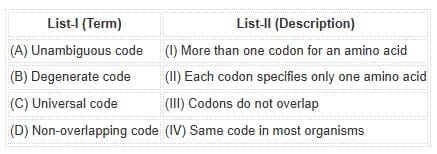 Choose the correct answer from the options given below:
- a)(A)-(II), (B)-(I), (C)-(IV), (D)-(III)
- b)(A)-(I), (B)-(II), (C)-(III), (D)-(IV)
- c)(A)-(III), (B)-(IV), (C)-(II), (D)-(I)
- d)(A)-(IV), (B)-(III), (C)-(I), (D)-(II)
Correct answer is option 'A'. Can you explain this answer?
Match List-I with List-II:
Choose the correct answer from the options given below:
a)
(A)-(II), (B)-(I), (C)-(IV), (D)-(III)
b)
(A)-(I), (B)-(II), (C)-(III), (D)-(IV)
c)
(A)-(III), (B)-(IV), (C)-(II), (D)-(I)
d)
(A)-(IV), (B)-(III), (C)-(I), (D)-(II)
| | Dr. Mohit Rajpoot answered |
The correct answer is Option A - A: (A)-(II), (B)-(I), (C)-(IV), (D)-(III)
Unambiguous code means that each codon specifies only one particular amino acid, which corresponds to statement (II).
Degenerate code (or redundant code) means that more than one codon can specify the same amino acid; this matches statement (I). The redundancy commonly arises from variability at the third base of the codon (wobble position).
Universal code denotes that the genetic code is conserved in most organisms, i.e., the same codon assignments are used broadly across species; this corresponds to statement (IV).
Non-overlapping code means that codons are read as discrete, sequential triplets without sharing nucleotides between adjacent codons, so codons do not overlap; this matches statement (III).
All four mappings in the chosen option are therefore correct, since each term aligns with the corresponding definition given above.
The anticodon region of tRNA molecule is located in which of the following loops?- a)DHU loop
- b)TψC loop
- c)Anticodon loop
- d)Acceptor arm
Correct answer is option 'C'. Can you explain this answer?
a)
DHU loop
b)
TψC loop
c)
Anticodon loop
d)
Acceptor arm
| | Dr. Mohit Rajpoot answered |
Correct Option - C
The correct answer is Option C - Anticodon loop
The tRNA molecule adopts a characteristic cloverleaf secondary structure composed of the acceptor arm (at the 3' end with the conserved CCA sequence), the DHU loop, the anticodon loop, and the TψC loop.
The acceptor arm carries the amino acid that becomes attached to the terminal adenosine of the CCA sequence by an aminoacylation reaction catalysed by aminoacyl-tRNA synthetases.
The anticodon is a triplet of nucleotides that is complementary to the mRNA codon; these three bases are positioned within the anticodon loop, enabling specific codon-anticodon pairing during translation on the ribosome.
Because the anticodon triplet is located in the anticodon loop, the option stating the Anticodon loop is correct.
The genetic code is described as degenerate because:- a)One codon codes for multiple amino acids
- b)Multiple codons can code for the same amino acid
- c)Some amino acids are not coded by any codon
- d)Each codon codes for a unique amino acid only
Correct answer is option 'B'. Can you explain this answer?
a)
One codon codes for multiple amino acids
b)
Multiple codons can code for the same amino acid
c)
Some amino acids are not coded by any codon
d)
Each codon codes for a unique amino acid only
| | Infinity Academy answered |
The correct answer is Option B - Multiple codons can code for the same amino acid
A codon is a sequence of three nucleotides (a triplet) on messenger RNA that specifies a single amino acid or a termination signal during translation.
There are 43 = 64 possible codons but only 20 standard amino acids; this numerical disparity makes it possible for more than one codon to specify the same amino acid.
Because different codons can correspond to the same amino acid, the genetic code is described as degenerate (also termed redundant).
Most redundancy occurs at the third base of the codon (the wobble position), where nonstandard base pairing allows one tRNA anticodon to recognise multiple codons for the same amino acid.
Certain codons have unique roles: AUG acts as the usual start codon and codes for methionine, while UAA, UAG, UGA are stop codons that do not code for amino acids; these facts do not contradict the degeneracy of the code.
Thus, the statement in Option B correctly captures why the genetic code is called degenerate.
The amino acid attachment site in tRNA molecule is located at:- a)Anticodon loop
- b)DHU loop
- c)3' end with CCA sequence
- d)TψC loop
Correct answer is option 'C'. Can you explain this answer?
a)
Anticodon loop
b)
DHU loop
c)
3' end with CCA sequence
d)
TψC loop
| | Dr. Mohit Rajpoot answered |
Correct Option - The correct option label i.e. C
The correct answer is Option C - 3' end with CCA sequence
Transfer RNA has a cloverleaf secondary structure with an acceptor stem formed by base-pairing between the 5' and 3' ends; the unpaired 3' end terminates in the conserved CCA sequence.
The amino acid is covalently attached to the 3' terminal adenosine of this CCA sequence via an ester linkage, catalysed by the enzyme aminoacyl-tRNA synthetase.
The anticodon loop contains the triplet that base-pairs with the mRNA codon and is not the site of amino acid attachment; the DHU loop and the TψC loop are other characteristic tRNA loops with distinct modified bases.
Hence, the amino acid attachment site is correctly identified as the 3' end with CCA sequence, making Option C the correct choice.
Which of the following is the initiator codon that also codes for methionine?- a)UAA
- b)AUG
- c)UUU
- d)GGG
Correct answer is option 'B'. Can you explain this answer?
a)
UAA
b)
AUG
c)
UUU
d)
GGG
| | Top Rankers answered |
Correct Option - B
The correct answer is Option B - AUG
AUG functions as the universal start codon that signals the beginning of translation and codes for the amino acid methionine.
In prokaryotes, the initiator tRNA brings N-formylmethionine (fMet) to the ribosome while recognizing the AUG codon; in eukaryotes, the initiator tRNA brings an unmodified methionine, but the initiating codon remains AUG.
The other listed codons are not initiator codons: UAA is a stop codon, UUU codes for phenylalanine, and GGG codes for glycine, so they do not serve as start codons that specify methionine.
Therefore, AUG is the codon that both initiates translation and specifies methionine.
Which one of the following CANNOT be a recognition sequence for a Type II restriction enzyme? - a)GAATTC
- b)AGCT
- c)GCGGCCGC
- d)ATGCCT
Correct answer is option 'D'. Can you explain this answer?
Which one of the following CANNOT be a recognition sequence for a Type II restriction enzyme?
a)
GAATTC
b)
AGCT
c)
GCGGCCGC
d)
ATGCCT
 | Priya Singh answered |
Explanation:
Recognition sequences are specific DNA sequences that are recognized and cleaved by Type II restriction enzymes. These enzymes typically recognize palindromic sequences, which read the same forward and backward on both strands of DNA. The recognition sequence is usually 4-8 base pairs in length.
Let's analyze each option to determine if it can be a recognition sequence for a Type II restriction enzyme:
a) GAATTC: This sequence is the recognition sequence for the restriction enzyme EcoRI. It is a palindromic sequence, reading the same forward and backward on both strands: 5'-GAATTC-3' on one strand and 3'-CTTAAG-5' on the complementary strand.
b) AGCT: This sequence is not palindromic and therefore cannot be a recognition sequence for a Type II restriction enzyme. It reads 5'-AGCT-3' on one strand and 3'-TCGA-5' on the complementary strand.
c) GCGGCCGC: This sequence is the recognition sequence for the restriction enzyme NotI. It is a palindromic sequence: 5'-GCGGCCGC-3' on one strand and 3'-CGCCGGCG-5' on the complementary strand.
d) ATGCCT: This sequence is not palindromic and therefore cannot be a recognition sequence for a Type II restriction enzyme. It reads 5'-ATGCCT-3' on one strand and 3'-TACGGA-5' on the complementary strand.
Therefore, option D (ATGCCT) cannot be a recognition sequence for a Type II restriction enzyme because it is not palindromic. The correct answer is D.
Recognition sequences are specific DNA sequences that are recognized and cleaved by Type II restriction enzymes. These enzymes typically recognize palindromic sequences, which read the same forward and backward on both strands of DNA. The recognition sequence is usually 4-8 base pairs in length.
Let's analyze each option to determine if it can be a recognition sequence for a Type II restriction enzyme:
a) GAATTC: This sequence is the recognition sequence for the restriction enzyme EcoRI. It is a palindromic sequence, reading the same forward and backward on both strands: 5'-GAATTC-3' on one strand and 3'-CTTAAG-5' on the complementary strand.
b) AGCT: This sequence is not palindromic and therefore cannot be a recognition sequence for a Type II restriction enzyme. It reads 5'-AGCT-3' on one strand and 3'-TCGA-5' on the complementary strand.
c) GCGGCCGC: This sequence is the recognition sequence for the restriction enzyme NotI. It is a palindromic sequence: 5'-GCGGCCGC-3' on one strand and 3'-CGCCGGCG-5' on the complementary strand.
d) ATGCCT: This sequence is not palindromic and therefore cannot be a recognition sequence for a Type II restriction enzyme. It reads 5'-ATGCCT-3' on one strand and 3'-TACGGA-5' on the complementary strand.
Therefore, option D (ATGCCT) cannot be a recognition sequence for a Type II restriction enzyme because it is not palindromic. The correct answer is D.
During transcription, which of the following correctly describes the role of the coding strand?- a)It is used by RNA polymerase as a template for RNA synthesis
- b)It has the same sequence as RNA except thymine is replaced by uracil
- c)It is complementary to the RNA formed
- d)It is synthesized during transcription
Correct answer is option 'B'. Can you explain this answer?
During transcription, which of the following correctly describes the role of the coding strand?
a)
It is used by RNA polymerase as a template for RNA synthesis
b)
It has the same sequence as RNA except thymine is replaced by uracil
c)
It is complementary to the RNA formed
d)
It is synthesized during transcription
| | Ambition Institute answered |
The coding strand (non-template strand) has the same sequence as the RNA transcript except that thymine (T) is replaced by uracil (U). The template strand is actually used by RNA polymerase for RNA synthesis.
Match List-I with List-II:
List-I (Component) List-II (Function in transcription) (A) Promoter (I) Signals the end of transcription (B) Template strand (II) Recognition site for RNA polymerase (C) Terminator (III) Provides the nucleotide sequence for RNA synthesis (D) Coding strand (IV) Has same sequence as mRNA (except T for U)
Choose the correct answer from the options given below:- a)(A)-(II), (B)-(III), (C)-(I), (D)-(IV)
- b)(A)-(I), (B)-(IV), (C)-(II), (D)-(III)
- c)(A)-(III), (B)-(II), (C)-(IV), (D)-(I)
- d)(A)-(IV), (B)-(I), (C)-(III), (D)-(II)
Correct answer is option 'A'. Can you explain this answer?
| List-I (Component) | List-II (Function in transcription) |
|---|---|
| (A) Promoter | (I) Signals the end of transcription |
| (B) Template strand | (II) Recognition site for RNA polymerase |
| (C) Terminator | (III) Provides the nucleotide sequence for RNA synthesis |
| (D) Coding strand | (IV) Has same sequence as mRNA (except T for U) |
a)
(A)-(II), (B)-(III), (C)-(I), (D)-(IV)
b)
(A)-(I), (B)-(IV), (C)-(II), (D)-(III)
c)
(A)-(III), (B)-(II), (C)-(IV), (D)-(I)
d)
(A)-(IV), (B)-(I), (C)-(III), (D)-(II)
| | Infinity Academy answered |
Correct Option - A
The correct answer is Option A - (A)-(II), (B)-(III), (C)-(I), (D)-(IV)
Promoter is a specific DNA sequence that serves as the recognition site for RNA polymerase and associated transcription factors; it directs the enzyme to the correct start site for transcription initiation.
The template strand is the DNA strand that is read by RNA polymerase and therefore provides the nucleotide sequence for RNA synthesis; the RNA produced is complementary to this strand.
The terminator is a DNA sequence that causes RNA polymerase to stop transcription and release the nascent RNA, thus it signals the end of transcription.
The coding strand (also called the non-template strand) has the same nucleotide sequence as the produced mRNA except that every thymine (T) in DNA corresponds to uracil (U) in RNA; it is not used as the direct template during synthesis.
Each component therefore matches as follows: Promoter → recognition site for RNA polymerase; Template strand → provides sequence for RNA synthesis; Terminator → signals end of transcription; Coding strand → same sequence as mRNA (T replaced by U), which confirms the given option.
Which of the following statements regarding the genetic code are correct?
A. The genetic code is nearly universal across all organisms.
B. The genetic code is overlapping in nature.
C. The codon AUG has a dual function as both initiator and codes for methionine.
D. The genetic code is degenerate with 61 codons coding for amino acids.
E. All stop codons also code for amino acids.- a)A, B and C only
- b)A, C and D only
- c)B, D and E only
- d)A, B and D only
Correct answer is option 'B'. Can you explain this answer?
A. The genetic code is nearly universal across all organisms.
B. The genetic code is overlapping in nature.
C. The codon AUG has a dual function as both initiator and codes for methionine.
D. The genetic code is degenerate with 61 codons coding for amino acids.
E. All stop codons also code for amino acids.
a)
A, B and C only
b)
A, C and D only
c)
B, D and E only
d)
A, B and D only
| | Dr. Mohit Rajpoot answered |
The correct answer is Option B - A, C and D only
Statement A is correct: the genetic code is described as nearly universal, meaning that the same codon assignments apply across most organisms with only a few well-characterised exceptions (for example, some mitochondrial codes and a few protists and bacteria).
Statement B is incorrect: the standard genetic code is non-overlapping, so each nucleotide is read as part of only one codon in a sequential, triplet reading frame; overlapping codons (where a nucleotide would belong to more than one codon) are not a feature of canonical translation.
Statement C is correct: the codon AUG functions as the primary start codon to initiate translation and also specifies the amino acid methionine; in prokaryotes the initiating methionine is commonly modified to formylmethionine (fMet).
Statement D is correct: the genetic code is degenerate because several codons can specify the same amino acid. Out of the 64 codons possible, 3 stop codons exist, leaving 61 codons that code for amino acids.
Statement E is incorrect: the stop codons (UAA, UAG, UGA) do not code for amino acids; they signal termination of polypeptide synthesis.
Thus, the true statements are A, C and D, which corresponds to the option stated above.
During transcription in eukaryotes, which enzyme is primarily responsible for synthesizing mRNA?- a)RNA polymerase I
- b)RNA polymerase II
- c)RNA polymerase III
- d)DNA polymerase
Correct answer is option 'B'. Can you explain this answer?
a)
RNA polymerase I
b)
RNA polymerase II
c)
RNA polymerase III
d)
DNA polymerase
| | Top Rankers answered |
The correct answer is Option B - RNA polymerase II
RNA polymerase II is the nuclear enzyme in eukaryotes that synthesizes the primary transcripts of protein-coding genes, i.e., the precursors of messenger RNA.
This enzyme transcribes DNA into RNA in the 5'→3' direction using ribonucleoside triphosphates as substrates and it initiates transcription without the need for a DNA primer (no primer requirement).
The initial product synthesized by RNA polymerase II is pre-mRNA (heterogeneous nuclear RNA), which is processed by 5' capping, splicing (removal of introns), and 3' polyadenylation to form mature mRNA.
For contrast, RNA polymerase I primarily transcribes most ribosomal RNA (rRNA) in the nucleolus, and RNA polymerase III transcribes tRNA and 5S rRNA.
DNA polymerase, by comparison, functions in DNA replication, requires a primer, and synthesizes DNA rather than RNA, so it does not synthesize mRNA.
Therefore, the enzyme responsible for synthesizing mRNA in eukaryotes is RNA polymerase II.
Which of the following is NOT a stop codon in the genetic code?- a)UAA
- b)UAG
- c)UGA
- d)AUG
Correct answer is option 'D'. Can you explain this answer?
a)
UAA
b)
UAG
c)
UGA
d)
AUG
| | Top Rankers answered |
The correct answer is Option D - AUG
The triplet codons UAA, UAG and UGA function as stop codons (termination codons) in the genetic code.
Stop codons do not code for any amino acid; they signal the termination of translation by allowing release factors to bind and promote release of the newly synthesized polypeptide from the ribosome.
By contrast, AUG is the start codon and specifies the amino acid methionine (and the initiating amino acid is N-formylmethionine in prokaryotes). Thus AUG initiates translation rather than terminating it.
Therefore, AUG is not a stop codon, which makes Option D the correct choice.
Match List-I with List-II:
List-I (Codon) List-II (Function/Amino acid) (A) UAA (I) Methionine (B) AUG (II) Stop codon (C) UUU (III) Phenylalanine (D) UAG (IV) Stop codon (amber)
Choose the correct answer from the options given below:- a)(A)-(II), (B)-(I), (C)-(III), (D)-(IV)
- b)(A)-(I), (B)-(II), (C)-(IV), (D)-(III)
- c)(A)-(III), (B)-(IV), (C)-(I), (D)-(II)
- d)(A)-(IV), (B)-(III), (C)-(II), (D)-(I)
Correct answer is option 'A'. Can you explain this answer?
| List-I (Codon) | List-II (Function/Amino acid) |
|---|---|
| (A) UAA | (I) Methionine |
| (B) AUG | (II) Stop codon |
| (C) UUU | (III) Phenylalanine |
| (D) UAG | (IV) Stop codon (amber) |
a)
(A)-(II), (B)-(I), (C)-(III), (D)-(IV)
b)
(A)-(I), (B)-(II), (C)-(IV), (D)-(III)
c)
(A)-(III), (B)-(IV), (C)-(I), (D)-(II)
d)
(A)-(IV), (B)-(III), (C)-(II), (D)-(I)
| | Dr. Mohit Rajpoot answered |
Correct Option - A
The correct answer is Option A - A: (A)-(II), (B)-(I), (C)-(III), (D)-(IV)
Codon denotes a triplet of ribonucleotides on mRNA that specifies either an amino acid or a translation stop signal.
AUG functions as the principal start codon in translation and encodes the amino acid Methionine, so (B) → (I) is correct.
UAA is one of the standard stop codons that terminates polypeptide synthesis; therefore (A) → (II) is correct.
UAG is also a stop codon, specifically called the amber codon, so (D) → (IV) is correct.
UUU specifies the amino acid Phenylalanine, hence (C) → (III) is correct.
Each codon-to-function mapping above independently verifies the matched pairs in the chosen option; therefore Option A is correct.
Chapter doubts & questions for DNA, RNA, and Protein - Biology 2026 is part of Grade 9 exam preparation. The chapters have been prepared according to the Grade 9 exam syllabus. The Chapter doubts & questions, notes, tests & MCQs are made for Grade 9 2026 Exam. Find important definitions, questions, notes, meanings, examples, exercises, MCQs and online tests here.
Chapter doubts & questions of DNA, RNA, and Protein - Biology in English & Hindi are available as part of Grade 9 exam. Download more important topics, notes, lectures and mock test series for Grade 9 Exam by signing up for free.
Biology108 videos|203 docs|88 tests |
