


All questions of Motion in Two Dimensions for Grade 9 Exam
How many directions are possible for the same horizontal range?- a)4
- b)3
- c)2
- d)1
Correct answer is option 'C'. Can you explain this answer?
How many directions are possible for the same horizontal range?
a)
4
b)
3
c)
2
d)
1
 | Mira Joshi answered |
We know that the horizontal range for any projectile motion let say R = 2u2.sin 2a /g
Where u is initial speed, and a is the angle at which the particle is thrown, which is responsible for direction. So in between the possible range of a that is 0 - 90, there are maximum two equal values of sin 2a, thus the maximum number of directions for the same or equal range are 2.
Where u is initial speed, and a is the angle at which the particle is thrown, which is responsible for direction. So in between the possible range of a that is 0 - 90, there are maximum two equal values of sin 2a, thus the maximum number of directions for the same or equal range are 2.

Which statement is true for a ball thrown at 20 degrees with the horizontal, when it is at the highest point in its trajectory?- a)Its velocity is zero but its acceleration is nonzero
- b)Its velocity is nonzero but its acceleration is zero
- c)Its velocity and acceleration are both zero
- d)Its velocity is perpendicular to its acceleration
Correct answer is option 'D'. Can you explain this answer?
Which statement is true for a ball thrown at 20 degrees with the horizontal, when it is at the highest point in its trajectory?
a)
Its velocity is zero but its acceleration is nonzero
b)
Its velocity is nonzero but its acceleration is zero
c)
Its velocity and acceleration are both zero
d)
Its velocity is perpendicular to its acceleration
 | Suresh Reddy answered |
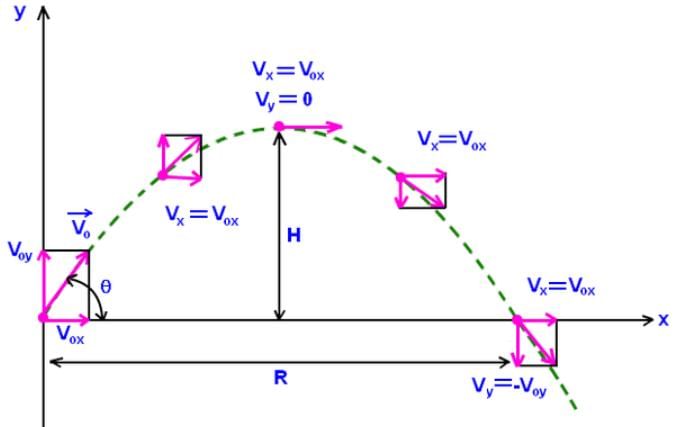
At the highest point in its trajectory, the acceleration (g) is acting in downward direction, whereas velocity of the projectile is only in the X (horizontal) direction.
The quantity which remains unchanged during the flight of an oblique projectile is- a)Horizontal component of acceleration
- b)Vertical component of acceleration
- c)Vertical component of velocity
- d)Horizontal component of velocity
Correct answer is option 'D'. Can you explain this answer?
The quantity which remains unchanged during the flight of an oblique projectile is
a)
Horizontal component of acceleration
b)
Vertical component of acceleration
c)
Vertical component of velocity
d)
Horizontal component of velocity
 | Sarthak Rajendra Bande answered |
As there is no horizontal acceleration is present in oblique projection horizontal component of velocity is constant
If an object is dropped through the window of a fast running train. Then- a)the object moves straight horizontally.
- b)to a man standing near the track, path of the object will be a part of parabola.
- c)the object falls down vertically.
- d)the object will follow an elliptical path
Correct answer is option 'B'. Can you explain this answer?
If an object is dropped through the window of a fast running train. Then
a)
the object moves straight horizontally.
b)
to a man standing near the track, path of the object will be a part of parabola.
c)
the object falls down vertically.
d)
the object will follow an elliptical path
| | Suresh Reddy answered |
When an object is still held it is the part of a system in which the train is moving, once it is left it still has the same velocity as the train for a person from ground. Thus as the velocity is horizontal and acceleration is vertical, it would follow a parabolic trajectory.
A battle ship simultaneously fires two shells at enemy ships. Both are fired with the same speed but with different directions as shown. If the shells follow the parabolic trajectories shown, which ship gets hit first?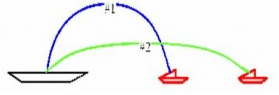
- a)they get hit at the same time.
- b)ship μ2
- c)need more information about the trajectories.
- d)ship μ1
Correct answer is 'B'. Can you explain this answer?
A battle ship simultaneously fires two shells at enemy ships. Both are fired with the same speed but with different directions as shown. If the shells follow the parabolic trajectories shown, which ship gets hit first?
a)
they get hit at the same time.
b)
ship μ2
c)
need more information about the trajectories.
d)
ship μ1
 | Krishna Iyer answered |
Ship 2 gets hit first. The time of flight only depends on the y-component of motion, not the x-component. The higher you throw something up in the air, the more time it spends in the air. It can also be shown from equation-
y=v0y t – ½ g t2=0
v0y for projectile μ1 is greater than for μ2.
Centripetal force always acts at 90 degrees to the velocity, and away from the centre of the circle.- a)true
- b)cannot predict
- c)false
- d)none of these
Correct answer is option 'C'. Can you explain this answer?
Centripetal force always acts at 90 degrees to the velocity, and away from the centre of the circle.
a)
true
b)
cannot predict
c)
false
d)
none of these
 | Anjana Sharma answered |
1. The centripetal force is always towards the centre of the circle.
2. The force always acts at 90 degrees to the direction of the movement.
A body is thrown with a velocity of 10m/s at an angle of 60 degrees with the horizontal. Its velocity at the highest point is: - a)5 m/s
- b)8.7 m/s
- c)10 mis
- d)0
Correct answer is option 'A'. Can you explain this answer?
A body is thrown with a velocity of 10m/s at an angle of 60 degrees with the horizontal. Its velocity at the highest point is:
a)
5 m/s
b)
8.7 m/s
c)
10 mis
d)
0
| | Mira Joshi answered |
At the highest point, its vertical velocity will become zero. Hence the only left velocity is horizontal which remains unchanged and is equal to 10 cos 60 = 5m/s


A model aeroplane is tethered to a post and held by a fine line. It flies in a horizontal circle. Then the line breaks. What direction will it fly in?- a)In a circular path, as before
- b)Directly to the centre of the circle
- c)In a straight line at a tangent
- d)Directly away from the centre of the circle
Correct answer is option 'C'. Can you explain this answer?
A model aeroplane is tethered to a post and held by a fine line. It flies in a horizontal circle. Then the line breaks. What direction will it fly in?
a)
In a circular path, as before
b)
Directly to the centre of the circle
c)
In a straight line at a tangent
d)
Directly away from the centre of the circle
 | Preeti Iyer answered |
It is because at every point of circle an object has two acceleration (Tangential & Angular acceleration).At every point a body experience a tangential force which is perpendicular to the radius of the circle, when the string breaks the centripetal force disappear ( the radially inward force which holds a body in a circular motion) Hence the only Tangential force act on the body & it goes in that way.
Which of the following is called a fictitious force?- a)Gravitational force
- b)Frictional force
- c)Centrifugal force
- d)Centripetal force
Correct answer is option 'C'. Can you explain this answer?
Which of the following is called a fictitious force?
a)
Gravitational force
b)
Frictional force
c)
Centrifugal force
d)
Centripetal force
 | Nandini Patel answered |
Centrifugal force, a fictitious force, peculiar to a particle moving on a circular path, that has the same magnitude and dimensions as the force that keeps the particle on its circular path (the centripetal force) but points in the opposite direction.
At the point of maximum height, the acceleration is:- a)minimum
- b)g
- c)maximum
- d)zero
Correct answer is option 'B'. Can you explain this answer?
At the point of maximum height, the acceleration is:
a)
minimum
b)
g
c)
maximum
d)
zero
| | Suresh Iyer answered |
At a point of maximum height, the derivative of displacement i.e. velocity is zero but as the gravitational acceleration is equal at all near points to the surface of earth, acceleration at maximum height is still equal to g.
When a projectile is thrown up at an angle θ to the ground, the time taken by it to rise and to fall are related as- a)time of rise can be less than or equal to time of fall
- b)they are equal
- c)time of rise < time of fall
- d)time of rise > time of fall
Correct answer is option 'B'. Can you explain this answer?
When a projectile is thrown up at an angle θ to the ground, the time taken by it to rise and to fall are related as
a)
time of rise can be less than or equal to time of fall
b)
they are equal
c)
time of rise < time of fall
d)
time of rise > time of fall
 | Gaurav Kumar answered |
The time of fall or rise for a projectile depends upon its vertical component of initial velocity and the vertical acceleration. As the acceleration does not change and the motion of path is identical for the rise phase and the fall phase, we can easily deduce that time taken is also the same.
Uniform circular motion is called continuously accelerated motion mainly because its :- a)direction of motion changes
- b)speed remains the same
- c)velocity remains the same
- d)direction of motion does not change
Correct answer is option 'A'. Can you explain this answer?
Uniform circular motion is called continuously accelerated motion mainly because its :
a)
direction of motion changes
b)
speed remains the same
c)
velocity remains the same
d)
direction of motion does not change
| | Krishna Iyer answered |
An accelerating body is an object that is changing its velocity. And since velocity is a vector that has both magnitude and direction, a change in either the magnitude or the direction constitutes a change in the velocity.
Hence a uniform circular motion is a accelerated motion because direction of motion keeps on changing
Hence a uniform circular motion is a accelerated motion because direction of motion keeps on changing
A stone of mass 5 kg is attached to a string of 10 m length and is whirled in a horizontal circle. The string can withstand a maximum tension of 160 N. The maximum velocity of revolution that can be given to the stone without breaking the string is- a)17.88 m/s
- b)16 m/s
- c)20 m/s
- d)19.4 m/s
Correct answer is option 'A'. Can you explain this answer?
A stone of mass 5 kg is attached to a string of 10 m length and is whirled in a horizontal circle. The string can withstand a maximum tension of 160 N. The maximum velocity of revolution that can be given to the stone without breaking the string is
a)
17.88 m/s
b)
16 m/s
c)
20 m/s
d)
19.4 m/s
 | Mayank Chatterjee answered |
Given, mass of stone, m = 5 kg
Length of string, l = 10 m
Maximum tension, T = 160 N
We need to find the maximum velocity of revolution that can be given to the stone without breaking the string.
Maximum velocity of revolution:
We know that the tension in the string, T is given by:
T = (mv²) / r
where m is the mass of the stone, v is the velocity of the stone and r is the radius of the circle.
Finding the radius:
The length of the string, l is equal to the circumference of the circle, so:
l = 2πr
=> r = l / (2π)
=> r = 10 / (2π) = 1.59 m
Finding the maximum velocity:
Substituting the values in the tension equation, we get:
T = (mv²) / r
=> v² = (Tr) / m
=> v = √[(Tr) / m]
Now, substituting the given values, we get:
v = √[(160 × 1.59) / 5]
=> v = 17.88 m/s
Therefore, the maximum velocity of revolution that can be given to the stone without breaking the string is 17.88 m/s.
Length of string, l = 10 m
Maximum tension, T = 160 N
We need to find the maximum velocity of revolution that can be given to the stone without breaking the string.
Maximum velocity of revolution:
We know that the tension in the string, T is given by:
T = (mv²) / r
where m is the mass of the stone, v is the velocity of the stone and r is the radius of the circle.
Finding the radius:
The length of the string, l is equal to the circumference of the circle, so:
l = 2πr
=> r = l / (2π)
=> r = 10 / (2π) = 1.59 m
Finding the maximum velocity:
Substituting the values in the tension equation, we get:
T = (mv²) / r
=> v² = (Tr) / m
=> v = √[(Tr) / m]
Now, substituting the given values, we get:
v = √[(160 × 1.59) / 5]
=> v = 17.88 m/s
Therefore, the maximum velocity of revolution that can be given to the stone without breaking the string is 17.88 m/s.
It is advised to drive along the slippery road slowly, because:- a)Normal reaction gets reduced
- b)advice is not correct
- c)water on the road opposes the motion
- d)Friction is reduced
Correct answer is option 'D'. Can you explain this answer?
It is advised to drive along the slippery road slowly, because:
a)
Normal reaction gets reduced
b)
advice is not correct
c)
water on the road opposes the motion
d)
Friction is reduced
| | Krishna Iyer answered |
It is advised to drive along the slippery road slowly, because friction is reduced and if the driver is driving at a larger speed there is a risk of skidding.
The angle through which the outer edge is raised above the inner edge is called- a)angle of inclination
- b)angle of repose
- c)angle of banking
- d)angle of declination
Correct answer is option 'C'. Can you explain this answer?
The angle through which the outer edge is raised above the inner edge is called
a)
angle of inclination
b)
angle of repose
c)
angle of banking
d)
angle of declination
 | Jayant Mishra answered |
A banked turn (or banking turn) is a turn or change of direction in which the vehicle banks or inclines, usually towards the inside of the turn. ... The bank angle is the angle at which the vehicle is inclined about its longitudinal axis with respect to the horizontal.
A bird is tossing (flying to and fro) between two cars moving towards each other on a straight road. One car has speed of 27 km h−1 while the other has the speed of 18 km h−1. The bird starts moving from first car towards the other and is moving with the speed of 36 km h−1 when the two were separated by 36 km. The total distance covered by the bird is- a)28.8 km
- b)38.8 km
- c)48.8 km
- d)58.8 km
Correct answer is option 'A'. Can you explain this answer?
A bird is tossing (flying to and fro) between two cars moving towards each other on a straight road. One car has speed of 27 km h−1 while the other has the speed of 18 km h−1. The bird starts moving from first car towards the other and is moving with the speed of 36 km h−1 when the two were separated by 36 km. The total distance covered by the bird is
a)
28.8 km
b)
38.8 km
c)
48.8 km
d)
58.8 km
| | Ajay Yadav answered |
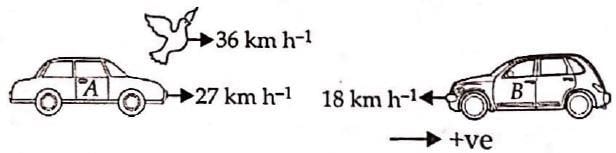
Velocity of car A, vA = +27kmh−1
Velocity of car B, vB = −18kmh−1
Relative velocity of car A with respect to car B
=vA − vB = + 27kmh−1 (−18kmh−1) = 45kmh−1
Time taken by the two cars to meet = 36 km/45 km h-1 = 0.8
Time taken by the two cars to meet = 36 km/45 km h-1 = 0.8
Thus, distance covered by the bird
= 36kmh−1 x 0.8h = 28.8km
= 36kmh−1 x 0.8h = 28.8km
Two parallel rail tracks run north-south. On one track train A moves north with a speed of 54 kmh−1 and on the other track train B moves south with a speed of 90kmh−1. What is the velocity of a monkey running on the roof of the train A against its motion with a velocity of 18 kmh-1 with respect to the train A as observed by a man standing on the ground?- a)5 ms-1
- b)10 ms-1
- c)15 ms-1
- d)20 ms-1
Correct answer is option 'B'. Can you explain this answer?
Two parallel rail tracks run north-south. On one track train A moves north with a speed of 54 kmh−1 and on the other track train B moves south with a speed of 90kmh−1. What is the velocity of a monkey running on the roof of the train A against its motion with a velocity of 18 kmh-1 with respect to the train A as observed by a man standing on the ground?
a)
5 ms-1
b)
10 ms-1
c)
15 ms-1
d)
20 ms-1
| | Gaurav Kumar answered |
Let the velocity of the monkey with respect to ground be vMG
Relative velocity of the monkey with respect to the train A
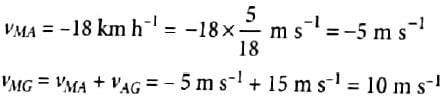
Relative velocity of the monkey with respect to the train A
At what angle should a projectile with initial velocity ‘v’ be thrown, so that it achieves its maximum range?- a)450
- b)900
- c)600
- d)300
Correct answer is option 'A'. Can you explain this answer?
At what angle should a projectile with initial velocity ‘v’ be thrown, so that it achieves its maximum range?
a)
450
b)
900
c)
600
d)
300
| | Neha Joshi answered |
Sine of an angle has maximum value 1 when the angle is 90 degree Rmaxis obtained when 2ø = 90 degreeorø= 45 degree
Which one of the following is not an example of projectile?- a)A bullet fired from a gun.
- b)A kicked football.
- c)Taking off of an aircraft.
- d)A javelin thrown by an athlete.
Correct answer is option 'C'. Can you explain this answer?
Which one of the following is not an example of projectile?
a)
A bullet fired from a gun.
b)
A kicked football.
c)
Taking off of an aircraft.
d)
A javelin thrown by an athlete.
| | Jyoti Shah answered |
Understanding Projectiles
In physics, a projectile is an object that is thrown into the air with an initial velocity and is primarily influenced by the force of gravity and air resistance. To better understand why option 'C' (Taking off of an aircraft) is not a projectile, let's break down the examples.
Examples of Projectiles
- A bullet fired from a gun: Once fired, the bullet travels through the air under the influence of gravity and air resistance, making it a classic example of a projectile.
- A kicked football: When a football is kicked, it follows a curved trajectory due to the forces acting on it, including gravity, making it a projectile as well.
- A javelin thrown by an athlete: The javelin, once released, travels through the air in a parabolic path, demonstrating the characteristics of a projectile.
Why is Taking Off of an Aircraft Not a Projectile?
- Initial Lift-Off: When an aircraft takes off, it generates lift through its wings, which counteracts gravity. This lift is produced by the thrust from the engines, unlike projectiles that rely solely on their initial velocity and gravity.
- Controlled Flight: An aircraft is actively controlled during takeoff and flight, which means it is not simply following a path determined by gravity and air resistance. Instead, it relies on aerodynamic principles and engine thrust.
- Continuous Force Application: Projectiles do not have any forces acting on them after they are launched, except for gravity and air resistance. In contrast, aircraft are powered and maintained in the air by continuous engine thrust and aerodynamic lift.
In conclusion, while bullets, kicked footballs, and javelins follow the characteristics of projectiles, aircraft rely on lift and thrust, distinguishing them from true projectiles.
In physics, a projectile is an object that is thrown into the air with an initial velocity and is primarily influenced by the force of gravity and air resistance. To better understand why option 'C' (Taking off of an aircraft) is not a projectile, let's break down the examples.
Examples of Projectiles
- A bullet fired from a gun: Once fired, the bullet travels through the air under the influence of gravity and air resistance, making it a classic example of a projectile.
- A kicked football: When a football is kicked, it follows a curved trajectory due to the forces acting on it, including gravity, making it a projectile as well.
- A javelin thrown by an athlete: The javelin, once released, travels through the air in a parabolic path, demonstrating the characteristics of a projectile.
Why is Taking Off of an Aircraft Not a Projectile?
- Initial Lift-Off: When an aircraft takes off, it generates lift through its wings, which counteracts gravity. This lift is produced by the thrust from the engines, unlike projectiles that rely solely on their initial velocity and gravity.
- Controlled Flight: An aircraft is actively controlled during takeoff and flight, which means it is not simply following a path determined by gravity and air resistance. Instead, it relies on aerodynamic principles and engine thrust.
- Continuous Force Application: Projectiles do not have any forces acting on them after they are launched, except for gravity and air resistance. In contrast, aircraft are powered and maintained in the air by continuous engine thrust and aerodynamic lift.
In conclusion, while bullets, kicked footballs, and javelins follow the characteristics of projectiles, aircraft rely on lift and thrust, distinguishing them from true projectiles.
A police van moving on a highway with a speed of 30km h−1 fires a bullet at a thief's car speeding away in the same direction with a speed of 192km h−1. If the muzzle speed of the bullet is 150ms−1 , with what relative speed does the bullet hit the thief's car?- a)95 ms-1
- b)105 m s-1
- c)115 ms-1
- d)125 m s-1
Correct answer is option 'B'. Can you explain this answer?
A police van moving on a highway with a speed of 30km h−1 fires a bullet at a thief's car speeding away in the same direction with a speed of 192km h−1. If the muzzle speed of the bullet is 150ms−1 , with what relative speed does the bullet hit the thief's car?
a)
95 ms-1
b)
105 m s-1
c)
115 ms-1
d)
125 m s-1
| | Mira Joshi answered |
Speed of police van w.r.t. ground
∴ vPG = 30kmh−1
Speed of thief’s car w.r.t. ground
∴ vTG = 192kmh−1
Speed of bullet w.r.t. police van

Speed with which the bullet will hit the thief’s car will be
vBT = vBG + vGT = vBP + vPG + vGT
= 540kmh−1 + 30kmh−1 − 192kmh−1
(∵ vGT = −vTG)

A bus is moving with a speed of 10ms−1 on a straight road. A scooterist wishes to overtake the bus in 100s. If the bus is at a distance of 1km from the scooterist with what speed should the scooterist chase the bus?- a)40 ms-1
- b)25 ms-1
- c)115 m s-1
- d)125 ms-1
Correct answer is option 'D'. Can you explain this answer?
A bus is moving with a speed of 10ms−1 on a straight road. A scooterist wishes to overtake the bus in 100s. If the bus is at a distance of 1km from the scooterist with what speed should the scooterist chase the bus?
a)
40 ms-1
b)
25 ms-1
c)
115 m s-1
d)
125 ms-1
| | Raghav Bansal answered |
Let vs be the velocity of the scooter, the distance between the scooter and the bus = 1000m,
The velocity of the bus = 10ms−1
Time taken to overtake = 100s
Relative velocity of the scooter with respect to the bus = (vs − 10)
1000/(vs − 10) = 100s
= vs = 20ms−1
Two parallel rail tracks run north-south. On one track train A moves north with a speed of 54kmh−1 and on the other track train B moves south with a speed of 90kmh−1. The velocity of train A with respect to train B is- a)10 ms-1
- b)15 ms-1
- c)25 ms-1
- d)40 ms-1
Correct answer is option 'D'. Can you explain this answer?
Two parallel rail tracks run north-south. On one track train A moves north with a speed of 54kmh−1 and on the other track train B moves south with a speed of 90kmh−1. The velocity of train A with respect to train B is
a)
10 ms-1
b)
15 ms-1
c)
25 ms-1
d)
40 ms-1
| | Preeti Iyer answered |
Let the positive direction of motion be from south to north. Velocity of train A with respect to ground
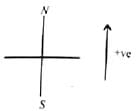

Velocity of train B with respect to ground

Relative velocity of train A with respect to train B is

In circular motion:- a)Radial acceleration is non-zero
- b)Radial velocity is zero
- c)Body is in equilibrium
- d)All of the above
Correct answer is option 'D'. Can you explain this answer?
In circular motion:
a)
Radial acceleration is non-zero
b)
Radial velocity is zero
c)
Body is in equilibrium
d)
All of the above
| | Stuti Joshi answered |
Circular motion involves the motion of an object in a circular path. The object moves around the center of the circle with a constant speed. In circular motion, the object experiences various types of acceleration and velocity. Let’s discuss the given options to understand circular motion in detail.
Radial acceleration is non-zero:
Radial acceleration is the acceleration of an object towards the center of the circle. In circular motion, the direction of velocity changes continuously, and hence the object experiences a change in direction. This change in direction leads to the acceleration of the object towards the center of the circle, known as radial acceleration. Therefore, option ‘a’ is correct.
Radial velocity is zero:
Radial velocity is the velocity of an object in the radial direction, i.e., towards the center of the circle. In circular motion, the object moves in a circular path without any radial motion, i.e., the object moves perpendicular to the radius of the circle. Hence, radial velocity is zero in circular motion. Therefore, option ‘b’ is incorrect.
Body is in equilibrium:
Equilibrium is a state where the object is at rest or moves with a constant velocity. In circular motion, the object moves with a constant speed, but the direction of the velocity changes continuously. Therefore, the object is not at rest, but it is also not moving with a constant velocity. Hence, the body is not in equilibrium in circular motion. Therefore, option ‘c’ is incorrect.
All of the above:
From the above discussion, we can conclude that radial acceleration is non-zero, radial velocity is zero, and the body is not in equilibrium in circular motion. Therefore, option ‘d’ is the correct answer.
Conclusion:
Circular motion involves the motion of an object in a circular path. The object experiences various types of acceleration and velocity in circular motion. In circular motion, radial acceleration is non-zero, radial velocity is zero, and the body is not in equilibrium.
Radial acceleration is non-zero:
Radial acceleration is the acceleration of an object towards the center of the circle. In circular motion, the direction of velocity changes continuously, and hence the object experiences a change in direction. This change in direction leads to the acceleration of the object towards the center of the circle, known as radial acceleration. Therefore, option ‘a’ is correct.
Radial velocity is zero:
Radial velocity is the velocity of an object in the radial direction, i.e., towards the center of the circle. In circular motion, the object moves in a circular path without any radial motion, i.e., the object moves perpendicular to the radius of the circle. Hence, radial velocity is zero in circular motion. Therefore, option ‘b’ is incorrect.
Body is in equilibrium:
Equilibrium is a state where the object is at rest or moves with a constant velocity. In circular motion, the object moves with a constant speed, but the direction of the velocity changes continuously. Therefore, the object is not at rest, but it is also not moving with a constant velocity. Hence, the body is not in equilibrium in circular motion. Therefore, option ‘c’ is incorrect.
All of the above:
From the above discussion, we can conclude that radial acceleration is non-zero, radial velocity is zero, and the body is not in equilibrium in circular motion. Therefore, option ‘d’ is the correct answer.
Conclusion:
Circular motion involves the motion of an object in a circular path. The object experiences various types of acceleration and velocity in circular motion. In circular motion, radial acceleration is non-zero, radial velocity is zero, and the body is not in equilibrium.
In circular motion, the- a)Direction of motion is fixed
- b)Direction of motion changes continuously
- c)Acceleration is zero
- d)Velocity is constant
Correct answer is option 'B'. Can you explain this answer?
In circular motion, the
a)
Direction of motion is fixed
b)
Direction of motion changes continuously
c)
Acceleration is zero
d)
Velocity is constant
 | Hansa Sharma answered |
When an object moves along a circular path, it is called circular motion. During such a motion, the direction of motion at any point is given by the tangent at that point which changes continuously.
Two cars A and B are running at velocities of 60 km h−1 and 45 km h−1. What is the relative velocity of car A with respect to car B, if both are moving eastward?- a)15 km h-1
- b)45 km h-1
- c)60 km h-1
- d)105 km h-1
Correct answer is option 'A'. Can you explain this answer?
Two cars A and B are running at velocities of 60 km h−1 and 45 km h−1. What is the relative velocity of car A with respect to car B, if both are moving eastward?
a)
15 km h-1
b)
45 km h-1
c)
60 km h-1
d)
105 km h-1
| | Anjali Sharma answered |
Velocity of car A w.r.t. ground
∴ vAG = 60 kmh−1
Velocity of car B w.r.t. ground
∴ vBG = 45 km h−1
Relative velocity of car A w.r.t. B
vAB = vAG + vGB
=vAG − vBG = 15 km h−1 (∵ vGB = −vBG)
A 175m long train is travelling along a straight track with a velocity 72km−1h. A bird is flying parallel to the train in the opposite direction with a velocity 18km−1h. The time taken by the bird to cross the train is- a)35 s
- b)27 s
- c)11.6 s
- d)7 s
Correct answer is option 'D'. Can you explain this answer?
A 175m long train is travelling along a straight track with a velocity 72km−1h. A bird is flying parallel to the train in the opposite direction with a velocity 18km−1h. The time taken by the bird to cross the train is
a)
35 s
b)
27 s
c)
11.6 s
d)
7 s
| | Lakshmi Pillai answered |
Understanding the Problem
To find the time taken by the bird to cross the train, we first need to determine the relative speeds of the train and the bird.
Step 1: Convert Speeds to m/s
- The train's speed: 72 km/h = (72 * 1000) / (60 * 60) = 20 m/s
- The bird's speed: 18 km/h = (18 * 1000) / (60 * 60) = 5 m/s
Step 2: Calculate Relative Speed
Since the bird is flying in the opposite direction to the train, we add their speeds to find the relative speed:
- Relative speed = Speed of train + Speed of bird
- Relative speed = 20 m/s + 5 m/s = 25 m/s
Step 3: Calculate Time to Cross the Train
The time taken to cross the train is determined by the length of the train and the relative speed:
- Length of the train = 175 m
- Time = Distance / Speed
- Time = 175 m / 25 m/s = 7 seconds
Conclusion
Therefore, the time taken by the bird to cross the train is 7 seconds, which corresponds to option 'D'.
This exercise demonstrates the importance of understanding relative motion in physics, especially in problems involving objects moving in opposite directions.
To find the time taken by the bird to cross the train, we first need to determine the relative speeds of the train and the bird.
Step 1: Convert Speeds to m/s
- The train's speed: 72 km/h = (72 * 1000) / (60 * 60) = 20 m/s
- The bird's speed: 18 km/h = (18 * 1000) / (60 * 60) = 5 m/s
Step 2: Calculate Relative Speed
Since the bird is flying in the opposite direction to the train, we add their speeds to find the relative speed:
- Relative speed = Speed of train + Speed of bird
- Relative speed = 20 m/s + 5 m/s = 25 m/s
Step 3: Calculate Time to Cross the Train
The time taken to cross the train is determined by the length of the train and the relative speed:
- Length of the train = 175 m
- Time = Distance / Speed
- Time = 175 m / 25 m/s = 7 seconds
Conclusion
Therefore, the time taken by the bird to cross the train is 7 seconds, which corresponds to option 'D'.
This exercise demonstrates the importance of understanding relative motion in physics, especially in problems involving objects moving in opposite directions.
Railway tracks are banked at the curves so that the necessary centripetal force may be obtained from the horizontal component of the reaction on the train.- a)true
- b)false
- c)cannot predict
- d)none of these
Correct answer is option 'A'. Can you explain this answer?
Railway tracks are banked at the curves so that the necessary centripetal force may be obtained from the horizontal component of the reaction on the train.
a)
true
b)
false
c)
cannot predict
d)
none of these
 | Sahana Joshi answered |
Understanding Banked Curves
When trains navigate curves, banking the tracks is essential for safety and efficiency. This design helps manage the forces acting on the train as it travels around a curve.
Why Are Tracks Banked?
- Centripetal Force: When a train goes around a curve, it requires a centripetal force to change direction. This force is perpendicular to the train's motion and directed towards the center of the curve.
- Horizontal Component of Reaction: The banking of the tracks creates an angle between the vertical and the track surface. This angle allows the normal reaction force from the track to have a horizontal component that provides the necessary centripetal force.
Benefits of Banking
- Reduced Lateral Friction: By banking the tracks, the need for friction between the train's wheels and the track is minimized. This reduces wear and tear on both the train and the tracks.
- Enhanced Stability: Properly banked curves allow trains to maintain higher speeds without the risk of derailing, as the forces are balanced effectively.
- Improved Comfort: Passengers experience less lateral acceleration, making the ride more comfortable.
Conclusion
In summary, the statement that railway tracks are banked at curves to obtain the necessary centripetal force from the horizontal component of the reaction is indeed true (option 'A'). This engineering design is crucial for the safe and efficient operation of trains on curved tracks.
When trains navigate curves, banking the tracks is essential for safety and efficiency. This design helps manage the forces acting on the train as it travels around a curve.
Why Are Tracks Banked?
- Centripetal Force: When a train goes around a curve, it requires a centripetal force to change direction. This force is perpendicular to the train's motion and directed towards the center of the curve.
- Horizontal Component of Reaction: The banking of the tracks creates an angle between the vertical and the track surface. This angle allows the normal reaction force from the track to have a horizontal component that provides the necessary centripetal force.
Benefits of Banking
- Reduced Lateral Friction: By banking the tracks, the need for friction between the train's wheels and the track is minimized. This reduces wear and tear on both the train and the tracks.
- Enhanced Stability: Properly banked curves allow trains to maintain higher speeds without the risk of derailing, as the forces are balanced effectively.
- Improved Comfort: Passengers experience less lateral acceleration, making the ride more comfortable.
Conclusion
In summary, the statement that railway tracks are banked at curves to obtain the necessary centripetal force from the horizontal component of the reaction is indeed true (option 'A'). This engineering design is crucial for the safe and efficient operation of trains on curved tracks.
At which place of the earth, the centripetal force is maximum- a)At the earth surface
- b)At the equator
- c)At the north pole
- d)At the south pole
Correct answer is option 'B'. Can you explain this answer?
At which place of the earth, the centripetal force is maximum
a)
At the earth surface
b)
At the equator
c)
At the north pole
d)
At the south pole
 | Top Rankers answered |
The centripetal force experienced due to the Earth's rotation is given by f = mv2/r, where v is the linear velocity at the surface due to Earth's rotation and r is the radius from the axis of rotation.
The linear velocity v is maximum at the equator because it is the farthest point from the axis and completes one rotation in 24 hours. The Earth's radius is also
maximum at the equator, but the effect of the much higher velocity outweighs the increase in radius, giving the maximum centripetal force at the equator.At the poles, the linear velocity is zero, so there is no centripetal force due to Earth's rotation.
The _______ circular motion describes as the motion of an object in a circular path with a _______ speed. Fill in the blank.- a)Non-uniform, constant
- b)Uniform, constant
- c)Non-uniform, varying
- d)Uniform, Varying
Correct answer is option 'B,C'. Can you explain this answer?
The _______ circular motion describes as the motion of an object in a circular path with a _______ speed. Fill in the blank.
a)
Non-uniform, constant
b)
Uniform, constant
c)
Non-uniform, varying
d)
Uniform, Varying
| | Nandini Iyer answered |
Therefore, the correct multiple answers are:
2. Uniform, constant
3. Non-uniform, varying
3. Non-uniform, varying
- Non-uniform, constant – This is incorrect. If the motion is non-uniform, the speed cannot be constant.
- Uniform, constant – This is correct. In uniform circular motion, the speed is constant.
- Non-uniform, varying – This is correct. In non-uniform circular motion, the speed varies.
- Uniform, varying – This is incorrect. If the motion is uniform, the speed must remain constant, so it cannot be varying.
A ball A is dropped from a building of height 45 m. Simultaneously another identical ball B is thrown up with a speed 50 m s−1. The relative speed of ball B w.r.t. ball A at any instant of time is (Take g = 10 m s−2).- a)0
- b)10 m s-1
- c)25 ms-1
- d)50 ms-1
Correct answer is option 'D'. Can you explain this answer?
A ball A is dropped from a building of height 45 m. Simultaneously another identical ball B is thrown up with a speed 50 m s−1. The relative speed of ball B w.r.t. ball A at any instant of time is (Take g = 10 m s−2).
a)
0
b)
10 m s-1
c)
25 ms-1
d)
50 ms-1
| | Jyoti Sengupta answered |
Here, uA = −0 , uB = +50ms−1
aA = −g , aB = −g
uBA = uB − uA = 50ms−1 − (0)ms−1 = 50ms−1
aBA = aB − aA = −g − (−g) = 0
∵ vBA = uBA + aBAt(As aBA = 0)
∴ vBA = uBA
As there is no acceleration of ball B w.r.t to ball A, therefore the relative speed of ball B w.r.t ball A at any instant of time remains constant (= 50ms−1).
For a particle in a non- uniform accelerated circular motion - a)Velocity is transverse and acceleration has both radial and transverse components
- b)Velocity is transverse and acceleration is radial only
- c)Velocity is radial and acceleration has both radial and transverse components
- d)Velocity is radial and acceleration is transverse only
Correct answer is option 'A'. Can you explain this answer?
For a particle in a non- uniform accelerated circular motion
a)
Velocity is transverse and acceleration has both radial and transverse components
b)
Velocity is transverse and acceleration is radial only
c)
Velocity is radial and acceleration has both radial and transverse components
d)
Velocity is radial and acceleration is transverse only
| | Sandeep Chawla answered |
Explanation:
Non-uniform circular motion is the motion of an object moving in a circular path with a varying speed. The direction of the velocity and acceleration of an object in non-uniform circular motion changes at every point on the circular path.
Velocity:
Velocity is the rate of change of displacement with respect to time. In non-uniform circular motion, the velocity of the object is always tangent to the circular path. The magnitude of the velocity changes at every point on the circular path.
Acceleration:
Acceleration is the rate of change of velocity with respect to time. In non-uniform circular motion, the acceleration of the object is not constant. It changes at every point on the circular path.
Now, let's discuss the given options one by one:
a) Velocity is radial and acceleration is transverse only:
In this option, the velocity is radial which means it is directed towards the center of the circular path. But the acceleration is transverse which means it is perpendicular to the velocity vector. This option is correct because the direction of the acceleration is always towards the center of the circular path in non-uniform circular motion.
b) Velocity is transverse and acceleration is radial only:
In this option, the velocity is transverse which means it is perpendicular to the radius vector. But the acceleration is radial which means it is directed towards the center of the circular path. This option is incorrect because the direction of the acceleration is not always radial in non-uniform circular motion.
c) Velocity is radial and acceleration has both radial and transverse components:
In this option, the velocity is radial which means it is directed towards the center of the circular path. But the acceleration has both radial and transverse components. This option is incorrect because the direction of the acceleration is always towards the center of the circular path in non-uniform circular motion.
d) Velocity is transverse and acceleration has both radial and transverse components:
In this option, the velocity is transverse which means it is perpendicular to the radius vector. But the acceleration has both radial and transverse components. This option is incorrect because the direction of the acceleration is not always radial in non-uniform circular motion.
Hence, the correct option is 'a' - Velocity is radial and acceleration is transverse only.
Non-uniform circular motion is the motion of an object moving in a circular path with a varying speed. The direction of the velocity and acceleration of an object in non-uniform circular motion changes at every point on the circular path.
Velocity:
Velocity is the rate of change of displacement with respect to time. In non-uniform circular motion, the velocity of the object is always tangent to the circular path. The magnitude of the velocity changes at every point on the circular path.
Acceleration:
Acceleration is the rate of change of velocity with respect to time. In non-uniform circular motion, the acceleration of the object is not constant. It changes at every point on the circular path.
Now, let's discuss the given options one by one:
a) Velocity is radial and acceleration is transverse only:
In this option, the velocity is radial which means it is directed towards the center of the circular path. But the acceleration is transverse which means it is perpendicular to the velocity vector. This option is correct because the direction of the acceleration is always towards the center of the circular path in non-uniform circular motion.
b) Velocity is transverse and acceleration is radial only:
In this option, the velocity is transverse which means it is perpendicular to the radius vector. But the acceleration is radial which means it is directed towards the center of the circular path. This option is incorrect because the direction of the acceleration is not always radial in non-uniform circular motion.
c) Velocity is radial and acceleration has both radial and transverse components:
In this option, the velocity is radial which means it is directed towards the center of the circular path. But the acceleration has both radial and transverse components. This option is incorrect because the direction of the acceleration is always towards the center of the circular path in non-uniform circular motion.
d) Velocity is transverse and acceleration has both radial and transverse components:
In this option, the velocity is transverse which means it is perpendicular to the radius vector. But the acceleration has both radial and transverse components. This option is incorrect because the direction of the acceleration is not always radial in non-uniform circular motion.
Hence, the correct option is 'a' - Velocity is radial and acceleration is transverse only.
Which one of the following is most probably not a case of uniform circular motion?- a)Motion of a racing car on a circular track
- b)Motion of the moon around the earth
- c)Motion of a toy train on a circular track
- d)Motion of seconds hand on the circular dial of a watch
Correct answer is option 'A'. Can you explain this answer?
Which one of the following is most probably not a case of uniform circular motion?
a)
Motion of a racing car on a circular track
b)
Motion of the moon around the earth
c)
Motion of a toy train on a circular track
d)
Motion of seconds hand on the circular dial of a watch
 | Jhanvi Chakraborty answered |
Understanding Uniform Circular Motion
Uniform circular motion refers to motion along a circular path at a constant speed. In this scenario, the object’s speed remains constant, but its direction changes continuously, resulting in acceleration towards the center of the circle.
Analyzing the Options
- Motion of a racing car on a circular track
- This motion is often not uniform because a racing car changes its speed while navigating turns. Drivers accelerate or decelerate, which means the speed is not constant.
- Motion of the moon around the earth
- The moon moves in a nearly circular orbit at a constant speed, making this a classic case of uniform circular motion.
- Motion of a toy train on a circular track
- If the toy train moves at a constant speed around the track, it exemplifies uniform circular motion.
- Motion of the seconds hand on the circular dial of a watch
- The seconds hand moves at a constant speed, completing a full revolution in a fixed time, thus representing uniform circular motion.
Conclusion
The correct answer is option 'A' – the motion of a racing car on a circular track. This is because the car typically experiences variations in speed, unlike the other options, which maintain a constant speed while moving in a circular path.
Uniform circular motion refers to motion along a circular path at a constant speed. In this scenario, the object’s speed remains constant, but its direction changes continuously, resulting in acceleration towards the center of the circle.
Analyzing the Options
- Motion of a racing car on a circular track
- This motion is often not uniform because a racing car changes its speed while navigating turns. Drivers accelerate or decelerate, which means the speed is not constant.
- Motion of the moon around the earth
- The moon moves in a nearly circular orbit at a constant speed, making this a classic case of uniform circular motion.
- Motion of a toy train on a circular track
- If the toy train moves at a constant speed around the track, it exemplifies uniform circular motion.
- Motion of the seconds hand on the circular dial of a watch
- The seconds hand moves at a constant speed, completing a full revolution in a fixed time, thus representing uniform circular motion.
Conclusion
The correct answer is option 'A' – the motion of a racing car on a circular track. This is because the car typically experiences variations in speed, unlike the other options, which maintain a constant speed while moving in a circular path.
A train A which is 120m long is running with velocity 20m/s while train B which is 130m long is running in opposite direction with velocity 30m/s. What is the time taken by train B to cross the train A?- a)5 s
- b)25 s
- c)10 s
- d)100 s
Correct answer is option 'A'. Can you explain this answer?
A train A which is 120m long is running with velocity 20m/s while train B which is 130m long is running in opposite direction with velocity 30m/s. What is the time taken by train B to cross the train A?
a)
5 s
b)
25 s
c)
10 s
d)
100 s
| | Preeti Iyer answered |
Length of train A = 120m
Velocity of train A, vA = 20m/s
Length of train B = 130m
Velocity of train B, vB = 30m/s
Relative velocity of B w.r.t. A = vB + vA = 50m/s
(trains move in opposite directions)
Total path length to be covered by B = 130 + 120 = 250m
Velocity of train A, vA = 20m/s
Length of train B = 130m
Velocity of train B, vB = 30m/s
Relative velocity of B w.r.t. A = vB + vA = 50m/s
(trains move in opposite directions)
Total path length to be covered by B = 130 + 120 = 250m
∴ Time taken by train B = 250 m/50m/s = 5 s
On a long horizontally moving belt, a child runs to and fro with a speed 9kmh−1 (with respect to the belt) between his father and mother located 50m apart on the moving belt. The belt moves with a speed of 4kmh−1. For an observer on a stationary platform, the speed of the child running in the direction of motion of the belt is- a)4 km h-1
- b)5 km h-1
- c)9 km h-1
- d)13 km h-1
Correct answer is option 'D'. Can you explain this answer?
On a long horizontally moving belt, a child runs to and fro with a speed 9kmh−1 (with respect to the belt) between his father and mother located 50m apart on the moving belt. The belt moves with a speed of 4kmh−1. For an observer on a stationary platform, the speed of the child running in the direction of motion of the belt is
a)
4 km h-1
b)
5 km h-1
c)
9 km h-1
d)
13 km h-1
| | Jyoti Sengupta answered |
Figure shows conditions of the question.
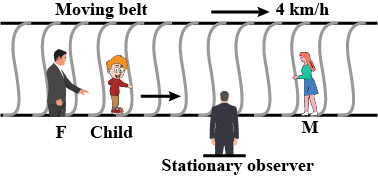
In this case,
Speed of belt w.r.t. ground
∴ vBG = 4kmh−1
Speed of child w.r.t. belt
∴ vCB = 9kmh−1
∴ For an observer on a stationary platform, speed of child running in the direction of motion of the belt is
vCG = vCB + vBG = 9kmh−1 + 4kmh−1
= 13kmh−1
On a two-lane road, car A is travelling with a speed of 36 km h-1. Two cars B and C approach car A in opposite directions with a speed of 54 km h-1 each. At a certain instant, when the distance AB is equal to AC, both being 1 km, B decides to overtake A before C does. The minimum required acceleration of car B to avoid an accident is- a)1 ms-2
- b)1.5 ms-2
- c)2 ms-2
- d)3 ms-2
Correct answer is option 'A'. Can you explain this answer?
On a two-lane road, car A is travelling with a speed of 36 km h-1. Two cars B and C approach car A in opposite directions with a speed of 54 km h-1 each. At a certain instant, when the distance AB is equal to AC, both being 1 km, B decides to overtake A before C does. The minimum required acceleration of car B to avoid an accident is
a)
1 ms-2
b)
1.5 ms-2
c)
2 ms-2
d)
3 ms-2
| | Ajay Yadav answered |
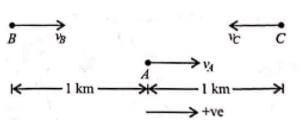
Velocity of car A ,

Velocity of car B ,

Velocity of car C ,
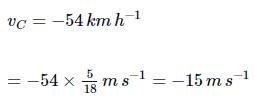
Relative velocity of car B w.r.t. car A
vBA = vB−vA = 15ms−1−10ms−1 = 5ms−1
Relative velocity of car C w.r.t. car A is
vCA = vC−vA = −15ms−1 − 10ms−1=−25ms−1
At a certain instant, both cars B and C are at the same distance from car A
i.e. AB − BC = 1km = 1000m
Time taken by car C to cover 1km to reach car A
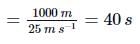
In order to avoid an accident, the car B accelerates such that it overtakes car A in less than 40s. Let the minimum required acceleration be a. Then,
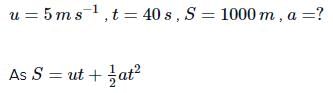
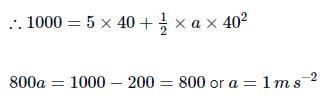
In order to avoid an accident, the car B accelerates such that it overtakes car A in less than 40s. Let the minimum required acceleration be a. Then,
A particles revolves along a circle with a uniform speed. The motion of the particle is ____ .- a)one dimensional
- b)two dimensional.
- c)translatory
- d)oscillatory
Correct answer is option 'B'. Can you explain this answer?
A particles revolves along a circle with a uniform speed. The motion of the particle is ____ .
a)
one dimensional
b)
two dimensional.
c)
translatory
d)
oscillatory
| | Nandini Iyer answered |
To describe the motion of a particle along a circle with a uniform speed. We need two variable, either x and y, or r and θ. Therefore, the motion of the particle is two-dimensional.
Two towns A and B are connected by a regular bus service with a bus leaving in either direction every T minutes. A man cycling with a speed of 20 kmh-1 in the direction A to B notices that a bus goes past him every 18 min in the direction of his motion, and every 6 min in the opposite direction. The period T of the bus service is- a)4.5 min
- b)9 min
- c)12 min
- d)24 min
Correct answer is option 'B'. Can you explain this answer?
Two towns A and B are connected by a regular bus service with a bus leaving in either direction every T minutes. A man cycling with a speed of 20 kmh-1 in the direction A to B notices that a bus goes past him every 18 min in the direction of his motion, and every 6 min in the opposite direction. The period T of the bus service is
a)
4.5 min
b)
9 min
c)
12 min
d)
24 min
| | Ananya Das answered |
Let vkmh−1 be the constant speed with which the bus travel ply between the towns A and B .
Relative velocity of the bus from A to B with respect to the cyclist = (v − 20)kmh−1
Relative velocity of the bus from B to A with respect to the cyclist = (v + 20)kmh−1
Distance travelled by the bus in time T (minutes) = vT
As per question
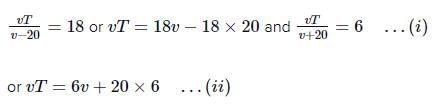
Equating (i) and (ii) , we get
= 18v − 18 x 20 = 6v + 20 × 6
or 12v = 20 x 6 + 18 x 20 = 480 or v = 40 kmh−1
Putting this value of v in (i) , we get
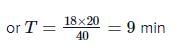
40T = 18 x 40 − 18 x 20 = 18 x 20
Two cars A and B are running at velocities of 60 km h−1 and 45 km h−1. What is the relative velocity of car A with respect to car B, if car A is moving eastward and car B is moving westward?- a)15 km h-1
- b)45 km h-1
- c)60 km h-1
- d)105 km h-1
Correct answer is option 'D'. Can you explain this answer?
Two cars A and B are running at velocities of 60 km h−1 and 45 km h−1. What is the relative velocity of car A with respect to car B, if car A is moving eastward and car B is moving westward?
a)
15 km h-1
b)
45 km h-1
c)
60 km h-1
d)
105 km h-1
| | Raghav Bansal answered |
Velocity of car A w.r.t. ground
∴ vAG = 60 kmh−1 as it is moving towards east
Velocity of car B w.r.t. ground
∴vBG = -45 km h−1 as it is moving towards west
Relative velocity of car A w.r.t. B
vAB = vAG - vBG
= 60 - (-45) = 60 + 45= 105 km h−1
In a uniform circular motion - - a)Both velocity and acceleration are constant.
- b)Both speed and velocity constant
- c)Both Acceleration and speed changes
- d)Both acceleration and velocity changes
Correct answer is option 'D'. Can you explain this answer?
In a uniform circular motion -
a)
Both velocity and acceleration are constant.
b)
Both speed and velocity constant
c)
Both Acceleration and speed changes
d)
Both acceleration and velocity changes
 | Stepway Academy answered |
CONCEPT:
- Uniform motion is the type of motion where a moving object traces equal distances in equal intervals of time.
- Since the distance and time intervals are the same, speed is constant in uniform motion.
- Uniform circular motion is where a moving object traces a circular path with constant speed.
- A circle is assumed to be a polygon with infinitely many sides such that each side approximates to a point.
- So, if the object moving on a circular path undergoes a change in direction at every point.
- Since direction changes and speed remains constant, velocity is varying.
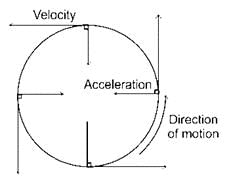
EXPLANATION:
- Velocity is changing in a uniform circular motion as the direction of the object keeps changing at every point.
- Acceleration is the rate of change of velocity. Since velocity keeps changing at every instant, acceleration also changes.
Therefore, both acceleration and velocity changes in a uniform circular motion.
A jet airplane travelling at the speed of 500kmh−1 ejects its products of combustion at the speed of 1500kmh−1 relative to the jet plane. The speed of the products of combustion with respect to an observer on the ground is- a)500 km h-1
- b)1000 km h-1
- c)1500 km h-1
- d)2000 km h-1
Correct answer is option 'B'. Can you explain this answer?
A jet airplane travelling at the speed of 500kmh−1 ejects its products of combustion at the speed of 1500kmh−1 relative to the jet plane. The speed of the products of combustion with respect to an observer on the ground is
a)
500 km h-1
b)
1000 km h-1
c)
1500 km h-1
d)
2000 km h-1
| | Hansa Sharma answered |
Veloity of jet plane w.r.t ground vjG = 500 km h-1
Velocity of products of combustion w.r.t jet plane vCJ = -1500 kmh-1
∴ Velocity of products of combustion w.r.t ground is vCG = vCJ + vJG = - 1500kmh-1 + 500 kmh-1
= -1000 km h-1
-ve sign shows that the direction of products of combustion is opposite to that of the plane
∴ Speed of the products of combustion w.r.t ground = 1000 km h-1
Velocity of products of combustion w.r.t jet plane vCJ = -1500 kmh-1
∴ Velocity of products of combustion w.r.t ground is vCG = vCJ + vJG = - 1500kmh-1 + 500 kmh-1
= -1000 km h-1
-ve sign shows that the direction of products of combustion is opposite to that of the plane
∴ Speed of the products of combustion w.r.t ground = 1000 km h-1
A ball A is thrown up vertically with a speed u and at the same instant another ball B is released from a height h. At time t, the speed of A relative to B is- a)u
- b)u - 2gt
- c)

- d)2u
Correct answer is option 'A'. Can you explain this answer?
A ball A is thrown up vertically with a speed u and at the same instant another ball B is released from a height h. At time t, the speed of A relative to B is
a)
u
b)
u - 2gt
c)
d)
2u
| | Ananya Das answered |
Taking upwards motion of ball A for time t, its velocity is VA = U - gt.
Taking downwards motion of ball B for time, its velocity is VB = gt.
Relative velocity of A w.r.t. B
=VAB = VA -(-VB) = (u - gt) - (-gt) = u
Taking downwards motion of ball B for time, its velocity is VB = gt.
Relative velocity of A w.r.t. B
=VAB = VA -(-VB) = (u - gt) - (-gt) = u
Uniform circular motion is called continuously accelerated motion mainly because- a)direction of motion changes
- b)speed remains the same
- c)velocity remains the same
- d)direction of motion does not change
Correct answer is option 'A'. Can you explain this answer?
Uniform circular motion is called continuously accelerated motion mainly because
a)
direction of motion changes
b)
speed remains the same
c)
velocity remains the same
d)
direction of motion does not change
| | Anoushka Basu answered |
**Uniform Circular Motion**
Uniform circular motion refers to the motion of an object traveling in a circular path at a constant speed. In this type of motion, the object moves along the circumference of the circle, maintaining a fixed distance from the center.
**Acceleration in Uniform Circular Motion**
While the speed of the object remains constant in uniform circular motion, it is important to note that the object is still experiencing acceleration. This may seem counterintuitive since we typically associate acceleration with a change in speed. However, in uniform circular motion, the acceleration is directed towards the center of the circle and is known as centripetal acceleration.
**Direction of Motion Changes**
The correct answer to why uniform circular motion is called continuously accelerated motion is that the direction of motion changes. In uniform circular motion, an object continuously changes its direction as it moves along the circular path. This change in direction implies that the object is experiencing acceleration.
**Velocity Remains the Same**
While the object is undergoing acceleration in uniform circular motion, its velocity remains constant. Velocity is a vector quantity that includes both magnitude (speed) and direction. In uniform circular motion, the speed of the object remains constant, but its direction changes. Therefore, the velocity of the object remains the same in terms of magnitude, but the direction of the velocity vector continually changes.
**Centripetal Acceleration**
The centripetal acceleration is the acceleration experienced by an object undergoing uniform circular motion. It is directed towards the center of the circle and is responsible for continuously changing the direction of the object's motion. The magnitude of the centripetal acceleration can be calculated using the formula:
a = v^2 / r
where a is the centripetal acceleration, v is the velocity of the object, and r is the radius of the circular path.
**Conclusion**
In conclusion, uniform circular motion is called continuously accelerated motion because the direction of motion of the object undergoing circular motion continually changes. Although the speed (magnitude of velocity) remains constant, the object experiences centripetal acceleration directed towards the center of the circle. This acceleration is responsible for continuously changing the direction of the object's motion, making it an example of accelerated motion.
Uniform circular motion refers to the motion of an object traveling in a circular path at a constant speed. In this type of motion, the object moves along the circumference of the circle, maintaining a fixed distance from the center.
**Acceleration in Uniform Circular Motion**
While the speed of the object remains constant in uniform circular motion, it is important to note that the object is still experiencing acceleration. This may seem counterintuitive since we typically associate acceleration with a change in speed. However, in uniform circular motion, the acceleration is directed towards the center of the circle and is known as centripetal acceleration.
**Direction of Motion Changes**
The correct answer to why uniform circular motion is called continuously accelerated motion is that the direction of motion changes. In uniform circular motion, an object continuously changes its direction as it moves along the circular path. This change in direction implies that the object is experiencing acceleration.
**Velocity Remains the Same**
While the object is undergoing acceleration in uniform circular motion, its velocity remains constant. Velocity is a vector quantity that includes both magnitude (speed) and direction. In uniform circular motion, the speed of the object remains constant, but its direction changes. Therefore, the velocity of the object remains the same in terms of magnitude, but the direction of the velocity vector continually changes.
**Centripetal Acceleration**
The centripetal acceleration is the acceleration experienced by an object undergoing uniform circular motion. It is directed towards the center of the circle and is responsible for continuously changing the direction of the object's motion. The magnitude of the centripetal acceleration can be calculated using the formula:
a = v^2 / r
where a is the centripetal acceleration, v is the velocity of the object, and r is the radius of the circular path.
**Conclusion**
In conclusion, uniform circular motion is called continuously accelerated motion because the direction of motion of the object undergoing circular motion continually changes. Although the speed (magnitude of velocity) remains constant, the object experiences centripetal acceleration directed towards the center of the circle. This acceleration is responsible for continuously changing the direction of the object's motion, making it an example of accelerated motion.
A particle is acted upon by a force of constant magnitude. Which is always perpendicular to the velocity of the particle ? The motion of the particle takes place in a plane. It follow that that- a)its velocity is constant
- b)its acceleration is constant
- c)its kinetic energy is constant
- d)it moves in a circular path
Correct answer is option 'C,D'. Can you explain this answer?
A particle is acted upon by a force of constant magnitude. Which is always perpendicular to the velocity of the particle ? The motion of the particle takes place in a plane. It follow that that
a)
its velocity is constant
b)
its acceleration is constant
c)
its kinetic energy is constant
d)
it moves in a circular path
| | Shail Majumdar answered |
Perpendicular Force on a Particle in a Plane
When a particle is acted upon by a force of constant magnitude that is always perpendicular to its velocity, the following can be observed:
Circular Motion
The particle moves in a circular path because the force acts as a centripetal force, pulling the particle towards the center of the circle.
Constant Kinetic Energy
Since the force is always perpendicular to the velocity of the particle, it does not do any work on the particle. Therefore, the kinetic energy of the particle remains constant.
Variable Speed
Although the particle moves in a circular path, its speed is not constant. This is because the force only changes the direction of the particle, not its speed. Therefore, the particle will move faster when it is farther away from the center of the circle and slower when it is closer to the center.
Conclusion
In conclusion, when a particle is acted upon by a force of constant magnitude that is always perpendicular to its velocity, it will move in a circular path with variable speed while maintaining constant kinetic energy.
When a particle is acted upon by a force of constant magnitude that is always perpendicular to its velocity, the following can be observed:
Circular Motion
The particle moves in a circular path because the force acts as a centripetal force, pulling the particle towards the center of the circle.
Constant Kinetic Energy
Since the force is always perpendicular to the velocity of the particle, it does not do any work on the particle. Therefore, the kinetic energy of the particle remains constant.
Variable Speed
Although the particle moves in a circular path, its speed is not constant. This is because the force only changes the direction of the particle, not its speed. Therefore, the particle will move faster when it is farther away from the center of the circle and slower when it is closer to the center.
Conclusion
In conclusion, when a particle is acted upon by a force of constant magnitude that is always perpendicular to its velocity, it will move in a circular path with variable speed while maintaining constant kinetic energy.
Chapter doubts & questions for Motion in Two Dimensions - Physics 2026 is part of Grade 9 exam preparation. The chapters have been prepared according to the Grade 9 exam syllabus. The Chapter doubts & questions, notes, tests & MCQs are made for Grade 9 2026 Exam. Find important definitions, questions, notes, meanings, examples, exercises, MCQs and online tests here.
Chapter doubts & questions of Motion in Two Dimensions - Physics in English & Hindi are available as part of Grade 9 exam. Download more important topics, notes, lectures and mock test series for Grade 9 Exam by signing up for free.
Physics208 videos|298 docs|123 tests |
