


All Exams > Grade 9 > Mathematics: Geometry > All Questions
All questions of Transformations and Symmetry for Grade 9 Exam
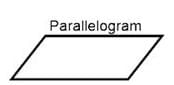
A parallelogram has ______ lines of symmetry:
- a)3
- b)1
- c)2
- d)0
Correct answer is option 'D'. Can you explain this answer?
A parallelogram has ______ lines of symmetry:
a)
3
b)
1
c)
2
d)
0
 | Ananya Choudhary answered |
A parallelogram has zero lines of symmetry.

Find the number of lines of symmetry in the below figure:
- a)4
- b)3
- c)2
- d)1
Correct answer is option 'A'. Can you explain this answer?
Find the number of lines of symmetry in the below figure:
a)
4
b)
3
c)
2
d)
1
 | Ananya Das answered |
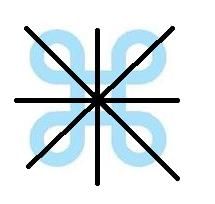
These are the 4 lines of symmetry
Find the number of lines of symmetry in the below figure:
- a)3
- b)4
- c)0
- d)None of these
Correct answer is option 'C'. Can you explain this answer?
Find the number of lines of symmetry in the below figure:
a)
3
b)
4
c)
0
d)
None of these
| | Ananya Das answered |
If you draw a vertical or horizontal or diagonal line you will find that its not symmetrical. Hence, it doesn’t have any lines of symmetry.
How many lines of symmetries are there in rectangle?- a)2
- b)1
- c)0
- d)None of these
Correct answer is option 'A'. Can you explain this answer?
How many lines of symmetries are there in rectangle?
a)
2
b)
1
c)
0
d)
None of these
 | Dikshit Sitapur answered |
Only 2 lines of symmetry can be drawn in a rectangle. one is vertical and another is horizontal. carners lines are incorrect.
How many lines of symmetries are there in a square?- a)2
- b)3
- c)4
- d)1
Correct answer is option 'C'. Can you explain this answer?
How many lines of symmetries are there in a square?
a)
2
b)
3
c)
4
d)
1
 | Muskan Preet answered |
Because square has 4 lines . If we draw symmetry in the centre of square the lines are also four 2 right side and 2 left side
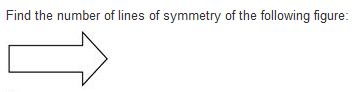
- a)2
- b)1
- c)3
- d)None of these
Correct answer is option 'B'. Can you explain this answer?
a)
2
b)
1
c)
3
d)
None of these
 | Raji V answered |
No , answer none of this
Letter ‘D’ of the English alphabet have reflectional symmetry (i.e., symmetry related to mirror reflection) about.- a)a horizontal mirror
- b)a vertical mirror
- c)both
- d)None of these
Correct answer is option 'B'. Can you explain this answer?
Letter ‘D’ of the English alphabet have reflectional symmetry (i.e., symmetry related to mirror reflection) about.
a)
a horizontal mirror
b)
a vertical mirror
c)
both
d)
None of these
| | Ananya Das answered |
When you’ll place a horizontal mirror you’ll see that D appears D in the mirror. If you place a vertical mirror D will be laterally inverted.
Number of lines of symmetry a triangle does not have:- a)3
- b)1
- c)0
- d)2
Correct answer is option 'D'. Can you explain this answer?
Number of lines of symmetry a triangle does not have:
a)
3
b)
1
c)
0
d)
2
| | Anita Menon answered |
Equilateral Triangle
(all sides equal,
all angles equal) = = 3 Lines of Symmetry
(all sides equal,
all angles equal) = = 3 Lines of Symmetry
Isosceles Triangle
(two sides equal,
two angles equal) == 1 Lines of Symmetry
(two sides equal,
two angles equal) == 1 Lines of Symmetry
Scalene Triangle
(no sides equal,
no angles equal) == No Lines of Symmetry
(no sides equal,
no angles equal) == No Lines of Symmetry
Which of the followings has both horizontal as well as vertical line of symmetry?- a)H
- b)S
- c)V
- d)A
Correct answer is option 'A'. Can you explain this answer?
Which of the followings has both horizontal as well as vertical line of symmetry?
a)
H
b)
S
c)
V
d)
A
 | Uma Shankar Singh answered |
Correct answer is option 'a' as H is horizontally and vertically symmetrical if we draw a line between H vertically and horizontally across it.
How many lines of symmetries are there in regular pentagon?- a)2
- b)3
- c)5
- d)4
Correct answer is option 'C'. Can you explain this answer?
How many lines of symmetries are there in regular pentagon?
a)
2
b)
3
c)
5
d)
4
 | Deepak Mehra answered |
Line symmetry in regular polygonsA square is a regular polygon. It has four
The mirror image of ‘W’, when the mirror is placed vertically:- a)V
- b)M
- c)U
- d)W
Correct answer is option 'D'. Can you explain this answer?
The mirror image of ‘W’, when the mirror is placed vertically:
a)
V
b)
M
c)
U
d)
W
 | Sukriti Shah answered |
An object is formed by reflecting the object in a mirror. It is a reversed and flipped version of the original object. The mirror image appears to be behind the mirror and is identical in shape and size to the original object, but with the left and right sides switched.
How many lines of symmetries are there in an isosceles triangle?- a)3
- b)2
- c)1
- d)None of these
Correct answer is option 'C'. Can you explain this answer?
How many lines of symmetries are there in an isosceles triangle?
a)
3
b)
2
c)
1
d)
None of these
| | Sam Earth answered |
There is only one line of symmetry in an isosceles triangle as only two sides of a triangle are equal in length. Thus, the correct answer is choice (b).
How many lines of symmetries are there in a rhombus?- a)1
- b)2
- c)3
- d)4
Correct answer is option 'B'. Can you explain this answer?
How many lines of symmetries are there in a rhombus?
a)
1
b)
2
c)
3
d)
4
 | Anagha Choudhury answered |
Two linesA rhombus has two lines of symmetry that run through one vertex to
How many lines of symmetries are there in an equilateral triangle?- a)2
- b)3
- c)0
- d)1
Correct answer is option 'B'. Can you explain this answer?
How many lines of symmetries are there in an equilateral triangle?
a)
2
b)
3
c)
0
d)
1
 | Prisha Banerjee answered |
Three linesThe division of triangles into scalene, isosceles, and equilateral can be

Find the number of lines of symmetry in the below figure: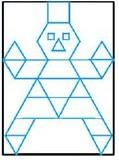
- a)3
- b)1
- c)2
- d)none of these
Correct answer is option 'B'. Can you explain this answer?
Find the number of lines of symmetry in the below figure:
a)
3
b)
1
c)
2
d)
none of these
| | Amit Sharma answered |
It has only 1 line of symmetry which is a vertical line of symmetry, as if you draw a horizontal line one half will have a face and one half will have legs which are not symmetrical.
Find the number of lines of symmetry in regular hexagon.- a)2
- b)6
- c)1
- d)3
Correct answer is option 'B'. Can you explain this answer?
Find the number of lines of symmetry in regular hexagon.
a)
2
b)
6
c)
1
d)
3
| | Pradyumna Rao answered |
Regular hexagon means the all sides of hexagon are equal.
Letter ‘A’ of the English alphabet have reflectional symmetry (i.e., symmetry related to mirror reflection) about.- a)a vertical mirror
- b)both
- c)a horizontal mirror
- d)None of these
Correct answer is option 'A'. Can you explain this answer?
Letter ‘A’ of the English alphabet have reflectional symmetry (i.e., symmetry related to mirror reflection) about.
a)
a vertical mirror
b)
both
c)
a horizontal mirror
d)
None of these
 | Asha Datta answered |
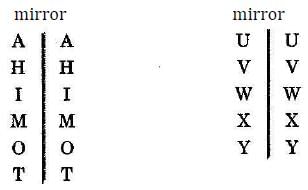
Vertical mirror – A, H, I, M, O, T, U, V, W, X and Y
Which of these quadrilaterals have both line and rotational symmetries of order more than 3?- a)A triangle
- b)A square
- c)A kite
- d)A rectangle
Correct answer is option 'B'. Can you explain this answer?
Which of these quadrilaterals have both line and rotational symmetries of order more than 3?
a)
A triangle
b)
A square
c)
A kite
d)
A rectangle
 | Nidhi menon answered |
Understanding Symmetries
When analyzing quadrilaterals, it's essential to understand what line and rotational symmetries are:
- Line Symmetry: A shape has line symmetry if it can be divided into two identical halves by a straight line.
- Rotational Symmetry: A shape has rotational symmetry if it can be rotated around a central point and still look the same at certain angles.
Symmetries of Given Quadrilaterals
Let's examine each option based on these definitions:
- A Triangle:
- A triangle can have line symmetry (like an equilateral triangle) but generally has rotational symmetry of order 1 (it only looks the same when rotated 0 degrees).
- A Square:
- A square has 4 lines of symmetry (through the midpoints and corners) and a rotational symmetry of order 4 (it looks the same at 90°, 180°, 270°, and 360°). This is the only quadrilateral in this list with both line and rotational symmetries of order more than 3.
- A Kite:
- A kite has 1 line of symmetry but only has rotational symmetry of order 1 (it does not look the same when rotated).
- A Rectangle:
- A rectangle has 2 lines of symmetry (through the midpoints) and a rotational symmetry of order 2 (it looks the same at 180° but not at smaller angles).
Conclusion
The only quadrilateral from your list that possesses both line and rotational symmetries of order more than 3 is the square. Thus, the correct answer is option B (the square).
When analyzing quadrilaterals, it's essential to understand what line and rotational symmetries are:
- Line Symmetry: A shape has line symmetry if it can be divided into two identical halves by a straight line.
- Rotational Symmetry: A shape has rotational symmetry if it can be rotated around a central point and still look the same at certain angles.
Symmetries of Given Quadrilaterals
Let's examine each option based on these definitions:
- A Triangle:
- A triangle can have line symmetry (like an equilateral triangle) but generally has rotational symmetry of order 1 (it only looks the same when rotated 0 degrees).
- A Square:
- A square has 4 lines of symmetry (through the midpoints and corners) and a rotational symmetry of order 4 (it looks the same at 90°, 180°, 270°, and 360°). This is the only quadrilateral in this list with both line and rotational symmetries of order more than 3.
- A Kite:
- A kite has 1 line of symmetry but only has rotational symmetry of order 1 (it does not look the same when rotated).
- A Rectangle:
- A rectangle has 2 lines of symmetry (through the midpoints) and a rotational symmetry of order 2 (it looks the same at 180° but not at smaller angles).
Conclusion
The only quadrilateral from your list that possesses both line and rotational symmetries of order more than 3 is the square. Thus, the correct answer is option B (the square).
Letter ‘C’ of the English alphabet have reflectional symmetry (i.e., symmetry related to mirror reflection) about.- a)a horizontal mirror
- b)a vertical mirror
- c)both
- d)None of these
Correct answer is option 'A'. Can you explain this answer?
Letter ‘C’ of the English alphabet have reflectional symmetry (i.e., symmetry related to mirror reflection) about.
a)
a horizontal mirror
b)
a vertical mirror
c)
both
d)
None of these
| | Amit Sharma answered |
when you’ll place a horizontal mirror you’ll see that C appears C in the mirror.
Letter ‘B’ of the English alphabet have reflectional symmetry (i.e., symmetry related to mirror reflection) about.- a)both
- b)a horizontal mirror
- c)a vertical mirror
- d)None of these
Correct answer is option 'B'. Can you explain this answer?
Letter ‘B’ of the English alphabet have reflectional symmetry (i.e., symmetry related to mirror reflection) about.
a)
both
b)
a horizontal mirror
c)
a vertical mirror
d)
None of these
| | Anita Menon answered |
Yes , B has a horizontal line of symmetry from the middle , but does not have a vertical line of symmetry, because its not symmetrical with vertical line.

Which of the following alphabets has many lines of symmetry?- a)I
- b)O
- c)P
- d)F
Correct answer is option 'B'. Can you explain this answer?
Which of the following alphabets has many lines of symmetry?
a)
I
b)
O
c)
P
d)
F
 | Arindam Kumar answered |
O has many lines of symmetry.
Which of the following alphabets has a horizontal line of symmetry?- a)C
- b)K
- c)D
- d)All the above
Correct answer is option 'D'. Can you explain this answer?
Which of the following alphabets has a horizontal line of symmetry?
a)
C
b)
K
c)
D
d)
All the above
| | Dipanjan Mukherjee answered |
Explanation:
A horizontal line of symmetry means that a figure can be divided into two equal halves by a line that is parallel to the ground. Let's analyze each alphabet one by one to determine if it has a horizontal line of symmetry:
a) C:
The alphabet "C" has a curved shape, but it does not have a horizontal line of symmetry. If we try to draw a horizontal line through the middle of the "C", the two halves will not be equal.
b) K:
The alphabet "K" consists of two diagonal lines joined at a vertical line. It does not have a horizontal line of symmetry because a horizontal line cannot divide it into two equal halves.
c) D:
The alphabet "D" has a rounded shape with a straight vertical line. It does have a horizontal line of symmetry. If we draw a horizontal line through the middle of the "D", the two halves will be equal.
d) All the above:
Since both "C" and "K" do not have a horizontal line of symmetry, the correct answer is option 'D', which states that all the above alphabets do not have a horizontal line of symmetry.
In conclusion, only the alphabet "D" has a horizontal line of symmetry.
A horizontal line of symmetry means that a figure can be divided into two equal halves by a line that is parallel to the ground. Let's analyze each alphabet one by one to determine if it has a horizontal line of symmetry:
a) C:
The alphabet "C" has a curved shape, but it does not have a horizontal line of symmetry. If we try to draw a horizontal line through the middle of the "C", the two halves will not be equal.
b) K:
The alphabet "K" consists of two diagonal lines joined at a vertical line. It does not have a horizontal line of symmetry because a horizontal line cannot divide it into two equal halves.
c) D:
The alphabet "D" has a rounded shape with a straight vertical line. It does have a horizontal line of symmetry. If we draw a horizontal line through the middle of the "D", the two halves will be equal.
d) All the above:
Since both "C" and "K" do not have a horizontal line of symmetry, the correct answer is option 'D', which states that all the above alphabets do not have a horizontal line of symmetry.
In conclusion, only the alphabet "D" has a horizontal line of symmetry.
Which of these letters has only rotational symmetry?- a)S
- b)E
- c)B
- d)P
Correct answer is option 'A'. Can you explain this answer?
Which of these letters has only rotational symmetry?
a)
S
b)
E
c)
B
d)
P
 | Malini bajaj answered |
Rotational symmetry in capital letters describes a property in which the letter looks the same after being rotated. Capital letters that have rotational symmetry are: Z, S, H, N and O.
The letters Z, S, H and N, when rotated 180 degrees clockwise or counterclockwise, will look the same after rotation completion. This is called rotational symmetry on the order of two, because there were two 90 degree rotations. The letter O has rotational symmetry on the order of one, because after being rotated by 90 degrees, it still looks the same.
The letters Z, S, H and N, when rotated 180 degrees clockwise or counterclockwise, will look the same after rotation completion. This is called rotational symmetry on the order of two, because there were two 90 degree rotations. The letter O has rotational symmetry on the order of one, because after being rotated by 90 degrees, it still looks the same.
 in a horizontal mirror?


Letter ‘I’ of the English alphabet have reflectional symmetry (i.e., symmetry related to mirror reflection) about.- a)Both horizontal and veritcal
- b)a vertical mirror
- c)Neither horizontal nor veritcal
- d)a horizontal mirror
Correct answer is option 'A'. Can you explain this answer?
Letter ‘I’ of the English alphabet have reflectional symmetry (i.e., symmetry related to mirror reflection) about.
a)
Both horizontal and veritcal
b)
a vertical mirror
c)
Neither horizontal nor veritcal
d)
a horizontal mirror
 | Geetika Shah answered |
‘I’ have both vertical and horizontal symmetry since horizontal division divides ’I’ symmetrical similarly it has a vertical symmetry.
A square has a rotational symmetry of order 4 about its centre. What is the angle of rotation?- a)45o
- b)90o
- c)180o
- d)270o
Correct answer is option 'B'. Can you explain this answer?
A square has a rotational symmetry of order 4 about its centre. What is the angle of rotation?
a)
45o
b)
90o
c)
180o
d)
270o
| | Siddharth Mehta answered |
The angle of rotation of a shape refers to the degree by which the shape needs to be rotated to coincide with its original position. In this case, a square has a rotational symmetry of order 4, which means it can be rotated by a certain angle multiple times to align with itself.
To determine the angle of rotation, we need to consider the number of times the square can be rotated to achieve symmetry. Since the rotational symmetry of order 4 means the square can be rotated four times to match its original position, we can calculate the angle of rotation by dividing a full circle (360 degrees) by the number of rotations.
Let's break down the steps to find the angle of rotation:
Step 1: Determine the number of rotations for symmetry
In this case, the square has a rotational symmetry of order 4, which means it can be rotated four times to align with itself.
Step 2: Calculate the angle of rotation
To find the angle of rotation, we divide a full circle (360 degrees) by the number of rotations.
360 degrees ÷ 4 rotations = 90 degrees
Therefore, the angle of rotation for the square with rotational symmetry of order 4 is 90 degrees.
Option B, which states that the angle of rotation is 90 degrees, is the correct answer.
To determine the angle of rotation, we need to consider the number of times the square can be rotated to achieve symmetry. Since the rotational symmetry of order 4 means the square can be rotated four times to match its original position, we can calculate the angle of rotation by dividing a full circle (360 degrees) by the number of rotations.
Let's break down the steps to find the angle of rotation:
Step 1: Determine the number of rotations for symmetry
In this case, the square has a rotational symmetry of order 4, which means it can be rotated four times to align with itself.
Step 2: Calculate the angle of rotation
To find the angle of rotation, we divide a full circle (360 degrees) by the number of rotations.
360 degrees ÷ 4 rotations = 90 degrees
Therefore, the angle of rotation for the square with rotational symmetry of order 4 is 90 degrees.
Option B, which states that the angle of rotation is 90 degrees, is the correct answer.
Which of the following alphabets has line symmetry?- a)P
- b)Q
- c)Z
- d)A
Correct answer is option 'D'. Can you explain this answer?
Which of the following alphabets has line symmetry?
a)
P
b)
Q
c)
Z
d)
A
 | Meghana patil answered |
Explanation:
The alphabet that has line symmetry is the letter "A".
Definition of Line Symmetry:
Line symmetry, also known as reflection symmetry, occurs when a figure can be divided into two identical halves by a line. If the figure remains unchanged after flipping it over this line, it is said to have line symmetry.
Analysis of the Given Alphabets:
Let's analyze each of the given alphabets to determine which one has line symmetry:
- Option a) P: The letter "P" does not have line symmetry. If we were to draw a line vertically through the center of the "P", the two halves would not be identical.
- Option b) Q: The letter "Q" does not have line symmetry. If we were to draw a line vertically through the center of the "Q", the two halves would not be identical.
- Option c) Z: The letter "Z" does not have line symmetry. If we were to draw a line vertically through the center of the "Z", the two halves would not be identical.
- Option d) A: The letter "A" has line symmetry. If we were to draw a line vertically through the center of the "A", the two halves would be identical.
Conclusion:
Among the given options, only the letter "A" has line symmetry. Therefore, the correct answer is option 'D'.
Find the number of lines of symmetry of the following figure:
- a)2
- b)1
- c)3
- d)None of these
Correct answer is option 'A'. Can you explain this answer?
Find the number of lines of symmetry of the following figure:
a)
2
b)
1
c)
3
d)
None of these
| | Geetika Shah answered |
Yes there are only two lines of symmetry i.e. a horizontal and a vertical line of symmetry, diagonally its not symmetrical.
What is the other name for a line of symmetry of a circle?- a)An arc
- b)A sector
- c)A diameter
- d)A radius
Correct answer is option 'C'. Can you explain this answer?
What is the other name for a line of symmetry of a circle?
a)
An arc
b)
A sector
c)
A diameter
d)
A radius
 | Sonal Dasgupta answered |
A diameter divides the circle into 2 equal parts. So, it can be considered as a line of symmetry.
Which of the following alphabets has no line of symmetry?- a)A
- b)B
- c)P
- d)O
Correct answer is option 'C'. Can you explain this answer?
Which of the following alphabets has no line of symmetry?
a)
A
b)
B
c)
P
d)
O
| | Mainak Chauhan answered |
Line of Symmetry in Alphabets
Symmetry in Alphabets:
Symmetry is a key concept in mathematics and can be observed in various shapes and figures, including alphabets. A line of symmetry divides a shape into two identical halves, mirroring each other.
Alphabets with Symmetry:
- Alphabets like A and O have a line of symmetry. When folded along the line of symmetry, both halves match perfectly.
Alphabets without Symmetry:
- The alphabet P does not have a line of symmetry. If you try to fold the alphabet P along any axis, the two halves will not match perfectly.
Explanation:
When we look at the alphabet P, we can see that it has a curved shape with a vertical line on one side. This vertical line acts as a distinguishing feature that prevents the alphabet P from having a line of symmetry. No matter how we try to fold the alphabet P, the two halves will not coincide perfectly.
Conclusion:
In summary, out of the alphabets mentioned (A, B, P, O), the alphabet P is the one that does not have a line of symmetry. This lack of symmetry is due to the specific shape and design of the alphabet P, making it distinct from the other alphabets mentioned.
Symmetry in Alphabets:
Symmetry is a key concept in mathematics and can be observed in various shapes and figures, including alphabets. A line of symmetry divides a shape into two identical halves, mirroring each other.
Alphabets with Symmetry:
- Alphabets like A and O have a line of symmetry. When folded along the line of symmetry, both halves match perfectly.
Alphabets without Symmetry:
- The alphabet P does not have a line of symmetry. If you try to fold the alphabet P along any axis, the two halves will not match perfectly.
Explanation:
When we look at the alphabet P, we can see that it has a curved shape with a vertical line on one side. This vertical line acts as a distinguishing feature that prevents the alphabet P from having a line of symmetry. No matter how we try to fold the alphabet P, the two halves will not coincide perfectly.
Conclusion:
In summary, out of the alphabets mentioned (A, B, P, O), the alphabet P is the one that does not have a line of symmetry. This lack of symmetry is due to the specific shape and design of the alphabet P, making it distinct from the other alphabets mentioned.
Letter ‘T’ of the English alphabet have reflectional symmetry (i.e., symmetry related to mirror reflection) about.- a)both
- b)a horizontal mirror
- c)a vertical mirror
- d)None of these
Correct answer is option 'C'. Can you explain this answer?
Letter ‘T’ of the English alphabet have reflectional symmetry (i.e., symmetry related to mirror reflection) about.
a)
both
b)
a horizontal mirror
c)
a vertical mirror
d)
None of these
| | Sarangi singhania answered |
T has only vertical symmetry since if we draw a horizontal line, we have -on one half but not in other half
Letter ‘E’ of the English alphabet have reflectional symmetry (i.e., symmetry related to mirror reflection) about.- a)both
- b)a horizontal mirror
- c)a vertical mirror
- d)None of these
Correct answer is option 'B'. Can you explain this answer?
Letter ‘E’ of the English alphabet have reflectional symmetry (i.e., symmetry related to mirror reflection) about.
a)
both
b)
a horizontal mirror
c)
a vertical mirror
d)
None of these
| | Mansi nambiar answered |
Understanding Reflectional Symmetry
Reflectional symmetry, also known as mirror symmetry, occurs when one half of an object is a mirror image of the other half. In the case of the letter 'E', we can analyze its symmetry by considering how it would appear if reflected in a mirror.
Vertical vs. Horizontal Reflection
- Vertical Mirror: If we place a vertical mirror on the left or right side of the letter 'E', the two halves created by the mirror will look identical. The vertical line divides 'E' into two symmetrical parts, with the top, middle, and bottom lines remaining parallel and in the same arrangement.
- Horizontal Mirror: If we attempt to reflect 'E' using a horizontal mirror (above or below), the top and bottom sections do not align. The top arm of 'E' would appear at the bottom in the reflection and vice versa, which breaks symmetry.
Conclusion
Thus, the letter 'E' only exhibits reflectional symmetry when using a vertical mirror. The correct answer to the question is option 'B', as the shape of 'E' maintains its structure and symmetry only when reflected vertically. This understanding illustrates the importance of reflectional symmetry in recognizing and analyzing shapes in geometry.
Reflectional symmetry, also known as mirror symmetry, occurs when one half of an object is a mirror image of the other half. In the case of the letter 'E', we can analyze its symmetry by considering how it would appear if reflected in a mirror.
Vertical vs. Horizontal Reflection
- Vertical Mirror: If we place a vertical mirror on the left or right side of the letter 'E', the two halves created by the mirror will look identical. The vertical line divides 'E' into two symmetrical parts, with the top, middle, and bottom lines remaining parallel and in the same arrangement.
- Horizontal Mirror: If we attempt to reflect 'E' using a horizontal mirror (above or below), the top and bottom sections do not align. The top arm of 'E' would appear at the bottom in the reflection and vice versa, which breaks symmetry.
Conclusion
Thus, the letter 'E' only exhibits reflectional symmetry when using a vertical mirror. The correct answer to the question is option 'B', as the shape of 'E' maintains its structure and symmetry only when reflected vertically. This understanding illustrates the importance of reflectional symmetry in recognizing and analyzing shapes in geometry.
Letter ‘G’ of the English alphabet have reflectional symmetry (i.e., symmetry related to mirror reflection) about.- a)Neither horizontal nor veritcal
- b)a horizontal mirror
- c)a vertical mirror
- d)both
Correct answer is option 'A'. Can you explain this answer?
Letter ‘G’ of the English alphabet have reflectional symmetry (i.e., symmetry related to mirror reflection) about.
a)
Neither horizontal nor veritcal
b)
a horizontal mirror
c)
a vertical mirror
d)
both
 | Arjun Chakraborty answered |
Yes , G does not have any line of symmetry , if you draw it horizontally or vertically , its not symmetrical.
Find the number of lines of symmetry in the below figure:
- a)3
- b)1
- c)4
- d)2
Correct answer is option 'C'. Can you explain this answer?
Find the number of lines of symmetry in the below figure:
a)
3
b)
1
c)
4
d)
2
| | Manish Kumar answered |
A square has 4 lines of symmetry vertically,horizontally,diagonally
Line symmetry is also known as _______ symmetry.- a)Rotational
- b)Non linear
- c)irregular
- d)reflection
Correct answer is option 'D'. Can you explain this answer?
Line symmetry is also known as _______ symmetry.
a)
Rotational
b)
Non linear
c)
irregular
d)
reflection
 | Rohini Seth answered |
Line symmetry is also known as reflection symmetry.Because a mirror line resembles the line of symmetry, where one half is the mirror image of the other half.
A In A XYZ, XY = XZ and XM⊥YZand ZP⊥XY. About which of the following is the triangle symmetrical?- a)XM
- b)YN
- c)ZP
- d)XZ
Correct answer is option 'A'. Can you explain this answer?
A In A XYZ, XY = XZ and XM⊥YZand ZP⊥XY. About which of the following is the triangle symmetrical?
a)
XM
b)
YN
c)
ZP
d)
XZ
 | Anshu Basu answered |

Since XY=XZ and XM⊥YZ,
∠YXM=∠ZXM. So, the triangle is symmetrical about XM as it bisects the apex angle.
What is the order of rotational symmetry of the figure given?
- a)2
- b)1
- c)4
- d)3
Correct answer is option 'C'. Can you explain this answer?
What is the order of rotational symmetry of the figure given?
a)
2
b)
1
c)
4
d)
3
 | Anu John answered |
The wheel moves in 360 turn so the symmetry is 4


Letter ‘H’ of the English alphabet have reflectional symmetry (i.e., symmetry related to mirror reflection) about.- a)a vertical mirror
- b)Both horizontal and veritcal
- c)a horizontal mirror
- d)Neither horizontal nor veritcal
Correct answer is option 'B'. Can you explain this answer?
Letter ‘H’ of the English alphabet have reflectional symmetry (i.e., symmetry related to mirror reflection) about.
a)
a vertical mirror
b)
Both horizontal and veritcal
c)
a horizontal mirror
d)
Neither horizontal nor veritcal
 | Kirti Dasgupta answered |
Letters of the English alphabet symmetric about both horizontal and vertical mirrors: -
H, I, O and X
The letters when flipped along both the axes (horizontal and vertical) retains the original figure.
Which of the following triangles has no line of symmetry?- a)An equilateral triangle
- b)An isosceles triangle
- c)A scalene triangle
- d)All of the above
Correct answer is option 'C'. Can you explain this answer?
Which of the following triangles has no line of symmetry?
a)
An equilateral triangle
b)
An isosceles triangle
c)
A scalene triangle
d)
All of the above
 | Rithika Roy answered |
A scalene triangle has no line of symmetry.
Which of the following alphabets has a vertical line of symmetry?- a)M
- b)B
- c)Q
- d)E
Correct answer is option 'A'. Can you explain this answer?
Which of the following alphabets has a vertical line of symmetry?
a)
M
b)
B
c)
Q
d)
E
 | Prateek Sharma answered |
Recall definition of line symmetry. 

A Which of the following figures has rotational symmetry of order more than 1?- a)

- b)

- c)

- d)All of these
Correct answer is option 'D'. Can you explain this answer?
A Which of the following figures has rotational symmetry of order more than 1?
a)
b)
c)
d)
All of these
 | Coders Trust answered |
Rotational symmetry of order n means the figure looks the same after a rotation of 360° ÷ n, and more than once in a full 360° turn. If it only matches after a full 360°, then its order is 1.
(a) Circle with two perpendicular diameters
When rotated by 90°, 180°, 270°, or 360°, it looks the same. So, it has rotational symmetry of order 4.
When rotated by 90°, 180°, 270°, or 360°, it looks the same. So, it has rotational symmetry of order 4.
(b) Equilateral triangle
When rotated by 120°, 240°, or 360°, it looks the same. So, it has rotational symmetry of order 3.
When rotated by 120°, 240°, or 360°, it looks the same. So, it has rotational symmetry of order 3.
(c) Four-leaf figure (like a pinwheel)
When rotated by 90°, 180°, 270°, or 360°, it looks the same. So, it has rotational symmetry of order 4.
When rotated by 90°, 180°, 270°, or 360°, it looks the same. So, it has rotational symmetry of order 4.
(d) All of these
Since each of the given figures (a, b, c) has rotational symmetry of order greater than 1, the correct answer is d) All of these.
Since each of the given figures (a, b, c) has rotational symmetry of order greater than 1, the correct answer is d) All of these.
Final Answer (with explanation for exam): All three figures shown have rotational symmetry of order more than 1. The circle with diameter has order 4, the equilateral triangle has order 3, and the four-leaf figure has order 4. Hence, the correct option is d) All of these.
What is the order of rotational symmetry for the given figure? 
- a)3
- b)4
- c)6
- d)12
Correct answer is option 'C'. Can you explain this answer?
What is the order of rotational symmetry for the given figure?
a)
3
b)
4
c)
6
d)
12
 | Rainbow Rise Classes answered |
The given figure is a six-pointed star, which has rotational symmetry of order 6. This means the figure looks the same after a rotation of 360°/6 = 60° about its center. Therefore, the order of rotational symmetry is 6.
Which of the following figures are symmetrical with respect to minimum two lines? - a)

- b)

- c)Both (a) and (b)
- d)

Correct answer is option 'C'. Can you explain this answer?
Which of the following figures are symmetrical with respect to minimum two lines?
a)
b)
c)
Both (a) and (b)
d)
| | Rainbow Rise Classes answered |
Figure 1 has, in total, 4 lines of Symmetry
Figure 2 has 2 lines of symmetry
So both figure 1 and 2 has minimum 2 lines of symmetry
Figure 2 has 2 lines of symmetry
So both figure 1 and 2 has minimum 2 lines of symmetry
In the given figure, the dotted line is the line of symmetry. Which figure is formed if the given figure is reflected in the dotted line? 
- a)A square
- b)A rhombus
- c)A triangle
- d)A pentagon
Correct answer is option 'B'. Can you explain this answer?
In the given figure, the dotted line is the line of symmetry. Which figure is formed if the given figure is reflected in the dotted line?
a)
A square
b)
A rhombus
c)
A triangle
d)
A pentagon
| | Rainbow Rise Classes answered |

The figure formed is a rhombus.
Chapter doubts & questions for Transformations and Symmetry - Mathematics: Geometry 2026 is part of Grade 9 exam preparation. The chapters have been prepared according to the Grade 9 exam syllabus. The Chapter doubts & questions, notes, tests & MCQs are made for Grade 9 2026 Exam. Find important definitions, questions, notes, meanings, examples, exercises, MCQs and online tests here.
Chapter doubts & questions of Transformations and Symmetry - Mathematics: Geometry in English & Hindi are available as part of Grade 9 exam. Download more important topics, notes, lectures and mock test series for Grade 9 Exam by signing up for free.
Mathematics: Geometry49 videos|110 docs|33 tests |
