


All Exams > CTET & State TET > 2 Months Preparation for CTET Paper 2 > All Questions
All questions of Construct of Intelligence and Multi-Dimensional Intelligence for CTET & State TET Exam
Given below are two statements, one leveled as Assertion (A) and the other leveled as Reason (R) :Assertion (A) - Slow learners are those children who are low in achieving academic skills and are often ignored by others as dull and lazy.Reason (R) - Separate classes and enrichment programs are used for gifted children to satisfy and utilize their intelligence.- a)Both (A) and (R) are correct and (R) is the correct explanation of (A)
- b)Both (A) and (R) are correct, but (R) is not the correct explanation of (A)
- c)(A) is correct, but (R) is not the correct
- d)(A) is not correct, but (R) is correct.
Correct answer is option 'B'. Can you explain this answer?
Given below are two statements, one leveled as Assertion (A) and the other leveled as Reason (R) :
Assertion (A) - Slow learners are those children who are low in achieving academic skills and are often ignored by others as dull and lazy.
Reason (R) - Separate classes and enrichment programs are used for gifted children to satisfy and utilize their intelligence.
a)
Both (A) and (R) are correct and (R) is the correct explanation of (A)
b)
Both (A) and (R) are correct, but (R) is not the correct explanation of (A)
c)
(A) is correct, but (R) is not the correct
d)
(A) is not correct, but (R) is correct.
 | Ritesh Kumar Shivhare answered |
Exceptional children are those who deviate from the normal population and need special education services to meet their needs. It includes children who are gifted, backward, creative, learning disabled, slow learners, etc.
Key Points
Slow learners:
- These are those children who are low in achieving academic skills and often ignored by others as dull, lazy, or inept as a part of the school setting. Slow learners also lag behind in social, emotional, and psychological well-being.
- Slow learners have limited cognitive capacity. They fail to dope with learning situations and to reason abstractly. Rational thinking becomes practically impossible.
- They have poor memory. It is because of a lack of concentration. A slow learner also lacks imagination and foresight. He faces difficulty to foresee consequences in the future.
Gifted learners:
- A gifted child is one who displays consistently remarkable performance in various physical or cognitive aspects and exhibits superiority in general intelligence levels.
- Separate classes and enrichment programs can be used for gifted children to satisfy and utilize their intelligence. Enrichment program for Gifted children includes:
- Grade acceleration: It refers to advancing gifted students to more challenging and higher-level classes in a shorter amount of time than usual.
- Enrichment of curriculum: It refers to include programs that are designed to give students the opportunity to try new things and explore and develop interests outside of the classroom.
- Arrangement of special classes: It refers to the 'Congregated Gifted Classes' which congregate gifted students together to receive specialized instruction and training.
Hence, it could be concluded that both (A) and (R) are correct, but (R) is not the correct explanation of (A).

The teacher teaches multiplication tables, sets the tables to music, and let them learn it in a singsong tune. Through this, the teacher is catering to the needs of students having:- a)Linguistic intelligence
- b)Logical intelligence
- c)Musical intelligence
- d)Visual intelligence
Correct answer is option 'C'. Can you explain this answer?
a)
Linguistic intelligence
b)
Logical intelligence
c)
Musical intelligence
d)
Visual intelligence
 | Manisha Mukherjee answered |
Understanding Musical Intelligence
Musical intelligence is one of Howard Gardner's multiple intelligences, which emphasizes the ability to recognize, create, and appreciate musical pitch, rhythm, and timbre. In this teaching scenario, the teacher employs music to enhance the learning of multiplication tables.
How Music Facilitates Learning
- Engagement: Setting multiplication tables to music captures students' attention, making learning more enjoyable and engaging.
- Memory Retention: Melodies and rhythms aid memory retention. Information set to music is often easier to recall than information presented in a traditional format.
- Creativity: Incorporating music fosters creativity in learning. It encourages students to express themselves and can lead to a deeper understanding of mathematical concepts.
Why Not Other Intelligences?
- Linguistic Intelligence: While linguistic intelligence involves sensitivity to spoken and written language, the focus here is on musical elements rather than language itself.
- Logical Intelligence: Although logical intelligence is crucial for understanding mathematical concepts, the method used (music) primarily appeals to musical intelligence.
- Visual Intelligence: Visual intelligence relates to spatial awareness and the ability to visualize concepts. In this case, the use of music does not primarily cater to these skills.
Conclusion
By integrating music into the learning of multiplication tables, the teacher effectively addresses the needs of students with musical intelligence, promoting a fun and effective learning environment that enhances memory and engagement.
Musical intelligence is one of Howard Gardner's multiple intelligences, which emphasizes the ability to recognize, create, and appreciate musical pitch, rhythm, and timbre. In this teaching scenario, the teacher employs music to enhance the learning of multiplication tables.
How Music Facilitates Learning
- Engagement: Setting multiplication tables to music captures students' attention, making learning more enjoyable and engaging.
- Memory Retention: Melodies and rhythms aid memory retention. Information set to music is often easier to recall than information presented in a traditional format.
- Creativity: Incorporating music fosters creativity in learning. It encourages students to express themselves and can lead to a deeper understanding of mathematical concepts.
Why Not Other Intelligences?
- Linguistic Intelligence: While linguistic intelligence involves sensitivity to spoken and written language, the focus here is on musical elements rather than language itself.
- Logical Intelligence: Although logical intelligence is crucial for understanding mathematical concepts, the method used (music) primarily appeals to musical intelligence.
- Visual Intelligence: Visual intelligence relates to spatial awareness and the ability to visualize concepts. In this case, the use of music does not primarily cater to these skills.
Conclusion
By integrating music into the learning of multiplication tables, the teacher effectively addresses the needs of students with musical intelligence, promoting a fun and effective learning environment that enhances memory and engagement.
Prerna a primary school teacher, plans to create specialized activities that align with each type of intelligence to foster a learning environment where every student can thrive according to their unique talents and preferences.Which of the following sets correctly matches the type of intelligence with its associated characteristic as per Howard Gardner's theory of multiple intelligences?- a)Musical Intelligence: Ability in performance or composition skills.
- b)Spatial Intelligence: Skill in appreciating the natural world.
- c)Intrapersonal Intelligence: Skill in understanding and relating to others.
- d)Logical-Mathematical Intelligence: Skill of dance or athletic abilities.
Correct answer is option 'A'. Can you explain this answer?
Prerna a primary school teacher, plans to create specialized activities that align with each type of intelligence to foster a learning environment where every student can thrive according to their unique talents and preferences.
Which of the following sets correctly matches the type of intelligence with its associated characteristic as per Howard Gardner's theory of multiple intelligences?
a)
Musical Intelligence: Ability in performance or composition skills.
b)
Spatial Intelligence: Skill in appreciating the natural world.
c)
Intrapersonal Intelligence: Skill in understanding and relating to others.
d)
Logical-Mathematical Intelligence: Skill of dance or athletic abilities.
 | Krishan Kumar answered |
Howard Gardner's theory of multiple intelligences proposes that intelligence is not a single, unitary concept but rather a set of distinct abilities or intelligences that individuals possess to varying degrees.
Key Points
Here are the eight intelligences proposed by Gardner:
- Linguistic Intelligence: Involves sensitivity to language, including the ability to understand and use words effectively in speaking and writing. Individuals with linguistic intelligence are skilled in languages, storytelling, writing, and rhetoric.
- Logical-Mathematical Intelligence: Involves the ability to reason logically, analyze problems, and perform mathematical operations. Individuals with this intelligence excel in areas such as mathematics, logic, scientific reasoning, and problem-solving.
- Spatial Intelligence: Involves the ability to perceive, understand, and manipulate visual-spatial information. Individuals with spatial intelligence are adept at visualizing, interpreting maps or diagrams, and understanding relationships between objects in space.
- Musical Intelligence: Involves sensitivity to rhythm, pitch, melody, and timbre. Individuals with musical intelligence excel in areas such as singing, playing musical instruments, composing music, or recognizing musical patterns.
- Bodily-Kinesthetic Intelligence: Involves the ability to use one's body effectively and skillfully, particularly in activities requiring coordination, balance, and physical movement. Individuals with bodily-kinesthetic intelligence excel in areas such as sports, dance, acting, and hands-on activities.
- Interpersonal Intelligence: Involves the ability to understand and relate to others effectively. Individuals with interpersonal intelligence are skilled at communicating, empathizing, and understanding others' perspectives and emotions.
- Intrapersonal Intelligence: Involves self-awareness, self-reflection, and understanding of one's thoughts, feelings, and motivations. Individuals with intrapersonal intelligence are introspective and have a deep understanding of themselves.
- Naturalistic Intelligence: Involves sensitivity to and appreciation for the natural world. Individuals with naturalistic intelligence are attuned to the environment, recognize patterns in nature, and have a deep understanding of living things and ecosystems.
Hence, we can conclude that the correct match is "Musical Intelligence: Ability in performance or composition skills".
The ability to adapt to new situations and produce new ideas is ________ intelligence.- a)Expective
- b)Exponential
- c)Experiential
- d)Emotional
Correct answer is option 'C'. Can you explain this answer?
a)
Expective
b)
Exponential
c)
Experiential
d)
Emotional
| | Krishan Kumar answered |
Sternberg defined human intelligence as the cognitive ability to learn from experience to reason well, to remember important information, and to cope with the demands of daily living. Thus, it involves reasoning, problem-solving ability, knowledge, memory and successful adaptation to one’s surroundings. He viewed intelligence as how well an individual deal with environmental changes throughout their life span.
Key Points
Sternberg formulated the ‘triarchic theory of intelligence’ which theorizes that there are three types of intelligence such as
- Componential or analytical intelligence
- Experiential or creative intelligence
- Contextual or practical intelligence
Important Points
- Componential or analytical intelligence refers to the ability to break down the problem into components and analyze things for a problem–solving. It refers to the internal mechanisms used in problem-solving. It reflects the traditional conceptualization of intelligence and relates more to academic achievement. It is also called being ‘book smart’. They are good at problem-solving and abstract reasoning.
- Experiential or creative intelligence refers to new ways of problem-solving by engaging in divergent thinking. It uses prior knowledge and experience to come up with new ideas and solve problems. It includes two components: Automation and novelty. Automation means some aspects of information processing are automated, they do not require much attention, effort or energy. They can run parallel to other processes. This enables the individual to use cognitive resources for coming up with novel/ new ideas.
- Contextual or practical intelligence refers to the ability to use the information to function effectively in life. It is also known as ‘street smart’ or being high on ‘common sense’. It is the ability to understand and deal with everyday situation and events successfully. It is the ability to adapt, adjust and change depending on the contextual requirements. Thus they can handle real-life problems.
Thus from the above-mentioned points, it is clear that the ability to adapt to new situations and produce new ideas is experiential intelligence.
Which one of the following intelligence gives the ability to manipulate and create mental images in order to solve problems and is not limited to visual domains?- a)Spatial intelligence
- b)Linguistic intelligence
- c)Musical intelligence
- d)Bodily-kinesthetic intelligence
Correct answer is option 'A'. Can you explain this answer?
Which one of the following intelligence gives the ability to manipulate and create mental images in order to solve problems and is not limited to visual domains?
a)
Spatial intelligence
b)
Linguistic intelligence
c)
Musical intelligence
d)
Bodily-kinesthetic intelligence
 | Maitri Saha answered |
Spatial Intelligence
Spatial intelligence gives individuals the ability to manipulate and create mental images in order to solve problems. It involves the capacity to understand and interpret visual information, as well as the ability to visualize and manipulate objects in one's mind. This type of intelligence is not limited to visual domains, as it also encompasses the ability to think in three dimensions and understand spatial relationships.
Characteristics of Spatial Intelligence
- Spatial intelligence involves skills such as visualizing, manipulating objects in space, and understanding spatial relationships.
- Individuals with spatial intelligence are often good at solving puzzles, reading maps, and interpreting diagrams.
- This type of intelligence is crucial in fields such as architecture, engineering, and design, where the ability to visualize and manipulate spatial information is essential.
Importance of Spatial Intelligence
- Spatial intelligence plays a significant role in problem-solving and critical thinking, as individuals with this intelligence can mentally manipulate information to come up with creative solutions.
- It is also essential for understanding complex concepts and relationships, as well as for effectively communicating ideas through visual means.
- Developing spatial intelligence can enhance overall cognitive abilities and improve performance in various academic and professional settings.
In conclusion, spatial intelligence gives individuals the ability to manipulate and create mental images to solve problems, and it is not limited to visual domains. This type of intelligence is crucial for tasks that involve visualizing and manipulating spatial information, making it a valuable skill in various fields and disciplines.
Spatial intelligence gives individuals the ability to manipulate and create mental images in order to solve problems. It involves the capacity to understand and interpret visual information, as well as the ability to visualize and manipulate objects in one's mind. This type of intelligence is not limited to visual domains, as it also encompasses the ability to think in three dimensions and understand spatial relationships.
Characteristics of Spatial Intelligence
- Spatial intelligence involves skills such as visualizing, manipulating objects in space, and understanding spatial relationships.
- Individuals with spatial intelligence are often good at solving puzzles, reading maps, and interpreting diagrams.
- This type of intelligence is crucial in fields such as architecture, engineering, and design, where the ability to visualize and manipulate spatial information is essential.
Importance of Spatial Intelligence
- Spatial intelligence plays a significant role in problem-solving and critical thinking, as individuals with this intelligence can mentally manipulate information to come up with creative solutions.
- It is also essential for understanding complex concepts and relationships, as well as for effectively communicating ideas through visual means.
- Developing spatial intelligence can enhance overall cognitive abilities and improve performance in various academic and professional settings.
In conclusion, spatial intelligence gives individuals the ability to manipulate and create mental images to solve problems, and it is not limited to visual domains. This type of intelligence is crucial for tasks that involve visualizing and manipulating spatial information, making it a valuable skill in various fields and disciplines.
Creative intelligence is dependent on-- a)rote learning.
- b)experiential learning
- c)verbal learning
- d)discovery learning.
Correct answer is option 'B'. Can you explain this answer?
a)
rote learning.
b)
experiential learning
c)
verbal learning
d)
discovery learning.
 | Arya Banerjee answered |
Experiential Learning and Creative Intelligence
Experiential learning plays a crucial role in the development of creative intelligence. Here's why:
1. Active Engagement:
Experiential learning involves actively engaging with real-world experiences, which allows individuals to apply their knowledge in practical situations. This hands-on approach helps in developing problem-solving skills and encourages thinking outside the box.
2. Encourages Exploration:
Experiential learning encourages individuals to explore different perspectives, experiment with new ideas, and take risks. This exploration is essential for fostering creativity and innovation.
3. Emotional Connection:
Experiential learning often involves emotional engagement with the subject matter, which can lead to a deeper understanding and connection. Emotions play a significant role in the creative process, as they can inspire new ideas and unique solutions.
4. Adaptability:
Through experiential learning, individuals learn to adapt to new situations, think on their feet, and come up with creative solutions in real-time. This ability to adapt and think creatively is essential for success in today's rapidly changing world.
In conclusion, experiential learning is a key factor in developing creative intelligence because it encourages active engagement, exploration, emotional connection, and adaptability. By experiencing and reflecting on real-world situations, individuals can enhance their creative thinking skills and problem-solving abilities.
Experiential learning plays a crucial role in the development of creative intelligence. Here's why:
1. Active Engagement:
Experiential learning involves actively engaging with real-world experiences, which allows individuals to apply their knowledge in practical situations. This hands-on approach helps in developing problem-solving skills and encourages thinking outside the box.
2. Encourages Exploration:
Experiential learning encourages individuals to explore different perspectives, experiment with new ideas, and take risks. This exploration is essential for fostering creativity and innovation.
3. Emotional Connection:
Experiential learning often involves emotional engagement with the subject matter, which can lead to a deeper understanding and connection. Emotions play a significant role in the creative process, as they can inspire new ideas and unique solutions.
4. Adaptability:
Through experiential learning, individuals learn to adapt to new situations, think on their feet, and come up with creative solutions in real-time. This ability to adapt and think creatively is essential for success in today's rapidly changing world.
In conclusion, experiential learning is a key factor in developing creative intelligence because it encourages active engagement, exploration, emotional connection, and adaptability. By experiencing and reflecting on real-world situations, individuals can enhance their creative thinking skills and problem-solving abilities.
Which one of the following illustrates a person with linguistic intelligence?- a)The ability to notice and make distinctions among others
- b)The ability to handle to long chains of reasoning
- c)Sensitivity to the meaning and order of words and the varied uses of languages
- d)Sensitivity to pitch, melody and tone
Correct answer is option 'C'. Can you explain this answer?
Which one of the following illustrates a person with linguistic intelligence?
a)
The ability to notice and make distinctions among others
b)
The ability to handle to long chains of reasoning
c)
Sensitivity to the meaning and order of words and the varied uses of languages
d)
Sensitivity to pitch, melody and tone
 | Tech Era answered |
Linguistic Intelligence is a part of Howard Gardner's multiple intelligence theory that deals with an individual's ability to understand both spoken and written language, as well as their ability to speak and write themselves. In a practical sense, linguistic intelligence is the extent to which an individual can use language, both written and verbal, to achieve goals. In addition to this, high linguistic intelligence has been linked to improved problem solving, as well as to increased abstract reasoning.
linguistic intelligence includes Listening, speaking writing, storytelling, explaining, teaching, using humor, understanding the syntax and meaning or words, remembering information, convincing someone of their point of view.
Which of the following student reveals the "Bodily Kinaesthetic" intelligence, as proposed by Gardner?- a)Chaman has won numerous awards for his ability to play the piano.
- b)Mayank is a champion tennis player.
- c)Anita won the science fair for designing an irrigation system.
- d)Kavita earned a perfect score on her midterm history exam.
Correct answer is option 'B'. Can you explain this answer?
Which of the following student reveals the "Bodily Kinaesthetic" intelligence, as proposed by Gardner?
a)
Chaman has won numerous awards for his ability to play the piano.
b)
Mayank is a champion tennis player.
c)
Anita won the science fair for designing an irrigation system.
d)
Kavita earned a perfect score on her midterm history exam.
 | KnowIT answered |
Intelligence refers to the capacity to acquire and apply knowledge. It is the ability to solve problems, learn from experiences, and apply knowledge to deal with new situations. There are many theories related to intelligence. These theories are propounded by eminent psychologists to provide a framework to understand different aspects of human intelligence.
Key Points
The theory of Multiple Intelligence which consists of eight different kinds of intelligence is propounded by an American psychologist 'Howard Gardner'.
This theory emphasizes that:
- intelligence is of several kinds rather than dominated by a general factor.
- intelligence can't be tied to a single domain as each individual has his/her abilities.
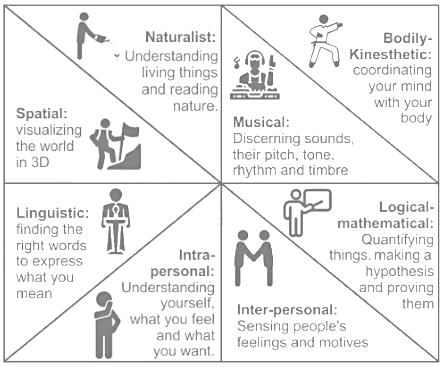
A type of intelligence that is most visible in dancers, athletes, surgeons, etc., is known as 'Bodily-kinesthetic intelligence' as the individual who possesses 'Bodily Kinaesthetic Intelligence' can:
- co-ordinate their mind with their body.
- use one's whole body to solve problems.
- perform physical activities in a skilled way.
Hence, it could be concluded that a 'Mayank is a champion tennis player' reflects the 'Bodily-kinesthetic intelligence'.
Additional Information
Refer to the diagram to know all the eight categories of intelligence suggested by Howard Gardner:
The view which conceptualizes intelligence in terms of operations, contents and products is known as- a)systems model
- b)structure of intellect
- c)hierarchical model
- d)G factor model
Correct answer is option 'B'. Can you explain this answer?
a)
systems model
b)
structure of intellect
c)
hierarchical model
d)
G factor model
 | TeamUnknown answered |
Intelligence refers to the
capacity to acquire and apply knowledge
. It is the ability to solve problems, learn from experiences, and apply knowledge to deal with new situations.- There are many theories related to intelligence. These theories are propounded by eminent psychologists to provide a framework to understanddifferent aspects of human intelligence.
Important Points
Three-dimensional Model of Intelligence
- J. P. Guilforddeveloped theThree-dimensional Modelor Structure of Intellect Model as a way of organizing intellectual factors into a system.
- The model is three-dimensional, and dimensions areOperationcategories,ContentCategories, andProductcategories.
- According to this theory, There are
- 6 kinds of operations(cognition, memory recording, memory retention, divergent production, convergent production, evaluation),
- 6 kinds of products(units, classes, relations, systems, transformations, and implications), and
- 5 kinds of content(visual, auditory, symbolic, semantic, behavioral).
- Each of these dimensions is independent,there are theoretically 180 different components of intelligence.
- Guilford researched and developed a wide variety of psychometric tests to measure the specific abilities predicted by SI theory.
- These tests provide an operational definition of the many abilities proposed by the theory. Furthermore, factor analysis was used to determine which tests appeared to measure the same or different abilities.
Hence, it is clear that the view which conceptualizes intelligence in terms of operations, contents, and products is known as a structure of intellect.
Additional Information
- Systems models may produce valid dynamic responses to times series inputs from a Phase One database but may be found to generate obviously invalid responses to other inputs. This suggests further tests: perturbation of one or more input series.
- A hierarchical model is a model in which lower levels are sorted under a hierarchy of successively higher-level units.
- G-Factor model containers the abilities of general intelligence.
Mr. Richard attended an intelligence test wherein he excelled in mechanical, verbal, spatial and numerical skills. His reasoning skills were applauded. Which intelligence, according to Spearman influences all the specific abilities?- a)Fluid
- b)Crystallized
- c)General
- d)Practical
Correct answer is option 'C'. Can you explain this answer?
Mr. Richard attended an intelligence test wherein he excelled in mechanical, verbal, spatial and numerical skills. His reasoning skills were applauded. Which intelligence, according to Spearman influences all the specific abilities?
a)
Fluid
b)
Crystallized
c)
General
d)
Practical
| | Ritesh Kumar Shivhare answered |
Two-factor theory: In 1927, Charles Spearman proposed a two-factor theory of intelligence employing a statistical method called factor analysis.
Key Points
He showed that intelligence consisted of a general factor (g-factor) and some specific factors (s-factors).
- Charles Spearman developed a statistical tool called factor analysis.
- In factor analysis, all the variables related are tested for correlation.
- Spearman tested people and their performances in given various tasks related to intelligence.
- Such tasks were related to spatial, verbal, numerical, and mechanical abilities.
- He discovered that one who scored well in one task often did well in other areas too.
- Thus, according to Spearman one general intelligence factor influences all other cognitive abilities.
Hence, we conclude that according to Spearman, general intelligence influences all specific abilities.
Chapter doubts & questions for Construct of Intelligence and Multi-Dimensional Intelligence - 2 Months Preparation for CTET Paper 2 2026 is part of CTET & State TET exam preparation. The chapters have been prepared according to the CTET & State TET exam syllabus. The Chapter doubts & questions, notes, tests & MCQs are made for CTET & State TET 2026 Exam. Find important definitions, questions, notes, meanings, examples, exercises, MCQs and online tests here.
Chapter doubts & questions of Construct of Intelligence and Multi-Dimensional Intelligence - 2 Months Preparation for CTET Paper 2 in English & Hindi are available as part of CTET & State TET exam. Download more important topics, notes, lectures and mock test series for CTET & State TET Exam by signing up for free.
2 Months Preparation for CTET Paper 2367 videos|1021 docs|335 tests |
