


All Exams > CTET & State TET > 2 Months Preparation for CTET Paper 2 > All Questions
All questions of Algebra for CTET & State TET Exam
What is the value of 225 + 225?- a)226
- b)250
- c)425
- d)450
- e)2625
Correct answer is option 'A'. Can you explain this answer?
What is the value of 225 + 225?
a)
226
b)
250
c)
425
d)
4
50
e)
2625
 | Anihegde1502 answered |
Take 2raise to25 common thjs ib bracket there will be (1+1)i.e 2raise to25 *2 thus power will get add 25+1 i.e 26 hence ans is option A

If ‘x’ and ‘y’ are non-negative integers, what is the value of x + y?(1) x4 is even, where x is a prime number.(2) xy is odd.- a)Statement (1) ALONE is sufficient, but statement (2) alone is not sufficient.
- b)Statement (2) ALONE is sufficient, but statement (1) alone is not sufficient.
- c)BOTH statements TOGETHER are sufficient, but NEITHER statement ALONE is sufficient.
- d)EACH statement ALONE is sufficient.
- e)Statements (1) and (2) TOGETHER are NOT sufficient.
Correct answer is option 'C'. Can you explain this answer?
If ‘x’ and ‘y’ are non-negative integers, what is the value of x + y?
(1) x4 is even, where x is a prime number.
(2) xy is odd.
a)
Statement (1) ALONE is sufficient, but statement (2) alone is not sufficient.
b)
Statement (2) ALONE is sufficient, but statement (1) alone is not sufficient.
c)
BOTH statements TOGETHER are sufficient, but NEITHER statement ALONE is sufficient.
d)
EACH statement ALONE is sufficient.
e)
Statements (1) and (2) TOGETHER are NOT sufficient.
 | BT Educators answered |
(1) x = 2, y is unknown. Insufficient
(2) x and y unknown. Insufficient
(1)+(2) only possibility x=2, y=0; Sufficient
C is correct
(2) x and y unknown. Insufficient
(1)+(2) only possibility x=2, y=0; Sufficient
C is correct
If a, b and x are integers such that 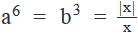 , what is the value of a - b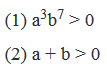
- a)Statement (1) ALONE is sufficient, but statement (2) alone is not sufficient to answer the question asked.
- b)Statement (2) ALONE is sufficient, but statement (1) alone is not sufficient to answer the question asked.
- c)BOTH statements (1) and (2) TOGETHER are sufficient to answer the question asked, but NEITHER statement ALONE is sufficient to answer the question asked.
- d)EACH statement ALONE is sufficient to answer the question asked.
- e)Statements (1) and (2) TOGETHER are NOT sufficient to answer the question asked, and additional data specific to the problem are needed.
Correct answer is option 'D'. Can you explain this answer?
If a, b and x are integers such that , what is the value of a - b
, what is the value of a - ba)
Statement (1) ALONE is sufficient, but statement (2) alone is not sufficient to answer the question asked.
b)
Statement (2) ALONE is sufficient, but statement (1) alone is not sufficient to answer the question asked.
c)
BOTH statements (1) and (2) TOGETHER are sufficient to answer the question asked, but NEITHER statement ALONE is sufficient to answer the question asked.
d)
EACH statement ALONE is sufficient to answer the question asked.
e)
Statements (1) and (2) TOGETHER are NOT sufficient to answer the question asked, and additional data specific to the problem are needed.
 | Anaya Patel answered |
Steps 1 & 2: Understand Question and Draw Inferences
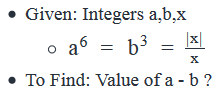
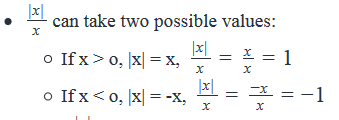
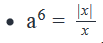
- As a6 is always positive,a6 = 1, i.e. a = 1 or -1
- So, we can reject the value of

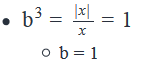 Possible values of a – b
 - If a = 1 and b = 1, a – b = 0
- If a = -1 and b = 1, a- b = -2
- So, we need to find the unique value of a to find the value of a – b.Step 3: Analyze Statement 1 independently(1) a3 b7 > 0
- Rewriting a3b7 as ab(a2b6)
- Therefore, ab(a2b6)>0
- We know that a2b6 is always > 0 (even power of any number is always positive)
- So, for ab(a2b6)> 0
- ab > 0
- This tells us that a and b have same signs.
- Since b > 0, therefore a will also be greater than 0, so the value of a = 1.
- a – b = 1 -1 = 0
- Sufficient to answerStep 4: Analyze Statement 2 independently(2) a + b > 0
- If a = 1 and b = 1, a + b = 2 > 0
- If a = -1 and b = 1, a + b = 0, is not greater than zero
- Hence, we have a unique answer, where a =1 and b = 1Thus a – b = 1 – 1 = 0.Sufficient to answer.Step 5: Analyze Both Statements Together (if needed)As we have a unique answer from steps 3 and 4, this step is not required.Answer: D
James deposited $1,000 each in two investment schemes X and Y. Scheme X doubles the invested amount every 7 years and scheme Y doubles the invested amount every 14 years. If James withdraws $500 from scheme X at the end of every 7th year, how many years will it take for the total amount invested in schemes X and Y to amount more than $40,000?- a)14
- b)28
- c)42
- d)56
- e)70
Correct answer is option 'C'. Can you explain this answer?
James deposited $1,000 each in two investment schemes X and Y. Scheme X doubles the invested amount every 7 years and scheme Y doubles the invested amount every 14 years. If James withdraws $500 from scheme X at the end of every 7th year, how many years will it take for the total amount invested in schemes X and Y to amount more than $40,000?
a)
14
b)
28
c)
42
d)
56
e)
70
 | Wizius Careers answered |
Given
- Scheme X doubles the invested amount every 7 years
- James deposited $1000 in scheme X
- James withdraws $500 from scheme X after the end of every 7 years
- Scheme Y doubles the invested amount after every 14 years
- James deposited $1,000 in scheme Y
To Find: Number of years it will take total amount deposited in schemes X and Y to grow to > $40,000?
Approach
- For finding the number of years it will take the deposits in schemes X and Y to grow to more than $40,000, we need to find the amount in both the schemes X and Y after every 7 years.(As amount in scheme X doubles after every 7 years, we will need to calculate the amount at the end of every 7 years and not at the end of 14 years).
- Scheme X
- As the amount invested in scheme X doubles every 7 years, we will need to calculate the amount in scheme X after every interval of 7 years
- However, we will need to make sure that we subtract $500 at each interval of 7 years from the final amount
- Scheme Y
- As the amount invested in scheme Y doubles after every 14 years, we will need to calculate the amount in scheme Y after every interval of 14 years.
- At each interval, we will calculate the sum of amounts in scheme X and Y to check if it exceeds $40,000.
Working Out

- Amount at the end of year 7 in scheme X = $1000 * 2 = $2000
- However James withdrew $500 at the end of 7th year, So, the amount remaining will be $2000 – $500 = $1500
- The same logic has been applied in calculating the amounts at the end of every 7 year interval
- Amount at the end of year 14 in scheme Y = $1000 * 2 = $2000
- The same logic has been applied in calculating the amounts at the end of every 14 years interval.
- The same logic has been applied in calculating the amounts at the end of every 14 years interval.
- We can see that the total amount in schemes X and Y exceed $40,000 by the end of the year 42.
Answer: C
If Z is a positive integer such that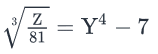
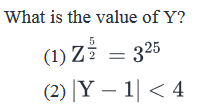
- a)Statement (1) ALONE is sufficient, but statement (2) alone is not sufficient to answer the question asked.
- b)Statement (2) ALONE is sufficient, but statement (1) alone is not sufficient to answer the question asked.
- c)BOTH statements (1) and (2) TOGETHER are sufficient to answer the question asked, but NEITHER statement ALONE is sufficient to answer the question asked.
- d)EACH statement ALONE is sufficient to answer the question asked.
- e)Statements (1) and (2) TOGETHER are NOT sufficient to answer the question asked, and additional data specific to the problem are needed.
Correct answer is option 'E'. Can you explain this answer?
If Z is a positive integer such that
a)
Statement (1) ALONE is sufficient, but statement (2) alone is not sufficient to answer the question asked.
b)
Statement (2) ALONE is sufficient, but statement (1) alone is not sufficient to answer the question asked.
c)
BOTH statements (1) and (2) TOGETHER are sufficient to answer the question asked, but NEITHER statement ALONE is sufficient to answer the question asked.
d)
EACH statement ALONE is sufficient to answer the question asked.
e)
Statements (1) and (2) TOGETHER are NOT sufficient to answer the question asked, and additional data specific to the problem are needed.
 | Meera Rana answered |
Steps 1 & 2: Understand Question and Draw Inferences
Given:
- Z is a positive integer
- Z = 81(Y4 – 7)3 . . . (1)
We need to find the value of Y.
Step 3: Analyze Statement 1 independently
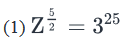
- Squaring both sides:
- Z5 = 350
- Taking 5th root on both sides:
- Z = 310 . . . (2)
- Put (2) in (1):
- 310 = 34(Y4 – 7)3
- 36 = (Y4 – 7)3
- Taking the cube-root on both sides:
- 32 = Y4 – 7
- Y4 = 9 + 7 = 16
- Y4 = 24 = (-2)4
- Y = 2 or -2
Not sufficient to determine a unique value of Y.
Step 4: Analyze Statement 2 independently
(2) |Y-1| < 4
- Distance of Y from 1 on the number line is less than 4 units

- -3 < Y < 5
Multiple values of Y possible. Not sufficient.
Step 5: Analyze Both Statements Together (if needed)
- From St. 1, Y = 2 or – 2
- From St. 2, -3 < Y < 5
- This inequality is satisfied by both 2 and -2
So, even after combining both statements, we have 2 possible values of Y
Since we couldn’t find a unique value of Y, the correct answer. Is Option E.
In a Country X, temperature decrease (in degrees) is linearly related to percentage increase in sale of water heaters and is given by the relation:ΔT= ky+5 Where,ΔT is temperature decrease (in degrees).y is the increase in sale of water heaters (in percentage).K is a constant.A temperature decrease of 10 degrees results in a 1% increase in sale of water heaters. What would be the percentage increase in sale of water heaters when temperature decreases by 15 degrees?- a)1.5%
- b)2%
- c)2.5%
- d)3%
- e)3.5%
Correct answer is option 'B'. Can you explain this answer?
In a Country X, temperature decrease (in degrees) is linearly related to percentage increase in sale of water heaters and is given by the relation:
ΔT= ky+5
Where,
ΔT is temperature decrease (in degrees).
y is the increase in sale of water heaters (in percentage).
K is a constant.
A temperature decrease of 10 degrees results in a 1% increase in sale of water heaters. What would be the percentage increase in sale of water heaters when temperature decreases by 15 degrees?
a)
1.5%
b)
2%
c)
2.5%
d)
3%
e)
3.5%
 | Tushar Ghosh answered |
∆T=ky+5;
given: ∆T=10
y=1
therefore: 10= k(1) +5
=> k= 10-5=5
having determined value of k=5, we add new values as
∆T=15
k=5
y=?
thus, 15=5y+5
or, 5y=15-5
5y=10
y=2
since y is the value in percentage of increase in sale of water heater, therefore, the percentage of increase in water heater is 2%.
given: ∆T=10
y=1
therefore: 10= k(1) +5
=> k= 10-5=5
having determined value of k=5, we add new values as
∆T=15
k=5
y=?
thus, 15=5y+5
or, 5y=15-5
5y=10
y=2
since y is the value in percentage of increase in sale of water heater, therefore, the percentage of increase in water heater is 2%.
-2x - ky -9 = 04x – 10y + 18 = 0What is the value of k if the system of linear equations shown above has infinite solutions?- a)-5
- b)-1
- c)1
- d)3
- e)5
Correct answer is option 'A'. Can you explain this answer?
-2x - ky -9 = 0
4x – 10y + 18 = 0
What is the value of k if the system of linear equations shown above has infinite solutions?
a)
-5
b)
-1
c)
1
d)
3
e)
5
 | Siddharth Pillai answered |
Given equations,
-2x - ky -9 = 0 .. (a)
4x – 10y + 18 = 0 .. (b)
Multiply the equation (a) with 2 and add it to equation (b), we get
⇒ -4x - 2ky - 18 +4x - 10y + 18 = 0
⇒ -2ky -10y = 0
⇒ -2ky = 10y
⇒ -2k = 10
⇒ k = -5
Find the value of z such that 2(z-1)3 + 6(1-z)3 = 32?- a)-2
- b)-1
- c)0
- d)1
- e)2
Correct answer is option 'B'. Can you explain this answer?
Find the value of z such that 2(z-1)3 + 6(1-z)3 = 32?
a)
-2
b)
-1
c)
0
d)
1
e)
2
 | Yash Patel answered |
⇒ 2(z-1)3 + 6(1-z)3 = 32
⇒ 2 [ z3 -1 - 3z(z-1) ] + 6 [1 - z3 - 3z(1-z)] = 32
⇒ 2 [ z3 - 1 -3z2 + 3z ] + 6 [ 1 - z3 -3z + 3z2 ] = 32
⇒ 2z3 - 2 - 6z2 + 6z + 6 - 6z3 -18z2 + 18z = 32
⇒ -4z3 + 12z2 - 12z + 4 = 32
Substract 32 from both sides we get,
⇒ -4z3 + 12z2 - 12z + 4 - 32 = 32 - 32
⇒ -4z3 + 12z2 - 12z - 28 = 0
⇒ -4( z + 1 )( z2 - 4z -7) = 0
⇒ ( z + 1 )( z2 - 4z -7) = 0
Then,
( z + 1 ) = 0
z = -1
or
( z2 - 4z -7) = 0
z = 2 + √3i, 2 - √3i
Find the value of 
- a)1/256
- b)1/128
- c)1/64
- d)1/32
- e)1/16
Correct answer is option 'B'. Can you explain this answer?
Find the value of
a)
1/256
b)
1/128
c)
1/64
d)
1/32
e)
1/16
 | Catalyst Learningacademy answered |
We want to evaluate:
(2-3 + 2-5) / (22 + 24).
Step 1. Compute the numerator: 2-3 = 1 / 23 = 1 / 8
2-5 = 1 / 25 = 1 / 32
2-5 = 1 / 25 = 1 / 32
Hence, 2-3 + 2-5 = (1/8) + (1/32) = (4/32) + (1/32) = 5/32.
Step 2. Compute the denominator: 22 = 4
24 = 16
So, 22 + 24 = 4 + 16 = 20.
24 = 16
So, 22 + 24 = 4 + 16 = 20.
Step 3. Combine numerator and denominator: (5/32) / 20 = (5/32) × (1/20) = 5 / (32 × 20) = 5/640 = 1/128.
Thus, the value of the given expression is 1/128.
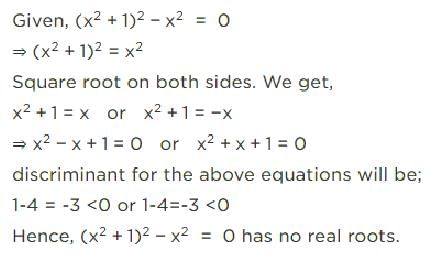
If n is a positive integer greater than 2, what is the greatest prime factor of 3n + 3n + 3n – 3n-2?- a)3
- b)5
- c)7
- d)11
- e)13
Correct answer is option 'E'. Can you explain this answer?
If n is a positive integer greater than 2, what is the greatest prime factor of 3n + 3n + 3n – 3n-2?
a)
3
b)
5
c)
7
d)
11
e)
13
 | Arnab Kumar answered |
Solution:
Firstly, we can simplify the given expression by combining the exponents:
3n 3n 3n 3n-2 = 33n-2 * 33n = 36n
Now, to find the greatest prime factor of 36n, we can factorize it into prime factors:
36n = 2^2 * 3^2 * n
The greatest prime factor of 36n would be the largest prime factor of n. Since n is greater than 2, we know that it is either a prime number or a composite number with prime factors.
To find the greatest prime factor of n, we can start by dividing n by 2 repeatedly until we get an odd number. For example, if n is 60, we can divide it by 2 three times to get 15:
60 ÷ 2 = 30
30 ÷ 2 = 15
Now, we can check if 15 is a prime number or if it has any other prime factors. We can do this by dividing 15 by the smallest prime numbers, which are 2, 3, 5, 7, 11, 13, etc.
15 ÷ 3 = 5
Since 5 is a prime number, it is the greatest prime factor of n. Therefore, the greatest prime factor of 36n is 13, which is the largest prime factor of 3.
Firstly, we can simplify the given expression by combining the exponents:
3n 3n 3n 3n-2 = 33n-2 * 33n = 36n
Now, to find the greatest prime factor of 36n, we can factorize it into prime factors:
36n = 2^2 * 3^2 * n
The greatest prime factor of 36n would be the largest prime factor of n. Since n is greater than 2, we know that it is either a prime number or a composite number with prime factors.
To find the greatest prime factor of n, we can start by dividing n by 2 repeatedly until we get an odd number. For example, if n is 60, we can divide it by 2 three times to get 15:
60 ÷ 2 = 30
30 ÷ 2 = 15
Now, we can check if 15 is a prime number or if it has any other prime factors. We can do this by dividing 15 by the smallest prime numbers, which are 2, 3, 5, 7, 11, 13, etc.
15 ÷ 3 = 5
Since 5 is a prime number, it is the greatest prime factor of n. Therefore, the greatest prime factor of 36n is 13, which is the largest prime factor of 3.
Mike visits his childhood friend Alan at a regular interval of 4 months. For example, if Mike visits Alan on 1st Jan, his next visit would be on 1st May and so on. He started this routine on his 25th birthday. Yesterday, he celebrated his Nth birthday. How many visits has Mike made so far (including the first visit on his 25th birthday)?- a)n – 24
- b)2n – 50
- c)2n – 49
- d)3n – 75
- e)3n – 74
Correct answer is option 'E'. Can you explain this answer?
Mike visits his childhood friend Alan at a regular interval of 4 months. For example, if Mike visits Alan on 1st Jan, his next visit would be on 1st May and so on. He started this routine on his 25th birthday. Yesterday, he celebrated his Nth birthday. How many visits has Mike made so far (including the first visit on his 25th birthday)?
a)
n – 24
b)
2n – 50
c)
2n – 49
d)
3n – 75
e)
3n – 74
| | Aisha Gupta answered |
In a period of 1 year, Mike visits Alan 3 times (12 months divided by 4). However this excludes the first time visit and takes into consideration the subsequent visits only. So starting on his 25th birthday, Mike will visit Alan 3(n-25) times up till his nth birthday. However we have to add the first visit as well. So the final answer would be 3n-74 .
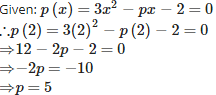

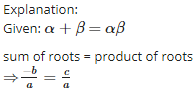

Find the value of n that satisfies the equation 2(-3)4n = 18(27)n+2- a)3
- b)4
- c)6
- d)8
- e)22
Correct answer is option 'D'. Can you explain this answer?
Find the value of n that satisfies the equation 2(-3)4n = 18(27)n+2
a)
3
b)
4
c)
6
d)
8
e)
22
| | Mrinalini Dasgupta answered |
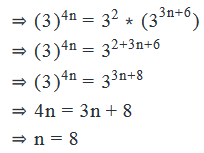
We need to find the value of n, given 2(−34n)=18(27)n+2

(Cancelling 2 on both sides. Also making use of the fact that 32k = (-3)2k)
Find the value of positive integer P that lies between 1 and 30 and is a perfect square.(1) P has at least one Prime factor(2) The cube of P is less than 300- a)Statement (1) ALONE is sufficient, but statement (2) alone is not sufficient.
- b)Statement (2) ALONE is sufficient, but statement (1) alone is not sufficient.
- c)BOTH statements TOGETHER are sufficient, but NEITHER statement ALONE is sufficient.
- d)EACH statement ALONE is sufficient.
- e)Statements (1) and (2) TOGETHER are NOT sufficient.
Correct answer is option 'B'. Can you explain this answer?
Find the value of positive integer P that lies between 1 and 30 and is a perfect square.
(1) P has at least one Prime factor
(2) The cube of P is less than 300
a)
Statement (1) ALONE is sufficient, but statement (2) alone is not sufficient.
b)
Statement (2) ALONE is sufficient, but statement (1) alone is not sufficient.
c)
BOTH statements TOGETHER are sufficient, but NEITHER statement ALONE is sufficient.
d)
EACH statement ALONE is sufficient.
e)
Statements (1) and (2) TOGETHER are NOT sufficient.
| | Saumya Shah answered |
Statement (1) ALONE is sufficient, but statement (2) alone is not sufficient.
Statement (1): P has at least one Prime factor
This statement tells us that P has at least one prime factor. Since a perfect square is a number that can be expressed as the product of two equal integers, we can conclude that P must have at least one prime factor that repeats.
To find a perfect square between 1 and 30, we can list the squares of all the positive integers less than or equal to the square root of 30 (which is approximately 5.5). The perfect squares between 1 and 30 are: 1, 4, 9, 16, and 25.
From this list, we can see that all the perfect squares have at least one prime factor. Therefore, statement (1) alone is sufficient to find the value of P.
Statement (2) ALONE is not sufficient.
Statement (2): The cube of P is less than 300
This statement tells us that the cube of P is less than 300. However, it does not provide any information about the prime factors or whether P is a perfect square.
Let's analyze the possible values of P using statement (2):
- If P is 1, 1^3 = 1, which is less than 300.
- If P is 2, 2^3 = 8, which is less than 300.
- If P is 3, 3^3 = 27, which is less than 300.
- If P is 4, 4^3 = 64, which is less than 300.
- If P is 5, 5^3 = 125, which is less than 300.
- If P is 6, 6^3 = 216, which is less than 300.
From this analysis, we can see that there are multiple possible values of P that satisfy statement (2), and not all of them are perfect squares. Therefore, statement (2) alone is not sufficient to find the value of P.
Conclusion:
Statement (1) alone is sufficient to find the value of P, as all the perfect squares between 1 and 30 have at least one prime factor. However, statement (2) alone is not sufficient, as it does not provide any information about the prime factors or whether P is a perfect square. Therefore, the correct answer is option (a) Statement (1) ALONE is sufficient, but statement (2) alone is not sufficient.
Statement (1): P has at least one Prime factor
This statement tells us that P has at least one prime factor. Since a perfect square is a number that can be expressed as the product of two equal integers, we can conclude that P must have at least one prime factor that repeats.
To find a perfect square between 1 and 30, we can list the squares of all the positive integers less than or equal to the square root of 30 (which is approximately 5.5). The perfect squares between 1 and 30 are: 1, 4, 9, 16, and 25.
From this list, we can see that all the perfect squares have at least one prime factor. Therefore, statement (1) alone is sufficient to find the value of P.
Statement (2) ALONE is not sufficient.
Statement (2): The cube of P is less than 300
This statement tells us that the cube of P is less than 300. However, it does not provide any information about the prime factors or whether P is a perfect square.
Let's analyze the possible values of P using statement (2):
- If P is 1, 1^3 = 1, which is less than 300.
- If P is 2, 2^3 = 8, which is less than 300.
- If P is 3, 3^3 = 27, which is less than 300.
- If P is 4, 4^3 = 64, which is less than 300.
- If P is 5, 5^3 = 125, which is less than 300.
- If P is 6, 6^3 = 216, which is less than 300.
From this analysis, we can see that there are multiple possible values of P that satisfy statement (2), and not all of them are perfect squares. Therefore, statement (2) alone is not sufficient to find the value of P.
Conclusion:
Statement (1) alone is sufficient to find the value of P, as all the perfect squares between 1 and 30 have at least one prime factor. However, statement (2) alone is not sufficient, as it does not provide any information about the prime factors or whether P is a perfect square. Therefore, the correct answer is option (a) Statement (1) ALONE is sufficient, but statement (2) alone is not sufficient.
Which of the following equations has the set of all real numbers as its solution set?- a) 3(N+4)+5N=8(N+3)
- b) 4(N+4)+4N=8(N+3)
- c) 2(N+4)+6N=8(N+3)
- d) 6(N+4)+2N=8(N+3)
- e) 5(N+4)+3N=8(N+3)
Correct answer is option 'D'. Can you explain this answer?
Which of the following equations has the set of all real numbers as its solution set?
a)
3(N+4)+5N=8(N+3)
b)
4(N+4)+4N=8(N+3)
c)
2(N+4)+6N=8(N+3)
d)
6(N+4)+2N=8(N+3)
e)
5(N+4)+3N=8(N+3)
| | Saumya Sharma answered |
The right side of each equation is 8(N+3), which simplifies by way of distribution to
8(N+3)=8⋅N+8⋅3=8N+24
If the left side of the equation simplifies to an identical expression, the equation has all real numbers as its solutions.
We test the left side of each equation:
2(N+4)+6N=8(N+3)
2(N+4)+6N=2⋅N+2⋅4+6N=2N+8+6N=8N+8
2(N+4)+6N=2⋅N+2⋅4+6N=2N+8+6N=8N+8
3(N+4)+5N=8(N+3)
3(N+4)+5N=3⋅N+3⋅4+5N=3N+12+5N=8N+12
4(N+4)+4N=8(N+3)
4(N+4)+4N=4⋅N+4⋅4+4N=4N+16+4N=8N+16
5(N+4)+3N=8(N+3)
5(N+4)+3N=5⋅N+5⋅4+3N=5N+20+3N=8N+20
6(N+4)+2N=8(N+3)
6(N+4)+2N=6⋅N+6⋅4+2N=6N+24+2N=8N+24
Of the given choices,
6(N+4)+2N=8(N+3)
can be rewritten as
8N+24=8N+24,
which is an identity and has the set of all real numbers as its solution set.
The angry Arjun carried some arrows for fighting with Bheeshma. With half the arrows, he cut down the arrows thrown by Bheeshma on him and with six other arrows he killed the rath driver of Bheeshma. With one arrow each he knocked down respectively the rath, flag and bow of Bheeshma. Finally with one more than four times the square root of arrows he laid Bheeshma unconscious on an arrow bed. The total number of arrows that Arjun had is- a)80
- b)100
- c)96
- d)120
Correct answer is option 'B'. Can you explain this answer?
The angry Arjun carried some arrows for fighting with Bheeshma. With half the arrows, he cut down the arrows thrown by Bheeshma on him and with six other arrows he killed the rath driver of Bheeshma. With one arrow each he knocked down respectively the rath, flag and bow of Bheeshma. Finally with one more than four times the square root of arrows he laid Bheeshma unconscious on an arrow bed. The total number of arrows that Arjun had is
a)
80
b)
100
c)
96
d)
120
| | Prateek Gupta answered |
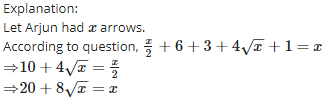
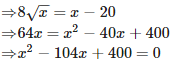
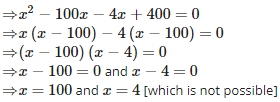
Therefore, Arjun had 100 arrows.
Simplify the following expression.(4x + 1)2 − (4x + 3) (4x − 1)- a)(4x + 1)
- b)4
- c)(4x − 3)
- d)4x
Correct answer is option 'B'. Can you explain this answer?
Simplify the following expression.
(4x + 1)2 − (4x + 3) (4x − 1)
a)
(4x + 1)
b)
4
c)
(4x − 3)
d)
4x
 | Om Mehta answered |
Simplifying the Expression
To simplify the expression (4x + 1)² − (4x + 3)(4x − 1), we will break it down step by step.
Step 1: Expand the first term
- The expression (4x + 1)² can be expanded using the formula (a + b)² = a² + 2ab + b².
- Here, a = 4x and b = 1. Therefore:
- (4x)² = 16x²
- 2(4x)(1) = 8x
- 1² = 1
- Thus, (4x + 1)² = 16x² + 8x + 1.
Step 2: Expand the second term
- The expression (4x + 3)(4x − 1) uses the distributive property (FOIL method).
- First: (4x)(4x) = 16x²
- Outside: (4x)(-1) = -4x
- Inside: (3)(4x) = 12x
- Last: (3)(-1) = -3
- Combining these gives: 16x² + 8x - 3.
Step 3: Combine both parts
- Now substitute back into the main expression:
- (16x² + 8x + 1) - (16x² + 8x - 3)
- Distributing the negative sign:
- 16x² + 8x + 1 - 16x² - 8x + 3
Step 4: Simplify
- The 16x² and -16x² cancel out.
- The 8x and -8x also cancel out.
- This leaves us with: 1 + 3 = 4.
Conclusion
The simplified expression is 4, which corresponds to option 'B'.
To simplify the expression (4x + 1)² − (4x + 3)(4x − 1), we will break it down step by step.
Step 1: Expand the first term
- The expression (4x + 1)² can be expanded using the formula (a + b)² = a² + 2ab + b².
- Here, a = 4x and b = 1. Therefore:
- (4x)² = 16x²
- 2(4x)(1) = 8x
- 1² = 1
- Thus, (4x + 1)² = 16x² + 8x + 1.
Step 2: Expand the second term
- The expression (4x + 3)(4x − 1) uses the distributive property (FOIL method).
- First: (4x)(4x) = 16x²
- Outside: (4x)(-1) = -4x
- Inside: (3)(4x) = 12x
- Last: (3)(-1) = -3
- Combining these gives: 16x² + 8x - 3.
Step 3: Combine both parts
- Now substitute back into the main expression:
- (16x² + 8x + 1) - (16x² + 8x - 3)
- Distributing the negative sign:
- 16x² + 8x + 1 - 16x² - 8x + 3
Step 4: Simplify
- The 16x² and -16x² cancel out.
- The 8x and -8x also cancel out.
- This leaves us with: 1 + 3 = 4.
Conclusion
The simplified expression is 4, which corresponds to option 'B'.
In a cricket match Kumble took three wickets less than twice the number of wickets taken by Srinath. The product of the number of wickets taken by these two is 20, then the number of wickets taken by Kumble is- a)2
- b)4
- c)10
- d)5
Correct answer is option 'D'. Can you explain this answer?
In a cricket match Kumble took three wickets less than twice the number of wickets taken by Srinath. The product of the number of wickets taken by these two is 20, then the number of wickets taken by Kumble is
a)
2
b)
4
c)
10
d)
5
| | Prateek Gupta answered |
Explanation:
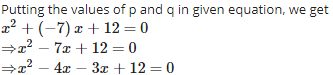
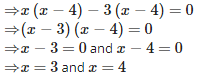
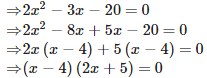
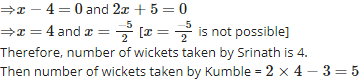
Let the number of wickets taken by Srinath be x then the number of wickets taken by Kumble will be 2x−3
According to question, x(2x−3)=20
According to question, x(2x−3)=20
If (d + e + f) = 14, (d2 + e2 + f2) = 96, then find the value of (de + ef + fd).- a)75
- b)25
- c)50
- d)100
Correct answer is option 'C'. Can you explain this answer?
a)
75
b)
25
c)
50
d)
100
 | Qudrat Chauhan answered |
Given:
(d + e + f) = 14
(d
2
+ e2
+ f2
) = 96Formula Used:
(a + b + c)2 = 2 ×
(ab + bc + ca) +a
2
+ b
2
+ c
2
Calculation:
⇒ (d + e + f)
2
= 2 × (de + ef + fd) +d
2
+ e
2
+ f
2
⇒ ( 14)2 =
2×
(de + ef + fd) + 96
⇒ 2 ×
(de + ef + fd) = 196 - 96 = 100
⇒ (de + ef + fd) = 100/2 = 50
∴ The value of (de + ef + fd) is 50.
What is the maximum possible power of 4 in the number that is obtained when the product of the first 15 positive integers is subtracted from the product of the first 20 positive integers?- a)0
- b)3
- c)5
- d)7
- e)8
Correct answer is option 'C'. Can you explain this answer?
What is the maximum possible power of 4 in the number that is obtained when the product of the first 15 positive integers is subtracted from the product of the first 20 positive integers?
a)
0
b)
3
c)
5
d)
7
e)
8
| | Sahana Mehta answered |
Given
- Product of first 15 positive integers = 1*2*3…….* 15 = 15!
- Product of first 20 positive integers = 1*2*3*…….* 20 = 20!
- So, we can write 20! = 15! * 16 * 17 * 18 * 19 * 20
To Find: Maximum power of 4 that divides (20! – 15!)
Approach
- We will first need to simplify the expression 20! – 15!
- We know that 20! = 15! * 16 * 17 * 18 * 19 * 20
- So, 20! – 15! = 15! (20*19*18….*16 – 1) = 15! * odd integer
- Since 20 *19*…..16 is even, and 1 is odd, 20*19*……16 -1 will be odd
- Therefore, we only need to find the maximum power of 4 that divides 15!
2. To find the maximum power of 4 in 15!, we will first need to find the maximum power of 2 in 15!, as 4 = 22
- Let’s take a simple example to understand how we can find this. Consider a number p = 1*2*3*4. We need to find the power of 2 in p.
- Now, powers of 2 will occur in multiples of 2. So, we should first find the multiples of 2 in p. They are 2 and 4. However all multiples of 2 will not contain only 21. Some of them may contain higher powers of 2. For example, here 4 contains 22.
- So, when we are finding multiples of 2, we should also find the multiples of higher powers of 2 in p.
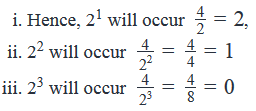
- Hence, 2 will occur 2 + 1 = 3 times in p.
3. We will use the same logic to find out the power of 2 in 15!
- Once we know the power of 2 in 15!, we can find the power of 4 in 15!
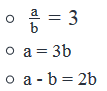
Working Out

Simplify,- a)x2- 2x + 1
- b)x2+ 2x + 2
- c)x2+ 2x + 1
- d)x2+ x + 1
Correct answer is option 'C'. Can you explain this answer?
Simplify,
a)
x2- 2x + 1
b)
x
2
+ 2x + 2c)
x
2
+ 2x + 1d)
x
2
+ x + 1  | Anagha Datta answered |
Explanation:
- To simplify the given expression x^4 - 2x^2 + x^2 - 2x + 1, we can combine like terms.
Combine like terms:
- Combine the terms with the same variable and exponent:
x^4 - 2x^2 + x^2 - 2x + 1
= x^4 - 2x^2 + 1x^2 - 2x + 1
- Combine the x^2 terms:
= x^4 - x^2 - 2x + 1
- The simplified expression is x^4 - x^2 - 2x + 1, which can be further simplified to:
= x^2 + 2x + 1
Therefore, the simplified form of the expression x^4 - 2x^2 + x^2 - 2x + 1 is x^2 + 2x + 1.
- To simplify the given expression x^4 - 2x^2 + x^2 - 2x + 1, we can combine like terms.
Combine like terms:
- Combine the terms with the same variable and exponent:
x^4 - 2x^2 + x^2 - 2x + 1
= x^4 - 2x^2 + 1x^2 - 2x + 1
- Combine the x^2 terms:
= x^4 - x^2 - 2x + 1
- The simplified expression is x^4 - x^2 - 2x + 1, which can be further simplified to:
= x^2 + 2x + 1
Therefore, the simplified form of the expression x^4 - 2x^2 + x^2 - 2x + 1 is x^2 + 2x + 1.
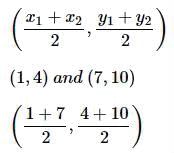

Find the solution to the system of linear equations: x – 2y + 6 =04y -2x -14 =0- a)(0, -3)
- b)(-1, 3)
- c)(2, 4)
- d)(-7, 0)
- e)No unique solution
Correct answer is option 'E'. Can you explain this answer?
Find the solution to the system of linear equations:
x – 2y + 6 =0
4y -2x -14 =0
a)
(0, -3)
b)
(-1, 3)
c)
(2, 4)
d)
(-7, 0)
e)
No unique solution
| | Ananya Iyer answered |
Given equations,
x – 2y + 6 =0 ..(a)
4y -2x -14 =0 ..(b)
Multiply the equation a with 2 and add the equation to b , we get
⇒ 2x - 4y + 12 + 4y - 2x -14 = 0
⇒ -2 = 0
Hence the equation is non unique equation
What is the value of (27x3 - 58x2y + 31xy2 - 8y3), when x = -5 and y = -7?- a)1924
- b)-1924
- c)-1926
- d)1926
Correct answer is option 'A'. Can you explain this answer?
a)
1924
b)
-1924
c)
-1926
d)
1926
 | Yash Nair answered |
Given Values:
x = -5
y = -7
Expression:
27x^3 - 58x^2y + 31xy^2 - 8y^3
Substitute x and y values:
27(-5)^3 - 58(-5)^2(-7) + 31(-5)(-7)^2 - 8(-7)^3
Calculate the expression:
27(-125) - 58(25)(-7) + 31(-5)(49) - 8(-343)
-3375 + 10150 - 7565 + 2744
= 1954
Therefore, the value of the expression when x = -5 and y = -7 is 1954. Hence, the correct answer is option 'A' (1924), which seems to be a typo in the question.
x = -5
y = -7
Expression:
27x^3 - 58x^2y + 31xy^2 - 8y^3
Substitute x and y values:
27(-5)^3 - 58(-5)^2(-7) + 31(-5)(-7)^2 - 8(-7)^3
Calculate the expression:
27(-125) - 58(25)(-7) + 31(-5)(49) - 8(-343)
-3375 + 10150 - 7565 + 2744
= 1954
Therefore, the value of the expression when x = -5 and y = -7 is 1954. Hence, the correct answer is option 'A' (1924), which seems to be a typo in the question.
If α and β are the roots of the equation x2 - 7x + 1 = 0, then what is the value ofα4+β4?- a)2207
- b)2247
- c)2317
- d)2337
Correct answer is option 'A'. Can you explain this answer?
α4
+β4
?a)
2207
b)
2247
c)
2317
d)
2337
 | Yogesh Dwivedi answered |
Concept:
1.
For the quadratic equation ax2
+ bx + c = 0Sum of root (α + β) = -b/a
Product of root = c/a
2.
a2 + b2
= (a + b)2
- 2ab3.
a4
+
b4
= (a2 + b2)
2
- 2(
ab)2
Calculation:
x
2
- 7x + 1 = 0As α & β be roots of the quadratic equation
α + β =
-(-7)/1α + β
= 7
αβ = 1
By using the above identity
α2 + β2 = (α + β)2 - 2αβ = 72 - 2
α
2
+ β
2
= 47Now we can use the identity:
α4 + β4 =
(α
2
+ β
2
)
2
- 2α
2
β
2
Substituting in the value of α2 + β2 and αβ = 1, we get:
α44 + β4 = (47)2 - 2 = 2207
∴ The value of α
4
+ β4
is 2207.What is the remainder obtained when 1010 + 105 – 24 is divided by 36?- a)5
- b)6
- c)12
- d)16
- e)32
Correct answer is option 'E'. Can you explain this answer?
What is the remainder obtained when 1010 + 105 – 24 is divided by 36?
a)
5
b)
6
c)
12
d)
16
e)
32
| | Sandeep Mehra answered |
To find the remainder when 1010, 105, and 24 are divided by 36, we can perform the division and observe the remainder.
Dividing 1010 by 36:
When we divide 1010 by 36, we get a quotient of 28 and a remainder of 22.
Dividing 105 by 36:
When we divide 105 by 36, we get a quotient of 2 and a remainder of 33.
Dividing 24 by 36:
When we divide 24 by 36, we get a quotient of 0 and a remainder of 24.
Now, let's perform the division again but with the remainders.
Dividing 22 by 36:
When we divide 22 by 36, we get a quotient of 0 and a remainder of 22.
Dividing 33 by 36:
When we divide 33 by 36, we get a quotient of 0 and a remainder of 33.
Dividing 24 by 36:
When we divide 24 by 36, we get a quotient of 0 and a remainder of 24.
Summing the remainders:
To find the remainder when the sum of the three numbers is divided by 36, we sum the remainders obtained in each division: 22 + 33 + 24 = 79.
Reducing the remainder:
Since the remainder obtained (79) is greater than the divisor (36), we need to reduce it. We can do this by repeatedly subtracting the divisor until we obtain a remainder less than the divisor.
79 - 36 = 43
43 - 36 = 7
The remainder after reducing is 7.
Therefore, the remainder obtained when 1010, 105, and 24 are divided by 36 is 7.
Hence, the correct answer is option E.
Dividing 1010 by 36:
When we divide 1010 by 36, we get a quotient of 28 and a remainder of 22.
Dividing 105 by 36:
When we divide 105 by 36, we get a quotient of 2 and a remainder of 33.
Dividing 24 by 36:
When we divide 24 by 36, we get a quotient of 0 and a remainder of 24.
Now, let's perform the division again but with the remainders.
Dividing 22 by 36:
When we divide 22 by 36, we get a quotient of 0 and a remainder of 22.
Dividing 33 by 36:
When we divide 33 by 36, we get a quotient of 0 and a remainder of 33.
Dividing 24 by 36:
When we divide 24 by 36, we get a quotient of 0 and a remainder of 24.
Summing the remainders:
To find the remainder when the sum of the three numbers is divided by 36, we sum the remainders obtained in each division: 22 + 33 + 24 = 79.
Reducing the remainder:
Since the remainder obtained (79) is greater than the divisor (36), we need to reduce it. We can do this by repeatedly subtracting the divisor until we obtain a remainder less than the divisor.
79 - 36 = 43
43 - 36 = 7
The remainder after reducing is 7.
Therefore, the remainder obtained when 1010, 105, and 24 are divided by 36 is 7.
Hence, the correct answer is option E.
The square of the difference between two given natural numbers is 324, while the product of these two given numbers is 144. Find the positive difference between the squares of these two given numbers.- a)630
- b)540
- c)450
- d)360
Correct answer is option 'B'. Can you explain this answer?
a)
630
b)
540
c)
450
d)
360
 | Saumya Mehta answered |
Given Information:
The square of the difference between two natural numbers is 324, while the product of these two numbers is 144.
Let's solve the problem step by step:
Step 1: Set up the equations
Let the two natural numbers be x and y. According to the given information,
1. (x - y)^2 = 324
2. xy = 144
Step 2: Solve the equations
1. (x - y)^2 = 324
Expanding the left side, we get:
x^2 - 2xy + y^2 = 324
x^2 + y^2 - 2xy = 324
2. xy = 144
Now, substitute the value of xy from equation 2 into equation 1:
x^2 + y^2 - 2*144 = 324
x^2 + y^2 = 612
Step 3: Find the positive difference between the squares of the numbers
We need to find the positive difference between x^2 and y^2.
Since x^2 + y^2 = 612, and xy = 144, we can find the squares of x and y.
x^2 = 612 - y^2
x^2 = 612 - 144
x^2 = 468
Similarly,
y^2 = 612 - x^2
y^2 = 612 - 468
y^2 = 144
Now, find the positive difference between x^2 and y^2:
|x^2 - y^2| = |468 - 144| = 324
Therefore, the positive difference between the squares of the two given natural numbers is 324.
Conclusion:
The correct answer is option B) 540.
The square of the difference between two natural numbers is 324, while the product of these two numbers is 144.
Let's solve the problem step by step:
Step 1: Set up the equations
Let the two natural numbers be x and y. According to the given information,
1. (x - y)^2 = 324
2. xy = 144
Step 2: Solve the equations
1. (x - y)^2 = 324
Expanding the left side, we get:
x^2 - 2xy + y^2 = 324
x^2 + y^2 - 2xy = 324
2. xy = 144
Now, substitute the value of xy from equation 2 into equation 1:
x^2 + y^2 - 2*144 = 324
x^2 + y^2 = 612
Step 3: Find the positive difference between the squares of the numbers
We need to find the positive difference between x^2 and y^2.
Since x^2 + y^2 = 612, and xy = 144, we can find the squares of x and y.
x^2 = 612 - y^2
x^2 = 612 - 144
x^2 = 468
Similarly,
y^2 = 612 - x^2
y^2 = 612 - 468
y^2 = 144
Now, find the positive difference between x^2 and y^2:
|x^2 - y^2| = |468 - 144| = 324
Therefore, the positive difference between the squares of the two given natural numbers is 324.
Conclusion:
The correct answer is option B) 540.
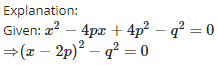

Simplify the expression: (c + d)2 - (c - d)2- a)4cd
- b)(c2 + d2)
- c)2(c2 + d2)
- d)2cd
Correct answer is option 'A'. Can you explain this answer?
Simplify the expression:
(c + d)2 - (c - d)2
a)
4cd
b)
(c2 + d2)
c)
2(c
2 + d
2)
d)
2cd
 | Disha Sarkar answered |
Explanation:
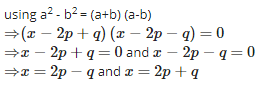
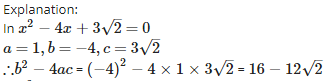
To simplify the given expression (c + d)2 - (c - d)2, we need to expand and simplify the terms.
Expansion:
(c + d)2 = c2 + 2cd + d2
(c - d)2 = c2 - 2cd + d2
Simplifying the expression:
(c + d)2 - (c - d)2
= (c2 + 2cd + d2) - (c2 - 2cd + d2)
= c2 + 2cd + d2 - c2 + 2cd - d2
= 4cd
Therefore, the simplified expression is 4cd, which is option 'A'.
To simplify the given expression (c + d)2 - (c - d)2, we need to expand and simplify the terms.
Expansion:
(c + d)2 = c2 + 2cd + d2
(c - d)2 = c2 - 2cd + d2
Simplifying the expression:
(c + d)2 - (c - d)2
= (c2 + 2cd + d2) - (c2 - 2cd + d2)
= c2 + 2cd + d2 - c2 + 2cd - d2
= 4cd
Therefore, the simplified expression is 4cd, which is option 'A'.
For what value of N would the following equation have no solution?3(4x−7)+12=2(5x−3)+N(x−3)- a) N=1
- b) N=2
- c) N=-1
- d) N=-2
Correct answer is option 'B'. Can you explain this answer?
For what value of N would the following equation have no solution?
3(4x−7)+12=2(5x−3)+N(x−3)
a)
N=1
b)
N=2
c)
N=-1
d)
N=-2
| | Niharika Sen answered |
The equation is incomplete, as it ends with an open parenthesis. Please provide the complete equation so that I can assist you further.
Solve the following equation:2|x−5|+16=30.- a) x=0;10
- b)x=2
- c) x=−7;7
- d) x=−9:16
- e) x=−2;12
Correct answer is option 'E'. Can you explain this answer?
Solve the following equation:
2|x−5|+16=30.
a)
x=0;10
b)
x=2
c)
x=−7;7
d)
x=−9:16
e)
x=−2;12
| | Saumya Sharma answered |
We start by isolating the absolute value expression:
2|x−5|+16=30⇔2|x−5|=30−16=14⇔|x−5|=7
This gives us two cases when we remove the absolute value:
x−5=7 and x−5=−7
Then we solve for each case:
x−5=7⇒x=7+5⇒x=12
x−5=−7⇒x=−7+5⇒x=−2
Solve for x: −6x−20=−2x+4(1−3x)- a)20
- b)-6
- c)6
- d)3
Correct answer is option 'D'. Can you explain this answer?
Solve for x: −6x−20=−2x+4(1−3x)
a)
20
b)
-6
c)
6
d)
3
| | Amar Chakraborty answered |
Explanation:
−6x−20=−2x+4(1−3x
−6x−20=−2x+4−12x
−6x−20=−14x+4
−6x+14x=4+20
8x=24
x=3
−6x−20=−2x+4(1−3x
−6x−20=−2x+4−12x
−6x−20=−14x+4
−6x+14x=4+20
8x=24
x=3
The two numbers whose sum is 27 and their product is 182 are- a)12 and 13
- b)12 and 15
- c)14 and 15
- d)13 and 14
Correct answer is option 'D'. Can you explain this answer?
The two numbers whose sum is 27 and their product is 182 are
a)
12 and 13
b)
12 and 15
c)
14 and 15
d)
13 and 14
| | Prateek Gupta answered |
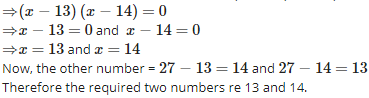
Explanation:Let the one number be xx .As the sum of numbers is 27 , then the other number will be (27−x)(27−x) According to question

The common root of 2x2+x−6 = 0 and x2−3x−10 = 0 is- a)2
- b)5
- c)-2
- d)3/2
Correct answer is option 'C'. Can you explain this answer?
The common root of 2x2+x−6 = 0 and x2−3x−10 = 0 is
a)
2
b)
5
c)
-2
d)
3/2
| | Chirag Sen answered |
The common root of 2x^2 and x is x.
If sum of squares of two real numbers is 12 and the product of the numbers is 4, find the difference between the numbers.- a)4
- b)8
- c)1
- d)2
Correct answer is option 'D'. Can you explain this answer?
a)
4
b)
8
c)
1
d)
2
| | Yogesh Dwivedi answered |
Given:
Sum of squares of two numbers = 12,
Product of the numbers = 4
Solution:
Let the numbers be 'a' and 'b'.
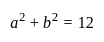
ab = 4
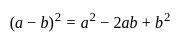
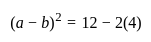

Taking the square root of both sides, we get:
a - b = ±2
Therefore, the difference between the numbers is ±2.
If (p - q) = 8, then what is the value of q3 - p3 + 24pq?- a)729
- b)512
- c)-512
- d)-343
Correct answer is option 'C'. Can you explain this answer?
a)
729
b)
512
c)
-512
d)
-343
 | Simar Sharma answered |
Given:
(p - q) = 8,
Formula used:
(a - b)3 = a3 - b3 - 3ab(a - b)
Calculation:
According to the question,
⇒ (p - q) = 8
Take cube on both sides,
⇒ (p - q)3 = 83
⇒ p3 - q
3
- 3pq(p - q)= 83
⇒ p
3
- q3
- 3pq(8) = 512⇒ p
3
- q3
- 24pq = 512It can be written as:
⇒ q
3
-p
3
+ 24pq = -512Therefore, "-512" is the required answer.
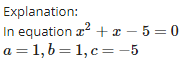


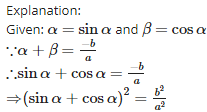
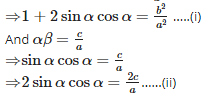

The product of two successive integral multiples of 5 is 1050. Then the numbers are- a)35 and 40
- b)25 and 30
- c)25 and 42
- d)30 and 35
Correct answer is option 'D'. Can you explain this answer?
The product of two successive integral multiples of 5 is 1050. Then the numbers are
a)
35 and 40
b)
25 and 30
c)
25 and 42
d)
30 and 35
| | Tanishq Yadav answered |
The problem:
The product of two successive integral multiples of 5 is 1050. We need to find these two numbers.
Approach:
Let's assume the two numbers as (5x) and (5x + 5), where x is an integer. We can form an equation based on the given information and solve for x.
Solution:
Let's form the equation based on the given information:
(5x) * (5x + 5) = 1050
Expanding the equation:
25x^2 + 25x = 1050
Simplifying the equation:
25x^2 + 25x - 1050 = 0
Factoring the equation:
25(x^2 + x - 42) = 0
Further simplification:
(x^2 + x - 42) = 0
Factoring the quadratic equation:
(x + 7)(x - 6) = 0
Solving for x:
x + 7 = 0 or x - 6 = 0
If x + 7 = 0, then x = -7
If x - 6 = 0, then x = 6
Since we are looking for positive integers, we can discard the negative value of x.
Calculating the numbers:
Using the value of x, we can find the two numbers:
First number = 5x = 5 * 6 = 30
Second number = 5x + 5 = 5 * 6 + 5 = 35
Thus, the two successive integral multiples of 5 that have a product of 1050 are 30 and 35.
Final Answer:
The correct answer is option D, which states that the numbers are 30 and 35.
The product of two successive integral multiples of 5 is 1050. We need to find these two numbers.
Approach:
Let's assume the two numbers as (5x) and (5x + 5), where x is an integer. We can form an equation based on the given information and solve for x.
Solution:
Let's form the equation based on the given information:
(5x) * (5x + 5) = 1050
Expanding the equation:
25x^2 + 25x = 1050
Simplifying the equation:
25x^2 + 25x - 1050 = 0
Factoring the equation:
25(x^2 + x - 42) = 0
Further simplification:
(x^2 + x - 42) = 0
Factoring the quadratic equation:
(x + 7)(x - 6) = 0
Solving for x:
x + 7 = 0 or x - 6 = 0
If x + 7 = 0, then x = -7
If x - 6 = 0, then x = 6
Since we are looking for positive integers, we can discard the negative value of x.
Calculating the numbers:
Using the value of x, we can find the two numbers:
First number = 5x = 5 * 6 = 30
Second number = 5x + 5 = 5 * 6 + 5 = 35
Thus, the two successive integral multiples of 5 that have a product of 1050 are 30 and 35.
Final Answer:
The correct answer is option D, which states that the numbers are 30 and 35.
Which of the following is a quadratic equation?- a)3x2 - 2x + 3 = 2
- b)x2 + 2x + 3
- c)x + 5 = 2x - 8
- d)x3 + 2x2 + 3x + 1 = 0
Correct answer is option 'A'. Can you explain this answer?
a)
3x2 - 2x + 3 = 2
b)
x2 + 2x + 3
c)
x + 5 = 2x - 8
d)
x3 + 2x2 + 3x + 1 = 0
 | Tech Era answered |
Concept Used:
A quadratic equation is an equation of the second degree, meaning it contains at least one term that is squared. The standard form is ax² + bx + c = 0, where a, b, and c are constants, and x is an unknown variable.
Calculation:
3x
2
- 2x + 3 = 2
⇒ 3x
2
- 2x + 1 = 0, This equation is the form of ax² + bx + c = 0.
Option 2 - x
2
+ 2x + 3, this is the not the form of ax² + bx + c = 0
Option 3 - x + 5 = 2x - 8, I this equation second degree equation not formed.
Option 4 -
x
3
+ 2x
2
+ 3x + 1 = 0, In this equation degree is 3, in quadratic degree is 2.
∴
This equation can also be written in standard form by subtracting 2 from both sides to get 3x² - 2x + 1 = 0. Option (1) is correct. Z=2a×5b×7cA positive integer Z can be expressed in terms of its prime factors as above, where a, b and c are positive integers. Is 3|a−b|<9?(1) Z is divisible by 40 but not by 50(2) Za−b=26×52×74- a)Statement (1) ALONE is sufficient, but statement (2) alone is not sufficient to answer the question asked.
- b)Statement (2) ALONE is sufficient, but statement (1) alone is not sufficient to answer the question asked.
- c)BOTH statements (1) and (2) TOGETHER are sufficient to answer the question asked, but NEITHER statement ALONE is sufficient to answer the question asked.
- d)EACH statement ALONE is sufficient to answer the question asked.
- e)Statements (1) and (2) TOGETHER are NOT sufficient to answer the question asked, and additional data specific to the problem are needed.
Correct answer is option 'D'. Can you explain this answer?
Z=2a×5b×7c
A positive integer Z can be expressed in terms of its prime factors as above, where a, b and c are positive integers. Is 3|a−b|<9?
(1) Z is divisible by 40 but not by 50
(2) Za−b=26×52×74
a)
Statement (1) ALONE is sufficient, but statement (2) alone is not sufficient to answer the question asked.
b)
Statement (2) ALONE is sufficient, but statement (1) alone is not sufficient to answer the question asked.
c)
BOTH statements (1) and (2) TOGETHER are sufficient to answer the question asked, but NEITHER statement ALONE is sufficient to answer the question asked.
d)
EACH statement ALONE is sufficient to answer the question asked.
e)
Statements (1) and (2) TOGETHER are NOT sufficient to answer the question asked, and additional data specific to the problem are needed.
| | Devansh Shah answered |
Steps 1 & 2: Understand Question and Draw Inferences
Given:
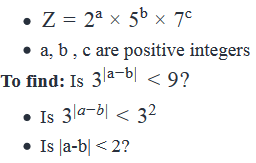
Step 3: Analyze Statement 1 independently
(1) Z is divisible by 40 but not by 50
- 40 = 23*5
- 50 = 2*52
- The power of 2 in Z is at least 3
- a ≥ 3
- The power of 5 in Z is 1.
- b = 1
- Therefore, a – b ≥ 3 – 1
a – b ≥ 2
So, answer to the asked question is: NO
Statement 1 is sufficient to answer the question.
Step 4: Analyze Statement 2 independently

- Equating the powers of a base on both sides of the equation:
- a(a - b) = 6. . . (1)
- b(a - b) = 2. . . (2)
- Dividing (1) by (2)
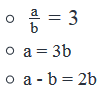
- The minimum value of b is 1 (b is a positive integer)
- So, minimum value of a – b = 2
Thus, the answer to the asked question is: NO
Statement 2 is sufficient to answer the question.
Step 5: Analyze Both Statements Together (if needed)
Since we’ve already arrived at unique answers in Steps 3 and 4, this step is not required
Answer: Option D
If x is a positive integer less than 100 such that x is divisible by 2y, where y is a positive integer, what is the value of y?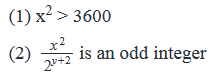
- a)Statement (1) ALONE is sufficient, but statement (2) alone is not sufficient to answer the question asked.
- b)Statement (2) ALONE is sufficient, but statement (1) alone is not sufficient to answer the question asked.
- c)BOTH statements (1) and (2) TOGETHER are sufficient to answer the question asked, but NEITHER statement ALONE is sufficient to answer the question asked.
- d)EACH statement ALONE is sufficient to answer the question asked.
- e)Statements (1) and (2) TOGETHER are NOT sufficient to answer the question asked, and additional data specific to the problem are needed.
Correct answer is option 'B'. Can you explain this answer?
If x is a positive integer less than 100 such that x is divisible by 2y, where y is a positive integer, what is the value of y?
a)
Statement (1) ALONE is sufficient, but statement (2) alone is not sufficient to answer the question asked.
b)
Statement (2) ALONE is sufficient, but statement (1) alone is not sufficient to answer the question asked.
c)
BOTH statements (1) and (2) TOGETHER are sufficient to answer the question asked, but NEITHER statement ALONE is sufficient to answer the question asked.
d)
EACH statement ALONE is sufficient to answer the question asked.
e)
Statements (1) and (2) TOGETHER are NOT sufficient to answer the question asked, and additional data specific to the problem are needed.
| | Abhishek Choudhury answered |
Steps 1 & 2: Understand Question and Draw Inferences
- x is an integer such that 0 < x < 100
- x is divisible by 2y, where y is a positive integer
- Since y > 0, this means 2 is definitely a prime factor 2
- Since x is a positive integer, we can write the Prime-factorized form of x as:

- are integers > 0, z ≥ y and are prime numbers other than 2.
- As x < 100, 2z < 100
- So, z = { 1, 2, 3, 4, 5, 6} as 27 = 128 > 100
- Since x is completely divisible by 2y, z ≥ y. So, y can take any value of z, i.e. 1 ≤ y ≤ 6
- To Find: Unique value of y
Step 3: Analyze Statement 1 independently
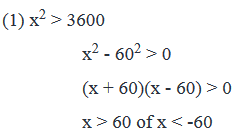
- As x is a positive integer, x < -60 is not possible.
- So, x > 60, i.e. 60 < x < 100.
However, we do not know if 2 is the only prime factor or x. So, we cannot find a unique value of y.
- For example, if 2 is the only prime factor of x, then y can have only 1 value: 6
- But if x has other prime factors, then multiple values of y are possible. For example, x could be 22*3*7 (y = 2) or 23*11 (y = 3) etc.
Insufficient to answer.
Step 4: Analyze Statement 2 independently

- Using the prime factorized expression of x, we can write:
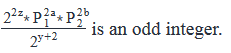
- Since the integer resulting from this division is odd, the powers of 2 in the numerator and the denominator should cancel out each other.
- Hence 22z = 2y+2
- z=y/2+1 ….(1). So, y must be even as z is an integer
- Also, from our discussion in Steps 1 and 2, we know that z ≥ y
- Substituting (1) in the above inequality, we get:
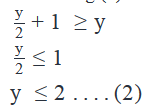
Using (2), along with the inference that y must be even, we have y = 2 as the only possible option.
Sufficient to answer.
Step 5: Analyze Both Statements Together (if needed)
As we have a unique answer from step 4, this step is not required.
Answer: B
If 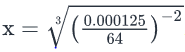 , what is the value of x?
- a)6400
- b)8000
- c)12500
- d)15625
- e)22500
Correct answer is option 'A'. Can you explain this answer?
If , what is the value of x?
, what is the value of x?a)
6400
b)
8000
c)
12500
d)
15625
e)
22500
| | Arya Yadav answered |
Given:
To find: Value of x
Working Out:
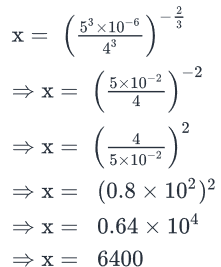
Looking at the answer choices, we see that the correct answer is Option A
Is the sum of xy and yx positive?(1) xy > 0(2) x + y > 0- a)Statement (1) ALONE is sufficient, but statement (2) alone is not sufficient to answer the question asked.
- b)Statement (2) ALONE is sufficient, but statement (1) alone is not sufficient to answer the question asked.
- c)BOTH statements (1) and (2) TOGETHER are sufficient to answer the question asked, but NEITHER statement ALONE is sufficient to answer the question asked.
- d)EACH statement ALONE is sufficient to answer the question asked.
- e)Statements (1) and (2) TOGETHER are NOT sufficient to answer the question asked, and additional data specific to the problem are needed.
Correct answer is option 'C'. Can you explain this answer?
Is the sum of xy and yx positive?
(1) xy > 0
(2) x + y > 0
a)
Statement (1) ALONE is sufficient, but statement (2) alone is not sufficient to answer the question asked.
b)
Statement (2) ALONE is sufficient, but statement (1) alone is not sufficient to answer the question asked.
c)
BOTH statements (1) and (2) TOGETHER are sufficient to answer the question asked, but NEITHER statement ALONE is sufficient to answer the question asked.
d)
EACH statement ALONE is sufficient to answer the question asked.
e)
Statements (1) and (2) TOGETHER are NOT sufficient to answer the question asked, and additional data specific to the problem are needed.
| | Sahana Mehta answered |
Steps 1 & 2: Understand Question and Draw Inferences
To Find: If xy + yx > 0
Step 3: Analyze Statement 1 independently
(1) xy > 0
- Tells that x and y are of the same sign. Two cases arise:
- x, y > 0
- In this case xy, yx > 0. So, xy + yx > 0
- x, y < 0
- In this case, xy + yx may or may not be positive, depending on the values of x and y. Following cases can arise:
- Both x, y are even → In this case xy,yx > 0. So, xy+yx > 0
- Both x and y are odd → In this case xy,yx < 0. So, xy+yx < 0
- x is even and y is odd → In this case xy < 0, yx > 0. Cannot comment on the value of xy+yx
- x is odd and y is even → In this case xy < 0, yx > 0. Cannot comment on the value of xy+yx
- x, y > 0
Insufficient to answer.
Step 4: Analyze Statement 2 independently
(2) x + y > 0
- Considering the constraint x + y > 0, following cases are possible:
- x, y > 0. So, x + y > 0. In this case, xy, yx > 0. So, xy + yx > 0
- x < 0, y > 0 and |y| > |x|. So, x + y > 0. In this case xy + yx may or may not be positive.
- If y is odd, then xy < 0 , yx > 0 as y is positive. In this case, we cannot comment on the value of xy + yx
- If y is even , then xy > 0 , yx > 0 as y is positive. In this case, xy + yx > 0
- x > 0, y < 0 and |x| > |y|. So, x + y > 0. In this case xy + yx may or may not be positive.
Insufficient to answer.
Step 5: Analyze Both Statements Together (if needed)
- From Statement 1, xy > 0
- From Statement 2, x + y > 0
Statement-1 tells us that x and y have the same signs. Following cases are possible:
- If x & y > 0, xy > 0 and x + y > 0. In this case xy + yx > 0
- If x & y < 0, x+ y < 0. Not possible. (If x & y both are negative, the x + y cannot be > 0)
The only possible case is when x, y > 0 and hence xy + yx > 0
Sufficient to answer.
Answer: C
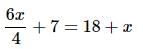
Solve the following equation for x
- a) x=0
- b) x=11
- c)x=33
- d)x=7
- e)x=22
Correct answer is option 'E'. Can you explain this answer?
Solve the following equation for x
a)
x=0
b)
x=11
c)
x=33
d)
x=7
e)
x=22
| | Pranav Das answered |
We proceed as follows
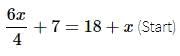
6x+28=72+4x (Multiply both sides by 4. Remember to distribute the 4 to both summands on both sides.)
6x=44+4x (Subtract 28 from both sides)
2x=44 (Subtract 4x from both sides)
x=22 (Divide both sides by 2)
6x=44+4x (Subtract 28 from both sides)
2x=44 (Subtract 4x from both sides)
x=22 (Divide both sides by 2)
Which of the following is the zeros of the polynomial 9x2 - 4: - a)

- b)4, 4
- c)9, -9
- d)

Correct answer is option 'A'. Can you explain this answer?
Which of the following is the zeros of the polynomial 9x2 - 4:
a)
b)
4, 4
c)
9, -9
d)
 | Tom Tattle answered |
Concept -
let the polynomial be p(x) then p(x) = 0 gives you the zeros of the polynomial.
Explanation -
We have the polynomial 9x2 - 4
Now for the zeros of the polynomial -
9x2 - 4 = 0
⇒
9x
2
= 4
⇒ x
2
= 4/9

Hence option (1) is true.
Chapter doubts & questions for Algebra - 2 Months Preparation for CTET Paper 2 2026 is part of CTET & State TET exam preparation. The chapters have been prepared according to the CTET & State TET exam syllabus. The Chapter doubts & questions, notes, tests & MCQs are made for CTET & State TET 2026 Exam. Find important definitions, questions, notes, meanings, examples, exercises, MCQs and online tests here.
Chapter doubts & questions of Algebra - 2 Months Preparation for CTET Paper 2 in English & Hindi are available as part of CTET & State TET exam. Download more important topics, notes, lectures and mock test series for CTET & State TET Exam by signing up for free.
2 Months Preparation for CTET Paper 2367 videos|1021 docs|335 tests |
