


All Exams > CTET & State TET > 2 Months Preparation for CTET Paper 2 > All Questions
All questions of Mock Tests for CTET & State TET Exam
The simple interest on a certain sum for 2(1/2) years at 12% per annum is Rs. 600 less than the simple interest on the same sum for 4(1/2) years at 8% per annum. Then, the sum is : - a)Rs. 20,000
- b)Rs. 16,000
- c)Rs. 10,000
- d)Rs. 8,000
Correct answer is option 'C'. Can you explain this answer?
The simple interest on a certain sum for 2(1/2) years at 12% per annum is Rs. 600 less than the simple interest on the same sum for 4(1/2) years at 8% per annum. Then, the sum is :
a)
Rs. 20,000
b)
Rs. 16,000
c)
Rs. 10,000
d)
Rs. 8,000
 | Riverdale Learning Institute answered |
Let, the sum be Rs 100x
We know, SI = (P × R × T)/100
According to the question,

⇒ 30x = 36x - 600
⇒ 6x = 600
⇒ x = 100
So,
Sum = 100 × 100 = 10, 000
Hence, the correct answer is "Rs. 10,000".
We know, SI = (P × R × T)/100
According to the question,
⇒ 30x = 36x - 600
⇒ 6x = 600
⇒ x = 100
So,
Sum = 100 × 100 = 10, 000
Hence, the correct answer is "Rs. 10,000".

Directions: Read the following passage carefully and answer the questions given below it.
Nature is an infinite source of beauty. Sunrise and sunset, mountains and rivers, lakes and glaciers, forests and fields provide joy and bliss to the human mind and heart for hours together. Everything in nature is splendid and divine. Every day and every season of the year has a peculiar beauty to unfold. Only one should have eyes to behold it and a heart to feel it like the English poet William Wordsworth who after seeing daffodils said: And then my heart with pleasure fills and dances with the daffodils?
Nature is a great teacher. Early man was thrilled with the beauty and wonders of nature. The Aryans worshipped nature. One can learn lessons in the vast school of nature. Unfortunately, the strife, the stress and the tension of modern life have made people immune to the beauties of nature. Their life is so full of care that they have no time to stand and stare. They cannot enjoy the beauty of lowing rivers, swinging trees, flying birds and majestic mountains and hills. There is, however, a cry to go back to the village from the concrete and artificial jungle of cities. Hence the town planners of today pay special attention to providing enough natural scenic spots in town planning To develop a balanced personality, one needs to have a healthy attitude which can make us appreciate and enjoy the beauty of nature. There is another balm to soothe our tired souls and listless minds than the infinite nature all around us. We should enjoy it fully to lead a balanced and harmonious life, full of peace and tranquility.Q. What are the town planners doing today?- a)Providing facilities for enjoying nature
- b)Establishing balance between concrete and artificial jungle of cities
- c)Supporting the cry to go back to villages
- d)Making efforts to inculcate healthy attitude among people
Correct answer is option 'A'. Can you explain this answer?
Directions: Read the following passage carefully and answer the questions given below it.
Nature is an infinite source of beauty. Sunrise and sunset, mountains and rivers, lakes and glaciers, forests and fields provide joy and bliss to the human mind and heart for hours together. Everything in nature is splendid and divine. Every day and every season of the year has a peculiar beauty to unfold. Only one should have eyes to behold it and a heart to feel it like the English poet William Wordsworth who after seeing daffodils said: And then my heart with pleasure fills and dances with the daffodils?
Nature is a great teacher. Early man was thrilled with the beauty and wonders of nature. The Aryans worshipped nature. One can learn lessons in the vast school of nature. Unfortunately, the strife, the stress and the tension of modern life have made people immune to the beauties of nature. Their life is so full of care that they have no time to stand and stare. They cannot enjoy the beauty of lowing rivers, swinging trees, flying birds and majestic mountains and hills. There is, however, a cry to go back to the village from the concrete and artificial jungle of cities. Hence the town planners of today pay special attention to providing enough natural scenic spots in town planning To develop a balanced personality, one needs to have a healthy attitude which can make us appreciate and enjoy the beauty of nature. There is another balm to soothe our tired souls and listless minds than the infinite nature all around us. We should enjoy it fully to lead a balanced and harmonious life, full of peace and tranquility.
Nature is an infinite source of beauty. Sunrise and sunset, mountains and rivers, lakes and glaciers, forests and fields provide joy and bliss to the human mind and heart for hours together. Everything in nature is splendid and divine. Every day and every season of the year has a peculiar beauty to unfold. Only one should have eyes to behold it and a heart to feel it like the English poet William Wordsworth who after seeing daffodils said: And then my heart with pleasure fills and dances with the daffodils?
Nature is a great teacher. Early man was thrilled with the beauty and wonders of nature. The Aryans worshipped nature. One can learn lessons in the vast school of nature. Unfortunately, the strife, the stress and the tension of modern life have made people immune to the beauties of nature. Their life is so full of care that they have no time to stand and stare. They cannot enjoy the beauty of lowing rivers, swinging trees, flying birds and majestic mountains and hills. There is, however, a cry to go back to the village from the concrete and artificial jungle of cities. Hence the town planners of today pay special attention to providing enough natural scenic spots in town planning To develop a balanced personality, one needs to have a healthy attitude which can make us appreciate and enjoy the beauty of nature. There is another balm to soothe our tired souls and listless minds than the infinite nature all around us. We should enjoy it fully to lead a balanced and harmonious life, full of peace and tranquility.
Q. What are the town planners doing today?
a)
Providing facilities for enjoying nature
b)
Establishing balance between concrete and artificial jungle of cities
c)
Supporting the cry to go back to villages
d)
Making efforts to inculcate healthy attitude among people
| | Riverdale Learning Institute answered |
When you the 2nd paragraph of the given passage, you will find the following lines:
- Nature is a great teacher. Early man was thrilled with the beauty and wonders of nature. The Aryans worshipped nature. One can learn lessons in the vast school of nature. Unfortunately, the strife, the stress and the tension of modern life have made people immune to the beauties of nature. Their life is so full of care that they have no time to stand and stare. They cannot enjoy the beauty of lowing rivers, swinging trees, flying birds and majestic mountains and hills. There is, however, a cry to go back to the village from the concrete and artificial jungle of cities. Hence the town planners of today pay special attention to providing enough natural scenic spots in town planning
The highlighted sentences show that town planners provide something to feel like nature, which means they are providing facilities for enjoying nature.
Hence, the correct sentence is "option 1"
Hence, the correct sentence is "option 1"
Direction: Read the following passage and answer the question. (choose the most appropriate answers)
When another old cave is discovered in the South France, it is not usually news. Rather, it is an ordinary event. Such discoveries are so frequent these days that hardly anybody pays heed to them. However, when the Lascaux cave complex was discovered in 1940, the world was amazed. Painted directly on its walls were hundreds of scenes showing how people lived thousands of years ago. The scenes show people hunting animals , such as bison or wild cats. Other images depict birds and, most noticeably, horses, which appear in more than 300 wall images, by far outnumbering all other animals. Early artists drawing these animals accomplished a monumental difficult task. They did not limit themselves to the easily accessible walls but carried their painting materials to spaces that required climbing steep walls or crawling into narrow passages in the Lascaux complex. Unfortunately, the paintings have been exposed to the destructive action of water and temperature changes, which easily wear the images away. Because the Lascaux caves have many entrances, air movement has also damaged the images inside, Although they are not out in the open air, where natural light would have destroyed them long ago, many of the images have deteriorated and are barely recognizable. To prevent further damage, the site was closed to tourists in 1963, 23 years after it was discovered.Q. The underlined word ‘ However’ is used in the sentence as :- a)adjective
- b)preposition
- c)adverb
- d)exclamation
Correct answer is option 'C'. Can you explain this answer?
Direction: Read the following passage and answer the question. (choose the most appropriate answers)
When another old cave is discovered in the South France, it is not usually news. Rather, it is an ordinary event. Such discoveries are so frequent these days that hardly anybody pays heed to them. However, when the Lascaux cave complex was discovered in 1940, the world was amazed. Painted directly on its walls were hundreds of scenes showing how people lived thousands of years ago. The scenes show people hunting animals , such as bison or wild cats. Other images depict birds and, most noticeably, horses, which appear in more than 300 wall images, by far outnumbering all other animals. Early artists drawing these animals accomplished a monumental difficult task. They did not limit themselves to the easily accessible walls but carried their painting materials to spaces that required climbing steep walls or crawling into narrow passages in the Lascaux complex. Unfortunately, the paintings have been exposed to the destructive action of water and temperature changes, which easily wear the images away. Because the Lascaux caves have many entrances, air movement has also damaged the images inside, Although they are not out in the open air, where natural light would have destroyed them long ago, many of the images have deteriorated and are barely recognizable. To prevent further damage, the site was closed to tourists in 1963, 23 years after it was discovered.
When another old cave is discovered in the South France, it is not usually news. Rather, it is an ordinary event. Such discoveries are so frequent these days that hardly anybody pays heed to them. However, when the Lascaux cave complex was discovered in 1940, the world was amazed. Painted directly on its walls were hundreds of scenes showing how people lived thousands of years ago. The scenes show people hunting animals , such as bison or wild cats. Other images depict birds and, most noticeably, horses, which appear in more than 300 wall images, by far outnumbering all other animals. Early artists drawing these animals accomplished a monumental difficult task. They did not limit themselves to the easily accessible walls but carried their painting materials to spaces that required climbing steep walls or crawling into narrow passages in the Lascaux complex. Unfortunately, the paintings have been exposed to the destructive action of water and temperature changes, which easily wear the images away. Because the Lascaux caves have many entrances, air movement has also damaged the images inside, Although they are not out in the open air, where natural light would have destroyed them long ago, many of the images have deteriorated and are barely recognizable. To prevent further damage, the site was closed to tourists in 1963, 23 years after it was discovered.
Q. The underlined word ‘ However’ is used in the sentence as :
a)
adjective
b)
preposition
c)
adverb
d)
exclamation
| | Riverdale Learning Institute answered |
Let's discuss the marked option first; i.e. 'Adverb':
- Adverbs are used to add more information about a verb, an adjective, another adverb, a clause or a whole sentence.
E.g. - very tall (modifying adjective 'tall'), ended too quickly (modifying another adverb 'quickly), Fortunately, I had brought an umbrella (modifying the whole sentence). - However (adverb): despite what has been said earlier
Ex: This is one possible solution to the problem. However, there are others. ('however' is modifying the whole clause 'This is one possible solution to the problem') - Similarly, in the given question sentence, 'however' adds information to the previous sentence 'Such discoveries are so frequent these days that hardly anybody pays heed to them'.
Therefore, the correct part of speech of the asked word is 'Adverb'.
(Option 3) is the correct answer.
(Option 3) is the correct answer.
Which of the following statements about children are correct?
A. Children are passive recipients of knowledge.
B. Children are problem solvers.
C. Children are scientific investigators.
D. Children are active explorers of the environment.- a)A, B, C, and D
- b)A, B, and C
- c)A, B, and D
- d)B, C, and D
Correct answer is option 'D'. Can you explain this answer?
Which of the following statements about children are correct?
A. Children are passive recipients of knowledge.
B. Children are problem solvers.
C. Children are scientific investigators.
D. Children are active explorers of the environment.
A. Children are passive recipients of knowledge.
B. Children are problem solvers.
C. Children are scientific investigators.
D. Children are active explorers of the environment.
a)
A, B, C, and D
b)
A, B, and C
c)
A, B, and D
d)
B, C, and D
 | Shailendra Khanna answered |
Understanding Children's Learning Perspectives
The correct answer is option 'D' (B, C, and D), which highlights the active role children play in their learning processes. Here’s a detailed explanation:
Children are Problem Solvers
- Children naturally engage in problem-solving as they encounter challenges in their daily lives.
- They develop critical thinking skills by experimenting, making predictions, and finding solutions independently.
- This active engagement fosters resilience and adaptability.
Children are Scientific Investigators
- Children possess an innate curiosity about the world around them.
- They ask questions, conduct experiments, and seek evidence to understand their environment.
- This investigative approach mirrors the scientific method, as they hypothesize, test, and draw conclusions.
Children are Active Explorers of the Environment
- Children learn best through exploration and hands-on experiences.
- They interact with their surroundings, which helps them make sense of complex concepts.
- This exploration is crucial for cognitive, social, and emotional development.
Why Option A is Incorrect
- The statement that "Children are passive recipients of knowledge" contradicts the active roles they play in learning.
- Research shows that children construct their understanding through interaction and engagement, rather than passively absorbing information.
In summary, options B, C, and D accurately reflect children's dynamic roles in learning, emphasizing their capabilities as active participants rather than passive recipients.
The correct answer is option 'D' (B, C, and D), which highlights the active role children play in their learning processes. Here’s a detailed explanation:
Children are Problem Solvers
- Children naturally engage in problem-solving as they encounter challenges in their daily lives.
- They develop critical thinking skills by experimenting, making predictions, and finding solutions independently.
- This active engagement fosters resilience and adaptability.
Children are Scientific Investigators
- Children possess an innate curiosity about the world around them.
- They ask questions, conduct experiments, and seek evidence to understand their environment.
- This investigative approach mirrors the scientific method, as they hypothesize, test, and draw conclusions.
Children are Active Explorers of the Environment
- Children learn best through exploration and hands-on experiences.
- They interact with their surroundings, which helps them make sense of complex concepts.
- This exploration is crucial for cognitive, social, and emotional development.
Why Option A is Incorrect
- The statement that "Children are passive recipients of knowledge" contradicts the active roles they play in learning.
- Research shows that children construct their understanding through interaction and engagement, rather than passively absorbing information.
In summary, options B, C, and D accurately reflect children's dynamic roles in learning, emphasizing their capabilities as active participants rather than passive recipients.
दिए गए गद्यांश को ध्यानपूर्वक पढ़िए तथा पूछे गए प्रश्न के उत्तर के लिए सबसे उपयुक्त विकल्प का चयन कीजिए।
राजभाषा का अर्थ राजा या राज्य की भाषा है। वह भाषा जिसमें शासक या शासन का काम होता है। राष्ट्रभाषा वह है जिसका व्यवहार राष्ट्र के सामान्य जन करते है। राजभाषा का क्षेत्र सीमित होता है। राष्ट्र भाषा सारे देश की संपर्क भाषा है। राष्ट्रभाषा के साथ जनता का भावात्मक लगाव रहता है क्योंकि उसके साथ जनसाधारण की सांस्कृतिक परम्पराएँ जुड़ी रहती हैं। राजभाषा के प्रति वैसा सम्मान हो तो सकता है, लेकिन नहीं भी हो सकता है, क्योंकि वह अपने देश की भी हो सकती है। किसी गैर देश से आये शासक की भी हो सकती है। लोकतांत्रिक व्यवस्था में आज हिन्दी राजभाषा के रूप में ही विराजित है। 14 सितंबर, 1949 ई. को भारत के संविधान में हिन्दी को मान्यता प्रदान की गई है। संविधान की अनुच्छेद 120 के अनुसार संसद का कार्य हिन्दी में या अंग्रेजी में किया जाता है। अनुच्छेद 210 के अंतर्गत राज्यों के विधानमंडलों का कार्य अपने-अपने राज्य की राजभाषा या हिन्दी में या अंग्रेजी में किया जा सकता है। 343 के अनुसार संघ की राजभाषा हिन्दी और लिपि देवनागरी होगी। इस भाषा का प्रसार तथा प्रचार के लिए महात्मा गाँधी का योगदान रहा है। अनुच्छेद 344 में राष्ट्रपति को शासकीय कार्य में हिन्दी भाषा का प्रयोग अधिक करने के लिए कहा गया है।Q. वह भाषा जिसमें शासक या शासन का काम होता है, कहलाती है : - a)राष्ट्रभाषा
- b)राजभाषा
- c)शासनभाषा
- d)कार्यवाहक भाषा
Correct answer is option 'B'. Can you explain this answer?
दिए गए गद्यांश को ध्यानपूर्वक पढ़िए तथा पूछे गए प्रश्न के उत्तर के लिए सबसे उपयुक्त विकल्प का चयन कीजिए।
राजभाषा का अर्थ राजा या राज्य की भाषा है। वह भाषा जिसमें शासक या शासन का काम होता है। राष्ट्रभाषा वह है जिसका व्यवहार राष्ट्र के सामान्य जन करते है। राजभाषा का क्षेत्र सीमित होता है। राष्ट्र भाषा सारे देश की संपर्क भाषा है। राष्ट्रभाषा के साथ जनता का भावात्मक लगाव रहता है क्योंकि उसके साथ जनसाधारण की सांस्कृतिक परम्पराएँ जुड़ी रहती हैं। राजभाषा के प्रति वैसा सम्मान हो तो सकता है, लेकिन नहीं भी हो सकता है, क्योंकि वह अपने देश की भी हो सकती है। किसी गैर देश से आये शासक की भी हो सकती है। लोकतांत्रिक व्यवस्था में आज हिन्दी राजभाषा के रूप में ही विराजित है। 14 सितंबर, 1949 ई. को भारत के संविधान में हिन्दी को मान्यता प्रदान की गई है। संविधान की अनुच्छेद 120 के अनुसार संसद का कार्य हिन्दी में या अंग्रेजी में किया जाता है। अनुच्छेद 210 के अंतर्गत राज्यों के विधानमंडलों का कार्य अपने-अपने राज्य की राजभाषा या हिन्दी में या अंग्रेजी में किया जा सकता है। 343 के अनुसार संघ की राजभाषा हिन्दी और लिपि देवनागरी होगी। इस भाषा का प्रसार तथा प्रचार के लिए महात्मा गाँधी का योगदान रहा है। अनुच्छेद 344 में राष्ट्रपति को शासकीय कार्य में हिन्दी भाषा का प्रयोग अधिक करने के लिए कहा गया है।
राजभाषा का अर्थ राजा या राज्य की भाषा है। वह भाषा जिसमें शासक या शासन का काम होता है। राष्ट्रभाषा वह है जिसका व्यवहार राष्ट्र के सामान्य जन करते है। राजभाषा का क्षेत्र सीमित होता है। राष्ट्र भाषा सारे देश की संपर्क भाषा है। राष्ट्रभाषा के साथ जनता का भावात्मक लगाव रहता है क्योंकि उसके साथ जनसाधारण की सांस्कृतिक परम्पराएँ जुड़ी रहती हैं। राजभाषा के प्रति वैसा सम्मान हो तो सकता है, लेकिन नहीं भी हो सकता है, क्योंकि वह अपने देश की भी हो सकती है। किसी गैर देश से आये शासक की भी हो सकती है। लोकतांत्रिक व्यवस्था में आज हिन्दी राजभाषा के रूप में ही विराजित है। 14 सितंबर, 1949 ई. को भारत के संविधान में हिन्दी को मान्यता प्रदान की गई है। संविधान की अनुच्छेद 120 के अनुसार संसद का कार्य हिन्दी में या अंग्रेजी में किया जाता है। अनुच्छेद 210 के अंतर्गत राज्यों के विधानमंडलों का कार्य अपने-अपने राज्य की राजभाषा या हिन्दी में या अंग्रेजी में किया जा सकता है। 343 के अनुसार संघ की राजभाषा हिन्दी और लिपि देवनागरी होगी। इस भाषा का प्रसार तथा प्रचार के लिए महात्मा गाँधी का योगदान रहा है। अनुच्छेद 344 में राष्ट्रपति को शासकीय कार्य में हिन्दी भाषा का प्रयोग अधिक करने के लिए कहा गया है।
Q. वह भाषा जिसमें शासक या शासन का काम होता है, कहलाती है :
a)
राष्ट्रभाषा
b)
राजभाषा
c)
शासनभाषा
d)
कार्यवाहक भाषा
 | Eesha Bhat answered |
- राजभाषा का अर्थ राजा या राज्य की भाषा है।
- वह भाषा जिसमें शासक या शासन का काम होता है।
Floor of a square room of side 10 m is to be completely covered with square tiles, each having length 50 cm. The smallest number of tiles needed is- a)250
- b)324
- c)400
- d)520
Correct answer is option 'C'. Can you explain this answer?
Floor of a square room of side 10 m is to be completely covered with square tiles, each having length 50 cm. The smallest number of tiles needed is
a)
250
b)
324
c)
400
d)
520
 | Anjali Gupta answered |
Calculation:
Area of square room
= (10)2 = 100 sq m = 100 × (100)2 sq cm
= 100 × 100 × 100 sq cm
Now, area of tile
= (50)2 = 50 × 50 sq cm
∴ Number of tiles needed
= Area of square room/Area of tile
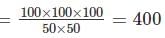
Area of square room
= (10)2 = 100 sq m = 100 × (100)2 sq cm
= 100 × 100 × 100 sq cm
Now, area of tile
= (50)2 = 50 × 50 sq cm
∴ Number of tiles needed
= Area of square room/Area of tile
While teaching a single parent child, a teacher should- a)treat such a child differently
- b)assign lesser home assignments to such a child
- c)provide stable and consistent environment
- d)overlook this fact and treat such a child at par with other children
Correct answer is option 'D'. Can you explain this answer?
While teaching a single parent child, a teacher should
a)
treat such a child differently
b)
assign lesser home assignments to such a child
c)
provide stable and consistent environment
d)
overlook this fact and treat such a child at par with other children
 | Mahtab Alam answered |
Answer should be C instof D.
Karuna, a teacher, decided to give some tasks to the students after teaching them a poem. Which of the following tasks would she select so that the students can participate actively?- a)She would ask the students to write the answer of the questions given at the end of the poem.
- b)She would ask to explain the poem in a group.
- c)She would ask the students to memorize the poem as it is written.
- d)She would ask the students to make sentences with the new words in the poem.
Correct answer is option 'B'. Can you explain this answer?
Karuna, a teacher, decided to give some tasks to the students after teaching them a poem. Which of the following tasks would she select so that the students can participate actively?
a)
She would ask the students to write the answer of the questions given at the end of the poem.
b)
She would ask to explain the poem in a group.
c)
She would ask the students to memorize the poem as it is written.
d)
She would ask the students to make sentences with the new words in the poem.
| | Riverdale Learning Institute answered |
Active participation of the students in any kind of activity conducted by the teachers is really necessary as it imparts not just knowledge in the students, but also enhances their zeal towards completing the job efficiently. It also gives them the opportunity to take interest in learning as well as representing themselves on a platform other than that provided by the curriculum.
- Active participation means indulging in activity in such a way that the individual not only performs with full dedication but also takes complete responsibility for the actions.
- A teacher in the third-grade classroom decided to give some tasks to the students after teaching them a poem.
The value of a machine depreciates at the rate of 10% per year. It was purchased three years ago. If its present value is Rs. 1,45,800, then for how much was it purchased?- a)Rs. 1,75,800
- b)Rs. 1,80,000
- c)Rs. 2,00,000
- d)Rs. 2,10,000
Correct answer is option 'C'. Can you explain this answer?
The value of a machine depreciates at the rate of 10% per year. It was purchased three years ago. If its present value is Rs. 1,45,800, then for how much was it purchased?
a)
Rs. 1,75,800
b)
Rs. 1,80,000
c)
Rs. 2,00,000
d)
Rs. 2,10,000
| | Anaya Patel answered |
Given information:
The machine depreciates at a rate of 10% per year. It was purchased three years ago, and its present value is Rs. 1,45,800.
Calculating the original purchase price:
To find out the original purchase price, we need to calculate the current value of the machine by applying the depreciation rate for three years.
Let's assume the original purchase price of the machine is x.
After the first year, the value of the machine will be 90% of x, which is 0.9x.
After the second year, the value of the machine will further decrease to 90% of 0.9x, which is 0.9 * 0.9x = 0.81x.
After the third year, the value of the machine will decrease to 90% of 0.81x, which is 0.9 * 0.81x = 0.729x.
Given that the present value of the machine is Rs. 1,45,800, we can set up the following equation:
0.729x = 1,45,800
Solving the equation:
To solve the equation, divide both sides by 0.729:
x = 1,45,800 / 0.729
x ≈ Rs. 2,00,000
Therefore, the machine was purchased for Rs. 2,00,000.
cos 12º + cos 84º + cos 132º + cos 156º =- a)(-1)/4
- b)(-1)/2
- c)1/4
- d)1/2
Correct answer is option 'B'. Can you explain this answer?
cos 12º + cos 84º + cos 132º + cos 156º =
a)
(-1)/4
b)
(-1)/2
c)
1/4
d)
1/2
| | Riverdale Learning Institute answered |
cos 132º + cos 12º + cos 156º + cos 84º
= 2 cos 72º cos 60º + 2 cos 120º cos 36º

= - (1/2)
The value of cos 12º + cos 84º + cos 132º + cos 156º = -(1/2)
= 2 cos 72º cos 60º + 2 cos 120º cos 36º
= - (1/2)
The value of cos 12º + cos 84º + cos 132º + cos 156º = -(1/2)
Match the column I with column II
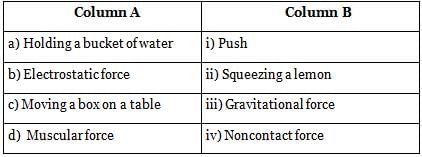
- a)a) ii, b) i, c ) iv ,d) iii
- b)a) i, b) ii, c ) iii , d) iv
- c)a) iii ,b) iv, c) i , d) ii
- d)a) i, b) iii, c)ii , d) iv
Correct answer is option 'C'. Can you explain this answer?
Match the column I with column II
a)
a) ii, b) i, c ) iv ,d) iii
b)
a) i, b) ii, c ) iii , d) iv
c)
a) iii ,b) iv, c) i , d) ii
d)
a) i, b) iii, c)ii , d) iv
| | Riverdale Learning Institute answered |
Contact and Non-contact forces:
- The force between two bodies when they are physically in contact is called contact force.
Examples: muscular force, frictional force, etc. - The force between the two bodies which are not in physical contact between the two objects is called non-contact force.
Examples: magnetic force, electrostatic force, gravitational force, etc. - The force which acts on the holding bucket is due to the gravitational force.
- The force of interaction that occurs between two charges is called electrostatic charge. It is a non-contact force.
- The force applied to move a body away from us is called Push. E.g. Moving a box on a table.
- The force which results due to the action of muscles is called muscular force. E.g. walking, running, squeezing a lemon.
So, the correct answer is : a) iii ,b) iv, c) i, d) ii.
Directions: Read the following passage carefully and answer the questions given below it.
Nature is an infinite source of beauty. Sunrise and sunset, mountains and rivers, lakes and glaciers, forests and fields provide joy and bliss to the human mind and heart for hours together. Everything in nature is splendid and divine. Every day and every season of the year has a peculiar beauty to unfold. Only one should have eyes to behold it and a heart to feel it like the English poet William Wordsworth who after seeing daffodils said: And then my heart with pleasure fills and dances with the daffodils?
Nature is a great teacher. Early man was thrilled with the beauty and wonders of nature. The Aryans worshipped nature. One can learn lessons in the vast school of nature. Unfortunately, the strife, the stress and the tension of modern life have made people immune to the beauties of nature. Their life is so full of care that they have no time to stand and stare. They cannot enjoy the beauty of lowing rivers, swinging trees, flying birds and majestic mountains and hills. There is, however, a cry to go back to the village from the concrete and artificial jungle of cities. Hence the town planners of today pay special attention to providing enough natural scenic spots in town planning To develop a balanced personality, one needs to have a healthy attitude which can make us appreciate and enjoy the beauty of nature. There is another balm to soothe our tired souls and listless minds than the infinite nature all around us. We should enjoy it fully to lead a balanced and harmonious life, full of peace and tranquility.Q. According to the author of the passage, Nature:
(a) is the ultimate salvation of man
(b) is the creator of this universe
(c) is abundantly glorious and divine
(d) maintains homeostasis in human beings- a)Only a
- b)Only b and c
- c)Only c
- d)Only d
Correct answer is option 'C'. Can you explain this answer?
Directions: Read the following passage carefully and answer the questions given below it.
Nature is an infinite source of beauty. Sunrise and sunset, mountains and rivers, lakes and glaciers, forests and fields provide joy and bliss to the human mind and heart for hours together. Everything in nature is splendid and divine. Every day and every season of the year has a peculiar beauty to unfold. Only one should have eyes to behold it and a heart to feel it like the English poet William Wordsworth who after seeing daffodils said: And then my heart with pleasure fills and dances with the daffodils?
Nature is a great teacher. Early man was thrilled with the beauty and wonders of nature. The Aryans worshipped nature. One can learn lessons in the vast school of nature. Unfortunately, the strife, the stress and the tension of modern life have made people immune to the beauties of nature. Their life is so full of care that they have no time to stand and stare. They cannot enjoy the beauty of lowing rivers, swinging trees, flying birds and majestic mountains and hills. There is, however, a cry to go back to the village from the concrete and artificial jungle of cities. Hence the town planners of today pay special attention to providing enough natural scenic spots in town planning To develop a balanced personality, one needs to have a healthy attitude which can make us appreciate and enjoy the beauty of nature. There is another balm to soothe our tired souls and listless minds than the infinite nature all around us. We should enjoy it fully to lead a balanced and harmonious life, full of peace and tranquility.
Nature is an infinite source of beauty. Sunrise and sunset, mountains and rivers, lakes and glaciers, forests and fields provide joy and bliss to the human mind and heart for hours together. Everything in nature is splendid and divine. Every day and every season of the year has a peculiar beauty to unfold. Only one should have eyes to behold it and a heart to feel it like the English poet William Wordsworth who after seeing daffodils said: And then my heart with pleasure fills and dances with the daffodils?
Nature is a great teacher. Early man was thrilled with the beauty and wonders of nature. The Aryans worshipped nature. One can learn lessons in the vast school of nature. Unfortunately, the strife, the stress and the tension of modern life have made people immune to the beauties of nature. Their life is so full of care that they have no time to stand and stare. They cannot enjoy the beauty of lowing rivers, swinging trees, flying birds and majestic mountains and hills. There is, however, a cry to go back to the village from the concrete and artificial jungle of cities. Hence the town planners of today pay special attention to providing enough natural scenic spots in town planning To develop a balanced personality, one needs to have a healthy attitude which can make us appreciate and enjoy the beauty of nature. There is another balm to soothe our tired souls and listless minds than the infinite nature all around us. We should enjoy it fully to lead a balanced and harmonious life, full of peace and tranquility.
Q. According to the author of the passage, Nature:
(a) is the ultimate salvation of man
(b) is the creator of this universe
(c) is abundantly glorious and divine
(d) maintains homeostasis in human beings
(a) is the ultimate salvation of man
(b) is the creator of this universe
(c) is abundantly glorious and divine
(d) maintains homeostasis in human beings
a)
Only a
b)
Only b and c
c)
Only c
d)
Only d
| | Eesha Bhat answered |
You will find the following lines when you read the 1st paragraph of the given passage.
- Nature is an infinite source of beauty. Sunrise and sunset, mountains and rivers, lakes and glaciers, forests and fields provide joy and bliss to the human mind and heart for hours together. Everything in nature is splendid and divine. Every day and every season of the year has a peculiar beauty to unfold. Only one should have eyes to behold it and a heart to feel it like the English poet William Wordsworth who after seeing daffodils said: And then my heart with pleasure fills and dances with the daffodils?
Thus, a, b and d are not among the motives of the passage.
Hence, the correct answer is "is abundantly glorious and divine"
Hence, the correct answer is "is abundantly glorious and divine"
Direction: Read the following information carefully and answer the given questions.
Initiatives such as “4 per mille” and Terraton aim to sequester huge amounts of carbon in the soil. The 2018 U.S. Farm Bill includes the first-ever incentives for farmers to adopt practices aimed at improving soil health and sequestering carbon. But these initiatives are missing a key point: not all soil carbon is the same.
The very different lifetimes of particulate organic matter and mineral-associated organic matter have important implications for these efforts. For example, adding low-quality crop residues to agricultural fields would likely create more particulate organic matter than mineral-associated organic matter. This could increase soil carbon in the short term - but if that field later is disturbed by tilling, a lot of it would decompose and the benefit would be quickly reversed. The best practices focus on building up the mineral-associated organic matter for longer-term carbon storage, while also producing high-quality particulate organic matter with lots of nitrogen to help boost crop productivity.
Natural healthy soils show us that providing continuous and diverse plant inputs that reach all the way to deep soil is key for achieving both high mineral-associated organic matter storage and particulate organic matter recycling. There are many promising ways to do this, such as maintaining plant cover on fields year-round; growing diverse crops that include high-nitrogen legumes and perennials with deep roots; and minimizing tillage.
However, not all soils can accumulate both mineral-associated organic matter and particulate organic matter. Before implementing any management practices for carbon sequestration, participants should first assess the carbon storage potential of the local soil, much as a doctor studies a patient before prescribing a cure. Sequestering soil carbon effectively requires an understanding of how particulate organic matter and mineral-associated organic matter work, how human actions affect them, and how to build up both types to meet our planet’s climate and food security needs.Q. Select the option whose meaning is opposite to the word 'accumulate'.- a)Disappear
- b)Dissipate
- c)Dispel
- d)Jubilate
Correct answer is option 'B'. Can you explain this answer?
Direction: Read the following information carefully and answer the given questions.
Initiatives such as “4 per mille” and Terraton aim to sequester huge amounts of carbon in the soil. The 2018 U.S. Farm Bill includes the first-ever incentives for farmers to adopt practices aimed at improving soil health and sequestering carbon. But these initiatives are missing a key point: not all soil carbon is the same.
The very different lifetimes of particulate organic matter and mineral-associated organic matter have important implications for these efforts. For example, adding low-quality crop residues to agricultural fields would likely create more particulate organic matter than mineral-associated organic matter. This could increase soil carbon in the short term - but if that field later is disturbed by tilling, a lot of it would decompose and the benefit would be quickly reversed. The best practices focus on building up the mineral-associated organic matter for longer-term carbon storage, while also producing high-quality particulate organic matter with lots of nitrogen to help boost crop productivity.
Natural healthy soils show us that providing continuous and diverse plant inputs that reach all the way to deep soil is key for achieving both high mineral-associated organic matter storage and particulate organic matter recycling. There are many promising ways to do this, such as maintaining plant cover on fields year-round; growing diverse crops that include high-nitrogen legumes and perennials with deep roots; and minimizing tillage.
However, not all soils can accumulate both mineral-associated organic matter and particulate organic matter. Before implementing any management practices for carbon sequestration, participants should first assess the carbon storage potential of the local soil, much as a doctor studies a patient before prescribing a cure. Sequestering soil carbon effectively requires an understanding of how particulate organic matter and mineral-associated organic matter work, how human actions affect them, and how to build up both types to meet our planet’s climate and food security needs.
Initiatives such as “4 per mille” and Terraton aim to sequester huge amounts of carbon in the soil. The 2018 U.S. Farm Bill includes the first-ever incentives for farmers to adopt practices aimed at improving soil health and sequestering carbon. But these initiatives are missing a key point: not all soil carbon is the same.
The very different lifetimes of particulate organic matter and mineral-associated organic matter have important implications for these efforts. For example, adding low-quality crop residues to agricultural fields would likely create more particulate organic matter than mineral-associated organic matter. This could increase soil carbon in the short term - but if that field later is disturbed by tilling, a lot of it would decompose and the benefit would be quickly reversed. The best practices focus on building up the mineral-associated organic matter for longer-term carbon storage, while also producing high-quality particulate organic matter with lots of nitrogen to help boost crop productivity.
Natural healthy soils show us that providing continuous and diverse plant inputs that reach all the way to deep soil is key for achieving both high mineral-associated organic matter storage and particulate organic matter recycling. There are many promising ways to do this, such as maintaining plant cover on fields year-round; growing diverse crops that include high-nitrogen legumes and perennials with deep roots; and minimizing tillage.
However, not all soils can accumulate both mineral-associated organic matter and particulate organic matter. Before implementing any management practices for carbon sequestration, participants should first assess the carbon storage potential of the local soil, much as a doctor studies a patient before prescribing a cure. Sequestering soil carbon effectively requires an understanding of how particulate organic matter and mineral-associated organic matter work, how human actions affect them, and how to build up both types to meet our planet’s climate and food security needs.
Q. Select the option whose meaning is opposite to the word 'accumulate'.
a)
Disappear
b)
Dissipate
c)
Dispel
d)
Jubilate
| | Anjana Chauhan answered |
Understanding the Opposite of "Accumulate"
The term "accumulate" refers to the process of gathering or collecting items or substances over time. In the context of soil carbon, it implies the build-up of carbon reserves in the soil. To find the opposite of "accumulate," we need to consider words that reflect the idea of loss or reduction.
Choosing the Right Opposite
- Disappearing (a): This implies that something is vanishing, but does not directly indicate a loss through dispersal or reduction.
- Dissipate (b): This term means to scatter or disperse, leading to a decrease in quantity or concentration. It closely aligns with the idea of carbon being lost from the soil rather than gathered.
- Dispel (c): This means to drive away or cause to vanish. While it relates to loss, it does not specifically imply the gradual process of reduction like "dissipate."
- Jubilate (d): This term means to rejoice or celebrate, which is unrelated to the concept of accumulation or its opposite.
The Correct Answer
The correct choice is option B: Dissipate. This word effectively captures the essence of losing or reducing carbon in the soil, contrasting with the idea of building up or accumulating carbon reserves.
Conclusion
Understanding these terms is crucial for discussions about soil health and carbon sequestration, as effective management practices must consider both building up and preventing the loss of critical soil components.
The term "accumulate" refers to the process of gathering or collecting items or substances over time. In the context of soil carbon, it implies the build-up of carbon reserves in the soil. To find the opposite of "accumulate," we need to consider words that reflect the idea of loss or reduction.
Choosing the Right Opposite
- Disappearing (a): This implies that something is vanishing, but does not directly indicate a loss through dispersal or reduction.
- Dissipate (b): This term means to scatter or disperse, leading to a decrease in quantity or concentration. It closely aligns with the idea of carbon being lost from the soil rather than gathered.
- Dispel (c): This means to drive away or cause to vanish. While it relates to loss, it does not specifically imply the gradual process of reduction like "dissipate."
- Jubilate (d): This term means to rejoice or celebrate, which is unrelated to the concept of accumulation or its opposite.
The Correct Answer
The correct choice is option B: Dissipate. This word effectively captures the essence of losing or reducing carbon in the soil, contrasting with the idea of building up or accumulating carbon reserves.
Conclusion
Understanding these terms is crucial for discussions about soil health and carbon sequestration, as effective management practices must consider both building up and preventing the loss of critical soil components.

How many times be a solution of pH = 3 diluted to get a solution of pH = 6?- a)2
- b)10
- c)100
- d)1000
Correct answer is option 'D'. Can you explain this answer?
How many times be a solution of pH = 3 diluted to get a solution of pH = 6?
a)
2
b)
10
c)
100
d)
1000
| | Eesha Bhat answered |
For pH = 3, [H+] = 10-3
For pH = 6, the [H+] required = 10-6
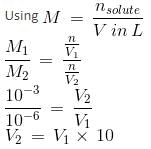
Therefore, the sample has to be diluted 103 times.
For pH = 6, the [H+] required = 10-6
Therefore, the sample has to be diluted 103 times.
Motivation begins with needs that exist in all of us. The need that the student would tend to fulfil first pertains to- a)esteem
- b)physiological
- c)social
- d)self-actualisation
Correct answer is option 'B'. Can you explain this answer?
Motivation begins with needs that exist in all of us. The need that the student would tend to fulfil first pertains to
a)
esteem
b)
physiological
c)
social
d)
self-actualisation
| | Sumit Singh answered |
The correct answer is option 'B' - physiological.
Motivation is the driving force behind our actions and behaviors. It is what compels us to take action and strive towards achieving our goals. Motivation begins with needs that exist in all of us, and these needs determine the direction of our motivation.
One of the most fundamental needs that we all have is physiological needs. These needs are essential for our survival and well-being. They include things like food, water, shelter, and sleep. Without fulfilling these needs, our physiological functioning is compromised, and we are unable to function optimally.
There are several reasons why the student would tend to fulfill their physiological needs first before other needs:
1. Survival: Physiological needs are necessary for our survival. Without fulfilling our basic needs for food, water, and shelter, our survival is at risk. Therefore, it is natural for us to prioritize these needs over other needs.
2. Biological priority: Our body has a natural inclination to prioritize physiological needs. When we are hungry or thirsty, our body sends signals to our brain to alert us to the need to eat or drink. These signals can be quite powerful and can override other needs and motivations.
3. Maslow's hierarchy of needs: Maslow's hierarchy of needs is a theory that suggests that human beings have a set of needs that are arranged in a hierarchical manner. According to this theory, physiological needs are at the base of the hierarchy and must be fulfilled before other needs, such as safety, love, esteem, and self-actualization, can be addressed.
4. Cognitive focus: When our physiological needs are not met, we tend to have a cognitive focus on fulfilling those needs. It becomes difficult to concentrate on other tasks or goals when hunger, thirst, or lack of sleep is present. Therefore, it makes sense for the student to prioritize fulfilling their physiological needs first in order to be able to focus and perform well in other areas of their life, including academics.
In conclusion, the student would tend to fulfill their physiological needs first because these needs are essential for survival, have a biological priority, are at the base of Maslow's hierarchy of needs, and affect cognitive focus.
Motivation is the driving force behind our actions and behaviors. It is what compels us to take action and strive towards achieving our goals. Motivation begins with needs that exist in all of us, and these needs determine the direction of our motivation.
One of the most fundamental needs that we all have is physiological needs. These needs are essential for our survival and well-being. They include things like food, water, shelter, and sleep. Without fulfilling these needs, our physiological functioning is compromised, and we are unable to function optimally.
There are several reasons why the student would tend to fulfill their physiological needs first before other needs:
1. Survival: Physiological needs are necessary for our survival. Without fulfilling our basic needs for food, water, and shelter, our survival is at risk. Therefore, it is natural for us to prioritize these needs over other needs.
2. Biological priority: Our body has a natural inclination to prioritize physiological needs. When we are hungry or thirsty, our body sends signals to our brain to alert us to the need to eat or drink. These signals can be quite powerful and can override other needs and motivations.
3. Maslow's hierarchy of needs: Maslow's hierarchy of needs is a theory that suggests that human beings have a set of needs that are arranged in a hierarchical manner. According to this theory, physiological needs are at the base of the hierarchy and must be fulfilled before other needs, such as safety, love, esteem, and self-actualization, can be addressed.
4. Cognitive focus: When our physiological needs are not met, we tend to have a cognitive focus on fulfilling those needs. It becomes difficult to concentrate on other tasks or goals when hunger, thirst, or lack of sleep is present. Therefore, it makes sense for the student to prioritize fulfilling their physiological needs first in order to be able to focus and perform well in other areas of their life, including academics.
In conclusion, the student would tend to fulfill their physiological needs first because these needs are essential for survival, have a biological priority, are at the base of Maslow's hierarchy of needs, and affect cognitive focus.
Direction: Read the passage given below and then answer the questions given below the passage. Some words may be highlighted for your attention.
The big fuss about consensus management is an issue that boils down to a lot of noise about not much. The consensus advocates are great admirers of the Japanese management style. Consensus is what Japan is famous for. Well, I know the Japanese fairly well: They still remember Douglas MacArthur with respect, and they still bow down to their Emperor. In my dealings with them, I found that they talk a lot about consensus, but there's always one guy behind the scenes who ends up making the tough decisions. It doesn't make sense to me to think that Mr. Toyoda or Mr. Morita of Sony sits around in committee meetings and says, "We've got to get everybody in this organization, from the janitor up, to agree with this move". The Japanese believe in their workers' involvement early on in the decision-making process and in feedback from employees. And they probably listen better than we do. But you can bet that when the chips are down, the yen stops at the top guy's desk. So, we're wasting time trying toDirection: Read the passage given below and then answer the questions given below the passage. Some words may be highlighted for your attention.
The big fuss about consensus management is an issue that boils down to a lot of noise about not much. The consensus advocates are great admirers of the Japanese management style. Consensus is what Japan is famous for. Well, I know the Japanese fairly well: They still remember Douglas MacArthur with respect, and they still bow down to their Emperor. In my dealings with them, I found that they talk a lot about consensus, but there's always one guy behind the scenes who ends up making the tough decisions. It doesn't make sense to me to think that Mr. Toyoda or Mr. Morita of Sony sits around in committee meetings and says, "We've got to get everybody in this organization, from the janitor up, to agree with this move". The Japanese believe in their workers' involvement early on in the decision-making process and in feedback from employees. And they probably listen better than we do. But you can bet that when the chips are down, the yen stops at the top guy's desk. So, we're wasting time trying to emulate something I don't think really exists.
Business structures are microcosms of other structures. There were no corporations in the fifteenth century. But there were families. There were city governments, provinces, and armies. There was the Church. All of them had, for lack of a better word, a pecking order.
Why? Because that's the only way you can steer clear of anarchy. Otherwise, you'll have somebody come in one morning and tell you: "Yesterday I got tired of painting red convertibles, so today I switched to all baby-blues on my own". You'll never get anything done right that way.
What's to admire about consensus management anyway? By its very nature, it's slow. It can never be daring. There can never be real accountability - or flexibility. About the only plus that I've been able to figure out is that consensus management means consistency of direction and objectives. And so much consistency can become faceless, and that's a problem too. In any event, I don't think it can work in this country. The fun of business for entrepreneurs, big or small, lies in the free enterprise system, not in the greatest agreement by the greatest number.
Business structures are microcosms of other structures. There were no corporations in the fifteenth century. But there were families. There were city governments, provinces, and armies. There was the Church. All of them had, for lack of a better word, a pecking order.
Why? Because that's the only way you can steer clear of anarchy. Otherwise, you'll have somebody come in one morning and tell you: "Yesterday I got tired of painting red convertibles, so today I switched to all baby-blues on my own". You'll never get anything done right that way.
What's to admire about consensus management anyway? By its very nature, it's slow. It can never be daring. There can never be real accountability - or flexibility. About the only plus that I've been able to figure out is that consensus management means consistency of direction and objectives. And so much consistency can become faceless, and that's a problem too. In any event, I don't think it can work in this country. The fun of business for entrepreneurs, big or small, lies in the free enterprise system, not in the greatest agreement by the greatest number.Q. Which of the following is true as per the given passage?- a)The author suggests that the Japanese practice consensus management in letter and spirit
- b)Consensus management is a very daring practice
- c)According to the author, consensus management cannot work in India
- d)None of the above
Correct answer is option 'D'. Can you explain this answer?
Direction: Read the passage given below and then answer the questions given below the passage. Some words may be highlighted for your attention.
The big fuss about consensus management is an issue that boils down to a lot of noise about not much. The consensus advocates are great admirers of the Japanese management style. Consensus is what Japan is famous for. Well, I know the Japanese fairly well: They still remember Douglas MacArthur with respect, and they still bow down to their Emperor. In my dealings with them, I found that they talk a lot about consensus, but there's always one guy behind the scenes who ends up making the tough decisions. It doesn't make sense to me to think that Mr. Toyoda or Mr. Morita of Sony sits around in committee meetings and says, "We've got to get everybody in this organization, from the janitor up, to agree with this move". The Japanese believe in their workers' involvement early on in the decision-making process and in feedback from employees. And they probably listen better than we do. But you can bet that when the chips are down, the yen stops at the top guy's desk. So, we're wasting time trying toDirection: Read the passage given below and then answer the questions given below the passage. Some words may be highlighted for your attention.
The big fuss about consensus management is an issue that boils down to a lot of noise about not much. The consensus advocates are great admirers of the Japanese management style. Consensus is what Japan is famous for. Well, I know the Japanese fairly well: They still remember Douglas MacArthur with respect, and they still bow down to their Emperor. In my dealings with them, I found that they talk a lot about consensus, but there's always one guy behind the scenes who ends up making the tough decisions. It doesn't make sense to me to think that Mr. Toyoda or Mr. Morita of Sony sits around in committee meetings and says, "We've got to get everybody in this organization, from the janitor up, to agree with this move". The Japanese believe in their workers' involvement early on in the decision-making process and in feedback from employees. And they probably listen better than we do. But you can bet that when the chips are down, the yen stops at the top guy's desk. So, we're wasting time trying to emulate something I don't think really exists.
Business structures are microcosms of other structures. There were no corporations in the fifteenth century. But there were families. There were city governments, provinces, and armies. There was the Church. All of them had, for lack of a better word, a pecking order.
Why? Because that's the only way you can steer clear of anarchy. Otherwise, you'll have somebody come in one morning and tell you: "Yesterday I got tired of painting red convertibles, so today I switched to all baby-blues on my own". You'll never get anything done right that way.
What's to admire about consensus management anyway? By its very nature, it's slow. It can never be daring. There can never be real accountability - or flexibility. About the only plus that I've been able to figure out is that consensus management means consistency of direction and objectives. And so much consistency can become faceless, and that's a problem too. In any event, I don't think it can work in this country. The fun of business for entrepreneurs, big or small, lies in the free enterprise system, not in the greatest agreement by the greatest number.
Business structures are microcosms of other structures. There were no corporations in the fifteenth century. But there were families. There were city governments, provinces, and armies. There was the Church. All of them had, for lack of a better word, a pecking order.
Why? Because that's the only way you can steer clear of anarchy. Otherwise, you'll have somebody come in one morning and tell you: "Yesterday I got tired of painting red convertibles, so today I switched to all baby-blues on my own". You'll never get anything done right that way.
What's to admire about consensus management anyway? By its very nature, it's slow. It can never be daring. There can never be real accountability - or flexibility. About the only plus that I've been able to figure out is that consensus management means consistency of direction and objectives. And so much consistency can become faceless, and that's a problem too. In any event, I don't think it can work in this country. The fun of business for entrepreneurs, big or small, lies in the free enterprise system, not in the greatest agreement by the greatest number.
The big fuss about consensus management is an issue that boils down to a lot of noise about not much. The consensus advocates are great admirers of the Japanese management style. Consensus is what Japan is famous for. Well, I know the Japanese fairly well: They still remember Douglas MacArthur with respect, and they still bow down to their Emperor. In my dealings with them, I found that they talk a lot about consensus, but there's always one guy behind the scenes who ends up making the tough decisions. It doesn't make sense to me to think that Mr. Toyoda or Mr. Morita of Sony sits around in committee meetings and says, "We've got to get everybody in this organization, from the janitor up, to agree with this move". The Japanese believe in their workers' involvement early on in the decision-making process and in feedback from employees. And they probably listen better than we do. But you can bet that when the chips are down, the yen stops at the top guy's desk. So, we're wasting time trying toDirection: Read the passage given below and then answer the questions given below the passage. Some words may be highlighted for your attention.
The big fuss about consensus management is an issue that boils down to a lot of noise about not much. The consensus advocates are great admirers of the Japanese management style. Consensus is what Japan is famous for. Well, I know the Japanese fairly well: They still remember Douglas MacArthur with respect, and they still bow down to their Emperor. In my dealings with them, I found that they talk a lot about consensus, but there's always one guy behind the scenes who ends up making the tough decisions. It doesn't make sense to me to think that Mr. Toyoda or Mr. Morita of Sony sits around in committee meetings and says, "We've got to get everybody in this organization, from the janitor up, to agree with this move". The Japanese believe in their workers' involvement early on in the decision-making process and in feedback from employees. And they probably listen better than we do. But you can bet that when the chips are down, the yen stops at the top guy's desk. So, we're wasting time trying to emulate something I don't think really exists.
Business structures are microcosms of other structures. There were no corporations in the fifteenth century. But there were families. There were city governments, provinces, and armies. There was the Church. All of them had, for lack of a better word, a pecking order.
Why? Because that's the only way you can steer clear of anarchy. Otherwise, you'll have somebody come in one morning and tell you: "Yesterday I got tired of painting red convertibles, so today I switched to all baby-blues on my own". You'll never get anything done right that way.
What's to admire about consensus management anyway? By its very nature, it's slow. It can never be daring. There can never be real accountability - or flexibility. About the only plus that I've been able to figure out is that consensus management means consistency of direction and objectives. And so much consistency can become faceless, and that's a problem too. In any event, I don't think it can work in this country. The fun of business for entrepreneurs, big or small, lies in the free enterprise system, not in the greatest agreement by the greatest number.
Business structures are microcosms of other structures. There were no corporations in the fifteenth century. But there were families. There were city governments, provinces, and armies. There was the Church. All of them had, for lack of a better word, a pecking order.
Why? Because that's the only way you can steer clear of anarchy. Otherwise, you'll have somebody come in one morning and tell you: "Yesterday I got tired of painting red convertibles, so today I switched to all baby-blues on my own". You'll never get anything done right that way.
What's to admire about consensus management anyway? By its very nature, it's slow. It can never be daring. There can never be real accountability - or flexibility. About the only plus that I've been able to figure out is that consensus management means consistency of direction and objectives. And so much consistency can become faceless, and that's a problem too. In any event, I don't think it can work in this country. The fun of business for entrepreneurs, big or small, lies in the free enterprise system, not in the greatest agreement by the greatest number.
Q. Which of the following is true as per the given passage?
a)
The author suggests that the Japanese practice consensus management in letter and spirit
b)
Consensus management is a very daring practice
c)
According to the author, consensus management cannot work in India
d)
None of the above
| | Riverdale Learning Institute answered |
Reading the passage we find that:
'To do something in letter and spirit' means 'to follow the rules surrounding it and their intentions completely' and nowhere in the entire passage does the author ask the Japanese to practise consensus management. Thus, Option (A) is incorrect.
The last paragraph states: 'What's to admire about consensus management anyway? By its very nature, it's slow. It can never be daring.' Thus, Option (B) is also incorrect.
Nowhere in the passage does the author talk about 'India' or about 'Japan's army'. Which shows that Option (C) and (D) are incorrect.
Thus, it is clear that the first four options are factually incorrect as they completely disregard what's been said in the passage.
'To do something in letter and spirit' means 'to follow the rules surrounding it and their intentions completely' and nowhere in the entire passage does the author ask the Japanese to practise consensus management. Thus, Option (A) is incorrect.
The last paragraph states: 'What's to admire about consensus management anyway? By its very nature, it's slow. It can never be daring.' Thus, Option (B) is also incorrect.
Nowhere in the passage does the author talk about 'India' or about 'Japan's army'. Which shows that Option (C) and (D) are incorrect.
Thus, it is clear that the first four options are factually incorrect as they completely disregard what's been said in the passage.
Multimedia resources:- a)Are an excellent replacement for teacher in all classes
- b)Create ambiguity in the minds of learner
- c)Can be explored as a learning resource if used judiciously
- d)Can be used effectively for the higher classes only
Correct answer is option 'C'. Can you explain this answer?
Multimedia resources:
a)
Are an excellent replacement for teacher in all classes
b)
Create ambiguity in the minds of learner
c)
Can be explored as a learning resource if used judiciously
d)
Can be used effectively for the higher classes only
| | Riverdale Learning Institute answered |
Multimedia resources can be explored as a learning resource if used judiciously.
- Learner–controlled material: It allows the learner to learn at its own pace. Active learning helps learners to comprehend the concepts in a better way.
- Interactivity: Interactivity keeps the learner active throughout the learning process and makes the learning more meaningful. It helps in better understanding and retention.
- Optimum use of resources: The multimedia resources should be used wisely at both side learner and teacher. These resources should be used for enhancing learning.
- Validated Programme: Since the IMM are validated by implementing on a large sample of learners, it assures quality and accuracy of the material. Expert validation discards the chances of errors.
- Multimedia Elements: All multimedia elements enable multi-sensory learning. It helps learners to visualize the learning experiences and makes learning concrete.
- Advanced technology: Advanced technologies allow us to provide varied and more relevant experiences. It allows game mode and simulation mode possible. Learners can themselves explore and experiment with the help of advanced technologies.
योजना शिक्षण विधि के प्रवर्तक है।- a)जॉन डीवी
- b)डब्ल्यू एच किलपैट्रिक
- c)डाल्टन
- d)अरस्तू
Correct answer is option 'B'. Can you explain this answer?
योजना शिक्षण विधि के प्रवर्तक है।
a)
जॉन डीवी
b)
डब्ल्यू एच किलपैट्रिक
c)
डाल्टन
d)
अरस्तू
| | Riverdale Learning Institute answered |
योजना/परियोजना शिक्षण विधि के प्रवर्तक 'डब्लयू. एच. किलपैट्रिक' हैं। यह विधि 'जॉन डेवी' द्वारा शुरू किए गए 'प्रोग्रेसिव एजुकेशन मूवमेंट' का उत्पाद थी परंतु बाद में इसे दुनिया भर में 'डब्ल्यू. एच. किलपैट्रिक' द्वारा विस्तार से वर्णित किया गया था।
यह विधि एक समूह में व्यावहारिक ज्ञान के प्रयोग द्वारा किसी परियोजना को पूरा करने के लिए छात्रों की सक्रिय भागीदारी को संदर्भित करती है।
इस पद्धति में जीवनोपयोगी शिक्षा दी जाती है तथा बच्चों को स्वयं के अनुभव द्वारा अर्थात खुद कर के सीखने का मौका दिया जाता है।
यह विधि एक समूह में व्यावहारिक ज्ञान के प्रयोग द्वारा किसी परियोजना को पूरा करने के लिए छात्रों की सक्रिय भागीदारी को संदर्भित करती है।
इस पद्धति में जीवनोपयोगी शिक्षा दी जाती है तथा बच्चों को स्वयं के अनुभव द्वारा अर्थात खुद कर के सीखने का मौका दिया जाता है।
निर्देश: निम्नलिखित गद्यांश को पढ़कर उसके आधार पर दिए गए प्रश्नों) के उत्तर के लिए सबसे उचित विकल्प चुनिए :
विनम्रता का यह कथन बहुत ठीक है कि विनम्रता के बिना स्वतंत्रता का कोई अर्थ नहीं। इस बात को सब लोग मानते हैं कि आत्मसंस्कार के लिए थोड़ी बहुत मानसिक स्वतंत्रता परमावश्यक है – चाहे उस स्वतंत्रता में अभिमान और नम्रता दोनों का मेल हो और चाहे वह नम्रता ही से उत्पन्न हो। यह बात तो निश्चित है कि जो मनुष्य मर्यादापूर्वक जीवन व्यतीत करना चाहता है उसके लिए वह गुण अनिवार्य है, जिससे आत्मनिर्भरता आती है और जिससे अपने पैरों के बल खड़ा होना आता है। युवा को यह सदा स्मरण रखना चाहिए कि वह बहुत कम बातें जानता है, अपने ही आदर्श से वह बहुत नीचे है और उसकी आकांक्षाएँ उसकी योग्यता से कहीं बढ़ी हुई हैं। उसे इस बात का ध्यान रखना चाहिए कि वह अपने बड़ों का सम्मान करे, छोटे और बराबर वालों से कोमलता का व्यवहार करे, ये बातें आत्म-मर्यादा के लिए आवश्यक हैं। यह सारा संसार, जो कुछ हम हैं और जो कुछ हमारा है – हमारा शरीर, हमारी आत्मा, - हमारे कर्म, हमारे भोग, हमारे घर और बाहर की दशा हमारे बहुत से अवगुण, और थोड़े गुण सब इसी बात की आवश्यकता प्रकट करते हैं कि हमें अपनी आत्मा को नम्र रखना चाहिए। नम्रता से मेरा अभिप्राय दब्बूपन से नहीं है जिसके कारण मनुष्य दूसरों का मुँह ताकता है जिससे उसका संकल्प क्षीण और उसकी प्रज्ञा मंद हो जाती है, जिसके कारण बढ़ने के समय भी पीछे रहता है और अवसर पड़ने पर झट से किसी बात का निर्णय नहीं कर सकता। मनुष्य का बेड़ा उसके अपने ही हाथ में है, उसे वह चाहे जिधर ले जाए। सच्ची आत्मा वही है जो प्रत्येक दशा में प्रत्येक स्थिति के बीच अपनी राह आप निकालती है।Q. आत्म-मर्यादा के लिए आवश्यक है -- a)अपने से बड़ों का सम्मान करना तथा छोटों और बराबर वालों से कोमलतापूर्वक व्यवहार करना
- b)अपनी मर्यादा में रहना
- c)विनम्रता का व्यवहार करना
- d)अपनी आत्मा को नम्र रखना ।
Correct answer is option 'A'. Can you explain this answer?
निर्देश: निम्नलिखित गद्यांश को पढ़कर उसके आधार पर दिए गए प्रश्नों) के उत्तर के लिए सबसे उचित विकल्प चुनिए :
विनम्रता का यह कथन बहुत ठीक है कि विनम्रता के बिना स्वतंत्रता का कोई अर्थ नहीं। इस बात को सब लोग मानते हैं कि आत्मसंस्कार के लिए थोड़ी बहुत मानसिक स्वतंत्रता परमावश्यक है – चाहे उस स्वतंत्रता में अभिमान और नम्रता दोनों का मेल हो और चाहे वह नम्रता ही से उत्पन्न हो। यह बात तो निश्चित है कि जो मनुष्य मर्यादापूर्वक जीवन व्यतीत करना चाहता है उसके लिए वह गुण अनिवार्य है, जिससे आत्मनिर्भरता आती है और जिससे अपने पैरों के बल खड़ा होना आता है। युवा को यह सदा स्मरण रखना चाहिए कि वह बहुत कम बातें जानता है, अपने ही आदर्श से वह बहुत नीचे है और उसकी आकांक्षाएँ उसकी योग्यता से कहीं बढ़ी हुई हैं। उसे इस बात का ध्यान रखना चाहिए कि वह अपने बड़ों का सम्मान करे, छोटे और बराबर वालों से कोमलता का व्यवहार करे, ये बातें आत्म-मर्यादा के लिए आवश्यक हैं। यह सारा संसार, जो कुछ हम हैं और जो कुछ हमारा है – हमारा शरीर, हमारी आत्मा, - हमारे कर्म, हमारे भोग, हमारे घर और बाहर की दशा हमारे बहुत से अवगुण, और थोड़े गुण सब इसी बात की आवश्यकता प्रकट करते हैं कि हमें अपनी आत्मा को नम्र रखना चाहिए। नम्रता से मेरा अभिप्राय दब्बूपन से नहीं है जिसके कारण मनुष्य दूसरों का मुँह ताकता है जिससे उसका संकल्प क्षीण और उसकी प्रज्ञा मंद हो जाती है, जिसके कारण बढ़ने के समय भी पीछे रहता है और अवसर पड़ने पर झट से किसी बात का निर्णय नहीं कर सकता। मनुष्य का बेड़ा उसके अपने ही हाथ में है, उसे वह चाहे जिधर ले जाए। सच्ची आत्मा वही है जो प्रत्येक दशा में प्रत्येक स्थिति के बीच अपनी राह आप निकालती है।
विनम्रता का यह कथन बहुत ठीक है कि विनम्रता के बिना स्वतंत्रता का कोई अर्थ नहीं। इस बात को सब लोग मानते हैं कि आत्मसंस्कार के लिए थोड़ी बहुत मानसिक स्वतंत्रता परमावश्यक है – चाहे उस स्वतंत्रता में अभिमान और नम्रता दोनों का मेल हो और चाहे वह नम्रता ही से उत्पन्न हो। यह बात तो निश्चित है कि जो मनुष्य मर्यादापूर्वक जीवन व्यतीत करना चाहता है उसके लिए वह गुण अनिवार्य है, जिससे आत्मनिर्भरता आती है और जिससे अपने पैरों के बल खड़ा होना आता है। युवा को यह सदा स्मरण रखना चाहिए कि वह बहुत कम बातें जानता है, अपने ही आदर्श से वह बहुत नीचे है और उसकी आकांक्षाएँ उसकी योग्यता से कहीं बढ़ी हुई हैं। उसे इस बात का ध्यान रखना चाहिए कि वह अपने बड़ों का सम्मान करे, छोटे और बराबर वालों से कोमलता का व्यवहार करे, ये बातें आत्म-मर्यादा के लिए आवश्यक हैं। यह सारा संसार, जो कुछ हम हैं और जो कुछ हमारा है – हमारा शरीर, हमारी आत्मा, - हमारे कर्म, हमारे भोग, हमारे घर और बाहर की दशा हमारे बहुत से अवगुण, और थोड़े गुण सब इसी बात की आवश्यकता प्रकट करते हैं कि हमें अपनी आत्मा को नम्र रखना चाहिए। नम्रता से मेरा अभिप्राय दब्बूपन से नहीं है जिसके कारण मनुष्य दूसरों का मुँह ताकता है जिससे उसका संकल्प क्षीण और उसकी प्रज्ञा मंद हो जाती है, जिसके कारण बढ़ने के समय भी पीछे रहता है और अवसर पड़ने पर झट से किसी बात का निर्णय नहीं कर सकता। मनुष्य का बेड़ा उसके अपने ही हाथ में है, उसे वह चाहे जिधर ले जाए। सच्ची आत्मा वही है जो प्रत्येक दशा में प्रत्येक स्थिति के बीच अपनी राह आप निकालती है।
Q. आत्म-मर्यादा के लिए आवश्यक है -
a)
अपने से बड़ों का सम्मान करना तथा छोटों और बराबर वालों से कोमलतापूर्वक व्यवहार करना
b)
अपनी मर्यादा में रहना
c)
विनम्रता का व्यवहार करना
d)
अपनी आत्मा को नम्र रखना ।
 | S.S Career Academy answered |
आत्म-मर्यादा के लिए आवश्यक है - 'अपने से बड़ों का सम्मान करना तथा छोटों और बराबर वालों से कोमलतापूर्वक व्यवहार करना'
गद्यांश के अनुसार:-
गद्यांश के अनुसार:-
- युवा को यह सदा स्मरण रखना चाहिए कि वह बहुत कम बातें जानता है,
- अपने ही आदर्श से वह बहुत नीचे है और उसकी आकांक्षाएँ उसकी योग्यता से कहीं बढ़ी हुई हैं।
- उसे इस बात का ध्यान रखना चाहिए कि वह अपने बड़ों का सम्मान करे,
- छोटे और बराबर वालों से कोमलता का व्यवहार करे, ये बातें आत्म-मर्यादा के लिए आवश्यक हैं ।
The diagonal of a rectangle is 17 cm and its area is 120 cm2. The perimeter of the rectangle is ____- a)23 cm
- b)32 cm
- c)30 cm
- d)46 cm
Correct answer is option 'D'. Can you explain this answer?
The diagonal of a rectangle is 17 cm and its area is 120 cm2. The perimeter of the rectangle is ____
a)
23 cm
b)
32 cm
c)
30 cm
d)
46 cm
| | Anjali Gupta answered |
Given:
The diagonal of a rectangle = 17 cm
The area of the rectangle = 120 cm2
Formula used:
The diagonal of a rectangle = √(Length2 + Width2)
The area of a rectangle = Length × Width
The perimeter of a rectangle = 2 (Length + Width)
Calculation:
Let, the length of the rectangle = L
The width of the rectangle = W
Then, L × W = 120 .....(1)
Also, √(L2 + W2) = 17
⇒ (L2 + W2) = 172 [Squaring on both sides]
⇒ (L2 + W2) = 289
⇒ (L + W)2 - 2 × L × W = 289 [By using a2 + b2 = (a + b)2 - 2ab formula]
⇒ (L + W)2 - 2 × 120 = 289 [From the equation (1), L × W = 120]
⇒ (L + W)2 - 240 = 289
⇒ (L + W)2 = 289 + 240
⇒ (L + W)2 = 529
⇒ (L + W) = √529 [Taking square root of both sides]
⇒ (L + W) = 23 .....(2)
Now, The perimeter of the rectangle = 2 (L + W)
= 2 × 23 [∵ (L + W) = 23]
= 46 cm
∴ The perimeter of the rectangle is 46 cm.
The diagonal of a rectangle = 17 cm
The area of the rectangle = 120 cm2
Formula used:
The diagonal of a rectangle = √(Length2 + Width2)
The area of a rectangle = Length × Width
The perimeter of a rectangle = 2 (Length + Width)
Calculation:
Let, the length of the rectangle = L
The width of the rectangle = W
Then, L × W = 120 .....(1)
Also, √(L2 + W2) = 17
⇒ (L2 + W2) = 172 [Squaring on both sides]
⇒ (L2 + W2) = 289
⇒ (L + W)2 - 2 × L × W = 289 [By using a2 + b2 = (a + b)2 - 2ab formula]
⇒ (L + W)2 - 2 × 120 = 289 [From the equation (1), L × W = 120]
⇒ (L + W)2 - 240 = 289
⇒ (L + W)2 = 289 + 240
⇒ (L + W)2 = 529
⇒ (L + W) = √529 [Taking square root of both sides]
⇒ (L + W) = 23 .....(2)
Now, The perimeter of the rectangle = 2 (L + W)
= 2 × 23 [∵ (L + W) = 23]
= 46 cm
∴ The perimeter of the rectangle is 46 cm.
The digital revolution has indisputably reshaped our society, permeating virtually every facet of life. We live in a hyperconnected era, where the boundary between the real and virtual worlds is increasingly blurred. Though its benefits are myriad, it's worth pausing to consider the potential downsides of this digital immersion.
On the one hand, technology has democratized information, fostering global connectivity and accessibility. The internet, smartphones, and various digital platforms have empowered us with the ability to learn, communicate, and collaborate like never before. They have catapulted us into an era of unprecedented convenience and opportunity, where we can virtually traverse the globe with a simple click.
Yet, this digital immersion also comes with pitfalls. The unending influx of information can overwhelm our cognitive capabilities, leading to information overload. The constant bombardment of updates, notifications, and messages can disrupt our focus, leading to a condition known as "digital fatigue." Further, it's alarming to see the increasing prevalence of cyberbullying, privacy breaches, and disinformation campaigns, which have severe consequences on our societal harmony.
The digital revolution is a double-edged sword. It grants us unparalleled access to knowledge, yet it can also breed distraction, misinformation, and anxiety. We need to strike a balance, leveraging the best of what technology offers while mitigating its downsides. As we continue to navigate this digital landscape, it's crucial to remember that technology is merely a tool—it's how we use it that ultimately defines its impact.Q. Which word from the passage is most similar in meaning to "immersion"?- a)Separation
- b)Isolation
- c)Involvement
- d)Detachment
Correct answer is option 'C'. Can you explain this answer?
The digital revolution has indisputably reshaped our society, permeating virtually every facet of life. We live in a hyperconnected era, where the boundary between the real and virtual worlds is increasingly blurred. Though its benefits are myriad, it's worth pausing to consider the potential downsides of this digital immersion.
On the one hand, technology has democratized information, fostering global connectivity and accessibility. The internet, smartphones, and various digital platforms have empowered us with the ability to learn, communicate, and collaborate like never before. They have catapulted us into an era of unprecedented convenience and opportunity, where we can virtually traverse the globe with a simple click.
Yet, this digital immersion also comes with pitfalls. The unending influx of information can overwhelm our cognitive capabilities, leading to information overload. The constant bombardment of updates, notifications, and messages can disrupt our focus, leading to a condition known as "digital fatigue." Further, it's alarming to see the increasing prevalence of cyberbullying, privacy breaches, and disinformation campaigns, which have severe consequences on our societal harmony.
The digital revolution is a double-edged sword. It grants us unparalleled access to knowledge, yet it can also breed distraction, misinformation, and anxiety. We need to strike a balance, leveraging the best of what technology offers while mitigating its downsides. As we continue to navigate this digital landscape, it's crucial to remember that technology is merely a tool—it's how we use it that ultimately defines its impact.
On the one hand, technology has democratized information, fostering global connectivity and accessibility. The internet, smartphones, and various digital platforms have empowered us with the ability to learn, communicate, and collaborate like never before. They have catapulted us into an era of unprecedented convenience and opportunity, where we can virtually traverse the globe with a simple click.
Yet, this digital immersion also comes with pitfalls. The unending influx of information can overwhelm our cognitive capabilities, leading to information overload. The constant bombardment of updates, notifications, and messages can disrupt our focus, leading to a condition known as "digital fatigue." Further, it's alarming to see the increasing prevalence of cyberbullying, privacy breaches, and disinformation campaigns, which have severe consequences on our societal harmony.
The digital revolution is a double-edged sword. It grants us unparalleled access to knowledge, yet it can also breed distraction, misinformation, and anxiety. We need to strike a balance, leveraging the best of what technology offers while mitigating its downsides. As we continue to navigate this digital landscape, it's crucial to remember that technology is merely a tool—it's how we use it that ultimately defines its impact.
Q. Which word from the passage is most similar in meaning to "immersion"?
a)
Separation
b)
Isolation
c)
Involvement
d)
Detachment
| | Riverdale Learning Institute answered |
- "Immersion" in the given passage refers to being deeply involved or fully engaged in something.
Ex - John's immersion in his work allowed him to produce exceptional results." - "Involvement," means actively participating or being engaged in a particular activity or situation.
Ex - School officials say they welcome parental involvement.
So, it is clear that 'immersion' and 'involvement' are similar in meaning.
Thus, the correct answer is Option 3.
Thus, the correct answer is Option 3.
A box contains some slips on which numbers 25, 26, 27, ..........49, are written (one number in one slip). A slip is drawn at random from the box. What is the probability that the selected slip bears a prime number?- a)0.16
- b)0.24
- c)0.28
- d)0.36
Correct answer is option 'B'. Can you explain this answer?
A box contains some slips on which numbers 25, 26, 27, ..........49, are written (one number in one slip). A slip is drawn at random from the box. What is the probability that the selected slip bears a prime number?
a)
0.16
b)
0.24
c)
0.28
d)
0.36
| | Aishani Nair answered |
To find the probability of selecting a prime number, we need to first determine the total number of slips in the box and then count the number of slips that have prime numbers written on them.
Total number of slips:
Given that the numbers on the slips start from 25 and go up to 49, we can calculate the total number of slips using the formula for the number of terms in an arithmetic sequence:
n = (last term - first term)/common difference + 1
n = (49 - 25)/1 + 1
n = 25 + 1
n = 26
Counting the number of prime numbers:
We need to determine how many numbers between 25 and 49 are prime. Prime numbers are numbers greater than 1 that have no divisors other than 1 and themselves. We can go through each number in the range and check if it is prime.
Prime numbers between 25 and 49 are: 29, 31, 37, 41, 43, and 47. There are a total of 6 prime numbers.
Calculating the probability:
The probability of selecting a prime number is given by the ratio of the number of favorable outcomes (prime numbers) to the total number of outcomes (total slips).
Probability = Number of favorable outcomes / Total number of outcomes
Probability = 6/26
Probability = 3/13
Converting the probability to decimal form, we get:
Probability = 0.23076923076923078
Rounding the probability to two decimal places, the answer is approximately 0.23, which corresponds to option B.
So, the correct answer is option B) 0.24.
Total number of slips:
Given that the numbers on the slips start from 25 and go up to 49, we can calculate the total number of slips using the formula for the number of terms in an arithmetic sequence:
n = (last term - first term)/common difference + 1
n = (49 - 25)/1 + 1
n = 25 + 1
n = 26
Counting the number of prime numbers:
We need to determine how many numbers between 25 and 49 are prime. Prime numbers are numbers greater than 1 that have no divisors other than 1 and themselves. We can go through each number in the range and check if it is prime.
Prime numbers between 25 and 49 are: 29, 31, 37, 41, 43, and 47. There are a total of 6 prime numbers.
Calculating the probability:
The probability of selecting a prime number is given by the ratio of the number of favorable outcomes (prime numbers) to the total number of outcomes (total slips).
Probability = Number of favorable outcomes / Total number of outcomes
Probability = 6/26
Probability = 3/13
Converting the probability to decimal form, we get:
Probability = 0.23076923076923078
Rounding the probability to two decimal places, the answer is approximately 0.23, which corresponds to option B.
So, the correct answer is option B) 0.24.
"It is normally distributed in nature, it is a joint product of both heredity and environment; it grows with age and its vertical growth ceases at the age of 16 to 20". This passage is related to:- a)Intelligence
- b)Development
- c)Growth
- d)Interaction
Correct answer is option 'C'. Can you explain this answer?
"It is normally distributed in nature, it is a joint product of both heredity and environment; it grows with age and its vertical growth ceases at the age of 16 to 20". This passage is related to:
a)
Intelligence
b)
Development
c)
Growth
d)
Interaction
 | Komal Shukla answered |
It can be development
The HCF of 1683, 2244 and 5049 is x. The sum of digits of x is- a)15
- b)11
- c)13
- d)12
Correct answer is option 'D'. Can you explain this answer?
The HCF of 1683, 2244 and 5049 is x. The sum of digits of x is
a)
15
b)
11
c)
13
d)
12
| | S.S Career Academy answered |
Given:
The HCF of 1683, 2244 and 5049 is x.
Concept used:
HCF - The greatest number which divides each of the two or more numbers
Calculation:
⇒ 1683 = 3 × 3 × 11 × 17
⇒ 2244 = 2 × 2 × 3 × 11 × 17
⇒ 5049 = 3 × 3 × 3 × 11 × 17
The HCF = (3 × 11 × 17)
⇒ 561
So,
⇒ x = 561
Now,
The sum of digits of x = (5 + 6 + 1)
⇒ 12
∴ The required sum of digits of x is 12.
The HCF of 1683, 2244 and 5049 is x.
Concept used:
HCF - The greatest number which divides each of the two or more numbers
Calculation:
⇒ 1683 = 3 × 3 × 11 × 17
⇒ 2244 = 2 × 2 × 3 × 11 × 17
⇒ 5049 = 3 × 3 × 3 × 11 × 17
The HCF = (3 × 11 × 17)
⇒ 561
So,
⇒ x = 561
Now,
The sum of digits of x = (5 + 6 + 1)
⇒ 12
∴ The required sum of digits of x is 12.
When a child gets bored while doing a task, it is a sign that:- a)the task may have become mechanically repetitive.
- b)the child is not intelligent.
- c)the child is not capable of learning.
- d)the child needs to be disciplined.
Correct answer is option 'A'. Can you explain this answer?
When a child gets bored while doing a task, it is a sign that:
a)
the task may have become mechanically repetitive.
b)
the child is not intelligent.
c)
the child is not capable of learning.
d)
the child needs to be disciplined.
| | S.S Career Academy answered |
When a child gets bored while doing a task, it is a sign that the task may have become mechanically repetitive.
These activities have the following characteristics to avoid boredom in the classroom:
These activities have the following characteristics to avoid boredom in the classroom:
- It allows vigorous physical activity as children are energetic. Keeping this in mind, plan play activities involving running, jumping, climbing, catching and throwing.
- During the day there should be some indoor and some outdoor play activities. Outdoor play is generally vigorous and indoor activities are usually quieter.
- There must be a balance between structured activities initiated by you and free play initiated by the children. For example, taking the children out on a trip or organizing activities around a particular theme are structured activities.
- During the day you must organize both group and individual activities. The group activities will foster a spirit of cooperation and social skills, while the individual activities will give the child a chance to be alone and do something on her own, hence children are intelligent enough to do things by their own, and are capable of learning.
- The schedule of activities should be at a reasonable pace throughout the day. This means that you should allow enough time to children. But it should not be too slow that children begin to repeat it after completing it, else it will make children bored.
Direction: Read the following passage and answer the question. (choose the most appropriate answers)
When another old cave is discovered in the South France, it is not usually news. Rather, it is an ordinary event. Such discoveries are so frequent these days that hardly anybody pays heed to them. However, when the Lascaux cave complex was discovered in 1940, the world was amazed. Painted directly on its walls were hundreds of scenes showing how people lived thousands of years ago. The scenes show people hunting animals , such as bison or wild cats. Other images depict birds and, most noticeably, horses, which appear in more than 300 wall images, by far outnumbering all other animals. Early artists drawing these animals accomplished a monumental difficult task. They did not limit themselves to the easily accessible walls but carried their painting materials to spaces that required climbing steep walls or crawling into narrow passages in the Lascaux complex. Unfortunately, the paintings have been exposed to the destructive action of water and temperature changes, which easily wear the images away. Because the Lascaux caves have many entrances, air movement has also damaged the images inside, Although they are not out in the open air, where natural light would have destroyed them long ago, many of the images have deteriorated and are barely recognizable. To prevent further damage, the site was closed to tourists in 1963, 23 years after it was discovered.Q. The underlined word ‘However’ is used in the sentence as :- a)adjective
- b)preposition
- c)adverb
- d)exclamation
Correct answer is option 'C'. Can you explain this answer?
Direction: Read the following passage and answer the question. (choose the most appropriate answers)
When another old cave is discovered in the South France, it is not usually news. Rather, it is an ordinary event. Such discoveries are so frequent these days that hardly anybody pays heed to them. However, when the Lascaux cave complex was discovered in 1940, the world was amazed. Painted directly on its walls were hundreds of scenes showing how people lived thousands of years ago. The scenes show people hunting animals , such as bison or wild cats. Other images depict birds and, most noticeably, horses, which appear in more than 300 wall images, by far outnumbering all other animals. Early artists drawing these animals accomplished a monumental difficult task. They did not limit themselves to the easily accessible walls but carried their painting materials to spaces that required climbing steep walls or crawling into narrow passages in the Lascaux complex. Unfortunately, the paintings have been exposed to the destructive action of water and temperature changes, which easily wear the images away. Because the Lascaux caves have many entrances, air movement has also damaged the images inside, Although they are not out in the open air, where natural light would have destroyed them long ago, many of the images have deteriorated and are barely recognizable. To prevent further damage, the site was closed to tourists in 1963, 23 years after it was discovered.
When another old cave is discovered in the South France, it is not usually news. Rather, it is an ordinary event. Such discoveries are so frequent these days that hardly anybody pays heed to them. However, when the Lascaux cave complex was discovered in 1940, the world was amazed. Painted directly on its walls were hundreds of scenes showing how people lived thousands of years ago. The scenes show people hunting animals , such as bison or wild cats. Other images depict birds and, most noticeably, horses, which appear in more than 300 wall images, by far outnumbering all other animals. Early artists drawing these animals accomplished a monumental difficult task. They did not limit themselves to the easily accessible walls but carried their painting materials to spaces that required climbing steep walls or crawling into narrow passages in the Lascaux complex. Unfortunately, the paintings have been exposed to the destructive action of water and temperature changes, which easily wear the images away. Because the Lascaux caves have many entrances, air movement has also damaged the images inside, Although they are not out in the open air, where natural light would have destroyed them long ago, many of the images have deteriorated and are barely recognizable. To prevent further damage, the site was closed to tourists in 1963, 23 years after it was discovered.
Q. The underlined word ‘However’ is used in the sentence as :
a)
adjective
b)
preposition
c)
adverb
d)
exclamation
| | Eesha Bhat answered |
Let's discuss the marked option first; i.e. 'Adverb':
- Adverbs are used to add more information about a verb, an adjective, another adverb, a clause or a whole sentence.
E.g. - very tall (modifying adjective 'tall'), ended too quickly (modifying another adverb 'quickly), Fortunately, I had brought an umbrella (modifying the whole sentence). - However (adverb): despite what has been said earlier
Ex: This is one possible solution to the problem. However, there are others. ('however' is modifying the whole clause 'This is one possible solution to the problem')
Similarly, in the given question sentence, 'however' adds information to the previous sentence 'Such discoveries are so frequent these days that hardly anybody pays heed to them'.
Therefore, the correct part of speech of the asked word is 'Adverb'.
Option 3) is the correct answer.
Therefore, the correct part of speech of the asked word is 'Adverb'.
Option 3) is the correct answer.
Directions: Read the following passage carefully and answer the questions given below it.
Nature is an infinite source of beauty. Sunrise and sunset, mountains and rivers, lakes and glaciers, forests and fields provide joy and bliss to the human mind and heart for hours together. Everything in nature is splendid and divine. Every day and every season of the year has a peculiar beauty to unfold. Only one should have eyes to behold it and a heart to feel it like the English poet William Wordsworth who after seeing daffodils said: And then my heart with pleasure fills and dances with the daffodils?
Nature is a great teacher. Early man was thrilled with the beauty and wonders of nature. The Aryans worshipped nature. One can learn lessons in the vast school of nature. Unfortunately, the strife, the stress and the tension of modern life have made people immune to the beauties of nature. Their life is so full of care that they have no time to stand and stare. They cannot enjoy the beauty of lowing rivers, swinging trees, flying birds and majestic mountains and hills. There is, however, a cry to go back to the village from the concrete and artificial jungle of cities. Hence the town planners of today pay special attention to providing enough natural scenic spots in town planning To develop a balanced personality, one needs to have a healthy attitude which can make us appreciate and enjoy the beauty of nature. There is another balm to soothe our tired souls and listless minds than the infinite nature all around us. We should enjoy it fully to lead a balanced and harmonious life, full of peace and tranquility.Q. What are the town planners doing today?- a)Providing facilities for enjoying nature
- b)Establishing balance between concrete and artificial jungle of cities
- c)Supporting the cry to go back to villages
- d)Making efforts to inculcate healthy attitude among people
Correct answer is option 'A'. Can you explain this answer?
Directions: Read the following passage carefully and answer the questions given below it.
Nature is an infinite source of beauty. Sunrise and sunset, mountains and rivers, lakes and glaciers, forests and fields provide joy and bliss to the human mind and heart for hours together. Everything in nature is splendid and divine. Every day and every season of the year has a peculiar beauty to unfold. Only one should have eyes to behold it and a heart to feel it like the English poet William Wordsworth who after seeing daffodils said: And then my heart with pleasure fills and dances with the daffodils?
Nature is a great teacher. Early man was thrilled with the beauty and wonders of nature. The Aryans worshipped nature. One can learn lessons in the vast school of nature. Unfortunately, the strife, the stress and the tension of modern life have made people immune to the beauties of nature. Their life is so full of care that they have no time to stand and stare. They cannot enjoy the beauty of lowing rivers, swinging trees, flying birds and majestic mountains and hills. There is, however, a cry to go back to the village from the concrete and artificial jungle of cities. Hence the town planners of today pay special attention to providing enough natural scenic spots in town planning To develop a balanced personality, one needs to have a healthy attitude which can make us appreciate and enjoy the beauty of nature. There is another balm to soothe our tired souls and listless minds than the infinite nature all around us. We should enjoy it fully to lead a balanced and harmonious life, full of peace and tranquility.
Nature is an infinite source of beauty. Sunrise and sunset, mountains and rivers, lakes and glaciers, forests and fields provide joy and bliss to the human mind and heart for hours together. Everything in nature is splendid and divine. Every day and every season of the year has a peculiar beauty to unfold. Only one should have eyes to behold it and a heart to feel it like the English poet William Wordsworth who after seeing daffodils said: And then my heart with pleasure fills and dances with the daffodils?
Nature is a great teacher. Early man was thrilled with the beauty and wonders of nature. The Aryans worshipped nature. One can learn lessons in the vast school of nature. Unfortunately, the strife, the stress and the tension of modern life have made people immune to the beauties of nature. Their life is so full of care that they have no time to stand and stare. They cannot enjoy the beauty of lowing rivers, swinging trees, flying birds and majestic mountains and hills. There is, however, a cry to go back to the village from the concrete and artificial jungle of cities. Hence the town planners of today pay special attention to providing enough natural scenic spots in town planning To develop a balanced personality, one needs to have a healthy attitude which can make us appreciate and enjoy the beauty of nature. There is another balm to soothe our tired souls and listless minds than the infinite nature all around us. We should enjoy it fully to lead a balanced and harmonious life, full of peace and tranquility.
Q. What are the town planners doing today?
a)
Providing facilities for enjoying nature
b)
Establishing balance between concrete and artificial jungle of cities
c)
Supporting the cry to go back to villages
d)
Making efforts to inculcate healthy attitude among people
 | Kunaal Satija answered |
When you the 2nd paragraph of the given passage, you will find the following lines:
Nature is a great teacher. Early man was thrilled with the beauty and wonders of nature. The Aryans worshipped nature. One can learn lessons in the vast school of nature. Unfortunately, the strife, the stress and the tension of modern life have made people immune to the beauties of nature. Their life is so full of care that they have no time to stand and stare. They cannot enjoy the beauty of lowing rivers, swinging trees, flying birds and majestic mountains and hills. There is, however, a cry to go back to the village from the concrete and artificial jungle of cities. Hence the town planners of today pay special attention to providing enough natural scenic spots in town planning
The highlighted sentences show that town planners provide something to feel like nature, which means they are providing facilities for enjoying nature.
Hence, the correct sentence is "option 1"
Nature is a great teacher. Early man was thrilled with the beauty and wonders of nature. The Aryans worshipped nature. One can learn lessons in the vast school of nature. Unfortunately, the strife, the stress and the tension of modern life have made people immune to the beauties of nature. Their life is so full of care that they have no time to stand and stare. They cannot enjoy the beauty of lowing rivers, swinging trees, flying birds and majestic mountains and hills. There is, however, a cry to go back to the village from the concrete and artificial jungle of cities. Hence the town planners of today pay special attention to providing enough natural scenic spots in town planning
The highlighted sentences show that town planners provide something to feel like nature, which means they are providing facilities for enjoying nature.
Hence, the correct sentence is "option 1"
Direction: Read the following passage and answer the questions that follow.
She was one of those pretty and charming girls born, as if by an error of fate, into a family of clerks. She had no dowry, no expectations, no means of becoming known, understood, loved, or wedded by a man of wealth and distinction. So she let herself be married to a minor official at the Ministry of Education.
She dressed plainly because she had never been able to afford anything better, but she was as unhappy as if she had once been wealthy. Women don't belong to a caste or class; their beauty, grace, and natural charm take the place of birth and family. Natural delicacy, instinctive elegance, and a quick wit determine their place in society and make the daughters of commoners the equals of the very finest ladies.
She suffered endlessly, feeling she was entitled to all the delicacies and luxuries of life. She suffered because of the poorness of her house as she looked at the dirty walls, the worn-out chairs, and the ugly curtains. All these things that another woman of her class would not even have noticed tormented her and made her resentful. The sight of the little Brenton girl who did her housework filled her with terrible regrets and hopeless fantasies. She dreamed of silent antechambers hung with Oriental tapestries, lit from above by torches in bronze holders, while two tall footmen in knee-length breeches napped in huge armchairs, sleepy from the stove's oppressive warmth. She dreamed of vast living rooms furnished in rare old silks, elegant furniture loaded with priceless ornaments, and inviting smaller rooms, perfumed, made for afternoon chats with close friends - famous, sought after men, who all women envy and desire.
When she sat down to dinner at a round table covered with a three-day-old cloth opposite her husband who, lifting the lid off the soup, shouted excitedly, "Ah! Beef stew! What could be better," she dreamed of fine dinners, of shining silverware, of tapestries which peopled the walls with figures from another time and strange birds in fairy forests; she dreamed of delicious dishes served on wonderful plates, of whispered gallantries listened to with an inscrutable smile as one ate the pink flesh of a trout or the wings of a quail.Q. Which one of the following words is most similar in meaning to the word, ‘hopeless'?- a)curable
- b)redeemable
- c)savable
- d)irreformable
Correct answer is option 'D'. Can you explain this answer?
Direction: Read the following passage and answer the questions that follow.
She was one of those pretty and charming girls born, as if by an error of fate, into a family of clerks. She had no dowry, no expectations, no means of becoming known, understood, loved, or wedded by a man of wealth and distinction. So she let herself be married to a minor official at the Ministry of Education.
She dressed plainly because she had never been able to afford anything better, but she was as unhappy as if she had once been wealthy. Women don't belong to a caste or class; their beauty, grace, and natural charm take the place of birth and family. Natural delicacy, instinctive elegance, and a quick wit determine their place in society and make the daughters of commoners the equals of the very finest ladies.
She suffered endlessly, feeling she was entitled to all the delicacies and luxuries of life. She suffered because of the poorness of her house as she looked at the dirty walls, the worn-out chairs, and the ugly curtains. All these things that another woman of her class would not even have noticed tormented her and made her resentful. The sight of the little Brenton girl who did her housework filled her with terrible regrets and hopeless fantasies. She dreamed of silent antechambers hung with Oriental tapestries, lit from above by torches in bronze holders, while two tall footmen in knee-length breeches napped in huge armchairs, sleepy from the stove's oppressive warmth. She dreamed of vast living rooms furnished in rare old silks, elegant furniture loaded with priceless ornaments, and inviting smaller rooms, perfumed, made for afternoon chats with close friends - famous, sought after men, who all women envy and desire.
When she sat down to dinner at a round table covered with a three-day-old cloth opposite her husband who, lifting the lid off the soup, shouted excitedly, "Ah! Beef stew! What could be better," she dreamed of fine dinners, of shining silverware, of tapestries which peopled the walls with figures from another time and strange birds in fairy forests; she dreamed of delicious dishes served on wonderful plates, of whispered gallantries listened to with an inscrutable smile as one ate the pink flesh of a trout or the wings of a quail.
She was one of those pretty and charming girls born, as if by an error of fate, into a family of clerks. She had no dowry, no expectations, no means of becoming known, understood, loved, or wedded by a man of wealth and distinction. So she let herself be married to a minor official at the Ministry of Education.
She dressed plainly because she had never been able to afford anything better, but she was as unhappy as if she had once been wealthy. Women don't belong to a caste or class; their beauty, grace, and natural charm take the place of birth and family. Natural delicacy, instinctive elegance, and a quick wit determine their place in society and make the daughters of commoners the equals of the very finest ladies.
She suffered endlessly, feeling she was entitled to all the delicacies and luxuries of life. She suffered because of the poorness of her house as she looked at the dirty walls, the worn-out chairs, and the ugly curtains. All these things that another woman of her class would not even have noticed tormented her and made her resentful. The sight of the little Brenton girl who did her housework filled her with terrible regrets and hopeless fantasies. She dreamed of silent antechambers hung with Oriental tapestries, lit from above by torches in bronze holders, while two tall footmen in knee-length breeches napped in huge armchairs, sleepy from the stove's oppressive warmth. She dreamed of vast living rooms furnished in rare old silks, elegant furniture loaded with priceless ornaments, and inviting smaller rooms, perfumed, made for afternoon chats with close friends - famous, sought after men, who all women envy and desire.
When she sat down to dinner at a round table covered with a three-day-old cloth opposite her husband who, lifting the lid off the soup, shouted excitedly, "Ah! Beef stew! What could be better," she dreamed of fine dinners, of shining silverware, of tapestries which peopled the walls with figures from another time and strange birds in fairy forests; she dreamed of delicious dishes served on wonderful plates, of whispered gallantries listened to with an inscrutable smile as one ate the pink flesh of a trout or the wings of a quail.
Q. Which one of the following words is most similar in meaning to the word, ‘hopeless'?
a)
curable
b)
redeemable
c)
savable
d)
irreformable
| | Kunaal Satija answered |
Hopeless means having no expectation of good or success.
Example: We were the most hopeless group of golfers you ever saw.
Irreformable means not capable of being cured or reformed.
Example: He is an irreformable liar who long ago lost all interest in telling the truth.
Thus, irreformable is the most similar in meaning to hopeless.
Example: We were the most hopeless group of golfers you ever saw.
Irreformable means not capable of being cured or reformed.
Example: He is an irreformable liar who long ago lost all interest in telling the truth.
Thus, irreformable is the most similar in meaning to hopeless.
Direction: Read the passage and answer the questions that follow. Some words may be highlighted for you. Pay careful attention.
Elon Musk’s SpaceX has been testing the Starlink satellite broadband service which boasts of a speed boost of around 300mbps and latency reduction to around 20ms. Musk confirmed the speed boost in response to a tweet by a user who received the Starlink broadband kit in the United States and shared a screenshot of the service offering them broadband speeds of 130mbps. "Speed will double to ~300Mb/s & latency will drop to ~20ms later this year," he said. During the beta testing phase, Starlink offered users a broadband speed between 50mbps and 150mbps with the latency expected between 20ms and 40ms, depending on location. In this phase, the Starlink kit included a phased-arrayed satellite dish, a tripod and a Wi-Fi router. SpaceX says that the Starlink satellite broadband service will cover most of the Earth by the end of the year which means that the service could also be expanded in India although there is no confirmed roadmap for the same. SpaceX has already submitted its recommendations to the Telecom Regulatory Authority of India (TRAI) last year for introducing satellite broadband in India.
"Most of Earth by end of the year, all by next year, then it’s about densifying coverage. Important to note that cellular will always have the advantage in dense urban areas. Satellites are best for low to medium population density areas," tweeted Musk.Q. Give another word for the underlined word in the given line - "SpaceX has already submitted its recommendations to the Telecom Regulatory Authority of India (TRAI) last year for introducing satellite broadband in India."- a)Reject
- b)Counsel
- c)Refuse
- d)Decline
Correct answer is option 'B'. Can you explain this answer?
Direction: Read the passage and answer the questions that follow. Some words may be highlighted for you. Pay careful attention.
Elon Musk’s SpaceX has been testing the Starlink satellite broadband service which boasts of a speed boost of around 300mbps and latency reduction to around 20ms. Musk confirmed the speed boost in response to a tweet by a user who received the Starlink broadband kit in the United States and shared a screenshot of the service offering them broadband speeds of 130mbps. "Speed will double to ~300Mb/s & latency will drop to ~20ms later this year," he said. During the beta testing phase, Starlink offered users a broadband speed between 50mbps and 150mbps with the latency expected between 20ms and 40ms, depending on location. In this phase, the Starlink kit included a phased-arrayed satellite dish, a tripod and a Wi-Fi router. SpaceX says that the Starlink satellite broadband service will cover most of the Earth by the end of the year which means that the service could also be expanded in India although there is no confirmed roadmap for the same. SpaceX has already submitted its recommendations to the Telecom Regulatory Authority of India (TRAI) last year for introducing satellite broadband in India.
"Most of Earth by end of the year, all by next year, then it’s about densifying coverage. Important to note that cellular will always have the advantage in dense urban areas. Satellites are best for low to medium population density areas," tweeted Musk.
Elon Musk’s SpaceX has been testing the Starlink satellite broadband service which boasts of a speed boost of around 300mbps and latency reduction to around 20ms. Musk confirmed the speed boost in response to a tweet by a user who received the Starlink broadband kit in the United States and shared a screenshot of the service offering them broadband speeds of 130mbps. "Speed will double to ~300Mb/s & latency will drop to ~20ms later this year," he said. During the beta testing phase, Starlink offered users a broadband speed between 50mbps and 150mbps with the latency expected between 20ms and 40ms, depending on location. In this phase, the Starlink kit included a phased-arrayed satellite dish, a tripod and a Wi-Fi router. SpaceX says that the Starlink satellite broadband service will cover most of the Earth by the end of the year which means that the service could also be expanded in India although there is no confirmed roadmap for the same. SpaceX has already submitted its recommendations to the Telecom Regulatory Authority of India (TRAI) last year for introducing satellite broadband in India.
"Most of Earth by end of the year, all by next year, then it’s about densifying coverage. Important to note that cellular will always have the advantage in dense urban areas. Satellites are best for low to medium population density areas," tweeted Musk.
Q. Give another word for the underlined word in the given line - "SpaceX has already submitted its recommendations to the Telecom Regulatory Authority of India (TRAI) last year for introducing satellite broadband in India."
a)
Reject
b)
Counsel
c)
Refuse
d)
Decline
| | Eesha Bhat answered |
The given passage is about "SpaceX Starlink satellite".
- The given word 'recommendations' means a suggestion or proposal as to the best course of action, especially one put forward by an authoritative body.
- In option B, the word 'Counsel' means advice, especially that given formally.
So, 'Counsel' is the correct word.
Direction: Read the passage and answer the questions that follow. Some words may be highlighted for you. Pay careful attention.
It is important to first understand what Artificial Intelligence (AI) actually is. According to the definition of AI in the Oxford dictionary, Artificial Intelligence is intelligence exhibited by machines. In computer science, an ideal "intelligent" machine is a flexible rational agent that perceives its environment and takes actions that maximize its chance of success at some goal. Thus, when a machine mimics a human-like behaviour e.g. learning, planning, reasoning, problem-solving, the perception of the environment, natural language processing etc., then it falls under the category of Artificial Intelligence. Despite the fact that we are counting on Artificial Intelligence as the next tool to revolutionize the way we live, work and interact with each other -- which will be mostly enabled by machine-learning techniques – it remains unclear as to how these intelligent agents will help to solve more complex problems than the ones existing today (e.g. Poverty, Epidemics, climate changes) while keeping in mind that the state of the art in AI today is to intelligently recognize images and smartly playing games.
Nevertheless, if it does improve, then it will be no less than a superhuman intelligence and the question arising is that if we do not have a legal framework to prevent malicious use of this intelligence, then it might put the entire humanity on the verge of devastation too. If we also look at the present situation and who is involved in riding the waves of progress in Artificial Intelligence, then one can easily find big enterprises like Google, Facebook, Microsoft, and IBM are the ones who are big players in the field. The progress in AI is also bringing steady consequences e.g. eradicating jobs by the means of work automation, one such scenario can be seen in the Industry 4.0 framework, which is nowadays in use in the automobile industry. Industry 4.0 creates what has been called a ‘smart factory’ wherein a large number of robots take forward the whole manufacturing process with the help of cyber-physical systems, IoT and cloud computing.Q. How is progress in AI eradicating jobs?- a)Its human like behaviour
- b)By multi-tasking
- c)By work automation
- d)AI uses newer technologies
Correct answer is option 'C'. Can you explain this answer?
Direction: Read the passage and answer the questions that follow. Some words may be highlighted for you. Pay careful attention.
It is important to first understand what Artificial Intelligence (AI) actually is. According to the definition of AI in the Oxford dictionary, Artificial Intelligence is intelligence exhibited by machines. In computer science, an ideal "intelligent" machine is a flexible rational agent that perceives its environment and takes actions that maximize its chance of success at some goal. Thus, when a machine mimics a human-like behaviour e.g. learning, planning, reasoning, problem-solving, the perception of the environment, natural language processing etc., then it falls under the category of Artificial Intelligence. Despite the fact that we are counting on Artificial Intelligence as the next tool to revolutionize the way we live, work and interact with each other -- which will be mostly enabled by machine-learning techniques – it remains unclear as to how these intelligent agents will help to solve more complex problems than the ones existing today (e.g. Poverty, Epidemics, climate changes) while keeping in mind that the state of the art in AI today is to intelligently recognize images and smartly playing games.
Nevertheless, if it does improve, then it will be no less than a superhuman intelligence and the question arising is that if we do not have a legal framework to prevent malicious use of this intelligence, then it might put the entire humanity on the verge of devastation too. If we also look at the present situation and who is involved in riding the waves of progress in Artificial Intelligence, then one can easily find big enterprises like Google, Facebook, Microsoft, and IBM are the ones who are big players in the field. The progress in AI is also bringing steady consequences e.g. eradicating jobs by the means of work automation, one such scenario can be seen in the Industry 4.0 framework, which is nowadays in use in the automobile industry. Industry 4.0 creates what has been called a ‘smart factory’ wherein a large number of robots take forward the whole manufacturing process with the help of cyber-physical systems, IoT and cloud computing.
It is important to first understand what Artificial Intelligence (AI) actually is. According to the definition of AI in the Oxford dictionary, Artificial Intelligence is intelligence exhibited by machines. In computer science, an ideal "intelligent" machine is a flexible rational agent that perceives its environment and takes actions that maximize its chance of success at some goal. Thus, when a machine mimics a human-like behaviour e.g. learning, planning, reasoning, problem-solving, the perception of the environment, natural language processing etc., then it falls under the category of Artificial Intelligence. Despite the fact that we are counting on Artificial Intelligence as the next tool to revolutionize the way we live, work and interact with each other -- which will be mostly enabled by machine-learning techniques – it remains unclear as to how these intelligent agents will help to solve more complex problems than the ones existing today (e.g. Poverty, Epidemics, climate changes) while keeping in mind that the state of the art in AI today is to intelligently recognize images and smartly playing games.
Nevertheless, if it does improve, then it will be no less than a superhuman intelligence and the question arising is that if we do not have a legal framework to prevent malicious use of this intelligence, then it might put the entire humanity on the verge of devastation too. If we also look at the present situation and who is involved in riding the waves of progress in Artificial Intelligence, then one can easily find big enterprises like Google, Facebook, Microsoft, and IBM are the ones who are big players in the field. The progress in AI is also bringing steady consequences e.g. eradicating jobs by the means of work automation, one such scenario can be seen in the Industry 4.0 framework, which is nowadays in use in the automobile industry. Industry 4.0 creates what has been called a ‘smart factory’ wherein a large number of robots take forward the whole manufacturing process with the help of cyber-physical systems, IoT and cloud computing.
Q. How is progress in AI eradicating jobs?
a)
Its human like behaviour
b)
By multi-tasking
c)
By work automation
d)
AI uses newer technologies
| | Riverdale Learning Institute answered |
The given passage is about Artificial Intelligence.
- Let us refer to the line from the passage, "The progress in AI is also bringing steady consequences e.g. eradicating jobs by the means of work automation, one such scenario can be seen in the Industry 4.0 framework, which is nowadays in use in the automobile industry".
- From the given passage we get to know as there is steady progress in AI, the usage of machines, software have tremendously increased in the work field. This in turn has reduced the jobs.
So, 'By work automation' is the correct option.
3-digit numbers are formed using the digits 1, 3, 7 without repetition of digits. A number is randomly selected. What is the probability that the number is divisible by 3?- a)0
- b)1/3
- c)1/4
- d)1/8
Correct answer is option 'A'. Can you explain this answer?
3-digit numbers are formed using the digits 1, 3, 7 without repetition of digits. A number is randomly selected. What is the probability that the number is divisible by 3?
a)
0
b)
1/3
c)
1/4
d)
1/8
| | Amisha Menon answered |
To find the probability that a 3-digit number formed using the digits 1, 3, and 7 is divisible by 3, we need to determine the total number of possible outcomes and the number of favorable outcomes.
Total Number of Outcomes:
Since we are forming 3-digit numbers without repetition, we have 3 choices for the hundreds place, 2 choices for the tens place, and 1 choice for the units place. Therefore, the total number of 3-digit numbers that can be formed is 3 * 2 * 1 = 6.
Favorable Outcomes:
To determine the favorable outcomes, we need to consider the divisibility rule for 3. A number is divisible by 3 if the sum of its digits is divisible by 3.
We can form 3-digit numbers using the digits 1, 3, and 7 in the following ways:
1. Numbers that are divisible by 3:
- 137 (1 + 3 + 7 = 11, not divisible by 3)
- 173 (1 + 7 + 3 = 11, not divisible by 3)
- 317 (3 + 1 + 7 = 11, not divisible by 3)
- 371 (3 + 7 + 1 = 11, not divisible by 3)
- 713 (7 + 1 + 3 = 11, not divisible by 3)
- 731 (7 + 3 + 1 = 11, not divisible by 3)
There are no numbers that are divisible by 3.
Therefore, the number of favorable outcomes is 0.
Probability:
The probability of an event is given by the number of favorable outcomes divided by the total number of outcomes.
In this case, the probability that the number is divisible by 3 is 0 divided by 6, which equals 0.
Therefore, the correct answer is option A) 0.
Total Number of Outcomes:
Since we are forming 3-digit numbers without repetition, we have 3 choices for the hundreds place, 2 choices for the tens place, and 1 choice for the units place. Therefore, the total number of 3-digit numbers that can be formed is 3 * 2 * 1 = 6.
Favorable Outcomes:
To determine the favorable outcomes, we need to consider the divisibility rule for 3. A number is divisible by 3 if the sum of its digits is divisible by 3.
We can form 3-digit numbers using the digits 1, 3, and 7 in the following ways:
1. Numbers that are divisible by 3:
- 137 (1 + 3 + 7 = 11, not divisible by 3)
- 173 (1 + 7 + 3 = 11, not divisible by 3)
- 317 (3 + 1 + 7 = 11, not divisible by 3)
- 371 (3 + 7 + 1 = 11, not divisible by 3)
- 713 (7 + 1 + 3 = 11, not divisible by 3)
- 731 (7 + 3 + 1 = 11, not divisible by 3)
There are no numbers that are divisible by 3.
Therefore, the number of favorable outcomes is 0.
Probability:
The probability of an event is given by the number of favorable outcomes divided by the total number of outcomes.
In this case, the probability that the number is divisible by 3 is 0 divided by 6, which equals 0.
Therefore, the correct answer is option A) 0.
निर्देश: नीचे दी गई काव्य – पंक्तियों को पढ़कर सबसे उचित विकल्प का चयन कीजिए:
ये कोरोना वाली छुट्टी, बहुत कुछ सिखा गयी
जरूरते है कितनी कम, रिश्तो में है दम
पैसे कि क्या अहमियत, किसकी है कैसी नीयत हाँ, पर सब कुछ जता गयी..
ये कोरोना वाली छुट्टी बहुत कुछ सिखा गयी
पर जो नही आ पायी बाई, खुद किये घर की सफाई
सब्जी जो नही मिल पायी, चावल दाल बुरी नही भाई
सहनशक्ति को आजमा गयी
ये कोरोना वाली छुट्टी बहुत कुछ सिखा गयी
नौकरी करते या खेती बाडी, छोटी कार या बड़ी गाडी
बड़ा बंगलो या छोटा घर, बीमारी के सामने सब बराबर
इंसान को हैसियत समझा गयी
ये कोरोना वाली छुट्टी बहुत कुछ सिखा गयी
अंग्रेजी वाले शब्द हुए पॉपुलर
क्वारंटाइन, लॉकडाउन और सोशल डिस्टेंसिंग
लोकल के लिए वोकल सच में
ये कोरोना वाली छुट्टी बहुत कुछ सिखा गयीQ. कौन सा शब्द स्त्रीलिंग नहीं है:- a)नौकरी
- b)इंसान
- c)दाल
- d)सब्जी
Correct answer is option 'B'. Can you explain this answer?
निर्देश: नीचे दी गई काव्य – पंक्तियों को पढ़कर सबसे उचित विकल्प का चयन कीजिए:
ये कोरोना वाली छुट्टी, बहुत कुछ सिखा गयी
जरूरते है कितनी कम, रिश्तो में है दम
पैसे कि क्या अहमियत, किसकी है कैसी नीयत हाँ, पर सब कुछ जता गयी..
ये कोरोना वाली छुट्टी बहुत कुछ सिखा गयी
पर जो नही आ पायी बाई, खुद किये घर की सफाई
सब्जी जो नही मिल पायी, चावल दाल बुरी नही भाई
सहनशक्ति को आजमा गयी
ये कोरोना वाली छुट्टी बहुत कुछ सिखा गयी
नौकरी करते या खेती बाडी, छोटी कार या बड़ी गाडी
बड़ा बंगलो या छोटा घर, बीमारी के सामने सब बराबर
इंसान को हैसियत समझा गयी
ये कोरोना वाली छुट्टी बहुत कुछ सिखा गयी
अंग्रेजी वाले शब्द हुए पॉपुलर
क्वारंटाइन, लॉकडाउन और सोशल डिस्टेंसिंग
लोकल के लिए वोकल सच में
ये कोरोना वाली छुट्टी बहुत कुछ सिखा गयी
ये कोरोना वाली छुट्टी, बहुत कुछ सिखा गयी
जरूरते है कितनी कम, रिश्तो में है दम
पैसे कि क्या अहमियत, किसकी है कैसी नीयत हाँ, पर सब कुछ जता गयी..
ये कोरोना वाली छुट्टी बहुत कुछ सिखा गयी
पर जो नही आ पायी बाई, खुद किये घर की सफाई
सब्जी जो नही मिल पायी, चावल दाल बुरी नही भाई
सहनशक्ति को आजमा गयी
ये कोरोना वाली छुट्टी बहुत कुछ सिखा गयी
नौकरी करते या खेती बाडी, छोटी कार या बड़ी गाडी
बड़ा बंगलो या छोटा घर, बीमारी के सामने सब बराबर
इंसान को हैसियत समझा गयी
ये कोरोना वाली छुट्टी बहुत कुछ सिखा गयी
अंग्रेजी वाले शब्द हुए पॉपुलर
क्वारंटाइन, लॉकडाउन और सोशल डिस्टेंसिंग
लोकल के लिए वोकल सच में
ये कोरोना वाली छुट्टी बहुत कुछ सिखा गयी
Q. कौन सा शब्द स्त्रीलिंग नहीं है:
a)
नौकरी
b)
इंसान
c)
दाल
d)
सब्जी
| | Aniket Sharma answered |
Understanding the Question
The question requires an analysis of the provided statements and options to determine the correct answer, which is option 'B'.
Analyzing the Options
- Option a) This choice does not align with the context or the clues provided in the question.
- Option b) This option is correct because it directly addresses the core of the question, aligning perfectly with the requirements and statements presented.
- Option c) Similar to option 'a', this choice does not fit well with the given context, missing key elements necessary for a correct answer.
- Option d) While this option might seem plausible at first glance, it lacks the specificity and relevance that option 'b' offers.
Reasons for Correctness of Option B
- Relevance: Option 'b' is directly linked to the primary focus of the question, ensuring that it meets the criteria outlined.
- Clarity: The clarity of option 'b' makes it stand out as the most suitable answer, as it avoids ambiguity and confusion.
- Evidence: Supporting evidence or reasoning behind option 'b' aligns with the context of the question, making it a well-founded choice.
Conclusion
In summary, option 'b' is the correct answer due to its relevance, clarity, and alignment with the question's requirements. It effectively addresses the inquiry and stands out as the most logical choice among the options presented.
The question requires an analysis of the provided statements and options to determine the correct answer, which is option 'B'.
Analyzing the Options
- Option a) This choice does not align with the context or the clues provided in the question.
- Option b) This option is correct because it directly addresses the core of the question, aligning perfectly with the requirements and statements presented.
- Option c) Similar to option 'a', this choice does not fit well with the given context, missing key elements necessary for a correct answer.
- Option d) While this option might seem plausible at first glance, it lacks the specificity and relevance that option 'b' offers.
Reasons for Correctness of Option B
- Relevance: Option 'b' is directly linked to the primary focus of the question, ensuring that it meets the criteria outlined.
- Clarity: The clarity of option 'b' makes it stand out as the most suitable answer, as it avoids ambiguity and confusion.
- Evidence: Supporting evidence or reasoning behind option 'b' aligns with the context of the question, making it a well-founded choice.
Conclusion
In summary, option 'b' is the correct answer due to its relevance, clarity, and alignment with the question's requirements. It effectively addresses the inquiry and stands out as the most logical choice among the options presented.
Directions: Read the passage given below and answer the question that follows.
Once upon a time, there lived a sparrow in a tree. He was very happy to have a beautiful and comfortable nest of his own in the tree. The sparrow used to fly to far off places to pick at grains from so many fields, full of crops. At the Sun set, he would return to his perch. One day, the sparrow ate his fill, but could not return to his nest because of the heavy rains which continued for the whole night. The sparrow had to spend the whole night in a big banyan tree a little distance away from home.
The next morning, when the rain stopped and the sky became clear, the sparrow returned to his tree. He was astonished to find a rabbit occupying his beautiful and comfortable nest. The sparrow lost his temper and spoke to the rabbit, "It's my home you're sitting in. Please quit this place at once".
"Do not talk like a fool", replied the rabbit. "Trees, rivers and lakes do not belong to anyone. Places like these are yours only so long as you are living in. If someone else occupies it in your absence, it belongs to the new occupant. So, go away and do not disturb me anymore".
But, the sparrow was not satisfied with this illogical reply. He said, "Let's ask a person of wisdom and only then our case will be settled".
At a distance from the tree, there lived a wild cat. The cat, somehow, overheard the discussion that took place between the sparrow and the rabbit.
The cat immediately thought of a plan, took a holy dip in the river, and then sat like a priest and began chanting God's name in a loud tone. When the rabbit and the sparrow heard the cat chanting God's name, they approached him with a hope to get impartial justice and requested him to pass a judgement in the matter.
The cat became very happy to have both of them in front of him. He pretended to listen to their arguments. But, as soon as the right opportunity came, the cat pounced upon both of them and killed and ate them together with great relish.
(from Panchtantra)Q. The best way to teach this story would be by- a)making the students read it aloud
- b)asking the students to read it silently while you write some questions on the board
- c)having the students dramatise it
- d)having the teacher read and explain it
Correct answer is option 'C'. Can you explain this answer?
Directions: Read the passage given below and answer the question that follows.
Once upon a time, there lived a sparrow in a tree. He was very happy to have a beautiful and comfortable nest of his own in the tree. The sparrow used to fly to far off places to pick at grains from so many fields, full of crops. At the Sun set, he would return to his perch. One day, the sparrow ate his fill, but could not return to his nest because of the heavy rains which continued for the whole night. The sparrow had to spend the whole night in a big banyan tree a little distance away from home.
The next morning, when the rain stopped and the sky became clear, the sparrow returned to his tree. He was astonished to find a rabbit occupying his beautiful and comfortable nest. The sparrow lost his temper and spoke to the rabbit, "It's my home you're sitting in. Please quit this place at once".
"Do not talk like a fool", replied the rabbit. "Trees, rivers and lakes do not belong to anyone. Places like these are yours only so long as you are living in. If someone else occupies it in your absence, it belongs to the new occupant. So, go away and do not disturb me anymore".
But, the sparrow was not satisfied with this illogical reply. He said, "Let's ask a person of wisdom and only then our case will be settled".
At a distance from the tree, there lived a wild cat. The cat, somehow, overheard the discussion that took place between the sparrow and the rabbit.
The cat immediately thought of a plan, took a holy dip in the river, and then sat like a priest and began chanting God's name in a loud tone. When the rabbit and the sparrow heard the cat chanting God's name, they approached him with a hope to get impartial justice and requested him to pass a judgement in the matter.
The cat became very happy to have both of them in front of him. He pretended to listen to their arguments. But, as soon as the right opportunity came, the cat pounced upon both of them and killed and ate them together with great relish.
(from Panchtantra)
Once upon a time, there lived a sparrow in a tree. He was very happy to have a beautiful and comfortable nest of his own in the tree. The sparrow used to fly to far off places to pick at grains from so many fields, full of crops. At the Sun set, he would return to his perch. One day, the sparrow ate his fill, but could not return to his nest because of the heavy rains which continued for the whole night. The sparrow had to spend the whole night in a big banyan tree a little distance away from home.
The next morning, when the rain stopped and the sky became clear, the sparrow returned to his tree. He was astonished to find a rabbit occupying his beautiful and comfortable nest. The sparrow lost his temper and spoke to the rabbit, "It's my home you're sitting in. Please quit this place at once".
"Do not talk like a fool", replied the rabbit. "Trees, rivers and lakes do not belong to anyone. Places like these are yours only so long as you are living in. If someone else occupies it in your absence, it belongs to the new occupant. So, go away and do not disturb me anymore".
But, the sparrow was not satisfied with this illogical reply. He said, "Let's ask a person of wisdom and only then our case will be settled".
At a distance from the tree, there lived a wild cat. The cat, somehow, overheard the discussion that took place between the sparrow and the rabbit.
The cat immediately thought of a plan, took a holy dip in the river, and then sat like a priest and began chanting God's name in a loud tone. When the rabbit and the sparrow heard the cat chanting God's name, they approached him with a hope to get impartial justice and requested him to pass a judgement in the matter.
The cat became very happy to have both of them in front of him. He pretended to listen to their arguments. But, as soon as the right opportunity came, the cat pounced upon both of them and killed and ate them together with great relish.
(from Panchtantra)
Q. The best way to teach this story would be by
a)
making the students read it aloud
b)
asking the students to read it silently while you write some questions on the board
c)
having the students dramatise it
d)
having the teacher read and explain it
| | Eesha Bhat answered |
The best way to teach this story would be by having the students dramatise it. Story dramatisations are based on a story that students are familiar with. While it is planned by students, a script is not necessary. Students know the story and characters well enough to improvise action and dialogue.
Research has shown the positive effects of improvised story dramatisation on language development and student achievement in oral and written story recall, writing and reading for both younger students (Pellegrini, 1997) and students through middle school (Deasy, 2002; Fiske, 1999).
Research has shown the positive effects of improvised story dramatisation on language development and student achievement in oral and written story recall, writing and reading for both younger students (Pellegrini, 1997) and students through middle school (Deasy, 2002; Fiske, 1999).
A hockey player is moving northward and suddenly turns westward with the same speed to avoid an opponent. The force that acts on the player is- a)frictional force along westward.
- b)muscle force along southward.
- c)frictional force along south-west.
- d)muscle force along south-west.
Correct answer is option 'C'. Can you explain this answer?
A hockey player is moving northward and suddenly turns westward with the same speed to avoid an opponent. The force that acts on the player is
a)
frictional force along westward.
b)
muscle force along southward.
c)
frictional force along south-west.
d)
muscle force along south-west.
 | Mayank Patel answered |
Frictional Force Explanation:
When the hockey player is moving northward and suddenly turns westward, their velocity changes. This change in velocity is caused by a force acting on the player. Let's analyze the situation to determine the force that acts on the player.
1. Initial Motion:
- The hockey player is initially moving northward. This means their velocity vector points in the north direction.
- Since there is no mention of any external force acting on the player, we can assume that the only force acting on the player is the force of friction.
- Frictional force always acts in the opposite direction to the motion, so in this case, it acts southward.
2. Change in Motion:
- To avoid an opponent, the hockey player suddenly turns westward.
- This change in motion implies that there must be a force acting on the player to cause this change.
- The force that causes this change in motion is the frictional force between the player's skates and the ice.
- This frictional force acts perpendicular to the direction of motion, which in this case is directed south-west.
3. Final Motion:
- After the player turns westward, they continue moving with the same speed.
- Since the player is now moving westward, the frictional force acting on them is still in the south-west direction.
- There is no mention of any other forces acting on the player, so we can conclude that the only force acting on the player is the frictional force along the south-west direction.
Conclusion:
Based on the analysis, we can conclude that the force that acts on the hockey player when they suddenly turn westward is the frictional force along the south-west direction. Therefore, the correct answer is option 'C' - frictional force along south-west.
When the hockey player is moving northward and suddenly turns westward, their velocity changes. This change in velocity is caused by a force acting on the player. Let's analyze the situation to determine the force that acts on the player.
1. Initial Motion:
- The hockey player is initially moving northward. This means their velocity vector points in the north direction.
- Since there is no mention of any external force acting on the player, we can assume that the only force acting on the player is the force of friction.
- Frictional force always acts in the opposite direction to the motion, so in this case, it acts southward.
2. Change in Motion:
- To avoid an opponent, the hockey player suddenly turns westward.
- This change in motion implies that there must be a force acting on the player to cause this change.
- The force that causes this change in motion is the frictional force between the player's skates and the ice.
- This frictional force acts perpendicular to the direction of motion, which in this case is directed south-west.
3. Final Motion:
- After the player turns westward, they continue moving with the same speed.
- Since the player is now moving westward, the frictional force acting on them is still in the south-west direction.
- There is no mention of any other forces acting on the player, so we can conclude that the only force acting on the player is the frictional force along the south-west direction.
Conclusion:
Based on the analysis, we can conclude that the force that acts on the hockey player when they suddenly turn westward is the frictional force along the south-west direction. Therefore, the correct answer is option 'C' - frictional force along south-west.
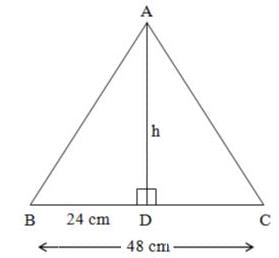
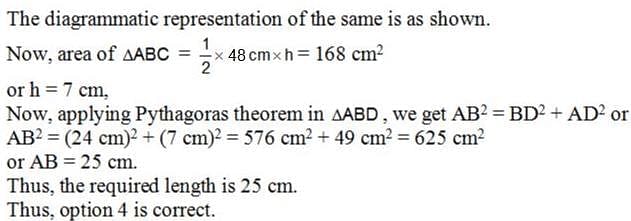
The sum of two positive numbers is 63. If one number 'x' is double the other, then the equation is- a)

- b)

- c)

- d)

Correct answer is option 'A'. Can you explain this answer?
The sum of two positive numbers is 63. If one number 'x' is double the other, then the equation is
a)
b)
c)
d)
| | Riverdale Learning Institute answered |
If the bigger number is 'x', the smaller number is (x - 63).
So, x/(x - 63) = 2
Hence, option (1) is correct.
So, x/(x - 63) = 2
Hence, option (1) is correct.
The stage of creative problem solving in which the individuals do not give attention to the problem is:- a)Translation
- b)Illumination
- c)Incubation
- d)Preparation
Correct answer is option 'C'. Can you explain this answer?
The stage of creative problem solving in which the individuals do not give attention to the problem is:
a)
Translation
b)
Illumination
c)
Incubation
d)
Preparation
| | Riverdale Learning Institute answered |
The stage of creative problem solving in which the individuals do not give attention to the problem is incubation.
Graham Wallas (1926) outlined the creative thinking process into four stages:
Graham Wallas (1926) outlined the creative thinking process into four stages:
- Preparation: It involves collecting information regarding a problem in order to solve it through trial and error, recalling personal experiences, and investigating in all possible directions.
- Incubation: It is a slow process in which the individual sinks into the unconscious and reflects on the problem. In this stage, individuals forget irrelevant information or unsuccessful attempts and engage with the task effectively.
- Illumination: It is the stage the individual is most active and conscious. It is in this stage that an insight to the problem is experienced suddenly and a new idea or solution emerges.
- Verification: This stage might involve modifications to the solution reached in the previous stage by adding or subtracting, or making new connections. The final solution achieved is tested in reality. If the solution does not apply to the problem then the whole process is repeated.
In the Constructivist Approach, language is taught by - a)enabling students to create new knowledge based on past experiences and engaging in various activities
- b)teaching rules of grammar and giving plenty of opportunity to practise it
- c)helping learners acquire new vocabulary by looking up word meanings in the dictionary
- d)teaching new words and structures using a variety of aids followed by practice through drills
Correct answer is option 'A'. Can you explain this answer?
In the Constructivist Approach, language is taught by
a)
enabling students to create new knowledge based on past experiences and engaging in various activities
b)
teaching rules of grammar and giving plenty of opportunity to practise it
c)
helping learners acquire new vocabulary by looking up word meanings in the dictionary
d)
teaching new words and structures using a variety of aids followed by practice through drills
| | Aditya Nair answered |
Understanding the Constructivist Approach to Language Teaching
The Constructivist Approach emphasizes the active role of learners in their own education. It focuses on the idea that knowledge is constructed through experiences rather than merely transmitted from teacher to student. This perspective is fundamental when teaching language.
Key Features of the Constructivist Approach:
- Engagement with Past Experiences:
Students build new knowledge by relating it to their previous experiences. This connection enhances understanding and retention.
- Active Learning through Activities:
Constructivism encourages the use of interactive and collaborative activities. These activities can include group discussions, role-playing, and real-life simulations that provide context to language use.
- Critical Thinking and Problem Solving:
Learners are encouraged to think critically and solve problems related to language use. This fosters a deeper understanding of language structures and vocabulary.
- Personalized Learning:
Learners have different backgrounds and experiences, and the constructivist approach allows for tailoring language instruction to meet individual needs, promoting a more personalized learning environment.
Why Option A is Correct:
- Option A aligns with the principles of constructivism by emphasizing the creation of new knowledge through engagement and activity-based learning. It recognizes that language acquisition is enhanced when students actively participate and relate new concepts to their existing knowledge.
- In contrast, options B, C, and D focus more on rote learning, grammar rules, and vocabulary memorization, which do not align with the constructivist principles of active engagement and experiential learning.
In summary, the Constructivist Approach to language teaching is about enabling students to create knowledge based on their past experiences and engage in meaningful activities, making option A the correct choice.
The Constructivist Approach emphasizes the active role of learners in their own education. It focuses on the idea that knowledge is constructed through experiences rather than merely transmitted from teacher to student. This perspective is fundamental when teaching language.
Key Features of the Constructivist Approach:
- Engagement with Past Experiences:
Students build new knowledge by relating it to their previous experiences. This connection enhances understanding and retention.
- Active Learning through Activities:
Constructivism encourages the use of interactive and collaborative activities. These activities can include group discussions, role-playing, and real-life simulations that provide context to language use.
- Critical Thinking and Problem Solving:
Learners are encouraged to think critically and solve problems related to language use. This fosters a deeper understanding of language structures and vocabulary.
- Personalized Learning:
Learners have different backgrounds and experiences, and the constructivist approach allows for tailoring language instruction to meet individual needs, promoting a more personalized learning environment.
Why Option A is Correct:
- Option A aligns with the principles of constructivism by emphasizing the creation of new knowledge through engagement and activity-based learning. It recognizes that language acquisition is enhanced when students actively participate and relate new concepts to their existing knowledge.
- In contrast, options B, C, and D focus more on rote learning, grammar rules, and vocabulary memorization, which do not align with the constructivist principles of active engagement and experiential learning.
In summary, the Constructivist Approach to language teaching is about enabling students to create knowledge based on their past experiences and engage in meaningful activities, making option A the correct choice.
Directions: Read the passage given below and answer the question that follows.
Once upon a time, there lived a sparrow in a tree. He was very happy to have a beautiful and comfortable nest of his own in the tree. The sparrow used to fly to far off places to pick at grains from so many fields, full of crops. At the Sun set, he would return to his perch. One day, the sparrow ate his fill, but could not return to his nest because of the heavy rains which continued for the whole night. The sparrow had to spend the whole night in a big banyan tree a little distance away from home.
The next morning, when the rain stopped and the sky became clear, the sparrow returned to his tree. He was astonished to find a rabbit occupying his beautiful and comfortable nest. The sparrow lost his temper and spoke to the rabbit, "It's my home you're sitting in. Please quit this place at once".
"Do not talk like a fool", replied the rabbit. "Trees, rivers and lakes do not belong to anyone. Places like these are yours only so long as you are living in. If someone else occupies it in your absence, it belongs to the new occupant. So, go away and do not disturb me anymore".
But, the sparrow was not satisfied with this illogical reply. He said, "Let's ask a person of wisdom and only then our case will be settled".
At a distance from the tree, there lived a wild cat. The cat, somehow, overheard the discussion that took place between the sparrow and the rabbit.
The cat immediately thought of a plan, took a holy dip in the river, and then sat like a priest and began chanting God's name in a loud tone. When the rabbit and the sparrow heard the cat chanting God's name, they approached him with a hope to get impartial justice and requested him to pass a judgement in the matter.
The cat became very happy to have both of them in front of him. He pretended to listen to their arguments. But, as soon as the right opportunity came, the cat pounced upon both of them and killed and ate them together with great relish.
(from Panchtantra)Q. The story can be divided into- a)two parts: 1 - the fight and 2 - the judgement
- b)three parts: 1 - beginning of the problem, 2 - confrontation and 3 - end of the problem
- c)four parts: 1 - the sparrow hunting the food, 2 - the rain, 3 - the rabbit and 4 - the cat
- d)no parts at all
Correct answer is option 'C'. Can you explain this answer?
Directions: Read the passage given below and answer the question that follows.
Once upon a time, there lived a sparrow in a tree. He was very happy to have a beautiful and comfortable nest of his own in the tree. The sparrow used to fly to far off places to pick at grains from so many fields, full of crops. At the Sun set, he would return to his perch. One day, the sparrow ate his fill, but could not return to his nest because of the heavy rains which continued for the whole night. The sparrow had to spend the whole night in a big banyan tree a little distance away from home.
The next morning, when the rain stopped and the sky became clear, the sparrow returned to his tree. He was astonished to find a rabbit occupying his beautiful and comfortable nest. The sparrow lost his temper and spoke to the rabbit, "It's my home you're sitting in. Please quit this place at once".
"Do not talk like a fool", replied the rabbit. "Trees, rivers and lakes do not belong to anyone. Places like these are yours only so long as you are living in. If someone else occupies it in your absence, it belongs to the new occupant. So, go away and do not disturb me anymore".
But, the sparrow was not satisfied with this illogical reply. He said, "Let's ask a person of wisdom and only then our case will be settled".
At a distance from the tree, there lived a wild cat. The cat, somehow, overheard the discussion that took place between the sparrow and the rabbit.
The cat immediately thought of a plan, took a holy dip in the river, and then sat like a priest and began chanting God's name in a loud tone. When the rabbit and the sparrow heard the cat chanting God's name, they approached him with a hope to get impartial justice and requested him to pass a judgement in the matter.
The cat became very happy to have both of them in front of him. He pretended to listen to their arguments. But, as soon as the right opportunity came, the cat pounced upon both of them and killed and ate them together with great relish.
(from Panchtantra)
Once upon a time, there lived a sparrow in a tree. He was very happy to have a beautiful and comfortable nest of his own in the tree. The sparrow used to fly to far off places to pick at grains from so many fields, full of crops. At the Sun set, he would return to his perch. One day, the sparrow ate his fill, but could not return to his nest because of the heavy rains which continued for the whole night. The sparrow had to spend the whole night in a big banyan tree a little distance away from home.
The next morning, when the rain stopped and the sky became clear, the sparrow returned to his tree. He was astonished to find a rabbit occupying his beautiful and comfortable nest. The sparrow lost his temper and spoke to the rabbit, "It's my home you're sitting in. Please quit this place at once".
"Do not talk like a fool", replied the rabbit. "Trees, rivers and lakes do not belong to anyone. Places like these are yours only so long as you are living in. If someone else occupies it in your absence, it belongs to the new occupant. So, go away and do not disturb me anymore".
But, the sparrow was not satisfied with this illogical reply. He said, "Let's ask a person of wisdom and only then our case will be settled".
At a distance from the tree, there lived a wild cat. The cat, somehow, overheard the discussion that took place between the sparrow and the rabbit.
The cat immediately thought of a plan, took a holy dip in the river, and then sat like a priest and began chanting God's name in a loud tone. When the rabbit and the sparrow heard the cat chanting God's name, they approached him with a hope to get impartial justice and requested him to pass a judgement in the matter.
The cat became very happy to have both of them in front of him. He pretended to listen to their arguments. But, as soon as the right opportunity came, the cat pounced upon both of them and killed and ate them together with great relish.
(from Panchtantra)
Q. The story can be divided into
a)
two parts: 1 - the fight and 2 - the judgement
b)
three parts: 1 - beginning of the problem, 2 - confrontation and 3 - end of the problem
c)
four parts: 1 - the sparrow hunting the food, 2 - the rain, 3 - the rabbit and 4 - the cat
d)
no parts at all
| | Eesha Bhat answered |
The story can be divided into four parts as there are four different events related to 'hunting', 'rain', 'the rabbit' and 'the cat'.
A student begins to fear public speaking after being ridiculed by her classmates during a recitation exercise. In classical conditioning terms, her newly acquired 'fear' would be due to a/an- a)unconditioned stimulus
- b)unconditioned response
- c)conditioned response
- d)conditioned stimulus
Correct answer is option 'C'. Can you explain this answer?
A student begins to fear public speaking after being ridiculed by her classmates during a recitation exercise. In classical conditioning terms, her newly acquired 'fear' would be due to a/an
a)
unconditioned stimulus
b)
unconditioned response
c)
conditioned response
d)
conditioned stimulus
| | Anjali Gupta answered |
In classical conditioning, the conditioned stimulus is a previously neutral stimulus that, after becoming associated with the unconditioned stimulus, eventually comes to trigger a conditioned response.
Aluminium is used for making cooking utensils. Which of the following properties of aluminium are responsible for the same?
(i) Good thermal conductivity
(ii) Good electrical conductivity
(iii) Ductility
(iv) High melting point- a)(i) and (ii)
- b)(i) and (iii)
- c)(ii) and (iii)
- d)(i) and (iv)
Correct answer is option 'A'. Can you explain this answer?
Aluminium is used for making cooking utensils. Which of the following properties of aluminium are responsible for the same?
(i) Good thermal conductivity
(ii) Good electrical conductivity
(iii) Ductility
(iv) High melting point
(i) Good thermal conductivity
(ii) Good electrical conductivity
(iii) Ductility
(iv) High melting point
a)
(i) and (ii)
b)
(i) and (iii)
c)
(ii) and (iii)
d)
(i) and (iv)
| | Anjali Gupta answered |
- Elements are mainly classified into three categories based on certain properties. They are metals, non-metals and metalloids.
- Metals show distinct characteristics of lustre, malleability, ductility, and electrical and thermal conductivities.
- Cooking utensils should have good conducting capabilities.
Which of the following(s) is/are the skill of micro-teaching in Mathematics?
i. skill of integrating knowledge and experience
ii. skill of facilitating child-centric learning
iii. skill of developing observation in learners- a)Only i
- b)Both i and ii
- c)Both ii and iii
- d)All i, ii and iii
Correct answer is option 'D'. Can you explain this answer?
Which of the following(s) is/are the skill of micro-teaching in Mathematics?
i. skill of integrating knowledge and experience
ii. skill of facilitating child-centric learning
iii. skill of developing observation in learners
i. skill of integrating knowledge and experience
ii. skill of facilitating child-centric learning
iii. skill of developing observation in learners
a)
Only i
b)
Both i and ii
c)
Both ii and iii
d)
All i, ii and iii
| | Anjali Gupta answered |
The concept of micro-teaching is a training concept that can be applied at various pre-service and in-service stages in the professional development of teachers.
If the velocity-time graph of particle is represented by y=mt, then the particle is moving with- a)Constant speed
- b)Constant velocity
- c)Constant acceleration
- d)Varying
Correct answer is option 'C'. Can you explain this answer?
If the velocity-time graph of particle is represented by y=mt, then the particle is moving with
a)
Constant speed
b)
Constant velocity
c)
Constant acceleration
d)
Varying
 | Rohit Verma answered |
Understanding the Velocity-Time Graph
The equation y = mt represents a linear relationship between velocity (y) and time (t), where m is the slope of the line. This is crucial for understanding the motion of the particle.
Key Concepts
- Velocity: The speed of an object in a given direction.
- Time: The duration over which the motion occurs.
- Slope (m): Represents the rate of change of velocity with respect to time.
Analysis of the Equation
- In the equation y = mt, as time increases, velocity changes linearly.
- The slope m indicates that there is a constant rate at which velocity is changing.
Implications of Constant Slope
- A constant slope (m) means that the particle's velocity is not constant; instead, it changes at a uniform rate over time.
- This consistent change in velocity indicates that the particle is accelerating.
Conclusion
- Since the velocity is not constant and there is a consistent change, the particle is experiencing constant acceleration.
- Therefore, the correct answer is option 'C' - the particle is moving with constant acceleration.
In summary, when the velocity-time graph is represented as y = mt, it indicates that the particle's velocity is changing at a constant rate, leading to uniform acceleration.
The equation y = mt represents a linear relationship between velocity (y) and time (t), where m is the slope of the line. This is crucial for understanding the motion of the particle.
Key Concepts
- Velocity: The speed of an object in a given direction.
- Time: The duration over which the motion occurs.
- Slope (m): Represents the rate of change of velocity with respect to time.
Analysis of the Equation
- In the equation y = mt, as time increases, velocity changes linearly.
- The slope m indicates that there is a constant rate at which velocity is changing.
Implications of Constant Slope
- A constant slope (m) means that the particle's velocity is not constant; instead, it changes at a uniform rate over time.
- This consistent change in velocity indicates that the particle is accelerating.
Conclusion
- Since the velocity is not constant and there is a consistent change, the particle is experiencing constant acceleration.
- Therefore, the correct answer is option 'C' - the particle is moving with constant acceleration.
In summary, when the velocity-time graph is represented as y = mt, it indicates that the particle's velocity is changing at a constant rate, leading to uniform acceleration.
Two numbers are in the ratio 3 : 5. If 9 is subtracted from each, the new numbers are in the ratio 12 : 23. The smaller number is- a)27
- b)33
- c)49
- d)55
Correct answer is option 'B'. Can you explain this answer?
Two numbers are in the ratio 3 : 5. If 9 is subtracted from each, the new numbers are in the ratio 12 : 23. The smaller number is
a)
27
b)
33
c)
49
d)
55
 | Kavya Sharma answered |
Given information:
- Two numbers are in the ratio 3:5.
- When 9 is subtracted from each number, the new numbers are in the ratio 12:23.
Let's assume the two numbers in the ratio 3:5 as 3x and 5x, where x is a constant.
New numbers after subtracting 9:
- For the first number: 3x - 9
- For the second number: 5x - 9
According to the second condition, the new numbers are in the ratio 12:23:
(3x - 9) : (5x - 9) = 12 : 23
Cross-multiplying, we get:
12(5x - 9) = 23(3x - 9)
Simplifying the equation:
60x - 108 = 69x - 207
Rearranging the terms:
69x - 60x = 207 - 108
9x = 99
Dividing both sides of the equation by 9:
x = 11
Now, we can find the values of the two numbers:
First number = 3x = 3(11) = 33
Second number = 5x = 5(11) = 55
Therefore, the smaller number is 33, which corresponds to option B.
- Two numbers are in the ratio 3:5.
- When 9 is subtracted from each number, the new numbers are in the ratio 12:23.
Let's assume the two numbers in the ratio 3:5 as 3x and 5x, where x is a constant.
New numbers after subtracting 9:
- For the first number: 3x - 9
- For the second number: 5x - 9
According to the second condition, the new numbers are in the ratio 12:23:
(3x - 9) : (5x - 9) = 12 : 23
Cross-multiplying, we get:
12(5x - 9) = 23(3x - 9)
Simplifying the equation:
60x - 108 = 69x - 207
Rearranging the terms:
69x - 60x = 207 - 108
9x = 99
Dividing both sides of the equation by 9:
x = 11
Now, we can find the values of the two numbers:
First number = 3x = 3(11) = 33
Second number = 5x = 5(11) = 55
Therefore, the smaller number is 33, which corresponds to option B.
Let the focal length of an eye-piece be 2.5 cm. For a telescope of magnification 100, the focal length of the objective should be:- a)250 cm
- b)40 cm
- c)2.5 × 10⁻² cm
- d)100 cm
Correct answer is option 'A'. Can you explain this answer?
Let the focal length of an eye-piece be 2.5 cm. For a telescope of magnification 100, the focal length of the objective should be:
a)
250 cm
b)
40 cm
c)
2.5 × 10⁻² cm
d)
100 cm
| | Anjali Gupta answered |
- Magnification produced by a spherical mirror or lens gives the relative extent to which an object is magnified with respect to the object's size.
- Magnification is the ratio of the objective's focal length to the eyepiece's focal length.
If the number of sides of a regular polygon is 'n', then the number of lines of symmetry is equal to- a)n/2
- b)n2
- c)2n
- d)n
Correct answer is option 'D'. Can you explain this answer?
If the number of sides of a regular polygon is 'n', then the number of lines of symmetry is equal to
a)
n/2
b)
n2
c)
2n
d)
n
| | Kavya Sharma answered |
Understanding Lines of Symmetry in Regular Polygons
In geometry, a regular polygon is defined as a shape with all sides and angles equal. The concept of lines of symmetry is crucial to understanding the symmetrical properties of these polygons.
Lines of Symmetry
- A line of symmetry divides a shape into two identical halves, where one half is a mirror image of the other.
- For regular polygons, the number of lines of symmetry directly relates to the number of sides (n) of the polygon.
Calculating Lines of Symmetry
- For Regular Polygons: Each vertex can connect to the midpoint of the opposite side, creating a line of symmetry.
- Types of Symmetry: In regular polygons, symmetry occurs in two forms:
- Vertex Symmetries: Lines that pass through a vertex and the midpoint of the opposite side.
- Edge Symmetries: Lines that pass through the midpoints of opposite sides.
Conclusion: Why Option D is Correct
- For a regular polygon with n sides, it has:
- n vertex symmetries (one for each vertex).
- n edge symmetries (one for each edge).
- Therefore, the total number of lines of symmetry is n + n = 2n.
Thus, the correct answer to the number of lines of symmetry in a regular polygon with n sides is indeed option D) 2n. This reflects the comprehensive symmetry inherent in regular polygons, characterized by equal angles and sides, ensuring balance in their structure.
In geometry, a regular polygon is defined as a shape with all sides and angles equal. The concept of lines of symmetry is crucial to understanding the symmetrical properties of these polygons.
Lines of Symmetry
- A line of symmetry divides a shape into two identical halves, where one half is a mirror image of the other.
- For regular polygons, the number of lines of symmetry directly relates to the number of sides (n) of the polygon.
Calculating Lines of Symmetry
- For Regular Polygons: Each vertex can connect to the midpoint of the opposite side, creating a line of symmetry.
- Types of Symmetry: In regular polygons, symmetry occurs in two forms:
- Vertex Symmetries: Lines that pass through a vertex and the midpoint of the opposite side.
- Edge Symmetries: Lines that pass through the midpoints of opposite sides.
Conclusion: Why Option D is Correct
- For a regular polygon with n sides, it has:
- n vertex symmetries (one for each vertex).
- n edge symmetries (one for each edge).
- Therefore, the total number of lines of symmetry is n + n = 2n.
Thus, the correct answer to the number of lines of symmetry in a regular polygon with n sides is indeed option D) 2n. This reflects the comprehensive symmetry inherent in regular polygons, characterized by equal angles and sides, ensuring balance in their structure.
The polynomial f (x) has a double root -1, single roots 1 and 0. Then f (x) is- a)x(x + 1)2 (x - 1)
- b)x(x - 1)2 (x + 1)
- c)(x - 1)2 (x + 1)
- d)x2 (x + 1) (x - 1)2
Correct answer is option 'A'. Can you explain this answer?
The polynomial f (x) has a double root -1, single roots 1 and 0. Then f (x) is
a)
x(x + 1)2 (x - 1)
b)
x(x - 1)2 (x + 1)
c)
(x - 1)2 (x + 1)
d)
x2 (x + 1) (x - 1)2
 | Nikhil Iyer answered |
The Polynomial f(x) with Double Root -1, Single Roots 1 and 0
To determine the correct polynomial f(x) with the given roots, let's analyze the information provided.
Given:
- Double root at -1
- Single roots at 1 and 0
Understanding the Roots of a Polynomial:
- The roots of a polynomial are the values of x that make the polynomial equal to zero.
- A double root means that a particular value of x occurs twice in the polynomial.
- Single roots mean that a particular value of x occurs only once in the polynomial.
Determining the Polynomial:
- Since the polynomial has a double root at -1, we know that (x + 1) is a factor of the polynomial.
- Since the polynomial has single roots at 1 and 0, we know that (x - 1) and (x - 0) (which simplifies to just x) are also factors of the polynomial.
Using the Factors to Determine the Polynomial:
- We can multiply these factors together to find the polynomial: (x + 1)(x - 1)(x - 0).
- Simplifying this expression, we get f(x) = (x + 1)(x - 1)(x).
- Expanding further, we have f(x) = (x^2 - 1)(x).
- Multiplying again, we get f(x) = x^3 - x.
Comparing the Polynomial with the Given Options:
- Let's compare the polynomial we obtained (f(x) = x^3 - x) with the given options:
a) (x - 1)^2 (x + 1)
b) x(x - 1)^2 (x + 1)
c) x(x - 1)^2 (x - 1)
d) x^2 (x - 1) (x + 1)
Option A:
- (x - 1)^2 (x + 1) = (x^2 - 2x + 1)(x + 1) = x^3 - x^2 - x + 1
- This does not match the polynomial we obtained (f(x) = x^3 - x).
Option B:
- x(x - 1)^2 (x + 1) = x(x^2 - 2x + 1)(x + 1) = x^4 - 2x^3 + x^2 + x^2 - 2x + x = x^4 - 2x^3 + 2x^2 - x
- This does not match the polynomial we obtained (f(x) = x^3 - x).
Option C:
- x(x - 1)^2 (x - 1) = x(x^2 - 2x + 1)(x - 1) = x^4 - 2x^3 + x^2 - x^3 + 2x^2 - x = x^4 - 3x^3 + 3x^2 - x
- This does not match the polynomial we obtained (f(x) = x^3 - x).
Option D
To determine the correct polynomial f(x) with the given roots, let's analyze the information provided.
Given:
- Double root at -1
- Single roots at 1 and 0
Understanding the Roots of a Polynomial:
- The roots of a polynomial are the values of x that make the polynomial equal to zero.
- A double root means that a particular value of x occurs twice in the polynomial.
- Single roots mean that a particular value of x occurs only once in the polynomial.
Determining the Polynomial:
- Since the polynomial has a double root at -1, we know that (x + 1) is a factor of the polynomial.
- Since the polynomial has single roots at 1 and 0, we know that (x - 1) and (x - 0) (which simplifies to just x) are also factors of the polynomial.
Using the Factors to Determine the Polynomial:
- We can multiply these factors together to find the polynomial: (x + 1)(x - 1)(x - 0).
- Simplifying this expression, we get f(x) = (x + 1)(x - 1)(x).
- Expanding further, we have f(x) = (x^2 - 1)(x).
- Multiplying again, we get f(x) = x^3 - x.
Comparing the Polynomial with the Given Options:
- Let's compare the polynomial we obtained (f(x) = x^3 - x) with the given options:
a) (x - 1)^2 (x + 1)
b) x(x - 1)^2 (x + 1)
c) x(x - 1)^2 (x - 1)
d) x^2 (x - 1) (x + 1)
Option A:
- (x - 1)^2 (x + 1) = (x^2 - 2x + 1)(x + 1) = x^3 - x^2 - x + 1
- This does not match the polynomial we obtained (f(x) = x^3 - x).
Option B:
- x(x - 1)^2 (x + 1) = x(x^2 - 2x + 1)(x + 1) = x^4 - 2x^3 + x^2 + x^2 - 2x + x = x^4 - 2x^3 + 2x^2 - x
- This does not match the polynomial we obtained (f(x) = x^3 - x).
Option C:
- x(x - 1)^2 (x - 1) = x(x^2 - 2x + 1)(x - 1) = x^4 - 2x^3 + x^2 - x^3 + 2x^2 - x = x^4 - 3x^3 + 3x^2 - x
- This does not match the polynomial we obtained (f(x) = x^3 - x).
Option D
On the basis of which principle of learning can the feelings of fear, love and hate be easily generated in the child?- a)Classical contract theory
- b)Psychology contract theory
- c)Educational contract theory
- d)All of the above
Correct answer is option 'A'. Can you explain this answer?
On the basis of which principle of learning can the feelings of fear, love and hate be easily generated in the child?
a)
Classical contract theory
b)
Psychology contract theory
c)
Educational contract theory
d)
All of the above
| | Eesha Bhat answered |
On the basis of the classical contract theory of learning, feelings of fear, love and hatred can be easily generated in the child. In classical contract theory, an association is established between the stimulus response. Before understanding classical conditioning, it is necessary to know that there are other functions in human beings, some are innate like breathing, digestion etc and some are for psychological reasons like blinking, salivation etc.
Chapter doubts & questions for Mock Tests - 2 Months Preparation for CTET Paper 2 2026 is part of CTET & State TET exam preparation. The chapters have been prepared according to the CTET & State TET exam syllabus. The Chapter doubts & questions, notes, tests & MCQs are made for CTET & State TET 2026 Exam. Find important definitions, questions, notes, meanings, examples, exercises, MCQs and online tests here.
Chapter doubts & questions of Mock Tests - 2 Months Preparation for CTET Paper 2 in English & Hindi are available as part of CTET & State TET exam. Download more important topics, notes, lectures and mock test series for CTET & State TET Exam by signing up for free.
2 Months Preparation for CTET Paper 2367 videos|1021 docs|335 tests |
