


All Exams > CTET & State TET > 2 Months Preparation for CTET Paper 2 > All Questions
All questions of Mock Tests for CTET & State TET Exam
Directions: Identify the compound sentence.- a)He is too tired to walk.
- b)After he had done the sums, he went to bed.
- c)As she worked hard, she completed the work.
- d)The farmer was old and he could not plough the field himself.
Correct answer is option 'D'. Can you explain this answer?
Directions: Identify the compound sentence.
a)
He is too tired to walk.
b)
After he had done the sums, he went to bed.
c)
As she worked hard, she completed the work.
d)
The farmer was old and he could not plough the field himself.
 | Aparna Kapoor answered |
Compound Sentence Identification Explanation:
Explanation:
A compound sentence is a sentence that contains at least two independent clauses. In a compound sentence, these independent clauses can stand alone as separate sentences. Let's analyze the given options to identify the compound sentence:
- Option 'A': "He is too tired to walk." This is a simple sentence with only one independent clause.
- Option 'B': "After he had done the sums, he went to bed." This is a complex sentence with a dependent clause ("After he had done the sums") and an independent clause ("he went to bed").
- Option 'C': "As she worked hard, she completed the work." This is a complex sentence with a dependent clause ("As she worked hard") and an independent clause ("she completed the work").
- Option 'D': "The farmer was old and he could not plough the field himself." This is a compound sentence as it contains two independent clauses: "The farmer was old" and "he could not plough the field himself."
Therefore, the compound sentence in the given options is option 'D'. The presence of two independent clauses ("The farmer was old" and "he could not plough the field himself") connected by the coordinating conjunction "and" makes it a compound sentence.
Explanation:
A compound sentence is a sentence that contains at least two independent clauses. In a compound sentence, these independent clauses can stand alone as separate sentences. Let's analyze the given options to identify the compound sentence:
- Option 'A': "He is too tired to walk." This is a simple sentence with only one independent clause.
- Option 'B': "After he had done the sums, he went to bed." This is a complex sentence with a dependent clause ("After he had done the sums") and an independent clause ("he went to bed").
- Option 'C': "As she worked hard, she completed the work." This is a complex sentence with a dependent clause ("As she worked hard") and an independent clause ("she completed the work").
- Option 'D': "The farmer was old and he could not plough the field himself." This is a compound sentence as it contains two independent clauses: "The farmer was old" and "he could not plough the field himself."
Therefore, the compound sentence in the given options is option 'D'. The presence of two independent clauses ("The farmer was old" and "he could not plough the field himself") connected by the coordinating conjunction "and" makes it a compound sentence.

The order of learning language skills in the Direct Method of Language Teaching is:- a)Speaking, reading, listening, writing
- b)Reading, writing, listening, speaking
- c)Listening, reading, writing, speaking
- d)Listening, speaking, reading, writing
Correct answer is option 'D'. Can you explain this answer?
The order of learning language skills in the Direct Method of Language Teaching is:
a)
Speaking, reading, listening, writing
b)
Reading, writing, listening, speaking
c)
Listening, reading, writing, speaking
d)
Listening, speaking, reading, writing
 | Riverdale Learning Institute answered |
The Direct Method emphasizes the use of the target language in the classroom and focuses on developing oral proficiency.
- In this method, the learning process starts with listening, as students are exposed to authentic spoken language in the target language.
- They then move on to speaking, practicing and producing the language through oral communication activities.
- Reading skills are introduced next, allowing students to comprehend written texts in the target language.
- Finally, writing skills are developed, enabling students to express themselves in written form.
- This sequence reflects the natural progression of language acquisition, mirroring the way children acquire their first language.
- By prioritizing listening and speaking at the early stages, the Direct Method aims to develop communicative competence and fluency before moving on to reading and writing, which involve more complex language structures and skills.
Hence , it is clear that the order of learning language skills in the Direct Method of Language Teaching is Listening, speaking, reading, writing.
'Prediction' as a subskill is associated with: - a)reading
- b)drafting
- c)summarising
- d)note making
Correct answer is option 'A'. Can you explain this answer?
'Prediction' as a subskill is associated with:
a)
reading
b)
drafting
c)
summarising
d)
note making
| | Arvind Menon answered |
Prediction as a subskill is associated with reading because it involves using contextual clues and prior knowledge to make educated guesses about what will happen next in a text. When reading, individuals use prediction to anticipate the outcome of a story or the next event in a narrative. This allows readers to actively engage with the text and make connections between the information presented and their own understanding of the subject matter.
Here is a detailed explanation of why prediction is associated with reading:
1. Understanding the Text: When reading a text, prediction helps readers to understand the content more effectively. By making predictions, readers actively interact with the text, making connections between prior knowledge and the information presented. This enhances comprehension and allows readers to anticipate the direction of the text.
2. Contextual Clues: Prediction is closely tied to interpreting contextual clues within a text. These clues may be explicit, such as foreshadowing or hints provided by the author, or they may be implicit, requiring readers to draw inferences based on the information provided. By analyzing these clues, readers can make predictions about the likely outcomes or events that will occur later in the text.
3. Active Engagement: Prediction encourages active engagement with the text. Rather than passively reading, individuals who make predictions are actively involved in the reading process. This engagement helps to maintain focus and attention, leading to better comprehension and retention of information.
4. Monitoring Comprehension: Predictions also serve as a tool for monitoring comprehension. As readers make predictions, they can assess whether their predictions align with the actual events or outcomes in the text. If their predictions are incorrect, readers can revise their understanding and adjust their predictions accordingly.
In summary, prediction is a subskill associated with reading because it enhances comprehension, utilizes contextual clues, encourages active engagement, and allows for the monitoring of comprehension. By making predictions while reading, individuals can better understand and interpret the text, making connections between prior knowledge and the information presented.
Here is a detailed explanation of why prediction is associated with reading:
1. Understanding the Text: When reading a text, prediction helps readers to understand the content more effectively. By making predictions, readers actively interact with the text, making connections between prior knowledge and the information presented. This enhances comprehension and allows readers to anticipate the direction of the text.
2. Contextual Clues: Prediction is closely tied to interpreting contextual clues within a text. These clues may be explicit, such as foreshadowing or hints provided by the author, or they may be implicit, requiring readers to draw inferences based on the information provided. By analyzing these clues, readers can make predictions about the likely outcomes or events that will occur later in the text.
3. Active Engagement: Prediction encourages active engagement with the text. Rather than passively reading, individuals who make predictions are actively involved in the reading process. This engagement helps to maintain focus and attention, leading to better comprehension and retention of information.
4. Monitoring Comprehension: Predictions also serve as a tool for monitoring comprehension. As readers make predictions, they can assess whether their predictions align with the actual events or outcomes in the text. If their predictions are incorrect, readers can revise their understanding and adjust their predictions accordingly.
In summary, prediction is a subskill associated with reading because it enhances comprehension, utilizes contextual clues, encourages active engagement, and allows for the monitoring of comprehension. By making predictions while reading, individuals can better understand and interpret the text, making connections between prior knowledge and the information presented.
Directions: Select the most appropriate option.
Compounding is- a)stringing together older words like the formation of 'earthquake' from 'earth' and 'quake'
- b)removing seeming affixes from existing words, such as forming 'edit' from 'editor'
- c)joining parts of two or more older words, such as forming 'smog', which comes from 'smoke' and 'fog'
- d)forming new words from existing ones by adding affixes to them, like shame + less + ness, 'shamelessness'
Correct answer is option 'A'. Can you explain this answer?
Directions: Select the most appropriate option.
Compounding is
Compounding is
a)
stringing together older words like the formation of 'earthquake' from 'earth' and 'quake'
b)
removing seeming affixes from existing words, such as forming 'edit' from 'editor'
c)
joining parts of two or more older words, such as forming 'smog', which comes from 'smoke' and 'fog'
d)
forming new words from existing ones by adding affixes to them, like shame + less + ness, 'shamelessness'
| | Riverdale Learning Institute answered |
In linguistics, a compound is a lexeme (less precisely, a word) that consists of more than one stem. Compounding, composition or nominal composition is the process of word formation that creates compound lexemes. That is, in familiar terms, compounding occurs when two or more words are joined to make one longer word. There are three forms of compound words:
The closed form, in which the words are melded together, such as firefly, secondhand, softball, childlike, crosstown, redhead, keyboard, makeup, notebook;
The hyphenated form, such as daughter-in-law, master-at-arms, over-the-counter, six-pack, six-year-old, mass-produced; and The open form, such as post office, real estate, middle class, full moon, half sister, attorney general.
Blending: A blend is a word formed by joining parts of two words after clipping. An example is 'smog', which comes from 'smoke' and 'fog', or 'brunch', which comes from 'breakfast' and 'lunch'.
The closed form, in which the words are melded together, such as firefly, secondhand, softball, childlike, crosstown, redhead, keyboard, makeup, notebook;
The hyphenated form, such as daughter-in-law, master-at-arms, over-the-counter, six-pack, six-year-old, mass-produced; and The open form, such as post office, real estate, middle class, full moon, half sister, attorney general.
Blending: A blend is a word formed by joining parts of two words after clipping. An example is 'smog', which comes from 'smoke' and 'fog', or 'brunch', which comes from 'breakfast' and 'lunch'.
Direction: Read the following passage carefully and answer the questions that follow.
The morning of June 27th was clear and sunny, with the fresh warmth of a full-summer day; the flowers were blossoming profusely, and the grass was richly green. The people of the village began to gather in the square, between the post office and the bank, around ten o’clock; in some towns, there were so many people that the lottery took two days and had to be started on June 20th, but in this village, where there were only about three hundred people, the whole lottery took less than two hours so that it could begin at ten o’clock in the morning and still be through in time to allow the villagers to get home for noon dinner.
The children assembled first, of course. The school was recently over for the summer, and the feeling of liberty sat uneasily on most of them; they tended to gather together quietly for a while before they broke into boisterous play, and their talk was still of the classroom and the teacher, of books and reprimands. Bobby Martin had already stuffed his pockets full of stones, and the other boys soon followed his example, selecting the smoothest and roundest stones; Bobby and Harry Jones and Dickie Delacroix—the villagers pronounced this name “Dellacroy”—eventually made a great pile of stones in one corner of the square and guarded it against the raids of the other boys. The girls stood aside, talking among themselves, looking over their shoulders at the boys, and the tiny children rolled in the dust or clung to the hands of their older brothers or sisters.
Soon the men began to gather, surveying their own children, speaking of planting and rain, tractors and taxes. They stood together, away from the pile of stones in the corner, and their jokes were quiet, and they smiled rather than laughed. The women, wearing faded house dresses and sweaters, came shortly after their menfolk. They greeted one another and exchanged bits of gossip as they went to join their husbands. Soon the women, standing by their husbands, began to call to their children, and the children came reluctantly, having to be called four or five times. Bobby Martin ducked under his mother’s grasping hand and ran, laughing, back to the pile of stones. His father spoke up sharply, and Bobby came quickly and took his place between his father and his oldest brother.Q. Which one of the following words is the most similar in the meaning to the word "tiny" as used in the passage (Para 2)?- a)Colossal
- b)Prodigious
- c)Titanic
- d)Bitsy
Correct answer is option 'D'. Can you explain this answer?
Direction: Read the following passage carefully and answer the questions that follow.
The morning of June 27th was clear and sunny, with the fresh warmth of a full-summer day; the flowers were blossoming profusely, and the grass was richly green. The people of the village began to gather in the square, between the post office and the bank, around ten o’clock; in some towns, there were so many people that the lottery took two days and had to be started on June 20th, but in this village, where there were only about three hundred people, the whole lottery took less than two hours so that it could begin at ten o’clock in the morning and still be through in time to allow the villagers to get home for noon dinner.
The children assembled first, of course. The school was recently over for the summer, and the feeling of liberty sat uneasily on most of them; they tended to gather together quietly for a while before they broke into boisterous play, and their talk was still of the classroom and the teacher, of books and reprimands. Bobby Martin had already stuffed his pockets full of stones, and the other boys soon followed his example, selecting the smoothest and roundest stones; Bobby and Harry Jones and Dickie Delacroix—the villagers pronounced this name “Dellacroy”—eventually made a great pile of stones in one corner of the square and guarded it against the raids of the other boys. The girls stood aside, talking among themselves, looking over their shoulders at the boys, and the tiny children rolled in the dust or clung to the hands of their older brothers or sisters.
Soon the men began to gather, surveying their own children, speaking of planting and rain, tractors and taxes. They stood together, away from the pile of stones in the corner, and their jokes were quiet, and they smiled rather than laughed. The women, wearing faded house dresses and sweaters, came shortly after their menfolk. They greeted one another and exchanged bits of gossip as they went to join their husbands. Soon the women, standing by their husbands, began to call to their children, and the children came reluctantly, having to be called four or five times. Bobby Martin ducked under his mother’s grasping hand and ran, laughing, back to the pile of stones. His father spoke up sharply, and Bobby came quickly and took his place between his father and his oldest brother.
The morning of June 27th was clear and sunny, with the fresh warmth of a full-summer day; the flowers were blossoming profusely, and the grass was richly green. The people of the village began to gather in the square, between the post office and the bank, around ten o’clock; in some towns, there were so many people that the lottery took two days and had to be started on June 20th, but in this village, where there were only about three hundred people, the whole lottery took less than two hours so that it could begin at ten o’clock in the morning and still be through in time to allow the villagers to get home for noon dinner.
The children assembled first, of course. The school was recently over for the summer, and the feeling of liberty sat uneasily on most of them; they tended to gather together quietly for a while before they broke into boisterous play, and their talk was still of the classroom and the teacher, of books and reprimands. Bobby Martin had already stuffed his pockets full of stones, and the other boys soon followed his example, selecting the smoothest and roundest stones; Bobby and Harry Jones and Dickie Delacroix—the villagers pronounced this name “Dellacroy”—eventually made a great pile of stones in one corner of the square and guarded it against the raids of the other boys. The girls stood aside, talking among themselves, looking over their shoulders at the boys, and the tiny children rolled in the dust or clung to the hands of their older brothers or sisters.
Soon the men began to gather, surveying their own children, speaking of planting and rain, tractors and taxes. They stood together, away from the pile of stones in the corner, and their jokes were quiet, and they smiled rather than laughed. The women, wearing faded house dresses and sweaters, came shortly after their menfolk. They greeted one another and exchanged bits of gossip as they went to join their husbands. Soon the women, standing by their husbands, began to call to their children, and the children came reluctantly, having to be called four or five times. Bobby Martin ducked under his mother’s grasping hand and ran, laughing, back to the pile of stones. His father spoke up sharply, and Bobby came quickly and took his place between his father and his oldest brother.
Q. Which one of the following words is the most similar in the meaning to the word "tiny" as used in the passage (Para 2)?
a)
Colossal
b)
Prodigious
c)
Titanic
d)
Bitsy
| | Riverdale Learning Institute answered |
- Tiny: very small or diminutive, minute.
Example: He's from a tiny town that you've probably never heard of. - Bitsy: very small in size.
Example: It's just a bitsy blister, but it's right on my heel so that I feel it every time I take a step.
Thus, "bitsy" is the most similar in meaning to "tiny".
Inclusive education is for
I. Minorities students
II. Excluded students
III. General categories students
IV. Disadvantage students- a)I and II
- b)II and IV
- c)I, II and III
- d)I, II, III and IV
Correct answer is option 'D'. Can you explain this answer?
Inclusive education is for
I. Minorities students
II. Excluded students
III. General categories students
IV. Disadvantage students
I. Minorities students
II. Excluded students
III. General categories students
IV. Disadvantage students
a)
I and II
b)
II and IV
c)
I, II and III
d)
I, II, III and IV
 | Nayana H answered |
Inclusive education means educating a child irrespective of their gender, caste, disability and also prosperity of students.
Direction: Read the following information carefully and answer the given questions.
Initiatives such as “4 per mille” and Terraton aim to sequester huge amounts of carbon in the soil. The 2018 U.S. Farm Bill includes the first-ever incentives for farmers to adopt practices aimed at improving soil health and sequestering carbon. But these initiatives are missing a key point: not all soil carbon is the same.
The very different lifetimes of particulate organic matter and mineral-associated organic matter have important implications for these efforts. For example, adding low-quality crop residues to agricultural fields would likely create more particulate organic matter than mineral-associated organic matter. This could increase soil carbon in the short term - but if that field later is disturbed by tilling, a lot of it would decompose and the benefit would be quickly reversed. The best practices focus on building up the mineral-associated organic matter for longer-term carbon storage, while also producing high-quality particulate organic matter with lots of nitrogen to help boost crop productivity.
Natural healthy soils show us that providing continuous and diverse plant inputs that reach all the way to deep soil is key for achieving both high mineral-associated organic matter storage and particulate organic matter recycling. There are many promising ways to do this, such as maintaining plant cover on fields year-round; growing diverse crops that include high-nitrogen legumes and perennials with deep roots; and minimizing tillage.
However, not all soils can accumulate both mineral-associated organic matter and particulate organic matter. Before implementing any management practices for carbon sequestration, participants should first assess the carbon storage potential of the local soil, much as a doctor studies a patient before prescribing a cure. Sequestering soil carbon effectively requires an understanding of how particulate organic matter and mineral-associated organic matter work, how human actions affect them, and how to build up both types to meet our planet’s climate and food security needs.Q. What will happen if we add low-quality crop residues to the agricultural field?- a)It will help the soil to sequester more carbon in the atmosphere.
- b)It will create more particulate organic matter than mineral-based organic matter in the soil.
- c)It will create more mineral-associated organic matter than particulate organic matter.
- d)It will help the high diversity crops to grow better.
Correct answer is option 'B'. Can you explain this answer?
Direction: Read the following information carefully and answer the given questions.
Initiatives such as “4 per mille” and Terraton aim to sequester huge amounts of carbon in the soil. The 2018 U.S. Farm Bill includes the first-ever incentives for farmers to adopt practices aimed at improving soil health and sequestering carbon. But these initiatives are missing a key point: not all soil carbon is the same.
The very different lifetimes of particulate organic matter and mineral-associated organic matter have important implications for these efforts. For example, adding low-quality crop residues to agricultural fields would likely create more particulate organic matter than mineral-associated organic matter. This could increase soil carbon in the short term - but if that field later is disturbed by tilling, a lot of it would decompose and the benefit would be quickly reversed. The best practices focus on building up the mineral-associated organic matter for longer-term carbon storage, while also producing high-quality particulate organic matter with lots of nitrogen to help boost crop productivity.
Natural healthy soils show us that providing continuous and diverse plant inputs that reach all the way to deep soil is key for achieving both high mineral-associated organic matter storage and particulate organic matter recycling. There are many promising ways to do this, such as maintaining plant cover on fields year-round; growing diverse crops that include high-nitrogen legumes and perennials with deep roots; and minimizing tillage.
However, not all soils can accumulate both mineral-associated organic matter and particulate organic matter. Before implementing any management practices for carbon sequestration, participants should first assess the carbon storage potential of the local soil, much as a doctor studies a patient before prescribing a cure. Sequestering soil carbon effectively requires an understanding of how particulate organic matter and mineral-associated organic matter work, how human actions affect them, and how to build up both types to meet our planet’s climate and food security needs.
Initiatives such as “4 per mille” and Terraton aim to sequester huge amounts of carbon in the soil. The 2018 U.S. Farm Bill includes the first-ever incentives for farmers to adopt practices aimed at improving soil health and sequestering carbon. But these initiatives are missing a key point: not all soil carbon is the same.
The very different lifetimes of particulate organic matter and mineral-associated organic matter have important implications for these efforts. For example, adding low-quality crop residues to agricultural fields would likely create more particulate organic matter than mineral-associated organic matter. This could increase soil carbon in the short term - but if that field later is disturbed by tilling, a lot of it would decompose and the benefit would be quickly reversed. The best practices focus on building up the mineral-associated organic matter for longer-term carbon storage, while also producing high-quality particulate organic matter with lots of nitrogen to help boost crop productivity.
Natural healthy soils show us that providing continuous and diverse plant inputs that reach all the way to deep soil is key for achieving both high mineral-associated organic matter storage and particulate organic matter recycling. There are many promising ways to do this, such as maintaining plant cover on fields year-round; growing diverse crops that include high-nitrogen legumes and perennials with deep roots; and minimizing tillage.
However, not all soils can accumulate both mineral-associated organic matter and particulate organic matter. Before implementing any management practices for carbon sequestration, participants should first assess the carbon storage potential of the local soil, much as a doctor studies a patient before prescribing a cure. Sequestering soil carbon effectively requires an understanding of how particulate organic matter and mineral-associated organic matter work, how human actions affect them, and how to build up both types to meet our planet’s climate and food security needs.
Q. What will happen if we add low-quality crop residues to the agricultural field?
a)
It will help the soil to sequester more carbon in the atmosphere.
b)
It will create more particulate organic matter than mineral-based organic matter in the soil.
c)
It will create more mineral-associated organic matter than particulate organic matter.
d)
It will help the high diversity crops to grow better.
| | Riverdale Learning Institute answered |
Let's refer to the following lines of the passage:
For example, adding low-quality crop residues to agricultural fields would likely create more particulate organic matter than mineral-associated organic matter.
For example, adding low-quality crop residues to agricultural fields would likely create more particulate organic matter than mineral-associated organic matter.
______ exhibits a basic level of order, but the teacher still struggles to maintain it.- a)Adequate classroom environment
- b)Orderly restrictive learning environment
- c)Orderly enabling learning environment
- d)Dysfunctional classroom environment
Correct answer is option 'A'. Can you explain this answer?
______ exhibits a basic level of order, but the teacher still struggles to maintain it.
a)
Adequate classroom environment
b)
Orderly restrictive learning environment
c)
Orderly enabling learning environment
d)
Dysfunctional classroom environment
 | Dia Mehta answered |
Adequate classroom environment exhibits a basic level of order, but the teacher still struggles to maintain it.
There are four categories of classroom environment including dysfunctional, adequate, orderly restrictive and orderly enabling/flexible environment, in which adequate classroom environment exhibits the basic level of order for meaningful learning, but the teacher still struggles to maintain it.
There are four categories of classroom environment including dysfunctional, adequate, orderly restrictive and orderly enabling/flexible environment, in which adequate classroom environment exhibits the basic level of order for meaningful learning, but the teacher still struggles to maintain it.
NCF 2005 emphasizes the most is:- a)To solve hard questions
- b)To memorise the concepts
- c)On construction of knowledge
- d)To do mathematics speedily
Correct answer is option 'C'. Can you explain this answer?
NCF 2005 emphasizes the most is:
a)
To solve hard questions
b)
To memorise the concepts
c)
On construction of knowledge
d)
To do mathematics speedily
| | Dia Mehta answered |
The National Curriculum Framework (NCF) 2005 is an education policy document in India that provides guidelines for school curriculum development.
- The NCF 2005 emphasizes a constructivist approach to learning, which focuses on students actively constructing their knowledge and understanding through hands-on experiences, problem-solving, critical thinking, and inquiry-based learning.
- The framework emphasizes the development of higher-order thinking skills, application of knowledge to real-life situations, and fostering a deep understanding of concepts rather than rote memorization.
- It promotes a student-centered approach to education that encourages active engagement and the ability to think critically and creatively.
Hence, we can conclude that NCF 2005 emphasizes that most is on construction of knowledge.
If a student frequently remains inattentive in class, he or she should be:- a)Punished hard
- b)Expelled from school
- c)Advised to stop reading in school
- d)None of the above
Correct answer is option 'D'. Can you explain this answer?
If a student frequently remains inattentive in class, he or she should be:
a)
Punished hard
b)
Expelled from school
c)
Advised to stop reading in school
d)
None of the above
 | Aspire Academy answered |
If the teacher comes to know that a student is absent in the class, in such a case, instead of expelling/punishing/preventing him/her from attending the class, the teacher should know the reason for his/her negligence and find out the appropriate remedy.
Improving Teacher Preparation in Classroom Management
Improving Teacher Preparation in Classroom Management
- Provide teacher candidates with instructional approaches for classroom management through coursework and guided practice with feedback, and
- Address the challenges facing teacher candidates and new teachers in creating a positive classroom context
While checking the notebooks the teacher observed that a child has repeatedly made some errors in writing such as reverse images as b – d, m – w. The child is showing the signs of _____.- a)learning preference
- b)learning style
- c)learning disability
- d)learning differences
Correct answer is option 'C'. Can you explain this answer?
While checking the notebooks the teacher observed that a child has repeatedly made some errors in writing such as reverse images as b – d, m – w. The child is showing the signs of _____.
a)
learning preference
b)
learning style
c)
learning disability
d)
learning differences
| | Dia Mehta answered |
While checking the notebooks the teacher observed that a child has repeatedly made some errors in writing such as reverse images as b – d, m – w. The child is showing signs of learning disability.
Learning disability refers to a neurological disorder that causes cognitive impairment.
Dyslexia is the most common learning disability which results in reverse or mirror images of the alphabet. It is a learning disability that makes learners:
Learning disability refers to a neurological disorder that causes cognitive impairment.
Dyslexia is the most common learning disability which results in reverse or mirror images of the alphabet. It is a learning disability that makes learners:
- unable to read and interpret letters and words.
- confuse with the same shapes and sounds of the alphabet.
- bewilder in identifying and relating speech sounds with letters and words.
Directions: Study the following pie chart carefully and answer the questions.
The pie chart given below shows the percentage distribution of the total number of male faculties in six different schools.
Total male faculties in all schools together = 8400
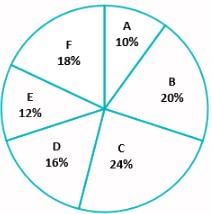
What is the average of total number of male faculties in school A, C and F?- a)1466
- b)1456
- c)1686
- d)1256
Correct answer is option 'B'. Can you explain this answer?
Directions: Study the following pie chart carefully and answer the questions.
The pie chart given below shows the percentage distribution of the total number of male faculties in six different schools.
Total male faculties in all schools together = 8400
What is the average of total number of male faculties in school A, C and F?
The pie chart given below shows the percentage distribution of the total number of male faculties in six different schools.
Total male faculties in all schools together = 8400
What is the average of total number of male faculties in school A, C and F?
a)
1466
b)
1456
c)
1686
d)
1256
| | Riverdale Learning Institute answered |
Given:
Male faculties in scool A = 10%, school C = 24% and school F = 18%
Calculation:
Male faculties in
School A = 8400 × 10/100 = 840
School C = 8400 × 24/100 = 2016
School F = 8400 × 18/100 = 1512
Average = (840 + 2016 + 1512)/3 = 1456
∴ The average of total number of male faculties in school A, C and F is 1456.
Male faculties in scool A = 10%, school C = 24% and school F = 18%
Calculation:
Male faculties in
School A = 8400 × 10/100 = 840
School C = 8400 × 24/100 = 2016
School F = 8400 × 18/100 = 1512
Average = (840 + 2016 + 1512)/3 = 1456
∴ The average of total number of male faculties in school A, C and F is 1456.
When the elder brother hides the toy, Karan looks for the toy and finds it. Karan's age according to Piaget is ____________.- a)2 year
- b)2 month
- c)8 to 12 month
- d)7 year
Correct answer is option 'C'. Can you explain this answer?
When the elder brother hides the toy, Karan looks for the toy and finds it. Karan's age according to Piaget is ____________.
a)
2 year
b)
2 month
c)
8 to 12 month
d)
7 year
| | Aarav Gupta answered |
According to Piaget's theory of cognitive development, children go through different stages of cognitive development as they grow. One of these stages is the sensorimotor stage, which occurs from birth to around 2 years of age. During this stage, children learn about the world through their senses and motor actions.
In the given scenario, Karan is looking for a toy that his elder brother has hidden. This behavior indicates that Karan is actively searching for an object that is not in his immediate sight. This ability to search for a hidden object is a characteristic of the later part of the sensorimotor stage, typically between 8 to 12 months of age.
Explanation:
1. Piaget's stages of cognitive development: Piaget proposed that children progress through four stages of cognitive development. The sensorimotor stage is the first stage, which occurs from birth to around 2 years of age.
2. Characteristics of the sensorimotor stage: During the sensorimotor stage, infants and toddlers explore their environment using their senses and motor actions. They develop object permanence, the understanding that objects continue to exist even when they are out of sight.
3. Searching for a hidden toy: In the given scenario, Karan's behavior of actively looking for the hidden toy indicates that he has developed object permanence. He understands that the toy still exists, even though it is not in his immediate sight.
4. Age range: According to Piaget, the ability to search for a hidden object typically emerges between 8 to 12 months of age. Therefore, Karan's age in this scenario falls within this range.
5. Answer: Based on the above explanation, the correct answer is option C: 8 to 12 months.
In conclusion, according to Piaget's theory of cognitive development, Karan's age in the given scenario is 8 to 12 months. This is because he is actively searching for a hidden toy, which indicates the development of object permanence, a characteristic of the later part of the sensorimotor stage.
In the given scenario, Karan is looking for a toy that his elder brother has hidden. This behavior indicates that Karan is actively searching for an object that is not in his immediate sight. This ability to search for a hidden object is a characteristic of the later part of the sensorimotor stage, typically between 8 to 12 months of age.
Explanation:
1. Piaget's stages of cognitive development: Piaget proposed that children progress through four stages of cognitive development. The sensorimotor stage is the first stage, which occurs from birth to around 2 years of age.
2. Characteristics of the sensorimotor stage: During the sensorimotor stage, infants and toddlers explore their environment using their senses and motor actions. They develop object permanence, the understanding that objects continue to exist even when they are out of sight.
3. Searching for a hidden toy: In the given scenario, Karan's behavior of actively looking for the hidden toy indicates that he has developed object permanence. He understands that the toy still exists, even though it is not in his immediate sight.
4. Age range: According to Piaget, the ability to search for a hidden object typically emerges between 8 to 12 months of age. Therefore, Karan's age in this scenario falls within this range.
5. Answer: Based on the above explanation, the correct answer is option C: 8 to 12 months.
In conclusion, according to Piaget's theory of cognitive development, Karan's age in the given scenario is 8 to 12 months. This is because he is actively searching for a hidden toy, which indicates the development of object permanence, a characteristic of the later part of the sensorimotor stage.
Which of the following tense forms is used in the following sentence?
By the end of next year, I will be 50 years old.- a)Imperfect
- b)Perfect
- c)Simple
- d)Continuous
Correct answer is option 'B'. Can you explain this answer?
Which of the following tense forms is used in the following sentence?
By the end of next year, I will be 50 years old.
By the end of next year, I will be 50 years old.
a)
Imperfect
b)
Perfect
c)
Simple
d)
Continuous
 | Megha Singhania answered |
Understanding the Sentence Structure
The sentence "By the end of next year, I will be 50 years old" contains a specific tense that expresses future certainty about an age milestone.
Analysis of the Tense
- The verb phrase "will be" indicates a future action or state.
- This construction is commonly used to denote future facts or predictions.
Identifying the Correct Option
- The tense used here is Future Simple Tense.
- Therefore, the correct answer should be recognized as c) Simple.
Explanation of Tense Forms
- Imperfect: Refers to ongoing actions in the past, often used in storytelling.
- Perfect: Involves actions that have been completed at some point in the past or that have relevance to the present.
- Simple: Indicates an action that is completed or a state that exists, often focusing on the present, past, or future without additional nuance.
- Continuous: Describes actions that are ongoing (e.g., "I will be being").
Conclusion
In the given sentence, the phrase "will be" indeed conveys a simple future action, making option 'c' the correct choice. The confusion might arise with the term "Perfect," which typically refers to completed actions rather than future states. Thus, the appropriate classification is important for understanding tense usage accurately.
The sentence "By the end of next year, I will be 50 years old" contains a specific tense that expresses future certainty about an age milestone.
Analysis of the Tense
- The verb phrase "will be" indicates a future action or state.
- This construction is commonly used to denote future facts or predictions.
Identifying the Correct Option
- The tense used here is Future Simple Tense.
- Therefore, the correct answer should be recognized as c) Simple.
Explanation of Tense Forms
- Imperfect: Refers to ongoing actions in the past, often used in storytelling.
- Perfect: Involves actions that have been completed at some point in the past or that have relevance to the present.
- Simple: Indicates an action that is completed or a state that exists, often focusing on the present, past, or future without additional nuance.
- Continuous: Describes actions that are ongoing (e.g., "I will be being").
Conclusion
In the given sentence, the phrase "will be" indeed conveys a simple future action, making option 'c' the correct choice. The confusion might arise with the term "Perfect," which typically refers to completed actions rather than future states. Thus, the appropriate classification is important for understanding tense usage accurately.
Direction: Read the following passage carefully and answer the questions that follow.
The morning of June 27th was clear and sunny, with the fresh warmth of a full-summer day; the flowers were blossoming profusely, and the grass was richly green. The people of the village began to gather in the square, between the post office and the bank, around ten o’clock; in some towns, there were so many people that the lottery took two days and had to be started on June 20th, but in this village, where there were only about three hundred people, the whole lottery took less than two hours so that it could begin at ten o’clock in the morning and still be through in time to allow the villagers to get home for noon dinner.
The children assembled first, of course. The school was recently over for the summer, and the feeling of liberty sat uneasily on most of them; they tended to gather together quietly for a while before they broke into boisterous play, and their talk was still of the classroom and the teacher, of books and reprimands. Bobby Martin had already stuffed his pockets full of stones, and the other boys soon followed his example, selecting the smoothest and roundest stones; Bobby and Harry Jones and Dickie Delacroix—the villagers pronounced this name “Dellacroy”—eventually made a great pile of stones in one corner of the square and guarded it against the raids of the other boys. The girls stood aside, talking among themselves, looking over their shoulders at the boys, and the tiny children rolled in the dust or clung to the hands of their older brothers or sisters.
Soon the men began to gather, surveying their own children, speaking of planting and rain, tractors and taxes. They stood together, away from the pile of stones in the corner, and their jokes were quiet, and they smiled rather than laughed. The women, wearing faded house dresses and sweaters, came shortly after their menfolk. They greeted one another and exchanged bits of gossip as they went to join their husbands. Soon the women, standing by their husbands, began to call to their children, and the children came reluctantly, having to be called four or five times. Bobby Martin ducked under his mother’s grasping hand and ran, laughing, back to the pile of stones. His father spoke up sharply, and Bobby came quickly and took his place between his father and his oldest brother.Q. Which of the following statements are true concerning Bobby Martin?
A. Bobby Martin ducked under his mother’s grasping hand and ran, laughing, back to the pile of stones.
B. Bobby and Harry Jones and Dickie Delacroix—the villagers pronounced this name “Dellacroy”—eventually made a great pile of stones in one corner of the square and guarded it against the raids of the other boys.- a)A is false, B is true
- b)A is true, B is false
- c)Both A and B are true
- d)Both A and B are false
Correct answer is option 'C'. Can you explain this answer?
Direction: Read the following passage carefully and answer the questions that follow.
The morning of June 27th was clear and sunny, with the fresh warmth of a full-summer day; the flowers were blossoming profusely, and the grass was richly green. The people of the village began to gather in the square, between the post office and the bank, around ten o’clock; in some towns, there were so many people that the lottery took two days and had to be started on June 20th, but in this village, where there were only about three hundred people, the whole lottery took less than two hours so that it could begin at ten o’clock in the morning and still be through in time to allow the villagers to get home for noon dinner.
The children assembled first, of course. The school was recently over for the summer, and the feeling of liberty sat uneasily on most of them; they tended to gather together quietly for a while before they broke into boisterous play, and their talk was still of the classroom and the teacher, of books and reprimands. Bobby Martin had already stuffed his pockets full of stones, and the other boys soon followed his example, selecting the smoothest and roundest stones; Bobby and Harry Jones and Dickie Delacroix—the villagers pronounced this name “Dellacroy”—eventually made a great pile of stones in one corner of the square and guarded it against the raids of the other boys. The girls stood aside, talking among themselves, looking over their shoulders at the boys, and the tiny children rolled in the dust or clung to the hands of their older brothers or sisters.
Soon the men began to gather, surveying their own children, speaking of planting and rain, tractors and taxes. They stood together, away from the pile of stones in the corner, and their jokes were quiet, and they smiled rather than laughed. The women, wearing faded house dresses and sweaters, came shortly after their menfolk. They greeted one another and exchanged bits of gossip as they went to join their husbands. Soon the women, standing by their husbands, began to call to their children, and the children came reluctantly, having to be called four or five times. Bobby Martin ducked under his mother’s grasping hand and ran, laughing, back to the pile of stones. His father spoke up sharply, and Bobby came quickly and took his place between his father and his oldest brother.
The morning of June 27th was clear and sunny, with the fresh warmth of a full-summer day; the flowers were blossoming profusely, and the grass was richly green. The people of the village began to gather in the square, between the post office and the bank, around ten o’clock; in some towns, there were so many people that the lottery took two days and had to be started on June 20th, but in this village, where there were only about three hundred people, the whole lottery took less than two hours so that it could begin at ten o’clock in the morning and still be through in time to allow the villagers to get home for noon dinner.
The children assembled first, of course. The school was recently over for the summer, and the feeling of liberty sat uneasily on most of them; they tended to gather together quietly for a while before they broke into boisterous play, and their talk was still of the classroom and the teacher, of books and reprimands. Bobby Martin had already stuffed his pockets full of stones, and the other boys soon followed his example, selecting the smoothest and roundest stones; Bobby and Harry Jones and Dickie Delacroix—the villagers pronounced this name “Dellacroy”—eventually made a great pile of stones in one corner of the square and guarded it against the raids of the other boys. The girls stood aside, talking among themselves, looking over their shoulders at the boys, and the tiny children rolled in the dust or clung to the hands of their older brothers or sisters.
Soon the men began to gather, surveying their own children, speaking of planting and rain, tractors and taxes. They stood together, away from the pile of stones in the corner, and their jokes were quiet, and they smiled rather than laughed. The women, wearing faded house dresses and sweaters, came shortly after their menfolk. They greeted one another and exchanged bits of gossip as they went to join their husbands. Soon the women, standing by their husbands, began to call to their children, and the children came reluctantly, having to be called four or five times. Bobby Martin ducked under his mother’s grasping hand and ran, laughing, back to the pile of stones. His father spoke up sharply, and Bobby came quickly and took his place between his father and his oldest brother.
Q. Which of the following statements are true concerning Bobby Martin?
A. Bobby Martin ducked under his mother’s grasping hand and ran, laughing, back to the pile of stones.
B. Bobby and Harry Jones and Dickie Delacroix—the villagers pronounced this name “Dellacroy”—eventually made a great pile of stones in one corner of the square and guarded it against the raids of the other boys.
A. Bobby Martin ducked under his mother’s grasping hand and ran, laughing, back to the pile of stones.
B. Bobby and Harry Jones and Dickie Delacroix—the villagers pronounced this name “Dellacroy”—eventually made a great pile of stones in one corner of the square and guarded it against the raids of the other boys.
a)
A is false, B is true
b)
A is true, B is false
c)
Both A and B are true
d)
Both A and B are false
| | Aspire Academy answered |
The correct answer is Both A and B are true.
The answer can be decided by looking at the lines given in the second and last paragraph of the passage:
"Bobby and Harry Jones and Dickie Delacroix—the villagers pronounced this name “Dellacroy”—eventually made a great pile of stones in one corner of the square and guarded it against the raids of the other boys."
"Bobby Martin ducked under his mother’s grasping hand and ran, laughing, back to the pile of stones."
From the above lines, it is clear that both statements A and B are correct.
The answer can be decided by looking at the lines given in the second and last paragraph of the passage:
"Bobby and Harry Jones and Dickie Delacroix—the villagers pronounced this name “Dellacroy”—eventually made a great pile of stones in one corner of the square and guarded it against the raids of the other boys."
"Bobby Martin ducked under his mother’s grasping hand and ran, laughing, back to the pile of stones."
From the above lines, it is clear that both statements A and B are correct.
Choose content words from the following.- a)nouns
- b)prepositions
- c)determiners
- d)conjunctions
Correct answer is option 'A'. Can you explain this answer?
Choose content words from the following.
a)
nouns
b)
prepositions
c)
determiners
d)
conjunctions
 | Hrithik Joshi answered |
Understanding Content Words
Content words are the words in a sentence that carry the main meaning and contribute significantly to the semantic content. They are essential for conveying the core message of a sentence.
Categories of Words
In the context of the options provided:
Why Nouns are Content Words
Nouns are classified as content words because:
In conclusion, the correct answer is option 'A' because nouns are the primary content words that provide meaning, while the other options serve grammatical functions.
Content words are the words in a sentence that carry the main meaning and contribute significantly to the semantic content. They are essential for conveying the core message of a sentence.
Categories of Words
In the context of the options provided:
- Nouns: These are words that name people, places, things, or ideas. They are primary carriers of meaning, making them essential content words.
- Prepositions: These words indicate relationships between nouns (e.g., in, on, at). They serve a grammatical function and do not carry substantial meaning on their own.
- Determiners: Words like "a," "the," and "some" specify nouns but do not add meaning on their own. They are grammatical words.
- Conjunctions: Words that connect clauses or sentences (e.g., and, but, or). They play a structural role rather than contributing to the content.
Why Nouns are Content Words
Nouns are classified as content words because:
- Meaningful Representation: Nouns represent tangible objects, concepts, or entities, making them crucial for understanding the subject matter.
- Core Communication: In any dialogue or text, nouns usually form the basis of what is being discussed, thus driving the conversation.
- Contextual Significance: The meaning of sentences often hinges on the nouns used, highlighting their role as the backbone of communication.
In conclusion, the correct answer is option 'A' because nouns are the primary content words that provide meaning, while the other options serve grammatical functions.
A tightly structured lesson of Physics if taught with little flexibility is least conducive to the learning of the student who- a)has an IQ of 125
- b)is culturally disadvantaged
- c)has an IQ of 85
- d)is hyperactive
Correct answer is option 'D'. Can you explain this answer?
A tightly structured lesson of Physics if taught with little flexibility is least conducive to the learning of the student who
a)
has an IQ of 125
b)
is culturally disadvantaged
c)
has an IQ of 85
d)
is hyperactive
 | Eesha Bhat answered |
It is a process which is explicitly and systematically designed to ensure that the learners accomplish the instructional objectives. The purpose of instruction is to improve performance. Hyperactive students find it difficult to concentrate for a long time. They need freedom to learn in short spans. Hyperactive students need to be consistently active because of their inability to concentrate and impulsive behaviour.
निर्देश : नीचे दिए गए पद्यांश को ध्यानपूर्वक पढ़कर सबसे सटीक विकल्प का चयन कीजिए-
पालने के सिरहाने गायी जाने वाली लोरियों से लेकर
रेडियो से आने वाले समाचारों तक
हर जगह छिपे हुए असत्य पर विजय पाना
चाहे वह असत्य हृदय में हो या किताबों में
या शोर-गुल भरी सड़कों पर
कितना कल्पनातीत आनंद है ज्ञान में
यह जान लेने में
कि समय के कदम अनिवार्य रूप से किधर बढ़ते रहेंगे
और अब भविष्य में क्या आनेवाला है।Q. 'कल्पनातीत' से तात्पर्य है -- a)अतीत की कल्पना
- b)काल्पनिकता
- c)कल्पना से पूर्ण
- d)कल्पना से परे
Correct answer is option 'D'. Can you explain this answer?
निर्देश : नीचे दिए गए पद्यांश को ध्यानपूर्वक पढ़कर सबसे सटीक विकल्प का चयन कीजिए-
पालने के सिरहाने गायी जाने वाली लोरियों से लेकर
रेडियो से आने वाले समाचारों तक
हर जगह छिपे हुए असत्य पर विजय पाना
चाहे वह असत्य हृदय में हो या किताबों में
या शोर-गुल भरी सड़कों पर
कितना कल्पनातीत आनंद है ज्ञान में
यह जान लेने में
कि समय के कदम अनिवार्य रूप से किधर बढ़ते रहेंगे
और अब भविष्य में क्या आनेवाला है।
पालने के सिरहाने गायी जाने वाली लोरियों से लेकर
रेडियो से आने वाले समाचारों तक
हर जगह छिपे हुए असत्य पर विजय पाना
चाहे वह असत्य हृदय में हो या किताबों में
या शोर-गुल भरी सड़कों पर
कितना कल्पनातीत आनंद है ज्ञान में
यह जान लेने में
कि समय के कदम अनिवार्य रूप से किधर बढ़ते रहेंगे
और अब भविष्य में क्या आनेवाला है।
Q. 'कल्पनातीत' से तात्पर्य है -
a)
अतीत की कल्पना
b)
काल्पनिकता
c)
कल्पना से पूर्ण
d)
कल्पना से परे
| | Aspire Academy answered |
अन्य अर्थ: जिसकी कल्पना न की जा सके।
कल्पना- उद्भावना, परिकल्पना, मनगढ़ंत, मनोरचना, सूझ
विलोम शब्द- यथार्थ
कल्पना का विशेषण काल्पनिक
काल्पनिक- 'कल्पना' मूल शब्द + 'इक' प्रत्यय
कल्पना- उद्भावना, परिकल्पना, मनगढ़ंत, मनोरचना, सूझ
विलोम शब्द- यथार्थ
कल्पना का विशेषण काल्पनिक
काल्पनिक- 'कल्पना' मूल शब्द + 'इक' प्रत्यय
Directions: Select the most appropriate option.
Which of the following is a critique of theory of multiple intelligences?- a)Multiple intelligences are only the 'talents' present in intelligence as a whole.
- b)Multiple intelligences provide students to discover their propensities.
- c)It overemphasises practical intelligence.
- d)It cannot be supported by empirical evidence at all.
Correct answer is option 'A'. Can you explain this answer?
Directions: Select the most appropriate option.
Which of the following is a critique of theory of multiple intelligences?
Which of the following is a critique of theory of multiple intelligences?
a)
Multiple intelligences are only the 'talents' present in intelligence as a whole.
b)
Multiple intelligences provide students to discover their propensities.
c)
It overemphasises practical intelligence.
d)
It cannot be supported by empirical evidence at all.
| | Eesha Bhat answered |
The theory of multiple intelligences is a theory of intelligence that differentiates it into specific (primarily sensory) "modalities", rather than seeing intelligence as dominated by a single general ability. Gardner's theory of multiple intelligences has attracted controversy and criticism. 'Multiple intelligences are only the 'talents' present in intelligence as a whole' is one of the criticisms of this theory.
Hence, option 1 is correct.
Hence, option 1 is correct.
Direction: Read the given passages carefully and answer the question that follows.
Everything that men do or think concerns either the satisfaction of the needs they feel or the need to escape from pain. This must be kept in mind when we seek to understand spiritual or intellectual movements and the way in which they develop, for feeling and longing are the motive forces of all human striving and productivity – however nobly these latter may display themselves to us.
What, then, are the feelings and the needs which have brought mankind to religious thought and to faith in the widest sense? A moment’s consideration shows that the most varied emotions stand at the cradle of religious thought and experience.
In primitive people, it is, first of all, fear that awakens religious ideas – fear of hunger, of wild animals, of illness, and of death. Since the understanding of causal connections is usually limited on this level of existence, the human soul forges a being, more or less like itself, on whose will and activities depend the experiences which it fears. One hopes to win the favor of this being, by deeds and sacrifices, which according to the tradition of the race are supposed to appease the being or to make him well disposed to man. I call this the religion of fear.
This religion is considerably established, though not caused, by the formation of priestly caste which claims to mediate between the people and the being they fear and so attains a position of power. Often a leader or despot will combine the function of the priesthood with its own temporal rule for the sake of greater security, or an alliance may exist between the interests of political power and the priestly caste.Q. “Human soul forges a being” means:- a)That ghosts and witches are a creation of the human mind
- b)That the concept of God is a creation of the human mind
- c)Both (A) and (B)
- d)Neither (A) nor (B)
Correct answer is option 'C'. Can you explain this answer?
Direction: Read the given passages carefully and answer the question that follows.
Everything that men do or think concerns either the satisfaction of the needs they feel or the need to escape from pain. This must be kept in mind when we seek to understand spiritual or intellectual movements and the way in which they develop, for feeling and longing are the motive forces of all human striving and productivity – however nobly these latter may display themselves to us.
What, then, are the feelings and the needs which have brought mankind to religious thought and to faith in the widest sense? A moment’s consideration shows that the most varied emotions stand at the cradle of religious thought and experience.
In primitive people, it is, first of all, fear that awakens religious ideas – fear of hunger, of wild animals, of illness, and of death. Since the understanding of causal connections is usually limited on this level of existence, the human soul forges a being, more or less like itself, on whose will and activities depend the experiences which it fears. One hopes to win the favor of this being, by deeds and sacrifices, which according to the tradition of the race are supposed to appease the being or to make him well disposed to man. I call this the religion of fear.
This religion is considerably established, though not caused, by the formation of priestly caste which claims to mediate between the people and the being they fear and so attains a position of power. Often a leader or despot will combine the function of the priesthood with its own temporal rule for the sake of greater security, or an alliance may exist between the interests of political power and the priestly caste.
Everything that men do or think concerns either the satisfaction of the needs they feel or the need to escape from pain. This must be kept in mind when we seek to understand spiritual or intellectual movements and the way in which they develop, for feeling and longing are the motive forces of all human striving and productivity – however nobly these latter may display themselves to us.
What, then, are the feelings and the needs which have brought mankind to religious thought and to faith in the widest sense? A moment’s consideration shows that the most varied emotions stand at the cradle of religious thought and experience.
In primitive people, it is, first of all, fear that awakens religious ideas – fear of hunger, of wild animals, of illness, and of death. Since the understanding of causal connections is usually limited on this level of existence, the human soul forges a being, more or less like itself, on whose will and activities depend the experiences which it fears. One hopes to win the favor of this being, by deeds and sacrifices, which according to the tradition of the race are supposed to appease the being or to make him well disposed to man. I call this the religion of fear.
This religion is considerably established, though not caused, by the formation of priestly caste which claims to mediate between the people and the being they fear and so attains a position of power. Often a leader or despot will combine the function of the priesthood with its own temporal rule for the sake of greater security, or an alliance may exist between the interests of political power and the priestly caste.
Q. “Human soul forges a being” means:
a)
That ghosts and witches are a creation of the human mind
b)
That the concept of God is a creation of the human mind
c)
Both (A) and (B)
d)
Neither (A) nor (B)
| | Riverdale Learning Institute answered |
According to the line given in the passage, Since the understanding of causal connections is usually limited on this level of existence, the human soul forges a being, more or less like itself, on whose will and activities depend on the experiences which it fears.
'forges' means "create something strong or successful".
Here, the speaker says that human has forged something in his mind which is similar to himself most probably his fears. The concept of God is a creation of the human mind- this sentence is correct because 'God' is one of the fears of a human mind which is mentioned in the passage.
The First statement 'that ghosts and witches are a creation of the human mind'- this statement is also correct because of the phrase causal connections.
'forges' means "create something strong or successful".
Here, the speaker says that human has forged something in his mind which is similar to himself most probably his fears. The concept of God is a creation of the human mind- this sentence is correct because 'God' is one of the fears of a human mind which is mentioned in the passage.
The First statement 'that ghosts and witches are a creation of the human mind'- this statement is also correct because of the phrase causal connections.
Which of the following multimedia resources can be use in learning language?- a)CD-ROMs
- b)Interactive language books
- c)Language games
- d)All of the above
Correct answer is option 'D'. Can you explain this answer?
Which of the following multimedia resources can be use in learning language?
a)
CD-ROMs
b)
Interactive language books
c)
Language games
d)
All of the above
 | Raghav Sharma answered |
Explanation:
There are several multimedia resources that can be used in learning a language. These resources provide interactive and engaging experiences that can enhance language acquisition and retention. The following multimedia resources can be used in learning a language:
1. CD-ROMs:
CD-ROMs contain interactive language programs that include audio, video, and interactive exercises. They provide a comprehensive learning experience by combining various multimedia elements. Learners can listen to native speakers, practice pronunciation, complete exercises, and receive immediate feedback. CD-ROMs also offer the advantage of being portable and can be used on computers or laptops.
2. Interactive language books:
Interactive language books combine traditional reading materials with multimedia elements. These books often include audio recordings of native speakers, interactive exercises, and multimedia content such as videos and images. Learners can listen to the correct pronunciation of words and phrases, practice reading and listening comprehension, and engage with the material in a more interactive way.
3. Language games:
Language games, whether in digital or physical form, are an excellent tool for language learning. They provide a fun and interactive way to practice vocabulary, grammar, and language skills. Language games can be in the form of crossword puzzles, word searches, quizzes, or interactive online games. These games encourage active participation, motivation, and retention of language knowledge.
By using multimedia resources like CD-ROMs, interactive language books, and language games, learners can benefit from a more engaging and interactive learning experience. These resources provide opportunities for active participation, practice, and reinforcement of language skills. They also offer immediate feedback, which helps learners identify and correct their mistakes.
Using a combination of multimedia resources can cater to different learning styles and preferences. Some learners may prefer visual or auditory input, while others may benefit from interactive exercises or games. Therefore, utilizing a variety of multimedia resources can enhance language learning and make it more enjoyable and effective.
In conclusion, all of the above options - CD-ROMs, interactive language books, and language games - can be used as multimedia resources in learning a language. They provide interactive, engaging, and comprehensive learning experiences that cater to different learning styles and preferences.
There are several multimedia resources that can be used in learning a language. These resources provide interactive and engaging experiences that can enhance language acquisition and retention. The following multimedia resources can be used in learning a language:
1. CD-ROMs:
CD-ROMs contain interactive language programs that include audio, video, and interactive exercises. They provide a comprehensive learning experience by combining various multimedia elements. Learners can listen to native speakers, practice pronunciation, complete exercises, and receive immediate feedback. CD-ROMs also offer the advantage of being portable and can be used on computers or laptops.
2. Interactive language books:
Interactive language books combine traditional reading materials with multimedia elements. These books often include audio recordings of native speakers, interactive exercises, and multimedia content such as videos and images. Learners can listen to the correct pronunciation of words and phrases, practice reading and listening comprehension, and engage with the material in a more interactive way.
3. Language games:
Language games, whether in digital or physical form, are an excellent tool for language learning. They provide a fun and interactive way to practice vocabulary, grammar, and language skills. Language games can be in the form of crossword puzzles, word searches, quizzes, or interactive online games. These games encourage active participation, motivation, and retention of language knowledge.
By using multimedia resources like CD-ROMs, interactive language books, and language games, learners can benefit from a more engaging and interactive learning experience. These resources provide opportunities for active participation, practice, and reinforcement of language skills. They also offer immediate feedback, which helps learners identify and correct their mistakes.
Using a combination of multimedia resources can cater to different learning styles and preferences. Some learners may prefer visual or auditory input, while others may benefit from interactive exercises or games. Therefore, utilizing a variety of multimedia resources can enhance language learning and make it more enjoyable and effective.
In conclusion, all of the above options - CD-ROMs, interactive language books, and language games - can be used as multimedia resources in learning a language. They provide interactive, engaging, and comprehensive learning experiences that cater to different learning styles and preferences.
Determinants of individual differences in human beings relate to which of the following?- a)Differences in environment
- b)Differences in heredity
- c)Both heredity and environment interacting separately
- d)Interaction between heredity and environment
Correct answer is option 'D'. Can you explain this answer?
Determinants of individual differences in human beings relate to which of the following?
a)
Differences in environment
b)
Differences in heredity
c)
Both heredity and environment interacting separately
d)
Interaction between heredity and environment
 | Isha Sinha answered |
Interaction between Heredity and Environment
Individual differences in human beings are influenced by a complex interplay between heredity and environment. Both factors contribute significantly to shaping an individual's characteristics, behaviors, and capabilities. Here is how they interact:
Heredity:
- Heredity refers to the genetic information passed down from parents to offspring.
- It determines traits such as eye color, height, and certain predispositions to diseases.
- Genetic factors also play a role in intelligence, personality traits, and other psychological characteristics.
Environment:
- The environment includes all external influences on an individual, such as family, peers, school, culture, and socioeconomic status.
- Environmental factors can affect physical health, mental well-being, cognitive development, and social skills.
- The quality of the environment, including nurturing, education, and opportunities, can have a profound impact on an individual's growth and development.
Interaction between Heredity and Environment:
- It is essential to understand that heredity and environment do not act independently but interact dynamically.
- Genes can influence how individuals respond to their environment and how their environment shapes genetic expression.
- For example, a child may inherit a genetic predisposition for a certain disease, but environmental factors such as diet and lifestyle choices can either exacerbate or mitigate the risk.
- Similarly, a person's genetic makeup may influence their temperament, but environmental experiences can also play a significant role in shaping personality traits.
In conclusion, individual differences in human beings are a result of the complex interplay between heredity and environment. Both factors contribute to the uniqueness of each individual, and understanding their interaction is crucial for promoting optimal development and well-being.
As per the vision statement of NCF 2005, School Mathematics does not take place in a situation, where children- a)learn to enjoy Mathematics
- b)see Mathematics as a part of their daily life experience
- c)pose and solve meaningful problems
- d)memorise formulae and algorithms
Correct answer is option 'D'. Can you explain this answer?
As per the vision statement of NCF 2005, School Mathematics does not take place in a situation, where children
a)
learn to enjoy Mathematics
b)
see Mathematics as a part of their daily life experience
c)
pose and solve meaningful problems
d)
memorise formulae and algorithms
 | Sameer Kapoor answered |
The vision statement of NCF 2005 (National Curriculum Framework) for School Mathematics emphasizes the importance of creating a learning environment where children do not merely memorize formulas and algorithms, but instead, they develop a deeper understanding of mathematics and its applications in their daily lives.
Explanation of the answer:
The correct answer to this question is option 'D', which states that School Mathematics does not take place in a situation where children memorize formulas and algorithms. This choice aligns with the vision statement of NCF 2005, which emphasizes a more holistic approach to mathematics education.
Explanation of the vision statement:
The vision statement of NCF 2005 promotes a learner-centered approach to mathematics education. It seeks to move away from the traditional approach of rote memorization and focus on building conceptual understanding, problem-solving skills, and an appreciation for the subject.
Key points from the vision statement:
1. Learning to enjoy Mathematics: The vision statement emphasizes the importance of creating a positive and enjoyable learning environment for children. It encourages teachers to use various teaching strategies, activities, and resources to make mathematics engaging and interesting for students. The goal is to instill a love for mathematics and remove any fear or anxiety associated with the subject.
2. Mathematics as a part of daily life experience: The vision statement emphasizes the need to connect mathematics to real-life situations and experiences. It encourages teachers to help students understand the relevance and applicability of mathematics in their daily lives. This can be done by incorporating real-life examples, problem-solving activities, and hands-on experiences in the teaching of mathematics.
3. Pose and solve meaningful problems: The vision statement emphasizes the importance of problem-solving in mathematics education. It encourages teachers to provide students with opportunities to pose and solve meaningful problems, both in and outside the classroom. This helps students develop critical thinking, logical reasoning, and analytical skills.
4. Memorize formulas and algorithms: The vision statement discourages the practice of rote memorization of formulas and algorithms without understanding their underlying concepts. It emphasizes the need for students to develop a deeper understanding of mathematical concepts and relationships. Instead of focusing solely on memorization, the emphasis is on building conceptual understanding and problem-solving skills.
In conclusion, the vision statement of NCF 2005 encourages a shift from rote memorization to a more holistic and meaningful approach to mathematics education. It promotes the idea that School Mathematics should not be a situation where children only memorize formulas and algorithms, but rather a learning environment where they learn to enjoy mathematics, see it as a part of their daily life experience, and pose and solve meaningful problems.
Explanation of the answer:
The correct answer to this question is option 'D', which states that School Mathematics does not take place in a situation where children memorize formulas and algorithms. This choice aligns with the vision statement of NCF 2005, which emphasizes a more holistic approach to mathematics education.
Explanation of the vision statement:
The vision statement of NCF 2005 promotes a learner-centered approach to mathematics education. It seeks to move away from the traditional approach of rote memorization and focus on building conceptual understanding, problem-solving skills, and an appreciation for the subject.
Key points from the vision statement:
1. Learning to enjoy Mathematics: The vision statement emphasizes the importance of creating a positive and enjoyable learning environment for children. It encourages teachers to use various teaching strategies, activities, and resources to make mathematics engaging and interesting for students. The goal is to instill a love for mathematics and remove any fear or anxiety associated with the subject.
2. Mathematics as a part of daily life experience: The vision statement emphasizes the need to connect mathematics to real-life situations and experiences. It encourages teachers to help students understand the relevance and applicability of mathematics in their daily lives. This can be done by incorporating real-life examples, problem-solving activities, and hands-on experiences in the teaching of mathematics.
3. Pose and solve meaningful problems: The vision statement emphasizes the importance of problem-solving in mathematics education. It encourages teachers to provide students with opportunities to pose and solve meaningful problems, both in and outside the classroom. This helps students develop critical thinking, logical reasoning, and analytical skills.
4. Memorize formulas and algorithms: The vision statement discourages the practice of rote memorization of formulas and algorithms without understanding their underlying concepts. It emphasizes the need for students to develop a deeper understanding of mathematical concepts and relationships. Instead of focusing solely on memorization, the emphasis is on building conceptual understanding and problem-solving skills.
In conclusion, the vision statement of NCF 2005 encourages a shift from rote memorization to a more holistic and meaningful approach to mathematics education. It promotes the idea that School Mathematics should not be a situation where children only memorize formulas and algorithms, but rather a learning environment where they learn to enjoy mathematics, see it as a part of their daily life experience, and pose and solve meaningful problems.
Which of the following statements about writing readiness is correct?
I. Finger muscle coordination and control.
II. Directionality-habit of writing from right to left.- a)Neither I nor II
- b)Only I
- c)Both I and II
- d)Only II
Correct answer is option 'B'. Can you explain this answer?
Which of the following statements about writing readiness is correct?
I. Finger muscle coordination and control.
II. Directionality-habit of writing from right to left.
I. Finger muscle coordination and control.
II. Directionality-habit of writing from right to left.
a)
Neither I nor II
b)
Only I
c)
Both I and II
d)
Only II
| | Aspire Academy answered |
The skill of writing requires acquiring certain experiences and some competencies by the learner to enable him/her to be “ready” for writing. Writing readiness refers to the developmental stage when a child has the physical and cognitive abilities needed to learn to write. By being “ready” what is meant is that before starting on formal writing, the learners have developed the following abilities/skills:
i) eye-hand coordination.
ii) finger muscle coordination and control
iii) visual discrimination (letter perception), i.e., competence to differentiate between different shapes and forms
iv) directionality-habit of writing from left to right
i) eye-hand coordination.
ii) finger muscle coordination and control
iii) visual discrimination (letter perception), i.e., competence to differentiate between different shapes and forms
iv) directionality-habit of writing from left to right
The basic skills for learning a language are:
(i) Listening and speaking skill
(ii) Phonetic and word skill
(iii) Phonic and phrase skill
(iv) Reading and writing skill- a)(i) and (ii)
- b)(ii) and (iii)
- c)(i) and (iv)
- d)(ii) and (iv)
Correct answer is option 'C'. Can you explain this answer?
The basic skills for learning a language are:
(i) Listening and speaking skill
(ii) Phonetic and word skill
(iii) Phonic and phrase skill
(iv) Reading and writing skill
(i) Listening and speaking skill
(ii) Phonetic and word skill
(iii) Phonic and phrase skill
(iv) Reading and writing skill
a)
(i) and (ii)
b)
(ii) and (iii)
c)
(i) and (iv)
d)
(ii) and (iv)
 | Yash Khurana answered |
The basic skills for learning a language are listening and speaking skill, phonetic and word skill, phonic and phrase skill, and reading and writing skill. However, the correct answer is option C, which includes listening and speaking skill and reading and writing skill.
Listening and speaking skill:
- Listening and speaking skill is one of the fundamental skills required to learn a language effectively.
- Listening helps in understanding the pronunciation, intonation, and rhythm of a language. It also helps in recognizing different accents and dialects.
- Speaking skill, on the other hand, helps in practicing the correct pronunciation and fluency of the language. It also helps in building confidence in using the language in real-life situations.
Phonetic and word skill:
- Phonetic and word skill refers to the ability to recognize and produce the sounds of a language accurately.
- It involves understanding the phonetic symbols and patterns of a language.
- This skill helps in improving pronunciation and is essential for effective communication.
Phonic and phrase skill:
- Phonic and phrase skill refers to the ability to recognize and understand the phonics and phrases of a language.
- It involves understanding the sound and spelling patterns of words and phrases.
- This skill helps in improving reading and comprehension abilities.
Reading and writing skill:
- Reading and writing skill is crucial for developing a strong language foundation.
- Reading helps in expanding vocabulary, understanding grammar structures, and exposing oneself to different writing styles.
- Writing, on the other hand, helps in practicing language skills, organizing thoughts, and expressing ideas effectively.
Explanation of the correct answer (Option C):
Option C includes listening and speaking skill and reading and writing skill. These two skills are considered the basic skills for learning a language.
- Listening and speaking skill helps in developing oral communication skills and understanding spoken language.
- Reading and writing skill helps in developing written communication skills, expanding vocabulary, and understanding grammar rules.
- These skills work together to enhance overall language proficiency.
Listening and speaking skill:
- Listening and speaking skill is one of the fundamental skills required to learn a language effectively.
- Listening helps in understanding the pronunciation, intonation, and rhythm of a language. It also helps in recognizing different accents and dialects.
- Speaking skill, on the other hand, helps in practicing the correct pronunciation and fluency of the language. It also helps in building confidence in using the language in real-life situations.
Phonetic and word skill:
- Phonetic and word skill refers to the ability to recognize and produce the sounds of a language accurately.
- It involves understanding the phonetic symbols and patterns of a language.
- This skill helps in improving pronunciation and is essential for effective communication.
Phonic and phrase skill:
- Phonic and phrase skill refers to the ability to recognize and understand the phonics and phrases of a language.
- It involves understanding the sound and spelling patterns of words and phrases.
- This skill helps in improving reading and comprehension abilities.
Reading and writing skill:
- Reading and writing skill is crucial for developing a strong language foundation.
- Reading helps in expanding vocabulary, understanding grammar structures, and exposing oneself to different writing styles.
- Writing, on the other hand, helps in practicing language skills, organizing thoughts, and expressing ideas effectively.
Explanation of the correct answer (Option C):
Option C includes listening and speaking skill and reading and writing skill. These two skills are considered the basic skills for learning a language.
- Listening and speaking skill helps in developing oral communication skills and understanding spoken language.
- Reading and writing skill helps in developing written communication skills, expanding vocabulary, and understanding grammar rules.
- These skills work together to enhance overall language proficiency.

Which among the following are the parameters for measuring the validity of a test?
(A) Construct
(B) Stability
(C) Criterion
(D) Content- a)A, B only
- b)A, B, C
- c)A, C, D
- d)All of the above
Correct answer is option 'C'. Can you explain this answer?
Which among the following are the parameters for measuring the validity of a test?
(A) Construct
(B) Stability
(C) Criterion
(D) Content
(A) Construct
(B) Stability
(C) Criterion
(D) Content
a)
A, B only
b)
A, B, C
c)
A, C, D
d)
All of the above
| | Eesha Bhat answered |
To have confidence that a test is valid, and thus the inferences we make based on the test scores are valid, three kinds of validity evidence are:
Construct- It is the extent to which the content of the test matches the instructional objectives.
Criterion- It is the extent to which scores on the test are in agreement with or predict an external criterion.
Content- It is the extent to which an assessment corresponds to other variables, as predicted by some rationale or theory.
Construct- It is the extent to which the content of the test matches the instructional objectives.
Criterion- It is the extent to which scores on the test are in agreement with or predict an external criterion.
Content- It is the extent to which an assessment corresponds to other variables, as predicted by some rationale or theory.
In Geometry, a student is able to make predictions and formulate a hypothesis accordingly. In which level according to Bloom's taxonomy this student is?- a)Analysis
- b)Evaluation
- c)Synthesis
- d)Application
Correct answer is option 'C'. Can you explain this answer?
In Geometry, a student is able to make predictions and formulate a hypothesis accordingly. In which level according to Bloom's taxonomy this student is?
a)
Analysis
b)
Evaluation
c)
Synthesis
d)
Application
 | Om Singhania answered |
Explanation:
Level according to Bloom's Taxonomy:
Synthesis
- In Bloom's Taxonomy, synthesis is the level where students are able to make predictions, formulate hypotheses, and create new ideas based on existing information.
- When a student in Geometry is able to make predictions and formulate a hypothesis accordingly, they are demonstrating the ability to synthesize information.
- This level of thinking involves taking information from various sources, analyzing it, and then creating something new or making predictions based on that analysis.
- Therefore, the student in this scenario would be operating at the synthesis level according to Bloom's Taxonomy.
Level according to Bloom's Taxonomy:
Synthesis
- In Bloom's Taxonomy, synthesis is the level where students are able to make predictions, formulate hypotheses, and create new ideas based on existing information.
- When a student in Geometry is able to make predictions and formulate a hypothesis accordingly, they are demonstrating the ability to synthesize information.
- This level of thinking involves taking information from various sources, analyzing it, and then creating something new or making predictions based on that analysis.
- Therefore, the student in this scenario would be operating at the synthesis level according to Bloom's Taxonomy.
Dyscalculia is a problem related to:- a)Doing mathematical calculations
- b)Writing without committing mistakes
- c)Speaking accurately
- d)Listening message properly
Correct answer is option 'A'. Can you explain this answer?
Dyscalculia is a problem related to:
a)
Doing mathematical calculations
b)
Writing without committing mistakes
c)
Speaking accurately
d)
Listening message properly
| | Eesha Bhat answered |
Learning disability refers to a neurological disorder that causes cognitive impairment. Dyslexia, dysgraphia, dyscalculia, etc are the most common learning disability.
Learning disability:
Learning disability:
- Learning disability is intrinsic and due to central nervous system dysfunction.
- It is a variable state which can be addressed by appropriate comprehensible input.
- It can't be attributed to cultural deprivation as it can present in children of any culture.
Which of the following statements is not true ?- a)Growth is a biological process.
- b)Education is a goal-oriented process.
- c)Learning is a process of behavioural changes.
- d)Development is a quantitative process.
Correct answer is option 'D'. Can you explain this answer?
Which of the following statements is not true ?
a)
Growth is a biological process.
b)
Education is a goal-oriented process.
c)
Learning is a process of behavioural changes.
d)
Development is a quantitative process.
| | Eesha Bhat answered |
Growth is the expansion of some object, institution or population which is measurable and is always quantitative whereas development is related to qualitative improvement. Qualitative differences focus on changes in the way children think, behave, and perceive the world differently as they mature.
Hence statement 4 is not true.
Hence statement 4 is not true.
Which of the following is a myth about the nature of science?- a)Science is a creative endeavor
- b)A hypothesis is an educated guess.
- c)The way to learn Science is to do Science
- d)Science is a composite discipline
Correct answer is option 'B'. Can you explain this answer?
Which of the following is a myth about the nature of science?
a)
Science is a creative endeavor
b)
A hypothesis is an educated guess.
c)
The way to learn Science is to do Science
d)
Science is a composite discipline
| | Eesha Bhat answered |
‘Science’ has been derived from the Latin word ‘scientia’ which means ‘knowing’. In order to present the nature of Science to learners, a teacher can keep in mind that McComos (1998) proposed 15 incorrect ideas about Science. A myth about the Nature of Science:
- A hypothesis becomes theories that in turn become laws.
- Scientific laws and other such ideas are absolute.
- A hypothesis is an educated guess.
- A general and universal scientific method exists.
- Evidence accumulated carefully will result in sure knowledge.
- Science and its methods provide absolute proof.
However, science is a creative endeavor, way to learn science is to do science and science is a composite discipline are true statements about nature of science.
In the given figure l ∥ m ∥ n, the value of x is
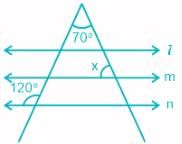
- a)80°
- b)70°
- c)60°
- d)50°
Correct answer is option 'D'. Can you explain this answer?
In the given figure l ∥ m ∥ n, the value of x is
a)
80°
b)
70°
c)
60°
d)
50°
| | Riverdale Learning Institute answered |
Given:
l ∥ m ∥ n
Concept used:
Sum of interior angles of a triangle = 180°
Calculation:
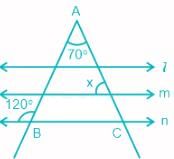
⇒ ∠ABC = 180° - 120° = 60°
⇒ ∠ACB = 180° - ∠A - ∠ABC
⇒ ∠ACB = 180° - 70° - 60°
⇒ ∠ACB = 50°
⇒ ∠x = ∠ACB [Corresponding angles]
⇒ ∠x = 50°
∴ The value of x is 50°.
l ∥ m ∥ n
Concept used:
Sum of interior angles of a triangle = 180°
Calculation:
⇒ ∠ABC = 180° - 120° = 60°
⇒ ∠ACB = 180° - ∠A - ∠ABC
⇒ ∠ACB = 180° - 70° - 60°
⇒ ∠ACB = 50°
⇒ ∠x = ∠ACB [Corresponding angles]
⇒ ∠x = 50°
∴ The value of x is 50°.
Direction: Read the following passage carefully and answer the questions that follow.
The morning of June 27th was clear and sunny, with the fresh warmth of a full-summer day; the flowers were blossoming profusely, and the grass was richly green. The people of the village began to gather in the square, between the post office and the bank, around ten o’clock; in some towns, there were so many people that the lottery took two days and had to be started on June 20th, but in this village, where there were only about three hundred people, the whole lottery took less than two hours so that it could begin at ten o’clock in the morning and still be through in time to allow the villagers to get home for noon dinner.
The children assembled first, of course. The school was recently over for the summer, and the feeling of liberty sat uneasily on most of them; they tended to gather together quietly for a while before they broke into boisterous play, and their talk was still of the classroom and the teacher, of books and reprimands. Bobby Martin had already stuffed his pockets full of stones, and the other boys soon followed his example, selecting the smoothest and roundest stones; Bobby and Harry Jones and Dickie Delacroix—the villagers pronounced this name “Dellacroy”—eventually made a great pile of stones in one corner of the square and guarded it against the raids of the other boys. The girls stood aside, talking among themselves, looking over their shoulders at the boys, and the tiny children rolled in the dust or clung to the hands of their older brothers or sisters.
Soon the men began to gather, surveying their own children, speaking of planting and rain, tractors and taxes. They stood together, away from the pile of stones in the corner, and their jokes were quiet, and they smiled rather than laughed. The women, wearing faded house dresses and sweaters, came shortly after their menfolk. They greeted one another and exchanged bits of gossip as they went to join their husbands. Soon the women, standing by their husbands, began to call to their children, and the children came reluctantly, having to be called four or five times. Bobby Martin ducked under his mother’s grasping hand and ran, laughing, back to the pile of stones. His father spoke up sharply, and Bobby came quickly and took his place between his father and his oldest brother.Q. Which one of the following words is the most opposite in the meaning to the word "together" as used in the passage (Para 3)?- a)Unitedly
- b)Concertedly
- c)Solely
- d)Conjointly
Correct answer is option 'C'. Can you explain this answer?
Direction: Read the following passage carefully and answer the questions that follow.
The morning of June 27th was clear and sunny, with the fresh warmth of a full-summer day; the flowers were blossoming profusely, and the grass was richly green. The people of the village began to gather in the square, between the post office and the bank, around ten o’clock; in some towns, there were so many people that the lottery took two days and had to be started on June 20th, but in this village, where there were only about three hundred people, the whole lottery took less than two hours so that it could begin at ten o’clock in the morning and still be through in time to allow the villagers to get home for noon dinner.
The children assembled first, of course. The school was recently over for the summer, and the feeling of liberty sat uneasily on most of them; they tended to gather together quietly for a while before they broke into boisterous play, and their talk was still of the classroom and the teacher, of books and reprimands. Bobby Martin had already stuffed his pockets full of stones, and the other boys soon followed his example, selecting the smoothest and roundest stones; Bobby and Harry Jones and Dickie Delacroix—the villagers pronounced this name “Dellacroy”—eventually made a great pile of stones in one corner of the square and guarded it against the raids of the other boys. The girls stood aside, talking among themselves, looking over their shoulders at the boys, and the tiny children rolled in the dust or clung to the hands of their older brothers or sisters.
Soon the men began to gather, surveying their own children, speaking of planting and rain, tractors and taxes. They stood together, away from the pile of stones in the corner, and their jokes were quiet, and they smiled rather than laughed. The women, wearing faded house dresses and sweaters, came shortly after their menfolk. They greeted one another and exchanged bits of gossip as they went to join their husbands. Soon the women, standing by their husbands, began to call to their children, and the children came reluctantly, having to be called four or five times. Bobby Martin ducked under his mother’s grasping hand and ran, laughing, back to the pile of stones. His father spoke up sharply, and Bobby came quickly and took his place between his father and his oldest brother.
The morning of June 27th was clear and sunny, with the fresh warmth of a full-summer day; the flowers were blossoming profusely, and the grass was richly green. The people of the village began to gather in the square, between the post office and the bank, around ten o’clock; in some towns, there were so many people that the lottery took two days and had to be started on June 20th, but in this village, where there were only about three hundred people, the whole lottery took less than two hours so that it could begin at ten o’clock in the morning and still be through in time to allow the villagers to get home for noon dinner.
The children assembled first, of course. The school was recently over for the summer, and the feeling of liberty sat uneasily on most of them; they tended to gather together quietly for a while before they broke into boisterous play, and their talk was still of the classroom and the teacher, of books and reprimands. Bobby Martin had already stuffed his pockets full of stones, and the other boys soon followed his example, selecting the smoothest and roundest stones; Bobby and Harry Jones and Dickie Delacroix—the villagers pronounced this name “Dellacroy”—eventually made a great pile of stones in one corner of the square and guarded it against the raids of the other boys. The girls stood aside, talking among themselves, looking over their shoulders at the boys, and the tiny children rolled in the dust or clung to the hands of their older brothers or sisters.
Soon the men began to gather, surveying their own children, speaking of planting and rain, tractors and taxes. They stood together, away from the pile of stones in the corner, and their jokes were quiet, and they smiled rather than laughed. The women, wearing faded house dresses and sweaters, came shortly after their menfolk. They greeted one another and exchanged bits of gossip as they went to join their husbands. Soon the women, standing by their husbands, began to call to their children, and the children came reluctantly, having to be called four or five times. Bobby Martin ducked under his mother’s grasping hand and ran, laughing, back to the pile of stones. His father spoke up sharply, and Bobby came quickly and took his place between his father and his oldest brother.
Q. Which one of the following words is the most opposite in the meaning to the word "together" as used in the passage (Para 3)?
a)
Unitedly
b)
Concertedly
c)
Solely
d)
Conjointly
| | Eesha Bhat answered |
- Together: in or into one place, mass, collection, or group
Example: Our students study together, share ideas, and seed new opportunities for future collaboration. - Solely: without another
Example: You will be held solely responsible for any damage.
Thus, "solely" is the most opposite in meaning to "together".
In science teaching, explanation method will be proved most useful when-- a)Knowledge is to given to students.
- b)To develop interest and in form of helping way of text book.
- c)To draw attention of indisciplined class.
- d)To completely present the subject matter.
Correct answer is option 'B'. Can you explain this answer?
In science teaching, explanation method will be proved most useful when-
a)
Knowledge is to given to students.
b)
To develop interest and in form of helping way of text book.
c)
To draw attention of indisciplined class.
d)
To completely present the subject matter.
 | Poonam Yadav answered |
Answer b
Task : Fill in the blanks choosing the suitable words.
(i) I want a cup of ______ coffee. (strong/powerful)
(ii) He is a ______ smoker. (heavy/big)
The task above tests the learner's ability in:- a)spelling
- b)pronunciation
- c)collocation
- d)idiomatic use
Correct answer is option 'C'. Can you explain this answer?
Task : Fill in the blanks choosing the suitable words.
(i) I want a cup of ______ coffee. (strong/powerful)
(ii) He is a ______ smoker. (heavy/big)
The task above tests the learner's ability in:
(i) I want a cup of ______ coffee. (strong/powerful)
(ii) He is a ______ smoker. (heavy/big)
The task above tests the learner's ability in:
a)
spelling
b)
pronunciation
c)
collocation
d)
idiomatic use
| | Aspire Academy answered |
A collocation is two or more words that often go together. These combinations just sound "right" to native English speakers, who use them all the time. On the other hand, other combinations may be unnatural and just sound "wrong". Look at these examples-
I want a cup of Strong (not powerful) coffee.
He is a heavy (not big) smoker.
NOTE:
I want a cup of Strong (not powerful) coffee.
He is a heavy (not big) smoker.
NOTE:
- Spelling: the forming of words from letters according to accepted usage.
- Pronunciation: the way in which a particular letter word or sound is said.
- Idiomatic use: using language that contains expressions that are natural to somebody who learned the language as a child.
Hence, the task above tests the learner's ability in collocation.
जब विद्यालय में विभिन्न प्रकार की सामग्री का उपयोग किया जाता है, तो उसे क्या कहा जाता हैं?- a)सामग्री प्रतिस्थापन
- b)सामग्री विस्तार
- c)सामग्री अनुकूलन
- d)सामग्री चूक
Correct answer is option 'C'. Can you explain this answer?
जब विद्यालय में विभिन्न प्रकार की सामग्री का उपयोग किया जाता है, तो उसे क्या कहा जाता हैं?
a)
सामग्री प्रतिस्थापन
b)
सामग्री विस्तार
c)
सामग्री अनुकूलन
d)
सामग्री चूक
| | Aspire Academy answered |
जब विद्यालय में विभिन्न प्रकार की सामग्री का उपयोग किया जाता है, तो उसे सामग्री अनुकूलन कहा जाता हैं।
शिक्षक द्वारा बनायी गयी कम लागत की अधिगम सामग्री शिक्षण में प्रयोग करने के लिए सबसे उत्तम होती है।
शिक्षक द्वारा बनायी गयी कम लागत की अधिगम सामग्री शिक्षण में प्रयोग करने के लिए सबसे उत्तम होती है।
- कक्षा में गुणवत्ता लाने के लिए शिक्षक को अधिगम का समर्थन करने के लिए सामग्री की आवश्यकता होती है।
- यदि विविध अधिगम सामग्री का प्रयोग किया जाए तो कोई भी बच्चा अधिगम प्रक्रिया में पूरी तरह भाग ले पाऐगा।
- जब विद्यालय में विभिन्न प्रकार की सामग्री का उपयोग अधिगम को सरल और सुसाध्य बनाने के लिए किया जाता है तो इसे सामग्री अनुकूलन कहते हैं।
- जहां उपयुक्त हो अधिगम के समर्थन के लिए दृश्य सामग्री जैसे चित्र, फोटोग्राफ आदि का प्रयोग करना चाहिए। एक “समुद्री घोड़े” या 'ताजमहल' का चित्र बच्चे को शब्दों से कहीं अधिक जानकारी देगा।
- महान व्यक्तियों के चित्र, कम गिनती में रह गए जानवरों व पौधों के चित्र, ऐतिहासिक स्थानों को फोटोग्राफ और घटनाएं चित्रों के रूप में, सब बच्चों की कल्पना सही
- दिशा में ले जाने में मदद करती हैं।
Language of mathematics learned in school should be interlinked with everyday speech because- a)It will help children in good interpersonal skills
- b)It makes children highly motivated
- c)It develops deep understanding of the subject
- d)None of them
Correct answer is option 'C'. Can you explain this answer?
Language of mathematics learned in school should be interlinked with everyday speech because
a)
It will help children in good interpersonal skills
b)
It makes children highly motivated
c)
It develops deep understanding of the subject
d)
None of them
| | Riverdale Learning Institute answered |
The language of mathematics refers to the language used to express mathematical thoughts and ideas. It makes learners able to assimilate mathematical terms, reason logically, and recognize and employ patterns of mathematical thought. The language of mathematics learned in school should be interlinked with everyday speech because it develops a deep understanding of the subject.
The main characteristics of mathematical language are
The main characteristics of mathematical language are
- the simplicity of the concepts so that the learner can easily understand them.
- accuracy is also needed in mathematics so that students can learn to commit fewer mistakes and be accurate in doing calculations.
- through precision, students learn exactly how to use formulas and under what situations these formulas are correct.
Hence, we conclude that the language of mathematics learned in school should be interlinked with everyday speech because it develops a deep understanding of the subject.
A wire is in the form of a square with side 66 cm. If it is bent into a circle, then what is the radius of the circle?- a)42
- b)36
- c)45
- d)33
Correct answer is option 'A'. Can you explain this answer?
A wire is in the form of a square with side 66 cm. If it is bent into a circle, then what is the radius of the circle?
a)
42
b)
36
c)
45
d)
33
| | Eesha Bhat answered |
Given:
A wire is in the shape of a square of side 66 cm
Formula Used:
The perimeter of a Square = 4 × Side
The perimeter of a Circle = 2πr
Calculation:
According to the question,
Perimeter of Square = Perimeter of Circle
⇒ 4 × 66 = 2 × (22/7) × r
⇒ 2 × 3 = r/7
⇒ r = 42 cm
∴ The radius of the circle is 42 cm.
A wire is in the shape of a square of side 66 cm
Formula Used:
The perimeter of a Square = 4 × Side
The perimeter of a Circle = 2πr
Calculation:
According to the question,
Perimeter of Square = Perimeter of Circle
⇒ 4 × 66 = 2 × (22/7) × r
⇒ 2 × 3 = r/7
⇒ r = 42 cm
∴ The radius of the circle is 42 cm.
The word 'Compulsory' in 'The Right to Free and Compulsory Education 2009' means that- a)parents are compulsorily forced to send their children to school to avoid punitive action
- b)compulsory education will be imparted through continuous testing
- c)central government will ensure admission, attendance and completion of elementary education
- d)appropriate governments will ensure admission, attendance and completion of elementary education
Correct answer is option 'D'. Can you explain this answer?
The word 'Compulsory' in 'The Right to Free and Compulsory Education 2009' means that
a)
parents are compulsorily forced to send their children to school to avoid punitive action
b)
compulsory education will be imparted through continuous testing
c)
central government will ensure admission, attendance and completion of elementary education
d)
appropriate governments will ensure admission, attendance and completion of elementary education
| | Riverdale Learning Institute answered |
The RTE Act provides for The Right of Children to Free and Compulsory Education till completion of elementary education in a neighbourhood school. It clarifies that 'compulsory education' means obligation of the appropriate government to provide free elementary education and ensure compulsory admission, attendance and completion of elementary education to every child in the six to fourteen age group.
'Free' means that no child shall be liable to pay any kind of fee or charges or expenses which may prevent him or her from pursuing and completing elementary education. It makes provisions for a non-admitted child to be admitted to an age appropriate class.
'Free' means that no child shall be liable to pay any kind of fee or charges or expenses which may prevent him or her from pursuing and completing elementary education. It makes provisions for a non-admitted child to be admitted to an age appropriate class.
Absenteeism can be stopped by- a)teaching
- b)punishing the students
- c)giving them sweets
- d)contacting the parents
Correct answer is option 'A'. Can you explain this answer?
Absenteeism can be stopped by
a)
teaching
b)
punishing the students
c)
giving them sweets
d)
contacting the parents
| | Aditi Singhania answered |
Teaching as a Solution to Absenteeism:
Teaching is the most effective way to address absenteeism among students. Here's why:
Engagement:
- By making the lessons interesting and interactive, teachers can keep students engaged and motivated to attend classes regularly.
- Incorporating hands-on activities, group projects, and real-life examples can make learning more enjoyable for students.
Relevance:
- Teachers can make the content relevant to students' lives by connecting it to their interests, experiences, and future goals.
- Showing the practical applications of what they are learning can help students see the value of attending classes.
Support:
- Teachers can provide additional support to students who are struggling with attendance issues by offering extra help, counseling, or resources.
- Building a positive and supportive relationship with students can encourage them to come to school regularly.
Responsibility:
- By instilling a sense of responsibility in students towards their education, teachers can help them understand the importance of attending classes and being present in school.
- Setting clear expectations and holding students accountable for their attendance can promote a sense of ownership and commitment.
Conclusion:
In conclusion, teaching plays a crucial role in addressing absenteeism among students. By creating engaging, relevant, and supportive learning environments, teachers can help promote regular attendance and ensure that students are actively participating in their education.
Teaching is the most effective way to address absenteeism among students. Here's why:
Engagement:
- By making the lessons interesting and interactive, teachers can keep students engaged and motivated to attend classes regularly.
- Incorporating hands-on activities, group projects, and real-life examples can make learning more enjoyable for students.
Relevance:
- Teachers can make the content relevant to students' lives by connecting it to their interests, experiences, and future goals.
- Showing the practical applications of what they are learning can help students see the value of attending classes.
Support:
- Teachers can provide additional support to students who are struggling with attendance issues by offering extra help, counseling, or resources.
- Building a positive and supportive relationship with students can encourage them to come to school regularly.
Responsibility:
- By instilling a sense of responsibility in students towards their education, teachers can help them understand the importance of attending classes and being present in school.
- Setting clear expectations and holding students accountable for their attendance can promote a sense of ownership and commitment.
Conclusion:
In conclusion, teaching plays a crucial role in addressing absenteeism among students. By creating engaging, relevant, and supportive learning environments, teachers can help promote regular attendance and ensure that students are actively participating in their education.
Which of the following statements is/are NOT correct?
I. Force per unit volume is called pressure.
II. Liquids can exert pressure on walls of containers.
III. Force acting on an object can cause a change in it state of motion but not its shape.- a)Only I and II
- b)Only III
- c)I, II and III
- d)Only I and III
Correct answer is option 'D'. Can you explain this answer?
Which of the following statements is/are NOT correct?
I. Force per unit volume is called pressure.
II. Liquids can exert pressure on walls of containers.
III. Force acting on an object can cause a change in it state of motion but not its shape.
I. Force per unit volume is called pressure.
II. Liquids can exert pressure on walls of containers.
III. Force acting on an object can cause a change in it state of motion but not its shape.
a)
Only I and II
b)
Only III
c)
I, II and III
d)
Only I and III
| | Eesha Bhat answered |
- Force acting on a unit area is called pressure.
- The pressure increases with increasing depth.
- This is due to the water up above weighing down on the water below.
- Liquid pressure increases as depth increases.
- The pressure is greater on the lower surfaces of the body than on the upper surfaces as the pressure in a fluid increases with depth.
- Pressure and depth are directly proportional to each other.
Characteristic of simplicity relates to which of the following?- a)Moral value
- b)Practical value
- c)Cultural value
- d)Disciplinary value
Correct answer is option 'D'. Can you explain this answer?
Characteristic of simplicity relates to which of the following?
a)
Moral value
b)
Practical value
c)
Cultural value
d)
Disciplinary value
| | Om Singhania answered |
The characteristic of simplicity relates to the disciplinary value.
Simplicity is a characteristic that is valued and emphasized in various disciplines and fields of study. It refers to the quality of being straightforward, uncomplicated, and easy to understand. Simplicity is often seen as a desirable trait because it promotes clarity, efficiency, and effectiveness in different areas of life.
In the context of disciplines such as science, mathematics, and engineering, simplicity is highly valued. The principle of Occam's razor, for example, states that the simplest explanation is often the best explanation. In scientific research, simplicity is often sought after in theories and models, as it allows for easier understanding and application. In mathematics, simplicity is valued in the form of elegant and concise proofs and solutions. In engineering, simplicity is key to creating efficient and reliable designs.
Simplicity is also valued in other fields, such as literature, art, and design. In literature, simplicity in writing style and storytelling can enhance the reader's experience and make the message more accessible. In art and design, simplicity can create visually appealing and impactful works. Minimalism, for example, is a style that emphasizes simplicity and eliminates unnecessary elements in order to convey a clear and powerful message.
Furthermore, simplicity is often valued in personal and professional contexts. In personal life, simplicity can lead to a balanced and fulfilling lifestyle, free from unnecessary complexity and stress. In the workplace, simplicity can improve productivity and communication, as well as reduce errors and confusion.
Overall, simplicity is a characteristic that is highly valued in various disciplines and areas of life. It promotes clarity, efficiency, and effectiveness, and is an important principle to strive for in order to achieve better understanding and results.
Simplicity is a characteristic that is valued and emphasized in various disciplines and fields of study. It refers to the quality of being straightforward, uncomplicated, and easy to understand. Simplicity is often seen as a desirable trait because it promotes clarity, efficiency, and effectiveness in different areas of life.
In the context of disciplines such as science, mathematics, and engineering, simplicity is highly valued. The principle of Occam's razor, for example, states that the simplest explanation is often the best explanation. In scientific research, simplicity is often sought after in theories and models, as it allows for easier understanding and application. In mathematics, simplicity is valued in the form of elegant and concise proofs and solutions. In engineering, simplicity is key to creating efficient and reliable designs.
Simplicity is also valued in other fields, such as literature, art, and design. In literature, simplicity in writing style and storytelling can enhance the reader's experience and make the message more accessible. In art and design, simplicity can create visually appealing and impactful works. Minimalism, for example, is a style that emphasizes simplicity and eliminates unnecessary elements in order to convey a clear and powerful message.
Furthermore, simplicity is often valued in personal and professional contexts. In personal life, simplicity can lead to a balanced and fulfilling lifestyle, free from unnecessary complexity and stress. In the workplace, simplicity can improve productivity and communication, as well as reduce errors and confusion.
Overall, simplicity is a characteristic that is highly valued in various disciplines and areas of life. It promotes clarity, efficiency, and effectiveness, and is an important principle to strive for in order to achieve better understanding and results.
Who is known as the father of modern media education.- a)Edger Dale
- b)Flanders
- c)Erikson
- d)Charles Babbage
Correct answer is option 'A'. Can you explain this answer?
Who is known as the father of modern media education.
a)
Edger Dale
b)
Flanders
c)
Erikson
d)
Charles Babbage
| | Eesha Bhat answered |
Edger Dale is known as the father of modern media education.
Edger Dale: edgar Dale (April 27, 1900 in Benson, Minnesota, – March 8, 1985 in Columbus, Ohio) was an American educator who developed the Cone of Experience, also known as the Learning Pyramid. He made several contributions to audio and visual instruction, including a methodology for analyzing the content of motion pictures.
Edger Dale: edgar Dale (April 27, 1900 in Benson, Minnesota, – March 8, 1985 in Columbus, Ohio) was an American educator who developed the Cone of Experience, also known as the Learning Pyramid. He made several contributions to audio and visual instruction, including a methodology for analyzing the content of motion pictures.
If a learner is able to perform the four basic operations on whole numbers, fractions and decimal numbers, the learner is at _________.- a)the partitioning phase
- b)factoring phase
- c)operating phase
- d)quantifying phase
Correct answer is option 'C'. Can you explain this answer?
If a learner is able to perform the four basic operations on whole numbers, fractions and decimal numbers, the learner is at _________.
a)
the partitioning phase
b)
factoring phase
c)
operating phase
d)
quantifying phase
 | Naman Gupta answered |
Understanding the Operating Phase
The operating phase is a critical stage in mathematical learning where a learner demonstrates proficiency in performing arithmetic operations. This includes basic operations with whole numbers, fractions, and decimal numbers.
Key Characteristics of the Operating Phase:
- Proficiency in Basic Operations:
- Learners can add, subtract, multiply, and divide whole numbers with confidence.
- They can also handle fractions and decimals, applying the same operations effectively.
- Conceptual Understanding:
- At this phase, learners not only perform calculations but also understand the underlying concepts.
- They grasp how operations affect the values of numbers and can compare results.
- Application of Skills:
- Learners can apply these skills to solve real-world problems.
- This includes tasks like budgeting, cooking measurements, and other daily activities that require numerical operations.
Comparison with Other Phases:
- Partitioning Phase:
- This phase focuses on breaking numbers into parts but does not necessarily require performing operations.
- Factoring Phase:
- Involves finding factors of numbers, which is a more advanced skill related to multiplication and division.
- Quantifying Phase:
- This phase emphasizes understanding quantities and measurements rather than operations.
Conclusion:
In conclusion, when a learner can confidently perform the four basic operations on whole numbers, fractions, and decimal numbers, they have reached the operating phase. This foundation is essential for more advanced mathematical concepts and practical applications.
The operating phase is a critical stage in mathematical learning where a learner demonstrates proficiency in performing arithmetic operations. This includes basic operations with whole numbers, fractions, and decimal numbers.
Key Characteristics of the Operating Phase:
- Proficiency in Basic Operations:
- Learners can add, subtract, multiply, and divide whole numbers with confidence.
- They can also handle fractions and decimals, applying the same operations effectively.
- Conceptual Understanding:
- At this phase, learners not only perform calculations but also understand the underlying concepts.
- They grasp how operations affect the values of numbers and can compare results.
- Application of Skills:
- Learners can apply these skills to solve real-world problems.
- This includes tasks like budgeting, cooking measurements, and other daily activities that require numerical operations.
Comparison with Other Phases:
- Partitioning Phase:
- This phase focuses on breaking numbers into parts but does not necessarily require performing operations.
- Factoring Phase:
- Involves finding factors of numbers, which is a more advanced skill related to multiplication and division.
- Quantifying Phase:
- This phase emphasizes understanding quantities and measurements rather than operations.
Conclusion:
In conclusion, when a learner can confidently perform the four basic operations on whole numbers, fractions, and decimal numbers, they have reached the operating phase. This foundation is essential for more advanced mathematical concepts and practical applications.
The section on 'activities and projects included in the exercises of NCERT Science textbooks for class Vlll' primarily aims at- a)enhancing in-depth understanding of the basic concepts
- b)keeping the students engaged during vacations
- c)providing opportunity to students for extended learning
- d)assessing the students on practical skills
Correct answer is option 'C'. Can you explain this answer?
The section on 'activities and projects included in the exercises of NCERT Science textbooks for class Vlll' primarily aims at
a)
enhancing in-depth understanding of the basic concepts
b)
keeping the students engaged during vacations
c)
providing opportunity to students for extended learning
d)
assessing the students on practical skills
| | Eesha Bhat answered |
The section on 'activities and projects included in the exercises of NCERT Science textbooks for class Vlll' primarily aims at assessing the students on practical skills. It will enhance their thinking skills.
Individuals who have the ability to understand the motives, feelings and behaviours of others to bond with them are high on_______intelligence in Howard Gardner’s theory.- a)naturalistic
- b)interpersonal
- c)intrapersonal
- d)spatial
Correct answer is option 'B'. Can you explain this answer?
Individuals who have the ability to understand the motives, feelings and behaviours of others to bond with them are high on_______intelligence in Howard Gardner’s theory.
a)
naturalistic
b)
interpersonal
c)
intrapersonal
d)
spatial
| | Eesha Bhat answered |
Individuals who have the ability to understand the motives, feelings and behaviours of others to bond with them are high on interpersonal Intelligence in Howard Gardner’s theory.
Interpersonal intelligence: In this type of intelligence people have the ability to understand others' feelings, wishes, expectations, and needs & others' behavior.
These people have better social communication skills and have the ability to relate well with others and manage relationships.
Thus, people having interpersonal intelligence have the ability to interact with others in society.
Interpersonal intelligence: In this type of intelligence people have the ability to understand others' feelings, wishes, expectations, and needs & others' behavior.
These people have better social communication skills and have the ability to relate well with others and manage relationships.
Thus, people having interpersonal intelligence have the ability to interact with others in society.
मौन वाचन का प्रकार नहीं है
(i) समवेत वाचन
(ii) द्रुत वाचन
(iii) वैयक्तिक वाचन
(iv) अनुकरण वाचन- a)(i), (ii), तथा (iii)
- b)(i), (ii), तथा (iv)
- c)(i), (iii), तथा (iv)
- d)(ii), (iii), तथा (iv)
Correct answer is option 'D'. Can you explain this answer?
मौन वाचन का प्रकार नहीं है
(i) समवेत वाचन
(ii) द्रुत वाचन
(iii) वैयक्तिक वाचन
(iv) अनुकरण वाचन
(i) समवेत वाचन
(ii) द्रुत वाचन
(iii) वैयक्तिक वाचन
(iv) अनुकरण वाचन
a)
(i), (ii), तथा (iii)
b)
(i), (ii), तथा (iv)
c)
(i), (iii), तथा (iv)
d)
(ii), (iii), तथा (iv)
 | Vaibhav Sinha answered |
To determine the correct answer, let's analyze the given options and match them with the given statements.
(i) This statement is common to all options, so it is not helpful in determining the correct answer.
(ii) This statement is present in options B, C, and D.
(iii) This statement is present in options C and D.
(iv) This statement is present in options B and D.
Now, let's analyze each option individually:
Option A: (i), (ii), (iii)
This option includes statements (i), (ii), and (iii), but it does not include statement (iv). Therefore, option A is incorrect.
Option B: (i), (ii), (iv)
This option includes statements (i), (ii), and (iv), but it does not include statement (iii). Therefore, option B is incorrect.
Option C: (i), (iii), (iv)
This option includes statements (i), (iii), and (iv), but it does not include statement (ii). Therefore, option C is incorrect.
Option D: (ii), (iii), (iv)
This option includes all the given statements, (ii), (iii), and (iv), making it the correct answer.
In conclusion, the correct answer is Option D: (ii), (iii), (iv)
(i) This statement is common to all options, so it is not helpful in determining the correct answer.
(ii) This statement is present in options B, C, and D.
(iii) This statement is present in options C and D.
(iv) This statement is present in options B and D.
Now, let's analyze each option individually:
Option A: (i), (ii), (iii)
This option includes statements (i), (ii), and (iii), but it does not include statement (iv). Therefore, option A is incorrect.
Option B: (i), (ii), (iv)
This option includes statements (i), (ii), and (iv), but it does not include statement (iii). Therefore, option B is incorrect.
Option C: (i), (iii), (iv)
This option includes statements (i), (iii), and (iv), but it does not include statement (ii). Therefore, option C is incorrect.
Option D: (ii), (iii), (iv)
This option includes all the given statements, (ii), (iii), and (iv), making it the correct answer.
In conclusion, the correct answer is Option D: (ii), (iii), (iv)
Direction: Read the following passage carefully and answer the questions that follow.
The morning of June 27th was clear and sunny, with the fresh warmth of a full-summer day; the flowers were blossoming profusely, and the grass was richly green. The people of the village began to gather in the square, between the post office and the bank, around ten o’clock; in some towns, there were so many people that the lottery took two days and had to be started on June 20th, but in this village, where there were only about three hundred people, the whole lottery took less than two hours so that it could begin at ten o’clock in the morning and still be through in time to allow the villagers to get home for noon dinner.
The children assembled first, of course. The school was recently over for the summer, and the feeling of liberty sat uneasily on most of them; they tended to gather together quietly for a while before they broke into boisterous play, and their talk was still of the classroom and the teacher, of books and reprimands. Bobby Martin had already stuffed his pockets full of stones, and the other boys soon followed his example, selecting the smoothest and roundest stones; Bobby and Harry Jones and Dickie Delacroix—the villagers pronounced this name “Dellacroy”—eventually made a great pile of stones in one corner of the square and guarded it against the raids of the other boys. The girls stood aside, talking among themselves, looking over their shoulders at the boys, and the tiny children rolled in the dust or clung to the hands of their older brothers or sisters.
Soon the men began to gather, surveying their own children, speaking of planting and rain, tractors and taxes. They stood together, away from the pile of stones in the corner, and their jokes were quiet, and they smiled rather than laughed. The women, wearing faded house dresses and sweaters, came shortly after their menfolk. They greeted one another and exchanged bits of gossip as they went to join their husbands. Soon the women, standing by their husbands, began to call to their children, and the children came reluctantly, having to be called four or five times. Bobby Martin ducked under his mother’s grasping hand and ran, laughing, back to the pile of stones. His father spoke up sharply, and Bobby came quickly and took his place between his father and his oldest brother.Q. Which of the following statement is true?- a)They stood together, away from the pile of stones in the corner, and their jokes were quiet, and they smiled rather than laughed.
- b)Harry Jones had already stuffed his pockets full of stones, and the other boys soon followed his example, selecting the smoothest and roundest stones.
- c)There were so many people that the lottery took two days and had to be started on June 27th.
- d)Harry came quickly and took his place between his father and his oldest brother.
Correct answer is option 'A'. Can you explain this answer?
Direction: Read the following passage carefully and answer the questions that follow.
The morning of June 27th was clear and sunny, with the fresh warmth of a full-summer day; the flowers were blossoming profusely, and the grass was richly green. The people of the village began to gather in the square, between the post office and the bank, around ten o’clock; in some towns, there were so many people that the lottery took two days and had to be started on June 20th, but in this village, where there were only about three hundred people, the whole lottery took less than two hours so that it could begin at ten o’clock in the morning and still be through in time to allow the villagers to get home for noon dinner.
The children assembled first, of course. The school was recently over for the summer, and the feeling of liberty sat uneasily on most of them; they tended to gather together quietly for a while before they broke into boisterous play, and their talk was still of the classroom and the teacher, of books and reprimands. Bobby Martin had already stuffed his pockets full of stones, and the other boys soon followed his example, selecting the smoothest and roundest stones; Bobby and Harry Jones and Dickie Delacroix—the villagers pronounced this name “Dellacroy”—eventually made a great pile of stones in one corner of the square and guarded it against the raids of the other boys. The girls stood aside, talking among themselves, looking over their shoulders at the boys, and the tiny children rolled in the dust or clung to the hands of their older brothers or sisters.
Soon the men began to gather, surveying their own children, speaking of planting and rain, tractors and taxes. They stood together, away from the pile of stones in the corner, and their jokes were quiet, and they smiled rather than laughed. The women, wearing faded house dresses and sweaters, came shortly after their menfolk. They greeted one another and exchanged bits of gossip as they went to join their husbands. Soon the women, standing by their husbands, began to call to their children, and the children came reluctantly, having to be called four or five times. Bobby Martin ducked under his mother’s grasping hand and ran, laughing, back to the pile of stones. His father spoke up sharply, and Bobby came quickly and took his place between his father and his oldest brother.
The morning of June 27th was clear and sunny, with the fresh warmth of a full-summer day; the flowers were blossoming profusely, and the grass was richly green. The people of the village began to gather in the square, between the post office and the bank, around ten o’clock; in some towns, there were so many people that the lottery took two days and had to be started on June 20th, but in this village, where there were only about three hundred people, the whole lottery took less than two hours so that it could begin at ten o’clock in the morning and still be through in time to allow the villagers to get home for noon dinner.
The children assembled first, of course. The school was recently over for the summer, and the feeling of liberty sat uneasily on most of them; they tended to gather together quietly for a while before they broke into boisterous play, and their talk was still of the classroom and the teacher, of books and reprimands. Bobby Martin had already stuffed his pockets full of stones, and the other boys soon followed his example, selecting the smoothest and roundest stones; Bobby and Harry Jones and Dickie Delacroix—the villagers pronounced this name “Dellacroy”—eventually made a great pile of stones in one corner of the square and guarded it against the raids of the other boys. The girls stood aside, talking among themselves, looking over their shoulders at the boys, and the tiny children rolled in the dust or clung to the hands of their older brothers or sisters.
Soon the men began to gather, surveying their own children, speaking of planting and rain, tractors and taxes. They stood together, away from the pile of stones in the corner, and their jokes were quiet, and they smiled rather than laughed. The women, wearing faded house dresses and sweaters, came shortly after their menfolk. They greeted one another and exchanged bits of gossip as they went to join their husbands. Soon the women, standing by their husbands, began to call to their children, and the children came reluctantly, having to be called four or five times. Bobby Martin ducked under his mother’s grasping hand and ran, laughing, back to the pile of stones. His father spoke up sharply, and Bobby came quickly and took his place between his father and his oldest brother.
Q. Which of the following statement is true?
a)
They stood together, away from the pile of stones in the corner, and their jokes were quiet, and they smiled rather than laughed.
b)
Harry Jones had already stuffed his pockets full of stones, and the other boys soon followed his example, selecting the smoothest and roundest stones.
c)
There were so many people that the lottery took two days and had to be started on June 27th.
d)
Harry came quickly and took his place between his father and his oldest brother.
| | Eesha Bhat answered |
The correct answer is They stood together, away from the pile of stones in the corner, and their jokes were quiet, and they smiled rather than laughed.
Let's explore the options:
Option (A) is correct as:
The second line of the last paragraph states, "They stood together, away from the pile of stones in the corner, and their jokes were quiet, and they smiled rather than laughed."
Option (B) is incorrect as:
According to the passage, the correct statement is, "Bobby Martin had already stuffed his pockets full of stones, and the other boys soon followed his example, selecting the smoothest and roundest stones;".
Option (C) is incorrect as:
According to the passage, the correct statement is, "there were so many people that the lottery took two days and had to be started on June 20th,".
Option (D) is also incorrect as:
According to the passage, the correct statement is, "His father spoke up sharply, and Bobby came quickly and took his place between his father and his oldest brother."
Let's explore the options:
Option (A) is correct as:
The second line of the last paragraph states, "They stood together, away from the pile of stones in the corner, and their jokes were quiet, and they smiled rather than laughed."
Option (B) is incorrect as:
According to the passage, the correct statement is, "Bobby Martin had already stuffed his pockets full of stones, and the other boys soon followed his example, selecting the smoothest and roundest stones;".
Option (C) is incorrect as:
According to the passage, the correct statement is, "there were so many people that the lottery took two days and had to be started on June 20th,".
Option (D) is also incorrect as:
According to the passage, the correct statement is, "His father spoke up sharply, and Bobby came quickly and took his place between his father and his oldest brother."
A teacher wants her students to know about government schemes through primary sources. Which one of the following schemes is inappropriate?- a)A review of a book on government schemes
- b)An interview with a Block Development Officer
- c)A survey of schemes in the students' neighbourhood
- d)A report on expenditure incurred, on various schemes in the student's neighbourhood.
Correct answer is option 'A'. Can you explain this answer?
A teacher wants her students to know about government schemes through primary sources. Which one of the following schemes is inappropriate?
a)
A review of a book on government schemes
b)
An interview with a Block Development Officer
c)
A survey of schemes in the students' neighbourhood
d)
A report on expenditure incurred, on various schemes in the student's neighbourhood.
| | Eesha Bhat answered |
A review of a book on government schemes is not appropriate to take knowledge of primary sources.
Primary Sources: A source will be considered as a primary source in case it carries newly generated information, original work of research, or a new interpretation of already known facts. The document is the first and often the only published record of original research. The information contained in primary sources is generally scattered and unorganized.
Primary Sources: A source will be considered as a primary source in case it carries newly generated information, original work of research, or a new interpretation of already known facts. The document is the first and often the only published record of original research. The information contained in primary sources is generally scattered and unorganized.
What instructional adaptations should a teacher make while working with students who are ‘Visually Challenged’?- a)Use a variety of visual presentations
- b)Orient herself so that the students can watch her closely
- c)Focus on a variety of written tasks, especially worksheets.
- d)Speak clearly and use a lot of touches and feel materials
Correct answer is option 'D'. Can you explain this answer?
What instructional adaptations should a teacher make while working with students who are ‘Visually Challenged’?
a)
Use a variety of visual presentations
b)
Orient herself so that the students can watch her closely
c)
Focus on a variety of written tasks, especially worksheets.
d)
Speak clearly and use a lot of touches and feel materials
| | Aspire Academy answered |
In the teaching-learning process, visually challenged learners suffer from an issue with sight or vision but when they are facilitated with the right training and tools, they develop a good literacy ability.
Instructional adaptations that a teacher should make while working with visually challenged learners include:
Instructional adaptations that a teacher should make while working with visually challenged learners include:
- using a lot of touches and feel materials.
- giving verbal clues to create opportunities to imagine.
- introducing tactile materials during classroom discussions.
- speaking clearly and loudly with appropriate pauses and reiterations.
- providing learning with the help of auditory systems such as an audio CD of the textbook, radio, etc.
- using the braille system to make them read-write as its raised dots will help the child to study the words through the pattern.
A teacher should not use a variety of visual presentations and written tasks especially worksheets for visually challenged learners as it could lead to low self-esteem and feeling of failure in them.
So, it could be concluded that a teacher should speak clearly and use a lot of touches and feel materials while working with visually challenged learners.
Tactile materials: It refers to the inputs which children receive through the receptive sensors of their skins.
Braille system: It refers to a pattern of raised dots called "Braille" to represent letters, numbers, and punctuation marks, that can be felt with a finger.
So, it could be concluded that a teacher should speak clearly and use a lot of touches and feel materials while working with visually challenged learners.
Tactile materials: It refers to the inputs which children receive through the receptive sensors of their skins.
Braille system: It refers to a pattern of raised dots called "Braille" to represent letters, numbers, and punctuation marks, that can be felt with a finger.
Chapter doubts & questions for Mock Tests - 2 Months Preparation for CTET Paper 2 2026 is part of CTET & State TET exam preparation. The chapters have been prepared according to the CTET & State TET exam syllabus. The Chapter doubts & questions, notes, tests & MCQs are made for CTET & State TET 2026 Exam. Find important definitions, questions, notes, meanings, examples, exercises, MCQs and online tests here.
Chapter doubts & questions of Mock Tests - 2 Months Preparation for CTET Paper 2 in English & Hindi are available as part of CTET & State TET exam. Download more important topics, notes, lectures and mock test series for CTET & State TET Exam by signing up for free.
2 Months Preparation for CTET Paper 2367 videos|1021 docs|335 tests |
