


All Exams > Class 9 > 6 Months Preparation for Class 9 (CBSE) > All Questions
All questions of Tissues for Class 9 Exam


Voluntary muscles are found in - a)Alimentary canal
- b)Limbs
- c)Iris of the eye
- d)Bronchi of lungs
Correct answer is option 'B'. Can you explain this answer?
Voluntary muscles are found in
a)
Alimentary canal
b)
Limbs
c)
Iris of the eye
d)
Bronchi of lungs
| | Aradhiya Gupta answered |
Voluntary muscles are found in limbs arms feet hand etc
Cork cells are made impervious to water and gases by the presence of- a)cellulose
- b)lipids
- c)suberin
- d)lignin
Correct answer is option 'C'. Can you explain this answer?
Cork cells are made impervious to water and gases by the presence of
a)
cellulose
b)
lipids
c)
suberin
d)
lignin
 | Vivek Shreyu answered |
Impervious to water and gases due to the presence of suberin
Chloroplasts occur in which of the following cells?a)collenchyma and sclerenchymab)parenchyma and collenchymac)chlorenchyma and sieve tubesd)xylem parenchyma and sclerenchymaCorrect answer is option 'B'. Can you explain this answer?
 | Pooja Shah answered |
Specialized parenchyma cells known as chlorenchyma found in plant leaves contain chloroplasts. This allows them to perform a photosynthetic function and responsible for the storage of starch.
So, the correct answer is 'Chlorenchyma and parenchyma.'
Blood is- a)Acidic
- b)Alkaline
- c)Variable
- d)Neutral
Correct answer is option 'B'. Can you explain this answer?
Blood is
a)
Acidic
b)
Alkaline
c)
Variable
d)
Neutral
 | Rohini Seth answered |
Fats are stored in the human body as adipose tissue. Adipose tissue serves as a storage site for fat.
The husk of coconut is a ________ tissue.- a)Meristematic
- b)Sclerenchymatous
- c)Epithelial
- d)Vascular
Correct answer is option 'B'. Can you explain this answer?
The husk of coconut is a ________ tissue.
a)
Meristematic
b)
Sclerenchymatous
c)
Epithelial
d)
Vascular
 | Arvind Singh answered |
Husk of coconut is made up of sclerenchymatous tissue.
It is present in mesocarp of fruit of coconut and a yield a coir a well known fibre used for making mats, ropes, cords, brushes e.t.c.
Sclerenchymatous tissue are found in stems( around the vascular bundle) , roots, vein of leaves, hard coverings of seeds and nuts.
The function of sclerenchymatous tissue is mainly mechanical & protective. It gives strength , rigidity ,flexibility and elasticity to the plant body.
Cells of tissue A have small intercellular spaces and walls thickened at the corners. Cells of tissue B do not have intercellular spaces and thickened cell walls. Identify tissue A and B.- a)A: Collenchyma, B: Sclerenchyma
- b)A: Sclerenchyma, B: Collenchyma
- c)A: Chlorenchyma, B: Sclerenchyma
- d)Collenchyma, B- Chlorenchyma
Correct answer is 'A'. Can you explain this answer?
Cells of tissue A have small intercellular spaces and walls thickened at the corners. Cells of tissue B do not have intercellular spaces and thickened cell walls. Identify tissue A and B.
a)
A: Collenchyma, B: Sclerenchyma
b)
A: Sclerenchyma, B: Collenchyma
c)
A: Chlorenchyma, B: Sclerenchyma
d)
Collenchyma, B- Chlorenchyma
| | Amit Sharma answered |
Collenchyma: The cells have cell walls thickened at the corners due to pectin deposition.
Sclerenchyma: Their walls are thickened due to lignin deposition.
Lignified or thickened cell wall is a characteristic feature of______.- a)collenchyma
- b)sclerenchyma
- c)parenchyma
- d)phloem
Correct answer is option 'B'. Can you explain this answer?
Lignified or thickened cell wall is a characteristic feature of______.
a)
collenchyma
b)
sclerenchyma
c)
parenchyma
d)
phloem
| | Ananya Das answered |
Sclerenchyma cells have thickened lignified walls, which make them strong and waterproof. They are commonly classified into support types and conducting forms. Support sclerenchyma is comprised of sclereids and fibers.
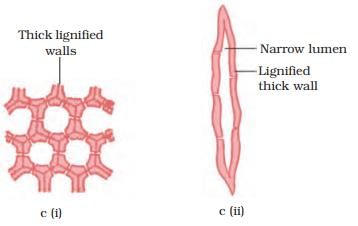
Sclerenchyma (i) transverse section, (ii) longitudinal section.
Sclerenchyma (i) transverse section, (ii) longitudinal section.
Striated muscles are found in- a)Gall bladder
- b)Wall of bronchi
- c)Skeletal muscles
- d)Lungs
Correct answer is option 'C'. Can you explain this answer?
Striated muscles are found in
a)
Gall bladder
b)
Wall of bronchi
c)
Skeletal muscles
d)
Lungs
| | Ananya Sharma answered |
Skeletal muscle is one of three major muscle types, the others being cardiac muscle and smooth muscle. It is a form of striated muscle tissue which is under the voluntary control of the somatic nervous system. Most skeletal muscles are attached to bones by bundles of collagen fibers known as tendons.
Fat is abundant in- a)Liver cells
- b)Alveolar tissue
- c)Lymph glands
- d)Adipose tissue
Correct answer is option 'D'. Can you explain this answer?
Fat is abundant in
a)
Liver cells
b)
Alveolar tissue
c)
Lymph glands
d)
Adipose tissue
 | Vikram Verma answered |
D is the correct option.The fat stored in adipose tissue comes from dietary fats or is produced in the body. hormone signaling; adipose tissueWhen hormones signal the need for energy, fatty acids and glycerol are released from triglycerides stored in fat cells (adipocytes) and are delivered to organs and tissues in the body.
Which tissue is responsible for bending of a stem, without breaking it?- a)Aerenchyma
- b)Chlorenchyma
- c)Collenchyma
- d)Sclerenchyma
Correct answer is 'C'. Can you explain this answer?
Which tissue is responsible for bending of a stem, without breaking it?
a)
Aerenchyma
b)
Chlorenchyma
c)
Collenchyma
d)
Sclerenchyma
| | Arjun Sharma answered |
Collenchyma provides elasticity and flexibility to the plant organs and thereby, prevents its breaking when it is bent.
Which hard and stiff tissue is present around vascular bundles, veins of leaves and hard covering of seeds?- a)Collenchyma
- b)Sclerenchyma
- c)Chlorenchyma
- d)Xylem
Correct answer is option 'B'. Can you explain this answer?
Which hard and stiff tissue is present around vascular bundles, veins of leaves and hard covering of seeds?
a)
Collenchyma
b)
Sclerenchyma
c)
Chlorenchyma
d)
Xylem
| | Vikram Khanna answered |
Sclerenchyma, in plants, support tissue composed of any of various kinds of hard woody cells. Mature sclerenchyma cells are usually dead cells that have heavily thickened secondary walls containing lignin. The cells are rigid and nonstretchable and are usually found in nongrowing regions of plant bodies, such as the bark or mature stems. Sclerenchyma is one of the three types of ground, or fundamental, tissue in plants; the other two types are parenchyma (living thin-walled tissue) and collenchyma (living support tissue with irregular walls). Sclerenchyma cells occur in many different shapes and sizes, but two main types occur: fibres and sclereids. Scelerenchyma permanent tissue and its wall is made up of lignin.
Practice Test/Quiz or MCQ (Multiple Choice Questions) with Solutions of Chapter "Animal Tissues (Tissue)" are available for CBSE Class 9 Science and have been compiled as per the syllabus of CBSE Class 9 Science Q. A tissue is a :- a)Group of separate organs that are coordinated in their activities
- b)Group of similar cells that function together in a specialised activity
- c)Layer of cells surrounding an organ
- d)Sheet of cells, one layer thick
Correct answer is option 'B'. Can you explain this answer?
Practice Test/Quiz or MCQ (Multiple Choice Questions) with Solutions of Chapter "Animal Tissues (Tissue)" are available for CBSE Class 9 Science and have been compiled as per the syllabus of CBSE Class 9 Science
Q. A tissue is a :
a)
Group of separate organs that are coordinated in their activities
b)
Group of similar cells that function together in a specialised activity
c)
Layer of cells surrounding an organ
d)
Sheet of cells, one layer thick
| | Arjun Sharma answered |
Tissue is a cellular organizational level between cells and a complete organ. A tissue is an ensemble of similar cells and their extracellular matrix from the same origin that together carry out a specific function. Organs are then formed by the functional grouping together of multiple tissues.
Cells of squamous epithelium are- a)Columnar
- b)Tall with elongated nuclei
- c)Flat plate-like
- d)Cube like
Correct answer is option 'C'. Can you explain this answer?
Cells of squamous epithelium are
a)
Columnar
b)
Tall with elongated nuclei
c)
Flat plate-like
d)
Cube like
| | Anita Menon answered |
The three principal shapes associated with epithelial cells are—squamous, cuboidal and columnar. Squamous epithelium has cells that are wider than their height (flat and scale-like). This is found as the lining of the mouth, oesophagus, the blood vessels and in the alveoli of the lungs.
Cells of tissue A have small intercellular spaces and walls thickened at the corners. Cells of tissue B do not have intercellular spaces and thickened cell walls. Identify tissue A and B.- a)A: Collenchyma, B: Sclerenchyma
- b)A: Sclerenchyma, B: Collenchyma
- c)A: Chlorenchyma, B: Sclerenchyma
- d)Collenchyma, B- Chlorenchyma
Correct answer is option 'A'. Can you explain this answer?
Cells of tissue A have small intercellular spaces and walls thickened at the corners. Cells of tissue B do not have intercellular spaces and thickened cell walls. Identify tissue A and B.
a)
A: Collenchyma, B: Sclerenchyma
b)
A: Sclerenchyma, B: Collenchyma
c)
A: Chlorenchyma, B: Sclerenchyma
d)
Collenchyma, B- Chlorenchyma
| | Amit Sharma answered |
Collenchyma: The cells have cell walls thickened at the corners due to pectin deposition.
Sclerenchyma: Their walls are thickened due to lignin deposition.
Can you explain the answer of this question below:Parenchymatous cells performing photosynthesis are called:
- A:
Sclerenchyma
- B:
Aerenchyma
- C:
Collenchyma
- D:
Chlorenchyma
The answer is d.
Parenchymatous cells performing photosynthesis are called:
Sclerenchyma
Aerenchyma
Collenchyma
Chlorenchyma
 | Anjali Singh answered |
Chlorenchyma cells are parenchymatous cells that perform photosynthesis in plants. These cells are specifically adapted for this function and contain chloroplasts, which are responsible for capturing light energy and converting it into chemical energy through the process of photosynthesis.
Chlorenchyma cells are found in the mesophyll of leaves, where they are closely packed together to form a continuous layer. They are also present in other green parts of the plant, such as the stems and fruits.
Here are some key characteristics of chlorenchyma cells:
1. Chloroplasts: Chlorenchyma cells contain a high concentration of chloroplasts, which are the organelles responsible for photosynthesis. The chloroplasts contain the pigment chlorophyll, which gives plants their green color and enables them to absorb light energy.
2. Large central vacuole: Chlorenchyma cells typically have a large central vacuole, which helps maintain the turgidity of the cell. This allows the chloroplasts to be positioned close to the cell surface, maximizing their exposure to light.
3. Thin cell walls: The cell walls of chlorenchyma cells are thin and flexible, allowing for efficient gas exchange and the movement of nutrients between cells.
4. Interconnected cytoplasm: Chlorenchyma cells are interconnected through plasmodesmata, which are small channels in the cell walls that allow for the exchange of materials and communication between cells.
5. Photosynthetic function: Chlorenchyma cells are responsible for producing glucose, the primary source of energy for plants. Through photosynthesis, they convert carbon dioxide and water into glucose and oxygen, using light energy absorbed by the chlorophyll.
Overall, chlorenchyma cells are highly specialized for photosynthesis and play a crucial role in the production of food and oxygen in plants. Their unique structural and functional adaptations enable them to efficiently capture and utilize light energy for the synthesis of glucose, supporting the growth and survival of the plant.
Chlorenchyma cells are found in the mesophyll of leaves, where they are closely packed together to form a continuous layer. They are also present in other green parts of the plant, such as the stems and fruits.
Here are some key characteristics of chlorenchyma cells:
1. Chloroplasts: Chlorenchyma cells contain a high concentration of chloroplasts, which are the organelles responsible for photosynthesis. The chloroplasts contain the pigment chlorophyll, which gives plants their green color and enables them to absorb light energy.
2. Large central vacuole: Chlorenchyma cells typically have a large central vacuole, which helps maintain the turgidity of the cell. This allows the chloroplasts to be positioned close to the cell surface, maximizing their exposure to light.
3. Thin cell walls: The cell walls of chlorenchyma cells are thin and flexible, allowing for efficient gas exchange and the movement of nutrients between cells.
4. Interconnected cytoplasm: Chlorenchyma cells are interconnected through plasmodesmata, which are small channels in the cell walls that allow for the exchange of materials and communication between cells.
5. Photosynthetic function: Chlorenchyma cells are responsible for producing glucose, the primary source of energy for plants. Through photosynthesis, they convert carbon dioxide and water into glucose and oxygen, using light energy absorbed by the chlorophyll.
Overall, chlorenchyma cells are highly specialized for photosynthesis and play a crucial role in the production of food and oxygen in plants. Their unique structural and functional adaptations enable them to efficiently capture and utilize light energy for the synthesis of glucose, supporting the growth and survival of the plant.
Bone forming cells are- a)Osteoblasts
- b)Osteoclasts
- c)Chondroblasts
- d)Chondroclasts
Correct answer is option 'A'. Can you explain this answer?
Bone forming cells are
a)
Osteoblasts
b)
Osteoclasts
c)
Chondroblasts
d)
Chondroclasts
 | Khushneet Kaur answered |
OSTEOBLASTS are the cells that form new bone. They also come from the bone marrow and are related to structural cells. They have only one nucleus.Osteoblasts work in teams to build bone. They produce new bone called "osteoid" which is made of bone collagen and other protein.
Cartilage is produced by- a)Osteoblasts
- b)Epithelium
- c)Fibroblasts
- d)Chondroblasts
Correct answer is option 'D'. Can you explain this answer?
Cartilage is produced by
a)
Osteoblasts
b)
Epithelium
c)
Fibroblasts
d)
Chondroblasts
 | Shruti answered |
Cartilage is produced by chondroblasts. explanation :-chondroblasts connective tissue is comprised of living cells within an extracellular matrix. the extracellular matrix in cartilage is produced by specialized cells called chondroblasts.

Which of the following tissues has dead cells?- a)Parenchyma
- b)Sclerenchyma
- c)Collenchyma
- d)Epithelial tissue
Correct answer is option 'B'. Can you explain this answer?
Which of the following tissues has dead cells?
a)
Parenchyma
b)
Sclerenchyma
c)
Collenchyma
d)
Epithelial tissue
| | Krishna Singi answered |
Option b is the correct answer reason pls search on Google
The protein deposited in the dead superficial cells that make the skin epithelium impervious to water is- a)Keratin
- b)Elastin
- c)Collagen
- d)Mucus
Correct answer is option 'A'. Can you explain this answer?
The protein deposited in the dead superficial cells that make the skin epithelium impervious to water is
a)
Keratin
b)
Elastin
c)
Collagen
d)
Mucus
| | Amit Kumar answered |
A is the correct option.The protein deposited in the dead superficial cells that make the skin epithelium impervious to water is Keratin which makes this epithelium impervious to water.
Mammary glands are modified- a)Sebaceous gland
- b)Sweat gland
- c)Oil gland
- d)Lymph gland
Correct answer is option 'B'. Can you explain this answer?
Mammary glands are modified
a)
Sebaceous gland
b)
Sweat gland
c)
Oil gland
d)
Lymph gland
 | Sarita Reddy answered |
These exocrine glands are enlarged and modified sweat glands and are the characteristic of mammals which gave the class its name. The basic components of the mammary gland are the alveoli (hollow cavities, a few millimetres large) lined with milk-secreting cuboidal cells and surrounded by myoepithelial cells.
Why are guard cells important for plant survival?- a)They transport nutrients.
- b)They store food.
- c)They regulate the opening and closing of stomata.
- d)They protect the plant from predators.
Correct answer is option 'C'. Can you explain this answer?
a)
They transport nutrients.
b)
They store food.
c)
They regulate the opening and closing of stomata.
d)
They protect the plant from predators.
 | Abhijeet Dasgupta answered |
Importance of Guard Cells in Plant Survival
Guard cells are specialized cells located on the surface of leaves and stems, playing a crucial role in the regulation of stomata, which are tiny openings that allow gas exchange. Their function is pivotal for plant survival for several reasons:
Regulation of Gas Exchange
- Guard cells control the opening and closing of stomata.
- This regulation facilitates the intake of carbon dioxide (CO2) for photosynthesis while minimizing water loss.
Water Conservation
- By closing the stomata during hot or dry conditions, guard cells help reduce transpiration (water loss through evaporation).
- This is essential for maintaining water balance and preventing wilting or dehydration of the plant.
Oxygen Release
- During photosynthesis, guard cells enable the release of oxygen (O2) as a byproduct.
- Proper functioning of stomata ensures that oxygen accumulates in the environment, which is vital for aerobic organisms.
Adaptation to Environmental Conditions
- Guard cells can respond to environmental signals such as light, humidity, and CO2 levels.
- This adaptability allows plants to optimize their gas exchange processes based on current conditions.
In summary, guard cells are integral to the plant's ability to manage gas exchange effectively, conserve water, and adapt to varying environmental conditions. Their role in regulating stomatal openings is fundamental for photosynthesis and overall plant health, making them essential for plant survival.
Guard cells are specialized cells located on the surface of leaves and stems, playing a crucial role in the regulation of stomata, which are tiny openings that allow gas exchange. Their function is pivotal for plant survival for several reasons:
Regulation of Gas Exchange
- Guard cells control the opening and closing of stomata.
- This regulation facilitates the intake of carbon dioxide (CO2) for photosynthesis while minimizing water loss.
Water Conservation
- By closing the stomata during hot or dry conditions, guard cells help reduce transpiration (water loss through evaporation).
- This is essential for maintaining water balance and preventing wilting or dehydration of the plant.
Oxygen Release
- During photosynthesis, guard cells enable the release of oxygen (O2) as a byproduct.
- Proper functioning of stomata ensures that oxygen accumulates in the environment, which is vital for aerobic organisms.
Adaptation to Environmental Conditions
- Guard cells can respond to environmental signals such as light, humidity, and CO2 levels.
- This adaptability allows plants to optimize their gas exchange processes based on current conditions.
In summary, guard cells are integral to the plant's ability to manage gas exchange effectively, conserve water, and adapt to varying environmental conditions. Their role in regulating stomatal openings is fundamental for photosynthesis and overall plant health, making them essential for plant survival.
Dermis of mammalian skin is mainly composed of- a)Muscular tissue
- b)Epithelial tissue
- c)Connective tissue
- d)All of the above
Correct answer is option 'C'. Can you explain this answer?
Dermis of mammalian skin is mainly composed of
a)
Muscular tissue
b)
Epithelial tissue
c)
Connective tissue
d)
All of the above
 | Krishna Iyer answered |
The dermis forms the bulk of the mammalian skin. It is composed of an association of connective tissue fibres, mainly collagen, with a ground substance of mucopolysaccharide materials (glycosaminoglycans), which can hold a quantity of water in its domain.
Haversian system is typically found in bones of- a)Fishes
- b)Aves
- c)Reptiles
- d)Mammals
Correct answer is option 'D'. Can you explain this answer?
Haversian system is typically found in bones of
a)
Fishes
b)
Aves
c)
Reptiles
d)
Mammals
 | Jyoti Kapoor answered |
Haversian system (named for Clopton Havers) is the fundamental functional unit of much compact bone. Osteons are roughly cylindrical structures that are typically several millimeters long and around 0.2 mm in diameter. They are present in many bones of most mammals and some bird, reptile, and amphibian species.
Which of the following statements about meristematic tissue are correct?
(i) Consists of cells that are very active, with dense cytoplasm, thin cellulose walls, and prominent nuclei.
(ii) Lacks vacuoles because they are involved in rapid cell division.
(iii) Is classified into apical, lateral, and intercalary based on their location.
(iv) Is responsible for the permanent shape, size, and function of cells.- a)(i) and (ii)
- b)(iii) and (iv)
- c)(i), (ii) and (iii)
- d)(i) and (iv)
Correct answer is option 'C'. Can you explain this answer?
Which of the following statements about meristematic tissue are correct?
(i) Consists of cells that are very active, with dense cytoplasm, thin cellulose walls, and prominent nuclei.
(ii) Lacks vacuoles because they are involved in rapid cell division.
(iii) Is classified into apical, lateral, and intercalary based on their location.
(iv) Is responsible for the permanent shape, size, and function of cells.
(i) Consists of cells that are very active, with dense cytoplasm, thin cellulose walls, and prominent nuclei.
(ii) Lacks vacuoles because they are involved in rapid cell division.
(iii) Is classified into apical, lateral, and intercalary based on their location.
(iv) Is responsible for the permanent shape, size, and function of cells.
a)
(i) and (ii)
b)
(iii) and (iv)
c)
(i), (ii) and (iii)
d)
(i) and (iv)
 | Prepworks Coaching answered |
- Meristematic tissue is characterized by cells that are very active, with dense cytoplasm, thin cellulose walls, and prominent nuclei.
- These cells lack vacuoles because they are involved in rapid cell division and do not require storage.
- Meristematic tissue is indeed classified into apical, lateral, and intercalary based on their location.
- However, it is not directly responsible for the permanent shape, size, and function of cells; that role is taken up by permanent tissue formed after differentiation.
- Therefore, statements (i), (ii), and (iii) are correct.
Horns of most mammals are composed of- a)Bones
- b)Cartilage
- c)Keratin
- d)Chitin
Correct answer is option 'C'. Can you explain this answer?
Horns of most mammals are composed of
a)
Bones
b)
Cartilage
c)
Keratin
d)
Chitin
| | Ravi Verma answered |
Rhinocerotidae: The "horns" of rhinoceroses are made of keratin, the same substance as fingernails, and grow continuously, but do not have a bone core. Chamaeleonidae: Many chameleons, most notably the Jackson's Chameleon, possess horns on their skulls, and have a keratin covering.
Direction: In the following questions, a statement of assertion (A) is followed by a statement of reason (R). Mark the correct choice as:Assertion: Bone and cartilage are connective tissue.Reason: Blood is connective tissue in which plasma is the matrix.- a)Both assertion (A) and reason (R) are true but reason (R) is not the correct explanation of assertion (A).
- b)Both assertion (A) and reason (R) are true and reason (R) is the correct explanation of assertion (A).
- c)Assertion (A) is true but reason (R) is false.
- d)Assertion (A) is false but reason (R) is true.
Correct answer is option 'B'. Can you explain this answer?
Direction: In the following questions, a statement of assertion (A) is followed by a statement of reason (R). Mark the correct choice as:
Assertion: Bone and cartilage are connective tissue.
Reason: Blood is connective tissue in which plasma is the matrix.
a)
Both assertion (A) and reason (R) are true but reason (R) is not the correct explanation of assertion (A).
b)
Both assertion (A) and reason (R) are true and reason (R) is the correct explanation of assertion (A).
c)
Assertion (A) is true but reason (R) is false.
d)
Assertion (A) is false but reason (R) is true.
| | Meera Rana answered |
- Assertion (A): True. Bone and cartilage are types of connective tissue. They support and protect the body, with bone being hard and rigid, while cartilage is more flexible.
- Reason (R): True. Blood is indeed a connective tissue, and the plasma serves as its matrix, providing a medium for transporting nutrients, waste, and cells.
- The reason does not explain why bone and cartilage are connective tissues; it describes blood instead.
Thus, the correct choice is A: Both assertion and reason are true, but reason is not the correct explanation of assertion.
- Reason (R): True. Blood is indeed a connective tissue, and the plasma serves as its matrix, providing a medium for transporting nutrients, waste, and cells.
- The reason does not explain why bone and cartilage are connective tissues; it describes blood instead.
Thus, the correct choice is A: Both assertion and reason are true, but reason is not the correct explanation of assertion.
Simple squamous epithelial cells are extremely thin and flat, forming a delicate lining in areas such as the ____.- a)Skin
- b)Intestine
- c)Oesophagus
- d)Kidney
Correct answer is option 'C'. Can you explain this answer?
Simple squamous epithelial cells are extremely thin and flat, forming a delicate lining in areas such as the ____.
a)
Skin
b)
Intestine
c)
Oesophagus
d)
Kidney
 | Sivakami Anbukumaran answered |
Oesophagus is covered with Simple Squamous Epithelial Cells because:
Cuboidal Epithelial Tissues are known to provide turgidity and rigidity to cells .
Glandular Epithelial Tissue is found in secretion organs.
Ciliated Columnar Epithelial Tissues help in movement of substances , but due to the area occupied of these tissues it would not assist in the movement of food
So it leaves it to option A.
HOPE THIS HELPS...
Tendon connects- a)Cartilage with muscles
- b)Bone with muscles
- c)Ligament with muscles
- d)Bone with bone
Correct answer is option 'B'. Can you explain this answer?
Tendon connects
a)
Cartilage with muscles
b)
Bone with muscles
c)
Ligament with muscles
d)
Bone with bone
| | Shrigouri Gundagi answered |
A tendon is a fibrous connective tissue which attaches muscle to bone. ... Atendon serves to move the bone or structure. A ligament is a fibrous connective tissue which attaches boneto bone, and usually serves to hold structures together and keep them stable.
Connective tissues that transmit the force generated by muscle contraction to the skeleton. The tendons integrate with themuscle and skeletal tissues through specialized structures termed the myotendinous junction and the enthesis, respectively, that provide flexible but robust and resilient anchor points.
Connective tissues that transmit the force generated by muscle contraction to the skeleton. The tendons integrate with themuscle and skeletal tissues through specialized structures termed the myotendinous junction and the enthesis, respectively, that provide flexible but robust and resilient anchor points.
Select the incorrect sentence- a)Blood has matrix containing proteins, salt and hormones
- b)Two bones are connected with ligament
- c)Tendons are non-fibrous tissue and fragile
- d)cartilage is a form of connective tissue
Correct answer is option 'C'. Can you explain this answer?
Select the incorrect sentence
a)
Blood has matrix containing proteins, salt and hormones
b)
Two bones are connected with ligament
c)
Tendons are non-fibrous tissue and fragile
d)
cartilage is a form of connective tissue
 | Akshay Jain answered |
A tendon is a flexible but inelastic cord of strong fibrous collagen tissue attaching a muscle to a bone.
Direction: In the following questions, a statement of assertion (A) is followed by a statement of reason (R). Mark the correct choice as:Assertion : Meristematic tissues constitute the major portion of the plant body.Reason : Meristematic tissues consist of differentiated cells.- a)Both assertion (A) and reason (R) are true and reason (R) is the correct explanation of assertion (A).
- b)Both assertion (A) and reason (R) are true but reason (R) is not the correct explanation of assertion (A).
- c)Assertion (A) is true but reason (R) is false.
- d)Assertion (A) is false but reason (R) is true.
Correct answer is option 'D'. Can you explain this answer?
Direction: In the following questions, a statement of assertion (A) is followed by a statement of reason (R). Mark the correct choice as:
Assertion : Meristematic tissues constitute the major portion of the plant body.
Reason : Meristematic tissues consist of differentiated cells.
a)
Both assertion (A) and reason (R) are true and reason (R) is the correct explanation of assertion (A).
b)
Both assertion (A) and reason (R) are true but reason (R) is not the correct explanation of assertion (A).
c)
Assertion (A) is true but reason (R) is false.
d)
Assertion (A) is false but reason (R) is true.
| | Anita Menon answered |
Meristematic tissues, after differentiation, give rise to permanent tissues. These constitute the major portion of the plant body.
1 A plant is composed of two main types of tissue: meristematic tissue and permanent tissue. Meristematic tissue consists of actively dividing cells found in root and shoot tips. As growth occurs, meristematic tissue differentiates into permanent tissue, which is categorized as either simple or complex.
2 Meristematic tissue cells are either undifferentiated or incompletely differentiated, and they continue to divide and contribute to the growth of the plant. ... Such cells take on specific roles and lose their ability to divide further. They differentiate into three main types: dermal, vascular, and ground tissue.
Direction: In the following questions, a statement of assertion (A) is followed by a statement of reason (R). Mark the correct choice as:Assertion: Permanent tissue is composed of mature cells.Reason: Meristematic tissue is a group of actively dividing cells.- a)Both assertion (A) and reason (R) are true and reason (R) is the correct explanation of assertion (A).
- b)Both assertion (A) and reason (R) are true but reason (R) is not the correct explanation of assertion (A).
- c)Assertion (A) is true but reason (R) is false.
- d)Assertion (A) is false but reason (R) is true.
Correct answer is option 'B'. Can you explain this answer?
Direction: In the following questions, a statement of assertion (A) is followed by a statement of reason (R). Mark the correct choice as:
Assertion: Permanent tissue is composed of mature cells.
Reason: Meristematic tissue is a group of actively dividing cells.
a)
Both assertion (A) and reason (R) are true and reason (R) is the correct explanation of assertion (A).
b)
Both assertion (A) and reason (R) are true but reason (R) is not the correct explanation of assertion (A).
c)
Assertion (A) is true but reason (R) is false.
d)
Assertion (A) is false but reason (R) is true.
| | Amit Kumar answered |
Meristematic tissues are made up of actively dividing cells, present in the growing areas of the plant body whereas Permanent tissue is a well-differentiated plant tissue derived from meristematic tissue, which has lost its ability to divide.
What is the main function of striated muscles?- a)Involuntary movements
- b)Protection
- c)Voluntary movements
- d)Absorption and secretion
Correct answer is option 'C'. Can you explain this answer?
a)
Involuntary movements
b)
Protection
c)
Voluntary movements
d)
Absorption and secretion
| | Parth Khanna answered |
Understanding Striated Muscles
Striated muscles, also known as skeletal muscles, are essential components of the muscular system. They play a crucial role in body movement and functionality.
Main Function
- The primary function of striated muscles is voluntary movements. This means they are consciously controlled by the brain, allowing us to perform actions like walking, running, and lifting objects.
Characteristics of Striated Muscles
- Striations: These muscles have a striped appearance under a microscope, hence the name "striated."
- Multinucleated: Each muscle fiber contains multiple nuclei, which aids in muscle growth and repair.
- Fast Contraction: Striated muscles can contract quickly, enabling rapid movements.
Role in Voluntary Movements
- Conscious Control: Unlike involuntary muscles (like smooth and cardiac muscles), striated muscles are controlled voluntarily. This allows for precise and intentional movement.
- Muscle Contraction Mechanism: When the brain sends signals through motor neurons, it activates the muscle fibers to contract. This contraction pulls on bones, resulting in movement.
- Coordination with Skeletal System: Striated muscles are attached to bones via tendons and work in conjunction with the skeletal system to facilitate various activities.
Conclusion
In summary, striated muscles are vital for voluntary movements, allowing individuals to interact with their environment actively. Their unique structure and function enable a wide range of physical activities, making them essential for daily life.
Striated muscles, also known as skeletal muscles, are essential components of the muscular system. They play a crucial role in body movement and functionality.
Main Function
- The primary function of striated muscles is voluntary movements. This means they are consciously controlled by the brain, allowing us to perform actions like walking, running, and lifting objects.
Characteristics of Striated Muscles
- Striations: These muscles have a striped appearance under a microscope, hence the name "striated."
- Multinucleated: Each muscle fiber contains multiple nuclei, which aids in muscle growth and repair.
- Fast Contraction: Striated muscles can contract quickly, enabling rapid movements.
Role in Voluntary Movements
- Conscious Control: Unlike involuntary muscles (like smooth and cardiac muscles), striated muscles are controlled voluntarily. This allows for precise and intentional movement.
- Muscle Contraction Mechanism: When the brain sends signals through motor neurons, it activates the muscle fibers to contract. This contraction pulls on bones, resulting in movement.
- Coordination with Skeletal System: Striated muscles are attached to bones via tendons and work in conjunction with the skeletal system to facilitate various activities.
Conclusion
In summary, striated muscles are vital for voluntary movements, allowing individuals to interact with their environment actively. Their unique structure and function enable a wide range of physical activities, making them essential for daily life.
Which of the following tissue has matrix, that is the source of its structural and functional performances?- a)Connective tissue
- b)Muscular tissue
- c)Nervous tissue
- d)Epithelial tissue
Correct answer is option 'A'. Can you explain this answer?
Which of the following tissue has matrix, that is the source of its structural and functional performances?
a)
Connective tissue
b)
Muscular tissue
c)
Nervous tissue
d)
Epithelial tissue
| | Abhiram Khanna answered |
Connective tissue and its matrix
Connective tissue is a type of tissue that provides support and structure to the other tissues and organs in the body. It is made up of cells and extracellular matrix, which is the source of its structural and functional performances.
Extracellular matrix
The extracellular matrix is a complex network of proteins and carbohydrates that surrounds the cells in connective tissue. It is produced by the cells themselves and provides structural support, regulates cell behavior, and helps with the exchange of nutrients and waste products between cells and the bloodstream.
Components of extracellular matrix
The extracellular matrix includes various components, such as:
1. Fibrous proteins like collagen and elastin, which provide strength and flexibility to the tissue.
2. Ground substance, which is a gel-like substance that fills the space between the cells and fibers. It contains water, electrolytes, and glycosaminoglycans (GAGs), which are long chains of carbohydrates that attract and hold water.
3. Glycoproteins like fibronectin and laminin, which help to connect the extracellular matrix to the cells.
Functions of extracellular matrix
The extracellular matrix has several important functions, such as:
1. Providing structural support to the tissue.
2. Regulating cell behavior, including cell proliferation, migration, and differentiation.
3. Facilitating the exchange of nutrients and waste products between cells and the bloodstream.
Conclusion
In summary, connective tissue has a matrix that is the source of its structural and functional performances. The extracellular matrix is a complex network of proteins and carbohydrates that surrounds the cells in connective tissue and provides structural support, regulates cell behavior, and helps with the exchange of nutrients and waste products between cells and the bloodstream.
Connective tissue is a type of tissue that provides support and structure to the other tissues and organs in the body. It is made up of cells and extracellular matrix, which is the source of its structural and functional performances.
Extracellular matrix
The extracellular matrix is a complex network of proteins and carbohydrates that surrounds the cells in connective tissue. It is produced by the cells themselves and provides structural support, regulates cell behavior, and helps with the exchange of nutrients and waste products between cells and the bloodstream.
Components of extracellular matrix
The extracellular matrix includes various components, such as:
1. Fibrous proteins like collagen and elastin, which provide strength and flexibility to the tissue.
2. Ground substance, which is a gel-like substance that fills the space between the cells and fibers. It contains water, electrolytes, and glycosaminoglycans (GAGs), which are long chains of carbohydrates that attract and hold water.
3. Glycoproteins like fibronectin and laminin, which help to connect the extracellular matrix to the cells.
Functions of extracellular matrix
The extracellular matrix has several important functions, such as:
1. Providing structural support to the tissue.
2. Regulating cell behavior, including cell proliferation, migration, and differentiation.
3. Facilitating the exchange of nutrients and waste products between cells and the bloodstream.
Conclusion
In summary, connective tissue has a matrix that is the source of its structural and functional performances. The extracellular matrix is a complex network of proteins and carbohydrates that surrounds the cells in connective tissue and provides structural support, regulates cell behavior, and helps with the exchange of nutrients and waste products between cells and the bloodstream.
Which tissue forms a protective layer that becomes impervious to gases and water in older plants?- a)Phloem
- b)Epidermis
- c)Cork
- d)Parenchyma
Correct answer is option 'C'. Can you explain this answer?
a)
Phloem
b)
Epidermis
c)
Cork
d)
Parenchyma
 | Let's Tute answered |
In older plants, cork forms a protective layer that is impervious to gases and water, effectively serving as an external protective tissue. Option C is correct.
Direction: In the following questions, a statement of assertion (A) is followed by a statement of reason (R). Mark the correct choice as:Assertion : Ciliated epithelium helps in movement of particles.Reason : Cilia help in movement.- a)Both assertion (A) and reason (R) are true and reason (R) is the correct explanation of assertion (A).
- b)Both assertion (A) and reason (R) are true but reason (R) is not the correct explanation of assertion (A).
- c)Assertion (A) is true but reason (R) is false.
- d)Assertion (A) is false but reason (R) is true.
Correct answer is option 'A'. Can you explain this answer?
Direction: In the following questions, a statement of assertion (A) is followed by a statement of reason (R). Mark the correct choice as:
Assertion : Ciliated epithelium helps in movement of particles.
Reason : Cilia help in movement.
a)
Both assertion (A) and reason (R) are true and reason (R) is the correct explanation of assertion (A).
b)
Both assertion (A) and reason (R) are true but reason (R) is not the correct explanation of assertion (A).
c)
Assertion (A) is true but reason (R) is false.
d)
Assertion (A) is false but reason (R) is true.
| | Radha Iyer answered |
The function of the cilia is to move particles, free cells or mucus in a specific direction. It is present in inner surfaces of some hollow organs such as Fallopian tubes, bronchioles and small bronchi and help in movement of the particles present there. Thus, the function of ciliated epithelium (as it possesses cilia) is the movement of particles.
What type of cells make up the epidermis in plants?- a)Dead cells
- b)Living cells with thick walls
- c)Living cells with thin walls
- d)Loosely arranged cells
Correct answer is option 'C'. Can you explain this answer?
a)
Dead cells
b)
Living cells with thick walls
c)
Living cells with thin walls
d)
Loosely arranged cells
 | Tariq Al-Habib answered |
Introduction
The epidermis is the outermost layer of cells in plants, serving as a protective barrier. Understanding the composition of the epidermis is crucial for grasping how plants interact with their environment.
Composition of the Epidermis
- The epidermis primarily consists of living cells with thin walls. These cells are essential for various functions in plants, including:
- Protection: They shield underlying tissues from physical damage and pathogens.
- Gas Exchange: Stomata, openings found in the epidermis, allow for the exchange of gases (like oxygen and carbon dioxide) necessary for photosynthesis.
- Water Regulation: The epidermis helps in minimizing water loss through transpiration due to its structure and the presence of cuticle, a waxy layer that further reduces evaporation.
Characteristics of Epidermal Cells
- Thin Cell Walls: The thin walls of epidermal cells enable flexibility and allow for efficient gas exchange. This is crucial for the plant's ability to photosynthesize and respire.
- Living Cells: Unlike some other plant tissues, the epidermal cells remain alive at maturity, helping in the plant's adaptability to environmental changes.
- Variety in Shape and Size: Epidermal cells can vary in size and shape depending on the plant species and its environmental adaptations, but they maintain the general function of protection and regulation.
Conclusion
In summary, the correct answer is option 'C' because the epidermis consists of living cells with thin walls. This unique structure allows the epidermis to effectively perform its vital roles in plant health and survival.
The epidermis is the outermost layer of cells in plants, serving as a protective barrier. Understanding the composition of the epidermis is crucial for grasping how plants interact with their environment.
Composition of the Epidermis
- The epidermis primarily consists of living cells with thin walls. These cells are essential for various functions in plants, including:
- Protection: They shield underlying tissues from physical damage and pathogens.
- Gas Exchange: Stomata, openings found in the epidermis, allow for the exchange of gases (like oxygen and carbon dioxide) necessary for photosynthesis.
- Water Regulation: The epidermis helps in minimizing water loss through transpiration due to its structure and the presence of cuticle, a waxy layer that further reduces evaporation.
Characteristics of Epidermal Cells
- Thin Cell Walls: The thin walls of epidermal cells enable flexibility and allow for efficient gas exchange. This is crucial for the plant's ability to photosynthesize and respire.
- Living Cells: Unlike some other plant tissues, the epidermal cells remain alive at maturity, helping in the plant's adaptability to environmental changes.
- Variety in Shape and Size: Epidermal cells can vary in size and shape depending on the plant species and its environmental adaptations, but they maintain the general function of protection and regulation.
Conclusion
In summary, the correct answer is option 'C' because the epidermis consists of living cells with thin walls. This unique structure allows the epidermis to effectively perform its vital roles in plant health and survival.
Direction: In the following questions, a statement of assertion (A) is followed by a statement of reason (R). Mark the correct choice as:Assertion: Guard cells are specialized epidermal cells.Reason: Stomata are found in the epidermis of leaves.- a)Both assertion (A) and reason (R) are true and reason (R) is the correct explanation of assertion (A).
- b)Both assertion (A) and reason (R) are true but reason (R) is not the correct explanation of assertion (A).
- c)Assertion (A) is true but reason (R) is false.
- d)Assertion (A) is false but reason (R) is true.
Correct answer is option 'B'. Can you explain this answer?
Direction: In the following questions, a statement of assertion (A) is followed by a statement of reason (R). Mark the correct choice as:
Assertion: Guard cells are specialized epidermal cells.
Reason: Stomata are found in the epidermis of leaves.
a)
Both assertion (A) and reason (R) are true and reason (R) is the correct explanation of assertion (A).
b)
Both assertion (A) and reason (R) are true but reason (R) is not the correct explanation of assertion (A).
c)
Assertion (A) is true but reason (R) is false.
d)
Assertion (A) is false but reason (R) is true.
| | Anita Menon answered |
Stomata are present in the epidermis of leaves. They are essential for transpiration and gaseous exchange. Stomata are minute aperture bounded by two specialized epidermal cells called guard cells.
Direction: In the following questions, a statement of assertion (A) is followed by a statement of reason (R). Mark the correct choice as:Assertion : Lateral meristems add thickness of plants.Reason : Lateral meristems divide only in one plane.- a)Both assertion (A) and reason (R) are true and reason (R) is the correct explanation of assertion (A).
- b)Both assertion (A) and reason (R) are true but reason (R) is not the correct explanation of assertion (A).
- c)Assertion (A) is true but reason (R) is false.
- d)Assertion (A) is false but reason (R) is true.
Correct answer is option 'A'. Can you explain this answer?
Direction: In the following questions, a statement of assertion (A) is followed by a statement of reason (R). Mark the correct choice as:
Assertion : Lateral meristems add thickness of plants.
Reason : Lateral meristems divide only in one plane.
a)
Both assertion (A) and reason (R) are true and reason (R) is the correct explanation of assertion (A).
b)
Both assertion (A) and reason (R) are true but reason (R) is not the correct explanation of assertion (A).
c)
Assertion (A) is true but reason (R) is false.
d)
Assertion (A) is false but reason (R) is true.
 | Ishan Choudhury answered |
Lateral meristems are present along the side of the stem. Vascular cambium in the gymnosperms and the angiosperms is a good example of lateral meristems. Lateral meristem is always composed of a single layer of rectangular cells that divide only in one plane and produce new vascular tissues on either side.
Assertion (A): Muscular tissue consists of elongated cells responsible for movement in our body.Reason (R): Muscles contain special proteins called contractile proteins, which contract and relax to cause movement.- a)If both Assertion and Reason are true and Reason is the correct explanation of Assertion
- b)If both Assertion and Reason are true but Reason is not the correct explanation of Assertion
- c)If Assertion is true but Reason is false
- d)If both Assertion and Reason are false
Correct answer is option 'A'. Can you explain this answer?
Assertion (A): Muscular tissue consists of elongated cells responsible for movement in our body.
Reason (R): Muscles contain special proteins called contractile proteins, which contract and relax to cause movement.
a)
If both Assertion and Reason are true and Reason is the correct explanation of Assertion
b)
If both Assertion and Reason are true but Reason is not the correct explanation of Assertion
c)
If Assertion is true but Reason is false
d)
If both Assertion and Reason are false
 | EduRev Class 9 answered |
- Assertion Correctness: The assertion is true. Muscular tissue indeed consists of elongated cells responsible for movement in our body.
- Reason Correctness: The reason is also correct. Muscles do contain special proteins called contractile proteins which contract and relax to cause movement.
- Explanation: The reason provided logically explains why muscular tissue is responsible for movement. The contractile proteins within muscles enable them to contract and relax, leading to movement. Thus, the reason is the correct explanation of the assertion.
The columnar epithelial cells possess cilia in______.- a)stomach
- b)respiratory tract
- c)uterus
- d)digestive tract
Correct answer is option 'B'. Can you explain this answer?
The columnar epithelial cells possess cilia in______.
a)
stomach
b)
respiratory tract
c)
uterus
d)
digestive tract
 | Imk Pathshala answered |
Columnar epithelial cells with cilia are called ciliated columnar epithelium. These cilia help move particles or fluids over the epithelial surface.
- In the respiratory tract, they help sweep mucus and dust particles out of the airways.
Why not the others?
- a) Stomach → has simple columnar epithelium, but non-ciliated.
- c) Uterus → does have ciliated epithelium, but it is not columnar in all parts.
- d) Digestive tract → mainly lined with non-ciliated columnar epithelium for absorption.
Assertion (A): Meristematic tissues in plants are primarily responsible for plant growth.Reason (R): Meristematic tissues contain actively dividing cells that lead to an increase in length and girth of plant organs.- a)If both Assertion and Reason are true and Reason is the correct explanation of Assertion
- b)If both Assertion and Reason are true but Reason is not the correct explanation of Assertion
- c)If Assertion is true but Reason is false
- d)If both Assertion and Reason are false
Correct answer is option 'A'. Can you explain this answer?
Assertion (A): Meristematic tissues in plants are primarily responsible for plant growth.
Reason (R): Meristematic tissues contain actively dividing cells that lead to an increase in length and girth of plant organs.
a)
If both Assertion and Reason are true and Reason is the correct explanation of Assertion
b)
If both Assertion and Reason are true but Reason is not the correct explanation of Assertion
c)
If Assertion is true but Reason is false
d)
If both Assertion and Reason are false
 | C K Academy answered |
- The assertion that meristematic tissues in plants are primarily responsible for plant growth is correct. These tissues contain actively dividing cells, which contribute to the increase in length and girth of plant organs, supporting the assertion.
- The reason statement is also true. Meristematic tissues indeed have cells that divide rapidly, leading to growth. This aligns with the characteristic function of meristems in plants.
- Furthermore, the reason provides an accurate and logical explanation for the assertion. The actively dividing cells in meristems are responsible for the growth of plant organs, thus justifying why Reason is the correct explanation of Assertion.
Direction: In the following questions, a statement of assertion (A) is followed by a statement of reason (R). Mark the correct choice as:Assertion: Husk of coconut is made of sclerenchymatous tissue.Reason: Cells of sclerenchymatous tissue are dead with long and narrow walls thickened due to lignin.- a)Both assertion (A) and reason (R) are true but reason (R) is not the correct explanation of assertion (A).
- b)Both assertion (A) and reason (R) are true and reason (R) is the correct explanation of assertion (A).
- c)Assertion (A) is true but reason (R) is false.
- d)Assertion (A) is false but reason (R) is true.
Correct answer is option 'B'. Can you explain this answer?
Direction: In the following questions, a statement of assertion (A) is followed by a statement of reason (R). Mark the correct choice as:
Assertion: Husk of coconut is made of sclerenchymatous tissue.
Reason: Cells of sclerenchymatous tissue are dead with long and narrow walls thickened due to lignin.
a)
Both assertion (A) and reason (R) are true but reason (R) is not the correct explanation of assertion (A).
b)
Both assertion (A) and reason (R) are true and reason (R) is the correct explanation of assertion (A).
c)
Assertion (A) is true but reason (R) is false.
d)
Assertion (A) is false but reason (R) is true.
| | Imk Pathshala answered |
Assertion: Husk of coconut is made of sclerenchymatous tissue.
Reason: Cells of sclerenchymatous tissue are dead with long and narrow walls thickened due to lignin.
- Both assertion (A) and reason (R) are true.
- Reason (R) explains that the cells are dead and have thickened walls, which supports the assertion.
- Thus, the correct choice is that both statements are true, and reason (R) correctly explains assertion (A).
Which of the following structures or substances is incorrectly paired with a tissue?- a)Haversian system — bone
- b)Platelets — blood
- c)Fibroblasts — skeletal muscle
- d)Chondroitin sulfate — cartilage
Correct answer is option 'C'. Can you explain this answer?
a)
Haversian system — bone
b)
Platelets — blood
c)
Fibroblasts — skeletal muscle
d)
Chondroitin sulfate — cartilage
| | Samaira Kapoor answered |
Incorrect Pairing: Fibroblasts and Skeletal Muscle
The correct answer is option 'C', as it inaccurately associates fibroblasts with skeletal muscle. Below is a detailed explanation:
Understanding the Components
- Fibroblasts:
- These are specialized cells primarily found in connective tissues.
- Their main role is to produce collagen and other fibers, providing structural support to tissues.
- Skeletal Muscle:
- Skeletal muscle is a type of muscle tissue responsible for voluntary movements.
- It is composed of muscle fibers (myocytes) that are organized into bundles and are innervated by motor neurons.
Correct Associations
- Haversian System — Bone:
- The Haversian system, or osteon, is the fundamental functional unit of compact bone, providing strength and support.
- Platelets — Blood:
- Platelets, or thrombocytes, are small cell fragments in blood that play a crucial role in clotting.
- Chondroitin Sulfate — Cartilage:
- Chondroitin sulfate is a key component of cartilage, contributing to its elasticity and resistance to compression.
Conclusion
The pairing of fibroblasts with skeletal muscle is inaccurate, as fibroblasts are not involved in the structure or function of skeletal muscle. Instead, they are integral to connective tissues, while skeletal muscle is made up of muscle fibers. Understanding the distinct roles of these cells and tissues is essential for grasping the complexity of human anatomy and physiology.
The correct answer is option 'C', as it inaccurately associates fibroblasts with skeletal muscle. Below is a detailed explanation:
Understanding the Components
- Fibroblasts:
- These are specialized cells primarily found in connective tissues.
- Their main role is to produce collagen and other fibers, providing structural support to tissues.
- Skeletal Muscle:
- Skeletal muscle is a type of muscle tissue responsible for voluntary movements.
- It is composed of muscle fibers (myocytes) that are organized into bundles and are innervated by motor neurons.
Correct Associations
- Haversian System — Bone:
- The Haversian system, or osteon, is the fundamental functional unit of compact bone, providing strength and support.
- Platelets — Blood:
- Platelets, or thrombocytes, are small cell fragments in blood that play a crucial role in clotting.
- Chondroitin Sulfate — Cartilage:
- Chondroitin sulfate is a key component of cartilage, contributing to its elasticity and resistance to compression.
Conclusion
The pairing of fibroblasts with skeletal muscle is inaccurate, as fibroblasts are not involved in the structure or function of skeletal muscle. Instead, they are integral to connective tissues, while skeletal muscle is made up of muscle fibers. Understanding the distinct roles of these cells and tissues is essential for grasping the complexity of human anatomy and physiology.
Assertion (A): Parenchyma tissue generally stores food in plants.Reason (R): Collenchyma tissue provides flexibility to various parts of a plant.- a)If both Assertion and Reason are true and Reason is the correct explanation of Assertion
- b)If both Assertion and Reason are true but Reason is not the correct explanation of Assertion
- c)If Assertion is true but Reason is false
- d)If both Assertion and Reason are false
Correct answer is option 'B'. Can you explain this answer?
Assertion (A): Parenchyma tissue generally stores food in plants.
Reason (R): Collenchyma tissue provides flexibility to various parts of a plant.
a)
If both Assertion and Reason are true and Reason is the correct explanation of Assertion
b)
If both Assertion and Reason are true but Reason is not the correct explanation of Assertion
c)
If Assertion is true but Reason is false
d)
If both Assertion and Reason are false
| | Imk Pathshala answered |
- The Assertion (A) is true as parenchyma tissue indeed generally stores food in plants.
- The Reason (R) is also true as collenchyma tissue provides flexibility to various parts of a plant.
- However, the Reason is not the correct explanation of the Assertion. While both statements are correct, they are independent of each other and do not directly explain or support each other.
Choose the correctly matched pair.- a)Apical meristem - Increases girth of stem
- b)Lateral meristem - Increases length of stem
- c)Intercalary meristem - Located at the growing tips of stems
- d)Apical meristem - Located at the growing tips of stems
Correct answer is option 'D'. Can you explain this answer?
Choose the correctly matched pair.
a)
Apical meristem - Increases girth of stem
b)
Lateral meristem - Increases length of stem
c)
Intercalary meristem - Located at the growing tips of stems
d)
Apical meristem - Located at the growing tips of stems
| | Imk Pathshala answered |
- Option A: Apical meristem - Increases girth of stem This is incorrect. Apical meristem is located at the growing tips of stems and roots and is responsible for the increase in length, not girth.
- Option B: Lateral meristem - Increases length of stem This is incorrect. Lateral meristem, such as the cambium, is responsible for the increase in the girth (thickness) of the stem, not the length.
- Option C: Intercalary meristem - Located at the growing tips of stems This is incorrect. Intercalary meristem is located near the nodes of the plant and helps in the growth of the internodes (the stem segments between nodes), not at the growing tips.
- Option D: Apical meristem - Located at the growing tips of stems This is correct. Apical meristem is found at the tips of stems and roots and is responsible for the vertical growth of the plant.
- Therefore, the correctly matched pair is Option D: Apical meristem - Located at the growing tips of stems.
What is the main supportive function of xylem fibers in plants?- a)Photosynthesis
- b)Nutrient storage
- c)Structural support
- d)Water transport
Correct answer is option 'C'. Can you explain this answer?
a)
Photosynthesis
b)
Nutrient storage
c)
Structural support
d)
Water transport
| | Let's Tute answered |
Xylem fibers mainly provide structural support within the plant, helping it maintain rigidity and strength. Therefore, Option C is correct.
Which cells are involved in the gas exchange process in plants?- a)Vascular cells
- b)Epidermal cells
- c)Guard cells
- d)Cork cells
Correct answer is option 'C'. Can you explain this answer?
a)
Vascular cells
b)
Epidermal cells
c)
Guard cells
d)
Cork cells
 | Shreya Bajaj answered |
Understanding Gas Exchange in Plants
Gas exchange in plants primarily occurs through specialized cells known as guard cells. These cells play a crucial role in controlling the opening and closing of stomata, which are tiny pores located on the surface of leaves.
The Role of Guard Cells
- Stomatal Regulation: Guard cells surround each stoma (plural: stomata) and regulate its size. When guard cells take up water, they swell and curve, causing the stomata to open. Conversely, when they lose water, they shrink, closing the stomata.
- Gas Exchange: Through these openings, plants exchange gases with the environment. They take in carbon dioxide (CO2) for photosynthesis and release oxygen (O2) as a byproduct. Additionally, water vapor is also lost during this process, known as transpiration.
Importance of Gas Exchange
- Photosynthesis: For photosynthesis to occur, plants need a continuous supply of CO2. The opening of stomata allows this essential gas to enter the leaf.
- Respiration: During respiration, plants consume oxygen and release CO2. Guard cells facilitate this gas exchange by managing stomatal openings.
Other Cell Types
While vascular cells (a), epidermal cells (b), and cork cells (d) have important functions, they do not directly participate in the gas exchange process:
- Vascular Cells: Responsible for transporting water, nutrients, and sugars.
- Epidermal Cells: Serve as protective layers but do not regulate gas exchange.
- Cork Cells: Provide insulation and protection, typically found in older parts of the plant.
In summary, guard cells are essential for the gas exchange process in plants, making option 'C' the correct answer.
Gas exchange in plants primarily occurs through specialized cells known as guard cells. These cells play a crucial role in controlling the opening and closing of stomata, which are tiny pores located on the surface of leaves.
The Role of Guard Cells
- Stomatal Regulation: Guard cells surround each stoma (plural: stomata) and regulate its size. When guard cells take up water, they swell and curve, causing the stomata to open. Conversely, when they lose water, they shrink, closing the stomata.
- Gas Exchange: Through these openings, plants exchange gases with the environment. They take in carbon dioxide (CO2) for photosynthesis and release oxygen (O2) as a byproduct. Additionally, water vapor is also lost during this process, known as transpiration.
Importance of Gas Exchange
- Photosynthesis: For photosynthesis to occur, plants need a continuous supply of CO2. The opening of stomata allows this essential gas to enter the leaf.
- Respiration: During respiration, plants consume oxygen and release CO2. Guard cells facilitate this gas exchange by managing stomatal openings.
Other Cell Types
While vascular cells (a), epidermal cells (b), and cork cells (d) have important functions, they do not directly participate in the gas exchange process:
- Vascular Cells: Responsible for transporting water, nutrients, and sugars.
- Epidermal Cells: Serve as protective layers but do not regulate gas exchange.
- Cork Cells: Provide insulation and protection, typically found in older parts of the plant.
In summary, guard cells are essential for the gas exchange process in plants, making option 'C' the correct answer.
Red cell count is carried out by- a)Haemocytometer
- b)Haemoglobinometer
- c)Sphygmomanometer
- d)Electrocardiogram
Correct answer is option 'A'. Can you explain this answer?
Red cell count is carried out by
a)
Haemocytometer
b)
Haemoglobinometer
c)
Sphygmomanometer
d)
Electrocardiogram
| | EduRev Class 9 answered |
Light and dark bands (striations) are characteristic of striated muscles, which include skeletal and cardiac muscles.
Chapter doubts & questions for Tissues - 6 Months Preparation for Class 9 (CBSE) 2026 is part of Class 9 exam preparation. The chapters have been prepared according to the Class 9 exam syllabus. The Chapter doubts & questions, notes, tests & MCQs are made for Class 9 2026 Exam. Find important definitions, questions, notes, meanings, examples, exercises, MCQs and online tests here.
Chapter doubts & questions of Tissues - 6 Months Preparation for Class 9 (CBSE) in English & Hindi are available as part of Class 9 exam. Download more important topics, notes, lectures and mock test series for Class 9 Exam by signing up for free.
6 Months Preparation for Class 9 (CBSE)322 videos|2173 docs|359 tests |
