


All Exams > Class 10 > 6 Months Boards Preparation for Class 10 (CBSE) > All Questions
All questions of Circles for Class 10 Exam
In the given figure, PQ is the tangent of the circle. Line segment PR intersects the circle at Nand R. PQ = 15 cm, PR = 25 cm, find PN: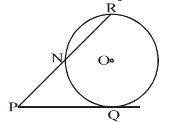
- a)15 cm
- b)10 cm
- c)9 cm
- d)6 cm
Correct answer is option 'C'. Can you explain this answer?
In the given figure, PQ is the tangent of the circle. Line segment PR intersects the circle at Nand R. PQ = 15 cm, PR = 25 cm, find PN:
a)
15 cm
b)
10 cm
c)
9 cm
d)
6 cm
 | Archana singh answered |
Given, PQ = 15 cm
PR = 25 cm
We know that, PQ² = PN × PR
15² = PN × 25
225 = PN × 25
PN = 9
15² = PN × 25
225 = PN × 25
PN = 9

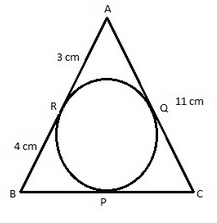
In the given figure, AR=5cm, BR=4cm and AC =11cm. What is the length of BC?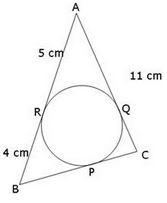
- a)6 cm
- b)10 cm
- c)4 cm
- d)8 cm
Correct answer is option 'B'. Can you explain this answer?
In the given figure, AR=5cm, BR=4cm and AC =11cm. What is the length of BC?
a)
6 cm
b)
10 cm
c)
4 cm
d)
8 cm
 | Vivek Rana answered |
Since the sides of the triangles are tangent to the circle. BR = BP,AR = AQ and CP = CQ
So, BP = 4cm and AQ = 5
CQ = 11-5 = 6 = CP
BC = BP + CP = 4 + 6 = 10 cm
So, BP = 4cm and AQ = 5
CQ = 11-5 = 6 = CP
BC = BP + CP = 4 + 6 = 10 cm
The length of the tangent drawn from a point 8 cm away from the centre of a circle of radius 6 cm is- a)√7 cm
- b)2√7 cm
- c)10 cm
- d)5 cm
Correct answer is option 'B'. Can you explain this answer?
The length of the tangent drawn from a point 8 cm away from the centre of a circle of radius 6 cm is
a)
√7 cm
b)
2√7 cm
c)
10 cm
d)
5 cm
 | Pooja Shah answered |
Let P be the external point and PA and PB be the tangents and OA and OB be the radii.
So OP is the hypotenuse=8cm
Applying Pythagoras theorem,
H2 = P2 + B2
64 = AP2 + 36
AP =
So OP is the hypotenuse=8cm
Applying Pythagoras theorem,
H2 = P2 + B2
64 = AP2 + 36
AP =
In fig, O is the centre of the circle, CA is tangent at A and CB is tangent at B drawn to the circle. If ∠ACB = 75°, then ∠AOB =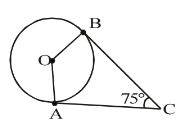
- a)75°
- b)85°
- c)95°
- d)105º
Correct answer is option 'D'. Can you explain this answer?
In fig, O is the centre of the circle, CA is tangent at A and CB is tangent at B drawn to the circle. If ∠ACB = 75°, then ∠AOB =
a)
75°
b)
85°
c)
95°
d)
105º
| | Kuldeep Kuldeep answered |
Solution:- The length of tangents drawn from an external point to the circle are equal.
In the figure, CA and CB are the tangents from external point of a circle and OA and OB are the two radius of a circle.
Draw a line OC, then you will get two triangles OAC and OBC.
In a ∆le AOC and ∆le BOC,
Angle OAC and OBC = 180 degree. Because, these are angles between the radii and tangents. So, there are two right angles.
The value for right angled triangle is 90 degree. Here, you can see both right angled triangle, so 90×2 = 180 degree.
Angle AOB = Angle OAC + Angle OBC - Angle ACB.
Given:- Angle ACB = 75 degree. , Angle OAC and OBC = 90 degree.
Angle AOB = 90 + 90 - 75.
Angle AOB = 180 -75.
Angle AOB =105 degree.
So, option d is correct friend.
In the figure, CA and CB are the tangents from external point of a circle and OA and OB are the two radius of a circle.
Draw a line OC, then you will get two triangles OAC and OBC.
In a ∆le AOC and ∆le BOC,
Angle OAC and OBC = 180 degree. Because, these are angles between the radii and tangents. So, there are two right angles.
The value for right angled triangle is 90 degree. Here, you can see both right angled triangle, so 90×2 = 180 degree.
Angle AOB = Angle OAC + Angle OBC - Angle ACB.
Given:- Angle ACB = 75 degree. , Angle OAC and OBC = 90 degree.
Angle AOB = 90 + 90 - 75.
Angle AOB = 180 -75.
Angle AOB =105 degree.
So, option d is correct friend.

Practice Test/Quiz or MCQ (Multiple Choice Questions) with Solutions of Chapter "Circles" are available for CBSE Class 10 Mathematics (Maths) and have been compiled as per the syllabus of CBSE Class 10 Mathematics (Maths)Q. A point P is 10 cm from the centre of a circle. The length of the tangent drawn from P to the circle is 8 cm. The radius of the circle is equal to- a)4 cm
- b)5 cm
- c)6 cm
- d)None of these.
Correct answer is option 'C'. Can you explain this answer?
Practice Test/Quiz or MCQ (Multiple Choice Questions) with Solutions of Chapter "Circles" are available for CBSE Class 10 Mathematics (Maths) and have been compiled as per the syllabus of CBSE Class 10 Mathematics (Maths)
Q. A point P is 10 cm from the centre of a circle. The length of the tangent drawn from P to the circle is 8 cm. The radius of the circle is equal to
a)
4 cm
b)
5 cm
c)
6 cm
d)
None of these.
 | Krishna Iyer answered |
ΔPTO is a right angled triangle at T ,where the tangent touches the circle.
So applying pythagoras theorem,
H2=P2+B2
102=B2+82
B=
Radius is 6cm.
So applying pythagoras theorem,
H2=P2+B2
102=B2+82
B=
Radius is 6cm.
A point P is 25 cm from the centre of a circle. The radius of the circle is 7 cm and length of the tangent drawn from P to the circle is x cm. The value of x =- a)20 cm
- b)24 cm
- c)18 cm
- d)12 cm.
Correct answer is option 'B'. Can you explain this answer?
A point P is 25 cm from the centre of a circle. The radius of the circle is 7 cm and length of the tangent drawn from P to the circle is x cm. The value of x =
a)
20 cm
b)
24 cm
c)
18 cm
d)
12 cm.
 | Rohini malhotra answered |
Given information
- A point P is 25 cm from the centre of a circle.
- The radius of the circle is 7 cm.
- Length of the tangent drawn from P to the circle is x cm.
To find
The value of x.
Solution
Let O be the centre of the circle and PT be the tangent drawn from P to the circle as shown below.
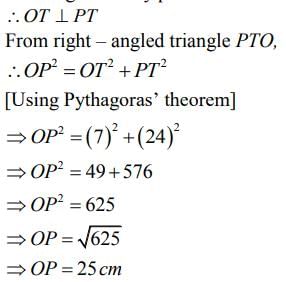
[INSERT IMAGE]
We can observe that OP is the hypotenuse of the right-angled triangle OPT. Therefore, using Pythagoras theorem, we can find the length of PT as follows.
OP² = OT² + PT²
(25)² = (7)² + PT²
625 = 49 + PT²
PT² = 625 - 49
PT² = 576
PT = √576
PT = 24 cm
Therefore, the value of x is 24 cm.
Answer: Option B.
- A point P is 25 cm from the centre of a circle.
- The radius of the circle is 7 cm.
- Length of the tangent drawn from P to the circle is x cm.
To find
The value of x.
Solution
Let O be the centre of the circle and PT be the tangent drawn from P to the circle as shown below.
[INSERT IMAGE]
We can observe that OP is the hypotenuse of the right-angled triangle OPT. Therefore, using Pythagoras theorem, we can find the length of PT as follows.
OP² = OT² + PT²
(25)² = (7)² + PT²
625 = 49 + PT²
PT² = 625 - 49
PT² = 576
PT = √576
PT = 24 cm
Therefore, the value of x is 24 cm.
Answer: Option B.
If the diagonals of a cyclic quadrilateral are equal, then the quadrilateral is- a)rhombus
- b)square
- c)rectangle
- d)none of these
Correct answer is option 'C'. Can you explain this answer?
If the diagonals of a cyclic quadrilateral are equal, then the quadrilateral is
a)
rhombus
b)
square
c)
rectangle
d)
none of these
| | Raghav Bansal answered |
Let ABCD be a cyclic quadrilateral having diagonals BD and AC, intersecting each other at point O.
(Consider BD as a chord)
∠BCD + ∠BAD = 180 (Cyclic quadrilateral)
∠BCD = 180− 90 = 90
(Considering AC as a chord)
∠ADC + ∠ABC = 180 (Cyclic quadrilateral)
90+ ∠ABC = 180
∠ABC = 90
Each interior angle of a cyclic quadrilateral is of 90.Hence it is a rectangle.
(Consider BD as a chord)
∠BCD + ∠BAD = 180 (Cyclic quadrilateral)
∠BCD = 180− 90 = 90
(Considering AC as a chord)
∠ADC + ∠ABC = 180 (Cyclic quadrilateral)
90+ ∠ABC = 180
∠ABC = 90
Each interior angle of a cyclic quadrilateral is of 90.Hence it is a rectangle.
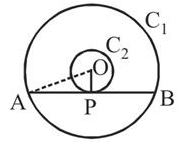
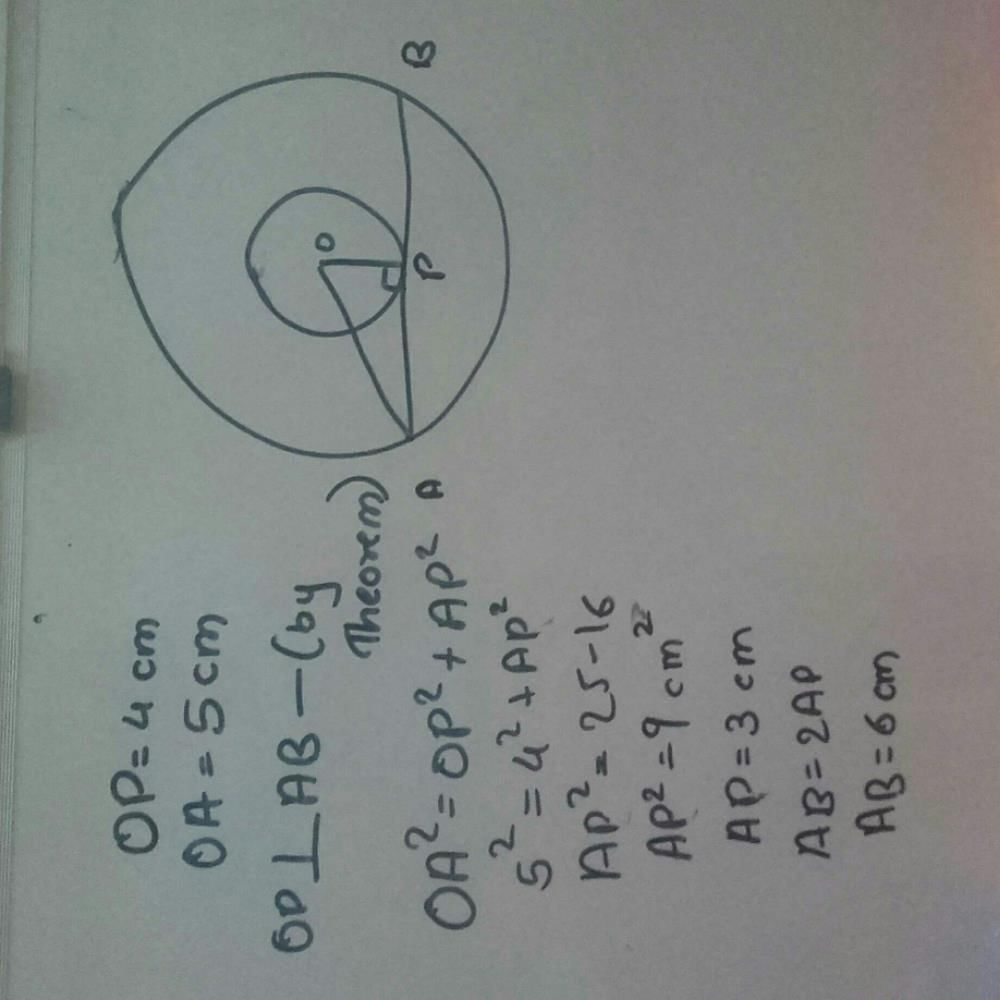
PT is a tangent from an external point P and PAB is a secant. If PT = 6cm and PA = 3cm, then the length of PB is __- a)6
- b)36
- c)12
- d)2
Correct answer is option 'C'. Can you explain this answer?
PT is a tangent from an external point P and PAB is a secant. If PT = 6cm and PA = 3cm, then the length of PB is __
a)
6
b)
36
c)
12
d)
2
| | Rahul Kapoor answered |
We know that:
PT^2 = PA X PB
therfore PB = PT^2/PA = 36/3 = 12
In the given figure, PT is tangent to the circle with centre O. If OT = 6 cm and OP = 10 cm then the length of tangent PT is 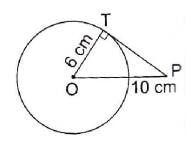
- a)6 cm
- b)15 cm
- c)18 cm
- d)8 cm
Correct answer is option 'D'. Can you explain this answer?
In the given figure, PT is tangent to the circle with centre O. If OT = 6 cm and OP = 10 cm then the length of tangent PT is
a)
6 cm
b)
15 cm
c)
18 cm
d)
8 cm
 | Learning Education answered |
In right triangle PTO By using Pythagoras theorem,
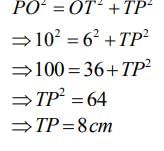
PO2 = OT2 + TP2
⇒ 102 = 62 + TP2
⇒ TP2 = 100 - 36
⇒ TP2 = 64
⇒ TP = 8
ABC is a right triangle right angled at B such that BC = 6 cm and AB = 8 cm. The radius of its incircle is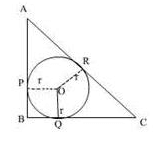
- a)3 cm
- b)8 cm
- c)2 cm
- d)5 cm
Correct answer is option 'C'. Can you explain this answer?
ABC is a right triangle right angled at B such that BC = 6 cm and AB = 8 cm. The radius of its incircle is
a)
3 cm
b)
8 cm
c)
2 cm
d)
5 cm
 | Coachify answered |
By pythagoras theorem ,
H2 = P2 + B2
=36 + 64=100
H=10
We have a square BPOQ so all sides are equal.
Since tangents from a point are equal in length
Let AP = AR = x
BP=BQ=y
RC = QC = z
x + y = 8
x = 8 - y
x + z = 10 ⇒ 8 - y + z = 10 ⇒ z = 2 + y
y + z = 6 ⇒ y + 2 + y = 6 ⇒ y = 2
x = 6, z= 4
Since BP = OQ = y = 2
H2 = P2 + B2
=36 + 64=100
H=10
We have a square BPOQ so all sides are equal.
Since tangents from a point are equal in length
Let AP = AR = x
BP=BQ=y
RC = QC = z
x + y = 8
x = 8 - y
x + z = 10 ⇒ 8 - y + z = 10 ⇒ z = 2 + y
y + z = 6 ⇒ y + 2 + y = 6 ⇒ y = 2
x = 6, z= 4
Since BP = OQ = y = 2
The quadrilateral formed by angle bisectors of a cyclic quadrilateral is a:- a)rectangle
- b)square
- c)parallelogram
- d)cyclic quadrilateral
Correct answer is option 'D'. Can you explain this answer?
The quadrilateral formed by angle bisectors of a cyclic quadrilateral is a:
a)
rectangle
b)
square
c)
parallelogram
d)
cyclic quadrilateral
| | Tejas Devarajan answered |
Cyclic quadrilaterals do not any definite rules unlike IIgram .The only rule that applies hear is that opp angles are supplementary.Hence it would'n matter if the angle bisectors form a quadrilateral
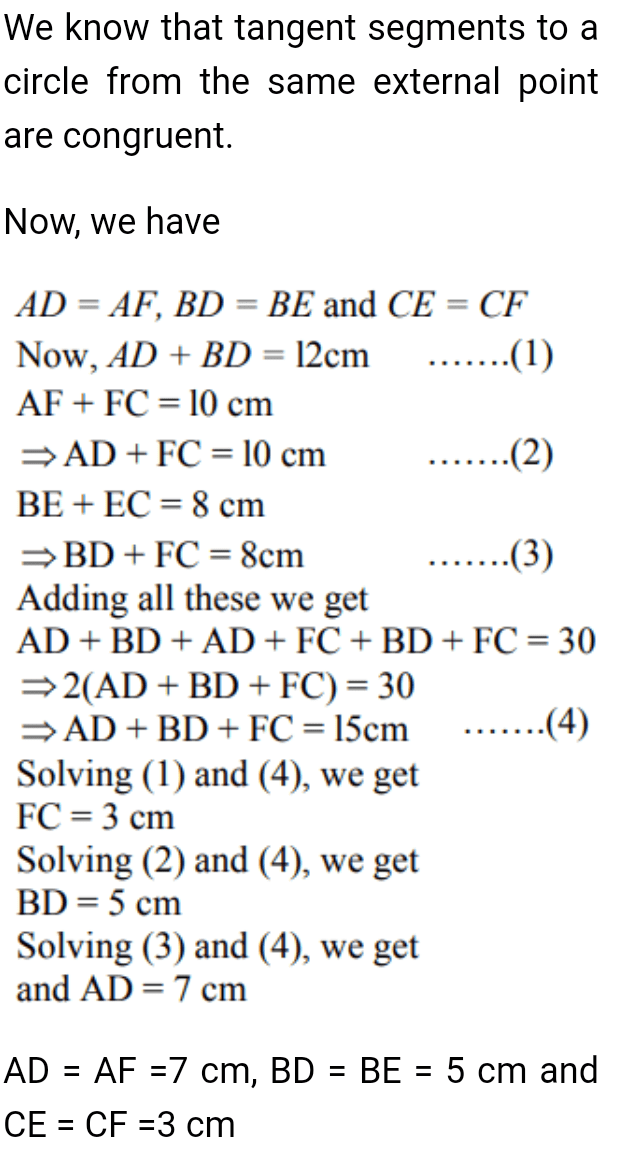
A circle is inscribed in a ΔABC having AB= 10cm, BC = 12cm and CA = 8cm and touching these sides at D, E, F respectively. The lengths of AD, BE and CF will be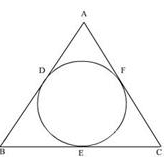
- a)AD = 4cm, BE = 6cm, CF = 8cm
- b)AD = 5cm, BE = 9cm, CF = 4cm
- c)AD = 3cm, BE = 7cm, CF = 5cm
- d)AD = 2cm, BE = 6cm, CF = 7cm
Correct answer is option 'C'. Can you explain this answer?
A circle is inscribed in a ΔABC having AB= 10cm, BC = 12cm and CA = 8cm and touching these sides at D, E, F respectively. The lengths of AD, BE and CF will be
a)
AD = 4cm, BE = 6cm, CF = 8cm
b)
AD = 5cm, BE = 9cm, CF = 4cm
c)
AD = 3cm, BE = 7cm, CF = 5cm
d)
AD = 2cm, BE = 6cm, CF = 7cm
 | Tanishka Gupta answered |
Read the following text and answer the following question on the basis of the same:A farmer has a field in the shape of triangle with AB = 13 cm, BC = 14 cm and AE = 7 cm. He wants to leave a space in the form of a circular field for growing wheat and the remaining for growing vegetables.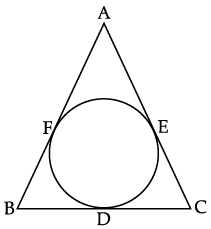 Q. The measure of CE + CD is:
- a)15 cm
- b)16 cm
- c)10 cm
- d)14 cm
Correct answer is option 'B'. Can you explain this answer?
Read the following text and answer the following question on the basis of the same:
A farmer has a field in the shape of triangle with AB = 13 cm, BC = 14 cm and AE = 7 cm. He wants to leave a space in the form of a circular field for growing wheat and the remaining for growing vegetables.
a)
15 cm
b)
16 cm
c)
10 cm
d)
14 cm
| | Swati Malkani answered |
16 cm.
Segment joining the points of contact of two parallel tangents- a)may or may not pass through the centre.
- b)will pass through the centre.
- c)will not pass through the centre.
- d)none of these
Correct answer is option 'B'. Can you explain this answer?
Segment joining the points of contact of two parallel tangents
a)
may or may not pass through the centre.
b)
will pass through the centre.
c)
will not pass through the centre.
d)
none of these
 | Omprakash Meena answered |
Because that is diameter which definitely pass through the centre

AB is a chord of the circle and AOC is its diameter such that angle ACB = 50°. If AT is the tangent to the circle at the point A, then BAT is equal to- a) 65°
- b) 60°
- c)50°
- d)40°
Correct answer is option 'C'. Can you explain this answer?
AB is a chord of the circle and AOC is its diameter such that angle ACB = 50°. If AT is the tangent to the circle at the point A, then BAT is equal to
a)
65°
b)
60°
c)
50°
d)
40°
 | Deepak Chatterjee answered |
Understanding the Circle Geometry
In the given problem, we have a circle with a chord AB, and AOC is its diameter. The angle ACB is given as 50°. We need to find the measure of angle BAT, where AT is the tangent to the circle at point A.
Circle Properties and Tangents
- A tangent to a circle is perpendicular to the radius at the point of tangency.
- The angle between the tangent and the chord through the point of contact is equal to the angle in the alternate segment.
Applying the Theorem
- Since AT is the tangent at point A, and OA is the radius, we have angle OAT = 90°.
- According to the alternate segment theorem, angle BAT (the angle between the tangent AT and chord AB) is equal to angle ACB.
Calculating the Angles
- Given that angle ACB = 50°, we can write:
Angle BAT = Angle ACB
Therefore, Angle BAT = 50°
Conclusion
Thus, the measure of angle BAT is 50°, which corresponds to option 'c'. This is a fundamental property in circle geometry, illustrating the relationship between tangents and chords in a circle.
In the given problem, we have a circle with a chord AB, and AOC is its diameter. The angle ACB is given as 50°. We need to find the measure of angle BAT, where AT is the tangent to the circle at point A.
Circle Properties and Tangents
- A tangent to a circle is perpendicular to the radius at the point of tangency.
- The angle between the tangent and the chord through the point of contact is equal to the angle in the alternate segment.
Applying the Theorem
- Since AT is the tangent at point A, and OA is the radius, we have angle OAT = 90°.
- According to the alternate segment theorem, angle BAT (the angle between the tangent AT and chord AB) is equal to angle ACB.
Calculating the Angles
- Given that angle ACB = 50°, we can write:
Angle BAT = Angle ACB
Therefore, Angle BAT = 50°
Conclusion
Thus, the measure of angle BAT is 50°, which corresponds to option 'c'. This is a fundamental property in circle geometry, illustrating the relationship between tangents and chords in a circle.
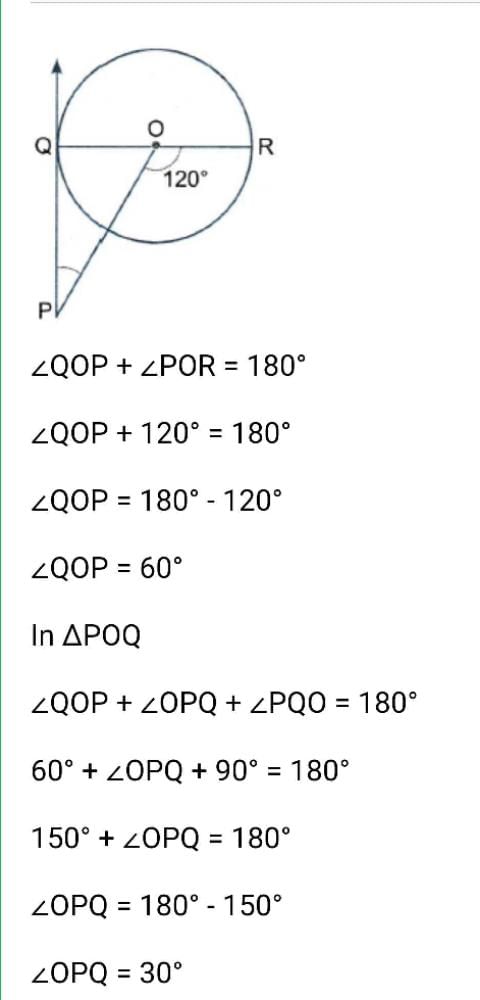
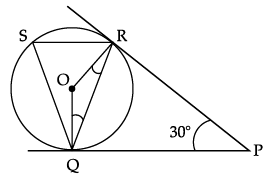
Read the following text and answer the following questions on the basis of same: A ferris wheel (Or a big wheel in the United Kingdom) is an amusement ride consisting of a rotating upright wheel with multiple passenger carrying components attached to the rim in such a way that as the wheel turns, they are kept upright, usually by gravity.After taking a ride in Ferris wheel Aarti came out from the crowd and was observing her friends who were enjoying the ride. She was curios about the different angles and measures that wheel will form. She forms the figure as given below: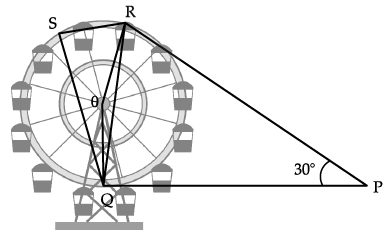
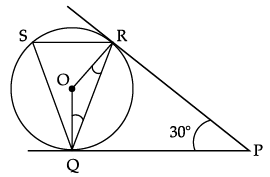 Q. In the given figure, Find ∠ROQ
- a)60°
- b)100°
- c)150°
- d)90°
Correct answer is option 'C'. Can you explain this answer?
Read the following text and answer the following questions on the basis of same: A ferris wheel (Or a big wheel in the United Kingdom) is an amusement ride consisting of a rotating upright wheel with multiple passenger carrying components attached to the rim in such a way that as the wheel turns, they are kept upright, usually by gravity.
After taking a ride in Ferris wheel Aarti came out from the crowd and was observing her friends who were enjoying the ride. She was curios about the different angles and measures that wheel will form. She forms the figure as given below:
Q. In the given figure, Find ∠ROQ
a)
60°
b)
100°
c)
150°
d)
90°
 | Aditya Shah answered |
∠ROQ +∠RPQ = 180°
∠ROQ + 30° = 180°
∠ROQ = 150°
In the given figure, length of BC is: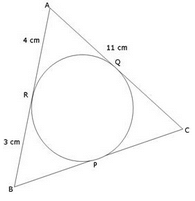
- a)15 cm
- b)10 cm
- c)13 cm
- d)21 cm
Correct answer is option 'B'. Can you explain this answer?
In the given figure, length of BC is:
a)
15 cm
b)
10 cm
c)
13 cm
d)
21 cm
| | Mehak Jaju answered |
Theorem use krna if 2 tangents are arising from same point are of equal length
Read the following text and answer the following questions on the basis of same: A ferris wheel (Or a big wheel in the United Kingdom) is an amusement ride consisting of a rotating upright wheel with multiple passenger carrying components attached to the rim in such a way that as the wheel turns, they are kept upright, usually by gravity.After taking a ride in Ferris wheel Aarti came out from the crowd and was observing her friends who were enjoying the ride. She was curios about the different angles and measures that wheel will form. She forms the figure as given below: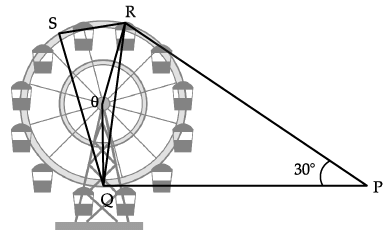
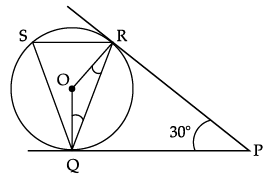 Q. Find ∠ORP
- a)90°
- b)70°
- c)100°
- d)60°
Correct answer is option 'A'. Can you explain this answer?
Read the following text and answer the following questions on the basis of same: A ferris wheel (Or a big wheel in the United Kingdom) is an amusement ride consisting of a rotating upright wheel with multiple passenger carrying components attached to the rim in such a way that as the wheel turns, they are kept upright, usually by gravity.
After taking a ride in Ferris wheel Aarti came out from the crowd and was observing her friends who were enjoying the ride. She was curios about the different angles and measures that wheel will form. She forms the figure as given below:
Q. Find ∠ORP
a)
90°
b)
70°
c)
100°
d)
60°
| | Avinash Patel answered |
Radius is always perpendicular to the tangent.
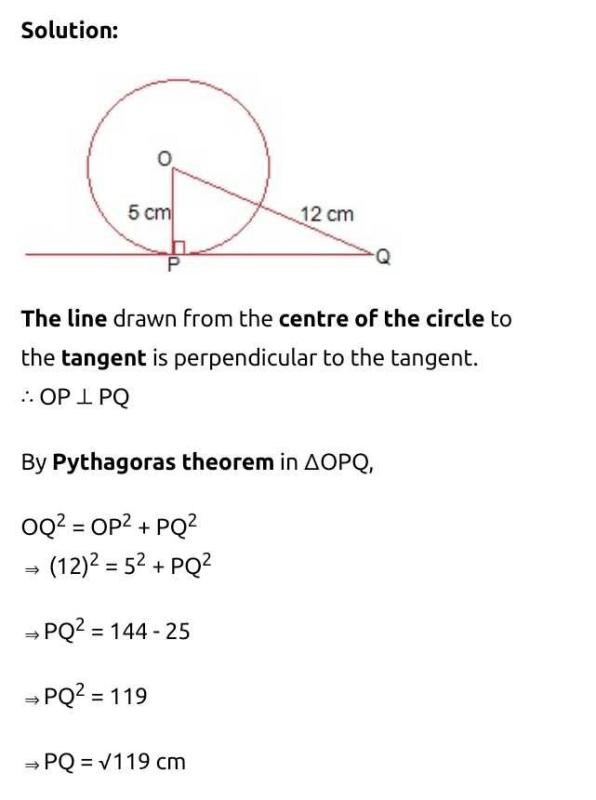
A tangent PQ at a point P of a circle of radius 5 cm meets a line through the centre O at a point Q such that OQ = 12 cm. Length PQ is- a)12 cm
- b)13 cm
- c)8.5 cm
- d)√119 cm
Correct answer is option 'D'. Can you explain this answer?
A tangent PQ at a point P of a circle of radius 5 cm meets a line through the centre O at a point Q such that OQ = 12 cm. Length PQ is
a)
12 cm
b)
13 cm
c)
8.5 cm
d)
√119 cm
 | Kds Coaching answered |
In the given problem, PQ is a tangent to the circle at point P, and OP is the radius to the point of tangency. By the property of tangents, OP is perpendicular to PQ, i.e., OP ⟂ PQ.
Given:
- Radius, OP = 5 cm
- OQ = 12 cm
Since OP ⟂ PQ, triangle OPQ is a right-angled triangle with the right angle at P.
Applying the Pythagorean theorem in triangle OPQ:
OQ² = OP² + PQ²
Substituting the known values:
12² = 5² + PQ²
144 = 25 + PQ²
PQ² = 144 - 25 = 119
Therefore, PQ = √119 cm.
Read the following text and answer the following question on the basis of the same:A farmer has a field in the shape of triangle with AB = 13 cm, BC = 14 cm and AE = 7 cm. He wants to leave a space in the form of a circular field for growing wheat and the remaining for growing vegetables.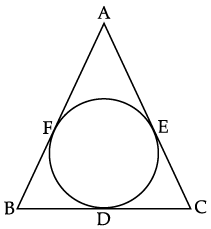 Q. The measure of AC is:
- a)15 cm
- b)17 cm
- c)12 cm
- d)13 cm
Correct answer is option 'A'. Can you explain this answer?
Read the following text and answer the following question on the basis of the same:
A farmer has a field in the shape of triangle with AB = 13 cm, BC = 14 cm and AE = 7 cm. He wants to leave a space in the form of a circular field for growing wheat and the remaining for growing vegetables.
Q. The measure of AC is:
a)
15 cm
b)
17 cm
c)
12 cm
d)
13 cm
| | Radha Iyer answered |
∴ AB = 13 cm (given)
BF = AB – AF
= (13 – 7) cm
AE = 7 cm (given)
Then, AF = AE (Tangents of the circle)
⇒ AF = 7 cm.
[Proved AF = 7 cm]
BF = 6 cm
BC = 14 cm (given)
and BD = 6 cm [Proved in Q. 3]
then CD = BC – BD
= (14 – 6) cm = 8 cm
but CD = CE (Tangents of the circle)
∴ CE = 8 cm
So, CD + CE = (8 + 8) cm = 16 cm.
CE = 8 cm
and AE = 7 cm (given)
then, AC = AE + EC
= (7 + 8) cm
= 15 cm.
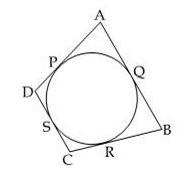
Both Assertion and Reason are true but Reason is not correct explanation of AssertionIn the following figure, a circle with centre O is inscribed in a quadrilateral ABCD such that, it touches the sides BC, AB, AD and CD at points P, Q, R and S respectively. If AB = 29 cm, AD = 23 cm, ∠B = 90° and DS = 5 cm.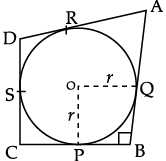 Q. Find the value of AR:
- a)16 cm
- b)17 cm
- c)18 cm
- d)10 cm
Correct answer is option 'C'. Can you explain this answer?
Both Assertion and Reason are true but Reason is not correct explanation of Assertion
In the following figure, a circle with centre O is inscribed in a quadrilateral ABCD such that, it touches the sides BC, AB, AD and CD at points P, Q, R and S respectively. If AB = 29 cm, AD = 23 cm, ∠B = 90° and DS = 5 cm.
Q. Find the value of AR:
a)
16 cm
b)
17 cm
c)
18 cm
d)
10 cm
| | Amit Kumar answered |
Here, AD = 23 cm (given)
and
Here, DS = 5 cm
but DR = DS (Length of tangents are equal)
then DR = 5 cm.
DR = 5 cm (Proved)
then AR = AD – DR cm
= (23 – 5) cm = 18 cm.
Both Assertion and Reason are true but Reason is not correct explanation of AssertionIn the following figure, a circle with centre O is inscribed in a quadrilateral ABCD such that, it touches the sides BC, AB, AD and CD at points P, Q, R and S respectively. If AB = 29 cm, AD = 23 cm, ∠B = 90° and DS = 5 cm.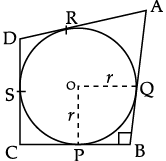 Q. Find the value of QB:
- a)11 cm
- b)10 cm
- c)12 cm
- d)15 cm
Correct answer is option 'A'. Can you explain this answer?
Both Assertion and Reason are true but Reason is not correct explanation of Assertion
In the following figure, a circle with centre O is inscribed in a quadrilateral ABCD such that, it touches the sides BC, AB, AD and CD at points P, Q, R and S respectively. If AB = 29 cm, AD = 23 cm, ∠B = 90° and DS = 5 cm.
Q. Find the value of QB:
a)
11 cm
b)
10 cm
c)
12 cm
d)
15 cm
 | Ishan Choudhury answered |
AB = 29 cm (given)
but AQ = AR (Length of tangents are equal)
then AQ = 18 cm
Here, AD = 23 cm (given)
and
Here, DS = 5 cm
but DR = DS (Length of tangents are equal)
then DR = 5 cm.
DR = 5 cm (Proved)
then AR = AD – DR cm
= (23 – 5) cm = 18 cm. [Proved]
∴ BQ = AB – AQ
= (29 – 18) cm = 11 cm.
Both Assertion and Reason are true but Reason is not correct explanation of AssertionIn the following figure, a circle with centre O is inscribed in a quadrilateral ABCD such that, it touches the sides BC, AB, AD and CD at points P, Q, R and S respectively. If AB = 29 cm, AD = 23 cm, ∠B = 90° and DS = 5 cm.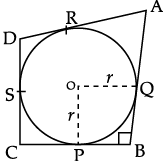 Q. AR is equal to:
- a)DR
- b)DS
- c)AQ
- d)PB
Correct answer is option 'C'. Can you explain this answer?
Both Assertion and Reason are true but Reason is not correct explanation of Assertion
In the following figure, a circle with centre O is inscribed in a quadrilateral ABCD such that, it touches the sides BC, AB, AD and CD at points P, Q, R and S respectively. If AB = 29 cm, AD = 23 cm, ∠B = 90° and DS = 5 cm.
Q. AR is equal to:
a)
DR
b)
DS
c)
AQ
d)
PB
| | Amit Kumar answered |
AR = AQ (Length of tangents are equal)
Read the following text and answer the following question on the basis of the same:A farmer has a field in the shape of triangle with AB = 13 cm, BC = 14 cm and AE = 7 cm. He wants to leave a space in the form of a circular field for growing wheat and the remaining for growing vegetables.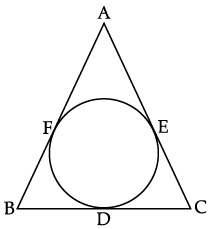 Q. The measure of BD is:
- a)2.5 cm
- b)4 cm
- c)5 cm
- d)6 cm
Correct answer is option 'D'. Can you explain this answer?
Read the following text and answer the following question on the basis of the same:
A farmer has a field in the shape of triangle with AB = 13 cm, BC = 14 cm and AE = 7 cm. He wants to leave a space in the form of a circular field for growing wheat and the remaining for growing vegetables.
Q. The measure of BD is:
a)
2.5 cm
b)
4 cm
c)
5 cm
d)
6 cm
| | Rohit Sharma answered |
∴ AB = 13 cm (given)
BF = AB – AF
= (13 – 7) cm
[Proved in Q. 1., AF = 7 cm]
BF = 6 cm
BF = 6 cm (Proved)
∴ BD = BF (Tangents of the circle)
So, BD = 6 cm.
Read the following text and answer the following questions on the basis of same: A ferris wheel (Or a big wheel in the United Kingdom) is an amusement ride consisting of a rotating upright wheel with multiple passenger carrying components attached to the rim in such a way that as the wheel turns, they are kept upright, usually by gravity.After taking a ride in Ferris wheel Aarti came out from the crowd and was observing her friends who were enjoying the ride. She was curios about the different angles and measures that wheel will form. She forms the figure as given below: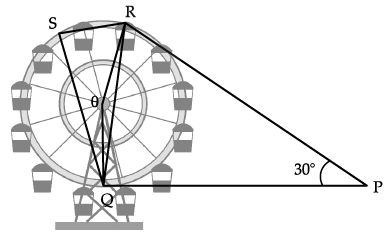
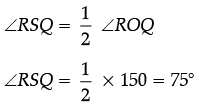
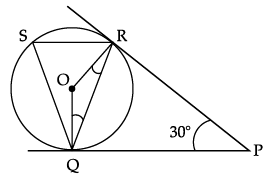 Q. Find ∠RSQ
- a)60°
- b)75°
- c)100°
- d)30°
Correct answer is option 'B'. Can you explain this answer?
Read the following text and answer the following questions on the basis of same: A ferris wheel (Or a big wheel in the United Kingdom) is an amusement ride consisting of a rotating upright wheel with multiple passenger carrying components attached to the rim in such a way that as the wheel turns, they are kept upright, usually by gravity.
After taking a ride in Ferris wheel Aarti came out from the crowd and was observing her friends who were enjoying the ride. She was curios about the different angles and measures that wheel will form. She forms the figure as given below:
Q. Find ∠RSQ
a)
60°
b)
75°
c)
100°
d)
30°
| | Kiran Mehta answered |
Read the following text and answer the following questions on the basis of same: A ferris wheel (Or a big wheel in the United Kingdom) is an amusement ride consisting of a rotating upright wheel with multiple passenger carrying components attached to the rim in such a way that as the wheel turns, they are kept upright, usually by gravity.After taking a ride in Ferris wheel Aarti came out from the crowd and was observing her friends who were enjoying the ride. She was curios about the different angles and measures that wheel will form. She forms the figure as given below: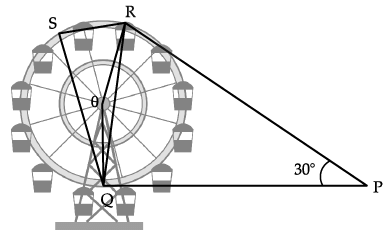
 Q. Find ∠ORQ
- a)20°
- b)10°
- c)16°
- d)15°
Correct answer is option 'D'. Can you explain this answer?
Read the following text and answer the following questions on the basis of same: A ferris wheel (Or a big wheel in the United Kingdom) is an amusement ride consisting of a rotating upright wheel with multiple passenger carrying components attached to the rim in such a way that as the wheel turns, they are kept upright, usually by gravity.
After taking a ride in Ferris wheel Aarti came out from the crowd and was observing her friends who were enjoying the ride. She was curios about the different angles and measures that wheel will form. She forms the figure as given below:
Q. Find ∠ORQ
a)
20°
b)
10°
c)
16°
d)
15°
| | Radha Iyer answered |
In triangle ORQ,
∠ORQ + ∠OQR + ∠ROQ= 180°
2∠ORQ = 180° – ∠ROQ
2∠ORQ = 180° – 150° = 30°
∠ORQ = 15°
Both Assertion and Reason are true but Reason is not correct explanation of AssertionIn the following figure, a circle with centre O is inscribed in a quadrilateral ABCD such that, it touches the sides BC, AB, AD and CD at points P, Q, R and S respectively. If AB = 29 cm, AD = 23 cm, ∠B = 90° and DS = 5 cm. Q. Find the value of BP:
- a)10 cm
- b)11 cm
- c)12 cm
- d)13 cm
Correct answer is option 'B'. Can you explain this answer?
Both Assertion and Reason are true but Reason is not correct explanation of Assertion
In the following figure, a circle with centre O is inscribed in a quadrilateral ABCD such that, it touches the sides BC, AB, AD and CD at points P, Q, R and S respectively. If AB = 29 cm, AD = 23 cm, ∠B = 90° and DS = 5 cm.
Q. Find the value of BP:
a)
10 cm
b)
11 cm
c)
12 cm
d)
13 cm
| | Ananya Das answered |
AB = 29 cm (given) but AQ = AR(Length of tangents are equal) then AQ = 18 cm
Here, AD = 23 cm (given)
and
Here, DS = 5 cm
but DR = DS (Length of tangents are equal)
then DR = 5 cm.
DR = 5 cm (Proved)
then AR = AD – DR cm
= (23 – 5) cm = 18 cm. [Proved]
∴ BQ = AB – AQ
= (29 – 18) cm = 11 cm.
BQ = 11 cm [Proved]
and BP = BQ (Length of tangents are equal)
∴ BP = 11 cm.
Both Assertion and Reason are true but Reason is not correct explanation of AssertionIn the following figure, a circle with centre O is inscribed in a quadrilateral ABCD such that, it touches the sides BC, AB, AD and CD at points P, Q, R and S respectively. If AB = 29 cm, AD = 23 cm, ∠B = 90° and DS = 5 cm.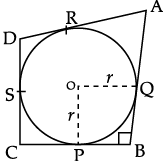 Q. Find the value of DR:
- a)6 cm
- b)5 cm
- c)7 cm
- d)8 cm
Correct answer is option 'B'. Can you explain this answer?
Both Assertion and Reason are true but Reason is not correct explanation of Assertion
In the following figure, a circle with centre O is inscribed in a quadrilateral ABCD such that, it touches the sides BC, AB, AD and CD at points P, Q, R and S respectively. If AB = 29 cm, AD = 23 cm, ∠B = 90° and DS = 5 cm.
Q. Find the value of DR:
a)
6 cm
b)
5 cm
c)
7 cm
d)
8 cm
| | Meera Rana answered |
Here, DS = 5 cm
but DR = DS
(Length of tangents are equal)
then DR = 5 cm.
Read the following text and answer the following question on the basis of the same:A farmer has a field in the shape of triangle with AB = 13 cm, BC = 14 cm and AE = 7 cm. He wants to leave a space in the form of a circular field for growing wheat and the remaining for growing vegetables.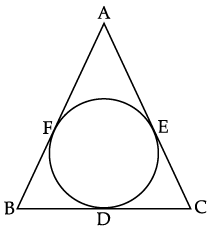 Q. The measure of BF is:
- a)4 cm
- b)6 cm
- c)3 cm
- d)10 cm
Correct answer is option 'B'. Can you explain this answer?
Read the following text and answer the following question on the basis of the same:
A farmer has a field in the shape of triangle with AB = 13 cm, BC = 14 cm and AE = 7 cm. He wants to leave a space in the form of a circular field for growing wheat and the remaining for growing vegetables.
Q. The measure of BF is:
a)
4 cm
b)
6 cm
c)
3 cm
d)
10 cm
| | Amit Sharma answered |
∴ AB = 13 cm (given)
∴ BF = AB – AF
= (13 – 7) cm
AE = 7 cm (given)
Then, AF = AE (Tangents of the circle)
⇒ AF = 7 cm.
[Proved, AF = 7 cm]
BF = 6 cm
Read the following text and answer the following questions on the basis of same: A ferris wheel (Or a big wheel in the United Kingdom) is an amusement ride consisting of a rotating upright wheel with multiple passenger carrying components attached to the rim in such a way that as the wheel turns, they are kept upright, usually by gravity.After taking a ride in Ferris wheel Aarti came out from the crowd and was observing her friends who were enjoying the ride. She was curios about the different angles and measures that wheel will form. She forms the figure as given below: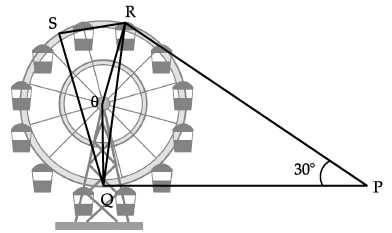
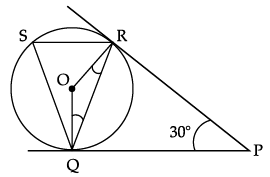 Q. Find ∠RQP
- a)75°
- b)60°
- c)30°
- d)90°
Correct answer is option 'A'. Can you explain this answer?
Read the following text and answer the following questions on the basis of same: A ferris wheel (Or a big wheel in the United Kingdom) is an amusement ride consisting of a rotating upright wheel with multiple passenger carrying components attached to the rim in such a way that as the wheel turns, they are kept upright, usually by gravity.
After taking a ride in Ferris wheel Aarti came out from the crowd and was observing her friends who were enjoying the ride. She was curios about the different angles and measures that wheel will form. She forms the figure as given below:
Q. Find ∠RQP
a)
75°
b)
60°
c)
30°
d)
90°
| | Avinash Patel answered |
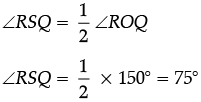
∠RSQ =∠RQP = 75°
[Angles in alternate segment]
Read the following text and answer the following question on the basis of the same:A farmer has a field in the shape of triangle with AB = 13 cm, BC = 14 cm and AE = 7 cm. He wants to leave a space in the form of a circular field for growing wheat and the remaining for growing vegetables.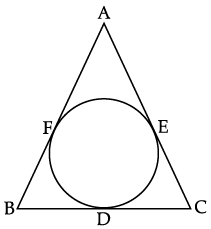 Q. The measure of AF is:
- a)6 cm
- b)8 cm
- c)7 cm
- d)5 cm
Correct answer is option 'C'. Can you explain this answer?
Read the following text and answer the following question on the basis of the same:
A farmer has a field in the shape of triangle with AB = 13 cm, BC = 14 cm and AE = 7 cm. He wants to leave a space in the form of a circular field for growing wheat and the remaining for growing vegetables.
Q. The measure of AF is:
a)
6 cm
b)
8 cm
c)
7 cm
d)
5 cm
| | Vikram Kapoor answered |
AE = 7 cm (given)
Then, AF = AE (Tangents of the circle)
⇒ AF = 7 cm.
In the figure, PQ is a tangent at a point R of the circle with centre O. If ∠TRQ = 30°.The measure of ∠PRS is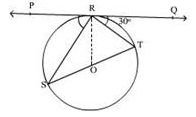
- a)45°
- b)120°
- c)90°
- d)60°
Correct answer is option 'D'. Can you explain this answer?
In the figure, PQ is a tangent at a point R of the circle with centre O. If ∠TRQ = 30°.The measure of ∠PRS is
a)
45°
b)
120°
c)
90°
d)
60°
| | Arwin answered |
TRQ=30,
TSR=TRQ=30( alternate segment theorem)-1
TRS=90( angle in semicircle)--2,
from 1&2 and by angle sum property of a triangle,
RTS=60,
since RTS=PRS ( by alternate segment theory)
PRS=60
TSR=TRQ=30( alternate segment theorem)-1
TRS=90( angle in semicircle)--2,
from 1&2 and by angle sum property of a triangle,
RTS=60,
since RTS=PRS ( by alternate segment theory)
PRS=60
In fig, O is the centre of the circle. PQ is tangent to the circle and secant PAB passes through the centre O. If PQ = 5 cm and PA = 1 cm, then the radius of the circle is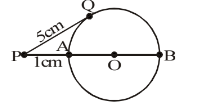
- a)8 cm
- b)12 cm
- c)10 cm
- d)6 cm
Correct answer is option 'B'. Can you explain this answer?
In fig, O is the centre of the circle. PQ is tangent to the circle and secant PAB passes through the centre O. If PQ = 5 cm and PA = 1 cm, then the radius of the circle is
a)
8 cm
b)
12 cm
c)
10 cm
d)
6 cm
| | Kds Coaching answered |
AOB is the diameter of the circle since POB passes through O.
Now PA is the segment of the secant POB outside the circle.
So, by the tangent–secant rule, the square of the tangent = secant segment × segment of the secant outside the circle when a secant and tangent to a circle are drawn from a point outside the circle.
PB × PA = PQ × PA ⇒ PB = (PQ²) / PA
PB = (25²) / 1 = 625 / 1 = 25 cm
The diameter AOB = PB - PA = (25 - 1) cm = 24 cm
The radius = x = AOB / 2 = 24 cm / 2 = 12 cm
Now PA is the segment of the secant POB outside the circle.
So, by the tangent–secant rule, the square of the tangent = secant segment × segment of the secant outside the circle when a secant and tangent to a circle are drawn from a point outside the circle.
PB × PA = PQ × PA ⇒ PB = (PQ²) / PA
PB = (25²) / 1 = 625 / 1 = 25 cm
The diameter AOB = PB - PA = (25 - 1) cm = 24 cm
The radius = x = AOB / 2 = 24 cm / 2 = 12 cm
Chapter doubts & questions for Circles - 6 Months Boards Preparation for Class 10 (CBSE) 2026 is part of Class 10 exam preparation. The chapters have been prepared according to the Class 10 exam syllabus. The Chapter doubts & questions, notes, tests & MCQs are made for Class 10 2026 Exam. Find important definitions, questions, notes, meanings, examples, exercises, MCQs and online tests here.
Chapter doubts & questions of Circles - 6 Months Boards Preparation for Class 10 (CBSE) in English & Hindi are available as part of Class 10 exam. Download more important topics, notes, lectures and mock test series for Class 10 Exam by signing up for free.
6 Months Boards Preparation for Class 10 (CBSE)353 videos|2318 docs|326 tests |
