


All Exams > NEET > 15 Weeks Preparation - Biology Class 12 > All Questions
All questions of Daily Practice & Tests for NEET Exam
Fossils are generally found in:- a)Metamorphic rocks
- b)Igneous rocks
- c)Sedimentary rocks
- d)Any type of rock
Correct answer is option 'C'. Can you explain this answer?
Fossils are generally found in:
a)
Metamorphic rocks
b)
Igneous rocks
c)
Sedimentary rocks
d)
Any type of rock
 | Geetika Shah answered |
Fossils are generally found in sedimentary rocks.

Tendrils in plants are an example of- a)Adaptive radiation
- b)Convergent evolution
- c)Divergent evolution
- d)Co-evolution
Correct answer is option 'C'. Can you explain this answer?
Tendrils in plants are an example of
a)
Adaptive radiation
b)
Convergent evolution
c)
Divergent evolution
d)
Co-evolution
 | Ayush Singh answered |
Yes answer should be convergent because no thorns were asked in ques tendrils are many types originating from leaf,stem,stipule which are different in origin
Evolution is- a)Progressive development of race
- b)History of race
- c)History and development of a race along with variations
- d)Development of race
Correct answer is 'C'. Can you explain this answer?
Evolution is
a)
Progressive development of race
b)
History of race
c)
History and development of a race along with variations
d)
Development of race
 | Pooja Mehta answered |
The term evolution was coined by Herbert Spencer, an English philosopher which means unrolling or unfolding of nature that brings about an orderly change from one form or condition to another resulting in descendants becoming different from ancestors. Thus, it is history and development of race along with variations.
Darwin judged the fitness of an individual by- a)Dominance over other individual
- b)Strategy to obtain food
- c)Ability to defend itself
- d)Number of offspring
Correct answer is option 'D'. Can you explain this answer?
Darwin judged the fitness of an individual by
a)
Dominance over other individual
b)
Strategy to obtain food
c)
Ability to defend itself
d)
Number of offspring
 | Rajeev Saxena answered |
Darwin realised that under the intense competition of members in a population, any variation which favoured survival in a particular environment would increase the individuals ability to reproduce and leave fertile offsprings. While less favourable variations decrease the chance of successful reproduction. Hence, Darwin judged the fitness of an individual by reproducing ability and the number of offsprings.
It is believed that the first organisms which inhabitated earth's surface were [MP PMT 01]- a)Autotrophs
- b)Mixotrophs
- c)Bacteria
- d)Chromatotrophs
Correct answer is option 'C'. Can you explain this answer?
It is believed that the first organisms which inhabitated earth's surface were
[MP PMT 01]
a)
Autotrophs
b)
Mixotrophs
c)
Bacteria
d)
Chromatotrophs
 | Srishti Shah answered |
The first organisms that inhabited Earth's surface were bacteria. This is supported by several lines of evidence.
Fossil Record:
The oldest fossils found on Earth are of bacteria-like organisms. These fossils date back to 3.5 billion years ago. These bacteria were anaerobic, which means that they did not require oxygen to survive.
Chemical Evidence:
The chemical composition of rocks that are 3.8 billion years old suggests that they were formed by bacteria. These rocks contain isotopes of carbon that are only produced by living organisms.
Evolutionary History:
Bacteria are the most ancient and diverse group of organisms on Earth. They have been evolving for billions of years and have adapted to almost every environment on the planet.
Autotrophs and Mixotrophs:
Autotrophs are organisms that can produce their own food using energy from the sun or from inorganic compounds. Mixotrophs are organisms that can switch between being autotrophic and heterotrophic (consuming other organisms for food). While these types of organisms are important in the history of life on Earth, they did not appear until much later in evolution.
Chromatotrophs:
Chromatotrophs are bacteria that use chemicals as their source of energy. While these types of bacteria are also ancient, they are not believed to be the first organisms on Earth.
In conclusion, the first organisms that inhabited Earth's surface were bacteria. They have been evolving for billions of years and have adapted to almost every environment on the planet.
Fossil Record:
The oldest fossils found on Earth are of bacteria-like organisms. These fossils date back to 3.5 billion years ago. These bacteria were anaerobic, which means that they did not require oxygen to survive.
Chemical Evidence:
The chemical composition of rocks that are 3.8 billion years old suggests that they were formed by bacteria. These rocks contain isotopes of carbon that are only produced by living organisms.
Evolutionary History:
Bacteria are the most ancient and diverse group of organisms on Earth. They have been evolving for billions of years and have adapted to almost every environment on the planet.
Autotrophs and Mixotrophs:
Autotrophs are organisms that can produce their own food using energy from the sun or from inorganic compounds. Mixotrophs are organisms that can switch between being autotrophic and heterotrophic (consuming other organisms for food). While these types of organisms are important in the history of life on Earth, they did not appear until much later in evolution.
Chromatotrophs:
Chromatotrophs are bacteria that use chemicals as their source of energy. While these types of bacteria are also ancient, they are not believed to be the first organisms on Earth.
In conclusion, the first organisms that inhabited Earth's surface were bacteria. They have been evolving for billions of years and have adapted to almost every environment on the planet.
According to abiogenesis life originates from ______.- a)Pre-exiting life
- b)Extra-terrestrial matter
- c)Non-living matter
- d)Chemicals
Correct answer is 'C'. Can you explain this answer?
According to abiogenesis life originates from ______.
a)
Pre-exiting life
b)
Extra-terrestrial matter
c)
Non-living matter
d)
Chemicals
 | Hansa Sharma answered |
According to abiogenesis theory of origin of life, life originated from non-living matter like gases, inorganic substance and water at particular temperature and pressure.
- a)Geographical evolution
- b)Convergent evolution
- c)Divergent evolution
- d)Adaptive radiation
Correct answer is 'D'. Can you explain this answer?
| | Rajat Kapoor answered |
The diversification of an ancestral group into two or more species in different habitats is called divergent evolution. When this involves large number of species to occupy different ritches, this is called adaptive radiation. Adaptive radiation is the process of evolution of different species in a given geographical area starting from a species of animals or plants and literally radiating to other areas of geography (habitats). Darwin's finches represent one of best examples of this phenomenon. Australian marsupials are another example of adaptive radiation.
Fossils are most commonly preserved in______.- a)Sedimentary rocks
- b)Igneous rocks
- c)Metamorphic rocks
- d)Any type of rock
Correct answer is option 'A'. Can you explain this answer?
Fossils are most commonly preserved in______.
a)
Sedimentary rocks
b)
Igneous rocks
c)
Metamorphic rocks
d)
Any type of rock
 | Prerana M N answered |
Sedimentary rocks are mostly involved in forming fossils, owing to the way in which they are formed.
Links between organisms that show branching pattern of evolutionary relationships are shown by- a)Phylogenetic trees
- b)Living fossils
- c)Comparative embryology
- d)Two fossil layers
Correct answer is option 'A'. Can you explain this answer?
Links between organisms that show branching pattern of evolutionary relationships are shown by
a)
Phylogenetic trees
b)
Living fossils
c)
Comparative embryology
d)
Two fossil layers
| | Krithika Kumar answered |
Phylogenetic trees are diagrams that show the evolutionary relationships between different organisms. They are used to display the branching pattern of evolutionary relationships between organisms. The diagram looks like a tree with branches that represent different groups of organisms. These branches are called clades, and they represent groups of organisms that have descended from a common ancestor.
Phylogenetic trees are constructed based on a variety of data, including:
1. Morphological characteristics: The physical features of organisms, such as their shape, size, and structure.
2. Molecular data: DNA and RNA sequences are used to compare the genetic makeup of different organisms.
3. Fossil records: The study of fossils provides evidence of the evolutionary history of organisms.
Phylogenetic trees are an important tool for understanding the relationships between organisms and how they have evolved over time. They can be used to answer questions about the origins of different species and how they are related to one another.
In conclusion, phylogenetic trees are diagrams that show the branching pattern of evolutionary relationships between organisms. They are constructed based on a variety of data, including morphological characteristics, molecular data, and fossil records. They are an important tool for understanding the evolutionary history of organisms.
Phylogenetic trees are constructed based on a variety of data, including:
1. Morphological characteristics: The physical features of organisms, such as their shape, size, and structure.
2. Molecular data: DNA and RNA sequences are used to compare the genetic makeup of different organisms.
3. Fossil records: The study of fossils provides evidence of the evolutionary history of organisms.
Phylogenetic trees are an important tool for understanding the relationships between organisms and how they have evolved over time. They can be used to answer questions about the origins of different species and how they are related to one another.
In conclusion, phylogenetic trees are diagrams that show the branching pattern of evolutionary relationships between organisms. They are constructed based on a variety of data, including morphological characteristics, molecular data, and fossil records. They are an important tool for understanding the evolutionary history of organisms.
By studying analogous structures we look for ______.- a)Similarities in appearance but differences in functions
- b)Similarities in appearance and function but different in structure
- c)Similarities in organ structure
- d)Similarities in cell make up
Correct answer is option 'B'. Can you explain this answer?
By studying analogous structures we look for ______.
a)
Similarities in appearance but differences in functions
b)
Similarities in appearance and function but different in structure
c)
Similarities in organ structure
d)
Similarities in cell make up
| | Jaideep Chakraborty answered |
Introduction:
Studying analogous structures helps us understand the similarities and differences between organisms that have evolved independently. These structures may have similar functions but different evolutionary origins. By studying these structures, we can gain insights into convergent evolution and the adaptations that organisms have developed to fulfill similar roles in their environments.
Explanation:
Similarities in appearance and function:
Analogous structures refer to structures in different organisms that have similar functions but different evolutionary origins. These structures have evolved independently in response to similar environmental pressures, resulting in similar functions. For example, the wings of birds and bats are analogous structures because they serve the same purpose of enabling flight, but they have evolved from different ancestral structures.
Differences in structure:
While analogous structures may have similar functions, they often have different underlying structures. This is because they have evolved through convergent evolution, where different species independently develop similar traits. For example, the wings of birds are composed of feathers, while the wings of bats are formed by a thin membrane of skin stretched between elongated fingers.
Importance of studying analogous structures:
1. Understanding convergent evolution: By studying analogous structures, we can gain insights into how different organisms have independently evolved similar traits. This helps us understand the process of convergent evolution and how organisms adapt to similar environmental challenges.
2. Determining evolutionary relationships: Analogous structures can sometimes be misleading when trying to determine evolutionary relationships between organisms. For example, dolphins and sharks have similar streamlined body shapes, but they are not closely related. By studying analogous structures in conjunction with other evidence such as genetics, scientists can more accurately determine evolutionary relationships.
3. Identifying adaptive traits: Analogous structures often represent adaptations to similar ecological niches. By studying these structures, we can identify the key traits that enable organisms to thrive in specific environments. This knowledge can be applied to various fields, such as biomimicry, where engineers and designers draw inspiration from nature to create innovative solutions.
Conclusion:
Studying analogous structures allows us to explore the fascinating world of convergent evolution. By comparing the similarities and differences in appearance, function, and structure of these structures, we can gain a deeper understanding of how organisms adapt to their environments and the complex processes of evolution.
Studying analogous structures helps us understand the similarities and differences between organisms that have evolved independently. These structures may have similar functions but different evolutionary origins. By studying these structures, we can gain insights into convergent evolution and the adaptations that organisms have developed to fulfill similar roles in their environments.
Explanation:
Similarities in appearance and function:
Analogous structures refer to structures in different organisms that have similar functions but different evolutionary origins. These structures have evolved independently in response to similar environmental pressures, resulting in similar functions. For example, the wings of birds and bats are analogous structures because they serve the same purpose of enabling flight, but they have evolved from different ancestral structures.
Differences in structure:
While analogous structures may have similar functions, they often have different underlying structures. This is because they have evolved through convergent evolution, where different species independently develop similar traits. For example, the wings of birds are composed of feathers, while the wings of bats are formed by a thin membrane of skin stretched between elongated fingers.
Importance of studying analogous structures:
1. Understanding convergent evolution: By studying analogous structures, we can gain insights into how different organisms have independently evolved similar traits. This helps us understand the process of convergent evolution and how organisms adapt to similar environmental challenges.
2. Determining evolutionary relationships: Analogous structures can sometimes be misleading when trying to determine evolutionary relationships between organisms. For example, dolphins and sharks have similar streamlined body shapes, but they are not closely related. By studying analogous structures in conjunction with other evidence such as genetics, scientists can more accurately determine evolutionary relationships.
3. Identifying adaptive traits: Analogous structures often represent adaptations to similar ecological niches. By studying these structures, we can identify the key traits that enable organisms to thrive in specific environments. This knowledge can be applied to various fields, such as biomimicry, where engineers and designers draw inspiration from nature to create innovative solutions.
Conclusion:
Studying analogous structures allows us to explore the fascinating world of convergent evolution. By comparing the similarities and differences in appearance, function, and structure of these structures, we can gain a deeper understanding of how organisms adapt to their environments and the complex processes of evolution.
Mortality in babies is an example of ______- a)Stabilizing selection
- b)Directional selection
- c)Disruptive selection
- d)Abortion selection
Correct answer is option 'A'. Can you explain this answer?
Mortality in babies is an example of ______
a)
Stabilizing selection
b)
Directional selection
c)
Disruptive selection
d)
Abortion selection
 | EduRev NEET answered |
- Mortality in babies is an example of stabilizing selection.
- It is all depended on the baby’s birth weight.
- The optimum birth weight is 7.3 pounds which favor this selection.
- Newborn infants with less than 5.5 pounds and more than 10 pounds have the highest mortality rate.
An inter-breeding population of finches became separated geographically, forming two isolated groups. Each group then became subject to different selective pressures. One group was then introduced into the habitat of the other. Which one of the following would determine whether they now formed two distinct species?- a)They had been separated for more than three million years
- b)They failed to produce fertile F1 hybrids
- c)They showed marked differences in the shape of their beaks
- d)Their plumage had become markedly different
Correct answer is option 'B'. Can you explain this answer?
An inter-breeding population of finches became separated geographically, forming two isolated groups. Each group then became subject to different selective pressures. One group was then introduced into the habitat of the other. Which one of the following would determine whether they now formed two distinct species?
a)
They had been separated for more than three million years
b)
They failed to produce fertile F1 hybrids
c)
They showed marked differences in the shape of their beaks
d)
Their plumage had become markedly different
 | Mira Joshi answered |
Once inter-breeding population of finches, now have failed to produce fertile F1 hybrids, this means they have now formed two distinct species.

According to the Hardy-Weinberg principle, what condition indicates that evolution is occurring in a population?- a)Allele frequencies remain constant across generations.
- b)The frequency of homozygous dominant individuals equals p².
- c)Allele frequencies change due to factors like genetic drift or natural selection.
- d)The sum of p² + 2pq + q² equals 1 in all scenarios.
Correct answer is option 'C'. Can you explain this answer?
a)
Allele frequencies remain constant across generations.
b)
The frequency of homozygous dominant individuals equals p².
c)
Allele frequencies change due to factors like genetic drift or natural selection.
d)
The sum of p² + 2pq + q² equals 1 in all scenarios.
| | Nitya Menon answered |
Understanding the Hardy-Weinberg Principle
According to the Hardy-Weinberg principle, a population is in genetic equilibrium when specific conditions are met, resulting in constant allele frequencies across generations. However, if these conditions are violated, evolution is indicated.
Key Indicators of Evolution
- Allele Frequencies Change: The correct answer is option 'C', which states that allele frequencies change due to factors like genetic drift or natural selection. This change signifies that evolutionary processes are at work.
- Genetic Drift: Random fluctuations in allele frequencies can lead to significant changes in small populations, potentially resulting in evolution.
- Natural Selection: Differential survival and reproduction of individuals based on their phenotypic traits can alter allele frequencies over time, driving evolutionary change.
Other Options Explained
- Option A: This suggests that allele frequencies remain constant, which indicates that evolution is not occurring. This aligns with the Hardy-Weinberg equilibrium.
- Option B: The frequency of homozygous dominant individuals being equal to p² is a specific outcome of the Hardy-Weinberg equation but does not indicate evolution.
- Option D: The sum of p² + 2pq + q² equals 1 under Hardy-Weinberg equilibrium. This condition being satisfied does not imply evolution is occurring.
Conclusion
In summary, option 'C' accurately reflects that changes in allele frequencies due to mechanisms such as natural selection or genetic drift signify that evolution is occurring in a population. Understanding these concepts is crucial for interpreting population genetics and evolutionary biology.
According to the Hardy-Weinberg principle, a population is in genetic equilibrium when specific conditions are met, resulting in constant allele frequencies across generations. However, if these conditions are violated, evolution is indicated.
Key Indicators of Evolution
- Allele Frequencies Change: The correct answer is option 'C', which states that allele frequencies change due to factors like genetic drift or natural selection. This change signifies that evolutionary processes are at work.
- Genetic Drift: Random fluctuations in allele frequencies can lead to significant changes in small populations, potentially resulting in evolution.
- Natural Selection: Differential survival and reproduction of individuals based on their phenotypic traits can alter allele frequencies over time, driving evolutionary change.
Other Options Explained
- Option A: This suggests that allele frequencies remain constant, which indicates that evolution is not occurring. This aligns with the Hardy-Weinberg equilibrium.
- Option B: The frequency of homozygous dominant individuals being equal to p² is a specific outcome of the Hardy-Weinberg equation but does not indicate evolution.
- Option D: The sum of p² + 2pq + q² equals 1 under Hardy-Weinberg equilibrium. This condition being satisfied does not imply evolution is occurring.
Conclusion
In summary, option 'C' accurately reflects that changes in allele frequencies due to mechanisms such as natural selection or genetic drift signify that evolution is occurring in a population. Understanding these concepts is crucial for interpreting population genetics and evolutionary biology.
Praying mantis is a good example of- a)Warning colouration
- b)Social insects
- c)Mullerianmimcry
- d)Camouflage
Correct answer is option 'D'. Can you explain this answer?
Praying mantis is a good example of
a)
Warning colouration
b)
Social insects
c)
Mullerianmimcry
d)
Camouflage
 | Stepway Academy answered |
Camouflage is a method to avoid predators from praying by mixing with surroundings. Praying mantis is an example of camouflage.
Which of the following evidences does not favour the Lamarckian concept of inheritance of acquired characters?- a)Lack of pigment in cave-dwelling animals
- b)Melanisation in peppered moth
- c)Absence of limbs in snakes
- d)Presence of webbed toes in aquatic birds
Correct answer is option 'B'. Can you explain this answer?
Which of the following evidences does not favour the Lamarckian concept of inheritance of acquired characters?
a)
Lack of pigment in cave-dwelling animals
b)
Melanisation in peppered moth
c)
Absence of limbs in snakes
d)
Presence of webbed toes in aquatic birds
| | Priya Menon answered |
According to Lamarckism (proposed by Lamarck), whatever characters an individual acquires in its life time due to internal vital force, effect of environment, new needs, use and disuse of organs, they are inherited to next generations. This process continues and after several generations, the variations are accumulated upto such an extent that they give rise to new species. Melanisation in peppered moth favours Darwin's theory of natural selection.
Evolution of different species in a given area starting from a point and spreading to other geographical areas is known as- a)Migration
- b)Divergent evolution
- c)Adaptive radiation
- d)Natural selection
Correct answer is option 'C'. Can you explain this answer?
Evolution of different species in a given area starting from a point and spreading to other geographical areas is known as
a)
Migration
b)
Divergent evolution
c)
Adaptive radiation
d)
Natural selection
| | Mansi Deshpande answered |
Adaptive Radiation:
Adaptive radiation is the evolution of different species in a given area starting from a point and spreading to other geographical areas. It is a type of divergent evolution that occurs when a single ancestral species evolves into many different species to adapt to different ecological niches. The term "adaptive radiation" was coined by the American evolutionary biologist Henry Fairfield Osborn in 1897.
Factors that contribute to adaptive radiation:
1. Ecological opportunity: When new habitats or resources become available, organisms can exploit them and evolve to fill new niches.
2. Morphological innovation: Morphological innovation can allow organisms to exploit new resources or habitats.
3. Competition: Competition for resources can drive organisms to evolve different adaptations, leading to adaptive radiation.
Examples of adaptive radiation:
1. Darwin's finches: The Galápagos Islands are home to a number of different finch species that evolved from a common ancestor. Each species has a specialized beak that allows it to feed on different types of food.
2. Hawaiian honeycreepers: The Hawaiian Islands are home to a diverse group of birds known as honeycreepers. These birds evolved from a single ancestral species and have adapted to different ecological niches on the islands.
3. Australian marsupials: Australia is home to a number of different marsupial species that evolved from a common ancestor. These marsupials have adapted to different ecological niches, such as the kangaroo, koala, and Tasmanian devil.
Conclusion:
Adaptive radiation is an important process in the evolution of new species. It allows organisms to adapt to new environments and resources and can lead to the development of new ecological niches. The study of adaptive radiation can provide insights into the mechanisms of evolution and the factors that contribute to biodiversity.
Adaptive radiation is the evolution of different species in a given area starting from a point and spreading to other geographical areas. It is a type of divergent evolution that occurs when a single ancestral species evolves into many different species to adapt to different ecological niches. The term "adaptive radiation" was coined by the American evolutionary biologist Henry Fairfield Osborn in 1897.
Factors that contribute to adaptive radiation:
1. Ecological opportunity: When new habitats or resources become available, organisms can exploit them and evolve to fill new niches.
2. Morphological innovation: Morphological innovation can allow organisms to exploit new resources or habitats.
3. Competition: Competition for resources can drive organisms to evolve different adaptations, leading to adaptive radiation.
Examples of adaptive radiation:
1. Darwin's finches: The Galápagos Islands are home to a number of different finch species that evolved from a common ancestor. Each species has a specialized beak that allows it to feed on different types of food.
2. Hawaiian honeycreepers: The Hawaiian Islands are home to a diverse group of birds known as honeycreepers. These birds evolved from a single ancestral species and have adapted to different ecological niches on the islands.
3. Australian marsupials: Australia is home to a number of different marsupial species that evolved from a common ancestor. These marsupials have adapted to different ecological niches, such as the kangaroo, koala, and Tasmanian devil.
Conclusion:
Adaptive radiation is an important process in the evolution of new species. It allows organisms to adapt to new environments and resources and can lead to the development of new ecological niches. The study of adaptive radiation can provide insights into the mechanisms of evolution and the factors that contribute to biodiversity.
Assertion: The earliest organisms that appeared on the earth were non-green and presumably anaerobes.Reason: The first autotrophic organisms were the chemo-autotrophs that never released oxygen.- a)Both Assertion and Reason are true and the Reason is the correct explanation of the Assertion
- b)Assertion is true statement but Reason is false
- c)Both Assertion and Reason are false statements
- d)Both Assertion and Reason are true and the Reason is not the correct explanation of the Assertion
Correct answer is option 'D'. Can you explain this answer?
Assertion: The earliest organisms that appeared on the earth were non-green and presumably anaerobes.
Reason: The first autotrophic organisms were the chemo-autotrophs that never released oxygen.
a)
Both Assertion and Reason are true and the Reason is the correct explanation of the Assertion
b)
Assertion is true statement but Reason is false
c)
Both Assertion and Reason are false statements
d)
Both Assertion and Reason are true and the Reason is not the correct explanation of the Assertion
| | Gaurav Kumar answered |
The earliest organisms that appeared on the earth were non-green and presumably anaerobes. The first autotrophic organisms were the chemo-autotrophs that never released oxygen. Both the statements are correct but reason does not explain the assertion.
What did Charles Darwin conclude from his observations during his voyage on the H.M.S. Beagle?- a)All species were created simultaneously and remain unchanged.
- b)Existing living forms share similarities with life forms from millions of years ago and have evolved gradually.
- c)The earth is only a few thousand years old.
- d)Natural selection does not play a role in evolution.
Correct answer is option 'B'. Can you explain this answer?
a)
All species were created simultaneously and remain unchanged.
b)
Existing living forms share similarities with life forms from millions of years ago and have evolved gradually.
c)
The earth is only a few thousand years old.
d)
Natural selection does not play a role in evolution.
| | Shraddha Pillai answered |
Darwin's Observations on the H.M.S. Beagle
Charles Darwin's voyage on the H.M.S. Beagle (1831-1836) was a pivotal moment in the development of his theory of evolution. His extensive observations led him to conclude that:
Evolutionary Change
- Darwin noted that various species exhibited adaptations to their environments, suggesting they were not static but rather dynamic.
- He observed diverse life forms in different geographical locations, particularly in the Galápagos Islands, where he found unique species that were closely related to mainland species but adapted to their specific habitats.
Common Ancestry
- The similarities between species suggested that they shared common ancestors, indicating that life forms have evolved over millions of years through gradual changes.
- Fossils he examined showed a progression of life forms, supporting the idea that living organisms have evolved from earlier ones.
Natural Selection
- Darwin proposed that natural selection is a mechanism driving evolution, where individuals with advantageous traits are more likely to survive and reproduce.
- This led to the gradual adaptation of species over time, as those traits become more common in a population.
Conclusion
- The conclusion that existing living forms share similarities with ancient life forms and have evolved gradually encapsulates the essence of Darwin’s findings.
- This perspective laid the groundwork for modern evolutionary biology, highlighting the interconnectedness of life and the processes that shape it.
In summary, Darwin’s observations during his voyage led him to understand that species evolve over time, influenced by their environment and through natural selection, fundamentally reshaping our understanding of life on Earth.
Charles Darwin's voyage on the H.M.S. Beagle (1831-1836) was a pivotal moment in the development of his theory of evolution. His extensive observations led him to conclude that:
Evolutionary Change
- Darwin noted that various species exhibited adaptations to their environments, suggesting they were not static but rather dynamic.
- He observed diverse life forms in different geographical locations, particularly in the Galápagos Islands, where he found unique species that were closely related to mainland species but adapted to their specific habitats.
Common Ancestry
- The similarities between species suggested that they shared common ancestors, indicating that life forms have evolved over millions of years through gradual changes.
- Fossils he examined showed a progression of life forms, supporting the idea that living organisms have evolved from earlier ones.
Natural Selection
- Darwin proposed that natural selection is a mechanism driving evolution, where individuals with advantageous traits are more likely to survive and reproduce.
- This led to the gradual adaptation of species over time, as those traits become more common in a population.
Conclusion
- The conclusion that existing living forms share similarities with ancient life forms and have evolved gradually encapsulates the essence of Darwin’s findings.
- This perspective laid the groundwork for modern evolutionary biology, highlighting the interconnectedness of life and the processes that shape it.
In summary, Darwin’s observations during his voyage led him to understand that species evolve over time, influenced by their environment and through natural selection, fundamentally reshaping our understanding of life on Earth.
In the developmental history of mammalian heart, it is observed that it passes through a two chambered fish like heart, three chambered frog like heart and finally four chambered stage
To which hypothesis can this above cited statement be approximated?- a)Lamarck's principle
- b)Mendelian principle
- c)Biogenetic law
- d)Hardy Weinberg law
Correct answer is option 'C'. Can you explain this answer?
In the developmental history of mammalian heart, it is observed that it passes through a two chambered fish like heart, three chambered frog like heart and finally four chambered stage
To which hypothesis can this above cited statement be approximated?
To which hypothesis can this above cited statement be approximated?
a)
Lamarck's principle
b)
Mendelian principle
c)
Biogenetic law
d)
Hardy Weinberg law
 | Vivek Patel answered |
Biogenetic law or Recapitulation theory was given by Ernst Haeckel in 1866. It states that 'ontogeny repeats phylogeny'. Ontogeny is the life history of an organism while phylogeny is the evolutionary history of the race of that organism. This means that an organism repeats its ancestral history during its development.
Which of the following is not an example of placental mammals?- a)Mole
- b)Tasmanian tiger cat
- c)Mouse
- d)Anteater
Correct answer is option 'B'. Can you explain this answer?
Which of the following is not an example of placental mammals?
a)
Mole
b)
Tasmanian tiger cat
c)
Mouse
d)
Anteater
| | Stepway Academy answered |
Tasmanian tiger cat belongs to Australian marsupials. The remaining options belong to placental mammals. The Tasmanian tiger cat resembles bobcat of placental mammals. They show convergent evolution.
Primitive atmosphere was made up of the mixture of : [CPMT 81]- a)Oxygen, ammonia, methane, water
- b)Hydrogen, ammonia, methane, oxygen
- c)Hydrogen, steam, methane, ammonia
- d)Oxygen, methane, water, nickel
Correct answer is option 'C'. Can you explain this answer?
Primitive atmosphere was made up of the mixture of :
[CPMT 81]
a)
Oxygen, ammonia, methane, water
b)
Hydrogen, ammonia, methane, oxygen
c)
Hydrogen, steam, methane, ammonia
d)
Oxygen, methane, water, nickel
 | Anirudh Datta answered |
The primitive atmosphere of earth was reducing atmosphere with little or no oxygen but was rich in water vapour, carbon monoxide, carbon dioxide, nitrogen and hydrogen. Thus, oxygen was not present in primitive atmosphere. The high temperature, UV light and lightening provided energy for chemical reactions between hydrogen and free oxygen, nitrogen and carbon to form, ammonia, methane and cyanides. Owing to the high temperature of earth, water was present in form of superheated steam and ammonia, methane and cyanides were present in gaseous form.
Therefore, the correct answer is option C.
What did Oparin and Haldane propose about the origin of the first forms of life?- a)They came from pre-existing non-living organic molecules.
- b)They originated from extraterrestrial sources.
- c)They evolved directly from inorganic materials.
- d)They were created through divine intervention.
Correct answer is option 'A'. Can you explain this answer?
What did Oparin and Haldane propose about the origin of the first forms of life?
a)
They came from pre-existing non-living organic molecules.
b)
They originated from extraterrestrial sources.
c)
They evolved directly from inorganic materials.
d)
They were created through divine intervention.
| | Stepway Academy answered |
Oparin and Haldane proposed that the first forms of life originated from pre-existing non-living organic molecules that formed under the conditions present on early Earth.
Darwinism explains all the following except- a)off spring with better traits that over come competition are best suited for the environment
- b)variations may or may not be inherited from parents to offspring through genes
- c)within each species, there are variations
- d)organisms tend to produce more number of offspring than can survive
Correct answer is option 'B'. Can you explain this answer?
Darwinism explains all the following except
a)
off spring with better traits that over come competition are best suited for the environment
b)
variations may or may not be inherited from parents to offspring through genes
c)
within each species, there are variations
d)
organisms tend to produce more number of offspring than can survive
| | Preeti Iyer answered |
The main drawback of Darwinism is lack of knowledge of heredity. Darwin's theory could not explain the inheritance of variations from parents to off springs through genes.
Which one of the following describes correctly the homologous structures?- a)Organs with anatomical similarities, but performing different functions
- b)Organs with anatomical dissimilarities, but performing same function
- c)Organs that have no function now, but had important function in ancestors
- d)Organs appearing only in embryonic stage and disappearing later in the adult
Correct answer is option 'A'. Can you explain this answer?
Which one of the following describes correctly the homologous structures?
a)
Organs with anatomical similarities, but performing different functions
b)
Organs with anatomical dissimilarities, but performing same function
c)
Organs that have no function now, but had important function in ancestors
d)
Organs appearing only in embryonic stage and disappearing later in the adult
| | Meera Singh answered |
Homologous organs have a common origin and are built on the same basic pattern but perform different functions and are modified accordingly.
Which one of the following phenomena supports Darwin's concept of natural selection in organic evolution?- a)Development of transgenic animals
- b)Production of 'Dolly', the sheep by cloning
- c)Prevalence of pesticide resistant insects
- d)Development of organs from 'stem cells' for organ transplantation
Correct answer is option 'C'. Can you explain this answer?
Which one of the following phenomena supports Darwin's concept of natural selection in organic evolution?
a)
Development of transgenic animals
b)
Production of 'Dolly', the sheep by cloning
c)
Prevalence of pesticide resistant insects
d)
Development of organs from 'stem cells' for organ transplantation
| | Vivek Patel answered |
Prevalence of pesticide resistant insects supports natural selection theory, e.g., DDT was thought to be an effective insecticide against household pests (like mosquitoes, houseflies, body lice, etc.) in 1945. But, within 2 to 3 years of its introduction, new DDT resistant mosquitoes appeared in the population. These mutant strains, soon became well established in the population by natural selection and thus replaced the original DDT - sensitive mosquitoes.
Read the following statements carefully and select the correct ones
(i) Alfred Wallace, a naturalist who worked in Malay Archipelago had also come to similar conclusions as Darwin around the same time
(ii) August Weismann by careful experimentation demonstrated that life comes only from pre-existing life.
(iii) The organs which have the same fundamental structure but are different in functions are called homologous organs
(iv) Rate of appearance' of new. form is inversely proportional to life span of organism- a)(i) and (iii)
- b)(i) and (ii)
- c)(ii) and (iv)
- d)(iii) and (iv)
Correct answer is option 'A'. Can you explain this answer?
Read the following statements carefully and select the correct ones
(i) Alfred Wallace, a naturalist who worked in Malay Archipelago had also come to similar conclusions as Darwin around the same time
(ii) August Weismann by careful experimentation demonstrated that life comes only from pre-existing life.
(iii) The organs which have the same fundamental structure but are different in functions are called homologous organs
(iv) Rate of appearance' of new. form is inversely proportional to life span of organism
(i) Alfred Wallace, a naturalist who worked in Malay Archipelago had also come to similar conclusions as Darwin around the same time
(ii) August Weismann by careful experimentation demonstrated that life comes only from pre-existing life.
(iii) The organs which have the same fundamental structure but are different in functions are called homologous organs
(iv) Rate of appearance' of new. form is inversely proportional to life span of organism
a)
(i) and (iii)
b)
(i) and (ii)
c)
(ii) and (iv)
d)
(iii) and (iv)
| | Meera Singh answered |
Louis Pasteur by careful experimentation demonstrated that life comes only from pre-existing life. Rate of appearance of new forms is directly proportional to life span of organism. Microbes that divide fast evolve fast. For same process to occur in fish or fowl will take million of years.
Which ape is closely related to the man?- a)Orangutan
- b)Chimpanzee
- c)Gibbon
- d)Gorilla
Correct answer is option 'B'. Can you explain this answer?
Which ape is closely related to the man?
a)
Orangutan
b)
Chimpanzee
c)
Gibbon
d)
Gorilla
 | Lead Academy answered |
- Chimpanzee is closely related to man. DNA content and DNA matching are the same in both.
- This similarity is more than 99% with chimpanzee whereas 94% with a gibbon.
Gene drift occurs when gene migration occurs ______- a)by chance
- b)spontaneously
- c)slowly
- d)due to disaster
Correct answer is option 'A'. Can you explain this answer?
Gene drift occurs when gene migration occurs ______
a)
by chance
b)
spontaneously
c)
slowly
d)
due to disaster
 | Jyoti Sengupta answered |
Gene flow occurs when gene migration occurs many or multiple times. When this occurs by a chance, a process called gene drift occurs. It cannot occur spontaneously, slowly or due to a disaster.
How many factors affect the Hardy Weinberg principle?- a)Six
- b)Four
- c)Seven
- d)Five
Correct answer is option 'D'. Can you explain this answer?
How many factors affect the Hardy Weinberg principle?
a)
Six
b)
Four
c)
Seven
d)
Five
 | Harsh Chauhan answered |
Factors affecting the Hardy-Weinberg principle:
- Mutation: Mutations introduce new alleles into a population, which can disrupt the equilibrium predicted by the Hardy-Weinberg principle.
- Gene flow: The movement of alleles between populations can alter allele frequencies and disrupt the genetic equilibrium.
- Genetic drift: Random changes in allele frequencies due to chance events can lead to deviations from Hardy-Weinberg equilibrium.
- Non-random mating: If individuals preferentially choose mates with specific traits, it can lead to changes in allele frequencies and disrupt the principle.
- Natural selection: Differential survival and reproduction of individuals with certain genotypes can also cause deviations from Hardy-Weinberg equilibrium.
Each of these factors plays a role in shaping the genetic composition of populations and can lead to deviations from the predictions of the Hardy-Weinberg principle. Understanding and considering these factors is crucial in studying population genetics and evolution.
Which of the following does not belong to the Hardy Weinberg principle?- a)Frequency remained fixed through generations
- b)Used algebraic equations
- c)Allele frequency varies from species
- d)Gene pool remains a constan
Correct answer is option 'C'. Can you explain this answer?
Which of the following does not belong to the Hardy Weinberg principle?
a)
Frequency remained fixed through generations
b)
Used algebraic equations
c)
Allele frequency varies from species
d)
Gene pool remains a constan
 | Suresh Iyer answered |
Allele frequencies does not vary from species to species. In a population, the frequency always remains fixed or constant according to Hardy Weinberg principle. The alleles and total genes in any population remain constant and hence stable.
Industrial melanism was highlighted in:- a)Triticum aestivum
- b)Biston Betularia
- c)Rock python
- d)Mimosa pudica
Correct answer is option 'B'. Can you explain this answer?
Industrial melanism was highlighted in:
a)
Triticum aestivum
b)
Biston Betularia
c)
Rock python
d)
Mimosa pudica
| | Lead Academy answered |
- The peppered moth Biston betularia is also a model of parallel evolution in the incidence of melanism in the British form (f. carbonaria) and the American form (f. swettaria) as they are indistinguishable in appearance.
- Genetic analysis indicates that both phenotypes are inherited as autosomal dominants.
Hence the correct option is "B"
Statement I: When more than one adaptive radiation appeared in isolated geographical area it called a convergent evolution.
Statement II: Bats and birds are example of adaptive radiation.
Statement III: Tiger cat, kangaroo, wombat and sugar gliders are example of Australian marsupials.- a)Statement I and II is correct
- b)Statement I and III is correct
- c)Statement II and III is correct
- d)All statements are correct
Correct answer is option 'B'. Can you explain this answer?
Statement I: When more than one adaptive radiation appeared in isolated geographical area it called a convergent evolution.
Statement II: Bats and birds are example of adaptive radiation.
Statement III: Tiger cat, kangaroo, wombat and sugar gliders are example of Australian marsupials.
Statement II: Bats and birds are example of adaptive radiation.
Statement III: Tiger cat, kangaroo, wombat and sugar gliders are example of Australian marsupials.
a)
Statement I and II is correct
b)
Statement I and III is correct
c)
Statement II and III is correct
d)
All statements are correct
| | Saurabh Pratap Singh answered |
Statement (1) is as it is given in Ncert , means when to adaptive radiation occurs simultaneously in an isolated geographical area it becomes convergent evolution.for eg.adaptive radiation in placental mammals divergent evolution and adaptI've radiation in marsupoals is divergent evolution , but together , it show convergent evolution
and in option (3) these all are examples of adaptive radiation in marsupials
but 2nd is wrong
and in option (3) these all are examples of adaptive radiation in marsupials
but 2nd is wrong
Which of the following factors influence the Hardy-Weinberg equilibrium?
i. Gene migration
ii. Genetic drift
iii. Mutation
iv. Reproduction
v. Genetic recombination- a)Only iii, iv and v
- b)Only ii, iii, and iv
- c)Only i, ii, iii and v
- d)Only i, ii, iii and iv
Correct answer is option 'C'. Can you explain this answer?
Which of the following factors influence the Hardy-Weinberg equilibrium?
i. Gene migration
ii. Genetic drift
iii. Mutation
iv. Reproduction
v. Genetic recombination
i. Gene migration
ii. Genetic drift
iii. Mutation
iv. Reproduction
v. Genetic recombination
a)
Only iii, iv and v
b)
Only ii, iii, and iv
c)
Only i, ii, iii and v
d)
Only i, ii, iii and iv
| | Awantika Gupta answered |
Picture shown below is example of:-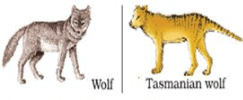
- a)Convergent evolution of Australian marsupials and placental mammals
- b)Homologous organs of both animals
- c)Divergent evolution of Australian marsupials and placental mammals
- d)Analogous organs of both animals
Correct answer is option 'A'. Can you explain this answer?
Picture shown below is example of:-
a)
Convergent evolution of Australian marsupials and placental mammals
b)
Homologous organs of both animals
c)
Divergent evolution of Australian marsupials and placental mammals
d)
Analogous organs of both animals
 | Dipanjan Chawla answered |
Wolf and Tasmania Wolf are examples of convergent evolution of placental mammals and Australian marsupials. They are evolved differently due to different in climatic and geographic regions.
Theory of 'Saltations' was given by - a)G Mendel
- b)Hugo de Vries
- c)J B S Haldane
- d)H J Miller
Correct answer is option 'B'. Can you explain this answer?
Theory of 'Saltations' was given by
a)
G Mendel
b)
Hugo de Vries
c)
J B S Haldane
d)
H J Miller
| | Shanaya Basak answered |
Introduction to the Theory of Saltations
The Theory of Saltations, proposed by Hugo de Vries, significantly contributed to the understanding of evolution and genetic variation. De Vries introduced this concept in the early 20th century, challenging the gradualism of Darwinian evolution.
Key Concepts of Saltation Theory
- Definition of Saltation:
Saltation refers to sudden and large evolutionary changes, as opposed to gradual changes over time.
- Mutation as a Driver:
De Vries emphasized mutations as the primary mechanism of saltation, suggesting that new species can arise rapidly due to significant genetic changes.
- Experiments with Evening Primrose:
De Vries conducted experiments on *Oenothera lamarckiana* (evening primrose) to observe how mutations could lead to new forms, supporting his theory.
Impact on Evolutionary Biology
- Revolutionized Understanding:
Saltation theory provided an alternative view to Darwin's gradualism, leading to discussions about the pace of evolutionary change.
- Foundation for Modern Genetics:
De Vries' work laid the groundwork for the field of genetics, influencing later researchers like J.B.S. Haldane and others who explored genetic variations in populations.
Conclusion
Hugo de Vries' Theory of Saltations highlights the importance of mutations in the evolutionary process, offering a perspective that complements traditional evolutionary theories. Understanding this theory is crucial for comprehending the mechanisms of evolution, especially in the context of genetic diversity and speciation.
The Theory of Saltations, proposed by Hugo de Vries, significantly contributed to the understanding of evolution and genetic variation. De Vries introduced this concept in the early 20th century, challenging the gradualism of Darwinian evolution.
Key Concepts of Saltation Theory
- Definition of Saltation:
Saltation refers to sudden and large evolutionary changes, as opposed to gradual changes over time.
- Mutation as a Driver:
De Vries emphasized mutations as the primary mechanism of saltation, suggesting that new species can arise rapidly due to significant genetic changes.
- Experiments with Evening Primrose:
De Vries conducted experiments on *Oenothera lamarckiana* (evening primrose) to observe how mutations could lead to new forms, supporting his theory.
Impact on Evolutionary Biology
- Revolutionized Understanding:
Saltation theory provided an alternative view to Darwin's gradualism, leading to discussions about the pace of evolutionary change.
- Foundation for Modern Genetics:
De Vries' work laid the groundwork for the field of genetics, influencing later researchers like J.B.S. Haldane and others who explored genetic variations in populations.
Conclusion
Hugo de Vries' Theory of Saltations highlights the importance of mutations in the evolutionary process, offering a perspective that complements traditional evolutionary theories. Understanding this theory is crucial for comprehending the mechanisms of evolution, especially in the context of genetic diversity and speciation.
What was the result of S.L. Miller's 1953 experiment?- a)Proved the theory of panspermia
- b)Formation of amino acids under simulated early Earth conditions
- c)Discovery of DNA
- d)Disproved the Big Bang theory
Correct answer is option 'B'. Can you explain this answer?
a)
Proved the theory of panspermia
b)
Formation of amino acids under simulated early Earth conditions
c)
Discovery of DNA
d)
Disproved the Big Bang theory
| | Stepway Academy answered |
In 1953, S.L. Miller conducted an experiment where he created conditions similar to early Earth with a mixture of gases and electrical discharges. This resulted in the formation of amino acids, supporting the idea of chemical evolution as a precursor to the origin of life.
Topic in NCERT: Origin of life
Line in NCERT: "he created electric discharge in a closed flask containing ch4, h2, nh3 and water vapour at 800°c. he observed formation of amino acids."
Which of the following are the two key concepts of Darwinian theory of evolution?- a)Genetic drift and mutation
- b)Adaptive radiation and homology
- c)Mutation and natural selection
- d)Branching descent and natural selection
Correct answer is option 'D'. Can you explain this answer?
Which of the following are the two key concepts of Darwinian theory of evolution?
a)
Genetic drift and mutation
b)
Adaptive radiation and homology
c)
Mutation and natural selection
d)
Branching descent and natural selection
| | Anjali Sharma answered |
According to Darwin's theory of evolution, nature selects the fittest. Fitness is based on characteristics which are inherited. Therefore, there must be a genetic basis for getting selected and to evolve. Some organisms are better adapted to survive in an otherwise hostile environment. Adaptative ability is inherited. Fitness is the end result of the ability to adapt and get selected by nature. Therefore, branching descent (inheritance) and natural selection are the two key concepts of Darwin's theory of evolution.
The difference between Homo sapiens and the Homo erectus was ____.- a)Homo erectus was much smaller in size than Homo sapiens
- b)Homo sapiens originated in Africa while Homo erectus was in Asia
- c)Homo erectus stayed in Africa while Homo sapiens did not
- d)The size of their brain of Homo erectus was smaller to homo sapiens
Correct answer is option 'D'. Can you explain this answer?
The difference between Homo sapiens and the Homo erectus was ____.
a)
Homo erectus was much smaller in size than Homo sapiens
b)
Homo sapiens originated in Africa while Homo erectus was in Asia
c)
Homo erectus stayed in Africa while Homo sapiens did not
d)
The size of their brain of Homo erectus was smaller to homo sapiens
 | Jhanvi Menon answered |
The correct answer is option 'D': The size of their brain of Homo erectus was smaller than that of Homo sapiens.
Explanation:
Homo sapiens and Homo erectus are two distinct species of hominins that lived during different periods of human evolution. There are several differences between these two species, but one of the most significant differences lies in the size of their brains.
1. Homo erectus:
- Homo erectus is an extinct species of hominin that lived from about 1.9 million years ago to about 143,000 years ago.
- They had a relatively larger cranial capacity compared to earlier hominins, but their brain size was still smaller than that of Homo sapiens.
- The average cranial capacity of Homo erectus was about 900 to 1100 cubic centimeters.
- Homo erectus is known for its robust physical features, including a thick skull, prominent brow ridges, and a long, low skull shape.
2. Homo sapiens:
- Homo sapiens, also known as anatomically modern humans, emerged around 300,000 years ago and are the only surviving species of hominins.
- They have a significantly larger brain size compared to Homo erectus.
- The average cranial capacity of Homo sapiens is about 1200 to 1600 cubic centimeters.
- Homo sapiens have a more rounded skull shape and less pronounced brow ridges compared to earlier hominins.
Importance of brain size:
- The size of the brain is often correlated with cognitive abilities, such as problem-solving, language, and complex social interactions.
- A larger brain size generally indicates a higher level of cognitive development and intelligence.
- The increase in brain size throughout human evolution is believed to be associated with the development of complex behaviors and cultural advancements.
In summary, the main difference between Homo sapiens and Homo erectus is that the size of the brain of Homo erectus was smaller compared to that of Homo sapiens.
Explanation:
Homo sapiens and Homo erectus are two distinct species of hominins that lived during different periods of human evolution. There are several differences between these two species, but one of the most significant differences lies in the size of their brains.
1. Homo erectus:
- Homo erectus is an extinct species of hominin that lived from about 1.9 million years ago to about 143,000 years ago.
- They had a relatively larger cranial capacity compared to earlier hominins, but their brain size was still smaller than that of Homo sapiens.
- The average cranial capacity of Homo erectus was about 900 to 1100 cubic centimeters.
- Homo erectus is known for its robust physical features, including a thick skull, prominent brow ridges, and a long, low skull shape.
2. Homo sapiens:
- Homo sapiens, also known as anatomically modern humans, emerged around 300,000 years ago and are the only surviving species of hominins.
- They have a significantly larger brain size compared to Homo erectus.
- The average cranial capacity of Homo sapiens is about 1200 to 1600 cubic centimeters.
- Homo sapiens have a more rounded skull shape and less pronounced brow ridges compared to earlier hominins.
Importance of brain size:
- The size of the brain is often correlated with cognitive abilities, such as problem-solving, language, and complex social interactions.
- A larger brain size generally indicates a higher level of cognitive development and intelligence.
- The increase in brain size throughout human evolution is believed to be associated with the development of complex behaviors and cultural advancements.
In summary, the main difference between Homo sapiens and Homo erectus is that the size of the brain of Homo erectus was smaller compared to that of Homo sapiens.
Which of the following is true?- a)Wings of birds and insects are homologous organs.
- b)Human hands and wings of birds are analogous organs.
- c)Human hands and wings of bats are analogous organs.
- d)Flipper of seal and wings of birds are homologous organs.
Correct answer is option 'D'. Can you explain this answer?
Which of the following is true?
a)
Wings of birds and insects are homologous organs.
b)
Human hands and wings of birds are analogous organs.
c)
Human hands and wings of bats are analogous organs.
d)
Flipper of seal and wings of birds are homologous organs.
| | Suresh Iyer answered |
Flipper of seal and wing of birds are modified forelimbs, thus, have same fundamental structure but have different functions. Flippers are meant for swimming and wings are meant for flying. Therefore, these organs are homologous oroans.
The following are some major events in the early history of life
P. First heterotrophic prokaryotes
Q. First genes
R. First eukaryotes
S. First autotrophic prokaryotes
T. First animals
Which option below places these events in the correct order?- a)PQSRT
- b)QSPTR
- c)QPSRT
- d)QSPRT
Correct answer is option 'C'. Can you explain this answer?
The following are some major events in the early history of life
P. First heterotrophic prokaryotes
Q. First genes
R. First eukaryotes
S. First autotrophic prokaryotes
T. First animals
Which option below places these events in the correct order?
P. First heterotrophic prokaryotes
Q. First genes
R. First eukaryotes
S. First autotrophic prokaryotes
T. First animals
Which option below places these events in the correct order?
a)
PQSRT
b)
QSPTR
c)
QPSRT
d)
QSPRT
| | Meera Singh answered |
Organisms have evolved from simpler forms to complex form. Hence the order of the events are genes first, then heterotrophic prokaryotes, then autotrophic prokaryotes, then eukaryotes and then animals.
Which of the following is the example of adaptive radiation?- a)Only Australian marsupials
- b)Only Darwin finches
- c)Darwin finches and Australian marsupials
- d)Light and dark winged moths
Correct answer is option 'C'. Can you explain this answer?
Which of the following is the example of adaptive radiation?
a)
Only Australian marsupials
b)
Only Darwin finches
c)
Darwin finches and Australian marsupials
d)
Light and dark winged moths
| | Kushagra Budhgaya answered |
Refer ncert u'll get the explanation
Which theory explains the origin of universe?- a)Molecular theory
- b)Darwin theory
- c)Lamarck theory
- d)Big bang theory
Correct answer is option 'D'. Can you explain this answer?
Which theory explains the origin of universe?
a)
Molecular theory
b)
Darwin theory
c)
Lamarck theory
d)
Big bang theory
 | Nayanika Reddy answered |
Origin of universe is explained by big bang theory. According to this theory, whole universe was concentrated into single sphere. Due to same unknown region, there was explosion in it that forms different galaxies still moving away from each other.
Which of the following factors contribute to changes in gene and allele frequencies, leading to speciation?
Gene migration or gene flow
Genetic drift
Mutation
Genetic recombination
Natural selection- a)1, 2, 3, and 5 are correct
- b)1, 3, and 4 are correct
- c)2, 4, and 5 are correct
- d)1, 2, 3, 4, and 5 are correct
Correct answer is option 'D'. Can you explain this answer?
Gene migration or gene flow
Genetic drift
Mutation
Genetic recombination
Natural selection
a)
1, 2, 3, and 5 are correct
b)
1, 3, and 4 are correct
c)
2, 4, and 5 are correct
d)
1, 2, 3, 4, and 5 are correct
 | Infinity Academy answered |
Gene migration or gene flow (1) involves the movement of genes between populations, affecting gene frequencies.
Genetic drift (2) refers to random changes in gene frequencies due to chance events, especially in small populations.
Mutation (3) introduces new genetic variations that can alter gene frequencies.
Genetic recombination (4) during gametogenesis creates new combinations of alleles, influencing genetic diversity.
Natural selection (5) acts on heritable traits, enhancing reproductive success and influencing the frequency of advantageous alleles in future generations.
All these factors contribute to changes in allele frequencies and can lead to speciation over time.
Genetic drift (2) refers to random changes in gene frequencies due to chance events, especially in small populations.
Mutation (3) introduces new genetic variations that can alter gene frequencies.
Genetic recombination (4) during gametogenesis creates new combinations of alleles, influencing genetic diversity.
Natural selection (5) acts on heritable traits, enhancing reproductive success and influencing the frequency of advantageous alleles in future generations.
All these factors contribute to changes in allele frequencies and can lead to speciation over time.
How many peaks are there in the disruptive selection?- a)One
- b)Two
- c)Three
- d)No peaks
Correct answer is option 'B'. Can you explain this answer?
How many peaks are there in the disruptive selection?
a)
One
b)
Two
c)
Three
d)
No peaks
| | Riya Banerjee answered |
In disruptive selection, most of the individuals get the periphery values at both ends of the curve given in the graph. The population gets divided into two different groups. Hence, they have two peaks which resemble a two-humped camel.
What happens during disruptive selection?- a)Three peaks are formed
- b)Extreme value gets rejected
- c)Average value gets selected
- d)Members of both extreme are selected
Correct answer is option 'D'. Can you explain this answer?
What happens during disruptive selection?
a)
Three peaks are formed
b)
Extreme value gets rejected
c)
Average value gets selected
d)
Members of both extreme are selected
| | Jyoti Sengupta answered |
In disruptive selection, the members of both extreme are selected. The average gets rejected. Most of the individuals get values other than the mean character value. The naturally selected members are shown by two peaks.
Which of the following is not included in natural selection?- a)Stabilizing selection
- b)Directional selection
- c)Disruptive selection
- d)Technical selection
Correct answer is option 'D'. Can you explain this answer?
Which of the following is not included in natural selection?
a)
Stabilizing selection
b)
Directional selection
c)
Disruptive selection
d)
Technical selection
| | Dev Patel answered |
Natural selection mainly leads to three selections. They are: Stabilizing selection, directional selection, and disruptive selection. Technical selection does not belong to natural selection. This classification is based on different organism-environmental relationship.
Who demonstrated that life originated from pre-existing cells?- a)Louis Pasteur
- b)Hugo de Vries
- c)Charles Darwin
- d)Stanley Miller
Correct answer is option 'A'. Can you explain this answer?
Who demonstrated that life originated from pre-existing cells?
a)
Louis Pasteur
b)
Hugo de Vries
c)
Charles Darwin
d)
Stanley Miller
| | EduRev NEET answered |
- Louis Pasteur in his swan neck flask experiment, found out that life originated from pre-existing life.
- He prepared sterilized syrup of sugar and later killed yeast by boiling them in flasks.
Industrial melanism is an example of -- a)Mutation
- b)Natural selection
- c)Neo Darwinism
- d)Neo Lamarckism
Correct answer is option 'B'. Can you explain this answer?
Industrial melanism is an example of -
a)
Mutation
b)
Natural selection
c)
Neo Darwinism
d)
Neo Lamarckism
| | EduRev NEET answered |
Natural selection is the most widely accepted theory concerning the principal causal mechanism of evolutionary change profounded by Charles Darwin and Alfred Russel Wallace. It results from the differential reproduction (some members of a population produce abundant offspring, some only a few and still others none), one phenotype as compared with other phenotypes in the same population. This determines the relative share of different genotypes which individuals possess and propagate in a population. Industrial melanism supports evolution by natural selection. It is an adaptation where the moths living in the industrial areas developed melanin pigments to match their bodies to the tree trunks.
Industrial melanism as oberved in peppered moth proves that - a)The melanic form of the moth has no selective advantage over lighter form in industrial area
- b)The lighter-form the moth has no selective advantage either in polluted industrial area or non-polluted area
- c)Melanism is a pollution-generated feature
- d)The true black melanic froms escaped unoticed so they managed to survive resulting in more population of black moths.
Correct answer is option 'D'. Can you explain this answer?
Industrial melanism as oberved in peppered moth proves that
a)
The melanic form of the moth has no selective advantage over lighter form in industrial area
b)
The lighter-form the moth has no selective advantage either in polluted industrial area or non-polluted area
c)
Melanism is a pollution-generated feature
d)
The true black melanic froms escaped unoticed so they managed to survive resulting in more population of black moths.
| | Sonal Chakraborty answered |
Explanation:
Industrial Melanism in Peppered Moths:
- Industrial melanism in peppered moths refers to the phenomenon where the population of moths shifted from predominantly light-colored to predominantly dark-colored in industrial areas during the Industrial Revolution.
Survival Advantage of Melanic Forms:
- The true black melanic forms of the peppered moths were able to blend into the polluted environment better than the lighter forms. This provided them with a survival advantage as they were able to avoid predators more effectively.
- As a result, the black melanic moths were able to survive and reproduce more successfully in the industrial areas, leading to an increase in the population of black moths.
Selective Advantage of Melanic Forms:
- The increase in the population of black moths in industrial areas demonstrates that the melanic form had a selective advantage over the lighter form in polluted environments.
- This selective advantage is a result of natural selection, where individuals with traits that provide them with a better chance of survival and reproduction in their environment are more likely to pass on their genes to the next generation.
Conclusion:
- Therefore, the industrial melanism observed in peppered moths supports the idea that the true black melanic forms had a survival advantage in polluted industrial areas, leading to an increase in their population over time.
Chapter doubts & questions for Daily Practice & Tests - 15 Weeks Preparation - Biology Class 12 2026 is part of NEET exam preparation. The chapters have been prepared according to the NEET exam syllabus. The Chapter doubts & questions, notes, tests & MCQs are made for NEET 2026 Exam. Find important definitions, questions, notes, meanings, examples, exercises, MCQs and online tests here.
Chapter doubts & questions of Daily Practice & Tests - 15 Weeks Preparation - Biology Class 12 in English & Hindi are available as part of NEET exam. Download more important topics, notes, lectures and mock test series for NEET Exam by signing up for free.
15 Weeks Preparation - Biology Class 1247 videos|257 docs|137 tests |
