


All Exams > NEET > 1 Year Dropper's Course for NEET > All Questions
All questions of Electrostatic Potential and Capacitance for NEET Exam
Three capacitors, each of capacitance C = 3 mF, are connected as shown in the figure. The equivalent capacitance between points P and S is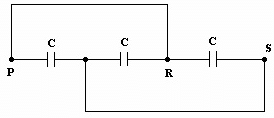
- a)9 μF
- b)6 μF
- c)3 μF
- d)1 μF
Correct answer is option 'A'. Can you explain this answer?
Three capacitors, each of capacitance C = 3 mF, are connected as shown in the figure. The equivalent capacitance between points P and S is
a)
9 μF
b)
6 μF
c)
3 μF
d)
1 μF
 | Dr Manju Sen answered |
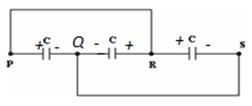
If P is at positive potential, then Q is at negative potential and R is at positive potential. The system therefore reduces to 3 capacitors in parallel. C= 9μF

Three different capacitors are connected in series, then:- a)they will have equal charges
- b)they will have same potential
- c)both 1 & 2
- d)none of these
Correct answer is option 'A'. Can you explain this answer?
Three different capacitors are connected in series, then:
a)
they will have equal charges
b)
they will have same potential
c)
both 1 & 2
d)
none of these
 | Ciel Knowledge answered |
C = Q/V
series connection splits the battery potential, hence....
V = V1 + V2
V1 = Q/C1 & V2 = Q/C2
Therefore, both have equal charge
series connection splits the battery potential, hence....
V = V1 + V2
V1 = Q/C1 & V2 = Q/C2
Therefore, both have equal charge

- a)0.5 J
- b)1.12 J
- c)1.2 J
- d)0.9 J
Correct answer is 'D'. Can you explain this answer?
 | Nikita Singh answered |
q=6x10⁻¹⁰ c
Q=-2x10⁻⁹c
r1=3x10⁻²m
r2=4x10⁻²m
△vQ=w/q
(1/4πεo)-2x10-9/10-2[(1/4)-(1/3)]=W/6x10-3
9x109x2x10-9x6x10-3/12x10-2=W
W=9x10-3x102
W=0.9J
Q=-2x10⁻⁹c
r1=3x10⁻²m
r2=4x10⁻²m
△vQ=w/q
(1/4πεo)-2x10-9/10-2[(1/4)-(1/3)]=W/6x10-3
9x109x2x10-9x6x10-3/12x10-2=W
W=9x10-3x102
W=0.9J
Two equipotential surfaces have a potential of -10V and 90V respectively, what is the difference in potential between these surfaces?- a)90V
- b)80V
- c)0V
- d)100V
Correct answer is 'D'. Can you explain this answer?
Two equipotential surfaces have a potential of -10V and 90V respectively, what is the difference in potential between these surfaces?
a)
90V
b)
80V
c)
0V
d)
100V
 | Krishna Iyer answered |
Potential = high potential - low potential
so our high potential is 90V and low potential is 10V,
potential = 90-(-10)=100V
so our high potential is 90V and low potential is 10V,
potential = 90-(-10)=100V
The amount of work done in moving a charge from one point to another along an equipotential line or surface charge is- a)Zero
- b)Infinity
- c)One
- d)Two
Correct answer is option 'A'. Can you explain this answer?
The amount of work done in moving a charge from one point to another along an equipotential line or surface charge is
a)
Zero
b)
Infinity
c)
One
d)
Two
 | Om Desai answered |
Since Potential difference between two points in equipotential surfaces is zero, the work done between two points in equipotential surface is also zero.
Work done in carrying 2C charge in a circular path of radius 2m around a charge of 10C is- a)6.67J
- b)60J
- c)Zero
- d)15J
Correct answer is option 'C'. Can you explain this answer?
Work done in carrying 2C charge in a circular path of radius 2m around a charge of 10C is
a)
6.67J
b)
60J
c)
Zero
d)
15J
 | Suresh Iyer answered |
The overall work performed in carrying a 2coulomb charge in a circular orbit of radius 3 m around a charge of 10 coulomb is calculated below.
It is a well-known fact that W=qdv.
Here dV is the change in overall potential. In the circular orbit of r potential at each point is similar.
Most significantly, the value of r is 3.
The value of dv=0 and hence W=q0=0.
It is a well-known fact that W=qdv.
Here dV is the change in overall potential. In the circular orbit of r potential at each point is similar.
Most significantly, the value of r is 3.
The value of dv=0 and hence W=q0=0.
Electric field intensity at point ‘B’ due to a point charge ‘Q’ kept at a point ‘A’ is 12 NC-1 and the electric potential at a point ‘B’ due to same charge is 6 JC-1. The distance between AB is- a)2 m
- b)1.5 m
- c)1 m
- d)0.5 m
Correct answer is option 'D'. Can you explain this answer?
Electric field intensity at point ‘B’ due to a point charge ‘Q’ kept at a point ‘A’ is 12 NC-1 and the electric potential at a point ‘B’ due to same charge is 6 JC-1. The distance between AB is
a)
2 m
b)
1.5 m
c)
1 m
d)
0.5 m
 | Imk Pathsala answered |
E.l = V where,
E = electric field intensity = 12 N/C
V = electric potential = 6 J/C
=> distance between A and B,
l = (6 / 12) m or (1 / 2) m = 0.5 m
E = electric field intensity = 12 N/C
V = electric potential = 6 J/C
=> distance between A and B,
l = (6 / 12) m or (1 / 2) m = 0.5 m
If 100 J of work has to be done in moving an electric charge of 4C from a place where potential is -5 V to another place, where potential is V volt. The value of V is- a)15 V
- b)20 V
- c)25 V
- d)10 V
Correct answer is option 'B'. Can you explain this answer?
If 100 J of work has to be done in moving an electric charge of 4C from a place where potential is -5 V to another place, where potential is V volt. The value of V is
a)
15 V
b)
20 V
c)
25 V
d)
10 V
| | Suresh Iyer answered |
From the definition, the work done to a test charge ‘q0’ from one place to another place in an electric field is given by the formula
W=q0x[vfinal-vinitial ]
100=4x[v-(-5)]
v+5=25
v=20V
W=q0x[vfinal-vinitial ]
100=4x[v-(-5)]
v+5=25
v=20V
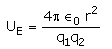
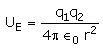
The electrostatic potential energy between two charges q1 and q2 separated by a distance by r is given by- a)

- b)
- c)
- d)

Correct answer is option 'D'. Can you explain this answer?
The electrostatic potential energy between two charges q1 and q2 separated by a distance by r is given by
a)
b)
c)
d)
 | Khushi Mittal answered |
Energy = force × distance U=Kq1q2/r^2 × r U=Kq1q2/r
Can you explain the answer of this question below:Equal charges are given to two spheres of different radii. The potential will
- A:
be equal on both the spheres
- B:
be more on the smaller sphere
- C:
be more on the bigger sphere
- D:
depend on the material of the sphere
The answer is b.
Equal charges are given to two spheres of different radii. The potential will
be equal on both the spheres
be more on the smaller sphere
be more on the bigger sphere
depend on the material of the sphere
 | Husna answered |
V is inversely proportional to radius
A hollow metal sphere of radius 5cm is charged so that the potential on its surface is 10V. The potential at a distance of 2cm from the centre of the sphere is- a)4V
- b)zero
- c)10/3V
- d)10V
Correct answer is option 'D'. Can you explain this answer?
A hollow metal sphere of radius 5cm is charged so that the potential on its surface is 10V. The potential at a distance of 2cm from the centre of the sphere is
a)
4V
b)
zero
c)
10/3V
d)
10V
 | Ayush Joshi answered |
In the case of a hollow metal sphere (spherical shell), the electric field inside the shell is zero. This means that the potential inside the shell is constant. Therefore the potential at the centre of the sphere is the same as that on its surface, i.e. 10 V.
Two capacitors of 20 μƒ and 30 μƒ are connected in series to a battery of 40V. Calculate charge on each capacitor.- a)480 C
- b)478 C
- c)450 C
- d)500 C
Correct answer is option 'A'. Can you explain this answer?
Two capacitors of 20 μƒ and 30 μƒ are connected in series to a battery of 40V. Calculate charge on each capacitor.
a)
480 C
b)
478 C
c)
450 C
d)
500 C
| | Nikita Singh answered |
C1= 20×10µf
and C2= 30×10µf
in series Ceq = C1C2/(C1+C2)
Ceq = 20×10^(-6)×30×10^(-6)/20×10^(-6)+30^×10(-6)
Ceq= 12×10^(-6)f
As we know that Q = CV
Putting the values of C and V= 40V, we get
Q = (12 * 10^-6) * 40
= 480µC
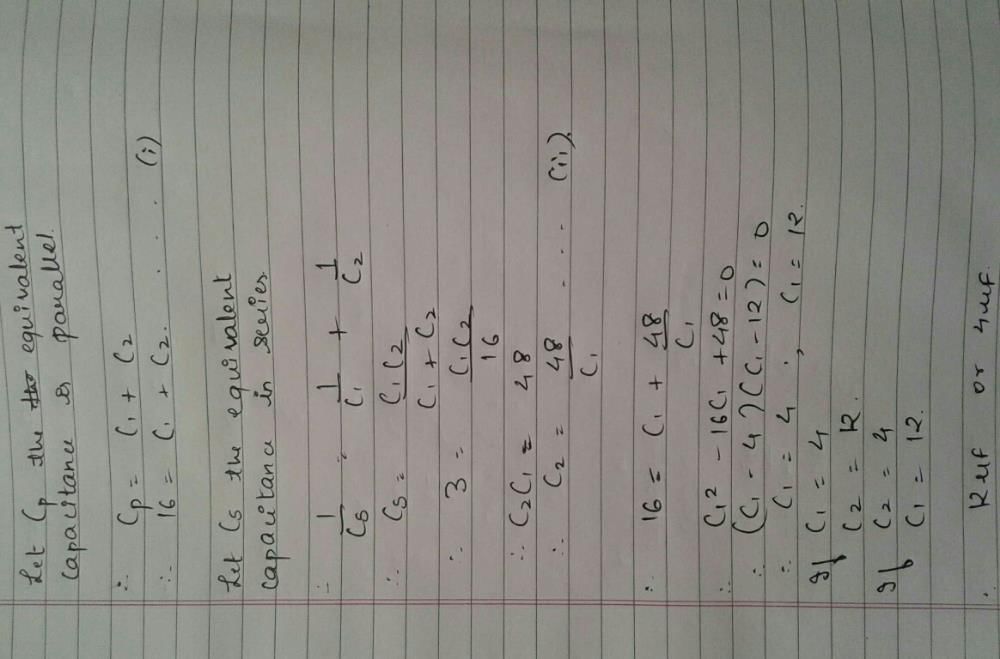
When two capacitors C1 and C2 are connected in series and parallel, their equivalent capacitances comes out to be 3 μƒ and 16 μƒ respectively. Calculate values of C1 and C2.- a)4μƒ and 12μƒ
- b)6μƒ and 10μƒ
- c)4μƒ and 10μƒ
- d)6μƒ and 12μƒ
Correct answer is option 'A'. Can you explain this answer?
When two capacitors C1 and C2 are connected in series and parallel, their equivalent capacitances comes out to be 3 μƒ and 16 μƒ respectively. Calculate values of C1 and C2.
a)
4μƒ and 12μƒ
b)
6μƒ and 10μƒ
c)
4μƒ and 10μƒ
d)
6μƒ and 12μƒ
 | Anonymous answered |
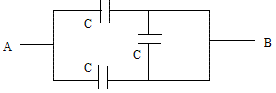
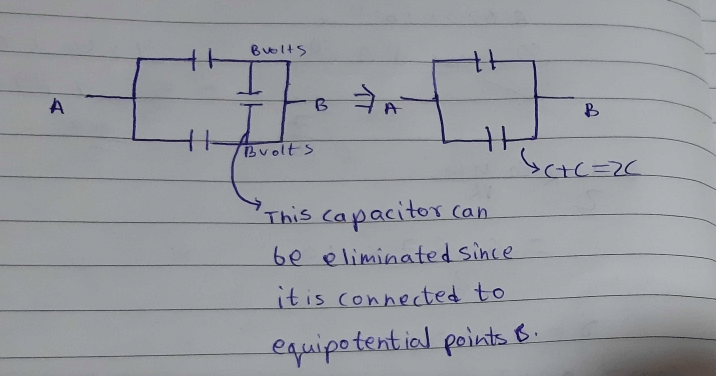
Here is a combination of three identical capacitors. If resultant capacitance is 1 μƒ, calculate capacitance of each capacitor.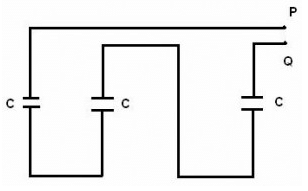
- a)6 μƒ
- b)3 μƒ
- c)4 μƒ
- d)2 μƒ
Correct answer is option 'B'. Can you explain this answer?
Here is a combination of three identical capacitors. If resultant capacitance is 1 μƒ, calculate capacitance of each capacitor.
a)
6 μƒ
b)
3 μƒ
c)
4 μƒ
d)
2 μƒ
 | Lavanya Menon answered |
Combination of Capacitors in Series
C(effective) = C/3 = 1
C(effective) = C/3 = 1
A hollow metal sphere of radius 10 cm is charged such that the potential on its surface is 80 volt. The potential at the centre of the sphere is- a)8 volt
- b)zero
- c)800 volt
- d)80 volt
Correct answer is option 'D'. Can you explain this answer?
A hollow metal sphere of radius 10 cm is charged such that the potential on its surface is 80 volt. The potential at the centre of the sphere is
a)
8 volt
b)
zero
c)
800 volt
d)
80 volt
 | Sunidhi Pandey answered |
Chage is uniformly distributed in an hollow sphere.
Can you explain the answer of this question below:It requires 4 J of work to move a charge of 20 C from point A to point B, separated by a distance of 0.2 cm. The potential difference between A and B in volts
- A:
0.2
- B:
16
- C:
5
- D:
80
The answer is a.
It requires 4 J of work to move a charge of 20 C from point A to point B, separated by a distance of 0.2 cm. The potential difference between A and B in volts
0.2
16
5
80
 | Mayank Singh answered |
As we know tha..v=w/q. .....1 so according to question w=4j and q=20c on putting value of w and q in equation 1 we find that v=0.2v
The shape of equipotential surface for an infinite line charge is:- a)Coaxial cylindrical surfaces
- b)Parallel plane surfaces
- c)Parallel plane surfaces perpendicular to lines of force
- d)None of above
Correct answer is option 'A'. Can you explain this answer?
The shape of equipotential surface for an infinite line charge is:
a)
Coaxial cylindrical surfaces
b)
Parallel plane surfaces
c)
Parallel plane surfaces perpendicular to lines of force
d)
None of above
 | Rajesh Gupta answered |
The shape of equipotential surface for an infinite line charge is coaxial cylindrical because A curved surface on which potential is constant is equipotential curve . If we consider the line charge then the focus of the point should have the same potential hence it is a coaxial cylinder.
When a positive charge is moved in an electrostatic field from a point at high potential to a low potential, its kinetic energy- a)Remains constant
- b)Decreases
- c)Increases
- d)Either increase or remain constant
Correct answer is option 'C'. Can you explain this answer?
When a positive charge is moved in an electrostatic field from a point at high potential to a low potential, its kinetic energy
a)
Remains constant
b)
Decreases
c)
Increases
d)
Either increase or remain constant
 | Siddhi Bhardwaj answered |
You can generalise it by assuming a positive charge moving away from another positive charge. now both of them are repelling each other with some force. so that positive charge will accelerate which results in the increase in K.E.
Electric potential is- a)scalar and dimensionless
- b)vector and dimensionless
- c)scalar with dimension
- d)vector with dimension
Correct answer is option 'C'. Can you explain this answer?
Electric potential is
a)
scalar and dimensionless
b)
vector and dimensionless
c)
scalar with dimension
d)
vector with dimension
 | Pooja Mehta answered |
He electric potential due to a system of point charges is equal to the sum of the point charges' individual potentials. This fact simplifies calculations significantly, since addition of potential (scalar) fields is much easier than addition of the electric (vector) fields.
Can you explain the answer of this question below:The potential energy of a system containing only one point charge is
- A:
Zero
- B:
Infinity
- C:
Nonzero finite
- D:
None of the above
The answer is a.
The potential energy of a system containing only one point charge is
Zero
Infinity
Nonzero finite
None of the above
 | .mie. answered |
Answer is 0 as there are no other sources of electrostatic potential .... against which an external agent must do work.... in moving the point charge.... from infinity to its final location.... therefore correct opt is A
Consider a solid cube made up of insulating material having a uniform volume charge density. Assuming the electrostatic potential to be zero at infinity, the ratio of the potential at a corner of the cube to that at the centre will be - a)1:1
- b)1:2
- c)1:4
- d)1:8
Correct answer is option 'B'. Can you explain this answer?
Consider a solid cube made up of insulating material having a uniform volume charge density. Assuming the electrostatic potential to be zero at infinity, the ratio of the potential at a corner of the cube to that at the centre will be
a)
1:1
b)
1:2
c)
1:4
d)
1:8
| | Sanaya Kumar answered |

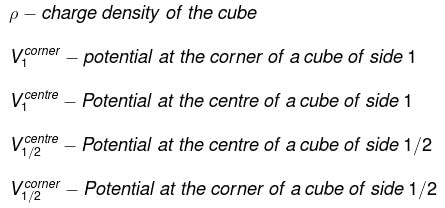
By dimensional analysis
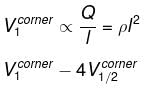
but by superposition
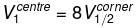
Because of the centre of the larger cube lies at a corner of the eight smaller cubes of which it is made
therefore,
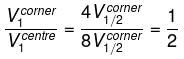
Because of the centre of the larger cube lies at a corner of the eight smaller cubes of which it is made
therefore,
The amount of work done in moving a unit positive charge through distance of 10 cm on an equipotential surface is- a)100 joule
- b)10 cm
- c)1/10 cm
- d)Zero
Correct answer is option 'D'. Can you explain this answer?
The amount of work done in moving a unit positive charge through distance of 10 cm on an equipotential surface is
a)
100 joule
b)
10 cm
c)
1/10 cm
d)
Zero
| | Anupam Singh answered |
Zero because at equipotential surface potential difference is zero
Find the equivalent capacitance of the combination.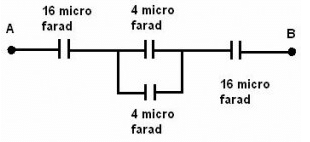
- a)16/3 μƒ
- b)16 μƒ
- c)19.0 μƒ
- d)8 μƒ
Correct answer is option 'C'. Can you explain this answer?
Find the equivalent capacitance of the combination.
a)
16/3 μƒ
b)
16 μƒ
c)
19.0 μƒ
d)
8 μƒ
 | Kumari Sakshi answered |
none of the optaion match answer should be 4
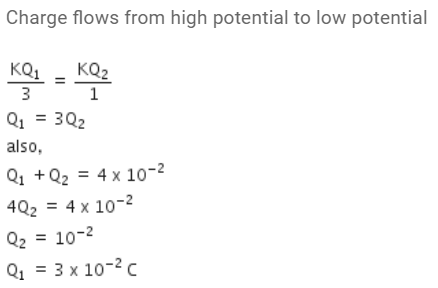
Two metallic spheres of radii 1 cm and 3 cm are given charges of (-1 x 10⁻² C) and 5 x 10⁻² C , respectively. If these are connected by a conducting wire, the final charge on the bigger sphere is:- a)2 x 10⁻² C
- b)3 x 10⁻² C
- c)4 x 10⁻² C
- d)1 x 10⁻² C
Correct answer is option 'B'. Can you explain this answer?
Two metallic spheres of radii 1 cm and 3 cm are given charges of (-1 x 10⁻² C) and 5 x 10⁻² C , respectively. If these are connected by a conducting wire, the final charge on the bigger sphere is:
a)
2 x 10⁻² C
b)
3 x 10⁻² C
c)
4 x 10⁻² C
d)
1 x 10⁻² C
| | Rajeev Saxena answered |
when two capacitors are put in series, the equivalent capacitance is - a)the reciprocal of the capacitances
- b)smaller than both capacitances
- c)the sum of the capacitances
- d)the product of the capacitances
Correct answer is option 'B'. Can you explain this answer?
when two capacitors are put in series, the equivalent capacitance is
a)
the reciprocal of the capacitances
b)
smaller than both capacitances
c)
the sum of the capacitances
d)
the product of the capacitances
 | Tarun Chakraborty answered |
Explanation:When two capacitors C1 and C2 are connected in series, the reciprocal of the equivalent capacitance in series is equal to the sum of the reciprocals of the two individual capacitances.
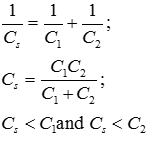
It has value lesser than the least value of capacitance.
What is the direction of the lines of force at any point on the equipotential surface?- a)Parallel to it
- b)Perpendicular to it.
- c)Inclined at 45 degrees
- d)None of the above
Correct answer is option 'B'. Can you explain this answer?
What is the direction of the lines of force at any point on the equipotential surface?
a)
Parallel to it
b)
Perpendicular to it.
c)
Inclined at 45 degrees
d)
None of the above
 | Anjali Iyer answered |
When electric lines of force get perpendicular to equipotential surface then area vector and electric lines of force are parallel to each other.so angle between them is zero. due to that reason they get perpendicular to each other.
In bringing an electron towards another electron, the electrostatic potential energy of the system- a)becomes zero
- b)decreases
- c)remains same
- d)increases
Correct answer is option 'D'. Can you explain this answer?
In bringing an electron towards another electron, the electrostatic potential energy of the system
a)
becomes zero
b)
decreases
c)
remains same
d)
increases
| | Nandini Patel answered |
The electron has negative charge. When an electron is bringing towards another electron, then due to same negative charge repulsive force is produced between them. So, to bring them closer a work is done against this repulsive force. This work is stored in the form of electrostatic potential energy. Thus, electrostatic potential energy of system increases.
Alternative: Electrostatic potential energy of system of two electrons
U=[1/4πε0][(−e)(−e)/r] = [1/4πε0](e^2/r)
Thus, as r decreases, potential energy U increases.
If a unit charge is taken from one part to another part over an equipotential surface, then what is the change in electrostatic potential energy of the charge?- a)10 J
- b)100 J
- c)1 J
- d)0 J
Correct answer is option 'D'. Can you explain this answer?
If a unit charge is taken from one part to another part over an equipotential surface, then what is the change in electrostatic potential energy of the charge?
a)
10 J
b)
100 J
c)
1 J
d)
0 J
 | Utsav Srivastava answered |
Equipotential surface means the potential on every. point on that surface is constant. it means the change in potential on equipotential surface is zero we know that... ( electrostatic potential energy = change in potential × charge.)... ... according to this electrostatic potential energy is zero
Equipotential surfaces cannot- a)be parallel
- b)be spherical
- c)Intersect
- d)be irregularly shaped.
Correct answer is option 'C'. Can you explain this answer?
Equipotential surfaces cannot
a)
be parallel
b)
be spherical
c)
Intersect
d)
be irregularly shaped.
| | Krishna Iyer answered |
The electric field lines are perpendicular to the equipotential surface. The field lines can not intersect each other because the electric force can not have two directions at a point.
The potential energy of a system containing only one point charge is- a)Zero
- b)Infinity
- c)Non zero finite
- d)None of the above
Correct answer is option 'A'. Can you explain this answer?
The potential energy of a system containing only one point charge is
a)
Zero
b)
Infinity
c)
Non zero finite
d)
None of the above
 | Manish Aggarwal answered |
Potential Energy of a System with One Point Charge
- Definition of Potential Energy: Potential energy is the energy stored in an object due to its position or configuration in a system.
- Potential Energy of a Point Charge: In the case of a system containing only one point charge, the potential energy of the system is considered to be zero.
- Explanation: When there is only one point charge in a system, there is no other charge or external force interacting with it to create potential energy. Therefore, the potential energy of a single point charge is considered to be zero.
This is why the correct answer is A: Zero.
A hollow metal sphere of radius 20 cm is charged such that the potential on its surface is 120 Volt. The potential at the centre of the sphere is- a)80 V
- b)6 V
- c)120 V
- d)Zero
Correct answer is 'C'. Can you explain this answer?
A hollow metal sphere of radius 20 cm is charged such that the potential on its surface is 120 Volt. The potential at the centre of the sphere is
a)
80 V
b)
6 V
c)
120 V
d)
Zero
| | Anjana Sharma answered |
Potential inside the charged sphere is constant and equal to potential on the surface. Hence the potential at the centre of the sphere is 120 V.
If the potential difference between the plates of a capacitor is increased by 0.1%, the energy stored in the capacitor increases by very nearly- a)0.1%
- b)0.144%
- c)0.11%
- d)0.2%
Correct answer is option 'D'. Can you explain this answer?
If the potential difference between the plates of a capacitor is increased by 0.1%, the energy stored in the capacitor increases by very nearly
a)
0.1%
b)
0.144%
c)
0.11%
d)
0.2%
 | Amar Shah answered |
**Explanation:**
To understand why the correct answer is option 'D', let's consider the equation for the energy stored in a capacitor:
**Energy (E) = 1/2 * C * V^2**
where E is the energy, C is the capacitance, and V is the potential difference (voltage) across the capacitor plates.
According to the question, the potential difference between the plates of the capacitor is increased by 0.1%. Let the initial potential difference be V1 and the increased potential difference be V2.
**Change in Potential Difference = (V2 - V1) = 0.1% of V1**
Using this information, we can write the new potential difference as:
**V2 = V1 + (0.1/100) * V1 = V1 + 0.001 * V1 = (1 + 0.001) * V1 = 1.001 * V1**
Next, we need to find the change in energy stored in the capacitor. Let the initial energy be E1 and the increased energy be E2.
**Change in Energy = (E2 - E1) = ?**
Using the equation for energy, we can write the new energy as:
**E2 = 1/2 * C * V2^2 = 1/2 * C * (1.001 * V1)^2 = 1/2 * C * (1.001^2) * V1^2**
Now, let's calculate the change in energy:
**Change in Energy = (E2 - E1) = 1/2 * C * (1.001^2) * V1^2 - 1/2 * C * V1^2**
Simplifying this expression:
**Change in Energy = 1/2 * C * V1^2 * (1.001^2 - 1) = 1/2 * C * V1^2 * (1.001^2 - 1)**
To find the percentage increase in energy, we need to divide the change in energy by the initial energy and multiply by 100. Let's calculate:
**Percentage Increase in Energy = (Change in Energy / E1) * 100**
Substituting the expression for change in energy:
**Percentage Increase in Energy = [1/2 * C * V1^2 * (1.001^2 - 1)] / [1/2 * C * V1^2] * 100**
Simplifying this expression:
**Percentage Increase in Energy = (1.001^2 - 1) * 100 = (1.001 * 1.001 - 1) * 100 = (1.002001 - 1) * 100 = 0.2001 * 100 = 0.2%**
Therefore, the energy stored in the capacitor increases by approximately 0.2% when the potential difference between the plates is increased by 0.1%. Hence, the correct answer is option 'D' (0.2%).
To understand why the correct answer is option 'D', let's consider the equation for the energy stored in a capacitor:
**Energy (E) = 1/2 * C * V^2**
where E is the energy, C is the capacitance, and V is the potential difference (voltage) across the capacitor plates.
According to the question, the potential difference between the plates of the capacitor is increased by 0.1%. Let the initial potential difference be V1 and the increased potential difference be V2.
**Change in Potential Difference = (V2 - V1) = 0.1% of V1**
Using this information, we can write the new potential difference as:
**V2 = V1 + (0.1/100) * V1 = V1 + 0.001 * V1 = (1 + 0.001) * V1 = 1.001 * V1**
Next, we need to find the change in energy stored in the capacitor. Let the initial energy be E1 and the increased energy be E2.
**Change in Energy = (E2 - E1) = ?**
Using the equation for energy, we can write the new energy as:
**E2 = 1/2 * C * V2^2 = 1/2 * C * (1.001 * V1)^2 = 1/2 * C * (1.001^2) * V1^2**
Now, let's calculate the change in energy:
**Change in Energy = (E2 - E1) = 1/2 * C * (1.001^2) * V1^2 - 1/2 * C * V1^2**
Simplifying this expression:
**Change in Energy = 1/2 * C * V1^2 * (1.001^2 - 1) = 1/2 * C * V1^2 * (1.001^2 - 1)**
To find the percentage increase in energy, we need to divide the change in energy by the initial energy and multiply by 100. Let's calculate:
**Percentage Increase in Energy = (Change in Energy / E1) * 100**
Substituting the expression for change in energy:
**Percentage Increase in Energy = [1/2 * C * V1^2 * (1.001^2 - 1)] / [1/2 * C * V1^2] * 100**
Simplifying this expression:
**Percentage Increase in Energy = (1.001^2 - 1) * 100 = (1.001 * 1.001 - 1) * 100 = (1.002001 - 1) * 100 = 0.2001 * 100 = 0.2%**
Therefore, the energy stored in the capacitor increases by approximately 0.2% when the potential difference between the plates is increased by 0.1%. Hence, the correct answer is option 'D' (0.2%).


If two spheres of different radii have equal charge, then the potential will be- a)dependent on nature of material of the spheres.
- b)more on smaller sphere
- c)more on bigger sphere
- d)equal on both spheres
Correct answer is option 'B'. Can you explain this answer?
If two spheres of different radii have equal charge, then the potential will be
a)
dependent on nature of material of the spheres.
b)
more on smaller sphere
c)
more on bigger sphere
d)
equal on both spheres
 | Sushil Kumar answered |
When equal charges are given to two spheres of different radii, the potential will be more or the smaller sphere as per the equation, Potential = Charge / Radius.
Since potential is inversely proportional to radius, the smaller radius will have higher potential and vice versa.
Since potential is inversely proportional to radius, the smaller radius will have higher potential and vice versa.
The capacitor preferred for high-frequency circuit is - a)Air capacitor
- b)Mica capacitor
- c)Electrolytic capacitor
- d)None of the above
Correct answer is option 'B'. Can you explain this answer?
The capacitor preferred for high-frequency circuit is
a)
Air capacitor
b)
Mica capacitor
c)
Electrolytic capacitor
d)
None of the above
| | Sushil Kumar answered |
Mica capacitor. Mica capacitors have low resistive and inductive components associated with it. Hence, they have high Q factor and because of high Q factor their characteristics are mostly frequency independent, which allows this capacitor to work at high frequency.
A charge q = 1.0 C moves distance of 1.5 m in the direction of a uniform electric field E of magnitude 2.0 N/C. Find its change in electrostatic potential energy.- a)2 J
- b)3 J
- c)4 J
- d)1 J
Correct answer is option 'B'. Can you explain this answer?
A charge q = 1.0 C moves distance of 1.5 m in the direction of a uniform electric field E of magnitude 2.0 N/C. Find its change in electrostatic potential energy.
a)
2 J
b)
3 J
c)
4 J
d)
1 J
 | Anchal Maurya answered |
Force (F)=E•q=2×1=2,. Energy (E)=F•d=2×1.5=3 joule
Negative mutual potential energy corresponds to attraction between two charges- a)False
- b)True
- c)Can’t predict
- d)None of the above
Correct answer is option 'B'. Can you explain this answer?
Negative mutual potential energy corresponds to attraction between two charges
a)
False
b)
True
c)
Can’t predict
d)
None of the above
 | Soham Rastogi answered |
The formula for electric potential energy of system of 2 charges is (kq1q2)/r, if the result comes out to be negative,one of the charges has to be negative and one has to be positive, because there can be no other case in which it comes out to be negative. Since opposite charges attract each other,hence the answer is True.
64 water drops having equal charges combine to form one bigger drop. The capacitance of the bigger drop, as compared to that of smaller drop will be- a)64 times
- b)8 times
- c)16 times
- d)4 times
Correct answer is option 'D'. Can you explain this answer?
64 water drops having equal charges combine to form one bigger drop. The capacitance of the bigger drop, as compared to that of smaller drop will be
a)
64 times
b)
8 times
c)
16 times
d)
4 times
 | Hansa Sharma answered |
Capacitance of the small drop of radius r C8 = 4πε0r and that of the big drop of radius R is CB = 4πε0R .
The volume of 64 small drops,
The ratio
The volume of 64 small drops,
The ratio
A metal sphere carries a charge of 5×10⁻⁸C and is at a potential of 200 V, relative to the potential far away. The potential at the centre of the sphere is:- a)-100V
- b)0
- c)200V
- d)2×10⁻⁶v
Correct answer is option 'C'. Can you explain this answer?
A metal sphere carries a charge of 5×10⁻⁸C and is at a potential of 200 V, relative to the potential far away. The potential at the centre of the sphere is:
a)
-100V
b)
0
c)
200V
d)
2×10⁻⁶v
 | Keerthana Iyer answered |
Given data:
Charge on the sphere, q = 5.1 × 10⁻⁸ C
Potential difference, V = 200 V
We know that the formula for potential difference is:
V = kq/r
where k is Coulomb's constant, q is the charge on the sphere and r is the radius of the sphere.
Calculating the radius of the sphere:
r = kq/V
r = (9 × 10^9 Nm^2/C^2 × 5.1 × 10⁻⁸ C) / (200 V)
r = 2.295 × 10⁻⁴ m
The potential at the centre of the sphere is given by:
V' = kq/R
where R is the radius of the sphere.
As the point is at the centre of the sphere, R = r.
V' = kq/r
V' = (9 × 10^9 Nm^2/C^2 × 5.1 × 10⁻⁸ C) / (2.295 × 10⁻⁴ m)
V' = 2 × 10² V
Therefore, the potential at the centre of the sphere is 200 V (option C).
Charge on the sphere, q = 5.1 × 10⁻⁸ C
Potential difference, V = 200 V
We know that the formula for potential difference is:
V = kq/r
where k is Coulomb's constant, q is the charge on the sphere and r is the radius of the sphere.
Calculating the radius of the sphere:
r = kq/V
r = (9 × 10^9 Nm^2/C^2 × 5.1 × 10⁻⁸ C) / (200 V)
r = 2.295 × 10⁻⁴ m
The potential at the centre of the sphere is given by:
V' = kq/R
where R is the radius of the sphere.
As the point is at the centre of the sphere, R = r.
V' = kq/r
V' = (9 × 10^9 Nm^2/C^2 × 5.1 × 10⁻⁸ C) / (2.295 × 10⁻⁴ m)
V' = 2 × 10² V
Therefore, the potential at the centre of the sphere is 200 V (option C).
The value of electric field vector  along the surface of constant potential of 100 V
- a)100 V/m
- b)-100 V/m
- c)10 V/m
- d)Zero
Correct answer is option 'D'. Can you explain this answer?
The value of electric field vector along the surface of constant potential of 100 V
along the surface of constant potential of 100 Va)
100 V/m
b)
-100 V/m
c)
10 V/m
d)
Zero
| | Anjana Sharma answered |
As we know that electric field is in reverse sense of the directional gradient of electric potential, so if V is constant, E should be zero. So, for E to be zero, either V has to be zero, or constant, or the 3 directional derivative components of V must cancel out each other in space. So we cant claim that V always has to be zero, if E is zero in a region, since E is a vector & V is a scalar quantity. But if V is zero, then surely E has to be zero; the reverse case is not true always.
hope it was helpful...
For any charge configuration, equipotential surface through a point is _____to the electric field at that point.- a)Perpendicular
- b)At 45 degrees
- c)Anti-parallel.
- d)Parallel
Correct answer is option 'A'. Can you explain this answer?
For any charge configuration, equipotential surface through a point is _____to the electric field at that point.
a)
Perpendicular
b)
At 45 degrees
c)
Anti-parallel.
d)
Parallel
| | Rhea Iyer answered |
Equipotential surface and Electric field
Equipotential surfaces and electric fields are important concepts in electrostatics. An equipotential surface is a surface on which all the points are at the same potential. Electric field is defined as the force per unit charge experienced by a test charge placed at a point in the electric field.
Perpendicular relationship
The equipotential surface through a point is perpendicular to the electric field at that point. This means that the equipotential surface and the electric field are at right angles to each other at any point on the surface. This relationship is a consequence of the fact that the electric field is a vector field, and the equipotential surface is a scalar field.
Visualizing equipotential surface
To visualize the equipotential surface, imagine a surface through which all points have the same potential. For example, if we have a point charge, the equipotential surfaces will be a series of spherical shells centered on the charge. The potential decreases as we move away from the charge, but any point on a given shell has the same potential.
Visualizing electric field
To visualize the electric field, imagine a vector at each point in space that shows the direction and magnitude of the force that would be experienced by a test charge placed at that point. For example, for a point charge, the electric field lines are radial lines emanating from the charge.
Relationship between equipotential surface and electric field
The relationship between equipotential surface and electric field can be understood in terms of work. When a test charge is moved along an equipotential surface, no work is done because the potential is constant. However, when a test charge is moved along an electric field line, work is done because the potential changes. This means that the equipotential surface and the electric field are always perpendicular to each other.
Equipotential surfaces and electric fields are important concepts in electrostatics. An equipotential surface is a surface on which all the points are at the same potential. Electric field is defined as the force per unit charge experienced by a test charge placed at a point in the electric field.
Perpendicular relationship
The equipotential surface through a point is perpendicular to the electric field at that point. This means that the equipotential surface and the electric field are at right angles to each other at any point on the surface. This relationship is a consequence of the fact that the electric field is a vector field, and the equipotential surface is a scalar field.
Visualizing equipotential surface
To visualize the equipotential surface, imagine a surface through which all points have the same potential. For example, if we have a point charge, the equipotential surfaces will be a series of spherical shells centered on the charge. The potential decreases as we move away from the charge, but any point on a given shell has the same potential.
Visualizing electric field
To visualize the electric field, imagine a vector at each point in space that shows the direction and magnitude of the force that would be experienced by a test charge placed at that point. For example, for a point charge, the electric field lines are radial lines emanating from the charge.
Relationship between equipotential surface and electric field
The relationship between equipotential surface and electric field can be understood in terms of work. When a test charge is moved along an equipotential surface, no work is done because the potential is constant. However, when a test charge is moved along an electric field line, work is done because the potential changes. This means that the equipotential surface and the electric field are always perpendicular to each other.
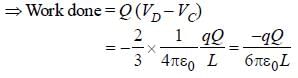
Charges +q and –q are placed at points A and B respectively which are a distance 2L apart, C is the midpoint between A and B. The work done in moving a charge +Q along the semicircle CRD is [2007]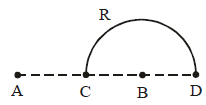
- a)

- b)

- c)

- d)

Correct answer is option 'C'. Can you explain this answer?
Charges +q and –q are placed at points A and B respectively which are a distance 2L apart, C is the midpoint between A and B. The work done in moving a charge +Q along the semicircle CRD is [2007]
a)
b)
c)
d)
 | Gaurav Kumar answered |
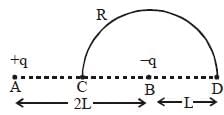
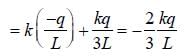
Potential at C = VC = 0
Potential at D = VD
Potential at D = VD
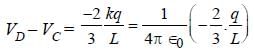
Potential difference
Chapter doubts & questions for Electrostatic Potential and Capacitance - 1 Year Dropper's Course for NEET 2026 is part of NEET exam preparation. The chapters have been prepared according to the NEET exam syllabus. The Chapter doubts & questions, notes, tests & MCQs are made for NEET 2026 Exam. Find important definitions, questions, notes, meanings, examples, exercises, MCQs and online tests here.
Chapter doubts & questions of Electrostatic Potential and Capacitance - 1 Year Dropper's Course for NEET in English & Hindi are available as part of NEET exam. Download more important topics, notes, lectures and mock test series for NEET Exam by signing up for free.
1 Year Dropper's Course for NEET472 videos|1727 docs|590 tests |
