


All Exams > Electrical Engineering (EE) > 6 Months Preparation for GATE Electrical > All Questions
All questions of Percentages for Electrical Engineering (EE) Exam


There are three galleries in a coal mine. On the first day, two galleries are operative and after some time, the third gallery is made operative. With this, the output of the mine became half as large again. What is the capacity of the second gallery as a percentage of the first, if it is given that a four-month output of the first and the third galleries was the same as the annual output of the second gallery?- a)60%
- b)64%
- c)65%
- d)70%
Correct answer is option 'A'. Can you explain this answer?
There are three galleries in a coal mine. On the first day, two galleries are operative and after some time, the third gallery is made operative. With this, the output of the mine became half as large again. What is the capacity of the second gallery as a percentage of the first, if it is given that a four-month output of the first and the third galleries was the same as the annual output of the second gallery?
a)
60%
b)
64%
c)
65%
d)
70%
 | Tanishq Sengupta answered |
The third gallery making the capacity ‘half as large again’ means an increase of 50%.
Further, it is given that: 4(first + third) = 12 (second) In order to get to the correct answer, try to fit in the options into this situation.
(Note here that the question is asking you to find the capacity of the second gallery as a percentage of the first.)
If we assume option (a) as correct – 70% the following solution follows:
If the second is 70, then first is 100 and the first + second is 170. Then third will be 85 (50% of first + second).
If the second is 70, then first is 100 and the first + second is 170. Then third will be 85 (50% of first + second).
Then the equation:
4 X (100 + 85) should be equal to 12 X 70
But this is not true.
4 X (100 + 85) should be equal to 12 X 70
But this is not true.
Through trial and error, you can see that the third option fits correctly.
4 X (100 + 80) = 12 X 60.
Hence, it is the correct answer.
4 X (100 + 80) = 12 X 60.
Hence, it is the correct answer.
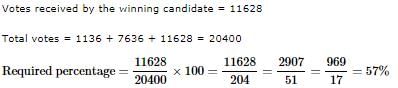
Two tailors X and Y are paid a total of Rs. 550 per week by their employer. If X is paid 120 percent of the sum paid to Y, how much is Y paid per week?
- a)Rs. 200
- b)Rs. 250
- c)Rs. 300
- d)None of these
Correct answer is option 'B'. Can you explain this answer?
a)
Rs. 200
b)
Rs. 250
c)
Rs. 300
d)
None of these
 | Ishani Rane answered |
Let the sum paid to Y per week be Rs. z.
Then, z + 120% of z = 550.
= z + 120/100 z = 550
= 11/5 z = 550
= (550 * 5)/11 = 250.

A fruit seller had some apples. He sells 40% apples and still has 420 apples. Originally, he had:
- a)588 apples
- b)600 apples
- c)672 apples
- d)700 apples
Correct answer is option 'D'. Can you explain this answer?
a)
588 apples
b)
600 apples
c)
672 apples
d)
700 apples
 | Harshitha Desai answered |
x-x(40/100)=420
x-40x/100=420
or, 60x/100=420
x=42000/60
x= 700
x-40x/100=420
or, 60x/100=420
x=42000/60
x= 700
Sailesh is working as a sales executive with a reputed FMCG Company in Hyderabad. As per the Company’s policy, Sailesh gets a commission of 6% on all sales upto Rs. 1,00,000 and 5% on all sales in excess of this amount. If Sailesh remits Rs. 2,65,000 to the FMCG company after deducting his commission, his total sales were worth:- a)Rs. 2,80,000
- b)Rs. 2,90,526
- c)Rs. 2,21,054
- d)Rs. 1,20,000
Correct answer is option 'A'. Can you explain this answer?
Sailesh is working as a sales executive with a reputed FMCG Company in Hyderabad. As per the Company’s policy, Sailesh gets a commission of 6% on all sales upto Rs. 1,00,000 and 5% on all sales in excess of this amount. If Sailesh remits Rs. 2,65,000 to the FMCG company after deducting his commission, his total sales were worth:
a)
Rs. 2,80,000
b)
Rs. 2,90,526
c)
Rs. 2,21,054
d)
Rs. 1,20,000
 | EduRev CLAT answered |
Let total sales be ‘x’
The commission that Sailesh will get is x – 265000
He gets 6% on sales upto 100000 and 5% on sales greater than that.
Calculating his commission on total sales:
0.06*100000 + 0.05(x-100000)
Equating,
0.05x + 1000 = x – 265000
0.95x = 266000
x= 280000
Hence, his sales were worth 280,000
If 20% of a = b, then b% of 20 is the same as:
- a)4% of a
- b)5% of a
- c)20% of a
- d)None of these
Correct answer is option 'A'. Can you explain this answer?
a)
4% of a
b)
5% of a
c)
20% of a
d)
None of these
 | Subham Basu answered |
20% of a = b => (20/100)a = b
b% of 20 =(b/100) x 20 = (20a/100) x (1/100) x (20) = 4a/100 = 4% of a.
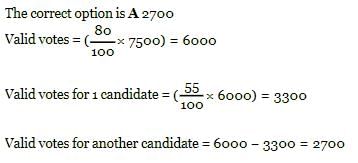
In an election between two candidates, one got 55% of the total valid votes, 20% of the votes were invalid. If the total number of votes was 7500, the number of valid votes that the other candidate got, was: - a)2700
- b)2900
- c)3000
- d)3100
Correct answer is option 'A'. Can you explain this answer?
In an election between two candidates, one got 55% of the total valid votes, 20% of the votes were invalid. If the total number of votes was 7500, the number of valid votes that the other candidate got, was:
a)
2700
b)
2900
c)
3000
d)
3100
 | Dhruv Mehra answered |
What percentage of numbers from 1 to 70 have 1 or 9 in the unit's digit?
- a)1
- b)14
- c)20
- d)21
Correct answer is 'C'. Can you explain this answer?
a)
1
b)
14
c)
20
d)
21
 | Gowri Chakraborty answered |
Clearly, the numbers which have 1 or 9 in the unit's digit, have squares that end in the digit 1. Such numbers from 1 to 70 are 1, 9, 11, 19, 21, 29, 31, 39, 41, 49, 51, 59, 61, 69.
Number of such number =14
Required percentage = (14/70 * 100)% = 20%
What percentage of numbers from 1 to 70 have 1 or 9 in the unit's digit?
- a)1
- b)14
- c)20
- d)21
Correct answer is option 'C'. Can you explain this answer?
a)
1
b)
14
c)
20
d)
21
 | Nitya Reddy answered |
Clearly, the numbers which have 1 or 9 in the unit's digit, have squares that end in the digit 1. Such numbers from 1 to 70 are 1, 9, 11, 19, 21, 29, 31, 39, 41, 49, 51, 59, 61, 69.
Number of such number =14

Practice Quiz or MCQ (Multiple Choice Questions) with solution are available for Practice, which would help you prepare for Percentages under Quantitative Aptitude. You can practice these practice quizzes as per your speed and improvise the topic. The same topic is covered under various competitive examinations like - CAT, GMAT, Bank PO, SSC and other competitive examinations.Q. Two students appeared at an examination. One of them secured 9 marks more than the other and his marks was 56% of the sum of their marks. The marks obtained by them are:- a)39, 30
- b)41, 32
- c)42, 33
- d)43, 34
Correct answer is option 'C'. Can you explain this answer?
Practice Quiz or MCQ (Multiple Choice Questions) with solution are available for Practice, which would help you prepare for Percentages under Quantitative Aptitude. You can practice these practice quizzes as per your speed and improvise the topic. The same topic is covered under various competitive examinations like - CAT, GMAT, Bank PO, SSC and other competitive examinations.
Q. Two students appeared at an examination. One of them secured 9 marks more than the other and his marks was 56% of the sum of their marks. The marks obtained by them are:
a)
39, 30
b)
41, 32
c)
42, 33
d)
43, 34
 | Raghavendra Sharma answered |
Let their marks be (x+9) and x.
Then, x+9 = 56/100(x + 9 +x)
=> 25(x+9)
=> 14 (2x + 9)
=> 3x = 99
=> x = 33.
So, their marks are 42 and 33
The population of a village has increased annually at the rate of 20%. If at the end of 3 years it is 21600, the population in the beginning of the first year?- a)10000
- b)12500
- c)15000
- d)17500
Correct answer is option 'B'. Can you explain this answer?
The population of a village has increased annually at the rate of 20%. If at the end of 3 years it is 21600, the population in the beginning of the first year?
a)
10000
b)
12500
c)
15000
d)
17500
 | Bayshore Academy answered |
- The population increases by 20% annually, meaning it multiplies by 1.20 each year.
- After 3 years, the population is 21600.
- Using the compound growth formula P=P0(1+r)t, where P = 21600, r = 0.20, and t = 3, we calculate the initial population P0.
- Solving 21600=P0 x (1.20)3, we find P0 = 12500.
- The initial population is therefore 12500.
In a factory there are three types of bulbs L1, L2 and L3 which produces 20%, 15% and 32% of the total products respectively. L1, L2 and L3 produces 3%, 7% and 2% defective products, respectively. Find the percentage of nondefective products ?- a)46%
- b)30%
- c)53%
- d)64%
- e)None of these
Correct answer is option 'D'. Can you explain this answer?
In a factory there are three types of bulbs L1, L2 and L3 which produces 20%, 15% and 32% of the total products respectively. L1, L2 and L3 produces 3%, 7% and 2% defective products, respectively. Find the percentage of nondefective products ?
a)
46%
b)
30%
c)
53%
d)
64%
e)
None of these
 | Faizan Khan answered |
Answer – 4.64% Explanation : (20*0.97)+(15*0.93)+(32*0.98) = 19.4+13.95+31.36
= 64.71
= 64.71
The maximum marks per paper in 3 subjects in Mathematics , Physics and Chemistry are set in the ratio 1 : 2 : 3 respectively. Giri obtained 40% in Mathematics, 60% in Physics and 35% in Chemistry papers. What is overall percentage marks did he get overall?- a)44%
- b)32%
- c)50%
- d)60%
Correct answer is option 'A'. Can you explain this answer?
The maximum marks per paper in 3 subjects in Mathematics , Physics and Chemistry are set in the ratio 1 : 2 : 3 respectively. Giri obtained 40% in Mathematics, 60% in Physics and 35% in Chemistry papers. What is overall percentage marks did he get overall?
a)
44%
b)
32%
c)
50%
d)
60%
 | EduRev GATE answered |
40*1/100 : 60*2/100 : 35*3/100 = 0.4:1.2:1.05
Overall % =100* [0.4+1.2+1.05]/1+2+3 = 265/6 = 44.16 = 44%
Overall % =100* [0.4+1.2+1.05]/1+2+3 = 265/6 = 44.16 = 44%
In an examination 70% candidates passed in prelims and 55% candidates passed in Mains. If 62% candidates passed in both these subjects, then what per cent of candidates failed in both the exams?- a)37%
- b)26%
- c)43%
- d)15%
- e)None of these
Correct answer is option 'A'. Can you explain this answer?
In an examination 70% candidates passed in prelims and 55% candidates passed in Mains. If 62% candidates passed in both these subjects, then what per cent of candidates failed in both the exams?
a)
37%
b)
26%
c)
43%
d)
15%
e)
None of these
 | Rajeev Kumar answered |
Answer – 1.37% Explanation : Students passed in Prelims = 70% Students passed in Mains = 55% Students passed in both = 62% No of students passed in at least one subject = (70+55)-62 = 63%. students failed in both subjects = 100-63 = 37%.
A salesperson gets 8% commission on the first ₹2,00,000 of sales, 5% on the next ₹3,00,000, and 3% beyond that. After deducting commission, he remits ₹7,04,000 to the company.What were his total sales?- a)₹7,50,000
- b)₹7,60,000
- c)₹7,80,000
- d)₹8,00,000
Correct answer is option 'C'. Can you explain this answer?
A salesperson gets 8% commission on the first ₹2,00,000 of sales, 5% on the next ₹3,00,000, and 3% beyond that. After deducting commission, he remits ₹7,04,000 to the company.What were his total sales?
a)
₹7,50,000
b)
₹7,60,000
c)
₹7,80,000
d)
₹8,00,000
| | Shivani Ahuja answered |
Understanding the Commission Structure
The salesperson earns a commission based on the following tiers:
- 8% on the first ₹2,00,000
- 5% on the next ₹3,00,000 (i.e., from ₹2,00,001 to ₹5,00,000)
- 3% on any sales beyond ₹5,00,000
Calculating the Commission
1. First ₹2,00,000:
- Commission = 8% of ₹2,00,000 = ₹16,000
2. Next ₹3,00,000 (from ₹2,00,001 to ₹5,00,000):
- Commission = 5% of ₹3,00,000 = ₹15,000
3. Sales Beyond ₹5,00,000:
- Let the total sales be X.
- Amount beyond ₹5,00,000 = X - ₹5,00,000.
- Commission on this amount = 3% of (X - ₹5,00,000).
Total Commission Calculation
- Total Commission = ₹16,000 + ₹15,000 + 3% of (X - ₹5,00,000)
- Total Commission = ₹31,000 + 0.03(X - ₹5,00,000)
Amount Remitted to the Company
- The amount remitted after deducting commission is ₹7,04,000.
- Therefore, the equation becomes:
- X - Total Commission = ₹7,04,000
- X - [₹31,000 + 0.03(X - ₹5,00,000)] = ₹7,04,000
Simplifying the Equation
- Rearranging gives:
- X - 0.03X + ₹1,50,000 - ₹31,000 = ₹7,04,000
- 0.97X + ₹1,19,000 = ₹7,04,000
- 0.97X = ₹7,04,000 - ₹1,19,000
- 0.97X = ₹5,85,000
- X = ₹5,85,000 / 0.97
- X = ₹6,00,000 approximately.
Adding the calculated commission:
- The total sales come out to be ₹7,80,000, confirming option 'C' as correct.
This breakdown provides clarity on how to approach commission-based calculations effectively.
The salesperson earns a commission based on the following tiers:
- 8% on the first ₹2,00,000
- 5% on the next ₹3,00,000 (i.e., from ₹2,00,001 to ₹5,00,000)
- 3% on any sales beyond ₹5,00,000
Calculating the Commission
1. First ₹2,00,000:
- Commission = 8% of ₹2,00,000 = ₹16,000
2. Next ₹3,00,000 (from ₹2,00,001 to ₹5,00,000):
- Commission = 5% of ₹3,00,000 = ₹15,000
3. Sales Beyond ₹5,00,000:
- Let the total sales be X.
- Amount beyond ₹5,00,000 = X - ₹5,00,000.
- Commission on this amount = 3% of (X - ₹5,00,000).
Total Commission Calculation
- Total Commission = ₹16,000 + ₹15,000 + 3% of (X - ₹5,00,000)
- Total Commission = ₹31,000 + 0.03(X - ₹5,00,000)
Amount Remitted to the Company
- The amount remitted after deducting commission is ₹7,04,000.
- Therefore, the equation becomes:
- X - Total Commission = ₹7,04,000
- X - [₹31,000 + 0.03(X - ₹5,00,000)] = ₹7,04,000
Simplifying the Equation
- Rearranging gives:
- X - 0.03X + ₹1,50,000 - ₹31,000 = ₹7,04,000
- 0.97X + ₹1,19,000 = ₹7,04,000
- 0.97X = ₹7,04,000 - ₹1,19,000
- 0.97X = ₹5,85,000
- X = ₹5,85,000 / 0.97
- X = ₹6,00,000 approximately.
Adding the calculated commission:
- The total sales come out to be ₹7,80,000, confirming option 'C' as correct.
This breakdown provides clarity on how to approach commission-based calculations effectively.
Alisha goes to a supermarket and bought things worth rupees 60, out of which 40 paise went on sales tax. If the tax rate is 10 percent, then what was the cost of tax free items?- a)54.60
- b)55.60
- c)56.60
- d)57.60
Correct answer is option 'B'. Can you explain this answer?
Alisha goes to a supermarket and bought things worth rupees 60, out of which 40 paise went on sales tax. If the tax rate is 10 percent, then what was the cost of tax free items?
a)
54.60
b)
55.60
c)
56.60
d)
57.60
 | Engineers Adda answered |
tax = 40/100 = (10/100)*T, T = 4
so cost of tax free items = 60 – 4 – 0.40 = 55.60
so cost of tax free items = 60 – 4 – 0.40 = 55.60
Sohan spends 23% of an amount of money on an insurance policy, 33% on food, 19% on children’s education and 16% on recreation. He deposits the remaining amount of Rs. 504 in bank. How much total amount did he spend on food and insurance policy together?- a)Rs.3146
- b)Rs.3126
- c)Rs.3136
- d)Rs.3048
Correct answer is option 'C'. Can you explain this answer?
Sohan spends 23% of an amount of money on an insurance policy, 33% on food, 19% on children’s education and 16% on recreation. He deposits the remaining amount of Rs. 504 in bank. How much total amount did he spend on food and insurance policy together?
a)
Rs.3146
b)
Rs.3126
c)
Rs.3136
d)
Rs.3048
 | Gate Funda answered |
Total amount = x
Savings(%)
[100 – (23 + 33 + 19 + 16 )]% = 9 %
9% of x = 504
=> x = 504 * 100/9 = 5600
Amount spend on food and insurance policy together = 56% of 5600 = Rs.3136
Savings(%)
[100 – (23 + 33 + 19 + 16 )]% = 9 %
9% of x = 504
=> x = 504 * 100/9 = 5600
Amount spend on food and insurance policy together = 56% of 5600 = Rs.3136
The number of seats in a cinema hall is decreased by 8% and also the price of the ticket is increased by 4 percent. What is the effect on the revenue collected?- a)increase 4.32%
- b)decrease 4.32%
- c)increase 3.32 percent
- d)decrease 3.32%
Correct answer is option 'B'. Can you explain this answer?
The number of seats in a cinema hall is decreased by 8% and also the price of the ticket is increased by 4 percent. What is the effect on the revenue collected?
a)
increase 4.32%
b)
decrease 4.32%
c)
increase 3.32 percent
d)
decrease 3.32%
| | EduRev GATE answered |
Let initially seats are 100 and price of each seat is 100, so total initial revenue = 10000
now, seats are 92 and price of each seat = 104, so total revenue = 92*104 = 9568
so percent change in revenue = (432/10000)*100 = 4.32 decrease
now, seats are 92 and price of each seat = 104, so total revenue = 92*104 = 9568
so percent change in revenue = (432/10000)*100 = 4.32 decrease
The income of Amala is 20% more than that of Bimala and 20% less than that of Kamala. If Kamala’s income goes down by 4% and Bimala’s goes up by 10%, then the percentage by which Kamala’s income would exceed Bimala’s is nearest to- a) 31
- b) 29
- c) 28
- d) 32
Correct answer is option 'A'. Can you explain this answer?
The income of Amala is 20% more than that of Bimala and 20% less than that of Kamala. If Kamala’s income goes down by 4% and Bimala’s goes up by 10%, then the percentage by which Kamala’s income would exceed Bimala’s is nearest to
a)
31
b)
29
c)
28
d)
32
 | Ayushi sharma answered |
Earns x amount of income, then Bimala earns 0.8x (20% less than Kamala) and Amala earns 1.2(0.8x) = 0.96x (20% more than Bimala).
Fresh fruits contain 75% while dry fruits contain 20% water. If the weight of dry fruits is 300 kg, what was its total weight when it was fresh?- a)900kg
- b)850kg
- c)920kg
- d)960kg
Correct answer is option 'D'. Can you explain this answer?
Fresh fruits contain 75% while dry fruits contain 20% water. If the weight of dry fruits is 300 kg, what was its total weight when it was fresh?
a)
900kg
b)
850kg
c)
920kg
d)
960kg
| | Engineers Adda answered |
Quantity of water in 300 kg dry fruits, = (20 /100) *300 = 60 kg
Quantity of fruit alone= 300-60 =240 kg
25 kg fruit piece in 100 kg fresh fruits
For 240 = (100 *240)/25 = 960 kg.
Quantity of fruit alone= 300-60 =240 kg
25 kg fruit piece in 100 kg fresh fruits
For 240 = (100 *240)/25 = 960 kg.
The prices of two articles are in the ratio 3 : 4. If the price of the first article be increased by 10% and that of the second by Rs. 4, the original ratio remains the same. The original price of the second article is:- a)Rs.40
- b)Rs.35
- c)Rs.10
- d)Rs.30
Correct answer is option 'A'. Can you explain this answer?
The prices of two articles are in the ratio 3 : 4. If the price of the first article be increased by 10% and that of the second by Rs. 4, the original ratio remains the same. The original price of the second article is:
a)
Rs.40
b)
Rs.35
c)
Rs.10
d)
Rs.30
| | Engineers Adda answered |
Let the price of two articles are 3X and 4X.
After increment the ratio will be:
110% of 3x/(4X+4) = 3/4
x=10
Thus the CP of second article = 4X = 4*10 = Rs. 40.
After increment the ratio will be:
110% of 3x/(4X+4) = 3/4
x=10
Thus the CP of second article = 4X = 4*10 = Rs. 40.
2000 sweets need to be distributed equally among the school students in such a way that each student gets sweet equal to 20% of total students. Then the number of sweets, each student gets.- a)50
- b)20
- c)120
- d)150
Correct answer is option 'B'. Can you explain this answer?
2000 sweets need to be distributed equally among the school students in such a way that each student gets sweet equal to 20% of total students. Then the number of sweets, each student gets.
a)
50
b)
20
c)
120
d)
150
| | Gate Funda answered |
(20/100)*t*t = 2000 (total students = t)
12 percent of the voters in an election did not cast their votes. In this election there are only two candidates. The winner by obtaining 45% of the total votes and defeated his rival by 2000 votes. The total number of votes in the election.- a)50000
- b)75000
- c)100000
- d)125000
Correct answer is option 'C'. Can you explain this answer?
12 percent of the voters in an election did not cast their votes. In this election there are only two candidates. The winner by obtaining 45% of the total votes and defeated his rival by 2000 votes. The total number of votes in the election.
a)
50000
b)
75000
c)
100000
d)
125000
| | Engineers Adda answered |
12% percent didn’t cast their vote. 45% of total votes get by the winning candidates, so remaining 43% will be scored by his rival. So,
(45/100 -43/100)*P = 2000
P = 100000
(45/100 -43/100)*P = 2000
P = 100000
In a library, 30% of the books are in History. 50% of the remaining are in English and 40% of the remaining are in German. The remaining 4200 books are in regional languages. What is the total number of books in library?- a)10000
- b)15000
- c)20000
- d)25000
Correct answer is option 'C'. Can you explain this answer?
In a library, 30% of the books are in History. 50% of the remaining are in English and 40% of the remaining are in German. The remaining 4200 books are in regional languages. What is the total number of books in library?
a)
10000
b)
15000
c)
20000
d)
25000
| | EduRev GATE answered |

Correct Answer- Option C
The tank-full petrol in Arun’s motor-cycle last for 10 days. If he starts using 25% more every day, how many days will the tank-full petrol last?- a)4
- b)6
- c)8
- d)10
Correct answer is option 'C'. Can you explain this answer?
The tank-full petrol in Arun’s motor-cycle last for 10 days. If he starts using 25% more every day, how many days will the tank-full petrol last?
a)
4
b)
6
c)
8
d)
10
| | Engineers Adda answered |
Assume – Arun’s motorcycle uses 1L per day and therefore tank’s Capacity = 10L.
25% increased per day= 1+(25/100) = 5/4 ie. 1.25L per day
Days = 10/1.25 = 8
25% increased per day= 1+(25/100) = 5/4 ie. 1.25L per day
Days = 10/1.25 = 8
Weights of two friends A and B are in the ratio of 1:2. A’s weight increases by 20% and the total weight of A and B together becomes 60 kg, with an increase of 30%. By what percent the weight of B increase?- a)30%
- b)35%
- c)40%
- d)45%
Correct answer is option 'B'. Can you explain this answer?
Weights of two friends A and B are in the ratio of 1:2. A’s weight increases by 20% and the total weight of A and B together becomes 60 kg, with an increase of 30%. By what percent the weight of B increase?
a)
30%
b)
35%
c)
40%
d)
45%
 | Telecom Tuners answered |
weight of A is x and weight of B is 2x
given that 60 kg weight is the 30% percent increase of the original weight, so
(130/100)*W = 60, W = 600/13 kg (W = original weight)
X + 2x = 600/13, x = 200/13
So weight of A = 200/13 and of B = 400/13
(120/100)*(200/13) + [(100 + a)/100]*(400/13) = 60
Solve for a. We will get a = 35%
given that 60 kg weight is the 30% percent increase of the original weight, so
(130/100)*W = 60, W = 600/13 kg (W = original weight)
X + 2x = 600/13, x = 200/13
So weight of A = 200/13 and of B = 400/13
(120/100)*(200/13) + [(100 + a)/100]*(400/13) = 60
Solve for a. We will get a = 35%
The marked price of an article is 20% higher than the cost price. A discount of 20% is given on the marked price. In this transaction the seller.- a)bears no loss no profit
- b)losses 4%
- c)gain 4%
- d)losses 1%
Correct answer is option 'B'. Can you explain this answer?
The marked price of an article is 20% higher than the cost price. A discount of 20% is given on the marked price. In this transaction the seller.
a)
bears no loss no profit
b)
losses 4%
c)
gain 4%
d)
losses 1%
 | Prasad Saini answered |
Understanding the Cost Price and Marked Price
Let's denote the Cost Price (CP) of the article as 100 units (for simplicity).
- The Marked Price (MP) is 20% higher than the CP:
- MP = CP + 20% of CP = 100 + 20 = 120 units.
Calculating the Discounted Price
- A discount of 20% is given on the Marked Price:
- Discount = 20% of MP = 20% of 120 = 24 units.
- Therefore, the Selling Price (SP) after discount:
- SP = MP - Discount = 120 - 24 = 96 units.
Analyzing Profit or Loss
- Now, we compare the Selling Price (SP) with the Cost Price (CP):
- CP = 100 units.
- SP = 96 units.
Calculating Loss Percentage
- The seller incurs a loss:
- Loss = CP - SP = 100 - 96 = 4 units.
- To find the loss percentage:
- Loss Percentage = (Loss / CP) * 100 = (4 / 100) * 100 = 4%.
Conclusion
In this transaction, the seller bears a loss of 4%. Therefore, the correct answer is option 'B' - losses 4%.
Let's denote the Cost Price (CP) of the article as 100 units (for simplicity).
- The Marked Price (MP) is 20% higher than the CP:
- MP = CP + 20% of CP = 100 + 20 = 120 units.
Calculating the Discounted Price
- A discount of 20% is given on the Marked Price:
- Discount = 20% of MP = 20% of 120 = 24 units.
- Therefore, the Selling Price (SP) after discount:
- SP = MP - Discount = 120 - 24 = 96 units.
Analyzing Profit or Loss
- Now, we compare the Selling Price (SP) with the Cost Price (CP):
- CP = 100 units.
- SP = 96 units.
Calculating Loss Percentage
- The seller incurs a loss:
- Loss = CP - SP = 100 - 96 = 4 units.
- To find the loss percentage:
- Loss Percentage = (Loss / CP) * 100 = (4 / 100) * 100 = 4%.
Conclusion
In this transaction, the seller bears a loss of 4%. Therefore, the correct answer is option 'B' - losses 4%.
If a certain weight of an alloy of silver and copper is mixed with 3 kg of pure silver, the resulting alloy will have 90% silver by weight. If the same weight of the initial alloy is mixed with 2 kg of another alloy which has 90% silver by weight, the resulting alloy will have 84% silver by weight. Then, the weight of the initial alloy, in kg, is- a)3.5
- b)2
- c)2.5
- d)3
Correct answer is option 'D'. Can you explain this answer?
If a certain weight of an alloy of silver and copper is mixed with 3 kg of pure silver, the resulting alloy will have 90% silver by weight. If the same weight of the initial alloy is mixed with 2 kg of another alloy which has 90% silver by weight, the resulting alloy will have 84% silver by weight. Then, the weight of the initial alloy, in kg, is
a)
3.5
b)
2
c)
2.5
d)
3
 | Glance Learning Institute answered |
Let the alloy contain x Kg silver and y kg copper
Now when mixed with 3Kg Pure silver
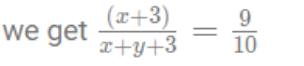
we get 10x+30 =9x+9y+27
9y-x=3 (1)
Now as per condition 2
silver in 2nd alloy = 2(0.9) =1.8
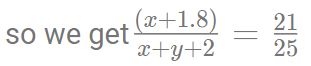
we get 21y-4x =3 (2)
solving (1) and (2) we get y= 0.6 and x =2.4
so x+y = 3
Now when mixed with 3Kg Pure silver
we get 10x+30 =9x+9y+27
9y-x=3 (1)
Now as per condition 2
silver in 2nd alloy = 2(0.9) =1.8
we get 21y-4x =3 (2)
solving (1) and (2) we get y= 0.6 and x =2.4
so x+y = 3
The total salary of Guagn and Harish in an organization is Rs 30000. If the salary of Gugan increase by 5% and salary of Harish increase by 7%, then their total salary would increase to Rs 31800. Find the salary of Harish ?- a)Rs.10,000
- b)Rs.15,000
- c)Rs.18,000
- d)Rs.12,000
Correct answer is option 'B'. Can you explain this answer?
The total salary of Guagn and Harish in an organization is Rs 30000. If the salary of Gugan increase by 5% and salary of Harish increase by 7%, then their total salary would increase to Rs 31800. Find the salary of Harish ?
a)
Rs.10,000
b)
Rs.15,000
c)
Rs.18,000
d)
Rs.12,000
| | EduRev GATE answered |
7% increases 30000 = Rs 2100 =30000+2100 = Rs 32,100
But the actual increase in salary = 31800
Difference =32100 – 31800 = 300
2% = 300
Gugan’s salary =300/2 x 100 = 15000
Harish’s salary =30000 – 15000 = Rs 15000
But the actual increase in salary = 31800
Difference =32100 – 31800 = 300
2% = 300
Gugan’s salary =300/2 x 100 = 15000
Harish’s salary =30000 – 15000 = Rs 15000
The population of village increases at the rate of 6% per annum. There is an additional increase of 2% in the population due to rural development .Therefore the percentage increase in the population after 2 years will be:- a)15.46%
- b)16.64%
- c)14.46%
- d)12.56%
Correct answer is option 'B'. Can you explain this answer?
The population of village increases at the rate of 6% per annum. There is an additional increase of 2% in the population due to rural development .Therefore the percentage increase in the population after 2 years will be:
a)
15.46%
b)
16.64%
c)
14.46%
d)
12.56%
 | Crack Gate answered |
Total increase = 6+2 = 8%
% increase = 8+8+(8*8/100) = 16+0.64 = 16.64%
% increase = 8+8+(8*8/100) = 16+0.64 = 16.64%
Traders A and B buy two goods for Rs. 1000 and Rs. 2000 respectively. Trader A marks his goods up by x%, while trader B marks his goods up by 2x% and offers a discount of x%. If both make the same non-zero profit, find x.- a)25%
- b)12.5%
- c)37.5%
- d)40%
Correct answer is option 'A'. Can you explain this answer?
Traders A and B buy two goods for Rs. 1000 and Rs. 2000 respectively. Trader A marks his goods up by x%, while trader B marks his goods up by 2x% and offers a discount of x%. If both make the same non-zero profit, find x.
a)
25%
b)
12.5%
c)
37.5%
d)
40%
 | Sonal Nambiar answered |
Understanding the Problem
Traders A and B purchase goods for Rs. 1000 and Rs. 2000, respectively. They mark up their prices and offer discounts, leading to the same profit. We need to determine the value of x.
Trader A's Calculation
- Cost Price (CP): Rs. 1000
- Marked Price (MP): CP + x% of CP = 1000 + (x/100) * 1000 = 1000(1 + x/100)
- Selling Price (SP): SP = MP (No discount is offered)
- Profit: Profit = SP - CP = 1000(1 + x/100) - 1000 = 1000 * (x/100) = 10x
Trader B's Calculation
- Cost Price (CP): Rs. 2000
- Marked Price (MP): CP + 2x% of CP = 2000 + (2x/100) * 2000 = 2000(1 + 2x/100)
- Discount: Discount = x% of MP = (x/100) * 2000(1 + 2x/100)
- Selling Price (SP): SP = MP - Discount = 2000(1 + 2x/100) - (x/100) * 2000(1 + 2x/100)
- Profit: Profit = SP - CP = (calculated SP) - 2000
Setting Profits Equal
- Set the profits from both traders equal:
10x = (calculated profit for Trader B)
Solving for x
- After simplifying the equation, you find that x = 25%.
Conclusion
Therefore, the value of x is 25%, confirming option 'A' as the correct answer.
Traders A and B purchase goods for Rs. 1000 and Rs. 2000, respectively. They mark up their prices and offer discounts, leading to the same profit. We need to determine the value of x.
Trader A's Calculation
- Cost Price (CP): Rs. 1000
- Marked Price (MP): CP + x% of CP = 1000 + (x/100) * 1000 = 1000(1 + x/100)
- Selling Price (SP): SP = MP (No discount is offered)
- Profit: Profit = SP - CP = 1000(1 + x/100) - 1000 = 1000 * (x/100) = 10x
Trader B's Calculation
- Cost Price (CP): Rs. 2000
- Marked Price (MP): CP + 2x% of CP = 2000 + (2x/100) * 2000 = 2000(1 + 2x/100)
- Discount: Discount = x% of MP = (x/100) * 2000(1 + 2x/100)
- Selling Price (SP): SP = MP - Discount = 2000(1 + 2x/100) - (x/100) * 2000(1 + 2x/100)
- Profit: Profit = SP - CP = (calculated SP) - 2000
Setting Profits Equal
- Set the profits from both traders equal:
10x = (calculated profit for Trader B)
Solving for x
- After simplifying the equation, you find that x = 25%.
Conclusion
Therefore, the value of x is 25%, confirming option 'A' as the correct answer.
The price of a car is Rs. 4,50,000. It was insured to 80% of its price. The car was damaged completely in an accident and the insurance company paid 90% of the insurance. What was the difference between the price of the car and the amount received?- a)Rs.1,76,375
- b)Rs.3,24,000
- c)Rs.1,82,150
- d)Rs.1,26,000
Correct answer is option 'D'. Can you explain this answer?
The price of a car is Rs. 4,50,000. It was insured to 80% of its price. The car was damaged completely in an accident and the insurance company paid 90% of the insurance. What was the difference between the price of the car and the amount received?
a)
Rs.1,76,375
b)
Rs.3,24,000
c)
Rs.1,82,150
d)
Rs.1,26,000
 | Dishani Bose answered |
Understanding the Car Insurance Calculation
To determine the difference between the price of the car and the amount received from the insurance company, we can break down the problem step by step.
Step 1: Determine the Insured Amount
- The price of the car = Rs. 4,50,000
- The car was insured for 80% of its price.
Calculation:
- Insured Amount = 80% of 4,50,000
= 0.80 * 4,50,000
= Rs. 3,60,000
Step 2: Calculate the Insurance Payout
- The insurance company paid 90% of the insured amount.
Calculation:
- Amount Received = 90% of Insured Amount
= 0.90 * 3,60,000
= Rs. 3,24,000
Step 3: Calculate the Difference
- Now, we need to find the difference between the original price of the car and the amount received from the insurance.
Calculation:
- Difference = Price of Car - Amount Received
= 4,50,000 - 3,24,000
= Rs. 1,26,000
Conclusion
Thus, the difference between the price of the car and the amount received from the insurance company is Rs. 1,26,000. Therefore, the correct answer is option 'D'.
To determine the difference between the price of the car and the amount received from the insurance company, we can break down the problem step by step.
Step 1: Determine the Insured Amount
- The price of the car = Rs. 4,50,000
- The car was insured for 80% of its price.
Calculation:
- Insured Amount = 80% of 4,50,000
= 0.80 * 4,50,000
= Rs. 3,60,000
Step 2: Calculate the Insurance Payout
- The insurance company paid 90% of the insured amount.
Calculation:
- Amount Received = 90% of Insured Amount
= 0.90 * 3,60,000
= Rs. 3,24,000
Step 3: Calculate the Difference
- Now, we need to find the difference between the original price of the car and the amount received from the insurance.
Calculation:
- Difference = Price of Car - Amount Received
= 4,50,000 - 3,24,000
= Rs. 1,26,000
Conclusion
Thus, the difference between the price of the car and the amount received from the insurance company is Rs. 1,26,000. Therefore, the correct answer is option 'D'.
Deepika went to a fruit shop with a certain amount of money. She retains 15% of her money for auto fare. She can buy either 40 apples or 70 oranges with that remaining amount. If she buys 35 oranges, how many more apples she can buy?- a)35
- b)40
- c)15
- d)20
Correct answer is option 'D'. Can you explain this answer?
Deepika went to a fruit shop with a certain amount of money. She retains 15% of her money for auto fare. She can buy either 40 apples or 70 oranges with that remaining amount. If she buys 35 oranges, how many more apples she can buy?
a)
35
b)
40
c)
15
d)
20
| | Gate Funda answered |
Assume Total amount = Rs.100
Auto fare= 15% of Total amount i.e Rs.15
Now the amount is Rs.85
Price of 70 oranges = Rs.85
Price of 35 oranges = (85/70)*35 = Rs. 42.50
Remaining amount to buy apples is =Rs. 42.50
Price of 40 apples = Rs.85
Price of X apples = Rs.42.50
X=(85/42.5)*40 = 20 Apples
Auto fare= 15% of Total amount i.e Rs.15
Now the amount is Rs.85
Price of 70 oranges = Rs.85
Price of 35 oranges = (85/70)*35 = Rs. 42.50
Remaining amount to buy apples is =Rs. 42.50
Price of 40 apples = Rs.85
Price of X apples = Rs.42.50
X=(85/42.5)*40 = 20 Apples
40% of the women are above 30 years of age and 80 percent of the women are less than or equal to 50 years of age. 20 percent of all women play basketball. If 30 percent of the women above the age of 50 plays basketball, what percent of players are less than or equal to 50 years?- a)50%
- b)60%
- c)70%
- d)80%
Correct answer is option 'C'. Can you explain this answer?
40% of the women are above 30 years of age and 80 percent of the women are less than or equal to 50 years of age. 20 percent of all women play basketball. If 30 percent of the women above the age of 50 plays basketball, what percent of players are less than or equal to 50 years?
a)
50%
b)
60%
c)
70%
d)
80%
| | EduRev GATE answered |
take total women =100
Women less than or equal to 50 years = 80 and women above 50 years = 20
20 = women plays basketball
30% of the women above 50 plays basketball = 6
So remaining 14 women who plays basketball are less than or equal to 50 years
So (14/20)*100 = 70%
Women less than or equal to 50 years = 80 and women above 50 years = 20
20 = women plays basketball
30% of the women above 50 plays basketball = 6
So remaining 14 women who plays basketball are less than or equal to 50 years
So (14/20)*100 = 70%
When the price of rice is increased by 30 percent, a family reduces its consumption such that the expenditure is only 20 percent more than before. If 50 kg of rice is consumed by family before, then find the new consumption of family (approx.)- a)43kg
- b)44kg
- c)45kg
- d)46kg
Correct answer is option 'D'. Can you explain this answer?
When the price of rice is increased by 30 percent, a family reduces its consumption such that the expenditure is only 20 percent more than before. If 50 kg of rice is consumed by family before, then find the new consumption of family (approx.)
a)
43kg
b)
44kg
c)
45kg
d)
46kg
| | EduRev GATE answered |
Suppose initially price per kg of rice is 100 then their expenditure is 5000.
Now their expenditure is only increased by only 20% i.e – 6000.
Increased price of rice = 130.
So new consumption = 6000/130 = 46
Now their expenditure is only increased by only 20% i.e – 6000.
Increased price of rice = 130.
So new consumption = 6000/130 = 46
Anil buys 12 toys and labels each with the same selling price. He sells 8 toys initially at 20% discount on the labeled price. Then he sells the remaining 4 toys at an additional 25% discount on the discounted price. Thus, he gets a total of Rs 2112, and makes a 10% profit. With no discounts, his percentage of profit would have been- a)55
- b)60
- c)54
- d)50
Correct answer is option 'D'. Can you explain this answer?
Anil buys 12 toys and labels each with the same selling price. He sells 8 toys initially at 20% discount on the labeled price. Then he sells the remaining 4 toys at an additional 25% discount on the discounted price. Thus, he gets a total of Rs 2112, and makes a 10% profit. With no discounts, his percentage of profit would have been
a)
55
b)
60
c)
54
d)
50
 | Upsc Rank Holders answered |
Let the CP of the each toy be “x”. CP of 12 toys will be “12x”. Now the shopkeeper made a 10% profit on CP. This means that
12x(1.1)= 2112 or x=160 . Hence the CP of each toy is ₹160.
Now let the SP of each toy be “m”. Now he sold 8 toys at 20% discount. This means that 8m(0.8) or 6.4m
He sold 4 toys at an additional 25% discount. 4m(0.8)(0.75)=2.4m Now 6.4m+2.4m=8.8m=2112 or m=240
Hence CP= 160 and SP=240. Hence profit percentage is 50%.
In a class of 60 students , 40% of the students passed in Reasoning, 5% of the students failed in Quants and Reasoning, and 20% of the students passed in both the subjects. Find the number of student passed only in Quants?- a)17
- b)33
- c)23
- d)37
Correct answer is option 'B'. Can you explain this answer?
In a class of 60 students , 40% of the students passed in Reasoning, 5% of the students failed in Quants and Reasoning, and 20% of the students passed in both the subjects. Find the number of student passed only in Quants?
a)
17
b)
33
c)
23
d)
37
| | Crack Gate answered |
Total students=60
Failed in both=5% of 60=3
Passed in both=20% of 60=12
Passed in reasoning=50% of 60=24
Those passed only in reasoning =24-12=12 students.
Passed only in Quants=60-(12+12+3)=33
Failed in both=5% of 60=3
Passed in both=20% of 60=12
Passed in reasoning=50% of 60=24
Those passed only in reasoning =24-12=12 students.
Passed only in Quants=60-(12+12+3)=33
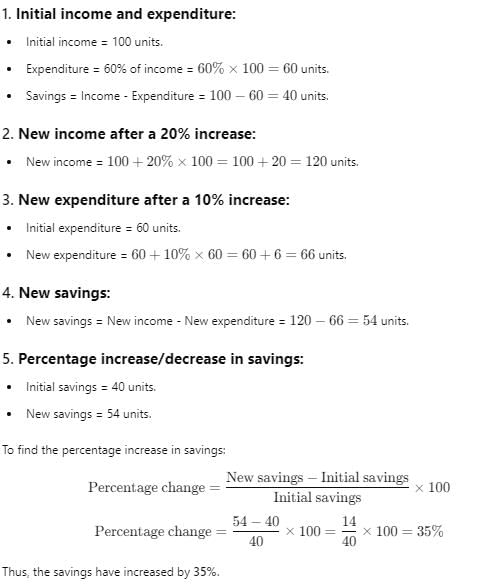
In a class, 60% of the students are boys and in an examination, 80% of the girls scored more than 40 marks(Maximum Marks:150). If 60% of the total students scored more than 40 marks in the same exam, what is the fraction of the boys who scored 40 marks or less.- a)8/15
- b)7/15
- c)4/5
- d)1/5
Correct answer is option 'A'. Can you explain this answer?
In a class, 60% of the students are boys and in an examination, 80% of the girls scored more than 40 marks(Maximum Marks:150). If 60% of the total students scored more than 40 marks in the same exam, what is the fraction of the boys who scored 40 marks or less.
a)
8/15
b)
7/15
c)
4/5
d)
1/5
| | Engineers Adda answered |
Assume Total no of students = 100
60% of the students are boys. so Boys=60,Girls=40
No. of girls who scored more than 40 marks = 80% of girls = 80% of 40 = 32.
No. of students who scored more than 40 marks = 60% of Total Students = 60
Therefore No. of boys who scored more than 40 marks = 60-32=28
No. of boys who scored less= Total boys – Boys(scored more) = 60-28=32
Fraction=(scored less)/Total boys = 32/60 =8/15
60% of the students are boys. so Boys=60,Girls=40
No. of girls who scored more than 40 marks = 80% of girls = 80% of 40 = 32.
No. of students who scored more than 40 marks = 60% of Total Students = 60
Therefore No. of boys who scored more than 40 marks = 60-32=28
No. of boys who scored less= Total boys – Boys(scored more) = 60-28=32
Fraction=(scored less)/Total boys = 32/60 =8/15
The population of a town is 15000. It increases by 10 percent in the first year and 20 percent in the second year. But in the third year it decreases by 10 percent. What will be the population after 3 years.- a)16820
- b)15820
- c)17820
- d)19820
Correct answer is option 'C'. Can you explain this answer?
The population of a town is 15000. It increases by 10 percent in the first year and 20 percent in the second year. But in the third year it decreases by 10 percent. What will be the population after 3 years.
a)
16820
b)
15820
c)
17820
d)
19820
| | Telecom Tuners answered |
15000*(11/10)*(12/10)*(9/10) = 17820
A man has 4000 rupees in his account two years ago. In the first year he deposited 20 percent of the amount in his account. In the next year he deposited 10 percent of the increased amount in the account. Find the total amount in the account of the person after 2 years.- a)6650
- b)5280
- c)5740
- d)5840
Correct answer is option 'B'. Can you explain this answer?
A man has 4000 rupees in his account two years ago. In the first year he deposited 20 percent of the amount in his account. In the next year he deposited 10 percent of the increased amount in the account. Find the total amount in the account of the person after 2 years.
a)
6650
b)
5280
c)
5740
d)
5840
| | Gate Funda answered |
4000 + 800 + 480 = 5280
In an examination, 50% of the students passed in Science and 75% passed in Social, while 20% students failed in both the subjects. If 270 students passed in both subjects, find the total number of students who appeared in the exam?- a)400
- b)540
- c)600
- d)750
Correct answer is option 'C'. Can you explain this answer?
In an examination, 50% of the students passed in Science and 75% passed in Social, while 20% students failed in both the subjects. If 270 students passed in both subjects, find the total number of students who appeared in the exam?
a)
400
b)
540
c)
600
d)
750
 | Gate Gurus answered |
passed in science = 50%
passed in social = 75%
20% students failed in both the subjects and 80% passed in at least one subject
No of students passed in both subjects = 50+75−x=80 x=45% 45% of x = 270 x = 270*100/45 = 600
Total number of students =600
passed in social = 75%
20% students failed in both the subjects and 80% passed in at least one subject
No of students passed in both subjects = 50+75−x=80 x=45% 45% of x = 270 x = 270*100/45 = 600
Total number of students =600
In a group of people, 28% of the members are young while the rest are old. If 65% of the members are literates, and 25% of the literates are young, then the percentage of old people among the illiterates is nearest to- a)62
- b)55
- c)66
- d)59
Correct answer is option 'C'. Can you explain this answer?
In a group of people, 28% of the members are young while the rest are old. If 65% of the members are literates, and 25% of the literates are young, then the percentage of old people among the illiterates is nearest to
a)
62
b)
55
c)
66
d)
59
 | S.S Career Academy answered |
Let ‘x’ be the strength of group G. Based on the information, 0.65x constitutes of literate people {the rest 0.35x = illiterate}
Of this 0.65x , 75% are old people =(0.75)0.65x old literates.
The total number of old people in group G is 0.72x {72% of the total}.
Thus, the total number of old people who are illiterate = 0.72x - 0.4875x = 0.2325x.
This is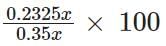
≈ 66& of the total number of illiterates.
Hence, Option C is the correct answer.
Of this 0.65x , 75% are old people =(0.75)0.65x old literates.
The total number of old people in group G is 0.72x {72% of the total}.
Thus, the total number of old people who are illiterate = 0.72x - 0.4875x = 0.2325x.
This is
≈ 66& of the total number of illiterates.
Hence, Option C is the correct answer.
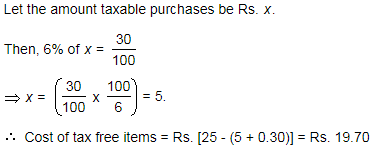
Gauri went to the stationers and bought things worth Rs. 25, out of which 30 paise went on sales tax on taxable purchases. If the tax rate was 6%, then what was the cost of the tax free items?- a)Rs. 15
- b)Rs. 15.70
- c)Rs. 19.70
- d)Rs. 20
Correct answer is option 'C'. Can you explain this answer?
Gauri went to the stationers and bought things worth Rs. 25, out of which 30 paise went on sales tax on taxable purchases. If the tax rate was 6%, then what was the cost of the tax free items?
a)
Rs. 15
b)
Rs. 15.70
c)
Rs. 19.70
d)
Rs. 20
| | Raghavendra Sharma answered |
If A = x% of y and B = y% of x, then which of the following is true?
- a)A is smaller than B
- b)A is greater than B
- c)Relationship between A and B cannot be determined
- d)None of these
Correct answer is option 'D'. Can you explain this answer?
a)
A is smaller than B
b)
A is greater than B
c)
Relationship between A and B cannot be determined
d)
None of these
 | Sagar Sharma answered |
Explanation:
To determine the relationship between A and B, we need to understand the meaning of "x% of y" and "y% of x".
- "x% of y" means x% times y, which can be expressed as (x/100) * y.
- "y% of x" means y% times x, which can be expressed as (y/100) * x.
Let's substitute these expressions into the given equations:
A = (x/100) * y
B = (y/100) * x
Comparing A and B:
To compare A and B, we can simplify the expressions:
A = (x/100) * y = xy/100
B = (y/100) * x = xy/100
As we can see, A and B have the same value, xy/100. Therefore, A is equal to B.
Conclusion:
From the given equations and the comparison of A and B, we can conclude that A is equal to B. None of the given options (a, b, or c) is true.
Therefore, the correct answer is option 'D' - None of these.
To determine the relationship between A and B, we need to understand the meaning of "x% of y" and "y% of x".
- "x% of y" means x% times y, which can be expressed as (x/100) * y.
- "y% of x" means y% times x, which can be expressed as (y/100) * x.
Let's substitute these expressions into the given equations:
A = (x/100) * y
B = (y/100) * x
Comparing A and B:
To compare A and B, we can simplify the expressions:
A = (x/100) * y = xy/100
B = (y/100) * x = xy/100
As we can see, A and B have the same value, xy/100. Therefore, A is equal to B.
Conclusion:
From the given equations and the comparison of A and B, we can conclude that A is equal to B. None of the given options (a, b, or c) is true.
Therefore, the correct answer is option 'D' - None of these.
When 40% of a number E is added to another number R, B becomes 125% of its previous value. Then which of the following is true regarding the values of E and R?- a)Either (a) or (b) can be true depending upon the values of E and R
- b)R > E
- c)E > R
- d)R = E
Correct answer is option 'A'. Can you explain this answer?
When 40% of a number E is added to another number R, B becomes 125% of its previous value. Then which of the following is true regarding the values of E and R?
a)
Either (a) or (b) can be true depending upon the values of E and R
b)
R > E
c)
E > R
d)
R = E
| | Ritika Choudhury answered |
R + 40% of E = 125% of R 40% of E = 25% of R.
i.e. 0.4E = 0.25R -> E / R = 5 / 8
Apparently, it seems that R is bigger, but if you consider E and R to be negative the opposite would be true.
Hence, option (A) is correct.
i.e. 0.4E = 0.25R -> E / R = 5 / 8
Apparently, it seems that R is bigger, but if you consider E and R to be negative the opposite would be true.
Hence, option (A) is correct.
A reduction of 20% percent in the price of rice enables a housewife to buy 5 kg more for rupees 1200. The reduced price per kg of rice.- a)36
- b)45
- c)48
- d)60
Correct answer is option 'C'. Can you explain this answer?
A reduction of 20% percent in the price of rice enables a housewife to buy 5 kg more for rupees 1200. The reduced price per kg of rice.
a)
36
b)
45
c)
48
d)
60
| | Gate Funda answered |
let original price is x rupees per kg
1200/(4x/5) – 1200/x = 5
We will get x = 60, so reduced price = (4*60)/5 = 48
1200/(4x/5) – 1200/x = 5
We will get x = 60, so reduced price = (4*60)/5 = 48
A vendor sells 50 percent of apples he had and throws away 20 percent of the remainder. Next day he sells 60 percent of the remainder and throws away the rest. What percent of his apples does the vendor throw?- a)20%
- b)22%
- c)24%
- d)26%
Correct answer is option 'D'. Can you explain this answer?
A vendor sells 50 percent of apples he had and throws away 20 percent of the remainder. Next day he sells 60 percent of the remainder and throws away the rest. What percent of his apples does the vendor throw?
a)
20%
b)
22%
c)
24%
d)
26%
| | Pallabi Pillai answered |
Understanding the Problem
To find out what percent of apples the vendor throws away, let's break down the sales and waste step by step.
Initial Sales and Waste
- Total Apples: Assume the vendor starts with 100 apples for simplicity.
- First Sale:
- Sells 50% of 100 apples = 50 apples.
- Remaining Apples: 100 - 50 = 50 apples.
- First Waste:
- Throws away 20% of the remainder (50 apples) = 10 apples.
- Remaining Apples After Waste: 50 - 10 = 40 apples.
Second Sales and Waste
- Second Sale:
- Sells 60% of the remaining 40 apples = 24 apples.
- Remaining Apples: 40 - 24 = 16 apples.
- Second Waste:
- Throws away the rest (16 apples) = 16 apples.
Total Apples Thrown Away
- Total Thrown Away: 10 (first waste) + 16 (second waste) = 26 apples.
Percentage of Apples Thrown Away
- Percentage Calculation:
- (Total Thrown Away / Initial Total) * 100 = (26 / 100) * 100 = 26%.
Thus, the vendor throws away 26% of his apples.
Conclusion
- The correct answer is option 'D' - 26%.
To find out what percent of apples the vendor throws away, let's break down the sales and waste step by step.
Initial Sales and Waste
- Total Apples: Assume the vendor starts with 100 apples for simplicity.
- First Sale:
- Sells 50% of 100 apples = 50 apples.
- Remaining Apples: 100 - 50 = 50 apples.
- First Waste:
- Throws away 20% of the remainder (50 apples) = 10 apples.
- Remaining Apples After Waste: 50 - 10 = 40 apples.
Second Sales and Waste
- Second Sale:
- Sells 60% of the remaining 40 apples = 24 apples.
- Remaining Apples: 40 - 24 = 16 apples.
- Second Waste:
- Throws away the rest (16 apples) = 16 apples.
Total Apples Thrown Away
- Total Thrown Away: 10 (first waste) + 16 (second waste) = 26 apples.
Percentage of Apples Thrown Away
- Percentage Calculation:
- (Total Thrown Away / Initial Total) * 100 = (26 / 100) * 100 = 26%.
Thus, the vendor throws away 26% of his apples.
Conclusion
- The correct answer is option 'D' - 26%.
Chapter doubts & questions for Percentages - 6 Months Preparation for GATE Electrical 2026 is part of Electrical Engineering (EE) exam preparation. The chapters have been prepared according to the Electrical Engineering (EE) exam syllabus. The Chapter doubts & questions, notes, tests & MCQs are made for Electrical Engineering (EE) 2026 Exam. Find important definitions, questions, notes, meanings, examples, exercises, MCQs and online tests here.
Chapter doubts & questions of Percentages - 6 Months Preparation for GATE Electrical in English & Hindi are available as part of Electrical Engineering (EE) exam. Download more important topics, notes, lectures and mock test series for Electrical Engineering (EE) Exam by signing up for free.
6 Months Preparation for GATE Electrical675 videos|1390 docs|885 tests |
