


All Exams > Electrical Engineering (EE) > 6 Months Preparation for GATE Electrical > All Questions
All questions of Average for Electrical Engineering (EE) Exam
A man bought 17 articles for Rs. 480 each, 15 articles for Rs. 600 each and 18 articles for Rs. 900 each. What is the average cost price per article?- a)Rs. 667.20
- b)Rs. 687.20
- c)Rs. 699.20
- d)Rs. 702.20
Correct answer is option 'A'. Can you explain this answer?
A man bought 17 articles for Rs. 480 each, 15 articles for Rs. 600 each and 18 articles for Rs. 900 each. What is the average cost price per article?
a)
Rs. 667.20
b)
Rs. 687.20
c)
Rs. 699.20
d)
Rs. 702.20
 | Iq Funda answered |

Hence, Option A is correct.

What is the average of first 5 positive prime numbers?- a)2
- b)3
- c)4
- d)None of these
Correct answer is option 'D'. Can you explain this answer?
What is the average of first 5 positive prime numbers?
a)
2
b)
3
c)
4
d)
None of these
| | Iq Funda answered |
First five positive numbers = 2, 3, 5, 7 and 11

Hence, Option D is correct.
Hence, Option D is correct.
The average weight of a group of 14 persons is 40 kg. One more person joins the group and the average weight becomes 41.50 kg. What is the weight of the new person?- a)60 kg
- b)62 kg
- c)62.50 kg
- d)64.50 kg
Correct answer is option 'C'. Can you explain this answer?
The average weight of a group of 14 persons is 40 kg. One more person joins the group and the average weight becomes 41.50 kg. What is the weight of the new person?
a)
60 kg
b)
62 kg
c)
62.50 kg
d)
64.50 kg
| | Iq Funda answered |
Reqd. weight = 41.50 × 15 – 14 × 40 = 62.50 kg
Hence, Option C is correct.
Hence, Option C is correct.
The average of 8 numbers 12, 19, 23, 7, ‘x’, 9, 26 and 13 is 16. What is the value of ‘x’?- a)15
- b)16
- c)17
- d)None of these
Correct answer is option 'D'. Can you explain this answer?
The average of 8 numbers 12, 19, 23, 7, ‘x’, 9, 26 and 13 is 16. What is the value of ‘x’?
a)
15
b)
16
c)
17
d)
None of these
| | Iq Funda answered |
12 + 19 + 23 + 7 + x + 9 + 26 + 13 = 16 × 8
109 + x = 128
x = 128 – 109 = 19
Hence, Option D is correct.
109 + x = 128
x = 128 – 109 = 19
Hence, Option D is correct.
What is the average of all odd numbers between 1 and 100?- a)51
- b)52
- c)50
- d)54
Correct answer is option 'C'. Can you explain this answer?
What is the average of all odd numbers between 1 and 100?
a)
51
b)
52
c)
50
d)
54
| | Iq Funda answered |
All odd numbers between 5 and 100 = 7 to 99
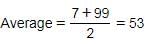
Hence, Option C is correct.
Hence, Option C is correct.
6 persons are sitting in a car. The average weight of all six persons is 72 kg and the average weight of the car and all six persons is 180 kg. What is the weight of the car?- a)800 kg
- b)828 kg
- c)848 kg
- d)824 kg
Correct answer is option 'B'. Can you explain this answer?
6 persons are sitting in a car. The average weight of all six persons is 72 kg and the average weight of the car and all six persons is 180 kg. What is the weight of the car?
a)
800 kg
b)
828 kg
c)
848 kg
d)
824 kg
| | Iq Funda answered |
Weight of the car = (180 × 7 – 72 × 6) = 828 kg
Hence, Option B is correct.
Hence, Option B is correct.


The average weight of A, B, C and D is 64 kg. If the average weight of A and B is 50 kg and that of B, C and D is 70 kg, what is the weight of B?- a)50 kg
- b)51 kg
- c)52 kg
- d)None of these
Correct answer is option 'D'. Can you explain this answer?
The average weight of A, B, C and D is 64 kg. If the average weight of A and B is 50 kg and that of B, C and D is 70 kg, what is the weight of B?
a)
50 kg
b)
51 kg
c)
52 kg
d)
None of these
| | Iq Funda answered |
Weights → A + B + C + D = 64 × 4 = 256 kg
Weights → A + B = 50 × 2 = 100 kg
Weights → B + C + D = 70 × 3 = 210 kg
Weights → A + B + B + C + D = 100 + 210 = 310 kg
So the answer = 310 – 256 = 54 kg
Hence, Option D is correct.
Weights → A + B = 50 × 2 = 100 kg
Weights → B + C + D = 70 × 3 = 210 kg
Weights → A + B + B + C + D = 100 + 210 = 310 kg
So the answer = 310 – 256 = 54 kg
Hence, Option D is correct.
The average number of visitors in a museum on each Sunday is 420 and the average number of visitors in the museum on any other day is 210. What is the average number of per day visitors in the whole month of April, which starts on Saturday?- a)230
- b)240
- c)245
- d)260
Correct answer is option 'C'. Can you explain this answer?
The average number of visitors in a museum on each Sunday is 420 and the average number of visitors in the museum on any other day is 210. What is the average number of per day visitors in the whole month of April, which starts on Saturday?
a)
230
b)
240
c)
245
d)
260
| | Iq Funda answered |
Sundays → 2nd, 9th, 16th, 23rd and 30th (5 Sundays)

Hence, Option C is correct.
Hence, Option C is correct.
The average of 20 numbers is 41. The average of the first 8 numbers is 39 and that of the last 13 numbers is 43. What is the 8th number?- a)51
- b)52
- c)53
- d)54
Correct answer is option 'A'. Can you explain this answer?
The average of 20 numbers is 41. The average of the first 8 numbers is 39 and that of the last 13 numbers is 43. What is the 8th number?
a)
51
b)
52
c)
53
d)
54
| | Iq Funda answered |
8 × 39 + 13 × 43 = 871
Since the 8th number came twice, it is added two times.
So the answer = 871 – 20 × 41 = 51
Hence, Option A is correct.
Since the 8th number came twice, it is added two times.
So the answer = 871 – 20 × 41 = 51
Hence, Option A is correct.
A company has 80 employees. The average income of 30 of them is Rs. 48,000 and the average income of the rest of them is Rs. 30,000. What is the average income of all the employees of the company?- a)Rs. 32,000
- b)Rs. 32,250
- c)Rs. 35,000
- d)Rs. 36,750
Correct answer is option 'D'. Can you explain this answer?
A company has 80 employees. The average income of 30 of them is Rs. 48,000 and the average income of the rest of them is Rs. 30,000. What is the average income of all the employees of the company?
a)
Rs. 32,000
b)
Rs. 32,250
c)
Rs. 35,000
d)
Rs. 36,750
| | Iq Funda answered |

Hence, Option D is correct.
The average weight of a group of 15 persons increases by 2 kg when a person weighing 40 kg is replaced by Saurabh. What is the weight of Saurabh?- a)75 kg
- b)72 kg
- c)70 kg
- d)64 kg
Correct answer is option 'C'. Can you explain this answer?
The average weight of a group of 15 persons increases by 2 kg when a person weighing 40 kg is replaced by Saurabh. What is the weight of Saurabh?
a)
75 kg
b)
72 kg
c)
70 kg
d)
64 kg
| | Iq Funda answered |
Combined weight of the group increases by = 2 × 15 = 30 kg
So the answer = 40 + 30 = 70 kg
Hence, Option C is correct.
So the answer = 40 + 30 = 70 kg
Hence, Option C is correct.
What is the average of all even numbers between 1 and 50?- a)21
- b)22
- c)23
- d)25
Correct answer is option 'D'. Can you explain this answer?
What is the average of all even numbers between 1 and 50?
a)
21
b)
22
c)
23
d)
25
| | Iq Funda answered |
All even numbers between 1 and 50 = 2 to 48
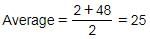
Hence, Option D is correct.
Hence, Option D is correct.
The average of 31 numbers is 57. The average of the first 10 numbers is 50 and that of the last 20 numbers is 61. What is the 11th number?- a)44
- b)45
- c)46
- d)47
Correct answer is option 'D'. Can you explain this answer?
The average of 31 numbers is 57. The average of the first 10 numbers is 50 and that of the last 20 numbers is 61. What is the 11th number?
a)
44
b)
45
c)
46
d)
47
| | Iq Funda answered |
Last 20 number = 12th to 31st
So remaining is 11th number.
So the answer = 31 × 57 – 10 × 50 – 20 × 61 = 47
Hence, Option D is correct.
So remaining is 11th number.
So the answer = 31 × 57 – 10 × 50 – 20 × 61 = 47
Hence, Option D is correct.

What is the average of all the composite numbers between 11 and 30?- a)20.62
- b)22.50
- c)22.97
- d)23.98
Correct answer is option 'A'. Can you explain this answer?
What is the average of all the composite numbers between 11 and 30?
a)
20.62
b)
22.50
c)
22.97
d)
23.98
| | Iq Funda answered |
Prime numbers between 1 and 30 →13, 17, 19, 23 and 29 (5)
Rest are prime numbers.
Total numbers 12 to 29 = 18
Total composite numbers = 13

Hence, Option A is correct.
Rest are prime numbers.
Total numbers 12 to 29 = 18
Total composite numbers = 13
Hence, Option A is correct.
The average of X natural numbers is 20. If 40 is added to the first number and 4 is subtracted from the last number, the average becomes 22. What is the value of X?- a)18
- b)20
- c)22
- d)22.50
Correct answer is option 'A'. Can you explain this answer?
The average of X natural numbers is 20. If 40 is added to the first number and 4 is subtracted from the last number, the average becomes 22. What is the value of X?
a)
18
b)
20
c)
22
d)
22.50
| | Iq Funda answered |
X × 20 + 40 – 4 = X × 22
36 = 2X
X = 18
Hence, Option A is correct.
36 = 2X
X = 18
Hence, Option A is correct.
The average of 13 numbers is 60. The average of the first 7 numbers is 57 and that of the last 7 numbers is 65. What is the 7th number?- a)70
- b)71
- c)72
- d)74
Correct answer is option 'D'. Can you explain this answer?
The average of 13 numbers is 60. The average of the first 7 numbers is 57 and that of the last 7 numbers is 65. What is the 7th number?
a)
70
b)
71
c)
72
d)
74
 | Yash Agarwal answered |
Given Information:
- Average of 13 numbers = 60
- Average of first 7 numbers = 57
- Average of last 7 numbers = 65
Solution:
- Let the sum of all 13 numbers be S.
Finding the sum of all 13 numbers:
- Average of 13 numbers = Sum of all 13 numbers / 13
- Sum of all 13 numbers = Average of 13 numbers * 13
- Sum of all 13 numbers = 60 * 13
- Sum of all 13 numbers = 780
Finding the sum of the first 7 numbers:
- Average of first 7 numbers = Sum of first 7 numbers / 7
- Sum of first 7 numbers = Average of first 7 numbers * 7
- Sum of first 7 numbers = 57 * 7
- Sum of first 7 numbers = 399
Finding the sum of the last 7 numbers:
- Sum of last 7 numbers = Sum of all 13 numbers - Sum of first 7 numbers
- Sum of last 7 numbers = 780 - 399
- Sum of last 7 numbers = 381
Finding the 7th number:
- Average of last 7 numbers = Sum of last 7 numbers / 7
- 65 = 381 / 7
- 65 = 54 + 7th number
- 7th number = 65 - 54
- 7th number = 11
Therefore, the 7th number is 11, which is not provided in the options. So, let's find the actual 7th number using the given options.
- 11 + 70 + 71 + 72 + 73 + 74 + 75 + 76 + 77 + 78 + 79 + 80 + 81 = 780
- The sum of all 13 numbers matches the calculated sum, so the 7th number = 74. Therefore, the correct answer is option 'D'.
A class has three sections A, B and C and the combined number of students in all three sections of the class is 200. In a test, the average marks of all the students in the class is 95. The average marks of all the students of sections A and B is 80 and the average marks of all the students of section C is 104. What is the number of students in Section C?- a)124
- b)120
- c)132
- d)125
Correct answer is option 'D'. Can you explain this answer?
A class has three sections A, B and C and the combined number of students in all three sections of the class is 200. In a test, the average marks of all the students in the class is 95. The average marks of all the students of sections A and B is 80 and the average marks of all the students of section C is 104. What is the number of students in Section C?
a)
124
b)
120
c)
132
d)
125
| | Iq Funda answered |
Let the number of students in Section C = X
The combined number of students in sections A and B = 200 – X
X × 104 + (200 – X) × 80 = 200 × 95
104X + 16000 – 80X = 19000
3000 = 24X
125 = X
Hence, Option D is correct.
The combined number of students in sections A and B = 200 – X
X × 104 + (200 – X) × 80 = 200 × 95
104X + 16000 – 80X = 19000
3000 = 24X
125 = X
Hence, Option D is correct.
The average weight of A, B and C is 72 kg. When D joins them, the new average becomes 68 kg. When E joins, A, B, C and D, the average of all five becomes 70 kg. What is the weight of E?- a)78 kg
- b)80 kg
- c)84 kg
- d)85 kg
Correct answer is option 'A'. Can you explain this answer?
The average weight of A, B and C is 72 kg. When D joins them, the new average becomes 68 kg. When E joins, A, B, C and D, the average of all five becomes 70 kg. What is the weight of E?
a)
78 kg
b)
80 kg
c)
84 kg
d)
85 kg
 | Ritu Kumar answered |
Average Weight of A, B, and C
The average weight of individuals A, B, and C is given as 72 kg.
- Therefore, the total weight of A, B, and C can be calculated as follows:
- Total weight (A + B + C) = Average weight × Number of individuals
- Total weight (A + B + C) = 72 kg × 3 = 216 kg
Inclusion of D
When individual D joins A, B, and C, the new average weight becomes 68 kg.
- The total number of individuals now is 4 (A, B, C, D).
- The new total weight (A + B + C + D) can be calculated:
- Total weight (A + B + C + D) = Average weight × Number of individuals
- Total weight (A + B + C + D) = 68 kg × 4 = 272 kg
Finding the Weight of D
To find the weight of D, we subtract the total weight of A, B, and C from the total weight of A, B, C, and D.
- Weight of D = Total weight (A + B + C + D) - Total weight (A + B + C)
- Weight of D = 272 kg - 216 kg = 56 kg
Inclusion of E
When E joins A, B, C, and D, the average weight of all five becomes 70 kg.
- The total number of individuals is now 5 (A, B, C, D, E).
- The new total weight (A + B + C + D + E) is:
- Total weight (A + B + C + D + E) = Average weight × Number of individuals
- Total weight (A + B + C + D + E) = 70 kg × 5 = 350 kg
Calculating the Weight of E
Now, we can find the weight of E by subtracting the total weight of A, B, C, and D from the total weight of A, B, C, D, and E.
- Weight of E = Total weight (A + B + C + D + E) - Total weight (A + B + C + D)
- Weight of E = 350 kg - 272 kg = 78 kg
Thus, the weight of E is 78 kg.
Correct answer is option 'A'.
The average weight of individuals A, B, and C is given as 72 kg.
- Therefore, the total weight of A, B, and C can be calculated as follows:
- Total weight (A + B + C) = Average weight × Number of individuals
- Total weight (A + B + C) = 72 kg × 3 = 216 kg
Inclusion of D
When individual D joins A, B, and C, the new average weight becomes 68 kg.
- The total number of individuals now is 4 (A, B, C, D).
- The new total weight (A + B + C + D) can be calculated:
- Total weight (A + B + C + D) = Average weight × Number of individuals
- Total weight (A + B + C + D) = 68 kg × 4 = 272 kg
Finding the Weight of D
To find the weight of D, we subtract the total weight of A, B, and C from the total weight of A, B, C, and D.
- Weight of D = Total weight (A + B + C + D) - Total weight (A + B + C)
- Weight of D = 272 kg - 216 kg = 56 kg
Inclusion of E
When E joins A, B, C, and D, the average weight of all five becomes 70 kg.
- The total number of individuals is now 5 (A, B, C, D, E).
- The new total weight (A + B + C + D + E) is:
- Total weight (A + B + C + D + E) = Average weight × Number of individuals
- Total weight (A + B + C + D + E) = 70 kg × 5 = 350 kg
Calculating the Weight of E
Now, we can find the weight of E by subtracting the total weight of A, B, C, and D from the total weight of A, B, C, D, and E.
- Weight of E = Total weight (A + B + C + D + E) - Total weight (A + B + C + D)
- Weight of E = 350 kg - 272 kg = 78 kg
Thus, the weight of E is 78 kg.
Correct answer is option 'A'.
In a year, the average monthly expenditure of Rajat in the first 5 months is Rs. 21,000, in the next 4 months is Rs. 24,000 and in the last three months is Rs. 12,000. If he saves overall Rs. 1,80,000 in the whole year, what is his average monthly income?- a)Rs. 31,250
- b)Rs. 34,750
- c)Rs. 35,000
- d)Rs. 36,750
Correct answer is option 'B'. Can you explain this answer?
In a year, the average monthly expenditure of Rajat in the first 5 months is Rs. 21,000, in the next 4 months is Rs. 24,000 and in the last three months is Rs. 12,000. If he saves overall Rs. 1,80,000 in the whole year, what is his average monthly income?
a)
Rs. 31,250
b)
Rs. 34,750
c)
Rs. 35,000
d)
Rs. 36,750
| | Iq Funda answered |
Total income of the year = 5 × 21,000 + 4 × 24,000 + 3 × 12,000 + 1,80,000 = 4,17,000

Hence, Option B is correct.
Hence, Option B is correct.
What is the average of all the numbers between 5 and 78, which can be divided by 6?- a)35
- b)36
- c)37
- d)39
Correct answer is option 'D'. Can you explain this answer?
What is the average of all the numbers between 5 and 78, which can be divided by 6?
a)
35
b)
36
c)
37
d)
39
| | Iq Funda answered |
Between 5 and 78:
First number = 6
Last number = 72
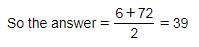
Hence, Option D is correct.
First number = 6
Last number = 72
Hence, Option D is correct.
The average weight of A, B and C is 50 kg. If the average weight of A and B is 45 kg and that of B and C is 59 kg, what is the weight of A?- a)28 kg
- b)29 kg
- c)30 kg
- d)None of these
Correct answer is option 'D'. Can you explain this answer?
The average weight of A, B and C is 50 kg. If the average weight of A and B is 45 kg and that of B and C is 59 kg, what is the weight of A?
a)
28 kg
b)
29 kg
c)
30 kg
d)
None of these
| | Iq Funda answered |
Reqd. weight = 50 × 3 – 59 × 2 = 32 kg
Hence, Option D is correct.
The average of 80 numbers is 105. The average of the first 21 numbers is 104 and that of the next 57 numbers is 103. What is the average of the last two numbers?- a)172.50
- b)200
- c)202.50
- d)240.50
Correct answer is option 'A'. Can you explain this answer?
The average of 80 numbers is 105. The average of the first 21 numbers is 104 and that of the next 57 numbers is 103. What is the average of the last two numbers?
a)
172.50
b)
200
c)
202.50
d)
240.50
| | Iq Funda answered |
The average of the last two numbers

Hence, Option A is correct.
Hence, Option A is correct.
There are 17 persons in a group. The average age of 16 persons among them is 60.50 years and the age of 17th person is 8 years more than the average age of all the 17 persons. What is the age of the 17th person?- a)54 years
- b)64 years
- c)60 years
- d)69 years
Correct answer is option 'D'. Can you explain this answer?
There are 17 persons in a group. The average age of 16 persons among them is 60.50 years and the age of 17th person is 8 years more than the average age of all the 17 persons. What is the age of the 17th person?
a)
54 years
b)
64 years
c)
60 years
d)
69 years
| | Iq Funda answered |
Let the average age of all the 17 persons = X years
Age of 17th persons = X + 8 years
16 × 60.50 + X + 8 = 17 × X
976 = 16X
X = 61
So the answer = 61 + 8 = 69 years
Hence, Option D is correct.
Age of 17th persons = X + 8 years
16 × 60.50 + X + 8 = 17 × X
976 = 16X
X = 61
So the answer = 61 + 8 = 69 years
Hence, Option D is correct.
Find the average of 6, 0.06, 66.66, 60.60, 600.60 and 6000?- a)1065.65
- b)1122.32
- c)1198.95
- d)1265.59
Correct answer is option 'B'. Can you explain this answer?
Find the average of 6, 0.06, 66.66, 60.60, 600.60 and 6000?
a)
1065.65
b)
1122.32
c)
1198.95
d)
1265.59
 | Shweta Kapoor answered |
Calculating the Average
To find the average of a set of numbers, you need to add all the numbers together and then divide by the total count of numbers. Let's calculate the average of the given numbers step by step.
Step 1: Add all the numbers together
6 + 0.06 + 66.66 + 60.60 + 600.60 + 6000 = 6734.92
Step 2: Find the total count of numbers
There are 6 numbers in the given set.
Step 3: Divide the sum by the total count
Average = 6734.92 / 6 = 1122.32
Therefore, the average of 6, 0.06, 66.66, 60.60, 600.60, and 6000 is 1122.32. So, the correct answer is option B.
To find the average of a set of numbers, you need to add all the numbers together and then divide by the total count of numbers. Let's calculate the average of the given numbers step by step.
Step 1: Add all the numbers together
6 + 0.06 + 66.66 + 60.60 + 600.60 + 6000 = 6734.92
Step 2: Find the total count of numbers
There are 6 numbers in the given set.
Step 3: Divide the sum by the total count
Average = 6734.92 / 6 = 1122.32
Therefore, the average of 6, 0.06, 66.66, 60.60, 600.60, and 6000 is 1122.32. So, the correct answer is option B.

The average of X natural numbers is 32. If 8 is added to the first number and 40 is subtracted from the last number, the average becomes 30. What is the value of X?- a)16
- b)18
- c)20
- d)22
Correct answer is option 'A'. Can you explain this answer?
The average of X natural numbers is 32. If 8 is added to the first number and 40 is subtracted from the last number, the average becomes 30. What is the value of X?
a)
16
b)
18
c)
20
d)
22
| | Iq Funda answered |
X × 32 + 8 – 40 = X × 30
2X = 32
X = 16
Hence, Option A is correct.
2X = 32
X = 16
Hence, Option A is correct.

Chapter doubts & questions for Average - 6 Months Preparation for GATE Electrical 2026 is part of Electrical Engineering (EE) exam preparation. The chapters have been prepared according to the Electrical Engineering (EE) exam syllabus. The Chapter doubts & questions, notes, tests & MCQs are made for Electrical Engineering (EE) 2026 Exam. Find important definitions, questions, notes, meanings, examples, exercises, MCQs and online tests here.
Chapter doubts & questions of Average - 6 Months Preparation for GATE Electrical in English & Hindi are available as part of Electrical Engineering (EE) exam. Download more important topics, notes, lectures and mock test series for Electrical Engineering (EE) Exam by signing up for free.
6 Months Preparation for GATE Electrical675 videos|1390 docs|885 tests |
