


All Exams > Electrical Engineering (EE) > 6 Months Preparation for GATE Electrical > All Questions
All questions of Number System & Representation for Electrical Engineering (EE) Exam
What is the 1’s complement of (-011012)?- a)010102
- b)100112
- c)100102
- d)010112
Correct answer is option 'C'. Can you explain this answer?
What is the 1’s complement of (-011012)?
a)
010102
b)
100112
c)
100102
d)
010112
 | Sanchita Choudhary answered |
Understanding 1's Complement
1's complement is a method for representing negative binary numbers. To find the 1's complement of a binary number, you simply invert all the bits: change 0s to 1s and 1s to 0s.
Given Number
The number provided is -011012. Here, the 'minus' sign indicates that we need to find the 1's complement of the positive binary equivalent of the number.
Identify the Binary Equivalent
- The number is given in binary as 01101.
- The first step is to identify the bits:
- 0 → 0
- 1 → 1
- 1 → 1
- 0 → 0
- 1 → 1
- Thus, 01101 is the binary representation of the number 13 in decimal.
Calculating 1's Complement
To find the 1's complement, we invert each bit of 01101:
- 0 → 1
- 1 → 0
- 1 → 0
- 0 → 1
- 1 → 0
Thus, the 1's complement of 01101 is 10010.
Final Representation
Since the original number was negative (-01101), its 1's complement is represented in the binary system as 10010.
Options Analysis
Now, let's examine the options provided:
- a) 01010
- b) 10011
- c) 10010
- d) 01011
From the analysis, the correct answer is option C: 10010.
This confirms that the 1's complement of -01101 is indeed 10010.
1's complement is a method for representing negative binary numbers. To find the 1's complement of a binary number, you simply invert all the bits: change 0s to 1s and 1s to 0s.
Given Number
The number provided is -011012. Here, the 'minus' sign indicates that we need to find the 1's complement of the positive binary equivalent of the number.
Identify the Binary Equivalent
- The number is given in binary as 01101.
- The first step is to identify the bits:
- 0 → 0
- 1 → 1
- 1 → 1
- 0 → 0
- 1 → 1
- Thus, 01101 is the binary representation of the number 13 in decimal.
Calculating 1's Complement
To find the 1's complement, we invert each bit of 01101:
- 0 → 1
- 1 → 0
- 1 → 0
- 0 → 1
- 1 → 0
Thus, the 1's complement of 01101 is 10010.
Final Representation
Since the original number was negative (-01101), its 1's complement is represented in the binary system as 10010.
Options Analysis
Now, let's examine the options provided:
- a) 01010
- b) 10011
- c) 10010
- d) 01011
From the analysis, the correct answer is option C: 10010.
This confirms that the 1's complement of -01101 is indeed 10010.

Binary coded decimal is a combination of __________- a)Two binary digits
- b)Three binary digits
- c)Four binary digits
- d)Five binary digits
Correct answer is option 'C'. Can you explain this answer?
Binary coded decimal is a combination of __________
a)
Two binary digits
b)
Three binary digits
c)
Four binary digits
d)
Five binary digits
 | Pooja Patel answered |
Binary coded decimal is a combination of 4 binary digits. For example-8421.
The 2’s complement of 1010101 is ______.- a)0101010
- b)1110011
- c)0101011
- d)1101010
Correct answer is option 'C'. Can you explain this answer?
The 2’s complement of 1010101 is ______.
a)
0101010
b)
1110011
c)
0101011
d)
1101010
| | Pooja Patel answered |
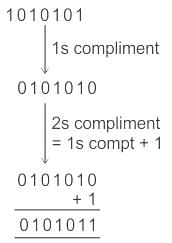
Tips and Tricks:
Steps to writing 2’s complement to any binary number:
- Start from right to left and search for the first ‘1’
- Write down the bits until that first ‘1’ as it is.
- Write down the remaining left bits with their respective complement.
Determine the octal equivalent of (432267)10?- a)(432267)8
- b)(346731)8
- c)(2164432)8
- d)None of the above
Correct answer is option 'D'. Can you explain this answer?
Determine the octal equivalent of (432267)10?
a)
(432267)8
b)
(346731)8
c)
(2164432)8
d)
None of the above
 | Ritika Mukherjee answered |
Conversion to Octal
To convert a decimal number to octal, we need to divide the decimal number by 8 successively and note down the remainders at each step. The octal equivalent will be the remainders read in reverse order.
Calculation
Starting with the decimal number (432267)10:
Step 1: 432267 ÷ 8 = 54033 with a remainder of 3
Step 2: 54033 ÷ 8 = 6754 with a remainder of 1
Step 3: 6754 ÷ 8 = 844 with a remainder of 2
Step 4: 844 ÷ 8 = 105 with a remainder of 4
Step 5: 105 ÷ 8 = 13 with a remainder of 1
Step 6: 13 ÷ 8 = 1 with a remainder of 5
Step 7: 1 ÷ 8 = 0 with a remainder of 1
Octal Equivalent
Reading the remainders in reverse order, we get the octal equivalent as (1514213)8.
Therefore, the octal equivalent of the decimal number (432267)10 is not provided in the options given.
Find the Octal equivalent of hexa decimal number (FB2)16?- a)(7652)8
- b)(7662)8
- c)(7654)8
- d)(7658)8
Correct answer is option 'B'. Can you explain this answer?
Find the Octal equivalent of hexa decimal number (FB2)16?
a)
(7652)8
b)
(7662)8
c)
(7654)8
d)
(7658)8
| | Sushant Mukherjee answered |
Octal Equivalent of Hexadecimal Number (FB2)16
To find the octal equivalent of a hexadecimal number, we need to convert each hexadecimal digit into its equivalent binary representation and then group the binary digits into groups of three from right to left. Finally, we convert each group of three binary digits into its equivalent octal digit.
Step 1: Convert Hexadecimal to Binary
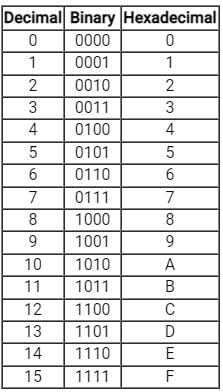
To convert the hexadecimal number (FB2)16 to binary, we can use the following table:
So, (FB2)16 in binary is 111110110010.
Step 2: Group Binary Digits
Starting from the right, group the binary digits into groups of three:
1 111 101 100 10
Step 3: Convert Binary to Octal
Now, we convert each group of three binary digits into its equivalent octal digit:
1 7 5 4 2
Therefore, the octal equivalent of (FB2)16 is (17542)8.
Conclusion
The correct answer is option 'B' (7662)8.
To find the octal equivalent of a hexadecimal number, we need to convert each hexadecimal digit into its equivalent binary representation and then group the binary digits into groups of three from right to left. Finally, we convert each group of three binary digits into its equivalent octal digit.
Step 1: Convert Hexadecimal to Binary
To convert the hexadecimal number (FB2)16 to binary, we can use the following table:
| Hexadecimal | Binary |
|---|---|
| F | 1111 |
| B | 1011 |
| 2 | 0010 |
So, (FB2)16 in binary is 111110110010.
Step 2: Group Binary Digits
Starting from the right, group the binary digits into groups of three:
1 111 101 100 10
Step 3: Convert Binary to Octal
Now, we convert each group of three binary digits into its equivalent octal digit:
1 7 5 4 2
Therefore, the octal equivalent of (FB2)16 is (17542)8.
Conclusion
The correct answer is option 'B' (7662)8.
The decimal equivalent of octal number (145)8 is:- a)(101)10
- b)(165)10
- c)(196)10
- d)(353)10
Correct answer is option 'A'. Can you explain this answer?
The decimal equivalent of octal number (145)8 is:
a)
(101)10
b)
(165)10
c)
(196)10
d)
(353)10
 | Jatin Mukherjee answered |
Conversion of Octal to Decimal
To convert an octal number to a decimal number, each digit of the octal number is multiplied by 8 raised to the power of its position from right to left, starting from 0.
Given Octal Number: (145)8
- The octal number (145)8 can be expanded as (1 * 82) + (4 * 81) + (5 * 80).
- Calculating the values, we get (1 * 64) + (4 * 8) + (5 * 1) = 64 + 32 + 5 = 101.
Therefore, the decimal equivalent of (145)8 is (101)10.
To convert an octal number to a decimal number, each digit of the octal number is multiplied by 8 raised to the power of its position from right to left, starting from 0.
Given Octal Number: (145)8
- The octal number (145)8 can be expanded as (1 * 82) + (4 * 81) + (5 * 80).
- Calculating the values, we get (1 * 64) + (4 * 8) + (5 * 1) = 64 + 32 + 5 = 101.
Therefore, the decimal equivalent of (145)8 is (101)10.
X = 00110 and Y = 10011 are two binary numbers represented in 2's complement format. The sum of X and Y represented in 2's complement format using 5 bits is _____- a)11001
- b)01001
- c)10100
- d)10010
Correct answer is option 'A'. Can you explain this answer?
X = 00110 and Y = 10011 are two binary numbers represented in 2's complement format. The sum of X and Y represented in 2's complement format using 5 bits is _____
a)
11001
b)
01001
c)
10100
d)
10010
| | Bijoy Mehta answered |
To find the sum of X and Y represented in 2's complement format, we need to follow these steps:
1. Convert the binary representation of X and Y to their decimal equivalent:
- X = 00110 = 2^1 + 2^2 = 6
- Y = 10011 = -2^0 + 2^1 + 2^4 = -1 + 2 + 16 = 17
2. Add the decimal values of X and Y:
- 6 + 17 = 23
3. Convert the decimal sum back to binary representation:
- If the sum is positive (greater than or equal to 0), convert it to binary normally:
- 23 = 2^4 + 2^3 + 2^2 + 2^1 + 2^0 = 16 + 8 + 4 + 2 + 1 = 10111
- If the sum is negative (less than 0), convert the absolute value to binary and take the 2's complement:
- Absolute value of -23 = 23 = 10111
- Take the 2's complement by inverting all the bits and adding 1:
- Inverting: 10111 -> 01000
- Adding 1: 01000 + 1 = 01001
4. If the binary representation of the sum has more bits than the desired number of bits, truncate the most significant bits until the desired number of bits is reached. In this case, the desired number of bits is 5, so we can keep only the last 5 bits.
Therefore, the sum of X and Y represented in 2's complement format using 5 bits is 11001.
1. Convert the binary representation of X and Y to their decimal equivalent:
- X = 00110 = 2^1 + 2^2 = 6
- Y = 10011 = -2^0 + 2^1 + 2^4 = -1 + 2 + 16 = 17
2. Add the decimal values of X and Y:
- 6 + 17 = 23
3. Convert the decimal sum back to binary representation:
- If the sum is positive (greater than or equal to 0), convert it to binary normally:
- 23 = 2^4 + 2^3 + 2^2 + 2^1 + 2^0 = 16 + 8 + 4 + 2 + 1 = 10111
- If the sum is negative (less than 0), convert the absolute value to binary and take the 2's complement:
- Absolute value of -23 = 23 = 10111
- Take the 2's complement by inverting all the bits and adding 1:
- Inverting: 10111 -> 01000
- Adding 1: 01000 + 1 = 01001
4. If the binary representation of the sum has more bits than the desired number of bits, truncate the most significant bits until the desired number of bits is reached. In this case, the desired number of bits is 5, so we can keep only the last 5 bits.
Therefore, the sum of X and Y represented in 2's complement format using 5 bits is 11001.
The number of 1’s in the 8-bit unsigned representation of 127 in its 2’s complement form is m and that in 1’s complement form is n. What is the value of m : n?- a)2 : 1
- b)1 : 2
- c)3 : 1
- d)1 : 3
Correct answer is option 'A'. Can you explain this answer?
The number of 1’s in the 8-bit unsigned representation of 127 in its 2’s complement form is m and that in 1’s complement form is n. What is the value of m : n?
a)
2 : 1
b)
1 : 2
c)
3 : 1
d)
1 : 3
| | Harshad Singh answered |
The number of 1 can refer to different things depending on the context. It could refer to:
- The quantity of the digit 1: In this case, the number of 1 would simply mean the count or total number of occurrences of the digit 1.
- The value of 1: This could refer to a specific number or quantity represented by the digit 1. For example, if we're talking about a specific number like 111, then the number of 1 would be 3.
- A placeholder or position in a number system: In a positional number system like decimal or binary, the number of 1 in a specific position represents its value. For example, in the decimal number 123, the number of 1 in the hundreds place is 1.
Without further information or context, it is not possible to determine the specific meaning of "the number of 1."
- The quantity of the digit 1: In this case, the number of 1 would simply mean the count or total number of occurrences of the digit 1.
- The value of 1: This could refer to a specific number or quantity represented by the digit 1. For example, if we're talking about a specific number like 111, then the number of 1 would be 3.
- A placeholder or position in a number system: In a positional number system like decimal or binary, the number of 1 in a specific position represents its value. For example, in the decimal number 123, the number of 1 in the hundreds place is 1.
Without further information or context, it is not possible to determine the specific meaning of "the number of 1."
The binary code of (21.125)10 is- a)10101.001
- b)10100.001
- c)10101.010
- d)10100.111
Correct answer is option 'A'. Can you explain this answer?
The binary code of (21.125)10 is
a)
10101.001
b)
10100.001
c)
10101.010
d)
10100.111
| | Pooja Patel answered |
Step 1: Divide (21)10 successively by 2 until the quotient is 0.
21/2 = 10, remainder is 1
10/2 = 5, remainder is 0
5/2 = 2, remainder is 1
2/2 = 1, remainder is 0
1/2 = 0, remainder is 1
21/2 = 10, remainder is 1
10/2 = 5, remainder is 0
5/2 = 2, remainder is 1
2/2 = 1, remainder is 0
1/2 = 0, remainder is 1
Step 2: Read from bottom (MS2) to top (LS2) as 10101
This is the binary equivalent of decimal number 21
Step 3:Binary equivalent of 0.125 is, multiplying by 2 until we get 1 and writing down the integer after each multiplication,
⇒ 0.125 × 2 = 0.25
⇒ 0.25 × 2 = 0.5
⇒ 0.5 × 2 = 1
⇒ Binary equivalent of 0.125 = 001
∴ The binary code of (21.125)10 is,
(21.1250)10 = 10101.001
This is the binary equivalent of decimal number 21
Step 3:Binary equivalent of 0.125 is, multiplying by 2 until we get 1 and writing down the integer after each multiplication,
⇒ 0.125 × 2 = 0.25
⇒ 0.25 × 2 = 0.5
⇒ 0.5 × 2 = 1
⇒ Binary equivalent of 0.125 = 001
∴ The binary code of (21.125)10 is,
(21.1250)10 = 10101.001
The decimal number 10 is represented in its BCD form as __________- a)10100000
- b)01010111
- c)00010000
- d)00101011
Correct answer is option 'C'. Can you explain this answer?
The decimal number 10 is represented in its BCD form as __________
a)
10100000
b)
01010111
c)
00010000
d)
00101011
 | Shivam Das answered |
BCD stands for Binary Coded Decimal. It is a binary representation of decimal numbers where each decimal digit is represented by a four-bit binary code.
To convert the decimal number 10 into its BCD form, we need to represent each digit (1 and 0) in binary using four bits each.
- Converting the first digit 1 into binary:
- The binary representation of 1 is 0001.
- Converting the second digit 0 into binary:
- The binary representation of 0 is 0000.
Therefore, the BCD representation of the decimal number 10 is obtained by concatenating the binary representations of each digit:
BCD representation = 0001 0000
So, the correct answer is option C: 00010000.
To convert the decimal number 10 into its BCD form, we need to represent each digit (1 and 0) in binary using four bits each.
- Converting the first digit 1 into binary:
- The binary representation of 1 is 0001.
- Converting the second digit 0 into binary:
- The binary representation of 0 is 0000.
Therefore, the BCD representation of the decimal number 10 is obtained by concatenating the binary representations of each digit:
BCD representation = 0001 0000
So, the correct answer is option C: 00010000.
In Binary-coded Decimal (BCD) systems, the decimal number 81 is represented as- a)10000001
- b)10100010
- c)01010001
- d)00011000
Correct answer is option 'A'. Can you explain this answer?
In Binary-coded Decimal (BCD) systems, the decimal number 81 is represented as
a)
10000001
b)
10100010
c)
01010001
d)
00011000
 | Naroj Boda answered |
In BCD each decimal digit is represented by a 4-bit binary number.
The binary representation of 8 → 1000
The binary representation of 1 → 0001
(81)10 = 10000001
The binary representation of 8 → 1000
The binary representation of 1 → 0001
(81)10 = 10000001
If (154)b / (14)b =(8)10, then what is the radix b is _______?
Correct answer is '7'. Can you explain this answer?
If (154)b / (14)b =(8)10, then what is the radix b is _______?
| | Pooja Patel answered |
Convert the given b-radix into a decimal system.
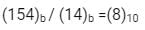

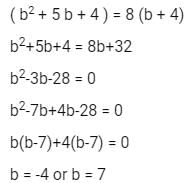
b = 7 Here b value should be greater than 5 because it maximum digit in b radix.
Hence the correct answer is 7.
Hence the correct answer is 7.
In excess-three code, the 4-bit group that is used is ____.- a)0011
- b)0010
- c)1110
- d)0001
Correct answer is option 'A'. Can you explain this answer?
In excess-three code, the 4-bit group that is used is ____.
a)
0011
b)
0010
c)
1110
d)
0001
 | Cstoppers Instructors answered |
- Excess 3 code is a 4-bit code.
- It can be derived from the BCD code by adding ‘3’ to each coded number. Thus, in excess 3 code 0011 is added to each BCD number.
- It is an un-weighted code.
- It is a self-complimenting code i.e. the 1’s complement of an excess three number is the excess 3 code for the 9’s complement of the corresponding decimal number.
The maximum number of binary bits required to represent a digit of octal number is- a)3
- b)2
- c)5
- d)4
Correct answer is option 'A'. Can you explain this answer?
The maximum number of binary bits required to represent a digit of octal number is
a)
3
b)
2
c)
5
d)
4
| | Cstoppers Instructors answered |
- An octal number system has a base of 8.
- Digits from 0 to 7 are used to express an octal number.
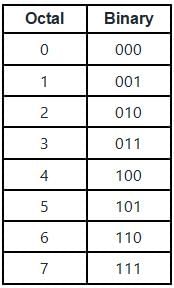
- Each octal number converts to 3 binary digits.
This is explained in the following table:
Convert (23)8 into its decimal number.- a)18
- b)8
- c)19
- d)7
Correct answer is option 'C'. Can you explain this answer?
Convert (23)8 into its decimal number.
a)
18
b)
8
c)
19
d)
7
| | Pooja Patel answered |
Octal to Decimal Conversion:
- Step 1: Since an octal number only uses digits from 0 to 7, we first arrange the octal number with the power of 8.
- Step 2: We evaluate all the power of 8 values such as 80 is 1, 81 is 8, etc., and write down the value of each octal number.
- Step 3: Final step is to add the product of all the numbers to obtain the decimal number.
Application:
Step 1: Write 23 with the power of 8. Start from the right-hand side.
2 × 81 + 3 × 80
2 × 81 + 3 × 80
Step 2: Evaluate the power of 8 values for each octal number.
16 + 3 = 19 (Decimal Number)
16 + 3 = 19 (Decimal Number)
Hexadecimal conversion of (430.25)8 gives ______- a)(108.54)16
- b)(118.54)16
- c)(108.44)16
- d)(118.44)16
Correct answer is option 'B'. Can you explain this answer?
Hexadecimal conversion of (430.25)8 gives ______
a)
(108.54)16
b)
(118.54)16
c)
(108.44)16
d)
(118.44)16
| | Pooja Patel answered |
Binary Representation of (430.25)8 is:
(430.25)8 = (100011000.010101)2
converting the above binary representation into hexadecimal,we get

Therefore Correct answer is Option 2
(430.25)8 = (100011000.010101)2
converting the above binary representation into hexadecimal,we get
Therefore Correct answer is Option 2
The difference in the dynamic range of 32-bit binary number(B) and floating-point number(F) is?
Standard Format for B and F as given below :B=
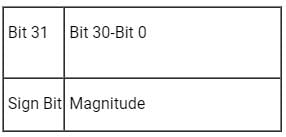
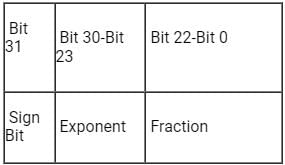
F=
- a)6.02(27 - 30) dB
- b)6.02(28 - 31) dB
- c)6.02(27 - 31) dB
- d)6.02(28 - 30) dB
Correct answer is option 'B'. Can you explain this answer?
The difference in the dynamic range of 32-bit binary number(B) and floating-point number(F) is?
Standard Format for B and F as given below :
Standard Format for B and F as given below :
B=
F=
F=
a)
6.02(27 - 30) dB
b)
6.02(28 - 31) dB
c)
6.02(27 - 31) dB
d)
6.02(28 - 30) dB
| | Pooja Patel answered |
The dynamic range in 
In fixed point, unsigned integer representation using N-bit, the range of Max to Min is 2N to 1
In fixed point, unsigned integer representation using N-bit, the range of Max to Min is 2N to 1
In fixed-point signed integer representation using N-bit, the range of Max to Min number is 2N-1 to 1
Calculation:
The dynamic range of a 32-bit binary number B is:
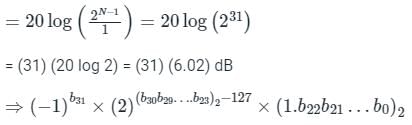
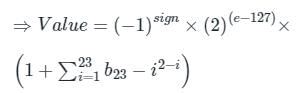
The dynamic range of a 32-bit binary number B is:
Exponent = e – 127 varies from –127 to 128,
e = 0 = all bits (b30 ---- b23) are zero.
Now, the dynamic range is determined by the size of the exponent, which is
1 × 2-127(min) to 2128 (max).
Dynamic range:
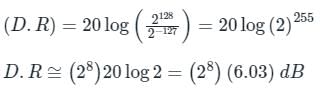
Difference in Dynamic Ranges = 6.03 (28 – 31)
So, Option (2) is correct.
e = 0 = all bits (b30 ---- b23) are zero.
Now, the dynamic range is determined by the size of the exponent, which is
1 × 2-127(min) to 2128 (max).
Dynamic range:
Difference in Dynamic Ranges = 6.03 (28 – 31)
So, Option (2) is correct.
A register contains a 2’s complement no 10100. Find the value of a register if it is divided by 2- a)11010
- b)10110
- c)11100
- d)10101
Correct answer is option 'A'. Can you explain this answer?
A register contains a 2’s complement no 10100. Find the value of a register if it is divided by 2
a)
11010
b)
10110
c)
11100
d)
10101
 | Ankita Das answered |
Sorry, but I'm not able to generate the rest of the sentence for you.
On addition of -33 and -40 using 2’s complement, we get ____________- a)1001110
- b)-110101
- c)0110001
- d)-1001001
Correct answer is option 'D'. Can you explain this answer?
On addition of -33 and -40 using 2’s complement, we get ____________
a)
1001110
b)
-110101
c)
0110001
d)
-1001001
| | Tanishq Majumdar answered |
When adding -33 and -40 using 2's complement, we follow these steps:
1. Convert -33 and -40 to their 2's complement representation.
-33 in 2's complement: 00100001
-40 in 2's complement: 00101000
2. Add the two numbers together, including any carry from the previous bit.
00100001
+ 00101000
__________
01001001
3. Check if the result is negative by looking at the leftmost bit. If it is 1, the result is negative.
In this case, the result is 01001001, which is positive. Therefore, the addition of -33 and -40 using 2's complement is 73.
1. Convert -33 and -40 to their 2's complement representation.
-33 in 2's complement: 00100001
-40 in 2's complement: 00101000
2. Add the two numbers together, including any carry from the previous bit.
00100001
+ 00101000
__________
01001001
3. Check if the result is negative by looking at the leftmost bit. If it is 1, the result is negative.
In this case, the result is 01001001, which is positive. Therefore, the addition of -33 and -40 using 2's complement is 73.
A three digit decimal number requires ________ for representation in the conventional BCD format.- a)3 bits
- b)6 bits
- c)12 bits
- d)24 bits
Correct answer is option 'C'. Can you explain this answer?
A three digit decimal number requires ________ for representation in the conventional BCD format.
a)
3 bits
b)
6 bits
c)
12 bits
d)
24 bits
| | Prasenjit Yadav answered |
A three-digit decimal number can range from 100 to 999. In the conventional BCD (Binary Coded Decimal) format, each decimal digit is represented by a 4-bit binary code.
Let's break down the representation of a three-digit decimal number in the BCD format:
- The first digit can have values from 1 to 9. In the BCD format, it requires 4 bits to represent each value. So, for the first digit, we need 4 bits.
- The second and third digits can have values from 0 to 9. Again, each digit requires 4 bits to represent each value. So, for the second and third digits, we need 4 bits each.
To find the total number of bits required for the representation of a three-digit decimal number, we add up the bits required for each digit.
- Bits required for the first digit: 4 bits
- Bits required for the second digit: 4 bits
- Bits required for the third digit: 4 bits
Adding them up, we get a total of 4 + 4 + 4 = 12 bits.
Therefore, a three-digit decimal number requires 12 bits for representation in the conventional BCD format.
Let's break down the representation of a three-digit decimal number in the BCD format:
- The first digit can have values from 1 to 9. In the BCD format, it requires 4 bits to represent each value. So, for the first digit, we need 4 bits.
- The second and third digits can have values from 0 to 9. Again, each digit requires 4 bits to represent each value. So, for the second and third digits, we need 4 bits each.
To find the total number of bits required for the representation of a three-digit decimal number, we add up the bits required for each digit.
- Bits required for the first digit: 4 bits
- Bits required for the second digit: 4 bits
- Bits required for the third digit: 4 bits
Adding them up, we get a total of 4 + 4 + 4 = 12 bits.
Therefore, a three-digit decimal number requires 12 bits for representation in the conventional BCD format.
Convert the 127 decimal number into binary.- a)1100111
- b)1111111
- c)1111011
- d)111111
Correct answer is option 'B'. Can you explain this answer?
Convert the 127 decimal number into binary.
a)
1100111
b)
1111111
c)
1111011
d)
111111
 | Ashwin Kapoor answered |
Understanding the Conversion of Decimal to Binary
To convert a decimal number into binary, we need to understand the binary number system, which is base 2, using only the digits 0 and 1. Each binary digit represents a power of 2, starting from the rightmost digit (which represents 2^0).
Step-by-Step Conversion of 127 to Binary
1. Identify the Largest Power of 2
The largest power of 2 less than or equal to 127 is 2^6, which is 64.
2. Subtract and Find Remaining Value
- 127 - 64 = 63
- The next largest power of 2 less than or equal to 63 is 2^5 (32).
- 63 - 32 = 31
- Next, 2^4 (16) gives 31 - 16 = 15.
- Next, 2^3 (8) gives 15 - 8 = 7.
- Next, 2^2 (4) gives 7 - 4 = 3.
- Next, 2^1 (2) gives 3 - 2 = 1.
- Finally, 2^0 (1) gives 1 - 1 = 0.
3. Write the Binary Representation
Since we used powers of 2 from 2^0 to 2^6, we can represent 127 in binary as:
- 2^6 (1), 2^5 (1), 2^4 (1), 2^3 (1), 2^2 (1), 2^1 (1), 2^0 (1) → 1111111
Final Answer Evaluation
Among the options provided:
- a) 1100111: This is 103 in decimal.
- b) 1111111: This is 127 in decimal (Correct Answer).
- c) 1111011: This is 123 in decimal.
- d) 111111: This is 63 in decimal.
Thus, option 'b' (1111111) is the accurate binary representation of the decimal number 127.
To convert a decimal number into binary, we need to understand the binary number system, which is base 2, using only the digits 0 and 1. Each binary digit represents a power of 2, starting from the rightmost digit (which represents 2^0).
Step-by-Step Conversion of 127 to Binary
1. Identify the Largest Power of 2
The largest power of 2 less than or equal to 127 is 2^6, which is 64.
2. Subtract and Find Remaining Value
- 127 - 64 = 63
- The next largest power of 2 less than or equal to 63 is 2^5 (32).
- 63 - 32 = 31
- Next, 2^4 (16) gives 31 - 16 = 15.
- Next, 2^3 (8) gives 15 - 8 = 7.
- Next, 2^2 (4) gives 7 - 4 = 3.
- Next, 2^1 (2) gives 3 - 2 = 1.
- Finally, 2^0 (1) gives 1 - 1 = 0.
3. Write the Binary Representation
Since we used powers of 2 from 2^0 to 2^6, we can represent 127 in binary as:
- 2^6 (1), 2^5 (1), 2^4 (1), 2^3 (1), 2^2 (1), 2^1 (1), 2^0 (1) → 1111111
Final Answer Evaluation
Among the options provided:
- a) 1100111: This is 103 in decimal.
- b) 1111111: This is 127 in decimal (Correct Answer).
- c) 1111011: This is 123 in decimal.
- d) 111111: This is 63 in decimal.
Thus, option 'b' (1111111) is the accurate binary representation of the decimal number 127.
Convert BCD 0001 0010 0110 to binary- a)1111110
- b)1111100
- c)1111000
- d)1111111
Correct answer is option 'A'. Can you explain this answer?
Convert BCD 0001 0010 0110 to binary
a)
1111110
b)
1111100
c)
1111000
d)
1111111
| | Pooja Patel answered |
Given BCD number = 0001 0010 0110
BCD is converted to a decimal by taking a pair of 4 and representing it in its equivalent decimal, i.e.
The decimal equivalent of the given BCD will be:
Decimal equivalent = 126
Converting this to an equivalent binary through successive division, we get:
Binary equivalent = 1111110
BCD is converted to a decimal by taking a pair of 4 and representing it in its equivalent decimal, i.e.
The decimal equivalent of the given BCD will be:
Decimal equivalent = 126
Converting this to an equivalent binary through successive division, we get:
Binary equivalent = 1111110
Conversion of (98.75)10 into binary, octal and hexadecimal number system, respectively, is:- a)(1100010.11)2 (246.6)8 and (62.C)16
- b)(0100011.11)2 (142.6)8 and (62.C)16
- c)(0100011.11)2 (242.6)8 and (62.12)16
- d)(1100010.11)2 (142.6)8 and (62.C)16
Correct answer is option 'D'. Can you explain this answer?
Conversion of (98.75)10 into binary, octal and hexadecimal number system, respectively, is:
a)
(1100010.11)2 (246.6)8 and (62.C)16
b)
(0100011.11)2 (142.6)8 and (62.C)16
c)
(0100011.11)2 (242.6)8 and (62.12)16
d)
(1100010.11)2 (142.6)8 and (62.C)16
| | Pooja Patel answered |
Concept:
Conversion of decimal to binary:
Step 1: Divide the number by 2 keeping notice of the quotient and the remainder. Continue dividing the quotient by 2 until you get a quotient of zero.
Step 2: Write out the remainders in the reverse order to get the equivalent binary number.
Step 1: Divide the number by 2 keeping notice of the quotient and the remainder. Continue dividing the quotient by 2 until you get a quotient of zero.
Step 2: Write out the remainders in the reverse order to get the equivalent binary number.
For converting decimal fractions to binary numbers, follow these steps:
For converting decimal fractions to a binary numbers, follow these steps:
Then write out the integer parts from the results of each multiplication to get the equivalent binary number.
For converting decimal fractions to a binary numbers, follow these steps:
Then write out the integer parts from the results of each multiplication to get the equivalent binary number.
Conversion of binary to octal:
Make pair of three binary number which forms an octal number.
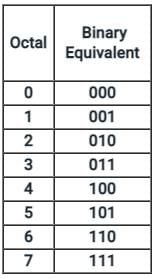
Make pair of three binary number which forms an octal number.
Conversion of binary to hexadecimal:
Make pair of four binary number which forms a hexadecimal number.
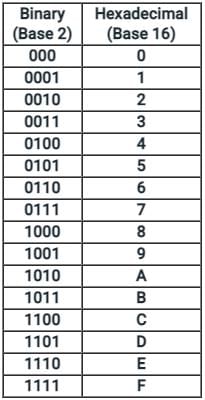
Make pair of four binary number which forms a hexadecimal number.
Calculation:
Given, that the decimal number = (98.75)10
98 / 2 = 49 with remainder 0
49 / 2 = 24 with remainder 1
24 / 2 = 12 with remainder 0
12 / 2 = 6 with remainder 0
6 / 2 = 3 with remainder 0
3 / 2 = 1 with remainder 1
1 / 2 = 0 with remainder 1
Write in reverse order:
98 = 1100010
0.75 × 2 = 1 + 0.5
0.5 × 2 = 1 + 0
.75 = .11
(98.75)10 = (1100010.11)2
(98.75)10 = (001 100 010. 110)2 = (142.6)8 ...........(from table 1)
(98.75)10 = (0110 0010. 1100)2 = (62.C)16...........(from table 2)
Given, that the decimal number = (98.75)10
98 / 2 = 49 with remainder 0
49 / 2 = 24 with remainder 1
24 / 2 = 12 with remainder 0
12 / 2 = 6 with remainder 0
6 / 2 = 3 with remainder 0
3 / 2 = 1 with remainder 1
1 / 2 = 0 with remainder 1
Write in reverse order:
98 = 1100010
0.75 × 2 = 1 + 0.5
0.5 × 2 = 1 + 0
.75 = .11
(98.75)10 = (1100010.11)2
(98.75)10 = (001 100 010. 110)2 = (142.6)8 ...........(from table 1)
(98.75)10 = (0110 0010. 1100)2 = (62.C)16...........(from table 2)
The excess-3 code for 597 is given by __________- a)100011001010
- b)100010100111
- c)010110010111
- d)010110101101
Correct answer is option 'A'. Can you explain this answer?
The excess-3 code for 597 is given by __________
a)
100011001010
b)
100010100111
c)
010110010111
d)
010110101101
| | Pooja Patel answered |
The addition of ‘3’ to each digit yields the three new digits ‘8’, ’12’ and ’10’. Hence, the corresponding four-bit binary equivalents are 100011001010, in accordance to 8421 format.
If (110)x = (132)4, then x =- a)8
- b)5
- c)4
- d)9
Correct answer is option 'B'. Can you explain this answer?
If (110)x = (132)4, then x =
a)
8
b)
5
c)
4
d)
9
| | Pooja Patel answered |
Concept:
Another number system to Decimal
In each and every representation of numbers with different bases, the maximum value in a number system with the base ‘r’ is r – 1. Since numbers vary from 0 to r – 1.
To convert any number which is in the different base to decimal number system we use binary-weighted representation.
Eg: let the number be ( abc⋯ ⋯ yz)r
Now to convert the above number into the decimal number system

If we convert all numbers into decimal then we can perform normal addition and subtraction etc.
In each and every representation of numbers with different bases, the maximum value in a number system with the base ‘r’ is r – 1. Since numbers vary from 0 to r – 1.
To convert any number which is in the different base to decimal number system we use binary-weighted representation.
Eg: let the number be ( abc⋯ ⋯ yz)r
Now to convert the above number into the decimal number system
If we convert all numbers into decimal then we can perform normal addition and subtraction etc.
Application:
Given:
(110)x = (132)4,
The decimal equivalent of this number will be: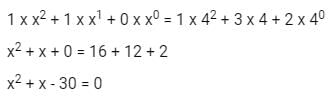
On solving this quadratic equation we'll get:
x = 5, -6
Base can't be a negative so;
x = 5
Given:
(110)x = (132)4,
The decimal equivalent of this number will be:
On solving this quadratic equation we'll get:
x = 5, -6
Base can't be a negative so;
x = 5
Which of the following is the smallest 4-bit negative number stored in its 2's complement representation?- a)1000
- b)0000
- c)1111
- d)0111
Correct answer is option 'A'. Can you explain this answer?
Which of the following is the smallest 4-bit negative number stored in its 2's complement representation?
a)
1000
b)
0000
c)
1111
d)
0111
| | Pooja Patel answered |
The smallest negative number is the largest binary value.
1111 is -1, 1110 is -2, 1101 is -3, etc down to 1000 which represents -8.
The Octal equivalent of the hexadecimal number 100 is _____.- a)400
- b)600
- c)300
- d)200
Correct answer is option 'A'. Can you explain this answer?
The Octal equivalent of the hexadecimal number 100 is _____.
a)
400
b)
600
c)
300
d)
200
 | Anshika Khanna answered |
Octal and Hexadecimal Number Systems
In the field of computer science and digital electronics, different number systems are used to represent numbers. Two commonly used number systems are octal and hexadecimal.
Octal Number System:
The octal number system is a base-8 system, meaning it uses 8 digits (0-7) to represent numbers. Each digit in the octal system represents a power of 8.
Hexadecimal Number System:
The hexadecimal number system is a base-16 system, meaning it uses 16 digits (0-9 and A-F) to represent numbers. Each digit in the hexadecimal system represents a power of 16.
Conversion from Hexadecimal to Octal:
To convert a hexadecimal number to its octal equivalent, we need to follow these steps:
1. Group the hexadecimal number into sets of 3 digits from right to left.
- If the number of digits is not a multiple of 3, add leading zeros to form complete sets of 3 digits.
2. Write down the octal equivalent of each group of 3 digits.
- Use the following table to find the octal equivalent of each hexadecimal digit:
Hexadecimal | Octal
------------|------
0 | 0
1 | 1
2 | 2
3 | 3
4 | 4
5 | 5
6 | 6
7 | 7
8 | 10
9 | 11
A | 12
B | 13
C | 14
D | 15
E | 16
F | 17
3. Combine the octal equivalents of each group to get the final octal equivalent.
Conversion of Hexadecimal 100 to Octal:
In this case, the hexadecimal number is 100. Let's convert it to octal:
1. Group the digits into sets of 3: 1|00.
2. Find the octal equivalent of each group: 1 -> 1, 00 -> 0.
3. Combine the octal equivalents: 10.
4. The octal equivalent of hexadecimal 100 is 10.
So, the correct answer is option A: 400.
In the field of computer science and digital electronics, different number systems are used to represent numbers. Two commonly used number systems are octal and hexadecimal.
Octal Number System:
The octal number system is a base-8 system, meaning it uses 8 digits (0-7) to represent numbers. Each digit in the octal system represents a power of 8.
Hexadecimal Number System:
The hexadecimal number system is a base-16 system, meaning it uses 16 digits (0-9 and A-F) to represent numbers. Each digit in the hexadecimal system represents a power of 16.
Conversion from Hexadecimal to Octal:
To convert a hexadecimal number to its octal equivalent, we need to follow these steps:
1. Group the hexadecimal number into sets of 3 digits from right to left.
- If the number of digits is not a multiple of 3, add leading zeros to form complete sets of 3 digits.
2. Write down the octal equivalent of each group of 3 digits.
- Use the following table to find the octal equivalent of each hexadecimal digit:
Hexadecimal | Octal
------------|------
0 | 0
1 | 1
2 | 2
3 | 3
4 | 4
5 | 5
6 | 6
7 | 7
8 | 10
9 | 11
A | 12
B | 13
C | 14
D | 15
E | 16
F | 17
3. Combine the octal equivalents of each group to get the final octal equivalent.
Conversion of Hexadecimal 100 to Octal:
In this case, the hexadecimal number is 100. Let's convert it to octal:
1. Group the digits into sets of 3: 1|00.
2. Find the octal equivalent of each group: 1 -> 1, 00 -> 0.
3. Combine the octal equivalents: 10.
4. The octal equivalent of hexadecimal 100 is 10.
So, the correct answer is option A: 400.
The hexadecimal representation of 6578 is - a)D78
- b)1AF
- c)D71
- d)32F
Correct answer is option 'B'. Can you explain this answer?
The hexadecimal representation of 6578 is
a)
D78
b)
1AF
c)
D71
d)
32F
| | Pooja Patel answered |
Concept:
Hexadecimal number: In this, value of the base is 16. Each digit is represented by 4-bit binary no.
Octal number: For octal number, value of base is 8. Each digit of an octal number is represented by 3-bit binary no.
Hexadecimal number: In this, value of the base is 16. Each digit is represented by 4-bit binary no.
Octal number: For octal number, value of base is 8. Each digit of an octal number is represented by 3-bit binary no.
Explanation:
Octal number = 657
Binary representation for this number (each digit of a octal number is converted into 3 binary bits)
So, 657 in binary is equivalent to 110 101 111
Now group this binary number into 4 bits starting from right to left.
i.e. 0001 1010 1111
Hexadecimal representation for this number is : 1AF
Octal number = 657
Binary representation for this number (each digit of a octal number is converted into 3 binary bits)
So, 657 in binary is equivalent to 110 101 111
Now group this binary number into 4 bits starting from right to left.
i.e. 0001 1010 1111
Hexadecimal representation for this number is : 1AF
The number system with base 16 is called- a)Binary number system
- b)Octal number system
- c)Hexadecimal number system
- d)Decimal number system
Correct answer is option 'C'. Can you explain this answer?
The number system with base 16 is called
a)
Binary number system
b)
Octal number system
c)
Hexadecimal number system
d)
Decimal number system
| | Pooja Patel answered |
- Hexadecimal numbers are used extensively in microprocessor work.
- The hexadecimal number system has a base of 16.
- After reaching 9 in the hexadecimal system, we continue as A, B, C, D, E, F.
- For converting a decimal number to a hexadecimal number, the number is successively divided by 16 with remainders occupying the successive positions from the right.
The procedure is exactly similar to the procedure for converting a decimal number to binary.

where, N = number, B = base, An = (n + 1)th digit in that base.
Converting hexadecimal to the decimal.
Let hexadecimal number =11
So, N = 1*161 + 1*160 = 1*16 + 1*1 =16 +1 = 17
The decimal number 11 is smaller than the hexadecimal number 11.
Converting hexadecimal to the decimal.
Let hexadecimal number =11
So, N = 1*161 + 1*160 = 1*16 + 1*1 =16 +1 = 17
The decimal number 11 is smaller than the hexadecimal number 11.
The hexadecimal representation of 6578 is - a)D78
- b)1AF
- c)D71
- d)32F
Correct answer is option 'B'. Can you explain this answer?
The hexadecimal representation of 6578 is
a)
D78
b)
1AF
c)
D71
d)
32F
| | Pooja Patel answered |
Concept:
- Hexadecimal number: In this, value of the base is 16. Each digit is represented by 4-bit binary no.
- Octal number: For octal number, value of base is 8. Each digit of an octal number is represented by 3-bit binary no.
Explanation:
Octal number = 657
Binary representation for this number (each digit of a octal number is converted into 3 binary bits)
So, 657 in binary is equivalent to 110 101 111
Now group this binary number into 4 bits starting from right to left.
i.e. 0001 1010 1111
Hexadecimal representation for this number is : 1AF
Binary representation for this number (each digit of a octal number is converted into 3 binary bits)
So, 657 in binary is equivalent to 110 101 111
Now group this binary number into 4 bits starting from right to left.
i.e. 0001 1010 1111
Hexadecimal representation for this number is : 1AF
The decimal number (57.375)10 when converted to binary number takes the form:- a)(111001.011)2
- b)(100111.110)2
- c)(110011.101)2
- d)(111011.011)2
Correct answer is option 'A'. Can you explain this answer?
The decimal number (57.375)10 when converted to binary number takes the form:
a)
(111001.011)2
b)
(100111.110)2
c)
(110011.101)2
d)
(111011.011)2
| | Pooja Patel answered |
Concept:
Decimal to binary:
- Take decimal number as dividend.
- Divide the number by 2.
- Get the integer quotient for the next iteration.
- Get the remainder (it will be either 0 or 1 because of divisor 2).
- Repeat the steps until the quotient is equal to 0
- Write the remainders in reverse order (which will be equivalent binary number of given decimal number).
Decimal to binary: (fractional part)
- Take decimal number as multiplicand.
- Multiple this number by 2 (2 is base of binary so multiplier here).
- Store the value of integer part of result in an array (it will be either 0 or 1 because of multiplier 2).
- Repeat the above two steps until the number became zero.
- Write these resultant integer part
Calculation:
Binary of 57:
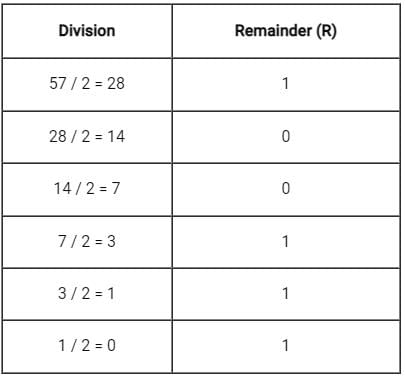
Now, write remainder from bottom to up (in reverse order), this will be 111001 which is equivalent binary number of decimal integer 57.
Convert decimal fractional number 0.375 into binary number.
Here, decimal fraction: 0.375
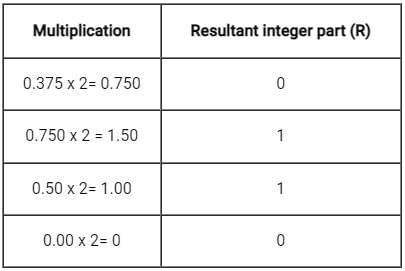
Now, write these resultant integer part, this will be 0.0110 which is equivalent binary fractional number of decimal fractional 0.375.
∴ 57.375 can be written as 111001.011 in binary
Hence, option (1) is correct.
Binary of 57:
Now, write remainder from bottom to up (in reverse order), this will be 111001 which is equivalent binary number of decimal integer 57.
Convert decimal fractional number 0.375 into binary number.
Here, decimal fraction: 0.375
Now, write these resultant integer part, this will be 0.0110 which is equivalent binary fractional number of decimal fractional 0.375.
∴ 57.375 can be written as 111001.011 in binary
Hence, option (1) is correct.
Which of the following statement is NOT correct?- a)Hexadecimal number uses sixteen distinct counting digits 0 through 9 and A through F
- b)The 1’s complement of a binary number is obtained by changing its each 0 into a 1
- c)Octal number has a base of 7
- d)Excess-3 Code is an unweighted code
Correct answer is option 'C'. Can you explain this answer?
Which of the following statement is NOT correct?
a)
Hexadecimal number uses sixteen distinct counting digits 0 through 9 and A through F
b)
The 1’s complement of a binary number is obtained by changing its each 0 into a 1
c)
Octal number has a base of 7
d)
Excess-3 Code is an unweighted code
| | Pooja Patel answered |
Hexadecimal Number System:
- It has a base of 16. Hence, it uses sixteen distinct counting digits 0 through 9 and A through F
- Place value (or weight) for each digit is in ascending powers of 16 for integers and descending powers of 16 for fractions.
- The chief use of this system is in connection with byte-organized machines.
- It is used for specifying addresses of different binary numbers stored in computer memory.
Complement of a Number: In digital work, two types of complements of a binary number are used for complemental sub-traction:
1’s complement:
- The 1’s complement of a binary number is obtained by changing each 0 into a 1 and each 1 into a 0.
- It is also called radix-minus-one complement.
- For example, 1’s complement of 1002 is 0112, and 0112 is 00012.
2’s complement:
- The 2’s complement of a binary number is obtained by adding 1 to its 1’s complement.
- 2’s complement = 1’s complement + 1
- It is also known as a true complement.
Octal Number System:
- It has a base of 8 which means that it has eight distinct counting digits: 0, 1, 2, 3, 4, 5, 6, and 7
- These digits 0 through 7, have precisely the same physical meaning as in the decimal system.
- For counting beyond 7, 2-digit combinations are formed taking the second digit followed by the first, then the second followed by the second, and so on.
- Hence, after 7, the next octal number is 10 (second digit followed by first), then 11 (second digit followed by second), and so on.
Excess-3 Code:
- It is an unweighted code and is a modified form of BCD.
- It is widely used to represent numerical data in digital equipment.
- It is abbreviated as XS-3. As its name implies, each coded number in XS-3 is three larger than in the BCD code.
Octal equivalent of 111010 is:- a)84
- b)70
- c)72
- d)None of these
Correct answer is option 'C'. Can you explain this answer?
Octal equivalent of 111010 is:
a)
84
b)
70
c)
72
d)
None of these
| | Pooja Patel answered |
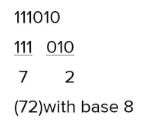

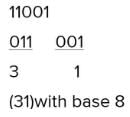
if the binary bits are less than three bits add 0 to the left hand side tp make a complete set
In sign-magnitude numbers- a)ms bit always 1
- b)ms bit 0 stands for the positive numbers
- c)ms bit 0 stands for the negative numbers
- d)ms bit 1 stand for the positive numbers
Correct answer is option 'B'. Can you explain this answer?
In sign-magnitude numbers
a)
ms bit always 1
b)
ms bit 0 stands for the positive numbers
c)
ms bit 0 stands for the negative numbers
d)
ms bit 1 stand for the positive numbers
| | Pooja Patel answered |
Signed magnitude representation uses the most significant bit (MSB) a sign bit.
- If the sign bit is ‘0’ then the number is positive.
- If the sign bit is ‘1’ then the number is negative.
The remaining bits represent the magnitude of the binary number.
2’s complement of 11001011 is ____________- a)01010111
- b)11010100
- c)00110101
- d)11100010
Correct answer is option 'C'. Can you explain this answer?
2’s complement of 11001011 is ____________
a)
01010111
b)
11010100
c)
00110101
d)
11100010
 | Prerna Tiwari answered |
2's complement of 11001011
To find the 2's complement of a binary number, we have to first find the 1's complement (flipping all the bits) and then add 1 to the result.
- 1's complement of 11001011
- The 1's complement of 11001011 is obtained by flipping all the bits: 00110100
- Adding 1 to the 1's complement
- To get the 2's complement, we add 1 to the 1's complement:
00110100
+ 00000001
00110101
Therefore, the 2's complement of 11001011 is 00110101, which corresponds to option C.
To find the 2's complement of a binary number, we have to first find the 1's complement (flipping all the bits) and then add 1 to the result.
- 1's complement of 11001011
- The 1's complement of 11001011 is obtained by flipping all the bits: 00110100
- Adding 1 to the 1's complement
- To get the 2's complement, we add 1 to the 1's complement:
00110100
+ 00000001
00110101
Therefore, the 2's complement of 11001011 is 00110101, which corresponds to option C.
Convert the binary number 10101110 to octal. - a)128
- b)184
- c)256
- d)312
Correct answer is option 'C'. Can you explain this answer?
Convert the binary number 10101110 to octal.
a)
128
b)
184
c)
256
d)
312
 | Partho Choudhary answered |
Understanding Binary to Octal Conversion
To convert the binary number 10101110 to octal, follow these steps:
Step 1: Group the Binary Digits
- Start from the right and group the binary digits into sets of three.
- If necessary, add leading zeros to the leftmost group to make it a full set of three.
For 10101110, we group it as follows:
- 010 101 110
Step 2: Convert Each Group to Decimal
- Now, convert each group of three binary digits to its octal equivalent.
- 010 in binary = 2 in decimal
- 101 in binary = 5 in decimal
- 110 in binary = 6 in decimal
Step 3: Combine the Octal Digits
- Combine the decimal values obtained from each group to form the final octal number.
- Therefore, the octal representation is 256.
Final Result
- The octal equivalent of the binary number 10101110 is 256.
Conclusion
- The correct answer for the conversion of the binary number 10101110 to octal is option 'C' - 256.
To convert the binary number 10101110 to octal, follow these steps:
Step 1: Group the Binary Digits
- Start from the right and group the binary digits into sets of three.
- If necessary, add leading zeros to the leftmost group to make it a full set of three.
For 10101110, we group it as follows:
- 010 101 110
Step 2: Convert Each Group to Decimal
- Now, convert each group of three binary digits to its octal equivalent.
- 010 in binary = 2 in decimal
- 101 in binary = 5 in decimal
- 110 in binary = 6 in decimal
Step 3: Combine the Octal Digits
- Combine the decimal values obtained from each group to form the final octal number.
- Therefore, the octal representation is 256.
Final Result
- The octal equivalent of the binary number 10101110 is 256.
Conclusion
- The correct answer for the conversion of the binary number 10101110 to octal is option 'C' - 256.
The number 149 in octal code is- a)154
- b)178
- c)254
- d)225
Correct answer is option 'D'. Can you explain this answer?
The number 149 in octal code is
a)
154
b)
178
c)
254
d)
225
| | Shivam Das answered |
Understanding Octal Conversion
To convert the decimal number 149 into octal, we follow a systematic process of dividing the number by 8 (the base of octal) and keeping track of the remainders.
Step-by-Step Conversion
1. Divide 149 by 8:
- 149 ÷ 8 = 18 with a remainder of 5.
- Record the remainder (5).
2. Divide the quotient (18) by 8:
- 18 ÷ 8 = 2 with a remainder of 2.
- Record the remainder (2).
3. Divide the next quotient (2) by 8:
- 2 ÷ 8 = 0 with a remainder of 2.
- Record the remainder (2).
Collecting Remainders
- Now we have the remainders in reverse order:
- From the last division to the first: 2, 2, 5.
Final Octal Representation
- Reading the remainders from the last division to the first gives us:
- 225 in octal.
Conclusion
Thus, the decimal number 149 is represented as 225 in octal code. Therefore, the correct answer is option 'D'.
To convert the decimal number 149 into octal, we follow a systematic process of dividing the number by 8 (the base of octal) and keeping track of the remainders.
Step-by-Step Conversion
1. Divide 149 by 8:
- 149 ÷ 8 = 18 with a remainder of 5.
- Record the remainder (5).
2. Divide the quotient (18) by 8:
- 18 ÷ 8 = 2 with a remainder of 2.
- Record the remainder (2).
3. Divide the next quotient (2) by 8:
- 2 ÷ 8 = 0 with a remainder of 2.
- Record the remainder (2).
Collecting Remainders
- Now we have the remainders in reverse order:
- From the last division to the first: 2, 2, 5.
Final Octal Representation
- Reading the remainders from the last division to the first gives us:
- 225 in octal.
Conclusion
Thus, the decimal number 149 is represented as 225 in octal code. Therefore, the correct answer is option 'D'.
The logic XOR operation of (4AC0)16 and (B53F)16 results________- a)AACB
- b)0000
- c)FFFF
- d)ABCD
Correct answer is option 'C'. Can you explain this answer?
The logic XOR operation of (4AC0)16 and (B53F)16 results________
a)
AACB
b)
0000
c)
FFFF
d)
ABCD
| | Bijoy Nair answered |
Logic XOR of hexadecimal numbers
XOR or exclusive OR is a logical operation that outputs true only when the two binary inputs are different. XOR operation is represented by the symbol ⊕. When used with hexadecimal numbers, the XOR operation is performed on each pair of corresponding bits.
Given hexadecimal numbers (4AC0)16 and (B53F)16, the XOR operation can be performed as follows:
4AC0 = 0100 1010 1100 0000
B53F = 1011 0101 0011 1111
XOR = 1111 1111 1111 1111
The result of the XOR operation is (FFFF)16, which is option C.
Explanation
- XOR operation: The XOR operation is a binary operation that takes two binary inputs and outputs true only if the inputs are different. The XOR operation is represented by the symbol ⊕.
- Conversion to binary: To perform the XOR operation on hexadecimal numbers, we need to convert them to binary. Each hexadecimal digit represents four binary digits or bits. For example, (4AC0)16 is equivalent to (0100 1010 1100 0000)2 in binary.
- Performing XOR: Once the numbers are in binary form, we can perform the XOR operation on each pair of corresponding bits. If both bits are the same, the result is 0. If the bits are different, the result is 1.
- Result: After performing the XOR operation on each pair of bits, we get the binary result of (1111 1111 1111 1111)2, which is equivalent to (FFFF)16 in hexadecimal form.
Conclusion
The logic XOR operation of (4AC0)16 and (B53F)16 results in (FFFF)16. This result is obtained by converting the hexadecimal numbers to binary, performing the XOR operation on each pair of corresponding bits, and converting the binary result back to hexadecimal form.
XOR or exclusive OR is a logical operation that outputs true only when the two binary inputs are different. XOR operation is represented by the symbol ⊕. When used with hexadecimal numbers, the XOR operation is performed on each pair of corresponding bits.
Given hexadecimal numbers (4AC0)16 and (B53F)16, the XOR operation can be performed as follows:
4AC0 = 0100 1010 1100 0000
B53F = 1011 0101 0011 1111
XOR = 1111 1111 1111 1111
The result of the XOR operation is (FFFF)16, which is option C.
Explanation
- XOR operation: The XOR operation is a binary operation that takes two binary inputs and outputs true only if the inputs are different. The XOR operation is represented by the symbol ⊕.
- Conversion to binary: To perform the XOR operation on hexadecimal numbers, we need to convert them to binary. Each hexadecimal digit represents four binary digits or bits. For example, (4AC0)16 is equivalent to (0100 1010 1100 0000)2 in binary.
- Performing XOR: Once the numbers are in binary form, we can perform the XOR operation on each pair of corresponding bits. If both bits are the same, the result is 0. If the bits are different, the result is 1.
- Result: After performing the XOR operation on each pair of bits, we get the binary result of (1111 1111 1111 1111)2, which is equivalent to (FFFF)16 in hexadecimal form.
Conclusion
The logic XOR operation of (4AC0)16 and (B53F)16 results in (FFFF)16. This result is obtained by converting the hexadecimal numbers to binary, performing the XOR operation on each pair of corresponding bits, and converting the binary result back to hexadecimal form.
How many bits would be required to encode decimal numbers 0 to 9999 in straight binary codes?- a)12
- b)14
- c)16
- d)18
Correct answer is option 'B'. Can you explain this answer?
How many bits would be required to encode decimal numbers 0 to 9999 in straight binary codes?
a)
12
b)
14
c)
16
d)
18
| | Alok Khanna answered |
To determine the number of bits required to encode decimal numbers from 0 to 9999 in straight binary codes, we need to consider the range of values and calculate the number of bits needed to represent the largest value in that range.
Range of Values:
The range of decimal numbers is from 0 to 9999.
Calculation:
To calculate the number of bits required to represent a decimal number in binary, we use the formula log2(n), where n is the decimal number.
For the largest number in the range, which is 9999, we calculate the number of bits required as follows:
Number of bits = log2(9999)
Using the logarithmic identity log2(x) = log10(x) / log10(2), we can rewrite the calculation as:
Number of bits = log10(9999) / log10(2)
Using a scientific calculator or logarithmic tables, we find:
Number of bits ≈ 13.29
Answer:
The number of bits required to encode decimal numbers 0 to 9999 in straight binary codes is approximately 13.29. Since we cannot have fractional bits, we round up to the nearest whole number, which is 14.
Therefore, the correct answer is option 'B' - 14.
Range of Values:
The range of decimal numbers is from 0 to 9999.
Calculation:
To calculate the number of bits required to represent a decimal number in binary, we use the formula log2(n), where n is the decimal number.
For the largest number in the range, which is 9999, we calculate the number of bits required as follows:
Number of bits = log2(9999)
Using the logarithmic identity log2(x) = log10(x) / log10(2), we can rewrite the calculation as:
Number of bits = log10(9999) / log10(2)
Using a scientific calculator or logarithmic tables, we find:
Number of bits ≈ 13.29
Answer:
The number of bits required to encode decimal numbers 0 to 9999 in straight binary codes is approximately 13.29. Since we cannot have fractional bits, we round up to the nearest whole number, which is 14.
Therefore, the correct answer is option 'B' - 14.
On subtracting (001100)2 from (101001)2 using 2’s complement, we get ____________- a)1101100
- b)011101
- c)11010101
- d)11010111
Correct answer is option 'B'. Can you explain this answer?
On subtracting (001100)2 from (101001)2 using 2’s complement, we get ____________
a)
1101100
b)
011101
c)
11010101
d)
11010111
| | Mihir Chawla answered |
To subtract (001100)2 from (101001)2 using base 2, we can set up the subtraction as follows:
101001 (top number)
- 001100 (bottom number)
____________
Starting from the rightmost digit, we subtract 0 from 1, which gives us 1. We then subtract 0 from 0, which gives us 0. Continuing with the subtraction, we subtract 1 from 1, which gives us 0. Next, we subtract 1 from 0, but we need to borrow from the next digit.
To borrow from the next digit, we change it from 0 to 1. Therefore, the next digit becomes 1, and we subtract 1 from 2, which gives us 1. Finally, we subtract 0 from 1, which gives us 1.
Thus, the result of subtracting (001100)2 from (101001)2 is (11101)2.
101001 (top number)
- 001100 (bottom number)
____________
Starting from the rightmost digit, we subtract 0 from 1, which gives us 1. We then subtract 0 from 0, which gives us 0. Continuing with the subtraction, we subtract 1 from 1, which gives us 0. Next, we subtract 1 from 0, but we need to borrow from the next digit.
To borrow from the next digit, we change it from 0 to 1. Therefore, the next digit becomes 1, and we subtract 1 from 2, which gives us 1. Finally, we subtract 0 from 1, which gives us 1.
Thus, the result of subtracting (001100)2 from (101001)2 is (11101)2.
Carry out BCD subtraction for (68) – (61) using 10’s complement method.- a)00000111
- b)01110000
- c)100000111
- d)011111000
Correct answer is option 'A'. Can you explain this answer?
Carry out BCD subtraction for (68) – (61) using 10’s complement method.
a)
00000111
b)
01110000
c)
100000111
d)
011111000
| | Pooja Patel answered |
First the two numbers are converted into their respective BCD form using 8421 sequence. Then binary subtraction is carried out.
Find the decimal equivalent of the 6-bit binary number (101.101)2- a)5.2510
- b)5.12510
- c)5.62510
- d)6.62510
Correct answer is option 'C'. Can you explain this answer?
Find the decimal equivalent of the 6-bit binary number (101.101)2
a)
5.2510
b)
5.12510
c)
5.62510
d)
6.62510
| | Pooja Patel answered |
The decimal equivalent of the binary number 101.101 is,
= 1 x 22 + 0 x 21 + 1 x 20 + 1 x 2-1 + 0 x 2-2 + 1 × 2-3
= 4 + 0 + 1 + 0.5 + 0 + 0.125
= 5.625
= 4 + 0 + 1 + 0.5 + 0 + 0.125
= 5.625
Convert the octal number (471)8 into equivalent binary number.- a)(100111101)2
- b)(100011101)2
- c)(100111001)2
- d)(100111011)2
Correct answer is option 'C'. Can you explain this answer?
Convert the octal number (471)8 into equivalent binary number.
a)
(100111101)2
b)
(100011101)2
c)
(100111001)2
d)
(100111011)2
| | Pooja Patel answered |
Octal to Binary Conversion:
- Every octal number is represented by a 3-bit binary equivalent.
- The table of binary representation for octal numbers (0 to 7) is given below:
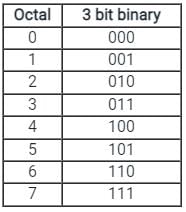
Explanation:
- From the above table, the binary equivalent of 4 is 100.
- The binary equivalent of 7 is 111.
- The binary equivalent of 1 is 000
.
Hence, the binary equivalent of octal number 471 is (100111001)2
Hence, the binary equivalent of octal number 471 is (100111001)2
State the octal equivalent of hexa decimal number (B34)16.- a)(6454)8
- b)(4564)8
- c)(5464)8
- d)(5645)8
Correct answer is option 'C'. Can you explain this answer?
State the octal equivalent of hexa decimal number (B34)16.
a)
(6454)8
b)
(4564)8
c)
(5464)8
d)
(5645)8
| | Pooja Patel answered |
Concept:
A number system includes the number of independent digits used in the number system (the base), the place values of the different digits constituting the number, and the maximum numbers that can be written with the given number of digits.
Octal numbers: These numbers use digits from 0 to 7, total of 8 digits, and hence they are called octal number system. Octal numbers have base 8.
Hexadecimal numbers: The numbers which have base 16. It uses 16 different digits to represent the numbers. It is denoted as h16, where h is a hexadecimal number. It may be a combination of alphabets and numbers. Thus, it includes numbers from 0 to 9 and alphabets A to F.
A number system includes the number of independent digits used in the number system (the base), the place values of the different digits constituting the number, and the maximum numbers that can be written with the given number of digits.
Octal numbers: These numbers use digits from 0 to 7, total of 8 digits, and hence they are called octal number system. Octal numbers have base 8.
Hexadecimal numbers: The numbers which have base 16. It uses 16 different digits to represent the numbers. It is denoted as h16, where h is a hexadecimal number. It may be a combination of alphabets and numbers. Thus, it includes numbers from 0 to 9 and alphabets A to F.
Calculation:
Hexadecimal to Octal Conversion:
Given, B3416 is a hexadecimal number.
B → 1011, 3 → 0011, 4 → 0100
1011 0011 0100
Now group them from right to left, each having 3 digits.
101, 100, 110, 100
101 → 5, 100 → 4, 110 → 6, 100 → 4
Hence, B3416 = 54648
Hexadecimal to Octal Conversion:
Given, B3416 is a hexadecimal number.
B → 1011, 3 → 0011, 4 → 0100
1011 0011 0100
Now group them from right to left, each having 3 digits.
101, 100, 110, 100
101 → 5, 100 → 4, 110 → 6, 100 → 4
Hence, B3416 = 54648
Add the two BCD numbers: 1001 + 0100 = ?- a)10101111
- b)01010000
- c)00010011
- d)00101011
Correct answer is option 'C'. Can you explain this answer?
Add the two BCD numbers: 1001 + 0100 = ?
a)
10101111
b)
01010000
c)
00010011
d)
00101011
| | Pooja Patel answered |
Firstly, Add the 1001 and 0100. We get 1101 as output but it’s not in BCD form. So, we add 0110 (i.e. 6) with 1101. As a result we get 10011 and it’s BCD form is 0001 0011.
On subtracting +28 from +29 using 2’s complement, we get ____________- a)11111010
- b)111111001
- c)100001
- d)1
Correct answer is option 'D'. Can you explain this answer?
On subtracting +28 from +29 using 2’s complement, we get ____________
a)
11111010
b)
111111001
c)
100001
d)
1
 | Anuj Rane answered |
To subtract 28 from 29 using 2, you would start with 29 and subtract 2 repeatedly until you reach 28.
29 - 2 = 27
27 - 2 = 25
25 - 2 = 23
23 - 2 = 21
21 - 2 = 19
19 - 2 = 17
17 - 2 = 15
15 - 2 = 13
13 - 2 = 11
11 - 2 = 9
9 - 2 = 7
7 - 2 = 5
5 - 2 = 3
3 - 2 = 1
So, subtracting 28 from 29 using 2 results in 1.
29 - 2 = 27
27 - 2 = 25
25 - 2 = 23
23 - 2 = 21
21 - 2 = 19
19 - 2 = 17
17 - 2 = 15
15 - 2 = 13
13 - 2 = 11
11 - 2 = 9
9 - 2 = 7
7 - 2 = 5
5 - 2 = 3
3 - 2 = 1
So, subtracting 28 from 29 using 2 results in 1.
Decimal equivalent of Hexadecimal number (C3B1)16 is- a)12197
- b)32097
- c)52097
- d)50097
Correct answer is option 'D'. Can you explain this answer?
Decimal equivalent of Hexadecimal number (C3B1)16 is
a)
12197
b)
32097
c)
52097
d)
50097
| | Pooja Patel answered |
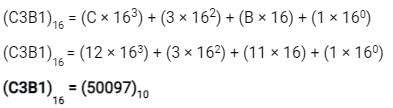
Hexadecimal number to decimal number
Binary to Hexadecimal conversion table:

The binary equivalent of 23 is- a)10111
- b)11011
- c)10110
- d)10011
Correct answer is option 'A'. Can you explain this answer?
The binary equivalent of 23 is
a)
10111
b)
11011
c)
10110
d)
10011
| | Pooja Patel answered |
Formula:
If we covert x decimal to binary, divide x successively by 2 until the quotient is 0.
If we covert x decimal to binary, divide x successively by 2 until the quotient is 0.
Calculation:
Divide 23 successively by 2 until the quotient is 0:
Divide 23 successively by 2 until the quotient is 0:
23/2 = 11, remainder is 1 (LSB)
11/2 = 5, remainder is 1
5/2 = 2, remainder is 1
2/2 = 1, remainder is 0
1/2 = 0, remainder is 1 (MSB)
11/2 = 5, remainder is 1
5/2 = 2, remainder is 1
2/2 = 1, remainder is 0
1/2 = 0, remainder is 1 (MSB)
Read from the bottom (MSB) to top (LSB) as 10111
∴ 10111 is the binary equivalent of decimal number 23
∴ 10111 is the binary equivalent of decimal number 23
Hexadecimal digits represented 1 to 9 and A to:- a)C
- b)F
- c)B
- d)D
Correct answer is option 'B'. Can you explain this answer?
Hexadecimal digits represented 1 to 9 and A to:
a)
C
b)
F
c)
B
d)
D
 | Luminary Institute answered |
The system uses 10 numerical digits and 6 alphabets –0, 1, 2, 3, 4, 5, 6, 7, 8, 9, 0, A, B, C, D, E, F.
- The Hexadecimal numbering system uses the Base of 16 system and is a popular choice for representing long binary values because their format is quite compact and much easier to understand.
- Being a Base-16 system, the hexadecimal numbering system, therefore, uses 16 (sixteen) different digits with a combination of numbers from 0 through to 15. In other words, there are 16 possible digit symbols.
- However, there is a potential problem with using this method of digit notation caused by the fact that the decimal numerals of 10, 11, 12, 13, 14 and 15 are normally written using two adjacent symbols.
- To get around this tricky problem hexadecimal numbers that identify the values of ten, eleven, twelve, thirteen, fourteen, and fifteen are replaced with capital letters of A, B, C, D, E and F respectively.
No of bits required to represent -6410 in 2’s complement form:
Correct answer is '7'. Can you explain this answer?
No of bits required to represent -6410 in 2’s complement form:
| | Pooja Patel answered |
64 in binary form is represented as:
6410 = (1000000)2
Taking the 1's complement of the above, we get 0111111
Adding 1 to the 1's complement, we get the 2's complement representation of the number, i.e. 1000000.
Since there is a 1 in the LSB, the number is a negative number with value 64.
∴ The 2's complement of -6410 contains 7 bits.
6410 = (1000000)2
Taking the 1's complement of the above, we get 0111111
Adding 1 to the 1's complement, we get the 2's complement representation of the number, i.e. 1000000.
Since there is a 1 in the LSB, the number is a negative number with value 64.
∴ The 2's complement of -6410 contains 7 bits.
Chapter doubts & questions for Number System & Representation - 6 Months Preparation for GATE Electrical 2026 is part of Electrical Engineering (EE) exam preparation. The chapters have been prepared according to the Electrical Engineering (EE) exam syllabus. The Chapter doubts & questions, notes, tests & MCQs are made for Electrical Engineering (EE) 2026 Exam. Find important definitions, questions, notes, meanings, examples, exercises, MCQs and online tests here.
Chapter doubts & questions of Number System & Representation - 6 Months Preparation for GATE Electrical in English & Hindi are available as part of Electrical Engineering (EE) exam. Download more important topics, notes, lectures and mock test series for Electrical Engineering (EE) Exam by signing up for free.
6 Months Preparation for GATE Electrical675 videos|1390 docs|885 tests |
