


All Exams > Electrical Engineering (EE) > 6 Months Preparation for GATE Electrical > All Questions
All questions of Differential Equations for Electrical Engineering (EE) Exam
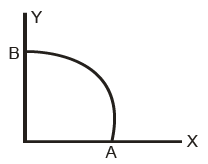


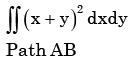
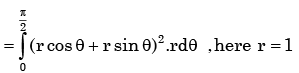
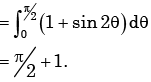
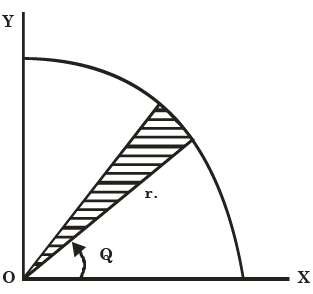


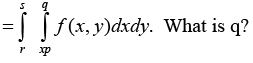

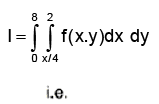
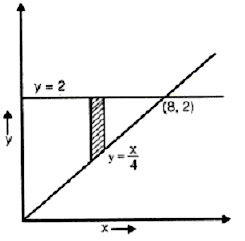
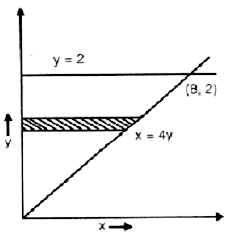
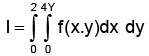

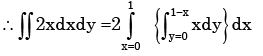
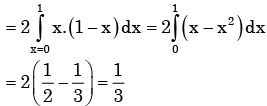
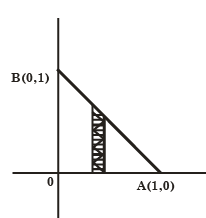
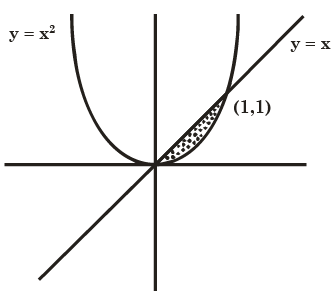
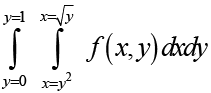
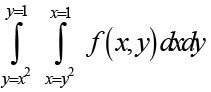
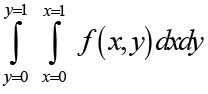
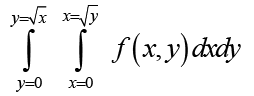
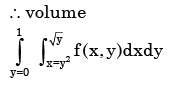
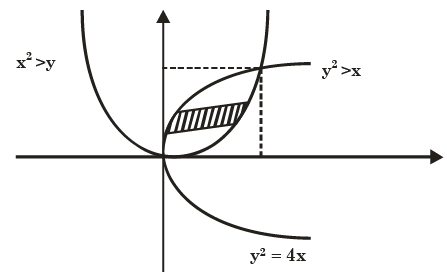
 over the triangle is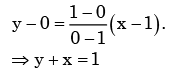
The following differential equation has 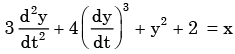 a)degree = 2, order = 1b)degree = 1, order = 2 c)degree = 4, order = 3 d)degree = 2, order = 3Correct answer is option 'B'. Can you explain this answer?
 | Anmol Basu answered |
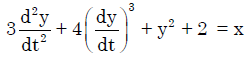
Order of highest derivative = 2
Hence, most appropriate answer is (b)
Hence, most appropriate answer is (b)
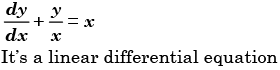
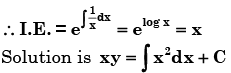
 with the condition that y = 1 at x = 1, is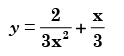
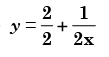


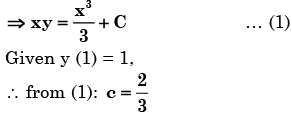
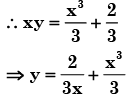
The general solution of the differential equation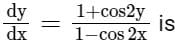
- a)tan y − cot x = c(c is a constant
- b)tan x − cot y = c(c is a constant)
- c)tan y + cot x = c(c is a constant)
- d)tan x + cot Y = c(c is a constant)
Correct answer is option 'C'. Can you explain this answer?
The general solution of the differential equation
a)
tan y − cot x = c(c is a constant
b)
tan x − cot y = c(c is a constant)
c)
tan y + cot x = c(c is a constant)
d)
tan x + cot Y = c(c is a constant)
 | Pioneer Academy answered |
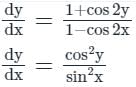
sec2ydy = cosec2x.dx
tan y = −cot x + c
tan y + cot x = c
A function n(x) satisfies the differential equation 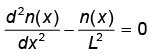 where L is a constant. The boundary conditions are: n(0)=K and n(∞)= 0. The solution to this equation is
 - a)n(x) = K exp(x/L)
- b)n(x) = K exp( x / √L )
- c)n(x) = K2 exp(-x/L)
- d)n(x) = K exp( -x/L)
Correct answer is option 'D'. Can you explain this answer?
A function n(x) satisfies the differential equation where L is a constant. The boundary conditions are: n(0)=K and n(∞)= 0. The solution to this equation is
where L is a constant. The boundary conditions are: n(0)=K and n(∞)= 0. The solution to this equation is a)
n(x) = K exp(x/L)
b)
n(x) = K exp( x / √L )
c)
n(x) = K2 exp(-x/L)
d)
n(x) = K exp( -x/L)
 | Sanvi Kapoor answered |
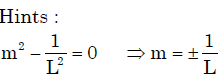
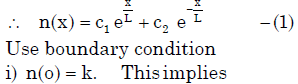


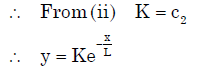
For finite solution c1 = 0
Which of the following equations cannot be solved by using the method of separation of variables?- a)Laplace Equation
- b)Helmholtz Equation
- c)Alpha Equation
- d)Biharmonic Equation
Correct answer is option 'C'. Can you explain this answer?
Which of the following equations cannot be solved by using the method of separation of variables?
a)
Laplace Equation
b)
Helmholtz Equation
c)
Alpha Equation
d)
Biharmonic Equation
 | Vertex Academy answered |
The method of separation of variables is used to solve a wide range of linear partial differential equations with boundary and initial conditions, such as:
- Heat equation
- Wave equation
- Laplace equation
- Helmholtz equation
- Biharmonic equation
The solution of dy/dx = y2 with initial value y(0) = 1 is bounded in the interval - a)−∞ ≤ x ≤ ∞
- b)−∞ ≤ x ≤ 1
- c)x < 1, x > 1
- d)−2 ≤ x ≤ 2
Correct answer is option 'C'. Can you explain this answer?
The solution of dy/dx = y2 with initial value y(0) = 1 is bounded in the interval
a)
−∞ ≤ x ≤ ∞
b)
−∞ ≤ x ≤ 1
c)
x < 1, x > 1
d)
−2 ≤ x ≤ 2
| | Vertex Academy answered |
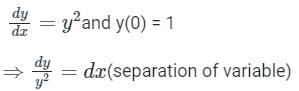
⇒ from the Integrating the equation, we get
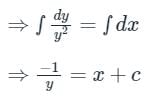
⇒ at x = 0, y = 1, hence -1/1 = c ⇒ c = -1
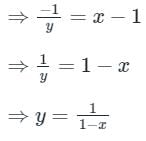
x ≠ 1, at (x = 1) y will be undefined
x > 1, x < 1
The general solution of (x2 D2 – xD), y= 0 is :- a) y = C1 + C2 ex
- b) y = C1 + C2 x2
- c)y = C1 x + C2 x2
- d)y = C1 + C2 x
Correct answer is option 'C'. Can you explain this answer?
The general solution of (x2 D2 – xD), y= 0 is :
a)
y = C1 + C2 ex
b)
y = C1 + C2 x2
c)
y = C1 x + C2 x2
d)
y = C1 + C2 x
 | Gate Gurus answered |
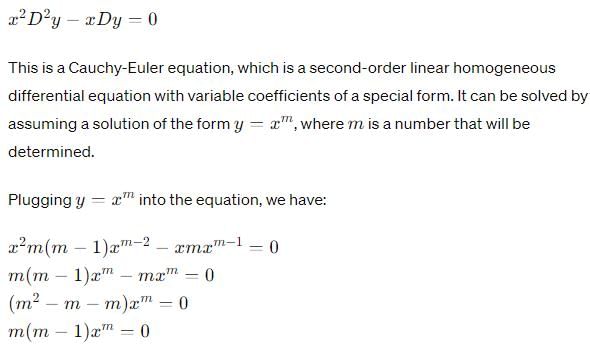
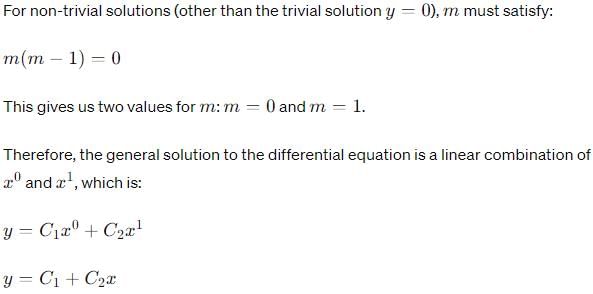
The correct answer is: y = C1 + C2 x
The solutions of the equation 3yy’ + 4x = 0 represents a:- a)Family of circles
- b)Family of ellipses
- c)Family of Parabolas
- d)Family of hyperbolas
Correct answer is option 'B'. Can you explain this answer?
The solutions of the equation 3yy’ + 4x = 0 represents a:
a)
Family of circles
b)
Family of ellipses
c)
Family of Parabolas
d)
Family of hyperbolas
 | Anshul Chakraborty answered |
Family of Ellipses
The given differential equation 3yy' + 4x = 0 can be rearranged to give y' = -4x / 3y. This is in the standard form of a first-order differential equation. To find the solutions of this equation, we need to integrate it with respect to x.
Integrating the Equation
By integrating the equation y' = -4x / 3y with respect to x, we get:
∫(1/y) dy = ∫(-4x/3) dx
This simplifies to:
ln|y| = -2x^2 + C
Where C is the constant of integration.
Exponential Form
Taking the exponential of both sides, we get:
|y| = e^(-2x^2 + C)
|y| = e^C * e^(-2x^2)
|y| = Ae^(-2x^2)
Where A = e^C is a non-zero constant.
Ellipse Equation
The equation obtained, |y| = Ae^(-2x^2), represents a family of ellipses. This is because the general form of an ellipse centered at the origin is given by:
(x/a)^2 + (y/b)^2 = 1
Comparing this with the equation obtained, we see that it is of the form:
y = Be^(Ax^2)
Which represents a family of ellipses with foci on the y-axis.
Therefore, the solutions of the given differential equation represent a family of ellipses.
The given differential equation 3yy' + 4x = 0 can be rearranged to give y' = -4x / 3y. This is in the standard form of a first-order differential equation. To find the solutions of this equation, we need to integrate it with respect to x.
Integrating the Equation
By integrating the equation y' = -4x / 3y with respect to x, we get:
∫(1/y) dy = ∫(-4x/3) dx
This simplifies to:
ln|y| = -2x^2 + C
Where C is the constant of integration.
Exponential Form
Taking the exponential of both sides, we get:
|y| = e^(-2x^2 + C)
|y| = e^C * e^(-2x^2)
|y| = Ae^(-2x^2)
Where A = e^C is a non-zero constant.
Ellipse Equation
The equation obtained, |y| = Ae^(-2x^2), represents a family of ellipses. This is because the general form of an ellipse centered at the origin is given by:
(x/a)^2 + (y/b)^2 = 1
Comparing this with the equation obtained, we see that it is of the form:
y = Be^(Ax^2)
Which represents a family of ellipses with foci on the y-axis.
Therefore, the solutions of the given differential equation represent a family of ellipses.
What is the area common to the circles r = a and r = 2a cos θ? - a)0.524 a2
- b)0.614 a2
- c)1.047 a2
- d)1.228 a2
Correct answer is option 'D'. Can you explain this answer?
What is the area common to the circles r = a and r = 2a cos θ?
a)
0.524 a2
b)
0.614 a2
c)
1.047 a2
d)
1.228 a2
 | Srishti Chopra answered |
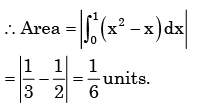
Area common to circles r = a
And r = 2a cos θ is 1.228 a2
Consider the following differential equation: Which of the following is the solution of the above equation (c is an arbitrary constant)?
- a)
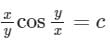
- b)
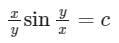
- c)
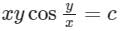
- d)
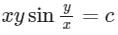
Correct answer is option 'C'. Can you explain this answer?
Consider the following differential equation:
Which of the following is the solution of the above equation (c is an arbitrary constant)?
a)
b)
c)
d)
| | Sanya Agarwal answered |
Given differential eqaution is,

Let, y = v × x
Let, y = v × x
dy = vdx + xdv
By substituting values of Y and dY in equation 1, we get
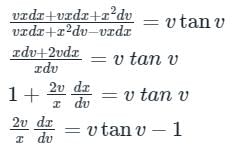
Integrating both sides
Integrating both sides
2 log x = log |sec v| - log v + log c
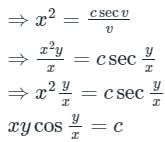
The solution of differential equation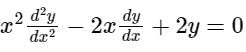 will be ___________, where c1 and c2 are arbitrary constants.
- a)y = c1x + c2x2
- b)y = c1 log x + c2x
- c)y = c1 + c2x
- d)y = c1x2 + c2x3
Correct answer is option 'A'. Can you explain this answer?
The solution of differential equationwill be ___________, where c1 and c2 are arbitrary constants.
will be ___________, where c1 and c2 are arbitrary constants.a)
y = c1x + c2x2
b)
y = c1 log x + c2x
c)
y = c1 + c2x
d)
y = c1x2 + c2x3
| | Gate Gurus answered |
Concept:
Linear differential equations with variable coefficients can be reduced to linear differential equations with constant coefficients by suitable substitutions.
Euler Cauchy Homogeneous linear equation:
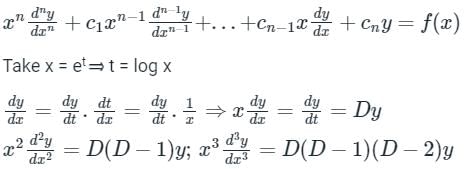
Calculation:
Calculation:
Given:
Euler Cauchy equation:
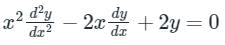
Now, the above differential equation becomes
Now, the above differential equation becomes
D (D – 1) y – 2 D y + 2 y = 0
⇒ D2 y – D y – 2 D y + 2 y = 0
⇒ (D2 – 3 D + 2) y = 0
Auxiliary equation:
(D2 – 3 D + 2) = 0
⇒ (D - 2) (D - 1) = 0
⇒ D = 2, 1
Now the roots are real and different, and the general solution of given equation is
y = c1 e2t + c2 et
⇒ y = c1x + c2x2
What is the complete solution for the equation x (y - z) p + y (z - x) q = z (x - y)?- a)ϕ (x + y + z, xyz) = 0
- b)ϕ (x + 2y + z, xz) = 0
- c)ϕ (2x + y + z, xyz) = 0
- d)ϕ (x + y + z, xy) = 0
Correct answer is option 'A'. Can you explain this answer?
What is the complete solution for the equation x (y - z) p + y (z - x) q = z (x - y)?
a)
ϕ (x + y + z, xyz) = 0
b)
ϕ (x + 2y + z, xz) = 0
c)
ϕ (2x + y + z, xyz) = 0
d)
ϕ (x + y + z, xy) = 0
| | Nilesh Kapoor answered |
To solve the equation x(y - z)p y(z - x)q = z(x - y), we need to simplify the equation and find the values of x, y, and z that satisfy the equation.
Given equation: x(y - z)p y(z - x)q = z(x - y)
Simplifying the equation:
xy^2p - xz^2p + y^2zq - yx^2q = zx - zy
xy^2p - xz^2p + y^2zq - yx^2q - zx + zy = 0
Now let's break down the options and see which one satisfies the equation:
a) (x y z, xyz) = 0
This option suggests that the values of x, y, and z multiplied together should be equal to zero. However, this condition does not ensure that the given equation is satisfied. Therefore, option 'A' is not the correct solution.
b) (x 2y z, xz) = 0
This option suggests that the values of x and z multiplied together should be equal to zero. Again, this condition does not guarantee that the equation is satisfied. Therefore, option 'B' is not the correct solution.
c) (2x y z, xyz) = 0
This option suggests that the values of 2x, y, and z multiplied together should be equal to zero. Similar to the previous options, this condition does not lead to the solution of the equation. Therefore, option 'C' is not the correct solution.
d) (x y z, xy) = 0
This option suggests that the values of x, y, and z multiplied by xy should be equal to zero. However, this condition does not satisfy the equation. Therefore, option 'D' is not the correct solution.
Therefore, the correct solution for the equation x(y - z)p y(z - x)q = z(x - y) is option 'A', which states that (x y z, xyz) = 0.
Given equation: x(y - z)p y(z - x)q = z(x - y)
Simplifying the equation:
xy^2p - xz^2p + y^2zq - yx^2q = zx - zy
xy^2p - xz^2p + y^2zq - yx^2q - zx + zy = 0
Now let's break down the options and see which one satisfies the equation:
a) (x y z, xyz) = 0
This option suggests that the values of x, y, and z multiplied together should be equal to zero. However, this condition does not ensure that the given equation is satisfied. Therefore, option 'A' is not the correct solution.
b) (x 2y z, xz) = 0
This option suggests that the values of x and z multiplied together should be equal to zero. Again, this condition does not guarantee that the equation is satisfied. Therefore, option 'B' is not the correct solution.
c) (2x y z, xyz) = 0
This option suggests that the values of 2x, y, and z multiplied together should be equal to zero. Similar to the previous options, this condition does not lead to the solution of the equation. Therefore, option 'C' is not the correct solution.
d) (x y z, xy) = 0
This option suggests that the values of x, y, and z multiplied by xy should be equal to zero. However, this condition does not satisfy the equation. Therefore, option 'D' is not the correct solution.
Therefore, the correct solution for the equation x(y - z)p y(z - x)q = z(x - y) is option 'A', which states that (x y z, xyz) = 0.
General solution of the Cauchy-Euler equation
- a)y = c1x2 + c2x4
- b)y = c1x2 + c2x-4
- c)y = (c1 + c2 In x) x4
- d)y = c1x4 + c2x-4 In x
Correct answer is option 'C'. Can you explain this answer?
General solution of the Cauchy-Euler equation
a)
y = c1x2 + c2x4
b)
y = c1x2 + c2x-4
c)
y = (c1 + c2 In x) x4
d)
y = c1x4 + c2x-4 In x
| | Gate Gurus answered |
Concept:
For different roots of the auxiliary equation, the solution (complementary function) of the differential equation is as shown below.
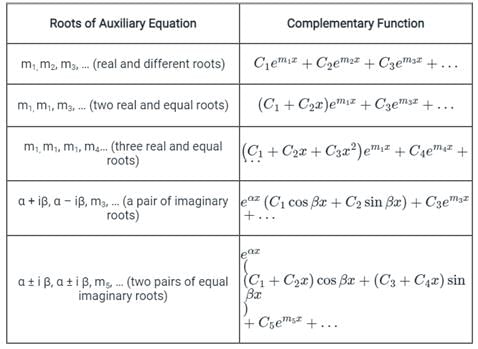
Calculation:
Calculation:
Given:
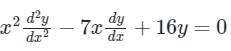
Put x = et
Put x = et
⇒ t = ln x

Now, the above differential equation becomes
Now, the above differential equation becomes
D(D – 1)y – 7Dy + 16y = 0
⇒ D2y – Dy – 7Dy + 16y = 0
⇒ (D2 – 8D + 16)y = 0
Auxiliary equation:
(D2 – 8 D + 16) = 0
⇒ D = 4
The solutions for the above roots of auxiliary equations are:
y(t) = (c1 + c2 t) e4t
⇒ y(x) = (c1 + c2 ln x) x4
A solution which does not contain any arbitrary constants is called a general solution.- a)True
- b)False
Correct answer is option 'A'. Can you explain this answer?
A solution which does not contain any arbitrary constants is called a general solution.
a)
True
b)
False
| | Rahul Chauhan answered |
The answer is True.
Explanation:
In mathematics and engineering, a solution that does not contain any arbitrary constants is referred to as a general solution. This means that the solution represents all possible solutions to a given problem or equation, without any additional constraints or specific values.
Definition of a General Solution:
A general solution is a solution in which all possible solutions to a problem or equation are included. It does not contain any arbitrary constants, which means that it represents the complete set of solutions without any additional restrictions or specific values.
Characteristics of a General Solution:
1. Contains No Arbitrary Constants: A general solution does not involve any arbitrary constants. It represents the complete set of solutions without imposing any specific values or restrictions.
2. Represents All Possible Solutions: A general solution encompasses all possible solutions to a problem or equation. It includes all valid solutions without any additional constraints.
3. Allows for Flexibility: Since a general solution does not involve any arbitrary constants, it allows for flexibility in determining specific solutions. It provides a framework within which specific solutions can be derived by assigning suitable values to the constants.
4. Can Be Modified: A general solution can be modified or refined by adding specific constraints or conditions. By introducing additional information or requirements, a more specific solution can be obtained.
5. Applies to a Range of Problems: The concept of a general solution is applicable to various mathematical and engineering problems. It is a fundamental concept in differential equations, linear algebra, and other branches of mathematics.
In conclusion, a general solution is a solution that represents all possible solutions to a problem or equation without any arbitrary constants. It offers flexibility and can be modified or refined to obtain more specific solutions.
Explanation:
In mathematics and engineering, a solution that does not contain any arbitrary constants is referred to as a general solution. This means that the solution represents all possible solutions to a given problem or equation, without any additional constraints or specific values.
Definition of a General Solution:
A general solution is a solution in which all possible solutions to a problem or equation are included. It does not contain any arbitrary constants, which means that it represents the complete set of solutions without any additional restrictions or specific values.
Characteristics of a General Solution:
1. Contains No Arbitrary Constants: A general solution does not involve any arbitrary constants. It represents the complete set of solutions without imposing any specific values or restrictions.
2. Represents All Possible Solutions: A general solution encompasses all possible solutions to a problem or equation. It includes all valid solutions without any additional constraints.
3. Allows for Flexibility: Since a general solution does not involve any arbitrary constants, it allows for flexibility in determining specific solutions. It provides a framework within which specific solutions can be derived by assigning suitable values to the constants.
4. Can Be Modified: A general solution can be modified or refined by adding specific constraints or conditions. By introducing additional information or requirements, a more specific solution can be obtained.
5. Applies to a Range of Problems: The concept of a general solution is applicable to various mathematical and engineering problems. It is a fundamental concept in differential equations, linear algebra, and other branches of mathematics.
In conclusion, a general solution is a solution that represents all possible solutions to a problem or equation without any arbitrary constants. It offers flexibility and can be modified or refined to obtain more specific solutions.
Consider the following statements about the linear dependence of the real valued functions y1 = 1, y2 = x and y3 = x2, over the field of real numbers.I. y1, y2 and y3 are linearly independent on – 1 ≤ x ≤ 0II. y1, y2 and y3 are linearly dependent on 0 ≤ x ≤ 1III. y1, y2 and y3 are linearly independent on 0 ≤ x ≤ 1IV. y1, y2 and y3 are linearly dependent on – 1 ≤ x ≤ 0Which one among the following is correct?- a)Both I and II are true
- b)Both I and III are true
- c)Both II and IV are true
- d)Both III and IV are true
Correct answer is option 'B'. Can you explain this answer?
Consider the following statements about the linear dependence of the real valued functions y1 = 1, y2 = x and y3 = x2, over the field of real numbers.
I. y1, y2 and y3 are linearly independent on – 1 ≤ x ≤ 0
II. y1, y2 and y3 are linearly dependent on 0 ≤ x ≤ 1
III. y1, y2 and y3 are linearly independent on 0 ≤ x ≤ 1
IV. y1, y2 and y3 are linearly dependent on – 1 ≤ x ≤ 0
Which one among the following is correct?
a)
Both I and II are true
b)
Both I and III are true
c)
Both II and IV are true
d)
Both III and IV are true
| | Anuj Verma answered |
Analysis:
To determine the linear dependence of the functions y1= 1, y2= x, and y3= x^2, we need to check if there exist constants c1, c2, and c3 not all zero such that c1*y1 + c2*y2 + c3*y3 = 0 for all x in the given interval.
For -1 ≤ x ≤ 0:
In this interval, y1 = 1, y2 = x, and y3 = x^2. We need to find constants c1, c2, and c3 such that c1*1 + c2*x + c3*x^2 = 0 for all x in this interval.
Since this equation is a quadratic, it can only be satisfied if c1 = c2 = c3 = 0. Therefore, y1, y2, and y3 are linearly independent in this interval.
For 0 ≤ x ≤ 1:
In this interval, we have the same functions y1, y2, and y3. We need to find constants c1, c2, and c3 such that c1*1 + c2*x + c3*x^2 = 0 for all x in this interval.
Since this equation is a quadratic, it can only be satisfied if c1 = c2 = c3 = 0. Therefore, y1, y2, and y3 are linearly independent in this interval.
Conclusion:
Therefore, the correct statement is that both I and III are true. In the given intervals, the functions y1, y2, and y3 are linearly independent.
To determine the linear dependence of the functions y1= 1, y2= x, and y3= x^2, we need to check if there exist constants c1, c2, and c3 not all zero such that c1*y1 + c2*y2 + c3*y3 = 0 for all x in the given interval.
For -1 ≤ x ≤ 0:
In this interval, y1 = 1, y2 = x, and y3 = x^2. We need to find constants c1, c2, and c3 such that c1*1 + c2*x + c3*x^2 = 0 for all x in this interval.
Since this equation is a quadratic, it can only be satisfied if c1 = c2 = c3 = 0. Therefore, y1, y2, and y3 are linearly independent in this interval.
For 0 ≤ x ≤ 1:
In this interval, we have the same functions y1, y2, and y3. We need to find constants c1, c2, and c3 such that c1*1 + c2*x + c3*x^2 = 0 for all x in this interval.
Since this equation is a quadratic, it can only be satisfied if c1 = c2 = c3 = 0. Therefore, y1, y2, and y3 are linearly independent in this interval.
Conclusion:
Therefore, the correct statement is that both I and III are true. In the given intervals, the functions y1, y2, and y3 are linearly independent.
A function y(t) such that y(0) = 1 and y(1) = 3e-1, is a solution of the differential equation 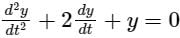 . Then y(2) is
- a)5e−1
- b)5e−2
- c)7e−1
- d)7e−2
Correct answer is option 'B'. Can you explain this answer?
A function y(t) such that y(0) = 1 and y(1) = 3e-1, is a solution of the differential equation . Then y(2) is
. Then y(2) isa)
5e−1
b)
5e−2
c)
7e−1
d)
7e−2
| | Pioneer Academy answered |
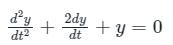
By applying the Laplace transform,
s2Y(s) − sy(0) − y′(0) + 2sY(s) − 2y(0) + Y(s) = 0
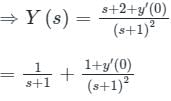
By applying the inverse Laplace transform
y(t) = e−t + (1 + y′(0))te−t
y(1) = 3 e-1
⇒ y(1) = e-1 + (1 + y’(0)) e-1 = 3 e-1
⇒ y’(0) = 1
Now the equation of y(t) becomes
y(t) = (1 + 2t) e-t
At t = 2,
y(2) = 5 e-2
Solve the following equation:
yexydx + (xexy + 2y)dy = 0- a)xexy + 2y2 = c
- b)xexy + y2 = c
- c)exy + 2y2 = c
- d)exy + y2 = c
Correct answer is option 'D'. Can you explain this answer?
Solve the following equation:
yexydx + (xexy + 2y)dy = 0
yexydx + (xexy + 2y)dy = 0
a)
xexy + 2y2 = c
b)
xexy + y2 = c
c)
exy + 2y2 = c
d)
exy + y2 = c
 | Anagha Mehta answered |
To solve the given equation, we need to separate the variables and integrate both sides with respect to their respective variables.
Given equation:
∫yexydx + ∫(xexy - 2y)dy = 0
Now let's solve each integral separately.
1. Integral with respect to x:
We can use integration by parts for the first integral. Let u = y and dv = exydx. Then du = dy and v = ∫exydx.
Using the integration by parts formula:
∫yexydx = y∫exydx - ∫(dy/ dx)∫exydx
= y∫exydx - ∫(1)(∫exydx)
= yexy - ∫exydx
2. Integral with respect to y:
∫(xexy - 2y)dy = ∫(xexy)dy - ∫(2y)dy
= x∫exydy - 2∫ydy
= xexy - y^2
Now let's substitute the results of the integrals back into the original equation:
yexy - ∫exydx + xexy - y^2 = 0
Combining like terms:
2yexy - y^2 - ∫exydx = 0
Rearranging the equation:
∫exydx = 2yexy - y^2
Comparing this equation with the given options:
exy - y^2 = c
We can see that the correct answer is option D: exy - y^2 = c.
Given equation:
∫yexydx + ∫(xexy - 2y)dy = 0
Now let's solve each integral separately.
1. Integral with respect to x:
We can use integration by parts for the first integral. Let u = y and dv = exydx. Then du = dy and v = ∫exydx.
Using the integration by parts formula:
∫yexydx = y∫exydx - ∫(dy/ dx)∫exydx
= y∫exydx - ∫(1)(∫exydx)
= yexy - ∫exydx
2. Integral with respect to y:
∫(xexy - 2y)dy = ∫(xexy)dy - ∫(2y)dy
= x∫exydy - 2∫ydy
= xexy - y^2
Now let's substitute the results of the integrals back into the original equation:
yexy - ∫exydx + xexy - y^2 = 0
Combining like terms:
2yexy - y^2 - ∫exydx = 0
Rearranging the equation:
∫exydx = 2yexy - y^2
Comparing this equation with the given options:
exy - y^2 = c
We can see that the correct answer is option D: exy - y^2 = c.
A particle undergoes forced vibrations according to the law xn(t) + 25x(t) = 21 sin t. If the particle starts from rest at t = 0, find the displacement at any time t > 0. - a)

- b)

- c)

- d)

Correct answer is option 'B'. Can you explain this answer?
A particle undergoes forced vibrations according to the law xn(t) + 25x(t) = 21 sin t. If the particle starts from rest at t = 0, find the displacement at any time t > 0.
a)
b)
c)
d)
| | Sanya Agarwal answered |
Concept:
The solution of the linear differential equation is of the form:
y = C.F + P.I
where C.F is the complementary function and P.I is the particular integral.
The 2nd order linear differential equation in the symbolic form is represented as:
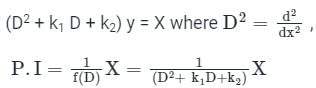
When X = Sin(ax)
f(-a2) is calculated by replacing D2 with a2 in f(D)
In the case of a forced damped system, the vibration equation:
 The solution of x is (CF + PI)
Where CF is complimentary function and PI is particular integral
But after some time CF becomes zero.
∴ x = P.I
Calculation:
Given:
xn(t) + 25x(t) = 21 sin t
The above equation can be written as:
D2 + 25x = 21 × Sin (t)
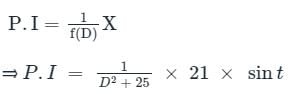
Here, a = 1, So putting -a2 = D2 = -1 in the above equation
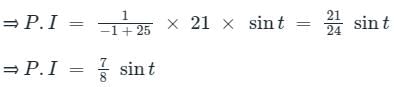
∴ The displacement at any time t > 0 = 
A particular solution for an equation is derived by substituting particular values to the arbitrary constants in the complete solution.- a)True
- b)False
Correct answer is option 'A'. Can you explain this answer?
A particular solution for an equation is derived by substituting particular values to the arbitrary constants in the complete solution.
a)
True
b)
False
| | Akshat Datta answered |
Particular Solution in Differential Equations:
When solving a differential equation, the general solution typically contains arbitrary constants that need to be determined. A particular solution is then found by substituting specific values into these arbitrary constants to satisfy any initial or boundary conditions given in the problem.
Importance of Particular Solution:
The particular solution is crucial as it provides the specific solution that meets the given conditions, making it unique among the infinite solutions that may exist for the differential equation. It allows us to find the exact solution that fits the problem at hand.
Process of Finding Particular Solution:
1. Begin by solving the differential equation to find the general solution, which includes arbitrary constants.
2. Use the initial or boundary conditions provided in the problem to determine the values of these arbitrary constants.
3. Substitute these specific values back into the general solution to obtain the particular solution that satisfies the given conditions.
Verification of Particular Solution:
Once the particular solution is found, it should be verified by substituting it back into the original differential equation to ensure that it indeed satisfies the equation. This step confirms that the particular solution is correct and meets all the requirements of the problem.
Conclusion:
In conclusion, a particular solution for a differential equation is derived by substituting particular values into the arbitrary constants in the general solution. It plays a vital role in providing the unique solution that meets the given conditions of the problem, and its accuracy should always be verified through the verification process.
When solving a differential equation, the general solution typically contains arbitrary constants that need to be determined. A particular solution is then found by substituting specific values into these arbitrary constants to satisfy any initial or boundary conditions given in the problem.
Importance of Particular Solution:
The particular solution is crucial as it provides the specific solution that meets the given conditions, making it unique among the infinite solutions that may exist for the differential equation. It allows us to find the exact solution that fits the problem at hand.
Process of Finding Particular Solution:
1. Begin by solving the differential equation to find the general solution, which includes arbitrary constants.
2. Use the initial or boundary conditions provided in the problem to determine the values of these arbitrary constants.
3. Substitute these specific values back into the general solution to obtain the particular solution that satisfies the given conditions.
Verification of Particular Solution:
Once the particular solution is found, it should be verified by substituting it back into the original differential equation to ensure that it indeed satisfies the equation. This step confirms that the particular solution is correct and meets all the requirements of the problem.
Conclusion:
In conclusion, a particular solution for a differential equation is derived by substituting particular values into the arbitrary constants in the general solution. It plays a vital role in providing the unique solution that meets the given conditions of the problem, and its accuracy should always be verified through the verification process.
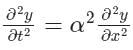
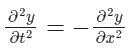
One dimensional wave equation is- a)
- b)

- c)
- d)None of these
Correct answer is option 'A'. Can you explain this answer?
One dimensional wave equation is
a)
b)
c)
d)
None of these
| | Pioneer Academy answered |
Concept:
Wave equation:
It is a second-order linear partial differential equation for the description of waves (like mechanical waves).
The Partial Differential equation is given as,
For One-Dimensional equation,
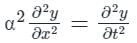
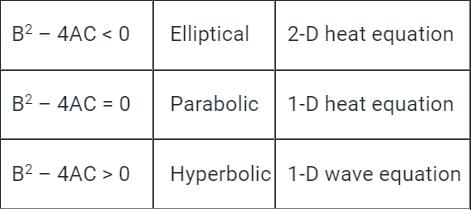
where, A = α2, B = 0, C = -1
Put all the values in equation (1)
∴ 0 - 4 (α2)(-1)
4α2 > 0.
So, this is a one-dimensional wave equation.
Additional Information
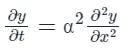
having A = α2, B = 0, C = 0
Put all the values in equation (1), we get
0 - 4(α2)(0) = 0, therefore it shows parabolic function.
So, this is a one-dimensional heat equation.
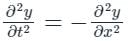
having A = 1, B = 0, C = 1
Put all the values in equation (1), we get 0 - 4(1)(1) = -4, therefore it shows elliptical function.
So, this is a two-dimensional heat equation.
Wave equation:
It is a second-order linear partial differential equation for the description of waves (like mechanical waves).
The Partial Differential equation is given as,
For One-Dimensional equation,
where, A = α2, B = 0, C = -1
Put all the values in equation (1)
∴ 0 - 4 (α2)(-1)
4α2 > 0.
So, this is a one-dimensional wave equation.
Additional Information
having A = α2, B = 0, C = 0
Put all the values in equation (1), we get
0 - 4(α2)(0) = 0, therefore it shows parabolic function.
So, this is a one-dimensional heat equation.
having A = 1, B = 0, C = 1
Put all the values in equation (1), we get 0 - 4(1)(1) = -4, therefore it shows elliptical function.
So, this is a two-dimensional heat equation.
The integrating factor of the differential equation
- a)x2(x2 - 1)
- b)x2(x2 + 1)
- c)x(x2 - 1)
- d)x(x2 + 1)
Correct answer is option 'A'. Can you explain this answer?
The integrating factor of the differential equation
a)
x2(x2 - 1)
b)
x2(x2 + 1)
c)
x(x2 - 1)
d)
x(x2 + 1)
| | Sanya Agarwal answered |
Concept:
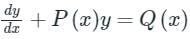
Equation of this type is known as Linear First Order Equation, whose solution is given by: y(I.F.) = ∫(Q × I.F.)dx + c whereI.F. = e∫Pdx
Equation of this type is known as Linear First Order Equation, whose solution is given by: y(I.F.) = ∫(Q × I.F.)dx + c whereI.F. = e∫Pdx
Calculation:
Given:
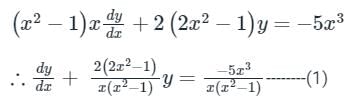
By comparing equation (1) with
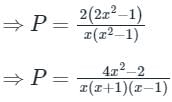
Solving through partial fraction method

(x + 1)(x - 1)A + x(x-1)B + x(x + 1)C = 4x2 – 2
By comparing equation (1) with
Solving through partial fraction method
(x + 1)(x - 1)A + x(x-1)B + x(x + 1)C = 4x2 – 2
Ax2 – A + Bx2 – Bx + Cx2 + Cx = 4x2 – 2
(A + B + C)x2 + (C - B)x – A = 4x2 – 2
Comparing co-efficient of x2, x, and constants we get
A + B + C = 4 ……. (ii)
C – B = 0
⇒ B = C
A = 2
∵ A + B + C = 4
⇒ 2 + B + C = 4
⇒ B + C = 2
∴ B = C = 1
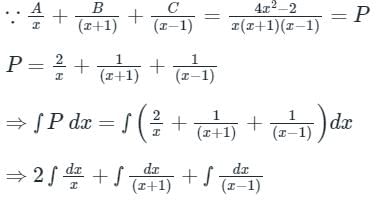
⇒ 2ln x + ln (x + 1) + ln (x - 1)
⇒ 2ln x + ln (x + 1) + ln (x - 1)
⇒ ln x2 + ln (x2 - 1)
⇒ ln x2(x2 - 1)
∵I.F. = e∫Pdx

⇒ I.F = x2 (x2 - 1)
For the equation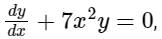 if y(0) = 3/7, then the value of y(1) is
- a)

- b)

- c)

- d)

Correct answer is option 'C'. Can you explain this answer?
For the equationif y(0) = 3/7, then the value of y(1) is
if y(0) = 3/7, then the value of y(1) isa)
b)
c)
d)
| | Sanya Agarwal answered |
Concept:
For solving first order, first-degree differential equations always first inspect with variable separation method.
Calculation:
Given the differential equation is,

separating variables
dy/y = −7x2dx, integrating both sides;

Where A is a constant.
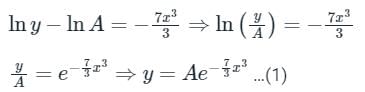
Use condition y(0) = 3/7 in (1)

Where A is a constant.
Use condition y(0) = 3/7 in (1)
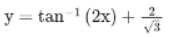
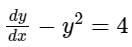 satisfying the condition y(0) = 1/√3

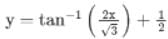
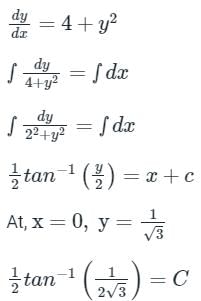
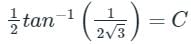

The integrating factor of equation
- a)

- b)

- c)

- d)

Correct answer is option 'A'. Can you explain this answer?
The integrating factor of equation
a)
b)
c)
d)
| | Vertex Academy answered |
Concept:
The standard form of a first-order linear differential equation is,
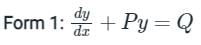
Where P and Q are the functions of x.
Where P and Q are the functions of x.
Integrating factor, IF = e∫Pdx
Now, the solution for the above differential equation is,
y(IF) = ∫IF.Qdx + C

Where P and Q are the functions of y.
Integrating factor, IF = e∫Pdy
Now, the solution for the above differential equation is,
x(IF) = ∫IF.Qdy + C
Calculation:
Given the differential equation is

Put tan y = t
By differentiating with respect to t,
⇒ sec2 y dy = dt
Now, the given equation becomes
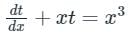
Now, it is in the form of a first order linear differential equation.
Integrating factor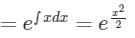
The differential equation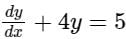 is valid in the domain 0 ≤ x ≤ 1 with y (0) = 2.25 The solution of the differential equation is
- a)y = e-4x + 5
- b)y = e-4x + 1.25
- c)y= e4x + 5
- d)y= e4x + 1.25
Correct answer is option 'B'. Can you explain this answer?
The differential equationis valid in the domain 0 ≤ x ≤ 1 with y (0) = 2.25 The solution of the differential equation is
is valid in the domain 0 ≤ x ≤ 1 with y (0) = 2.25 The solution of the differential equation isa)
y = e-4x + 5
b)
y = e-4x + 1.25
c)
y= e4x + 5
d)
y= e4x + 1.25
| | Sanvi Kapoor answered |
Concept:
If the differential equation is in the form of:
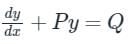
Integrating factor:
Integrating factor:
IF = e∫Pdx
Solution for equation:
y(IF) = ∫(IF)Qdx + C
Calculation:
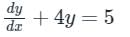
where 0 ≤ x ≤ 1 and y (0) = 2.25
This differential equation is in the linear form,
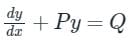
Where P = 4, Q = 5
∴ IF = e∫Pdx = e∫4dx = e4x
Solution of differential equation

Using y (0) = 2.25

c = 1

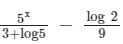
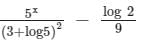
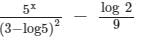
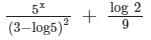
The particular integral of (D + 3)2 y = 5x - log 2, is- a)
- b)
- c)
- d)
Correct answer is option 'B'. Can you explain this answer?
The particular integral of (D + 3)2 y = 5x - log 2, is
a)
b)
c)
d)
| | Vertex Academy answered |
Given:
(D + 3)2y = 5x - log 2
Formula Used:
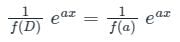
e log x = x
Calculation:
We have,
⇒ (D + 3)2y = 5x - log 2
Particular Integral of the differential equation is
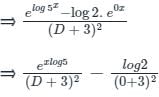
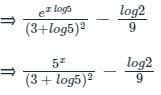
∴ The particular integral of (D + 3)2y = 5x - log 2 is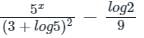
∴ The particular integral of (D + 3)2y = 5x - log 2 is
The solution to x2y’’ + xy’ – y = 0 is- a)y = c1x2 + c2x-3
- b)y = c1 + c2x-2
- c)

- d)y = c1x + c2x4
Correct answer is option 'C'. Can you explain this answer?
The solution to x2y’’ + xy’ – y = 0 is
a)
y = c1x2 + c2x-3
b)
y = c1 + c2x-2
c)
d)
y = c1x + c2x4
| | Sanya Agarwal answered |
Concept:
For different roots of the auxiliary equation, the solution (complementary function) of the differential equation is as shown below.
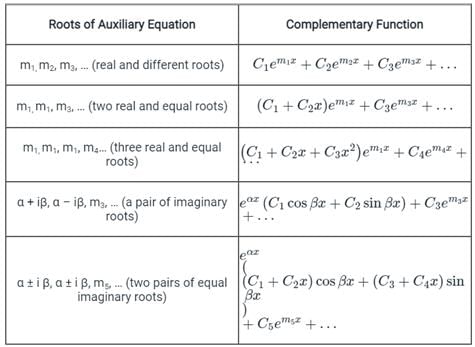
Calculation:
Calculation:
Given:
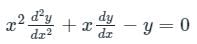
Put x = et
Put x = et
⇒ t = ln x

Now, the above differential equation becomes
Now, the above differential equation becomes
D(D – 1)y + Dy - y = 0
⇒ D2y – Dy + Dy - y = 0
⇒ (D2 -1)y = 0
Auxiliary equation:
(m2 – 1) = 0
⇒ m = ±1
The solutions for the above roots of auxiliary equations are:
y(t) = c1 et + c2 e-t
y(x) = c1 x + c2 x-1
The solution ex, e-x, and e2x of  will be:
- a)linearly dependent for x ϵ [-2, 2] and linearly independent elsewhere.
- b)linearly independent for x ϵ [-1, 1] and linearly independent elsewhere.
- c)linearly independent on every real interval.
- d)linearly dependent for all real x.
Correct answer is option 'C'. Can you explain this answer?
The solution ex, e-x, and e2x of will be:
will be:a)
linearly dependent for x ϵ [-2, 2] and linearly independent elsewhere.
b)
linearly independent for x ϵ [-1, 1] and linearly independent elsewhere.
c)
linearly independent on every real interval.
d)
linearly dependent for all real x.
| | Sanya Agarwal answered |
Concept:
Write auxillary equation by replacing

Equate to 0 and solve for (m) (f(m) = 0)
for m1, m2, m3, … (real and different roots)
Complementary function (CF) is given as:

Calculation:

The above expression is in the form f(D)y = X and can be written as:
D3 y - 2D2y - Dy + 2y = 0
y(D3 - 2 × D2 - D + 2) = 0
D3 - 2D2 - D + 2 = 0
The auxiliary equation is f(m) = 0
m3 - 2m2 - m + 2 = 0
(m - 1)(m + 1)(m - 2) = 0
So, the roots the auxiliary equation are m1 = 1, m2 = -1, m3 = 2.
The characteristics of the roots are real and distinct.
C.F = yc = c1em1x + c2em2x + c3em3x
yc = c1ex + c2e-x + c3e2x
So the solution will be linearly independent on every real interval.
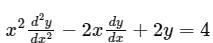
A differential equation is given as:
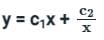
The solution of the differential equation in terms of arbitrary constants C1 and C2 is- a)y = C2x2 + C1x + 2
- b)
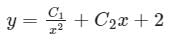
- c)y = C1x2 + C2x + 4
- d)
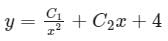
Correct answer is option 'A'. Can you explain this answer?
A differential equation is given as:
The solution of the differential equation in terms of arbitrary constants C1 and C2 is
The solution of the differential equation in terms of arbitrary constants C1 and C2 is
a)
y = C2x2 + C1x + 2
b)
c)
y = C1x2 + C2x + 4
d)
| | Vertex Academy answered |
Given differential equation:

is the standard form of Euler-Cauchy DE.
So, let x = ez
⇒ dx = ezdz = x.dz

Similarly, we can obtain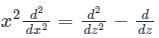
⇒ xD = θ
⇒ x2D2 = θ (θ - 1)
Making these substitutions in given DE, we get

(θ (θ - 1) – 2θ + 2) y = 4
θ (θ - 1) – 2(θ – 1) = 0
⇒ Solution for this will constitute of CF & PI.
⇒ CF = (θ – 1) (θ – 2) = 0 ⇒ θ = 1 & θ = 2
⇒ y = c1ez + c2e2z = c1x + c2x2

⇒ y = CF + PI = c2x2 + c1x + 2
{We can also solve this problem by differentiating option also, if we don’t remember the process.}
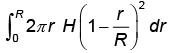
The expression  for the volume of a cone is equal to
- a)
- b)
- c)
- d)
Correct answer is option 'D'. Can you explain this answer?
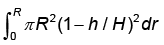
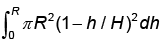
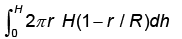
The expression for the volume of a cone is equal to
for the volume of a cone is equal toa)
b)
c)
d)
 | Nitin Joshi answered |
Choices (a) and (b) be correct because
for the volume of a cone is equal to

The general solution of the differential equation 
- a)y = (c1 – c2x) ex + c3 cos x + c4 sin x
- b)y = (c1 + c2x) ex – c3 cos x + c4 sin x
- c)y = (c1 + c2x) ex + c3 cos x + c4 sin x
- d)y = (c1 + c2x) ex + c3 cos x – c4 sin x
Correct answer is option 'C'. Can you explain this answer?
The general solution of the differential equation
a)
y = (c1 – c2x) ex + c3 cos x + c4 sin x
b)
y = (c1 + c2x) ex – c3 cos x + c4 sin x
c)
y = (c1 + c2x) ex + c3 cos x + c4 sin x
d)
y = (c1 + c2x) ex + c3 cos x – c4 sin x
| | Vertex Academy answered |
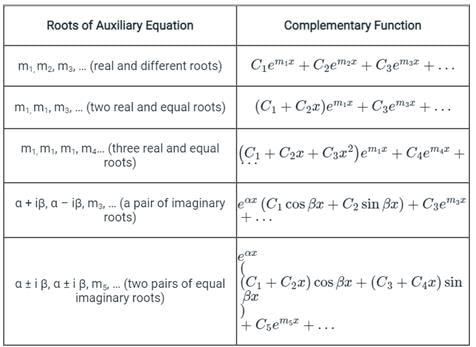
Concept:
General equation for DE:

Then its corresponding Auxiliary equation will be
AE: Dn + k1 Dn-1 + … kn = 0
Then the solution of above DE will be as follows:
Calculation:
Given:

Its Auxillary equations:
Its Auxillary equations:
(D4 – 2D3 + 2D2 – 2D + D) = 0
(D - 1)(D3 - D2 + D - 1) = 0
(D - 1)(D - 1)(D2 + 1) = 0
It roots = 1, 1, i, -i
Then it has two equal roots and one pair of imaginary roots.
Therefore, the solution is:
(c1 + c2x) ex + c3 cos x + c4 sin x = 0
If f(Z) is an analytical function and (r, θ) denotes the polar co-ordinates, then:- a)

- b)

- c)

- d)

Correct answer is option 'A'. Can you explain this answer?
If f(Z) is an analytical function and (r, θ) denotes the polar co-ordinates, then:
a)
b)
c)
d)
| | Gate Gurus answered |
Cauchy Riemann Equation in Polar Form:
A function f(z) which is single-valued and possesses a unique derivative with respect to z at all points of a region R, is called an analytic function of z in that region.
If f = u + iv is differentiable at z = reiθ then the Polar Cauchy Riemann equations at (r, θ) and x = rcos θ and y = rsin θ is given by,

Important Point:
Important Point:
Cauchy Riemann Equation in Rectangular Form:
If f(z) = u (x, y) + iv (x,y) is differentiable at z = x + iy. Then at z the first order patial derivatives of u and v exist and satisfy:

Consider the differential equation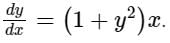 The general solution with constant C is
- a)
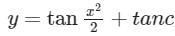
- b)
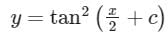
- c)
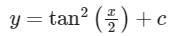
- d)
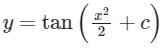
Correct answer is option 'D'. Can you explain this answer?
Consider the differential equationThe general solution with constant C is
The general solution with constant C isa)
b)
c)
d)
| | Sanya Agarwal answered |
Concept:
Separation of Variables:
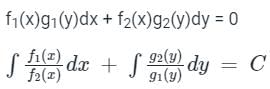
Calculation:
Calculation:
Given:
Differential equation:
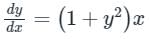
By separation of variables:
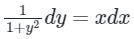
Integrating on both sides we will get:
By separation of variables:
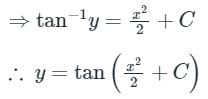
Integrating on both sides we will get:
The differential equation is solving by the method of variation of parameters, where the complementary function is given by- y = c1y1(x) + c2y2(x)
- a)The value of y1(x) = e3x
- b)The value of y2(x) = e3x
- c)The value of y2(x) = xe3x
- d)
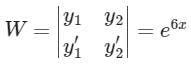
Correct answer is option 'D'. Can you explain this answer?
The differential equationis solving by the method of variation of parameters, where the complementary function is given by- y = c1y1(x) + c2y2(x)
is solving by the method of variation of parameters, where the complementary function is given by- y = c1y1(x) + c2y2(x)a)
The value of y1(x) = e3x
b)
The value of y2(x) = e3x
c)
The value of y2(x) = xe3x
d)
| | Sanya Agarwal answered |
Concept:
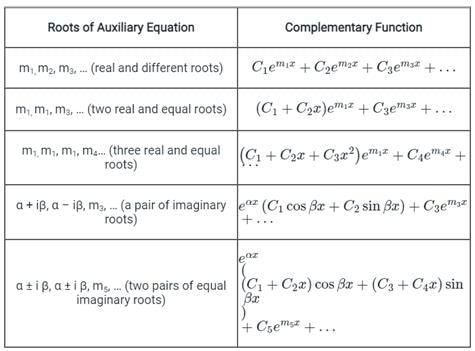
Calculation:
Calculation:
Given:
(D2 – 6D + 9)y = e3x/x2
Auxiliary equation is
(D2 – 6D + 9) = 0
⇒ (D – 3)2 = 0
C.F. = (C1 + C2x) e3x
C.F = C1(e3x) + C2(xe3x)







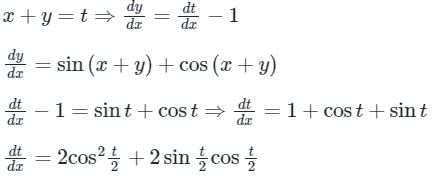
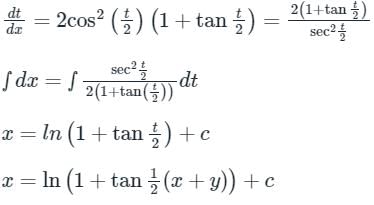


Solution of differential equation (D2 + 4)y = cosec 2x- a)

- b)

- c)

- d)None of these
Correct answer is option 'B'. Can you explain this answer?
Solution of differential equation (D2 + 4)y = cosec 2x
a)
b)
c)
d)
None of these
| | Sanya Agarwal answered |
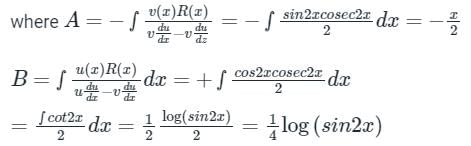
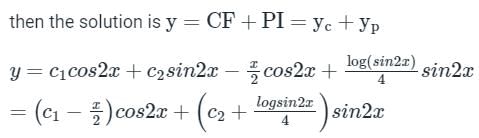
Auxiliary equation:
m2 + 4 = 0
m = ±2i
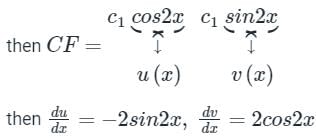
By wrongskion,

PI = A u(x) + B v(x)
The ordinary differential equation
- a)linear and homogeneous
- b)linear and non-homogeneous
- c)non-linear and homogeneous
- d)non-linear and non-homogeneous
Correct answer is option 'B'. Can you explain this answer?
The ordinary differential equation
a)
linear and homogeneous
b)
linear and non-homogeneous
c)
non-linear and homogeneous
d)
non-linear and non-homogeneous
| | Vertex Academy answered |
Concept:
Identification of Non-linear Differential Equation:
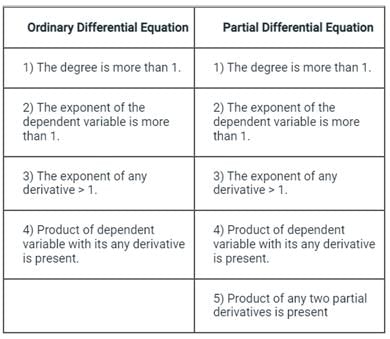
If any differential equation consists at least one of the above properties, then it is called non-linear differential equation and if any differential equation is free from all the above properties, then it is a linear differential equation.
If any differential equation consists at least one of the above properties, then it is called non-linear differential equation and if any differential equation is free from all the above properties, then it is a linear differential equation.
Given:

It is free from all the four characteristics described in the table. Hence it is a linear differential equation.
Product of dependent and independent variable i.e. x and u is present. Hence it is a non-homogenous equation.
Singular solution of a differential equation is one that cannot be obtained from the general solution gotten by the usual method of solving the differential equation.- a)True
- b)False
Correct answer is option 'A'. Can you explain this answer?
Singular solution of a differential equation is one that cannot be obtained from the general solution gotten by the usual method of solving the differential equation.
a)
True
b)
False
| | Sanya Agarwal answered |
A differential equation is said to have a singular solution if in all points in the domain of the equation the uniqueness of the solution is violated. Hence, this solution cannot be obtained from the general solution.
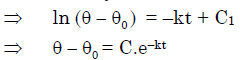
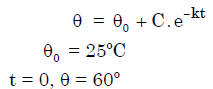
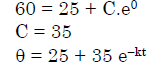
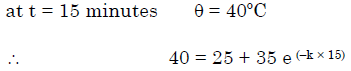
A spherical naphthalene ball exposed to the atmosphere loses volume at a rate proportional to its instantaneous surface area due to evaporation. If the initial diameter of the ball is 2 cm and the diameter reduces to 1 cm after 3 months, the ball completely evaporates in - a)6 month s
- b)9 month s
- c)12 month s
- d)infinite time
Correct answer is option 'A'. Can you explain this answer?
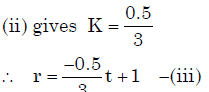
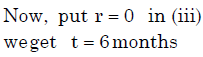
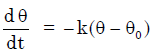
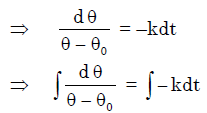
A spherical naphthalene ball exposed to the atmosphere loses volume at a rate proportional to its instantaneous surface area due to evaporation. If the initial diameter of the ball is 2 cm and the diameter reduces to 1 cm after 3 months, the ball completely evaporates in
a)
6 month s
b)
9 month s
c)
12 month s
d)
infinite time
 | Diya Patel answered |
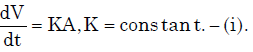
By the given condition
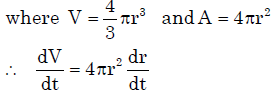
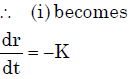
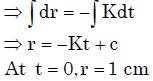
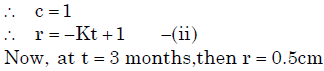


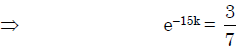
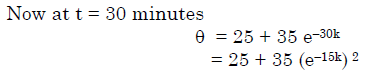

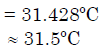
The following partial differential equation is defined for u:u (x, y)

The set auxiliary conditions necessary to solve the equation uniquely, is - a)three initial conditions
- b)three boundary conditions
- c)two initial conditions and one boundary condition
- d)one initial conditions and two boundary conditions
Correct answer is option 'D'. Can you explain this answer?
The following partial differential equation is defined for u:u (x, y)
The set auxiliary conditions necessary to solve the equation uniquely, is
The set auxiliary conditions necessary to solve the equation uniquely, is
a)
three initial conditions
b)
three boundary conditions
c)
two initial conditions and one boundary condition
d)
one initial conditions and two boundary conditions
| | Pioneer Academy answered |
Given:

∵ y ≥ 0 ⇒ It can be replaced with ‘t’.

This is a 1-D Heat equation. It measures temperature distribution in a uniform rod.
The general solution is u = f(x, t)

Auxiliary solutions include both initial and boundary conditions.
(1) Number of initial conditions = Highest order of time derivative in partial differential = 1
(2) The number of boundary conditions:
 To solve this partial differential equation, it needs to be integrated twice that will introduce two arbitrary constants.
Hence 2 boundary conditions and 1 initial condition are required to solve this Partial differential equation.
∵ y ≥ 0 ⇒ It can be replaced with ‘t’.
This is a 1-D Heat equation. It measures temperature distribution in a uniform rod.
The general solution is u = f(x, t)
Auxiliary solutions include both initial and boundary conditions.
(1) Number of initial conditions = Highest order of time derivative in partial differential = 1
(2) The number of boundary conditions:
To solve this partial differential equation, it needs to be integrated twice that will introduce two arbitrary constants.Hence 2 boundary conditions and 1 initial condition are required to solve this Partial differential equation.
The differential equation representing the family of circles touching y-axis at origin is:- a)Linear & of first order
- b)Linear & of second order
- c)Non-linear & of first order
- d)Non-linear & of second order
Correct answer is option 'C'. Can you explain this answer?
The differential equation representing the family of circles touching y-axis at origin is:
a)
Linear & of first order
b)
Linear & of second order
c)
Non-linear & of first order
d)
Non-linear & of second order
| | Jay Sharma answered |
Understanding the Family of Circles
The family of circles that touch the y-axis at the origin can be represented by the general equation of a circle. The equation can be described as:
- (x - h)² + (y - k)² = r²
Here, for circles touching the y-axis at the origin, the center (h, k) will be (r, k) where r is the radius and k can take any value.
Equation of the Circles
The specific equation becomes:
- (x - r)² + (y - k)² = r²
This can be expanded and rearranged as:
- x² - 2xr + r² + y² - 2yk + k² = r²
This simplifies to:
- x² + y² - 2xr - 2yk + k² = 0
Deriving the Differential Equation
To find the differential equation, we differentiate this equation with respect to x:
- 2x + 2y(dy/dx) - 2r - 2(dy/dx)k = 0
Rearranging gives us a first-order differential equation in terms of dy/dx.
Nature of the Differential Equation
- The equation is non-linear because of the presence of the terms involving (dy/dx) in a multiplicative form.
- It is of first order since it involves the first derivative but not higher derivatives.
Conclusion
Thus, the correct classification of the differential equation representing the family of circles touching the y-axis at the origin is:
- Non-linear & of first order (Option C).
The family of circles that touch the y-axis at the origin can be represented by the general equation of a circle. The equation can be described as:
- (x - h)² + (y - k)² = r²
Here, for circles touching the y-axis at the origin, the center (h, k) will be (r, k) where r is the radius and k can take any value.
Equation of the Circles
The specific equation becomes:
- (x - r)² + (y - k)² = r²
This can be expanded and rearranged as:
- x² - 2xr + r² + y² - 2yk + k² = r²
This simplifies to:
- x² + y² - 2xr - 2yk + k² = 0
Deriving the Differential Equation
To find the differential equation, we differentiate this equation with respect to x:
- 2x + 2y(dy/dx) - 2r - 2(dy/dx)k = 0
Rearranging gives us a first-order differential equation in terms of dy/dx.
Nature of the Differential Equation
- The equation is non-linear because of the presence of the terms involving (dy/dx) in a multiplicative form.
- It is of first order since it involves the first derivative but not higher derivatives.
Conclusion
Thus, the correct classification of the differential equation representing the family of circles touching the y-axis at the origin is:
- Non-linear & of first order (Option C).
Solve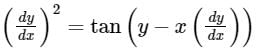
- a)y = cx + tan−1c2
- b)y = cx2 + tan−1c
- c)y = cx2 − tan−1c
- d)y = cx − tan−1c2
Correct answer is option 'A'. Can you explain this answer?
Solve
a)
y = cx + tan−1c2
b)
y = cx2 + tan−1c
c)
y = cx2 − tan−1c
d)
y = cx − tan−1c2
| | Pioneer Academy answered |
dy/dx = p
p2 = tan(y − xp)
tan−1p2 = y − xp
y = xp + tan−1p2
p2 = tan(y − xp)
tan−1p2 = y − xp
y = xp + tan−1p2
y = px + f(p)
Which is clairaut’s equation.
So equation is:
y = cx + tan−1c2
y = cx + tan−1c2
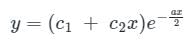
If roots of the auxiliary equation of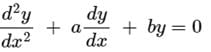 are real and equal, the general solution of the differential equation is
- a)

- b)

- c)

- d)

Correct answer is option 'B'. Can you explain this answer?
If roots of the auxiliary equation ofare real and equal, the general solution of the differential equation is
are real and equal, the general solution of the differential equation isa)
b)
c)
d)
| | Pioneer Academy answered |
Concept:
For different roots of the auxiliary equation, the solution (complementary function) of the differential equations is shown below.
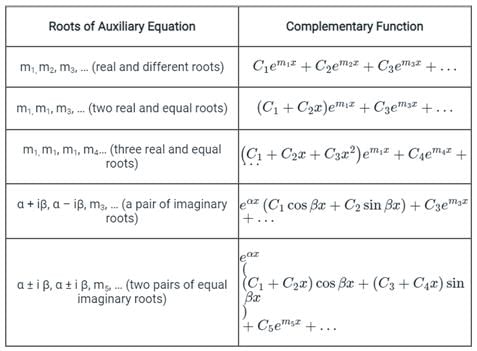
Calculation:
Calculation:
Given:
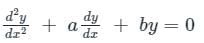
⇒ (D2 + aD + b)y = 0
Auxiliary equation:
m2 + am + b = 0
Roots of the auxiliary equation are:
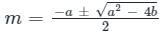
Given that, the roots of the auxiliary equation are real and equal.
⇒ m = -a/2 [∵ a2 - 4ab = 0]
The general solution of the differential equation is:
Chapter doubts & questions for Differential Equations - 6 Months Preparation for GATE Electrical 2026 is part of Electrical Engineering (EE) exam preparation. The chapters have been prepared according to the Electrical Engineering (EE) exam syllabus. The Chapter doubts & questions, notes, tests & MCQs are made for Electrical Engineering (EE) 2026 Exam. Find important definitions, questions, notes, meanings, examples, exercises, MCQs and online tests here.
Chapter doubts & questions of Differential Equations - 6 Months Preparation for GATE Electrical in English & Hindi are available as part of Electrical Engineering (EE) exam. Download more important topics, notes, lectures and mock test series for Electrical Engineering (EE) Exam by signing up for free.
6 Months Preparation for GATE Electrical675 videos|1390 docs|885 tests |
