


All Exams > Electrical Engineering (EE) > 6 Months Preparation for GATE Electrical > All Questions
All questions of Frequency Domain Analysis (Polar & Bode Plot) for Electrical Engineering (EE) Exam
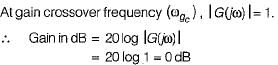



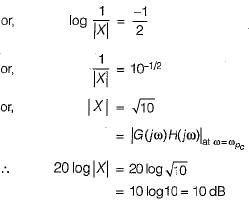
If the constant 'k' is negative, then what would be its contribution to the phase plot:- a)90 degrees
- b)45 degrees
- c)180 degrees
- d)0 degree
Correct answer is option 'C'. Can you explain this answer?
If the constant 'k' is negative, then what would be its contribution to the phase plot:
a)
90 degrees
b)
45 degrees
c)
180 degrees
d)
0 degree
 | Cstoppers Instructors answered |
Polar plot:
- The polar plot of a transfer function G(jω) is the plot of the magnitude of G(jω) versus the phase angle of G(jω) as ω is varied from 0 to positive infinity.
- For all pole systems, type indicates the starting point of the polar plot and order indicates the ending point of the polar plot.
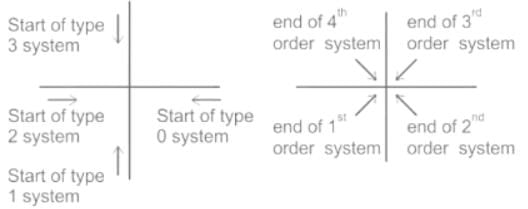
- As seen from the above figure, when a zero is added the type decreases, and the end of the polar plot shifts by +90°.
- When a pole is added, the type of the system increases, and hence the end of the polar plot shifts by -90°.
Calculation:
Let the transfer function be:
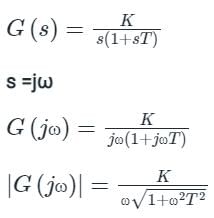
Let the transfer function be:
The total phase shift will be:
∠G(jω)H(jω) = -90° - tan-1(ωT) - 180° ----(1)
From equation (1) we can say that constant K has no contribution to the phase plot.
Hence K contributes 180° to the phase plot.
So option (c) is the correct answer.
∠G(jω)H(jω) = -90° - tan-1(ωT) - 180° ----(1)
From equation (1) we can say that constant K has no contribution to the phase plot.
Hence K contributes 180° to the phase plot.
So option (c) is the correct answer.
Consider a feedback system with gain margin of about 30. At what point does Nyquist plot crosses negative real axis?- a)-3
- b)-0.3
- c)-30
- d)-0.03
Correct answer is option 'B'. Can you explain this answer?
Consider a feedback system with gain margin of about 30. At what point does Nyquist plot crosses negative real axis?
a)
-3
b)
-0.3
c)
-30
d)
-0.03
 | Sharmila Kulkarni answered |
Nyquist Plot and Gain Margin
Nyquist plot is a graphical representation of a system's frequency response. It is used to analyze the stability of a feedback system. The Nyquist plot is a plot of the frequency response of a system in the complex plane. The gain margin of a feedback system is the amount of gain that the system can handle before it becomes unstable. It is defined as the amount of gain that causes the Nyquist plot to cross the negative real axis.
Answer Explanation
Given that the gain margin of the feedback system is about 30, we can determine at what point the Nyquist plot crosses the negative real axis by using the Nyquist stability criterion. The Nyquist stability criterion states that the number of encirclements of the -1 point in the Nyquist plot is equal to the number of unstable poles of the closed-loop transfer function.
Since the gain margin is about 30, the Nyquist plot will cross the negative real axis at a point where the magnitude of the complex number is equal to 1/30. This is because the gain margin is the reciprocal of the point where the Nyquist plot crosses the negative real axis. Therefore, the Nyquist plot will cross the negative real axis at a frequency of -0.3, which corresponds to a magnitude of 1/30.
Thus, the correct answer is option B, -0.3.
Nyquist plot is a graphical representation of a system's frequency response. It is used to analyze the stability of a feedback system. The Nyquist plot is a plot of the frequency response of a system in the complex plane. The gain margin of a feedback system is the amount of gain that the system can handle before it becomes unstable. It is defined as the amount of gain that causes the Nyquist plot to cross the negative real axis.
Answer Explanation
Given that the gain margin of the feedback system is about 30, we can determine at what point the Nyquist plot crosses the negative real axis by using the Nyquist stability criterion. The Nyquist stability criterion states that the number of encirclements of the -1 point in the Nyquist plot is equal to the number of unstable poles of the closed-loop transfer function.
Since the gain margin is about 30, the Nyquist plot will cross the negative real axis at a point where the magnitude of the complex number is equal to 1/30. This is because the gain margin is the reciprocal of the point where the Nyquist plot crosses the negative real axis. Therefore, the Nyquist plot will cross the negative real axis at a frequency of -0.3, which corresponds to a magnitude of 1/30.
Thus, the correct answer is option B, -0.3.
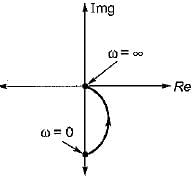
The inverse polar plot of the open loop transfer function, 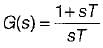 will be re presented by
- a)
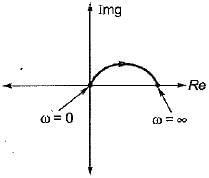
- b)
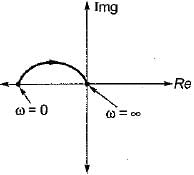
- c)
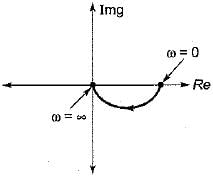
- d)
Correct answer is option 'A'. Can you explain this answer?
The inverse polar plot of the open loop transfer function, will be re presented by
will be re presented bya)
b)
c)
d)
 | Lavanya Menon answered |
Given, G(s) = (1+sT)/(sT)
The inverse polar plot of G(jω) is the polar plot of 1/G(jω)
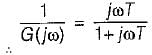
Thus,
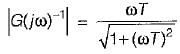
and
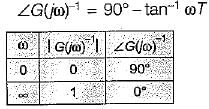
Hence, inverse polar plot will be as show below,
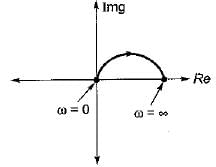
The inverse polar plot of G(jω) is the polar plot of 1/G(jω)
Thus,
and
Hence, inverse polar plot will be as show below,
If a system has an open loop transfer function 1-s / 1+s, then the gain of the system at frequency of 1 rad/s will be- a)1
- b)1/2
- c)Zero
- d)-1
Correct answer is option 'D'. Can you explain this answer?
If a system has an open loop transfer function 1-s / 1+s, then the gain of the system at frequency of 1 rad/s will be
a)
1
b)
1/2
c)
Zero
d)
-1
 | Anuj Rane answered |
Open Loop Transfer Function
The open loop transfer function of a system represents the relationship between the input and output of a system without any feedback. It is denoted by G(s) and is expressed as the ratio of the Laplace transform of the output to the Laplace transform of the input.
G(s) = Y(s) / X(s)
Where:
G(s) - open loop transfer function
Y(s) - Laplace transform of the output
X(s) - Laplace transform of the input
Given Transfer Function
In this question, the given open loop transfer function is 1 - s / 1 + s.
Frequency Response of a System
To determine the gain of a system at a specific frequency, we substitute jω for s in the transfer function, where ω represents the angular frequency in radians per second.
G(jω) = Y(jω) / X(jω)
To find the gain at a specific frequency, we substitute ω = 1 rad/s in the transfer function and evaluate the expression.
Gain at Frequency ω = 1 rad/s
Substituting ω = 1 rad/s in the transfer function:
G(j1) = Y(j1) / X(j1)
Calculating the Gain
G(j1) = (1 - j) / (1 + j)
To calculate the gain, we need to find the modulus of this complex number.
|G(j1)| = sqrt((1 - j)^2) / sqrt((1 + j)^2)
Simplifying the expression:
|G(j1)| = sqrt(1^2 + (-1)^2) / sqrt(1^2 + 1^2)
|G(j1)| = sqrt(1 + 1) / sqrt(1 + 1)
|G(j1)| = sqrt(2) / sqrt(2)
|G(j1)| = 1
Hence, the gain of the system at a frequency of 1 rad/s is 1.
Conclusion
The correct answer is option 'A' - 1. The gain of the system at a frequency of 1 rad/s is 1.
The open loop transfer function of a system represents the relationship between the input and output of a system without any feedback. It is denoted by G(s) and is expressed as the ratio of the Laplace transform of the output to the Laplace transform of the input.
G(s) = Y(s) / X(s)
Where:
G(s) - open loop transfer function
Y(s) - Laplace transform of the output
X(s) - Laplace transform of the input
Given Transfer Function
In this question, the given open loop transfer function is 1 - s / 1 + s.
Frequency Response of a System
To determine the gain of a system at a specific frequency, we substitute jω for s in the transfer function, where ω represents the angular frequency in radians per second.
G(jω) = Y(jω) / X(jω)
To find the gain at a specific frequency, we substitute ω = 1 rad/s in the transfer function and evaluate the expression.
Gain at Frequency ω = 1 rad/s
Substituting ω = 1 rad/s in the transfer function:
G(j1) = Y(j1) / X(j1)
Calculating the Gain
G(j1) = (1 - j) / (1 + j)
To calculate the gain, we need to find the modulus of this complex number.
|G(j1)| = sqrt((1 - j)^2) / sqrt((1 + j)^2)
Simplifying the expression:
|G(j1)| = sqrt(1^2 + (-1)^2) / sqrt(1^2 + 1^2)
|G(j1)| = sqrt(1 + 1) / sqrt(1 + 1)
|G(j1)| = sqrt(2) / sqrt(2)
|G(j1)| = 1
Hence, the gain of the system at a frequency of 1 rad/s is 1.
Conclusion
The correct answer is option 'A' - 1. The gain of the system at a frequency of 1 rad/s is 1.
The open loop transfer function of a unity gain negative feedback system is given as
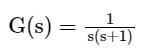
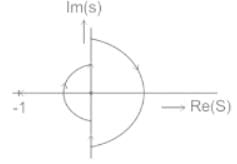
The Nyquist contour in the ��-plane encloses the entire right half plane and a small neighbourhood around the origin in the left half plane, as shown in the figure below. The number of encirclements of the point (−1 + j0) by the Nyquist plot of G(s), corresponding to the Nyquist contour, is denoted as N. Then N equals to
- a)0
- b)1
- c)2
- d)3
Correct answer is option 'B'. Can you explain this answer?
The open loop transfer function of a unity gain negative feedback system is given as
The Nyquist contour in the ��-plane encloses the entire right half plane and a small neighbourhood around the origin in the left half plane, as shown in the figure below. The number of encirclements of the point (−1 + j0) by the Nyquist plot of G(s), corresponding to the Nyquist contour, is denoted as N. Then N equals to
The Nyquist contour in the ��-plane encloses the entire right half plane and a small neighbourhood around the origin in the left half plane, as shown in the figure below. The number of encirclements of the point (−1 + j0) by the Nyquist plot of G(s), corresponding to the Nyquist contour, is denoted as N. Then N equals to
a)
0
b)
1
c)
2
d)
3
 | Zoya Sharma answered |
Concept
N = P - 2
N = no. of encirclements of )-1, 0) critical point by the Nyquist plot.
P = no. of right half of s-plane of G(s) H(s) as F(s)
z = no. of lright half of s-plane of CLTF as zero of F(s)
For stability z = 0
N - P = 0
N = P
for Nyquist stability criteria
Calculation
Open loop function:
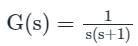
Close loop transfer function =
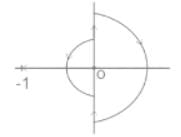
Close loop transfer function =
no pole in right hand side
z = 0, P ⇒ 1
N = 1 - 0
N = 1
no. of oncirclements N = 1
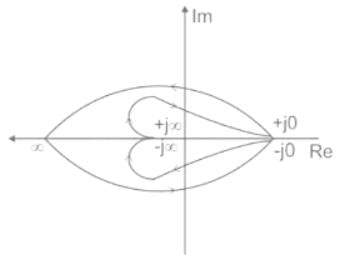
From the below given Nyquist plot, calculate the number of open-loop poles on the right-hand side of the s-plane for the closed-loop system to be stable.
- a)1
- b)2
- c)0
- d)-1
Correct answer is option 'A'. Can you explain this answer?
From the below given Nyquist plot, calculate the number of open-loop poles on the right-hand side of the s-plane for the closed-loop system to be stable.
a)
1
b)
2
c)
0
d)
-1
 | Ravi Singh answered |
Principle arguments
- It states that if there are “P” poles and “Z” zeroes for a closed, random selected path then the corresponding G(s)H(s) plane encircles the origin with P – Z times.
- Encirclements in s – plane and GH – plane are shown below.
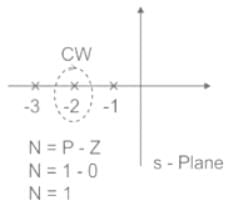
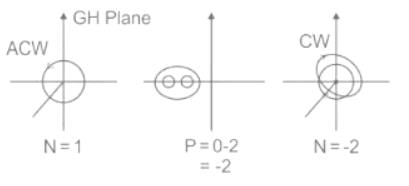
- In GH plane Anti clockwise encirclements are taken as positive and clockwise encirclements are taken as negative.
It is applied to the total RH plane by selecting a closed path with r = ∞
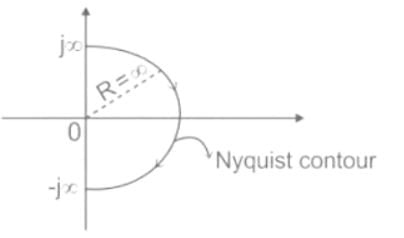
Nyquist stability completely deals with the right half of s – plane.
N(0, 0) = P – Z
N(0, 0): Number of encirclements around critical point (- 1, 0)
N(0, 0) = P – Z
N(0, 0): Number of encirclements around critical point (- 1, 0)
P: Open loop poles
Z: Open-loop zeroes.
Note:
1) To get the Closed-loop stability we require 1 + GH plane but available is GH plane, hence the origin is shifted to “-1” to get the closed-loop stability.
2) To become the system stable there should not be any closed-loop pole in the right of s – plane.
3) The closed-loop pole is the same as that of the zeroes of Characteristic Equation which must be zero in the right. i.e, Z = 0
N = P is the criteria.
Calculation:
From the given Nyquist plot there is one encirclement about ( -1, 0 ) in the Anti-clockwise direction.
So, N = 1
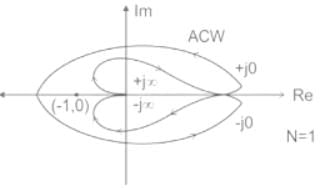
Now to satisfy the stability criteria N should be equal to P.
N = P = 1
So the number of open-loop poles in the Right-hand side of the system is 1.
The gain margin for the system with open loop transfer function G(s) H(s) = G(s) = 2(1 + s) / s2 is- a)8
- b)0
- c)1
- d)-8
Correct answer is option 'B'. Can you explain this answer?
The gain margin for the system with open loop transfer function G(s) H(s) = G(s) = 2(1 + s) / s2 is
a)
8
b)
0
c)
1
d)
-8
 | Mainak Roy answered |
Open Loop Transfer Function:
The open-loop transfer function of a control system is the transfer function obtained by removing the feedback loop from the system. In this case, the open-loop transfer function is given as:
G(s) = 2(1 - s) / s^2
Gain Margin:
The gain margin is a measure of the system's stability and indicates how much the system's gain can be increased before it becomes unstable. It is defined as the amount of gain at the frequency where the phase of the open-loop transfer function is -180 degrees.
Phase of the Open Loop Transfer Function:
To determine the gain margin, we first need to find the frequency at which the phase of the open-loop transfer function is -180 degrees.
The phase of the open-loop transfer function can be calculated as follows:
Phase = angle(2(1 - s) / s^2)
To find the frequency at which the phase is -180 degrees, we set the phase equal to -180 degrees and solve for s:
-180 = angle(2(1 - s) / s^2)
Finding the Gain Margin:
Once we have found the frequency at which the phase is -180 degrees, we can calculate the gain margin.
The gain margin is given by the reciprocal of the magnitude of the open-loop transfer function at the frequency where the phase is -180 degrees:
Gain Margin = 1 / |G(jω)|
where ω is the frequency at which the phase is -180 degrees.
In this case, since the open-loop transfer function is a rational function, we can substitute jω for s to determine the frequency at which the phase is -180 degrees.
By substituting jω for s in the open-loop transfer function G(s), we can calculate the magnitude of G(jω) at the frequency where the phase is -180 degrees:
|G(jω)| = |2(1 - jω) / (jω)^2|
Simplifying this expression, we get:
|G(jω)| = |2(1 - jω) / -ω^2|
To find the gain margin, we substitute -180 degrees for the phase, calculate the magnitude of the open-loop transfer function at that frequency, and take the reciprocal:
Gain Margin = 1 / |G(jω)|
By performing the calculations, we find that the gain margin is 0.
Therefore, the correct answer is option 'B', 0.
The open-loop transfer function of a control system is the transfer function obtained by removing the feedback loop from the system. In this case, the open-loop transfer function is given as:
G(s) = 2(1 - s) / s^2
Gain Margin:
The gain margin is a measure of the system's stability and indicates how much the system's gain can be increased before it becomes unstable. It is defined as the amount of gain at the frequency where the phase of the open-loop transfer function is -180 degrees.
Phase of the Open Loop Transfer Function:
To determine the gain margin, we first need to find the frequency at which the phase of the open-loop transfer function is -180 degrees.
The phase of the open-loop transfer function can be calculated as follows:
Phase = angle(2(1 - s) / s^2)
To find the frequency at which the phase is -180 degrees, we set the phase equal to -180 degrees and solve for s:
-180 = angle(2(1 - s) / s^2)
Finding the Gain Margin:
Once we have found the frequency at which the phase is -180 degrees, we can calculate the gain margin.
The gain margin is given by the reciprocal of the magnitude of the open-loop transfer function at the frequency where the phase is -180 degrees:
Gain Margin = 1 / |G(jω)|
where ω is the frequency at which the phase is -180 degrees.
In this case, since the open-loop transfer function is a rational function, we can substitute jω for s to determine the frequency at which the phase is -180 degrees.
By substituting jω for s in the open-loop transfer function G(s), we can calculate the magnitude of G(jω) at the frequency where the phase is -180 degrees:
|G(jω)| = |2(1 - jω) / (jω)^2|
Simplifying this expression, we get:
|G(jω)| = |2(1 - jω) / -ω^2|
To find the gain margin, we substitute -180 degrees for the phase, calculate the magnitude of the open-loop transfer function at that frequency, and take the reciprocal:
Gain Margin = 1 / |G(jω)|
By performing the calculations, we find that the gain margin is 0.
Therefore, the correct answer is option 'B', 0.
If the Nyquist plot cuts the negative real axis at a distance of 0.25, then the gain margin and phase margin of the system will be respectively- a)0.25 and 0°
- b)4.0 and -180°
- c)-0.25 and 180°
- d)4.0 and 0°
Correct answer is option 'D'. Can you explain this answer?
If the Nyquist plot cuts the negative real axis at a distance of 0.25, then the gain margin and phase margin of the system will be respectively
a)
0.25 and 0°
b)
4.0 and -180°
c)
-0.25 and 180°
d)
4.0 and 0°
 | Gayatri Menon answered |
Here,
| X | = 0.25 (Given)
∴
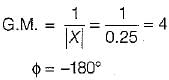
Also,
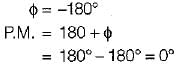
| X | = 0.25 (Given)
∴
Also,
If the gain of the open-loop system is increased to four times, the gain margin of the system- a)remains same
- b)becomes half
- c)becomes one-fourth
- d)none of the above
Correct answer is option 'C'. Can you explain this answer?
If the gain of the open-loop system is increased to four times, the gain margin of the system
a)
remains same
b)
becomes half
c)
becomes one-fourth
d)
none of the above
| | Saumya Sen answered |
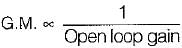
∴ When open-loop gain becomes 4-times, GM will become one-fourth.
All the constant N-circles in G planes cross the real axis at the fixed points. Which are these points?- a)-1 and origin
- b)Origin and +1
- c)-0.5 and 0.5
- d)-1 and +1
Correct answer is option 'A'. Can you explain this answer?
All the constant N-circles in G planes cross the real axis at the fixed points. Which are these points?
a)
-1 and origin
b)
Origin and +1
c)
-0.5 and 0.5
d)
-1 and +1
 | Sarita Yadav answered |
Centre of N circle is (-1/2, 1/2N)
N = tanα
Constant –N circles always pass through (-1, 0) and (0, 0).
N = tanα
Constant –N circles always pass through (-1, 0) and (0, 0).
The polar plot of a transfer function with ω as the parameter is known as the- a)Nyquist plot
- b)Bode plot
- c)Root-locus
- d)Signal flow graph
Correct answer is option 'A'. Can you explain this answer?
The polar plot of a transfer function with ω as the parameter is known as the
a)
Nyquist plot
b)
Bode plot
c)
Root-locus
d)
Signal flow graph
| | Sarita Yadav answered |
Nyquist plot:
Nyquist plots are an extension of polar plots for finding the stability of the closed-loop control systems. This is done by varying ω from −∞ to ∞, i.e. Nyquist plots are used to draw the complete frequency response of the open-loop transfer function.
Method of drawing Nyquist plot:
Nyquist plots are an extension of polar plots for finding the stability of the closed-loop control systems. This is done by varying ω from −∞ to ∞, i.e. Nyquist plots are used to draw the complete frequency response of the open-loop transfer function.
Method of drawing Nyquist plot:
- Locate the poles and zeros of open-loop transfer function G(s)H(s) in ‘s’ plane.
- Draw the polar plot by varying ω from zero to infinity.
- Draw the mirror image of the above polar plot for values of ω ranging from −∞ to zero.
- The number of infinite radii half circles will be equal to the number of poles at the origin.
- The infinite radius half-circle will start at the point where the mirror image of the polar plot ends. And this infinite radius half-circle will end at the point where the polar plot starts.
Consider the following statements:
Nichol’s chart gives information about.
i. Closed loop frequency response.
ii. The value of the peak magnitude of the closed loop frequency response Mp.
iii. The frequency at which Mp occurs.
Which of the above statements are correct?- a)2 and 3
- b)1 and 2
- c)1 and 3
- d)1,2 and 3
Correct answer is option 'D'. Can you explain this answer?
Consider the following statements:
Nichol’s chart gives information about.
i. Closed loop frequency response.
ii. The value of the peak magnitude of the closed loop frequency response Mp.
iii. The frequency at which Mp occurs.
Which of the above statements are correct?
Nichol’s chart gives information about.
i. Closed loop frequency response.
ii. The value of the peak magnitude of the closed loop frequency response Mp.
iii. The frequency at which Mp occurs.
Which of the above statements are correct?
a)
2 and 3
b)
1 and 2
c)
1 and 3
d)
1,2 and 3
| | Sarita Yadav answered |
Nichol’s chart gives information about closed loop frequency response, value of the peak magnitude of the closed loop frequency response Mp and the frequency at which Mp occurs.
What is the value of M for the constant M circle represented by the equation 8x2 + 18x + 8y2 + 9 = 0?- a)0.5
- b)2
- c)3
- d)8
Correct answer is option 'C'. Can you explain this answer?
What is the value of M for the constant M circle represented by the equation 8x2 + 18x + 8y2 + 9 = 0?
a)
0.5
b)
2
c)
3
d)
8
| | Sarita Yadav answered |
Comparing with the M circle equation we have the value of M = 3.
Due to an addition of pole at origin, the polar plot gets shifted by ___ at ω = 0?- a)-45°
- b)-60°
- c)-90°
- d)-180°
Correct answer is option 'C'. Can you explain this answer?
Due to an addition of pole at origin, the polar plot gets shifted by ___ at ω = 0?
a)
-45°
b)
-60°
c)
-90°
d)
-180°
| | Ameya Nambiar answered |
Introduction
In control systems and signal processing, the addition of poles in the transfer function can significantly affect the behavior of the system. A pole at the origin alters the phase response of the system, especially at low frequencies.
Effect of a Pole at the Origin
- A pole at the origin contributes a phase lag of 90 degrees to the system's response.
- This means that for every pole added at the origin, the phase of the output signal will lag behind the input signal by 90 degrees.
Polar Plot Shift
- In a polar plot, the phase shift impacts the angle of the plot as a function of frequency (ω).
- At ω = 0, the introduction of a pole at the origin will shift the plot downwards by 90 degrees.
Conclusion
- Therefore, when a pole is added at the origin, the polar plot is effectively shifted by -90 degrees at ω = 0.
- This shift is crucial for understanding system stability and frequency response.
The correct answer is option C: -90°.
In control systems and signal processing, the addition of poles in the transfer function can significantly affect the behavior of the system. A pole at the origin alters the phase response of the system, especially at low frequencies.
Effect of a Pole at the Origin
- A pole at the origin contributes a phase lag of 90 degrees to the system's response.
- This means that for every pole added at the origin, the phase of the output signal will lag behind the input signal by 90 degrees.
Polar Plot Shift
- In a polar plot, the phase shift impacts the angle of the plot as a function of frequency (ω).
- At ω = 0, the introduction of a pole at the origin will shift the plot downwards by 90 degrees.
Conclusion
- Therefore, when a pole is added at the origin, the polar plot is effectively shifted by -90 degrees at ω = 0.
- This shift is crucial for understanding system stability and frequency response.
The correct answer is option C: -90°.
Consider the system represented by the equation given below. What would be the total phase value at ω = 0?
200/[s3 (s + 3) (s + 6) (s + 10)].- a)-90°
- b)-180°
- c)-270°
- d)-360°
Correct answer is option 'C'. Can you explain this answer?
Consider the system represented by the equation given below. What would be the total phase value at ω = 0?
200/[s3 (s + 3) (s + 6) (s + 10)].
200/[s3 (s + 3) (s + 6) (s + 10)].
a)
-90°
b)
-180°
c)
-270°
d)
-360°
To be able to answer the question, we need the equation that represents the system. Please provide the equation so that we can proceed with the calculation.
Consider the following statements related to frequency domain analysis:
1. The cut-off rate is the slope of the log magnitude curve near the cut-off frequency.
2. The bandwidth is defined as the band of frequencies lying between 3 dB points.
3. Higher the value of resonant frequency of the system, slower is the time response.
4. The magnitude of resonant peak gives the information about the relative stability of the system.
Which of these statements is/are not correct?- a)1,3 and 4
- b)1, 2 and 3
- c)2 and 3
- d)3 and 4
Correct answer is option 'C'. Can you explain this answer?
Consider the following statements related to frequency domain analysis:
1. The cut-off rate is the slope of the log magnitude curve near the cut-off frequency.
2. The bandwidth is defined as the band of frequencies lying between 3 dB points.
3. Higher the value of resonant frequency of the system, slower is the time response.
4. The magnitude of resonant peak gives the information about the relative stability of the system.
Which of these statements is/are not correct?
1. The cut-off rate is the slope of the log magnitude curve near the cut-off frequency.
2. The bandwidth is defined as the band of frequencies lying between 3 dB points.
3. Higher the value of resonant frequency of the system, slower is the time response.
4. The magnitude of resonant peak gives the information about the relative stability of the system.
Which of these statements is/are not correct?
a)
1,3 and 4
b)
1, 2 and 3
c)
2 and 3
d)
3 and 4
 | Megha Datta answered |
The bandwidth is defined as the band of frequencies tying between -3 dB points. Hence, statement-2 is false.
Higher the value of resonant frequency of the system, faster is the time response. Hence, statement-3 is false.
Higher the value of resonant frequency of the system, faster is the time response. Hence, statement-3 is false.
The constant M-circle represented by the equation x2 + 2.25x + y2 = -1.25 has the value of M equal to:- a)1
- b)2
- c)3
- d)4
Correct answer is option 'C'. Can you explain this answer?
The constant M-circle represented by the equation x2 + 2.25x + y2 = -1.25 has the value of M equal to:
a)
1
b)
2
c)
3
d)
4
| | Sarita Yadav answered |
Comparing with the M circle equation we have the value of M = 3.
Polar plot of G(s) =  is a
is a- a)straight line
- b)semicircle
- c)parabola
- d)circle
Correct answer is option 'B'. Can you explain this answer?
Polar plot of G(s) = is a
is aa)
straight line
b)
semicircle
c)
parabola
d)
circle
 | Jyoti Basak answered |
Given, 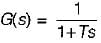
It is a type - 0 and order - 1 system, therefore its polar-plot will be as shown below.
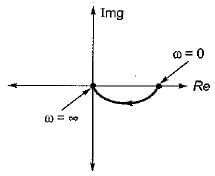
Hence, the polar plot will be semicircular in shape.
It is a type - 0 and order - 1 system, therefore its polar-plot will be as shown below.
Hence, the polar plot will be semicircular in shape.
The roots of the characteristic equation of the second order system in which real and imaginary part represents the :- a)Damped frequency and damping
- b)Damping and damped frequency
- c)Natural frequency and damping ratio
- d)Damping ratio and natural frequency
Correct answer is option 'B'. Can you explain this answer?
The roots of the characteristic equation of the second order system in which real and imaginary part represents the :
a)
Damped frequency and damping
b)
Damping and damped frequency
c)
Natural frequency and damping ratio
d)
Damping ratio and natural frequency
 | Hina Choudhary answered |
Understanding the Characteristic Equation
In control systems, the characteristic equation of a second-order system is crucial for analyzing system dynamics. The typical form of the characteristic equation is:
s² + 2ζω_ns + ω_n² = 0
where:
- s represents the complex roots,
- ζ is the damping ratio,
- ω_n is the natural frequency.
Roots of the Characteristic Equation
The roots of this equation can be expressed as:
s = -ζω_n ± jω_d
where:
- j represents the imaginary unit,
- ω_d is the damped frequency.
Real and Imaginary Parts
The roots consist of two components:
- The real part: -ζω_n (indicates the damping effect)
- The imaginary part: ± jω_d (indicates the oscillatory behavior)
Explanation of Option B
The correct identification of these components leads to understanding why option B is correct.
- Damping and Damped Frequency:
- The real part (-ζω_n) corresponds to the system’s damping. It determines how oscillations in the system decay over time.
- The imaginary part (± jω_d) corresponds to the damped frequency. It represents the frequency of oscillation when damping is present.
Conclusion
Thus, understanding the roots of the characteristic equation clarifies that the real part indicates the damping aspect while the imaginary part reflects the damped frequency, validating option B as the correct choice.
In control systems, the characteristic equation of a second-order system is crucial for analyzing system dynamics. The typical form of the characteristic equation is:
s² + 2ζω_ns + ω_n² = 0
where:
- s represents the complex roots,
- ζ is the damping ratio,
- ω_n is the natural frequency.
Roots of the Characteristic Equation
The roots of this equation can be expressed as:
s = -ζω_n ± jω_d
where:
- j represents the imaginary unit,
- ω_d is the damped frequency.
Real and Imaginary Parts
The roots consist of two components:
- The real part: -ζω_n (indicates the damping effect)
- The imaginary part: ± jω_d (indicates the oscillatory behavior)
Explanation of Option B
The correct identification of these components leads to understanding why option B is correct.
- Damping and Damped Frequency:
- The real part (-ζω_n) corresponds to the system’s damping. It determines how oscillations in the system decay over time.
- The imaginary part (± jω_d) corresponds to the damped frequency. It represents the frequency of oscillation when damping is present.
Conclusion
Thus, understanding the roots of the characteristic equation clarifies that the real part indicates the damping aspect while the imaginary part reflects the damped frequency, validating option B as the correct choice.
The polar plot of a transfer function passes through the critical point (-1,0). Gain margin is- a)Zero
- b)-1dB
- c)1dB
- d)Infinity
Correct answer is option 'A'. Can you explain this answer?
The polar plot of a transfer function passes through the critical point (-1,0). Gain margin is
a)
Zero
b)
-1dB
c)
1dB
d)
Infinity
| | Zoya Sharma answered |
Gain margin of a polar plot passing through the critical point is zero.
In Nyquist plot of a system on adding a pole at s = 0, then plot will -- a)remain unaltered
- b)rotate clockwise by 90°
- c)rotate anticlockwise by 90°
- d)rotate by 180°
Correct answer is option 'B'. Can you explain this answer?
In Nyquist plot of a system on adding a pole at s = 0, then plot will -
a)
remain unaltered
b)
rotate clockwise by 90°
c)
rotate anticlockwise by 90°
d)
rotate by 180°
 | Harshad Singh answered |
A) remain unaltered
Adding a pole at s = 0 in the Nyquist plot will not cause any rotation. The plot will remain unaltered because the pole at s = 0 does not contribute to the frequency response of the system.
Adding a pole at s = 0 in the Nyquist plot will not cause any rotation. The plot will remain unaltered because the pole at s = 0 does not contribute to the frequency response of the system.
The most important technique used for stability and the transient response of the system is- a)Nyquist plot
- b)Root locus
- c)Bode plot
- d)Routh Hurwitz criteria
Correct answer is option 'B'. Can you explain this answer?
The most important technique used for stability and the transient response of the system is
a)
Nyquist plot
b)
Root locus
c)
Bode plot
d)
Routh Hurwitz criteria
| | Ravi Singh answered |
Definition:
The root locus plots the poles of the closed-loop transfer function in the complex s-plane as K varies from 0 to ∞
The purpose of Root locus is defined as:
- To find the nature of the system and ‘K’ value for stability.
- To find the relative stability.
- If the root locus branches move towards the right, system is less stable and if they move towards the left then the system is more relative stable.
- It is the best method to find the Relative stability and RH criteria is best to find absolute stability
The relation between the closed-loop and open-loop poles
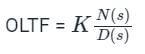
D(s) = 0 gives open-loop poles and N(s) = 0 gives closed-loop poles
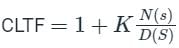
Characteristic equation is D(s) + kN(s) = 0.
Closed-loop poles are nothing but the sum of open-loop poles and zeroes.

Directions: It consists of two statements, one labelled as the ‘Statement (I)’ and the other as ‘Statement (II)’. Examine these two statements carefully and select the answers to these items using the codes given below:
Statement (I): The polar plot has limitation for portraying the frequency response of a system.
Statement (II): The calculation of frequency response is tedious and does not indicate the effect of the individual poles and zeros.- a)Both Statement (I) and Statement (II) are individually true and Statement (II) is the correct explanation of Statement (I)
- b)Both Statement (I) and Statement (II) are individually true but Statement (II) is not the correct explanation of Statement (I)
- c)Statement (I) is true but Statement (II) is false
- d)Statement (I) is false but Statement (II) is true
Correct answer is option 'D'. Can you explain this answer?
Directions: It consists of two statements, one labelled as the ‘Statement (I)’ and the other as ‘Statement (II)’. Examine these two statements carefully and select the answers to these items using the codes given below:
Statement (I): The polar plot has limitation for portraying the frequency response of a system.
Statement (II): The calculation of frequency response is tedious and does not indicate the effect of the individual poles and zeros.
Statement (I): The polar plot has limitation for portraying the frequency response of a system.
Statement (II): The calculation of frequency response is tedious and does not indicate the effect of the individual poles and zeros.
a)
Both Statement (I) and Statement (II) are individually true and Statement (II) is the correct explanation of Statement (I)
b)
Both Statement (I) and Statement (II) are individually true but Statement (II) is not the correct explanation of Statement (I)
c)
Statement (I) is true but Statement (II) is false
d)
Statement (I) is false but Statement (II) is true
| | Sanvi Kapoor answered |
Polar plot:
- The Polar plot is a plot, which can be drawn between the magnitude and the phase angle of G(jω)H(jω) by varying ω from zero to ∞.
- The calculation of frequency response is tedious, and it does not indicate the impact of individual components of open-loop transfer function.
- Another disadvantage of this plot is that it cannot tell how many poles are in right side of the complex plane.
- To overcome this disadvantage, magnitude is plotted by varying frequency from that is known as the Nyquist plot.
- It has no limitation in portraying the frequency response of a system.
Therefore, Statement (I) is false but Statement (II) is true.
Transfer function of a system is given as
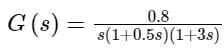
Polar plot of the same system is
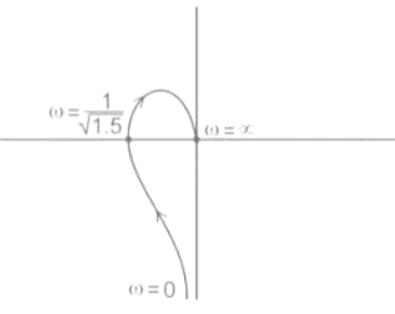
Gain margin (in dB) of the system is ______. (Important - Enter only the numerical value in the answer)
Correct answer is between '9,10'. Can you explain this answer?
Transfer function of a system is given as
Polar plot of the same system is
Gain margin (in dB) of the system is ______. (Important - Enter only the numerical value in the answer)
Polar plot of the same system is
Gain margin (in dB) of the system is ______. (Important - Enter only the numerical value in the answer)
| | Sanvi Kapoor answered |
Gain margin (GM) and Phase margin (PM) from the polar plot:
Let us consider the polar plot as shown below,
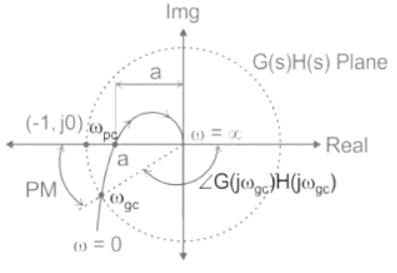
Figure: A polar plot of a stable system
Gain margin (GM):
The frequency at which the polar plot crosses the negative real axis is called a phase cross-over frequency (ωpc).
Let 'a' be the point of intersection and it is the magnitude at the phase cross-over frequency.
⇒ a = | G(jωpc) H(jωpc) |
And, we know that
Gain margin (GM) = 1 / |G(jωpc) H(jωpc)| = 1 / a
Gain margin in dB = 20 log (1 / a)
Calculations:
In the Given polar plot;
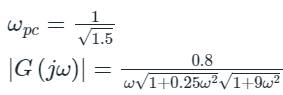
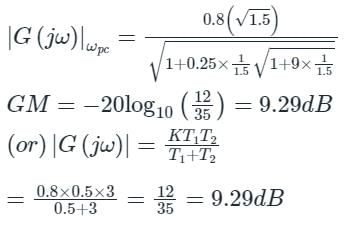
Phase margin (PM):
The frequency at which the polar plot crosses the unit circle (formed with the radius of the critical point) is called again cross-over frequency (ωgc).
From the polar plot, we can observe that
Phase margin (PM) = 180 - ∠G(jωgc) H(jωgc)
Let us consider the polar plot as shown below,
Figure: A polar plot of a stable system
Gain margin (GM):
The frequency at which the polar plot crosses the negative real axis is called a phase cross-over frequency (ωpc).
Let 'a' be the point of intersection and it is the magnitude at the phase cross-over frequency.
⇒ a = | G(jωpc) H(jωpc) |
And, we know that
Gain margin (GM) = 1 / |G(jωpc) H(jωpc)| = 1 / a
Gain margin in dB = 20 log (1 / a)
Calculations:
In the Given polar plot;
Phase margin (PM):
The frequency at which the polar plot crosses the unit circle (formed with the radius of the critical point) is called again cross-over frequency (ωgc).
From the polar plot, we can observe that
Phase margin (PM) = 180 - ∠G(jωgc) H(jωgc)
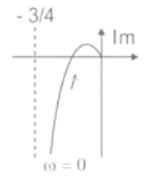
The frequency response of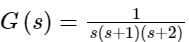 plotted in the complex G(jω) plane (for 0 < ω < ∞) is
- a)
- b)
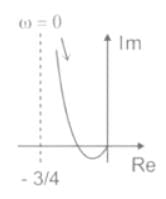
- c)
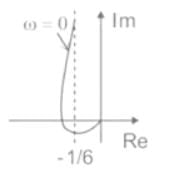
- d)
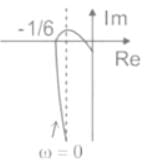
Correct answer is option 'D'. Can you explain this answer?
The frequency response ofplotted in the complex G(jω) plane (for 0 < ω < ∞) is
plotted in the complex G(jω) plane (for 0 < ω < ∞) isa)
b)
c)
d)
| | Cstoppers Instructors answered |
The given frequency response is
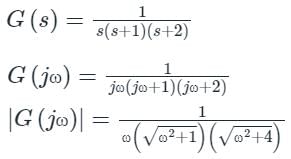

In Anti-clockwise the phase order is 0, 90, 180, 270, 360 or 0.
In clockwise the phase angle order is 0, -90, -180, -270, -360 or 0.
Here, 90∘ = -270∘ and 270∘ = -90∘
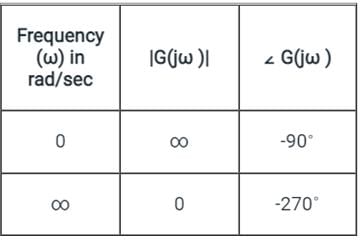
At ω = ωc (Cut-off frequency), ∠ G(jω) = -180∘
−90 − tan−1ωc − tan−10.5ωc = −180
tan−1ωc + tan−10.5ωc = 90
In clockwise the phase angle order is 0, -90, -180, -270, -360 or 0.
Here, 90∘ = -270∘ and 270∘ = -90∘
At ω = ωc (Cut-off frequency), ∠ G(jω) = -180∘
−90 − tan−1ωc − tan−10.5ωc = −180
tan−1ωc + tan−10.5ωc = 90

1 - 0.5ωc2 = 0
ωc = 1.414 rad/sec
At ω = ωc
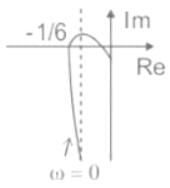
|G(jω)| = (1/6)
The polar plot for given transfer function is
When the gain margin is positive and phase margin is negative, the system is:- a)unstable
- b)highly stable
- c)oscillatory
- d)stable
Correct answer is option 'A'. Can you explain this answer?
When the gain margin is positive and phase margin is negative, the system is:
a)
unstable
b)
highly stable
c)
oscillatory
d)
stable
| | Zoya Sharma answered |
Phase Cross over Frequency:
- The frequency at which the phase plot is having the phase of -180° is known as phase cross-over frequency.
- It is denoted ωpc .
- The unit of phase cross over frequency is rad/sec
Gain Cross over Frequency:
- The frequency at which the magnitude plot is having the magnitude of zero dB is known as gain cross over frequency.
- It is denoted by ωgc.
- The unit of gain cross over frequency is rad/sec
Gain Margin:
Gain margin GM is defined as the negative of the magnitude in dB, at phase cross over frequency, i.e.

Mpc is the magnitude at phase cross over frequency. The unit of gain margin (GM) is dB.
Phase Margin
The phase margin of a system is defined as:
PM = 180° + ϕgc
The stability of the control system is based on the relation between gain margin and phase margin as:
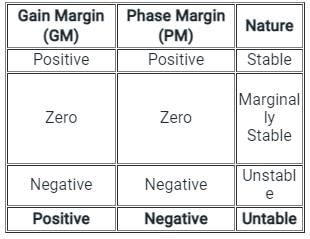
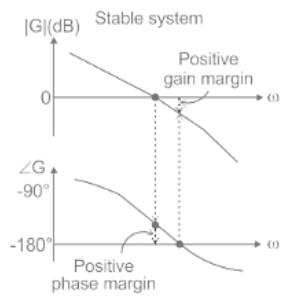
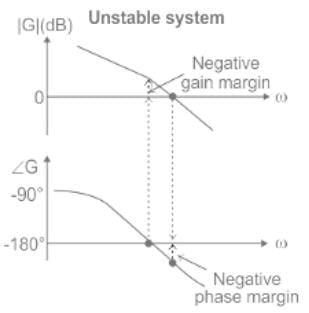
Phase Margin
The phase margin of a system is defined as:
PM = 180° + ϕgc
The stability of the control system is based on the relation between gain margin and phase margin as:
A system with a unity gain margin and zero phase margin is _____- a)sluggish
- b)highly stable
- c)oscillatory
- d)relatively stable
Correct answer is option 'C'. Can you explain this answer?
A system with a unity gain margin and zero phase margin is _____
a)
sluggish
b)
highly stable
c)
oscillatory
d)
relatively stable
| | Rajat Kapoor answered |
Unity Gain Margin (UGM) and Phase Margin (PM) are two important parameters used to analyze the stability of a control system.
Unity Gain Margin refers to the amount of gain that can be added to the system before it becomes unstable, while Phase Margin refers to the amount of phase lag that can be added to the system before it becomes unstable.
In this case, the system has a unity gain margin, which means that the system is on the verge of instability. This implies that any further increase in gain will cause the system to become unstable.
Zero Phase Margin means that the system has no phase lag before it becomes unstable. A zero phase margin indicates that the system is oscillatory in nature, meaning it will exhibit sustained oscillations or ringing behavior.
Hence, the correct answer is option C - oscillatory.
Here is a detailed explanation of each option:
a) Sluggish: Sluggishness refers to a slow response. A unity gain margin and zero phase margin do not imply sluggishness.
b) Highly stable: A highly stable system would have a large gain margin and a large phase margin. A unity gain margin and zero phase margin indicate that the system is on the verge of instability, so it is not highly stable.
c) Oscillatory: As mentioned earlier, a zero phase margin indicates that the system is oscillatory in nature. It will exhibit sustained oscillations or ringing behavior. Hence, this option is correct.
d) Relatively stable: Relatively stable refers to a system that is stable but with a small margin of stability. A unity gain margin and zero phase margin indicate that the system is on the verge of instability, so it is not relatively stable.
Unity Gain Margin refers to the amount of gain that can be added to the system before it becomes unstable, while Phase Margin refers to the amount of phase lag that can be added to the system before it becomes unstable.
In this case, the system has a unity gain margin, which means that the system is on the verge of instability. This implies that any further increase in gain will cause the system to become unstable.
Zero Phase Margin means that the system has no phase lag before it becomes unstable. A zero phase margin indicates that the system is oscillatory in nature, meaning it will exhibit sustained oscillations or ringing behavior.
Hence, the correct answer is option C - oscillatory.
Here is a detailed explanation of each option:
a) Sluggish: Sluggishness refers to a slow response. A unity gain margin and zero phase margin do not imply sluggishness.
b) Highly stable: A highly stable system would have a large gain margin and a large phase margin. A unity gain margin and zero phase margin indicate that the system is on the verge of instability, so it is not highly stable.
c) Oscillatory: As mentioned earlier, a zero phase margin indicates that the system is oscillatory in nature. It will exhibit sustained oscillations or ringing behavior. Hence, this option is correct.
d) Relatively stable: Relatively stable refers to a system that is stable but with a small margin of stability. A unity gain margin and zero phase margin indicate that the system is on the verge of instability, so it is not relatively stable.
In a bode magnitude plot, which one of the following slopes would be exhibited at high frequencies by a 4th order all-pole system?- a)-80dB/decade
- b)-40 dB/decade
- c)40 dB/decade
- d)80 dB/decade
Correct answer is option 'A'. Can you explain this answer?
In a bode magnitude plot, which one of the following slopes would be exhibited at high frequencies by a 4th order all-pole system?
a)
-80dB/decade
b)
-40 dB/decade
c)
40 dB/decade
d)
80 dB/decade
 | Naina Agarwal answered |
Understanding the Bode Magnitude Plot for a 4th Order All-Pole System
In control theory and signal processing, the Bode magnitude plot is a graphical representation of a system's frequency response. For a 4th order all-pole system, the behavior at high frequencies is particularly significant.
Characteristics of All-Pole Systems
- An all-pole system consists solely of poles and no zeros.
- The system is defined by its transfer function, which influences its stability and frequency response.
High-Frequency Response
- At high frequencies, each pole contributes to the slope of the Bode magnitude plot.
- For a first-order pole, the slope is -20 dB/decade.
Calculating the Total Slope
- A 4th order all-pole system has four poles.
- Therefore, the total slope at high frequencies is calculated as follows:
- Total slope = Number of poles x Slope per pole
- Total slope = 4 poles x (-20 dB/decade) = -80 dB/decade
Conclusion
- The high-frequency behavior of a 4th order all-pole system results in a slope of -80 dB/decade in the Bode magnitude plot.
- This negative slope indicates that as frequency increases, the gain of the system decreases significantly, reflecting the filtering characteristics of the system.
Thus, the correct answer is option 'A': -80 dB/decade.
In control theory and signal processing, the Bode magnitude plot is a graphical representation of a system's frequency response. For a 4th order all-pole system, the behavior at high frequencies is particularly significant.
Characteristics of All-Pole Systems
- An all-pole system consists solely of poles and no zeros.
- The system is defined by its transfer function, which influences its stability and frequency response.
High-Frequency Response
- At high frequencies, each pole contributes to the slope of the Bode magnitude plot.
- For a first-order pole, the slope is -20 dB/decade.
Calculating the Total Slope
- A 4th order all-pole system has four poles.
- Therefore, the total slope at high frequencies is calculated as follows:
- Total slope = Number of poles x Slope per pole
- Total slope = 4 poles x (-20 dB/decade) = -80 dB/decade
Conclusion
- The high-frequency behavior of a 4th order all-pole system results in a slope of -80 dB/decade in the Bode magnitude plot.
- This negative slope indicates that as frequency increases, the gain of the system decreases significantly, reflecting the filtering characteristics of the system.
Thus, the correct answer is option 'A': -80 dB/decade.
The slope of the line due to  factor in magnitude part of Bode plot is
- a)-40 db per octave
- b)-20 db per octave
- c)-12 db per octave
- d)-4 db per octave
Correct answer is option 'C'. Can you explain this answer?
The slope of the line due to factor in magnitude part of Bode plot is
factor in magnitude part of Bode plot isa)
-40 db per octave
b)
-20 db per octave
c)
-12 db per octave
d)
-4 db per octave
| | Swati Shah answered |
 represents type-2 factor which will have a slope of -40 db/decade.
We know that,
-20 db/decase = - 6 db/octave
∴ -40 db/decase = -12 db/octave
The characteristic equation of a closed loop control system is given by s2 + 4s + 16 = 0. The resonant frequency (in radian/sec) of the system is- a)2
- b)2√3
- c)4
- d)2√2
Correct answer is option 'D'. Can you explain this answer?
The characteristic equation of a closed loop control system is given by s2 + 4s + 16 = 0. The resonant frequency (in radian/sec) of the system is
a)
2
b)
2√3
c)
4
d)
2√2
| | Sharmila Kulkarni answered |
Given, s2 + 4s+ 16 = 0
or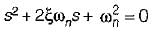
∴ ωn = 4 rad/s
and
∴ Resonant frequency,
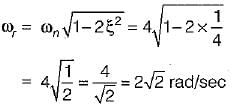
or
∴ ωn = 4 rad/s
and
∴ Resonant frequency,
Bode plot is applicable for - - a)Minimum phase network
- b)Non-minimum phase network
- c)All pass network
- d)Every network of the control system
Correct answer is option 'A'. Can you explain this answer?
Bode plot is applicable for -
a)
Minimum phase network
b)
Non-minimum phase network
c)
All pass network
d)
Every network of the control system
| | Sanya Agarwal answered |
Bode plot:
- In electrical engineering and control theory, a Bode plot is a graph of the frequency response of a system. It is usually a combination of a Bode magnitude plot, expressing the magnitude (usually in decibels) of the frequency response, and a Bode phase plot, expressing the phase shift.
- The Bode magnitude plot is the graph of the function |H(s = jω)| of frequency ω (with j being the imaginary unit). The ω -axis of the magnitude plot is logarithmic and the magnitude is given in decibels, i.e., a value for the magnitude |H| is plotted on the axis at 20log10|H|
- The Bode phase plot is the graph of the phase, commonly expressed in degrees, of the transfer function H(s = jω ) as a function of ω . The phase is plotted on the same logarithmic ω-axis as the magnitude plot, but the value for the phase is plotted on a linear vertical axis.
- For many practical problems, the detailed Bode plots can be approximated with straight-line segments that are asymptotes of the precise response. Hence Bode plot as asymptotic plot.
- Bode plot is applicable for minimum phase system.
Minimum Phase system:
- A transfer function G(s) is minimum phase if both G(s) and 1/G(s) are causal and stable
- A minimum phase system does not have zeros or poles on the right-half plane and it does not have delay.
- Bode discovered that the phase can be uniquely derived from the slope of the magnitude for minimum-phase system.
- We can draw Bode plot for non-minimum phase systems, but the magnitude and phase-angle plots are not 'uniquely related'.
- For a Minimum phase system, the magnitude and phase-angle plots are uniquely related, that means if either one of them is specified over the entire frequency range, the other plot can be determined uniquely. This does not apply to NMP systems.
System is said to be marginally stable, if- a)Gain crossover frequency > Phase crossover frequency
- b)Gain crossover frequency = Phase crossover frequency
- c)Gain crossover frequency < Phase crossover frequency
- d)Gain crossover frequency ≠ Phase crossover frequency
Correct answer is option 'B'. Can you explain this answer?
System is said to be marginally stable, if
a)
Gain crossover frequency > Phase crossover frequency
b)
Gain crossover frequency = Phase crossover frequency
c)
Gain crossover frequency < Phase crossover frequency
d)
Gain crossover frequency ≠ Phase crossover frequency
| | Nakul Chauhan answered |
Explanation:
Marginally Stable System:
A marginally stable system is a system where the gain crossover frequency is equal to the phase crossover frequency. In other words, the gain margin and phase margin are both zero.
Gain Crossover Frequency:
The gain crossover frequency is the frequency at which the magnitude of the open-loop transfer function is equal to 1 or 0 dB.
Phase Crossover Frequency:
The phase crossover frequency is the frequency at which the phase of the open-loop transfer function is equal to -180 degrees.
Relation between Gain and Phase Crossover Frequencies:
In a marginally stable system, the gain crossover frequency is equal to the phase crossover frequency. This means that the system is on the verge of instability, as there is no margin for stability. Any slight variation in parameters can potentially push the system into instability.
Conclusion:
Therefore, in a marginally stable system, the gain crossover frequency is equal to the phase crossover frequency. This balance between gain and phase margins indicates a critical stability point for the system.
Marginally Stable System:
A marginally stable system is a system where the gain crossover frequency is equal to the phase crossover frequency. In other words, the gain margin and phase margin are both zero.
Gain Crossover Frequency:
The gain crossover frequency is the frequency at which the magnitude of the open-loop transfer function is equal to 1 or 0 dB.
Phase Crossover Frequency:
The phase crossover frequency is the frequency at which the phase of the open-loop transfer function is equal to -180 degrees.
Relation between Gain and Phase Crossover Frequencies:
In a marginally stable system, the gain crossover frequency is equal to the phase crossover frequency. This means that the system is on the verge of instability, as there is no margin for stability. Any slight variation in parameters can potentially push the system into instability.
Conclusion:
Therefore, in a marginally stable system, the gain crossover frequency is equal to the phase crossover frequency. This balance between gain and phase margins indicates a critical stability point for the system.
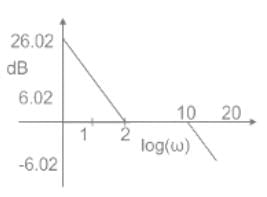
If the given system is connected to a unity negative feedback system, the steady-state error of a closed-loop system to a ramp input is;
- a)0.01
- b)1
- c)0.5
- d)0.2
Correct answer is option 'C'. Can you explain this answer?
If the given system is connected to a unity negative feedback system, the steady-state error of a closed-loop system to a ramp input is;
a)
0.01
b)
1
c)
0.5
d)
0.2
 | Pioneer Academy answered |
Concept-
For a unity feedback system with an open-loop transfer function G(s), the steady-state errors can be found identify the system type and using the respective formula:
For system type 0 : ess = 1/1+Kp
For system type 1 : ess = 1/Kv
For system type 2 : ess = 1/Kα
For a unity feedback system with an open-loop transfer function G(s), the steady-state errors can be found identify the system type and using the respective formula:
For system type 0 : ess = 1/1+Kp
For system type 1 : ess = 1/Kv
For system type 2 : ess = 1/Kα
By identifying the system type from the open-loop Bode plot, the steady-state error can be easily found as follows-
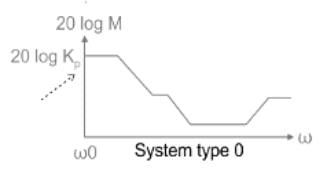
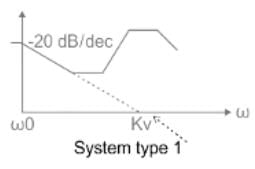
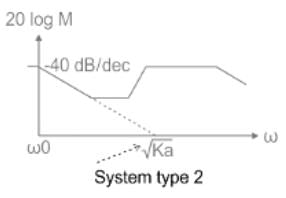
From the given bode plot initial slope =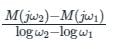

So one pole present at the origin
Since it is a type 1 system so it will intersect Real Axis at kv
Kv = 2
ess = 1/Kv = 1/2 = 0.5
From the given bode plot initial slope =
So one pole present at the origin
Since it is a type 1 system so it will intersect Real Axis at kv
Kv = 2
ess = 1/Kv = 1/2 = 0.5
Assertion (A) : Gain margin alone is adequate to indicate relative stability when system parameters other than the loop gain are subject to variation.
Reason (R) : Gain margin is the amount of gain in dB that can be added to the loop before the closed-loop system becomes unstable.- a)Both A and R are true and R is a correct explanation of A.
- b)Both A and R are true but R is not a correct explanation of A.
- c)A is true but R is false.
- d)A is false but R is true.
Correct answer is option 'D'. Can you explain this answer?
Assertion (A) : Gain margin alone is adequate to indicate relative stability when system parameters other than the loop gain are subject to variation.
Reason (R) : Gain margin is the amount of gain in dB that can be added to the loop before the closed-loop system becomes unstable.
Reason (R) : Gain margin is the amount of gain in dB that can be added to the loop before the closed-loop system becomes unstable.
a)
Both A and R are true and R is a correct explanation of A.
b)
Both A and R are true but R is not a correct explanation of A.
c)
A is true but R is false.
d)
A is false but R is true.
 | Maulik Chatterjee answered |
Assertion (A): Gain margin alone is adequate to indicate relative stability when system parameters other than the loop gain are subject to variation.
Reason (R): Gain margin is the amount of gain in dB that can be added to the loop before the closed-loop system becomes unstable.
Explanation:
The gain margin is a measure of the system's stability and is defined as the amount of gain that can be added to the loop before the system becomes unstable. It is usually expressed in decibels (dB). A positive gain margin indicates that the system is stable, while a negative gain margin indicates instability.
Assertion (A) is false:
The gain margin alone is not adequate to indicate relative stability when system parameters other than the loop gain are subject to variation. The gain margin only considers the loop gain and does not take into account other factors that can affect the system's stability, such as phase margin, time delays, nonlinearities, and disturbances. These factors can significantly impact the system's overall stability and performance.
Reason (R) is true:
The gain margin is indeed the amount of gain that can be added to the loop before the closed-loop system becomes unstable. It is a useful measure to assess the stability of a system. However, it should be noted that the gain margin alone is not sufficient to determine the overall stability of the system, especially when there are variations in system parameters other than the loop gain.
Conclusion:
In conclusion, while the gain margin provides insight into the system's stability based on the loop gain, it is not enough to determine the overall stability when other system parameters are subject to variation. Therefore, Assertion (A) is false, and Reason (R) is true, but it does not provide a correct explanation of Assertion (A).
Therefore, the correct answer is option D.
Reason (R): Gain margin is the amount of gain in dB that can be added to the loop before the closed-loop system becomes unstable.
Explanation:
The gain margin is a measure of the system's stability and is defined as the amount of gain that can be added to the loop before the system becomes unstable. It is usually expressed in decibels (dB). A positive gain margin indicates that the system is stable, while a negative gain margin indicates instability.
Assertion (A) is false:
The gain margin alone is not adequate to indicate relative stability when system parameters other than the loop gain are subject to variation. The gain margin only considers the loop gain and does not take into account other factors that can affect the system's stability, such as phase margin, time delays, nonlinearities, and disturbances. These factors can significantly impact the system's overall stability and performance.
Reason (R) is true:
The gain margin is indeed the amount of gain that can be added to the loop before the closed-loop system becomes unstable. It is a useful measure to assess the stability of a system. However, it should be noted that the gain margin alone is not sufficient to determine the overall stability of the system, especially when there are variations in system parameters other than the loop gain.
Conclusion:
In conclusion, while the gain margin provides insight into the system's stability based on the loop gain, it is not enough to determine the overall stability when other system parameters are subject to variation. Therefore, Assertion (A) is false, and Reason (R) is true, but it does not provide a correct explanation of Assertion (A).
Therefore, the correct answer is option D.
Assertion (A): Relative stability of the system reduces due to the presence of transportation lag.
Reason (R): Transportation lag can be conveniently handled by Bode plot.- a)Both A and R are true but R is correct explanation of A
- b)Both A and R are true but R is not correct explanation of A
- c)A is true but R is false
- d)A is false but R is true
Correct answer is option 'B'. Can you explain this answer?
Assertion (A): Relative stability of the system reduces due to the presence of transportation lag.
Reason (R): Transportation lag can be conveniently handled by Bode plot.
Reason (R): Transportation lag can be conveniently handled by Bode plot.
a)
Both A and R are true but R is correct explanation of A
b)
Both A and R are true but R is not correct explanation of A
c)
A is true but R is false
d)
A is false but R is true
 | Mahika Sengupta answered |
Assertion (A): Relative stability of the system reduces due to the presence of transportation lag.
Reason (R): Transportation lag can be conveniently handled by Bode plot.
The given assertion states that the relative stability of the system reduces due to the presence of transportation lag, and the reason provided is that transportation lag can be conveniently handled by the Bode plot.
A. Both A and R are true but R is correct explanation of A
B. Both A and R are true but R is not correct explanation of A
C. A is true but R is false
D. A is false but R is true
According to the Bode plot, the frequency response of a system can be represented by a magnitude plot and a phase plot. The magnitude plot shows the gain of the system at different frequencies, while the phase plot shows the phase shift of the system at different frequencies.
Transportation lag:
Transportation lag is a time delay that occurs in a system when there is a delay in the response of the output due to the time taken for the input to be transmitted from one point to another. This lag can be caused by various factors such as the physical distance between components, signal propagation delays, or processing delays.
Effect of transportation lag on system stability:
When a system has transportation lag, it introduces phase lag in the frequency response. This phase lag can lead to instability in the system. The presence of transportation lag reduces the relative stability of the system.
Handling transportation lag using Bode plot:
The Bode plot provides a graphical representation of the frequency response of a system. It can be used to analyze and design control systems. However, the Bode plot itself does not handle transportation lag directly.
While the Bode plot can provide valuable information about the frequency response of a system, it does not specifically address the issue of transportation lag. To handle transportation lag, additional techniques such as lead-lag compensation or Smith predictor may be employed.
Conclusion:
Based on the above discussion, Assertion A is true as the presence of transportation lag does reduce the relative stability of the system. Reason R is also true as the Bode plot can be used to analyze the frequency response of a system. However, Reason R is not a correct explanation of Assertion A, as the Bode plot itself does not handle transportation lag directly. Therefore, the correct answer is option B: Both A and R are true, but R is not a correct explanation of A.
Reason (R): Transportation lag can be conveniently handled by Bode plot.
The given assertion states that the relative stability of the system reduces due to the presence of transportation lag, and the reason provided is that transportation lag can be conveniently handled by the Bode plot.
A. Both A and R are true but R is correct explanation of A
B. Both A and R are true but R is not correct explanation of A
C. A is true but R is false
D. A is false but R is true
According to the Bode plot, the frequency response of a system can be represented by a magnitude plot and a phase plot. The magnitude plot shows the gain of the system at different frequencies, while the phase plot shows the phase shift of the system at different frequencies.
Transportation lag:
Transportation lag is a time delay that occurs in a system when there is a delay in the response of the output due to the time taken for the input to be transmitted from one point to another. This lag can be caused by various factors such as the physical distance between components, signal propagation delays, or processing delays.
Effect of transportation lag on system stability:
When a system has transportation lag, it introduces phase lag in the frequency response. This phase lag can lead to instability in the system. The presence of transportation lag reduces the relative stability of the system.
Handling transportation lag using Bode plot:
The Bode plot provides a graphical representation of the frequency response of a system. It can be used to analyze and design control systems. However, the Bode plot itself does not handle transportation lag directly.
While the Bode plot can provide valuable information about the frequency response of a system, it does not specifically address the issue of transportation lag. To handle transportation lag, additional techniques such as lead-lag compensation or Smith predictor may be employed.
Conclusion:
Based on the above discussion, Assertion A is true as the presence of transportation lag does reduce the relative stability of the system. Reason R is also true as the Bode plot can be used to analyze the frequency response of a system. However, Reason R is not a correct explanation of Assertion A, as the Bode plot itself does not handle transportation lag directly. Therefore, the correct answer is option B: Both A and R are true, but R is not a correct explanation of A.
If the GM of the system is 23.9dB then find the value of K.
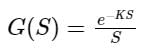
- a)0.1
- b)10
- c)0.01
- d)100
Correct answer is option 'A'. Can you explain this answer?
If the GM of the system is 23.9dB then find the value of K.
a)
0.1
b)
10
c)
0.01
d)
100
| | Cstoppers Instructors answered |
The gain margin of the system is 23.9 dB
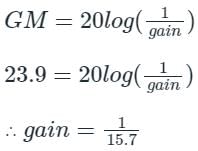
∴ phase crossover frequency Wpc = 15.7 rad
∴ at Wpc = 15.7 rad we will get the phase of -180º

-180º = -K(900) -90º
∴ K = 90/900
= 0.1
∴ phase crossover frequency Wpc = 15.7 rad
∴ at Wpc = 15.7 rad we will get the phase of -180º
-180º = -K(900) -90º
∴ K = 90/900
= 0.1
A system has transfer function equal to (1-s)/(1+s). Its gain at ω = 1 rad/s is- a)1
- b)0
- c)-1
- d)none of these
Correct answer is option 'A'. Can you explain this answer?
A system has transfer function equal to (1-s)/(1+s). Its gain at ω = 1 rad/s is
a)
1
b)
0
c)
-1
d)
none of these
| | Jaya Dasgupta answered |
Given transfer function represents an all pass filter which has gain of 1 at all frequencies.
If the Nyquist plot cuts the negative real axis at a distance of 0.8, then the gain margin of the system is- a)−0.8
- b)2.25
- c)0.8
- d)1.25
Correct answer is option 'D'. Can you explain this answer?
If the Nyquist plot cuts the negative real axis at a distance of 0.8, then the gain margin of the system is
a)
−0.8
b)
2.25
c)
0.8
d)
1.25
 | Yash Patel answered |
Concept:
The gain margin is defined as the amount of change in open-loop gain needed to make a closed-loop system unstable.
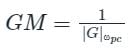
where, |G| = Gain of the system
ωpc = Phase crossover frequency
The frequency at which the gain of the system is zero is known as the phase crossover frequency.
Calculation:
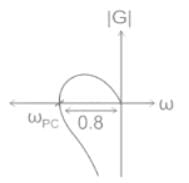
GM = 1/0.8
GM = 1.25
The gain margin is defined as the amount of change in open-loop gain needed to make a closed-loop system unstable.
where, |G| = Gain of the system
ωpc = Phase crossover frequency
The frequency at which the gain of the system is zero is known as the phase crossover frequency.
Calculation:
GM = 1/0.8
GM = 1.25
Match List-I (Different values of damping ratio) with List-II (Values of resonant peaks) and select the correct answer using the codes given below the lists:
List-I
A. ξ = 0
B. ξ = 0,707
C. ξ = 0.85
D. ξ = 0.5
List-II
1. More than unity
2. Not defined
3. Unity
4. infinite
Codes:
A B C D
(a) 1 3 2 4
(b) 4 1 2 3
(c) 4 3 2 1
(d) 1 2 3 4- a)(a)
- b)(b)
- c)(c)
- d)(d)
Correct answer is option 'C'. Can you explain this answer?
Match List-I (Different values of damping ratio) with List-II (Values of resonant peaks) and select the correct answer using the codes given below the lists:
List-I
A. ξ = 0
B. ξ = 0,707
C. ξ = 0.85
D. ξ = 0.5
List-II
1. More than unity
2. Not defined
3. Unity
4. infinite
Codes:
A B C D
(a) 1 3 2 4
(b) 4 1 2 3
(c) 4 3 2 1
(d) 1 2 3 4
List-I
A. ξ = 0
B. ξ = 0,707
C. ξ = 0.85
D. ξ = 0.5
List-II
1. More than unity
2. Not defined
3. Unity
4. infinite
Codes:
A B C D
(a) 1 3 2 4
(b) 4 1 2 3
(c) 4 3 2 1
(d) 1 2 3 4
a)
(a)
b)
(b)
c)
(c)
d)
(d)
 | Anjali Choudhury answered |
Resonant peak is given by,
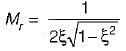
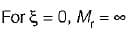
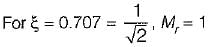
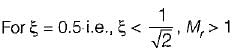

In frequency domainanalysis,
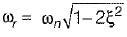
Thus, for ωr to be real Hence for
  there is no Mr or Mf is not defined.
Thus, for ωr to be real
Hence for there is no Mr or Mf is not defined.The frequency at which the Nyquist plot crosses the negative real axis is known as- a)natural frequency
- b)damped natural frequency
- c)gain crossover frequency
- d)phase crossover frequency
Correct answer is option 'D'. Can you explain this answer?
The frequency at which the Nyquist plot crosses the negative real axis is known as
a)
natural frequency
b)
damped natural frequency
c)
gain crossover frequency
d)
phase crossover frequency
| | Sanskriti Desai answered |
Nyquist plot is a graphical representation of the frequency response of a system. It is obtained by plotting the complex values of the transfer function of the system on the complex plane.
The Nyquist plot provides information about the gain and phase characteristics of the system at different frequencies. It is often used to analyze the stability and performance of control systems.
Key Points:
1. Nyquist Plot: The Nyquist plot is a plot of the complex transfer function on the complex plane. It is obtained by varying the frequency from 0 to infinity and evaluating the transfer function at each frequency.
2. Negative Real Axis: The negative real axis of the Nyquist plot represents the frequencies at which the phase shift of the system is -180 degrees or π radians. This is the critical frequency at which the system undergoes a phase crossover.
3. Phase Crossover Frequency: The frequency at which the Nyquist plot crosses the negative real axis is known as the phase crossover frequency. It is denoted as ωc.
4. Relationship with Stability: The phase crossover frequency is an important parameter for determining the stability of a control system. If the phase crossover frequency is too low, it indicates that the system has a slow response and may be unstable. On the other hand, if the phase crossover frequency is too high, it indicates that the system has a fast response but may have stability issues.
5. Gain Crossover Frequency: The gain crossover frequency is another important parameter that is related to the stability and performance of the system. It is the frequency at which the Nyquist plot crosses the unity gain magnitude. It is denoted as ωg.
6. Difference between Phase and Gain Crossover Frequency: The phase crossover frequency is related to the phase shift of the system, while the gain crossover frequency is related to the magnitude of the system. The phase crossover frequency provides information about the stability of the system, while the gain crossover frequency provides information about the performance of the system.
In conclusion, the frequency at which the Nyquist plot crosses the negative real axis is known as the phase crossover frequency. It is an important parameter for determining the stability of a control system.
The Nyquist plot provides information about the gain and phase characteristics of the system at different frequencies. It is often used to analyze the stability and performance of control systems.
Key Points:
1. Nyquist Plot: The Nyquist plot is a plot of the complex transfer function on the complex plane. It is obtained by varying the frequency from 0 to infinity and evaluating the transfer function at each frequency.
2. Negative Real Axis: The negative real axis of the Nyquist plot represents the frequencies at which the phase shift of the system is -180 degrees or π radians. This is the critical frequency at which the system undergoes a phase crossover.
3. Phase Crossover Frequency: The frequency at which the Nyquist plot crosses the negative real axis is known as the phase crossover frequency. It is denoted as ωc.
4. Relationship with Stability: The phase crossover frequency is an important parameter for determining the stability of a control system. If the phase crossover frequency is too low, it indicates that the system has a slow response and may be unstable. On the other hand, if the phase crossover frequency is too high, it indicates that the system has a fast response but may have stability issues.
5. Gain Crossover Frequency: The gain crossover frequency is another important parameter that is related to the stability and performance of the system. It is the frequency at which the Nyquist plot crosses the unity gain magnitude. It is denoted as ωg.
6. Difference between Phase and Gain Crossover Frequency: The phase crossover frequency is related to the phase shift of the system, while the gain crossover frequency is related to the magnitude of the system. The phase crossover frequency provides information about the stability of the system, while the gain crossover frequency provides information about the performance of the system.
In conclusion, the frequency at which the Nyquist plot crosses the negative real axis is known as the phase crossover frequency. It is an important parameter for determining the stability of a control system.
The constant M circle for M = 1 is the- a)straight line x = -1/2
- b)critical point (-1j0)
- c)circle with r = 0.33
- d)circle with r = 0.67
Correct answer is option 'A'. Can you explain this answer?
The constant M circle for M = 1 is the
a)
straight line x = -1/2
b)
critical point (-1j0)
c)
circle with r = 0.33
d)
circle with r = 0.67
 | Mainak Pillai answered |
Understanding the Constant M Circle
The constant M circle is a concept used in control systems, particularly in root locus and Nyquist plots. For a specific value of M, such as M = 1, we examine the implications on the system's stability and behavior. Let's break down the given options.
Option A: Straight Line x = -1/2
- The M circle for M = 1 represents a constant magnitude of the open-loop transfer function.
- This results in a line in the complex plane where the real part (x) is fixed.
- The straight line x = -1/2 indicates a specific point along the real axis, which is critical for determining stability margins.
Option B: Critical Point (-1j0)
- The critical point (-1j0) is significant in control theory but does not represent the M = 1 circle.
- It relates more to the location of poles and zeros rather than the constant M circle.
Option C: Circle with r = 0.33
- A circle with radius 0.33 does not align with the definition of the M = 1 constant circle.
- It represents a different magnitude, which is not applicable for M = 1.
Option D: Circle with r = 0.67
- Similar to option C, a circle with radius 0.67 does not correspond to the M = 1 condition.
- The radius chosen must reflect the unity magnitude condition, which is not satisfied here.
Conclusion
- Therefore, the correct interpretation of the constant M circle for M = 1 is indeed the straight line x = -1/2.
- This choice effectively represents the system's behavior under the specified conditions, making option A the correct answer.
The constant M circle is a concept used in control systems, particularly in root locus and Nyquist plots. For a specific value of M, such as M = 1, we examine the implications on the system's stability and behavior. Let's break down the given options.
Option A: Straight Line x = -1/2
- The M circle for M = 1 represents a constant magnitude of the open-loop transfer function.
- This results in a line in the complex plane where the real part (x) is fixed.
- The straight line x = -1/2 indicates a specific point along the real axis, which is critical for determining stability margins.
Option B: Critical Point (-1j0)
- The critical point (-1j0) is significant in control theory but does not represent the M = 1 circle.
- It relates more to the location of poles and zeros rather than the constant M circle.
Option C: Circle with r = 0.33
- A circle with radius 0.33 does not align with the definition of the M = 1 constant circle.
- It represents a different magnitude, which is not applicable for M = 1.
Option D: Circle with r = 0.67
- Similar to option C, a circle with radius 0.67 does not correspond to the M = 1 condition.
- The radius chosen must reflect the unity magnitude condition, which is not satisfied here.
Conclusion
- Therefore, the correct interpretation of the constant M circle for M = 1 is indeed the straight line x = -1/2.
- This choice effectively represents the system's behavior under the specified conditions, making option A the correct answer.
Nichol’s chart is useful for the detailed study and analysis of:- a)Closed loop frequency response
- b)Open loop frequency response
- c)Close loop and open loop frequency responses
- d)open loop and Close loop frequency responses
Correct answer is option 'A'. Can you explain this answer?
Nichol’s chart is useful for the detailed study and analysis of:
a)
Closed loop frequency response
b)
Open loop frequency response
c)
Close loop and open loop frequency responses
d)
open loop and Close loop frequency responses
| | Hiral Shah answered |
Nichol's Chart Overview
Nichol's Chart is a graphical tool used in control systems to analyze the frequency response of a system. It is particularly effective for assessing closed-loop frequency responses.
Closed Loop Frequency Response
- Definition: The closed-loop frequency response of a system refers to how the output responds to input changes when feedback is applied.
- Importance: Understanding this response is crucial for stability and performance evaluation in control systems.
Why Option A is Correct
- Focused Analysis: Nichol's Chart is designed to illustrate the relationship between gain and phase in the closed loop, making it easier to evaluate system stability and performance under varying conditions.
- Stability Margins: The chart allows engineers to determine gain and phase margins, which are critical for ensuring that the system remains stable.
- Bode and Nyquist Integration: While Bode plots and Nyquist diagrams focus on open-loop responses, Nichol's Chart integrates these concepts to provide insights into closed-loop dynamics.
Applications in Engineering
- Control System Design: Engineers use Nichol's Chart to design and tune control systems by adjusting parameters to achieve desired performance specifications.
- Feedback Analysis: It helps in analyzing how feedback affects system behavior, aiding in the development of robust control strategies.
In conclusion, Nichol's Chart is primarily useful for the detailed study and analysis of closed-loop frequency responses, making option A the correct choice.
Nichol's Chart is a graphical tool used in control systems to analyze the frequency response of a system. It is particularly effective for assessing closed-loop frequency responses.
Closed Loop Frequency Response
- Definition: The closed-loop frequency response of a system refers to how the output responds to input changes when feedback is applied.
- Importance: Understanding this response is crucial for stability and performance evaluation in control systems.
Why Option A is Correct
- Focused Analysis: Nichol's Chart is designed to illustrate the relationship between gain and phase in the closed loop, making it easier to evaluate system stability and performance under varying conditions.
- Stability Margins: The chart allows engineers to determine gain and phase margins, which are critical for ensuring that the system remains stable.
- Bode and Nyquist Integration: While Bode plots and Nyquist diagrams focus on open-loop responses, Nichol's Chart integrates these concepts to provide insights into closed-loop dynamics.
Applications in Engineering
- Control System Design: Engineers use Nichol's Chart to design and tune control systems by adjusting parameters to achieve desired performance specifications.
- Feedback Analysis: It helps in analyzing how feedback affects system behavior, aiding in the development of robust control strategies.
In conclusion, Nichol's Chart is primarily useful for the detailed study and analysis of closed-loop frequency responses, making option A the correct choice.
The Nyquist plot of a open-loop transfer function G(jω)H(jω) of a system encloses the (-1, j0) point. The gain margin of the system is- a)less than zero
- b)greater than zero
- c)zero
- d)infinity
Correct answer is option 'A'. Can you explain this answer?
The Nyquist plot of a open-loop transfer function G(jω)H(jω) of a system encloses the (-1, j0) point. The gain margin of the system is
a)
less than zero
b)
greater than zero
c)
zero
d)
infinity
 | Nilanjan Rane answered |
If Nyquist plot encloses the point (-1, j0), the system is unstable and gain margin is negative.
In polar plots, if a pole is added at the origin, what would be the value of the magnitude at Ω = 0?- a)Zero
- b)Infinity
- c)Unity
- d)Unpredictable
Correct answer is option 'B'. Can you explain this answer?
In polar plots, if a pole is added at the origin, what would be the value of the magnitude at Ω = 0?
a)
Zero
b)
Infinity
c)
Unity
d)
Unpredictable
| | Zoya Sharma answered |
Addition of pole causes instability to the system.
In polar plots, what does each and every point represent w.r.t magnitude and angle?- a)Scalar
- b)Vector
- c)Phasor
- d)Differentiator
Correct answer is option 'C'. Can you explain this answer?
In polar plots, what does each and every point represent w.r.t magnitude and angle?
a)
Scalar
b)
Vector
c)
Phasor
d)
Differentiator
| | Rajesh Saha answered |
Understanding Polar Plots
In polar plots, each point represents a specific relationship between magnitude and angle, crucial in fields like electrical engineering. The correct answer is C) Phasor.
What is a Phasor?
- A phasor is a complex number used to represent a sinusoidal function in terms of its magnitude (amplitude) and phase (angle).
- In engineering, phasors simplify the analysis of AC circuits by transforming differential equations into algebraic ones.
Components of a Phasor
- Magnitude: The distance from the origin to the point in the polar plot, representing the amplitude of the sinusoidal signal.
- Angle: The angle formed with respect to the positive x-axis, indicating the phase shift of the signal.
Why Polar Plots?
- Polar plots are advantageous for visualizing the relationship between magnitude and phase in a single representation.
- They allow engineers to analyze and interpret signals efficiently, especially in AC circuit analysis.
Conclusion
In summary, each point on a polar plot represents a phasor, encapsulating both magnitude and angle, essential for understanding sinusoidal signals in electrical engineering. The concept of phasors is fundamental for simplifying and analyzing complex AC systems, making option 'C' the correct choice.
In polar plots, each point represents a specific relationship between magnitude and angle, crucial in fields like electrical engineering. The correct answer is C) Phasor.
What is a Phasor?
- A phasor is a complex number used to represent a sinusoidal function in terms of its magnitude (amplitude) and phase (angle).
- In engineering, phasors simplify the analysis of AC circuits by transforming differential equations into algebraic ones.
Components of a Phasor
- Magnitude: The distance from the origin to the point in the polar plot, representing the amplitude of the sinusoidal signal.
- Angle: The angle formed with respect to the positive x-axis, indicating the phase shift of the signal.
Why Polar Plots?
- Polar plots are advantageous for visualizing the relationship between magnitude and phase in a single representation.
- They allow engineers to analyze and interpret signals efficiently, especially in AC circuit analysis.
Conclusion
In summary, each point on a polar plot represents a phasor, encapsulating both magnitude and angle, essential for understanding sinusoidal signals in electrical engineering. The concept of phasors is fundamental for simplifying and analyzing complex AC systems, making option 'C' the correct choice.
According to Nyquist stability criterion, where should be the position of all zeros of q(s) corresponding to s-plane?- a)On left half
- b)At the center
- c)On right half
- d)Random
Correct answer is option 'A'. Can you explain this answer?
According to Nyquist stability criterion, where should be the position of all zeros of q(s) corresponding to s-plane?
a)
On left half
b)
At the center
c)
On right half
d)
Random
 | Pooja Patel answered |
According to Nyquist stability criterion zeroes must lie on the left half on the s plane.
The frequency at which the Nyquist plot of a unity feedback system with the open loop transfer function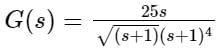 crosses the negative real axis is
- a)1 rad / s
- b)√2 rad / s
- c)√3 rad / s
- d)5 rad / s
Correct answer is option 'C'. Can you explain this answer?
The frequency at which the Nyquist plot of a unity feedback system with the open loop transfer function crosses the negative real axis is
crosses the negative real axis isa)
1 rad / s
b)
√2 rad / s
c)
√3 rad / s
d)
5 rad / s
 | Gate Gurus answered |
Concept:
- Nyquist plot crosses the negative real axis at phase cross over frequency (ωpc)
- The phase crossover frequency is the frequency at which the phase angle first reaches −180°
- i.e., ∠(G(ωpc)) = -1800
Calculation:
Given G(s) =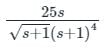
∠(G(ωpc)) = 900 – 0.5 tan-1(ωpc) – 4 tan-1(ωpc) = -1800
By solving we get ωpc = √3 rad/sec
∠(G(ωpc)) = 900 – 0.5 tan-1(ωpc) – 4 tan-1(ωpc) = -1800
By solving we get ωpc = √3 rad/sec
Assertion (A): The phase angle plot in Bode diagram is not affected by the variation in the gain of the system.
Reason(R): The variation in the gain of the system has no effect on the phase margin of the system.- a)Both A and R are true but R is correct explanation of A
- b)Both A and R are true but R is not correct explanation of A
- c)A is true but R is false
- d)A is false but R is true
Correct answer is option 'C'. Can you explain this answer?
Assertion (A): The phase angle plot in Bode diagram is not affected by the variation in the gain of the system.
Reason(R): The variation in the gain of the system has no effect on the phase margin of the system.
Reason(R): The variation in the gain of the system has no effect on the phase margin of the system.
a)
Both A and R are true but R is correct explanation of A
b)
Both A and R are true but R is not correct explanation of A
c)
A is true but R is false
d)
A is false but R is true
| | Sarita Yadav answered |
The variation in the gain of the system has effect on the phase margin but phase plot is not affected.
Chapter doubts & questions for Frequency Domain Analysis (Polar & Bode Plot) - 6 Months Preparation for GATE Electrical 2026 is part of Electrical Engineering (EE) exam preparation. The chapters have been prepared according to the Electrical Engineering (EE) exam syllabus. The Chapter doubts & questions, notes, tests & MCQs are made for Electrical Engineering (EE) 2026 Exam. Find important definitions, questions, notes, meanings, examples, exercises, MCQs and online tests here.
Chapter doubts & questions of Frequency Domain Analysis (Polar & Bode Plot) - 6 Months Preparation for GATE Electrical in English & Hindi are available as part of Electrical Engineering (EE) exam. Download more important topics, notes, lectures and mock test series for Electrical Engineering (EE) Exam by signing up for free.
6 Months Preparation for GATE Electrical675 videos|1390 docs|885 tests |
