


All Exams > Electrical Engineering (EE) > 6 Months Preparation for GATE Electrical > All Questions
All questions of Electromechanical Indicating Instruments for Electrical Engineering (EE) Exam
Which of the following statement(s) is/are TRUE regarding the magnetic shielding in an electrodynamometer wattmeter?
A. To avoid stray magnetic field errors
B. instrument is enclosed in a casing of high permeability alloy
C. A soft iron core is placed to direct the flux- a)A and B
- b)B and C
- c)C and A
- d)A, B, and C
Correct answer is option 'A'. Can you explain this answer?
Which of the following statement(s) is/are TRUE regarding the magnetic shielding in an electrodynamometer wattmeter?
A. To avoid stray magnetic field errors
B. instrument is enclosed in a casing of high permeability alloy
C. A soft iron core is placed to direct the flux
A. To avoid stray magnetic field errors
B. instrument is enclosed in a casing of high permeability alloy
C. A soft iron core is placed to direct the flux
a)
A and B
b)
B and C
c)
C and A
d)
A, B, and C
 | Gate Gurus answered |
Electrodynamometer Instruments:
- The electrodynamometer is a transfer-type instrument.
- A transfer-type instrument is one that may be calibrated with a dc source and then used without modification to measure AC.
- This requires the transfer type instruments to have the same accuracy for both DC and AC.
- These instruments are also called Electrodynamic or Dynamometer Type Instruments.
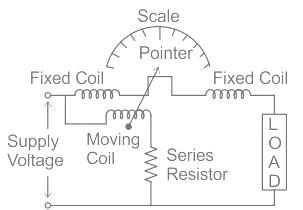
- A schematic diagram of Electrodynamic or Dynamometer Type Instruments is shown below:
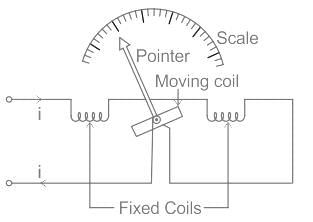
- An electrodynamic instrument is a moving-coil instrument in which the operating field is produced, not by a permanent magnet but by another fixed coil.
- This instrument can be used either as an ammeter or a voltmeter but is generally used as a wattmeter.
- The electrodynamic or dynamometer-type instrument is a moving-coil instrument but the magnetic field, in which the coil moves, is provided by two fixed coils rather than by permanent magnets (eg: PMMC instruments).
Construction:
Different parts of an Electrodynamometer instrument are briefly explained below
Fixed Coils:
Different parts of an Electrodynamometer instrument are briefly explained below
Fixed Coils:
- The field is produced by a fixed coil.
- This coil is divided into two sections to give a more uniform field near the center and to allow passage of the instrument shaft.
- The instrument as shown in the figure by a milliammeter, or may become a voltmeter by the addition of series resistance.
- The fixed coils are wound with fine wire for such applications.
- Field (fixed) coils are usually wound with a heavy wire carrying the main current in ammeters and watt meters.
- The wire is stranded where necessary to reduce eddy current losses in conductors.
- The coils are usually varnished and baked to form a solid assembly.
- These are then clamped in place against the coil supports, This makes the construction rigid so that there is no shifting or change in dimensions that might affect the calibration.
- The mounting supports are preferably made out of ceramic, as metal parts would weaken the field of the fixed coil on account of eddy currents.
Moving Coil:
- A single-element instrument has one moving coil.
- The moving coil is wound either as a self-sustaining coil or else on a non-metallic former.
- A metallic former cannot be used as eddy currents would be induced in it by the alternating field.
- Light but rigid construction is used for the moving coil.
- It should be noted that both fixed and moving coils are air-cored.
Control:
- The controlling torque is provided by two control springs.
- These springs act as leads to the moving coil.
Moving System:
- The moving coil is mounted on an aluminum spindle.
- The moving system also carries the counterweights and truss-type pointer.
- Sometimes a suspension may be used in case high sensitivity is desired.
Damping:
- Air friction damping is employed for these instruments and is provided by a pair of aluminum vanes, attached to the spindle at the bottom.
- These vanes move in sector-shaped chambers.
Shielding:
- The field produced by the fixed coils is somewhat weaker than in other types of instruments.
- It is nearly 0.005 to 0.006 Wb/m2.
- In DC measurements, even the earth’s magnetic field may affect the readings.
- Thus it is necessary to shield an electrodynamometer-type instrument from the effect of stray magnetic fields (0.0005 - 0.00075 Wb/m2).
- Air-cored electrodynamometer-type instruments are protected against external magnetic fields by enclosing them in a casing of high permeability alloy.
Cases and Scales:
- Laboratory standard instruments are usually contained in highly polished wooden cases.
- These cases are so constructed as to remain dimensionally stable over long periods.
- The glass is coated with some conducting material to completely remove the electrostatic effects.
- The case is supported by arable leveling screws.
- A spirit level is also provided to ensure proper leveling.

In Dynamometer type wattmeter, which type of the coil is split into two parts:- a)Pressure Coil
- b)Current Coil
- c)Pressure Coil and Current Coil both
- d)None of the above
Correct answer is option 'B'. Can you explain this answer?
In Dynamometer type wattmeter, which type of the coil is split into two parts:
a)
Pressure Coil
b)
Current Coil
c)
Pressure Coil and Current Coil both
d)
None of the above
 | Gate Funda answered |
Dynamometer wattmeter:
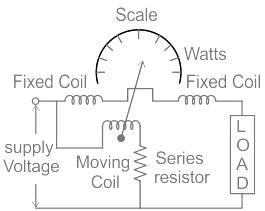
- It is a type of moving coil instrument used for the measurement of power.
- It consists of two coils - fixed and moving coil.
- The fixed coil is connected in series with the load, hence known as the current coil.
- The moving coil is connected in parallel with the load, hence known as the potential or pressure coil.
- The fixed coil is divided into two parts.
- The two fixed coils are air-cored to avoid hysteresis effects when used on AC.
Loading effect in a voltmeter can be avoided by- a)using high voltage range
- b)using a high sensitive voltmeter
- c)using an accurate and precise instrument
- d)using a low sensitive voltmeter
Correct answer is option 'C'. Can you explain this answer?
Loading effect in a voltmeter can be avoided by
a)
using high voltage range
b)
using a high sensitive voltmeter
c)
using an accurate and precise instrument
d)
using a low sensitive voltmeter
 | Rhea Reddy answered |
Higher the sensitivity of the voltmeter, lower the loading effect and vice-versa.
Current flowing in a circuit is i = (18 + 10sinωt + 7sin2ωt). A moving iron ammeter is connected in the circuit to measure this current. The reading of the meter will be approximately- a)28 A
- b)35 A
- c)18 A
- d)20 A
Correct answer is option 'D'. Can you explain this answer?
Current flowing in a circuit is i = (18 + 10sinωt + 7sin2ωt). A moving iron ammeter is connected in the circuit to measure this current. The reading of the meter will be approximately
a)
28 A
b)
35 A
c)
18 A
d)
20 A
 | Prasad Saini answered |
Analysis of the Current
The given current equation is i = (18 + 10sinωt + 7sin2ωt). This current is a combination of a DC component (18A) and two AC components (10sinωt and 7sin2ωt).
Calculating the Maximum and Minimum Current Values
To determine the maximum and minimum values of the current, we need to consider the maximum values of the AC components. The maximum value of sin function is 1, and the maximum value of sin2 function is also 1.
Therefore, the maximum current will be:
i_max = 18 + 10(1) + 7(1) = 35A
Similarly, the minimum current will be:
i_min = 18 + 10(-1) + 7(-1) = 0A
Reading of the Ammeter
The moving iron ammeter will measure the average value of the current over a period of time. Since the current waveform is periodic, the average value of the current will be the mean of the maximum and minimum values.
Therefore, the reading of the ammeter will be approximately:
(i_max + i_min) / 2 = (35 + 0) / 2 = 17.5A ≈ 18A
Therefore, the correct answer is option C) 18A.
The given current equation is i = (18 + 10sinωt + 7sin2ωt). This current is a combination of a DC component (18A) and two AC components (10sinωt and 7sin2ωt).
Calculating the Maximum and Minimum Current Values
To determine the maximum and minimum values of the current, we need to consider the maximum values of the AC components. The maximum value of sin function is 1, and the maximum value of sin2 function is also 1.
Therefore, the maximum current will be:
i_max = 18 + 10(1) + 7(1) = 35A
Similarly, the minimum current will be:
i_min = 18 + 10(-1) + 7(-1) = 0A
Reading of the Ammeter
The moving iron ammeter will measure the average value of the current over a period of time. Since the current waveform is periodic, the average value of the current will be the mean of the maximum and minimum values.
Therefore, the reading of the ammeter will be approximately:
(i_max + i_min) / 2 = (35 + 0) / 2 = 17.5A ≈ 18A
Therefore, the correct answer is option C) 18A.
In electrodynamometer movement, the deflection of the pointer is: - a)inversely proportional to the current
- b)directly proportional to the current
- c)inversely proportional to the current squared
- d)directly proportional to the current squared
Correct answer is option 'D'. Can you explain this answer?
In electrodynamometer movement, the deflection of the pointer is:
a)
inversely proportional to the current
b)
directly proportional to the current
c)
inversely proportional to the current squared
d)
directly proportional to the current squared
| | Gate Gurus answered |
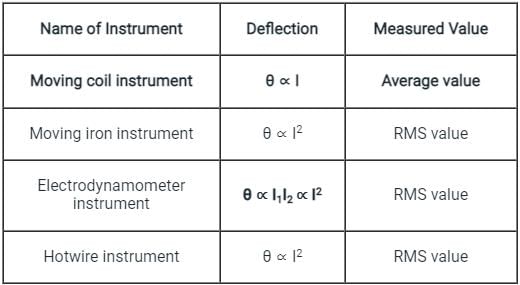
In all instruments except the Moving coil, the measured value is directly proportional to the square of response. They exhibit square law.
The deflecting torque in a moving iron meter:- a)is proportional to the square of the voltage
- b)is inversely proportional to the square of the current
- c)is inversely proportional to the current
- d)is proportional to the square of the current
Correct answer is option 'D'. Can you explain this answer?
The deflecting torque in a moving iron meter:
a)
is proportional to the square of the voltage
b)
is inversely proportional to the square of the current
c)
is inversely proportional to the current
d)
is proportional to the square of the current
 | Cstoppers Instructors answered |
Deflecting torque:
The torque needed to move the pointer over a calibrated scale is known as deflecting torque and it can overcome the inertia of the moving system, controlling torque and damping torque.
In moving iron instruments, the deflecting torque is given by
The torque needed to move the pointer over a calibrated scale is known as deflecting torque and it can overcome the inertia of the moving system, controlling torque and damping torque.
In moving iron instruments, the deflecting torque is given by
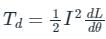
I is the operating current in Ampere
L is the inductance in Henry
θ is the deflection angle in radians
As the operating torque is directly proportional to the square if the operating current. Hence, this instrument possesses high operating torque.
Electro dynamometer type of instruments are enclosed in a casing made up of high permeability material to:- a)To remove electrostatic effects.
- b)To provide mechanical strength to the coils present.
- c)To protect against external magnetic fields.
- d)Provide good damping
Correct answer is option 'C'. Can you explain this answer?
Electro dynamometer type of instruments are enclosed in a casing made up of high permeability material to:
a)
To remove electrostatic effects.
b)
To provide mechanical strength to the coils present.
c)
To protect against external magnetic fields.
d)
Provide good damping
| | Gate Gurus answered |
Shielding of Electro dynamometer type instrument:
- The magnetic field produced by the fixed coils in the Electro dynamometer type instruments is weaker than in other types of instruments such as PMMC. It is nearly 0.005 to 0.006 Wb/m2.
- In d.c. measurements even the earth's magnetic field may affect the readings. Thus it is necessary to shield an electrodynamometer type instrument from the effect of stray magnetic fields.
- The stray magnetic field is around 0.0005 Wb/m2, which has a significant effect in the case of an electrodynamometer type instrument.
- Air cored electrodynamometer type instruments are protected against external magnetic fields by enclosing them in a casing of high permeability alloy.
- This shunts external magnetic fields around the instrument mechanism and minimizes their effects on the indication.
Swamp resistance and condenser are used- a)To reduce the error while measuring DC quantities in a moving iron instrument
- b)To reduce the error while measuring AC quantities in a moving iron instrument
- c)To reduce the error while measuring DC quantities in a moving coil instrument
- d)None of the above
Correct answer is option 'B'. Can you explain this answer?
Swamp resistance and condenser are used
a)
To reduce the error while measuring DC quantities in a moving iron instrument
b)
To reduce the error while measuring AC quantities in a moving iron instrument
c)
To reduce the error while measuring DC quantities in a moving coil instrument
d)
None of the above
 | Rajesh Verma answered |
Background:
Moving iron instruments are commonly used to measure both DC and AC quantities. However, these instruments can produce errors in their measurements due to various factors. Two techniques, known as swamp resistance and condenser, are employed to reduce these errors and improve the accuracy of measuring AC quantities in a moving iron instrument.
Explanation:
1. Swamp Resistance:
- Swamp resistance is used to reduce the error while measuring AC quantities in a moving iron instrument.
- AC quantities have rapidly changing magnitudes and directions, which can cause the moving iron instrument to exhibit non-linear behavior.
- This non-linearity can lead to errors in the measurement of AC quantities.
- Swamp resistance is introduced in series with the moving coil or iron of the instrument to counteract this non-linearity.
- The swamp resistance creates a voltage drop that opposes the non-linear behavior of the instrument, resulting in a more linear response.
- By using an appropriate swamp resistance, the instrument can accurately measure AC quantities.
2. Condenser:
- Condenser, also known as a capacitor, is another technique used to reduce errors while measuring AC quantities in a moving iron instrument.
- AC quantities have a frequency component, which can induce eddy currents in the moving iron or coil of the instrument.
- These eddy currents can cause additional losses and affect the accuracy of the instrument's measurement.
- By connecting a condenser in parallel with the moving iron or coil, the eddy currents are diverted through the condenser, reducing their impact on the instrument's measurement.
- The condenser provides a low impedance path for the eddy currents, minimizing their effect on the instrument's operation.
- This helps in improving the accuracy of measuring AC quantities in a moving iron instrument.
Conclusion:
In conclusion, both swamp resistance and condenser techniques are used to reduce errors while measuring AC quantities in a moving iron instrument. The swamp resistance counteracts the non-linear behavior of the instrument, while the condenser diverts the eddy currents to improve the instrument's accuracy. These techniques are essential for achieving accurate measurements in AC applications using moving iron instruments.
Moving iron instruments are commonly used to measure both DC and AC quantities. However, these instruments can produce errors in their measurements due to various factors. Two techniques, known as swamp resistance and condenser, are employed to reduce these errors and improve the accuracy of measuring AC quantities in a moving iron instrument.
Explanation:
1. Swamp Resistance:
- Swamp resistance is used to reduce the error while measuring AC quantities in a moving iron instrument.
- AC quantities have rapidly changing magnitudes and directions, which can cause the moving iron instrument to exhibit non-linear behavior.
- This non-linearity can lead to errors in the measurement of AC quantities.
- Swamp resistance is introduced in series with the moving coil or iron of the instrument to counteract this non-linearity.
- The swamp resistance creates a voltage drop that opposes the non-linear behavior of the instrument, resulting in a more linear response.
- By using an appropriate swamp resistance, the instrument can accurately measure AC quantities.
2. Condenser:
- Condenser, also known as a capacitor, is another technique used to reduce errors while measuring AC quantities in a moving iron instrument.
- AC quantities have a frequency component, which can induce eddy currents in the moving iron or coil of the instrument.
- These eddy currents can cause additional losses and affect the accuracy of the instrument's measurement.
- By connecting a condenser in parallel with the moving iron or coil, the eddy currents are diverted through the condenser, reducing their impact on the instrument's measurement.
- The condenser provides a low impedance path for the eddy currents, minimizing their effect on the instrument's operation.
- This helps in improving the accuracy of measuring AC quantities in a moving iron instrument.
Conclusion:
In conclusion, both swamp resistance and condenser techniques are used to reduce errors while measuring AC quantities in a moving iron instrument. The swamp resistance counteracts the non-linear behavior of the instrument, while the condenser diverts the eddy currents to improve the instrument's accuracy. These techniques are essential for achieving accurate measurements in AC applications using moving iron instruments.
A dynamometer wattmeter is rated at 10A and 100V with a full scale reading of 1000 W. The inductance of the voltage circuit is 5mH and its resistance 3000 ohm. Voltage across the current coil is negligible. At 50 Hz and zero power factors, the error in the wattmeter at the VA reading will be:
- a)0.325 W
- b)0.523 VA
- c)0.575 VA
- d)0.604 W
Correct answer is option 'B'. Can you explain this answer?
A dynamometer wattmeter is rated at 10A and 100V with a full scale reading of 1000 W. The inductance of the voltage circuit is 5mH and its resistance 3000 ohm. Voltage across the current coil is negligible. At 50 Hz and zero power factors, the error in the wattmeter at the VA reading will be:
a)
0.325 W
b)
0.523 VA
c)
0.575 VA
d)
0.604 W
| | Gate Gurus answered |
Concept:
The error in the wattmeter at the VA reading is given by:
Er = sinϕ × tanβ × true power
where β = Impedance angle of pressure coil
ϕ = Power factor angle
The impedance angle of the pressure coil is given by:

Calculation:
Given, cosϕ = 0
∴ sinϕ = 1
True power = 1000W
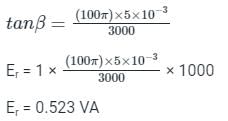
The error in the wattmeter at the VA reading is given by:
Er = sinϕ × tanβ × true power
where β = Impedance angle of pressure coil
ϕ = Power factor angle
The impedance angle of the pressure coil is given by:
Calculation:
Given, cosϕ = 0
∴ sinϕ = 1
True power = 1000W
Which of the following is not a desired characteristic of shunts used in PMMC instruments?- a)The resistance of the shunt should not vary with time.
- b)It must be manufactured using manganin or copper.
- c)It should have a low thermal emf.
- d)It should carry the current without excessive temperature rise.
Correct answer is option 'B'. Can you explain this answer?
Which of the following is not a desired characteristic of shunts used in PMMC instruments?
a)
The resistance of the shunt should not vary with time.
b)
It must be manufactured using manganin or copper.
c)
It should have a low thermal emf.
d)
It should carry the current without excessive temperature rise.
 | Sakshi Roy answered |
Shunts used in PMMC instruments are made up of manganin or constantan since they have very low temperature coefficient of resistance.
State TRUE/FALSE for following statements with reference to the dynamometer type instruments:- The scale is non-uniform.
- Air friction damping is used.
- a)Statement 1 and 2 both are false
- b)Statement 1 and 2 both are true
- c)Statement 1 is false and Statement 2 is true
- d)Statement 1 is true and Statement 2 is false
Correct answer is option 'C'. Can you explain this answer?
State TRUE/FALSE for following statements with reference to the dynamometer type instruments:
- The scale is non-uniform.
- Air friction damping is used.
a)
Statement 1 and 2 both are false
b)
Statement 1 and 2 both are true
c)
Statement 1 is false and Statement 2 is true
d)
Statement 1 is true and Statement 2 is false
| | Rithika Pillai answered |
Statement 1: The scale is non-uniform.
The statement is false. In dynamometer type instruments, the scale is generally uniform. The scale is a calibrated marking on the instrument that provides a visual representation of the measured quantity. In a dynamometer, the scale is typically evenly divided into equal intervals to represent the magnitude of the measured quantity.
Statement 2: Air friction damping is used.
The statement is true. Air friction damping is commonly used in dynamometer type instruments. Damping is the process of reducing the oscillations or vibrations of the instrument's moving parts, allowing for a more accurate and stable measurement. In air friction damping, the motion of the instrument's moving parts is opposed by the resistance offered by the surrounding air. This resistance helps to dampen the oscillations and bring the moving parts to rest quickly, allowing for more precise readings.
Explanation:
The given statements are:
1. The scale is non-uniform.
2. Air friction damping is used.
From the explanation provided above, we can conclude that:
- Statement 1 is false because the scale in dynamometer type instruments is typically uniform.
- Statement 2 is true because air friction damping is indeed used in dynamometer type instruments.
Hence, the correct answer is option C - Statement 1 is false and Statement 2 is true.
The statement is false. In dynamometer type instruments, the scale is generally uniform. The scale is a calibrated marking on the instrument that provides a visual representation of the measured quantity. In a dynamometer, the scale is typically evenly divided into equal intervals to represent the magnitude of the measured quantity.
Statement 2: Air friction damping is used.
The statement is true. Air friction damping is commonly used in dynamometer type instruments. Damping is the process of reducing the oscillations or vibrations of the instrument's moving parts, allowing for a more accurate and stable measurement. In air friction damping, the motion of the instrument's moving parts is opposed by the resistance offered by the surrounding air. This resistance helps to dampen the oscillations and bring the moving parts to rest quickly, allowing for more precise readings.
Explanation:
The given statements are:
1. The scale is non-uniform.
2. Air friction damping is used.
From the explanation provided above, we can conclude that:
- Statement 1 is false because the scale in dynamometer type instruments is typically uniform.
- Statement 2 is true because air friction damping is indeed used in dynamometer type instruments.
Hence, the correct answer is option C - Statement 1 is false and Statement 2 is true.
A PMMC uses a :- a)taut bond
- b)moving coil
- c)electrodynamometer
- d)moving iron type
Correct answer is option 'B'. Can you explain this answer?
A PMMC uses a :
a)
taut bond
b)
moving coil
c)
electrodynamometer
d)
moving iron type
 | Siddharth Khanna answered |
A PMMC uses a moving coil and the magnet is permanent.
The deflecting torque of a moving iron instrument is- a)

- b)

- c)

- d)

Correct answer is option 'B'. Can you explain this answer?
The deflecting torque of a moving iron instrument is
a)
b)
c)
d)
 | Pooja Patel answered |
Moving Iron Instruments are the most common type of ammeter and voltmeter used at power frequencies in laboratories.
These instruments are very accurate, cheap, and rugged as compared to other AC instruments.
These instruments are very accurate, cheap, and rugged as compared to other AC instruments.
Working Principle of Moving Iron Instruments:
- In Moving Iron Instruments, a plate or van of soft iron or of high permeability steel forms the moving element of the system.
- The iron van is so situated that it can move in the magnetic field produced by a stationary coil.
- The below figure shows a simple moving iron instrument.
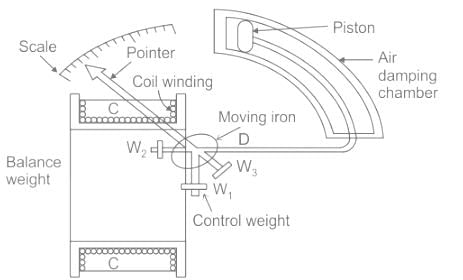
- The stationary coil is excited by the current or voltage under measurement.
- When the coil is excited, it becomes an electromagnet, and the iron van moves in direction of offering a low reluctance path.
- Thus the force of attraction is always produced in a direction to increase the inductance of the coil.
- Mind that as the van follows the low reluctance path, the net flux in the air gap will increase which means increased flux linkage of the coil, and hence inductance of coil will increase.
- It shall also be noticed that the inductance of the coil is variable and depends on the position of the iron van.
Torque Equation of Moving Iron Instruments:
Deflecting torque in Moving iron Instruments is given as
Td = (1/2)I2(dL/dƟ)
In moving iron instruments, the controlling torque is provided by spring. Controlling torque due to spring is given as
Tc = KƟ
Where K = Spring constant
Ɵ = Deflection in the needle
In equilibrium state, deflecting and controlling torque shall be equal as below.
Deflecting Torque = Controlling Torque
⇒ Td = Tc
⇒ (1/2)I2(dL/dƟ) = KƟ
⇒ Ɵ = (1/2)(I2/K)(dL/dƟ)
Deflecting torque in Moving iron Instruments is given as
Td = (1/2)I2(dL/dƟ)
In moving iron instruments, the controlling torque is provided by spring. Controlling torque due to spring is given as
Tc = KƟ
Where K = Spring constant
Ɵ = Deflection in the needle
In equilibrium state, deflecting and controlling torque shall be equal as below.
Deflecting Torque = Controlling Torque
⇒ Td = Tc
⇒ (1/2)I2(dL/dƟ) = KƟ
⇒ Ɵ = (1/2)(I2/K)(dL/dƟ)
Which of the following principles is utilised in an electrodynamometer type instrument?- a)Magnitude effect
- b)Force between two permanent magnets
- c)Force between two current-carrying coils
- d)Force between a permanent magnet and a current-carrying coil
Correct answer is option 'C'. Can you explain this answer?
Which of the following principles is utilised in an electrodynamometer type instrument?
a)
Magnitude effect
b)
Force between two permanent magnets
c)
Force between two current-carrying coils
d)
Force between a permanent magnet and a current-carrying coil
| | Pooja Patel answered |
Electrodynamometer type instrument utilized the principle of Electro-dynamic Effect or force between two current-carrying coils.
Which of the below is an application of paper chromatography?- a)For separation of amino acids.
- b)Paper Chromatography is specially used for separation of mixtures having polar and non polar compounds.
- c)It is used to determine organic compound, biochemical in urine, etc.
- d)All of the above.
Correct answer is option 'D'. Can you explain this answer?
Which of the below is an application of paper chromatography?
a)
For separation of amino acids.
b)
Paper Chromatography is specially used for separation of mixtures having polar and non polar compounds.
c)
It is used to determine organic compound, biochemical in urine, etc.
d)
All of the above.
| | Mihir Khanna answered |
Paper Chromatography
Paper chromatography is a widely used technique for separation and identification of different components in a mixture. It is based on the principle of differential migration of solutes in a mobile phase through a stationary phase. The technique is widely used in various fields including chemistry, biochemistry, forensics, and pharmaceuticals.
Applications of Paper Chromatography
1. Separation of Amino Acids
One of the most common applications of paper chromatography is the separation of amino acids. Amino acids are the building blocks of proteins and can be analyzed using this technique. The amino acids in a mixture can be separated based on their different polarities and interactions with the mobile and stationary phases. This separation is useful in various fields such as protein analysis, clinical diagnostics, and pharmaceutical research.
2. Separation of Polar and Non-polar Compounds
Paper chromatography is particularly useful for the separation of mixtures containing polar and non-polar compounds. The paper acts as the stationary phase, and the mobile phase can be selected to have different polarities. This allows the separation of different compounds based on their interactions with the paper and the mobile phase. The technique is commonly used in the analysis of natural products, such as plant extracts, where a wide range of compounds with different polarities may be present.
3. Determination of Organic Compounds
Paper chromatography is also used for the determination of organic compounds in various samples. For example, it can be used to analyze the composition of a mixture of organic solvents or to determine the presence of organic compounds in urine or other biological samples. The technique is useful in forensic analysis, environmental monitoring, and quality control of pharmaceuticals.
Conclusion
In conclusion, paper chromatography is a versatile technique with various applications. It can be used for the separation of amino acids, separation of polar and non-polar compounds, and determination of organic compounds in different samples. The technique is widely used in various fields due to its simplicity, cost-effectiveness, and ability to provide valuable information about the composition of mixtures.
Paper chromatography is a widely used technique for separation and identification of different components in a mixture. It is based on the principle of differential migration of solutes in a mobile phase through a stationary phase. The technique is widely used in various fields including chemistry, biochemistry, forensics, and pharmaceuticals.
Applications of Paper Chromatography
1. Separation of Amino Acids
One of the most common applications of paper chromatography is the separation of amino acids. Amino acids are the building blocks of proteins and can be analyzed using this technique. The amino acids in a mixture can be separated based on their different polarities and interactions with the mobile and stationary phases. This separation is useful in various fields such as protein analysis, clinical diagnostics, and pharmaceutical research.
2. Separation of Polar and Non-polar Compounds
Paper chromatography is particularly useful for the separation of mixtures containing polar and non-polar compounds. The paper acts as the stationary phase, and the mobile phase can be selected to have different polarities. This allows the separation of different compounds based on their interactions with the paper and the mobile phase. The technique is commonly used in the analysis of natural products, such as plant extracts, where a wide range of compounds with different polarities may be present.
3. Determination of Organic Compounds
Paper chromatography is also used for the determination of organic compounds in various samples. For example, it can be used to analyze the composition of a mixture of organic solvents or to determine the presence of organic compounds in urine or other biological samples. The technique is useful in forensic analysis, environmental monitoring, and quality control of pharmaceuticals.
Conclusion
In conclusion, paper chromatography is a versatile technique with various applications. It can be used for the separation of amino acids, separation of polar and non-polar compounds, and determination of organic compounds in different samples. The technique is widely used in various fields due to its simplicity, cost-effectiveness, and ability to provide valuable information about the composition of mixtures.
Error due to change in frequency in moving iron instruments may be reduced by using a/an:- a)Induction coil
- b)Condenser of suitable value in parallel with swamping resistance
- c)Condenser of suitable value in series with swamping resistance
- d)Balancing circuit
Correct answer is option 'B'. Can you explain this answer?
Error due to change in frequency in moving iron instruments may be reduced by using a/an:
a)
Induction coil
b)
Condenser of suitable value in parallel with swamping resistance
c)
Condenser of suitable value in series with swamping resistance
d)
Balancing circuit
 | Ameya Gupta answered |
Introduction:
Moving iron instruments are commonly used for measuring AC quantities. However, these instruments are susceptible to errors due to changes in frequency. To reduce this error, a condenser of suitable value in parallel with a swamping resistance is used.
Explanation:
1. Error due to change in frequency:
When the frequency of the AC signal changes, the impedance of the moving iron instrument also changes. This leads to variations in the current flowing through the instrument and affects its accuracy. The error due to change in frequency can be significant and needs to be minimized.
2. Swamping resistance:
A swamping resistance is connected in series with the moving iron instrument. Its purpose is to provide a constant resistance to the AC signal, independent of frequency. This helps in stabilizing the current flowing through the instrument and reducing errors.
3. Condenser in parallel:
To further reduce the error due to change in frequency, a condenser of suitable value is connected in parallel with the swamping resistance. The condenser acts as a frequency compensating element.
4. Working principle:
When the frequency of the AC signal increases, the impedance of the condenser decreases. This causes a greater proportion of the current to flow through the condenser rather than the moving iron instrument. As a result, the error due to change in frequency is reduced.
5. Selection of condenser value:
The value of the condenser is chosen based on the desired frequency range over which the instrument needs to operate accurately. The capacitance of the condenser should be such that it compensates for the change in impedance of the moving iron instrument over this frequency range.
6. Parallel connection:
Connecting the condenser in parallel with the swamping resistance ensures that the compensation is provided directly to the moving iron instrument. This allows the instrument to accurately measure AC quantities over a wider range of frequencies.
Conclusion:
By using a condenser of suitable value in parallel with a swamping resistance, the error due to change in frequency in moving iron instruments can be significantly reduced. This helps in improving the accuracy and reliability of AC measurements.
Moving iron instruments are commonly used for measuring AC quantities. However, these instruments are susceptible to errors due to changes in frequency. To reduce this error, a condenser of suitable value in parallel with a swamping resistance is used.
Explanation:
1. Error due to change in frequency:
When the frequency of the AC signal changes, the impedance of the moving iron instrument also changes. This leads to variations in the current flowing through the instrument and affects its accuracy. The error due to change in frequency can be significant and needs to be minimized.
2. Swamping resistance:
A swamping resistance is connected in series with the moving iron instrument. Its purpose is to provide a constant resistance to the AC signal, independent of frequency. This helps in stabilizing the current flowing through the instrument and reducing errors.
3. Condenser in parallel:
To further reduce the error due to change in frequency, a condenser of suitable value is connected in parallel with the swamping resistance. The condenser acts as a frequency compensating element.
4. Working principle:
When the frequency of the AC signal increases, the impedance of the condenser decreases. This causes a greater proportion of the current to flow through the condenser rather than the moving iron instrument. As a result, the error due to change in frequency is reduced.
5. Selection of condenser value:
The value of the condenser is chosen based on the desired frequency range over which the instrument needs to operate accurately. The capacitance of the condenser should be such that it compensates for the change in impedance of the moving iron instrument over this frequency range.
6. Parallel connection:
Connecting the condenser in parallel with the swamping resistance ensures that the compensation is provided directly to the moving iron instrument. This allows the instrument to accurately measure AC quantities over a wider range of frequencies.
Conclusion:
By using a condenser of suitable value in parallel with a swamping resistance, the error due to change in frequency in moving iron instruments can be significantly reduced. This helps in improving the accuracy and reliability of AC measurements.
The reading of the voltmeter (rms) in volts, for the circuit shown in the figure is –
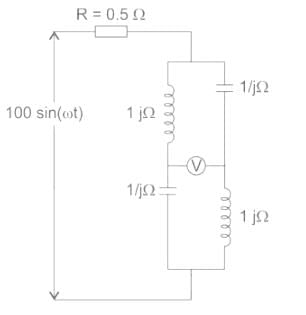
Correct answer is between '141,142'. Can you explain this answer?
The reading of the voltmeter (rms) in volts, for the circuit shown in the figure is –
 | Luminary Institute answered |
Impedance in both the parallel branches are zero
Therefore the current from the voltage source will be
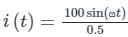
i(t) = 200 sin ωt
The impedance on both the parallel branches are equal, so the same amount of current will be flowing through each branch
⇒ I1 = I2 = 100 sin ωt
The voltage at node A is
VA = (- j1) 100 sin ωt
The voltage at node B is
VB = (j1) 100 sin ωt
Voltage measured by the voltmeter will be
V = VA - VB = - 200j sin ωt

Therefore the current from the voltage source will be
i(t) = 200 sin ωt
The impedance on both the parallel branches are equal, so the same amount of current will be flowing through each branch
⇒ I1 = I2 = 100 sin ωt
The voltage at node A is
VA = (- j1) 100 sin ωt
The voltage at node B is
VB = (j1) 100 sin ωt
Voltage measured by the voltmeter will be
V = VA - VB = - 200j sin ωt
What is the value of multiplier resistance on the 50 V range of a dc voltmeter that uses a 500 μA meter movement with an internal resistance of 1 kΩ?- a)109 kΩ
- b)199 kΩ
- c)99 kΩ
- d)119 kΩ
Correct answer is option 'C'. Can you explain this answer?
What is the value of multiplier resistance on the 50 V range of a dc voltmeter that uses a 500 μA meter movement with an internal resistance of 1 kΩ?
a)
109 kΩ
b)
199 kΩ
c)
99 kΩ
d)
119 kΩ
| | Lakshmi Desai answered |
The sensitivity of 500 μA meter movement is given by,
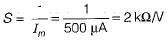
The value of the multiplier resistance can be obtained as
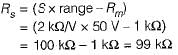
The value of the multiplier resistance can be obtained as
The pressure coil of a dynamometer type wattmeter is- a)Highly inductive
- b)Highly resistive
- c)Purely resistive
- d)Purely inductive
Correct answer is option 'B'. Can you explain this answer?
The pressure coil of a dynamometer type wattmeter is
a)
Highly inductive
b)
Highly resistive
c)
Purely resistive
d)
Purely inductive
| | Pooja Patel answered |
Electrodynamometer instrument as a wattmeter:
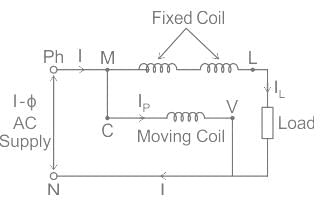
- An electrodynamometer instrument can be used as a wattmeter to measure power
- Two fixed coils are connected in series with the load are called current coils; These will carry a full load current IL as shown in the figure
- The moving coil is connected across the supply is called a voltage coil (or) pressure coil, which will carry a current IP as shown in the figure
- Both coils are connected in parallel so that two different currents will flow through the coils IL and IP respectively
In order to measure the AC power using this meter, we have to consider two assumptions inside the meter.
- The supply voltage is equal to load voltage that means a drop in the current coil is neglected
- The pressure coil is assumed to be purely and highly resistive in nature
A dc voltage with ripple is given by V(t) = [100 + 10 sin (ωt) - 5 sin (3ωt)] volts. Measurements of this voltage v(t), made by moving-coil and moving-iron voltmeters, show, readings of V1 and V2 respectively. The value of V2 - V1, in volts, is _________.
Correct answer is between '0.30,0.33'. Can you explain this answer?
A dc voltage with ripple is given by V(t) = [100 + 10 sin (ωt) - 5 sin (3ωt)] volts. Measurements of this voltage v(t), made by moving-coil and moving-iron voltmeters, show, readings of V1 and V2 respectively. The value of V2 - V1, in volts, is _________.
| | Pooja Patel answered |
Concept:
PMMC measures dc or average value, hot-wire and moving iron instruments measures RMS value.
If a current i is given as:
i = a0 + a1 sin (ω1t + θ1) + a2 sin (ω2t + θ2) + a3 sin (ω3t + θ3) +...........
Where,
a0 = DC value = average value of current
Rms value is:

PMMC measures dc or average value, hot-wire and moving iron instruments measures RMS value.
If a current i is given as:
i = a0 + a1 sin (ω1t + θ1) + a2 sin (ω2t + θ2) + a3 sin (ω3t + θ3) +...........
Where,
a0 = DC value = average value of current
Rms value is:
Calculation:
Given,
V(t) = [100 + 10 sin (ωt) - 5 sin (3ωt)]
In the above DC value of the signal is 100 V
For moving coil,
V1 = Vavg = 100 V
For moving iron,

The difference between the two meters is
V2 - V1 = 0.312 volts
Given,
V(t) = [100 + 10 sin (ωt) - 5 sin (3ωt)]
In the above DC value of the signal is 100 V
For moving coil,
V1 = Vavg = 100 V
For moving iron,
The difference between the two meters is
V2 - V1 = 0.312 volts
Which of the following types of instruments depends on the iron vane's attraction to the current-carrying coil to be measured for proper operation?- a)PMMC instrument
- b)Moving-iron instrument
- c)Moving-scale instrument
- d)PMM instrument
Correct answer is option 'B'. Can you explain this answer?
Which of the following types of instruments depends on the iron vane's attraction to the current-carrying coil to be measured for proper operation?
a)
PMMC instrument
b)
Moving-iron instrument
c)
Moving-scale instrument
d)
PMM instrument
 | Pioneer Academy answered |
Moving-iron instrument depends on the iron vane's attraction to the current-carrying coil to be measured for proper operation.
Moving-iron instrument:
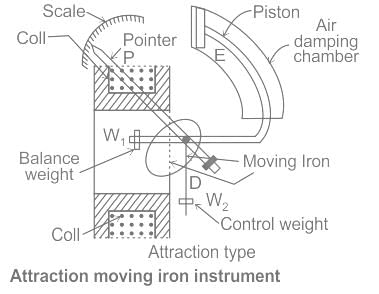
Moving-iron instrument:
- Whenever a piece of iron is placed nearer to a magnet it would be attracted by the magnet. The force of this attraction depends upon the strength of the magnetic field.
- If the magnet is an electromagnet then the magnetic field strength can easily be increased or decreased by increasing or decreasing the current through its coil.
- Accordingly, the attraction force acting on the piece of iron would also be increased and decreased.
- Depending upon this simple phenomenon, the moving iron instrument was developed.
Why is Dynamometer type wattmeter is equipped with mirror type scales and knife edge pointers?- a)To remove reading errors due to parallax
- b)To facilitate controlling force
- c)To facilitate proper damping
- d)To remove eddy current and hysteresis loss
Correct answer is option 'A'. Can you explain this answer?
Why is Dynamometer type wattmeter is equipped with mirror type scales and knife edge pointers?
a)
To remove reading errors due to parallax
b)
To facilitate controlling force
c)
To facilitate proper damping
d)
To remove eddy current and hysteresis loss
| | Pooja Patel answered |
Construction of Electrodynamometer Wattmeter:
Fixed Coils:
Fixed Coils:
- The reason for using fixed coils as current coils is that they can be made more massive and can be easily constructed to carry considerable current since they present no problem of leading the current in or out.
- The fixed coils are wound with heavy wire. This wire is stranded or laminated especially when carrying heavy currents in order to avoid eddy current losses in conductors.
Moving Coil:
- The moving coil is mounted on a pivoted spindle and is entirely embraced by the fixed spindle & is entirely embraced b the fixed current coils.
- The use of moving coil as pressure coil is a natural consequence of design requirements.
Scales and Pointers:
- They are equipped with mirror type scales and knife-edge pointers to remove reading errors due to parallax.
Damping:
- The damping is the effect which reduces the movement of the pointer.
- In this Wattmeter Air friction damping is used.
- The other types of damping are not used in the system because they destroy the useful magnetic flux.
Assertion (A): Gravity control is not suited for indicating instruments in general and portable instruments in particular.
Reason (R): Gravity control is used in only vertically mounted instruments.- a)Both A and R are true and R is a correct explanation of A.
- b)Both A and R are true but R is not a correct explanation of A.
- c)A is true but R is false.
- d)A is false but R is true.
Correct answer is option 'B'. Can you explain this answer?
Assertion (A): Gravity control is not suited for indicating instruments in general and portable instruments in particular.
Reason (R): Gravity control is used in only vertically mounted instruments.
Reason (R): Gravity control is used in only vertically mounted instruments.
a)
Both A and R are true and R is a correct explanation of A.
b)
Both A and R are true but R is not a correct explanation of A.
c)
A is true but R is false.
d)
A is false but R is true.
| | Tanishq Majumdar answered |
Gravity control is not suited for indicating instruments in general and portable instruments in particular because for using this type of control, the instruments must be mounted in level position otherwise there will be a very serious zero error. Gravity control is used in only vertically mounted instruments. Hence, reason is also a true statement but, not a correct explanation of assertion.
Which of the following is NOT a valid advantage of moving iron instruments?- a)Uniform scale
- b)Can be used for AC as well as DC measurements
- c)Low cost
- d)High operating torque
Correct answer is option 'A'. Can you explain this answer?
Which of the following is NOT a valid advantage of moving iron instruments?
a)
Uniform scale
b)
Can be used for AC as well as DC measurements
c)
Low cost
d)
High operating torque
| | Pooja Patel answered |
Characteristics of Moving-Iron Instruments:
Advantages:
Advantages:
- These are less expensive, robust, and simple in construction.
- These can be used for both d.c. and a.c. measurements. However, when used with d.c., they are liable to small errors due to residual magnetism.
- These instruments have high operating torque.
- These instruments are reasonably accurate.
Disadvantages:
- These instruments have non-linear scales.
- These instruments are not as sensitive as the permanent-magnet moving coil instruments.
- Errors are introduced due to changes in frequency in the case of a.c. measurements.
Applications: The moving-iron instruments are primarily used for a.c. measurements viz., alternating currents and voltages. They are not used to measure direct currents and voltages because their characteristics are inferior to permanent-magnet moving coil instruments.
A moving iron instrument can be used for- a)DC only
- b)AC only
- c)Resistance only
- d)Both AC and DC
Correct answer is option 'D'. Can you explain this answer?
A moving iron instrument can be used for
a)
DC only
b)
AC only
c)
Resistance only
d)
Both AC and DC
| | Pooja Patel answered |
Moving Iron (MI) type instruments:
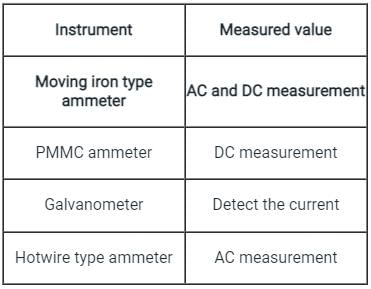
- Moving Iron (MI) type instruments can be used for both AC & DC measurements. But Moving Iron connected through the current Transformer block DC supply. So that Moving Iron connected through the current Transformer is only used for AC measurements.
- The moving iron meter has a large magnetic reluctance as compared to the PMMC meter. That’s why more power is required to operate the moving iron meter.
Advantages of moving iron:
- It is a universal instrument which can be used for the measurement of AC and DC quantities
- These instruments can withstand large loads and are not damaged even under severe overload conditions
- It is very cheap due to the simple construction
Disadvantages of moving iron:
- These instruments suffer from error due to hysteresis, frequency change, and stray losses
- The reading of the instrument is affected by temperature variation
In a moving iron instrument, the deflecting torque is:- a)∝ i, where i is the current through the instrument
- b)∝ 1 / i2, where i is the current through the instrument
- c)∝ i2, where i is the current through the instrument
- d)∝ 1 / i, where i is the current through the instrument
Correct answer is option 'C'. Can you explain this answer?
In a moving iron instrument, the deflecting torque is:
a)
∝ i, where i is the current through the instrument
b)
∝ 1 / i2, where i is the current through the instrument
c)
∝ i2, where i is the current through the instrument
d)
∝ 1 / i, where i is the current through the instrument
| | Mihir Khanna answered |
Produced by the magnetic field generated by the current flowing through the coil
b) produced by the magnetic field generated by the permanent magnet
c) directly proportional to the current flowing through the coil
d) inversely proportional to the square of the current flowing through the coil
b) produced by the magnetic field generated by the permanent magnet
c) directly proportional to the current flowing through the coil
d) inversely proportional to the square of the current flowing through the coil
The scale of an electrodynamometer usually reads the:- a)Average value of the ac
- b)Mean value of the ac
- c)Effective value of the ac
- d)Squared value of the ac
Correct answer is option 'C'. Can you explain this answer?
The scale of an electrodynamometer usually reads the:
a)
Average value of the ac
b)
Mean value of the ac
c)
Effective value of the ac
d)
Squared value of the ac
| | Pooja Patel answered |
Electrodynamometer instrument:
- Electrodynamic type instruments are similar to the PMMC-type elements except that the magnet is replaced by two serially connected fixed coils that produce the magnetic field when energized.
- The fixed coils are spaced far enough apart to allow passage of the shaft of the movable coil.
- The movable coil carries a pointer, which is balanced by counterweights. Its rotation is controlled by springs.
- The motor torque is proportional to the product of the currents in the moving and fixed coils. If the current is reversed, the field polarity and the polarity of the moving coil reverse at the same time, and the turning force continues in the original direction.
Measurement using Electrodynamometer instrument:
- This type of instrument can be used to measure AC or DC current, voltage, or its major application as a wattmeter for power measurement.
- For voltage and current measurement, the moving and fixed are serially connected. For power measurement, one of the coils (usually the fixed coils) passes the load current and other coil passes a current proportional to the load voltage.
- Similar to moving iron vane instruments, the electrodynamic instruments are true RMS (effective value) responding meters.
- When electro dynamic instruments used for power measurement its scale is linear because it predicts the average power delivered to the load and it is calibrated in average values for AC.
If the current through a moving iron instrument is increased by 20%, what is the percentage increase in the deflection torque?- a)40
- b)25
- c)32
- d)44
Correct answer is option 'D'. Can you explain this answer?
If the current through a moving iron instrument is increased by 20%, what is the percentage increase in the deflection torque?
a)
40
b)
25
c)
32
d)
44
 | Kritika Gupta answered |
Increase in current through a moving iron instrument and the percentage increase in deflection torque are related through a mathematical equation. To find the percentage increase in deflection torque, we need to understand the relationship between the current and deflection torque.
The deflection torque in a moving iron instrument is given by the equation:
T = K * I^2
where T is the deflection torque, K is a constant, and I is the current passing through the instrument.
Let's say the initial current passing through the instrument is I1, and the final current after the increase is I2. The initial deflection torque is T1, and we need to find the percentage increase in deflection torque.
- Identify the given information:
- Initial current: I1
- Increase in current: 20%
- Final current: I2 = I1 + 0.2 * I1 = 1.2 * I1
- Initial deflection torque: T1
- Percentage increase in deflection torque: ?
- Calculate the final deflection torque:
- Substitute the values in the equation: T2 = K * (1.2 * I1)^2 = 1.44 * K * I1^2
- Calculate the percentage increase in deflection torque:
- Percentage increase = (T2 - T1) / T1 * 100%
- Substitute the values: (1.44 * K * I1^2 - K * I1^2) / K * I1^2 * 100%
- Simplify: 0.44 * 100% = 44%
Hence, the percentage increase in the deflection torque is 44%. Therefore, the correct answer is option D.
The deflection torque in a moving iron instrument is given by the equation:
T = K * I^2
where T is the deflection torque, K is a constant, and I is the current passing through the instrument.
Let's say the initial current passing through the instrument is I1, and the final current after the increase is I2. The initial deflection torque is T1, and we need to find the percentage increase in deflection torque.
- Identify the given information:
- Initial current: I1
- Increase in current: 20%
- Final current: I2 = I1 + 0.2 * I1 = 1.2 * I1
- Initial deflection torque: T1
- Percentage increase in deflection torque: ?
- Calculate the final deflection torque:
- Substitute the values in the equation: T2 = K * (1.2 * I1)^2 = 1.44 * K * I1^2
- Calculate the percentage increase in deflection torque:
- Percentage increase = (T2 - T1) / T1 * 100%
- Substitute the values: (1.44 * K * I1^2 - K * I1^2) / K * I1^2 * 100%
- Simplify: 0.44 * 100% = 44%
Hence, the percentage increase in the deflection torque is 44%. Therefore, the correct answer is option D.

A moving coil instrument has the following data:
Number of turns = 100
Width of the coii = 20 mm
Depth of the coil = 30 mm
Flux density in the gap = 0.1 Wb/m2
If the control spring constant is 2 x 10⁻⁶ N-m/ degree, then the deflection of the pointer when the coil carries a current of 10 mA is- a)π/3 radians
- b)π/2 radians
- c)π/6 radians
- d)π/4 radians
Correct answer is option 'C'. Can you explain this answer?
A moving coil instrument has the following data:
Number of turns = 100
Width of the coii = 20 mm
Depth of the coil = 30 mm
Flux density in the gap = 0.1 Wb/m2
If the control spring constant is 2 x 10⁻⁶ N-m/ degree, then the deflection of the pointer when the coil carries a current of 10 mA is
Number of turns = 100
Width of the coii = 20 mm
Depth of the coil = 30 mm
Flux density in the gap = 0.1 Wb/m2
If the control spring constant is 2 x 10⁻⁶ N-m/ degree, then the deflection of the pointer when the coil carries a current of 10 mA is
a)
π/3 radians
b)
π/2 radians
c)
π/6 radians
d)
π/4 radians
| | Pallavi Nair answered |
The deflecting torque,

At equilibrium,
Tc = Td
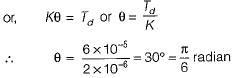
Thus, the deflection of the pointer = π/6 radian.
At equilibrium,
Tc = Td
Thus, the deflection of the pointer = π/6 radian.
A moving iron movement uses- a)radial vane .
- b)electrodynamometer
- c)ribbon
- d)moving coil
Correct answer is option 'A'. Can you explain this answer?
A moving iron movement uses
a)
radial vane .
b)
electrodynamometer
c)
ribbon
d)
moving coil
| | Niharika Basu answered |
Moving Iron Movement:
- A moving iron movement is a type of electromechanical device used in electrical measuring instruments, such as ammeters and voltmeters, to measure and indicate the value of current or voltage.
- It consists of a stationary coil and a movable iron piece, which is attracted by the magnetic field produced by the coil.
- The movement of the iron piece is proportional to the current or voltage being measured, allowing for accurate readings on the instrument's scale.
Working Principle:
- When current flows through the stationary coil, a magnetic field is created around it.
- The movable iron piece, which is placed within the magnetic field, experiences a force of attraction towards the coil.
- The force exerted on the iron piece is proportional to the strength of the magnetic field, which in turn is proportional to the current flowing through the coil.
- As the current changes, the magnetic field and hence the force on the iron piece also change, causing it to move.
- The movement of the iron piece is transferred through a mechanical linkage to the indicator needle or pointer on the instrument's scale, providing the measurement reading.
Advantages of Moving Iron Movement:
- Wide Measurement Range: Moving iron movements can be designed to measure a wide range of current or voltage values, making them suitable for various applications.
- Robust and Durable: The construction of moving iron movements is relatively simple and sturdy, allowing them to withstand rough handling and harsh environmental conditions.
- High Overload Capacity: Moving iron movements have a high overload capacity, meaning they can handle short-term overcurrent or overvoltage conditions without being damaged.
- Linear Scale: The movement of the iron piece is directly proportional to the current or voltage being measured, resulting in a linear scale on the instrument's display.
- Low Power Consumption: Moving iron movements require very little power to operate, making them energy-efficient.
Conclusion:
The correct answer to the question is option 'A' - radial vane. Moving iron movement is a type of electromechanical device used in electrical measuring instruments, and it operates on the principle of attraction between a stationary coil and a movable iron piece. It offers advantages such as a wide measurement range, robustness, high overload capacity, linear scale, and low power consumption.
- A moving iron movement is a type of electromechanical device used in electrical measuring instruments, such as ammeters and voltmeters, to measure and indicate the value of current or voltage.
- It consists of a stationary coil and a movable iron piece, which is attracted by the magnetic field produced by the coil.
- The movement of the iron piece is proportional to the current or voltage being measured, allowing for accurate readings on the instrument's scale.
Working Principle:
- When current flows through the stationary coil, a magnetic field is created around it.
- The movable iron piece, which is placed within the magnetic field, experiences a force of attraction towards the coil.
- The force exerted on the iron piece is proportional to the strength of the magnetic field, which in turn is proportional to the current flowing through the coil.
- As the current changes, the magnetic field and hence the force on the iron piece also change, causing it to move.
- The movement of the iron piece is transferred through a mechanical linkage to the indicator needle or pointer on the instrument's scale, providing the measurement reading.
Advantages of Moving Iron Movement:
- Wide Measurement Range: Moving iron movements can be designed to measure a wide range of current or voltage values, making them suitable for various applications.
- Robust and Durable: The construction of moving iron movements is relatively simple and sturdy, allowing them to withstand rough handling and harsh environmental conditions.
- High Overload Capacity: Moving iron movements have a high overload capacity, meaning they can handle short-term overcurrent or overvoltage conditions without being damaged.
- Linear Scale: The movement of the iron piece is directly proportional to the current or voltage being measured, resulting in a linear scale on the instrument's display.
- Low Power Consumption: Moving iron movements require very little power to operate, making them energy-efficient.
Conclusion:
The correct answer to the question is option 'A' - radial vane. Moving iron movement is a type of electromechanical device used in electrical measuring instruments, and it operates on the principle of attraction between a stationary coil and a movable iron piece. It offers advantages such as a wide measurement range, robustness, high overload capacity, linear scale, and low power consumption.
A D’Arsonval movement is- a)taut band
- b)PMMC
- c)electrodynamometer
- d)moving iron type
Correct answer is option 'B'. Can you explain this answer?
A D’Arsonval movement is
a)
taut band
b)
PMMC
c)
electrodynamometer
d)
moving iron type
| | Rajesh Verma answered |
D’Arsonval Movement Overview
The D'Arsonval movement, also known as a PMMC (Permanent Magnet Moving Coil) movement, is a fundamental design used in analog measuring instruments. It operates on the principle of electromagnetic induction.
Key Features of D’Arsonval Movement:
- Principle of Operation: The movement consists of a coil suspended in a magnetic field created by permanent magnets. When an electric current flows through the coil, it experiences a torque due to the interaction with the magnetic field, causing it to rotate.
- Construction: The D'Arsonval movement typically comprises a lightweight coil mounted on a pivot, with springs providing restoring torque. The permanent magnets are carefully positioned to create a uniform magnetic field.
- High Sensitivity: PMMC instruments are known for their high sensitivity, which allows them to measure small currents and voltages accurately.
- Linear Scale: The scale of a D'Arsonval meter is generally linear, making it easier to read and interpret measurements.
- Applications: This type of movement is widely used in analog voltmeters, ammeters, and galvanometers due to its accuracy and reliability.
Conclusion
In summary, the D'Arsonval movement is classified as a PMMC type because of its design and operational principles. Its efficient use of magnetic fields and coil dynamics allows for precise electrical measurements, making it a crucial component in various electrical engineering applications.
The D'Arsonval movement, also known as a PMMC (Permanent Magnet Moving Coil) movement, is a fundamental design used in analog measuring instruments. It operates on the principle of electromagnetic induction.
Key Features of D’Arsonval Movement:
- Principle of Operation: The movement consists of a coil suspended in a magnetic field created by permanent magnets. When an electric current flows through the coil, it experiences a torque due to the interaction with the magnetic field, causing it to rotate.
- Construction: The D'Arsonval movement typically comprises a lightweight coil mounted on a pivot, with springs providing restoring torque. The permanent magnets are carefully positioned to create a uniform magnetic field.
- High Sensitivity: PMMC instruments are known for their high sensitivity, which allows them to measure small currents and voltages accurately.
- Linear Scale: The scale of a D'Arsonval meter is generally linear, making it easier to read and interpret measurements.
- Applications: This type of movement is widely used in analog voltmeters, ammeters, and galvanometers due to its accuracy and reliability.
Conclusion
In summary, the D'Arsonval movement is classified as a PMMC type because of its design and operational principles. Its efficient use of magnetic fields and coil dynamics allows for precise electrical measurements, making it a crucial component in various electrical engineering applications.
To select the range, a multirange ammeter uses a- a)double pole double throw switch
- b)single pole double throw switch
- c)simple switch
- d)make before break type switch
Correct answer is option 'D'. Can you explain this answer?
To select the range, a multirange ammeter uses a
a)
double pole double throw switch
b)
single pole double throw switch
c)
simple switch
d)
make before break type switch
| | Samridhi Bose answered |
Answer:
To select the range, a multirange ammeter uses a make before break type switch. Let's understand the reasons behind this choice.
What is a multirange ammeter?
A multirange ammeter is an instrument used to measure electric current. It has multiple ranges, allowing it to measure different levels of current accurately. By selecting the appropriate range, the ammeter can provide precise readings for various current values.
The role of the switch in a multirange ammeter:
The switch in a multirange ammeter is responsible for selecting the desired range. It connects the appropriate shunt resistance in parallel with the meter movement, enabling accurate current measurement in that range.
Types of switches:
There are different types of switches available, but the make before break type switch is preferred for a multirange ammeter due to several reasons.
Make before break type switch:
A make before break type switch ensures that the circuit is completed in the new range before it is broken in the previous range. This eliminates the possibility of an open circuit during the switching process, which could result in inaccurate readings or damage to the meter.
Advantages of a make before break type switch:
1. Smooth transition: The make before break switch allows for a smooth transition between ranges without any interruption in the current flow. This ensures accurate and reliable readings.
2. Protection of the meter: By completing the circuit in the new range before breaking the previous range, the make before break switch protects the meter from sudden voltage spikes or damage that could occur during the switching process.
3. Prevention of arcing: Arcing is the phenomenon of electric current jumping across an air gap. A make before break switch minimizes the risk of arcing, as it ensures a continuous current flow throughout the switching process.
4. Increased durability: The make before break type switch is designed to withstand the mechanical stress of repeated switching between ranges, making it more durable than other types of switches.
Conclusion:
In conclusion, a multirange ammeter uses a make before break type switch to select the range. This switch ensures a smooth transition between ranges, protects the meter, prevents arcing, and increases the overall durability of the instrument.
To select the range, a multirange ammeter uses a make before break type switch. Let's understand the reasons behind this choice.
What is a multirange ammeter?
A multirange ammeter is an instrument used to measure electric current. It has multiple ranges, allowing it to measure different levels of current accurately. By selecting the appropriate range, the ammeter can provide precise readings for various current values.
The role of the switch in a multirange ammeter:
The switch in a multirange ammeter is responsible for selecting the desired range. It connects the appropriate shunt resistance in parallel with the meter movement, enabling accurate current measurement in that range.
Types of switches:
There are different types of switches available, but the make before break type switch is preferred for a multirange ammeter due to several reasons.
Make before break type switch:
A make before break type switch ensures that the circuit is completed in the new range before it is broken in the previous range. This eliminates the possibility of an open circuit during the switching process, which could result in inaccurate readings or damage to the meter.
Advantages of a make before break type switch:
1. Smooth transition: The make before break switch allows for a smooth transition between ranges without any interruption in the current flow. This ensures accurate and reliable readings.
2. Protection of the meter: By completing the circuit in the new range before breaking the previous range, the make before break switch protects the meter from sudden voltage spikes or damage that could occur during the switching process.
3. Prevention of arcing: Arcing is the phenomenon of electric current jumping across an air gap. A make before break switch minimizes the risk of arcing, as it ensures a continuous current flow throughout the switching process.
4. Increased durability: The make before break type switch is designed to withstand the mechanical stress of repeated switching between ranges, making it more durable than other types of switches.
Conclusion:
In conclusion, a multirange ammeter uses a make before break type switch to select the range. This switch ensures a smooth transition between ranges, protects the meter, prevents arcing, and increases the overall durability of the instrument.
Chapter doubts & questions for Electromechanical Indicating Instruments - 6 Months Preparation for GATE Electrical 2026 is part of Electrical Engineering (EE) exam preparation. The chapters have been prepared according to the Electrical Engineering (EE) exam syllabus. The Chapter doubts & questions, notes, tests & MCQs are made for Electrical Engineering (EE) 2026 Exam. Find important definitions, questions, notes, meanings, examples, exercises, MCQs and online tests here.
Chapter doubts & questions of Electromechanical Indicating Instruments - 6 Months Preparation for GATE Electrical in English & Hindi are available as part of Electrical Engineering (EE) exam. Download more important topics, notes, lectures and mock test series for Electrical Engineering (EE) Exam by signing up for free.
6 Months Preparation for GATE Electrical675 videos|1390 docs|885 tests |
