


All Exams > Electrical Engineering (EE) > 6 Months Preparation for GATE Electrical > All Questions
All questions of Extra Quiz for Electrical Engineering (EE) Exam


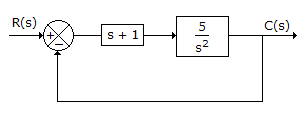


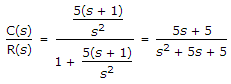 .
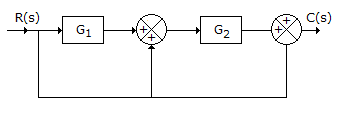
.For the system in the given figure. The transfer function C(s)/R(s) is
- a)G1 + G2 + 1
- b)G1 G2 + 1
- c)G1 G2 + G2 + 1
- d)none
Correct answer is option 'C'. Can you explain this answer?
For the system in the given figure. The transfer function C(s)/R(s) is
a)
G1 + G2 + 1
b)
G1 G2 + 1
c)
G1 G2 + G2 + 1
d)
none
 | Sparsh Saini answered |
Transfer function = (G1 + 1) G2 + 1 = G1 G2 + G2 + 1.
The entries in the first column of Routh array of a fourth order are 5, 2, - 0.1, 2, 1. The number of poles in the right half plane are- a)1
- b)2
- c)3
- d)4
Correct answer is option 'B'. Can you explain this answer?
The entries in the first column of Routh array of a fourth order are 5, 2, - 0.1, 2, 1. The number of poles in the right half plane are
a)
1
b)
2
c)
3
d)
4
 | Sanya Agarwal answered |
Two sign changes and hence two poles in right half plane.
The polar plot of a transfer function passes through (-1, 0) point. The gain margin is- a)zero
- b)- 1 dB
- c)1 dB
- d)infinity
Correct answer is option 'A'. Can you explain this answer?
The polar plot of a transfer function passes through (-1, 0) point. The gain margin is
a)
zero
b)
- 1 dB
c)
1 dB
d)
infinity
 | Ravi Singh answered |
When polar plot passes through (-1, 0) the system is on limit of stability and gain margin is zero.
A thermometer requires 1 minute to indicate 98% of its final response to a step input. If it is a first order system the time constant is- a)1 minute
- b)0.5 minute
- c)0.25 minute
- d)0.1 minute
Correct answer is option 'C'. Can you explain this answer?
A thermometer requires 1 minute to indicate 98% of its final response to a step input. If it is a first order system the time constant is
a)
1 minute
b)
0.5 minute
c)
0.25 minute
d)
0.1 minute
 | Snehal Rane answered |
0.98 = 1 - e-1/T or T = 0.25 minute.
In a second order system with a unit step input, the speed of response is high if system is- a)overdamped
- b)undamped system
- c)critically damped
- d)underdamped
Correct answer is option 'D'. Can you explain this answer?
In a second order system with a unit step input, the speed of response is high if system is
a)
overdamped
b)
undamped system
c)
critically damped
d)
underdamped
| | Harsh Kulkarni answered |
An underdamped system with damping factor slightly less than 1 gives high speed of response.
An endpoint of an inter-process communication flow across a computer network is called- a)socket
- b)pipe
- c)port
- d)none of the mentioned
Correct answer is option 'A'. Can you explain this answer?
An endpoint of an inter-process communication flow across a computer network is called
a)
socket
b)
pipe
c)
port
d)
none of the mentioned
| | Shubham Sharma answered |
Endpoint of Inter-Process Communication Flow
Inter-process communication (IPC) is the mechanism that allows different processes to communicate with each other in a computer system. Processes can exchange data, signals or messages through various IPC methods such as pipes, sockets, message queues, shared memory, etc. An endpoint is a unique identifier that specifies the source or destination of IPC communication flow.
Socket as an Endpoint
A socket is an endpoint of a two-way communication link between two processes running on a networked computer system. It is identified by an IP address and a port number. Sockets can be either TCP (Transmission Control Protocol) or UDP (User Datagram Protocol) based. TCP sockets provide reliable, ordered, and error-checked delivery of data, while UDP sockets provide unreliable, unordered, and unverified delivery of data.
Advantages of Sockets
- Sockets are widely used in network programming for building client-server applications.
- They provide a simple and flexible interface for IPC across different platforms and programming languages.
- They can handle multiple connections simultaneously and support asynchronous input/output operations.
- They can be used for both local and remote IPC, depending on the network configuration.
Conclusion
In summary, an endpoint of an IPC flow across a computer network is called a socket. Sockets are a popular and efficient mechanism for inter-process communication, providing a reliable and flexible way for processes to exchange data over a network.
Inter-process communication (IPC) is the mechanism that allows different processes to communicate with each other in a computer system. Processes can exchange data, signals or messages through various IPC methods such as pipes, sockets, message queues, shared memory, etc. An endpoint is a unique identifier that specifies the source or destination of IPC communication flow.
Socket as an Endpoint
A socket is an endpoint of a two-way communication link between two processes running on a networked computer system. It is identified by an IP address and a port number. Sockets can be either TCP (Transmission Control Protocol) or UDP (User Datagram Protocol) based. TCP sockets provide reliable, ordered, and error-checked delivery of data, while UDP sockets provide unreliable, unordered, and unverified delivery of data.
Advantages of Sockets
- Sockets are widely used in network programming for building client-server applications.
- They provide a simple and flexible interface for IPC across different platforms and programming languages.
- They can handle multiple connections simultaneously and support asynchronous input/output operations.
- They can be used for both local and remote IPC, depending on the network configuration.
Conclusion
In summary, an endpoint of an IPC flow across a computer network is called a socket. Sockets are a popular and efficient mechanism for inter-process communication, providing a reliable and flexible way for processes to exchange data over a network.
Assertion (A): The steady state response, of a stable, linear, time invariant system, to sinusoidal input depends on initial conditions.Reason (R): Frequency response, in steady state, is obtained by replacing s in the transfer function by jω- a)Both A and R are correct and R is correct explanation of A
- b)Both A and R are correct but R is not correct explanation of A
- c)A is correct but R is wrong
- d)R is correct but A is wrong
Correct answer is option 'D'. Can you explain this answer?
Assertion (A): The steady state response, of a stable, linear, time invariant system, to sinusoidal input depends on initial conditions.
Reason (R): Frequency response, in steady state, is obtained by replacing s in the transfer function by jω
a)
Both A and R are correct and R is correct explanation of A
b)
Both A and R are correct but R is not correct explanation of A
c)
A is correct but R is wrong
d)
R is correct but A is wrong
 | Meghana Gupta answered |
Steady state response does not depend on initial conditions.
Bellows converts- a)pressure difference into displacement
- b)pressure difference into voltage
- c)displacement into pressure difference
- d)either (a) or (c)
Correct answer is option 'A'. Can you explain this answer?
Bellows converts
a)
pressure difference into displacement
b)
pressure difference into voltage
c)
displacement into pressure difference
d)
either (a) or (c)
 | Ishan Saini answered |
To measure pressure, it is convenient to convert pressure into displacement and then use a displacement transducer.
Assertion (A): Potentiometers can not be used as error detectors in position control systems.Reason (R): The resolution of a potentiometer places an upper limit on its accuracy- a)Both A and R are correct and R is correct explanation of A
- b)Both A and R are correct but R is not correct explanation of A
- c)A is correct but R is wrong
- d)R is correct but A is wrong
Correct answer is option 'D'. Can you explain this answer?
Assertion (A): Potentiometers can not be used as error detectors in position control systems.
Reason (R): The resolution of a potentiometer places an upper limit on its accuracy
a)
Both A and R are correct and R is correct explanation of A
b)
Both A and R are correct but R is not correct explanation of A
c)
A is correct but R is wrong
d)
R is correct but A is wrong
 | Prasenjit Yadav answered |
Assertion (A): Potentiometers cannot be used as error detectors in position control systems.
Reason (R): The resolution of a potentiometer places an upper limit on its accuracy.
The correct answer is option 'D' - R is correct but A is wrong.
Explanation:
Potentiometers are widely used in position control systems as feedback devices to measure position. However, they are not commonly used as error detectors. Let's understand the assertion and reason individually to see why option 'D' is the correct answer.
Assertion (A): Potentiometers cannot be used as error detectors in position control systems.
Potentiometers, also known as pots, are variable resistors that change resistance based on the position of a movable contact. They are commonly used in position control systems to provide feedback on the current position of a controlled object. However, they are not typically used as error detectors in position control systems. Error detectors are devices or algorithms that compare the desired position with the actual position and generate an error signal. Potentiometers alone cannot perform this function efficiently.
Reason (R): The resolution of a potentiometer places an upper limit on its accuracy.
The resolution of a potentiometer refers to the smallest increment of position that it can detect. It is determined by the physical characteristics of the potentiometer, such as the resistance element and the wiper contact. The resolution of a potentiometer places a limit on its accuracy because it determines the smallest change in position that can be detected. If the resolution is not fine enough, the potentiometer may not be able to accurately measure small changes in position, leading to errors in the feedback signal.
Explanation of the correct answer:
The reason (R) is correct because the resolution of a potentiometer does place an upper limit on its accuracy. However, the assertion (A) is incorrect because potentiometers can be used as position feedback devices in control systems. They may not be ideal for error detection due to their limited resolution, but they are still commonly used for position sensing. Therefore, the correct answer is option 'D' - R is correct but A is wrong.
Reason (R): The resolution of a potentiometer places an upper limit on its accuracy.
The correct answer is option 'D' - R is correct but A is wrong.
Explanation:
Potentiometers are widely used in position control systems as feedback devices to measure position. However, they are not commonly used as error detectors. Let's understand the assertion and reason individually to see why option 'D' is the correct answer.
Assertion (A): Potentiometers cannot be used as error detectors in position control systems.
Potentiometers, also known as pots, are variable resistors that change resistance based on the position of a movable contact. They are commonly used in position control systems to provide feedback on the current position of a controlled object. However, they are not typically used as error detectors in position control systems. Error detectors are devices or algorithms that compare the desired position with the actual position and generate an error signal. Potentiometers alone cannot perform this function efficiently.
Reason (R): The resolution of a potentiometer places an upper limit on its accuracy.
The resolution of a potentiometer refers to the smallest increment of position that it can detect. It is determined by the physical characteristics of the potentiometer, such as the resistance element and the wiper contact. The resolution of a potentiometer places a limit on its accuracy because it determines the smallest change in position that can be detected. If the resolution is not fine enough, the potentiometer may not be able to accurately measure small changes in position, leading to errors in the feedback signal.
Explanation of the correct answer:
The reason (R) is correct because the resolution of a potentiometer does place an upper limit on its accuracy. However, the assertion (A) is incorrect because potentiometers can be used as position feedback devices in control systems. They may not be ideal for error detection due to their limited resolution, but they are still commonly used for position sensing. Therefore, the correct answer is option 'D' - R is correct but A is wrong.
Mechanical impedance is the ratio of- a)rms force to rms velocity
- b)rms force to rms displacement
- c)rms velocity to rms displacement
- d)none of the above
Correct answer is option 'A'. Can you explain this answer?
Mechanical impedance is the ratio of
a)
rms force to rms velocity
b)
rms force to rms displacement
c)
rms velocity to rms displacement
d)
none of the above
 | Neha Choudhury answered |
It relates forces with velocities acting on a mechanical system. The mechanical impedance of a point on a structure is the ratio of the force applied at a point to the resulting velocity at that point. Mechanical impedance is the inverse of mechanical admittance or mobility.Mechanical impedance is a measure of how much a structure resists motion when subjected to a harmonic force. It relates forces with velocities acting on a mechanical system. The mechanical impedance of a point on a structure is the ratio of the force applied at a point to the resulting velocity at that point.[1][2]
Mechanical impedance is the inverse of mechanical admittance or mobility. The mechanical impedance is a function of the frequency {\displaystyle \omega } \omega of the applied force and can vary greatly over frequency. At resonance frequencies, the mechanical impedance will be lower, meaning less force is needed to cause a structure to move at a given velocity. A simple example of this is pushing a child on a swing. For the greatest swing amplitude, the frequency of the pushes must be near the resonant frequency of the system.
{\displaystyle \mathbf {F} (\omega )=\mathbf {Z} (\omega )\mathbf {v} (\omega )} \mathbf {F} (\omega )=\mathbf {Z} (\omega )\mathbf {v} (\omega )
Where, {\displaystyle \mathbf {F} } \mathbf {F} is the force vector, {\displaystyle \mathbf {v} } \mathbf {v} is the velocity vector, {\displaystyle \mathbf {Z} } \mathbf {Z} is the impedance matrix and {\displaystyle \omega } \omega is the angular frequency.
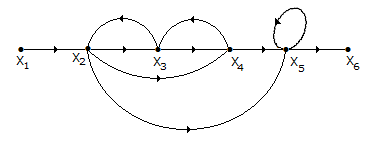
For the signal flow graph of the given figure consider the following statements- It has three forward paths
- It has three individual loops
- It has two non touching loops
Out of above the correct statements are
- a)1, 2, 3
- b)1, 2
- c)2, 3
- d)1, 3
Correct answer is option 'D'. Can you explain this answer?
For the signal flow graph of the given figure consider the following statements
- It has three forward paths
- It has three individual loops
- It has two non touching loops
Out of above the correct statements are
a)
1, 2, 3
b)
1, 2
c)
2, 3
d)
1, 3
 | Saishree Mondrathi answered |
I think option A is correct
forward paths=1) X1 X2 X3 X4 X5 X6
2) X1 X2 X4 X5 X6 and 3) X1 X2 X5 X6
individual loops= 1) X2 X3 X2 2) X3 X4 X3 and 3) X5 X5
non touching loops=1) either of X2 X3 X2 or X3 X4 X3
and 2) X5 X5.
forward paths=1) X1 X2 X3 X4 X5 X6
2) X1 X2 X4 X5 X6 and 3) X1 X2 X5 X6
individual loops= 1) X2 X3 X2 2) X3 X4 X3 and 3) X5 X5
non touching loops=1) either of X2 X3 X2 or X3 X4 X3
and 2) X5 X5.
A system has its two poles on the negative real axis and one pair of poles lies on jω axis. The system is- a)stable
- b)unstable
- c)limitedly stable
- d)either (a) or (c)
Correct answer is option 'C'. Can you explain this answer?
A system has its two poles on the negative real axis and one pair of poles lies on jω axis. The system is
a)
stable
b)
unstable
c)
limitedly stable
d)
either (a) or (c)
 | Sahana Sarkar answered |
When it lies on right of jω axis then it is known as unstable. When it lies on jw axis then it is known as limitedly stable or marginally stable.
First column elements of Routh's tabulation are 3, 5,  , 2. It means that there
- a)is one root in left half s plane
- b)are two roots in left half s plane
- c)are two roots in right half s plane
- d)is one root in right half s plane
Correct answer is option 'C'. Can you explain this answer?
First column elements of Routh's tabulation are 3, 5, , 2. It means that there
, 2. It means that therea)
is one root in left half s plane
b)
are two roots in left half s plane
c)
are two roots in right half s plane
d)
is one root in right half s plane
 | Bhavana Reddy Chinthared answered |
Since there are two sign changes in first column,the system is said to be unstable. And also the two roots lie on the right half of the s-plane.
From the noise point of view, bandwidth should- a)be large
- b)not be too large
- c)should be as large as possible
- d)should be infinite
Correct answer is option 'B'. Can you explain this answer?
From the noise point of view, bandwidth should
a)
be large
b)
not be too large
c)
should be as large as possible
d)
should be infinite
 | Sravya Khanna answered |
If noise is to be eliminated, bandwidth cannot be large.
The data link layer takes the packets from _________ and encapsulates them into frames for transmission.- a)network layer
- b)physical layer
- c)transport layer
- d)application layer
Correct answer is option 'A'. Can you explain this answer?
The data link layer takes the packets from _________ and encapsulates them into frames for transmission.
a)
network layer
b)
physical layer
c)
transport layer
d)
application layer
| | Shail Kulkarni answered |
Explanation:
The Data Link Layer is the second layer of the OSI Model. Its main responsibility is to take the packets from the Network Layer and encapsulate them into frames for transmission over the physical medium. The frames contain information such as source and destination MAC addresses, error checking bits and sequence numbers.
Functions of Data Link Layer:
The Data Link Layer performs the following functions:
1. Framing: It divides the data received from the Network Layer into frames and adds a header and a trailer to each frame.
2. Error Control: It detects and corrects errors that occur during transmission using techniques like CRC (Cyclic Redundancy Check).
3. Flow Control: It regulates the flow of data between two nodes to prevent congestion.
4. Access Control: It decides which device has access to the physical medium at any given time.
5. MAC Addressing: It assigns a unique MAC address to each device on the network for identification.
Conclusion:
In conclusion, the Data Link Layer takes the packets from the Network Layer and encapsulates them into frames for transmission over the physical medium. It performs functions like framing, error control, flow control, access control and MAC addressing.
The Data Link Layer is the second layer of the OSI Model. Its main responsibility is to take the packets from the Network Layer and encapsulate them into frames for transmission over the physical medium. The frames contain information such as source and destination MAC addresses, error checking bits and sequence numbers.
Functions of Data Link Layer:
The Data Link Layer performs the following functions:
1. Framing: It divides the data received from the Network Layer into frames and adds a header and a trailer to each frame.
2. Error Control: It detects and corrects errors that occur during transmission using techniques like CRC (Cyclic Redundancy Check).
3. Flow Control: It regulates the flow of data between two nodes to prevent congestion.
4. Access Control: It decides which device has access to the physical medium at any given time.
5. MAC Addressing: It assigns a unique MAC address to each device on the network for identification.
Conclusion:
In conclusion, the Data Link Layer takes the packets from the Network Layer and encapsulates them into frames for transmission over the physical medium. It performs functions like framing, error control, flow control, access control and MAC addressing.
User datagram protocol is called connectionless because- a)all UDP packets are treated independently by transport layer
- b)it sends data as a stream of related packets
- c)both (a) and (b)
- d)none of the mentioned
Correct answer is option 'A'. Can you explain this answer?
User datagram protocol is called connectionless because
a)
all UDP packets are treated independently by transport layer
b)
it sends data as a stream of related packets
c)
both (a) and (b)
d)
none of the mentioned
| | Ravi Singh answered |
-User Datagram Protocol (UDP) – a communications protocol that facilitates the exchange of messages between computing devices in a network. It's an alternative to the transmission control protocol (TCP). In a network that uses the Internet Protocol (IP), it is sometimes referred to as UDP/IP.
-
User datagram protocol is called connectionless because
all UDP packets are treated independently by transport layer.In control systems the magnitude of error voltage- a)is very small
- b)is very large
- c)neither small nor large
- d)may be any value from 0 to 50 V
Correct answer is option 'A'. Can you explain this answer?
In control systems the magnitude of error voltage
a)
is very small
b)
is very large
c)
neither small nor large
d)
may be any value from 0 to 50 V
 | Rajesh Verma answered |
The error voltage is always very small. A high value of error voltage may cause instability.
A stepper motor is- a)a two phase induction motor
- b)is a kind of rotating amplifier
- c)is an electromagnetic transducer used to convert an angular position of shaft into electrical signal
- d)is an electromechanical device which actuates a train of step angular movements in response to a train of input pulses on one to one basis
Correct answer is option 'D'. Can you explain this answer?
A stepper motor is
a)
a two phase induction motor
b)
is a kind of rotating amplifier
c)
is an electromagnetic transducer used to convert an angular position of shaft into electrical signal
d)
is an electromechanical device which actuates a train of step angular movements in response to a train of input pulses on one to one basis
| | Bijoy Nair answered |
When input pulses are applied, the motor moves in steps.
The gain margin for a stable system- a)has a positive decibel value
- b)has a negative decibel value
- c)has a large negative decibel value
- d)none of the above
Correct answer is option 'A'. Can you explain this answer?
The gain margin for a stable system
a)
has a positive decibel value
b)
has a negative decibel value
c)
has a large negative decibel value
d)
none of the above
 | Saumya Sen answered |
For a stable system gain margin is positive. Therefore decibel value is also positive.
Which of the following rotors are used in two phase ac servomotor?- Solid iron rotor
- Squirrel cage rotor
- Drag cup rotor
Of the above the correct ones are- a)1, 2, 3
- b)1, 2
- c)2, 3
- d)1, 3
Correct answer is option 'C'. Can you explain this answer?
Which of the following rotors are used in two phase ac servomotor?
- Solid iron rotor
- Squirrel cage rotor
- Drag cup rotor
a)
1, 2, 3
b)
1, 2
c)
2, 3
d)
1, 3
| | Sharmila Kulkarni answered |
Solid iron rotor would give rise to eddy currents.
The effect of negative feedback on distortion and bandwidth because- a)both are decreased
- b)both are increased
- c)distortion is reduced and bandwidth is increased
- d)distortion is increased and bandwidth is decreased
Correct answer is option 'C'. Can you explain this answer?
The effect of negative feedback on distortion and bandwidth because
a)
both are decreased
b)
both are increased
c)
distortion is reduced and bandwidth is increased
d)
distortion is increased and bandwidth is decreased
| | Rajesh Kumar answered |
Negative feedback increase bandwidth and reduces distortion.
Assertion (A): A large negative feedback is deliberately introduced in an amplifier to make its gain independent of variation in parameters of active device.Reason (R): A large negative value of feedback results in a high value of return difference compared to unity which makes the feedback gain inversely proportional to the feedback factor.- a)Both A and R are correct and R is correct explanation of A
- b)Both A and R are correct but R is not correct explanation of A
- c)A is correct but R is wrong
- d)R is correct but A is wrong
Correct answer is option 'A'. Can you explain this answer?
Assertion (A): A large negative feedback is deliberately introduced in an amplifier to make its gain independent of variation in parameters of active device.
Reason (R): A large negative value of feedback results in a high value of return difference compared to unity which makes the feedback gain inversely proportional to the feedback factor.
a)
Both A and R are correct and R is correct explanation of A
b)
Both A and R are correct but R is not correct explanation of A
c)
A is correct but R is wrong
d)
R is correct but A is wrong
| | Devansh Das answered |
Gain with feedback =  .
.
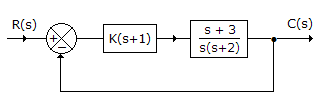
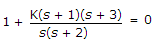
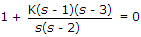
.For the system in the given figure the characteristic equation is
- a)
- b)
- c)K(s + 1)(s + 3) = 0
- d)s(s + 2) = 0
Correct answer is option 'A'. Can you explain this answer?
For the system in the given figure the characteristic equation is
a)
b)
c)
K(s + 1)(s + 3) = 0
d)
s(s + 2) = 0
| | Kalyan Patel answered |
Transfer function = 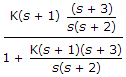 .
.
.Hence characteristic equation is 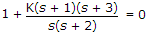 .
.
.The slope of log-magnitude asymptote changes by - 40 dB/ decade at a frequency ω1. This means that- a)a double pole is present
- b)a pair of complex conjugate poles is present
- c)either a double pole or a pair of complex conjugate poles is present
- d)a pole or zero at origin is present
Correct answer is option 'C'. Can you explain this answer?
The slope of log-magnitude asymptote changes by - 40 dB/ decade at a frequency ω1. This means that
a)
a double pole is present
b)
a pair of complex conjugate poles is present
c)
either a double pole or a pair of complex conjugate poles is present
d)
a pole or zero at origin is present
| | Samarth Khanna answered |
A double pole or pair of complex poles result in - 40 dB/decade slope in log magnitude graph.
A lead compensator is basically a- a)high pass filter
- b)low pass filter
- c)band stop filter
- d)none of the above
Correct answer is option 'A'. Can you explain this answer?
A lead compensator is basically a
a)
high pass filter
b)
low pass filter
c)
band stop filter
d)
none of the above
| | Sushant Mehta answered |
See transfer function in the equation  .
.
.Which of the following is not correct for two phase servomotor?- a)Rotor diameter is small
- b)Applied voltages are seldom balanced
- c)Rotor resistance is low
- d)Torque speed curve is linear
Correct answer is option 'C'. Can you explain this answer?
Which of the following is not correct for two phase servomotor?
a)
Rotor diameter is small
b)
Applied voltages are seldom balanced
c)
Rotor resistance is low
d)
Torque speed curve is linear
| | Divya Nair answered |
In this motor ratio  is small or R is high.
is small or R is high.The most commonly used devices for differencing and amplification, in control systems, are- a)BJT amplifiers
- b)FET amplifiers
- c)operational amplifiers
- d)either (a) or (b)
Correct answer is option 'C'. Can you explain this answer?
The most commonly used devices for differencing and amplification, in control systems, are
a)
BJT amplifiers
b)
FET amplifiers
c)
operational amplifiers
d)
either (a) or (b)
 | Debanshi Basak answered |
Op-amps are commonly used due to their several advantages.
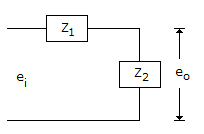
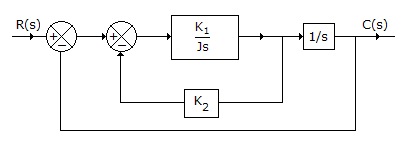
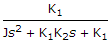
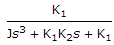
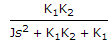
For the system of the given figure the transfer function  =
=
- a)

- b)

- c)

- d)

Correct answer is option 'B'. Can you explain this answer?
For the system of the given figure the transfer function =
=a)
b)
c)
d)
| | Prisha Sengupta answered |
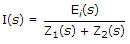 , E0(s) = [I(s)][Z2(s)] or
 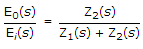 .
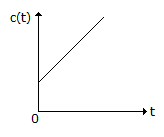
.In response to a unit step input the controller output in given figure is for
- a)proportional controller
- b)proportional plus integral controller
- c)integral controller
- d)none of the above
Correct answer is option 'B'. Can you explain this answer?
In response to a unit step input the controller output in given figure is for
a)
proportional controller
b)
proportional plus integral controller
c)
integral controller
d)
none of the above
| | Amar Sengupta answered |
The intercept on y-axis is due to proportional action and inclined line is due to integral action.
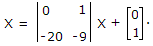 The poles of this system are located at
If 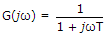 the polar plot, as the frequency is varied from 0 to infinity is
- a)a semicircle
- b)a circle
- c)a straight line
- d)none of the above
Correct answer is option 'A'. Can you explain this answer?
If the polar plot, as the frequency is varied from 0 to infinity is
the polar plot, as the frequency is varied from 0 to infinity isa)
a semicircle
b)
a circle
c)
a straight line
d)
none of the above
| | Mainak Pillai answered |
At ω = 0, G(jω) = 1 ∠ 0. At ω = ∞, G(jω) = 0 ∠ -90º.
The transfer function  can be for
- a)lead compensator
- b)lag compensator
- c)both (a) and (b)
- d)either (a) or (b)
Correct answer is option 'B'. Can you explain this answer?
The transfer function can be for
can be fora)
lead compensator
b)
lag compensator
c)
both (a) and (b)
d)
either (a) or (b)
| | Arshiya Basu answered |
For a lag compensator  β > 1
β > 1
β > 1Therefore  is less than
  .
.
is less than .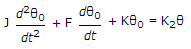


For the feedback system with closed loop transfer function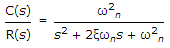 the settling time for 2% tolerance
- a)

- b)

- c)

- d)4ξωn
Correct answer is option 'C'. Can you explain this answer?
For the feedback system with closed loop transfer function the settling time for 2% tolerance
the settling time for 2% tolerancea)
b)
c)
d)
4ξωn
| | Preethi Banerjee answered |
 and settling time for 2% tolerance is 4T.
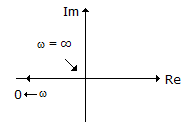
The polar plot of the given figure is for the term
- a)(jω)2
- b)1 + (jω)2
- c)

- d)

Correct answer is option 'C'. Can you explain this answer?
The polar plot of the given figure is for the term
a)
(jω)2
b)
1 + (jω)2
c)
d)
| | Poulomi Ahuja answered |
For the term  , magnitude is 0 at ω = ∞ and infinite at ω = 0. Moreover phase angle is -180º.
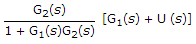
, magnitude is 0 at ω = ∞ and infinite at ω = 0. Moreover phase angle is -180º.In the given figure, C(s) =

- a)
- b)

- c)

- d)

Correct answer is option 'B'. Can you explain this answer?
In the given figure, C(s) =
a)
b)
c)
d)
| | Pallabi Pillai answered |
Use principle of superposition. Initially assume R(s) = 0 and find C(s).
Then assume U(s) = 0 and find C(s). Add the two responses.
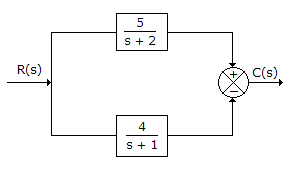
Assertion (A): The time response of the system with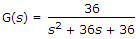 will not have any overshoot for unit step input.Reason (R): A critically damped system does not have any overshoot to a unit step input.
- a)Both A and R are correct and R is correct explanation of A
- b)Both A and R are correct but R is not correct explanation of A
- c)A is correct but R is wrong
- d)R is correct but A is wrong
Correct answer is option 'C'. Can you explain this answer?
Assertion (A): The time response of the system with will not have any overshoot for unit step input.
will not have any overshoot for unit step input.Reason (R): A critically damped system does not have any overshoot to a unit step input.
a)
Both A and R are correct and R is correct explanation of A
b)
Both A and R are correct but R is not correct explanation of A
c)
A is correct but R is wrong
d)
R is correct but A is wrong
| | Maulik Chatterjee answered |
System in A is overdamped.


 .
.The phase angle curve of G(jω) H(jω) can be drawn- a)by adding the phase angle curves of individual factors
- b)by subtracting the phase angle curves of individual factors
- c)by multiplying the phase angle curves of individual factors
- d)by dividing the phase angle curves of individual factors
Correct answer is option 'A'. Can you explain this answer?
The phase angle curve of G(jω) H(jω) can be drawn
a)
by adding the phase angle curves of individual factors
b)
by subtracting the phase angle curves of individual factors
c)
by multiplying the phase angle curves of individual factors
d)
by dividing the phase angle curves of individual factors
| | Sanskriti Desai answered |
When terms are multiplied, phase angles are added.
The first column of a Routh array is
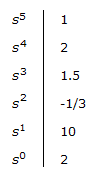
How many roots of the corresponding characteristic equation are in left half s-plane?- a)2
- b)3
- c)4
- d)5
Correct answer is option 'B'. Can you explain this answer?
The first column of a Routh array is
How many roots of the corresponding characteristic equation are in left half s-plane?
How many roots of the corresponding characteristic equation are in left half s-plane?
a)
2
b)
3
c)
4
d)
5
| | Sandeep Saha answered |
Total number of roots is 5. Since two sign changes in first column, two roots are in right half plane.
Hence 3 roots in left half plane.
In a two phase ac servomotor rotor resistance is R and rotor reactance is X. The speed curve will be linear if- a)

- b)

- c)

- d)X2 = R
Correct answer is option 'A'. Can you explain this answer?
In a two phase ac servomotor rotor resistance is R and rotor reactance is X. The speed curve will be linear if
a)
b)
c)
d)
X2 = R
| | Rahul Banerjee answered |
In a two phase servomotor  ∠ < 1 so that torque speed curve is almost linear.
∠ < 1 so that torque speed curve is almost linear.


 .
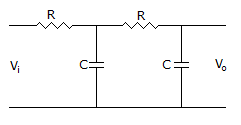
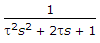
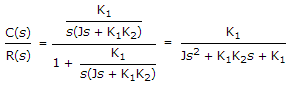
.The transfer function  has the characteristics of high pass filter.
- a)True
- b)False
Correct answer is option 'B'. Can you explain this answer?
The transfer function has the characteristics of high pass filter.
has the characteristics of high pass filter.a)
True
b)
False
| | Nayanika Singh answered |
When ω is high, the output is low.
 .
.Chapter doubts & questions for Extra Quiz - 6 Months Preparation for GATE Electrical 2026 is part of Electrical Engineering (EE) exam preparation. The chapters have been prepared according to the Electrical Engineering (EE) exam syllabus. The Chapter doubts & questions, notes, tests & MCQs are made for Electrical Engineering (EE) 2026 Exam. Find important definitions, questions, notes, meanings, examples, exercises, MCQs and online tests here.
Chapter doubts & questions of Extra Quiz - 6 Months Preparation for GATE Electrical in English & Hindi are available as part of Electrical Engineering (EE) exam. Download more important topics, notes, lectures and mock test series for Electrical Engineering (EE) Exam by signing up for free.
6 Months Preparation for GATE Electrical675 videos|1390 docs|885 tests |
