


All Exams > Electrical Engineering (EE) > 6 Months Preparation for GATE Electrical > All Questions
All questions of Power Electronics for Electrical Engineering (EE) Exam
If T is the chopping period, Ton the on-time period of chopper and Toff the off-time period of the chopper, then consider the following statements associated with the methods of controlling the output voltage of a chopper:
1. In pulse-width modulation (PWM) scheme, T is kept constant while Ton is varied.
2. In variable-frequency modulation (VFM) scheme, T is varied while either of Ton or Toff is kept constant.
3. In PWM scheme, the output voltage can be varied between zero to source voltage.
4. The large Toff in VFM scheme may make the load current discontinuous
5. PWM scheme is better than VFM scheme.Which of the statements given above are correct?- a)1,2,3, 4, and 5
- b)2, 3 and 5
- c)1,3 and 4
- d)2, 3, 4 and 5
Correct answer is option 'A'. Can you explain this answer?
If T is the chopping period, Ton the on-time period of chopper and Toff the off-time period of the chopper, then consider the following statements associated with the methods of controlling the output voltage of a chopper:
1. In pulse-width modulation (PWM) scheme, T is kept constant while Ton is varied.
2. In variable-frequency modulation (VFM) scheme, T is varied while either of Ton or Toff is kept constant.
3. In PWM scheme, the output voltage can be varied between zero to source voltage.
4. The large Toff in VFM scheme may make the load current discontinuous
5. PWM scheme is better than VFM scheme.
1. In pulse-width modulation (PWM) scheme, T is kept constant while Ton is varied.
2. In variable-frequency modulation (VFM) scheme, T is varied while either of Ton or Toff is kept constant.
3. In PWM scheme, the output voltage can be varied between zero to source voltage.
4. The large Toff in VFM scheme may make the load current discontinuous
5. PWM scheme is better than VFM scheme.
Which of the statements given above are correct?
a)
1,2,3, 4, and 5
b)
2, 3 and 5
c)
1,3 and 4
d)
2, 3, 4 and 5
 | Luminary Institute answered |
For dc – dc converter the critical inductance value.
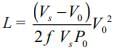
V0 = a Vs = 0.8 × 100 = 80 V
I0 = 2A Power P0 = V0 I0 = 160 Watt
f = 500
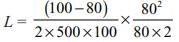
= 8 × 10⁻³ H = 8 mH.
V0 = a Vs = 0.8 × 100 = 80 V
I0 = 2A Power P0 = V0 I0 = 160 Watt
f = 500
= 8 × 10⁻³ H = 8 mH.

In current source inverters load voltage waveform V0 and load current waveform i0 respectively- a)depends on load impedance Z, does not depends on Z.
- b)depends on Z, depends on Z.
- c)does not depend on Z, does not depend on Z.
- d)does not depend on Z, depends on Z.
Correct answer is option 'A'. Can you explain this answer?
In current source inverters load voltage waveform V0 and load current waveform i0 respectively
a)
depends on load impedance Z, does not depends on Z.
b)
depends on Z, depends on Z.
c)
does not depend on Z, does not depend on Z.
d)
does not depend on Z, depends on Z.
 | Pankaj Mehta answered |
In a CSI, load current rather than load voltage is controlled, and the inverter output voltage is dependent upon the load impedance and the output voltage waveform. The load current and hence its waveform is independent of load impedance due to which a CSI has inherent protection against short-circuit across its terminals.
After firing an SCR, the gate pulse is removed. The current in the SCR will- a)rise up.
- b)remain the same.
- c)rise a little and then fall to zero.
- d)immediately fall to zero.
Correct answer is option 'B'. Can you explain this answer?
After firing an SCR, the gate pulse is removed. The current in the SCR will
a)
rise up.
b)
remain the same.
c)
rise a little and then fall to zero.
d)
immediately fall to zero.
 | Ravi Singh answered |
Once the thyristor (SCR) is turned-on, and the anode current is above latching current level, there is no need of gate current, hence, gate signal can be withdrawn i.e. gate looses control over the anode current.
Inverters designed from BJT are preferably used in saturation region than in active region because of- a)high efficiency
- b)high power factor
- c)both (a) and (b)
- d)none of these
Correct answer is option 'C'. Can you explain this answer?
Inverters designed from BJT are preferably used in saturation region than in active region because of
a)
high efficiency
b)
high power factor
c)
both (a) and (b)
d)
none of these
 | EduRev GATE answered |
The average voltage across the inductor for a complete cycle is zero and also the power dissipated across
inductor per cycle is zero So,
The load power only due to resistor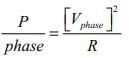


for 3 phases = 166.62 × 3 ≌ 500 Watt.
inductor per cycle is zero So,
The load power only due to resistor
for 3 phases = 166.62 × 3 ≌ 500 Watt.
Assertion (A): The lower order harmonics are reduced by using some technique while the higher order harmonics are reduced by using filter.
Reason (R): The cost of the filter is reduced and at the same time transient response is also improved to a great extent.- a)Both A and R are true and R is the correct explanation of A.
- b)Both A and R are true but R is not the correct explanation of A.
- c)A is true but R is false,
- d)A is false but R is true.
Correct answer is option 'A'. Can you explain this answer?
Assertion (A): The lower order harmonics are reduced by using some technique while the higher order harmonics are reduced by using filter.
Reason (R): The cost of the filter is reduced and at the same time transient response is also improved to a great extent.
Reason (R): The cost of the filter is reduced and at the same time transient response is also improved to a great extent.
a)
Both A and R are true and R is the correct explanation of A.
b)
Both A and R are true but R is not the correct explanation of A.
c)
A is true but R is false,
d)
A is false but R is true.
| | Luminary Institute answered |
The machine operated at 50 Hz.
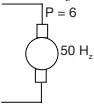
Synchronous speed Ns
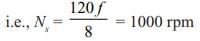
A slip of S = 0.02
Nr = (1 - S) Ns = 980 rpm.
Synchronous speed Ns
A slip of S = 0.02
Nr = (1 - S) Ns = 980 rpm.
In continues gating- a)overlap angle is very high
- b)SCR is heated up
- c)size of the pulse transformer is small
- d)commutation cannot be achieved effectively
Correct answer is option 'B'. Can you explain this answer?
In continues gating
a)
overlap angle is very high
b)
SCR is heated up
c)
size of the pulse transformer is small
d)
commutation cannot be achieved effectively
 | Debanshi Nair answered |
As the gating is applied for a longer duration, the device is heated up.
In dc choppers, the waveforms for input and output voltages are respectively- a)continuous, discontinuous
- b)both discontinuous
- c)discontinuous, continuous
- d)both continuous
Correct answer is option 'A'. Can you explain this answer?
In dc choppers, the waveforms for input and output voltages are respectively
a)
continuous, discontinuous
b)
both discontinuous
c)
discontinuous, continuous
d)
both continuous
 | Prisha Sengupta answered |
Explanation:
DC choppers are electronic devices that are used to convert a fixed DC voltage into a variable DC voltage. The waveform for input and output voltages in DC choppers is as follows:
Input Voltage Waveform:
The input voltage waveform is continuous in DC choppers. It means that the voltage is present at the input of the chopper throughout the operation.
Output Voltage Waveform:
The output voltage waveform is discontinuous in DC choppers. It means that the output voltage is present only for a certain period of time during the operation.
Reason:
The reason for the continuous input voltage waveform is that the input voltage is connected to a DC source that provides a constant voltage. On the other hand, the output voltage waveform is discontinuous because the chopper switches ON and OFF at a certain frequency. During the ON state, the output voltage is present, and during the OFF state, the output voltage is not present.
Conclusion:
Hence, we can conclude that the waveforms for input and output voltages in DC choppers are respectively continuous and discontinuous.
DC choppers are electronic devices that are used to convert a fixed DC voltage into a variable DC voltage. The waveform for input and output voltages in DC choppers is as follows:
Input Voltage Waveform:
The input voltage waveform is continuous in DC choppers. It means that the voltage is present at the input of the chopper throughout the operation.
Output Voltage Waveform:
The output voltage waveform is discontinuous in DC choppers. It means that the output voltage is present only for a certain period of time during the operation.
Reason:
The reason for the continuous input voltage waveform is that the input voltage is connected to a DC source that provides a constant voltage. On the other hand, the output voltage waveform is discontinuous because the chopper switches ON and OFF at a certain frequency. During the ON state, the output voltage is present, and during the OFF state, the output voltage is not present.
Conclusion:
Hence, we can conclude that the waveforms for input and output voltages in DC choppers are respectively continuous and discontinuous.
The single phase mid-point type cycloconverter uses __________ number of SCRs.- a)4
- b)8
- c)6
- d)none of the mentioned
Correct answer is option 'A'. Can you explain this answer?
The single phase mid-point type cycloconverter uses __________ number of SCRs.
a)
4
b)
8
c)
6
d)
none of the mentioned
| | Ishan Chawla answered |
Introduction:
A cycloconverter is a type of power electronic device that converts the frequency of an AC signal. It is commonly used in applications where variable frequency and voltage control is required. The single-phase mid-point type cycloconverter is a specific configuration of a cycloconverter that can be used to convert single-phase AC power.
Explanation:
In a single-phase mid-point type cycloconverter, the AC input voltage is connected to a pair of SCRs (Silicon Controlled Rectifiers) in an anti-parallel configuration. These SCRs are responsible for controlling the power flow and generating the desired output waveform.
Working of single-phase mid-point type cycloconverter:
The operation of a single-phase mid-point type cycloconverter can be divided into two modes:
1. Positive half-cycle mode: During the positive half-cycle of the input voltage, one of the SCRs is triggered and conducts for the duration of the positive half-cycle. The output voltage is generated during this time and is controlled by the triggering angle of the SCR.
2. Negative half-cycle mode: During the negative half-cycle of the input voltage, the other SCR is triggered and conducts for the duration of the negative half-cycle. The output voltage is generated during this time and is also controlled by the triggering angle of the SCR.
Number of SCRs:
In a single-phase mid-point type cycloconverter, there are two SCRs used in total. Each SCR is responsible for controlling one half-cycle of the input voltage. By triggering the appropriate SCR at the desired angle, the output voltage waveform can be controlled.
Advantages of single-phase mid-point type cycloconverter:
- Provides variable frequency control.
- Can operate with a wide range of input voltages.
- Suitable for applications that require precise control of output voltage and frequency.
Conclusion:
The single-phase mid-point type cycloconverter uses two SCRs in total. These SCRs control the power flow and generate the desired output waveform. This configuration allows for variable frequency and voltage control, making it suitable for various applications.
A cycloconverter is a type of power electronic device that converts the frequency of an AC signal. It is commonly used in applications where variable frequency and voltage control is required. The single-phase mid-point type cycloconverter is a specific configuration of a cycloconverter that can be used to convert single-phase AC power.
Explanation:
In a single-phase mid-point type cycloconverter, the AC input voltage is connected to a pair of SCRs (Silicon Controlled Rectifiers) in an anti-parallel configuration. These SCRs are responsible for controlling the power flow and generating the desired output waveform.
Working of single-phase mid-point type cycloconverter:
The operation of a single-phase mid-point type cycloconverter can be divided into two modes:
1. Positive half-cycle mode: During the positive half-cycle of the input voltage, one of the SCRs is triggered and conducts for the duration of the positive half-cycle. The output voltage is generated during this time and is controlled by the triggering angle of the SCR.
2. Negative half-cycle mode: During the negative half-cycle of the input voltage, the other SCR is triggered and conducts for the duration of the negative half-cycle. The output voltage is generated during this time and is also controlled by the triggering angle of the SCR.
Number of SCRs:
In a single-phase mid-point type cycloconverter, there are two SCRs used in total. Each SCR is responsible for controlling one half-cycle of the input voltage. By triggering the appropriate SCR at the desired angle, the output voltage waveform can be controlled.
Advantages of single-phase mid-point type cycloconverter:
- Provides variable frequency control.
- Can operate with a wide range of input voltages.
- Suitable for applications that require precise control of output voltage and frequency.
Conclusion:
The single-phase mid-point type cycloconverter uses two SCRs in total. These SCRs control the power flow and generate the desired output waveform. This configuration allows for variable frequency and voltage control, making it suitable for various applications.
The single-phase half-bridge inverter has a resistive load of 10Ω and the centre-tap dc input voltage is 96 V. The fundamental power consumed by the load is- a)628.6 Watt
- b)525.0Watt'
- c)746.5 Watt
- d)824.4 Watt
Correct answer is option 'C'. Can you explain this answer?
The single-phase half-bridge inverter has a resistive load of 10Ω and the centre-tap dc input voltage is 96 V. The fundamental power consumed by the load is
a)
628.6 Watt
b)
525.0Watt'
c)
746.5 Watt
d)
824.4 Watt
| | Niharika Basu answered |
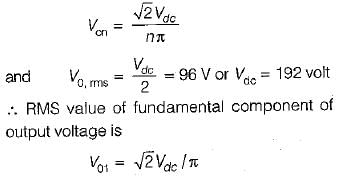
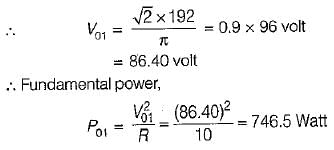
The nth harmonic-component of output voltage is
A 220 V dc shunt motor runs at 1500 rpm at no-load. The motor is fed through a type-A chopper. If the armature resistance is 1 Ω and duty cycle of chopper is 60%, the speed of the motor when it draw a current of 20 A would be approximately equal to- a)636 rpm
- b)842 rpm
- c)764 rpm
- d)535 rpm
Correct answer is option 'C'. Can you explain this answer?
A 220 V dc shunt motor runs at 1500 rpm at no-load. The motor is fed through a type-A chopper. If the armature resistance is 1 Ω and duty cycle of chopper is 60%, the speed of the motor when it draw a current of 20 A would be approximately equal to
a)
636 rpm
b)
842 rpm
c)
764 rpm
d)
535 rpm
 | Aashna Dey answered |
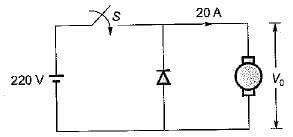
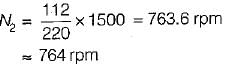
The output voltage,
V0 = αVs = 0.6 x 220 - 132 V
∴ Back emf

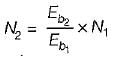
At no- load, N1, = 1500 rpm and Eb1 = 220 V Now, Eb α N
∴

or,
or,
Assertion (A): With increased reverse bias, the reverse blocking safe operating area increases in size.
Reason (R): The reverse blocking safe operating area is a plot of collector current versus collector-emitter voltage.- a)Both A and R are true and R is the correct explanation of A.
- b)Both A and R are true but R is not the correct explanation of A.
- c)A is true but R is false.
- d)A is false but R is true.
Correct answer is option 'D'. Can you explain this answer?
Assertion (A): With increased reverse bias, the reverse blocking safe operating area increases in size.
Reason (R): The reverse blocking safe operating area is a plot of collector current versus collector-emitter voltage.
Reason (R): The reverse blocking safe operating area is a plot of collector current versus collector-emitter voltage.
a)
Both A and R are true and R is the correct explanation of A.
b)
Both A and R are true but R is not the correct explanation of A.
c)
A is true but R is false.
d)
A is false but R is true.
 | Shail Nambiar answered |
The reverse blocking safe operating area (RBSOA) for a power transistor is shown below.
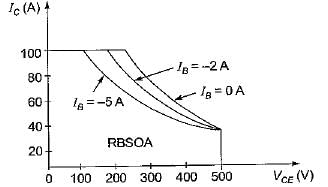
It is clear from above curve that with increased reverse bias, the RBSOA decreases in size.
It is clear from above curve that with increased reverse bias, the RBSOA decreases in size.
A single phase voltage controller has input of 230 V and a load of 15 Ω resistive. For 6 cycles on and 4 cycles off, determine the input pf.- a)0.6
- b)0.7746
- c)0.855
- d)0.236
Correct answer is option 'B'. Can you explain this answer?
A single phase voltage controller has input of 230 V and a load of 15 Ω resistive. For 6 cycles on and 4 cycles off, determine the input pf.
a)
0.6
b)
0.7746
c)
0.855
d)
0.236
 | Jatin Mukherjee answered |
k = (6/6+4) = 6/10 = 0.6
input pf = √0.6 = 0.7746.
input pf = √0.6 = 0.7746.
Assertion (A): Single phase half-wave converter introduces a dc component into the supply line.
Reason (R) : The supply current taken from the source is unidirectional and is in the form of dc pulses- a)Both A and R are true and R is the correct explanation of A.
- b)Both A and R are true but R is not the correct explanation of A,
- c)A is true but R is false.
- d)A is false but R is true.
Correct answer is option 'A'. Can you explain this answer?
Assertion (A): Single phase half-wave converter introduces a dc component into the supply line.
Reason (R) : The supply current taken from the source is unidirectional and is in the form of dc pulses
Reason (R) : The supply current taken from the source is unidirectional and is in the form of dc pulses
a)
Both A and R are true and R is the correct explanation of A.
b)
Both A and R are true but R is not the correct explanation of A,
c)
A is true but R is false.
d)
A is false but R is true.
 | Gaurav Chauhan answered |
Assertion (A): Single phase half-wave converter introduces a dc component into the supply line.
Reason (R): The supply current taken from the source is unidirectional and is in the form of dc pulses.
The correct answer is option 'A', which means that both the assertion and reason are true, and the reason is the correct explanation of the assertion.
Explanation:
In order to understand the given assertion and reason, let's break it down into two parts and discuss each part separately.
Part 1: Single phase half-wave converter introduces a dc component into the supply line
Single phase half-wave converter is a rectifier circuit that converts alternating current (AC) into pulsating direct current (DC). It consists of a diode connected in series with a load and an AC source. The diode allows current to flow only in one direction, which means it allows only the positive half-cycle of the input AC waveform to pass through. During the negative half-cycle, the diode blocks the current.
As a result, the output current of the half-wave converter is a pulsating DC waveform, where the current flows only during the positive half-cycle and becomes zero during the negative half-cycle. This pulsating DC waveform has a significant ripple component, which means it is not pure DC. However, this pulsating DC waveform does have a constant, non-zero component, known as the DC component.
Therefore, it can be concluded that a single phase half-wave converter introduces a DC component into the supply line.
Part 2: The supply current taken from the source is unidirectional and is in the form of DC pulses
The supply current taken from the source in a single phase half-wave converter is unidirectional, meaning it flows in only one direction. During the positive half-cycle of the input AC waveform, the diode allows the current to flow through the load, creating a positive pulse of current. However, during the negative half-cycle, the diode blocks the current, resulting in zero current flow.
This means that the supply current taken from the source is in the form of DC pulses, where the current flows only during the positive half-cycle and is zero during the negative half-cycle.
Therefore, it can be concluded that the supply current taken from the source in a single phase half-wave converter is unidirectional and in the form of DC pulses.
Conclusion:
The assertion that a single phase half-wave converter introduces a DC component into the supply line is true, and the reason that the supply current taken from the source is unidirectional and in the form of DC pulses is the correct explanation of this assertion. Hence, the correct answer is option 'A'.
Reason (R): The supply current taken from the source is unidirectional and is in the form of dc pulses.
The correct answer is option 'A', which means that both the assertion and reason are true, and the reason is the correct explanation of the assertion.
Explanation:
In order to understand the given assertion and reason, let's break it down into two parts and discuss each part separately.
Part 1: Single phase half-wave converter introduces a dc component into the supply line
Single phase half-wave converter is a rectifier circuit that converts alternating current (AC) into pulsating direct current (DC). It consists of a diode connected in series with a load and an AC source. The diode allows current to flow only in one direction, which means it allows only the positive half-cycle of the input AC waveform to pass through. During the negative half-cycle, the diode blocks the current.
As a result, the output current of the half-wave converter is a pulsating DC waveform, where the current flows only during the positive half-cycle and becomes zero during the negative half-cycle. This pulsating DC waveform has a significant ripple component, which means it is not pure DC. However, this pulsating DC waveform does have a constant, non-zero component, known as the DC component.
Therefore, it can be concluded that a single phase half-wave converter introduces a DC component into the supply line.
Part 2: The supply current taken from the source is unidirectional and is in the form of DC pulses
The supply current taken from the source in a single phase half-wave converter is unidirectional, meaning it flows in only one direction. During the positive half-cycle of the input AC waveform, the diode allows the current to flow through the load, creating a positive pulse of current. However, during the negative half-cycle, the diode blocks the current, resulting in zero current flow.
This means that the supply current taken from the source is in the form of DC pulses, where the current flows only during the positive half-cycle and is zero during the negative half-cycle.
Therefore, it can be concluded that the supply current taken from the source in a single phase half-wave converter is unidirectional and in the form of DC pulses.
Conclusion:
The assertion that a single phase half-wave converter introduces a DC component into the supply line is true, and the reason that the supply current taken from the source is unidirectional and in the form of DC pulses is the correct explanation of this assertion. Hence, the correct answer is option 'A'.
A d.c. chopper circuit connected to a 100 V d.c. source supplies an inductive load having 40 mH in series with a resistance of 5 Ω A freewheeling diode is placed across the load. The load current varies between the limits of 10 A and 12 A. The time ratio (Ton/Toff) of the chopper is- a)1.65
- b)0.98
- c)1.22
- d)0.75
Correct answer is option 'C'. Can you explain this answer?
A d.c. chopper circuit connected to a 100 V d.c. source supplies an inductive load having 40 mH in series with a resistance of 5 Ω A freewheeling diode is placed across the load. The load current varies between the limits of 10 A and 12 A. The time ratio (Ton/Toff) of the chopper is
a)
1.65
b)
0.98
c)
1.22
d)
0.75
 | Kiran Iyer answered |
The average value of load current
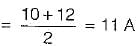
The maximum value of load current
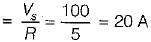
Now, the average value of the voltage is
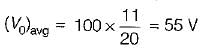
Also,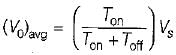
or,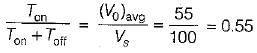
or,
or,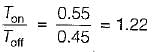
The maximum value of load current
Now, the average value of the voltage is
Also,
or,
or,
or,
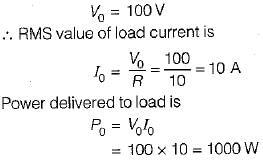
A single-phase half bridge inverter has supply voltage of 200 V. For a load resistance of 10 Ω, the output power is equal to- a)2000 W
- b)500 W
- c)225 W
- d)1000W
Correct answer is option 'D'. Can you explain this answer?
A single-phase half bridge inverter has supply voltage of 200 V. For a load resistance of 10 Ω, the output power is equal to
a)
2000 W
b)
500 W
c)
225 W
d)
1000W
| | Prisha Sen answered |
Output is a square wave with an amplitude of 100V.
RMS value of a square wave is equal to its peak value.
So, rms value of output voltage is
RMS value of a square wave is equal to its peak value.
So, rms value of output voltage is
Assertion (A): The commutation overlap is more predominant is semiconverters than in full converters.
Reason (R): The commutation period in seconds, when outgoing and incoming SCRs are conducting, is known as the overlap period.- a)Both A and R are true and R is the correct explanation of A.
- b)Both A and R are true but R is not the correct explanation of A.
- c)A is true but R is false.
- d)A is false but R is true.
Correct answer is option 'D'. Can you explain this answer?
Assertion (A): The commutation overlap is more predominant is semiconverters than in full converters.
Reason (R): The commutation period in seconds, when outgoing and incoming SCRs are conducting, is known as the overlap period.
Reason (R): The commutation period in seconds, when outgoing and incoming SCRs are conducting, is known as the overlap period.
a)
Both A and R are true and R is the correct explanation of A.
b)
Both A and R are true but R is not the correct explanation of A.
c)
A is true but R is false.
d)
A is false but R is true.
| | Poulomi Chopra answered |
The commutation overlap is more predominant in full converter than in semi converter. Hence, assertion is a false statement.
Assertion (A): For high power applications, inverters are used instead of transistors.
Reason (R): For high power applications, inverter is operated in active region.- a)Both A and R are true and R is the correct explanation of A.
- b)Both A and R are true but R is not the correct explanation of A.
- c)A is true but R is false.
- d)A is false but R is true.
Correct answer is option 'C'. Can you explain this answer?
Assertion (A): For high power applications, inverters are used instead of transistors.
Reason (R): For high power applications, inverter is operated in active region.
Reason (R): For high power applications, inverter is operated in active region.
a)
Both A and R are true and R is the correct explanation of A.
b)
Both A and R are true but R is not the correct explanation of A.
c)
A is true but R is false.
d)
A is false but R is true.
| | Nayanika Singh answered |
In low-power electronic circuits oscillators are used for converting dc power into ac power. These oscillator use transistors for converting dc voltage into sinusoidal ac voltage. Since transistor is used in active region, therefore there is substantial loss of power which decreases efficiency. In high power applications inverters are used instead of transistors and the inverters operate in saturation region or cut-off region. Thus, assertion is true but reason is false.
Assertion (A): The principal of step-up chopper can be employed for the regenerative braking of dc motors.
Reason (R) : The step-up chopper can be employed in regenerative braking only for increasing motor speeds- a)Both A and R are true and R is the correct explanation of A.
- b)Both A and R are true but R is not the correct explanation of A
- c)A is true but R is false
- d)A is false but R is true
Correct answer is option 'C'. Can you explain this answer?
Assertion (A): The principal of step-up chopper can be employed for the regenerative braking of dc motors.
Reason (R) : The step-up chopper can be employed in regenerative braking only for increasing motor speeds
Reason (R) : The step-up chopper can be employed in regenerative braking only for increasing motor speeds
a)
Both A and R are true and R is the correct explanation of A.
b)
Both A and R are true but R is not the correct explanation of A
c)
A is true but R is false
d)
A is false but R is true
| | Abhishek Chauhan answered |
The step-up chopper can be employed in regenerative braking both for increasing and decreasing motor speed provided duty cycle a is so adjusted that Vs/( 1 - a) exceeds the fixed source voiiage V0. Hence, reason is a false statement.
The drawback of fi-firing circuit for SCR is- a)firing angle limitation to
- b)reduced response time π/2
- c)high power loss
- d)requirement of high on-time of SCRs
Correct answer is option 'A'. Can you explain this answer?
The drawback of fi-firing circuit for SCR is
a)
firing angle limitation to
b)
reduced response time π/2
c)
high power loss
d)
requirement of high on-time of SCRs
| | Nilesh Joshi answered |
The R-firing circuit suffers from several disadvantages. One of them is that the trigger angle can be varied only upto an approximate value of 90°.
In dc choppers, per unit ripple is maximum when duty cycle α is- a)0.9
- b)0.7
- c)0.5
- d)0.2
Correct answer is option 'C'. Can you explain this answer?
In dc choppers, per unit ripple is maximum when duty cycle α is
a)
0.9
b)
0.7
c)
0.5
d)
0.2
| | EduRev GATE answered |
The minimum turn-ON time of the SCR is = 

For step down chopper, Vo = δ VS
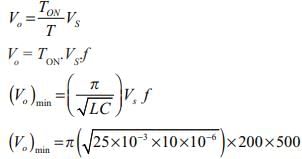
(Vo )min = 50 π V
For step down chopper, Vo = δ VS
(Vo )min = 50 π V
Assertion (A) : If the one-state anode current drops below a minimum level, designated as the holding current IH, the thyristor reverts to the forward blocking state.
Reason (R) : The loop gain of the equivalent pnp-npn transistors fall below unity and the regenerative hold-on action ceases.- a)Both A and R are true and R is the correct explanation of A.
- b)Both A and R are true but R is not the correct explanation of A.
- c)A is true but R is false.
- d)A is false but R is true.
Correct answer is option 'A'. Can you explain this answer?
Assertion (A) : If the one-state anode current drops below a minimum level, designated as the holding current IH, the thyristor reverts to the forward blocking state.
Reason (R) : The loop gain of the equivalent pnp-npn transistors fall below unity and the regenerative hold-on action ceases.
Reason (R) : The loop gain of the equivalent pnp-npn transistors fall below unity and the regenerative hold-on action ceases.
a)
Both A and R are true and R is the correct explanation of A.
b)
Both A and R are true but R is not the correct explanation of A.
c)
A is true but R is false.
d)
A is false but R is true.
| | Luminary Institute answered |
For successful turn ON i1 + i2 ≥ 100 mA
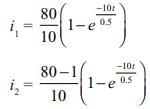
I = i1 + i2 = (8 + 7.9) (1 - e-20t ) = 100 mA
1 – e-20t = 6.30μ
t = 3.15 × 10⁻⁴ s
I = i1 + i2 = (8 + 7.9) (1 - e-20t ) = 100 mA
1 – e-20t = 6.30μ
t = 3.15 × 10⁻⁴ s
The principle of three phase cycloconverter is to- a)add and remove number of SCRs
- b)vary progressively the firing angle of the devices
- c)keep the firing angle as 0° for all the devices
- d)none of the mentioned
Correct answer is option 'B'. Can you explain this answer?
The principle of three phase cycloconverter is to
a)
add and remove number of SCRs
b)
vary progressively the firing angle of the devices
c)
keep the firing angle as 0° for all the devices
d)
none of the mentioned
| | Charvi Reddy answered |
B) vary progressively the firing angle of the devices
Consider the following statements associated with single phase full converters:
1. Mid-point converter configuration is used in case the terminals on dc side have to be grounded.
2. The transformer rating in mid-point converter is double the load rating.
3. SCRs are subjected to a peak inverse voltage of 2 Vm in single phase mid-point converter.
4. Bridge converter is preferred over mid-point converter.Which of these statements are correct?- a)1,3 and 4
- b)2, 3 and 4
- c)1,2 and 3
- d)1, 2, 3 and 4
Correct answer is option 'A'. Can you explain this answer?
Consider the following statements associated with single phase full converters:
1. Mid-point converter configuration is used in case the terminals on dc side have to be grounded.
2. The transformer rating in mid-point converter is double the load rating.
3. SCRs are subjected to a peak inverse voltage of 2 Vm in single phase mid-point converter.
4. Bridge converter is preferred over mid-point converter.
1. Mid-point converter configuration is used in case the terminals on dc side have to be grounded.
2. The transformer rating in mid-point converter is double the load rating.
3. SCRs are subjected to a peak inverse voltage of 2 Vm in single phase mid-point converter.
4. Bridge converter is preferred over mid-point converter.
Which of these statements are correct?
a)
1,3 and 4
b)
2, 3 and 4
c)
1,2 and 3
d)
1, 2, 3 and 4
| | Snehal Rane answered |
In mid-point converter, each secondary should be able to supply the load power. Due to this reason, the transformer rating in mid-point converter is double the load rating. Thus, statement-2 is not correct.
A single phase voltage controller has input of 230 V and a load of 15 Ω resistive. For 6 cycles on and 4 cycles off, determine the average value of SCR current.- a)21.68 A
- b)200 mA
- c)4.14 A
- d)2.07 A
Correct answer is option 'C'. Can you explain this answer?
A single phase voltage controller has input of 230 V and a load of 15 Ω resistive. For 6 cycles on and 4 cycles off, determine the average value of SCR current.
a)
21.68 A
b)
200 mA
c)
4.14 A
d)
2.07 A
| | Aashna Dey answered |
Peak current Im = (230 x √2)/15 = 21.681 A
k = (6/6+4) = 6/10 = 0.6
Avg current = (k Im)/π = 4.14 A.
k = (6/6+4) = 6/10 = 0.6
Avg current = (k Im)/π = 4.14 A.
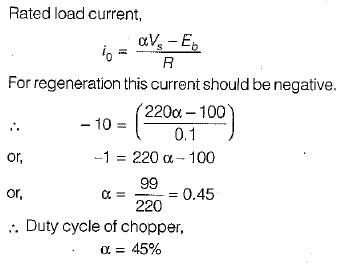
IA class C chopper is operated from a 220 V battery. The load Is a dc motor with R = 0.1Ω, L= 10 mH and Eb= 100 V. The duty cycle of the chopper to achieve regenerative braking at the rated current of 10 Ampere would be equal to- a)25%
- b)45%
- c)66%
- d)72%
Correct answer is option 'B'. Can you explain this answer?
IA class C chopper is operated from a 220 V battery. The load Is a dc motor with R = 0.1Ω, L= 10 mH and Eb= 100 V. The duty cycle of the chopper to achieve regenerative braking at the rated current of 10 Ampere would be equal to
a)
25%
b)
45%
c)
66%
d)
72%
| | Bhavana Reddy answered |
Thyristor is a semiconductor switch which is- a)unilateral and bistable
- b)bilateral and bistable
- c)unilateral and astable
- d)bistable and astable
Correct answer is option 'A'. Can you explain this answer?
Thyristor is a semiconductor switch which is
a)
unilateral and bistable
b)
bilateral and bistable
c)
unilateral and astable
d)
bistable and astable
 | Preethi Banerjee answered |
Like the diode, an SCR is an unidirectional device that blocks the current flow from cathode to anode i.e. unilateral. An SCR or a thyristor has three modes of operation namely forward conduction mode, forward blocking mode and reverse blocking mode. Out of these three modes of operation the first two are stable states due to which an SCR is bistable.
The nature of load current, l.e., whether load is continuous or discontinuous in controlled rectifiers- a)depends only on the type of load
- b)does not depend on type of load and firing angle delay
- c)depends only on the firing angle delay
- d)depends both on the type of load and firing angle delay
Correct answer is option 'D'. Can you explain this answer?
The nature of load current, l.e., whether load is continuous or discontinuous in controlled rectifiers
a)
depends only on the type of load
b)
does not depend on type of load and firing angle delay
c)
depends only on the firing angle delay
d)
depends both on the type of load and firing angle delay
| | Tarun Chawla answered |
The nature of load current in controlled rectifiers depends both on the type of load and the firing angle delay.
Explanation:
The nature of load current in controlled rectifiers is influenced by the type of load connected to the rectifier. The load can be either continuous or discontinuous.
A continuous load draws a relatively steady and constant current from the rectifier. It is characterized by a constant or nearly constant load current throughout the entire half-cycle of the input voltage. Examples of continuous loads include resistive loads, incandescent lamps, and heaters.
A discontinuous load draws current from the rectifier for only a portion of the half-cycle of the input voltage. The load current is interrupted during certain intervals of the input voltage cycle. Examples of discontinuous loads include inductive loads, capacitive loads, and loads with electronic switches.
The firing angle delay, also known as phase angle delay or firing delay, is the delay between the start of the input voltage cycle and the triggering of the thyristors in the controlled rectifier.
The firing angle delay controls the conduction period of the thyristors and, therefore, affects the load current waveform.
The nature of the load current is determined by the combined influence of the type of load and the firing angle delay.
- For a continuous load, the load current can be continuous or discontinuous depending on the firing angle delay. If the firing angle delay is such that the thyristors conduct for the entire half-cycle of the input voltage, the load current will be continuous. However, if the firing angle delay is such that the thyristors conduct for only a portion of the half-cycle, the load current will be discontinuous.
- For a discontinuous load, the load current will be discontinuous regardless of the firing angle delay. This is because the load itself interrupts the current flow during certain intervals of the input voltage cycle.
Therefore, the nature of load current in controlled rectifiers depends both on the type of load and the firing angle delay. It is important to consider these factors when designing and analyzing controlled rectifier circuits.
Explanation:
Type of Load
The nature of load current in controlled rectifiers is influenced by the type of load connected to the rectifier. The load can be either continuous or discontinuous.
Continuous Load
A continuous load draws a relatively steady and constant current from the rectifier. It is characterized by a constant or nearly constant load current throughout the entire half-cycle of the input voltage. Examples of continuous loads include resistive loads, incandescent lamps, and heaters.
Discontinuous Load
A discontinuous load draws current from the rectifier for only a portion of the half-cycle of the input voltage. The load current is interrupted during certain intervals of the input voltage cycle. Examples of discontinuous loads include inductive loads, capacitive loads, and loads with electronic switches.
Firing Angle Delay
The firing angle delay, also known as phase angle delay or firing delay, is the delay between the start of the input voltage cycle and the triggering of the thyristors in the controlled rectifier.
The firing angle delay controls the conduction period of the thyristors and, therefore, affects the load current waveform.
Combined Influence
The nature of the load current is determined by the combined influence of the type of load and the firing angle delay.
- For a continuous load, the load current can be continuous or discontinuous depending on the firing angle delay. If the firing angle delay is such that the thyristors conduct for the entire half-cycle of the input voltage, the load current will be continuous. However, if the firing angle delay is such that the thyristors conduct for only a portion of the half-cycle, the load current will be discontinuous.
- For a discontinuous load, the load current will be discontinuous regardless of the firing angle delay. This is because the load itself interrupts the current flow during certain intervals of the input voltage cycle.
Therefore, the nature of load current in controlled rectifiers depends both on the type of load and the firing angle delay. It is important to consider these factors when designing and analyzing controlled rectifier circuits.
A single-phase voltage controller, using one SCR in anti parallel with a diode, feeds a load R and Vs = 230 V. For a firing angel of 90° for the SCR, the PMMC voltage connected across R would read- a)0
- b)51.8 V
- c)–51.8 V
- d)–36.82 V
Correct answer is option 'C'. Can you explain this answer?
A single-phase voltage controller, using one SCR in anti parallel with a diode, feeds a load R and Vs = 230 V. For a firing angel of 90° for the SCR, the PMMC voltage connected across R would read
a)
0
b)
51.8 V
c)
–51.8 V
d)
–36.82 V
| | Nandita Bajaj answered |
As firing angle is 90, there is ideally be no conduction in the positive half. Hence, the average value will be zero.
Vo = (√2 Vs)/2π x (cos90 – 1) = – 51.8 V.
Vo = (√2 Vs)/2π x (cos90 – 1) = – 51.8 V.
To turn-off or commutate a thyristor- a)forced commutation is used
- b)reverse blocking voltage is applied
- c)gate current is made zero
- d)none of the above
Correct answer is option 'A'. Can you explain this answer?
To turn-off or commutate a thyristor
a)
forced commutation is used
b)
reverse blocking voltage is applied
c)
gate current is made zero
d)
none of the above
| | Saranya Mishra answered |
To turn-off a thyristor, anode current must be reduced below holding current and a reverse bias must be applied across thyristor for a finite period of time. If all these two conditions are not met simultaneously then forced commutation can be used to turn-off the thyristor.
A full-bridge bipolar PWM inverter is fed from a 240 V battery and is driving an RL load. The fundamental output voltage for a modulation index of 0.8 is- a)135V
- b)215V
- c)205 V
- d)165 V
Correct answer is option 'A'. Can you explain this answer?
A full-bridge bipolar PWM inverter is fed from a 240 V battery and is driving an RL load. The fundamental output voltage for a modulation index of 0.8 is
a)
135V
b)
215V
c)
205 V
d)
165 V
| | Sanchita Sharma answered |
The fundamental output voltage for a modulation index of M is

Assertion (A): The terminal voltage of a voltage source inverter remains substantially constant with variations in load.
Reason (R): Any short-circuit across the terminals of a voltage source inverter causes current to rise very fast.- a)Both A and R are true and R is the correct explanation of A
- b)Both A and R are true but R is not the correct explanation of A
- c)A is true but R is false
- d)A is false but R is true
Correct answer is option 'B'. Can you explain this answer?
Assertion (A): The terminal voltage of a voltage source inverter remains substantially constant with variations in load.
Reason (R): Any short-circuit across the terminals of a voltage source inverter causes current to rise very fast.
Reason (R): Any short-circuit across the terminals of a voltage source inverter causes current to rise very fast.
a)
Both A and R are true and R is the correct explanation of A
b)
Both A and R are true but R is not the correct explanation of A
c)
A is true but R is false
d)
A is false but R is true
| | Sharmila Bajaj answered |
Explanation:
The correct answer is option 'B': Both A and R are true but R is not the correct explanation of A.
Assertion (A): The terminal voltage of a voltage source inverter remains substantially constant with variations in load.
Reason (R): Any short-circuit across the terminals of a voltage source inverter causes current to rise very fast.
Explanation:
Terminal Voltage of a Voltage Source Inverter:
- A voltage source inverter (VSI) is an electronic device that converts a DC voltage source into an AC voltage source.
- The terminal voltage of a VSI refers to the voltage across the output terminals of the inverter.
- Ideally, the terminal voltage of a VSI should remain constant with variations in load.
Reason Explanation:
- The reason states that any short-circuit across the terminals of a VSI causes current to rise very fast.
- This statement is true because in a short-circuit condition, the impedance across the terminals becomes very low, resulting in a high current flow.
- However, this reason does not directly explain why the terminal voltage of a VSI remains constant with load variations.
Explanation of Assertion:
- The assertion states that the terminal voltage of a VSI remains substantially constant with variations in load.
- This assertion is true because VSIs are designed to regulate the output voltage regardless of the load variations.
- VSIs achieve this regulation by using control techniques such as pulse width modulation (PWM).
- PWM adjusts the width of the output pulses based on the load requirements, ensuring that the average output voltage remains constant.
Conclusion:
- Both the assertion and reason are true.
- However, the reason does not provide a correct explanation for the assertion.
- The terminal voltage of a VSI remains constant with variations in load due to the control techniques used, not solely because of the potential of a short-circuit.
The correct answer is option 'B': Both A and R are true but R is not the correct explanation of A.
Assertion (A): The terminal voltage of a voltage source inverter remains substantially constant with variations in load.
Reason (R): Any short-circuit across the terminals of a voltage source inverter causes current to rise very fast.
Explanation:
Terminal Voltage of a Voltage Source Inverter:
- A voltage source inverter (VSI) is an electronic device that converts a DC voltage source into an AC voltage source.
- The terminal voltage of a VSI refers to the voltage across the output terminals of the inverter.
- Ideally, the terminal voltage of a VSI should remain constant with variations in load.
Reason Explanation:
- The reason states that any short-circuit across the terminals of a VSI causes current to rise very fast.
- This statement is true because in a short-circuit condition, the impedance across the terminals becomes very low, resulting in a high current flow.
- However, this reason does not directly explain why the terminal voltage of a VSI remains constant with load variations.
Explanation of Assertion:
- The assertion states that the terminal voltage of a VSI remains substantially constant with variations in load.
- This assertion is true because VSIs are designed to regulate the output voltage regardless of the load variations.
- VSIs achieve this regulation by using control techniques such as pulse width modulation (PWM).
- PWM adjusts the width of the output pulses based on the load requirements, ensuring that the average output voltage remains constant.
Conclusion:
- Both the assertion and reason are true.
- However, the reason does not provide a correct explanation for the assertion.
- The terminal voltage of a VSI remains constant with variations in load due to the control techniques used, not solely because of the potential of a short-circuit.
In the integral cycle control of ac voltage controller, is the load is on for n cycles and off for m cycles, then the periodicity is given by? Consider the output is sinusoidal.- a)m/2π(m+n)
- b)n/2π(m+n)
- c)m/π(m+n)
- d)n/π(m+n)
Correct answer is option 'B'. Can you explain this answer?
In the integral cycle control of ac voltage controller, is the load is on for n cycles and off for m cycles, then the periodicity is given by? Consider the output is sinusoidal.
a)
m/2π(m+n)
b)
n/2π(m+n)
c)
m/π(m+n)
d)
n/π(m+n)
| | Debanshi Iyer answered |
Over a complete cycle of 2π x (on cycles + off cycles) the power is delivered for n cycles.
Hence, P = n/2π(m+n).
Hence, P = n/2π(m+n).
Assertion (A) : In 3-phase converters, the ripple frequency of the converter output voltage is higher than in single phase converter.
Reason (R) : The load current is mostly discontinuous in 3-phase converters.- a)Both A and R are true and R is the correct explanation of A.
- b)Both A and R are true but R is not the correct explanation of A.
- c)A is true but R is false.
- d)A is false but R is true.
Correct answer is option 'C'. Can you explain this answer?
Assertion (A) : In 3-phase converters, the ripple frequency of the converter output voltage is higher than in single phase converter.
Reason (R) : The load current is mostly discontinuous in 3-phase converters.
Reason (R) : The load current is mostly discontinuous in 3-phase converters.
a)
Both A and R are true and R is the correct explanation of A.
b)
Both A and R are true but R is not the correct explanation of A.
c)
A is true but R is false.
d)
A is false but R is true.
| | Avik Iyer answered |
The load current is mostly continuous in 3-phase converters. Hence reason is a false statement.
A four-quadrant chopper is driving a separately excited dc motor load. The motor parameters are R = 0.1 Ω, L = 10 mH. The supply voltage is 200 V d.c. If the rated current of the motor is 10 A with Eb = 150 V and motor is driving the rated torque, then it is operating under- a)forward motoring mode
- b)reverse braking mode
- c)reverse motoring mode
- d)forward brakina mode
Correct answer is option 'A'. Can you explain this answer?
A four-quadrant chopper is driving a separately excited dc motor load. The motor parameters are R = 0.1 Ω, L = 10 mH. The supply voltage is 200 V d.c. If the rated current of the motor is 10 A with Eb = 150 V and motor is driving the rated torque, then it is operating under
a)
forward motoring mode
b)
reverse braking mode
c)
reverse motoring mode
d)
forward brakina mode
 | Hiral Kulkarni answered |
For a four-quadrant chopper, the average voltage in all the four-modes is given by
V0 = 2 Vs (α - 0.5)
The average curreni,

or,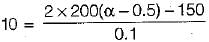
or, α = 0.877
Since α > 0.5, the motor is operating undi
forward motorina mode.
V0 = 2 Vs (α - 0.5)
The average curreni,
or,
or, α = 0.877
Since α > 0.5, the motor is operating undi
forward motorina mode.
In a single-pulse modulation of PWM inverters if pulse width is 120° then- a)5th harmonic will be eliminated
- b)3rd harmonic will be eliminated
- c)7th harmonic will be eliminated
- d)none of the above
Correct answer is option 'B'. Can you explain this answer?
In a single-pulse modulation of PWM inverters if pulse width is 120° then
a)
5th harmonic will be eliminated
b)
3rd harmonic will be eliminated
c)
7th harmonic will be eliminated
d)
none of the above
| | Manoj Chaudhary answered |
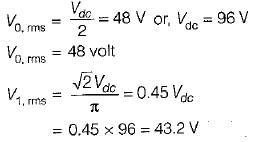
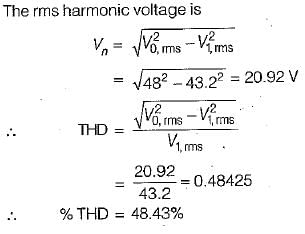
The rms value of amplitude of harmonic voltage of a single, pulse modulated wave is given by
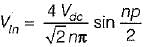
(where, p = width of pulse an Vdc = supply dc voltage)
If the 3rd harmonic Is to be eliminated, then
EL3 = 0
i.e.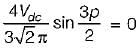
or,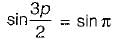
or,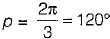
= Required pulse width
(where, p = width of pulse an Vdc = supply dc voltage)
If the 3rd harmonic Is to be eliminated, then
EL3 = 0
i.e.
or,
or,
= Required pulse width
In the principle of phase control- a)the load is on for some cycles and off for some cycles
- b)control is achieved by adjusting the firing angle of the devices
- c)control is achieved by adjusting the number of on off cycles
- d)control cannot be achieved
Correct answer is option 'B'. Can you explain this answer?
In the principle of phase control
a)
the load is on for some cycles and off for some cycles
b)
control is achieved by adjusting the firing angle of the devices
c)
control is achieved by adjusting the number of on off cycles
d)
control cannot be achieved
 | Anirban Gupta answered |
Switching devices is so operated that the load gets connected to ac source for a part of each half cycle.
The advantage of using a freewheeling diode with bridge type ac to dc converter is- a)reliable speed control
- b)reduced cost of system
- c)regenerative braking
- d)improved input power factor
Correct answer is option 'D'. Can you explain this answer?
The advantage of using a freewheeling diode with bridge type ac to dc converter is
a)
reliable speed control
b)
reduced cost of system
c)
regenerative braking
d)
improved input power factor
| | Gargi Mishra answered |
Advantage of using a freewheeling diode with a bridge type AC to DC converter is improved input power factor.
Explanation:
Bridge type AC to DC converter is used for converting AC voltage to DC voltage. However, it produces a pulsating DC voltage which is not suitable for most electronic devices. To smooth out the pulsations, a filter capacitor is used. But during the off time of the AC input voltage, the filter capacitor discharges through the load. This causes a reverse voltage across the diodes which can damage them.
To prevent this, a freewheeling diode is connected in parallel with each diode. During the off time of the AC input voltage, the freewheeling diode provides a path for the filter capacitor to discharge through the load. This prevents the reverse voltage across the diodes and protects them.
Moreover, the freewheeling diode also improves the input power factor by providing a path for the inductive load current to flow during the off time of the AC input voltage. This reduces the reactive power and improves the power factor.
Therefore, the advantage of using a freewheeling diode with a bridge type AC to DC converter is improved input power factor.
Explanation:
Bridge type AC to DC converter is used for converting AC voltage to DC voltage. However, it produces a pulsating DC voltage which is not suitable for most electronic devices. To smooth out the pulsations, a filter capacitor is used. But during the off time of the AC input voltage, the filter capacitor discharges through the load. This causes a reverse voltage across the diodes which can damage them.
To prevent this, a freewheeling diode is connected in parallel with each diode. During the off time of the AC input voltage, the freewheeling diode provides a path for the filter capacitor to discharge through the load. This prevents the reverse voltage across the diodes and protects them.
Moreover, the freewheeling diode also improves the input power factor by providing a path for the inductive load current to flow during the off time of the AC input voltage. This reduces the reactive power and improves the power factor.
Therefore, the advantage of using a freewheeling diode with a bridge type AC to DC converter is improved input power factor.
A four quadrant operation requires- a)two full converters connected back to back
- b)two full converters is series
- c)two semi-converters connected back to back
- d)two full converters connected in parallel
Correct answer is option 'C'. Can you explain this answer?
A four quadrant operation requires
a)
two full converters connected back to back
b)
two full converters is series
c)
two semi-converters connected back to back
d)
two full converters connected in parallel
| | Alok Verma answered |
In case “four quadrant operation" is required without any mechanical changeover switch, two full converters can be connected back to back to the load circuit. Such an arrangement using two converters in antiparailel and connected to the same dc load is called a “dual converter."
Which of the following are not a unidirectional current devices?
1. BJT
2. TRIAC
3. SCR
4. GTO
5. IGBT- a)4 and 5
- b)2 and 4
- c)5 only
- d)2 only
Correct answer is option 'D'. Can you explain this answer?
Which of the following are not a unidirectional current devices?
1. BJT
2. TRIAC
3. SCR
4. GTO
5. IGBT
1. BJT
2. TRIAC
3. SCR
4. GTO
5. IGBT
a)
4 and 5
b)
2 and 4
c)
5 only
d)
2 only
| | Hridoy Chakraborty answered |
TRIAC is a bidirectional device whereas BJT, GTO, SCR and IGBT are unidirectional devices.
Assertion (A) : By using freewheeling diode, load performance becomes better.
Reason ( R ) : Freewheeling diode prevents the load voltage from becoming negative.- a)Both A and R are true and R is the correct explanation of A.
- b)Both A and R are true but R is not the correct explanation of A.
- c)A is true but R is false.
- d)A is false but R is true.
Correct answer is option 'B'. Can you explain this answer?
Assertion (A) : By using freewheeling diode, load performance becomes better.
Reason ( R ) : Freewheeling diode prevents the load voltage from becoming negative.
Reason ( R ) : Freewheeling diode prevents the load voltage from becoming negative.
a)
Both A and R are true and R is the correct explanation of A.
b)
Both A and R are true but R is not the correct explanation of A.
c)
A is true but R is false.
d)
A is false but R is true.
| | Prasad Saini answered |
By using freewheeling diode, load performance becomes better because load current waveform is improved.
Whenever load voltage tends to go negative, freewheeling comes into play as a result of which ioaa current is transferred from main thyristor to freewheeling diode, allowing the thyristor to regain its forward blocking capability.
Hence, both assertion and reason are true but reason is not the correct explanation of assertion.
Whenever load voltage tends to go negative, freewheeling comes into play as a result of which ioaa current is transferred from main thyristor to freewheeling diode, allowing the thyristor to regain its forward blocking capability.
Hence, both assertion and reason are true but reason is not the correct explanation of assertion.
Consider the following statements:
1. In a full converter, direction of current cannot reverse.
2. Semi-converters are single quadrant converters.
3. A full converter can operate as a two-quadrant converter.
4. A full converter operates as a rectifier in first quadrant and as an inverter in the second quadrant.
5. In a full converter, direction of current cannot reverse but polarity of output voltage can be reversed.Q. Which of the statements given above are correct?- a)1, 2, 3 and 5
- b)2, 3 and 4
- c)2, 4 and 5
- d)1,3 and 4
Correct answer is option 'A'. Can you explain this answer?
Consider the following statements:
1. In a full converter, direction of current cannot reverse.
2. Semi-converters are single quadrant converters.
3. A full converter can operate as a two-quadrant converter.
4. A full converter operates as a rectifier in first quadrant and as an inverter in the second quadrant.
5. In a full converter, direction of current cannot reverse but polarity of output voltage can be reversed.
1. In a full converter, direction of current cannot reverse.
2. Semi-converters are single quadrant converters.
3. A full converter can operate as a two-quadrant converter.
4. A full converter operates as a rectifier in first quadrant and as an inverter in the second quadrant.
5. In a full converter, direction of current cannot reverse but polarity of output voltage can be reversed.
Q. Which of the statements given above are correct?
a)
1, 2, 3 and 5
b)
2, 3 and 4
c)
2, 4 and 5
d)
1,3 and 4
| | Arindam Sengupta answered |
Correct answer:
a)1, 2, 3 and 5
Explanation:
Full converters are AC to DC converters that have the ability to change the direction of current as well as the polarity of output voltage. Semi-converters, on the other hand, can only operate in one quadrant. The given statements can be explained as follows:
1. In a full converter, direction of current cannot reverse: This statement is incorrect. The direction of current in a full converter can be reversed by changing the firing angle of the thyristors.
2. Semi-converters are single quadrant converters: This statement is correct. Semi-converters can only operate in the first or third quadrant of the voltage-current plane.
3. A full converter can operate as a two-quadrant converter: This statement is correct. Full converters can operate in the first and fourth or second and third quadrants of the voltage-current plane.
4. A full converter operates as a rectifier in first quadrant and as an inverter in the second quadrant: This statement is incorrect. A full converter can operate as a rectifier or an inverter in any quadrant depending on the direction of current flow.
5. In a full converter, direction of current cannot reverse but polarity of output voltage can be reversed: This statement is correct. The direction of current can be changed by changing the firing angle of the thyristors but the polarity of output voltage can be reversed by changing the polarity of the DC source.
Therefore, the correct statements are 1, 2, 3, and 5.
a)1, 2, 3 and 5
Explanation:
Full converters are AC to DC converters that have the ability to change the direction of current as well as the polarity of output voltage. Semi-converters, on the other hand, can only operate in one quadrant. The given statements can be explained as follows:
1. In a full converter, direction of current cannot reverse: This statement is incorrect. The direction of current in a full converter can be reversed by changing the firing angle of the thyristors.
2. Semi-converters are single quadrant converters: This statement is correct. Semi-converters can only operate in the first or third quadrant of the voltage-current plane.
3. A full converter can operate as a two-quadrant converter: This statement is correct. Full converters can operate in the first and fourth or second and third quadrants of the voltage-current plane.
4. A full converter operates as a rectifier in first quadrant and as an inverter in the second quadrant: This statement is incorrect. A full converter can operate as a rectifier or an inverter in any quadrant depending on the direction of current flow.
5. In a full converter, direction of current cannot reverse but polarity of output voltage can be reversed: This statement is correct. The direction of current can be changed by changing the firing angle of the thyristors but the polarity of output voltage can be reversed by changing the polarity of the DC source.
Therefore, the correct statements are 1, 2, 3, and 5.
Turn-on time (ton) of an SCR is related to its turn-off time (toff) in which of the following way?- a)ton < toff
- b)ton > toff
- c)toff increases with ton
- d)ton depends on L/R ratio of load
Correct answer is option 'D'. Can you explain this answer?
Turn-on time (ton) of an SCR is related to its turn-off time (toff) in which of the following way?
a)
ton < toff
b)
ton > toff
c)
toff increases with ton
d)
ton depends on L/R ratio of load
| | Kajal Mukherjee answered |
The turn-on time of an SCR depends on time constant (L/R) of the load.
A transformer is having source voltage of 400 volt and turns ratio of 2:1. The transformer is centre-tapped. If the secondary is connected to single phase full-wave converter, PIV per SCR will be- a)200√2 V
- b)100√2 V
- c)200 V
- d) 100 V
Correct answer is option 'A'. Can you explain this answer?
A transformer is having source voltage of 400 volt and turns ratio of 2:1. The transformer is centre-tapped. If the secondary is connected to single phase full-wave converter, PIV per SCR will be
a)
200√2 V
b)
100√2 V
c)
200 V
d)
100 V
| | Akanksha Chopra answered |
Secondary voltage = 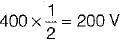
∴ PIV = 200√2 V
∴ PIV = 200√2 V
A current source inverter can be- a)load commutated
- b)force commutated
- c)either load or force commutated
- d)neither load nor force commutated
Correct answer is option 'C'. Can you explain this answer?
A current source inverter can be
a)
load commutated
b)
force commutated
c)
either load or force commutated
d)
neither load nor force commutated
| | Gaurav Chauhan answered |
A CSl can be either load commutated or force commutated.
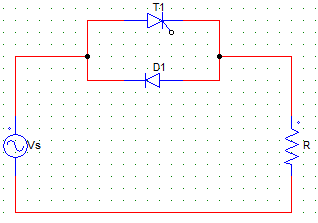
The below shown controller circuit is a
- a)half wave controller
- b)full wave controller
- c)none of the mentioned
- d)will depend upon the firing angle
Correct answer is option 'A'. Can you explain this answer?
The below shown controller circuit is a
a)
half wave controller
b)
full wave controller
c)
none of the mentioned
d)
will depend upon the firing angle
| | Sneha Bose answered |
As it consists one diode and one SCR only, the control is only in one cycle (the positive half in this case), hence it is a half wave controller.
Assertion (A) : It is necessary to keep the thyristor reverse biased for a finite period before a forward anode voltage can be reapplied.
Reason (R) : Once the SCR starts conducting an appreciable forward current, the gate has no control on it and the device can be brought back to the blocking state only by reducing the forward current level below that of the holding current.- a)Both A and R are true and R is the correct explanation of A.
- b)Both A and R are true but R is not the correct explanation of A
- c)A is true but R is false.
- d)A is false but R is true.
Correct answer is option 'B'. Can you explain this answer?
Assertion (A) : It is necessary to keep the thyristor reverse biased for a finite period before a forward anode voltage can be reapplied.
Reason (R) : Once the SCR starts conducting an appreciable forward current, the gate has no control on it and the device can be brought back to the blocking state only by reducing the forward current level below that of the holding current.
Reason (R) : Once the SCR starts conducting an appreciable forward current, the gate has no control on it and the device can be brought back to the blocking state only by reducing the forward current level below that of the holding current.
a)
Both A and R are true and R is the correct explanation of A.
b)
Both A and R are true but R is not the correct explanation of A
c)
A is true but R is false.
d)
A is false but R is true.
| | Sravya Khanna answered |
It is necessary to keep the thyristor reverse biased for a finite period before a forward anode voltage can be reapplied because if a forward voltage is applied immediately after reducing the anode current to zero, it will not block the forward voltage and will start conducting again, although it is not triggered by a gate pulse. Reason is also a true statement but not the correct explanation of assertion.
A single-quadrant type A chopper is operating with the following specifications:
Ideal battery of 220 V;
on-time ton - 1 ms;
off-time foff = 1.5 ms
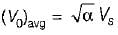
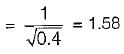
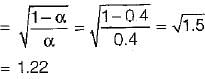
The ripple and form factors will be respectively given by- a)0.98 and 1.20
- b)1.58 and 1.22
- c)1.22 and 1.58
- d)1.58 and 1.20
Correct answer is option 'C'. Can you explain this answer?
A single-quadrant type A chopper is operating with the following specifications:
Ideal battery of 220 V;
on-time ton - 1 ms;
off-time foff = 1.5 ms
The ripple and form factors will be respectively given by
Ideal battery of 220 V;
on-time ton - 1 ms;
off-time foff = 1.5 ms
The ripple and form factors will be respectively given by
a)
0.98 and 1.20
b)
1.58 and 1.22
c)
1.22 and 1.58
d)
1.58 and 1.20
| | Juhi Joshi answered |
For a type-A chopper, average output voltage


A single-phase full bridge inverter can operate in load-commutation mode in case load consists of- a)RLC critically damped
- b)RLC underdamped
- c)RLC overdamped
- d)RC
Correct answer is option 'B'. Can you explain this answer?
A single-phase full bridge inverter can operate in load-commutation mode in case load consists of
a)
RLC critically damped
b)
RLC underdamped
c)
RLC overdamped
d)
RC
| | Bijoy Mehta answered |
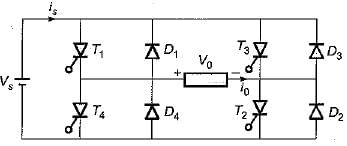
In a 1-φ full bridge inverter if RLC load is underdamped, then the two thyristors (namely T1 and T2) shown in figure will get commutated naturally and therefore no commutation circuitry will be needed. Thus, load commutation will be possible.
Chapter doubts & questions for Power Electronics - 6 Months Preparation for GATE Electrical 2026 is part of Electrical Engineering (EE) exam preparation. The chapters have been prepared according to the Electrical Engineering (EE) exam syllabus. The Chapter doubts & questions, notes, tests & MCQs are made for Electrical Engineering (EE) 2026 Exam. Find important definitions, questions, notes, meanings, examples, exercises, MCQs and online tests here.
Chapter doubts & questions of Power Electronics - 6 Months Preparation for GATE Electrical in English & Hindi are available as part of Electrical Engineering (EE) exam. Download more important topics, notes, lectures and mock test series for Electrical Engineering (EE) Exam by signing up for free.
6 Months Preparation for GATE Electrical675 videos|1390 docs|885 tests |
