


All Exams > NEET > NCERT on your Fingertips 2025-2026 Edition > All Questions
All questions of MCQ Corner for NEET Exam
Cell organelles with single membrane is- a)Lysosomes
- b)Chloroplast
- c)Plastids
- d)Mitochondria
Correct answer is option 'A'. Can you explain this answer?
Cell organelles with single membrane is
a)
Lysosomes
b)
Chloroplast
c)
Plastids
d)
Mitochondria
 | Ishaan Menon answered |
Lysosomes are single membrane structures containing enzymes for digestion of all types of macromolecules.

Which is common in plant and animal cells- a)Mitochondria
- b)Plastids
- c)Centrioles
- d)Central vacuoles
Correct answer is option 'A'. Can you explain this answer?
Which is common in plant and animal cells
a)
Mitochondria
b)
Plastids
c)
Centrioles
d)
Central vacuoles
 | Ashwini Khanna answered |
Mitochondria are present in both plant as well as animal cells. Plastids and central vacuoles are present in plant cells and centrioles are present in only animal cells.
The process of movement of few ions or molecules across the membrane against a concentration gradient from lower to higher concentration, it is called
a) Diffusionb)Passive transportc)Active transportd) OsmosisCorrect answer is option 'C'. Can you explain this answer?
 | Vijay Bansal answered |
Passive transport, also known as passive diffusion, is a process by which an ion or molecule passes through a cell wall via a concentration gradient, or from an area of high concentration to an area of low concentration. It’s like moving from the train to the platform of a subway station, or stepping out of a crowded room. Basically, passive transport gives an ion or molecule “room to breathe.”
Who was the first to explain that cells divide?- a)Schwann
- b)Robert Brown
- c)Rudolf Virchow
- d)Anton von LeeuwenHoek
Correct answer is option 'C'. Can you explain this answer?
Who was the first to explain that cells divide?
a)
Schwann
b)
Robert Brown
c)
Rudolf Virchow
d)
Anton von LeeuwenHoek
 | Mahesh Saini answered |
Rudolf Virchow(1855) first explained that cells divided and new cells are formed .
Read the given statements and select the correct option.
Statement 1: The cisternae in Golgi complex have cis face and trans face.
Statement 2: The cis face is also called forming face and trans face is also called maturing face.- a)Both statements 1 and 2 are correct and statement 2 is the correct explanation of statement 1.
- b)Both statements 1 and 2 are correct but statement 2 is not the correct explanation of statement 1.
- c)Statement 1 is correct and statement 2 is incorrect.
- d)Both statements 1 and 2 are incorrect.
Correct answer is option 'B'. Can you explain this answer?
Read the given statements and select the correct option.
Statement 1: The cisternae in Golgi complex have cis face and trans face.
Statement 2: The cis face is also called forming face and trans face is also called maturing face.
Statement 1: The cisternae in Golgi complex have cis face and trans face.
Statement 2: The cis face is also called forming face and trans face is also called maturing face.
a)
Both statements 1 and 2 are correct and statement 2 is the correct explanation of statement 1.
b)
Both statements 1 and 2 are correct but statement 2 is not the correct explanation of statement 1.
c)
Statement 1 is correct and statement 2 is incorrect.
d)
Both statements 1 and 2 are incorrect.
| | Vivek Patel answered |
Golgi complex consists of a stack of cisternae which are curved to give definite polarity to the Golgi apparatus. The convex side (forming/cis face) receives vesicles from endoplasmic reticulum. The concave side (maturing /transface) buds off vesicles as secretion.
Smallest free living organism are- a)PPLOs
- b)Bacteria
- c)Viroids
- d)Virus
Correct answer is option 'A'. Can you explain this answer?
Smallest free living organism are
a)
PPLOs
b)
Bacteria
c)
Viroids
d)
Virus
 | Shounak Nair answered |
PleuroPneumonia Like Organisms (PPLOs) are considered as smallest free living organism. It do not contain cell membrane or cell wall and present as fluid. It causes disease in plants.
Rough E.R. mainly responsible for:-- a)Protein synthesis
- b)Cell wall formation
- c)Lipid synthesis
- d)Cholesterol synthesis
Correct answer is option 'A'. Can you explain this answer?
Rough E.R. mainly responsible for:-
a)
Protein synthesis
b)
Cell wall formation
c)
Lipid synthesis
d)
Cholesterol synthesis
 | Neha Joshi answered |
Rough endoplasmic reticulum carry ribosomes on their surface. The ribosomes present on rough endoplasmic reticulum synthesize secretory proteins. The proteins required for internal use of cell are synthesized on cytoplasmic ribosomes.
A single unit membrane surrounds the organelle:- a)Chloroplast
- b)Nucleus
- c)Lysosome
- d)Microsome
Correct answer is option 'C'. Can you explain this answer?
A single unit membrane surrounds the organelle:
a)
Chloroplast
b)
Nucleus
c)
Lysosome
d)
Microsome
 | Pooja Mehta answered |
Single membrane-bound: Some organelles are bounded by a single membrane. For example, vacuole, lysosome, Golgi Apparatus, Endoplasmic Reticulum etc. They are present only in a eukaryotic cell.
The rod shaped bacteria is called as- a)Bacillus
- b)Vibrio
- c)Spiral
- d)Spherical
Correct answer is option 'A'. Can you explain this answer?
The rod shaped bacteria is called as
a)
Bacillus
b)
Vibrio
c)
Spiral
d)
Spherical
 | Dipanjan Chawla answered |
The shapes of bacteria are bacillus (rod like), coccus (spherical), vibrio (comma shaped) and spirillum (spiral).
The structure of plasma membrane fluid mosaic model is proposed by- a)Gram
- b)Singer and Nicolson
- c)Schwann and Schleiden
- d)Robert brown
Correct answer is option 'B'. Can you explain this answer?
The structure of plasma membrane fluid mosaic model is proposed by
a)
Gram
b)
Singer and Nicolson
c)
Schwann and Schleiden
d)
Robert brown
 | Rajeev Saxena answered |
An improved model of the structure of cell membrane was proposed by S.J. Singer and G.L. Nicolson (1972) widely accepted as fluid mosaic model.CORRECT OPTION IS B.
Who first saw and described a live cell?- a)T. Schwann
- b)R. Virchow
- c)A.V. Leeuwenhoek
- d)M. Schleiden
Correct answer is option 'C'. Can you explain this answer?
Who first saw and described a live cell?
a)
T. Schwann
b)
R. Virchow
c)
A.V. Leeuwenhoek
d)
M. Schleiden
 | Deepak Joshi answered |
Anton Von Leeuwenhoek first saw and described a live cell.
Chlorophyll in chloroplasts is located in- a)Pyrenoid
- b)Both grana and stroma
- c)Grana
- d)Stroma
Correct answer is option 'C'. Can you explain this answer?
Chlorophyll in chloroplasts is located in
a)
Pyrenoid
b)
Both grana and stroma
c)
Grana
d)
Stroma
| | Raghav Bansal answered |
Correct Answer :- c
Explanation : Chloroplasts are structurally made up of two components- thylakoids (internal membrane structures) and stroma. Some of the thylakoid membranes are stacked one above the other and are called as grana. The grana contain light trapping pigment chlorophyll and are thus the site of light reaction.
Lysosomes are produced by- a)Leucoplast
- b)Golgi bodies
- c)Mitochondria
- d)Endoplasmic reticulum
Correct answer is option 'B'. Can you explain this answer?
Lysosomes are produced by
a)
Leucoplast
b)
Golgi bodies
c)
Mitochondria
d)
Endoplasmic reticulum
 | Rohan Unni answered |
These are membrane bound vesicular structures formed by the process of packaging in the Golgi apparatus.
Carbohydrates, the most abundant biomolecules on Earth, are produced by- a)Viruses, fungi and bacteria
- b)Fungi, algae and green plant cells
- c)Some bacteria, algae and green plant cells
- d)All bacteria, fungi and algae
Correct answer is option 'C'. Can you explain this answer?
Carbohydrates, the most abundant biomolecules on Earth, are produced by
a)
Viruses, fungi and bacteria
b)
Fungi, algae and green plant cells
c)
Some bacteria, algae and green plant cells
d)
All bacteria, fungi and algae
 | Rocky Handsome answered |
Carbohydrates are organic compounds synthesized in the chlorophyll containing cells of some bacteria,-algae and green plant cells, during photosynthesis. Certain photoautotrophic bacteria eg. Green sulphur bacteria and purple sulphur bacteria contain pigments like chlorobium chlorophyll and bacteriochlorophyll respectively that helps them in photosynthesis. During photosynthesis carbon dioxide is reduced into carbohydrates by water and oxygen is liberated. so option C ) is correct ( . __ .)
Which of the following cell organelles store hydrolytic enzymes?- a)Chloroplasts
- b)Centrioles
- c)Chromoplasts
- d)Lysosomes
Correct answer is option 'D'. Can you explain this answer?
Which of the following cell organelles store hydrolytic enzymes?
a)
Chloroplasts
b)
Centrioles
c)
Chromoplasts
d)
Lysosomes
| | Hitakshi Tamta G answered |
Lysosomes are spherical bodies, or vacuoles that are enclosed by a single membrane (membrane- bound organelles). It contains different hydrolytic enzymes, such as proteases, lipases, and nucleases that are capable of breaking down all types of biological polymers (e.g., proteins, nucleic acids, carbohydrates, and lipids) that enter the cell or are no longer useful to the cell. So, the correct answer is 'Lysosome'.
The organelle involved in respiration is- a)Mitochondria
- b)Endoplasmic reticulum
- c)Chloroplast
- d)Golgi complex
Correct answer is option 'A'. Can you explain this answer?
The organelle involved in respiration is
a)
Mitochondria
b)
Endoplasmic reticulum
c)
Chloroplast
d)
Golgi complex
 | Akshat Chavan answered |
Mitochondria are the sites of aerobic respiration. They producecellular energy in the form of ATP
In prokaryotes, the reserved food material is stored in- a)Cytoplasm
- b)Vacuole
- c)Centrosome
- d)Endoplasmic reticulum
Correct answer is option 'A'. Can you explain this answer?
In prokaryotes, the reserved food material is stored in
a)
Cytoplasm
b)
Vacuole
c)
Centrosome
d)
Endoplasmic reticulum
 | Rajat Roy answered |
Reserve material in prokaryotic cells are stored in the cytoplasm in the form of inclusion bodies.
Chlorophyll is located inside- a)Stroma
- b)Plasma lemma
- c)Chromatophores
- d)Thylakoids
Correct answer is option 'D'. Can you explain this answer?
Chlorophyll is located inside
a)
Stroma
b)
Plasma lemma
c)
Chromatophores
d)
Thylakoids
 | Mrinalini Bajaj answered |
The chloroplast consists of a number of organised flattened membranous sacs called the thylakoids,Chlorophyll pigments are present in the thylakoids.
Cytoskeleton is made of- a)Phosphoglycerides
- b)Micro tubules
- c)Proteinaceousfilaments
- d)Hemicellulose
Correct answer is option 'C'. Can you explain this answer?
Cytoskeleton is made of
a)
Phosphoglycerides
b)
Micro tubules
c)
Proteinaceousfilaments
d)
Hemicellulose
| | Rajeev Saxena answered |
Proteinaceous filaments
The cytoplasm of all eukaryotic cells is crisscrossed by a network of protein fibres that support the shape of the cell and anchor organelles to fixed locations. It is a dynamic system with three types of fibres-actin filaments, microtubule and intermediate filaments.
Which one of the following has its own DNA?- a)Mitochondria
- b)Dictyosome
- c)Lysosome
- d)Peroxisome
Correct answer is option 'A'. Can you explain this answer?
Which one of the following has its own DNA?
a)
Mitochondria
b)
Dictyosome
c)
Lysosome
d)
Peroxisome
 | Gaurav Kumar answered |
In mitochondria, the inner membrane space is filled with a matrix which contains dense granules along with ribosomes and mitochondrial DNA. The mitochondrial DNA is circular in nature. There number varies from 2-6. Besides DNA, a mitochondrion has RNA and its ribosomes also. Thus, a complete protein synthesizing machinery is present in mitochondria, which suggests the semi-autonomous nature of mitochondria. Dictyosome, lysosome and peroxisome do not have their own DNA.
How much percent of vacuoles occupy the volume of the cell in plant cells?- a)80%
- b)90%
- c)50%
- d)70%
Correct answer is option 'B'. Can you explain this answer?
How much percent of vacuoles occupy the volume of the cell in plant cells?
a)
80%
b)
90%
c)
50%
d)
70%
 | Arya Nair answered |
In plant cells the vacuoles can occupy up to 90 per cent of the volume of the cell.
The core metal of chlorophyll is- a)Mg
- b)Fe
- c)Ni
- d)Cu
Correct answer is option 'A'. Can you explain this answer?
The core metal of chlorophyll is
a)
Mg
b)
Fe
c)
Ni
d)
Cu
 | Ritika Khanna answered |
It is consisted of a porphyrin head and a phytol tail. Porphyrin is a cyclic tetrapyrol structure, having a magnesium atom in the centre. Chlorophyll a methyl group (CH3) is attached to the third carbon in the porphyrin head.
Chromatin is made up of :–- a)Nucleoprotein
- b)Nucleoside
- c)Pentose sugar
- d)Nitrogenous base
Correct answer is option 'A'. Can you explain this answer?
Chromatin is made up of :–
a)
Nucleoprotein
b)
Nucleoside
c)
Pentose sugar
d)
Nitrogenous base
| | Satakshi Kumari answered |
In eukaryotes , there is a set of positively charged , basic proteins called history. Histones are organized to form a unit of eight molecules called Histones octamer. The negativity charged, DNA is wrapped around the positively charged histone octamer to form a structure called nucleosome . Nucleosome constitute the repeating unit of a structure in nucleus called chromatin.
Elaioplasts belongs to- a)Chloroplast
- b)Leucoplast
- c)Amyloplast
- d)Chromoplast
Correct answer is option 'B'. Can you explain this answer?
Elaioplasts belongs to
a)
Chloroplast
b)
Leucoplast
c)
Amyloplast
d)
Chromoplast
 | Arpita Tiwari answered |
The leucoplasts are the colourless plastids of varied shapes and sizes with stored nutrients. Leucoplast includes: a) Amyloplasts storing carbohydrates. b) Elaioplastsstoring oils and fats and c) Aleuroplasts storing proteins.
Animal cell do not possess- a)Centriole
- b)Plamsodesmata
- c)Ribosomes
- d)Plasmalemma
Correct answer is option 'B'. Can you explain this answer?
Animal cell do not possess
a)
Centriole
b)
Plamsodesmata
c)
Ribosomes
d)
Plasmalemma
 | Prisha Singh answered |
Animal cell do not possess plasmodesmata but it contain ribosomes, centriole andplamalemma. Plasmodesmata is the connection between two plant cells.
Many cells function properly and divide mitotically even though they do not have- a)Plasma membrane
- b)Cytoskeleton
- c)Plastids
- d)Mitochondria
Correct answer is option 'C'. Can you explain this answer?
Many cells function properly and divide mitotically even though they do not have
a)
Plasma membrane
b)
Cytoskeleton
c)
Plastids
d)
Mitochondria
 | Prakhar Maheshwari answered |
Plastids have no role in mitotic division of a cell. They are only responsible for colors. Eg; Animal cells do not have plastids yet they can divide.
Cristae are associated with which of the following?- a)Endoplasmic reticulum
- b)Mitochondria
- c)Protoplasm
- d)Cytoplasm
Correct answer is option 'B'. Can you explain this answer?
Cristae are associated with which of the following?
a)
Endoplasmic reticulum
b)
Mitochondria
c)
Protoplasm
d)
Cytoplasm
| | Stuti Sen answered |
**Mitochondria and Cristae**
The correct answer is option B: Mitochondria. Cristae are indeed associated with mitochondria.
**Explanation**
Mitochondria are double-membrane-bound organelles found in most eukaryotic cells. They are often referred to as the "powerhouses" of the cell because they generate most of the cell's supply of adenosine triphosphate (ATP), which is used as a source of chemical energy.
One important feature of mitochondria is their inner membrane, which is highly folded to form structures called cristae. Cristae are invaginations or inward folds of the inner mitochondrial membrane. These folds increase the surface area of the inner membrane, allowing for more space where ATP synthesis can occur.
**Function of Cristae**
The presence of cristae in mitochondria is crucial for their function. The inner membrane of the mitochondria contains the electron transport chain (ETC) complexes, which play a key role in generating ATP through aerobic respiration. The ETC complexes are responsible for transferring electrons from electron donors to electron acceptors, creating a proton gradient across the inner mitochondrial membrane. This proton gradient is then used to drive the synthesis of ATP.
The highly folded structure of cristae increases the surface area available for the ETC complexes and ATP synthase, which are embedded in the inner membrane. This allows for more efficient ATP production, as there is a higher concentration of these proteins in the cristae. The increased surface area also allows for more efficient electron transfer and proton pumping, further enhancing ATP synthesis.
**Summary**
Cristae are associated with mitochondria. They are invaginations or inward folds of the inner mitochondrial membrane. The presence of cristae increases the surface area of the inner membrane, allowing for more efficient ATP synthesis through the electron transport chain and ATP synthase.
The correct answer is option B: Mitochondria. Cristae are indeed associated with mitochondria.
**Explanation**
Mitochondria are double-membrane-bound organelles found in most eukaryotic cells. They are often referred to as the "powerhouses" of the cell because they generate most of the cell's supply of adenosine triphosphate (ATP), which is used as a source of chemical energy.
One important feature of mitochondria is their inner membrane, which is highly folded to form structures called cristae. Cristae are invaginations or inward folds of the inner mitochondrial membrane. These folds increase the surface area of the inner membrane, allowing for more space where ATP synthesis can occur.
**Function of Cristae**
The presence of cristae in mitochondria is crucial for their function. The inner membrane of the mitochondria contains the electron transport chain (ETC) complexes, which play a key role in generating ATP through aerobic respiration. The ETC complexes are responsible for transferring electrons from electron donors to electron acceptors, creating a proton gradient across the inner mitochondrial membrane. This proton gradient is then used to drive the synthesis of ATP.
The highly folded structure of cristae increases the surface area available for the ETC complexes and ATP synthase, which are embedded in the inner membrane. This allows for more efficient ATP production, as there is a higher concentration of these proteins in the cristae. The increased surface area also allows for more efficient electron transfer and proton pumping, further enhancing ATP synthesis.
**Summary**
Cristae are associated with mitochondria. They are invaginations or inward folds of the inner mitochondrial membrane. The presence of cristae increases the surface area of the inner membrane, allowing for more efficient ATP synthesis through the electron transport chain and ATP synthase.
The inner membrane of mitochondria thrown into folds to form finger like structure is called- a)Matrix
- b)Inter membrane space
- c)Amyloplast
- d)Cristae
Correct answer is option 'D'. Can you explain this answer?
The inner membrane of mitochondria thrown into folds to form finger like structure is called
a)
Matrix
b)
Inter membrane space
c)
Amyloplast
d)
Cristae
 | Palak Khanna answered |
Mitochondria are double membranous structure. The inner membrane of mitochondria thrown into folds to form finger-like structureis called cristae.
The staining procedure is developed by- a)Schleiden
- b)Gram
- c)A.V.Leeuwenhoek
- d)Schwann
Correct answer is option 'B'. Can you explain this answer?
The staining procedure is developed by
a)
Schleiden
b)
Gram
c)
A.V.Leeuwenhoek
d)
Schwann
 | Rajeev Sharma answered |
The staining procedure developed by Gram viz., those that take up the gram stain are gram positiveand the others that do not are called gram negative bacteria.
The plasma membrane consists mainly of- a)Proteins embedded in a polymer of glucose molecules
- b)Proteins embedded in a phospholipids layer
- c)Proteins embedded in a glucose molecules
- d)Proteins embedded in a carbohydrate bilayer
Correct answer is option 'B'. Can you explain this answer?
The plasma membrane consists mainly of
a)
Proteins embedded in a polymer of glucose molecules
b)
Proteins embedded in a phospholipids layer
c)
Proteins embedded in a glucose molecules
d)
Proteins embedded in a carbohydrate bilayer
 | Charvi Shah answered |
The plasma membrane is composed of lipids that are arranged in a bilayer. Also, the lipids are arranged within the membrane with the polar head towards the outer sides and the hydrophobic tails towards the inner part. The membrane proteins can be classified as integral or peripheral. Peripheral proteins lie on the surface
Select the wrong statement with respect to the structure of a plant cell.- a)Cellulosic cell wall is present inside the cell membrane.
- b)Centrioles are usually absent.
- c)A large central vacuole is present.
- d)Golgi apparatus is formed of a number of unconnected units called dictyosomes.
Correct answer is option 'A'. Can you explain this answer?
Select the wrong statement with respect to the structure of a plant cell.
a)
Cellulosic cell wall is present inside the cell membrane.
b)
Centrioles are usually absent.
c)
A large central vacuole is present.
d)
Golgi apparatus is formed of a number of unconnected units called dictyosomes.
| | Vivek Patel answered |
Cell wall is the outer rigid protective and supportive covering of plant cells,fungi and some protists. Cell membrane is covering of protoplasm which occurs inside the cell wall.
Select the incorrect matching- a)Cristae --- Mitochondria
- b)Chromosome—RNA
- c)Thylakoid – chloroplast
- d)Digestive enzyme – Lysosome
Correct answer is option 'B'. Can you explain this answer?
Select the incorrect matching
a)
Cristae --- Mitochondria
b)
Chromosome—RNA
c)
Thylakoid – chloroplast
d)
Digestive enzyme – Lysosome
 | Nilanjan Chakraborty answered |
Mitochondria contain cristae, finger like projection of inner layer, thylakoid is present in chloroplast and lysosome is a digestive enzyme but RNA is absent in Chromosome.
The eukaryotic ribosomes are of- a)50S
- b)30S
- c)80S
- d)70S
Correct answer is option 'C'. Can you explain this answer?
The eukaryotic ribosomes are of
a)
50S
b)
30S
c)
80S
d)
70S
 | Sushant Goyal answered |
The eukaryotic ribosomes are 80S while the prokaryotic ribosomes are 70S. Here ‘S’ stands for the sedimentation coefficient; it indirectly is a measure of density and size.
Which of these cells lack a nucleus?- a)Thrombocytes in humans
- b)Sieve tube cells of vascular plants
- c)Lymphocytes of primates
- d)Epithelial cells
Correct answer is option 'B'. Can you explain this answer?
Which of these cells lack a nucleus?
a)
Thrombocytes in humans
b)
Sieve tube cells of vascular plants
c)
Lymphocytes of primates
d)
Epithelial cells
 | Nipuns Institute answered |
- Some cells such as the red blood cells or the erythrocytes of humans and the sieve tube cells of vascular plants lack a nucleus in their mature cells.
- Leukocytes and thrombocytes possess a nucleus.
Ribonucleic acid occurs in :-- a)Nucleus
- b)Cytoplasm
- c)Nucleus and cytoplasm
- d)Mitochondria and chloroplast
Correct answer is option 'C'. Can you explain this answer?
Ribonucleic acid occurs in :-
a)
Nucleus
b)
Cytoplasm
c)
Nucleus and cytoplasm
d)
Mitochondria and chloroplast
| | Vishal Kumar answered |
RNA is located in the cytoplasm of a cell, where it will later be translated into proteins that the cell needs to keep preforming daily functions. it is present in nucleus also.
If you remove the fimbriae from the bacterial cell, which of the following would you expect to happen?- a)The bacteria could no longer swim
- b)The bacteria would not adhere to the host tissue
- c)Transportation of molecules across the membrane would stop
- d)The shape of bacteria would change
Correct answer is option 'B'. Can you explain this answer?
If you remove the fimbriae from the bacterial cell, which of the following would you expect to happen?
a)
The bacteria could no longer swim
b)
The bacteria would not adhere to the host tissue
c)
Transportation of molecules across the membrane would stop
d)
The shape of bacteria would change
| | Vivek Patel answered |
Fimbriae are hair like structures present in large number in bacteria. They help in attaching bacteria to solid surface or host tissues.
The stacks of closely packed thylakoids is called- a)Lumen
- b)Matrix
- c)Stroma
- d)Granum
Correct answer is option 'D'. Can you explain this answer?
The stacks of closely packed thylakoids is called
a)
Lumen
b)
Matrix
c)
Stroma
d)
Granum
 | Bhargavi Choudhury answered |
The stacks or closely packed thylakoids is called granum. Chlorophyll is present inside the thylakoidsto perform photosynthesis in plant cells.
Which among the following is incorrect about nucleus?- a)In plant cells, nucleus lies towards the periphery due to the large nucleus that occupies almost the entire region of the cell
- b)Nucleus helps in reproduction and acts as the control centre of the cell
- c)Nucleoplasm condenses and group together to form chromosomes
- d)Nucleus comprises of nuclear membrane, nuclear pores, nucleolus, nucleoplasm and chromatin
Correct answer is option 'A'. Can you explain this answer?
Which among the following is incorrect about nucleus?
a)
In plant cells, nucleus lies towards the periphery due to the large nucleus that occupies almost the entire region of the cell
b)
Nucleus helps in reproduction and acts as the control centre of the cell
c)
Nucleoplasm condenses and group together to form chromosomes
d)
Nucleus comprises of nuclear membrane, nuclear pores, nucleolus, nucleoplasm and chromatin
| | Sneha Chopra answered |
The correct answer is option 'A': Nucleoplasm condenses and group together to form chromosomes.
Explanation:
The nucleus is a membrane-bound organelle found in eukaryotic cells. It is often referred to as the control center of the cell because it houses the genetic material and is responsible for regulating various cellular activities.
Let's discuss each option one by one:
a) Nucleoplasm condenses and group together to form chromosomes:
This statement is incorrect. The nucleoplasm is the semi-fluid matrix present inside the nucleus. It contains various components such as chromatin, nucleolus, and soluble proteins. The chromatin consists of DNA, RNA, and proteins. During cell division, the chromatin undergoes condensation and forms chromosomes. Therefore, nucleoplasm does not condense to form chromosomes, rather it contains the chromatin which condenses.
b) Nucleus helps in reproduction and acts as the control centre of the cell:
This statement is correct. The nucleus contains the genetic material in the form of DNA. DNA carries the instructions for the synthesis of proteins and the regulation of cellular activities. The nucleus is involved in cell reproduction through processes like mitosis and meiosis. It also acts as the control center of the cell by regulating gene expression and cellular functions.
c) In plant cells, nucleus lies towards the periphery due to the large nucleus that occupies almost the entire region of the cell:
This statement is incorrect. In plant cells, the nucleus is typically located towards the center of the cell. It is surrounded by the cytoplasm and various organelles. The large central vacuole in plant cells occupies a significant portion of the cell's interior, but it does not displace the nucleus to the periphery.
d) Nucleus comprises of nuclear membrane, nuclear pores, nucleolus, nucleoplasm, and chromatin:
This statement is correct. The nucleus is enclosed by a nuclear membrane composed of two lipid bilayers. It has nuclear pores that allow the exchange of materials between the nucleus and the cytoplasm. The nucleolus is a prominent structure within the nucleus involved in the synthesis of ribosomes. The nucleoplasm is the semi-fluid matrix present inside the nucleus, as discussed earlier. Chromatin, consisting of DNA, RNA, and proteins, is also present in the nucleus.
Explanation:
The nucleus is a membrane-bound organelle found in eukaryotic cells. It is often referred to as the control center of the cell because it houses the genetic material and is responsible for regulating various cellular activities.
Let's discuss each option one by one:
a) Nucleoplasm condenses and group together to form chromosomes:
This statement is incorrect. The nucleoplasm is the semi-fluid matrix present inside the nucleus. It contains various components such as chromatin, nucleolus, and soluble proteins. The chromatin consists of DNA, RNA, and proteins. During cell division, the chromatin undergoes condensation and forms chromosomes. Therefore, nucleoplasm does not condense to form chromosomes, rather it contains the chromatin which condenses.
b) Nucleus helps in reproduction and acts as the control centre of the cell:
This statement is correct. The nucleus contains the genetic material in the form of DNA. DNA carries the instructions for the synthesis of proteins and the regulation of cellular activities. The nucleus is involved in cell reproduction through processes like mitosis and meiosis. It also acts as the control center of the cell by regulating gene expression and cellular functions.
c) In plant cells, nucleus lies towards the periphery due to the large nucleus that occupies almost the entire region of the cell:
This statement is incorrect. In plant cells, the nucleus is typically located towards the center of the cell. It is surrounded by the cytoplasm and various organelles. The large central vacuole in plant cells occupies a significant portion of the cell's interior, but it does not displace the nucleus to the periphery.
d) Nucleus comprises of nuclear membrane, nuclear pores, nucleolus, nucleoplasm, and chromatin:
This statement is correct. The nucleus is enclosed by a nuclear membrane composed of two lipid bilayers. It has nuclear pores that allow the exchange of materials between the nucleus and the cytoplasm. The nucleolus is a prominent structure within the nucleus involved in the synthesis of ribosomes. The nucleoplasm is the semi-fluid matrix present inside the nucleus, as discussed earlier. Chromatin, consisting of DNA, RNA, and proteins, is also present in the nucleus.
Glycocalyx (mucilage sheath) of a bacterial cell may occur in the form of a loose sheath called ____ or it may be thick and tough called _____ .- a)capsule, slime layer
- b)slime layer, capsule
- c)mesosome, capsule
- d)mesosome, slime layer
Correct answer is option 'B'. Can you explain this answer?
Glycocalyx (mucilage sheath) of a bacterial cell may occur in the form of a loose sheath called ____ or it may be thick and tough called _____ .
a)
capsule, slime layer
b)
slime layer, capsule
c)
mesosome, capsule
d)
mesosome, slime layer
| | Vivek Patel answered |
Glycocalyx (mucilage sheath) is the outermost layer of the bacterial cell envelope which consists of non-cellulosic polysacharides with or without proteins. It may occur in the form of loose sheath, called slime layer. If it is a thick coering, it is called capsule. Glycocalyx gives sticky character to the cell and is not absolutely essential for survival of bacteria. It prevents desiccation, protects from phagocytes, toxic chemicals and viruses and serves in attachment. It may give selective advantage though in certain situations.
Which organelle is involved in the formation of cilia and flagella in animals?- a)Basal body
- b)Microfilament
- c)Centromere
- d)Kinetochore
Correct answer is option 'A'. Can you explain this answer?
Which organelle is involved in the formation of cilia and flagella in animals?
a)
Basal body
b)
Microfilament
c)
Centromere
d)
Kinetochore
 | Stepway Academy answered |
Basal body is also known as a modified centriole which serves both to create and connect the cilia and flagella to the cell.
A few chromosomes have non-staining constrictions at a constant location. What are these constrictions called?- a)Satellite
- b)Flagella
- c)Cilia
- d)Kinetochore
Correct answer is option 'A'. Can you explain this answer?
A few chromosomes have non-staining constrictions at a constant location. What are these constrictions called?
a)
Satellite
b)
Flagella
c)
Cilia
d)
Kinetochore
 | Avantika Joshi answered |
Chromosomal Constrictions
Chromosomes are composed of DNA and proteins and can be visualized under a microscope during cell division. Sometimes, certain chromosomes exhibit non-staining constrictions at a constant location, which are known as satellites.
Explanation
- Satellite: These constrictions are called satellites because they appear as small, satellite-like structures attached to the main body of the chromosome.
- Location: Satellites are located at a specific region of the chromosome and are usually seen as small extensions from the main chromosomal body.
- Composition: Satellites consist of heterochromatin, which is densely packed DNA that does not undergo active transcription. This differentiates them from the rest of the chromosome.
- Function: The exact function of satellites is not fully understood, but they are thought to play a role in gene regulation, chromosomal stability, and centromere function.
- Identification: Satellites can be visualized using specific staining techniques during cytogenetic analysis, helping to identify specific chromosomes and genetic abnormalities.
Satellites are an interesting feature of chromosomes that provide valuable information about their structure and function. Further research is needed to fully understand the significance of these chromosomal constrictions.
Chromosomes are composed of DNA and proteins and can be visualized under a microscope during cell division. Sometimes, certain chromosomes exhibit non-staining constrictions at a constant location, which are known as satellites.
Explanation
- Satellite: These constrictions are called satellites because they appear as small, satellite-like structures attached to the main body of the chromosome.
- Location: Satellites are located at a specific region of the chromosome and are usually seen as small extensions from the main chromosomal body.
- Composition: Satellites consist of heterochromatin, which is densely packed DNA that does not undergo active transcription. This differentiates them from the rest of the chromosome.
- Function: The exact function of satellites is not fully understood, but they are thought to play a role in gene regulation, chromosomal stability, and centromere function.
- Identification: Satellites can be visualized using specific staining techniques during cytogenetic analysis, helping to identify specific chromosomes and genetic abnormalities.
Satellites are an interesting feature of chromosomes that provide valuable information about their structure and function. Further research is needed to fully understand the significance of these chromosomal constrictions.
Read the given statements and select the correct option.
Statement 1: In prokaryotes mitochondira are absent.
Statement 2: In prokaryotes mesosomes are present which help in respiration.- a)Both statements 1 and 2 are correct and statement 2 is the correct explanation of statement 1.
- b)Both statements 1 and 2 are correct but statement 2 is not the correct explanation of statement 1.
- c)Statement 1 is correct and statement 2 is incorrect.
- d)Both statements 1 and 2 are incorrect.
Correct answer is option 'B'. Can you explain this answer?
Read the given statements and select the correct option.
Statement 1: In prokaryotes mitochondira are absent.
Statement 2: In prokaryotes mesosomes are present which help in respiration.
Statement 1: In prokaryotes mitochondira are absent.
Statement 2: In prokaryotes mesosomes are present which help in respiration.
a)
Both statements 1 and 2 are correct and statement 2 is the correct explanation of statement 1.
b)
Both statements 1 and 2 are correct but statement 2 is not the correct explanation of statement 1.
c)
Statement 1 is correct and statement 2 is incorrect.
d)
Both statements 1 and 2 are incorrect.
 | Mohit Rajpoot answered |
The correct answer is b) Both statements 1 and 2 are correct but statement 2 is not the correct explanation of statement 1.
Explanation:
- Statement 1 is correct: Prokaryotes lack membrane-bound organelles like mitochondria.
- Statement 2 is also correct: Prokaryotes have structures called mesosomes, which are infoldings of the plasma membrane. They play a role in various functions including respiration. However, their role is not equivalent to the mitochondria in eukaryotic cells.
The fluid filled vacuoles or vesicles which are separated from cytoplasm by a selectively permeable membrane called- a)Symplast
- b)Aquaplast
- c)Hydroplast
- d)Tonoplast
Correct answer is option 'D'. Can you explain this answer?
The fluid filled vacuoles or vesicles which are separated from cytoplasm by a selectively permeable membrane called
a)
Symplast
b)
Aquaplast
c)
Hydroplast
d)
Tonoplast
 | Mehul Iyer answered |
Tonoplasts are the fluid filled vacuoles or vesicles which are separatedfrom cytoplasm by a selectively permeable membrane. It help in maintaining turgidity of the cell.
Ribosomes are synthesized in- a)nucleolus
- b)cytoplasm
- c)mitochondria
- d)Golgi complex
Correct answer is option 'A'. Can you explain this answer?
Ribosomes are synthesized in
a)
nucleolus
b)
cytoplasm
c)
mitochondria
d)
Golgi complex
 | Amrutha Yadav answered |
Ribosome Synthesis Overview
Ribosomes are essential cellular structures responsible for protein synthesis. They are composed of ribosomal RNA (rRNA) and proteins, and their synthesis occurs in a specific region of the cell.
Location of Ribosome Synthesis
- Nucleolus: The primary site for ribosome synthesis is the nucleolus, a dense region within the nucleus. Here, rRNA is transcribed and combined with ribosomal proteins imported from the cytoplasm.
- Ribosomal Subunits: In the nucleolus, the rRNA molecules are processed and assembled with proteins to form the two ribosomal subunits: the small subunit and the large subunit. These subunits are crucial for the ribosome's function in translating mRNA into proteins.
Other Cell Structures
- Cytoplasm: While ribosomes do exist in the cytoplasm, they are not synthesized there. Instead, the cytoplasm is where ribosomal subunits come together to form functional ribosomes once they exit the nucleolus.
- Mitochondria and Golgi Complex: Mitochondria have their own ribosomes for synthesizing some of their proteins, but these ribosomes are distinct and originate from the cell's nucleus. The Golgi complex is involved in modifying and packaging proteins but does not synthesize ribosomes.
Conclusion
In summary, ribosomes are synthesized in the nucleolus, where rRNA and proteins combine to form ribosomal subunits. Once assembled, these subunits are transported to the cytoplasm, where they play a vital role in protein synthesis. Understanding this process is crucial for students preparing for examinations like NEET.
Ribosomes are essential cellular structures responsible for protein synthesis. They are composed of ribosomal RNA (rRNA) and proteins, and their synthesis occurs in a specific region of the cell.
Location of Ribosome Synthesis
- Nucleolus: The primary site for ribosome synthesis is the nucleolus, a dense region within the nucleus. Here, rRNA is transcribed and combined with ribosomal proteins imported from the cytoplasm.
- Ribosomal Subunits: In the nucleolus, the rRNA molecules are processed and assembled with proteins to form the two ribosomal subunits: the small subunit and the large subunit. These subunits are crucial for the ribosome's function in translating mRNA into proteins.
Other Cell Structures
- Cytoplasm: While ribosomes do exist in the cytoplasm, they are not synthesized there. Instead, the cytoplasm is where ribosomal subunits come together to form functional ribosomes once they exit the nucleolus.
- Mitochondria and Golgi Complex: Mitochondria have their own ribosomes for synthesizing some of their proteins, but these ribosomes are distinct and originate from the cell's nucleus. The Golgi complex is involved in modifying and packaging proteins but does not synthesize ribosomes.
Conclusion
In summary, ribosomes are synthesized in the nucleolus, where rRNA and proteins combine to form ribosomal subunits. Once assembled, these subunits are transported to the cytoplasm, where they play a vital role in protein synthesis. Understanding this process is crucial for students preparing for examinations like NEET.
The site for the light reactions is- a)Vacuoles
- b)Cisternae
- c)Stroma
- d)Grana
Correct answer is option 'D'. Can you explain this answer?
The site for the light reactions is
a)
Vacuoles
b)
Cisternae
c)
Stroma
d)
Grana
| | Ritika Khanna answered |
In plant cells, the chloroplasts are responsible for trapping light energy essential for photosynthesis. The grana, in the plastid, is the site of light reactions.
In which of the following part of mitochodrie such dehydrogenase enzyme is located?- a)Perimitochondrial space
- b)Outer membrane
- c)matrix
- d)Inner membrane
Correct answer is option 'D'. Can you explain this answer?
In which of the following part of mitochodrie such dehydrogenase enzyme is located?
a)
Perimitochondrial space
b)
Outer membrane
c)
matrix
d)
Inner membrane
 | Ajay Yadav answered |
Succinate dehydrogenase, anenzyme complex involume in TCA cycle, is located in inner mitochondrial membrare.
What is the membrane system inside chloroplasts where chlorophyll is located?- a)Cisternae
- b)Cristae
- c)Thylakoids
- d)Tonoplast
Correct answer is option 'C'. Can you explain this answer?
a)
Cisternae
b)
Cristae
c)
Thylakoids
d)
Tonoplast
 | Maulik Gupta answered |
Chloroplast Structure
Chloroplasts are specialized organelles found in plant cells and some algae, playing a crucial role in photosynthesis. They contain several membranes and compartments that facilitate this process.
Thylakoids
- The correct answer is Thylakoids (option C).
- Thylakoids are membrane-bound structures within chloroplasts that are organized into stacks known as grana.
- Each thylakoid membrane is rich in chlorophyll, the pigment essential for capturing light energy.
Function of Thylakoids
- Thylakoids convert light energy into chemical energy during photosynthesis.
- The light-dependent reactions occur in the thylakoid membranes, where sunlight is absorbed by chlorophyll, leading to the production of ATP and NADPH.
- The thylakoid membranes also contain other pigments and proteins that assist in the photosynthetic process.
Other Membranes in Chloroplasts
- Cisternae: These are flattened membrane-bound compartments but are not related to chlorophyll.
- Cristae: These are foldings of the inner mitochondrial membrane, not found in chloroplasts.
- Tonoplast: This is the membrane surrounding the central vacuole in plant cells, distinct from thylakoids.
Conclusion
Understanding the role of thylakoids in chloroplasts is essential for grasping how plants convert sunlight into energy. Their structure and the presence of chlorophyll make them vital for the photosynthetic process.
Chloroplasts are specialized organelles found in plant cells and some algae, playing a crucial role in photosynthesis. They contain several membranes and compartments that facilitate this process.
Thylakoids
- The correct answer is Thylakoids (option C).
- Thylakoids are membrane-bound structures within chloroplasts that are organized into stacks known as grana.
- Each thylakoid membrane is rich in chlorophyll, the pigment essential for capturing light energy.
Function of Thylakoids
- Thylakoids convert light energy into chemical energy during photosynthesis.
- The light-dependent reactions occur in the thylakoid membranes, where sunlight is absorbed by chlorophyll, leading to the production of ATP and NADPH.
- The thylakoid membranes also contain other pigments and proteins that assist in the photosynthetic process.
Other Membranes in Chloroplasts
- Cisternae: These are flattened membrane-bound compartments but are not related to chlorophyll.
- Cristae: These are foldings of the inner mitochondrial membrane, not found in chloroplasts.
- Tonoplast: This is the membrane surrounding the central vacuole in plant cells, distinct from thylakoids.
Conclusion
Understanding the role of thylakoids in chloroplasts is essential for grasping how plants convert sunlight into energy. Their structure and the presence of chlorophyll make them vital for the photosynthetic process.
Arrange the following in the increasing order of their size:- a)virus < PPLO < typical bacteria < typical eukaryotic cell
- b)PPLO < virus < typical bacteria < typical eukaryotic cell
- c)virus < PPLO < typical eukaryotic cell < typical bacteria
- d)virus > PPLO > typical bacteria > typical eukaryotic cell
Correct answer is option 'A'. Can you explain this answer?
Arrange the following in the increasing order of their size:
a)
virus < PPLO < typical bacteria < typical eukaryotic cell
b)
PPLO < virus < typical bacteria < typical eukaryotic cell
c)
virus < PPLO < typical eukaryotic cell < typical bacteria
d)
virus > PPLO > typical bacteria > typical eukaryotic cell
 | Top Rankers answered |
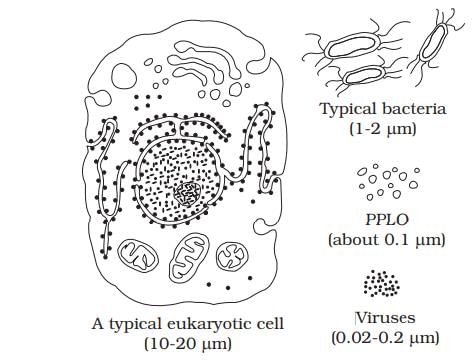
The correct order from smallest to largest is virus, PPLO (Mycoplasma), typical bacteria, and typical eukaryotic cell. Viruses are the smallest, usually only visible with an electron microscope. PPLOs are slightly larger than the largest viruses but smaller than typical bacteria. Typical bacteria are larger than viruses and PPLOs and are visible under light microscopes. Eukaryotic cells are the largest, significantly bigger than viruses, PPLOs, and typical bacteria, making Option A the correct choice.
Which of the following statements about plastids are correct?
I. Amyloplasts store carbohydrates
II. Elaioplasts store fats and oils
III. Chromoplasts lack pigments- a)I and II only
- b)II and III only
- c)I and III only
- d)I, II and III
Correct answer is option 'A'. Can you explain this answer?
Which of the following statements about plastids are correct?
I. Amyloplasts store carbohydrates
II. Elaioplasts store fats and oils
III. Chromoplasts lack pigments
I. Amyloplasts store carbohydrates
II. Elaioplasts store fats and oils
III. Chromoplasts lack pigments
a)
I and II only
b)
II and III only
c)
I and III only
d)
I, II and III
| | Top Rankers answered |
Statements I and II are correct. Chromoplasts contain pigments, so III is false.
A cell membrane shows fluid behavior due to- a)Mosaic of lipid and proteins
- b)Presence of fluid protein
- c)Mosaic of fat and glucose
- d)Sandwich of protein between lipids layer
Correct answer is option 'A'. Can you explain this answer?
A cell membrane shows fluid behavior due to
a)
Mosaic of lipid and proteins
b)
Presence of fluid protein
c)
Mosaic of fat and glucose
d)
Sandwich of protein between lipids layer
| | Naina Bansal answered |
With the help of freeze - fracture techniques in electron microscopy, the fluid mosaic model was put forward in 1970 by S J Singer and G L Nicolson. According to this model, plasma membrane is composed of phospholipids, extrinsic proteins (peripheral proteins) and intrinsic proteins (integral proteins). Selective permeability of plasma membrane can be explained with this model. Hence, Assertion and Reason both are true.
Chapter doubts & questions for MCQ Corner - NCERT on your Fingertips 2025-2026 Edition 2026 is part of NEET exam preparation. The chapters have been prepared according to the NEET exam syllabus. The Chapter doubts & questions, notes, tests & MCQs are made for NEET 2026 Exam. Find important definitions, questions, notes, meanings, examples, exercises, MCQs and online tests here.
Chapter doubts & questions of MCQ Corner - NCERT on your Fingertips 2025-2026 Edition in English & Hindi are available as part of NEET exam. Download more important topics, notes, lectures and mock test series for NEET Exam by signing up for free.
NCERT on your Fingertips 2025-2026 Edition1073 docs|700 tests |
