


All Exams > Electrical Engineering (EE) > 3 Months Preparation for GATE Electrical > All Questions
All questions of Grouping for Electrical Engineering (EE) Exam
Directions to SolveIn each of the following questions, group the given figures into three classes using each figure only once.Question - Group the given figures into three classes using each figure only once.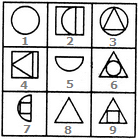
- a)1,5,8 ; 3,4,7 ; 2,6,9
- b)1,3,6 ; 4,5,9 ; 2,7,8
- c)1,3,6 ; 2,5,7 ; 4,8,9
- d)6,7,8 ; 1,3,7 ; 2,4,9
Correct answer is option 'C'. Can you explain this answer?
Directions to Solve
In each of the following questions, group the given figures into three classes using each figure only once.
Group the given figures into three classes using each figure only once.
a)
1,5,8 ; 3,4,7 ; 2,6,9
b)
1,3,6 ; 4,5,9 ; 2,7,8
c)
1,3,6 ; 2,5,7 ; 4,8,9
d)
6,7,8 ; 1,3,7 ; 2,4,9
| | Reham Sham answered |
1,3,6 contain one complete circle each
2,5,7 contain a semi circle each
4,8,9 contain a triangle, each
2,5,7 contain a semi circle each
4,8,9 contain a triangle, each

Directions to SolveIn each of the following questions, group the given figures into three classes using each figure only once.Question - Group the given figures into three classes using each figure only once.
- a)1,5,8 ; 2,6,7 ; 3,4,9
- b)1,5,7 ; 2,6,8 ; 3,4,5
- c)1,5,8 ; 2,4,7 ; 3,6,9
- d)1,5,8 ; 2,6,9 ; 3,4,7
Correct answer is option 'C'. Can you explain this answer?
Directions to Solve
In each of the following questions, group the given figures into three classes using each figure only once.
Group the given figures into three classes using each figure only once.
a)
1,5,8 ; 2,6,7 ; 3,4,9
b)
1,5,7 ; 2,6,8 ; 3,4,5
c)
1,5,8 ; 2,4,7 ; 3,6,9
d)
1,5,8 ; 2,6,9 ; 3,4,7
 | Kiran Reddy answered |
3, 6, 9 are geometrical figures containing line segments (the number of these line segments is half the number of sides in the figure) parallel to the sides of the figure.
1, 5, 8 consist of a circle and a triangle intersecting it. The triangle is also divided into two equal parts by a straight line.
2, 4, 7 are all funnel shaped figures.
Directions to SolveIn each of the following questions, group the given figures into three classes using each figure only once.Question - Group the given figures into three classes using each figure only once.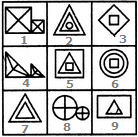
- a)1,3,7 ; 2,4,6 ; 5,8,9
- b)1,4,6 ; 2,5,7 ; 3,8,9
- c)1,4,8 ; 2,5,6 ; 3,7,9
- d)1,4,8 ; 2,7,9 ; 3,5,6
Correct answer is option 'C'. Can you explain this answer?
Directions to Solve
In each of the following questions, group the given figures into three classes using each figure only once.
Group the given figures into three classes using each figure only once.
a)
1,3,7 ; 2,4,6 ; 5,8,9
b)
1,4,6 ; 2,5,7 ; 3,8,9
c)
1,4,8 ; 2,5,6 ; 3,7,9
d)
1,4,8 ; 2,7,9 ; 3,5,6
| | Kiran Reddy answered |
1, 4, 8 contain similar elements (not equal in size) each divided into four parts and attached to each other.
2, 5, 6 contain three elements (two of which are similar) placed one inside the other.
3, 7, 9 contain one element inside the other, which may or may not be similar.
Directions to SolveIn each of the following questions, group the given figures into three classes using each figure only once.Question - Group the given figures into three classes using each figure only once.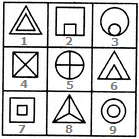
- a)1,7,9 ; 2,3,6 ; 4,5,8
- b)1,2,9 ; 3,4,6 ; 5,7,8
- c)1,6,8 ; 2,4,7 ; 3,5,9
- d)1,7,8 ; 2,9,3 ; 6,4,5
Correct answer is option 'A'. Can you explain this answer?
Directions to Solve
In each of the following questions, group the given figures into three classes using each figure only once.
Group the given figures into three classes using each figure only once.
a)
1,7,9 ; 2,3,6 ; 4,5,8
b)
1,2,9 ; 3,4,6 ; 5,7,8
c)
1,6,8 ; 2,4,7 ; 3,5,9
d)
1,7,8 ; 2,9,3 ; 6,4,5
| | Kiran Reddy answered |
1, 7, 9 contain two similar elements one inside the other but not touching each other.
2, 3, 6 contain two similar elements one inside the other and both touching each other.
4, 5, 8 are divided into equal parts by straight lines emerging from the centre.
Directions to SolveIn each of the following questions, group the given figures into three classes using each figure only once.Question - Group the given figures into three classes using each figure only once.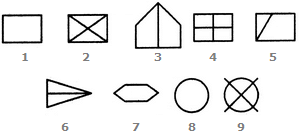
- a)1,2,4 ; 3,5,6 ; 7,8,9
- b)1,7,8 ; 3,5,6 ; 2,4,9
- c)1,3,4 ; 2,8,9 ; 5,6,7
- d)1,7,8 ; 2,3,6 ; 4,5,9
Correct answer is option 'B'. Can you explain this answer?
Directions to Solve
In each of the following questions, group the given figures into three classes using each figure only once.
Group the given figures into three classes using each figure only once.
a)
1,2,4 ; 3,5,6 ; 7,8,9
b)
1,7,8 ; 3,5,6 ; 2,4,9
c)
1,3,4 ; 2,8,9 ; 5,6,7
d)
1,7,8 ; 2,3,6 ; 4,5,9
| | Kiran Reddy answered |
1, 7, 8 are all undivided geometrical figures.
3, 5, 6 are geometrical figures divided into two parts.
2, 4, 9 are geometrical figures divided into four parts.
Directions to SolveIn each of the following questions, group the given figures into three classes using each figure only once.Question - Group the given figures into three classes using each figure only once.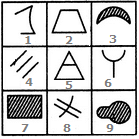
- a)1,3,6 ; 4,5,8 ; 2,7,9
- b)2,3,9 ; 4,5,8 ; 1,6,7
- c)1,6,8 ; 3,7,9 ; 2,4,5
- d)3,8,9 ; 1,2,7 ; 4,5,6
Correct answer is option 'C'. Can you explain this answer?
Directions to Solve
In each of the following questions, group the given figures into three classes using each figure only once.
Group the given figures into three classes using each figure only once.
a)
1,3,6 ; 4,5,8 ; 2,7,9
b)
2,3,9 ; 4,5,8 ; 1,6,7
c)
1,6,8 ; 3,7,9 ; 2,4,5
d)
3,8,9 ; 1,2,7 ; 4,5,6
| | Reham Sham answered |
1,6,8 are figures composed of straight as well as curved lines.
3,7,9 are closed figures shaded by oblique line
2,4,5 are figures composed straight lines only
3,7,9 are closed figures shaded by oblique line
2,4,5 are figures composed straight lines only
Directions to SolveIn each of the following questions, group the given figures into three classes using each figure only once.Question - Group the given figures into three classes using each figure only once.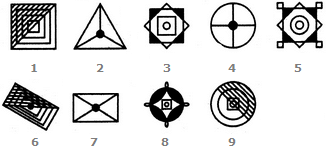
- a)2,4,7 ; 1,6,9 ; 3,5,8
- b)1,3,5 ; 2,6,7 ; 4,8,9
- c)1,5,7 ; 2,3,6 ; 4,8,9
- d)1,3,5 ; 2,4,7 ; 6,8,9
Correct answer is option 'A'. Can you explain this answer?
Directions to Solve
In each of the following questions, group the given figures into three classes using each figure only once.
Group the given figures into three classes using each figure only once.
a)
2,4,7 ; 1,6,9 ; 3,5,8
b)
1,3,5 ; 2,6,7 ; 4,8,9
c)
1,5,7 ; 2,3,6 ; 4,8,9
d)
1,3,5 ; 2,4,7 ; 6,8,9
| | Reham Sham answered |
1,6,9 are figure which are .half shaded by slating lines
2,4,7 are all divided into equal parts (either three or four parts ) by straight lines and also have a black circle at the centre .
3,5,8 have similar designs and have their four corners shaded black .
2,4,7 are all divided into equal parts (either three or four parts ) by straight lines and also have a black circle at the centre .
3,5,8 have similar designs and have their four corners shaded black .
Directions to SolveIn each of the following questions, group the given figures into three classes using each figure only once.Question - Group the given figures into three classes using each figure only once.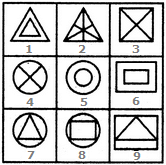
- a)1,2,3 ; 4,5,8 ; 6,7,9
- b)1,5,6 ; 2,3,4 ; 7,8,9
- c)1,3,5 ; 2,4,8 ; 6,7,9
- d)1,4,7 ; 2,5,8 ; 3,6,9
Correct answer is option 'B'. Can you explain this answer?
Directions to Solve
In each of the following questions, group the given figures into three classes using each figure only once.
Group the given figures into three classes using each figure only once.
a)
1,2,3 ; 4,5,8 ; 6,7,9
b)
1,5,6 ; 2,3,4 ; 7,8,9
c)
1,3,5 ; 2,4,8 ; 6,7,9
d)
1,4,7 ; 2,5,8 ; 3,6,9
| | Kiran Reddy answered |
1, 5, 6 have two similar elements, one inside the other.
2, 3, 4 contain straight lines each dividing, the figure into two equal parts.
7, 8, 9 have one element placed inside a different element.
Directions to SolveIn each of the following questions, group the given figures into three classes using each figure only once.Question - Group the given figures into three classes using each figure only once.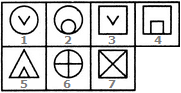
- a)1,2,6 ; 3,4,7 ; 5
- b)1,3 ; 2,6 ; 4,5,7
- c)1,2,6,7 ; 3 ; 4,5
- d)1,3 ; 2,4,5 ; 6,7
Correct answer is option 'D'. Can you explain this answer?
Directions to Solve
In each of the following questions, group the given figures into three classes using each figure only once.
Group the given figures into three classes using each figure only once.
a)
1,2,6 ; 3,4,7 ; 5
b)
1,3 ; 2,6 ; 4,5,7
c)
1,2,6,7 ; 3 ; 4,5
d)
1,3 ; 2,4,5 ; 6,7
 | KS Coaching Center answered |
1, 3 contain a V-shaped element inside a geometrical figure.
2, 4, 5 contain two similar elements, one placed inside the other and touching it.
6, 7 contain geometrical figures which are divided into four equal parts by two mutually perpendicular straight lines.
Directions to SolveIn each of the following questions, group the given figures into three classes using each figure only once.Question - Group the given figures into three classes using each figure only once.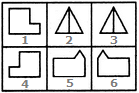
- a)1,4 ; 2,3 ; 5,6
- b)1,5 ; 2,6 ; 4,3
- c)1,6 ; 2,3 ; 4,5
- d)1,2 ; 3,6 ; 4,5
Correct answer is option 'A'. Can you explain this answer?
Directions to Solve
In each of the following questions, group the given figures into three classes using each figure only once.
Group the given figures into three classes using each figure only once.
a)
1,4 ; 2,3 ; 5,6
b)
1,5 ; 2,6 ; 4,3
c)
1,6 ; 2,3 ; 4,5
d)
1,2 ; 3,6 ; 4,5
| | KS Coaching Center answered |
(1, 4), (2, 3) and (5, 6) are three different pairs of identical figures.
Directions to SolveIn each of the following questions, group the given figures into three classes using each figure only once.Question - Group the given figures into three classes using each figure only once.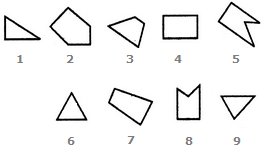
- a)7,8,9 ; 2,4,3 ; 1,5,6
- b)1,3,2 ; 4,5,7 ; 6,8,9
- c)1,6,8 ; 3,4,7 ; 2,5,9
- d)1,6,9 ; 3,4,7 ; 2,5,8
Correct answer is option 'D'. Can you explain this answer?
Directions to Solve
In each of the following questions, group the given figures into three classes using each figure only once.
Group the given figures into three classes using each figure only once.
a)
7,8,9 ; 2,4,3 ; 1,5,6
b)
1,3,2 ; 4,5,7 ; 6,8,9
c)
1,6,8 ; 3,4,7 ; 2,5,9
d)
1,6,9 ; 3,4,7 ; 2,5,8
| | KS Coaching Center answered |
1, 6, 9, are all triangles.
3, 4, 7 are all four-sided figures.
2, 5, 8 are all five-sided figures.
Directions to SolveIn each of the following questions, group the given figures into three classes using each figure only once.Question - Group the given figures into three classes using each figure only once.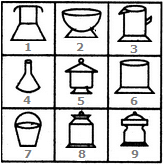
- a)1,4,7 ; 2,5,9 ; 3,8,6
- b)2,6,9 ; 1,4,7 ; 5,8,3
- c)1,4,7 ; 2,3,6 ; 5,8,9
- d)3,5,1 ; 4,7,8 ; 6,2,9
Correct answer is option 'C'. Can you explain this answer?
Directions to Solve
In each of the following questions, group the given figures into three classes using each figure only once.
Group the given figures into three classes using each figure only once.
a)
1,4,7 ; 2,5,9 ; 3,8,6
b)
2,6,9 ; 1,4,7 ; 5,8,3
c)
1,4,7 ; 2,3,6 ; 5,8,9
d)
3,5,1 ; 4,7,8 ; 6,2,9
| | KS Coaching Center answered |
5, 8, 9 are objects having both base as well as upper lid.
2, 3, 6 are objects having base but not upper lid.
1, 4, 7 tare objects which have neither a base nor an upper lid attached to them.
Directions to SolveIn each of the following questions, group the given figures into three classes using each figure only once.Question - Group the given figures into three classes using each figure only once.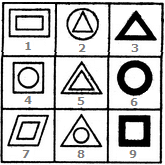
- a)1,5,7 ; 2,4,6 ; 3,9,8
- b)1,5,7 ; 2,4,8 ; 3,6,9
- c)1,4,7 ; 2,5,8 ; 3,6,9
- d)1,7,9 ; 3,5,8 ; 2,4,6
Correct answer is option 'B'. Can you explain this answer?
Directions to Solve
In each of the following questions, group the given figures into three classes using each figure only once.
Group the given figures into three classes using each figure only once.
a)
1,5,7 ; 2,4,6 ; 3,9,8
b)
1,5,7 ; 2,4,8 ; 3,6,9
c)
1,4,7 ; 2,5,8 ; 3,6,9
d)
1,7,9 ; 3,5,8 ; 2,4,6
 | Athira Banerjee answered |
1, 5, 7 have two similar elements, one inside the other.
2, 4, 8 have one element placed inside a different element.
3, 6, 9 have two similar elements, one inside the other and the area between the two elements is shaded.
Directions to SolveIn each of the following questions, group the given figures into three classes using each figure only once.Question - Group the given figures into three classes using each figure only once.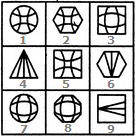
- a)1,2,5 ; 3,7,8 ; 4,6,9
- b)1,7,2 ; 3,9,6 ; 4,5,8
- c)2,3,8 ; 4,6,9 ; 1,5,7
- d)5,6,9 ; 3,4,1 ; 2,7,8
Correct answer is option 'A'. Can you explain this answer?
Directions to Solve
In each of the following questions, group the given figures into three classes using each figure only once.
Group the given figures into three classes using each figure only once.
a)
1,2,5 ; 3,7,8 ; 4,6,9
b)
1,7,2 ; 3,9,6 ; 4,5,8
c)
2,3,8 ; 4,6,9 ; 1,5,7
d)
5,6,9 ; 3,4,1 ; 2,7,8
| | KS Coaching Center answered |
1, 2, 5 are figures that have patterns formed from four lines curved in a concave direction.
3, 7, 8 are figures that have patterns formed from four lines curved in a convex direction.
4, 6, 9 are figures that have patterns formed from these straight lines.
Directions to SolveIn each of the following questions, group the given figures into three classes using each figure only once.Question - Group the given figures into three classes using each figure only once.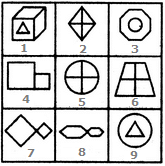
- a)1,3,9 ; 2,5,6 ; 4,7,8
- b)1,3,9 ; 2,7,8 ; 4,5,6
- c)1,2,4 ; 3,5,7 ; 6,8,9
- d)1,3,6 ; 2,4,8 ; 5,7,9
Correct answer is option 'A'. Can you explain this answer?
Directions to Solve
In each of the following questions, group the given figures into three classes using each figure only once.
Group the given figures into three classes using each figure only once.
a)
1,3,9 ; 2,5,6 ; 4,7,8
b)
1,3,9 ; 2,7,8 ; 4,5,6
c)
1,2,4 ; 3,5,7 ; 6,8,9
d)
1,3,6 ; 2,4,8 ; 5,7,9
| | Kiran Reddy answered |
1, 3, 9 have one element placed inside a different element.
2, 5, 6 contain two mutually perpendicular lines dividing the figure into four parts.
4, 7, 8 have two similar elements (unequal in size) attached to each other.
Directions to SolveIn each of the following questions, group the given figures into three classes using each figure only once.Question - Group the given figures into three classes using each figure only once.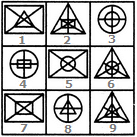
- a)2,4,7 ; 1,8,9 ; 3,5,6
- b)2,6,9 ; 1,5,7 ; 3,4,8
- c)2,6,7 ; 1,5,8 ; 3,4,9
- d)2,8,7 ; 1,5,9 ; 3,4,6
Correct answer is option 'B'. Can you explain this answer?
Directions to Solve
In each of the following questions, group the given figures into three classes using each figure only once.
Group the given figures into three classes using each figure only once.
a)
2,4,7 ; 1,8,9 ; 3,5,6
b)
2,6,9 ; 1,5,7 ; 3,4,8
c)
2,6,7 ; 1,5,8 ; 3,4,9
d)
2,8,7 ; 1,5,9 ; 3,4,6
| | KS Coaching Center answered |
1, 5, 7 contain a rectangle with its two diagonals as the outer element and another element (similar or different) placed inside it.
2, 6, 9 contain a triangle with its three medians as the outer element and another element (similar or different) placed inside it.
3, 4, 8 contain a circle with its two mutually perpendicular diameters as the outer element and another element (similar or different) placed inside it.
Directions to SolveIn each of the following questions, group the given figures into three classes using each figure only once.Question - Group the given figures into three classes using each figure only once.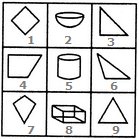
- a)1,4,7 ; 2,5,8 ; 3,6,9
- b)1,4,7 ; 2,5,9 ; 3,6,7
- c)1,3,4 ; 2,5,8 ; 6,7,9
- d)1,2,3 ; 4,5,6 ; 7,8,9
Correct answer is option 'A'. Can you explain this answer?
Directions to Solve
In each of the following questions, group the given figures into three classes using each figure only once.
Group the given figures into three classes using each figure only once.
a)
1,4,7 ; 2,5,8 ; 3,6,9
b)
1,4,7 ; 2,5,9 ; 3,6,7
c)
1,3,4 ; 2,5,8 ; 6,7,9
d)
1,2,3 ; 4,5,6 ; 7,8,9
| | KS Coaching Center answered |
1, 4, 7 are all (two-dimensional) quadrilaterals.
2, 5, 8 are all three-dimensional figures.
3, 6, 9 are all (two-dimensional) triangles.
Directions to SolveIn each of the following questions, group the given figures into three classes using each figure only once.Question - Group the given figures into three classes using each figure only once.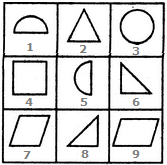
- a)1,3,5 ; 2,6,9 ; 4,7,8
- b)2,3,4 ; 5,6,8 ; 9,1,7
- c)1,3,5 ; 2,6,8 ; 4,7,9
- d)3,2,4 ; 6,5,8 ; 7,9,1
Correct answer is option 'C'. Can you explain this answer?
Directions to Solve
In each of the following questions, group the given figures into three classes using each figure only once.
Group the given figures into three classes using each figure only once.
a)
1,3,5 ; 2,6,9 ; 4,7,8
b)
2,3,4 ; 5,6,8 ; 9,1,7
c)
1,3,5 ; 2,6,8 ; 4,7,9
d)
3,2,4 ; 6,5,8 ; 7,9,1
| | KS Coaching Center answered |
1, 3, 5 are figures having partially or completely curved boundaries.
2, 6, 8 are all triangles.
4, 7, 9 are all quadrilaterals.
Directions to SolveIn each of the following questions, group the given figures into three classes using each figure only once.Question - Group the given figures into three classes using each figure only once.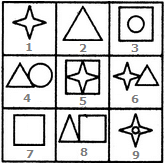
- a)3,4,9 ; 5,7,8 ; 1,2,6
- b)1,5,6 ; 2,4,8 ; 3,7,9
- c)4,6,8 ; 3,5,7 ; 1,2,9
- d)1,2,7 ; 3,5,9 ; 4,6,8
Correct answer is option 'D'. Can you explain this answer?
Directions to Solve
In each of the following questions, group the given figures into three classes using each figure only once.
Group the given figures into three classes using each figure only once.
a)
3,4,9 ; 5,7,8 ; 1,2,6
b)
1,5,6 ; 2,4,8 ; 3,7,9
c)
4,6,8 ; 3,5,7 ; 1,2,9
d)
1,2,7 ; 3,5,9 ; 4,6,8
| | Kiran Reddy answered |
1, 2, 7 are simple geometrical figures.
3, 5, 9 have one element placed inside a different element.
4, 6, 8 have two different elements attached to each other.
Directions to SolveIn each of the following questions, group the given figures into three classes using each figure only once.Question - Group the given figures into three classes using each figure only once.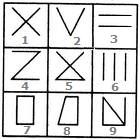
- a)1,2,3 ; 4,5,6 ; 7,8,9
- b)1,3,5 ; 2,4,6 ; 7,8,9
- c)1,5,9 ; 3,6,2 ; 4,7,8
- d)1,9,7 ; 2,8,5 ; 3,4,6
Correct answer is option 'A'. Can you explain this answer?
Directions to Solve
In each of the following questions, group the given figures into three classes using each figure only once.
Group the given figures into three classes using each figure only once.
a)
1,2,3 ; 4,5,6 ; 7,8,9
b)
1,3,5 ; 2,4,6 ; 7,8,9
c)
1,5,9 ; 3,6,2 ; 4,7,8
d)
1,9,7 ; 2,8,5 ; 3,4,6
| | KS Coaching Center answered |
1, 2, 3 are figures composed of two straight lines.
4, 5, 6 are figures composed of three straight lines.
7, 8, 9 are figures composed of four straight lines.
Chapter doubts & questions for Grouping - 3 Months Preparation for GATE Electrical 2026 is part of Electrical Engineering (EE) exam preparation. The chapters have been prepared according to the Electrical Engineering (EE) exam syllabus. The Chapter doubts & questions, notes, tests & MCQs are made for Electrical Engineering (EE) 2026 Exam. Find important definitions, questions, notes, meanings, examples, exercises, MCQs and online tests here.
Chapter doubts & questions of Grouping - 3 Months Preparation for GATE Electrical in English & Hindi are available as part of Electrical Engineering (EE) exam. Download more important topics, notes, lectures and mock test series for Electrical Engineering (EE) Exam by signing up for free.
3 Months Preparation for GATE Electrical676 videos|1399 docs|882 tests |
